
Crypto World
What Is the Status of the U.S.-Iran Peace Talks? Here's What Both Sides Are Saying

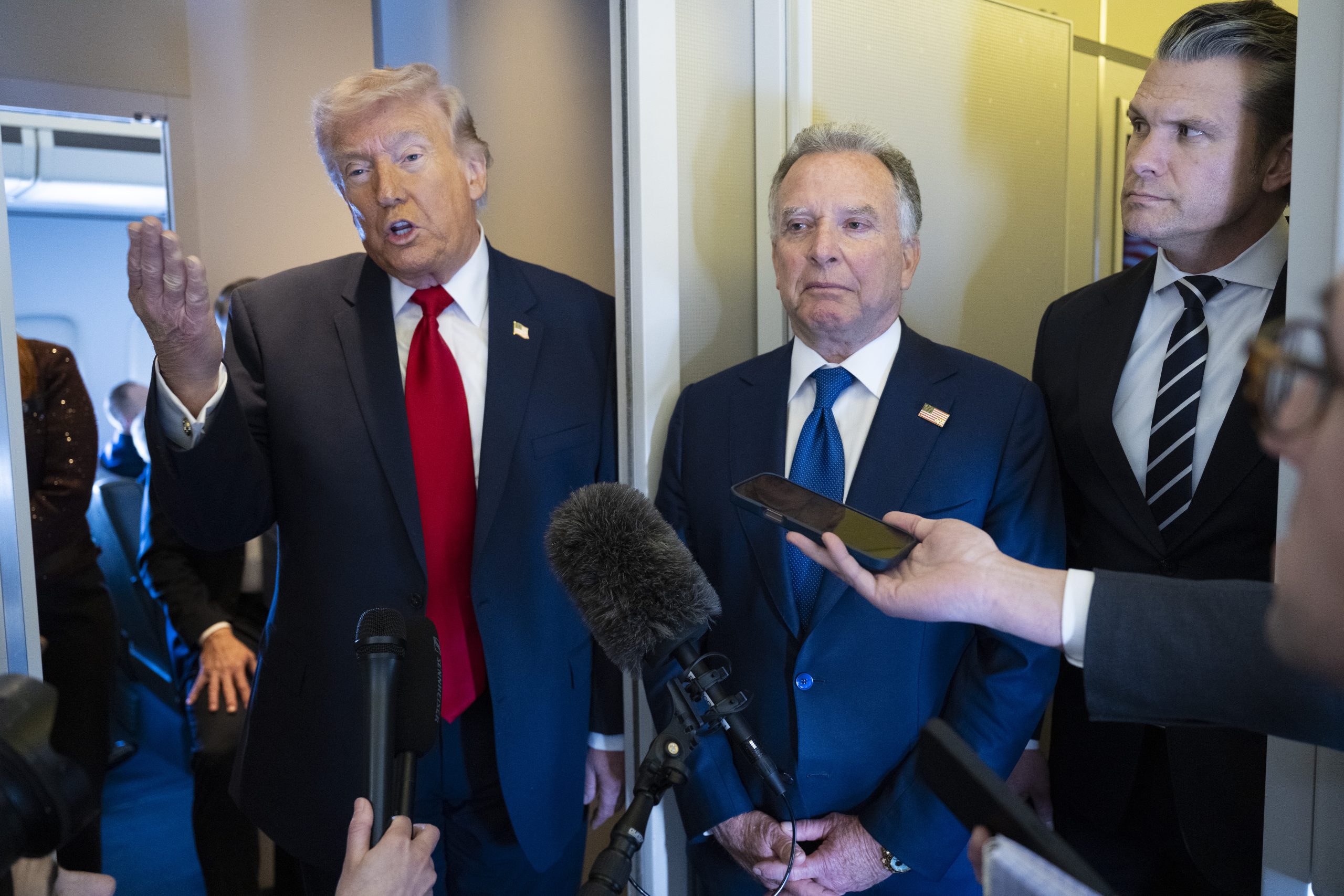
President Donald Trump at the start of the Iran war predicted it would last four-to-five weeks, but the conflict is now in its seventh month, with no clear timeline for when the fighting will end.
Active hostilities between Washington and Tehran resumed earlier this month, with oil tankers in and around the Strait of Hormuz coming under fire. Iran is vying to maintain a chokehold over the vital trade route amid the U.S. blockade against its ports. The Strait effectively remains in a military stalemate, bringing renewed regional instability and gravely impacting transit via the waterway, through which around a fifth of global oil production flowed before the war began on Feb. 28. Oil prices last week soared to over $100 a barrel for the first time since July, as the disruption sends energy markets spiraling once more.
The balance of power in the Gulf has come under further strain as Yemen’s Iran-backed Houthi rebels have made significant advances following weeks of fighting with the Saudi-backed government of Yemen, shattering a four-year informal cease-fire in the country’s civil war. The Houthis last week captured the strategic Perim Island, which sits in the Bab el-Mandeb Strait, another vital trade route situated between Yemen and Djibouti and Eritrea in the Horn of Africa, that links Asia and Europe via the Red Sea and Suez Canal. This came as they traveled along the Red Sea coastline, aiming to tighten their grip on the critical maritime chokepoint. The disruption has placed further pressure on the global oil market.
The Houthis’ expanding presence in the Red Sea and the potential it has to severely disrupt trade via the Bab el-Mandeb arguably gives Iran leverage in its war with the U.S., experts say.
“This has the effect of turning up the pressure on the U.S. and its allies who have been relying on alternate routes,” Daniel Benaim, a former U.S. Deputy Assistant Secretary of State for the Arabian Peninsula, tells TIME. “In a contest of economic wills, the alternate Red Sea has been a very important release valve for the blockage of the Strait of Hormuz.”
Diplomatic efforts in the Middle East have faltered. The Gulf states, many of which house U.S. bases that have been targeted by Iranian strikes, on Monday postponed a critical meeting with Tehran on the reopening of the Strait of Hormuz.
Despite pressure mounting for a clear way out of the war, meaningful negotiations between the U.S. and Iran also remain stalled. Here’s what each side has said regarding the status of peace talks, and how experts predict Iranian officials could use the Houthis’ disruption in the Red Sea to their benefit.
Trump says U.S. is ‘open’ to restarting negotiations
Trump on Monday said the U.S. is “open” to the concept of restarting negotiations between Washington and Tehran. High-level officials from both sides last convened for official peace talks in Switzerland in June.
“The failing nation of Iran wants to make a deal, quickly and badly,” he claimed. “I will determine whether or not the U.S.A. will choose to engage—the concept of which we are open to.”
Trump’s remarks stood in stark contrast to the position he laid out on Sept. 2, when he said he was “not trying to force” Iran to the bargaining table. “I couldn’t care less if they sign a worthless, to them, agreement. I like our position now much better, with almost total control of the Hormuz Strait, and their economy totally collapsing. They are just playing out the inevitable,” he insisted.
On Sept. 9, Trump assured the American public that the war will likely end “immediately after” the November midterms and said Iran’s government is holding out in hopes of hurting Republican political prospects.
Trump has expressed full confidence in the U.S.’ two-pronged military and economic campaign against Iran, with the latter aiming to choke Tehran off from the global economy through various sanctions.
Read More: How the U.S. Treasury’s New Aviation Sanctions on Iran Extend Beyond Tehran
Ali Vaez, deputy program director for the Middle East and North Africa at the International Crisis Group, tells TIME that Trump’s diplomatic approach will dictate how successful future negotiations may be.
“President Trump might be interested in getting a deal with Iran, but that’s not necessarily a guarantee that he will get a deal. It all depends on what approach he would adopt to diplomacy. If it’s maximalist, then it doesn’t stand a chance of succeeding,” he says, adding that dealing with Iran requires “a multi-dimensional diplomacy” in order to achieve a “sustainable de-escalation between Iran and the United States.”
Trump has repeatedly insisted that the U.S. has near total control of the vital waterway and that “oil is flowing,” but traffic via the Strait remains disrupted.
Kpler, a commodities data and analytics firm, shared data with TIME that shows that only 10 ships crossed the Strait of Hormuz on Monday—a significantly lower count than the 138 vessels that typically passed through the waterway during a 24-hour period before the war.
“The United States has shown over time that it has capabilities to move significant amounts of shipping through the Strait, but Iran has innovated,” says Benaim. “Iran and its allies are innovating in their ability to disrupt. So it’s a bit of a foot race between U.S. attempts to bypass Iran’s restraints and Iran’s attempts to enforce its own de facto blockade.”
The Iran war, and its economic impact, has been deeply unpopular with Americans who are facing increasingly high energy costs. Diesel prices last week reached a record $6 per gallon. The war with Iran has cost the U.S. government around $38 billion and contributed to growing inflation, according to newly-published analysis by the Congressional Budget Office. A national UMass Amherst/YouGov poll, conducted from Aug. 21 to 26, found that 68% of Americans view Trump’s handling of the war negatively.
Iran says ‘no talks until conditions met’
Iran has responded to Trump’s openness to negotiations by doubling down on its demands.
“Don’t get distracted by the U.S. President’s mixed signals—from ‘no negotiations’ to ‘we’re ready to talk,’” said Mohsen Rezaei, Iran’s recently-installed secretary of the Supreme National Security Council, on Monday. “No talks until Iran’s conditions are met. Period!”
While Rezaei did not directly name any conditions, Iran previously put forward a list of six demands for the U.S. to meet before the Strait of Hormuz would be fully reopened. Rezaei also seemingly pointed to the recent developments in the wider region, arguing that the “stakes around oil and the straits have changed” and warning that “damage control won’t stop what’s coming.”
The remarks from the hard-line national security adviser took an elevated position from that of Iranian President Masoud Pezeshkian, who in early September said Tehran was prepared to “reciprocate,” if the U.S. returned to the cease-fire conditions both countries negotiated in June. He was referencing the Memorandum of Understanding (MoU) signed on June 17, but the pact fell apart, with Washington and Tehran seemingly adopting different interpretations of the language used in the interim agreement.
Farea Al-Muslimi, a research fellow at Chatham House’s Middle East and North Africa program, says the Iranians are now “negotiating for the sake of negotiating,” arguing that their demands are intended to draw out talks while energy prices continue to rise.
“They can wait. They can afford it. They have no [democratic] parliaments. They don’t care about public opinion, as you imagine, and they are not allergic to pain,” he tells TIME.
Has Iran gained leverage as the Houthis close in on the Bab El-Mandeb Strait?
With the Houthis tightening its grip on the Bab el-Mandeb Strait, Iran has gained another potential source of leverage, experts say.
Amid the ongoing disruption to the Strait of Hormuz since the war started, there has been an uptick in the volume of crude oil and petroleum liquids that transit via the Bab el-Mandeb, increasing from 5.6 million barrels per day in the first quarter of 2026 to 8.1 million per day in the second quarter, according to the U.S. Energy Information Administration (EIA).
Despite the Houthis having claimed that they will not disrupt maritime traffic—except for Saudi Arabian oil tankers—experts tell TIME that the group’s ability to threaten shipping is enough to give Tehran greater leverage in any future round of negotiations.
“The Houthis march to the beat of their own drummer, but these actions certainly help Iran gain leverage by complicating alternative routes out of the Strait of Hormuz,” says Benaim.
In agreement, Al-Muslimi adds “the Iranians now have a new card they can use, and they haven’t totally used [it] yet, but they will. It’s a matter of time.”
“The Houthis are primarily concerned about advancing their own position within Yemen and globally. In this case, it happens to coincide with the pressure that Iran would like to apply on the United States and the international community,” Benaim adds.
Alternatives to the Bab el-Mandeb Strait present fresh challenges
The Bab el-Mandeb, which is Arabic for “Gate of Tears,” serves as the southern gateway to the Suez Canal— ships must pass through it to access the canal from the south. If the Houthis were to close the Bab el-Mandeb, it would increase the pressure on the global flow of oil.
Experts say shipping companies, if forced to find an alternative route, could be left to transit around South Africa’s Cape of Good Hope.
The Cape of Good Hope “could be a temporary solution, but it adds to insurance and travel costs, and timelines,” says Vaez. The EIA has estimated that the Cape route adds approximately 15 days to an oil voyage from the Arabian Sea to Europe.
Disturbances in the Bab el-Mandeb are particularly significant for Asian countries, experts say.
Asia has traditionally been Saudi Arabia’s primary export market for crude oil, receiving 75% of Saudi Arabia’s total annual crude oil exports in 2023, according to data from the EIA. China, Japan, South Korea, and India were its top crude oil importers.
The EIA on Sept. 9 acknowledged the concessions required when using alternative routes, noting that although “Saudi Arabia has increased oil shipments through the Suez Canal at the north end of the Red Sea,” it is “a longer and costlier route for customers in Asia.”
The Suez Canal also has constraints. As detailed by the International Energy Agency (IEA), “large crude carriers (VLCC) can only transit the canal when loaded below their 250,000 tonnes capacity.” As such, tankers following the route must first unload part of their cargo into a pipeline south of the canal and then reload the crude at a port before continuing their voyage, according to Reuters.



The U.S. House Financial Services Committee has advanced legislation to place the federal Strategic Bitcoin Reserve into law, voting 28-21 on Sept. 16 to report the amended H.R. 8957 favorably.
Summary
- 28 committee members backed H.R. 8957, while 21 opposed the amended Bitcoin reserve legislation Wednesday.
- 20 years is the minimum holding period for Bitcoin deposited into the proposed federal reserve.
- Annual proof-of-reserve reporting replaced the original quarterly schedule under the committee-approved substitute amendment on Wednesday.
- Treasury and Commerce would study budget-neutral Bitcoin acquisitions without borrowing, new taxes, or deficit spending.
- States could store Bitcoin in segregated Treasury reserve accounts while retaining legal title to holdings.
The House Financial Services Committee’s official markup record lists the American Reserve Modernization Act of 2026 among the measures considered Wednesday and identifies a substitute amendment from Rep. Bryan Steil of Wisconsin. The substitute was adopted by voice vote before the committee approved the amended bill in recorded vote FC-317.
Introduced on May 21 by Rep. Nick Begich of Alaska with Rep. Jared Golden of Maine as co-lead, ARMA would create a statutory Strategic Bitcoin Reserve and a separate Digital Asset Stockpile inside the Treasury Department. Begich’s office said at introduction that the measure was designed to centralize federal digital-asset custody and require government accounting of the assets.
Bitcoin reserve bill would impose a 20-year holding period
Under the committee substitute published by the House, the Treasury secretary would establish the Strategic Bitcoin Reserve for qualifying federal Bitcoin and a separate stockpile for qualifying non-Bitcoin digital assets. The reserve would cover Bitcoin that has been finally forfeited through criminal or civil proceedings or obtained through certain civil penalties, subject to existing legal claims and forfeiture requirements.
Bitcoin deposited into the reserve would have to remain there for at least 20 years from enactment. During that period, the bill says the assets could not be sold, swapped, auctioned, encumbered or otherwise disposed of. Two years before the holding period ends, Treasury would have to send Congress recommendations on whether the government should continue holding the assets or permit a controlled release.
After the 20-year period, the Treasury secretary could recommend selling up to 10% of reserve assets during any two-year period. The bill directs Treasury to consider the national deficit, Bitcoin’s long-term viability, possible market effects and the federal government’s financial position when making such recommendations.
Within one year of enactment, Treasury would separately study conditions under which Congress might permit sales before the 20-year period expires, including circumstances involving national security or financial stability. The amended language calls for legislative recommendations rather than giving Treasury an automatic exception.
Rep. Begich has argued that government Bitcoin should not “languish in fragmented and inconsistent custody.” House Financial Services Chairman French Hill described the measure during Wednesday’s markup as bringing federally held assets under “Treasury custody and consistent oversight.” Those statements represent the lawmakers’ stated rationale for the legislation.
Committee amendment changes Bitcoin reporting requirements
The version advanced Wednesday differs from the original H.R. 8957 in several areas. Earlier text called for quarterly public proof-of-reserve reports, which was reflected in crypto.news coverage when ARMA was introduced.
Steil’s adopted substitute changes that schedule. Treasury would publish an annual report giving details on reserve holdings, transactions and control of private keys. An independent third-party auditor with cryptographic-attestation expertise would verify the report, while the U.S. Comptroller General would conduct continuing oversight.
Federal agencies would face separate accounting requirements. Within 60 days of enactment, and annually afterward, agency heads would have to provide Treasury with a complete accounting of Bitcoin and other digital assets they hold, have seized or otherwise control.
Before the reserve and stockpile are formally established, agencies would transfer qualifying assets to Treasury where practicable and consistent with existing law. Once the structures exist, qualifying holdings remaining elsewhere would have to be transferred within 30 days using custody procedures intended to preserve traceability and auditability.
The bill preserves exceptions tied to existing forfeiture law. During the interim custody period, qualifying Bitcoin or other qualifying digital assets generally could not be sold or encumbered, except when required by law, ordered by a court, needed for national security or returned to identifiable crime victims.
ARMA would study new Bitcoin purchases without authorizing them
The amended legislation does not order Treasury to buy a fixed quantity of Bitcoin. Treasury and Commerce would instead receive 180 days to study the risks, costs and possible benefits of acquiring additional BTC using budget-neutral methods.
Potential mechanisms listed in the committee text include transactions involving non-Bitcoin assets from the Digital Asset Stockpile, Bitcoin received through forfeitures or settlements, and cooperative arrangements involving states, private entities or international partners. Any proposal would have to be assessed for its full cost to taxpayers, the federal government and the national debt.
The substitute expressly says the study does not authorize borrowing, new taxation, deficit spending or pledging federal assets as collateral to finance Bitcoin purchases. Treasury and Commerce would submit their report to relevant House and Senate committees within 180 days.
That structure differs from the separate BITCOIN Act introduced previously by Begich and Sen. Cynthia Lummis, which proposed acquiring 1 million BTC over five years. As crypto.news previously reported, ARMA dropped a fixed one-million-Bitcoin acquisition target and centered its approach on the 20-year holding requirement and a budget-neutral acquisition study.
States would have another option under ARMA. Within one year of enactment, Treasury would establish a voluntary program allowing states to store their own Bitcoin in segregated accounts inside the Strategic Bitcoin Reserve. Participating states would retain title to their Bitcoin and related forked or airdropped assets and would pay for services provided through the program.
The latest committee text therefore does not say states would store their Bitcoin at the Federal Reserve. It places the program within the Treasury-run Strategic Bitcoin Reserve.
Trump’s existing reserve rests on a 2025 executive order
President Donald Trump established the current Strategic Bitcoin Reserve through a March 6, 2025 executive order. The order directed Treasury to create the reserve with finally forfeited Bitcoin and said BTC deposited into it should not be sold. It created a separate U.S. Digital Asset Stockpile for non-Bitcoin assets.
The order instructed federal agencies to account for their digital-asset holdings and permitted Treasury and Commerce to develop budget-neutral strategies for acquiring additional Bitcoin. A subsequent White House digital-assets report said Treasury had delivered legal and investment considerations concerning the reserve and was continuing work with other federal officials on implementation.
ARMA would place many elements of that framework into federal statute if enacted. Unlike an executive order, the resulting provisions could not simply be rescinded through a later presidential executive action; changes to the statute would generally require another act of Congress. The proposed legislation, however, has not become law.
Public estimates of federal Bitcoin holdings should remain separate from an official reserve accounting.Arkham’s August research identified roughly 325,000 BTC across addresses it associates with the U.S. government. Arkham’s figures are on-chain estimates, not a Treasury audit, and government-linked wallets can contain assets with different forfeiture, restitution or custody statuses.
public wallet trackers cannot establish the precise size of the statutory reserve because some government-controlled assets may remain subject to legal claims or restitution requirements. No public Treasury proof-of-reserve report equivalent to the reporting contemplated by ARMA has established the 325,000 BTC figure as the reserve’s official balance.
H.R. 8957 now awaits further House action
The committee adopted Steil’s replacement text by voice vote and rejected a separate amendment offered by Ranking Member Maxine Waters by 21-28 before voting 28-21 to report H.R. 8957 favorably as amended. The committee proceeding identifies the final vote as FC-317.
Committee approval is not passage by the House. H.R. 8957 still requires consideration and approval by the full House, passage by the Senate in identical form, and the president’s signature before its provisions could take effect. No full-House passage had occurred in the official records reviewed on Sept. 17.
If enacted in its current committee-approved form, Treasury would face several statutory deadlines: a 60-day federal asset accounting, establishment of the reserve and stockpile within 180 days, a 180-day budget-neutral acquisition study, and creation of the voluntary state custody program within one year.
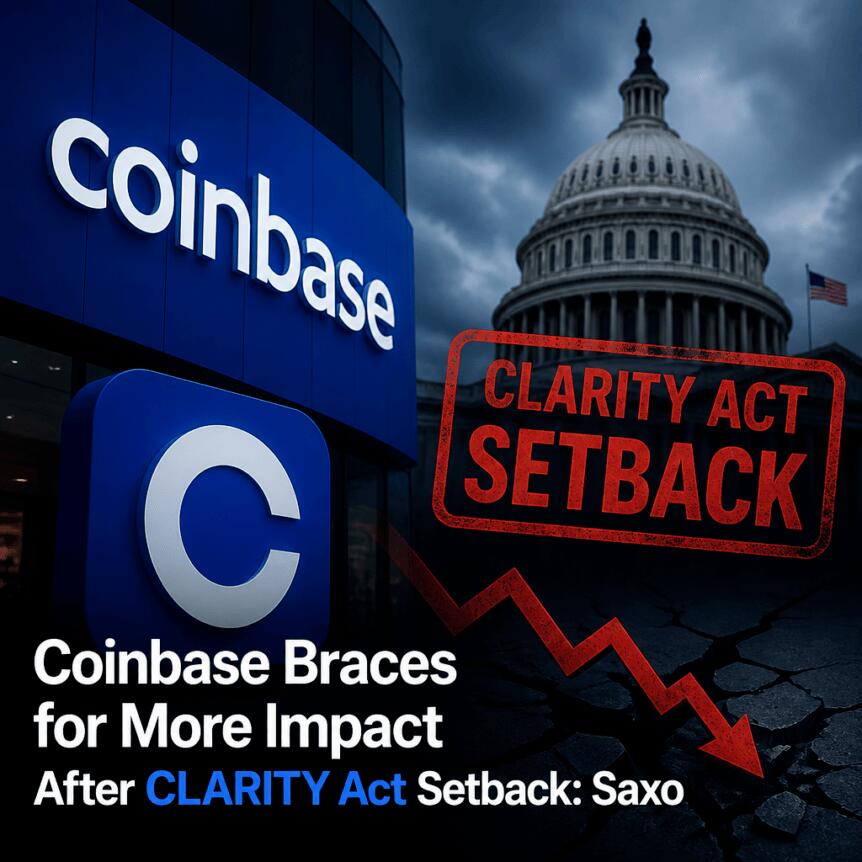
Crypto markets and crypto-adjacent equities slid sharply after the U.S. Senate failed to move forward on the Digital Asset Market Clarity (CLARITY) Act, dealing another blow to near-term prospects for comprehensive federal rules. The selloff extended beyond generic “risk-off” positioning, with investors focusing on which businesses would be most directly reshaped by any future market-structure legislation.
According to a Wednesday note from Saxo Bank strategist Ruben Dalfovo, Coinbase faces the highest regulatory exposure among the names that drew attention in the trading decline—because clearer rules around market structure could directly influence registration requirements and even shape who can participate in U.S. crypto markets, as well as which digital assets are eligible to be traded.
Key takeaways
- Saxo Bank says Coinbase is the most directly exposed to CLARITY-style market-structure rules, which could affect registration and trading participation in the U.S.
- Circle’s business links more closely to the adoption and usage of its USDC stablecoin, while Strategy is driven primarily by its Bitcoin holdings and financing setup.
- Shares of Coinbase, Circle, and Strategy fell after the Senate procedural vote failed to advance the CLARITY Act—despite differing underlying business models.
- CLARITY’s path forward this year has narrowed due to the Senate’s limited legislative calendar ahead of the Nov. 3 midterm elections and a Dec. 18 adjournment target.
Why Coinbase drew special attention
In the Saxo Bank note, Dalfovo argued that Coinbase’s revenue and business operations are tightly tied to the regulatory framework governing crypto trading. If market-structure rules are clarified, exchanges could see direct changes in how they meet compliance obligations—particularly around registration—and in what the rules ultimately allow platforms to offer.
“Coinbase is most exposed to clearer market rules because trading and crypto participation directly affect its business,” Dalfovo wrote.
This emphasis helps explain why investors reacted strongly to the Senate’s decision, even though the companies involved do not have identical exposure profiles. Where many holders of crypto-linked equities can be influenced by broader market sentiment, Dalfovo’s framing suggests Coinbase sits at the intersection of policy and day-to-day exchange operations.
Different exposures for Circle and Strategy
Saxo Bank’s breakdown also highlighted how regulatory outcomes can map unevenly onto different crypto-adjacent business models. Dalfovo characterized Circle (USDC issuer) and Strategy (a Bitcoin treasury company) as having distinct sensitivities to any legislation that may emerge.
Circle’s model, per Saxo, is more closely related to stablecoin adoption in the U.S.—including the use of USDC—and the income it earns on its reserves. In that sense, a clearer regulatory environment could matter indirectly through how confidently users and institutions adopt stablecoins, rather than through immediate exchange registration mechanics.
Strategy’s performance, by contrast, is primarily influenced by its Bitcoin holdings and the company’s financing structure. While broader regulatory certainty can affect Bitcoin sentiment and capital flows, Saxo’s view implies Strategy’s linkage is less about market-structure rules for trading platforms and more about the underlying asset and balance-sheet dynamics.
Stocks slide after CLARITY fails a key procedural vote
Following the Senate procedural vote on Tuesday, shares of the three companies—Coinbase, Circle, and Strategy—declined in the same general window even though their exposures differ. As Cointelegraph reported late Tuesday, the selloff saw each company fall between 5% and 10% after the vote.
Cointelegraph attributed the move to the fact that the Senate did not advance the CLARITY Act after lawmakers voted 49–50 against invoking cloture on a motion to proceed. The cloture motion is intended to limit debate and enable the Senate to move toward considering a bill on the floor, but it fell well short of the 60 votes required.
Early Wednesday, the decline continued. According to Yahoo Finance data referenced in the original reporting, Coinbase, Circle, and Strategy were each down roughly 2% to 6% in the opening session range.
CLARITY’s narrowing path and the ethics provisions sticking point
The Senate’s failure to advance CLARITY reflects more than scheduling friction. A major obstacle remained ethics-related provisions, according to the reporting, despite last-minute concessions intended to address concerns about public officials’ crypto interests.
The procedural setback significantly reduces the bill’s chances of revival within the current year. With the Senate facing a constrained schedule around the Nov. 3 midterm elections and targeting a Dec. 18 adjournment date, lawmakers have a relatively short window to reintroduce momentum on the legislation before the current Congress ends.
That timing constraint matters for investors because “policy uncertainty” often functions as a moving target: even if the underlying bill eventually returns, the delay can prolong the period in which firms operate without the clarity they would prefer on market structure, participation rules, and compliance expectations.
Readers following the equities trade around crypto regulation should also watch whether the ethics provisions remain a central point of disagreement. If they do, any future motion to bring CLARITY—or a revised version—forward could still face the same hurdle, regardless of broader industry support.
What to watch next
With the Senate’s calendar tightening and the ethics provisions still a focal contention, the next swing factor is whether CLARITY can be revived before the Congress concludes—and whether lawmakers can reach a compromise that satisfies both procedural requirements and lingering concerns over official crypto interests.


Payward has announced plans to bring on-chain perpetual futures to eligible U.S. clients through Hyperliquid’s HIP-3 infrastructure, using CFTC-regulated Bitnomial to deploy, clear and settle the proposed contracts.
Summary
- Payward plans regulated Hyperliquid perpetual markets for eligible U.S. clients, subject to regulatory approval first.
- Bitnomial would deploy, administer, clear and settle HIP-3 contracts under its existing CFTC-regulated infrastructure stack.
- NinjaTrader Clearing would carry client accounts, restricting access to users approved by both entities beforehand.
- Hyperliquid recorded nearly $237 billion in perpetual trading volume over thirty days, DefiLlama data shows.
- Payward reported 6.6 million funded accounts at June-end after launching regulated U.S. perpetuals through Bitnomial.
Payward, the parent company of Kraken, said on Sept. 16 that Hyperliquid would be the first blockchain protocol used for the initiative. The planned markets remain subject to regulatory approval and are not yet available for U.S. trading.
The proposal expands on Payward’s existing U.S. derivatives business. In its second-quarter 2026 financial update, the company said Bitnomial infrastructure already supports regulated U.S. perpetual futures and spot margin products. Payward reported 6.6 million funded accounts at the end of June, up 42% year over year.
Payward would put regulated markets directly on Hyperliquid
The planned structure differs from Payward’s existing U.S. perpetual futures because trades would use Hyperliquid’s public blockchain infrastructure.
Under Payward’s proposal, Bitnomial Exchange would act as the HIP-3 deployer. It would create, own and administer the perpetual markets while Bitnomial Clearinghouse handles clearing and settlement. Transactions would use Hyperliquid’s on-chain order book for matching and recording trades.
Hyperliquid’s official HIP-3 documentation says builder-deployed markets inherit HyperCore’s order books and margin system. Deployers control contract definitions, oracle prices, leverage limits and settlement procedures for the markets they create.
HIP-3 was originally designed as permissionless infrastructure. Hyperliquid recently introduced optional permissioning that lets market deployers restrict participation through on-chain allowlists. As crypto.news reported earlier this month, the feature was designed to support markets where regulatory or institutional requirements limit who can trade.
Payward plans to use that model for U.S. customers. Only traders successfully onboarded by NinjaTrader Clearing and included on the required NinjaTrader and Bitnomial allowlists would have access.
The arrangement would not give American customers unrestricted access to every market currently available through Hyperliquid. Bitnomial would determine which regulated products it deploys and administers under its exchange rules.
Bitnomial provides Payward’s CFTC-regulated stack
Federal records confirm that Bitnomial already holds the central registrations needed for Payward’s U.S. derivatives operation.
The CFTC designated Bitnomial Exchange as a contract market in 2020. The Commission’s current register continues to list the company as a designated contract market, or DCM. Bitnomial Clearinghouse is separately registered as a derivatives clearing organization. CFTC records state that it can clear futures, options on futures and fully collateralized swaps.
NinjaTrader Clearing would sit on the customer side of the proposed Hyperliquid structure. Its regulatory disclosures identify it as a CFTC-registered futures commission merchant and National Futures Association member under NFA ID 0309379.
The clearinghouse currently lists NinjaTrader Clearing among its clearing members. Payward acquired Bitnomial earlier this year. As crypto.news previously reported, the transaction gave the Kraken parent control of exchange, clearing and brokerage infrastructure for its domestic derivatives business. The acquisition had previously been valued at up to $550 million.
Kraken began offering perpetual futures to eligible American customers through Bitnomial in June. The initial setup brought perpetual contracts onto Kraken Pro alongside spot, margin and traditional futures products.
Payward’s latest plan would reuse parts of that regulated structure while moving execution of the proposed contracts onto Hyperliquid infrastructure.
Hyperliquid HIP-3 activity has grown rapidly
The proposal follows a sharp increase in trading through Hyperliquid and its builder-deployed markets. Current DefiLlama data for Hyperliquid show approximately $237 billion in perpetual futures volume over the latest 30-day period and around $45.5 billion over seven days. Cumulative perpetual volume stood above $5.3 trillion in the same snapshot.
The protocol’s HIP-3 system lets independent teams create markets using Hyperliquid’s trading infrastructure. A deployer currently needs to meet a 500,000 HYPE staking requirement to launch a mainnet perpetual DEX, according to Hyperliquid documentation.
Builder activity has extended past cryptocurrencies. HIP-3 markets have been used for products tied to equities, commodities and other financial assets.
TradeXYZ became the dominant HIP-3 operator during the second quarter. A Hyperliquid Research Collective report cited by crypto.news in September estimated that the venue processed $202.36 billion during the quarter and controlled 95.1% of HIP-3 trading volume. The figures came from independent researchers and were not audited financial results.
Payward said in its announcement that one existing HIP-3 operator accounts for around 98% of builder-deployed open interest. The company did not identify the venue by name in that statement.
CoinGecko’s 2026 State of Crypto Perpetuals report puts the size of the global market in context. Centralized perpetual exchanges handled $85.3 trillion of volume during 2025, while decentralized perpetual venues generated $6.38 trillion, up from $1.50 trillion in 2024.
CoinGecko calculated that average monthly volume among the 12 largest perpetual DEXs reached $611.57 billion during the first months of 2026.
U.S. clients would trade through approved accounts
The proposed Hyperliquid product would preserve traditional regulated-account controls even though market execution occurs on public blockchain infrastructure.
A U.S. customer would first need a futures account through NinjaTrader Clearing. The account would then need approval for the relevant Bitnomial market, while the associated address would have to appear on the permissioned HIP-3 access list.
Jon Pham, Payward’s head of U.S. derivatives, described the proposed setup as using the same clearinghouse that supports Payward’s existing American perpetual futures.
Arjun Sethi, Payward’s co-CEO, said the company intends for Bitnomial to hold the market keys and regulatory obligations. His remarks described the proposal as a way to connect public blockchain trading infrastructure with registered U.S. derivatives entities.
The plan is a more concrete version of discussions first reported in August. At the time, Hyperliquid and Payward were exploring a regulated U.S. route through Bitnomial, while Payward had presented the proposed structure to the CFTC.
A subsequent testnet upgrade supplied a technical component needed for such a structure. Hyperliquid introduced deployer-controlled allowlists for permissioned HIP-3 markets, letting operators determine which addresses could participate.
Earlier on-chain testing had already attracted attention. Crypto.news reported in August that a test deployment named “Kraken HIP-3 test DEX” had whitelisted 10 wallets and experimented with compliance-related controls. Kraken had not confirmed ownership of that test deployment at the time.
Regulatory clearance remains the next step
Payward has not announced a launch date for its Hyperliquid markets.
The company expressly described the planned on-chain contracts as subject to regulatory approval and said they would be listed under Bitnomial Exchange rules.
CFTC records reviewed for this report confirm Bitnomial’s existing DCM registration, Bitnomial Clearinghouse’s DCO registration and NinjaTrader Clearing’s FCM status. The records do not yet establish final regulatory clearance for the specific HIP-3 arrangement announced Sept. 16.
Bitnomial already lists regulated crypto perpetual products. CFTC market records include perpetual contracts tied to assets such as XRP, Stellar, Cardano, Tezos and Litecoin. The exchange separately has a HYPE/USD spot product, which should not be confused with Payward’s newly proposed Hyperliquid HIP-3 perpetual markets.
The HYPE spot contract was self-certified by Bitnomial earlier in 2026, with the exchange stating in its filing that the contract complied with the Commodity Exchange Act and relevant CFTC rules.
Payward said Hyperliquid would be the first protocol used for its planned U.S. on-chain perpetual markets and that it intends to make similar regulated infrastructure available for other partner products. No additional blockchain protocol or launch timetable was named in the Sept. 16 announcement.
Crypto World
ERA Launches Software Wallet, Turning Its Hardware Device Into a Full Self-Custody Ecosystem
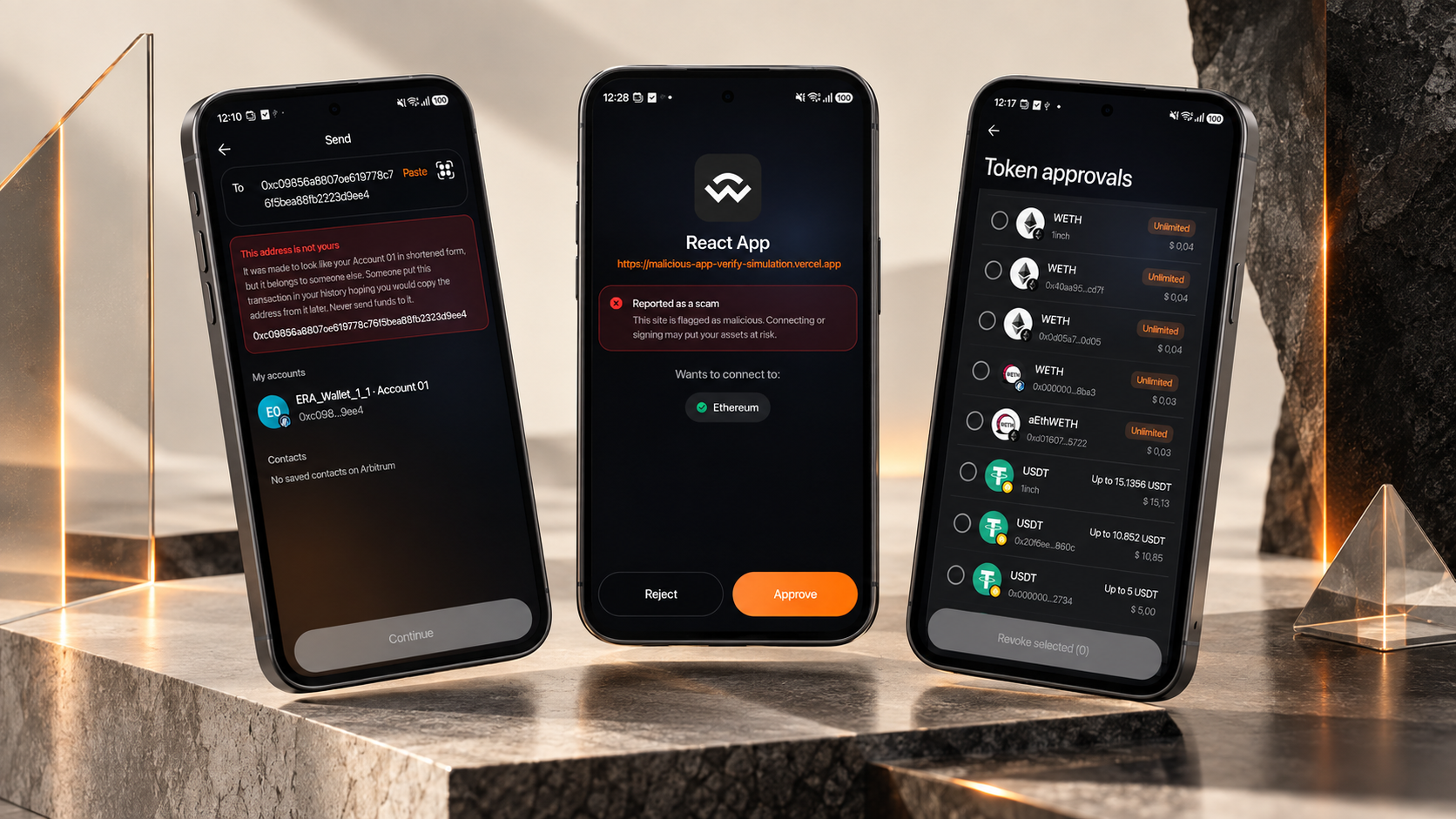
The companion app connects to the ERA hardware wallet to add portfolio management, swaps, and dApp access across 14 networks — while private keys never leave the device. The release follows a full independent security audit by Cure53, and lands alongside a major update to ERA Lens, ERA’s on-device scam-warning system, plus new hardware-side capabilities including Bitcoin multisig and on-device 2FA.
ERA, the maker of the air-gapped ERA hardware wallet, today announced the launch of the ERA Software Wallet, a companion mobile app for iOS and Android that turns its air-gapped hardware device into a full self-custody ecosystem. The move addresses one of the most common trade-offs in crypto self-custody: hardware wallets are secure but often clunky to use day-to-day, while software wallets are convenient but hold keys online.
ERA’s model keeps the two roles separate by design — the phone prepares transactions, the hardware device signs them, and the private keys never touch the phone at all.
“People don’t abandon self-custody because they don’t believe in it – they abandon it because it’s inconvenient,” said Alex Devyatkin, founder and CEO of ERA. “The Software Wallet doesn’t change what secures your assets. It changes how easy it is to actually use that security every day.”
What’s in the ERA Software Wallet
The app gives users a single interface to manage assets across 14 networks – Bitcoin (SegWit, Taproot, and Legacy address types), Ethereum, Solana, Tron, Base, Arbitrum, Optimism, Polygon, BNB Chain, Avalanche, Gnosis, zkSync, Kaia, and Aurora – while every transaction is still confirmed and signed on the ERA hardware device via QR or NFC.
Inside the app, users can:
- View portfolio balances across all supported networks, with each token clearly tagged by network
- Send and receive assets, with a network guard that prevents funds from being sent to the wrong chain
- Buy and sell crypto through integrated providers, with automatic KYC/country detection and side-by-side rate comparison
- Swap and bridge across chains in a single flow, powered by Rango’s routing, with a full quote shown before signing
- Connect to dApps via WalletConnect, with sessions still requiring hardware-signed approval
- Get proactive protection: warnings on unused token approvals, a spam-token filter, alerts on pending or stuck transactions, and full transaction history
App-level security includes PIN and biometric unlock (Face ID / Touch ID / fingerprint), auto-lock when the app is backgrounded, and screen-privacy protections that hide app content from the system app switcher and block screenshots and screen recording.
Backed by an Independent Security Audit
Ahead of launch, ERA commissioned a full white-box security audit from Cure53, a cybersecurity firm with an established track record auditing wallets and crypto infrastructure. Cure53 was given access to source code, builds, documentation, and internal components, and tested the mobile app, API, transaction construction, and QR/BC-UR signing flows. Every finding was fixed by ERA’s team and then retested by Cure53 to confirm the fix held.
The summary and full technical reports are public:
The Headline Device Update: ERA Lens’s New Scam-Warning System
The main update on the device side is to ERA Lens, ERA’s built-in transaction-decoding layer, which translates what a transaction actually does into plain language before signing rather than showing raw hex data.
This release adds a new scam-warning display, expands coverage to more DeFi and bridging protocols (including Rango, imToken, Rabby, MetaMask Portfolio Bridge, Mayan, Squid, LayerSwap, Stargate V2, GasZip, and Magpie), and can now decode newer, harder-to-read transaction formats such as EIP-7702, ERC-7821, and Safe multicalls — flagging unlimited approvals to unfamiliar addresses automatically.
The team also added 37 real transactions drawn from known incidents – including Bybit, WazirX, Radiant, Inferno Drainer, and PREMINT – to its automated test suite, so every new firmware release is checked against these attack patterns before shipping.

Extended Protection, Built Into the App
On the mobile side, the Software Wallet adds extended protection aimed at scams that target wallet users directly rather than the underlying blockchain. The home screen now surfaces a plain-language warning for unused token approvals, with a dedicated screen showing exactly which contract can spend how much of which token, in which network, revocable in one confirmation.
The app also guards against address poisoning — fake transaction records designed to trick users into copying a lookalike address from their own history. Between July 2 and August 1, 2026, ERA tracked 66 such fake entries across 24 poisoned addresses, spanning 8 wallets and 8 networks; if a recipient address is a near-identical copy of one of a user’s own addresses, sending is blocked outright, with no override.
Also New: Progressive Security on the Hardware Device
Alongside the software wallet launch, ERA is rolling out further capabilities to the hardware device itself, continuing its “wallet you never outgrow” model — meaning users can move to more advanced security setups without switching devices.
- Bitcoin multisig support – the ERA device can act as one cosigner in a Bitcoin multisig setup, for example holding one key in a 2-of-3 arrangement, removing any single point of failure.
- On-device two-factor authentication – TOTP authentication codes can now be stored directly on the ERA hardware device, adding a second layer of digital security on the same hardware that protects private keys.
- Device authenticity verification – separately from how transactions are signed, the ERA device can prove it is a genuine, unmodified unit by signing a one-time challenge with a factory-burned key, a check that takes under a minute.
About ERA
ERA (HWLT FZE) is a Dubai-based digital security company building the ERA Wallet ecosystem: an air-gapped hardware wallet, a companion multichain software wallet, and a built-in transaction-protection layer, ERA Lens.
The post ERA Launches Software Wallet, Turning Its Hardware Device Into a Full Self-Custody Ecosystem appeared first on BeInCrypto.
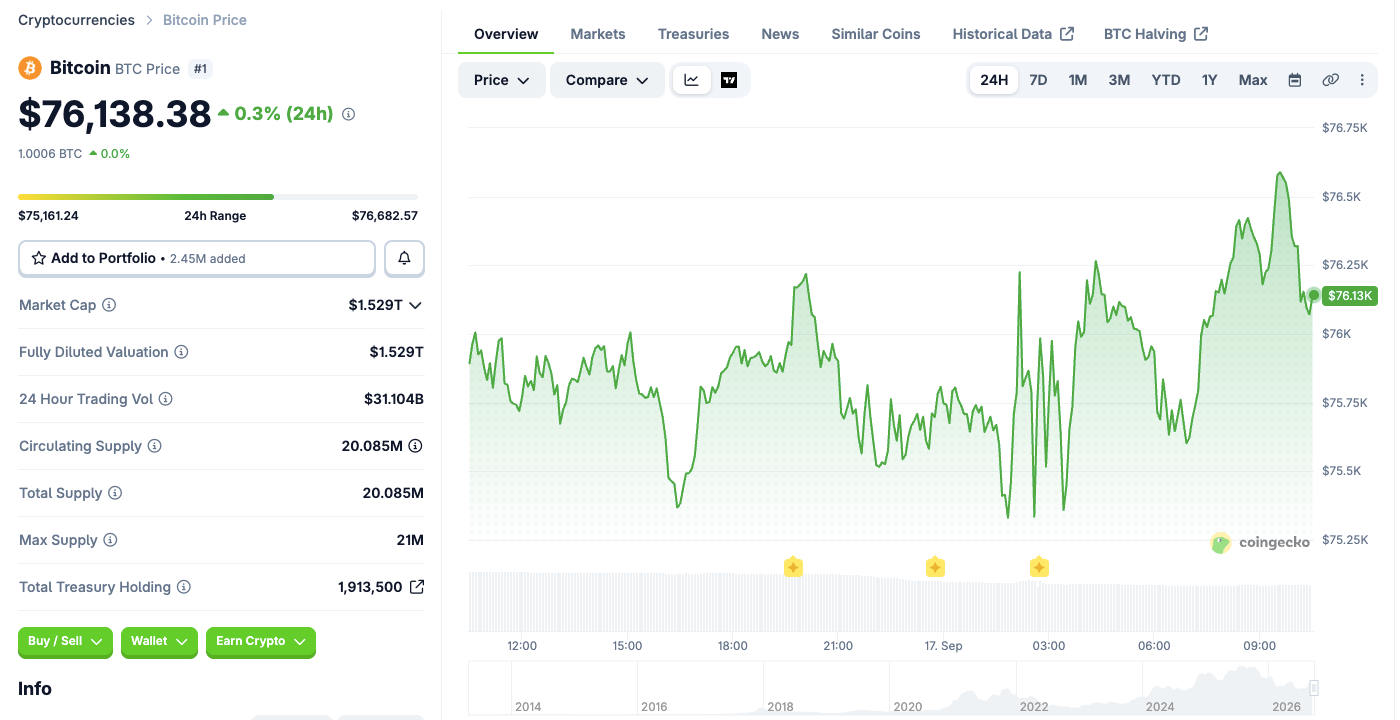
The Federal Reserve raised interest rates by a quarter point on Wednesday, its first hike since 2023. Bitcoin (BTC) climbed anyway, defying the old assumption that tighter policy always hurts risk assets.
Markets had priced in the move for days. That gap between expectation and reaction explains most of Wednesday’s price action, though it is not the whole story.
The Rate Hike Was Already Priced In
Interest rate futures put the odds of a hike at 92.7% just hours before the FOMC decision, according to BeInCrypto. Traders had already positioned for it well in advance.
Bitcoin dropped to around $75,350 shortly before the decision, then jumped past $76,100 within minutes of the release. It went as high as $76,500 after the markets closed in the US, to then settled near $76,138.

Research on past Fed cycles describes something similar. Traders who adjust positions before an announcement often barely react to the actual decision, sometimes even bouncing higher instead.
A Hawkish Surprise Would Have Hurt More
Scott Melker, host of Yahoo Finance’s Daily Wolf, argued a credible, one-time hike could calm long-term yields rather than spook markets. The condition was that Chair Kevin Warsh avoided signaling a longer tightening cycle.
Updated Fed projections show 16 of 18 officials now expect another hike before year-end, up sharply from nine in June. Yet the committee’s decision passed by a unanimous 12-0 vote, with the statement itself striking a measured tone.
Gold moved in a similar pattern. Spot prices spiked toward $4,360 right after the release, then sold off to settle between $4,280 and $4,300. The round trip points to quick profit-taking rather than genuine alarm.

Crypto-Specific Drivers Are Doing the Heavy Lifting
The Fed is not the only force moving prices this week. Bitcoin and XRP were already sliding after the CLARITY Act’s failure in the Senate, a bill meant to settle which federal regulator polices digital assets.
That setback alone wiped out more than $300 million in leveraged positions. Bitcoin and Ether ETFs then lost a combined $592 million to withdrawals on September 15, their worst single day of outflows in months.
Meanwhile, the broader top-10 board looked mixed rather than uniformly bullish. Zcash (ZEC) rallied more than 20% over seven days while XRP slipped, a reminder that altcoin-specific narratives can override the macro backdrop entirely.
With 16 policymakers still eyeing another hike this year, the next real test for crypto may not be the Fed’s next meeting. It may be whether the CLARITY Act debate reopens before then.
The post Fed Increased Rates, Why is The Crypto Market Up? appeared first on BeInCrypto.


Galaxy Research reported on September 16 that venture investment in crypto and blockchain companies rose 31% from the first quarter, while the number of deals increased 10%.
Summary
- Crypto VC funding reached $5.683 billion in Q2 across 384 deals, up 31% from Q1.
- Later-stage companies received 78% of Q2 venture capital, while pre-seed deals represented 21% of transactions.
- Trading, exchange, investing, and lending startups attracted $3.523 billion, nearly three-fifths of Q2 venture capital.
- U.S.-headquartered companies received 73.5% of Q2 crypto venture capital across 39.1% of completed deals globally.
- Five crypto venture funds raised roughly $3.9 billion in Q2, the fewest funds since 2019.
The increase in capital was driven mainly by later-stage financing, with mature companies receiving most of the money deployed during the quarter.
The first half of 2026 produced $10.018 billion in crypto venture investment across 744 deals. If that pace continues through the rest of the year, annual investment would reach roughly $20.037 billion, slightly below the $20.3 billion recorded in 2025, according to Galaxy Research’s Q2 report.
Crypto VC funding has returned above most 2023-2024 levels
Q2’s $5.683 billion investment figure followed a weaker first quarter, when crypto and blockchain startups received around $4 billion across 355 deals. Galaxy’s Q1 report showed capital falling by about half quarter-over-quarter after a large later-stage financing surge in late 2025.
The Q2 rebound was larger in dollar terms than in transaction volume. Capital increased 31%, while deal count rose 10%, indicating that larger financings accounted for much of the quarterly increase. Galaxy said the rise was driven primarily by later-stage transactions.
Galaxy’s data shows that the relationship between bitcoin prices and crypto venture activity remains weaker than during the 2017 and 2021 cycles. Bitcoin reached new highs in late 2025 while venture activity moved unevenly, although both bitcoin and venture investment increased during Q2 2026.
Deal sizes reached a new high in the quarter. Galaxy reported a median crypto deal size of roughly $4.9 million, while noting that valuation information was available for only 16% of Q2 transactions and was heavily weighted toward later-stage companies.
Later-stage companies received most of the $5.68B
Later-stage startups received approximately 78% of the capital invested during Q2, leaving 22% for younger companies. By transaction count, pre-seed rounds accounted for 21% of completed deals, while later-stage investments represented 26%.
The distribution produced a large gap between the number of early-stage transactions and the amount of capital committed to mature companies. Galaxy’s figures show that early-stage businesses continued to attract deals, but larger financing rounds drove the majority of dollars invested.
Trading, exchange, investing and lending companies accounted for the largest category, receiving roughly $3.523 billion during the quarter. The category represented close to three-fifths of all crypto venture capital invested in Q2. DeFi followed with approximately $478 million.
Privacy and security, tokenization, artificial intelligence, infrastructure, Web3, gaming and payments were among the other categories tracked by Galaxy. By deal count, trading, exchange, investing and lending companies recorded 51 transactions, while DeFi and payments/rewards each recorded 40.
Web3, NFT, DAO, metaverse and gaming companies completed 37 deals, followed by tokenization with 36, enterprise blockchain with 34 and infrastructure with 32. More than 90% of the capital invested in the trading, exchange, investing and lending category went to later-stage companies.
The concentration of capital in mature companies comes as other areas continue to attract smaller rounds. crypto venture funding remained active during July even as DeFi investment fell to its lowest quarterly level since late 2023.
U.S. companies captured 73.5% of crypto venture capital
U.S.-headquartered companies captured 73.5% of the capital represented in Galaxy’s Q2 dataset. The United Kingdom followed with 4%, while France accounted for 3.2%.
The U.S. share was smaller when measured by transaction count. American companies represented 39.1% of the 384 deals, followed by the United Kingdom at 7% and Singapore at 5.7%.
The geographic concentration was higher than in Q1, when U.S.-based startups received 70.2% of capital and represented 43.5% of completed transactions, according to Galaxy’s earlier report.
Recent financing activity has included transactions involving exchanges, stablecoin payments and tokenized markets. Payward, the parent company of Kraken, was the largest disclosed crypto funding deal during the September 5-11 period after Nasdaq Ventures agreed to invest $100 million in the company.
Latitude raised $35 million in a Series A during the same week to develop stablecoin-based cross-border payment infrastructure, while Antarctic Exchange announced a $7 million financing tied to its derivatives trading platform.
Five new crypto funds raised roughly $3.9B
Fundraising for new crypto venture funds remained concentrated in Q2. Five new crypto-focused funds raised approximately $3.9 billion, according to Galaxy. The firm said the number of new funds was the lowest for a quarter since Q3 2019.
Galaxy cited macroeconomic conditions, investor interest in artificial intelligence, spot crypto exchange-traded products and digital asset treasury companies as factors competing for allocator capital. The report stated that “fund managers still face a difficult environment.”
The dollar amount raised was higher than the roughly $1.1 billion secured across eight new funds in Q1. Galaxy’s first-quarter report described Q1 as the lowest quarterly new-fund count since Q3 2020.
If first-half fundraising continues at the same pace, Galaxy estimates that crypto venture funds could raise around $10 billion during 2026, above the $8.75 billion raised in 2025. The average fund size reached approximately $377.98 million, while the median fund size stood near $80 million.
The fundraising figures come alongside continuing individual company financing. During September 5-11, five disclosed crypto funding deals totaled $151 million, according to crypto.news. Payward’s $100 million transaction accounted for roughly two-thirds of the weekly total.
During the first half of 2026, venture capitalists invested $10.018 billion across 744 crypto and blockchain deals, according to Galaxy. The firm’s next quarterly dataset will provide the next measurement of venture activity after the Q2 rebound.
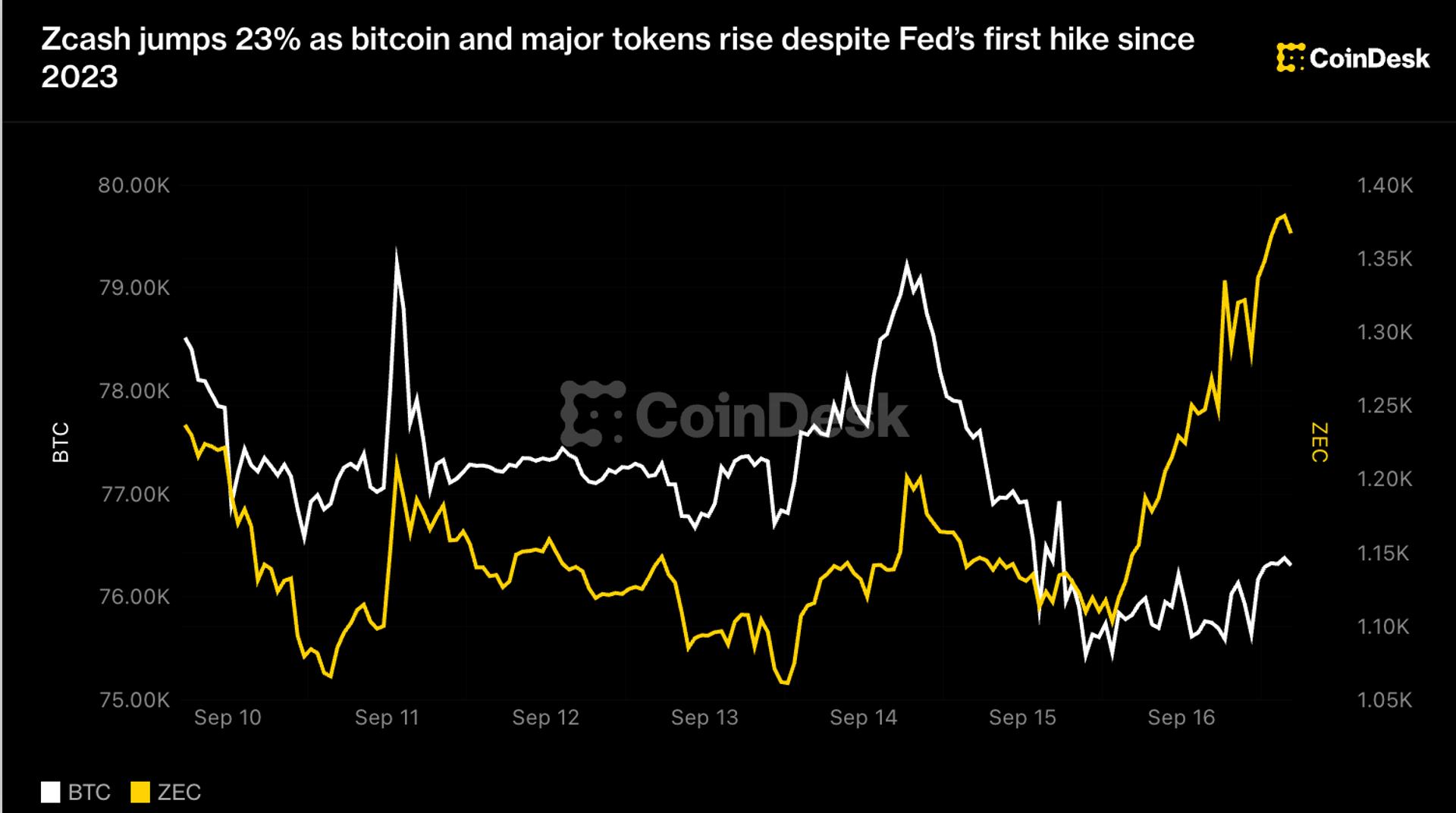
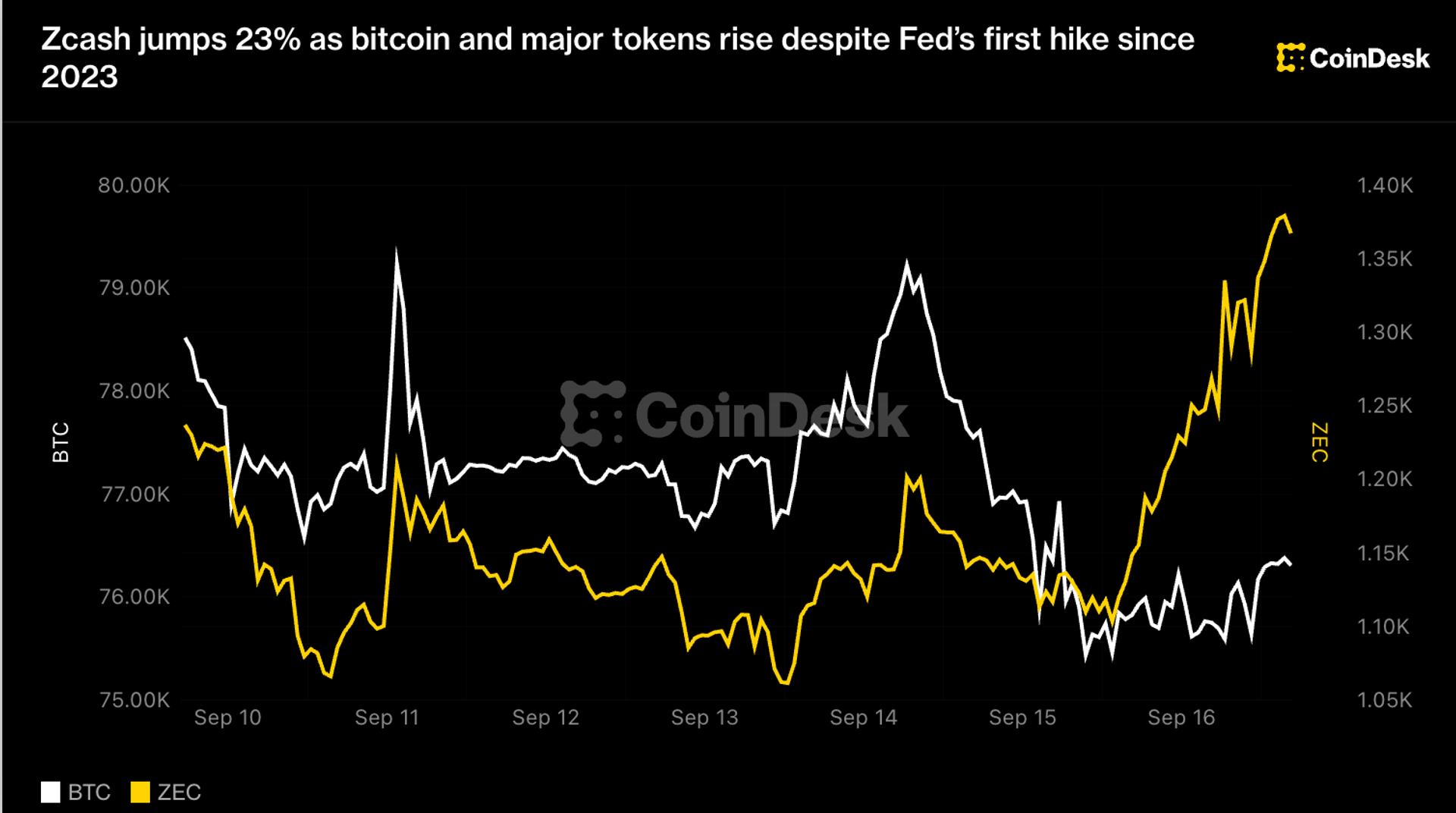
Privacy token Zcash surged 23% over the past 24 hours as bitcoin and other major cryptocurrencies rose overnight into Asian morning hours Thursday, alongside a recovery in stock futures following the Federal Reserve’s first interest-rate increase since 2023.
ZEC traded near $1,369, while bitcoin edged up less than 1% to about $76,258. Solana gained nearly 3% to just below $100. BNB and HYPE, the token of crypto trading platform Hyperliquid, added more than 2%, while ether, XRP and dogecoin rose between 1% and 2%.
ZEC’s surge coincided with comments from Matt Huang, co-founder of prominent crypto investment firm Paradigm, who discussed its role as a privacy complement to bitcoin and disclosed that his firm owns ZEC, per an X post.
Zcash lets users send money without publicly revealing who paid whom or how much. Its holders recently backed proposals to make payments faster while keeping scheduled cuts to the creation of new coins, a feature it shares with bitcoin.
Huang, whose firm owns ZEC, described Zcash as “a private complement to Bitcoin.” He supported continued funding for its developers, while arguing that votes by coin holders should be combined with other ways of deciding changes to the network.

“Medical-debt issues often stem from routine care, including doctor’s office visits and treatment for chronic conditions,” says Sara R. Collins, a senior scholar at the Commonwealth Fund and one of the authors of the report. High deductibles are another common source. “People are just dealing with routine care and bills that build up over time.”
The study, which consisted of interviews among a nationally representative sample of more than 6,300 adults in 2025, also included analysis of focus groups in which people expanded on their experiences with health care. In the focus groups, many people expressed surprise at how high their medical bills were despite their insurance coverage, Collins says.
The problem of insured Americans with medical debt could grow in the coming years as health insurance becomes less affordable. Already, the cost of health benefits per employee is projected to rise 8.2% in 2027, the highest increase since 2003, according to an August survey by Marsh, and some employers may downgrade their plans and shift more costs to employees, employers told Marsh. What’s more, after Congress decided not to renew subsidies for people buying health insurance from Affordable Care Act Exchanges, many consumers switched to lower quality plans that will cost them more if they have catastrophic or chronic health issues, according to April data from the Center on Budget and Policy Priorities.


South Korean retail investors have reported roughly $250 million in fraud losses tied to stock-tip chatrooms during the first half of 2026, while police investigated 3,506 related cases involving 336 billion won.
Summary
- Police investigated 3,506 stock-tip chatroom cases involving 336 billion won during 2026’s first-half period nationwide.
- Money involved rose 19.8% year over year, while investigated case numbers increased only 4.1% overall.
- Seoul police arrested ten suspects in June over a 9.9 billion won Cambodia-based investment scam.
- The alleged ring used fake brokerage apps and AI stock claims to target Korean investors.
- Financial regulators launched a September campaign warning about impersonation, fake news, and guaranteed-return investment pitches.
Reuters reported on Sept. 16 that the money involved rose 19.8% from the same six-month period in 2025, while the number of investigated cases increased 4.1%. At the exchange rate used in the report, 336 billion won equaled $246.57 million.
South Korea stock scams reached 3,506 police cases
During the January-to-June period, South Korea’s KOSPI became the world’s best-performing stock benchmark before falling as much as 44% from its June 19 peak, according to Reuters. Lawyers specializing in financial fraud told the news agency that scam operators used excitement during the rally and later market uncertainty to persuade inexperienced investors to send money.
The police numbers count investigated cases, not individual victims. Police told Reuters that a single case can contain several victims, so the 3,506 figure cannot be treated as a count of people who lost money. The 336 billion won figure represents money involved in cases investigated during the six-month period.
Investor participation has remained elevated across South Korea’s financial markets. As crypto.news previously reported, research released in September found a 95.7% year-over-year increase in online search interest tied to stocks and cryptocurrencies. The study measured search activity and did not measure actual investment losses.
Leveraged trading losses among younger South Korean investors came under scrutiny during sharp equity-market moves. Those figures concerned leveraged positions and remain separate from the police fraud data covering stock-tip chatrooms.
Fake chatrooms used trusted names and bogus trading apps
Police and lawyers described a pattern in which fraudsters placed comments beneath videos posted by well-known brokerage analysts or financial influencers, then directed users toward private chatrooms. Some groups charged subscription fees for purported stock recommendations, while others persuaded members to transfer money for investments.
A Seoul police investigation announced in June showed how one overseas network allegedly operated. Yonhap reported that police arrested 10 people accused of taking roughly 9.9 billion won from 59 South Koreans between February 2024 and February 2026 through an operation based in Cambodia.
Investigators said members posed as securities-company employees and steered users toward fake brokerage applications. According to Edaily, victims were shown fabricated balances and investment returns while operators promoted supposed AI-selected stocks and claims of returns reaching 600%.
Police said links placed beneath videos from genuine financial personalities were used to move possible victims into private Naver Band groups. Inside the groups, fake investors reportedly posted fabricated success stories that were designed to make the schemes appear credible.
One investor interviewed by Reuters said he entered a Naver group after seeing a TikTok video he believed had been posted by an executive at a securities company. The 47-year-old logistics worker, identified by the pseudonym Jay, said he eventually transferred 60 million won after being told an investment opportunity could produce a 600% return.
After the group stopped communicating and disappeared in April, Jay filed a criminal complaint with police and a civil claim against the holder of the bank account that received his money. Police declined to discuss his individual case. His warning to new investors was direct: “doubt every tip you are given.”
Regulators are expanding warnings and platform checks
South Korea’s Financial Services Commission said on Sept. 2 that financial authorities had launched a nationwide campaign focused on safer financial activity and investment fraud prevention.
The FSC said illegal operators had impersonated investment professionals, used AI-generated material, distributed fake news and promoted high-return or principal-protection claims before collecting investors’ money and disappearing.
The campaign is scheduled to run through the end of 2026 across social media, government websites, mobile applications and public display systems. The regulator said government agencies, banks and financial-sector associations would distribute warning material through their own communication channels.
Earlier in 2026, the Financial Supervisory Service issued consumer warnings concerning illegal stock-tip rooms that impersonated securities-company employees and distributed links leading to private chats or fake investment applications. A January alert urged investors to be cautious when unknown operators tried to move conversations into closed groups or requested installation of unfamiliar trading software.
Financial regulators later moved against potentially abusive stock promotion. On March 23, the FSC announced an intensive reporting and investigation period targeting financial influencers suspected of front-running recommended stocks, spreading false market information or circulating fabricated corporate developments.
The regulator said suspected violations could be referred to investigators when available evidence supported enforcement action.
Police have worked with online platforms on scam detection as well. Yonhap reported in June that the National Police Agency was sharing newly identified scam tactics with companies including Naver and Kakao so the platforms could strengthen their detection systems.
Police said losses associated with investment-tip rooms stood at 41.3 billion won in May, down 26.1% from the average monthly level recorded during the first quarter.
Cambodia-linked case is awaiting further court action
The Cambodia investigation remains one of the clearest criminal cases connected with tactics found in stock-tip chatrooms. Kyunghyang Shinmun reported that suspects allegedly divided tasks among callers, people posing as brokerage workers, translators and fake investors who posted success stories inside the groups.
Police secured approximately 273 million won in suspected criminal proceeds before indictment, according to MBC reporting. Investigators said efforts were continuing to trace higher-ranking members of the organization.
The Financial Supervisory Service told Reuters that it does not maintain a separate dataset covering illegal stock-tip chatroom cases because criminal investigations fall under law-enforcement agencies. The regulator did not answer the news agency’s question on whether new investor-protection rules were being prepared.
Naver said it takes action against fraudulent chatrooms after receiving reports and has been strengthening monitoring. Jeonbuk Bank, which held the account involved in Jay’s complaint, said it was aware of ongoing fraud cases and would continue improving fraud-detection measures. Police said the Cambodia-based case involving 10 suspects had been referred to prosecutors and was awaiting a court date.


Seven Senate Democrats voted Nay on the Senate’s September 15 cloture vote on the Digital Asset Market Clarity (CLARITY) Act, according to the chamber’s official roll call. Preceding this, CLARITY Act champion Senator Lummis said if it failed its first vote, they were ‘done.’
A day later, the same seven declared themselves committed to passing the bill.
The Record Is Clear
Senate Roll Call Vote 234, taken at 2:19 p.m. ET on September 15, lists each of the seven by name against the bill’s cloture motion, the procedural step that needed 60 votes to advance debate and fell to 49.
Senator Cynthia Lummis (R-Wyo.), the bill’s lead sponsor, had already warned that failure would end the fight, telling reporters, “I think we’re done. It’s over.”
The next day, the same seven senators issued a joint statement striking a different tone.
“We remain committed to working in a bipartisan fashion to get this legislation passed.”
Not a New Position, a Repeated One
That statement is not a first-time reversal. Six of the seven, plus Senator John Hickenlooper (D-Colo.) in Gillibrand’s place, issued nearly identical language in July, calling an earlier Republican draft insufficient on ethics and consumer protection while pledging to keep working toward a deal.
The pattern holds: oppose the specific text on the floor, while publicly keeping the door open to a future version.
Republicans reject that framing. House Majority Whip Tom Emmer accused the bloc of saying one thing publicly and voting another way, pointing to Gillibrand’s appearance at a Digital Chamber panel in March, where she said she wanted the US to lead the industry.
What This Means for CLARITY Act
Whether the CLARITY Act is dead or merely paused now depends on whose framing holds. Republicans control the floor calendar and have not scheduled another vote.
The seven Democrats have offered no new text and no timeline, only a repeat of language they have used before, leaving the bill’s fate exactly where Tuesday’s vote left it.
The post Lummis Says CLARITY Act Is Dead. The Democrats Who Killed It Say Otherwise appeared first on BeInCrypto.

Sydney Sweeney Reportedly Told by Agent to Dump Scooter Braun

XRP @ $11.60? XRP Has Entered “EXPLOSIVE PART” OF CYCLE, Popular Analyst Insists -Report

Ohio house of horrors mom-of-16 pleads not guilty to child abuse charges as she cradles stomach in court – but lawyer refuses to say if she’s pregnant again



-

 Fashion6 days ago
Weekend Open Thread – Corporette.com
-

 Tech4 days ago
The Latest Weird Thing to Play Doom Is the Mapped-Out Brain of a Fruit Fly
-

 Business6 days ago
10 Most-Streamed Songs On Spotify In 2026 So Far, Led By Ella Langley’s Dominant Run On The Charts This Year
-

 Crypto World6 days ago
XAG/USD: Silver’s Short-Term Rally Meets Its Moment of Truth
-
 Crypto World7 days ago
2 Chip Stocks Broke Out This Week. Neither Was Nvidia
-

 Tech6 days ago
Battery life is the only iPhone 18 Pro and iPhone Duo upgrade I care about. Apple didn’t disappoint
-

 Crypto World6 days ago
OKX launches 10x OpenAI, Anthropic X-Perps in Europe
-

 Crypto World6 days ago
Diesel Tops $6 a Gallon for the First Time as 28 States Set Records
-

 Crypto World3 days ago
Elon Musk Drops a Bombshell: Grok 5 Could Be the AGI Breakthrough
-

 Business7 days ago
Western Digital Slips 2.7% as AI Storage Rally Cools After Record Cash and Guidance
-

 News Videos6 days ago
Facing Financial Fears
-

 Business4 days ago
Rivals Sam Altman and Elon Musk Rally Behind Dario Amodei’s Call for a Slowdown in AI Development
-
Crypto World6 days ago
Ethereum Price Analysis: Consolidation at $2.5K Tests Momentum as On-Chain Activity Surges
-

 Business7 days ago
Five Leading AI Experts Warn Superintelligence Could Kill Humans and Explain Their Case
-

 Crypto World2 days ago
Kraken Lets xStocks Holders Earn Yield Through DeFi
-

 Crypto World7 days ago
Ant International joins Visa, Mastercard to build AI agent payment standards
-

 Crypto World5 days ago
Can AI Build a Startup in 72 Hours? Elon Musk's Team Will Livestream the Test
-
 NewsBeat3 days ago
‘Sick conspiracy’: Trump says only guardrails AI needs is ‘a strong and smart (High IQ!) president’ in all-caps rant
-

 Crypto World6 days ago
Bitcoin ETFs Pull $167M as 2026’s Best Inflow Run Slows
-

 Crypto World6 days ago
US CPI forecast at 3.4% as tariff risks build
You must be logged in to post a comment Login