
Crypto World
Who is Wei Zhou, one of the most mentioned people in CZ’s book?



Binance founder Changpeng Zhao (CZ) dedicated a considerable portion of his autobiography, Freedom of Money, to talking about somebody called Wei Zhou.
Indeed, Zhao is this fifth most mentioned person in the book, tied with Sam Bankman-Fried (SBF) with 23 mentions. But who is he?
Zhao joined Binance from Goldman Sachs in 2018 as its first chief financial officer (CFO).
He’d previously shepherded two companies through NYSE and NASDAQ IPOs, and in Binance’s eyes, he brought institutional credibility that the then-one-year-old crypto exchange desperately needed.
Zhou is now CEO of Coins.ph, a Philippines-based crypto wallet and exchange that he acquired from Indonesian super-app Gojek in 2022 for roughly $200 million.
He also advises Old Fashion Research, a blockchain fund run by former Binance executives, as well as serving as vice chairman of the gay dating app Grindr.
Wei Zhou : From CZ’s first CFO to his nemesis
CZ used Freedom of Money, written largely during his time in prison and published on April 8, to paint Zhao as an unreliable subordinate-turned-antagonist.
Specifically, it frames his tenure around two grievances.
The first involves Zhao’s role in Binance’s FTX investment.
FTX launched in May 2019 and within months, SBF approached Binance for investment. Zhao championed the deal, yet CZ claims that he initially declined.
However, by late 2019, FTX lowered its valuation and sweetened the offer with a Binance Coin (BNB) for FTX token (FTT) token swap. Binance agreed, taking a 20% stake in SBF’s company that would implode three years later.
Fortunately for CZ, Binance was able to sell its FTX equity, before FTX went bankrupt.
Fintech Alliance Philippines and Binance
CZ also complained about Zhao’s role in Binance’s Philippine expansion.
In September 2022, Zhao wrote to the chairman of Fintech Alliance Philippines, questioning a blockchain education partnership between the Alliance and Binance.
The letter, which a Philippine crypto publication published in full, called Binance an unregistered virtual asset service provider.
Zhao claimed that Coins.ph was “astounded” by the Binance-Alliance collaboration, an assertion that CZ frames as an underhanded attempt to block Binance from the Philippine market.
Unsurprisingly, Zhao denied the framing and told reporters, “We did not block Binance from joining. We asked to be involved in blockchain education initiatives of Fintech Alliance Philippines.”
Partial financials for his CFO
Basically, CZ’s memoir casts Zhou as a disloyal insider. However, other reports tell a different story about who kept whom in the dark.
Reuters reported in December 2022 that Zhao never had access to Binance’s full financial accounts during his tenure as CFO of nearly three years. Reuters says that two former colleagues confirmed that claim.
It also claimed the world’s largest crypto exchange ran its finances as a “black box” obscured from even its own CFO.
Zhao wasn’t the only executive to discover CZ’s centralized grip over Binance.
Binance.US, launched in 2019 while Zhao still served as global CFO, was meant to operate independently.
However, its first CEO, Catherine Coley, was replaced without explanation. Her successor, former US Comptroller of the Currency Brian Brooks, lasted less than four months.
Brooks later testified concerningly that he realized CZ ran the US entity, not him.
The SEC would eventually allege that Binance.US was a sham, controlled behind the scenes by CZ while publicly claiming independence.
Zhao left Binance in June 2021, the same summer Brooks walked out of Binance.US. Binance cited personal reasons for both departures.
Read more: How the battle between Binance and FTX went from bad to worse
Binance Avengers
After leaving, Zhao created a private group that CZ’s memoir called the “Binance Avengers.” It gathered disgruntled former employees to criticize the exchange.
CZ’s book claims some members later lost money after transferring assets to FTX.
The Binance supremo also places Zhao on an informal enemies list alongside SBF and OKX founder Star Xu. As Protos reported, the CZ-Xu grudge escalated to a $1 billion bet within days of the book’s release.
Got a tip? Send us an email securely via Protos Leaks. For more informed news, follow us on X, Bluesky, and Google News, or subscribe to our YouTube channel.

Aave, the decentralized finance protocol, has filed an emergency motion in a New York court to vacate a restraining notice that would block Arbitrum DAO from transferring 30,766 Ether to the victims of the Kelp DAO exploit. Gerstein Harrow LLP served the notice on Arbitrum DAO last Friday, claiming its clients hold default judgments against North Korea worth about $877 million and that the Kelp hacker group had possession of the stolen tokens, giving a legal claim over the Ether. Aave contends that theft does not confer ownership and argues that North Korea is only suspected to be involved, calling the notice “logically and legally incoherent.”
Meanwhile, Arbitrum DAO has been voting on whether to release the Ether to support DeFi United, an industry-wide coordination effort aiming to restore rsETH holders and backing after the roughly $292 million Kelp DAO hack on April 18. The voting window closes on May 7, with the outcome shaping how the DeFi ecosystem responds to the incident.
Key takeaways
- Aave filed an emergency motion to vacate a restraining notice intended to stop Arbitrum DAO from moving 30,766 ETH to Kelp exploit victims, arguing the claim rests on disputed ownership and questionable attribution to North Korea.
- The restraining order stems from Gerstein Harrow’s assertion that its clients hold default judgments against North Korea amounting to roughly $877 million tied to the incident.
- Arbitrum DAO’s vote to unfreeze the Ether is part of a broader effort, DeFi United, to make rsETH whole and restore the token’s backing after the April hack.
- Aave warns that delays could inflict “irreparable harm” on users and the broader DeFi ecosystem, potentially destabilizing collateral arrangements tied to immobilized assets.
- Gerstein Harrow has pursued similar recoveries in the past, including funds linked to the 2023 Heco Bridge hack and the 2025 Bybit exploit, setting a legal backdrop that readers should watch for in upcoming court actions.
Aave challenges restraining orders as it seeks to protect users
In its emergency motion, Aave argues that the court should vacate the restraining notice because the alleged ownership transfer does not follow the legal logic of property rights. The motion contends that a thief cannot lawfully convert stolen assets into property that can be restrained or redirected by a third party, especially when the rightful ownership remains with the protocol’s users who were harmed during the exploit on April 18, 2026.
Another core contention is that North Korea is only suspected of involvement, and the claim that the thief’s acts automatically confer legitimate ownership is inconsistent with established principles of property and criminal law. Aave’s lawyers describe the claim as “defies logic, common sense and the law,” noting that the immobilized Ether belongs to Arbitrum DAO’s user base, not to any state actor or the alleged hacker group.
The emergency motion also raises concerns that allowing the restraining notice to stand could deter future recovery efforts for North Korea–related hacks by inviting additional legal challenges to recover funds. Aave warns that delays in unfreezing assets could hamper the protocol’s ability to restore value for users who relied on rsETH and other DeFi positions that may incorporate those assets as collateral. If the assets remain frozen, the firm argues, the broader DeFi ecosystem could face cascading collateral and liquidity issues that cannot be cured by damages alone.
“The immobilized assets do not belong to North Korea or any affiliated entities. Instead, the immobilized assets belong to the users of the Aave protocol who were victimized when a third-party thief effectively stole their assets during a cyber exploit April 18, 2026.”
The move comes as Aave seeks to ensure that a court decision—whichever way it rulings—does not set a precedent that could complicate future asset-recovery efforts across DeFi. If the court does not immediately vacate the notice, Aave has asked for a bond—reportedly $300 million—to sustain the restraining order until a ruling is reached.
Arbitrum DAO’s vote and the DeFi United effort
The Arbitrum DAO vote to unfreeze the 30,766 ETH is tied to a coordinated industry response named DeFi United, aimed at protecting rsETH holders and stabilizing the backing that supported rsETH after the incident. The initiative seeks to marshal community resources and align recovery efforts to restore trust and liquidity within the Arbitrum ecosystem and broader DeFi networks. The outcome of the vote, expected by May 7, could determine how quickly a significant tranche of Ether could be redirected to affected users and how much leverage the DeFi community has in guiding asset recovery during a legal dispute.
The debate underscores the tension between legal seizures or restraints tied to high-profile cyber incidents and the operational realities of DeFi protocols, which rely on the trust and accessibility of user funds. Proponents of unfreezing the Ether argue that rapid action is necessary to prevent further value erosion and to fulfill promises made to rsETH holders who may have relied on the asset’s corroborated backing. Critics worry about potential misuse or setting a precedent that could tempt external actors to cause disruption in the service of complex legal battles.
Legal backdrop and what it means for DeFi recovery efforts
Gerstein Harrow has built a portfolio of cases where they claim an interest in funds allegedly stolen in North Korea–linked incidents and subsequently frozen by crypto firms. The framework of these cases includes earlier disputes over assets linked to the 2023 Heco Bridge hack and the 2025 Bybit exploit. The firm’s approach—asserting ownership rights on behalf of plaintiffs tied to state-backed or state-actor–assisted hacks—has drawn responses from affected protocols that argue such claims risk overreach and misalign with the actual ownership landscape of DeFi assets.
Aave’s legal response emphasizes that the chain of ownership, especially in a decentralized setting, does not automatically transfer to third parties based on circumstantial attribution. The case hinges on whether a restraining notice can be sustained when the underlying premise is contested, and whether a court should permit continued immobilization of assets intended to restore value to users who were harmed by a criminal act. The outcome could influence how DeFi protocols navigate similar recoveries in the future, particularly when the alleged perpetrators are subject to jurisdictional complexities or international sanctions considerations.
As the hearing date remains unannounced, observers are watching not only the immediate fate of the Arbitrum Ether in question but also how courts will handle asset-freeze requests in cross-border, high-stakes cybercrime scenarios. The proceedings could shape how quickly DeFi projects can mobilize recovered assets to support token holders and maintain collateral integrity across ecosystems.
Context and precedent worth watching
Beyond the current dispute, the legal strategies employed by Gerstein Harrow reflect a broader pattern of claims aimed at recovering stolen crypto, especially in cases where wrongdoing is attributed to state actors or state-backed entities. The linkage to North Korea’s alleged involvement has been a recurring theme in related coverage and legal filings, underscoring the challenge of attributing cyber theft in a global, decentralized market.
For investors and builders, the key takeaway is that the legal status of recovered assets—whether they can be restrained, redirected, or used to compensate victims—depends on nuanced interpretations of ownership, theft, and the jurisdiction in which disputes are heard. The Aave motion and the Arbitrum DAO vote illustrate how the industry is trying to balance rapid value restoration for users with complex, sometimes speculative, legal claims. The coming weeks will reveal whether the court grants temporary relief, vacates the notice, or imposes further conditions on asset handling during ongoing litigation.
As a reminder of the ongoing legal landscape, the case references publicly available materials, including the underlying court filings and related analyses. For instance, the CourtListener filing referenced by the parties provides detailed context on the restraining notice and the arguments presented by both sides. Meanwhile, industry observers note that the debate over NK attribution remains central to how aggressively courts will weigh similar requests in the future.
Readers should monitor the next scheduled developments: a judge’s ruling on the emergency motion and the May 7 conclusion of the Arbitrum DAO vote, both of which could recalibrate expectations for asset recovery programs across DeFi and impact how protocols approach recoveries in future incidents.
Source notes: The Kelp DAO incident and the 30,766 ETH figure are tied to the ongoing recovery effort. Aave’s position is documented in its emergency filing, which argues against the restraining notice on grounds of ownership and identity attribution. Related coverage includes references to DeFi United’s rsETH restoration plan and prior cases pursued by Gerstein Harrow, such as the Heco Bridge and Bybit exploits.


Ripple is now sharing its internal threat intelligence on North Korean hackers with the crypto industry, the company said Monday, in a move that reframes how the sector is responding to a shift in DPRK attack methodology.
The Drift hack was not a hack in the way most people think of one.
Nobody found a bug or exploited a smart contract. North Korean operatives spent months befriending Drift’s contributors, slipped malware onto their machines, and walked off with the keys. By the time the $285 million moved, every system that was supposed to catch a hack had nothing to flag.
That is the version of events Ripple and Crypto ISAC, the crypto industry’s threat-sharing group, laid out Monday alongside news that Ripple is now sharing its internal data on North Korean threat actors with the rest of the sector.
The 2022-24 wave of more DeFi hacks was centred on exploiting code, with attackers finding smart contract vulnerabilities and draining protocols in minutes.
But as security gets tighter, the modus operandi shifts from technology to people. Rogue operatives apply for jobs at crypto firms, pass background checks, show up on Zoom calls and build trust for months. Then they deploy attacks that no traditional security tool was built to catch, because the attacker is already inside.
Ripple is now feeding Crypto ISAC the kind of profile data that makes that pattern legible across companies. LinkedIn profiles, email addresses, locations, contact numbers — or the connective tissue that lets a security team recognise the candidate they just interviewed as the same operative who failed background checks at three other firms last week.
“The strongest security posture in crypto is a shared one,” Ripple posted on X. “A threat actor who fails a background check at one company will apply to three more that same week. Without shared intelligence, every company starts from zero.”
Lazarus Group’s reach across the crypto sector is now visible enough that it has begun reshaping legal proceedings as well as security ones.
On Monday, an attorney representing victims of North Korean terrorism served restraining notices on Arbitrum DAO, arguing that the 30,765 ETH frozen after April’s Kelp bridge exploit is North Korean property under U.S. enforcement law.
Lending company Aave has since disputed that filing in support of Arbitrum, arguing that a “thief does not gain lawful ownership of stolen property simply by taking it.”
The Kelp breach had drained $292 million in ether (ETH) and was also publicly attributed to Lazarus Group operatives, putting April’s Drift and Kelp losses together at more than half a billion dollars tied to a single state actor in the span of a single month.
Whether industry-level intelligence sharing actually slows the campaigns is the open question. The same operatives may already be in the next round of interviews somewhere.
K Wave Media has redirected up to $485 million from its Bitcoin treasury strategy into artificial intelligence infrastructure.
Summary
- K Wave redirected $485M from Bitcoin treasury plans into data centers and GPU compute operations.
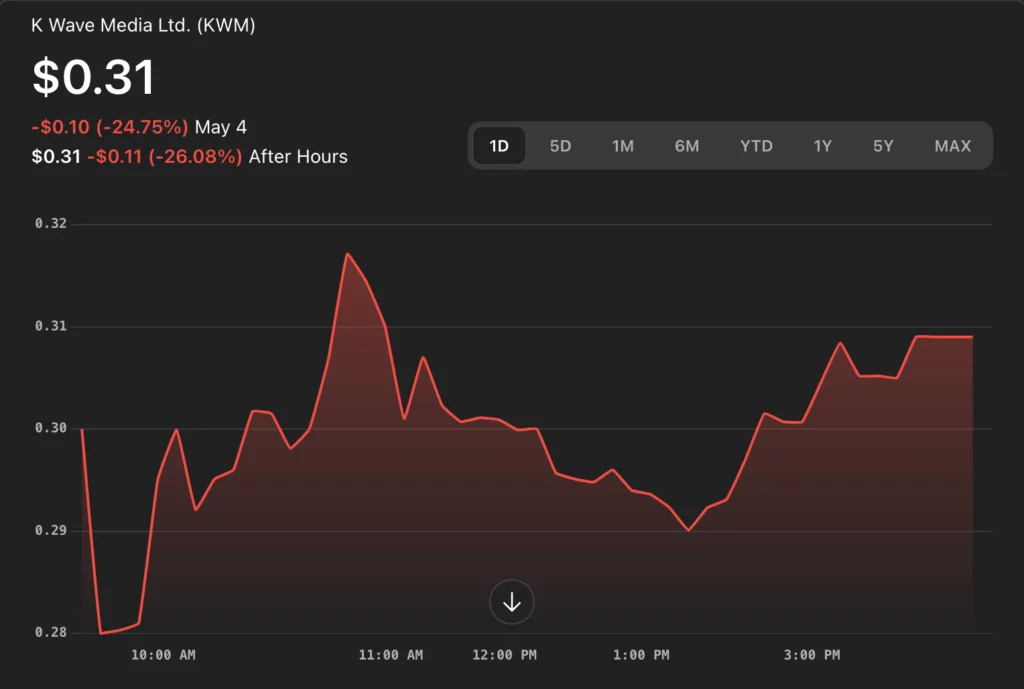
- KWM shares fell about 25% Monday after the company announced its Bitcoin-to-AI infrastructure strategy shift.
- The restructuring includes Play Co.’s planned sale and about $48M in debt and liabilities reduction.
The Nasdaq-listed media and entertainment company disclosed the change in a May 4 Form 6-K filing with the U.S. Securities and Exchange Commission.
The capital will now support data center investments, GPU compute and rental operations, and possible acquisitions in AI infrastructure.
The funds come from an amended securities purchase agreement with Anson Funds, which had earlier backed the company’s Bitcoin treasury plan.
Bitcoin treasury plan loses priority
The amended deal changes a prior $500 million equity purchase facility. That facility had been designed to support K Wave Media’s Bitcoin treasury strategy, which the company announced in 2025 as part of a wider capital markets shift.
K Wave Media had earlier linked its plans to Korean cultural intellectual property, digital assets and tokenized securities. The latest filing moves the company’s main funding plan away from Bitcoin and toward AI infrastructure, while keeping the focus on a new corporate structure.
Meanwhile, KWM shares fell after the announcement. Latest available market data showed the stock at $0.3071, down 24.75% from the previous close. The stock opened at $0.309, traded between $0.28 and $0.587, and recorded volume of more than 10.2 million shares.
The drop came as investors weighed the company’s move from a Bitcoin treasury plan to an AI infrastructure strategy.
Restructuring targets debt reduction
K Wave Media said its board approved the planned sale of Play Co., Ltd., its largest wholly owned subsidiary, back to the unit’s previous owner. The company expects the sale to remove about $48 million in debt and related contingent liabilities.
The company also said it may rebrand as “Talivar Technologies,” subject to shareholder approval. The vote is expected at its annual meeting in early July 2026. Chief executive Ted Kim said, “This marks a defining inflection point for KWM.”
Crypto treasury trend faces new test
The reversal comes after several public firms adopted crypto treasury plans in 2025. crypto.news reported in October that Asian companies including Top Win, Quantum Solutions and K Wave Media were raising capital to expand Bitcoin positions.
The move also fits a wider shift among crypto-linked firms toward AI infrastructure. crypto.news reported that Bitcoin miner Hut 8 secured $150 million from Coatue in 2024 to build an AI infrastructure platform. K Wave Media is now trying a similar direction through data centers, GPU operations and AI-related acquisitions.


Bitcoin just gave the options desks the breakout they were positioning for.
The largest crypto crossed $81,000 in Asian hours Tuesday, its highest level since late January, up from $79,000 at the end of U.S. trading hours on Monday and 5.3% higher on the week.
Other majors traded mixed. Ether held $2,379, off 0.1% on the day but up 4.0% on the week. XRP slipped 0.9% to $1.40. Solana dropped 0.9% to $84.84. BNB sat at $626. Dogecoin gave back 1.0% to $0.1117 after last week’s run, though it remains the standout on the seven-day tape at 12.4% as futures open interest continues to sit at year-highs.
The move came despite Brent crude paring just to $113 a barrel after surging 5.8% Monday on Iran’s disputed missile claim, with WTI near $104.
The macro picture has not actually improved, even as developments in the ongoing U.S.-Iran seem to be losing their grip on bitcoin.
U.S. destroyers Truxtun and Mason transited the Strait of Hormuz overnight, escorting two U.S.-flagged vessels through under what U.S. Central Command described as “coordinated threats.” A VTTI oil terminal in Fujairah was struck in an aerial attack. President Donald Trump told Salem News Channel the war may last another two to three weeks, meaning a previously announced four-week ceasefire is fraying.
Options markets are showing a flurry of action with bets on higher prices in the days ahead, Nomura’s market making arm Laser Digital flagged in a note shared with CoinDesk on Tuesday.
Bitcoin volatility has been quiet for most of the past week. Traders were not buying much in the way of options protection, and the price was not moving fast enough to justify it. When desks did pay for protection, they paid more for puts (bets on the price falling) than calls (bets on it rising) – the standard playbook in a market that is more worried about a drop than excited about a rally.
But underneath that, there has been quiet demand for cheap upside bets, structured through what traders call call ratio strategies. The trade involves buying call options that pay off if bitcoin rallies a little, and financing those by selling other call options that only pay off if bitcoin rallies a lot. The setup costs almost nothing upfront and benefits if bitcoin grinds higher without ripping past the upper level.
“Should the spot price experience a decisive breakout above $80K, the currently negative BTC risk reversal is expected to move into positive territory,” the note said.
A risk reversal is the difference in implied volatility between equally out-of-the-money calls and puts. When it sits negative, the market is pricing more fear of a drop than greed for a rally.
A flip to positive would be the first signal that options markets have actually shifted from cautious to constructive.
All major central banks held rates last week, which Laser Digital said reduces the right-tail distribution of rates and keeps U.S. financial conditions in their current range. Strategy reports earnings Tuesday, and the U.S. nonfarm payrolls print drops Friday. Both can move bitcoin if the surprise is large enough.


Haun Ventures has raised $1 billion in new funds to back founders working across crypto, finance and artificial intelligence.
Summary
- Haun Ventures raised $1B to invest in crypto infrastructure, tokenization and AI agent startups.
- Katie Haun said AI agents will increasingly conduct economic activity on behalf of users.
- The raise adds Haun Ventures to growing venture interest around AI and crypto infrastructure.
The firm announced the raise on May 4, saying it will continue supporting companies building the next stage of digital markets.
The firm, led by Katie Haun, said the funds will target three areas. These include crypto financial infrastructure, tokenization and AI agents. Haun described these sectors as part of a new economy that is forming around digital assets and automated software.
Katie Haun links crypto with AI agents
Haun said the market is changing across capital, commerce and trust. She wrote, “I’ve been following the flow of assets my entire career, and this is the most dynamic period in technology and finance I’ve ever witnessed.”
She also said AI agents will start taking part in economic activity for users. In her view, future services will need to support a world where computers become customers. That focus marks a shift for Haun Ventures, which has mostly backed crypto companies since launch.
Haun Ventures said financial services such as money, payments, banking, capital markets, insurance, identity and reputation are changing quickly. The firm also pointed to stablecoin volume, digital assets and tokenized markets as areas where new companies can build infrastructure.
Tokenization remains central to the firm’s plan. Haun said assets such as currencies, securities, gold and oil can become borderless, always available and programmable when moved onto digital rails. This aligns with rising interest from banks, asset managers and crypto firms in real-world asset markets.
Rising AI payments activity
Recent crypto.news reports show more firms building tools for AI agent payments. OKX launched an Agent Payments Protocol that lets AI systems handle quoting, escrow, settlement, usage tracking and dispute handling in one framework.
Coinbase-backed x402 also launched Agentic.market in April. The platform helps AI agents find, access and pay for online services. crypto.news reported that the x402 ecosystem has support from firms including Google, Microsoft, AWS, Visa and Stripe.
MoonPay has also moved into AI payments. The company introduced MoonAgents Card, a virtual Mastercard product that lets AI agents and users spend stablecoins from on-chain wallets. The card supports real-time crypto-to-fiat conversion at checkout.
These developments show why Haun Ventures is adding AI agents to its crypto thesis. The firm is not moving away from blockchain. Instead, it is backing systems where crypto payments, identity, fraud checks and tokenized assets can support autonomous software. A16Z has made a similar case, saying AI agents may need blockchain rails for micropayments, identity and smart contract execution.
Ondo price surged sharply on May 4, as strong fundamentals and rising demand for real-world asset exposure pushed the altcoin higher.
Summary
- Ondo price rose about 13%, with price moving from ~$0.27 to near $0.30 as trading volume jumped over 75% in 24 hours.
- Q1 2026 revenue hit $13.26 million while TVL reached $3.53 billion; integrations with Fidelity Investments, PayPal, Mastercard, and JPMorgan boosted institutional adoption.
- Anticipation of a fee-switch vote and expansion to the Solana network, alongside 60–70% market share in tokenized equities, supported bullish sentiment.
According to data from crypto.news, Ondo (ONDO) price jumped nearly 13% over the past day, climbing from an intraday low near $0.27 to test resistance around the $0.30 level at press time. The move was accompanied by a sharp increase in activity, with trading volume rising more than 75% in the last 24 hours.
Multiple catalysts appear to be driving ONDO’s rally today.
First, the token is benefiting from strong fundamental growth. Ondo reported solid Q1 2026 performance, with revenue reaching $13.26 million, while total value locked climbed to $3.53 billion. The steady expansion in both revenue and TVL points to increasing adoption of its tokenized finance products.
Second, institutional integration has added credibility to the project. Major financial and payments firms such as Fidelity Investments, PayPal, Mastercard, and JPMorgan have integrated Ondo’s offerings over the past quarter. This growing institutional footprint has strengthened its position as a key player in the tokenized real-world assets sector.
Third, investors are positioning ahead of a potential fee-switch mechanism expected in the second half of 2026. The proposal could allow token holders to earn a share of protocol revenue, a move that may materially change ONDO’s value accrual model and attract longer-term capital.
Fourth, Ondo’s expansion plans are adding to the bullish momentum. The project is preparing to extend its ecosystem to the Solana network, with plans to bring more than 200 tokenized stocks and ETFs to a broader retail user base. This could significantly increase accessibility and trading activity across its platform.
Finally, Ondo continues to dominate the tokenized equity niche. The protocol is estimated to control roughly 60% to 70% of the market share in this segment, reinforcing its position as one of the leading platforms in the rapidly growing RWA space.
Disclosure: This article does not represent investment advice. The content and materials featured on this page are for educational purposes only.


Prediction markets are moving closer to institutional finance as large investors seek direct ways to trade event risk, according to a May 4 Bernstein report.
Summary
- Bernstein says Kalshi’s first bespoke block trade could attract institutions seeking direct event-risk exposure.
- Greenlight brokered the Kalshi trade, with Jump Trading providing liquidity for a carbon allowance contract.
- Retail still drives prediction markets, with Polymarket and Bitget reporting $25.7B in March volume.
The firm said these markets can help investors track outcomes tied to tariffs, elections, policy decisions and geopolitics through clear yes-or-no contracts.
Bernstein pointed to Kalshi’s first bespoke institutional block trade as a key step. A block trade is a large private deal arranged between market players. In this case, the contract was built around the clearing price of California’s May carbon allowance auction.
Kalshi trade draws institutional attention
The Kalshi deal was brokered by Greenlight Commodities. It involved a Houston-based environmental hedge fund, with Jump Trading acting as the liquidity provider. The structure showed how prediction markets can serve a specific hedging need, rather than only broad retail speculation.
“We believe the introduction of block trading and bespoke contracts could expand participation from institutional investors seeking targeted exposure to event risks,” Bernstein analysts wrote.
The report framed custom contracts as a possible entry point for investors that need defined outcomes and larger trade sizes.
Clear Street’s partnership with Kalshi also added a regulated access route for larger investors. The deal covers clearing, settlement, block trading, swap services and trading tools for institutional clients. Clear Street said it became the first institutional Futures Commission Merchant to join Kalshi’s exchange and clearing house.
Retail still leads market volume
Despite rising institutional interest, prediction markets remain largely retail-driven. A Bitget Wallet and Polymarket report found that Polymarket recorded $25.7 billion in March trading volume. It also found that most users were smaller traders, with 82.8% trading under $10,000.
Bernstein said wider institutional use could push prediction markets toward a much larger industry by the end of the decade. However, the sector still faces questions about regulation, risk controls and whether event contracts should sit closer to financial markets or betting markets.
U.S. regulation remains uneven
Kalshi operates under the Commodity Futures Trading Commission, while Polymarket received conditional approval in late 2025 to offer event contracts in the U.S. through regulated channels, according to the Bernstein report.
Regulators and lawmakers continue to review the market. Reuters reported on May 4 that the SEC delayed more than two dozen proposed prediction-market ETFs while asking issuers for more information on mechanics and investor disclosures.
The U.S. Senate also voted on April 30 to ban senators, staff and officers from using prediction markets. Lawmakers cited concerns over public officials trading on real-world events while holding access to sensitive information.
WLFI alleges paid smear effort after token freeze.
Summary
- Trump-linked World Liberty Financial (WLFI) has filed a defamation lawsuit accusing Justin Sun of orchestrating a coordinated smear campaign to drive down the price of its $WLFI token.
- WLFI claims a Sun-linked entity violated token sale terms, had its tokens frozen, and then funded influencers and bots to label the project “a scam” with a hidden “backdoor” to more than 4 million followers.
- The case escalates an already bitter legal battle, coming weeks after Sun sued WLFI over frozen tokens and alleged “criminal extortion” and undisclosed blacklist functions in its smart contracts.
World Liberty Financial has announced it is suing Justin Sun for defamation, alleging that after a Sun-affiliated entity called Blue Anthem bought $WLFI tokens in November 2024 and then transferred some of them to Binance, the project froze those holdings under terms that had been “clearly disclosed in the token sale documentation.”
WLFI says that instead of seeking a good-faith resolution, Sun responded by launching “a coordinated smear campaign,” allegedly paying influencers and deploying bot networks to broadcast claims to more than 4 million followers that WLFI governance is “a scam” and that its smart contracts contain a hidden “backdoor” used to arbitrarily freeze user funds.
In its statement, the project insists that the freeze function “was clearly disclosed in the sales terms,” that governance is “transparent and community-driven,” and that it will “pursue legal action against Justin Sun” to protect its reputation and token holders.
Duelling lawsuits over freezes, blacklists, and losses
The countersuit comes after Sun filed his own federal complaint in California, alleging that WLFI secretly installed a “backdoor blacklisting function” in its smart contracts and used it to freeze his tokens as part of what he called an “illegal asset seizure scheme.”
According to that complaint, Sun says WLFI blacklisted his address and froze hundreds of millions of dollars’ worth of $WLFI after he refused to commit additional capital, with Reuters reporting that he accuses the Trump-family-backed venture of “wrongful token freeze, fraudulent misrepresentation, defamation, and running an extortion racket.”
Filings cited by outlets like the Wall Street Journal and CBS News say Sun at one point controlled between 3 billion and 4 billion WLFI tokens — an investment he valued at up to $1 billion at peak — and claim that a September 2025 freeze left him unable to sell as the token dropped roughly 25% from early September levels.
WLFI has countered that it used blacklist and freeze tools to protect the community, saying in earlier statements that it had restricted tokens across 272 wallets and that some addresses were flagged for “misappropriation of other holders’ funds,” even as critics questioned whether those mechanisms were properly disclosed or governed.
In a recent crypto.news feature, the broader feud was framed as a test of how far token projects can go in using on-chain control features without crossing into what major investors describe as confiscation.
Another crypto.news analysis highlighted how the case intersects with U.S. politics, given WLFI’s Trump-family backing and Sun’s role as one of its largest private backers with an initial commitment of about $75 million.
A separate crypto.news overview focused on Sun’s allegation of “criminal extortion” via smart-contract blacklists, a charge WLFI now effectively mirrors in reverse by accusing him of a paid disinformation effort aimed at “crashing” its token.


Aave LLC filed an emergency motion in New York on May 4 to vacate a restraining notice served on Arbitrum DAO.
Summary
- Aave says stolen ETH cannot become North Korea’s property through an alleged crypto exploit claim.
- Gerstein Harrow argues frozen ETH can satisfy judgments tied to alleged North Korea-linked crypto theft.
- Aave warns the freeze could delay rsETH recovery and harm users across the DeFi ecosystem.
The notice seeks to block the transfer of Ethereum linked to the April 18 rsETH incident. Aave asked the court to lift the notice, set a fast hearing, or require a $300 million bond if the freeze remains.
Gerstein Harrow LLP obtained court permission on May 1 to serve the notice, a writ of execution, and a coming turnover motion against Arbitrum DAO.
The filing says the notice targets about $71 million in frozen ETH that plaintiffs claim should satisfy unpaid judgments against North Korea. Aave disputes that claim.
Aave disputes North Korea ownership claim
Aave argued that stolen assets do not become a judgment debtor’s property because a thief held them for a short time. The filing said plaintiffs relied on “conjecture from posts on the internet” and that their theory “defies logic, common sense, and the law.”
The motion also said no court has found that North Korea, Lazarus Group, or any connected party carried out the hack. Aave said the immobilized assets belong to users who suffered losses during the exploit, not to North Korea or any linked entity.
Meanwhile, Arbitrum Security Council froze 30,765.6675 ETH on April 21. Aave said the funds were moved to a designated address so they could help restore rsETH backing and improve conditions for affected users.
The dispute comes as Arbitrum DAO weighs a plan to release the ETH for recovery work tied to the Kelp DAO exploit. Earlier crypto.news coverage said Aave and Kelp sought the release of 30,765 ETH, while a later report said Arbitrum’s frozen funds formed part of DeFi United’s wider recovery pool.
DeFi United effort grows across protocols
crypto.news reported that Mantle’s proposal to lend up to 30,000 ETH to Aave entered a Snapshot vote. The same report said DeFi United had gathered 1,137,714.633 ETH, worth about $314.57 million at the time, from commitments across several DAOs and protocols.
Other recovery steps also followed the Kelp incident. crypto.news reported that Aave DAO considered pausing AAVE buybacks until the rsETH issue was resolved. It also reported that Solana Foundation Chair Lily Liu said the foundation was lending USDT to Aave as part of a DeFi recovery effort.
Aave warns of harm to users
Aave told the court that keeping the ETH frozen could delay user withdrawals and recovery. Its lawyers said the restraint was causing “irreparable harm” to Aave users, protocol operations, and the wider DeFi community.
The filing also warned that the freeze could discourage future crypto recovery efforts after hacks. Aave said recovered assets should return to affected users, not outside judgment creditors. The court had not ruled on the emergency motion at the time of the filing.
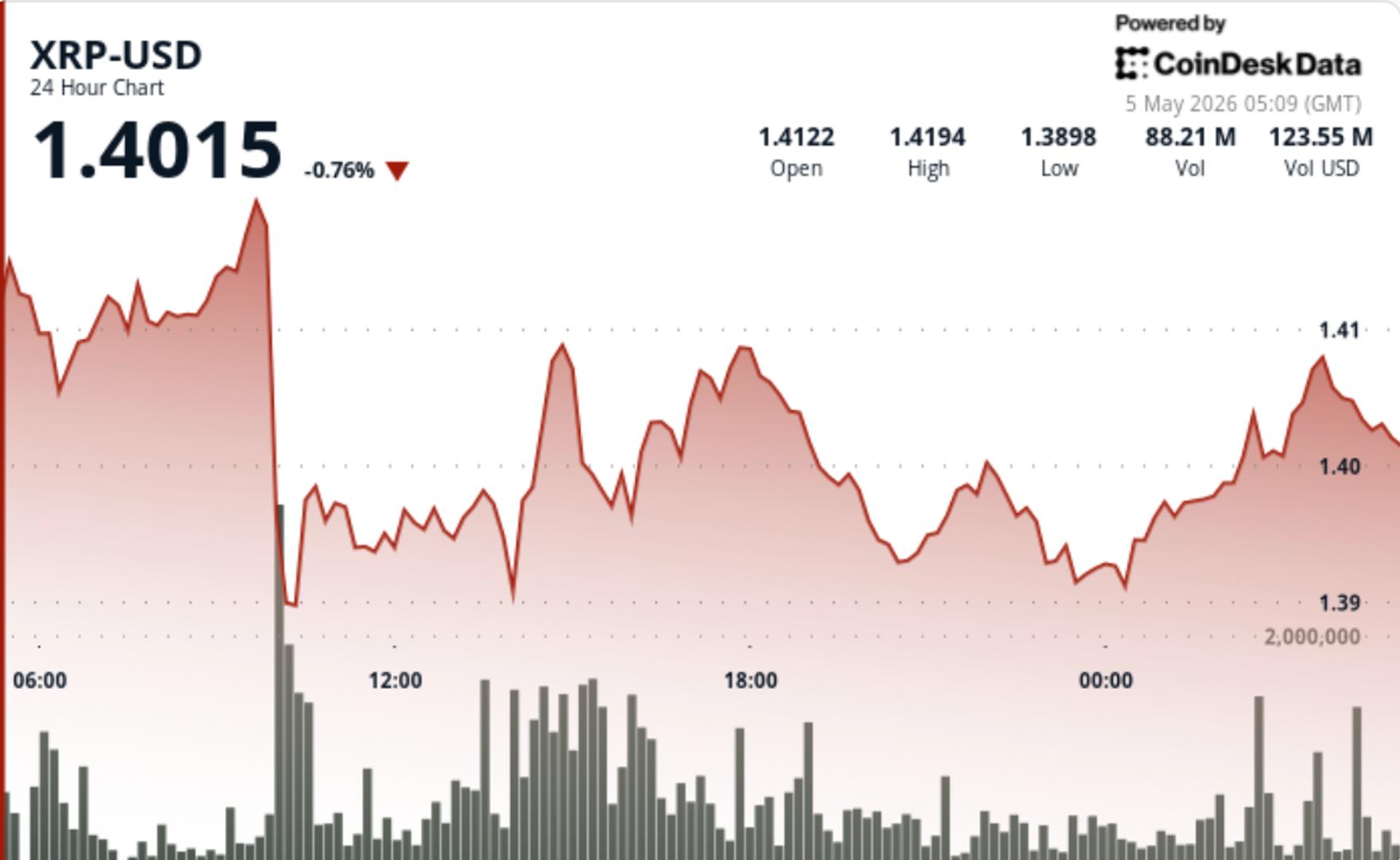
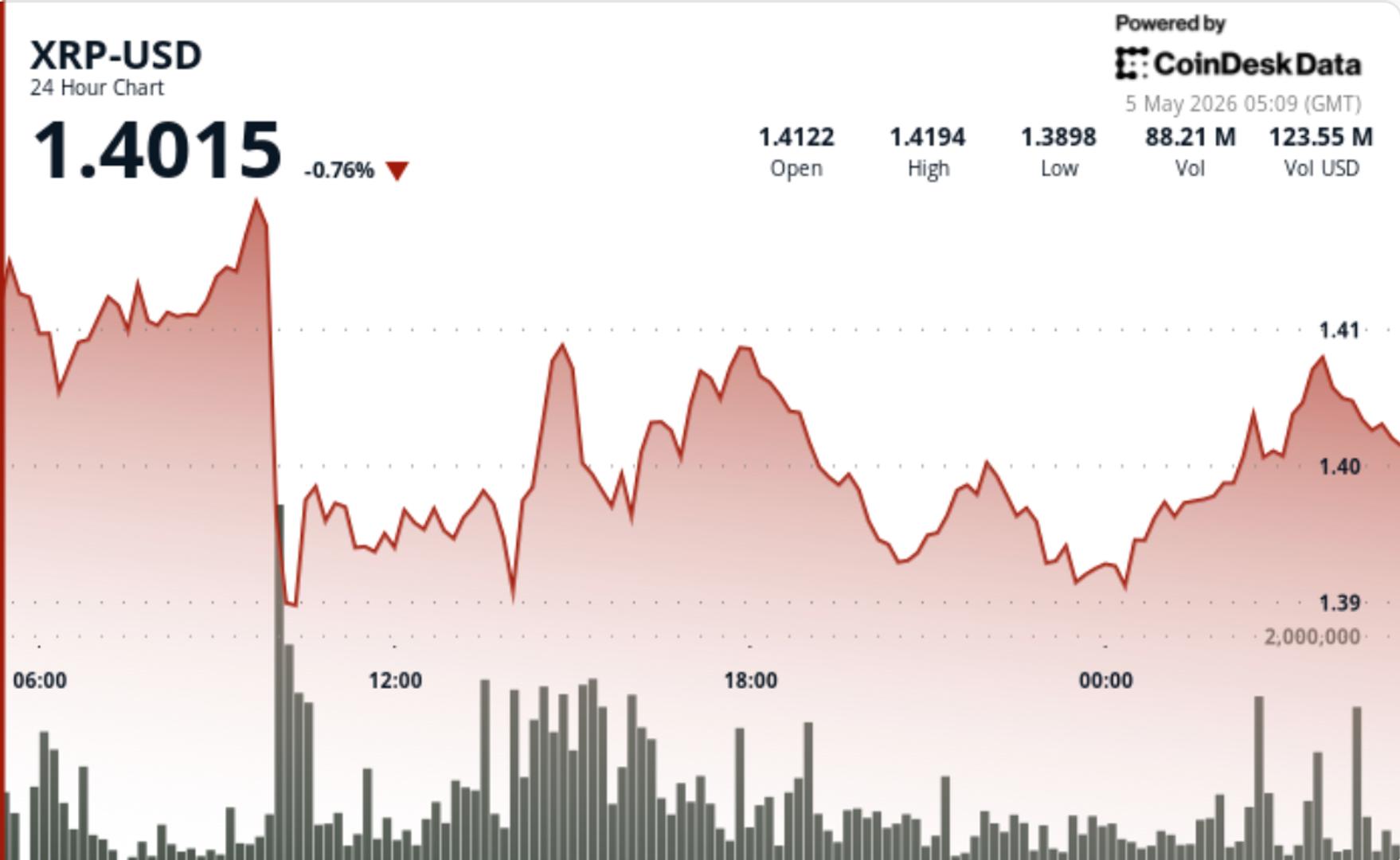
XRP slipped back under $1.40 after a high-volume break earlier in the session, but the lack of follow-through lower keeps price pinned in a tightening range where moves tend to build pressure rather than resolve it immediately.
News Background
• Broader crypto sentiment remained mixed, leaving XRP trading largely on technical structure rather than fresh catalysts.
• The market continues to rotate around key psychological levels, with $1.40 acting as a near-term pivot for positioning.
Price Action Summary
• XRP fell from $1.4109 to $1.3987, breaking below $1.40 on a 103M volume spike.
• Selling pushed price to $1.3865 before stabilizing into a narrow $1.3925–$1.4015 range.
• A late-hour push briefly reclaimed $1.40, but price failed to hold above the level into the close.
Technical Analysis
• The $1.40 level flipped from support to resistance after the breakdown, shifting short-term positioning.
• Volume was concentrated on the move lower, but faded during consolidation, suggesting selling pressure eased.
• Price is now compressing between $1.38 support and $1.41 resistance, with neither side in control.
• Momentum reset sharply during the recent drop, leaving room for expansion once direction resolves.
What traders should watch
• $1.40 remains the pivot. Reclaiming it shifts short-term bias back to upside.
• $1.41–$1.42 is the next resistance zone that needs to break for continuation.
• $1.38 is the floor. Losing it opens a move toward $1.34 and potentially $1.30.

Teni – Money (Official Visualizer)

Pep Guardiola sends title message to Arsenal after Man City draw with Everton | Football

Opinion: A taxing commerce environment

Manchester United reach agreement with Casemiro over contract clause amid transfer speculation

US brings back mandatory military draft registration

Steven Gerrard disagrees with Gary Neville over ‘shock’ Chelsea and Arsenal claim | Football


-

 Business6 days ago
Most Commercial Energy Audits Miss the Real Losses
-

 Fashion6 days ago
Kylie Jenner’s KHY Enters a New Era with ‘Born in LA’
-

 NewsBeat2 days ago
Channel 5 – All Creatures Great and Small series 7 new post
-
 Tech3 days ago
Trump’s 25% EU auto tariff breaches Turnberry Agreement that also covers semiconductors and digital trade
-
 Sports3 days ago
Paul Scholes issues Marcus Rashford reality check as agreement emerges over Man United star
-

 Crypto World7 days ago
CFTC’s AI will review U.S. crypto registration applications, chairman tells CoinDesk
-

 Business6 days ago
Barclay Brothers Avoid Bankruptcy: HSBC Drops High Court Petitions After IVA Deal
-
 Business5 days ago
Tesla Officially Registers Elon Musk’s Stock: What Investors Need to Know
-
 Crypto World7 days ago
Robinhood Phishing Scam Exploits Gmail Dot Feature to Bypass Security
-

 Tech7 days ago
Get Ready for More Brain-Scanning Consumer Gadgets
-

 Business4 days ago
Two Powerball Tickets Split $143 Million Jackpot in Indiana and Kansas
-

 Tech5 days ago
Texas Instruments made a new flagship graphing calculator: the TI-84 Evo
-
 Crypto World4 days ago
CoreWeave (CRWV) Stock Climbs 8% Despite $45M Insider Share Dump
-
Business2 days ago
Winning Numbers Drawn as Jackpot Resets to $20 Million
-
Crypto World5 days ago
Securitize and Computershare Enable Tokenized Equity Issuance for Over 25,000 U.S.-Listed Stocks
-

 Crypto World5 days ago
Gibraltar Proposes Tokenized Funds Regulation to Bolster Compliance
-

 Fashion2 days ago
Mary J. Blige Vegas Residency Looks: Crystal-Embellished Fjolla Haxhismajli, Todd Fisher, and More!
-
 Tech5 days ago
Official SAP npm packages compromised to steal credentials
-
 Crypto World7 days ago
Bitcoin (BTC) Price Action: Analysts Project $85K Rally Despite Current Consolidation Near $77K
-
 Tech7 days ago
Acer Swift 16 AI (2026) Review: Where Do Your Hands Go?
You must be logged in to post a comment Login