
Crypto World
Why is the crypto market dropping today? (March 27)



The crypto market continued its downtrend on Friday as hopes of peace in the U.S. and Iran faded following a breakdown in diplomatic talks.
Summary
- Crypto market extended losses as fading U.S.–Iran peace hopes pushed Bitcoin below key support and triggered nearly $300 million in liquidations.
- Escalating Middle East tensions and surging oil prices fueled inflation fears, raising expectations of tighter Federal Reserve policy.
- Investors rotated into safe-haven assets like gold while equities and crypto-related stocks declined amid a broader risk-off sentiment.
Bitcoin (BTC), the world’s largest crypto asset, lost the $70,000 psychological support, falling to $68,560 at press time, down 2.8% over the day. Ethereum (ETH) fell 3.9% to $2,050 while other major cryptocurrencies such as BNB (BNB), XRP (XRP), Solana (SOL), and Dogecoin (DOGE) posted losses between 2% and 4% respectively.
Some of the top laggards of the day were Siren (SIREN), Rain (RAIN), and Provenance Blockchain (HASH), which recorded double-digit losses of 42%, 13%, and 10%. The total crypto market cap fell 1.6% over the day to $2.43 trillion.
As crypto prices fell, the market suffered nearly $300 million in liquidations over the past 24 hours, with $254 million coming from long liquidations, reflecting the dominance of sellers. The Crypto Fear and Greed Index reading fell to 28, reflecting fear amidst investors who seem to be taking a risk-off stance amid market uncertainty.
The crypto market continued to remain bearish amid reports that the United States could be considering deploying 10,000 additional troops in the Middle East to bolster defenses against Iran. This followed after Tehran rejected the latest ceasefire proposal to end hostilities, as it called it an infringement on their sovereignty.
The ongoing geopolitical friction between the two nations has led to a blockade at the Strait of Hormuz, a key maritime choke point, leading to significant oil supply chain disruptions. This has resulted in soaring crude oil prices, sparking concerns of runaway inflation across the globe.
Notably, WTI crude oil prices soared by over 31.6% the past month to over $93, while Brent oil surged 38% to over $107. Iranian officials have even threatened to push prices as high as $200.
Expectations of sky-high inflation as a result of the energy war could force the U.S. Federal Reserve to take on stricter monetary policies as they pivot back to data-dependent decision-making on interest rate cuts.
While the Fed decided to keep interest rates unchanged at 3.50% to 3.75% during the March meeting, growing concerns of higher inflation could shift the odds in favor of a rate hike, a U-turn from the narrative observed before the Middle East war erupted.
Despite these separate reports suggesting that US President Donald Trump is prepared to extend the current pause on military action by another 10 days amid shaky peace negotiations, the market remains on edge.
Capital rotation to traditional safe-haven assets
Crypto prices dropped as investors seem to be rotating their capital into gold, which is touted as the ultimate safe-haven asset. After falling below key levels on Thursday, gold prices rebounded back above $4,400, up nearly 2% today. In comparison, silver outperformed with gains of 3% during the same period.
Several Asian tech stocks, such as Japan’s Nikkei, South Korea’s Kospi, and Hong Kong’s Hang Seng, also slumped as investor appetite for risk assets was severely dampened. Cryptocurrencies share a high correlation with these traditional equity indices.
Outside of the crypto market, several top tech companies such as Nvidia, Microsoft, and Amazon saw their valuations trimmed. Crypto-related stocks such as Coinbase (COIN), Circle (CRCL), and Strategy (MSTR) also faced selling pressure.
However, the deepest impact was felt by bitcoin miners such as Marathon Digital and Riot Platforms, which have seen their margins squeezed by rising energy costs and the broader market retreat.
Disclosure: This article does not represent investment advice. The content and materials featured on this page are for educational purposes only.


Key Highlights
- Shares closed down 11.37% at $688.80 Thursday, then climbed 1.50% to $699.10 after hours.
- Company disclosed plans for a 240,000-square-foot Greensboro, NC production site purchased from Qorvo, with operations expected by mid-2028.
- NVIDIA named as a confirmed customer through existing strategic supply agreements linked to the facility.
- Previous quarter showed Lumentum exceeding EPS forecasts ($1.67 actual vs. $1.41 projected) while revenue jumped 65.5% annually to $665.5M.
- Wall Street price targets vary significantly — BNP Paribas projects $1,040 while the average consensus hovers at $575.06; company insiders offloaded approximately $38.9M in shares recently.
Shares of Lumentum Holdings (LITE) experienced significant volatility Thursday, plummeting 11.37% before settling at $688.80. Trading volume reached approximately 6.18 million shares — representing a 4% increase over typical daily activity.
However, the semiconductor stock staged a comeback during extended trading hours. Shares climbed 1.50% to $699.10 after the company disclosed details about a significant domestic manufacturing investment.
Lumentum revealed its purchase of a 240,000-square-foot production campus in Greensboro, North Carolina, from fellow semiconductor company Qorvo. The facility will focus on manufacturing indium phosphide optical components, including continuous wave lasers and ultra-high-power laser systems utilizing 6-inch InP wafers.
Operations are scheduled to reach full capacity around mid-2028. Chief Executive Michael Hurlston noted that clients are “constructing the technological backbone that will shape the future generation of computing.”
NVIDIA received confirmation as a client through existing strategic partnership agreements connected to this manufacturing expansion. Debora Shoquist, NVIDIA’s EVP of Operations, stated the development “reinforces supply chain reliability and enables us to address increasing infrastructure requirements with assurance.”
The after-hours recovery indicates investors interpreted Thursday’s selloff as an attractive entry point rather than evidence of underlying business deterioration.
Impressive Financial Performance and Upgraded Outlook
Lumentum’s latest quarterly earnings provided substantial reasons for investor confidence. The firm reported earnings per share of $1.67, surpassing Wall Street’s $1.41 consensus by $0.26.
Total revenue reached $665.5 million — representing a 65.5% increase compared to the same period last year and exceeding analyst expectations of $646.74 million. Management issued Q3 2026 EPS guidance ranging from $2.15 to $2.35.
Despite this positive momentum, shares have retreated from their 52-week peak of $808.80. The stock nevertheless trades 84% higher than its 52-week bottom of $45.66, with an extraordinary 941.90% gain over the trailing twelve months.
Current pricing remains substantially above key technical indicators — the 50-day moving average sits at $567.66 while the 200-day moving average rests at $363.11, both considerably beneath today’s levels.
Wall Street Remains Divided
Analyst perspectives vary considerably. BNP Paribas maintains a bullish $1,040 price objective, suggesting roughly 47% appreciation potential from present valuations.
Morgan Stanley kept its Equal-Weight stance while increasing its target from $520 to $595. Mizuho holds an “outperform” recommendation with a $645 price goal.
The aggregated view from 19 Wall Street analysts indicates a “Moderate Buy” rating with a mean price target of $575.06 — presently trading below the stock’s current market value.
Regarding insider activity, company executives have disposed of approximately 65,775 shares valued at roughly $38.9 million during the previous 90-day period. Institutional investors control about 94% of outstanding shares.
LITE’s relative strength index registered 52.34 entering Friday’s session, with the company’s total market capitalization standing near $49.18 billion.

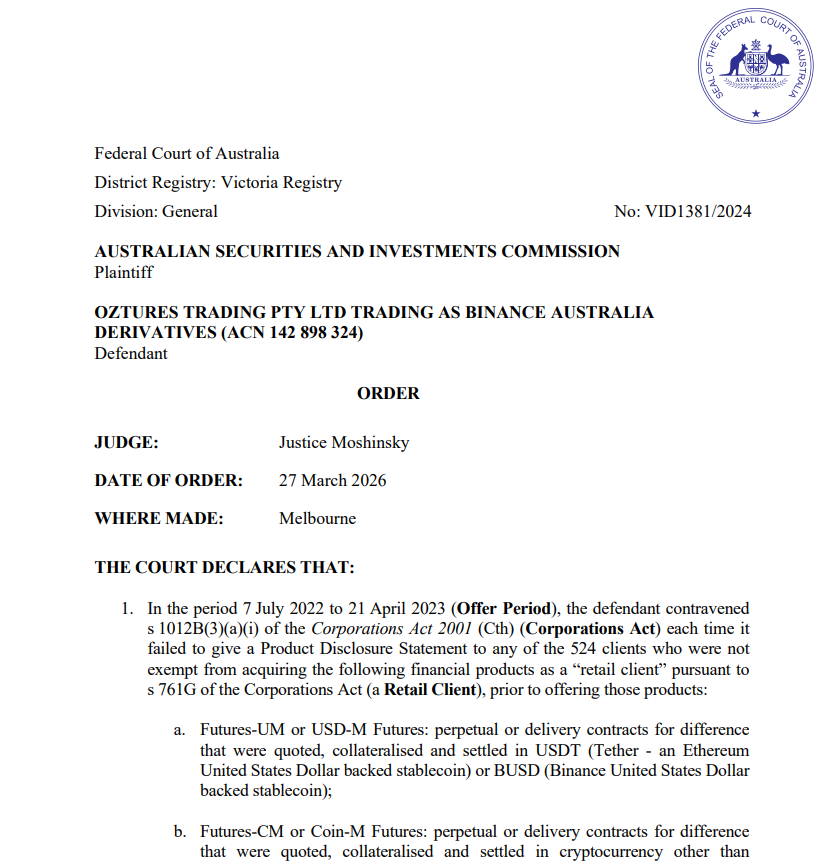
An Australian court ordered Binance Australia Derivatives to pay $6.9 million after misclassifying retail clients and exposing them to high-risk crypto products.
The Federal Court of Australia has ordered Oztures Trading Pty Ltd, trading as Binance Australia Derivatives, to pay a 10 million Australian dollar ($6.9 million) penalty after the company admitted to misclassifying more than 85% of its Australian client base and exposing retail investors to high-risk crypto derivatives without required protections.
The Australian Securities and Investments Commission (ASIC) said the affected group included 524 retail investors who were wrongly treated as wholesale clients between July 2022 and April 2023. Those clients later incurred $6.3 million in trading losses and paid $2.6 million in fees.
Binance also admitted in a statement of agreed facts to multiple compliance failures, including not providing product disclosure statements to retail clients, not making a target market determination and not maintaining a compliant internal dispute resolution system.
The penalty comes on top of the around $9 million in compensation that Binance’s local derivatives unit was ordered to pay to affected clients in November 2023.

Binance did not immediately respond to Cointelegraph’s request for comment.
Related: White House clears review of proposal to allow crypto in 401(k) retirement plans
This is a developing story, and further information will be added as it becomes available.
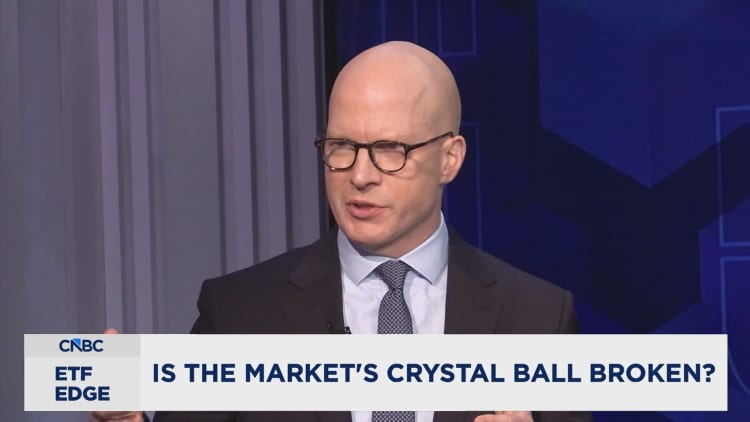

Investors may want to take a step back as stocks swing amid rising geopolitical tensions.
DBi’s Andrew Beer suggests the market’s crystal ball is broken.
“It’s not normal for big markets to move as much as they are right now,” the firm’s managing member told CNBC’s “ETF Edge” this week. “Something is deeply wrong in the market’s ability to forecast the state of the world… The only thing we can all do as investors is: This is the moment to plan and to prepare for the worst. You hope for the best.”
Beer, who has spent more than three decades in the hedge fund industry, thinks it’s remarkable the number of stresses on the financial system over the past 12 to18 months hasn’t caused things to spin out of control.
“You just you have more geopolitical risks stacked on top of each other today [and] more economic risk factors than I remember at any time in my career,” he added.
Beer urges investors to ask themselves how they would act if a 2008 or 2022 market downturn happens again.
“These financial assets are, they’re an investment, but they’re also what you need to survive, to live on, to retire, and so it’s the very real human side of it that I hope people will focus on,” he added.
According to Beer, investing like it’s 2025 could turn into regret.
“The best thing to do in 2025 was just turn off your computer beginning of the year and come back at the end of the year, and you’ve made money, your stocks and your bonds and everything else,” he said. “It won’t continue like that. We will go through a more difficult period.”
Recent moves in gold, silver, bitcoin and crude oil underscore how difficult it has become for investors to calibrate portfolios, especially as sharp reversals unfold over short periods of time, according to Beer.
“No one has a playbook for that,” said Beer, who is also watching for signs of strain in private credit, insurance company portfolios and other corners of the market where unusual stress could begin to spread.
NovaDius Wealth Management’s Nate Geraci highlighted exchange-traded funds that are designed to offer portfolio protection — particularly managed futures ETFs.
“This is absolutely something that is a longer-term allocation, and I almost view it as portfolio insurance,” the firm’s president said in the same interview. “You want that insurance when something goes bad in the market, and maybe that’s stocks and bonds going down together.”

Key Highlights
- Unity reported preliminary Q1 revenue of $505M–$508M, surpassing its own forecast of $480M–$490M and beating the Street’s $494M estimate.
- The company boosted its adjusted EBITDA outlook to $130M–$135M from the previous $105M–$110M range, representing a 58% increase versus the prior year.
- Vector, Unity’s artificial intelligence-driven advertising platform, powered the outperformance and now represents approximately 80% of Strategic Grow segment revenue.
- The company plans to shut down the ironSource Ads Network by April 30 and has engaged advisors to divest its Supersonic game publishing division.
- Wall Street firms including Citizens, Wedbush, and William Blair maintained positive ratings, with Citizens setting a $37 price objective.
Unity Software significantly exceeded its first-quarter projections, propelling shares approximately 15% higher in early Friday trading. The company disclosed the preliminary financial results in a Thursday evening announcement.
Management now projects first-quarter revenue landing between $505 million and $508 million. This handily surpasses the company’s previous outlook range of $480 million to $490 million, as well as the Wall Street consensus estimate of $494 million compiled by FactSet. The figure represents approximately 17% growth on a year-over-year basis.
Regarding profitability, Unity anticipates adjusted EBITDA will reach between $130 million and $135 million. This significantly exceeds the company’s earlier projection of $105 million to $110 million, marking a substantial 58% climb compared to the year-ago period.
Chief Executive Matt Bromberg highlighted Vector, the company’s artificial intelligence-powered advertising solution, as the primary catalyst behind the strong performance. Vector employs machine learning to connect players with appropriate games and has been generating superior long-term returns for advertising partners, according to management.
Vector currently comprises nearly 80% of the Strategic Grow segment’s revenue. The entire Grow division is projected to generate approximately $352 million during the first quarter.
Strategic Divestitures of Underperforming Assets
Unity simultaneously revealed plans to discontinue the ironSource Ads Network, with operations ceasing on April 30. During the latest quarter, ironSource contributed merely 11% of overall revenue expansion.
Additionally, the company has retained a financial advisor to pursue strategic alternatives for its Supersonic game publishing operations. Management indicated these strategic moves will accelerate top-line growth, enhance adjusted EBITDA performance, and boost operating margins.
The restructuring initiative has garnered favorable analyst commentary. William Blair’s Dylan Becker observed that the Grow segment, once these legacy operations are removed, is already expanding at a notably faster pace than the consolidated business.
Citizens maintained its Market Outperform recommendation with a $37 valuation target. The firm highlighted that Vector’s positive momentum persists, while data integration capabilities with Vector have entered the testing phase. Unity’s in-app purchase commerce solution is also scaling up.
Wedbush reaffirmed its Buy stance with a $30 price objective. Meanwhile, BofA Securities raised Unity from Underperform to Neutral, pointing to a more balanced risk profile.
Valuation Analysis Points to Upside Potential
Unity’s earnings per share are expected to improve dramatically from -$0.96 to $1.02 during the current fiscal year, based on InvestingPro projections. Citizens anticipates EBITDA margin expansion as the high-margin Vector platform captures an increasingly larger portion of total revenue.
William Blair’s Becker emphasized that Unity’s valuation remains attractive relative to direct competitors when examining 2026 revenue and EBITDA multiples.
Separately, Unity is said to be evaluating strategic alternatives for its China operations, including a possible divestiture that could command a valuation exceeding $1 billion.

House Financial Services Committee ranking Democrat Rep. Maxine Waters sent a formal letter Thursday to Federal Reserve Bank of Kansas City President Jeff Schmid, demanding answers on why Kraken’s banking subsidiary was granted a Federal Reserve master account, and what that access actually means in practice.
Waters set an April 10 response deadline, asking Schmid to detail which Fed services Kraken can access, what restrictions apply, and what anti-money laundering and consumer protection measures were evaluated before approval.
This is not routine congressional oversight. It is a direct challenge to the legitimacy of the most consequential crypto banking decision the Federal Reserve has made.
Key Takeaways:
- Legislative Pressure: Rep. Maxine Waters has demanded the Kansas City Fed respond by April 10, outlining the scope, restrictions, and risk controls behind Kraken Financial’s master account approval.
- Kraken’s Position: Kraken Financial — a Wyoming SPDI operating under a full-reserve, no-lending model — became the first crypto-native firm to secure Fed master account access, granted as a one-year pilot on March 4, 2026.
- What’s at Stake: The account gives Kraken direct access to Fedwire, placing a crypto exchange on the same payment rails as commercial banks and credit unions — a structural shift that traditional banking groups are calling premature and opaque.
What Waters Is Actually Demanding
Congressional scrutiny of the Kansas City Fed’s approval process centers on one core complaint: the Fed disclosed almost nothing.
The Kansas City Fed’s press release explicitly cited business confidentiality as the reason for withholding details about which services Kraken can access, a stance Waters called insufficient given the stakes.

Waters wrote that “the Kansas City Fed’s announcement does not disclose specific information about Kraken’s access to the range of Federal Reserve financial services due to the confidentiality of business information provided by applicants.”
Her letter demands specifics: which Fedwire functions, what ACH access, which safeguards, and how the approval aligns with existing statutory frameworks.
The account in question is a limited-purpose, or “skinny”, master account, granting Kraken Financial Tier 3 access to Fedwire and potentially ACH for reserve holdings and settlements.
It does not include access to Fed liquidity facilities. Fed Vice Chair for Supervision Michelle Bowman described the arrangement at an American Bankers Association conference on March 11 as a learning exercise: “We’re trying to learn,” she said, acknowledging the Fed could intervene if behaviors proved inconsistent.

Kraken Financial operates as a Payward subsidiary under Wyoming’s Special Purpose Depository Institution framework, full-reserve, no lending, no FDIC insurance. Every deposit is backed 1:1. That structure was central to the approval argument, but it has not quieted critics.
Bank Policy Institute policy counsel Paige Pidano Paridon stated the approval “ignores public comment that the Federal Reserve sought on this framework, and it was issued with no transparency into the process for approval or the risk mitigants.” The Fed had closed a public comment period on a crypto payment prototype account proposal less than one month before the March 4 approval, a timeline that has amplified banking sector frustration.
What to Watch
The deeper signal is precedent. Custodia Bank, also a Wyoming SPDI, was denied a master account in 2023 after years of litigation. Kraken’s approval on the same institutional framework, without a finalized Fed policy, means the criteria for access remain effectively opaque, which is precisely what Waters is targeting.
Transparency requirements that emerge from this congressional exchange could shape whether any future crypto firm can replicate Kraken’s path, or whether this pilot becomes a one-off carve-out.
The April 10 deadline for Kansas City Fed President Schmid’s response to Waters is the immediate inflection point. If Schmid discloses detailed service access and risk protocols, it normalizes the approval and weakens the transparency critique.
If he cites confidentiality and deflects, the congressional pressure escalates, potentially triggering formal committee hearings that put the entire Fed crypto banking framework under public examination.
The one-year pilot evaluation and Kraken’s IPO timeline are moving in parallel. How the Fed answers Congress will determine whether Kraken’s master account becomes the template for crypto banking access, or the last one approved before the window closes.
The post US Lawmaker Presses Kansas Fed Over Kraken Exchange Master Account Approval appeared first on Cryptonews.


Bitcoin (BTC) remained under pressure on Friday as on-chain data showed large holders were still adding to their positions.
Summary
- Santiment said wallets holding 10 to 10,000 BTC added 61,568 Bitcoin over the past month.
- Bitcoin fell below recent highs as Bhutan-linked transfers and Middle East tensions added pressure again.
- Retail wallets with under 0.01 BTC kept buying, matching whale accumulation and delaying breakout signals.
The move came as retail wallets also kept buying, while market sentiment stayed weak amid fresh geopolitical risk and renewed selling activity from Bhutan-linked wallets.
Santiment said wallets holding between 10 and 10,000 BTC added 61,568 BTC over the past month. The firm said that amounted to a 0.45% increase in holdings, even as Bitcoin slipped to the $68,100 area during the latest pullback.
The same data showed that smaller wallets did not step back. Santiment said wallets with less than 0.01 BTC added 0.42% over the same period, a pace close to the increase seen among whales and sharks. The analytics firm said large-wallet buying usually works best for price when retail investors are reducing exposure instead of matching the move.
Santiment said the current setup has not yet produced a clear breakout. It stated that a stronger upward move has often appeared when larger holders keep accumulating and smaller traders stop chasing price.
Bitcoin price weakens after recent rejection
Bitcoin traded at $66,349 at the latest check on Friday, according to market data from the finance tool. The same data showed an intraday high of $69,789 and a daily decline of almost 5%, keeping the asset well below the $72,000 level seen earlier in the week.
The recent decline has kept traders focused on whether on-chain accumulation can offset near-term selling pressure. Market watchers have tracked a pullback from the recent rebound, with price action failing to hold near the upper end of the current range.
Bhutan-linked wallets added to that pressure this week. Reporting based on Arkham Intelligence data said the Royal Government of Bhutan moved 519.707 BTC worth about $36.75 million, pushing its 2026 outflows above $150 million.
Middle East risk keeps sentiment fragile
Geopolitical tension has also stayed in focus. Reuters reported that the Pentagon is weighing the deployment of up to 10,000 additional US ground troops to the Middle East to give President Donald Trump more military options as he considers peace talks with Tehran.
That report followed earlier Reuters coverage that thousands of additional US troops were already expected to move to the region. The buildup has added another layer of caution for risk assets, including crypto, as traders monitor the chance of wider conflict around Iran.
Disclosure: This article does not represent investment advice. The content and materials featured on this page are for educational purposes only.
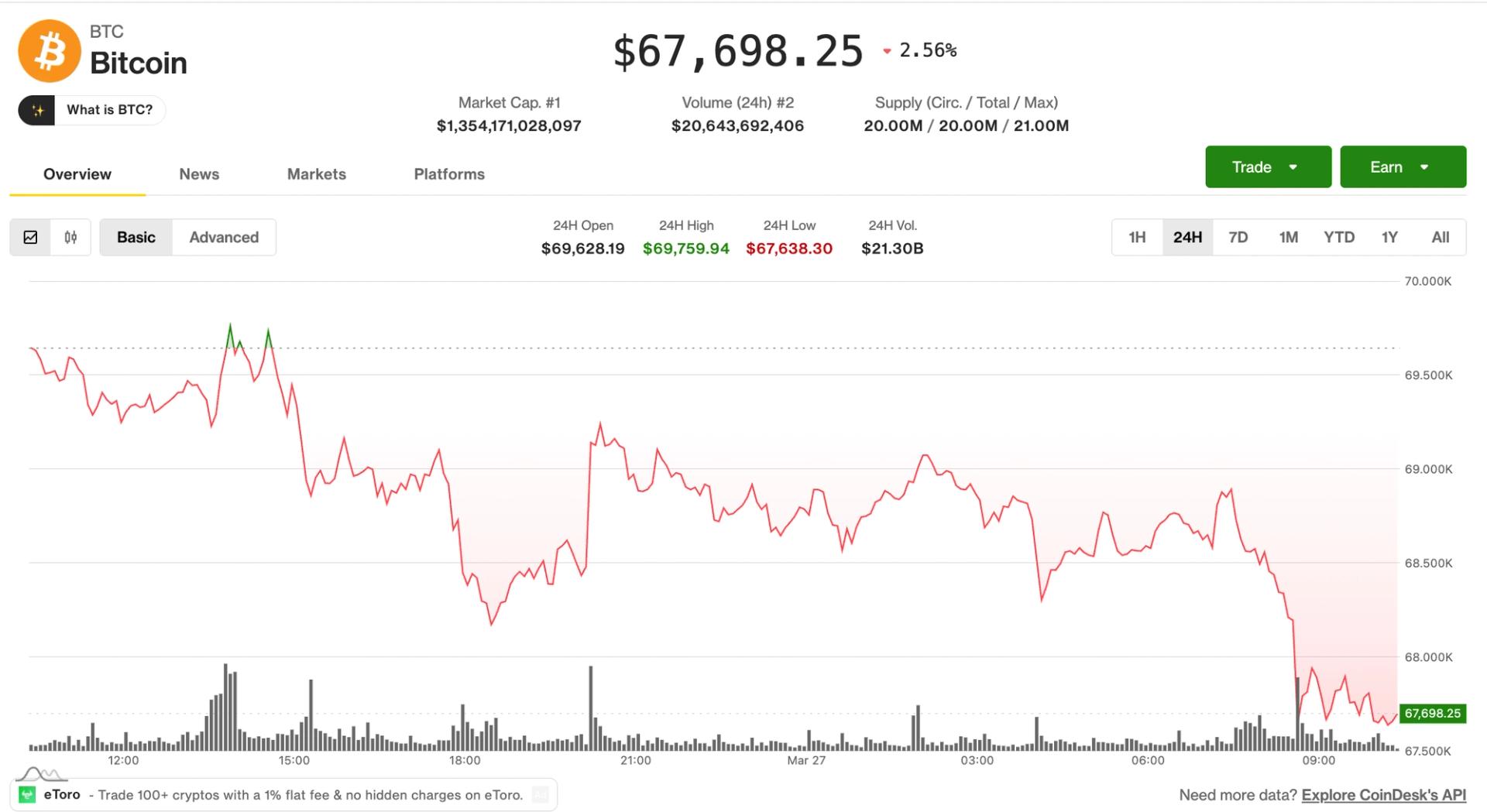
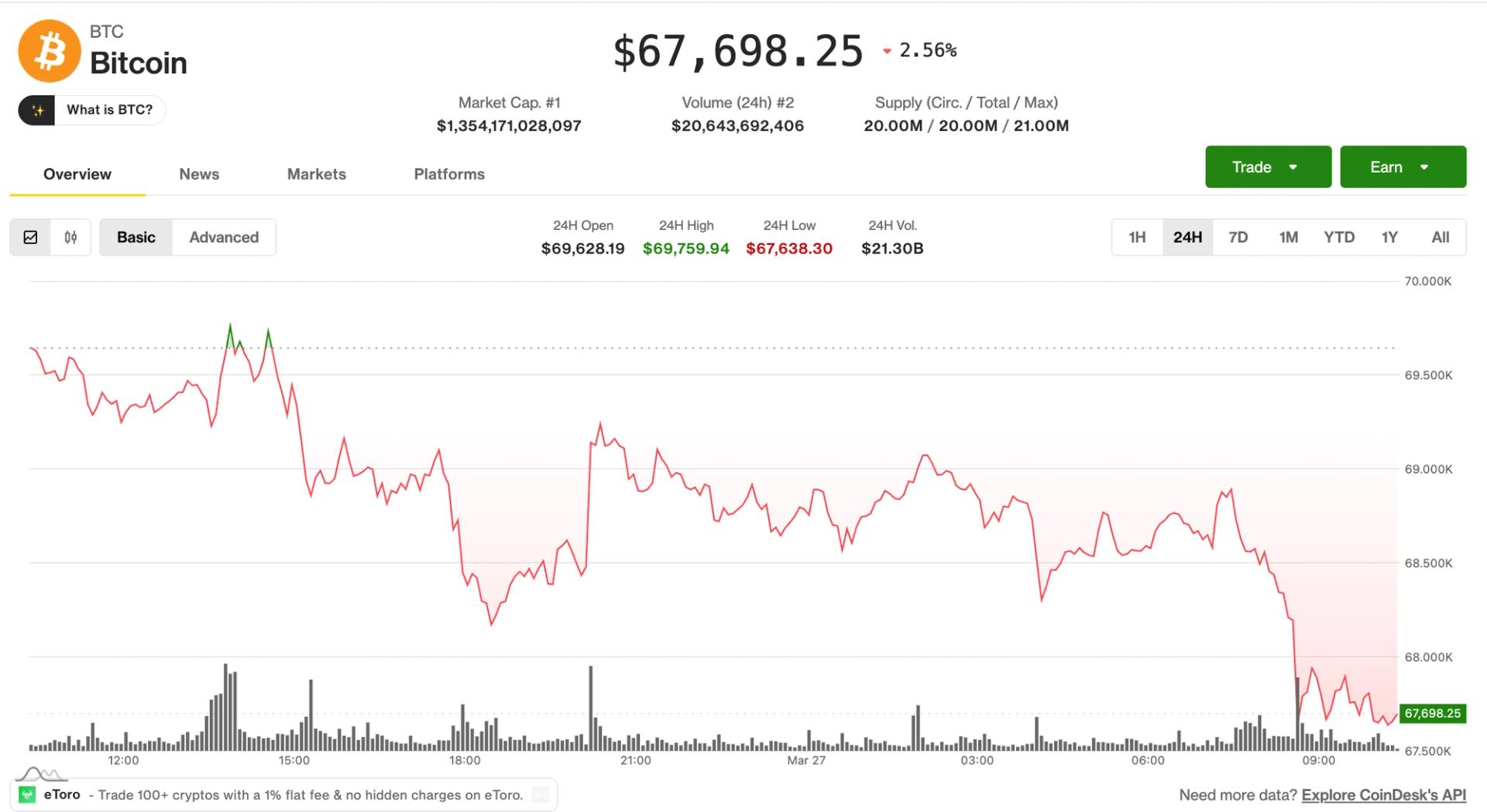
The crypto market tumbled to the lowest levels in more than two weeks, with bitcoin dropping below $67,000 and ether (ETH) closing in on $2,000. The CoinDesk 20 Index (CD20) lost 2.2% since midnight UTC, reaching its lowest since March 9.
The fall coincided with a drop in U.S. equities. Nasdaq 100 futures are now trading at 23,760, 10% below this year’s high from January.
The risk-off atmosphere was spurred by rising oil prices and fears that the war in Iran would not de-escalate as quickly as many had hoped. Oil remains above $100 per barrel, stoking inflation concerns.
Sections of the altcoin market were harder hit on Friday, with the likes of ETHFI losing 6% since midnight. WLD, WIF, SEI and FET all lost between 3.6% and 4.7%.
Derivatives positioning
- Long crypto futures bets, or bullish positions on market direction, bore the brunt of liquidations over the past 24 hours, with nearly $300 million liquidated, compared with just $50 million in short positions.
- That’s the fifth time in 10 days the longs have neared that level of punishment, an indication traders were predominantly positioned for the Iran war to translate into a price rally that has not materialized.
- XRP’s price fell over 2.5% in 24 hours, while open interest in futures has increased by 2% to 1.95 billion XRP, the most since Feb. 2.
- That combination represents renewed investor interest in shorting the falling market. Negative cumulative volume delta and sub-zero funding rates suggest the same.
- Futures tied to bitcoin, solana, dogecoin and BNB displayed an XRP-like bearish profile.
- Memecoin SHIB has the largest negative open-interest–adjusted cumulative volume delta among major tokens, signaling aggressive derisking, or shorting, by traders.
- Canton Network’s CC token stood out with positive funding rates and an increase in futures OI, both signaling growing demand for bullish exposure.
- Bitcoin and ether’s 30-day implied volatility indices, BVIV and EVIV, continued to drop despite weak spot prices, suggesting that traders aren’t panicking yet and do not anticipate a turbulent selloff.
- On Deribit, bitcoin options worth over $15 billion expired early Friday. So, the supposed expiry-related price magnet of $75,000 is no longer valid, which opens doors for deeper declines amid a worsening macro outlook.
- Bitcoin and ether puts are again trading at 6 to 8 volatility premium to calls across all expirations, risk reversal shows. It indicates sticky demand for downside protection.
Token talk
- The altcoin market showed its fragility again on Friday, failing to cling on to key levels of support in a low-liquidity trading environment.
- The CoinDesk Computing Select Index (CPUS) was the worst-performing benchmark, tumbling by 2.3% while the bitcoin-dominant CoinDesk 20 (CD20) dropped 1.2%.
- One token that bucked the bearish trend was ONDO, which rose after Ondo Finance, an asset management company, said it agreed to tokenize five Franklin Templeton exchange-traded funds (ETFs) and bring them to the Ondo Chain.
- The token is up by more than 8% in the past 24 hours, although it gave back some of those gains since midnight UTC.
- The average relative strength index (RSI) across all crypto tokens remains neutral despite the selloff, suggesting further declines are likely on Friday.
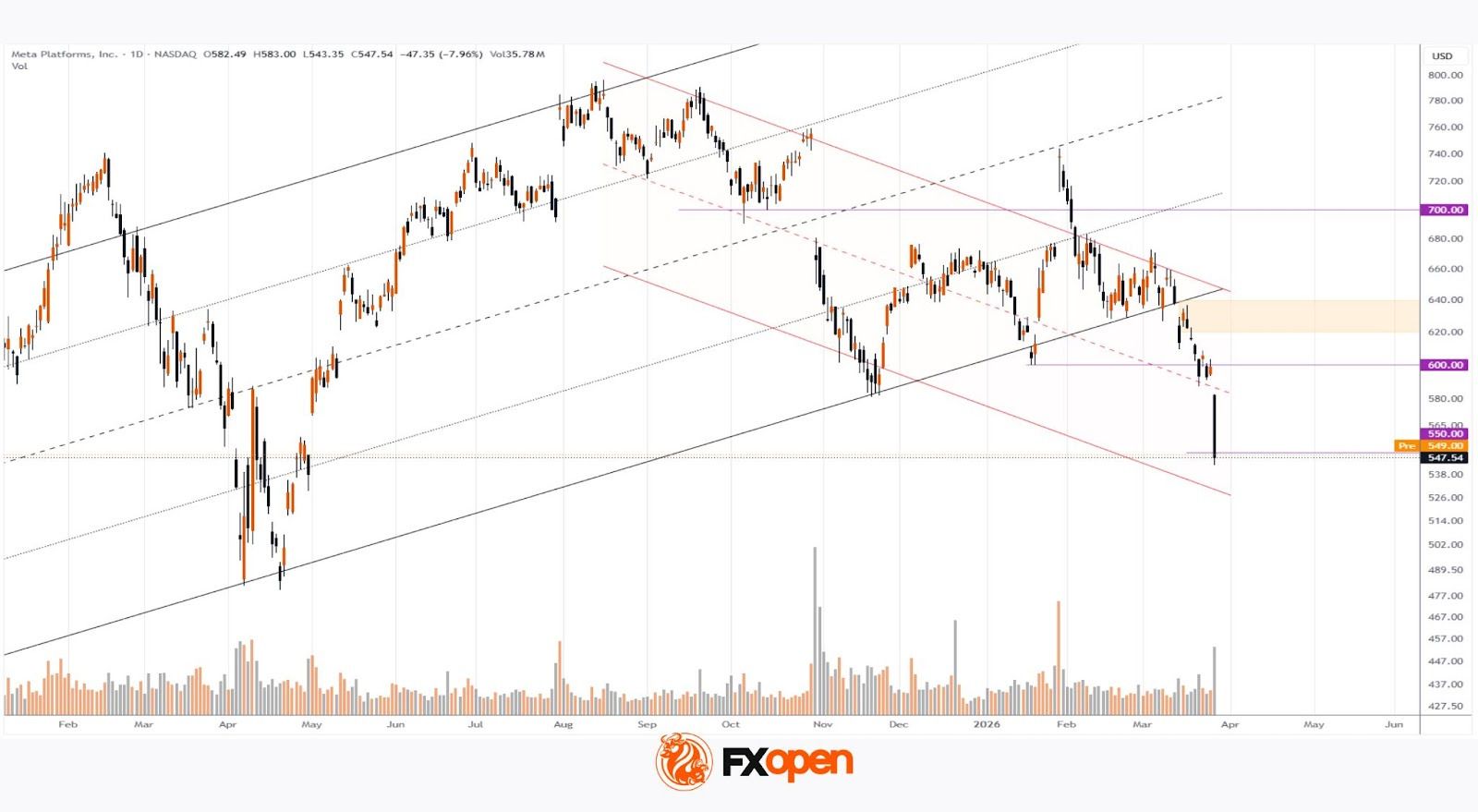
Yesterday, shares of Meta Platforms saw a sharp decline, dropping by approximately 8%, with trading closing below the $550 level for the first time since late April 2025.
Why META Shares Declined
The move was driven by a combination of factors, including:
→ Jury ruling. According to media reports, a jury ordered Meta to pay $375 million for misleading parents about the safety of Instagram and Facebook. The court also found the company liable for developing addictive algorithms that harm teenagers’ mental health.
→ Confirmed capital expenditure (CapEx) for 2026 in the range of $115–135 billion. Significant funds are being directed towards energy infrastructure, including a 6.6 GW nuclear energy deal to power the Prometheus supercomputer. The market may question whether returns on AI investments will justify such large-scale spending.
Sentiment has also been weighed down by reports of plans to cut up to 20% of the workforce. While layoffs are typically viewed positively due to cost savings, in this case they may signal that profit margins are being squeezed more than expected due to AI-related expenditure.
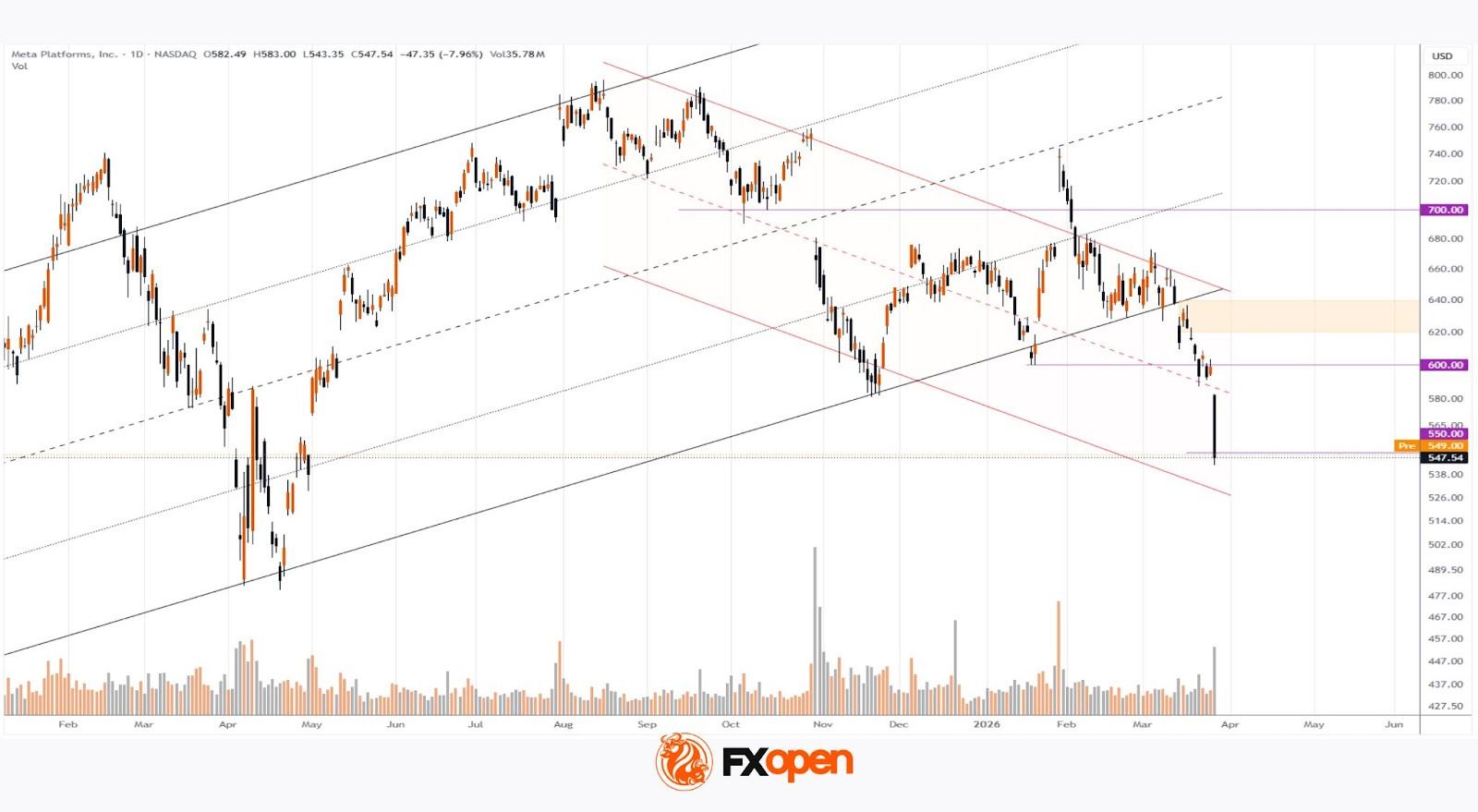
Technical Analysis of META
At the end of January, we:
→ constructed a system of two trend channels;
→ noted that META’s share price had moved above the psychological $700 level.
As it turned out, this was a bull trap formed in the wake of strong quarterly earnings. In early February, the price fell towards the lower boundary of the long-term ascending channel, and by the 13th, that boundary was broken under selling pressure.
As a result, the upward trajectory is losing relevance, giving way to the previously identified descending trend channel. In this context, the bearish breakout zone at $620–640 may now act as resistance, where sellers previously showed strength.
Additionally, it is worth noting that:
→ the psychological $600 level has lost its role as support;
→ yesterday’s candle featured a wide body with a close near the low, accompanied by high volumes — a clear sign of heavy selling pressure.
Against this backdrop, it cannot be ruled out that continued bearish control may push META’s price towards the lower boundary of the red channel.
Buy and sell stocks of the world’s biggest publicly-listed companies with CFDs on FXOpen’s trading platform. Open your FXOpen account now or learn more about trading share CFDs with FXOpen.
This article represents the opinion of the Companies operating under the FXOpen brand only. It is not to be construed as an offer, solicitation, or recommendation with respect to products and services provided by the Companies operating under the FXOpen brand, nor is it to be considered financial advice.
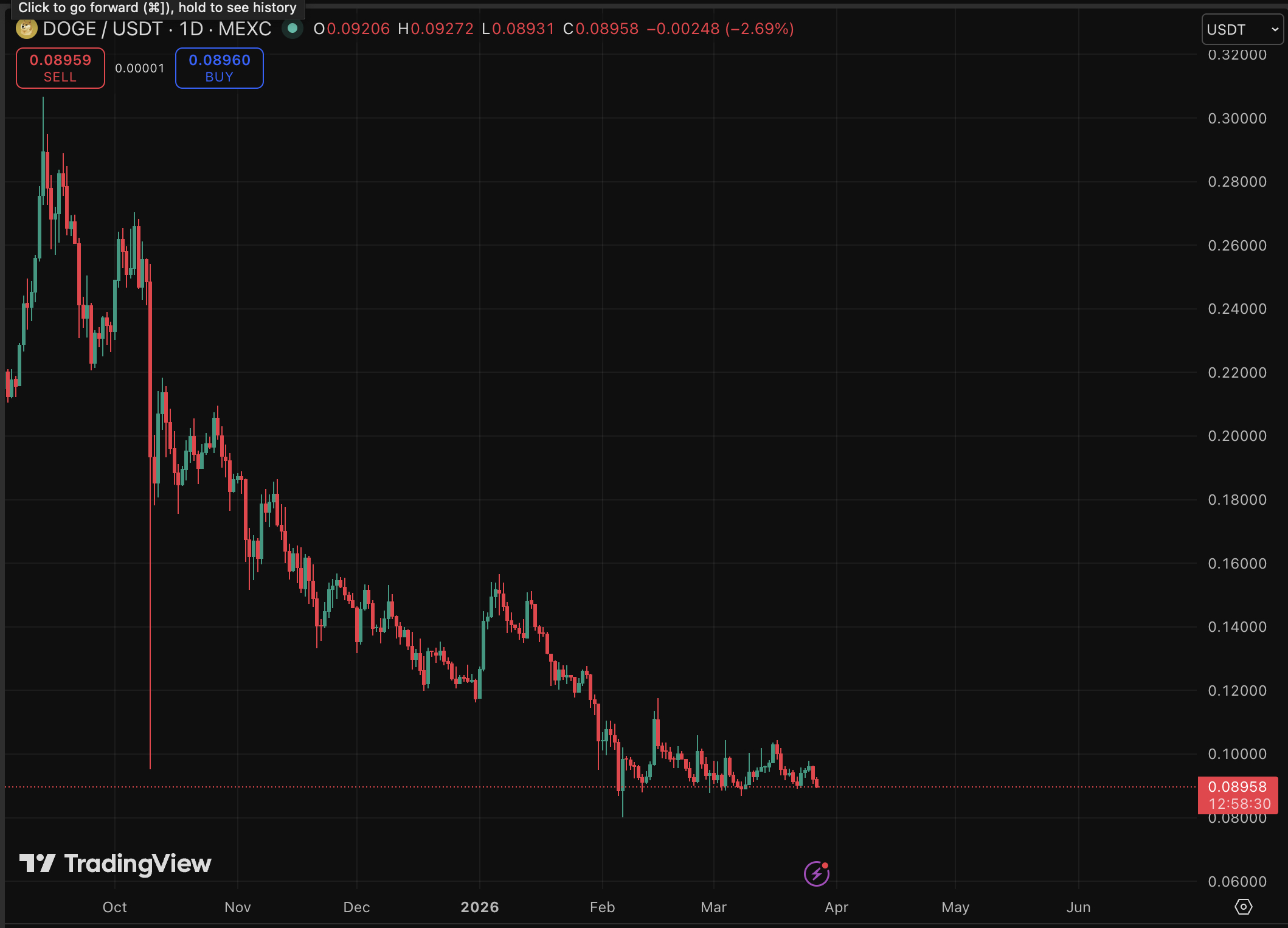
DOGE price is sliding to just 9 cents after a 2% drop in 24 hours, bleeding through support, while the broader crypto market also shed 3% to settle at under $2.4 trillion in total capitalization, and the prediction might get uglier. The Elon Musk wildcard leaves traders asking who, exactly, is buying this dip.
On-chain data offers a partial answer. Kraken users snapped up nearly 7.6 million DOGE tokens within a single hour window as prices retreated.
However, eight consecutive days of zero net ETF flows tell a different story at the institutional level: neither commitment nor panic, just paralysis. Blockchain behavior and ETF data are pointing in opposite directions, which rarely stays comfortable for long.
The buy dominance metric shows aggressive purchase orders have outpaced selling pressure across major spot venues for the entire prior 90-day period. With technical indicators flashing warning signs and no major catalyst on the immediate horizon, the next 72 hours could define DOGE’s directional bias for Q2.
Discover: The best crypto to diversify your portfolio with
DOGE Price Prediction: Can Dogecoin Price Reclaim $0.1 Before the Death Cross Takes Hold?
DOGE is clinging to its $0.087–$0.092 accumulation zone, a range that has so far absorbed selling pressure and where large holders appear to be building positions. A death cross has formed, with shorter-term moving averages crossing beneath longer-term counterparts, a pattern alongside a downward-sloping EMA 50 and EMA 100 that keeps medium-term momentum firmly negative.

Bulls need a close above $0.094 (EMA 20) to shift momentum. Clear that level and the next meaningful targets stack at $0.103 (EMA 50) and $0.123. Fail to hold $0.093, and the floor drops toward $0.0884.
Projection put the 2026 range of $0.0891–$0.2049 with an average of $0.116, optimistic against the current structure, but not impossible if sentiment turns. The path to $0.116 from $0.091 implies a 27% move.
Discover: The best pre-launch token sales
Maxi Doge Targets Early-Mover Upside as Dogecoin Tests Key Levels
DOGE at $0.091 offers a defined setup, but a $13.3 billion market cap means a 10x from here requires moving the entire meme coin market. That math frustrates traders who want asymmetric exposure. Established assets rarely deliver multiples.
That’s the gap Maxi Doge ($MAXI) is pitching into. The ERC-20 meme token positions itself as the gym-bro evolution of DOGE culture, a 240-lb canine juggernaut built around 1000x leverage trading mentality, holder-only trading competitions with leaderboard rewards, and a Maxi Fund treasury allocated to liquidity and partnerships. The tagline: Never skip leg-day, never skip a pump.
The presale has raised more than $4.7 Million at a current price of $0.000281, with huge 66% staking APY available to participants.
Visit Maxi Doge here, and join the maximum velocity community.
This article is not financial advice. Cryptocurrency investments are highly volatile. Always conduct your own research before investing.
The post DOGE Price Prediction: Big Holders Accumulate, Elon Musk? appeared first on Cryptonews.


Vietnamese authorities have opened a wide fraud case tied to the ONUS crypto ecosystem after detaining several suspects and accusing them of using token promotions and controlled trading to take investor funds.
Summary
- Vietnam detained ONUS-linked suspects after police alleged token promotions and market control were used deceptively.
- Authorities said the case involved VNDC, ONUS, and HNG tokens promoted through the platform directly.
- Vemanti said it hired US legal counsel after reports named two board members in indictments.
The case puts fresh focus on crypto enforcement in one of the world’s busiest retail digital asset markets.
Vietnam’s Ministry of Public Security launched criminal proceedings on March 23 over alleged “appropriating property through computer networks” and “money laundering” linked to the ONUS ecosystem, according to local reporting that cited the ministry’s investigation agency. The probe covers Hanoi and several other provinces and cities.
Authorities named several suspects in the case, including Vuong Le Vinh Nhan, Tran Quang Chien, and Ngo Thi Thao, based on Vietnamese reports. Investigators say the group promoted and traded tokens through the ONUS platform while keeping control over supply, demand, and pricing.
Investigators allege the group used promotions and coordinated trading activity to present certain tokens as real investment products while managing their markets from the center. Local reports said the case involves tokens such as VNDC, ONUS, and HNG.
Vietnamnet reported that police view the matter as one of the country’s largest cybercrime investigations tied to digital assets. Authorities have not published a full public breakdown of investor losses, though reports on the case said the scheme drew in funds worth billions of US dollars.
Vemanti Group said it learned through the ministry’s announcement and local media that Nhan Vuong, its board chairman, and Chien Tran, a board member, had been indicted. The company said it had received no earlier notice from authorities in any jurisdiction before the public reports appeared.
Vemanti added that it had hired US legal counsel to review the matter. The statement linked the investigation to ONUS Pro, the platform at the center of the Vietnam case.
Vietnam’s crypto market faces more fraud scrutiny
The case lands at a time when Vietnam remains a major crypto market. Chainalysis ranked Vietnam fourth in its 2025 Global Crypto Adoption Index, placing it among the world’s most active countries for grassroots digital asset use.
Regional enforcement has also widened beyond Vietnam. In India, the CBI said it arrested a Mumbai-based suspect accused of sending people to scam compounds in Myanmar, where trafficked victims were allegedly forced to run online fraud, including cryptocurrency investment scams and romance scams.

UK growth forecast cut to 0.7% as OECD warns Iran war impact will be worst among G20
Lumentum (LITE) Stock Plunges 11%, Then Rebounds on NVIDIA Partnership Announcement

Best Cute Sex Toys 2026: Aesthetic Vibrators And Novelty Pleasure Tech For Your Nightstand


-
 Crypto World7 days ago
NIO (NIO) Stock Plunges 6.5% as Shelf Registration Sparks Dilution Worries
-
 NewsBeat2 days ago
Manchester United reach agreement with Casemiro over contract clause amid transfer speculation
-

 Fashion7 days ago
Weekend Open Thread: Adidas – Corporette.com
-

 Politics7 days ago
Jenni Murray, Long-Serving Woman’s Hour Presenter, Dies Aged 75
-

 Crypto World6 days ago
Best Crypto to Buy Now: Strategy Just Spent $1.57 Billion on Bitcoin During Fear While Early Investors Quietly Enter Pepeto for 150x Potential
-

 Crypto World6 days ago
Bitcoin Price News: Bhutan Sells $72 Million in BTC Under Fiscal Pressure, but the Smart Money Entering Pepeto Sees What the Market Does Not
-

 News Videos1 day ago
Parliament publishes latest register of MPs’ financial interests
-

 Sports4 days ago
Remo Stars and Kano Pillars Strengthen Survival Hopes in NPFL
-

 Sports4 days ago
Gary Kirsten Accuses Pakistan Cricket Board Of ‘Interference’, Mohsin Naqvi Responds
-

 Tech5 days ago
Give Your Phone a Huge (and Free) Upgrade by Switching to Another Keyboard
-

 Business5 days ago
No Winner in March 21 Drawing as Prize Rolls to $133 Million for Next
-

 Sports7 days ago
2026 Kentucky Derby horses, odds, futures, preview, date: Expert who nailed 12 Derby-Oaks Doubles enters picks
-

 Tech5 days ago
AI enters the chat: New Seattle dating app relies on tech to facilitate meaningful human connections
-

 News Videos4 days ago
Ch 9 Financial Management Part 1 | Detailed One Shot | Class 12 Business Studies Boards 2026
-
Business7 days ago
Columbia Sportswear enters $500 million credit agreement with JPMorgan Chase
-

 Tech5 days ago
Today’s NYT Connections Hints, Answers for March 22 #1015
-

 Business15 hours ago
Instagram, YouTube Found Responsible for Teen’s Mental Health Struggle in Historic Ruling
-
 Crypto World7 days ago
Small-cap Russell 2000 enters correction territory
-

 Business5 days ago
Will Duke Basketball Win It All? Duke Basketball Enters Second Round as Third Favorite to Claim NCAA Title
-

 Sports4 days ago
2026 Kentucky Derby horses, odds, futures, preview, date: Expert who hit 12 Derby-Oaks Doubles enters picks
You must be logged in to post a comment Login