
Crypto World
why Pi Network’s social dominance is not converting to demand



Pi Network tops crypto social dominance rankings while trading 97% below its all-time high. The gap between the project’s 60 million users and its $0.09 price reveals a structural disconnect between community attention and market demand.
Summary
- Santiment data shows Pi Network leading crypto social dominance rankings for multiple weeks in mid-2026, yet PI trades near $0.09, down more than 97% from its February 2025 all-time high of $3.00.
- Roughly 1.21 billion PI tokens are scheduled to unlock across 2026 at a rate of approximately 6.5 million per day, all mined at zero cost, creating persistent sell pressure that social buzz alone cannot absorb.
- Binance and Coinbase have not listed PI despite an 86.8% community vote in Binance’s case, leaving the token without access to the two largest retail order books in crypto.
- Historical precedents from ICP, EOS, and XRP show that large communities can sustain social noise indefinitely without translating it into price appreciation when structural supply and liquidity barriers remain in place.
- The ESMA white paper registration and the approaching Protocol 27 “final planned upgrade” remove specific objections but do not address the core disconnect: social activity measures attention, not demand.
Pi Network has spent much of 2026 as one of the most discussed tokens in crypto. By several on-chain social metrics, it is the most discussed. Santiment’s social dominance tracker, which measures the share of total crypto conversation that a single asset captures, has shown PI at or near the top for multiple weeks running. The project’s Telegram groups remain among the largest in crypto. Its X mentions routinely outpace tokens with ten times its market capitalization. On Reddit, Pi Network threads generate more engagement than coverage of most top-20 assets.
None of this has moved the price.
PI sits near $0.09 as of mid-August 2026, roughly 97% below the $3.00 peak it reached during the euphoria of its open mainnet launch in February 2025. The market capitalization hovers just below $1 billion. Daily trading volume rarely exceeds $15 million, a number that would be unremarkable for a token ranked in the 200s, let alone one that claims 60 million users. The gap between Pi’s social presence and its market performance is not a mystery waiting to be solved. It is a case study in the mechanics of why attention, community size, and online engagement do not automatically convert to buying pressure.
This article examines those mechanics. For readers looking for the regulatory and protocol upgrade picture, crypto.news has covered that angle separately in a feature on Protocol 27 and its implications. The focus here is narrower and, for holders, possibly more uncomfortable: what specifically breaks the transmission mechanism between social buzz and token price, and whether Pi’s version of this problem is fixable.
The social dominance paradox
Social dominance in crypto analytics refers to the percentage of total social media mentions across the industry that a single token captures. When Santiment shows Pi Network at number one, it means more people are talking about PI on Twitter, Telegram, Reddit, and other tracked platforms than about Bitcoin, Ethereum, or Solana. That is a remarkable achievement for any asset, and it is especially notable for one trading under ten cents.
The instinct is to treat social dominance as a leading indicator. If enough people are talking about a token, the logic goes, some of them will buy it, and price follows attention. This model works in specific conditions: when the token is liquid, when it trades on exchanges that the audience actually uses, and when the social activity reflects new interest from participants who do not already hold the asset. Pi meets none of these conditions cleanly.
The 60 million Pioneers who make up Pi’s user base are not passive observers discovering a new token. They are existing holders, many of whom have been mining PI on their phones for years. When they post about Pi on social media, they are not signaling fresh demand. They are expressing existing conviction. The social dominance metric captures the volume of their voices without distinguishing between a thousand new buyers researching a token and a million existing holders defending their position.
This distinction matters because social dominance correlates with price only when it reflects capital rotation. When Bitcoin’s social dominance spikes during a halving cycle, it typically coincides with new retail and institutional money entering the market. When a meme token trends on X, it often reflects a burst of speculative buying from traders who did not hold the asset before. Pi’s social activity is structurally different. It is a closed loop of community engagement that rarely intersects with the order books where price is actually determined.
Supply at zero cost: the 1.21 billion token overhang
The most direct explanation for why social buzz does not move PI’s price is mechanical: the supply side overwhelms any demand the community generates.
Pi Network’s token unlock schedule for 2026 releases roughly 1.21 billion tokens into circulation over the course of the year. That works out to approximately 6.5 million new tokens per day, every day, regardless of whether anyone is buying. An additional 775 million tokens are expected to enter the market as three-year lockup periods expire. The total circulating supply already exceeds 11 billion tokens.
The critical detail is the cost basis. Every one of these tokens was mined for free on a mobile phone. The holders paid nothing to acquire them. In any market, when a large number of participants hold an asset at zero cost, the rational behavior is to sell at any price above zero. Not all holders will sell. But enough will sell, consistently, to create a permanent headwind that requires substantial new buying to overcome.
Consider the math. At $0.09 per token, 6.5 million daily unlocks represent approximately $585,000 in potential new sell pressure every single day. That is $4 million per week, $17 million per month. For a token with daily trading volume between $10 million and $15 million, absorbing even a fraction of that sell flow requires buyers who are actively choosing to purchase PI on an exchange. Social media posts, no matter how enthusiastic, do not place buy orders.
The first year of Pi’s open mainnet proved this dynamic conclusively. Despite sustained community engagement and multiple protocol upgrades, the price fell from $3.00 to under $0.10 as unlocks flooded the market. The community grew louder as the price fell, which is exactly what you would expect from holders defending an underwater position. The social metrics improved. The price did not.
The exchange gate: why Binance and Coinbase matter more than volume
If social dominance does not convert directly to price, the natural follow-up question is: where does buying pressure actually come from? In crypto, the answer is almost always exchange listings. When a token gains access to a major exchange, it gains access to that exchange’s entire user base, millions of potential buyers who could not previously purchase the asset even if they wanted to.
Pi has made partial progress here. Kraken listed PI for spot trading in March 2026, and OKX extended access to U.S. users in May. Both were meaningful milestones. But as crypto.news detailed in its price prediction analysis, the token kept falling after both listings. The reason is that Kraken and OKX, while reputable, are not where most retail crypto buyers live.
Binance and Coinbase together account for a disproportionate share of global retail trading volume. Binance’s user base exceeds 200 million registered accounts. Coinbase serves as the default entry point for American retail investors. A token listed on both platforms has access to a liquidity pool that is qualitatively different from one available only on mid-tier exchanges.
Binance held a community vote in February 2025 in which 86.8% of roughly 226,000 participants supported listing PI. The exchange never acted on the result. The stated concerns, code transparency, insufficient independent security audits, questions about decentralization, and token concentration risk, remain unresolved as of August 2026. Coinbase has been even quieter, offering no public commentary on PI at all.
The absence of these two platforms creates a structural ceiling on demand. Pi’s community can generate all the social buzz in the world, but if the exchanges where most buyers transact do not offer PI, that buzz has no on-ramp to the order book. The community is loud. The order book is thin. And price is set by the order book.
How social buzz without liquidity traps price
The interaction between high social activity and low liquidity creates a specific kind of trap. In a liquid market, social attention leads to order flow, which leads to price discovery. In an illiquid market, social attention leads to frustration, which leads to more social activity, which still does not generate order flow. The feedback loop amplifies noise without amplifying signal.
Pi’s trading volume tells this story clearly. Daily volume sits between $10 million and $15 million, with occasional spikes above $20 million during catalyst events. For context, Dogecoin, a meme token with a fraction of Pi’s claimed user base, routinely trades $500 million to $1 billion per day. Shiba Inu, another community-driven token, regularly sees $200 million or more. The difference is not community size. It is exchange access and speculative capital flow.
When Pi spikes on a catalyst, the pattern is consistent. Protocol v25 triggered a 39% rally in July 2026, pushing PI briefly above $0.10. Within days, the rally lost steam as open interest collapsed to $9.6 million and sellers absorbed the move. The CPI data release on August 12 pushed PI up 5% in a single session, then the token drifted back toward $0.088. Each spike attracts social media celebration, which registers as rising social dominance, which commentators interpret as bullish, which does not produce a sustained bid.
The thin order books mean that even modest selling, a few hundred thousand dollars, can push the price down noticeably. Conversely, thin books also mean that a genuine demand shock, a Binance listing, for example, could move price dramatically upward. But that is a statement about potential, not current reality. In the current structure, PI is caught in a low-liquidity trap where social engagement circulates within the community without reaching the exchange infrastructure that determines price.
Historical precedent: large communities, thin markets
Pi is not the first token to have a massive community and a declining price. The history of crypto is littered with projects that built enormous social followings only to watch price detach from engagement. The patterns are instructive.
Internet Computer (ICP) launched in May 2021 at a peak near $700, backed by a sophisticated technical vision and a community of developers who had followed the project for years. Within three months it had fallen to $30. Within two years it was under $5. Throughout that decline, the ICP community remained one of the most vocal in crypto, producing constant content about the project’s technical merits. Social activity stayed high. Price kept falling. The mechanism was the same as Pi’s: massive token unlocks from early participants who had received allocations at low or zero cost, combined with a market that had already priced in the best-case scenario before the fundamentals could catch up.
EOS raised $4 billion in the longest ICO in crypto history, launched with one of the largest and most engaged communities in the industry, and spent the next five years losing more than 95% of its value. The EOS community produced more governance proposals, more social media content, and more developer advocacy than most projects in the top 100. None of it translated to sustained buying pressure because the token’s supply dynamics and competitive position deteriorated faster than community enthusiasm could compensate.
XRP presents a different but related lesson. Ripple’s community, often called the XRP Army, has been one of the most active social media forces in crypto for nearly a decade. During the SEC lawsuit years from 2020 to 2025, XRP’s social dominance routinely spiked to levels comparable to Bitcoin and Ethereum. Price moved only when external catalysts, court rulings, exchange re-listings, provided structural changes to accessibility and regulatory risk. The social activity itself was noise. The signal was the legal and exchange infrastructure underneath it.
The common thread across all three cases is that community engagement sustains attention but does not create the structural conditions for price appreciation. Those conditions require some combination of reduced supply growth, expanded exchange access, and genuine on-chain utility. Pi has the attention. It is still working on the rest.
The opposing case: when community mass did convert
Not every large community fails to move price. Dogecoin and Shiba Inu both started as community-driven projects with minimal technical differentiation and achieved market capitalizations in the tens of billions. Understanding what made them different from Pi clarifies what Pi would need to change.
Dogecoin’s 2021 rally was driven by a specific set of conditions that Pi does not share. First, DOGE was listed on every major exchange, including Binance, Coinbase, and Robinhood, giving its community direct access to the deepest liquidity pools in crypto. Second, the community’s social activity attracted new capital from outside the existing holder base, driven in part by endorsements from Elon Musk and viral TikTok campaigns. Third, DOGE’s supply inflation, while perpetual, was low relative to its market cap, meaning the dilution did not overwhelm incoming demand.
Shiba Inu followed a similar pattern. Its community generated enough social momentum to force exchange listings, which created the liquidity infrastructure that allowed social buzz to convert to order flow. The token was listed on Binance within months of its initial surge and on Coinbase shortly after. Each listing unlocked a new pool of retail buyers.
The critical difference is the sequence. For DOGE and SHIB, community energy led to exchange listings, which led to liquidity, which led to price appreciation. For Pi, the sequence is stalled at the second step. The community energy exists. The exchange listings, at least on Binance and Coinbase, have not followed. Without the liquidity bridge, the community’s energy circulates internally without converting to market demand.
The opposing thesis for Pi bulls is straightforward: if Binance or Coinbase lists PI, the dynamic could reverse rapidly. Pi’s community is larger than Dogecoin’s was at the time of its 2021 breakout. If that community gains access to deep order books, the pent-up demand could produce a price move that dwarfs anything Pi has seen since its mainnet launch. This thesis is invalidated if both Binance and Coinbase continue to decline PI after Protocol 27 stabilizes the protocol and the ESMA registration removes the EU regulatory question, because at that point the community will have run out of structural excuses. It is also invalidated if a major listing occurs and the price still falls, which would confirm that the supply overhang is simply too large for any amount of retail demand to absorb.
What Protocol 27 and the ESMA filing change, and what they do not
Two recent developments have renewed optimism within the Pi community: the approaching Protocol 27, which the Core Team has called the “final planned upgrade,” and the ESMA registration of Pi’s MiCA white paper (entry 549, filed by PiBit Ltd). Both are real milestones. Neither directly addresses the social-to-price disconnect.
Protocol 27 matters for exchange listings because a stable, finalized protocol is easier to audit than one undergoing frequent breaking changes. Exchanges cite code transparency and security audit concerns as reasons for not listing PI. A protocol that stops changing gives independent auditors a fixed target, which could eventually produce the third-party security review that Binance and Coinbase appear to require. But Protocol 27 itself is not an audit. It is a precondition for one.
The ESMA registration matters because it provides legal standing for PI to be offered within the European Union. For exchanges considering EU markets, this removes a regulatory blocker. But dozens of tokens have registered MiCA white papers. The registration makes Pi compliant with a baseline requirement. It does not differentiate the project from competitors.
Neither development changes the supply schedule. The 6.5 million daily token unlocks will continue after Protocol 27 and after ESMA registration. Neither development forces Binance or Coinbase to list PI. And neither development converts social media engagement into exchange order flow.
What these milestones do is narrow the list of valid objections. Before Protocol 27, critics could argue that the protocol was too immature for serious exchange integration. After Protocol 27, that argument weakens. Before the ESMA filing, critics could argue that Pi lacked regulatory standing in major markets. After the filing, that argument is gone for the EU. The community’s task shifts from generating noise to forcing a decision from the exchanges that control access to retail liquidity. Whether that decision comes in Pi’s favor depends on factors, independent audits, governance reform, token concentration analysis, that social dominance cannot influence.
What to watch
Four metrics will determine whether Pi’s social dominance eventually converts to demand or remains permanently decorative.
First, watch the Binance and Coinbase response to Protocol 27. If the protocol stabilizes and both exchanges still decline to list PI within six months, the structural barrier to demand conversion is likely permanent under current conditions. Every month without a listing is a month where 195 million new tokens enter circulation without a matching increase in buyer access.
Second, watch daily trading volume relative to daily unlocks. If volume consistently stays below $20 million while 6.5 million tokens per day enter circulation, the sell-side math remains unfavorable. A sustained rise above $30 million to $50 million in daily volume, even without a major listing, would suggest that organic demand is beginning to absorb supply.
Third, watch on-chain transaction activity distinct from exchange trading. Pi’s claimed 13 million active wallet addresses and 51,800 Pioneer-built applications represent potential utility. If those applications generate real transaction volume, measured by contract calls, not just wallet counts, Pi would have a demand source independent of exchange listings. The KYC validator workforce that completed 526 million tasks is an example of real on-chain utility, but its scale, roughly $2 million in total payouts, is too small to move a billion-dollar token’s price.
Fourth, watch the composition of social activity. If Pi’s social dominance begins to include mentions from institutional accounts, exchange research desks, and DeFi protocols, that signals a broadening of interest beyond the existing holder base. If social dominance remains driven entirely by Pioneers defending their position, the metric is measuring conviction, not demand. Conviction without liquidity is a community. Conviction with liquidity is a market.



Binance provided Russian investigators with identity documents and cryptocurrency transaction records later used in a terrorism financing case against Russian IT specialist Yuri Belenkiy, according to an Aug. 17 Reuters investigation.
Summary
- Binance provided Russian investigators with Yuri Belenkiy’s identity and transaction records during 2025, Reuters reported.
- Russian authorities accused Belenkiy of sending more than $700 in cryptocurrency to Ukraine linked organizations.
- Belenkiy remains detained awaiting trial, while his lawyer has not publicly addressed Binance’s reported involvement.
- Binance says it answers lawful global information requests under applicable privacy, legal and regulatory requirements.
- Reuters could not establish whether Belenkiy registered with Binance as a Bulgarian or European resident.
The records reportedly included Belenkiy’s address, telephone number, date of birth, passport and Bulgarian residency permit. Russian authorities incorporated details of his Binance transactions into evidence supporting the criminal charge.
Belenkiy, 49, is accused of transferring more than $700 in cryptocurrency to organizations connected with Ukraine’s military. He remains detained in Russia while awaiting trial. Neither his lawyer nor Russian authorities responded to Reuters’ questions about Binance’s reported role.
Binance records identified Belenkiy and his transfers
Documents reviewed by Reuters showed that Russia’s Investigative Committee sent Binance a request for Belenkiy’s transaction history. The exchange reportedly responded with a data file confirming that he initiated transfers to a cryptocurrency wallet promoted by exiled Kremlin critic Arkady Babchenko.
Babchenko had published wallet addresses while raising money for medical equipment for Ukrainian soldiers. Russian investigators allege that Belenkiy made payments between January 2023 and March 2024 following those appeals.
The Investigative Committee also accused him of sending funds to a group associated with the Azov Brigade, which operates within Ukraine’s National Guard. Russia designates Azov as a terrorist organization. Other jurisdictions do not necessarily share Moscow’s classification.
Reuters said it reviewed an interim case outline sent to the Russian prosecutor general’s office. The document cited the Binance transaction records among the grounds for bringing terrorism financing charges.
The First Department, a legal support organization assisting defendants in politically sensitive Russian cases, obtained the documents from one of Belenkiy’s relatives. Reuters said it could not independently confirm how the organization received them.
Binance says it followed lawful information requests
Binance declined to discuss the confidential request or Belenkiy’s individual case. The exchange said it routinely cooperates with law enforcement bodies under applicable rules.
“Like other global financial institutions, we cooperate with lawful information requests from law enforcement globally, subject to applicable legal, privacy and regulatory requirements,” Binance said.
The company added that it does not create national laws, determine criminal charges or control how governments use information in court proceedings. Binance said those decisions rest with the relevant authorities.
An official Binance page instructs Russian and Belarusian law enforcement agencies to send requests to [email protected]. Reuters reported that Russian investigators received two replies from that address.
The page says Binance provides information and support as required by law. It does not explain which Binance entity handles Russian requests, which national law governs each disclosure or how the exchange evaluates requests involving possible political prosecutions.
Russia exit did not end law enforcement contact
Binance announced in September 2023 that it would fully exit Russia through its sale to CommEX. The company said operating there was incompatible with its compliance strategy.
Its official announcement said Binance would have no continuing revenue share or repurchase option. The customer migration and closure of Russian services were expected to take up to one year.
Lawyer Mike Bystrov told Reuters that Binance had no obligation to provide the records because it had left Russia. Binance disputed his interpretation but did not say which law required or permitted the disclosure.
Continued communication with investigators does not by itself show that Binance resumed commercial operations in Russia. Companies can retain historical customer records and respond to information requests after leaving a market. The legal basis and limits of that cooperation remain central questions in Belenkiy’s case.
CommEX later stopped operating after acquiring Binance’s local business. As previously reported, the proposed transition became uncertain when Binance’s Russian successor announced its closure.
GDPR protection remains an unresolved question
Belenkiy holds a Russian passport and a Bulgarian residency permit. Bystrov said European Union privacy protections could apply if Belenkiy registered his Binance account as an EU resident.
Under that interpretation, transferring personal information to Russia could require strict safeguards because the European Union does not recognize Russia as providing adequate data protection. The legal assessment would depend on Belenkiy’s account registration, the Binance entity controlling his data and the authority used for the transfer.
Reuters could not establish whether he registered as a Bulgarian resident. His lawyer did not answer that question, and Binance did not identify the entity that processed the request.
The European Data Protection Board declined to comment on the individual case. It said enforcement responsibility rests with national data protection authorities. Bulgaria’s Commission for Personal Data Protection did not respond to Reuters’ questions about whether any rules had been breached.
Bystrov said Binance “may” have had an obligation not to disclose the information under EU law, but no regulator or court has reached that conclusion.
The available documents concern only Belenkiy. Reuters could not determine whether Binance identified other people who donated through the same wallets or whether Russian authorities opened related cases using exchange data.
What happens next in the Binance data case
Belenkiy remains in detention pending trial. Russian authorities have not announced a trial date, while his lawyer has not publicly addressed the accuracy of the transaction evidence or Binance’s disclosure.
The criminal court may examine the transfers and other evidence when proceedings begin. Any GDPR inquiry would be separate and would likely require a European regulator to establish where Belenkiy’s account was registered and which Binance entity controlled his records.
The disclosure also adds to wider scrutiny of Binance’s compliance operations. In related coverage, Binance CEO Richard Teng rejected separate claims about weaknesses in sanctions controls and said the exchange works with law enforcement agencies worldwide.
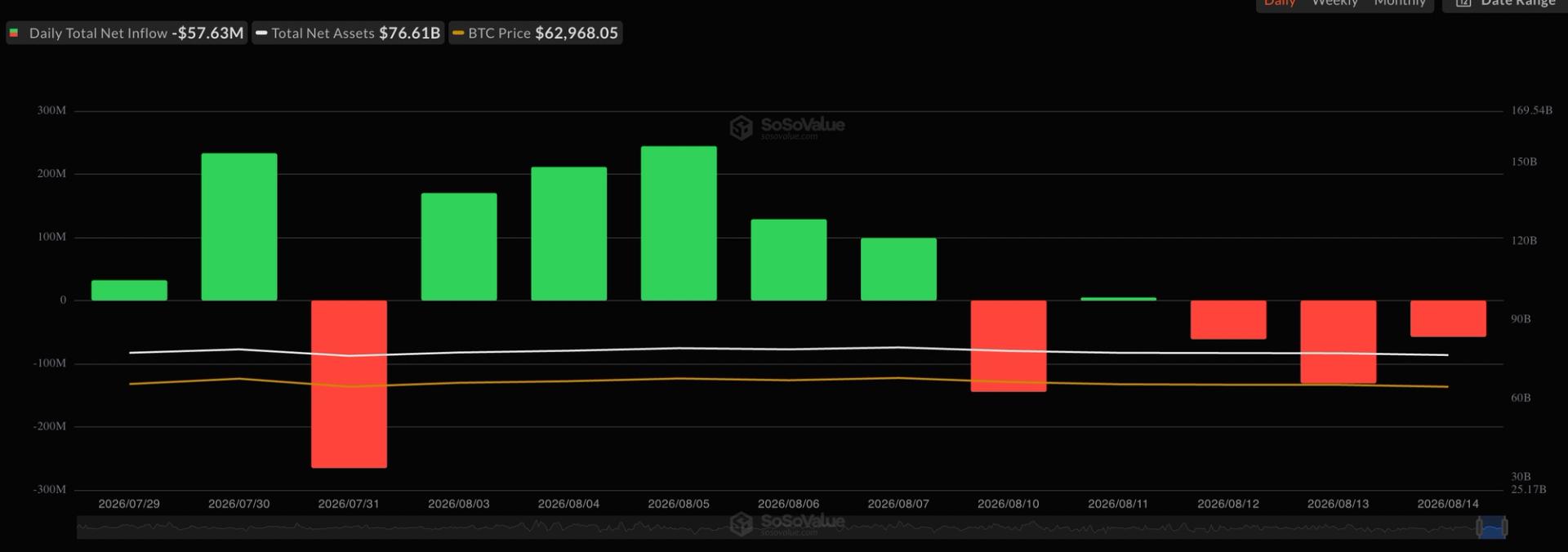
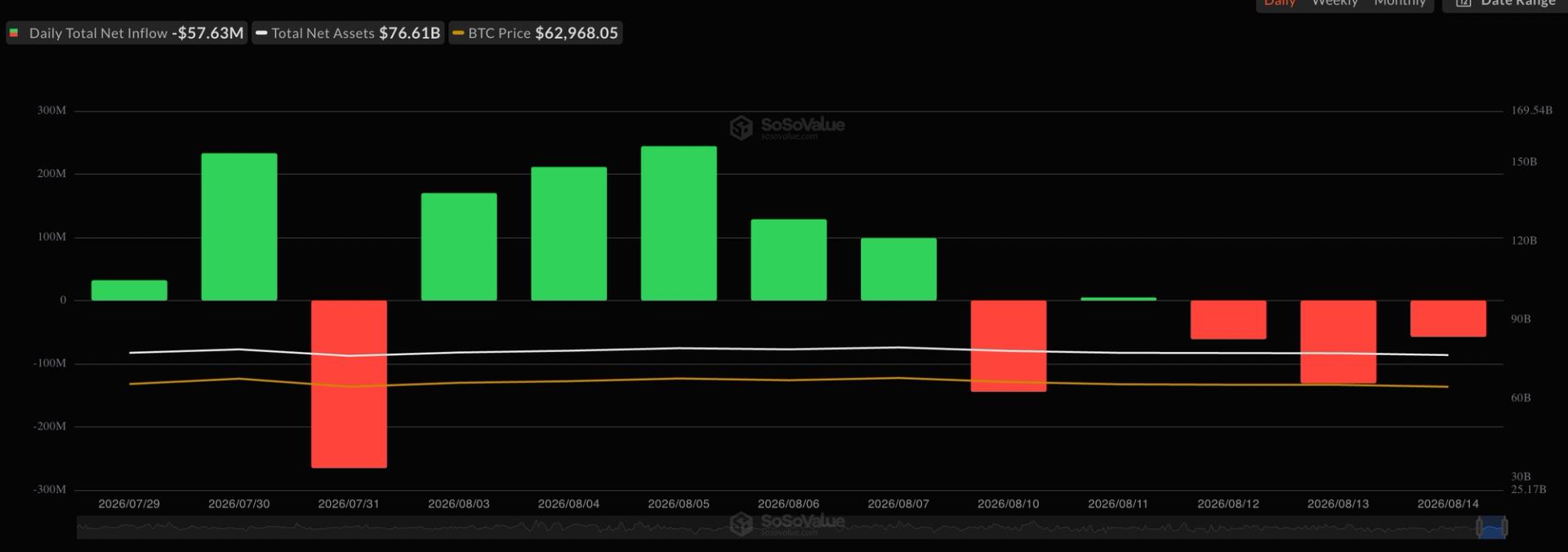
Bitcoin near $63,500 looks like more summer torpor, capped below $64,000 and holding above the low-$60,000s, but the flow picture underneath has reversed, said Yusuf Fakhro, partner at ARP Digital, in a note to CoinDesk.
US spot ETFs took in more than 14,000 BTC over five days into August 7, he said, the strongest stretch since May, and Q3 has drawn roughly 11,000 BTC of net inflows against 110,000 BTC of outflows in the back half of Q2. The institutional selling that defined the second quarter has flipped to buying.
Spot volumes have fallen to two-and-a-half-year lows, perpetual volumes to three-year lows, and volatility sits near multi-year troughs, Fakhro said.
Fresh demand arriving into the thinnest tape in years, when nobody is watching, is how durable bottoms tend to form. He reads bitcoin’s six months stuck between $60,000 and $80,000, holding near a 50% drawdown rather than grinding lower the way the 2014, 2018 and 2022 bear markets did, as apathy rather than deterioration, with on-chain data starting to show bottoming characteristics as sentiment shifts from panic to caution.
The risk sits on both sides. Bitcoin is as stuck below $64,000 as it is above $62,000, a box rather than a launchpad, and leverage sharpens it. Perpetual open interest has held above 300,000 BTC through the summer, elevated against its average while volumes collapsed, which leaves the market exposed to a sharp liquidation move in either direction.
Gold continues to trade close to multi-month highs following its recent advance, which was supported by the latest US inflation data. July’s CPI broadly matched market expectations, reducing the likelihood of a Federal Reserve rate hike in September. Lower expectations for further monetary tightening remain supportive for gold, as elevated interest rates increase the opportunity cost of holding the non-yielding asset. According to CNBC, some investors have begun taking profits after the rally. Over the coming weeks, expectations surrounding the Fed’s interest-rate path are likely to remain one of the main drivers of the precious metal.
Technical Analysis of Gold
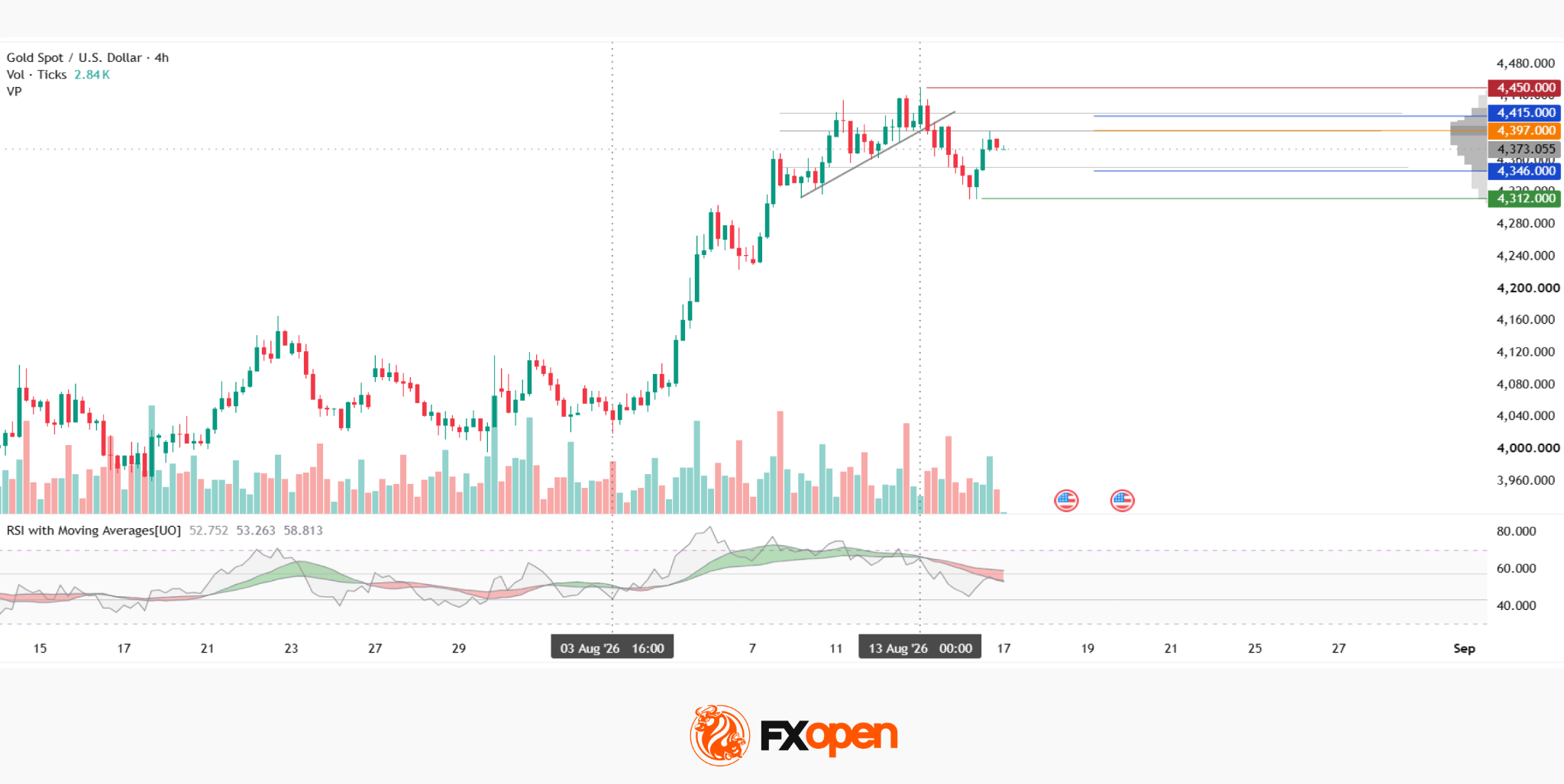
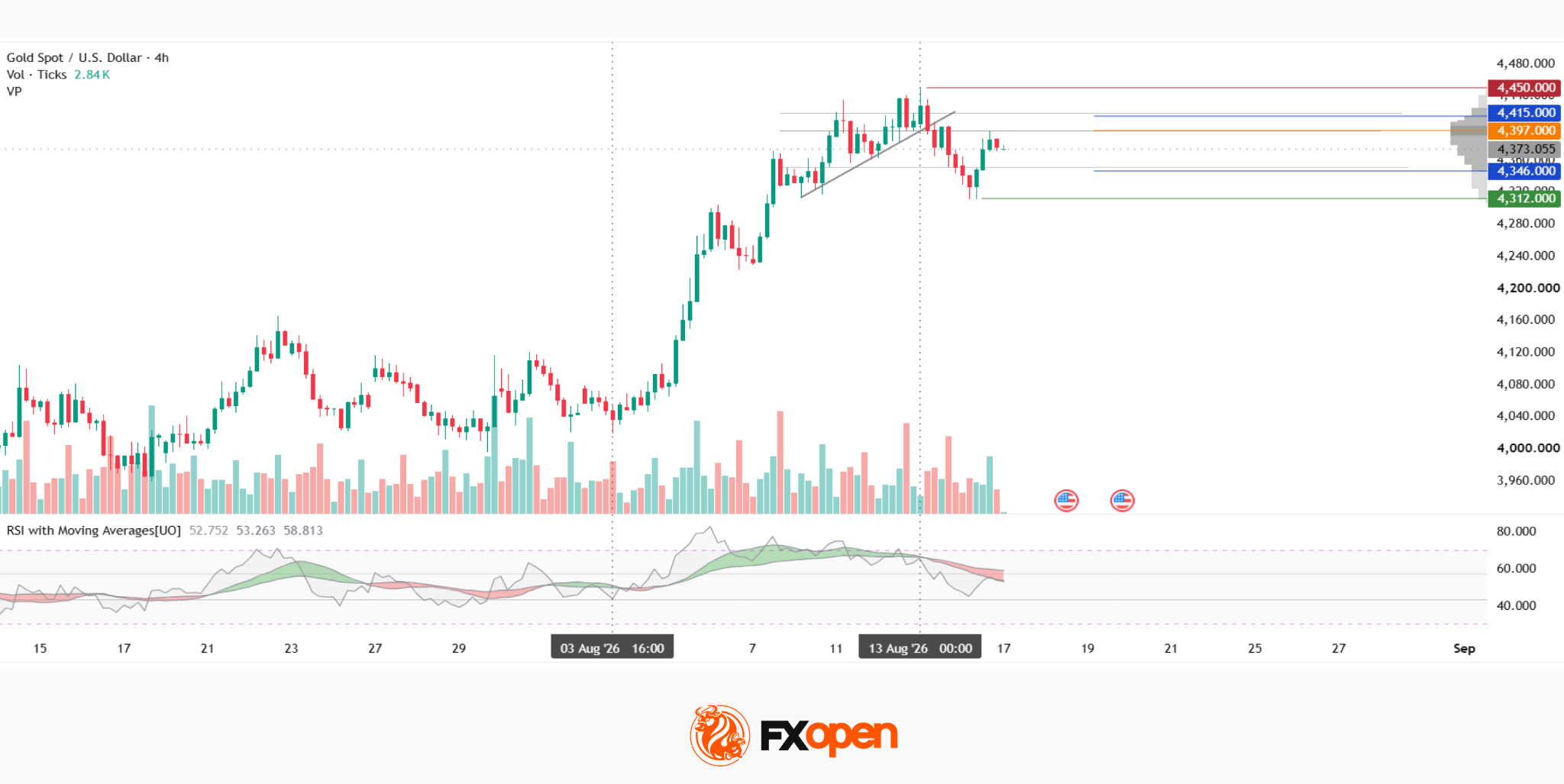
The four-hour XAU/USD chart shows a sustained uptrend that lifted the price towards the red resistance level at $4,450. An ascending trendline developed during the rally, but on 13 August the price broke below it on increased volume. The subsequent decline established a green support area around $4,312.
Following a rebound, gold returned to the dense area of the current market profile and is now trading between the Point of Control (POC) at $4,397 and the lower boundary of the profile at $4,346. If selling pressure builds, the $4,312 support zone could become increasingly significant.
A continuation of the upward move would bring the price into a relatively strong cluster of technical levels. The first obstacles are the POC at $4,397 and the upper boundary of the profile at $4,415. Beyond these levels, attention would shift towards the trend high around $4,450.
The RSI + MAs indicator currently shows readings of 52, 53 and 58. The oscillator and fast moving average have moved back into the neutral zone, while the slower moving average is following the same direction.
Key Takeaways
The main driver for gold remains the market’s expectations for the Federal Reserve’s interest-rate path. A further decline in expectations for rate hikes could continue to support buyers, while more hawkish signals from the central bank could increase selling pressure as the market undergoes a post-rally correction.
In the short term, gold is also likely to remain sensitive to movements in the US dollar and Treasury yields, both of which can significantly influence demand for the precious metal.
Start trading commodity CFDs with tight spreads (additional fees may apply). Open your trading account now or learn more about trading commodity CFDs with FXOpen.
This article represents the opinion of the Companies operating under the FXOpen brand only. It is not to be construed as an offer, solicitation, or recommendation with respect to products and services provided by the Companies operating under the FXOpen brand, nor is it to be considered financial advice.
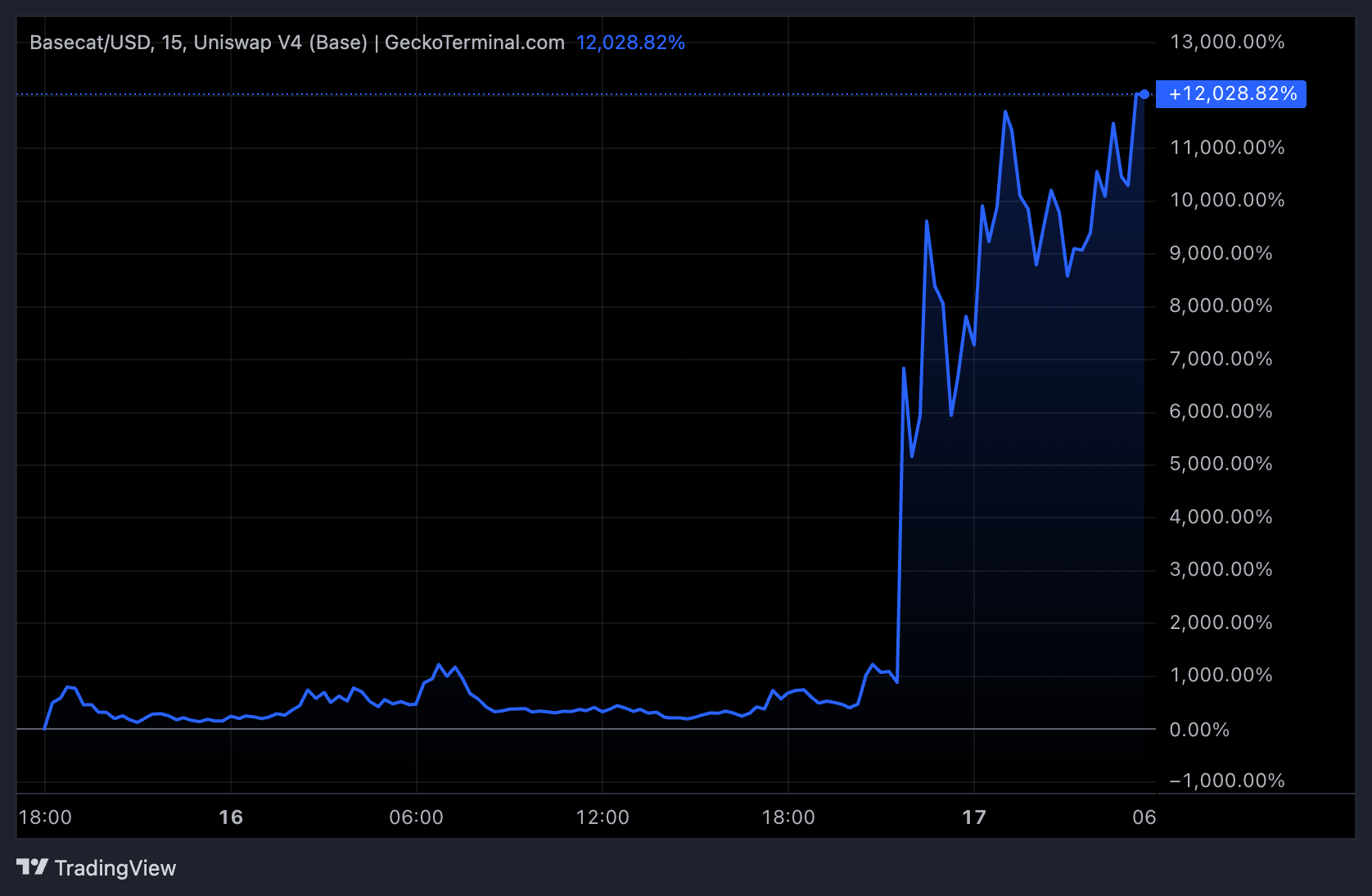
Basecat (BASECAT) surged 2,034% over the past 24 hours, lifting its market value to $17.2 million and extending its gains since launch to over 12,000%.
The token pairs a cartoon cat in a blue construction helmet with no stated utility. Trading activity surged today after two key developments.
Where the BASECAT Rally Started
Trading in BASECAT opened on Uniswap V4 on August 15, according to pool data on GeckoTerminal. The price saw a notable surge on August 16, as the market value jumped from under $1 million to peak at $20.35 million.
The rally has continued today. According to the latest data, BASECAT’s market cap stood at $17.2 million at press time. The meme coin is up over 12,000 since its launch.
Follow us on X to get the latest news as it happens

Trading activity has also been heavily concentrated around the recent rally. Over the past 24 hours, buyers accounted for 30,539 transactions compared with 26,994 sells, for a total of 57,533 transactions. Net buying reached approximately $172,260, while total trading volume climbed to $24.67 million.
However, it’s worth noting that BASECAT has no roadmap or product claims. A community-run site describes the concept in plain terms.
“BASECAT is simple: a meme token on Base built around a tiny cat in a blue hard hat. No invented utility. No fake roadmap. The community makes the story,” the website reads.
Why is BASECAT Surging?
With BASECAT up sharply, a key question arises. What is driving the four-digit surge today? GeckoTerminal attributed the move to listings on Gate and Coinbase Wallet.
However, BASECAT’s market remains relatively thin compared with its valuation. Liquidity stood at about $539,700 against a market capitalization of $17.2 million, with roughly 10,200 holders.
Thus, the combination of high volume and relatively limited liquidity can amplify price movements in either direction. As a result, the token’s rapid rise may also leave it vulnerable to sharp reversals if buying momentum fades.
BASECAT’s move also follows a broader pattern among newly launched meme coins, where social attention and short-term trading activity can quickly drive valuations higher.
For example, PLUMBER climbed more than 10,000% in August after a viral Crypto Twitter argument. The token subsequently gave back a significant portion of its gains, highlighting the volatility surrounding attention-driven meme coin rallies.
Subscribe to our YouTube channel to watch leaders and journalists provide expert insights
The post BASECAT Meme Coin Jumps 2,000%: Here’s What’s Driving the Rally appeared first on BeInCrypto.
Crypto World
Zoomex Launches Stock Perpetuals Competition Round 2: Elevating Cross-Asset Derivatives for Global Traders

Zoomex, a global cryptocurrency derivatives exchange, today officially announced the commencement of its highly anticipated Stock Perpetuals Competition Round 2. Engineered to seamlessly bridge the gap between Traditional Finance (TradFi) and Web3 crypto derivatives, the event showcases Zoomex’s robust derivatives infrastructure while offering global traders 24/7 access to high-demand U.S. equity perpetual contracts backed by a dynamic escalating prize pool and interactive reward tiers.
As global market volatility intensifies, retail and institutional traders increasingly seek frictionless risk-hedging mechanisms outside conventional trading hours. Zoomex addresses this demand through its proprietary derivatives engine, enabling users to trade perpetual contracts on top U.S. equities – including Nvidia (NVDA), Apple (AAPL), and Tesla (TSLA)—using USDT as margin. The platform eliminates traditional brokerage onboarding friction, offering leverage up to 25x and bi-directional (long/short) trading capabilities without market-close interruptions.
Executive Insight: Redefining Cross-Asset Trading
Addressing the strategic vision behind the competition, the Chief Brand Officer of Zoomex stated:
“At Zoomex, derivatives trading is not merely a feature—it is our core identity and structural foundation. Traditional stock markets remain constrained by strict opening hours, lengthy clearing cycles, and cross-border fiat capital controls. By integrating U.S. equities into our high-performance crypto derivatives matching engine, we deliver uninterrupted 24/7 execution, deep liquidity, and institutional-grade price anchoring.”
“Stock Competition Round 2 serves as both a high-stakes arena for top derivatives traders and a live showcase of Zoomex’s matching capacity and zero-slippage risk management. We are committed to establishing the most reliable cross-asset derivative highway in the digital asset industry.”
Institutional-Grade Derivatives: Core Product Pillars
Zoomex’s Stock Perpetuals product suite is specifically tailored for professional trading strategies, offering distinct competitive advantages:
- 24/7 Uninterrupted Market Access: Bypasses standard U.S. stock exchange market-close hours, permitting real-time risk management and position adjustments around global macroeconomic events.
- USDT Unified Collateral Settlement: Eliminates currency conversion friction and international wire delays by enabling capital deployment directly via USDT margin for opening, maintaining, and settling equity positions.
- High-Concurrency Engine & Anti-Wick Oracle System: Powered by Zoomex’s proprietary matching engine capable of handling high throughput during extreme volatility, backed by multi-source oracle pricing to prevent price manipulation and unfair liquidation wicks.
- Flexible Leverage & Bi-Directional Exposure: Supports up to 25x customizable leverage, allowing traders to execute complex long and short strategies across market cycles with maximum capital efficiency.
Stock Competition Round 2: Key Event Mechanics
- Dynamic Prize Pool: Escalates proportionally based on participant volume and cumulative derivative turnover, rewarding both Return on Investment (ROI) and trading volume.
- Trading Volume “Blind Boxes”: Unlocks milestone rewards as trading volume thresholds are met, offering instant USDT cash prizes, fee discount vouchers, and bonus credits.
- Transparent Leaderboard: Real-time rank updates refreshed every 5 minutes, backed by fully audited PnL tracking for absolute competition integrity.
About Zoomex
Founded in 2021, Zoomex is a global crypto trading platform dedicated to delivering an unmatched derivatives experience, serving over 3 million users across 35+ countries and regions. Built for traders who demand speed, clarity, and control, Zoomex seamlessly integrates high-performance execution, intuitive asset tracking, and transparent fee structures. Backed by a robust trust framework—featuring Hacken security audits, Proof of Reserves, and rigorous compliance standards—Zoomex empowers users with a cleaner, smarter, and more efficient trading ecosystem.
Beyond trading, Zoomex elevates the brand experience through high-profile partnerships with the Haas F1 Team, World Cup-winning goalkeeper Emiliano Martínez, and elite tennis tournaments. By bringing the speed, precision, discipline, and uncompromising fairness of world-class sports to the realm of crypto derivatives, Zoomex ensures its vision aligns seamlessly with every trade.
At Zoomex: Trading made simple. Funds made transparent. Profits made accessible.
The post Zoomex Launches Stock Perpetuals Competition Round 2: Elevating Cross-Asset Derivatives for Global Traders appeared first on BeInCrypto.
Vitalik Buterin has endorsed a plan to rebuild how Ethereum handles simple payments, copying a method Bitcoin has used since 2009. He credited Bitcoin developers for the idea on X.
The endorsement answers a problem Ethereum has carried for years. Every new account makes the network a little heavier to run.
Why Ethereum Keeps Getting Heavier
Thousands of computers worldwide hold a full copy of Ethereum. Those machines are called nodes, and each one stores every account ever created. That record never shrinks. A single account entry costs 100 to 150 bytes and stays there permanently, whether anyone uses it again or not.
Buterin has warned about the buildup before. He spent much of 2026 arguing that Ethereum’s deepest bottlenecks sit in how the network stores data. The side networks built on top are not the main problem.
How Bitcoin’s Design Could Fix It
Ethereum Foundation researcher Toni Wahrstatter published an answer in July. He borrowed the way Bitcoin handles money, counting individual coins instead of running account balances.
Bitcoin calls those coins unspent transaction outputs, or UTXOs. Once someone spends one, almost nothing stays behind, roughly a third of a byte. The outcome shows up at scale. One billion Ethereum accounts would demand up to 150 gigabytes. One billion spent coins would need about 300 megabytes.
Recipients would gain something too. Today they need Ethereum’s token, ETH, in a wallet before money arrives. Under the new model the payment covers its own fee.
Buterin added the second half in January. He proposed letting computers bundle many transaction checks into one compact package, instead of passing a heavy check around for every payment.
Not everyone welcomed the borrowing. Cardano founder Charles Hoskinson accused Ethereum of copying his own network’s coin tracking after the July proposal appeared.

Buterin Praises Bitcoiners and Points Ahead
Developer conall.gwei joined the two ideas. Whoever builds the next block could then publish a single 128 kB summary and settle an enormous batch of payments at once.
Buterin answered him directly.
Utreexo, the Bitcoin project he named, lets computers verify coins without keeping the full list. Buterin wants Ethereum to run both styles at once, so most activity scales up while ordinary people can still run a node. Those compact proofs, known as STARKs, already anchor his Lean Ethereum roadmap plans, which drew pushback over timelines in July. He also called the old tradeoff between speed, security and decentralization technically solved earlier this year.
The foundation keeps shipping changes regardless. It set out its 2026 protocol priorities in February, then swapped core cryptography this month to guard against quantum computers.
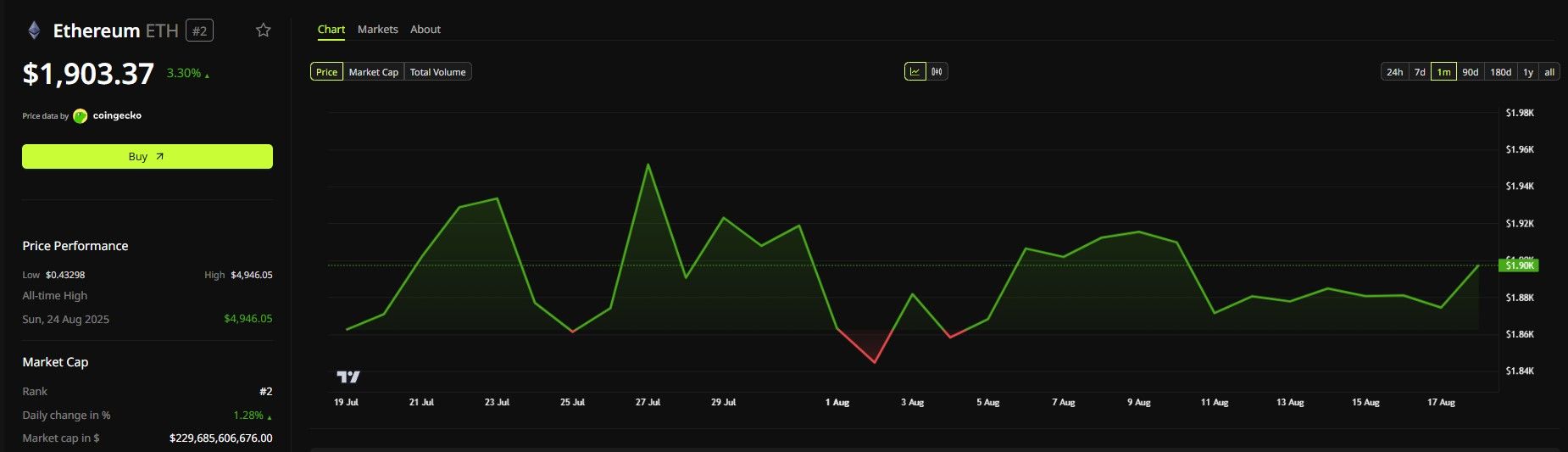
Markets have not rewarded the research push so far. ETH trades near $1,903, up 1.28% on the day, and the token has stalled below $2,000 for weeks.
Neither proposal has a launch date. Therefore, the open question is whether the teams that build Ethereum’s software will pick both up.
The post Vitalik Buterin Wants to Copy Bitcoin Design to Hyperscale Ethereum appeared first on BeInCrypto.
“Very unlikely.”
That’s how Goldman Sachs described the chances of a September Federal Reserve interest-rate increase, which provides a potential major tailwind for bitcoin , which has traded in a narrow range since early July.
The cryptocurrency is currently priced around $63,500, a 1% gain since midnight UTC. The price has remained firmly locked within the $62,000–$66,000 range that has been in play for over a month.
Goldman lowered the odds in response to a string of soft economic data, specifically retail sales, a key barometer of consumption, and employment figures alongside slowing inflation, Chief Economist Jan Hatzius told clients, according to Bloomberg.
“Under our baseline economic forecasts, the inflation news is more likely to improve further than to deteriorate anew as the year progresses,” Hatzius wrote in a note Sunday. “We still think market pricing for the funds rate is too hawkish.”


Ripple minted 10 million Ripple USD tokens on the XRP Ledger on Aug. 17, completing another large issuance transaction as the stablecoin’s circulating supply reached approximately 1.711 billion.
Summary
- Ripple minted 10 million RLUSD on XRPL on Aug. 17, according to public ledger records.
- CoinGecko placed circulating supply near 1.711 billion, with market capitalization around $1.71 billion Monday morning.
- The transaction cost 0.000405 XRP and used two authorized signers for approval before settlement completion.
- Ripple Mint lets approved institutions issue, redeem, bridge and monitor RLUSD through interfaces and APIs.
- One mint does not independently prove new institutional demand, market deployment, or purchases of XRP.
Public data cited by XRPScan showed that Ripple’s issuer account transferred the tokens to a designated RLUSD destination account. The transaction cost 0.000405 XRP, used two authorized signers and recorded a maximum delivery amount of 10 million RLUSD.
Ripple did not identify the receiving customer or disclose the tokens’ intended use. The transaction confirms issuance, but it does not independently support claims that “institutional demand grows.”
RLUSD mint does not confirm customer demand
A stablecoin mint creates tokens on a blockchain. It does not prove that the tokens immediately entered exchanges, payment channels or institutional portfolios. Newly issued RLUSD can remain in controlled accounts until an approved customer completes a transaction.
The ledger entry also does not establish that $10 million entered the broader crypto market. Ripple Mint allows customers to issue, redeem and transfer RLUSD for settlement, liquidity and treasury operations. Some issuance can therefore reflect inventory management rather than new investment.
Ripple completed another 10 million token mint on Aug. 10. As crypto.news reported, the transaction occurred while RLUSD’s supply remained below earlier summer levels. Ripple did not name the customer behind that issuance either.
A separate post by the BankXRP community account reported that 5 million RLUSD had been burned on Ethereum. Burns remove tokens from circulation and can accompany customer redemptions. Available records do not show whether the burn and the Aug. 17 XRPL mint were connected.
RLUSD supply returns to the $1.71 billion area
CoinGecko placed RLUSD’s circulating supply near 1.711 billion tokens on Aug. 17. Its market capitalization was approximately $1.71 billion, while reported 24 hour trading volume was around $50 million when checked. Market data can change throughout the day.
The latest supply figure was higher than Ripple’s Aug. 6 disclosure. Its transparency page reported $1.5896 billion of circulating RLUSD and $1.7026 billion of reserve assets as of that date.
The difference reflects the timing of the reserve snapshot and later blockchain activity. Monthly attestations provide a historical view rather than a live balance. Mints and burns recorded after the reporting date can change circulating supply before the next report.
Supply has also fluctuated during 2026. The Aug. 10 mint occurred after earlier burns reduced circulation. Individual issuance transactions should therefore be considered alongside redemptions and burns rather than treated as permanent growth.
U.S. oversight governs RLUSD reserves
Standard Custody & Trust Company issues RLUSD under a limited purpose trust charter from the New York State Department of Financial Services. The arrangement gives the stablecoin a direct U.S. regulatory connection through New York.
Ripple says RLUSD is redeemable at one U.S. dollar and backed by segregated reserves. Those reserves include cash, cash equivalents and short term U.S. Treasury securities. An independent accounting firm licensed in the United States conducts monthly attestations.
The Aug. 6 reserve disclosure showed assets exceeding the reported circulating supply at that date. It does not establish the exact reserve balance when the Aug. 17 mint occurred. A later attestation will provide the next formal comparison between outstanding tokens and reserve assets.
Regulatory oversight also does not identify the customer behind each mint. The framework covers areas including reserve management, redemption rights and reporting, while public ledger records show token movements.
Ripple widens institutional access to RLUSD
Ripple introduced Ripple Mint in July for approved institutional customers. The platform provides a web interface and application programming interfaces for minting, redeeming, bridging and monitoring RLUSD.
As previously reported, Ripple designed the platform so institutional customers can automate minting and redemption workflows. Customers can receive notifications covering fiat receipt, mint processing, blockchain settlement and payout completion.
Ripple also made an undisclosed investment in Notabene. The companies plan to add RLUSD to Notabene Flow and explore connections between Notabene’s transaction authorization system and Ripple Payments. They have not announced the first customer or a completion date.
International access has expanded alongside that infrastructure. In June, Ripple and SBI opened a new distribution channel after RLUSD became available to customers in Japan. SBI VC Trade offers the token to eligible retail and institutional customers through VCTRADE.
Ripple also partnered with BiLira, Bitexen and Bitlo to make RLUSD available to institutions in Türkiye. These developments support Ripple’s broader institutional strategy, but none identifies the party behind the latest mint.
What happens next for the 10 million tokens
Future transactions from the destination account may show whether the tokens move to an exchange, payment provider, market maker or another controlled wallet. Wallet movements may still leave the customer’s identity and commercial purpose undisclosed.
Later burns will determine whether the mint produces lasting supply growth. Ripple has not published a future issuance schedule or a deadline for disclosing customer activity connected to the transaction.
The next monthly reserve report will provide the clearest formal update on circulation and backing. Until then, the verified facts remain limited: Ripple minted 10 million RLUSD on XRPL, supply reached about 1.711 billion, and the public record does not prove growing institutional demand.
Anthropic appears to be moving closer to its initial public offering (IPO), which undoubtedly is one of the most closely watched technology listings of 2026.
The emerging consensus is that Claude’s maker could reach the public markets this fall; however, there are still a few important caveats and clarifications.
Prediction Markets Lean Toward October
While in no way a certainty, prediction market traders are leaning heavily in the direction that the IPO will come in October.
As you can see on the Polymarket snapshot, the contract tracking whether Anthropic will go public by September 15 implies just a 2% chance, while the probability for September 30 stands at 10%. By October 31, however, the odds jumped to 70%, and the market shows an 83% chance of an IPO by the end of this year.

Notably, the October probability had increased sharply in recent trading sessions, suggesting that users are becoming more confident that the listing could happen during that month.
Reports Also Point to Fall Listing
Not surprisingly, that view is also largely supported by recent reporting. A report from the Wall Street Journal said that the firm’s executives have been meeting with prospective investors to strengthen confidence ahead of an IPO that could arrive in September or early October.
Anthropic has also taken a major procedural step: the firm confidentially filed for a US IPO in June, giving it flexibility to move once regulatory review and market conditions allow it.
But that’s not the only impressive part about the IPO. Another report outlined that some investors are targeting a valuation of $2 trillion or even more for an October debut. This would be more than double the $965 million post-money valuation that Anthropic received in its May funding round, although the company has not publicly confirmed either the IPO date or the valuation.
$2 Trillion Valuation?
Whether participants in the IPO and public investors will support such a massive figure is likely to depend on the confidence placed in Anthropic’s growth projections.
Reuters reported that the company is forecasting roughly $190 billion to $200 billion in revenue in 2028, compared with a $47 billion annualized revenue run rate disclosed in May. Bankers and investors are now looking unusually far into the future when they assess what the firm could be worth. They are attempting to account for the company’s rapid growth and the high costs of training and operating cutting-edge AI models.
The post Is Anthropic About to Go Public Soon? October IPO Odds Are Surging appeared first on CryptoPotato.


Greenlane Holdings’ BERA-focused digital asset treasury has fallen to $16.4 million in fair value at the end of the second quarter, leaving the portfolio about 76.6% below its $70 million cost basis.
Summary
- Greenlane’s BERA treasury was valued at $16.4 million at the end of Q2, down 76.6% from its $70 million cost basis.
- The company held 81.3 million BERA and equivalent tokens as of June 30, up from 77.7 million at the end of March.
- Greenlane recorded a $19.1 million digital asset fair value loss and a $24.8 million net loss for the quarter.
- BERA has fallen 75.9% year to date and was trading near $0.146.
According to Greenlane’s latest regulatory filing, the Nasdaq-listed company held about 81.3 million BERA and BERA-equivalent tokens as of June 30, up from roughly 77.7 million at the end of the first quarter despite a continued decline in the token’s market price.
The difference between the portfolio’s acquisition cost and quarter-end fair value stood at about $53.8 million. Greenlane recorded a $19.1 million noncash fair-value loss on its digital assets during the three months through June, which contributed to a net loss of $24.8 million for the period.
At the same time, the company continued putting its holdings to work across the Berachain ecosystem. Its digital asset operations generated about $309,000 in staking and yield revenue during the quarter, providing income in BERA and other assets while the value of the underlying treasury declined.
Greenlane’s exposure has increased since the start of the year. The company reported 77.7 million BERA and equivalent tokens at the end of March, meaning its holdings grew by about 3.6 million tokens during the second quarter.
Greenlane’s BERA treasury has grown despite falling valuations
Greenlane entered the crypto treasury business in October 2025, transforming a company previously known mainly for cannabis accessories and consumer products into a publicly traded holder of Berachain’s native token.
The strategy followed a $110.7 million private placement backed by digital asset investors. As previously reported by crypto.news, the October 2025 financing was led by Polychain Capital, with participation from Blockchain.com, Kraken, North Rock Digital, CitizenX and dao5.
Greenlane said at the time that proceeds would support its BERA treasury, with tokens acquired through open-market and over-the-counter purchases. The company also established BeraStrategy as its digital asset management operation as part of the transaction.
By the end of February, Greenlane’s holdings consisted of its initial 54.2 million BERA position, another 14.9 million tokens bought in the open market and additional BERA obtained through staking, validator participation and structured token trading agreements, according to company disclosures.
Greenlane’s first-quarter filing later showed how quickly falling BERA prices were affecting the strategy. For the three months ended March 31, the company reported a net loss of $18.2 million, while its balance sheet had become heavily tied to digital assets, cash and dollar-pegged stablecoins.
Management said in that filing that its financial condition and operating results had become significantly influenced by digital asset market conditions, particularly the fair value of its BERA holdings.
The company has continued its legacy lifestyle accessories business through vapor.com and related channels, although Greenlane said the operation was reduced after its 2025 strategy change. Warehouse operations were substantially exited, and the remaining commerce business moved toward an asset-light drop-ship model.
BERA price decline has cut into Greenlane’s holdings
The valuation losses have come as BERA continued a steep decline from levels reached earlier in 2026.
Berachain was trading at about $0.146 at the time of writing, according to CoinGecko, leaving the token down roughly 75.9% since the start of the year. BERA had briefly traded above $1.20 earlier in 2026 before falling toward the $0.15 area.
The decline followed a period of extreme volatility in February. BERA briefly surged as high as $1.43 after an unusual imbalance in perpetual futures markets triggered heavy short liquidations.
During that move, BERA rallied 82% within 24 hours to about $0.94, while futures volume jumped 632% to $2.94 billion and open interest increased 102% to $142.8 million. Funding rates had swung between deeply negative and positive levels as traders repositioned after a Feb. 6 token unlock involving 63.75 million BERA.
The rally did not develop into a sustained recovery. By July 15, BERA was trading around $0.187, with the token already down more than 30% over the preceding month. Its price has since moved closer to $0.15, further reducing the dollar value of large BERA-denominated positions such as Greenlane’s treasury.
BERA’s current price also sits far below levels recorded soon after Berachain launched in February 2025. Following listings across several major exchanges, including Crypto.com, Upbit, MEXC and Bithumb, BERA reached an all-time high near $15 before beginning a prolonged decline.
Token supply has also increased since the network’s early trading period. A May 2025 Boyco Vaults release brought additional assets and BERA into circulation, with the token falling 21% over a seven-day period around the event. The release involved $2.7 billion in locked assets and included about 2% of BERA’s total supply.
Greenlane is earning yield from its Berachain position
While Greenlane’s treasury valuation has fallen, the company’s strategy involves more than holding BERA on its balance sheet.
Greenlane participates in staking, validator operations, liquidity provisioning, and other Berachain activities designed to generate additional tokens or yield. Those activities accounted for the $309,000 in digital asset segment revenue reported for the second quarter.
Berachain uses a Proof-of-Liquidity model that links network incentives to liquidity supplied across its decentralized finance ecosystem. BERA serves as the network’s native gas token, while BGT is used for governance and HONEY operates as its collateral-backed stablecoin.
Changes to that system have also expanded the role of BERA as a yield-producing asset. A Proof-of-Liquidity upgrade proposed in 2025 directed one-third of protocol incentives toward a BERA rewards model, creating a protocol-level source of yield for token holders.
The network had expanded its rewards beyond Berachain’s BEX pools in March 2025, allowing additional applications and vaults to participate in Proof-of-Liquidity incentives.
Greenlane’s strategy uses similar network mechanics to add to its token holdings over time. Its February disclosure said the treasury had accumulated BERA not only through purchases but also through staking and validator participation, while the company cautioned that protocol reward rates could change with network conditions, validator changes, reward schedules, and market volatility.
As of June 30, those activities had helped increase Greenlane’s BERA and BERA-equivalent position to 81.3 million tokens even as the fair value of the portfolio fell to $16.4 million.

Monitor Audio Silver Series 8G Debuts With 7 New Speakers for Music and Home Theater

Stolen motorcycle recovered by police in Farnworth

Sainsbury’s pauses London store’s AI cameras after man ousted


-

 Fashion3 days ago
Weekend Open Thread: Ann Taylor
-
 NewsBeat5 days ago
Communication cards help banking customers access services or report scams
-
 Business6 days ago
Oil Price Today (August 11): Crude oil rises to $88 after Trump’s compensation demand dents Hormuz opening. Here’s why
-

 Crypto World6 days ago
Revolut wins French banking licence, creates second EU banking hub
-
 Sports3 days ago
This U.S. Amateur is a glimpse into golf’s future in more ways than you think
-
 Crypto World6 days ago
Why Did Nvidia Stock Fall on Monday Despite a $500 Billion Wall Street AI Deal?
-

 Sports2 days ago
Birmingham 2026: Day 6 Timetable for Irish Athletes
-
 NewsBeat2 days ago
Myanmar says over 300,000 Rohingya refugees verified for repatriation as exodus enters ninth year
-

 Politics2 days ago
SEQ Code: The Three Letter Boarding Pass Code That Could Give You The Worst Seat
-
 Entertainment5 days ago
Keke Palmer Subtly Hints At Sean Evans Drama With Cryptic Post
-
 Crypto World7 days ago
Grayscale quietly drops Cardano, Polkadot and Hedera ETF plans
-

 Fashion7 days ago
Can You Wear Double Cloth Gauze Clothing To Your Office?
-

 Fashion6 days ago
Coffee Break: The Fonteyn Jane Flat
-

 Crypto World6 days ago
Bitcoin's BIP Editors Remove Luke Dashjr Two Days After BIP-110 Fork Stalled
-
 Entertainment6 days ago
57 Years Later, the Best Sitcom Ever Made Still Deserves a Reboot
-

 Tech6 days ago
Zoom Screen-Sharing Bug Let People Fully Take Over Other Devices On A Call
-
 Crypto World7 days ago
Hormuz Nerves Cost Bitcoin $65,000 Mark Despite Solid Institutional Flows
-

 Fashion6 days ago
Claire Life: Kicking Off MVAAFF With the C Suite Luncheon Featuring Phylicia Rashad, Letoya Luckett, and More!
-

 Fashion6 days ago
Should you refinance your debt? Pros, cons, and real numbers
-
 Crypto World5 days ago
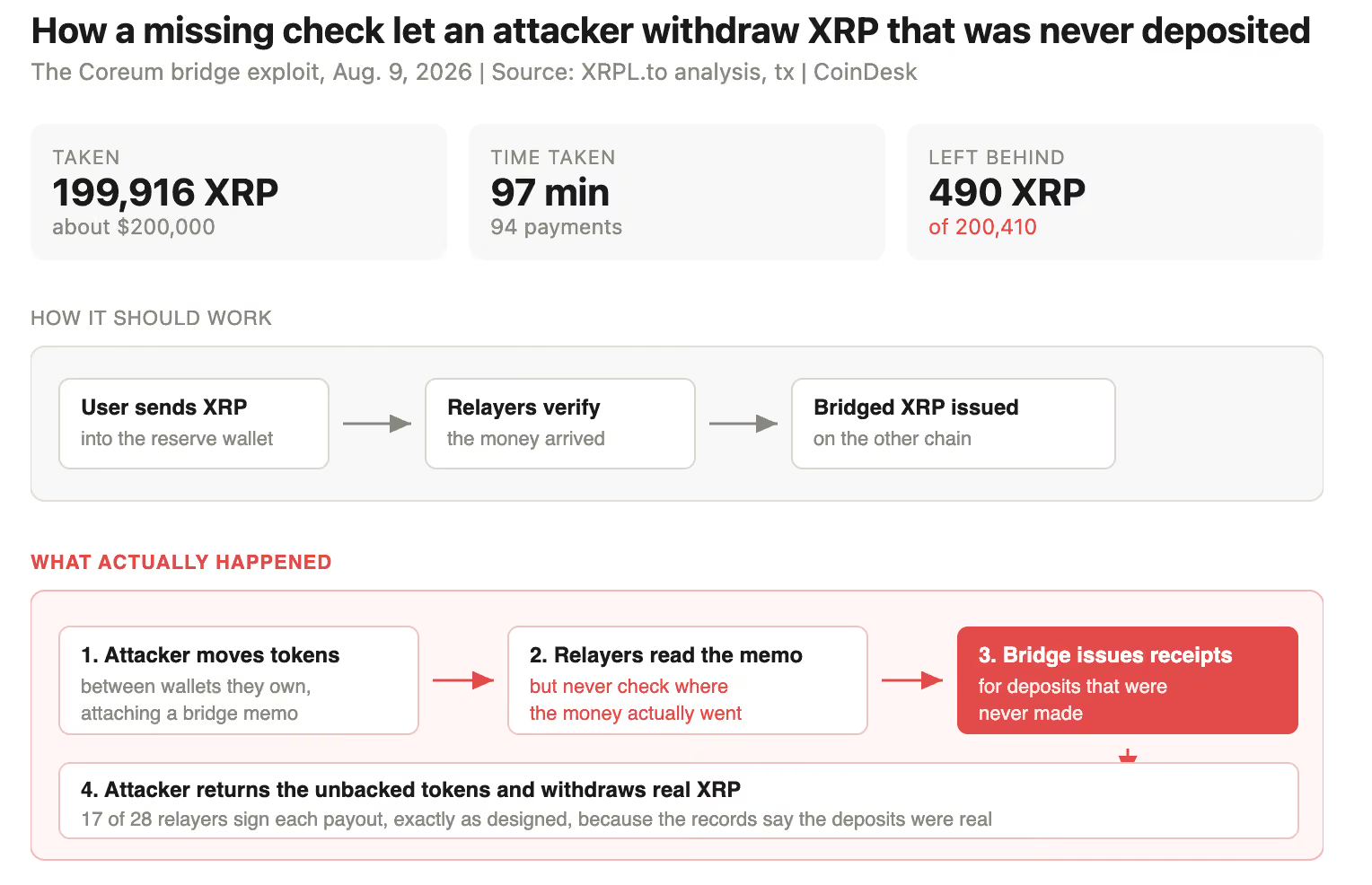
XRP bridge drained after software mistook fake deposits for real ones
You must be logged in to post a comment Login