

Crypto World
Why the endowment is swapping bitcoin for ethereum ETFs



Harvard University endowment’s decision to trim its bitcoin holdings while adding exposure to ether (ETH) has raised a familiar question: Is the endowment making a bet on Ethereum over Bitcoin, or simply adjusting risk?
The answer may be less dramatic than it appears and potentially bullish for the sector.
Michael Markov, co-founder and chairman of Markov Processes International, who studies university endowments, said crypto is likely the most volatile part of Harvard’s public markets portfolio. In the fourth quarter of 2025, price swings in both bitcoin and ether surged, with both assets losing around 25% of their value.
These sharp price swings have, at least in part, led Harvard to rebalance its portfolio, even if it did not change its long-term view of bitcoin. When an asset becomes more volatile and riskier than intended in a portfolio, cutting back restores balance.
“When volatility rises sharply, the risk contribution of that sleeve can expand disproportionately relative to its capital weight,” Markov said. In that setting, he added, trimming exposure can happen “without implying a strategic shift.”
Simply put, Harvard, which bought BlackRock’s bitcoin ETFs last year, likely didn’t lose its conviction in bitcoin; rather, it moved to rebalance its risk appetite.
In fact, it’s not just a crypto-specific move. Rebalancing capital out of assets that have done well and into underperforming sectors is something most Wall Street portfolio managers do to keep returns fixed. The idea is to rebalance the portfolio ahead of a market rotation, moving outperforming assets into underperforming ones to capture an eventual shift in sentiment.
For example, given sky-high valuations of traditional equities, some of these endowments, which tend to focus on long-term return, have begun looking into other alternative investment ideas, including digital assets-related ETFs. Harvard first bought bitcoin in the third quarter of 2025, allocating roughly 20% of its reported U.S.-listed public equity holdings into the crypto asset. The idea is not to overhaul portfolios but to add measured exposure that could lift returns in years when crypto or underperforming assets perform well, and traditional equities start to lose their higher valuations.
Another possibility is liquidity.
Harvard has increased its allocation to private equity in recent years, Markov noted, pushing more capital into long-term, illiquid investments. At the same time, billions of dollars in unfunded commitments remain on the books. That creates pressure on the smaller slice of the portfolio that can be sold quickly.
“That means the liquid sleeve is relatively small compared to the capital call obligations,” he said. When that happens, and investors such as Harvard need to fund capital investment requests from private equity, they tend to sell more liquid, publicly traded assets to fulfill those commitments.
“Selling some public ETFs – including crypto ETFs – is mechanically the easiest way to manage that pressure,” according to Markov.
Crypto demand
Despite the need to rebalance out of volatile assets or to fund other capital commitments, Harvard didn’t exit crypto.
Instead, it added almost 3.9 million shares of BlackRock’s ether ETF, currently valued at $56.6 million.
Samir Kerbage, chief investment officer at Hashdex, sees that move as part of a broader institutional shift into digital assets and beyond just investing in bitcoin.
“Harvard’s purchase of Ethereum ETFs is a clear sign of institutional demand for crypto assets beyond bitcoin,” Kerbage said. He pointed to the GENIUS Act — passed into law in July — making it easier for large allocators to navigate the crypto landscape.
As rules around stablecoins and tokenized securities take further shape, investment committees of large institutions may feel more comfortable backing networks that support those applications.
Ethereum sits at the center of much of that activity. Over the past few years, it has become the main network for stablecoins, tokenized funds and other onchain financial applications used by asset managers and fintech firms. Unlike bitcoin, it offers institution-level staking, allowing holders to lock up tokens to help secure the network and earn yield. That feature can make ether look less like a pure directional bet and more like exposure to the underlying infrastructure powering digital financial services.
Kerbage also expects institutions that move beyond bitcoin to favor diversified products, but slowly. While some allocators may consider assets such as ether, XRP or solana (SOL) on their own, he said many will likely choose index-style vehicles instead.
“This ongoing trend is not because it’s the fashionable choice, but because the alternatives are genuinely hard,” Kerbage said, citing questions such as which tokens to hold, how much to allocate and when to rebalance. “These aren’t crypto-specific problems.”
However, for a giant fund like Harvard signaling a desire to expand further into digital assets, even slowly, is likely positive for crypto, as even a few years ago, this was unthinkable.
Taken together, Harvard’s bitcoin trim and ether buy may reflect two things: managing short-term risk and cash needs, while slowly expanding beyond bitcoin as U.S. crypto rules become clearer. Ultimately, it’s likely a broader sign of further institutional confidence in digital assets.

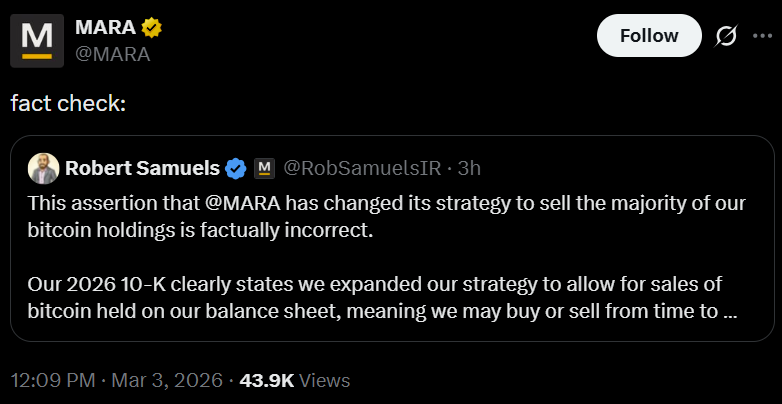
MARA Holdings, one of the world’s largest Bitcoin mining companies, has rejected claims that it plans to unload the majority of its Bitcoin holdings following speculation about a shift in its treasury policy.
The clarification came in a post on X from MARA vice president for investor relations Robert Samuels, who said the company has not altered its core Bitcoin (BTC) treasury approach.
His remarks were a direct response to SwanDesk adviser Jacob King, who claimed Tuesday that MARA had shifted toward a sell-down strategy, citing filings with the US Securities and Exchange Commission. King’s post had received more than 325,000 views at the time of writing.
Samuels pointed to the company’s 2026 10-K filing, which states that MARA expanded its policy to allow for potential sales of Bitcoin held on its balance sheet.

“Our 2026 10-K clearly states we expanded our strategy to allow for sales of bitcoin held on our balance sheet,” Samuels wrote.
As Cointelegraph initially reported, the filing authorizes discretionary transactions based on market conditions and capital allocation priorities, rather than mandating a reduction in reserves.
The distinction, Samuels argued, is between preserving optionality and committing to a material drawdown of Bitcoin treasury holdings.
MARA has historically positioned itself as a long-term Bitcoin holder, making any perceived shift in its treasury strategy closely watched by investors and market participants.
Related: Bitcoin mining’s 2026 reckoning: AI pivots, margin pressure and a fight to survive
MARA doubles down on diversification while maintaining a large BTC treasury
While MARA has broadened its operational footprint in recent years, its balance sheet remains heavily tied to Bitcoin exposure.
That diversification accelerated last month when MARA acquired a 64% stake in Exaion, a France-based computing infrastructure company focused on high-performance computing and blockchain services.
Even so, Bitcoin remains central to MARA’s balance sheet. The company holds 53,822 BTC, valued at about $3.7 billion, making it the largest publicly traded Bitcoin miner by treasury size.

Among public companies overall, only Michael Saylor’s Strategy holds more, with over 720,000 BTC accumulated to date.
Related: American Bitcoin boosts hashrate with 11,298 new mining machines
Crypto World
Bybit Retrieves $300M for Thousands of Users Through AI-Enhanced Fraud Prevention: Report
Beyond recoveries, Bybit blocked 3 million credential-stuffing attempts tied to account takeover schemes in 2025.
Bybit has reported recovering $300 million for thousands of users at a time when crypto-related fraud remains high across the industry.
The exchange attributed these efforts to an AI-powered fraud detection system that intervenes before people lose their funds.
Security Initiative Results
Bybit shared the results of its 2025 Security Initiative, stating on social media,
“We raised the standard in 2025, intercepting $300M in impersonation scams and fraud through our new AI-driven risk framework.”
The announcement comes as crypto fraud continues to weigh on the sector, with Chainalysis data showing that $17 billion in digital assets was drained in scam and fraud cases in 2025.
The report reveals that in the fourth quarter alone, the exchange flagged $500 million in withdrawals for review. Of that amount, $300 million was successfully intercepted and recovered, protecting the savings of more than 4,000 users.
During the same period, Bybit’s proprietary AI models identified 350 high-risk investment fraud addresses using on-chain data, shielding 8,000 people from potential withdrawal losses. The company also reported blocking over 3 million credential-stuffing attempts linked to account-takeover efforts in 2025.
Additionally, its system automatically labeled 350 suspicious addresses, and it manually tagged 600 more via internal ticket operations, preventing a further $1 million in imminent fraud losses.
You may also like:
David Zong, Head of Group Risk Control at Bybit, said in a statement that the firm’s goal in 2025 was to transform risk control into an active and intelligent guardian by integrating AI and on-chain monitoring.
“By integrating AI-driven on-chain monitoring with real-time intelligence from industry partners like TRM, Elliptic and Chainalysis, we not only just protect Bybit users but also help map the DNA of fraudulent networks,” he wrote.
Three-Tier Risk Framework
Bybit’s protection model structures potential scam scenarios into three escalating tiers while preserving normal trading activity. At the lowest risk level, the platform uses big data analysis to detect unusual activity, such as mass withdrawals to newly created addresses, and deploys automated surveys to support its Risk Operations team in blacklisting suspicious destinations.
Real-time alerts trigger during the withdrawal process for medium-risk cases, such as accounts flagged through credential stuffing databases or linked to questionable withdrawal addresses. This, in turn, prompts individuals to review transactions that may be influenced by social engineering tactics.
At the highest level, wallet addresses associated with confirmed scams face immediate withdrawal blocking and a mandatory one-hour cooling-off period.
The report concluded by outlining standardized monitoring indicators for wider industry use, including an anti-credential stuffing engine, real-time on-chain AI pattern recognition for pig butchering flows, an integrated intelligence hub combining tools from TRM Labs, Elliptic, and Chainalysis, and an end-to-end cross-chain tracing model for illicit fund tracking.
Binance Free $600 (CryptoPotato Exclusive): Use this link to register a new account and receive $600 exclusive welcome offer on Binance (full details).
LIMITED OFFER for CryptoPotato readers at Bybit: Use this link to register and open a $500 FREE position on any coin!
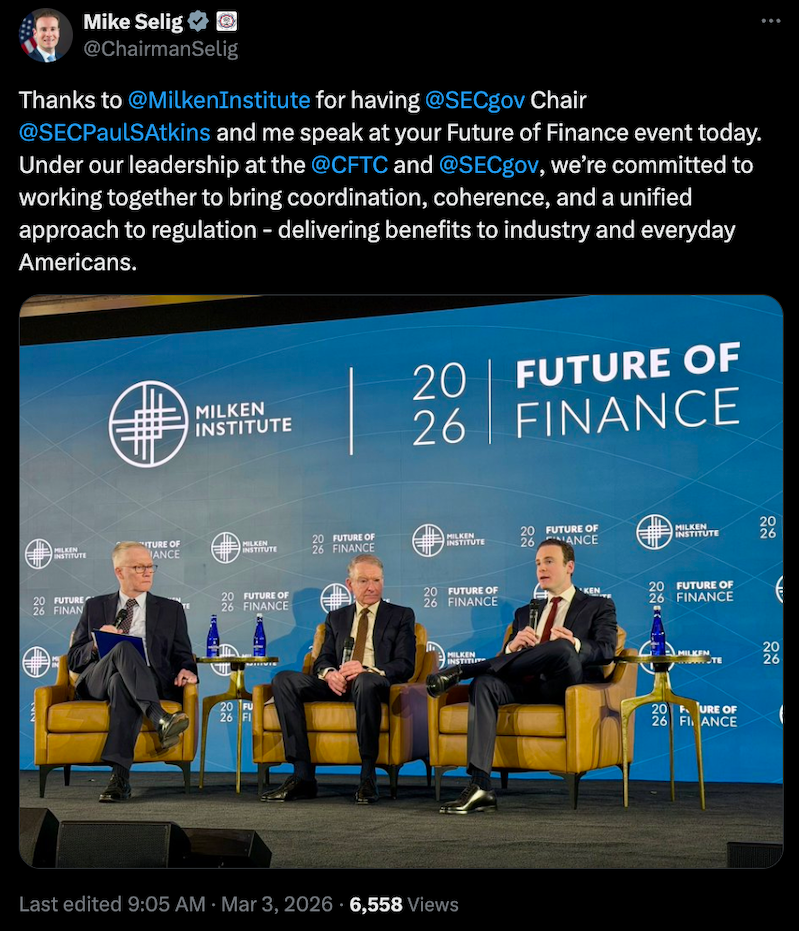
SEC Chair Paul Atkins and CFTC Chair Michael Selig addressed market structure, prediction markets and perpetual futures at a Tuesday event.
Michael Selig, chair of the US Commodity Futures Trading Commission (CFTC), said the agency will soon address how to handle perpetual futures contracts for cryptocurrencies.
In a Tuesday panel hosted by the Milken Institute in Washington, DC, Selig said that the CFTC was working toward getting “true perpetual futures” in the United States “within the next month or so.”
The CFTC chair is currently the only Senate-confirmed commissioner, with no indication as of Tuesday that US President Donald Trump will nominate anyone to fill any of the agency’s four vacant commissioner slots.
“The prior administration drove a lot of these firms and the liquidity offshore,” said Selig in a panel discussion with SEC Chair Paul Atkins.

Selig added that the CFTC was working to provide guidance regarding prediction markets “in the very near future.” He claimed in February that the agency had “exclusive jurisdiction” over regulating platforms offering event contracts, pushing back against many state-level enforcement actions against companies including Kalshi and Polymarket.
Related: Can US lawmakers pass crypto market structure before the midterms?
Market structure bill will impact SEC and CFTC
Atkins addressed concerns related to the digital asset market structure bill moving through Congress, which, according to some experts, has effectively been put on hold amid discussions on ethics, stablecoin yield and tokenized equities. According to the SEC chair, the agency needed a “sense of Congress enshrined in statutory form” to “direct the courts where to go” and support the commission’s efforts on crypto.
“There’s only so much you can do without legal certainty from Congress,” Selig said in response to Atkins’ remarks.
As of Tuesday, the Senate Banking Committee had not scheduled a markup to consider the market structure bill. The White House held the latest in a series of talks with industry leaders last week on stablecoin yield, but it was unclear whether those discussions would result in the legislation moving forward.
Magazine: Clarity Act risks repeat of Europe’s mistakes, crypto lawyer warns
Solana (SOL) has been facing a period of consolidation, with its price fluctuating between $87 and $77 in recent weeks. However, recent developments in the market suggest that the cryptocurrency could be at risk of a significant downturn.
A bearish pattern has emerged, and shifting investor behavior could trigger a price crash, with potential losses of up to 38% if SOL breaks below key support levels.
Rising Concern: Solana STHs Profits
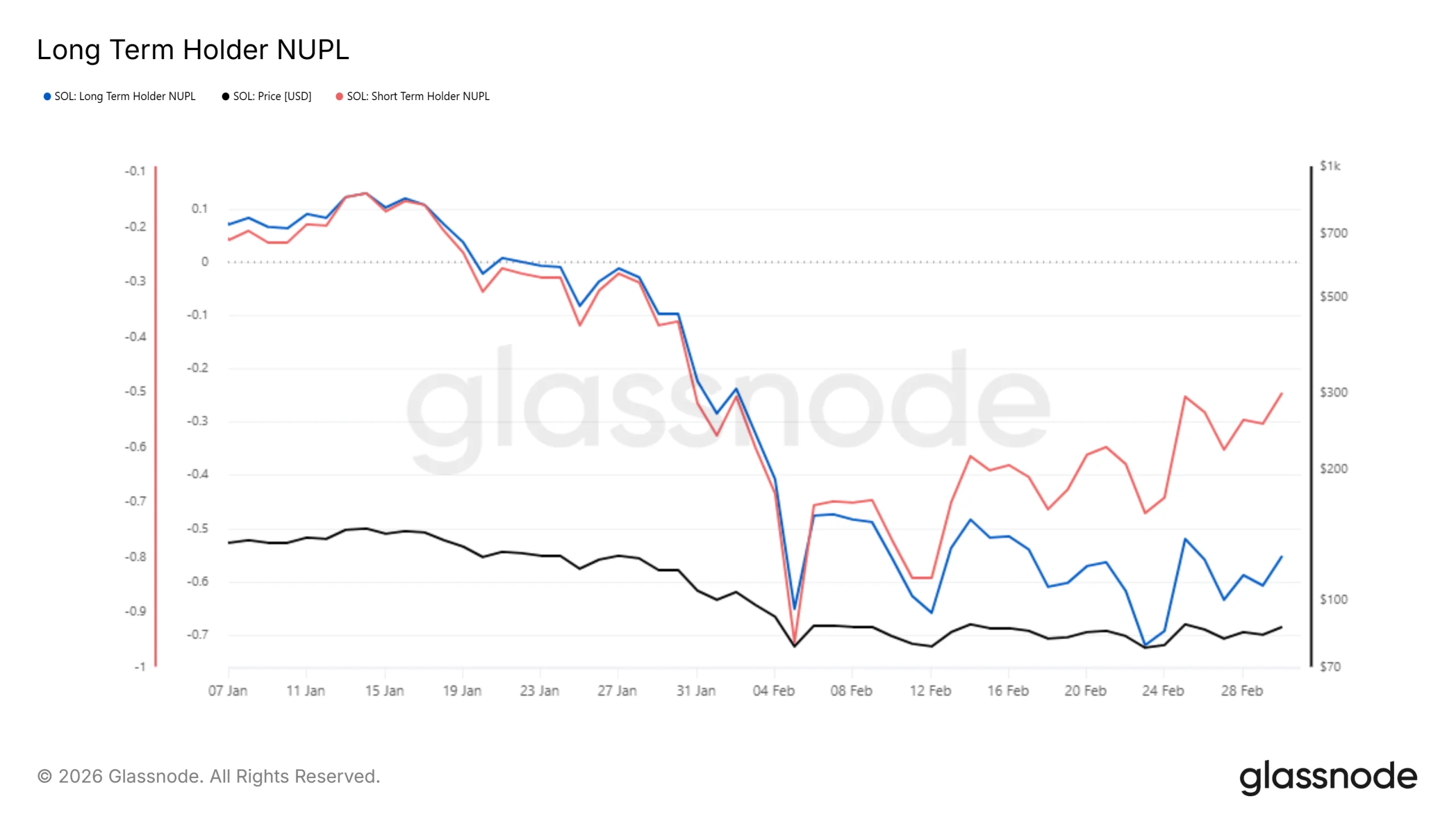
One of the key indicators raising concern for Solana is the LTH vs. STH NUPL (Long-Term Holder vs. Short-Term Holder Net Unrealized Profit/Loss). Since February, the unrealized profits of short-term holders (STHs) have been steadily climbing.
STHs are typically quick to sell when they see profits, and this could add significant selling pressure on Solana’s price. The absence of a similar profit rise among LTHs means that there is less stabilization from long-term holders.
Want more token insights like this? Sign up for Editor Harsh Notariya’s Daily Crypto Newsletter here.
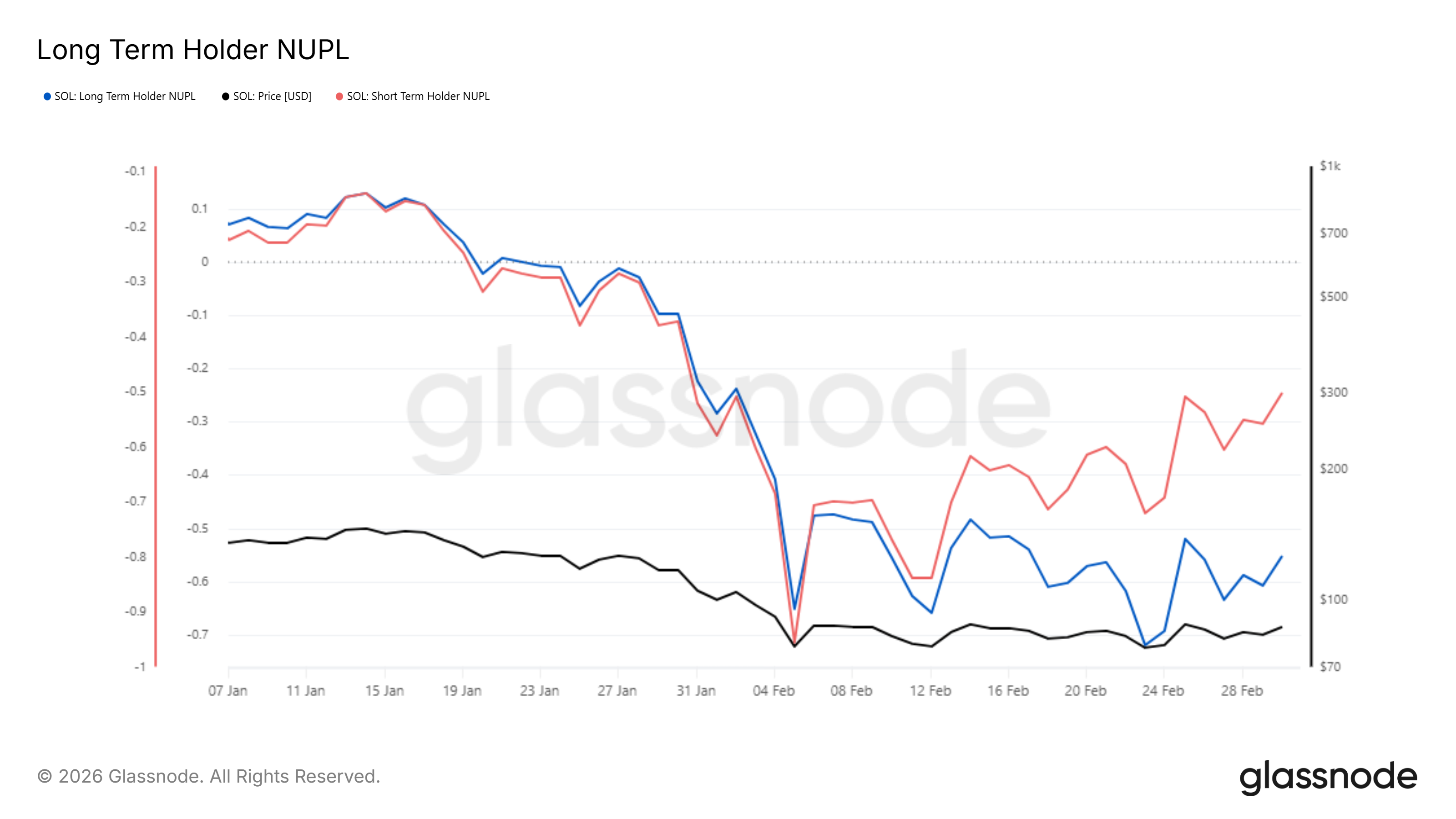
In fact, if the LTHs were to panic sell as well, it could further exacerbate the downward pressure on the price. The lack of support from these long-term holders raises the risk of intensified selling in the market.
Solana Faces Increased Selling Pressure
The overall macro momentum for Solana is showing signs of weakness. The Exchange Net Position Change indicator has highlighted a rising trend in exchange inflows, which signals increased selling activity.
Over the last four weeks, this indicator has consistently noted that Solana is facing selling pressure from investors, further contributing to the bearish sentiment surrounding the asset.
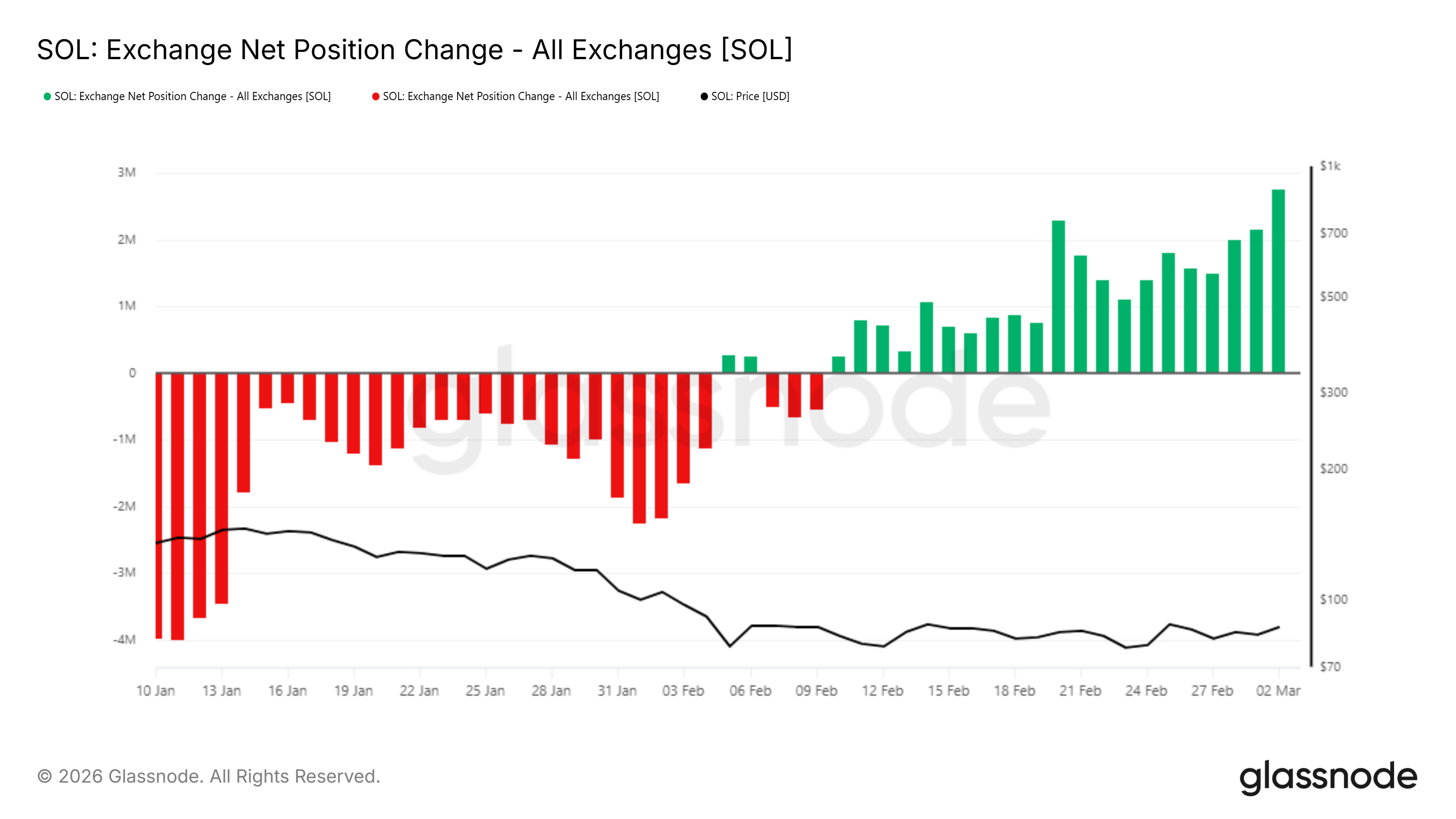
As more Solana holders sell their holdings, the downward pressure on SOL could intensify. This increasing sell-off could compound the bearish pattern forming on the charts, making it more likely that the price will break down below critical support levels.
SOL Price May Fall Out Of The Flag
At the time of writing, Solana is trading at $83, remaining rangebound between $77 and $87. The formation of a bearish flag pattern indicates that the price could experience a significant drop if it breaks below the $77 support level. A breakdown below this level could set Solana up for a 38% crash, with the price potentially falling to as low as $51.
In order for this crash to occur, the selling pressure would need to continue rising, and Solana would need to break the $64 support level. If this happens, the price could fall to $57, $51, and eventually $45, validating the bearish pattern.
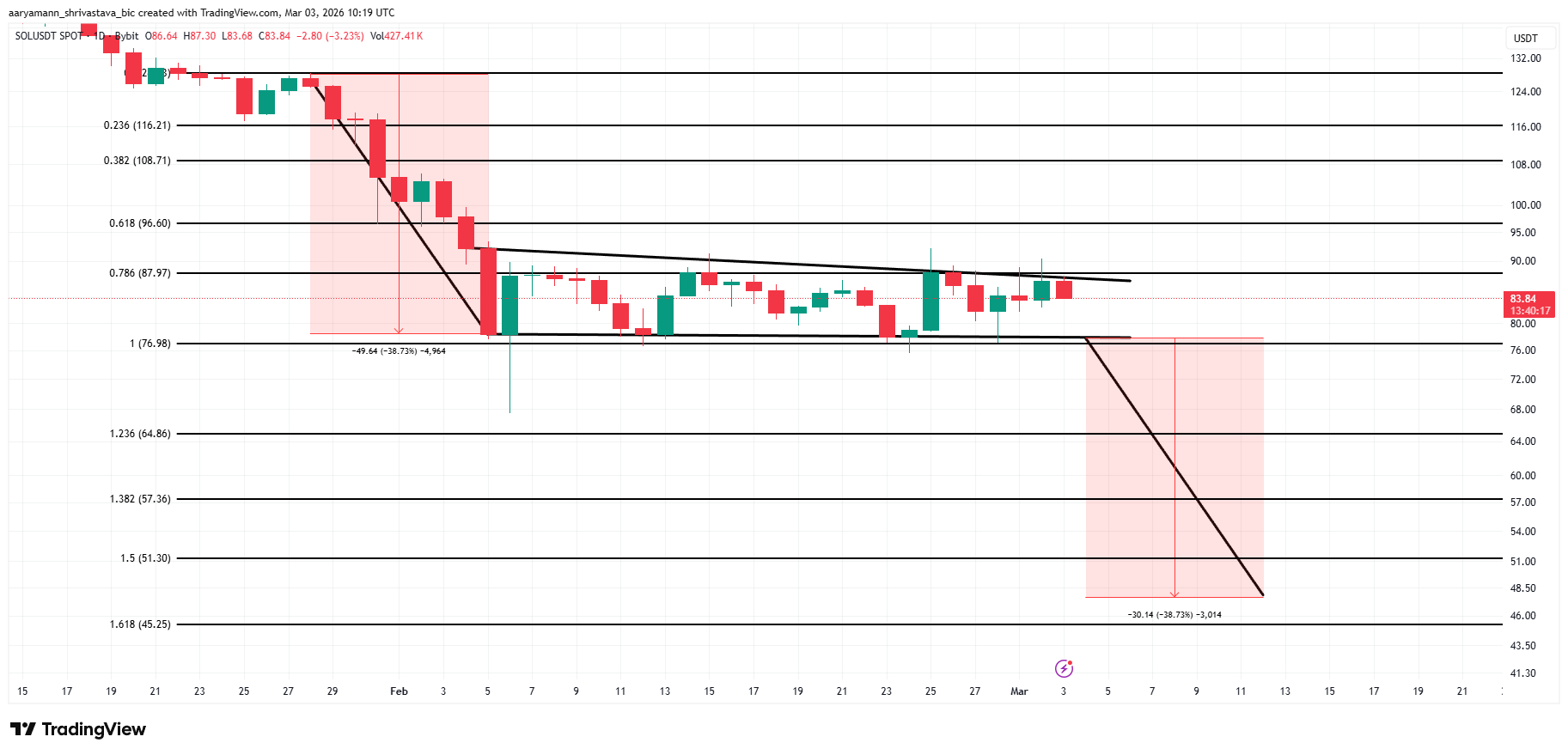
However, if investor sentiment shifts and focus turns toward supporting a recovery, Solana’s price could break out of the consolidation. If SOL manages to breach resistance levels at $88 and $96, it would invalidate the bearish outlook, potentially sending the price upward toward $100, marking a monthly high.
Crypto World
JP Morgan CEO Jamie Dimon says stablecoin issuers paying interest should be regulated as banks


JPMorgan Chase CEO Jamie Dimon said banks want stablecoin issuers that pay interest on customer balances to face the same rules as traditional lenders, sharpening an ongoing debate over U.S. crypto legislation.
In an interview with CNBC on Tuesday, Dimon addressed reported tensions with Coinbase CEO Brian Armstrong, who pulled support for the proposed CLARITY Act just one day before the Senate Banking Committee was scheduled to vote on it. Dimon argued that there needs to be a line between rewards paid on transactions and interest paid on stored balances.
“Rewards are the same as interest,” Dimon said. “If you are going to be holding balances and paying interest, that’s the bank. You should be regulated by a bank.”
Banks would accept a compromise in which crypto platforms offer rewards tied to transactions, he said. But firms that function like deposit-taking institutions should meet the same standards as banks, including capital and liquidity rules, anti-money laundering controls and federal deposit insurance requirements.
Dimon framed the issue as one of fairness and safety.
“Level playing field by product,” he said, arguing that companies offering similar financial services should operate under similar oversight. Without that parity, he warned, risks could build outside the regulated system. Armstrong, on the other hand, has said he believes that banks should be forced to compete instead.
Dimon, however, stressed that JPMorgan does support competition and uses blockchain in its own operations. The bank has developed a deposit token and processes payments and data transfers on distributed ledger systems. “We’re in favor of competition,” he said. “But it’s got to be fair and balanced.”
He also pointed to the broader compliance burden banks carry, from anti-money laundering checks to community lending obligations. Those requirements, he said, are designed to protect the financial system.
“For the safety of the system, not just the fairness of competition,” Dimon said.
The debate over stablecoin oversight has become a central issue in Washington as lawmakers weigh how to regulate digital assets without pushing activity into less transparent corners of the market. Lawmakers are reviewing new draft language circulated by the White House, though the banking and crypto industries have yet to reach agreement on whether stablecoin issuers should be allowed to offer yield on customer balances.
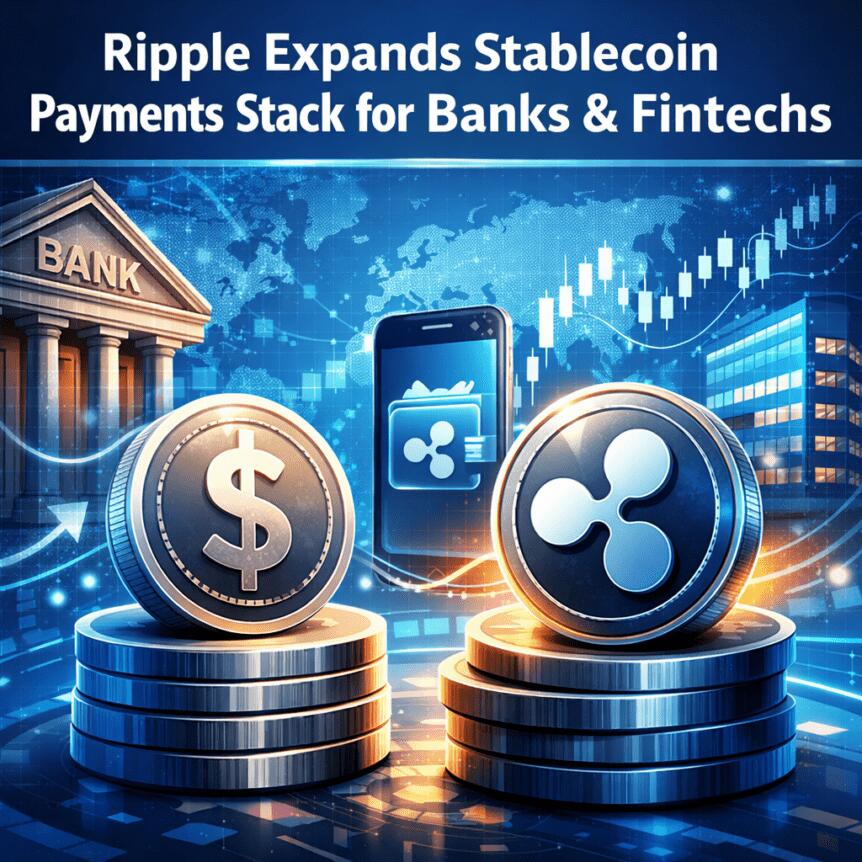
Ripple is expanding its global payments platform to give banks and fintechs a more complete stablecoin workflow, aiming to speed up cross-border settlements and cut the time and capital tied up in traditional networks. The upgrade to Ripple Payments adds capabilities for collecting, custodying, converting, and payout of stablecoins, tying together institutional rails with on-chain settlement. The move marks a deeper push to compete with legacy providers by reducing reliance on pre-funded accounts and correspondent banking chains that can bind up liquidity and slow transfers. The announcement comes as Ripple showcases its growing footprint across markets and its evolving infrastructure footprint in a sector where liquidity, speed, and regulatory clarity increasingly shape the competitive landscape.
Key takeaways
- Ripple Payments now supports end-to-end stablecoin workflows for institutions, including collection, custody, conversion, and payout, expanding its role beyond simple settlement rails.
- The upgrade is designed to reduce dependence on pre-funded accounts and traditional correspondent banking networks, potentially accelerating cross-border transactions and lowering liquidity bottlenecks.
- Ripple’s dollar-pegged token is gaining traction in the ecosystem, with the circulating supply nearing the hundreds of millions and growing as the platform expands adoption across institutions.
- The company has pursued strategic acquisitions to strengthen custody and treasury automation, notably Palisade and Rail, signaling a broader push into asset management and fiat/stablecoin interoperability.
- Regulatory momentum in the United States accompanies this growth, including discussions around a US crypto market structure bill and recent bank-charter considerations, underscoring the coupling of infrastructure growth with oversight.
Tickers mentioned: $RLUSD
Market context: The expansion aligns with a broader push in crypto-financial infrastructure toward regulated, on-chain settlement rails and stablecoin interoperability, as lawmakers weigh oversight frameworks and market structure changes.
Why it matters
The move deepens Ripple’s integration with traditional financial ecosystems by offering a turnkey stablecoin workflow that can be plugged into existing bank processes. For banks and fintechs, this means a potential reduction in the capital that must be set aside for pre-funded accounts and fewer intermediaries in the flow of cross-border payments. By combining custody, conversion, and payout within a single platform, Ripple aims to streamline liquidity management and settlement timing, which could translate into faster settlements and improved working capital efficiency for institutions participating in the network.
Beyond operational efficiencies, the expansion signals a maturation of the stablecoin payments ecosystem. The dollar-pegged token that Ripple supports is gradually gaining scale, and the company is citing real-world institutional usage as it broadens its footprint. The liquidity and settlement rails, already used in more than 60 markets and handling substantial transaction volume, are being extended to accommodate broader use cases, including treasury management and interbank settlements across regions.
Strategically, the push comes as Ripple consolidates its position through acquisitions that bolster custody and fiat-to-stablecoin exchange capabilities. The deals for Palisade and Rail underpin a broader thesis: to offer institutions a more seamless, auditable, and automated treasury stack that can manage digital and fiat assets under a unified framework. This aligns with industry trends toward more robust custody and compliance tooling as crypto assets gain traction in regulated environments.
Regulatory momentum complements the growth. In December, the US Office of the Comptroller of the Currency signaled a path for national bank charters that would cover crypto-adjacent operations, though with clear boundaries around deposit-taking and lending. The development, coupled with ongoing negotiations in Washington over a crypto market structure bill and stablecoin provisions, highlights a year of increasing clarity around how the sector could scale within the traditional financial system. Ripple’s legal leadership has been active in shaping these discussions, underscoring the company’s role in informing and responding to regulatory expectations as the ecosystem expands.
The corporate maneuvers—plus the regulatory dialogue—sit within a broader narrative of capital-efficient, faster payments via on-chain rails that could redefine cross-border liquidity management for financial institutions. As more banks and fintechs look to digital settlement capabilities, Ripple’s end-to-end solution could become a reference architecture for institutional adoption of stablecoins and digitized asset settlement, especially as policy conversations continue in the US and abroad.
What to watch next
- Regulatory milestones: finalization of national bank charter approvals and any concrete steps on the US crypto market structure bill with respect to stablecoins.
- Implementation milestones: timelines for broader integration of the end-to-end stablecoin workflow across additional institutions and regions, and updates on custody/treasury automation deployments from Palisade and Rail.
- Market adoption: indicators of increased institutional usage, including signed partnerships or pilot programs with banks and fintechs beyond the current roster.
- Liquidity and issuance dynamics: monitoring RLUSD (CRYPTO: RLUSD) supply growth and how it translates into on-chain settlement capacity and cross-border flows.
- Geopolitical/regulatory signals: any new guidelines or enforcement actions related to stablecoins and cross-border payments that could influence deployment strategy or product design.
Sources & verification
- Ripple announces end-to-end stablecoin platform expansion within Ripple Payments via Business Wire: Ripple Redefines Payments with End-to-End-Stablecoin Platform and Global Customer Momentum.
- Historical platform data and regional participants cited (AMINA Bank, Banco Genial, ECIB, AltPayNet) in the expansion narrative.
- RLUSD metrics and market data referenced from CoinMarketCap and related Ripple USD coverage.
- Regulatory context including OCC bank-charter discussions and the White House regulatory meeting involving Ripple’s OL team and other industry participants.
- Past acquisitions: Palisade (custody/treasury automation) and Rail (fiat/stablecoin interoperability) and their roles in expanding Ripple’s custody and settlement capabilities.
What the article links to
Ripple expands European footprint with Amina stablecoin payment partnership: https://cointelegraph.com/news/ripple-amina-stablecoin-cross-border-payments-europe
OCC approval discussions: https://cointelegraph.com/news/bitgo-circle-fidelity-bitgo-ripple-occ-approval-bank-conversion
Ripple CEO White House meeting on crypto banking clarity: https://cointelegraph.com/news/ripple-ceo-white-house-meeting-crypto-banking-clarity
Related coverage: Ripple acquired Rail for $200 million: https://cointelegraph.com/news/ripple-acquires-rail
RLUSD price index: https://cointelegraph.com/ripple-usd-price-index
RLUSD market data on CoinMarketCap: https://coinmarketcap.com/currencies/ripple-usd/
Announcement source: https://www.businesswire.com/news/home/20260303432530/en/Ripple-Redefines-Payments-with-End-to-End-Stablecoin-Platform-and-Global-Customer-Momentum?feedref=JjAwJuNHiystnCoBq_hl-bV7DTIYheT0D-1vT4_bKFzt_EW40VMdK6eG-WLfRGUE1fJraLPL1g6AeUGJlCTYs7Oafol48Kkc8KJgZoTHgMu0w8LYSbRdYOj2VdwnuKwa
BitGo Europe GmbH has launched its crypto-as-a-service offering across the European Economic Area, enabling fintechs and banks to integrate regulated crypto custody, trading and fiat on- and off-ramps under the EU’s Markets in Crypto-Assets (MiCA) framework.
According to Tuesday’s announcement, the expansion makes BitGo’s API-based infrastructure available in all 30 EEA countries, allowing institutions to embed wallet, onboarding and settlement services directly into their platforms. The service includes multi-asset wallets and Single Euro Payments Area (SEPA) fiat rails.
BitGo said custodial wallets are insured up to $250 million, subject to terms, and include configurable policy controls and 24/7 operational support. The platform supports buying, selling and holding Bitcoin (BTC) and other supported digital assets within a partner’s existing interface, with settlement handled through BitGo’s infrastructure.
The offering was previously available in the United States through BitGo Bank & Trust and is now operating in Europe via BitGo Europe GmbH, the company’s locally regulated entity.
BitGo has operated since 2013 and provides custody, wallets, staking, trading, financing, stablecoins and settlement services to institutional clients globally. The company went public on Jan. 22, trading on the New York Stock Exchange under the ticker BTGO.
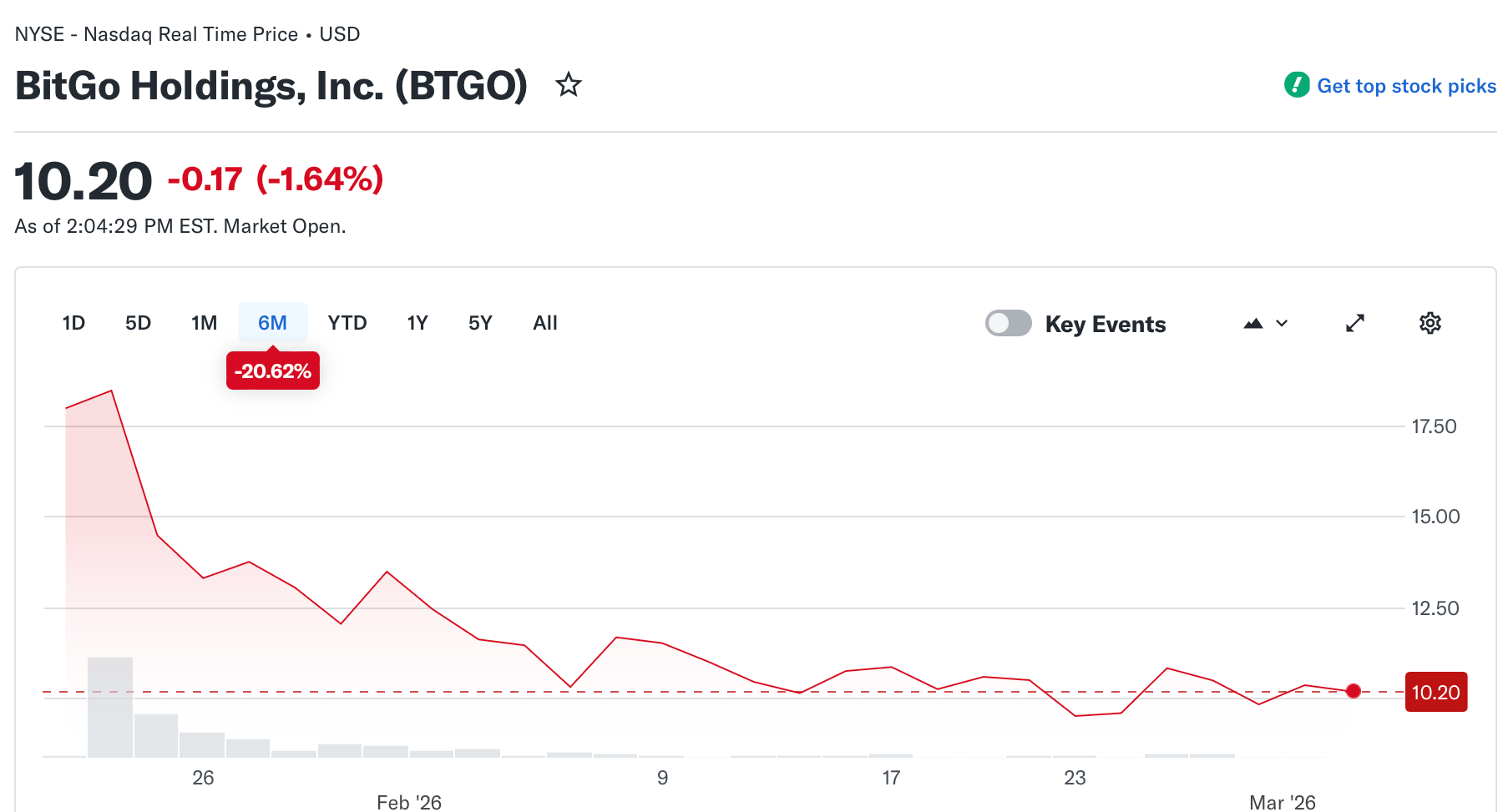
BitGo stock was trading at $10.20, down about 1.6% on Tuesday and about 20% since going public, according to Yahoo Finance data at the time of writing.

Related: Stablecoins could weaken bank lending and monetary policy in Europe: ECB
Custody infrastructure expands in Europe
The rollout reflects broader growth in regulated custody infrastructure across Europe following MiCA’s implementation, as financial institutions formalize digital asset services under the EU’s licensing regime. Several banks have opted to work with specialized crypto companies rather than build custody systems internally.
In July, Deutsche Bank moved toward crypto custody through partnerships with Bitpanda’s technology unit and Swiss digital asset infrastructure provider Taurus.
Spain’s BBVA in September said it would rely on Ripple’s institutional custody platform to support its Bitcoin and Ether (ETH) trading and safekeeping services, citing MiCA compliance.
At the market infrastructure level, Clearstream, part of Deutsche Börse, said it would offer Bitcoin and Ether custody and settlement to institutional clients through its Swiss subsidiary Crypto Finance AG.
Others have chosen to structure custody services through licensed European entities. In January, Standard Chartered announced plans to launch digital asset custody in Europe after obtaining a license in Luxembourg, establishing a dedicated EU entity to deliver the service directly.
Magazine: Clarity Act risks repeat of Europe’s mistakes, crypto lawyer warns
Over a third of tracked altcoins now sit near cycle lows despite a broader market stabilization.
Summary
- CryptoQuant data shows 38% of altcoins are trading close to all-time lows, a deeper drawdown than during the post-FTX unwinding phase.
- Analyst Darkfost describes this as the “largest regression of altcoins observed during this cycle,” highlighting persistent structural pressure on non-BTC assets.
- While BTC holds near recent highs, dispersion between majors and smaller caps has widened, with altcoin underperformance pointing to weak liquidity and selective risk appetite.
On-chain analytics firm CryptoQuant reports that 38% of altcoins are currently trading close to their all-time lows, marking a more severe retracement than the period following the collapse of FTX. The metric, highlighted by analyst Darkfost, is designed to capture how many alternative tokens remain under sustained selling pressure, even as the broader market shows signs of stabilization.
In a note summarized on social media, Darkfost describes this as the largest regression in altcoins observed so far in the current cycle, underscoring how uneven the recovery has been between blue-chip assets and the long tail of speculative tokens.
Market participants commenting on the data pointed out that, unlike the post-FTX phase—when forced liquidations and distressed selling drove prices lower—the current environment features relatively fewer obvious forced sellers. Instead, altcoin weakness appears to be driven by a mix of low liquidity, tighter risk budgets, and a rotation into more established names such as BTC and ETH, which have captured the bulk of inflows into spot markets and regulated products. One observer noted that in the FTX aftermath, once the main overhang cleared, many assets staged at least a reflexive bounce, whereas now a significant share of altcoins remains pinned near their lows despite occasional rallies in majors.investing+2
Dispersion and liquidity stress
The divergence described by CryptoQuant has important implications for portfolio construction and risk management across digital assets. Rising dispersion—where some segments of the market trend higher while others grind lower—tends to increase both opportunity and risk, particularly for funds attempting to rotate between themes or capture relative value. With a large share of altcoins near ATL, liquidity in many order books has thinned, raising the impact cost of entering or exiting positions and increasing the potential for sharp, “Bart-style” intraday moves noted by traders.
At the same time, the data suggests a growing concentration of market interest in a smaller set of higher-quality or more narrative-driven assets, including BTC, ETH, and ecosystems such as SOL that continue to see comparatively stronger developer and user activity. Centralized venues like Coinbase have also funneled more volume into a limited basket of listed tokens, further amplifying the relative underperformance of smaller caps that lack deep markets or institutional access. In Europe, evolving regulatory frameworks like MiCA may reinforce this concentration by encouraging platforms to prioritize assets with clearer compliance and disclosure profiles, potentially leaving many fringe altcoins structurally disadvantaged even if broader crypto sentiment improves.
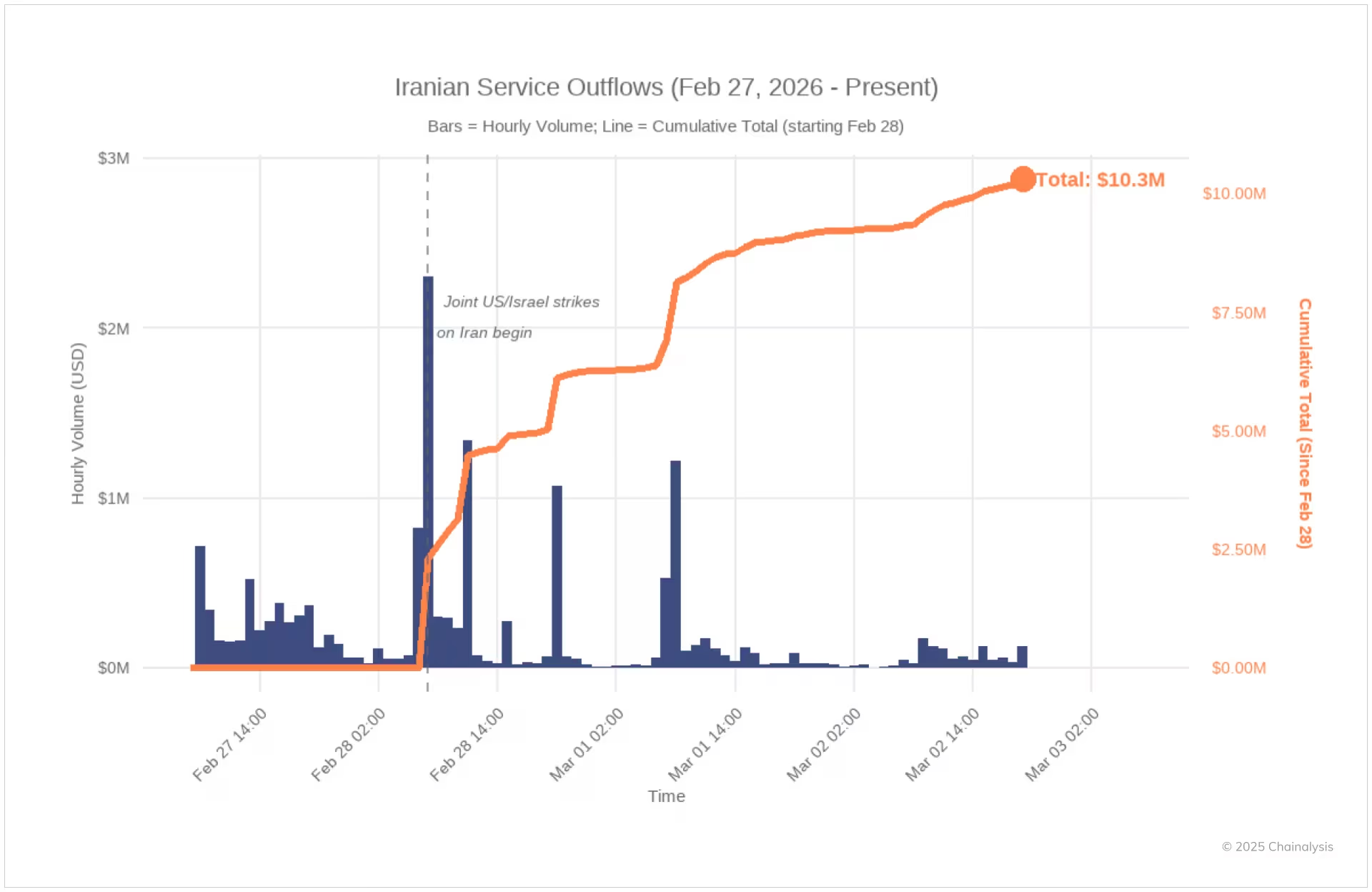
Crypto outflows from Iranian exchanges spiked to $10.3 million, underscoring cryptocurrencies’ role as financial safe havens during geopolitical crises.
Between February 28 and March 2, crypto outflows from Iranian exchanges surged to $10.3 million in the wake of US-Israeli airstrikes.
Nobitex, Iran’s largest cryptocurrency exchange, witnessed a striking 700% rise in outgoing transaction volumes immediately after the airstrikes, as reported by Elliptic. This surge reflects the growing trend of utilizing cryptocurrencies as a financial refuge during periods of instability.

Iran’s crypto ecosystem was valued at $7.8 billion in 2025, with significant activity often linked to geopolitical events, according to Chainalysis. This pattern of on-chain spikes around major shocks, such as the Kerman bombings in early 2024 and direct clashes with Israel in 2024–2025, underscores the correlation between geopolitical crises and crypto market fluctuations.
The recent airstrikes are not the first event to trigger substantial crypto movements within Iran. During a January 8 internet blackout, Bitcoin withdrawals surged before flatlining, only to resume once connectivity was restored. This behavior suggests robust demand for decentralized financial solutions when traditional infrastructure falters.
This article was generated with the assistance of AI workflows.


CFTC chairman Michael Selig plans to enable US-listed crypto perpetual futures within weeks.
Summary
- CFTC chair Michael Selig told attendees the agency aims to clear regulatory obstacles and launch “genuine professional” crypto perpetual futures in the US within about 4 weeks.
- The move is part of “Project Crypto,” a joint SEC–CFTC initiative that includes new guidance for DeFi, prediction markets, and tokenized collateral frameworks.
- BTC and major altcoins saw modest intraday gains while derivatives traders priced in potential onshoring of volume from offshore venues, with expectations for higher regulated futures open interest.
The US Commodity Futures Trading Commission (CFTC) is preparing to clear a formal path for crypto perpetual futures to operate onshore, in what could mark one of the most significant structural shifts for the digital asset derivatives market since the approval of spot exchange-traded products. According to remarks attributed to chairman Michael Selig and relayed via a CoinDesk report, the agency is “working to launch professional futures—genuine professional futures—in the US within approximately the next month,” with multiple policy announcements expected soon. The initiative aims to reverse years of regulatory ambiguity that pushed a large share of perpetual futures activity to offshore platforms, leaving US markets reliant on less standardized products and fragmented liquidity.
Selig’s comments, delivered at a Washington event alongside SEC chair Paul Atkins, frame perpetual futures as a core tool for risk management and price discovery that should exist within a transparent, supervised environment rather than primarily on unregulated exchanges. He argued that the prior approach “failed to create a pathway” for onshore perpetuals, contributing to capital flight and an uneven playing field for US firms. Under the new direction, the CFTC intends to use its rulemaking powers to permit additional tokenized collateral types and to define conditions under which perpetual and other novel derivatives can list and trade, subject to margin, clearing, and conduct safeguards.
Impact on markets and venues
Market participants immediately began debating how onshore perpetuals could reshape flows between US-registered markets and offshore exchanges that have historically dominated perpetual volume. Some commentators suggested that regulated contracts could draw a portion of institutional and professional activity away from lightly supervised venues, especially once larger platforms such as Coinbase expand their CFTC-registered offerings beyond existing structured products. Others questioned whether leverage caps, onboarding requirements, and surveillance obligations might limit the appeal of US-listed perps relative to high-leverage offshore alternatives that remain outside the direct reach of American regulators.
The timing also intersects with broader reforms under “Project Crypto,” which seeks clearer rules for DeFi developers, prediction markets, and retail leveraged products, as well as parallel regulatory developments in other jurisdictions under regimes like MiCA. If successful, onshoring more of the perpetual futures complex could tighten the link between CFTC-supervised benchmarks and spot BTC markets, improving transparency while potentially reducing the systemic risk associated with opaque, cross-border leverage cycles. For traders and firms, the coming announcements will determine how quickly new contracts can list, which collateral will qualify, and whether a meaningful share of global perpetual liquidity migrates into the US regulatory perimeter.

NFL news: Bears center Drew Dalman reportedly retires at just 27

Samsung’s glasses-free 3D screens are coming to malls and museums, and billboards may never look the same again

ITS OVER CRYPTO MARKET STRUCTURE HALTED DUE TO WAR! XRP OPTIONS INCOMING! #crypto #bitcoin #xrp #war

Smart energy pays enters the US market, targeting scalable financial infrastructure

Why Israel is blocking foreign journalists from entering

Bitcoin: We’re Entering The Most Dangerous Phase
ITS OVER CRYPTO MARKET STRUCTURE HALTED DUE TO WAR! XRP OPTIONS INCOMING! #crypto #bitcoin #xrp #war

The Next Financial Crisis? Private Equity, Private Credit & Life Insurance | Real Eisman Playbook

DISGUSTING Banks HATE Crypto The Fed Just ENDED Crypto Debanking FOREVER
-

 Politics5 days ago
ITV enters Gaza with IDF amid ongoing genocide
-

 Fashion4 days ago
Weekend Open Thread: Iris Top
-

 Politics14 hours ago
Alan Cumming Brands Baftas Ceremony A ‘Triggering S**tshow’
-

 Tech3 days ago
Unihertz’s Titan 2 Elite Arrives Just as Physical Keyboards Refuse to Fade Away
-

 NewsBeat6 days ago
Cuba says its forces have killed four on US-registered speedboat | World News
-
Sports4 days ago
The Vikings Need a Duck
-
 NewsBeat3 days ago
Dubai flights cancelled as Brit told airspace closed ’10 minutes after boarding’
-
 NewsBeat6 days ago
Manchester Central Mosque issues statement as it imposes new measures ‘with immediate effect’ after armed men enter
-

 NewsBeat2 days ago
‘Significant’ damage to boarded-up Horden house after fire
-
 NewsBeat3 days ago
The empty pub on busy Cambridge road that has been boarded up for years
-

 NewsBeat3 days ago
Abusive parents will now be treated like sex offenders and placed on a ‘child cruelty register’ | News UK
-
 NewsBeat7 days ago
Police latest as search for missing woman enters day nine
-

 Entertainment2 days ago
Baby Gear Guide: Strollers, Car Seats
-

 Business6 days ago
Discord Pushes Implementation of Global Age Checks to Second Half of 2026
-

 Business5 days ago
Only 4% of women globally reside in countries that offer almost complete legal equality
-
 Tech4 days ago
NASA Reveals Identity of Astronaut Who Suffered Medical Incident Aboard ISS
-
 NewsBeat3 days ago
Emirates confirms when flights will resume amid Dubai airport chaos
-
Politics3 days ago
FIFA hypocrisy after Israel murder over 400 Palestinian footballers
-

 Crypto World7 days ago
Entering new markets without increasing payment costs
-

 Crypto World5 days ago
From Crypto Treasury to RWA: ETHZilla Retreats and Relaunches as Forum Markets on Nasdaq