

Crypto World
Will ETH Finally Secure the $2K Breakout?

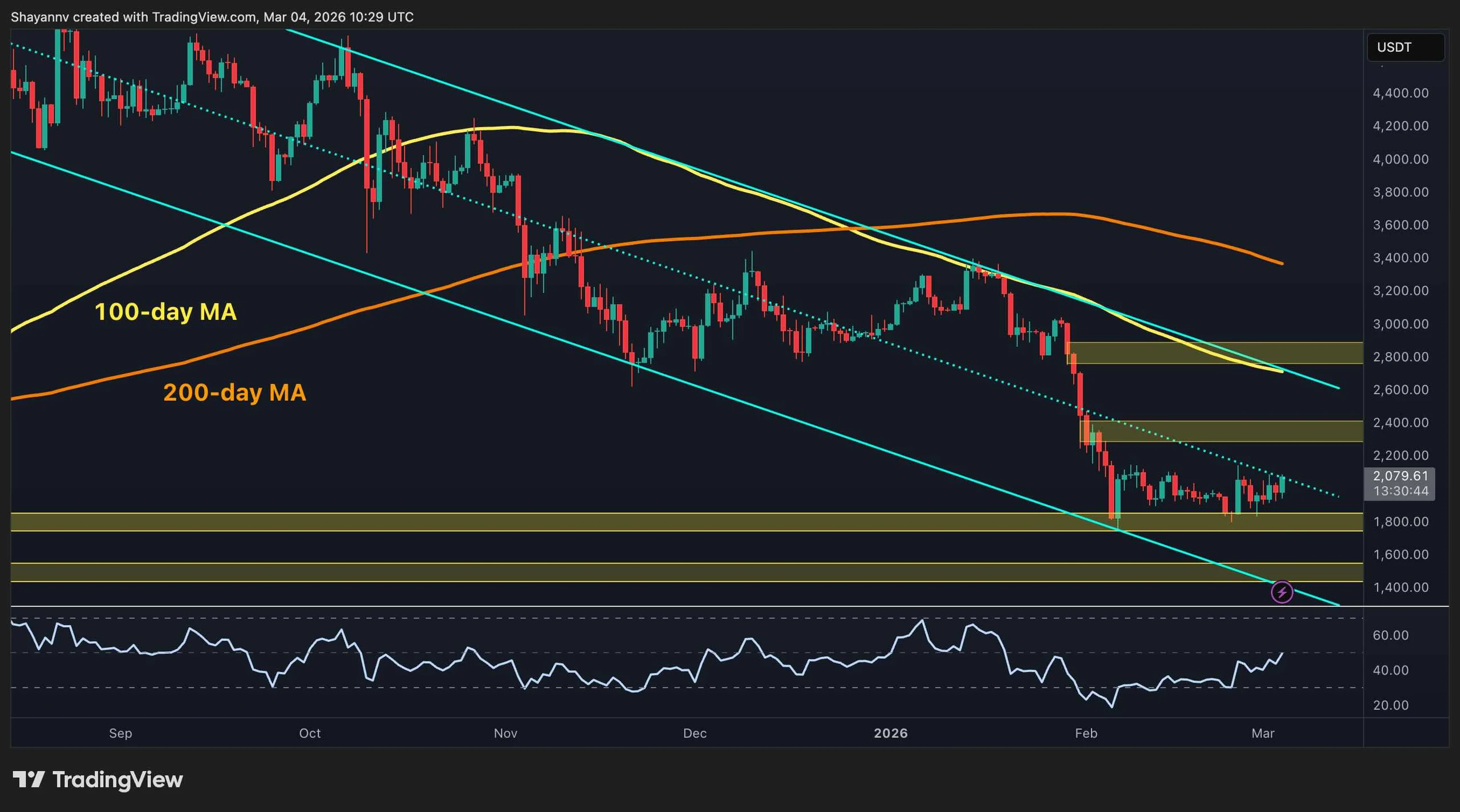
Ethereum is still trying to transition from capitulation into stabilization, with the price holding above the key $1,800 demand zone while repeatedly pressing into resistance near $2,150. The higher timeframe trend remains bearish, but the short-term structure is improving, so the next clean break from this range will likely set the tone for the next multi-week move.
Ethereum Price Analysis: The Daily Chart
On the daily chart, ETH is still trading below the 100-day moving average and the 200-day moving average, and both are sloping lower, which keeps the broader bias bearish. The asset is also respecting a descending channel, and the latest bounce is happening from the lower end of that structure rather than from a reclaimed trend level. The nearest overhead supply remains the $2,300 to $2,400 zone, which has acted as a pivot area during the previous distribution phase.
The most important support remains $1,800, which has been tested and defended after the sharp breakdown. If ETH loses $1,800 on a daily close, the next downside magnets are $1,600 and then $1,400, where prior demand zones sit on the chart. On the upside, a daily reclaim of $2,400 would be the first meaningful step toward shifting structure, with the next major resistance band near $2,800 to $3,000.
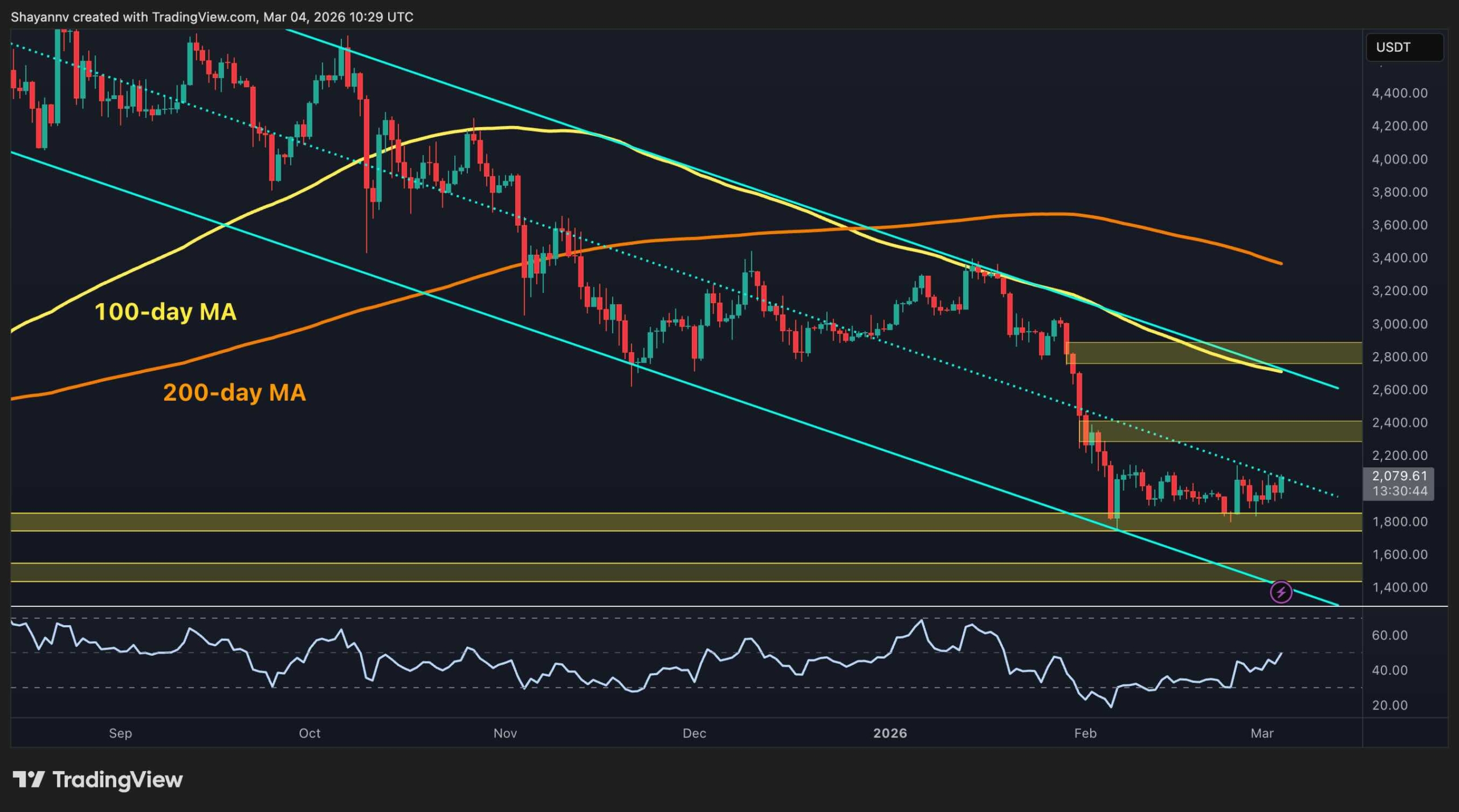
ETH/USDT 4-Hour Chart
On the 4-hour chart, ETH has been carving out a clear range, with buyers defending the $1,800 support area while sellers repeatedly cap the price near the $2,150 mark. This kind of consolidation after a hard sell-off often becomes a decision point, because liquidity builds at both ends, and the breakout can travel quickly. A clean push above $2,150 that holds would put $2,300 to $2,400 back in play as the next target zone.
If ETH fails again at $2,150 and rolls over, the immediate focus returns to the $1,800 area. The risk with repeated support tests is that each bounce can weaken the bid over time, especially if broader market sentiment stays fragile. A breakdown below $1,800 would likely trigger another volatility expansion move because it removes the main demand shelf that has been absorbing selling pressure.

On-Chain Analysis
The exchange reserve chart shows a sustained downtrend in ETH held on exchanges, falling toward roughly 15.9 million ETH. In general, declining exchange reserves are associated with reduced immediate sell-side supply, because fewer coins are sitting on venues where they can be quickly sold. That can support stronger rebounds when demand returns, especially if the price is already basing near support.
The key nuance is timing. During a bear phase, reserve declines can reflect a mix of cold storage withdrawals, staking, and migration to on-chain venues, not necessarily aggressive accumulation. If reserves keep falling while price holds above $1,800 and starts reclaiming resistance, it would strengthen the case for a recovery move. If reserves flatten or begin rising again while ETH remains rejected under $2,150, it can signal renewed distribution and increase the odds of another sweep back into the $1,800 support area.

Binance Free $600 (CryptoPotato Exclusive): Use this link to register a new account and receive $600 exclusive welcome offer on Binance (full details).
LIMITED OFFER for CryptoPotato readers at Bybit: Use this link to register and open a $500 FREE position on any coin!
Disclaimer: Information found on CryptoPotato is those of writers quoted. It does not represent the opinions of CryptoPotato on whether to buy, sell, or hold any investments. You are advised to conduct your own research before making any investment decisions. Use provided information at your own risk. See Disclaimer for more information.



Bitcoin finally got through the door.
The largest cryptocurrency broke above $72,000 on Thursday, its highest level since before the Feb. 5 crash and the first clean move above the $70,000 ceiling that had rejected it three times in the past month.
It was trading at $72,180 in Asian afternoon hours on Thursday, up 5.9% over the past 24 hours and 5.4% on the week, as a combination of easing war anxiety, strong ETF flows, and a broader equity rebound pulled risk appetite back into the market.
The rally was broad. Ether climbed 7.5% to $2,114, reclaiming $2,000 with conviction for the first time since late February. Dogecoin surged 7.5% to $0.095. Solana added 5.3% to $89.91. XRP rose 4.2% to $1.41 and BNB gained 3% to $650. WhiteBIT Coin jumped 5.6%. The only notable laggard was Tron, up just 1.4%.
The trigger was a shift in global risk sentiment. Asian equities rallied for the first time since the Iran war broke out, with South Korea’s benchmark surging 11% after its biggest drop on record in the previous session.
Wall Street had led the way after economic data eased inflation concerns, though the recovery looked tentative with U.S. and European futures edging lower Thursday morning.
The conflict itself remains unresolved, however. Tehran is still targeting Israel and Gulf states. U.S. and Israeli forces continued striking Iran, including sinking an Iranian warship in international waters. Defense Secretary Pete Hegseth said operations could last “six, could be eight, could be three” weeks. Trump said “we’re doing very well on the war front” and that the U.S. has “great support.”
But markets have moved past the initial shock and into pricing mode. The Strait of Hormuz situation appears to be stabilizing with U.S. tanker escorts underway. Oil pared its early-week spike.
And the worst-case scenario of an uncontrolled regional escalation looks less likely with each day that passes without a dramatic widening of the conflict.

TLDR:
- Venezuela’s Minerven will ship up to 1,000 kg of gold to US refineries under a new Trump-brokered deal.
- Trafigura is acting as intermediary, shepherding the gold under a separate US government arrangement.
- The contract requires 98% final gold purity, with the total deal value estimated above $150 million.
- The deal marks the third reported resource extraction agreement brokered by the Trump administration in 2025.
The United States has secured a multimillion-dollar gold agreement with Venezuela, marking a shift in Washington’s resource diplomacy.
Venezuela’s state-owned mining company, Minerven, will ship up to 1,000 kilograms of gold to US refineries.
Commodity trading giant Trafigura is serving as intermediary in the arrangement. The deal, reported by Axios, carries an estimated value exceeding $150 million.
Trump’s Venezuela Gold Deal: What the $150M Minerven Contract Covers
Interior Secretary Doug Burgum traveled to Venezuela personally to finalize the agreement.
His involvement signals how seriously Washington is treating resource access as a foreign policy tool. The contract specifies a 98% final gold content standard, according to sources cited by Axios.
Trafigura’s role is to shepherd the physical gold into US refining infrastructure under a separate arrangement with the government.
The trading firm has existing logistics networks across commodity supply chains. That infrastructure makes it a natural fit for a deal of this scale and sensitivity.
Kobeissi Letter, a renowned financial markets account, flagged the deal on X, noting the US is “eyeing Venezuela’s gold.” The post attracted attention from traders and macro analysts tracking dollar-adjacent commodity flows.
This marks the third resource extraction deal the Trump administration has reportedly structured since January, when Maduro’s grip on Venezuela reportedly weakened.
US Resource Strategy Extends Beyond Venezuela Into Asia and Latin America
The Venezuela gold agreement did not emerge in isolation.
According to posts by analyst Shanaka Perera on X, the same week saw Japan and India ink a rare earth agreement in Rajasthan. India also opened the Andaman Basin to oil exploration during that same period.
A joint US-Ecuador military operation also took place within the same seven-day window, according to Perera’s account. These moves, taken together, suggest a coordinated effort to lock in resource relationships across multiple regions simultaneously.
Venezuela holds some of the world’s largest oil reserves. For years, Caracas maintained deep financial and strategic ties with Beijing. A shift toward US-aligned commodity flows represents a meaningful change in that dynamic.
Gold markets have taken note. The deal adds to existing upward pressure on gold prices, which have held near record highs in recent sessions. A 1,000-kilogram shipment, while not enormous by global standards, carries symbolic weight given its origin and the political context surrounding it.
TLDR:
- Bitwise donated $233K from BITB profits to Bitcoin nonprofits in its second annual giving cycle.
- BITB now manages $2.7B in assets, directly increasing the size of this year’s developer donation.
- Brink, OpenSats, and HRF’s Bitcoin Fund split the contribution across open-source development grants.
- Bitwise CIO Matt Hougan says BITB is the only ETF with an ongoing profit-share pledge to developers.
Bitwise Asset Management has donated $233,000 to three Bitcoin-focused nonprofits. The funds come directly from profits generated by its Bitwise Bitcoin ETF, ticker BITB.
This marks the second consecutive year the firm has fulfilled a pledge made at the ETF’s January 2024 launch. The commitment ties 10% of gross annual profits to open-source Bitcoin development support.
Bitwise Bitcoin ETF Profits Fund Developer Grants for Second Straight Year
Bitwise directed the donation across three organizations. Brink, OpenSats, and the Human Rights Foundation’s Bitcoin Development Fund each received a portion.
All three groups focus on funding and training developers who maintain Bitcoin’s core infrastructure. None of them operate for profit.
The pledge originated when BITB first launched in January 2024. Bitwise committed to donating 10% of gross profits annually. The first donation followed that same year. This second contribution signals the firm intends to make the practice routine.
BITB has grown considerably since its debut. The fund now manages approximately $2.7 billion in assets under management. That growth directly increased the size of this year’s donation compared to the first.
Larger assets mean larger profits, and a larger share flows to developers.
Bitwise’s Chief Investment Officer Matt Hougan pointed out that BITB stands alone among ETFs in making this type of ongoing commitment.
No other Bitcoin ETF has structured a recurring donation tied to fund profits. The observation drew attention within the Bitcoin community.
Brink, OpenSats, and HRF Bitcoin Fund Split the $233,000 Contribution
Brink focuses on supporting full-time Bitcoin protocol developers through fellowships and grants. OpenSats funds open-source contributors working on Bitcoin and related projects.
The Human Rights Foundation’s Bitcoin Development Fund supports developers in regions where financial freedom is restricted.
Each organization allocates funds independently based on its own grant criteria. Bitwise does not direct how recipients distribute the money. The structure keeps the donation at arm’s length from any product or promotional interest.
Bitwise shared the announcement publicly via its official channels. The post credited investors who chose BITB for making the donation possible. It framed the contribution as a reinvestment into the ecosystem supporting the ETF itself.
The broader Bitcoin development community responded positively. The model connects institutional capital with open-source infrastructure in a direct, measurable way. Observers noted it creates a feedback loop: more BITB investment leads to more developer funding.
Bitwise has not disclosed projections for next year’s donation. The amount will depend on BITB’s profit performance through 2025.

Stablecoin firm Tether has led a $50 million strategic investment round in sleep technology startup Eight Sleep, to help the company integrate artificial intelligence agents into its sleep tech products.
The latest funding round was announced on Tuesday, with Eight Sleep raising $50 million at a $1.5 billion valuation. It follows a $100 million raise last August. The firm specializes in sleep health products, primarily across bedding and supplements.
In an announcement on Tuesday, Tether expressed its strong conviction in health technology to support “longevity, performance, and disease prevention,” and will collaborate with Eight Sleep to bring artificial intelligence-based health technology products to market.
Tether has been using its capital stockpile to invest in a wide range of areas outside crypto. Its investments span the gold sector, media, biotechnology and AI. The firm has also made multiple attempts to buy professional football clubs.

“Technologies that can turn continuous health data into clear, practical insights will shape the future of consumer health and wellness,” Tether said.
“The investment is designed to empower Eight Sleep and establish a long-term collaboration to build advanced AI-driven health technology using, among others, Tether’s QVAC architecture and leveraging QVAC’s edge intelligence to enhance Eight Sleep products,” it added.
Tether’s QVAC is a privacy-focused health tech service launched in December that enables users to integrate their bio-health data from multiple services or products, like smart rings, into a single platform, supported by local on-device AI to help users with data management and health insights.
Eight Sleep has stated that it plans to build a sleep-focused AI agent to support its Pod, a sleep tech product that automatically adjusts bed temperature, elevation, and sound based on factors such as heart rate, breathing, snoring, time asleep and sleep stages.
Related: Stablecoin giving grows as ‘crypto philanthropy’ matures: Report
The Pod already has AI integrations to track sleep health data; however, Eight Sleep has said the funding will help evolve the company’s current AI tools and capabilities.
“We’ve built the most seamless AI-powered health sensing system in the world, and this partnership with Tether gives us the infrastructure to take that intelligence beyond the Pod, into every aspect of personal health,” noted Franceschetti as part of Tether’s announcement.
On X, Franceschetti provided more detail, saying that Eight Sleep is now building a predictive agent trained on over 1 billion hours of sleep data; meanwhile, it is also “advancing FDA filings for sleep apnea detection.”
“Passive. Every night. No wires, no clinic visits,” he said.
Magazine: Bitcoin may face hard fork over any attempt to freeze Satoshi’s coins
Bitcoin remained bid Thursday amid signs of persistent demand for spot exchange-traded funds (ETFs).
The leading cryptocurrency traded near $72,500 on Thursday, according to CoinDesk market data. The U.S.-listed spot ETFs pulled in another $155 million in net inflows on Wednesday, extending a recent streak of institutional buying that has helped lift prices after weeks of sluggish activity.
The fresh inflows bring total allocations to roughly $1.47 billion over the past two weeks, according to data curated by SoSoValue, marking a sharp reversal after several weeks of withdrawals earlier this year.
Institutional demand through ETFs has begun to stabilize after a difficult start to the year. Investors have poured roughly $1.7 billion into U.S. spot bitcoin ETFs since Feb. 24, according to Bloomberg Intelligence data previously reported by CoinDesk, suggesting some investors are growing more comfortable that the market may have found at least a near term floor.
Earlier this week, analysts at Bitfinex cautioned that ETF inflows do not always translate into immediate buying pressure in the spot market. Authorized participants can create and short ETF shares before sourcing the underlying bitcoin, delaying the impact of those flows on price.
Still, the spot ETF inflows and bitcoin’s recent resilience during geopolitical tensions indicates growing macro relevance of the cryptocurrency, according to some market participants.
“Bitcoin is increasingly being repriced by the market as a geopolitical hedge rather than just a risk asset,” said Livio Weng, CEO of Bitfire. “Unlike gold, bitcoin trades 24/7 and can move across borders instantly, which makes it a natural escape valve for capital during periods of geopolitical stress.”
On-chain data calls for caution
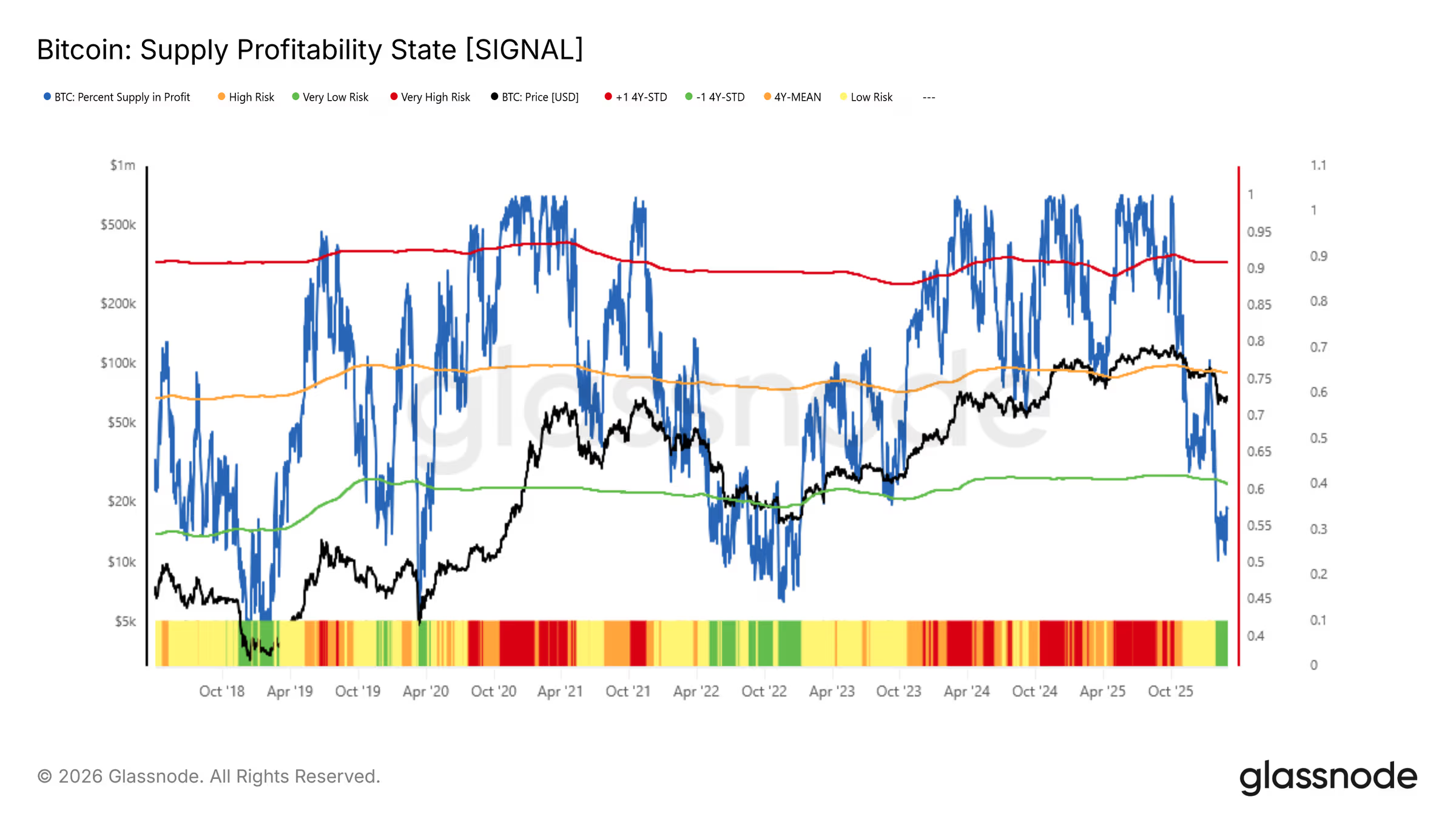
Despite the rebound in flows, underlying demand signals remain fragile, according to Glassnode. In a recent report, the firm said buy-side momentum has weakened significantly, with the 30-day moving average of realized profit falling about 63% since early February.
The share of bitcoin supply held in profit has also slipped to roughly 57%, a level historically associated with early stages of deeper bear market conditions. Glassnode added that the cost basis of short-term holders near $70,000 could act as a key behavioral ceiling, potentially turning rallies into distribution zones as traders exit positions near breakeven.



The U.S. banking industry is pushing back against the Federal Reserve’s decision to grant crypto exchange Kraken direct access to its core payments infrastructure, warning the move could introduce new risks to the financial system.
Summary
- Kraken Financial became the first crypto firm to gain access to the Federal Reserve’s core payment systems through a limited-purpose master account.
- Trade groups including the Independent Community Bankers of America (ICBA) say the move could introduce risks and bypass regulatory safeguards.
- Critics warn the decision could set a precedent allowing other crypto firms to seek similar direct access to U.S. financial infrastructure.
Kraken’s Wyoming-chartered banking arm, Kraken Financial, recently secured a limited-purpose Federal Reserve “master account,” making it the first crypto-native firm to connect directly to the central bank’s payment rails.
The account allows the firm to process transactions through systems such as Fedwire without relying on intermediary banks, enabling faster fiat transfers tied to digital asset markets.
U.S. banking lobby warns of risks after Kraken gets Fed payment account
While the approval represents a milestone for the crypto industry, major banking groups have voiced strong concerns about the decision. The Independent Community Bankers of America (ICBA) said it has “deep concerns” about granting a master account to Kraken Financial, arguing that crypto-focused institutions operate under different regulatory frameworks than traditional banks.
Banking lobby groups also questioned the approval process. The Bank Policy Institute said the Kansas City Federal Reserve granted what appears to be a “limited purpose” or “skinny” master account before the Federal Reserve Board finalized the policy framework governing such access.
According to the group, the move lacked transparency and could undermine consistency across the Fed system.
Critics also point to Kraken Financial’s status as a Wyoming Special Purpose Depository Institution (SPDI), which is not federally insured like traditional banks. Banking advocates argue that allowing uninsured institutions to access the Fed’s settlement infrastructure could pose financial stability and compliance risks.
The debate highlights growing tensions between traditional financial institutions and the digital asset industry.
If upheld, Kraken’s approval could serve as a precedent for other crypto companies seeking similar integration with the U.S. banking system, potentially reshaping how digital assets interact with traditional financial infrastructure.
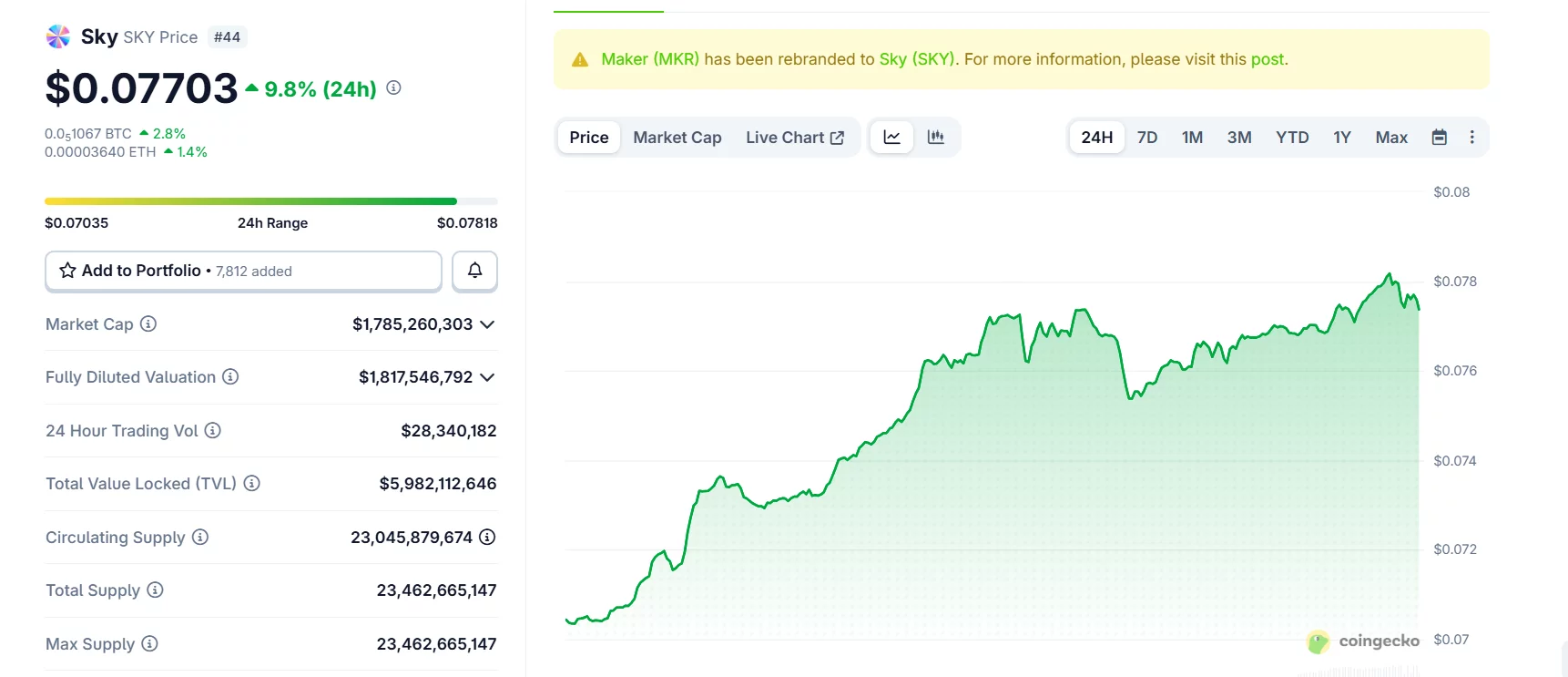
The SKY token rallied roughly 10% over the past 24 hours as investors responded to the protocol’s ongoing token buyback program and governance updates designed to reshape its tokenomics.
Summary
- SKY gained roughly 10% in the past 24 hours, according to on-chain and market data.
- The protocol has repurchased over 1.8 billion SKY tokens through its ongoing treasury-backed buyback program.
- Recent proposals approved adjustments to staking rewards and treasury management, which could reduce token inflation.
SKY climbs double digits as protocol buybacks fuel rally
According to on-chain data, the token’s latest move comes amid renewed interest in the project’s supply reduction strategy. The Sky protocol has been actively repurchasing its native token through a treasury-backed buyback mechanism, which removes tokens from circulation and can reduce selling pressure.
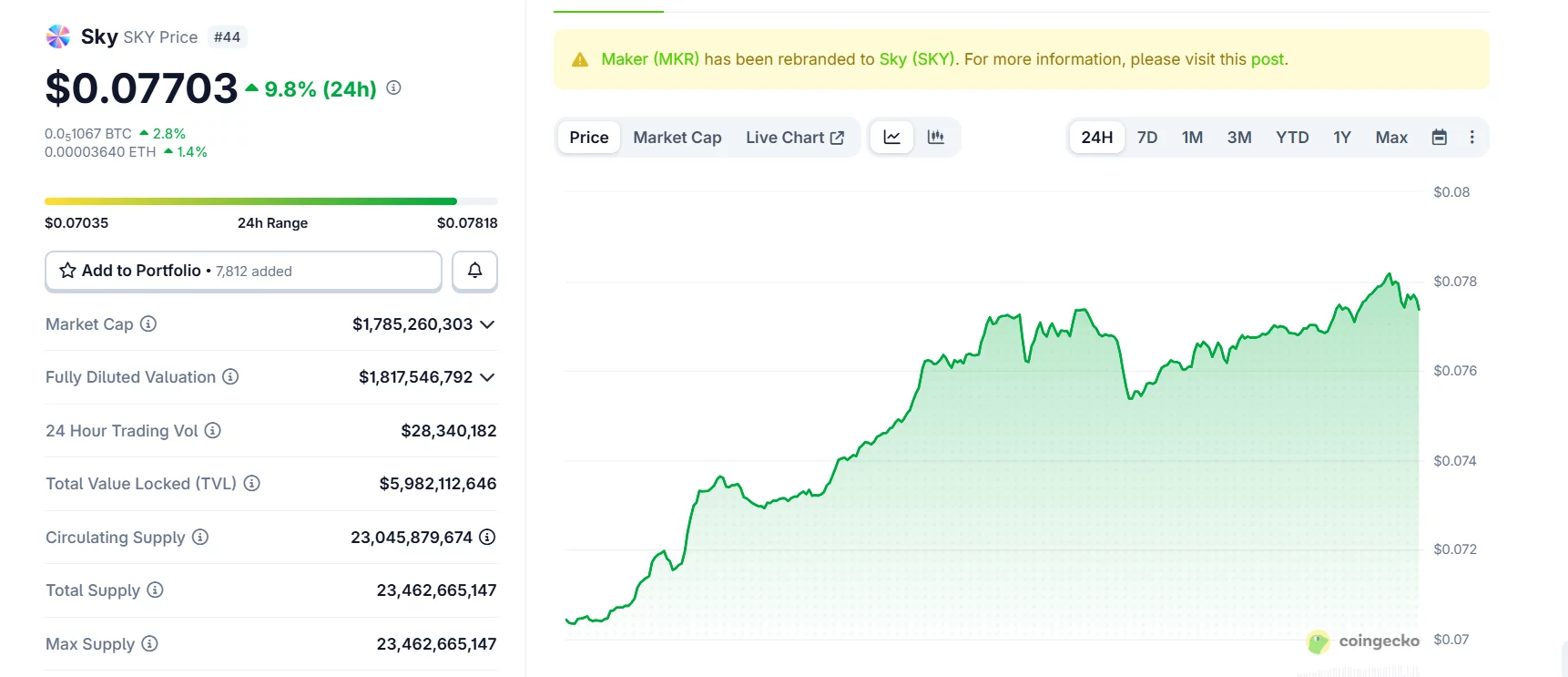
Data from the protocol’s public buyback dashboard shows that more than 1.8 billion SKY tokens have already been repurchased through the program. The buybacks are funded using USDS from the project’s treasury and are executed directly on the market.
The strategy mirrors traditional corporate share buybacks, a model increasingly adopted by some decentralized finance protocols to return value to token holders and support price stability.
Momentum also appears to have been boosted by recent governance developments within the Sky ecosystem. A newly approved executive vote introduced several operational updates, including adjustments to staking rewards and treasury management functions.
One of the key changes involves the normalization of SKY staking rewards, a move that effectively slows the rate at which new tokens are issued to participants.
By reducing emissions, the protocol aims to limit inflationary pressure on the token while maintaining incentives for network participants.
The governance vote also included operational updates related to agent onboarding and settlement cycles within the protocol’s broader infrastructure.
Taken together, the buyback activity and emission adjustments have strengthened the narrative around SKY’s evolving tokenomics, which increasingly emphasize supply management and revenue-backed incentives.
The rally highlights growing market interest in DeFi projects experimenting with token value accrual models that resemble equity-style financial mechanisms.
If the buyback pace continues and governance changes further tighten supply, analysts say SKY could remain a closely watched token in the decentralized finance sector.
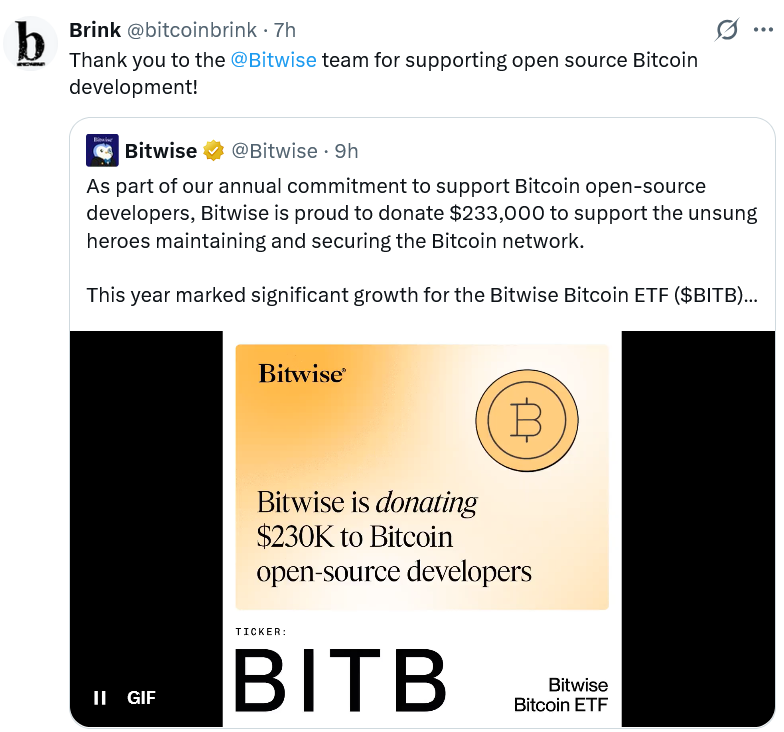
Crypto asset manager Bitwise has now donated a total of $383,000 to support developers who maintain and secure the Bitcoin network since 2024, with its latest $233,000 contribution announced on Wednesday.
Its second payout, funded by 10% of gross profits from its Bitwise Bitcoin ETF (BITB), adds to the $150,000 that it donated in February 2025 after BITB’s first full year.
“Bitwise is proud to donate $233,000 to support the unsung heroes maintaining and securing the Bitcoin network,” Bitwise said in a post to X on Wednesday.
Around the time of BITB’s launch in January 2024, Bitwise pledged to direct 10% of gross profits to Bitcoin developers, who play a key role in securing what has become a $1.4 trillion network.
“As $BITB continues to grow, so too does our contribution. Bitcoin is changing the world, and Bitwise will always strive to do our part to be a good steward of this incredible ecosystem.”
Bitwise said three Bitcoin-friendly non-profit organizations will allocate the funds: Bitcoin Brink, OpenSats and the Human Rights Foundation, through its Bitcoin Development Fund.

The $233,000 donation suggests Bitwise generated $2.33 million in gross profits from BITB in its second year.
Bitwise earns money from BITB by charging a 0.2% fee on BITB assets under management.
BITB is still third in total Bitcoin ETF flows
BITB has seen $2.2 billion worth of inflows since January 2024, trailing only BlackRock’s iShares Bitcoin Trust (IBIT) and the Fidelity Wise Origin Bitcoin Fund (FBTC), Farside Investors data shows.
However, IBIT and FBTC are far ahead, having amassed $62.4 billion and $11 billion worth of inflows, respectively.
Related: TradFi to adopt 24/7 crypto rails sooner than expected: Bitwise
Many Bitcoin ETFs have seen net inflows fall at the start of 2026 amid a broader crypto market pullback.

BITB has managed to weather that storm, however, increasing marginally from $2.17 billion to $2.21 billion across the first nine weeks of the year.
Magazine: A ‘tsunami’ of wealth is headed for crypto: Nansen’s Alex Svanevik
Crypto World
Bitcoin Outflows Hit 28,700 BTC: Is the Bitfinex Transfer Distorting the Market Signal?
TLDR:
- Bitcoin recorded its largest single-day outflow since November 2025, totaling 28,700 BTC across exchanges.
- Bitfinex alone accounted for 24,627 BTC of the total outflow, dropping reserves from 431,767 to 407,140 BTC.
- A single transaction moved 23,588 BTC to a newly created wallet, pointing to a possible internal treasury operation.
- Analysts urge caution as the outflow data may not reflect true accumulation without an official statement from Bitfinex.
Bitcoin outflows across major exchanges surged recently, reaching 28,700 BTC in a single day—the highest recorded since November 2025.
The bulk of this movement came from Bitfinex, where reserves dropped sharply within a short window. While such outflows are traditionally seen as a sign of accumulation, this event carries a distinct characteristic.
Market analysts are currently calling for caution before treating this data as a clear directional signal.
Bitcoin Outflows Reach Highest Point Since November 2025
The 28,700 BTC net outflow recorded across exchanges is not a routine figure. It marks the largest single-day outflow seen in several months.
Data shared by analyst Darkfost on X pointed to this unusual spike. The numbers quickly caught the attention of traders watching on-chain metrics.
According to Darkfost’s post, large Bitcoin outflows from exchanges often suggest accumulation behavior. Investors withdrawing BTC from platforms typically plan to hold rather than sell.
This reduces the available supply on trading venues over time. Historically, such patterns have been associated with periods of price strength.
The trend of moving Bitcoin off exchanges has appeared at various points in past market cycles. Reduced exchange reserves have often preceded upward price movement in those periods.
On-chain analysts widely reference this relationship. The pattern carries a reputation as a positive market signal.
However, this event does not fit neatly into that historical framework. The outflow was not distributed across many exchanges, as would be expected.
Instead, it was concentrated almost entirely on one platform. That concentration shifts the analysis considerably.
Single Bitfinex Transaction Raises Questions About Market Interpretation
Bitfinex saw its reserves fall from 431,767 BTC to 407,140 BTC within a very short period. That represents an outflow of roughly 24,627 BTC from the exchange alone.
This single platform accounted for the majority of the total outflow. The scale and speed of the movement stood out to on-chain analysts.
Within that movement, 23,588 BTC were transferred in a single transaction to a newly created wallet address. A single-block transfer of that size to a fresh address is uncommon in regular user activity.
Such transactions more closely resemble internal treasury operations or wallet restructuring. Exchanges carry out these moves for security or operational management purposes.
As of the time of writing, Bitfinex had issued no public statement about the transaction. Without official confirmation, analysts are working from observable on-chain data alone.
The characteristics of the transaction point more toward a platform-led operation. A newly created destination address and single-block execution are consistent with exchange-managed transfers.
Because of this, Bitcoin outflow data from this event may not reflect genuine accumulation activity. The actual market effect could be far smaller than the raw numbers suggest.
Analysts recommend waiting for further clarity before drawing any conclusions. Additional confirmation is needed before investors adjust their positions based on this data.
Analyst EGRAG says only a weekly close above a certain level would flip XRP’s long-running descending channel bullish.
XRP is attempting to push above the 200 EMA and the $1.55 level, a move that market analyst EGRAG CRYPTO says would signal short-term strength if confirmed with a weekly close.
Despite the attempted rally, the token remains trapped inside a descending channel that has defined its price action for months, leaving the broader trend corrective until a breakout above $2.20 flips the structure bullish.
XRP Tests 200 EMA
In a post published on X on March 4, EGRAG CRYPTO said XRP is “pushing above 200 EMA” but warned that the price is still trading inside a descending channel on the weekly timeframe.
According to their breakdown, a weekly close above $1.55 would weaken the current downward trajectory, while a close above $2.20 would invalidate the bearish structure and open the path toward $2.70 to $3.60.
If XRP fails to reclaim $1.55, the analyst outlined a move toward $1.26, with a possible sweep of macro support between $0.95 and $0.85. In a separate post, they assigned a 55% to 65% probability to a deeper sweep and a 35% to 45% chance of an early breakout reclaim.
“Structure > Emotion,” they wrote, arguing that the descending channel still defines the trend. The technical standoff comes at a time when derivatives and spot activity are contracting. Analyst Amr Taha previously noted that XRP futures open interest had dropped 70% since October 2025, falling to $203 million.
Binance open interest slipped below $270 million, levels last seen in April 2025 before a major rally. Historically, such resets have coincided with local bottoms as leverage is cleared out, though they do not guarantee a rebound.
You may also like:
Price Action Reflects Fragile Recovery
At the time of writing, data from CoinGecko showed that XRP had gained about 4% in the last 24 hours and roughly 3% over the past week, bouncing from a recent low near $1.27.
Even so, the token remains down more than 12% over 30 days and about 40% across the past year. Furthermore, it is still more than 61% below its July 2025 all-time high of $3.65.
The recent rebound has occurred within a 24-hour range between $1.34 and $1.42, with market capitalization holding near $86 billion.
For now, the weekly close relative to $1.55 is the immediate focus. A decisive break above $2.20 would alter the chart structure described by EGRAG, while rejection below the 200 EMA will keep the descending channel intact and leave lower supports in play.
Binance Free $600 (CryptoPotato Exclusive): Use this link to register a new account and receive $600 exclusive welcome offer on Binance (full details).
LIMITED OFFER for CryptoPotato readers at Bybit: Use this link to register and open a $500 FREE position on any coin!

‘We were at Dubai brunch when missiles flew towards us – it was terrifying’

Negative Breakout: These 7 stocks cross below their 200 DMAs

Cryptos jump 8% as bitcoin breaks $72,000


-

 Politics6 days ago
ITV enters Gaza with IDF amid ongoing genocide
-

 Politics2 days ago
Alan Cumming Brands Baftas Ceremony A ‘Triggering S**tshow’
-

 Fashion5 days ago
Weekend Open Thread: Iris Top
-

 Tech4 days ago
Unihertz’s Titan 2 Elite Arrives Just as Physical Keyboards Refuse to Fade Away
-
Sports5 days ago
The Vikings Need a Duck
-
 NewsBeat5 days ago
Dubai flights cancelled as Brit told airspace closed ’10 minutes after boarding’
-

 NewsBeat4 days ago
‘Significant’ damage to boarded-up Horden house after fire
-
 NewsBeat5 days ago
The empty pub on busy Cambridge road that has been boarded up for years
-

 NewsBeat4 days ago
Abusive parents will now be treated like sex offenders and placed on a ‘child cruelty register’ | News UK
-

 Entertainment3 days ago
Baby Gear Guide: Strollers, Car Seats
-
 Tech6 days ago
NASA Reveals Identity of Astronaut Who Suffered Medical Incident Aboard ISS
-

 Business6 days ago
Only 4% of women globally reside in countries that offer almost complete legal equality
-
 NewsBeat4 days ago
Emirates confirms when flights will resume amid Dubai airport chaos
-
Politics4 days ago
FIFA hypocrisy after Israel murder over 400 Palestinian footballers
-

 NewsBeat3 days ago
Is it acceptable to comment on the appearance of strangers in public? Readers discuss
-

 Crypto World6 days ago
From Crypto Treasury to RWA: ETHZilla Retreats and Relaunches as Forum Markets on Nasdaq
-

 Tech4 days ago
Viral ad shows aged Musk, Altman, and Bezos using jobless humans to power AI
-

 Business7 days ago
World Economic Forum boss Borge Brende quits after review of Jeffrey Epstein links
-

 Video7 days ago
Xii English top Selected mcq “Money Madness” Board Exam 2026, #chseodisha #hksir #mychseclass
-

 Video3 days ago
How to Build Finance Dashboards With AI in Minutes