

Crypto World
Will Ethereum price break past $2,400 resistance as bullish MACD crossover approaches?

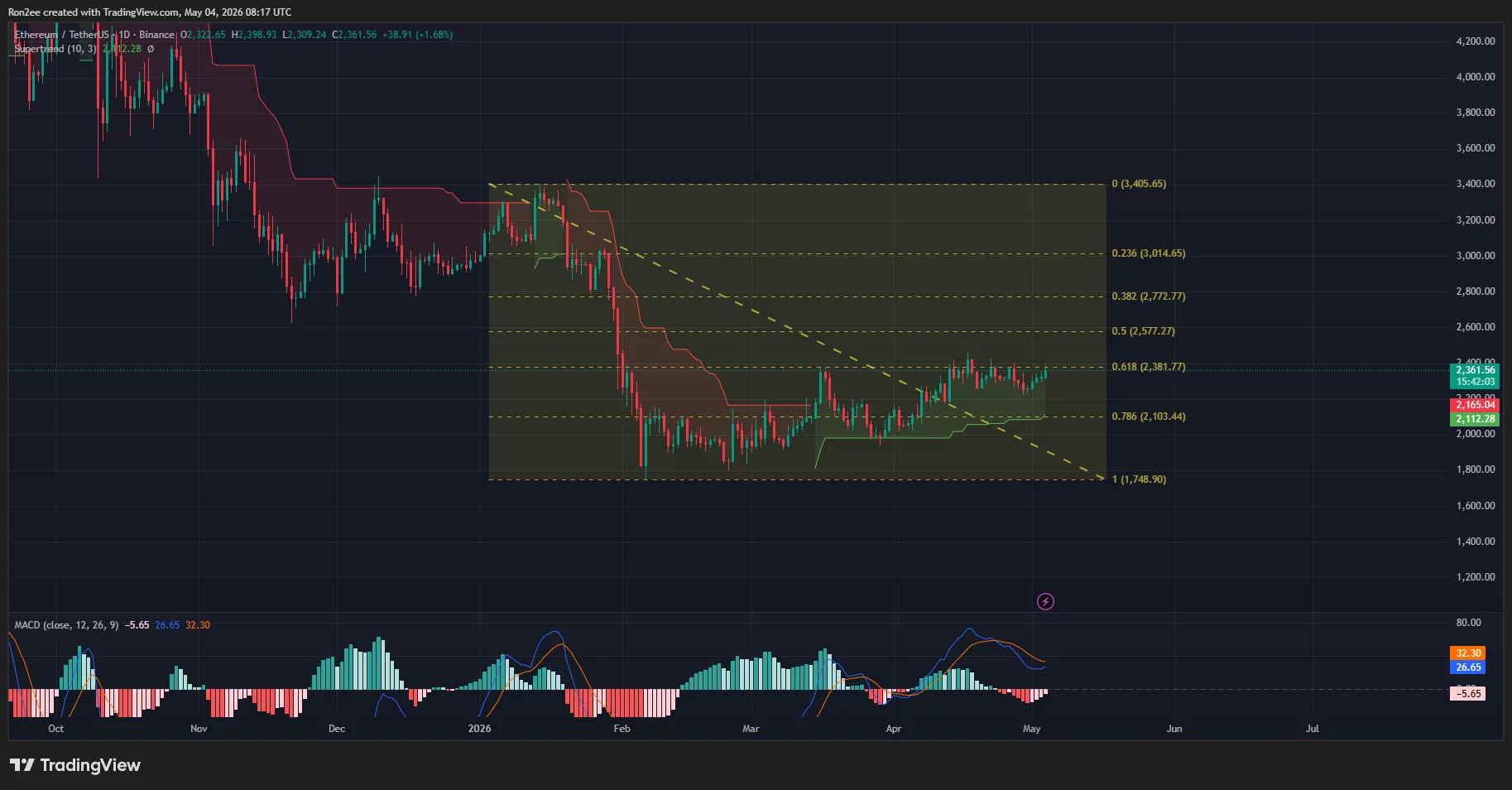
Ethereum price is eyeing a breakout from the $2,400 resistance, which has capped the token’s gains over the past week.
Summary
- Ethereum price is testing the $2,400 resistance after rebounding to $2,393, with repeated rejections keeping its price within a tight range.
- Technical indicators signal potential upside, with a looming MACD bullish crossover and Supertrend remaining in an uptrend since mid-March.
- ETF inflows ($101M) and declining exchange reserves (14.5M ETH, lowest since 2016) point to improving demand and reduced sell pressure.
According to data from crypto.news, Ethereum (ETH) price rebounded 3.5% to $2,393 on May 4 before facing rejection at $2,400 and stabilizing around $2,370 at press time. While Ethereum has briefly broken above the $2,400 mark on two occasions over the past month, the altcoin lost momentum and quickly retraced below the level.
However, at press time, several technical and fundamental factors suggest that the token could finally escape from the narrow trading range.
Notably, on the daily chart, Ethereum price is approaching a bullish MACD crossover, which typically signals a shift toward upward momentum. The last time such a positive crossover occurred, Ethereum price rose nearly 25% within a month.
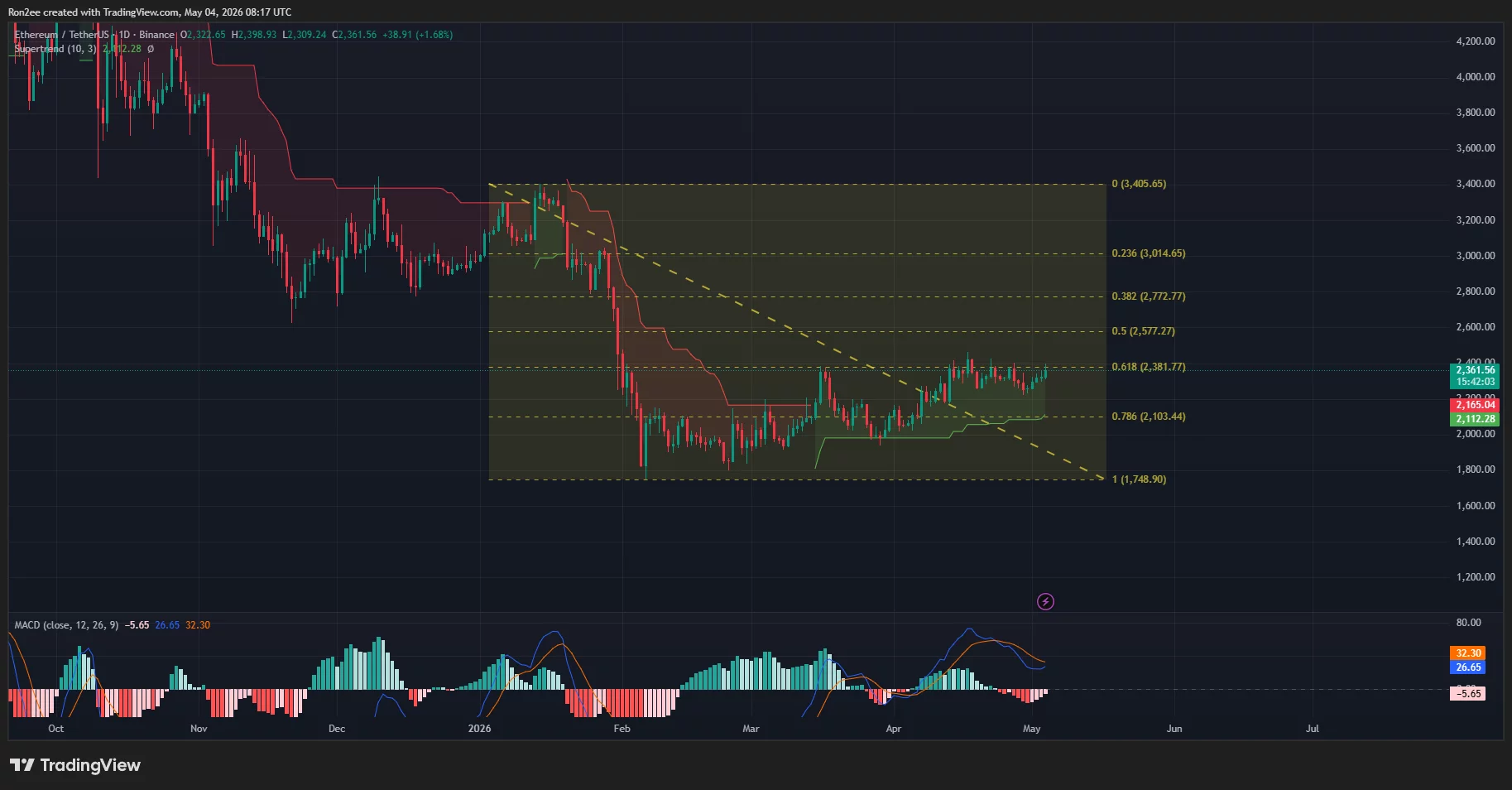
The Supertrend has remained green since mid-March, a sign that the broader market structure remains in an uptrend despite recent price fluctuations.
At press time, Ethereum price was near the 61.8% fibonacci retracement level at $2,381, a sign that bulls are aggressively defending the mid-range zone. A decisive break above the current resistance could trigger a breakout from the $2,400 and a move towards the next key 38.2% retracement level at $2,772 if bullish momentum holds.
Besides strong technical signals, on-chain demand also seems to support a potential rally. Data from SoSoValue show that Ethereum ETFs recorded over $100 million in net inflows last Friday, breaking off a 4-day negative streak, which saw $183 million in outflows.
While this is not yet a sign that institutional investors will go all in immediately, it shows renewed appetite for the asset, especially if the positive flows continue to show up this week.
Another catalyst that could support Ethereum’s gains is the drop in ETH balances on exchanges. Per data from CryptoQuant, Ethereum exchange reserves have fallen to 14.5 million, the lowest level since mid-2016, indicating reduced selling pressure on the token.
Disclosure: This article does not represent investment advice. The content and materials featured on this page are for educational purposes only.

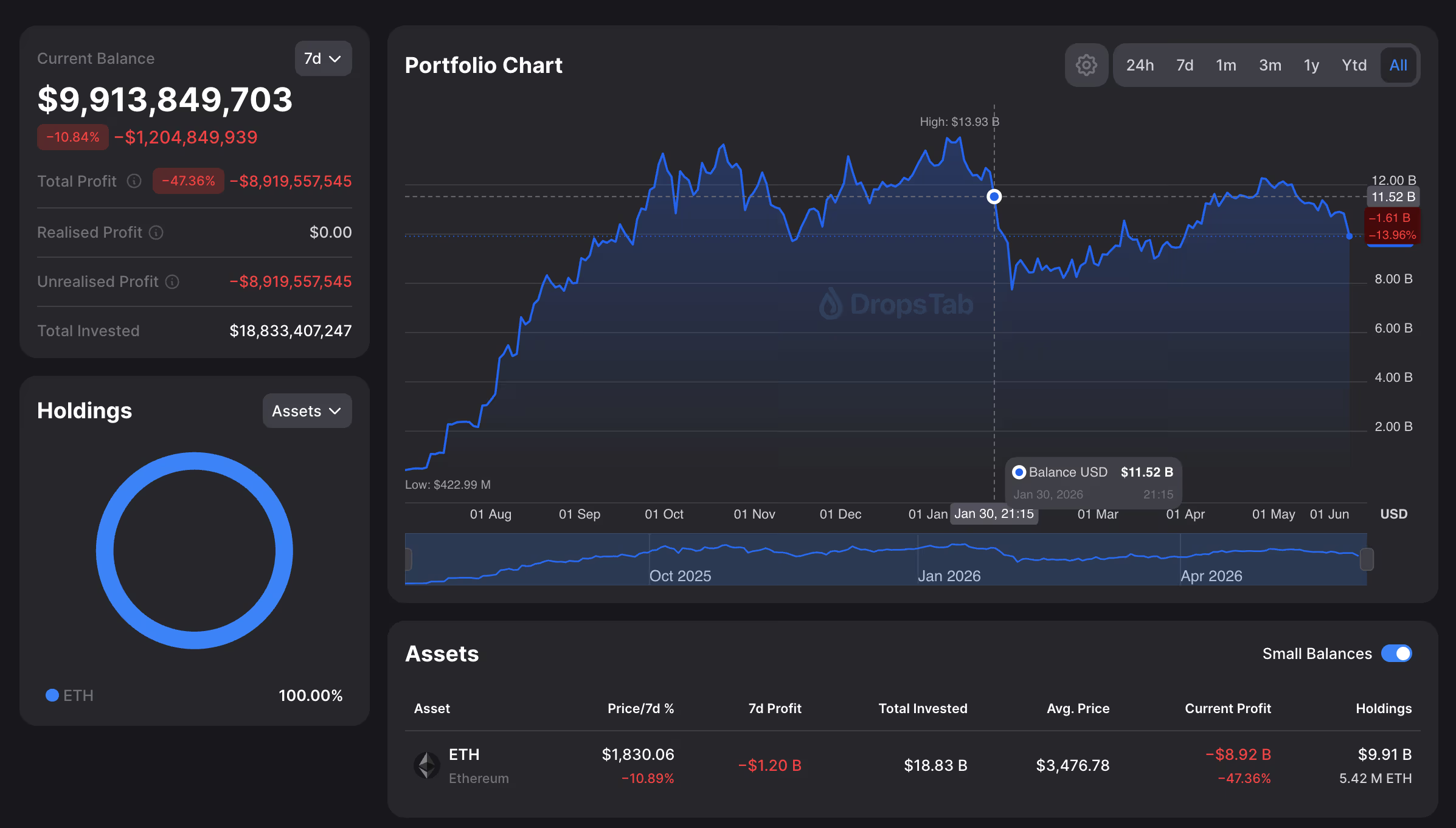
Bitmine Immersion Technologies (BMNR), the largest corporate holder of ether (ETH), is staring at nearly $9 billion in losses as the token’s slide below $1,800 drags down the value of its massive treasury.
Shares of the Tom Lee-chaired company fell another 5.9% Wednesday, slipping below $17 and extending their decline to 28% since early May. The stock has now dropped below its February lows to its weakest level since the company announced its pivot to an Ethereum treasury strategy in 2025.
The selloff comes as ETH retests its February lows. The second-largest cryptocurrency has lost more than 20% since early May, when Lee, Fundstrat’s co-founder and BitMine’s chairman, argued that the market’s “mini crypto winter” had likely ended and a new “crypto spring” had begun.
Under Lee’s leadership, Bitmine has amassed more than 5.4 million ETH, or roughly 4.5% of Ethereum’s circulating supply, in roughly a year. That position is worth about $10 billion at current prices.
Those holdings, however, are now deeply underwater, carrying an estimated $8.9 billion in unrealized losses, according to data collected by DropsTab.

Digital asset treasuries under pressure
Bitmine’s drawdown highlights renewed pressure across the digital asset treasury sector, where companies seek to replicate the playbook pioneered by Michael Saylor’s MicroStrategy (MSTR): raise capital through public markets and use the proceeds to accumulate crypto.
That model has become increasingly harder to sustain as crypto prices weakened and many treasury stocks drifted below the value of their underlying assets.
Strategy itself recently disclosed its first bitcoin sale since 2022, sparking debate about how the company might fund future obligations tied to its preferred stock offerings.
Read more: Saylor’s Strategy sold bitcoin for the first time since 2022. These firms are still buying
Bitmine’s situation differs in some key respects. The company financed its ether purchases primarily through equity issuance rather than debt, leaving it without the leverage concerns and interest payments that some treasury peers face.
The company also generates revenue from staking its ETH and operating its staking service MAVAN. Bitmine said it has staked more than 4.7 million ETH — about 87% of its holdings — and recently estimated annualized staking revenue at roughly $276 million.
Lee calls for $250,000 ETH
The recent price action has not tempered Lee’s long-term outlook.
Speaking at the Proof of Talk conference in Paris earlier this week, he said ETH could eventually reach $250,000 as tokenization, AI-driven transactions and corporate staking reshape Ethereum’s role in the global financial system.
For now, investors appear focused on a more immediate reality. Ether is back near levels last seen during February’s selloff, leaving Bitmine’s treasury deep underwater and highlighting the gap between Lee’s long-term thesis and the market’s current view of the asset.
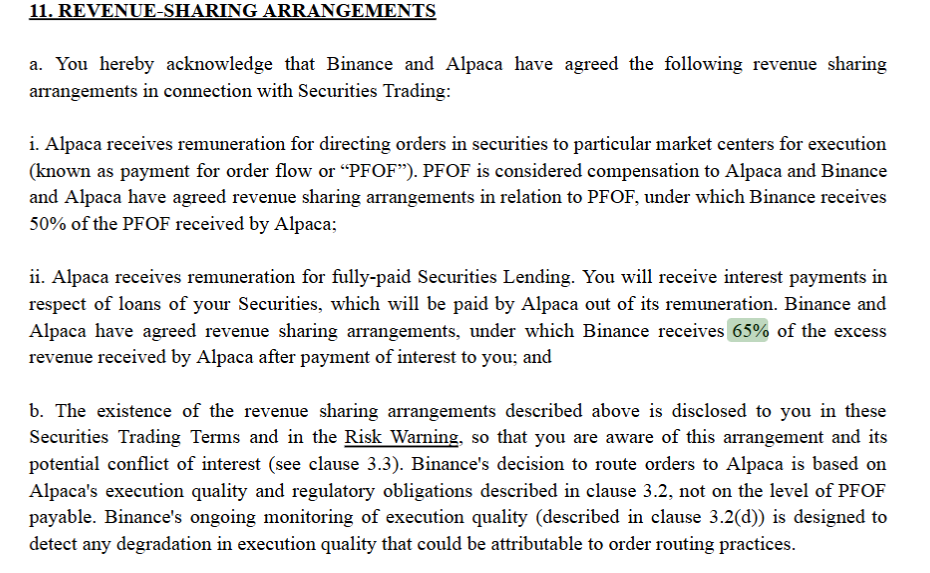
Binance disclosed a revenue-sharing arrangement with custodian and brokerage infrastructure API provider Alpaca, which has become a major infrastructure provider in the custody of tokenized US stocks and exchange-traded funds (ETFs).
Under Binance Securities Trading Terms published Tuesday, Binance will receive 50% of Alpaca’s payment-for-order-flow fees and 65% of remaining profit from user stock lending after users are paid interest, Binance will receive 50% of Alpaca’s payment-for-order-flow, or PFOF, fees and 65% of profit from user stock lending after the platform pays user interest.
Alpaca provides brokerage, clearing and custody infrastructure for Binance’s stock trading product and is also a major infrastructure provider in tokenized US stocks and ETFs. The company raised $150 million at an $1.15 billion valuation for its brokerage infrastructure in January.
The disclosure shows how Binance may monetize its push beyond crypto after launching access to more than 7,000 US-listed stocks and ETFs and previewing a later tokenized stock product called bStocks.
Cointelegraph contacted Binance for comment on the arrangement and asked whether it holds a minority stake in Alpaca.
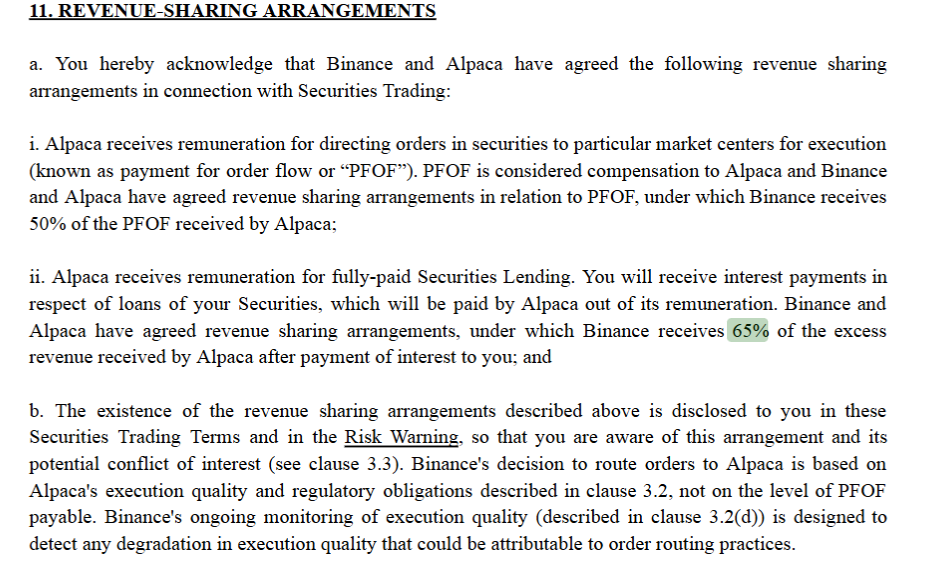
Binance Securities Trading Terms for tokenized stocks and ETFs, Revenue-Sharing Arrangements. Source: Binance
Alpaca said it held $480 million in assets under custody (AUC) as of December 2025, which represents a 29% market share of the current $1.62 billion value of total tokenized stocks, according to data provider RWA.xyz.
The total value of tokenized stocks rose by around 29% during the past 30 days, while holders rose 35% to 304,700. However, monthly active addresses declined by over 77%, to 31,877, signaling that investors are holding, rather than actively trading, these assets.
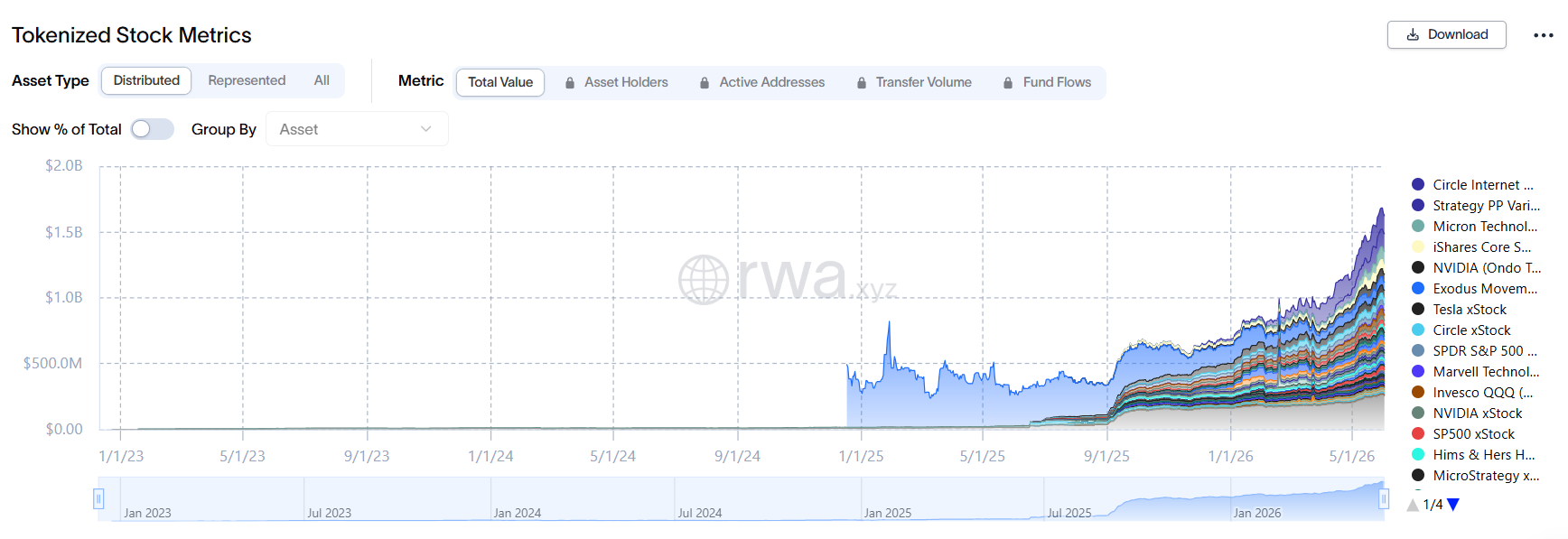
Tokenized stock market total value. Source: RWA.xyz
Crypto exchanges expand into tokenized US stocks
Other large cryptocurrency exchanges are also expanding their offering to include US stocks and ETFs, responding to the growing investor demand for more accessible blockchain-based trading products.
In April, crypto exchange Bitget launched a proxy offering tied to the pre-initial public offering (IPO) phase of Elon Musk’s aerospace manufacturing and space transportation company, SpaceX, Cointelegraph reported at the time.
Related: South Korea plans July rules for tokenized securities
Binance also launched a SpaceX-linked pre-IPO futures product tied to the expected valuation of the company ahead of its public listing, Cointelegraph reported on May 21.
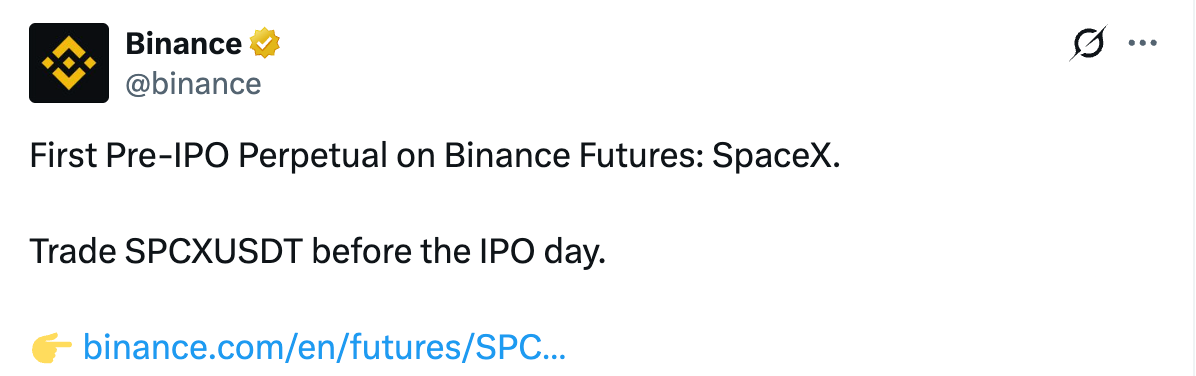
Source: Binance
In January, Vienna-based crypto exchange Bitpanda said it was expanding its offering to include about 10,000 stocks and ETFs.
In April 2025, Kraken launched 11,000 US-listed stocks and ETFs with commission-free trading in an effort to bring “equities and digital assets together” under one trading platform, as part of a “phased national rollout.”
Magazine: Block by block: Blockchain technology is transforming the real estate market
Trump-promoted US stocks have been among the most talked-about names on Wall Street this year, and three stand out for traders. One earned a Truth Social post for its war-fighting tech.
Another rode a government stake and a strong quarter. A third got a direct buy-it call at the White House. Here is how each trade is looking as we head deeper into 2026.
Palantir Technologies (NASDAQ: PLTR)
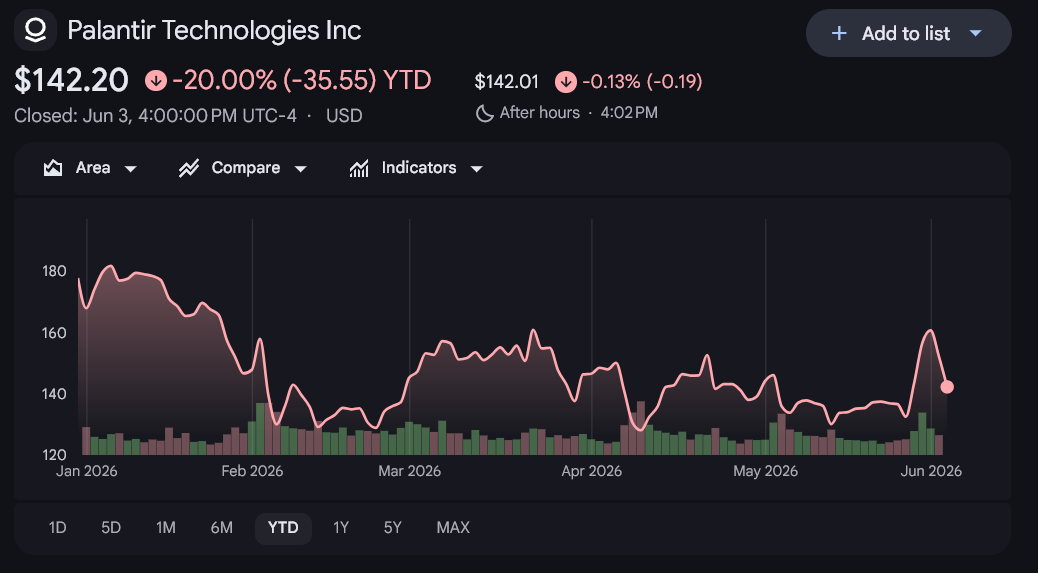
PLTR trades near $142, down 6.5% in the latest session. The pullback interrupts a sharp run that made it one of the standout Trump-promoted US stocks this spring.

Want more insights like this? Sign up for Editor Harsh Notariya’s Daily Newsletter here.
On April 10, Trump posted on Truth Social that Palantir had proven great war-fighting capabilities. The stock was near its April low of around $122 at the time. Since then, it has rebounded about 33%.
Note: Palantir makes AI software rather than weapons, but its platforms power the US military and intelligence work.
That bounce has not broken the broader downtrend. PLTR still trades inside a falling channel, a downward-sloping price range that has held since early November. The structure stays bearish until the price escapes it.
The key levels come from Fibonacci levels, which measure the proportional pullback of a prior move. It runs from the $207 November high to the $122 April low, revealing key levels. PLTR failed to clear $165 on June 1, a key technical level. The real trigger sits at $175, near the channel’s upper boundary.
A move above it by about 15% would shift the structure from bearish to neutral-bullish.

The bearish case is building too. Selling volume has risen since May 22, and a weak broader market could drag PLTR lower. A drop under $142 would expose the $122 low again.
Above $175 turns the trend, while rising sell volume and a break under $142 keep the bears in control throughout June.
Intel Corporation (NASDAQ: INTC)
INTC trades near $108, down 1.28% in the latest session, though pre-market quotes point higher near $114. The stock is the most policy-linked of the Trump-promoted stocks.
The Trump administration holds a stake in Intel, and that position is up nearly 250% as of late April, per data. Trump has taken public credit for the chipmaker’s surge. The fundamentals backed him up.
Intel’s Q1 2026 earnings drove a 15% jump, pushing the stock past its August 2000 record high.
That report powered a much larger run. INTC climbed from about $40 in late March to a peak near $133, a gain above 200%. The move formed a bull flag, a pause that follows a sharp rally and often resolves higher.
The recent dip looks like profit-taking. Price slipped from late May into early June, yet volume held steady rather than spiking. That hints sellers are not panicking. INTC now sits near $108, closing in on the $102 base.
The first hurdle to the upside is $124, where the breakout stalled. A reclaim there opens the path to the $133 peak, again in June, about 24% higher, then $159 and $194.

The bearish case matters too. A drop under $102 weakens the pattern considerably, and a break under $79 would invalidate it. Hold above $102 and reclaim $124 to keep the flag alive, or lose $102 and risk a slide to $79.
Dell Technologies (NYSE: DELL)
DELL trades near $435, down 6.58% in the latest session after touching a record near $469. It carries the most direct endorsement of the three.
In early May, Trump told a White House crowd to go out and buy a Dell, calling them great. The stock was already climbing, and the comment added fuel. Since late March, DELL has run from about $155 to its $469 peak. It has roughly doubled in the weeks since the direct endorsement.
The move traces a clean pole with the flag (consolidation) expected to form now. This is because the volume faded as the price peaked around May 29, while selling pressure has built since late May. Buyers are stepping back, suggesting a pullback.
The economic anchor is real, as Dell’s AI server demand and a $9.7 billion Pentagon contract back the rally continuation, despite the possible pullback.

The key levels come from the Fibonacci levels of the run from $155 to $468. A pullback is likely to first test $394, then $349. Holding there would keep the uptrend intact and set up another push. The bearish case builds below.
A drop under $312 toward $275 would signal a deeper unwind. The risk grows if AI server spending cools or the political tailwind fades.
For now, DELL needs a daily close back above $468 to prove the rally still has strength.
The post 3 Trump-Promoted US Stocks to Watch in June appeared first on BeInCrypto.

XRP price is bleeding. The token is changing hands at $1.21–$1.24 as it losses 2% today, and the weekly chart looks worse, down 7%.
The selloff accelerated since earlier this week, extending a downtrend that began mid-May when XRP peaked at $1.55. Since that local top, the token has sliced through a critical support zone and hit its lowest price since February.
All the above put the cumulative drawdown at over 66% from its all-time high last year. However, the drop is broad-based: total crypto market cap has collapsed from above $4 trillion to just $2.4 trillion as most altcoins are down double digits alongside XRP.
But it just seems unusual for XRP. Spot XRP ETFs pulled in over $131 million in May alone, their strongest monthly performance this year, while Ripple’s RLUSD stablecoin now carries over $1.8 billion in AUM and $22 billion in 30-day volume. Strong fundamentals, weak price.
Discover: The Best Crypto to Diversify Your Portfolio
Can XRP Price Recover to $1.50? Realistically
XRP price broke support and has not reclaimed it. The key level to watch is the $1.20 zone, which served as consolidation support through much of Q1. A confirmed daily close below that figure would open a path toward $1.00–$1.05, a range last tested in late 2024.
On the upside, the former support around $1.40–$1.45 now acts as resistance; reclaiming that level would be the minimum requirement for any credible bull case.

Three scenarios frame the near-term path. If ETF inflows accelerate, sentiment flips, and XRP reclaims $1.40 within two weeks, XRP price might finally recover. Or it grinds sideways between $1.20 and $1.35 as the market stabilizes.
Now the ugly scenario. If the $1.20 floor cracks and momentum sellers pile in, the token might retest sub-$1.10 levels. The momentum indicators currently favor the bear range.
Ripple’s regulatory wins, licenses secured in the UK, Australia, and the EU, plus a $50 billion company valuation, provide a long-term floor under sentiment. AI-driven price models remain bullish on a 12-month horizon, but near-term technicals suggest caution.
Discover: The Best Token Presales
LiquidChain Targets Early Mover Upside as XRP Tests Key Levels
When a major-cap asset like XRP sheds 12% in a week despite institutional ETF demand, the message is clear: size does not guarantee safety in this cycle. Rotating into earlier-stage infrastructure plays before institutional price discovery begins is a strategy worth examining.
LiquidChain ($LIQUID) is a Layer 3 infrastructure project positioning itself as the cross-chain liquidity layer for the next cycle. Its core proposition is straightforward: fuse Bitcoin, Ethereum, and Solana liquidity into a single execution environment, so developers deploy once and access all three ecosystems simultaneously.
LiquidChain is cooking.
The Order doesn't sleep. ⟁pic.twitter.com/CXY4ya0MC5
— LiquidChain (@getliquidchain) June 3, 2026
The architecture includes a Unified Liquidity Layer, Single-Step Execution, Verifiable Settlement, and a Deploy-Once Architecture designed to eliminate the fragmentation that currently makes cross-chain development painful and expensive.
The presale is live at $0.01466 per $LIQUID, with $820K to date.
For those researching the space, the full LiquidChain presale details are here.
The post XRP Price Loses Key Support: The Drawdown May Not Be Over Yet appeared first on Cryptonews.
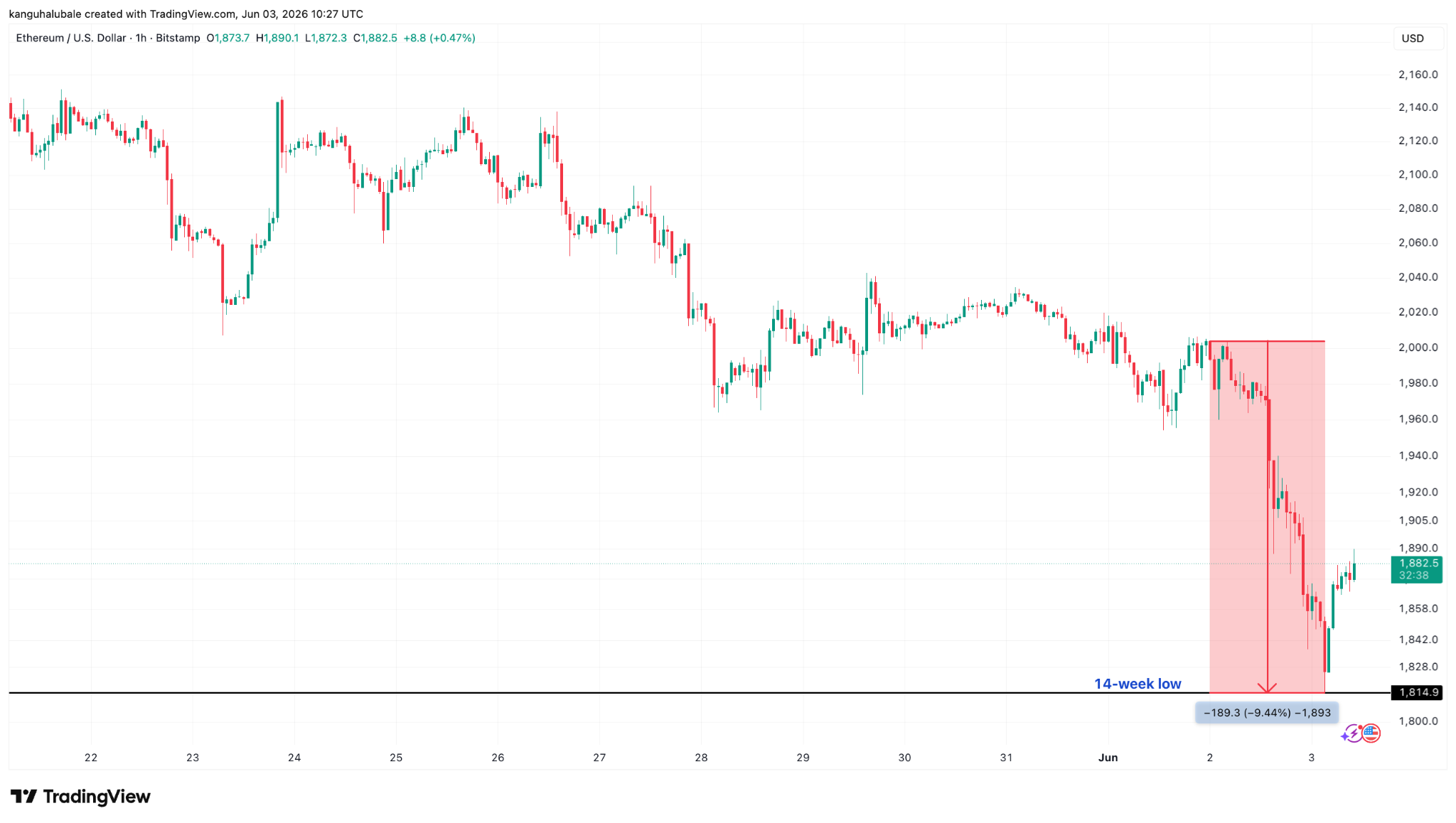
Ether (ETH) dropped to $1,814 on Wednesday, its lowest in over 14 weeks, raising concerns about whether the ETH/USD pair can stabilize above key liquidity zones near its multi-year lows at $1,800.
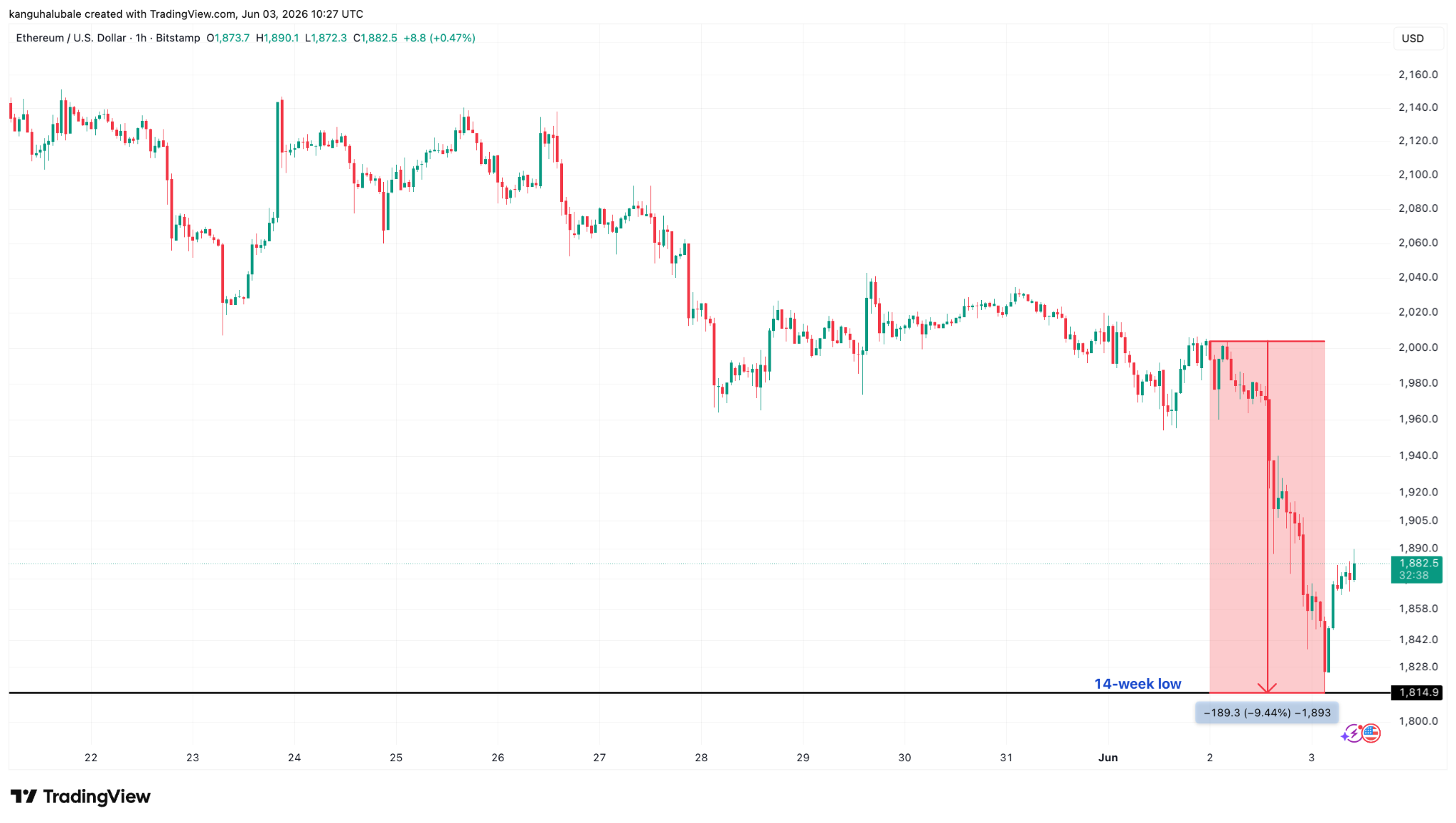
ETH/USD 1-hour chart. Source: Cointelegraph/TradingView
Key takeaways:
- Ether fell to a 14-week low near $1,800, with traders warning a breakdown could trigger deeper losses toward $1,200-$1,600.
- The Coinbase Premium Index hit its lowest level since February, signaling persistent weakness in US spot demand.
- Spot Ethereum ETFs logged sixteen straight days of outflows.
Ether sits on weak support at $1,800
Ether’s technical structure has weakened after losing support at $2,000 and $2,200. Note that all the major moving averages lie within this zone on the daily chart.
Today, ETH traded as low as $1,814 on Bitstamp, while the daily relative strength index (RSI) fell to 25, its lowest level since Feb. 6, highlighting strong downside pressure and oversold conditions.
Related: Bitmine buys $52M ETH as Tom Lee says price not yet showing Ethereum’s strength
However, this might also mean that the sellers are losing momentum, suggesting a possible price rebound from current levels, akin to the 39% rebound seen in February.
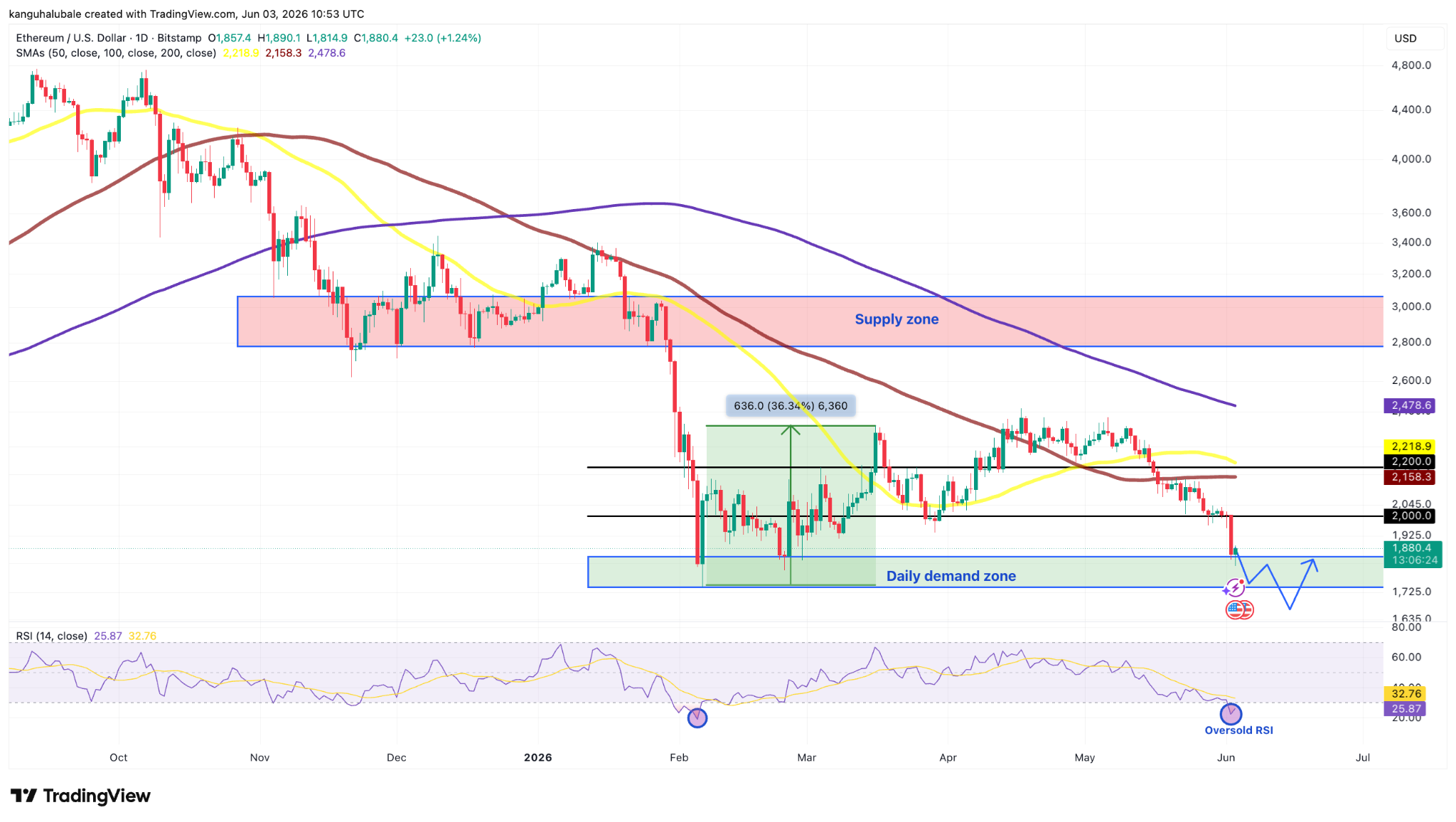
ETH/USD daily chart. Source: Cointelegraph/TradingView
Traders say Ether’s bullishness hinges on the ETH/USD pair holding above the crucial $1,800 support.
“$ETH almost tapped the $1,800 level today,” analyst Ted Pillows said in a Wednesday post on X, adding:
“This is the last support zone for Ethereum before new lows.”
An accompanying chart revealed that a break below $1,800 would bring areas below $1,700 into the picture.
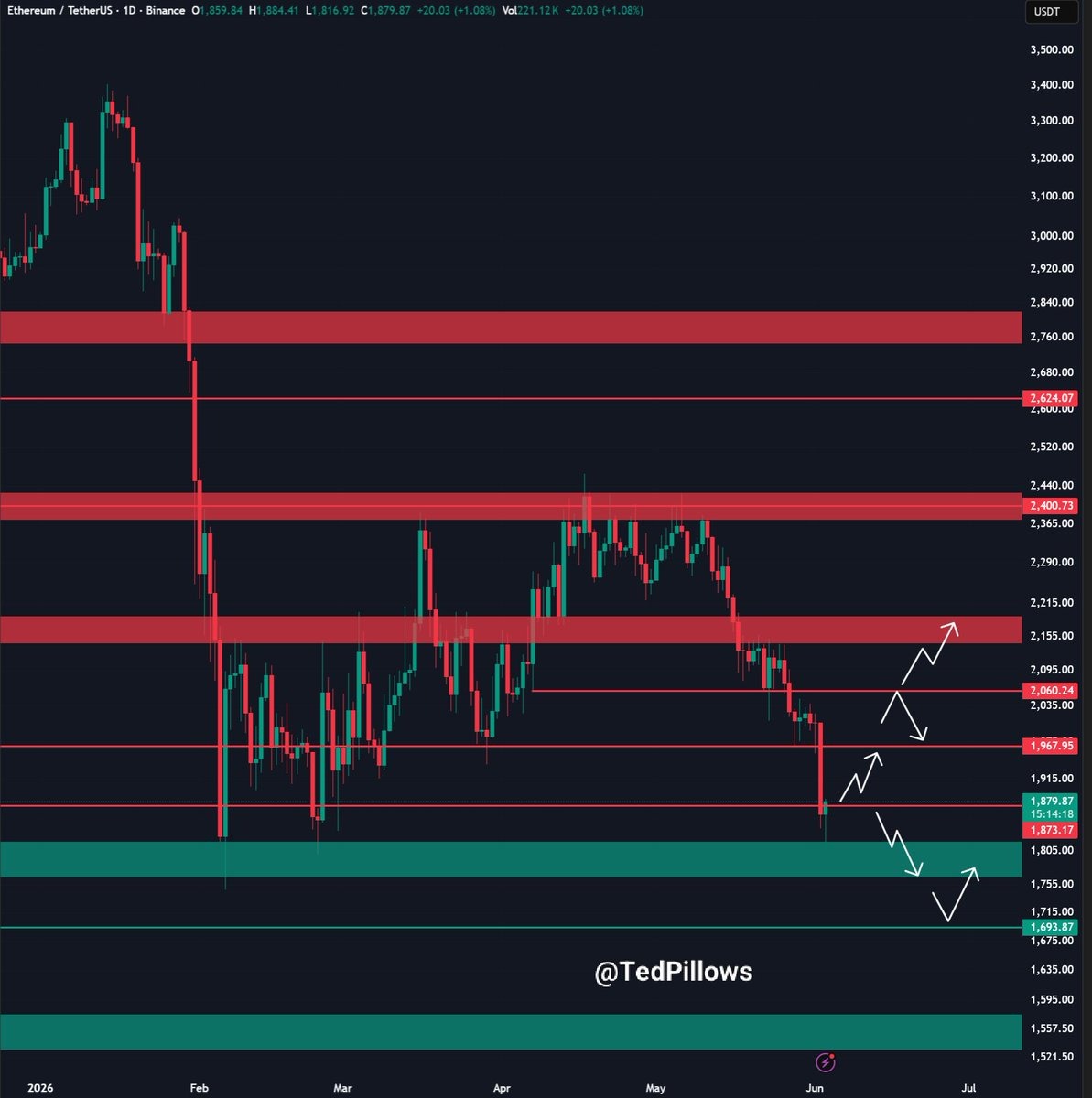
ETH/USD daily chart. Source: X/Ted Pillows
Additionally, fellow analyst CrypDoMillions said losing $1,800 would send ETH price lower toward $1,600.
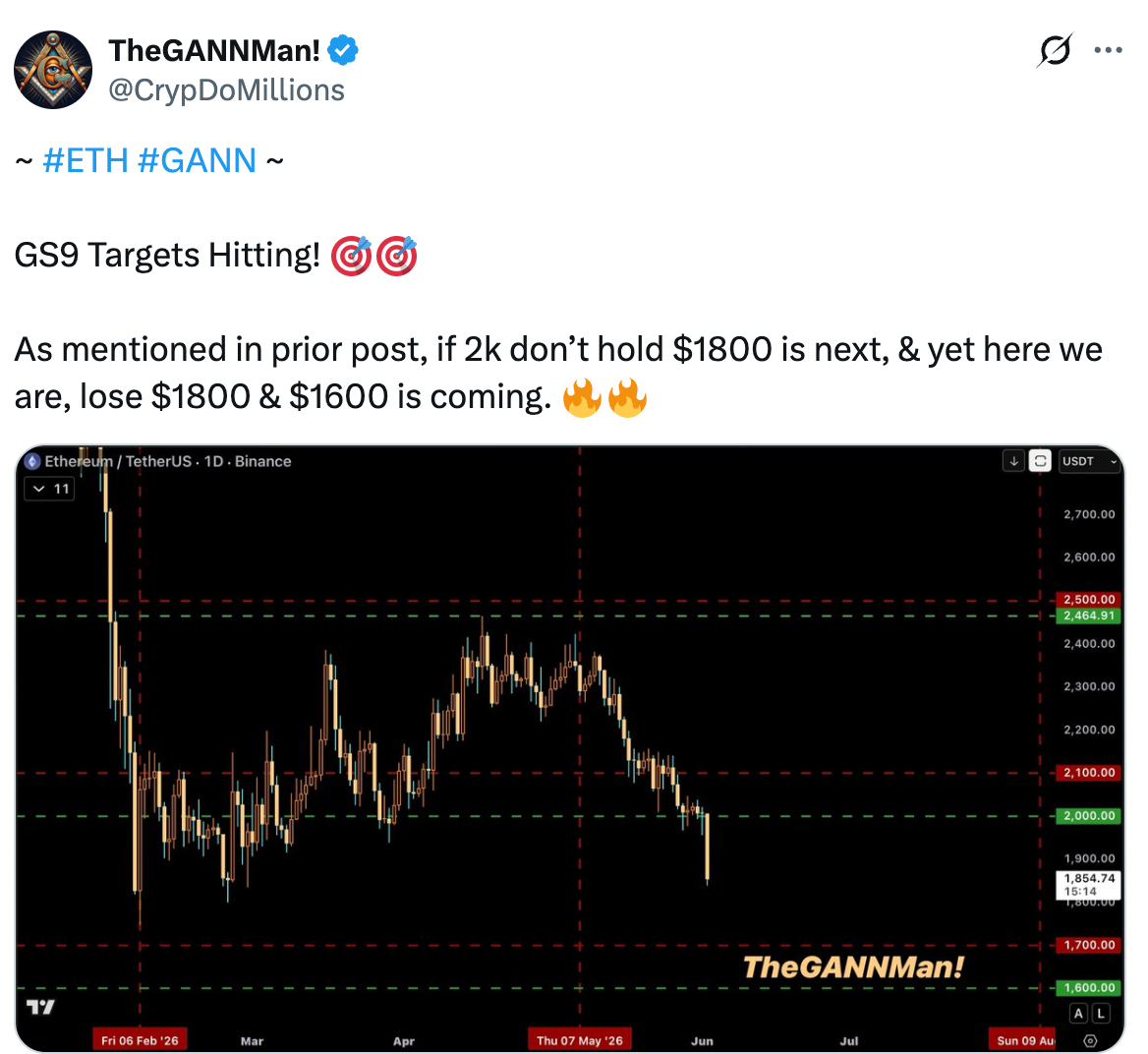
ETH/USD daily chart. Source: X/CrypDoMillions
Not all traders had confidence in Ether’s ability to remain above $1,800, with analyst BitFrog saying that “$ETH is on life support” at current levels, adding:
“Bulls better wake up fast. $1,800 looks shaky, honestly.”
The Entity-Adjusted UTXO Realized Price Distribution (URPD) metric, showing at which prices the current set of ETH UTXOs were created, shows that ETH trades above a relatively open zone between $1,800 and $1,250, where there’s less demand.
This means ETH may move more into this range if the sell-off continues, with the downside possibly capped at $1,200. This is where investors acquired more than 1.4 million ETH.
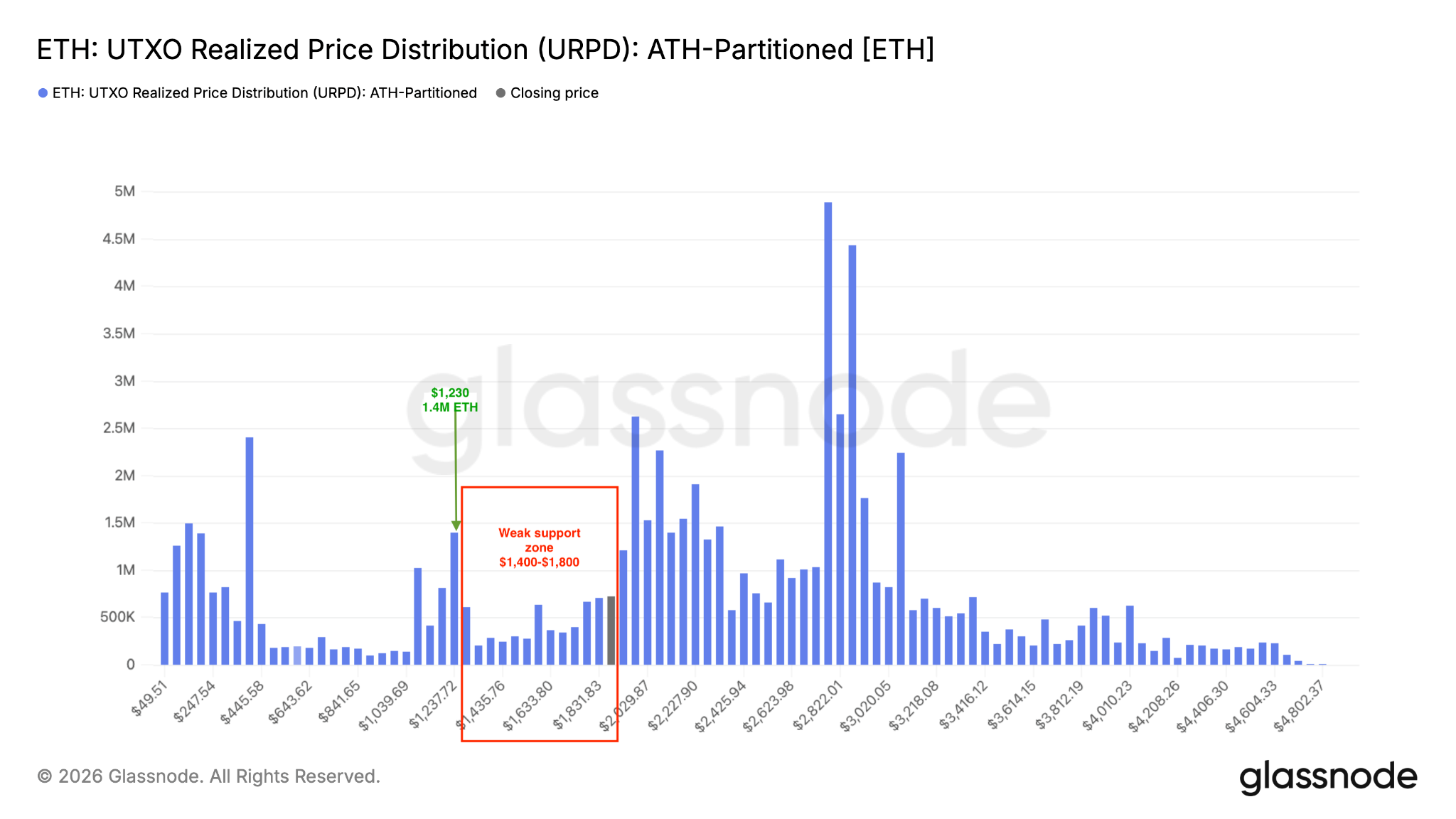
ETH: Entity-Adjusted URPD. Source: Glassnode
Meanwhile, Ether’s cost-basis distribution heatmap shows weak accumulation between $1,200 and $1,800, suggesting a potential pathway toward the lower zone in the short term.
Ether’s Coinbase Premium falls to February levels
The Ethereum Coinbase Premium Index, which tracks the price difference between ETH on Coinbase and Binance, dropped to -0.16 on May 28, before recovering to -0.13.
A deeply negative premium confirms that the selling pressure is originating from US entities. The last time the metric was this negative was during the early February sell-off when ETH price dropped to multi-year lows at $1,750.
Historically, extreme negative premiums often coincided with capitulation phases, as seen in April 2025 and during the 2022 bear market.
This implies that as long as US investors sell at a discount compared to the global market, the bears remain in control.
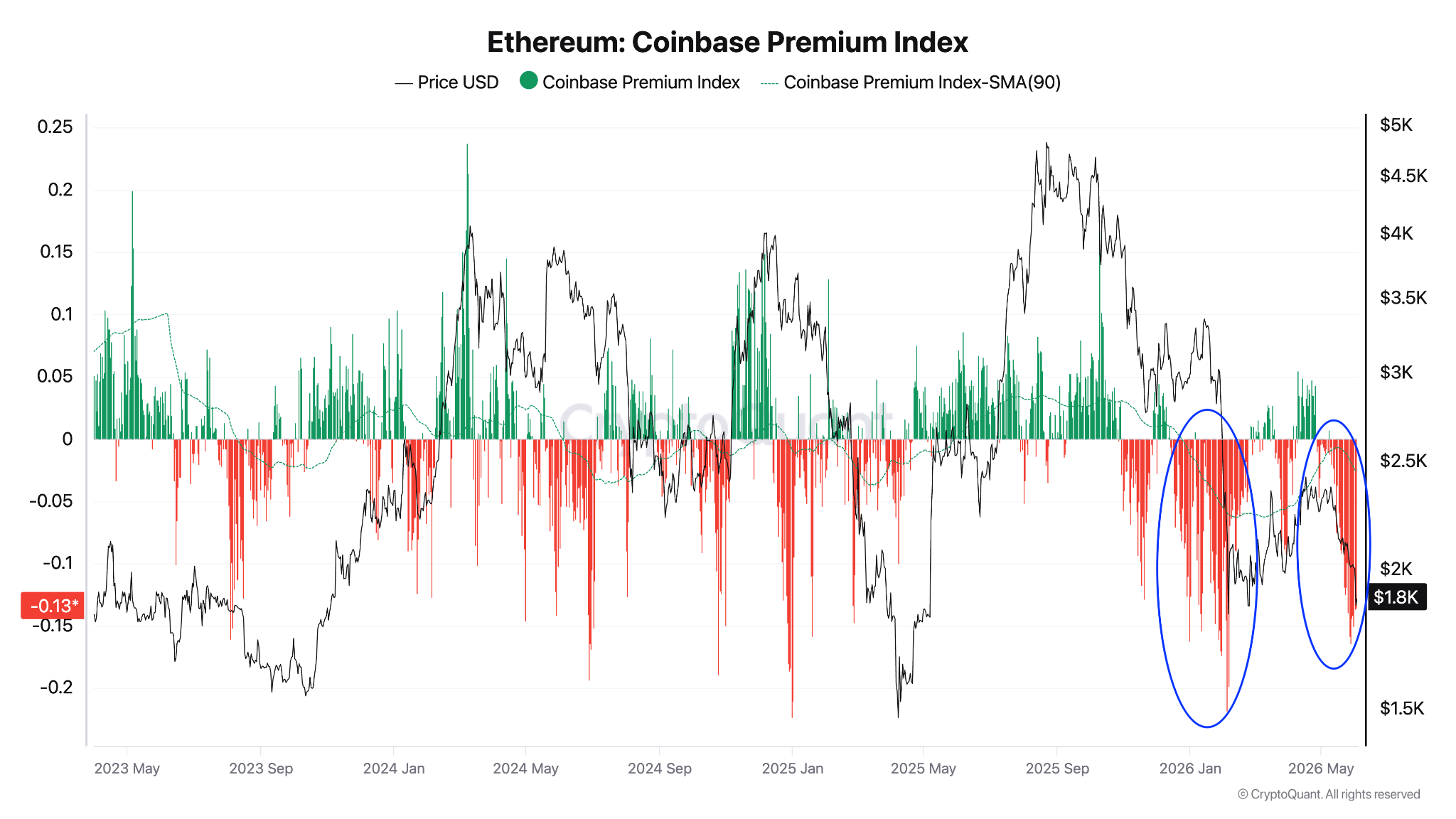
Ethereum Coinbase Premium Index. Source: CryptoQuant
“Coinbase Premium has fallen into a notable discount, signaling potential weakness in spot demand,” crypto investor and trader Thomas The Trader said in an X post on Tuesday.
“ETH Coinbase Premium just reached its lowest point since February,” analyst Inoms said in a Monday X post, adding:
“The message is clear: US demand is still weak.”
Weak US demand is also evidenced by heavy outflows from US-based spot Ethereum exchange-traded funds (ETFs). These ETFs have posted outflows for sixteen consecutive days, the longest losing streak since March 2025.
Investors have withdrawn nearly $847.2 million from these investment products over this period, according to data from SoSoValue.
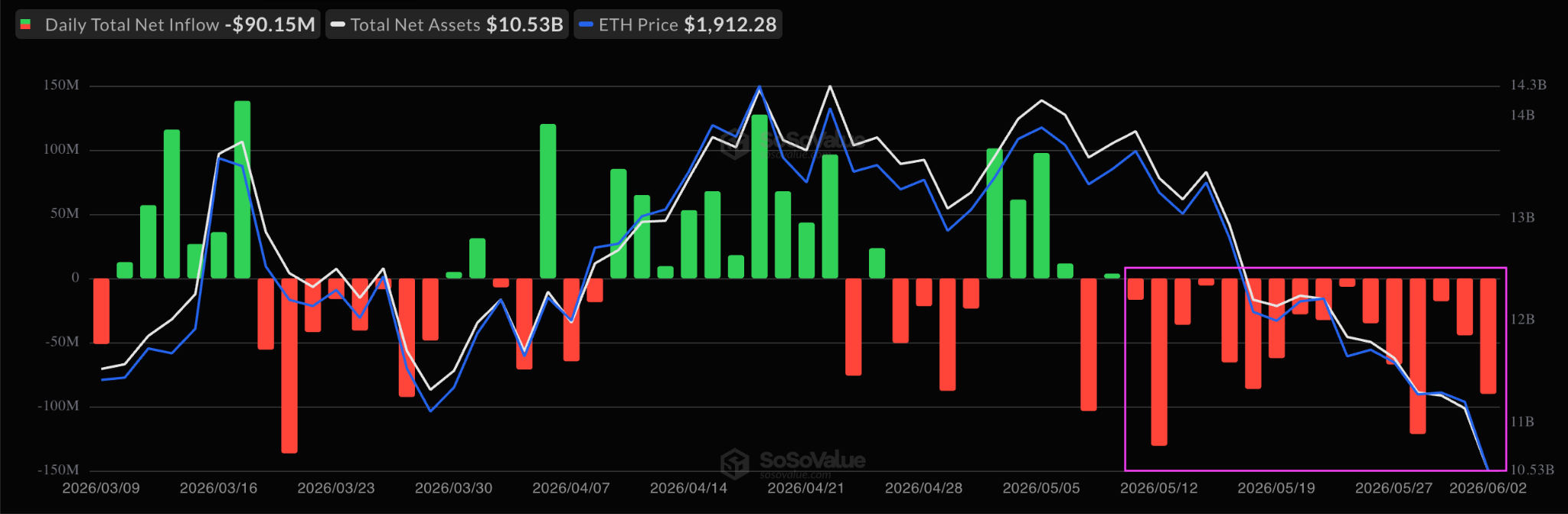
Spot Ethereum ETFs flows chart. Source: SoSoValue
Coupled with more than $257.3 million in outflows from global Ethereum investment products last week, this points to institutional selling, which will likely continue to put pressure on the price in the near term.


Ray Dalio says the AI bubble will burst, but not because the technology fails. The Bridgewater founder argues the real trigger comes when investors must convert paper wealth into cash.
He made the case in a Bloomberg television interview, saying liquidity demands, not earnings or technology, decide when a bubble finally cracks.
Why Wealth is Not the Same as Money
Dalio draws a sharp line between wealth and money. A startup can reach a billion-dollar valuation after raising only $50 million. That figure counts as wealth, yet nobody can spend it.
Money is what people actually spend. To reach it, holders must sell their wealth first. When wealth grows far faster than the money supply, the financial system turns fragile.
That gap sits at the heart of why so many billionaires stay bullish on AI while real cash remains scarce. AI firms can mint trillions in valuations without holding the money to back them.
The scale of the spending is large. Bridgewater estimates Alphabet, Amazon, Meta, and Microsoft could invest about $650 billion in AI infrastructure during 2026.
That marks a sharp jump from roughly $410 billion in 2025.
Follow us on X to get the latest news as it happens
What Could Force the Selling
The pricking starts when holders suddenly need cash, Dalio says. Debt payments, wealth taxes, or fund redemptions can each push large owners to sell at once.
“All great technology changes, produce bubbles. And the reason they produce bubbles is because nobody can get get it exactly right. Okay? There, you have to either spend a ton of money to capture your market share and so on,” Dalio said in the interview.
He ties the risk to a stretched government balance sheet. He notes the United States spends about $7 trillion against only $5 trillion in revenue. That deficit forces more debt into an already strained bond market.
He also pointed to bond market stress as a parallel pressure. Long rates rising relative to short rates often signals trouble, echoing his global monetary order warnings.
Dalio links the same dynamic to a possible world order breakdown and to rising structural inflation risk. His bubble indicators now sit near levels last seen in 2000 and 1929.
Dalio flags a vulnerable window after the midterm elections and before the presidential vote. Political conflict over taxes could sharpen the pressure then.
Still, he cautioned against panic selling and told investors to brace for lower returns ahead.
A Test for Every Risk Asset
The distinction matters far beyond AI stocks. It reaches every risk asset, from equities to crypto, where Dalio still favors digital gold Bitcoin, or BTC, over cash.
A sudden shock could speed up the reckoning. Dalio warned that a halt in chip exports from Taiwan would crash AI stocks fast.
Whether the squeeze arrives through taxes, debt, or redemptions may decide how the coming months play out for markets.
Subscribe to our YouTube channel to watch leaders and journalists provide expert insights
The post Ray Dalio Says AI’s Biggest Threat Isn’t What Most People Think appeared first on BeInCrypto.
Crypto World
Binance Closes Its Centralized NFT Marketplace, Joining Coinbase, Kraken in CEX-Backed NFT Retreat
Binance, the world's largest crypto exchange by trading volume, will shut its centralized NFT marketplace on July 3 and migrate the service into its self-custody Binance Wallet, the company said in an announcement published Wednesday, closing the last major centralized-exchange NFT venue still… Read the full story at The Defiant
Crypto World
Mastercard Opens Card-Settlement Network on Eight Blockchains, Adding Weekend and Holiday Cycles


Mastercard on Tuesday opened its global card-settlement network to regulated stablecoins, allowing issuers and acquirers to clear card transactions onchain across eight blockchains and adding intraday, weekend and holiday settlement cycles for the first time. The company announced the expansion in… Read the full story at The Defiant

[Update (June 3 at 8:01 pm UTC): This article has been updated to include a response from Fairshake in the fourth paragraph.]
Democratic and Republican candidates across California, New Jersey and South Dakota won their respective primaries on Tuesday after being the beneficiaries of supportive ads purchased by cryptocurrency industry-backed political action committees (PACs).
On Tuesday, Democrats Jacqui Irwin, Ted Lieu, Zoe Lofgren, Dave Min, Mike McGuire, Hilda Solis, George Whitesides, Lou Correa and Lateefah Simon won their respective California primaries for House seats. Democrat Rob Menendez and Republican Mike Rounds also won primaries for New Jersey’s 8th congressional district and a South Dakota Senate seat, respectively.

Selection of results after Tuesday’s primaries for California House seats. Source: CalMatters
The political wins came after the Protect Progress and Defend American Jobs PACs spent about a combined $3.5 million on media to support the candidates. The groups are affiliated with Fairshake, a political action committee funded largely by cryptocurrency exchange Coinbase and Ripple Labs that reported having a war chest of $193 million in January.
“America needs members of Congress who will act to lay out responsible guardrails for the community to maintain our global leadership,” Fairshake spokesperson Geoff Vetter told Cointelegraph.
The PAC spending came on the heels of similar buys for supportive media in Texas runoff primaries last week, which resulted in Democrat Christian Menefee defeating incumbent US Representative Al Green, and four Republican candidates winning primaries in smaller House districts. Many of the candidates in the state races have supported advancing digital assets, either through voting on “pro-crypto” legislation while in office like the GENIUS Act or in public statements.
Related: PACs laud Texas primary wins, look to back more pro-crypto candidates
Maryland is shaping up to be the next focus for Fairshake and its affiliates. Federal Election Commission (FEC) filings showed Protect Progress had spent more than $3.1 million as of Wednesday to support Democratic candidate Adrian Boafo in Maryland’s 5th Congressional district, which is scheduled to hold a primary on June 23.
Crypto advocacy organizations back new developer-focused PAC
On Wednesday, industry leaders announced the launch of Defend Developers, a hybrid PAC that will support “incumbent members of Congress who actively champion developer protections and crypto builders.” According to the group, Defend Developers’ board of directors includes “CEOs, CLOs, and policy leaders at top crypto organizations, including DeFi Education Fund, Orca Creative, Solana Policy Institute, and Uniswap Labs.”
“For too long, developers building decentralized technologies have faced regulatory uncertainty and enforcement actions instead of clear rules and guidelines,” said the PAC’s founder, Gavin Zavatone. “While legislation and rulemakings are being written as we speak, for some policymakers there is limited incentive to understand the fundamental nature of software development.”
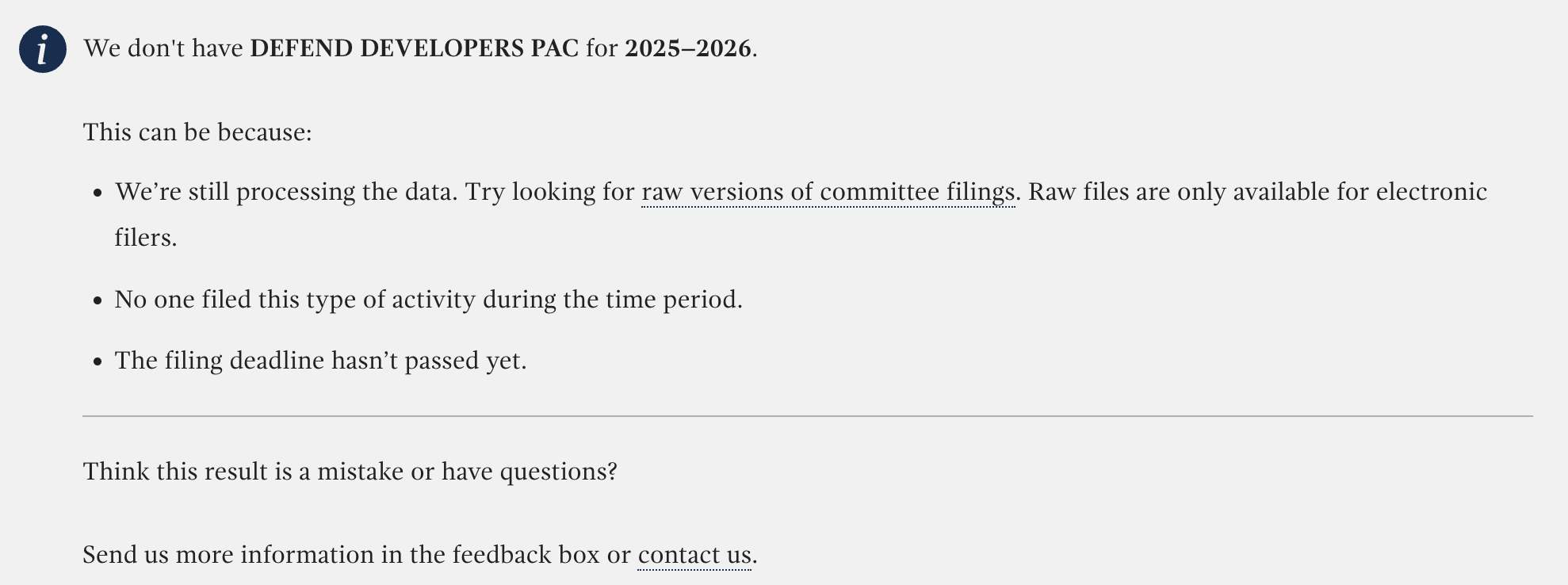
No official data available on Defend Developers as of Wednesday. Source: FEC
The FEC portal did not show any funding or expenditure activity, as of Wednesday. Nick Stoltzfus, co-CEO of on-chain student loan digital asset platform Stratofied, was listed as treasurer and custodian of records in the PAC’s statement of organization on May 15.
The PAC did not say where or how it would focus its efforts as part of the 2026 US midterms other than “key races across the country.” Cointelegraph reached out to Defend Developers for comment but did not receive an immediate response.
Magazine: Korea’s first memecoin rug-pull case, China’s crypto rules review: Asia Express

[PRESS RELEASE – Tel Aviv, Israel, June 3rd, 2026]
The market moves, $GCOIN leads. Today, $GCOIN officially lists on leading global exchange WEEX – marking the powerful start of five major exchange listings scheduled for this June alone. This coordinated global expansion is engineered to significantly expand accessibility , lower entry barriers for retail users, and scale the token’s footprint across key international markets. Behind this massive rollout is a single, undeniable reality: a token backed by real infrastructure, real utility, and an economy that never sleeps.
An Economy That Never Sleeps
$GCOIN is the core utility layer of the Playnance ecosystem – a unified, 24/7 on-chain iGaming economy processing approximately 1 million transactions daily. Every bet, every game, every partner platform, every payout flows through $GCOIN – across casino games, sports and esports betting, live trading, prediction markets, and jackpots. All verticals, all on-chain, all powered by one utility token- $GCOIN. As the ecosystem expands, $GCOIN continues to be used through staking, rewards, platform operations, and participation across every vertical. This is not a single-use asset, this is the engine of an entire digital economy.
Be The Boss: The Growth Engine Powering It All
At the heart of $GCOIN’s growing demand is Be The Boss – Playnance’s AI-powered Web3 iGaming protocol that has redefined what it means to be an operator. Anyone, including entrepreneurs, influencers, or streamers can launch a fully branded Web3 iGaming platform in under 5 minutes. AI technology handles the creation and backend operations automatically – partners focus entirely on growth, community, and traffic.
The results speak for themselves: 3,300+ active bosses operating globally, 500+ new platforms launching every week, and over $2.4M paid out to partners – with more than $700K distributed directly in $GCOIN. Each boss is an ambassador. Each platform is a distribution channel, each new operator expands the reach and utility of $GCOIN across every corner of the world.
Token Strength Built on Fundamentals
$GCOIN currently has a market capitalization of approximately $49.6M with five exchange listings still ahead this month. With over 1.26B $GCOIN staked across four staking pools, and a 164M token reward treasury, the staking ecosystem alone reflects deep, long-term conviction from the community.
$GCOIN is already live and actively traded on MEXC and a DEX within the Playnance ecosystem- with real volume, real users, and real ecosystem activity behind it. Today’s listing on WEEX marks the beginning of an aggressive June expansion, as five major exchange listings roll out to scale global accessibility and cement $GCOIN’s position as the leading utility token of the on-chain iGaming industry.
Coming soon: Vertical Staking Pools – a major evolution that will allow $GCOIN holders to stake directly into the specific verticals they believe in most, whether Casino, Sports, Prediction, or Trading – with rewards tied directly to each vertical’s activity.
Infrastructure That Sets the Standard
Built on a proprietary high-performance blockchain – gasless, instant, and fully scalable – the infrastructure delivers real-time settlements, instant on-chain payouts, and non-custodial shared wallet architecture that other platforms simply cannot replicate. It processes over 10,000 casino games, 2.5M live sports and esports events annually, and a growing suite of live products including live casino, live trading, and prediction markets.
”$GCOIN keeps rising because it was built right,” said Pini Peter, CEO of Playnance. “We built a protocol where every single interaction – every game, every platform, every partner – creates genuine utility for the token. The global iGaming industry is moving on-chain, and Playnance is not waiting for that future – we are building it. WEEX is one more milestone in a journey that is just getting started.”
About Playnance
Founded in 2020, Playnance is a Web3 iGaming infrastructure company developing live, non-custodial, on-chain products designed to onboard mainstream Web2 users into blockchain environments. The company builds consumer-facing platforms powered by shared wallet systems and high-volume on-chain execution, currently processing approximately 2 million transactions per day. Playnance focuses on removing friction between user experience and blockchain infrastructure by abstracting complexity while maintaining full on-chain transparency and non-custodial architecture.
The post $GCOIN Lists on WEEX: Five Exchanges This June as Real Utility Drives Global Expansion appeared first on CryptoPotato.

Dame Dash Throws Major Shade At Jay-Z After Roots Picnic Diss

Why ‘psychopath’ is a dangerous label when it comes to criminal justice

Spurs Heavy Favorites Over Knicks in 2026 NBA Finals Prediction Markets on Kalshi and Polymarket



-

 Tech6 days ago
Waymo dominates autonomous vehicle registrations as Tesla trails behind
-

 News Videos5 days ago
This is BROKEN! INSANE 5x MONEY CAR WASH WEEK! The NEW GTA Online UPDATE Today! (GTA5 New Update)
-
 Tech4 days ago
SpaceX just won a second Golden Dome contract. This one is $4.16 billion.
-

 Business2 days ago
Jade Biosciences, Inc. (JBIO) Discusses Positive Interim Results From JADE101 Phase I Healthy Volunteer Study and Development Plans Transcript
-

 News Videos5 days ago
SHE IS KILLING XRP!!! WATCH URGENT AND ACT FAST
-
 NewsBeat5 days ago
FIRST NIGHT REVIEW: Take That bring the Circus back to life in spectacular sun-soaked style
-
 Crypto World5 days ago
CFTC Has Approved the First Regulated Bitcoin Perpetual Contract in the U.S.
-

 Business4 days ago
Is the Spurs Phenom Already Better Than Prime Diesel?
-
 NewsBeat5 days ago
Novak Djokovic v Joao Fonseca LIVE: French Open latest scores and results after Jannik Sinner’s shocking collapse
-
 Entertainment5 days ago
Weak ‘Supergirl’ Box Office Tracking Amid Milly Alcock Backlash
-
 Crypto World5 days ago
Snowflake (SNOW) Stock Rallies on Strong Q1 Results and AI Product Growth
-

 Business5 days ago
Demand Conditions Improve In Chemicals Sector In April 2026
-
 Crypto World5 days ago
MicroStrategy Moves $30 Million in BTC to Coinbase Prime: Is the Bitcoin Sell-Off Already Here?
-

 Politics5 days ago
The House | Inside Andy Burnham’s Makerfield Campaign: “Nobody Thinks This Is In The Bag”
-

 Tech5 days ago
This Week In Security: Ubiquiti Fixes, And FreeBSD Joins The Club You Don’t Want To Join
-
 Entertainment4 days ago
One of the Greatest Sitcoms of All Time Shoots Up Apple TV’s Charts 11 Years Later
-

 Entertainment5 days ago
Maddox Jolie-Pitt Legally Requests to Drop Brad’s Surname
-
 Crypto World1 day ago
Seagate (STX) Stock Surges to Record High on AI Boom and Legal Settlement
-
 Entertainment5 days ago
Britney Spears Shares Troubling Update After Hard Year
-
 Entertainment5 days ago
Bruce Willis’ Generosity Resurfaces Amid His Dementia
You must be logged in to post a comment Login