

Crypto World
Will US Get CLARITY This Week? Bitcoin’s New $80K Target: Hodler’s Digest

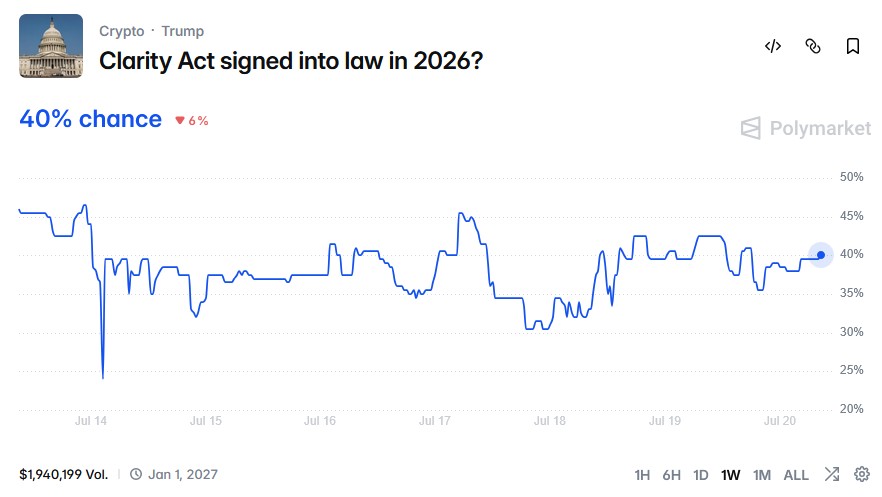
CLARITY hinges on Trump’s ethics
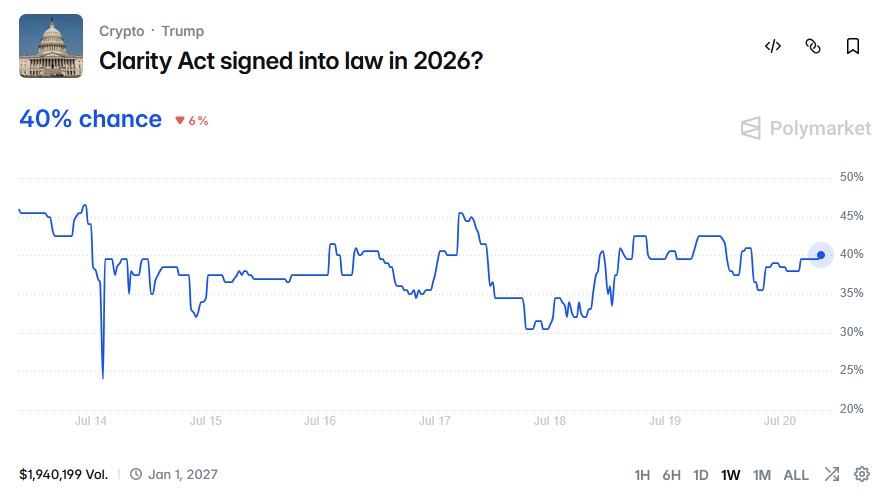
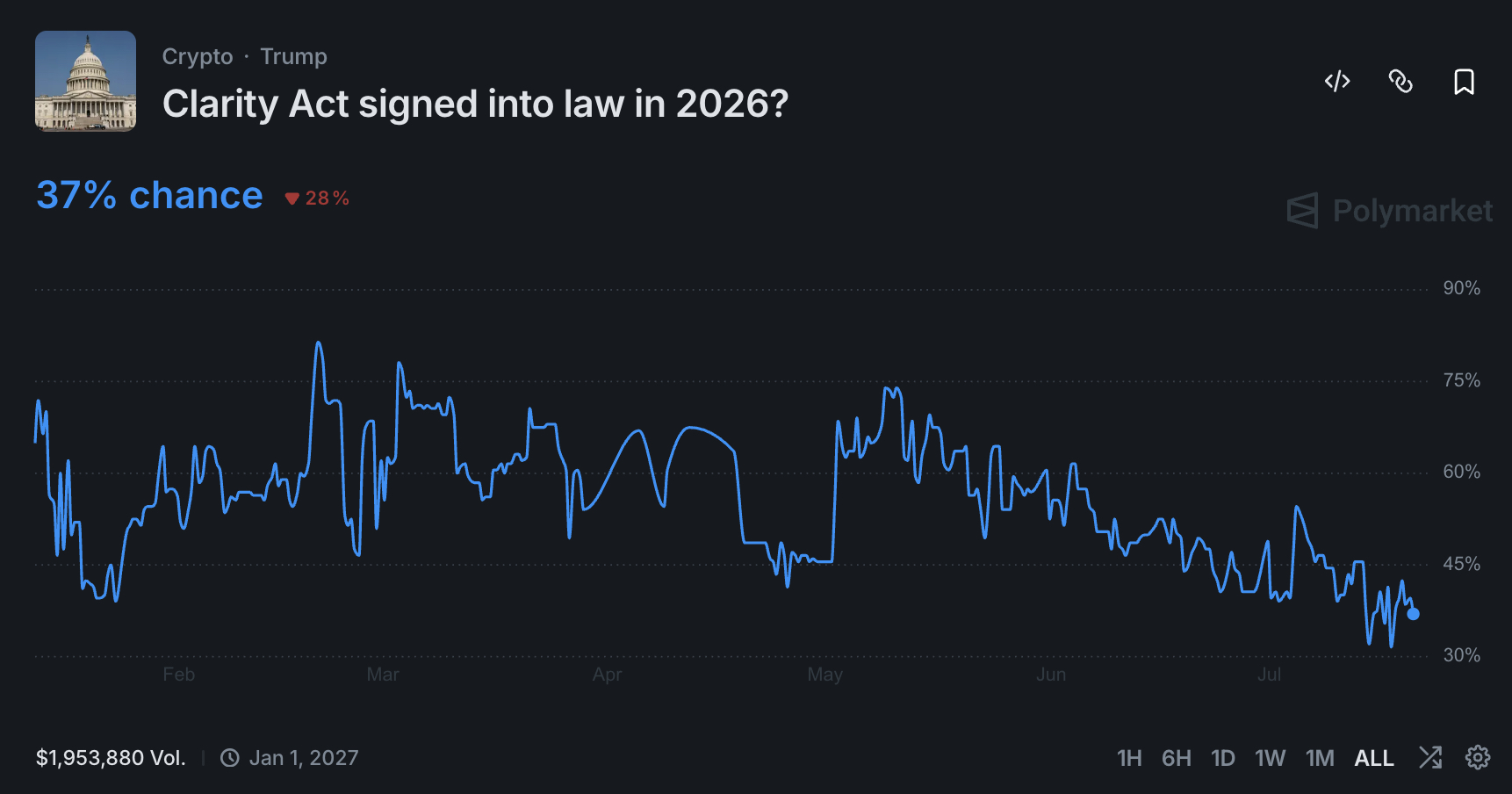
Polymarket suggests the odds of the CLARITY Act passing this year are just 40%, after a raft of Democratic Senators, including Chris Murphy, Jeff Merkley and Chris Van Hollen, spoke out against the bill.
A crucial Senate vote could happen as early as this week, with Senate Majority Leader John Thune stating it will definitely be held before Aug. 10.
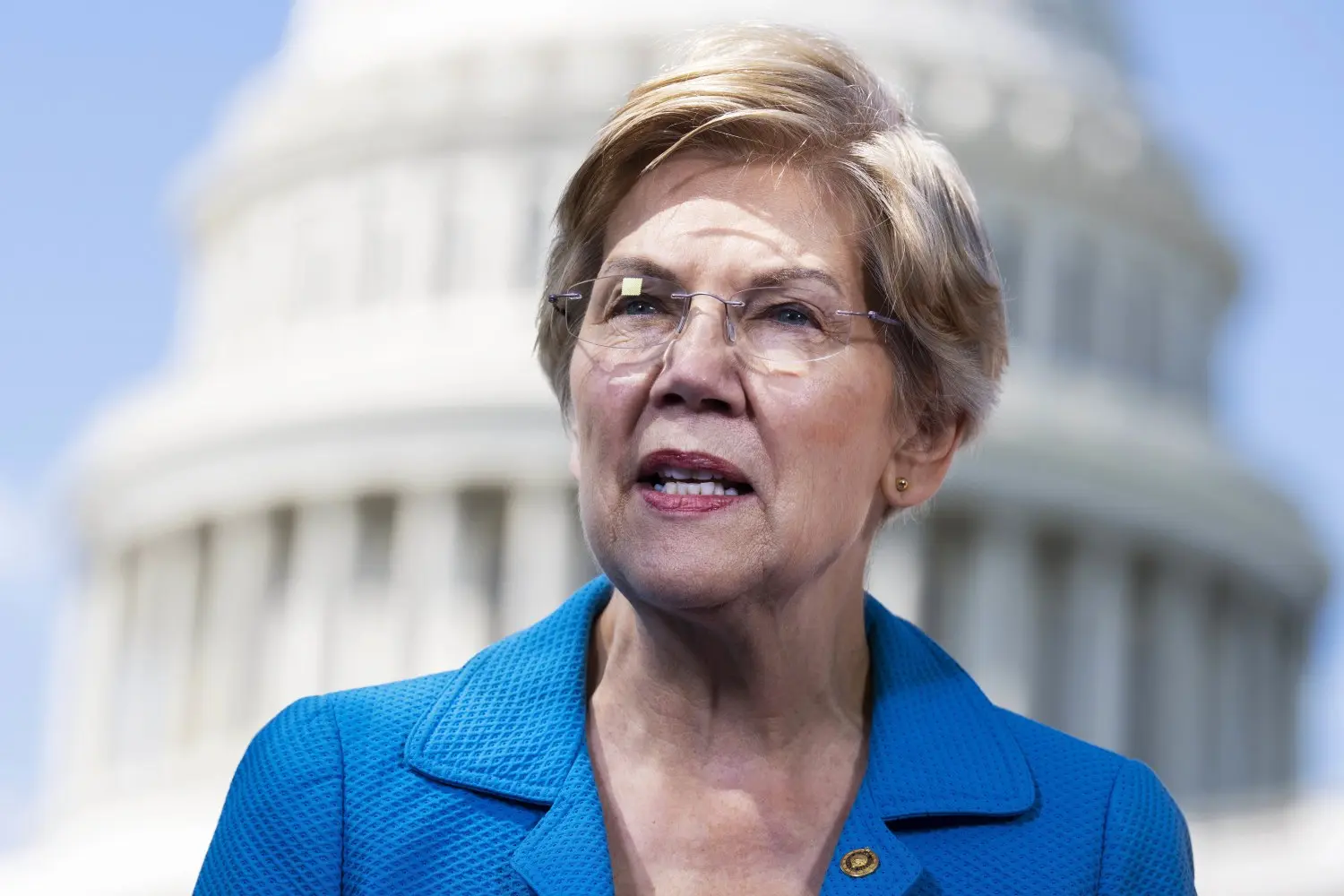
Democrat Senator Elizabeth Warren is trying to spoil the vote by highlighting how much money President Trump has extracted from the industry. She demanded Trump voluntarily release his crypto earnings for this year, after his 2025 disclosure, showed he earned more than a billion dollars from crypto last year. The controversy means that Senate Democrats are unlikely to support the bill without a provision banning elected officials promoting or issuing cryptocurrency.
Summer Mersinger, the CEO of the Blockchain Association and a former commissioner at the US Commodity Futures Trading Commission, said: “Ethics is the big elephant in the room.”
“For my members and what we are advocating for on the Hill… look, whatever you decide on ethics, that’s really not our concern. That is politics. That’s Congress. That’s elected officials. But please don’t let it kill all the hard work that we put in the rest of the bill.”
Source: Polymarket
Prediction markets see record Q2 volume, France blocks Polmarket
Crypto markets continued to flounder in the second quarter, with the notable exception of prediction markets.
Spot trading volume across the top 10 centralized exchanges (CEXs) fell from $2.7 trillion in the first quarter to just $1.95 trillion in the second, according to CoinGecko’s latest Crypto Industry Report.
CEX perps volume also declined 10% to $12.7 trillion, while the stablecoin market slipped 1.6% to $305.1 billion. In contrast, prediction markets recorded their strongest quarter on record with $113.8 billion in notional volume.
Polymarket’s World Cup winner market alone has attracted more than $3.3 billion in trading volume, while contracts tied to the 2028 US presidential election rank among the platform’s largest markets, according to Polymarketscan data.
Meanwhile, France’s National Gambling Authority has just ordered internet service providers to block access to Polymarket as it considers prediction markets to be illegal gambling.
Polymarket is blocked in 33 countries… unless you have a VPN of course.
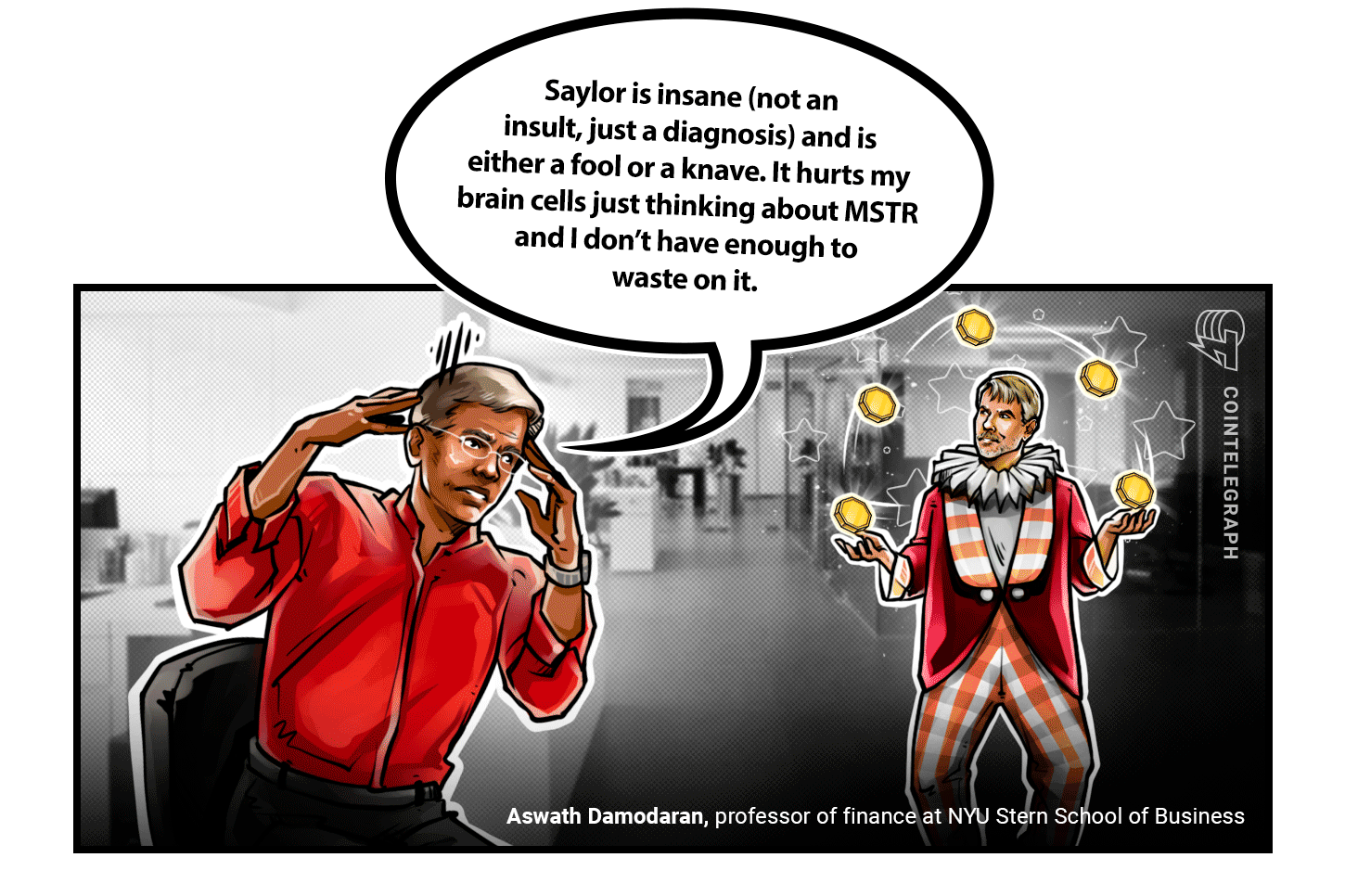
Strategy became a symbol of the dot-com crash: Could history repeat?
Senate agrees SBF should serve his time as FTX distributes another $900M
The US Senate has adopted a resolution opposing executive clemency for former FTX CEO Sam Bankman-Fried.
The measure cannot block a presidential pardon but reflects bipartisan Senate opposition.
Bankman-Fried was sentenced to 25 years in federal prison in March 2024 after being convicted of fraud and conspiracy charges linked to FTX’s collapse in 2022.
Speculation about a possible presidential pardon grew after Bankman-Fried applied for clemency from Trump in June 2026.
On Friday, the FTX Recovery Trust said it would distribute about $900 million to creditors in the fifth round of repayments. The trust has now paid out about $10 billion since the company filed for bankruptcy.
Tokenized stocks hit record $2.3B
The global market capitalization of tokenized stocks rose to a record $2.3 billion on Wednesday, as more investors sought exposure to blockchain-based equity products.
The Ethereum network boasted the largest market share, at 34%, followed by BNB Chain with 30% and the Solana network with 23%, data aggregator Token Terminal shared in a Wednesday X post.
The largest increase came from Kraken exchange’s xStocks, which accounted for $507 million worth of tokenized stocks and Binance’s bStocks, with $334 million. Ondo Finance remained the largest tokenized stock issuer with $955 million in onchain equities, according to Token Terminal data.
The Depository Trust & Clearing Corporation, which is the custodian of $114 trillion in assets, last week launched a trial of tokenized securities in partnership with more than 40 financial firms.
Robinhood Chain also aims to become a leader in tokenized stocks, however its volume to date is largely driven by memecoins.

Is Robinhood Chain’s success bullish or bearish for ETH the asset?
US and UK to align stablecoin rules, but Genius Act rules are TBA
The US Department of the Treasury and HM Treasury in the UK have issued four joint recommendations on digital assets.
The task force recommended that authorities consider a private-sector-led group focused on “testing of cross-border use cases for tokenized assets” and that financial agencies in the US and the Bank of England identify shared approaches on the regulation of tokenized assets.
The statement said that stablecoins “should be fully backed, on at least a one-to-one basis, by high-quality, liquid assets,” aligning with the US law.
Ironically, a few days later it emerged the US regulatory agencies had all missed Saturday’s rulemaking deadline for the GENIUS stablecoin act. Missing the statutory deadline does not invalidate the GENIUS Act, but will result in issuers having less time to comply before the rules go into effect in January.

Source: ZachXBT (but DYOR)
Winners and Losers
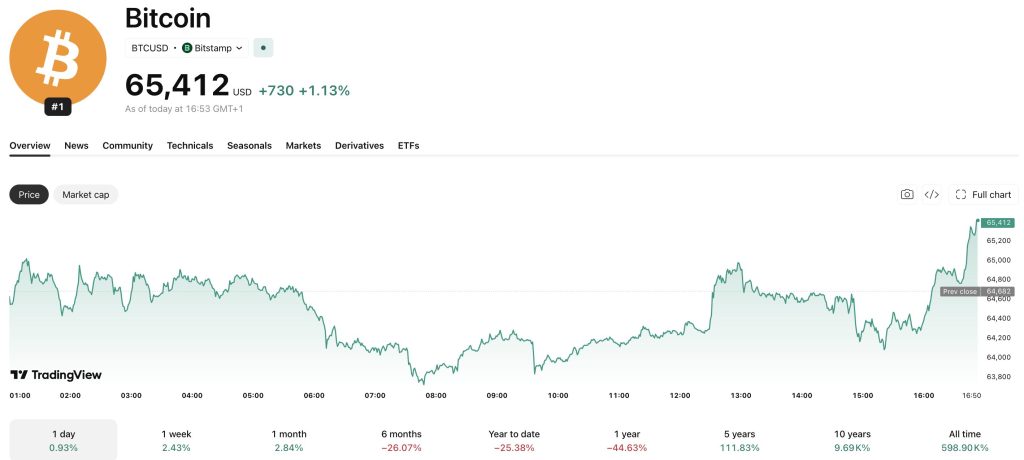
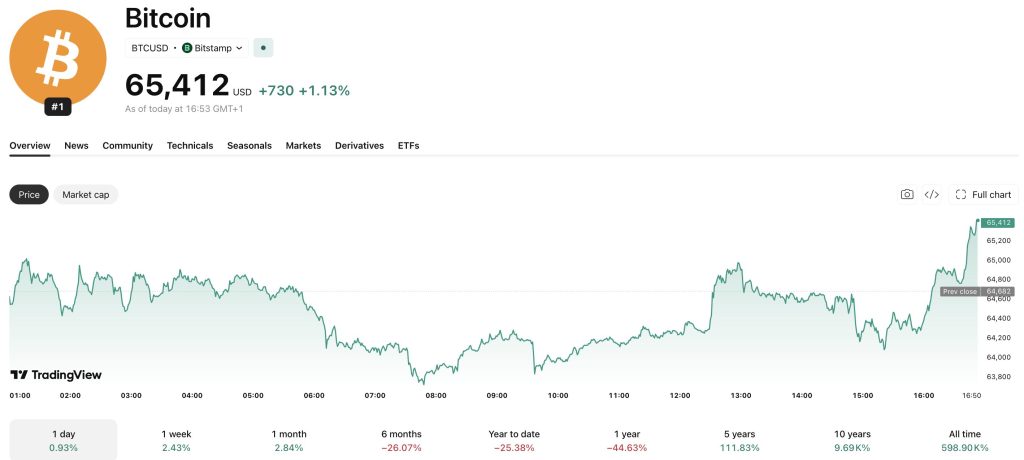
At the end of the week, Bitcoin (BTC) is at $64,620, Ether (ETH) at $1,868 and XRP (XRP) is at $1.09. The total market cap is at $2.21 trillion, according to CoinMarketCap.
Among the biggest 100 cryptocurrencies, the top three altcoin winners of the week are Pump.fun (PUMP) which gained 36%, Venice Token (VVV) on 10%, and Litecoin (LTC) which is up 7%.
The top three altcoin losers of the week are DeXe (DEXE) after it lost 27%, Lighter (LIT) which was down 17%, and Worldcoin (WRLD) which fell 14%.
Prediction of the Week
Bitcoin gets new $80K August target
Bitcoin (BTC) may hit up to $80,000 by August if it clears nearby resistance, a new prediction says. A macro tide could be the spark to ignite the next move higher.
Crypto trader and analyst Michaël van de Poppe said earlier this week that BTC/USD has successfully defended “crucial” support.
“It’s holding the crucial level at $61,000 and flipping important MAs for support, indicating that there’s more momentum on the horizon,” he wrote, referring to moving average trend lines.
“I’m expecting to see a rally to $68,000 in the next 1-2 weeks, followed by a continuation towards $75,000-80,000 in August.”
Not everyone agreed with the analysis, including nichoxbt who thinks the price is heading back under $60,000.
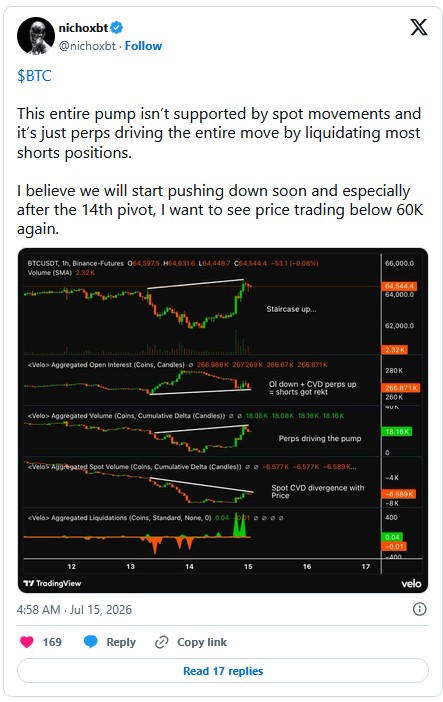
Source: Nichoxbt
Top FUD of the Week
Consensys unknowingly outsourced developer work to North Korean
Blockchain company Consensys accidentally used a software developer linked to North Korea, who had access to some of its systems for a month.
First reported on Friday by Drop Site, Consensys earlier this year took on a software developer via a “reputable third party service provider” who was later discovered to have ties to the Democratic People’s Republic of Korea.
The move caused the Metamask developer to temporarily suspend product releases, but said an investigation has “confirmed there was no misappropriation of assets or data, no malicious code deployed, and no impact to user safety and security.”
Kaspersky identifies malware framework targeting crypto investors
Cybersecurity company Kaspersky said a newly identified malware framework is targeting cryptocurrency investors.
Dubbed “OkoBot,” the malware initiates an infection chain that starts with social engineering tactics such as ClickFix, which tricks users into running malicious commands, or trojanized GitHub apps that deliver a backdoor to infected devices, the cybersecurity company wrote in a Wednesday report.
A separate malware campaign seeks to infiltrate the devices of Web3 developers via fake LinkedIn recruitment opportunities, according to SlowMist.
Attackers contact blockchain devs via LinkedIn, posing as recruiters. They then send fake GitHub repositories to victims, claiming they contain code that needs to be assessed before the interview, the security company said in a Saturday report.
Base’s social bet left it trailing in prediction markets and perps: Pollak
Base creator Jesse Pollak says he is stepping back from leading the Base App after admitting he made a “wrong bet” on social, leaving the chain to fall behind on prediction markets and perpetual futures.
In a post to X on Wednesday, Pollak said he had bet that creator, content and messaging apps would drive adoption, but instead the market “disintegrated completely.”
Pollak said he now realized financial applications are the way forward for the network, with a focus on trading, payments and AI agents.
The Base App will now return to Coinbase, and will be overseen by crypto influencer and trader Jordan Fish, better known on X as “Cobie.”
Top Magazine Stories of the Week

Strategy became a symbol of the dot-com crash: Could history repeat?
MicroStrategy blew up during the dot-com era, before Michael Saylor transformed it into the world’s largest corporate Bitcoin holder. Did he learn his lesson?
Is Robinhood Chain’s success bullish or bearish for ETH the asset?
Surging volumes on Robinhood Chain could be very good for Ethereum, but only if the “ETH is money” crowd turn out to be right.
Gambling on random Pokémon cards: Onchain gagcha hits record high as crypto sinks
Users spent a record $324 million on onchain gacha in June, even as Bitcoin hit a 21-month low. The thrill of scoring a top Pokemon card from a random pack is becoming big business.
Cointelegraph publishes long-form journalism, analysis and narrative reporting produced by Cointelegraph’s in-house editorial team with subject-matter expertise. All articles are edited and reviewed by Cointelegraph editors in line with our editorial standards. Content published in here does not constitute financial, legal or investment advice. Readers should conduct their own research and consult qualified professionals where appropriate. Cointelegraph maintains full editorial independence.


Robinhood Markets is drawing fresh attention from Wall Street as analysts argue the company’s next growth leg could come from tokenized assets and prediction markets rather than traditional retail crypto activity. In a Monday research note, Bernstein lifted its price target for Robinhood stock to $160 from $130, while keeping an Outperform rating. The shares were last reported around $101.
Bernstein’s thesis centers on the idea that two adjacent segments—prediction markets and tokenized equities—could scale faster than legacy revenue streams. The firm expects prediction markets to become Robinhood’s fastest-growing business, projecting segment revenue of $1.7 billion by 2028, which it frames as a 64% compound annual growth rate.
Key takeaways
- Bernstein raised Robinhood’s stock price target to $160 from $130 and maintained an Outperform rating.
- The research note argues prediction markets could become Robinhood’s fastest-growing segment, with revenue projected at $1.7 billion by 2028.
- Tokenized equities are presented as a major long-term opportunity, supported by Robinhood’s blockchain infrastructure strategy.
- Bernstein points to a broader market backdrop: growth in onchain real-world assets that could expand to $2 trillion–$4 trillion by 2030 from about $35 billion today.
- Infrastructure providers are also accelerating governance and issuance tooling for tokenized securities, suggesting institutional momentum is building.
Bernstein’s shift: prediction markets and tokenized equities
Bernstein’s Monday note emphasizes that Robinhood’s expansion path is increasingly tied to product categories that extend beyond straightforward crypto trading. The firm singled out prediction markets as the most immediate growth driver, forecasting rapid scaling that could outpace other lines of business.
Importantly, Bernstein also linked the prediction markets story to Robinhood’s broader platform ambitions—positioning the company to compete across multiple “battleground” asset types. While the note highlights several categories, its core investment case is that Robinhood can leverage its distribution and user base to build market activity around new trading paradigms.
Tokenized equities: Robinhood Chain and the infrastructure angle
On the tokenized equities front, Bernstein identified Robinhood’s engagement with blockchain infrastructure as a long-term differentiator. The firm referenced Robinhood Chain, describing it as the company’s Arbitrum-based layer-2 network used to support tokenized real-world assets.
According to Bernstein, Robinhood’s approach is designed to allow the platform to develop on-chain financial products without needing to depend on third-party blockchains. This matters for investors because infrastructure choices can affect product rollout speed, integration complexity, and the economics of building and operating blockchain-enabled services.
Bernstein tied its tokenization view to a macro capital markets shift, arguing tokenization is becoming a foundational layer for capital markets. The analysts projected the total value of onchain real-world assets could rise to $2 trillion to $4 trillion by 2030 from roughly $35 billion today. They further expect tokenized equities to capture an increasing portion of that growth as issuance and adoption broaden beyond certain asset types such as Treasury securities and private credit.
Rather than treating tokenized equities as a narrow experiment, Bernstein frames them as part of a larger, compounding trend in how financial institutions may issue, transfer, and govern assets digitally. For traders and users, that could eventually translate into more choices for tokenized instruments; for builders and issuers, it signals rising demand for compliant rails that can support custody, governance, and reporting.
Wall Street builds governance tooling for tokenized securities
Bernstein’s note landed as institutional infrastructure continues to mature. On Monday, Alpaca and Broadridge Financial Solutions announced they had integrated Broadridge’s shareholder governance capabilities into Alpaca’s Instant Tokenization Network.
The integration is aimed at giving holders of tokenized securities governance rights closer to those of traditional shareholders, including features such as proxy voting, investor communications, and regulatory disclosures.
That announcement follows last week’s partnership between Securitize and investment bank Cantor Fitzgerald, which focused on developing infrastructure for blockchain-based initial public offerings and follow-on equity offerings under existing U.S. securities regulations. Together, the developments suggest tokenized assets are moving beyond issuance experiments toward operational completeness—particularly around governance and regulatory workflows.
Tokenized stocks have also been gaining visibility in market tracking. RWA.xyz reports the asset class has grown to nearly $2 billion in market value this year.
What to watch next for Robinhood and tokenized markets
For readers following Robinhood’s trajectory, the key question is whether management can translate these infrastructure and segment-level bets into consistent revenue growth as prediction markets scale and tokenized equities gain traction. In the broader market, investors should watch whether governance tooling and compliance layers—such as the Broadridge-Alpaca integration—continue to expand, since that infrastructure often determines how quickly tokenized securities can move from pilots to repeatable offerings.


The hottest thing in artificial intelligence (AI) is not a chip or a chatbot. It is an IOU. Morgan Stanley expects AI companies to raise $570 billion from the bond market in 2026.
Nvidia and Kimi K3, Moonshot AI’s new Chinese model, own the headlines. Yet pension funds and insurers quietly pay for it all.
Morgan Stanley Turns the AI Bond Market Into a Fee Machine
The money is moving at record speed. Up to $236 billion of AI debt had been sold by May 31, four times last year’s pace, Forbes reported.
Morgan Stanley saw it coming. It led $65 billion in AI bond deals in late 2025 alone, according to Bloomberg.
The reward was $2.3 billion in fees in six months, LSEG data shows, up from $1.4 billion. That leap carried it past Goldman Sachs, behind only JPMorgan Chase.
The trick? Package Big Tech’s credit and long-term computing contracts into bonds that cautious investors will buy.
Follow us on X to get the latest news as it happens
Google’s Safety Net and Meta’s Hidden Debt
TeraWulf proves the model. The former Bitcoin miner now builds AI data centers instead. Its $3.2 billion bond sale drew $10 billion of orders at a 7.75% yield.
Why the rush for a junk-rated miner? Google. An SEC filing shows that Google is backing $3.2 billion in leases owed by tenant Fluidstack at TeraWulf’s New York campus. If Fluidstack stops paying, Google pays. In return, Google got the right to buy roughly 14% of TeraWulf.
Cipher Mining won a similar deal, which fueled a rally in miner stocks that outperformed BTC.
Meta plays the same game bigger. Morgan Stanley arranged $27 billion for its Hyperion campus in Louisiana, the largest private credit deal ever. Partner Blue Owl owns 80%, so the debt stays off Meta’s books.
Bond Investors Start Charging for Patience
Buyers are cooling. In February, they bought nearly five times as many Big Tech bonds as were on offer. By July, under two. And in late 2025, insuring Oracle’s debt cost more than at any time since 2009. The nerves align with broader AI bubble warnings.
The spending will not slow, however. Data centers need $2.9 trillion through 2028, and Big Tech’s cash covers only half of that, Morgan Stanley estimates.
Bonds built the railroads and the 1990s telecom boom. Now they are building AI. Every chip and every chatbot runs on borrowed money eventually. Whoever prices that debt decides how fast the future arrives.
The post Morgan Stanley Turned AI Into Wall Street’s Hottest Bond Trade appeared first on BeInCrypto.


Michael Saylor’s Strategy published formal guidance last July that his company would not sell MSTR stock below 2.5x the value of the company’s BTC holdings except to pay interest and dividends.
It’s sold $14.3 billion of MSTR since, every share of it below that formerly sacred 2.5x mNAV.
The term mNAV — invented by fans of public companies amassing crypto — refers to a company’s multiple-to-Net Asset Value under the assumption that crypto holdings like BTC are tantamount to its NAV, even though they’re not.
Saylor’s ephemeral pledge appeared on July 31, 2025, on slide 96 of the company’s earnings deck, claiming, “We will not issue MSTR below 2.5x mNAV except to pay interest and dividends.”
Executives also reiterated that commitment verbally on that earnings call and elsewhere.
Once upon a time, during a brief mania for leverage in late 2024 and early 2025, investors actually valued Strategy far higher than the value of its BTC.
Although the company has fallen below 1x mNAV several times and now trades at 1x, it once traded for 3.2x the value of its BTC — a level it’s never reattained.
Read more: It took Michael Saylor seven minutes to define mNAV
Michael Saylor’s long-term mNAV guidance lasted days
After formalizing its no-selling policy below 2.5x mNAV, Strategy changed its mind days later.
On August 18, 2025, it announced an “Update to MSTR Equity Guidance” in a follow-on SEC filing.
The update added a catch-all exception as number 3: “When mNAV (as defined on Strategy.com) is below 2.5x, Strategy will tactically issue MSTR Shares to (1) pay interest on debt obligations, (2) fund preferred equity dividends, and (3) when otherwise deemed advantageous to the Company.”
The new third clause was a longer way of saying, essentially, whenever.
It resumed dilutive share sales the same week it changed its guidance, offloading 875,000 shares for $310 million per an SEC filing and soon ramping it up to billions of dollars.
The selling has rarely paused since Saylor changed his mind.
Protos reviewed every weekly at-the-market disclosure filed since the change. They add up to at least 92 million new shares sold for $14.3 billion.
Strategy’s mNAV ratio has never come close to the 2.5x threshold since, with all sales below the threshold.
Relentless shareholder dilution
The number of MSTR shares outstanding are now 343 million. When Saylor’s 2.5x promise ended on July 31, 2025, the share count was near 284 million.
That means common shareholders have suffered dilution that has ballooned the supply of their investment by over 20% in less than 12 months.
To be fair, the price of BTC hasn’t performed particularly well over the last year, so Saylor can note that the company survived, managed a difficult environment, and paid all bondholders and dividend obligations on-time.
Shareholder dilution, unfortunately, serviced that uptime.
Strategy paid $381 million of preferred dividends in 2025 across its STRK, STRF, STRC, STRD, and STRE tickers, while its operations burned $67 million of cash.
Preferred dividends cost another $230 million in the first quarter of 2026 alone and now annualize to $1.763 billion.
Read more: We made a dictionary of MicroStrategy’s invented terminology
Selling MSTR below 1x mNAV can be ‘advantageous’
The August 2025 guidance slide had one more pledge: below 1.0x mNAV, Strategy “will consider issuing credit to repurchase MSTR.” It’s never done this.
Instead, by June 26, 2026, Strategy’s enterprise mNAV on its own website closed below 1.0x for the first time.
Strategy’s response was to quickly sell more shares of MSTR — 12.7 million, to be precise, for $1.15 billion.
Selling that stock slightly below and barely above 1x mNAV, apparently, remained in the zone of “when otherwise deemed advantageous to the company.”
Three days later, Saylor posted, “Strategy expects to remain disciplined in its use of MSTR issuance, particularly when the stock trades at or near 1x mNAV.”
In an attempt to instill confidence, Strategy’s board announced a large share repurchase authorization. Although it authorized buybacks, it’s never actually conducted buybacks under that authorization.
Every weekly filing since has repeated the same phrase: “did not purchase any shares under its share repurchase programs.”
Finally, the most devastating metric is simply the value that common shareholders have lost since Strategy’s revoked guidance to not dilute them below 2.5x.
At time of writing, MSTR was trading near $99.50, down 35% year to date and down 75% from its $401.86 close on the day of the original 2.5x mNAV promise.
Strategy has spent over $1 billion across five years amassing BTC and massive, unrealized losses. Despite massive expenditures actively managing its treasury, its average cost basis is more than $10,000 higher per BTC than the current price of BTC.
Its unrealized loss on its investment now exceeds $8 billion.
Got a tip? Send us an email securely via Protos Leaks. For more informed news and investigations, follow us on X, Bluesky, and Google News, or subscribe to our YouTube channel.
In Bitcoin news today, Michael Saylor, co-founder of Strategy and the largest publicly listed corporate BTC holder, has gone on record opposing BIP-110, the proposed one-year soft fork that would restrict non-financial data storage on the Bitcoin blockchain, arguing that the proposed cure carries more systemic risk than the condition it targets.
His critique, posted to X and covered by the Bitcoin Foundation on July 11, frames the entire debate not as a spam-management question but as a Bitcoin governance question: who decides what constitutes a valid transaction, and what happens once that line is drawn within the protocol.
That framing cuts directly to the precedent problem. As Saylor stated in his X post, “He wrote: “BIP 110 turns a spam dispute into a consensus change that would invalidate some currently valid, fee-paying transactions.
That precedent is the danger.” The concern is not specifically about Ordinals or blockchain spam today; it is about what the protocol becomes the moment it starts filtering transactions by perceived intent rather than fee payment and cryptographic validity.
Bitcoin News: The Miner Threshold is the Flashpoint
BIP-110’s activation mechanics have drawn as much fire as its content. The proposal would lock in if miners signal support in at least 55% of blocks during a 2,016-block period – well below the 95% threshold that has historically governed permanent consensus changes in Bitcoin.
Saylor has flagged this reduction as a structural risk, warning it could produce a network split and sustained market uncertainty at a moment when no such disruption is justified by the underlying threat.
The current miner signaling picture gives that warning context: as of July 13, support stood at approximately 1.3%, per the public BIP-110 signaling monitor at bip110.org. The voluntary signaling deadline falls around block 961,542 in August.
A 55% threshold is aggressive by any historical standard in Bitcoin governance; at 1.3% support, it is also currently unreachable, but the threshold itself remains a live governance concern regardless of the present signal count.
The technical scope of the proposal is sweeping for a supposedly temporary measure. BIP-110 would restore a tighter limit on OP_RETURN outputs, restrict larger data uploads, and reject blocks containing transactions that are valid under Bitcoin’s current rules.
Nodes adopting BIP-110 would, in effect, enforce a narrower definition of which transactions are acceptable than non-adopting nodes, a split scenario Saylor is flagging.
Discover: The Best Token Presales
Bitcoin Neutrality vs. Protocol Gatekeeping
Saylor’s deeper argument is that Bitcoin neutrality is not a soft preference; it is a structural property the network cannot afford to compromise.
With this Bitcoin news drop, the proposal reframes the change to consensus rules to fight spam as a decision about which valid, fee-paying transactions the network should accept, raising concerns about embedding judgment in the protocol.
The chilling-effect logic follows directly. If consensus rules can be modified to exclude data storage when a segment of the community labels it as spam, the same mechanism is available for other categories that would raise similar concerns.
The institutional investors who have followed Strategy’s lead and the broader wave of corporate treasury adoption across the Bitcoin corporate treasury space are implicitly betting on protocol stability. A governance mechanism that can exclude valid use cases introduces a risk category unrelated to price or macro.
There is also a direct fee-revenue argument. Suppressing on-chain use cases, whatever their aesthetic merit, can affect the demand for transaction fees.
Saylor’s position is that market-based fees and individual relay policies are the correct instruments for managing unwanted data traffic, because they operate without altering consensus and can be reversed or adjusted without a network-wide coordination event.
Broader Opposition and What Comes Next
In other Bitcoin news, Saylor is not the only prominent voice pushing back. Other long-standing Bitcoin contributors have also publicly opposed BIP-110. The debate has surfaced a wider tension in Bitcoin governance over who holds effective veto power: miners, developers, node operators, or major holders, and whether a 55% miner threshold is a legitimate activation path for changes of this scope.
With miner support effectively at zero six weeks before the August deadline and no clear institutional momentum building behind the proposal, BIP-110 may be difficult to push through under the required 55% signaling threshold. But the governance argument Saylor is making does not expire with this particular proposal.
The question of whether Bitcoin’s consensus layer should ever be used to discriminate between transaction types, and who gets to make that call, is now squarely on the table. Institutional players have a direct stake in how that question gets answered.
Strategy holds approximately 843,775 BTC. His argument is not philosophical posturing. It is a position from the largest corporate Bitcoin balance sheet in existence, and it lands squarely on the side of preserving the protocol’s neutrality.
Discover: The Best Crypto to Diversify Your Portfolio
The post Bitcoin News: Saylor Warns BIP-110 Trades Bitcoin Neutrality for a Dangerous Precedent appeared first on Cryptonews.

Bitcoin (BTC) continues to trade in a consolidation phase, a little above the $60,000 level. The market is approaching 165 days of testing that crucial price zone despite a rally above $80,000 in May that ultimately failed to sustain momentum, according to analyst Darkfost.
The analyst pointed to a lack of fresh liquidity entering the crypto market as one of the main reasons behind Bitcoin’s inability to establish a stronger uptrend.
Stablecoin Drain
Fresh demand has struggled to materialize for both Bitcoin and the broader crypto market, the analysis said. Exchange stablecoin reserves have reflected that trend since the beginning of the year, which essentially shows a near-continuous decline as outflows consistently outpaced inflows.
Over the past 30 days, Binance recorded approximately $1.55 billion in stablecoin outflows – a significant reduction in reserves over a relatively short period. Bybit also saw a further $786 million leave its stablecoin reserves during the same timeframe. In total, the two exchanges recorded nearly $2.3 billion in stablecoin outflows over the past month.
Darkfost explained that the falling reserves indicate that incoming liquidity and investor demand are continuing to contract. The analyst added that market participants appear to be withdrawing stablecoins from exchanges rather than deploying them into crypto assets, while some may be exiting the market entirely.
According to the analysis, such a “pessimistic” market positioning continues to limit the liquidity available to Bitcoin, which then ends up preventing the asset from making a meaningful breakout above its long-running consolidation range around the $60,000 level.
Accumulation Opportunity
Some market analysts, such as Doctor Profit, believe that the ongoing market conditions present a gradual accumulation opportunity. The analyst recently said that investors waiting for Bitcoin’s traditional four-year cycle bottom could end up missing the market’s next move.
Meanwhile, market trader Daan Crypto Trades said the crypto asset is on track to close another weekly candle above its 200-week moving average (200MA), a level often watched as an important long-term support indicator. However, the trader said a stronger move higher is still needed to retrace the previous decline and reclaim the 200-week exponential moving average (200EMA). Until that happens, Bitcoin is expected to remain stuck in its “choppy” trading range around the current level.
The post What Does $2.3B Stablecoin Exodus From Binance and Bybit Mean for Bitcoin appeared first on CryptoPotato.


Binance founder Changpeng Zhao has drawn a line between Bitcoin’s 21 million supply cap and an AI investment cycle that JPMorgan CEO Jamie Dimon expects to attract $725 billion this year.
Summary
- CZ says AI boosts productivity, while Bitcoin’s fixed supply protects wealth from inflation.
- Jamie Dimon expects AI investment to reach $725 billion amid a powerful spending cycle.
- BlackRock executives believe debt and currency concerns could strengthen Bitcoin’s long-term case.
CZ wrote in a recent X post that artificial intelligence and Bitcoin serve separate financial and economic roles, rejecting the idea that rapid advances in AI can protect investors when fiat currencies lose purchasing power.
“AI is great, but it does not protect you against inflation. Bitcoin does.”
According to CZ, artificial intelligence can raise productivity, improve business efficiency and support technological development, while Bitcoin gives holders access to an asset whose supply cannot be expanded. His comparison places scarcity at the center of Bitcoin’s appeal rather than treating it as another fast-growing technology investment.
Capital has continued to enter AI software, chips, data centers and computing infrastructure as companies seek applications across healthcare, finance and manufacturing, CZ noted. Although those investments may produce new services and higher output, he argued that ownership in an AI company remains tied to revenue, execution and competition.
Companies developing AI products can also issue additional shares or raise fresh capital to fund expansion, according to CZ. Such financing can dilute existing shareholders, whereas Bitcoin’s protocol limits the total number of coins to 21 million, preventing any company or government from increasing its supply.
For CZ, that difference gives Bitcoin its potential as a long-term store of value when inflation weakens fiat money. His case does not rest on Bitcoin matching the productivity gains promised by AI; instead, he views the asset as protection against monetary expansion and the loss of purchasing power.
Bitcoin and AI serve different investment needs
CZ has previously acknowledged that the AI boom could temporarily pull money away from Bitcoin and other assets. As private companies such as OpenAI and Anthropic attract large funding rounds, he argued that some investors may sell existing holdings to gain exposure to AI-related opportunities.
Despite that competition for capital, CZ does not consider Bitcoin and artificial intelligence direct rivals. Under his framework, AI helps companies produce more goods and services, while Bitcoin allows investors to hold an asset that cannot be diluted through additional issuance.
The distinction also separates the risks attached to the two themes. According to CZ, an AI company’s value depends on its ability to turn technology spending into a durable business while competing against other developers. Bitcoin holders face different risks, but its programmed scarcity does not depend on one management team meeting sales targets or defending market share.
Demand for AI infrastructure remains strong, with JPMorgan CEO Jamie Dimon forecasting that related investment will reach $725 billion this year. Dimon has linked his optimism to the volume of capital entering the industry and the continuing strength of the U.S. economy.
Describing the spending cycle as difficult to stop, Dimon compared its momentum with a wave gaining force.
“We’re in a bull market. It’s like a little tsunami. When that kind of thing happens, it’s very hard to stop.”
Dimon’s view supports CZ’s assessment that AI will continue drawing large amounts of investor capital, although the two executives differ sharply on Bitcoin. The JPMorgan chief has repeatedly criticized the cryptocurrency, while CZ has built his inflation argument around its fixed issuance.
Rather than dismissing the AI trade, CZ’s comments assign it a separate purpose. He credits the technology with improving productivity, but he does not believe higher output or stronger corporate earnings can replace an asset designed to resist supply expansion.
Debt concerns strengthen Bitcoin’s scarcity case
At the same time, rising government borrowing has added weight to the monetary concerns behind CZ’s position. Dimon, despite his long-running criticism of Bitcoin, has recently warned about government debt and geopolitical risks that could affect markets over the next several years.
BlackRock executives have also connected fiscal pressure with Bitcoin’s investment case. Robert Mitchnick, BlackRock’s head of digital assets, has argued that concern over U.S. debt and persistent budget deficits could become a major source of demand for the cryptocurrency.
BlackRock CEO Larry Fink issued a similar warning in his 2025 annual letter, stating that uncontrolled U.S. debt could eventually threaten the dollar’s reserve-currency status. Fink argued that decentralized assets such as Bitcoin could benefit if investors lose confidence in national currencies and seek alternatives outside government control. BlackRock’s 2025 annual letter also placed technological change and long-term investing among the forces reshaping capital markets.
BlackRock’s fixed-income team has separately identified rising U.S. debt as a risk to demand for long-dated Treasury bonds and the dollar. The asset manager’s analysis warned that heavier issuance and reduced demand from major buyers could push borrowing costs higher, adding another fiscal concern to the case advanced by Bitcoin supporters.
Against that setting, CZ’s argument treats AI spending and Bitcoin ownership as responses to different conditions. His view assigns AI a role in generating economic growth while reserving Bitcoin for investors seeking scarcity when debt, inflation, or currency weakness threatens the value of conventional money.
US stocks gained roughly $550 billion Monday as hopes rose for a 10-day US-Iran ceasefire. Oil fell as traders priced in calmer supply risks.
Mediators want the pause to revive June’s interim peace deal. A senior Iranian official confirmed the offer to Reuters on Monday.

Why US-Iran Ceasefire Hopes Lifted Stocks and Cooled Oil
The offer went to Tehran on Monday, Reuters reported. It aims to revive the Islamabad Memorandum, the peace deal Pakistan and Qatar brokered in June. Donald Trump and Iranian President Masoud Pezeshkian signed it remotely on June 17. The truce collapsed in July when strikes resumed.
Stocks jumped on the news. The S&P 500 rose 0.63% and the Nasdaq climbed 1.02%, market data shows, with analysts estimating the total gain at roughly $550 billion, with tech stocks leading.
US stocks have a track record here. They proved the strongest wartime hedge in the war’s first phase, beating gold and Bitcoin (BTC). Still, Monday’s rally came as US Central Command announced a ninth straight night of strikes.
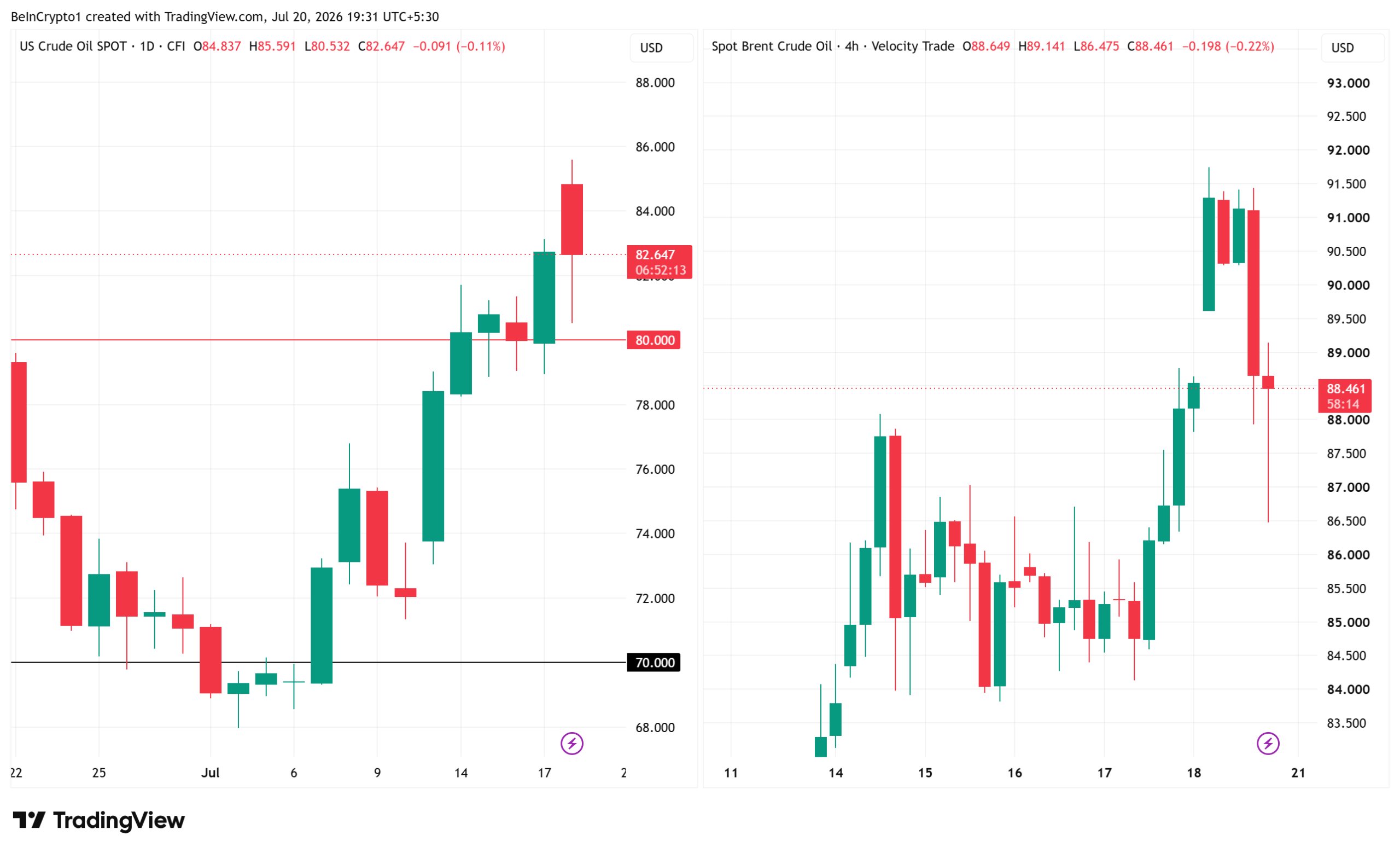
Oil moved the other way. WTI traded near $82.65 and Brent slipped to about $88.46, TradingView data shows. This is only hours after oil price topped $90 after reports of escalating war on Sunday.
Tehran Doubts and Houthi Threats Keep the Rally Fragile
Iran is not sold. Parliament Speaker Mohammad Bagher Ghalibaf said the US keeps sending military equipment to the region while claiming it wants peace.
“We’ve reached the stage of mastery in recognizing these American games, and on that basis, we’ve prepared ourselves. Actions must confirm claims, not contradict them,” Ghalibaf said.
His post came hours after Yemen’s Houthis declared a maritime embargo on Saudi shipping through the Bab el-Mandeb Strait. Military spokesman Yahya Saree called it an “eye for an eye” response to Riyadh’s siege of Houthi ports.
That threat hits Saudi Arabia where it hurts. Riyadh now sends over 70% of its crude exports through the Red Sea port of Yanbu, Kpler data shows. Those flows run near 4 million barrels per day. The pivot began while Hormuz disruptions threatened cheaper US gasoline.
The safety net is thin too. The US Strategic Petroleum Reserve sits at its lowest level since 1983 after a record 400 million-barrel release in March. Traders already price high odds of $4 gas by the end of July. Such a move would constitute a climb of nearly 25% above current levels.

Markets have seen this pattern before. A June relief rally faded once strikes resumed. Meanwhile, a fresh oil spike could revive pressure for Fed hikes. For now, the gains rest on a proposal, not a pause. Real progress will decide whether they last.
The post New Ceasefire Hopes Add $550 Billion to US Stocks as Oil Retreats appeared first on BeInCrypto.
Analysts at Bernstein have raised their price target on Robinhood Markets, based on their investment thesis that the online brokerage’s next phase of growth will be driven by tokenized equities and prediction markets rather than traditional crypto trading.
In a Monday research note, Bernstein raised its price target on Robinhood (HOOD) stock to $160 from $130 per share and maintained its Outperform rating. HOOD stock was last seen trading around $101.
The analysts said prediction markets are poised to become Robinhood’s fastest-growing business, forecasting segment revenue to reach $1.7 billion by 2028, representing a 64% compound annual growth rate.
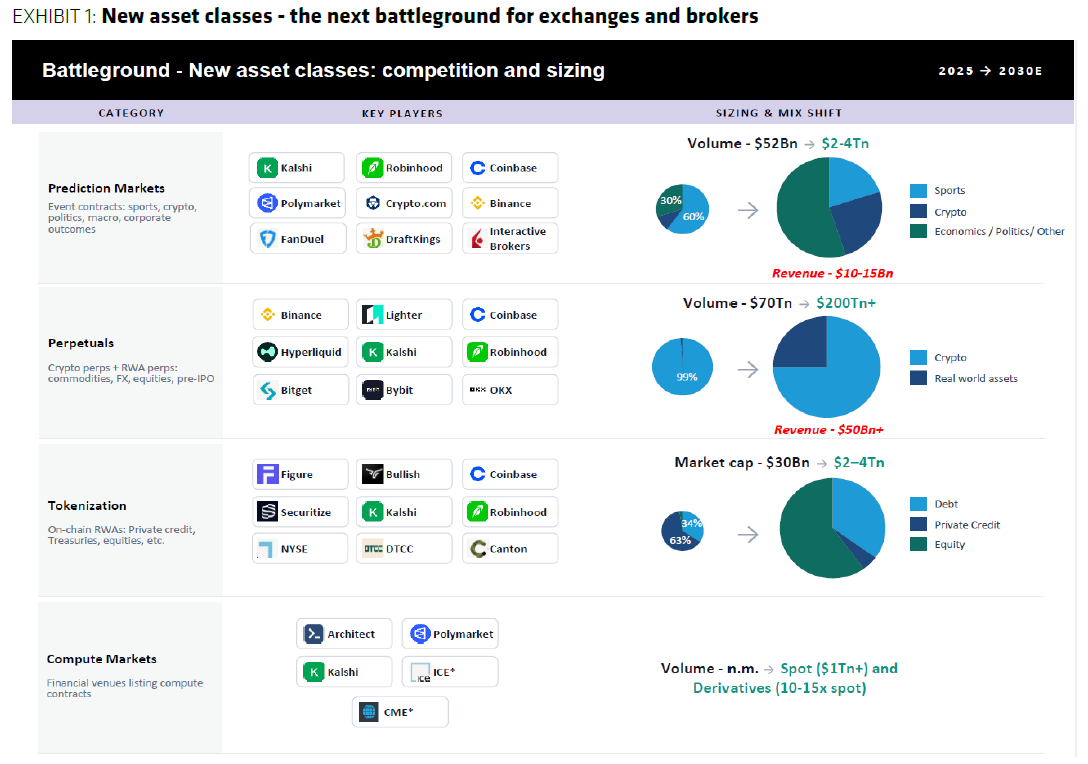
Beyond prediction markets, Bernstein identified tokenized equities as a major long-term opportunity, pointing to Robinhood’s investment in blockchain infrastructure. The firm highlighted Robinhood Chain, the company’s Arbitrum-based layer-2 network, as its proprietary infrastructure for tokenized real-world assets, enabling the platform to build on-chain financial products without relying on third-party blockchains.
Bernstein said that tokenization is emerging as a foundational layer for capital markets, projecting that the value of onchain real-world assets will grow to between $2 trillion and $4 trillion by 2030 from roughly $35 billion today. The analysts expect tokenized equities to account for an increasing share of that growth as adoption expands beyond Treasury securities and private credit.
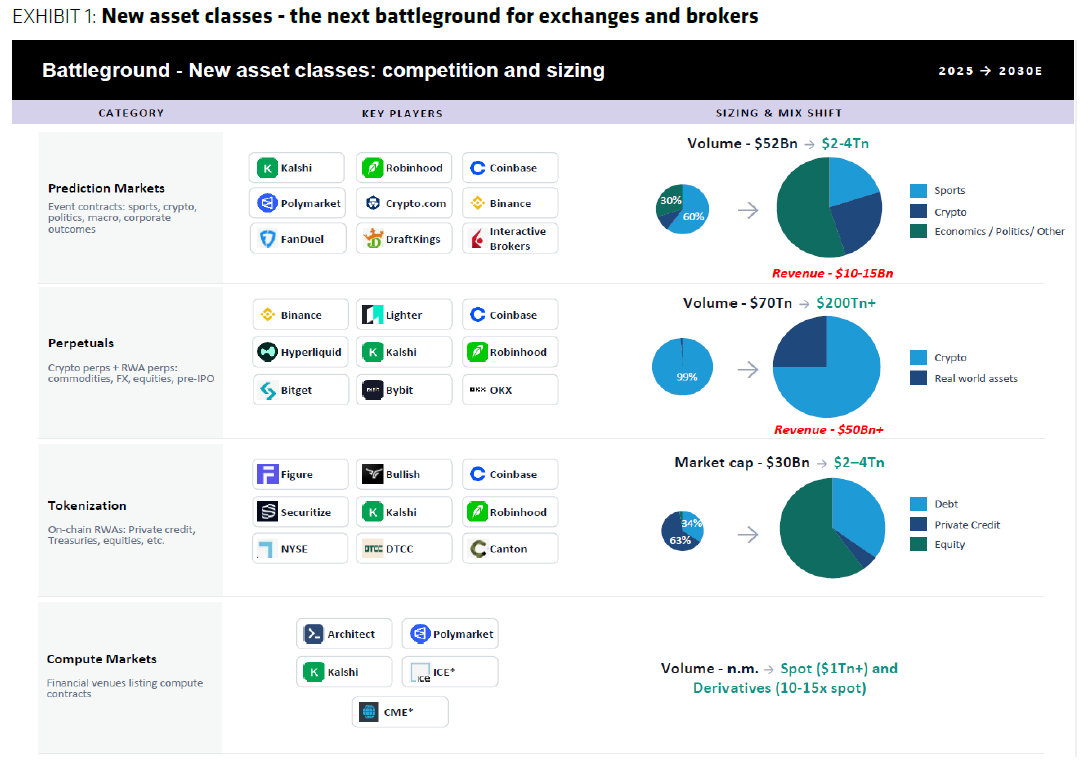
Robinhood is competing across key “battleground” asset classes, including prediction markets, perpetual futures and tokenized RWAs. Source: Bernstein
Related: Tradable’s $1B Stellar deal adds to institutional tokenization boom
Wall Street expands tokenization infrastructure
The Bernstein report comes as financial institutions continue to expand infrastructure for tokenized securities.
On Monday, brokerage infrastructure provider Alpaca and financial technology company Broadridge Financial Solutions announced they had integrated Broadridge’s shareholder governance tools into Alpaca’s Instant Tokenization Network. The integration adds capabilities such as proxy voting, investor communications and regulatory disclosures for tokenized securities, aiming to give token holders governance rights comparable to those of traditional shareholders.
The announcement follows last week’s partnership between tokenization platform Securitize and investment bank Cantor Fitzgerald to develop infrastructure for blockchain-based initial public offerings and follow-on equity offerings within existing US securities regulations.
The institutional push comes as tokenized stocks continue to gain traction. The asset class has grown to nearly $2 billion in market value this year, according to RWA.xyz.
Related: Crypto Biz: When dollars disappear, stablecoins step in
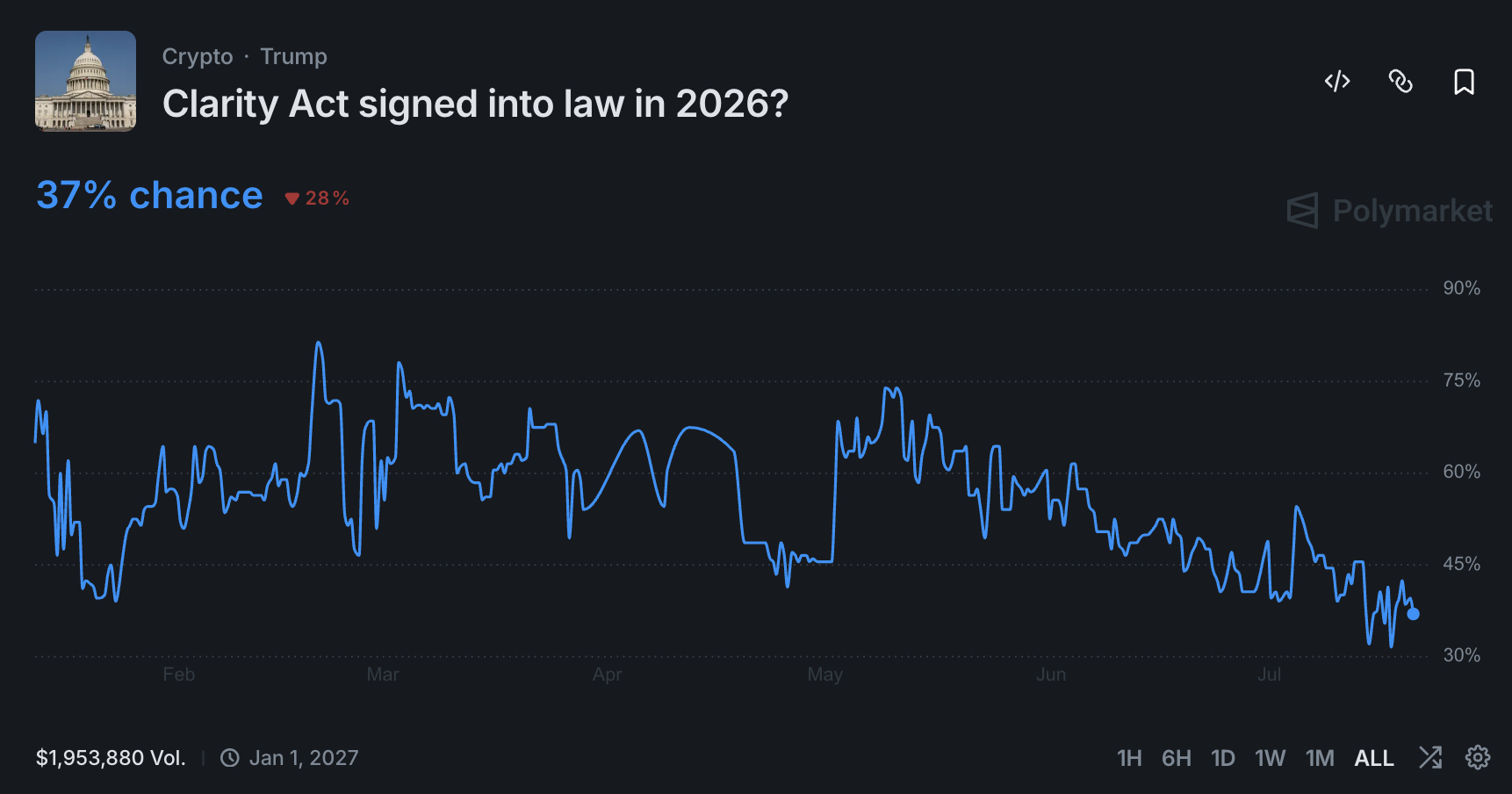
Polymarket traders have cut the odds of the CLARITY Act becoming law in 2026 to 37% today. The prediction market has turned more cautious as Senate negotiations remain deadlocked over ethics provisions tied to President Donald Trump’s crypto business interests. Although the House has passed the bill and the Senate Banking Committee approved it, the legislation has yet to receive a Senate floor vote.
The delay has fueled concerns that the bill could miss its best opportunity before lawmakers leave Washington for the August recess. Every week without progress leaves fewer legislative days on the calendar. As a result, traders have become increasingly skeptical that the legislation can clear the Senate this year.
The biggest obstacle is no longer the bill’s market structure framework. Instead, negotiations have centered on an ethics amendment. Senate Democrats, led by Elizabeth Warren, want enforceable restrictions preventing senior government officials, including the president, from financially benefiting from the digital asset industry they oversee.
Discover: The Best Crypto to Diversify Your Portfolio
CLARITY Act Stalls as Ethics Dispute Deepens
Republicans have resisted language aimed specifically at the president’s crypto interests. They argue such provisions could undermine bipartisan support for the broader legislation. Without a compromise, Democrats have shown little willingness to provide the votes Republicans need to advance the bill.
The debate intensified after Trump’s latest annual financial disclosure revealed roughly $1.4 billion in crypto-related income. The filing included about $594 million connected to World Liberty Financial. It also reported approximately $635 million tied to the TRUMP meme coin venture.
Democrats argue that those financial interests create an obvious conflict if the president signs legislation affecting the same industry. They contend that ethics protections should accompany any market structure reforms. The disclosure has therefore become the central issue in Senate negotiations rather than a secondary political dispute.
The Senate math leaves little room for error. Most legislation requires 60 votes to overcome a filibuster, meaning Republicans cannot pass the CLARITY Act on their own. They must secure support from several Democrats to move the bill forward.
Several Democrats who previously appeared open to supporting the legislation now insist on enforceable ethics safeguards before committing their votes. Until bipartisan negotiators bridge that gap, the bill is expected to remain in procedural limbo despite continued backing from much of the crypto industry.
Discover: The Best Token Presales
Senate Calendar Leaves Little Room for Delay
Time has also become a growing concern. Senate leaders have only a limited number of legislative days before the August recess. Appropriations bills, nominations, and other priorities continue competing for valuable floor time.
If the CLARITY Act misses that window, its path could become even more difficult later this year. Congress will soon shift its focus toward government funding deadlines and other legislative priorities. Supporters acknowledge that every delay increases the political challenge.
For now, Polymarket traders appear to be pricing in uncertainty rather than outright failure. The odds could improve if lawmakers reach a bipartisan agreement on ethics language or if Senate leaders schedule a floor vote. Until then, the CLARITY Act remains stalled, and its path to becoming law remains uncertain.
Trade Ethereum on Bybit and Get a Chance to Win Our $1,000 USDT Airdrop
The post Senate Ethics Deadlock Drags CLARITY Act Odds Under 40% on Polymarket appeared first on Cryptonews.

President Bola Ahmed Tinubu of Nigeria has moved to address what his office called the fragmentation of digital asset regulation.
The Nigerian president’s special adviser Bayo Onanuga said that an executive order signed on Friday would “harmonize the regulation of virtual assets, strengthen cooperation among the nation’s financial, revenue and capital markets agencies, protect citizens from fraud, and safeguard the integrity of the financial system while enabling responsible innovation.”
It also established a virtual asset council headed by some of the nation’s top financial regulators to direct related policies, and Nigeria’s tax authority will update its policies on digital assets.
“[T]he order does not create a new regulator or transfer powers between agencies,” said Onanuga. “Each institution retains its full statutory mandate and independence, and the framework coordinates their work rather than replacing it. To provide certainty for operators and protection for the public, registration will follow the nature of the activity and the asset involved […] This closes the gaps through which unregistered operators have previously escaped oversight.“
Nigeria has seen some of the strongest growth in digital asset adoption in Africa, in both cryptocurrencies and stablecoins. According to a June report from the International Monetary Fund (IMF), the country accounted for about 60% of stablecoin inflows within sub-Saharan Africa since 2019 and had about $59 billion in crypto inflows between July 2023 and June 2024.

Source: IMF
Related: Blockchain.com expands into Ghana after 700% trading surge in Nigeria
“The policy challenge is to narrow the gap that made the workaround [in cross-border payments] attractive, while ensuring that new risks remain contained,” said the IMF on Nigeria’s stablecoin adoption. “That requires a clear strategy: open to innovation but anchored in sound macroeconomic policy and effective regulation.”
Nigerian tax authority revamped digital assets approach
While the executive order said that the country’s tax authority, the Nigerian Revenue Service, would provide additional details on the effects on taxpayers, the agency had already announced policy reforms.
In January, authorities said that under the Nigeria Tax Administration Act, crypto service providers were required to link transactions to tax identification numbers and, in some cases, national identification numbers.
Magazine: The British Virgin Islands are a top crypto hub no one ever talks about: Here’s why

Financial Audit Stolen VALOR

Channel 5 The Crow Girl cast list as Welsh actors Eve Myles and Charles Dale star
JetBlue wins auction for Spirit’s LaGuardia flight slots


-
 NewsBeat4 days ago
London Mayor Sadiq Khan handed a peerage by Keir Starmer alongside 15 other Labour figures… just days before the PM leaves No10
-

 Fashion3 days ago
Weekend Open Thread – Corporette.com
-

 Politics2 days ago
The House | The City of London can help the new chancellor deliver growth in every postcode
-

 Politics5 days ago
Young campaigners urge incoming PM to act on outdoor junk food ads
-

 Crypto World5 days ago
CFTC blocks Kalshi from unwinding Michigan trades after court order
-
 Crypto World3 days ago
Two July Windows Left: The CLARITY Act’s Senate Fight and What Failure Means
-

 Crypto World2 days ago
Ripple Payments Joins MiCA With 14 Firms, Does It Mean Anything For XRP?
-

 Business5 days ago
Nvidia Stock Slips After Big Tuesday Rally as Huang Confirms Vera Rubin Chip Is Now in Production Today
-

 Politics1 day ago
Democrats look to World Cup watch parties to register thousands of voters
-
 Entertainment5 days ago
Disney’s Most Ambitious Failed Star Wars Attraction Is Coming to SDCC
-

 Crypto World3 days ago
Ripple wins EU-wide access as ESMA adds it to MiCA register
-

 Business5 days ago
Palantir Shares Rise After Expanded Nvidia Partnership and Fresh Analyst Upgrades Ahead of Earnings Day
-

 Crypto World4 days ago
Injective Submits SEC Transfer-Agent Registration to Onchain Ownership Records
-

 NewsBeat3 days ago
Registration is now open for March for Men with Kev 2026
-

 Tech7 days ago
Get Your ESP32 Sunny Side Up With This Solar Dev Board
-

 News Videos6 days ago
XRP BOMBSHELL… XRP OMBOARDED FOR TRANSACTIONS!!!
-

 Tech6 days ago
Dark Secrets Emerge When Jailbreaking LLMs
-

 NewsBeat9 hours ago
Unregistered fitter used Gas Safe logo on business flyers
-
 Sports5 days ago
New Cornerback Enters Vikings Trade Rumor Mill
-

 News Videos4 days ago
Money | Class 12 Economics | CBSE Board Exam 2026-27
You must be logged in to post a comment Login