

Crypto World
Wintermute: Long-Term Funds Are Buying BTC in OTC Tranches Amid ETF Outflows


TLDR:
- Wintermute confirms long-term funds are buying BTC in OTC tranches with an 18-month price outlook.
- BTC and ETH ETFs shed nearly $2B in combined outflows over ten days, the longest streak since launch.
- Wintermute places key BTC downside support between $60,000 and $65,000 amid summer weakness.
- Crypto missed two straight weeks of the equity rally as AI earnings drove rotation into Nasdaq stocks.
Crypto market maker Wintermute reports that long-term funds have begun accumulating Bitcoin through OTC desks in tranches, even as spot prices sit near $72,000.
The firm’s June 1 market update says these buyers see current levels as attractive on an 18-month horizon. The move comes as BTC and ETH ETFs recorded nearly $2 billion in combined outflows over ten days, marking the longest redemption streak since their launch.
BTC OTC Desks Record Quiet Accumulation From Long-Duration Holders
BTC OTC activity is picking up from longer-term oriented funds, Wintermute confirmed in its weekly update. The firm stated that it is “seeing longer-term holders start to TWAP into the market through the OTC desk, with no appetite to call the exact bottom but a view that these levels look attractive on an 18-month basis.”
The move comes in tranches rather than single large orders, a method that avoids moving spot price.
Wintermute placed key downside support between $60,000 and $65,000. That range represents the floor longer-term holders appear to be referencing when sizing their positions.
The firm described the setup as “relatively weak into the summer months” but noted the underlying cycle looks more like a reset than a structural breakdown.
The OTC accumulation stands in contrast to what is happening in the ETF market. BTC spot ETFs recorded approximately $1.4 billion in outflows during the most recent week, extending the longest redemption streak since their launch.
ETH ETFs shed around $240 million over the same period. Between May 20 and May 29, combined BTC and ETH ETF outflows reached nearly $2 billion.
Strategy, the largest corporate Bitcoin holder, began selling during this window as well. That development added to bearish sentiment across crypto-native circles.
Wintermute noted that “the bid that carried BTC from $70k to $80k in April is gone,” with the marginal dollar now sitting in Nvidia, Dell, and small-cap equities instead.
Crypto Sits Out the Equity Rally as Macro Pressure Persists
Wintermute noted that crypto has now missed two consecutive weeks of the broader risk-asset rally. The firm said “the risk-on rotation went into Nasdaq and the Russell 2k” while crypto, described as “the most risk-sensitive cross-asset class, got skipped.” The S&P 500 logged its ninth straight green week, gaining 1.9%, while the Nasdaq rose 8% on the month.
The macro backdrop explains part of the divergence. April PCE printed at 3.8% headline, with core rising to 3.3%. The bond market is pricing a 35–40% probability of a rate hike before year-end.
Wintermute flagged that “it’s not unthinkable to see stagflation and double dip inflation pop up again in Q3,” particularly with AI-driven demand keeping the broader economy hot.
Equities are climbing through that backdrop on the strength of an AI earnings story. Wintermute observed that “equities aren’t rallying because the macro improved — they’re rallying because AI earnings keep printing and the market is choosing to look through everything else.” Crypto has no equivalent narrative, leaving it fully exposed to the same headwinds the equity market is bypassing.
Near-term catalysts include Wednesday’s CPI and PPI data and the Monday launch of CME Nasdaq crypto index futures.
Wintermute identified ETF flows as the key metric to watch, noting that “sustained inflows marked the institutional return in April” and that their continued absence is “what’s keeping spot heavy.”


Crypto World
Bitcoin’s compute power dwarfs top 100 supercomputers by 600k times, says Bittensor co-founder


The infrastructure supporting global computing is undergoing a massive shift. True computing power no longer belongs to isolated corporate data centers, but to open, global networks.
Speaking at the Proof of Talk summit in Paris, Bittensor co-founder and Crucible Labs partner Ala Shaabana highlighted the staggering math behind decentralized networks. To show the audience what distributed computing can do, he stacked the Bitcoin network up against traditional enterprise setups.
“We all know that Bitcoin really dwarfs the top 100 supercomputers,” Shaabana said. “Does anybody know, in comparison, what the hash rate is? It’s over 600,000 times the power of really what these supercomputers can do. And that’s just, really, it’s Bitcoin.”
To understand Shaabana’s comment, it helps to know what Bittensor actually is.
It is a Layer 1 protocol built on the same codebase philosophy as Bitcoin: a hard cap of 21 million tokens, halvings hardcoded into predetermined blocks, with no pre-mine, and no venture capital. Bittensor is a decentralized network that replaces Bitcoin’s hash-puzzle mining with running and validating artificial intelligence.
The same incentive architecture that turned Bitcoin into a computing force 600,000 times more powerful than the world’s top supercomputers is redirected by Bittensor toward AI, organized across 128 specialized problem-solving networks called subnets. Each subnet defines its own goal, and miners compete for TAO token rewards by meeting it, meaning the network’s intelligence is shaped entirely by what it chooses to reward. That design principle, borrowed directly from Bitcoin’s playbook, is the foundation of everything Shaabana argues below.
Shift in long-term bull case
Shaabana’s core logic is simple: if coordination and code could create the world’s most powerful financial computing engine, the exact same blueprint can be applied to AI. By breaking a network down into 128 individual problem-solving neighborhoods or subnets, developers can source global hardware and intelligence without a central tech monopoly.
The trick to making a distributed system work relies entirely on the incentive design. “Show me the subnet, and I’ll tell you what the miners are optimizing for,” Shaabens said, adapting a famous market quote. If you reward participants for raw compute speed, they optimize for speed. If you reward them for data storage, they optimize for storage.
By setting these programmatic goals, open networks naturally attract talent and computing power far more efficiently than standard corporations.
“The long-term bull case is no longer primarily technological,” Shaabana concluded. “It is driven by debt, liquidity, and declining trust in traditional sovereign systems. Subnets really create markets. Intelligence really is no longer locked behind issues of organization; signals will define the truth, and performance is really rewarded.”
Crypto World
Hyperliquid’s (HYPE) Social Dominance Hits 2026 High as Bulls Target Triple-Digit Prices

Hyperliquid’s native token, HYPE, recently climbed to a record high above $73, as growing trader interest and optimism continued to build around the project.
According to Santiment, social activity and positive sentiment surrounding the token have surged across X, Reddit, Telegram, and other crypto communities.
Soaring Social Interest
The analytics platform reported that HYPE’s social dominance has climbed to its highest level of 2026. Santiment found that positive commentary has risen alongside the token’s price, amidst growing confidence among traders as Hyperliquid continues to stand out as one of the market’s strongest-performing projects.
Several developments have contributed to the momentum, including growing perpetual futures trading volume, the continued expansion of Hyperliquid’s decentralized trading infrastructure, and increasing recognition of the platform as a credible competitor to centralized derivatives exchanges.
Other recent initiatives, such as the launch of new trading products, rising protocol revenues, and speculation about future ecosystem growth, were also some of the factors supporting investor confidence. As these developments have attracted attention, discussions surrounding HYPE have accelerated, making it one of the most widely discussed crypto assets.
From a technical perspective, crypto analyst Ali Martinez believes HYPE’s rally may still have room to run. He noted that previous sell signals have been invalidated and identified $97 and $163 as potential upside targets if the token’s momentum continues.
Wall Street Takes Notice
A similarly bullish view was recently shared by Bitwise Chief Investment Officer Matt Hougan, who described Hyperliquid as one of the most important crypto projects to emerge in recent years. The exec asserted that the platform has evolved into a financial “super-app” offering access to multiple asset classes beyond crypto.
He also said Hyperliquid represents a new generation of crypto tokens designed to accrue value from the outset, citing its buyback-driven model. Based on these factors, Hougan further argued that HYPE remains significantly undervalued despite its strong performance.
Investor appetite for HYPE is also evident in the ETF market. After 21Shares launched the first US spot Hyperliquid ETF under the THYP ticker, Bitwise followed with BHYP. The two funds have attracted more than $57 million and nearly $80 million in inflows since their respective debuts, according to SoSoValue.
The post Hyperliquid’s (HYPE) Social Dominance Hits 2026 High as Bulls Target Triple-Digit Prices appeared first on CryptoPotato.
Ripple’s native cross-border token has not been spared by the overall market-wide calamity that has only worsened today, with a fresh nosedive to a multi-month low.
What’s particularly interesting about XRP’s crash toward $1.20 is that it comes on the token’s 14th birthday.

The last time the popular altcoin traded at such low levels was briefly during the early February crash when it tanked to just over $1.10. Aside from that quick leg down, it hasn’t been below $1.30 since before the US presidential elections in 2024.
However, this crash now comes after several consecutive breakout rejections at prices between $1.50 and $1.60. The latest such unsuccessful attempt came in mid-May, when XRP soared to $1.55 only to be halted and driven south hard.
Today’s price drop to $1.20 registered minutes ago has left around $30 million in liquidations from leveraged traders. It has also wiped out billions from XRP’s market cap, which has helped USDC surpass it on CoinGecko as the fifth-largest cryptocurrency by that metric.
XRP’s market cap stands below $75 billion as of press time, down from over $85 billion just several days ago.
Interestingly, today marks the asset’s 14th birthday, which makes the crash even more painful. On this date in 2012, Ripple co-founder Arthur Britto released lines of code that created 100 billion XRP tokens. He began working together with David Schwartz and Jed McCaleb in 2011.
Ali Martinez weighed in on the asset’s recent price performance and predicted that it could continue its path south to somewhere around $1.14 after it broke down from a rising trend-line symmetrical triangle.
The post XRP’s Birthday Turns Sour as Ripple Price Plummets to 4-Month Low appeared first on CryptoPotato.
Crypto World
UK House of Lords committee calls on Bank of England to reconsider proposed stablecoin restrictions


A U.K. House of Lords committee said the Bank of England (BOE) should reconsider its proposed limits on consumer stablecoin holdings in a new report.
The cross-party Financial Services Regulation Committee of the U.K. Parliament’s second chamber also advised reconsideration of requirements for stablecoin issuers to hold at least 40% of backing assets in central bank deposits yielding no interest in its “Stablecoins: waiting for regulation” report published Wednesday.
Stablecoins are digital tokens pegged to the value of a traditional financial asset, such as a fiat currency like the U.S. dollar or the pound sterling.
As central banks and lawmakers have constructed regulatory frameworks for the use and issuance of stablecoins in recent years, the Bank of England has stood out for proposing what many industry figures deemed unnecessarily stern restrictions.
The U.K.’s central bank proposed limits of 20,000 pounds ($27,000) per coin for individuals and 10 million pounds ($13.5 million) for businesses, which some observers said risked making the country uncompetitive compared to neighboring markets which would have no such limitations.
“Given the early stage of the GBP stablecoin market, rather than pre-emptively impose holding limits, the Bank should consider monitoring the growth of the market and imposing holding limits only if the financial stability risks clearly warrant it,” the House of Lords committee said.
The report questioned the rules on backing assets, saying they “could have a significant impact on the business viability of stablecoin issuers in the U.K.”
For its part, the BOE is planning to ease the proposed restrictions, with Sarah Breeden, deputy governor for financial stability, admitting they were “overly conservative,” last month.
The BOE is “looking very hard at whether there are different ways we can manage what we think is an important risk as stablecoins come into play,” Breeden said in an interview with the Financial Times.
Crypto World
Franklin Templeton Wires BENJI Money-Market Fund Into MoonPay Trade for Onchain Stablecoin Swaps


Franklin Templeton plugged its BENJI tokenized money-market fund into MoonPay Trade on Tuesday, opening an onchain path for institutional users to swap supported stablecoins directly into shares of the asset manager's US government money fund and back without leaving the blockchain. The… Read the full story at The Defiant
Key takeaways:
- Bitcoin’s sharp 8% drop triggered $1.5 billion in forced liquidations, ending a tight two-month small-cap correlation.
- Worsening market sentiment was driven by $2.1 billion in Bitcoin ETF outflows and rising fears of a Federal Reserve interest rate hike.
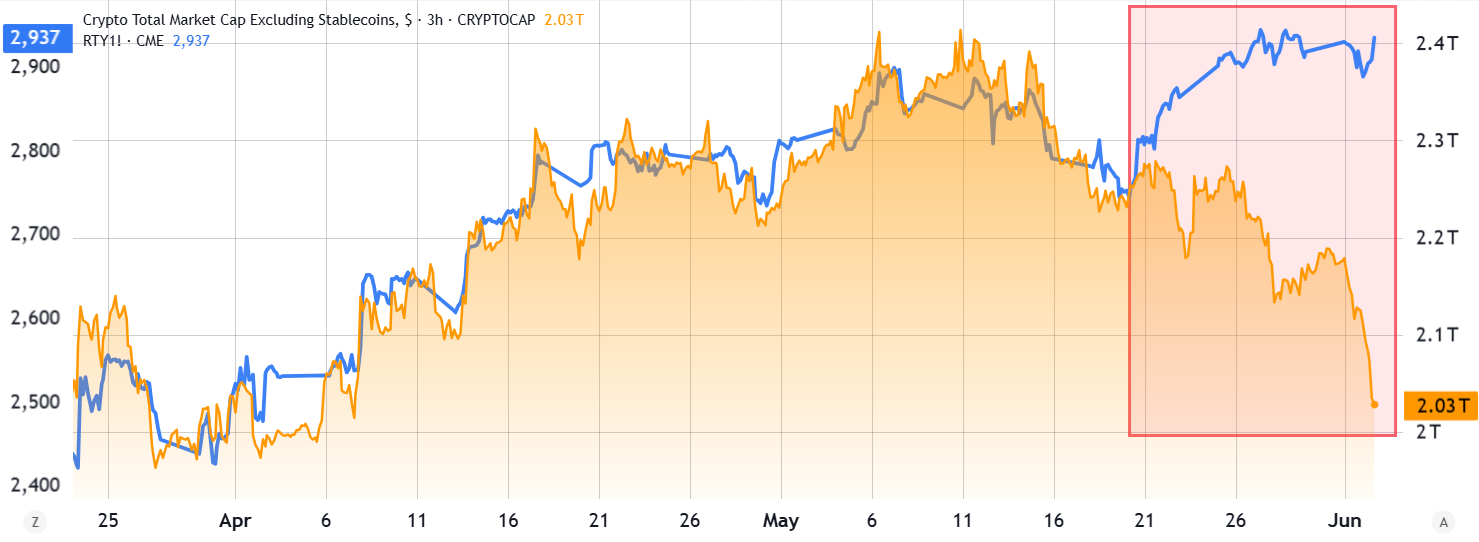
Bitcoin (BTC) faced a sharp 9% drop over 48 hours, hitting the $67,000 support for the first time in two months. This correction wiped out a substantial $176 billion from the total crypto market cap in just two days, triggering $1.5 billion in forced liquidations for overleveraged long positions.
Traders remain uncertain about the drivers behind crypto’s underperformance, especially since US equities have shown notable strength.
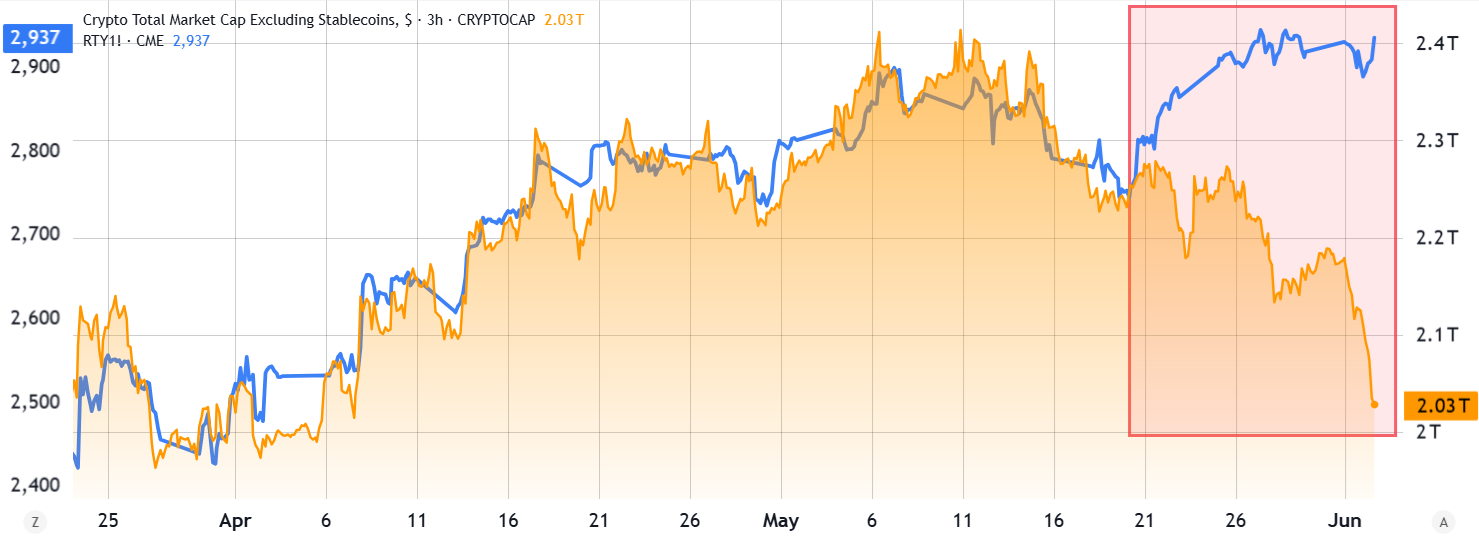
US Russell 2000 small cap equities index (left) vs. Bitcoin/USD. Source: TradingView
The tight correlation between Bitcoin and US small-cap stocks officially broke on May 21 after a solid two-month run. Worsening market sentiment was likely fueled by $2.1 billion in net outflows from US-listed spot Bitcoin ETFs between May 12 and May 20, though derivatives data had already been hinting at a lack of institutional appetite.
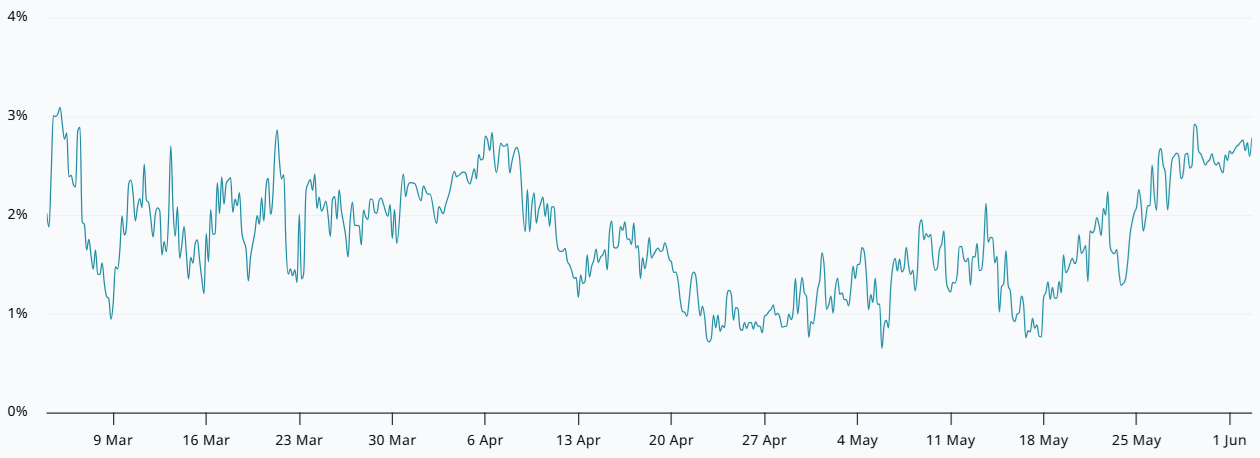
Bitcoin 2-month futures basis rate. Source: Laevitas
The annualized BTC futures premium relative to spot markets has held below the neutral 4% threshold for over three months, confirming weak demand for bullish leverage.
Strategy’s Bitcoin accumulation pause and strength in AI investments
Strategy (MSTR US), led by Michael Saylor, also sparked mixed reactions after it chose to buy back convertible debt while pausing its signature weekly Bitcoin purchases.
Source: X/bjunjo
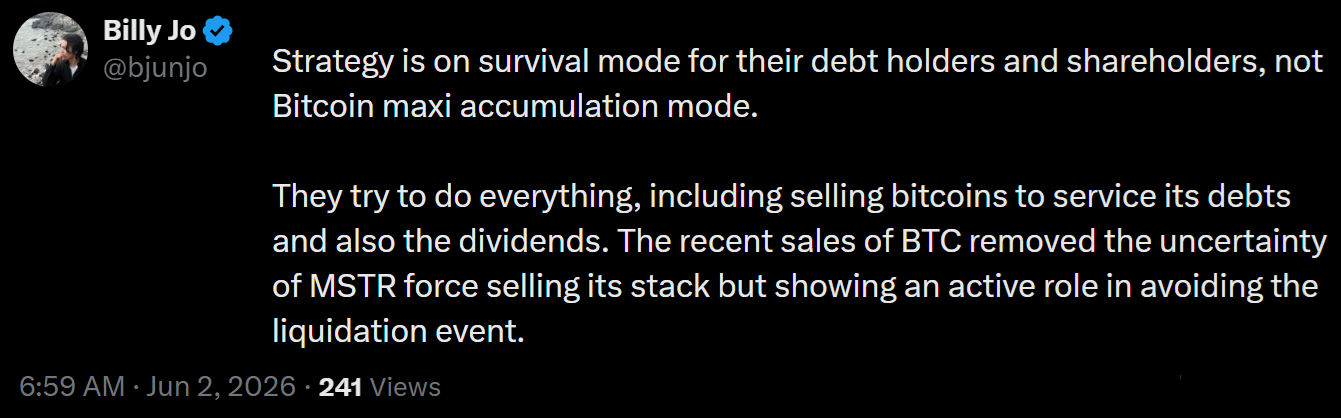
X user ‘bjunjo’ said that Strategy entered “survival mode for their debt holders and shareholders,” putting aside the sole mission to accumulate more Bitcoin. According to the analysis, the company will do whatever it takes to meet its financial obligations, as shown by a recent BTC 32 sale. Jeff Dorman, Chief Investment Officer at Arca, called the move “a complete balance sheet mismanagement.”
Source: X/ScroogeCap
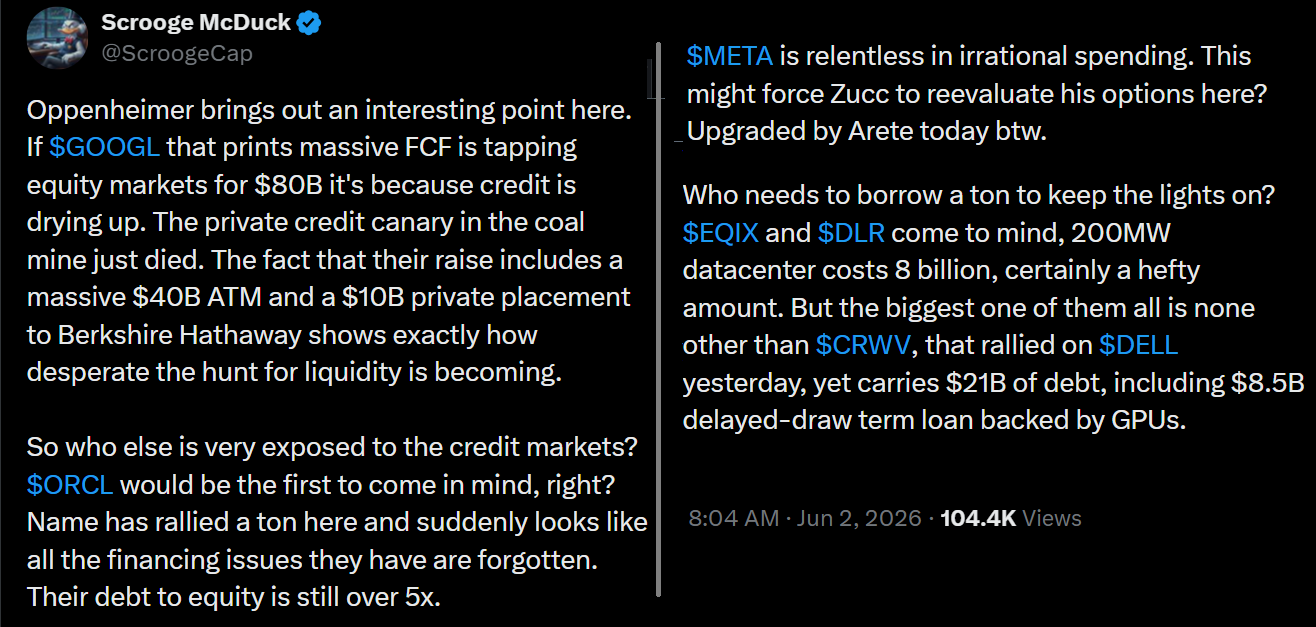
Meanwhile, X analyst ScroogeCap noted that Google’s (GOOG US) decision to raise equity rather than debt suggests that private equity is effectively dead as liquidity dries up. The analysis highlights that the Oracle (ORCL US) debt-to-equity ratio remains unusually high, while Meta (META US) might be forced to tap more capital due to “irrational spending.”
Jim Bianco of Bianco Research reportedly said, “We have not seen the market this concentrated around a single theme in 150 years.” Additionally, JPMorgan research found that 41 AI-related stocks account for half of the S&P 500’s market value.
Related: Bitcoin gets new $50K target after BTC price crashes 6% in a day
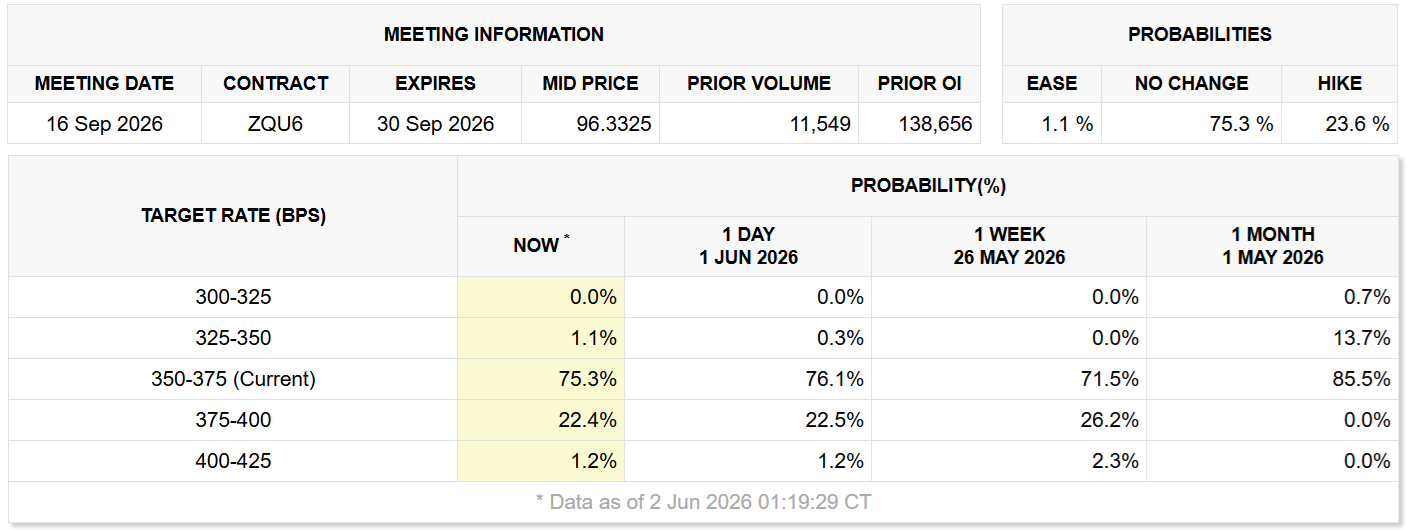
Interest rate target probabilities for the Sept. FOMC meeting. Source: CME Group
Traders became increasingly risk-averse as the war in Iran showed no sign of imminent relief, explaining the broader sell-off across cryptocurrency markets. US government bonds are now pricing in a 23% probability of the US Federal Reserve hiking interest rates by September, up from 0% just one month prior according to the CME FedWatch Tool.
Ultimately, the cryptocurrency market crash on Tuesday reflects heavy outflows from spot Bitcoin ETFs, an extreme capital concentration in AI investments and a macroeconomic environment signaling stricter monetary policy for longer than the market had previously anticipated.

The US Senate has returned from recess with the Digital Asset Clarity Act at the top of the legislative calendar, and the bill’s most consequential provision is not market structure-it is the explicit prohibition on the Federal Reserve issuing a retail Central Bank Digital Currency.
That CBDC block, if enacted, forecloses the only credible government-backed competitor to private stablecoin issuers, handing Circle’s USDC and Tether’s USDT a structural moat that no regulatory guidance memo can replicate.
The GENIUS Act-the stablecoin payments bill signed into law in July 2025-established the licensing framework.
The Clarity Act is the architecture that determines who dominates the payments rails underneath it. These two pieces of legislation are not parallel tracks. They are sequential, and the Senate’s June session is where the second leg either locks in or stalls.
Discover: The Best Crypto to Diversify Your Portfolio
What the Clarity Act Actually Does to the Fed-and Why Senate Timing Is Structural
The transmission mechanism is direct: the Clarity Act prohibits the Federal Reserve from unilaterally issuing a retail CBDC without explicit Congressional authorization, effectively requiring legislative action-not just regulatory rulemaking-before any digital dollar can reach consumers.
That is not a procedural technicality. It is a hard legislative wall that private stablecoin issuers cannot build for themselves but benefit enormously from having in statute.
The bill passed the House of Representatives in July 2025 and cleared two Senate committees before the Memorial Day break-the Agriculture Committee in January and the Banking Committee in May by a 15–9 vote. Senators must now consolidate both versions into a single package, with some in the chamber projecting a floor vote by August.
— CoinlytX (@CoinlytX) June 2, 2026
 The CLARITY Act is closer than ever.
After clearing Senate Banking with a 15-9 vote, the bill now heads to the Senate floor. The clock is ticking—lawmakers have a narrow window before the July 4 recess to get it across the finish line.
A delay could push crypto market… pic.twitter.com/FQTAliNs87
The 2026 midterm campaign window hardens in Q1 next year, which means the practical runway for complex financial legislation is shorter than the calendar suggests. As prior coverage has detailed, stalling the Clarity Act now likely pushes comprehensive crypto regulation to 2030.
White House crypto adviser Patrick Witt set an Independence Day target in May. That window has passed, but the consolidation process beginning this week is the next measurable inflection point.
The Senate needs 60 votes to pass the bill, meaning Republicans must secure at least seven Democratic or independent votes on the floor, making the current negotiation over ethics provisions not a sideshow but the actual determinant of whether this legislation moves.
Why Circle and Tether Win Structurally-and Where the Risk Asymmetry Sits
A statutory CBDC prohibition changes the competitive landscape in a way that market share data alone does not capture. USDT and USDC collectively account for the overwhelming majority of stablecoin trading volume and on-chain liquidity globally.
The existential risk to both-not from regulation but from government-issued displacement-disappears if the Clarity Act passes. The Federal Reserve is removed as a potential competitor by law, not by market dynamics.
The asymmetry between Circle and Tether is worth examining clearly. Circle has pursued MiCA compliance in Europe and operates under a licensed framework that positions USDC as the institutionally acceptable stablecoin for regulated entities.
The market structure implications of the Clarity Act reinforce that positioning: a US legislative framework that explicitly licenses private issuers and blocks the Fed creates a compliance pathway that Circle is already resourced to navigate.
Tether operates at scale-USDT dominates offshore and emerging-market liquidity-but carries more regulatory exposure in jurisdictions demanding audited reserves and formal licensing.
The Clarity Act’s Senate Banking version also retains language allowing yield or rewards on stablecoins used in payments or on-chain activities.
That provision is what JPMorgan CEO Jamie Dimon is objecting to, arguing it allows crypto companies to pay interest on stablecoin balances in a way that competes directly with bank deposits. His opposition is not ideological. It is competitive. That tension is real, and it will surface in floor negotiations.
Stablecoin regulation under the GENIUS Act framework is already moving toward implementation-the US Treasury Department, FDIC, FinCEN, and the Office of Foreign Assets Control closed their public comment period Tuesday.
That rulemaking timeline will shape how the Clarity Act’s provisions translate into operational requirements for issuers. The two frameworks are interlocked.
Discover: The Best Token Presales
The post Senate Returns With Clarity Act: CBDC Blocked, Stablecoins Win appeared first on Cryptonews.
Strive Asset Management (ASST) has acquired 2,500 bitcoin for roughly $185.2 million at an average price of $74,092 per coin, between May 23 and June 1, the company reported in an 8-K filing released Tuesday.
The new purchase was at a lower average price than Strive’s last disclosed acquisition of 1,109 BTC at $76,989 on May 22, suggesting the company bought into the dip that has taken bitcoin from above $74,000 last week to roughly $70,800 by Tuesday morning, per CoinDesk data.
Strive disclosed its quarter-to-date BTC yield at 23.0% and year-to-date yield at 36.7%, metrics that measure growth in bitcoin holdings on a per-share basis after accounting for dilution from new share issuance. The company also reported an amplification ratio of 57.0%, indicating shareholders’ bitcoin exposure grew faster than bitcoin’s underlying price appreciation. The company said it also raised cash reserves to maintain an 18-month dividend reserve.
Strive acquired an additional 2,500 $BTC for ~$185.2M at an average cost of ~$74,092 per bitcoin.
STRIVE SNAPSHOT
Bitcoin holdings: 19,000
QTD BTC Yield: 23.0%
YTD BTC Yield: 36.7%
Amplification ratio: 57.0%Cash was increased to maintain 18-month dividend reserve.$ASST $SATA pic.twitter.com/eTPHmMHBh1
— Matt Cole (@ColeMacro) June 2, 2026
The purchase lifts its total holdings to 19,000 BTC, data shows, and pushes the bitcoin treasury company further into the top 10 of publicly traded corporate holders.
The filing comes as its peer, and the largest corporate bitcoin holder, Strategy (MSTR), disclosed its first publicized sale of 32 bitcoin for $2.5 million at an average price of $77,135 on Monday, sparking a selloff in BTC and the broader crypto market since.
Meanwhile, Benchmark analyst Mark Palmer initiated coverage on Strive with a Buy rating and a $32 price target on Tuesday, implying roughly 93% upside even after the company’s Class A shares fell 3.59% to $16.58 in pre-market trading.

Robinhood Markets has completed its $180 million acquisition of WonderFi, a Toronto-based provider of digital asset products and services. With the deal, Robinhood is entering the Canadian market by acquiring an established operator of regulated crypto exchanges.
As part of the acquisition, WonderFi’s two regulated crypto trading platforms, Bitbuy and Coinsquare, will become part of the Robinhood brand. Canadian customers will be invited to use the Robinhood app, which offers a flat 0.5% fee per CAD trade, along with the company’s user interface, user experience, and global infrastructure.
Major Canadian Crypto Push
In its official press release, Robinhood said it will continue supporting WonderFi’s existing institutional relationships in Canada while building on the institutional business it has developed through Bitstamp. The expansion is part of Robinhood’s broader strategy to build an integrated global financial ecosystem.
Following the acquisition, Robinhood now has more than 1 million international funded customers, including approximately 300,000 funded customers that came through WonderFi. WonderFi employees will join Robinhood’s existing Canadian workforce of more than 240 employees. Robinhood established its Canadian headquarters in Toronto in 2024 as an engineering hub, citing Canada’s strong technology talent pool.
In a statement, Johann Kerbrat, SVP and General Manager of Robinhood Crypto & International, said
“WonderFi has extensive experience operating regulated crypto platforms that serve beginner and advanced crypto users alike, making it an ideal partner to accelerate Robinhood’s mission in Canada. We’re pleased to have closed our acquisition and look forward to delivering innovative, user-centric investing products to Canadian customers.”
The deal comes months after Robinhood reported a sharp decline in crypto trading activity during the first quarter. Crypto transaction revenue fell 47% year-over-year to $134 million, while crypto trading volume dropped 48% to $24 billion. The company also missed analyst expectations for earnings and revenue, even though net income increased 3% to $346 million.
Layer 2 Plans
In February, Robinhood launched the public testnet for Robinhood Chain, an Ethereum Layer 2 network built using Arbitrum technology. The testnet gives developers early access to the network ahead of a planned mainnet launch later this year and allows them to build and test applications using standard Ethereum tools.
According to the company, several infrastructure providers, including Alchemy, Chainlink, LayerZero, and TRM, had already begun integrating with the network.
The post Robinhood Officially Enters Canada After Closing WonderFi Acquisition appeared first on CryptoPotato.
TLDR:
- The CFTC approved the first perpetual futures contract on a US regulated venue on May 29, 2025.
- Perpetual futures use a funding rate mechanism to keep contract prices aligned with the spot market.
- Regulated platforms Kalshi and Polymarket stand to benefit from the CFTC’s new regulatory framework.
- The approval marks a step toward DeFi platforms like Hyperliquid gaining access to US-based users.
The CFTC perpetual futures approval on May 29 marks a turning point for US derivatives markets. For the first time, a perpetual futures contract has received regulatory clearance on a domestic venue.
The move follows crypto’s growing influence on traditional finance, after stablecoins and tokenized assets led the way. It also opens a path for decentralized platforms like Hyperliquid to eventually reach American users.
Crypto Exports Another Innovation to Traditional Finance
The digital assets industry has steadily introduced new financial instruments to mainstream markets. Stablecoins were the first major export, offering dollar-pegged utility across global payment rails.
Tokenized assets followed, bringing real-world value onto blockchain infrastructure. Now, perpetual futures complete a third wave of crypto-native innovation entering regulated finance.
Grayscale noted the progression in a post on X, pointing to the CFTC approval as a continuation of that trend. The firm described it as another step in DeFi platforms reaching US users over time.
This framing places the CFTC decision within a broader structural shift, not just a regulatory footnote. Traditional finance is increasingly drawing from a crypto playbook built over the last decade.
The approval also benefits regulated US platforms operating in prediction and derivatives markets. Kalshi and Polymarket stand to gain from clearer regulatory footing under this framework.
Additionally, the CFTC provided guidance allowing Coinbase Financial Markets to offer access through a Foreign Futures framework. That guidance further broadens the scope of who can participate under US oversight.
The timing of this approval aligns with a more open regulatory environment in Washington. Regulators have shifted toward engagement rather than enforcement in recent months.
As a result, market participants are now better positioned to structure compliant perpetual futures products. That shift creates room for more instruments to move from crypto-native venues into mainstream trading infrastructure.
How Perpetual Futures Work and Why They Matter
Unlike traditional futures, perpetual futures carry no expiration date and require no physical delivery. That structure makes them more flexible for traders seeking continuous exposure to an asset or price index.
They function similarly to total return swaps in traditional finance. The key difference is the funding rate mechanism that keeps contract prices anchored to the spot market.
The funding rate involves periodic payments exchanged between long and short position holders. When the futures price rises above spot, longs pay shorts to discourage further premium.
When it falls below, shorts pay longs to close the discount gap. The larger the price divergence, the bigger the payment in either direction.
This mechanism creates a built-in correction system without requiring contract settlement. It keeps market prices honest while allowing open-ended exposure for participants.
Traders can hold positions indefinitely, adjusting based on funding costs rather than expiry calendars. That flexibility has made perp futures the dominant derivative product across crypto markets globally.
The CFTC’s move now brings that structure into a compliant US framework for the first time. It sets a precedent for how crypto-native instruments can be adapted for regulated domestic venues.
Over time, it may also ease the path for DeFi-native platforms to extend services to US-based users. The approval is a structural development with long-term reach across both crypto and traditional finance markets.

Bitcoin’s compute power dwarfs top 100 supercomputers by 600k times, says Bittensor co-founder

‘Godzilla’ Director’s 2-Part Sci-Fi Saga Officially Debuts on Free Streaming This Month

Hostinger builds Agentic Mail so AI agents can finally run email workflows without waiting on outdated human systems



-

 NewsBeat6 days ago
Israel says it has killed new Hamas military leader in Gaza City airstrikes
-

 Tech7 days ago
NASA taps Blue Origin to deliver lunar rovers for Moon Base initiative
-

 News Videos4 days ago
This is BROKEN! INSANE 5x MONEY CAR WASH WEEK! The NEW GTA Online UPDATE Today! (GTA5 New Update)
-

 News Videos7 days ago
XRP *JUST* SUCCEEDED!!!! CLARITY ACT EXPOSED!!! (SHE EXPOSED IT)
-
 Tech4 days ago
SpaceX just won a second Golden Dome contract. This one is $4.16 billion.
-

 Business7 days ago
Selena Gomez Reportedly Upset Over Benny Blanco’s Comments on Her ‘Terrible’ Diet
-

 Tech5 days ago
Waymo dominates autonomous vehicle registrations as Tesla trails behind
-

 News Videos4 days ago
SHE IS KILLING XRP!!! WATCH URGENT AND ACT FAST
-
 NewsBeat4 days ago
FIRST NIGHT REVIEW: Take That bring the Circus back to life in spectacular sun-soaked style
-

 Business1 day ago
Jade Biosciences, Inc. (JBIO) Discusses Positive Interim Results From JADE101 Phase I Healthy Volunteer Study and Development Plans Transcript
-

 Tech6 days ago
The Samsung pay deal is the moment Korean unions changed register
-

 Tech7 days ago
Millions of AI agents imperiled by critical vulnerability in open source package
-
Crypto World4 days ago
CFTC Has Approved the First Regulated Bitcoin Perpetual Contract in the U.S.
-
Crypto World7 days ago
SpaceX’s $2 Trillion IPO: Why Tech Giants Nvidia (NVDA), Apple (AAPL), and Microsoft (MSFT) May Face Pressure
-
 Entertainment7 days ago
The Most Misunderstood Sci-Fi Horror Movie of the Last 10 Years Just Took Over Netflix
-
 Crypto World4 days ago
Snowflake (SNOW) Stock Rallies on Strong Q1 Results and AI Product Growth
-
 NewsBeat4 days ago
Novak Djokovic v Joao Fonseca LIVE: French Open latest scores and results after Jannik Sinner’s shocking collapse
-
 Entertainment4 days ago
Weak ‘Supergirl’ Box Office Tracking Amid Milly Alcock Backlash
-

 Business3 days ago
Is the Spurs Phenom Already Better Than Prime Diesel?
-

 Business4 days ago
Demand Conditions Improve In Chemicals Sector In April 2026
You must be logged in to post a comment Login