

Crypto World
X to suspend creator revenue for undisclosed AI war videos



Head of Product Nikita Bier announced that X is revising its Creator Revenue Sharing policies to penalize users who post AI-generated videos depicting armed conflict without clear disclosure.
Summary
- X will suspend creators from revenue sharing for 90 days if they post AI-generated war videos without disclosure.
- Repeat violations will lead to permanent removal from the monetization program.
- Enforcement may be triggered through Community Notes or AI-detection signals embedded in content metadata.
Post AI war videos without a label? X will cut your pay
In a post on the platform, Bier said that effective immediately, creators who share AI-generated war-related videos without labeling them as synthetic will be suspended from the revenue-sharing program for 90 days.
Repeat violations will result in permanent removal from monetization eligibility.
The move comes amid heightened global tensions and growing concerns about the use of generative AI tools to create realistic but misleading battlefield footage. Bier said that during times of war, access to authentic information is critical, and that AI technologies now make it “trivial” to produce deceptive content that can distort public understanding.
Under the updated policy, enforcement will be triggered if a post receives a Community Note identifying it as AI-generated, or if metadata and other technical signals indicate the use of generative AI tools. The company said it will continue refining its detection systems and moderation policies to maintain trust on the platform.
The announcement reflects a broader industry struggle to balance open expression with the risks posed by increasingly sophisticated AI media tools. Platforms worldwide have faced pressure from governments and civil society groups to prevent manipulated war footage and deepfakes from spreading during geopolitical crises.
X’s updated monetization rules focus specifically on revenue eligibility rather than account bans, signaling an effort to deter misleading content by targeting financial incentives tied to virality and engagement.


Key highlights:
-
Byreal CLI enables AI agent trading, farming on Solana DEX
-
Copy Farmer auto-replicates top LP strategies with risk preview
-
Agent skills include pool analysis, swaps, CLMM management
Byreal unveiled its first AI agent skillset Tuesday, launching an open-source CLI designed specifically for autonomous economic actors on its Solana-based decentralised exchange.
The move marks one of the earliest attempts to build DeFi infrastructure natively for machine users rather than just human traders.
The CLI, published as an Openclaw skill, allows AI agents to execute swaps, analyse liquidity pools, manage concentrated liquidity positions and replicate top-performing farming strategies — all without human intervention.
Byreal founder Emily Bao framed the release as a structural pivot: “Byreal is now building for agents. We believe agents will become autonomous economic actors.”
Agent-native farming debuts with Copy Farmer
At the core of the launch is Copy Farmer, Byreal’s liquidity replication system that lets agents scan top liquidity providers, evaluate APRs, volatility and range positioning, then automatically mirror those strategies. Users — or agents — can preview positions before capital deployment, addressing a key risk in automated yield farming.
The CLI architecture rests on three principles:
-
Deterministic execution to eliminate AI hallucination risks
-
Constraint-based skills that convert intent into bounded actions
-
Machine-readable documentation parsed directly by models
Additional skills cover pool analysis (APR modelling, risk scoring), swap execution (AMM + RFQ routing), CLMM position management (tick alignment, fee claiming) and token discovery.
This stack extends beyond trading automation into capital formation — a shift Bao called essential for agent economics.
Machine-first protocols challenge DeFi UX norms
Traditional DEXes prioritise human‑facing interfaces: slick UIs, mobile apps and educational content. Byreal flips this model, treating agents as first‑class users requiring identity, wallet control and permissionless execution.
“Crypto uniquely provides all three,” Bao said. “Trading is only half the system — capital formation and yield deployment matter just as much.”
The release coincides with growing AI agent hype in crypto, but Byreal differentiates by embedding structured farming directly into the conversational layer.
Most agent projects focus on high-frequency trading; Byreal targets LP optimisation — historically 60–70% of DeFi TVL but underserved by automation.
Solana’s speed meets agent scale
Solana’s sub‑second finality and parallel execution make it ideal for agent workloads, where latency compounds across thousands of micro‑decisions.
Byreal’s deterministic CLI ensures capital deployment logic stays separate from natural language processing, minimising protocol‑level risks.
The agent‑native thesis rests on volume projections: protocols optimised for machines today capture tomorrow’s routing layer as agent adoption scales.
Early DEXes like Uniswap prioritised human UX; Byreal bets the next era belongs to machine economics.
Industry observers see parallels to high‑frequency trading’s dominance of TradFi liquidity. If agents claim even 10% of DeFi volume, agent‑native infrastructure becomes table stakes.
Byreal’s open‑source CLI lowers barriers for developers building the agent economy.
KuCoin’s recent PoR leadership underscores transparency demands even as innovation accelerates. Byreal’s launch arrives amid Solana’s derivatives surge, where agent‑driven yield could unlock new capital inflows.
For protocols, the challenge shifts from user acquisition to machine onboarding. Byreal positions itself at this inflection: not just a DEX, but agent infrastructure.
Whether machines eclipse humans remains speculative, but the CLI proves crypto can speak their language.


As crypto assets continue to expand from on-chain trading into everyday spending, payment products are becoming a core pillar of exchange ecosystems. Recently, one of the global leading digital asset trading platforms Gate officially launched the all-new Gate Card, introducing a high-cashback structure, a dual-track tier upgrade system, and elevated spending limits to further differentiate its offering in the crypto payments market.
One of the standout features of the new Gate Card is its cashback rate of up to 5%. Users earn rewards in multiple assets, including BTC, ETH, USDT, or GT, after each purchase. With a card fee of 1%, higher-tier users can fully offset costs and generate additional net returns, with monthly rewards capped at up to 250 USDT.
Unlike traditional payment cards that focus solely on convenience, this design transforms spending into a sustainable reward mechanism, making “spend-to-earn” a tangible reality.
The card’s tier system has also been upgraded with a dual-track progression model. Users can level up either by meeting spending thresholds or by qualifying through their VIP status, without the need to satisfy multiple overlapping conditions. Tier assessments are automated and take effect in the following month, offering a transparent and predictable growth path.
This structure effectively links trading activity with consumption behavior, enhancing retention among higher-tier users while providing a clear upgrade route for entry- and mid-level users.
In terms of benefits, Gate Card adopts a T0–T4 tiered framework, with each level corresponding to different cashback rates and monthly caps. Top-tier users can enjoy up to 5% cashback with a monthly limit of 250 USDT. The progressively increasing benefits strengthen long-term engagement and encourage users to continuously expand activity and asset holdings.
High spending limits further underscore the product’s focus on premium use cases. Gate Card supports single-transaction and daily limits of up to $500,000 and a monthly cap of $1,500,000, with no annual limits for VIP10-VIP14, making it suitable for cross-border payments, large purchases, and capital management. These elevated limits significantly enhance the card’s appeal to high-net-worth users and improve the real-world utility of crypto assets.
In addition, the global coverage has further expanded its application scenarios. Gate Card can be used in over 100 countries and regions, covering approximately 130 million merchants worldwide that accept Visa. It supports both online and offline payments as well as ATM withdrawals. Users can choose between virtual and physical cards, with additional support for Google Pay, enabling seamless mobile and multi-scenario payments.
Overall, the new Gate Card builds a closed-loop growth model centered on trading, spending, and tier progression. Higher tiers unlock greater rewards, which in turn stimulate increased spending and trading activity, reinforcing user engagement and asset retention.
As the crypto industry moves toward broader adoption and real-world integration, payment tools are emerging as a vital bridge between on-chain assets and the global economy. Through its combination of high cashback, generous limits, and structured growth incentives, Gate Card offers a compelling blueprint for crypto payments with stronger yield potential and ecosystem synergy.
Looking ahead, Gate plans to further integrate crypto payments into its broader platform ecosystem, expand global use cases, and accelerate the large-scale adoption of digital assets in everyday life, helping shape a more sustainable growth model for the industry.
About Gate
Gate, founded in 2013 by Dr. Han, is one of the world’s earliest cryptocurrency exchanges. The platform serves over 50 million users with 4,400+ digital assets and pioneered the industry’s first 100% proof-of-reserves. Beyond core trading services, Gate’s ecosystem includes Gate Wallet, Gate Ventures, and other innovative solutions.
For more information, please visit: Website | X | Telegram | LinkedIn| Instagram | YouTube
Disclaimer: This content does not constitute an offer, solicitation, or recommendation. You should always seek independent professional advice before making investment decisions. Note that Gate may restrict or prohibit certain services in specific jurisdictions. For more information, please read the User Agreement via https://www.gate.com/user-agreement.
Crypto World
Coinbase leads crypto stocks higher after Trump signals support for digital asset market structure bill

Shares of Coinbase and other cryptocurrency companies surged Wednesday after President Donald Trump threw his weight behind the industry’s battle against U.S. banks over yield-bearing stablecoins — adding to momentum the firms were already feeling from bitcoin‘s bounce.
Coinbase was last up more than 12%. Other digital asset firms such as Strategy and Circle jumped 9% and nearly 6%, respectively. Meanwhile, shares of JPMorgan Chase and Bank of America fell less than 1%.
“The Genius Act is being threatened and undermined by the Banks, and that is unacceptable,” Trump said late Tuesday in his social media post. “They need to make a good deal with the Crypto Industry because that’s what’s in best interest of the American People.”
Greenlighting firms to issue dollar-pegged digital tokens that offer interest-like returns has been a sticking point of the Clarity Act, a market structure bill for the crypto industry, in the U.S. Congress.
Crypto companies also got a boost as cryptocurrencies staged a comeback. Bitcoin and ether advanced 5% and 6% on Wednesday, respectively.
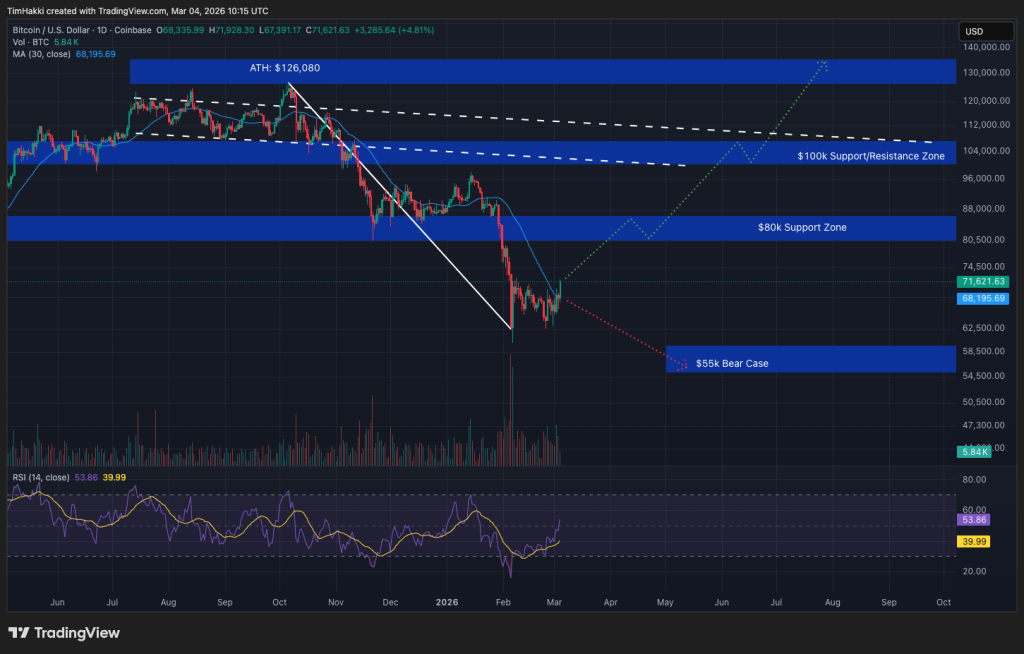
Why is crypto up today? Crypto progenitor Bitcoin (BTC) just staged a massive V-shaped recovery, reclaiming $71,000 hours after global headlines screamed war.
The weekend dip to $63,000, triggered by intensifying conflict involving Israel, the U.S., and Iran, looked like the start of a risk-off collapse.
It wasn’t. Instead, the market absorbed the shock, flushed the leverage, and kept buying. While traditional markets panicked over blocked supply lines in the Strait of Hormuz, crypto participants saw a discount. That matters. It signals a shift in market resilience that bears did not account for.
Discover: Crypto’s best pre-launch token sales.
Bitcoin Price Action: Institutional Resilience Meets Geopolitical Risk
The drop was sharp, but the recovery was cleaner. When news of the escalation broke, leverage got flushed immediately.
On-chain analysis indicates supply exhaustion from sellers at the $63,000 mark. Exchange flows remained neutral to negative, suggesting coins were moving to cold storage rather than flooding order books. Regional data supports this. Iranian exchange outflows suggest local capital flight seeking safety in digital assets, while global desks treated the geopolitical risk as a liquidity event to fill bids.
Tagus Capital noted in a recent newsletter that Bitcoin is exhibiting “defensive characteristics” despite its high-beta reputation. Where gold retreated after a brief spike, Bitcoin stabilized and reversed. The smart money absorbed the selling pressure. No capitulation.
Bitcoin Price Prediction: $71,000 Reclaimed, Is $75,000 Next?
The chart is painting a clear invalidation of the bear case. Reclaiming $71,000 changes the market structure entirely. The $65,700 level has now flipped from previous resistance to a fortress of support. The V-shape recovery confirms demand at lower levels was stronger than the panic.
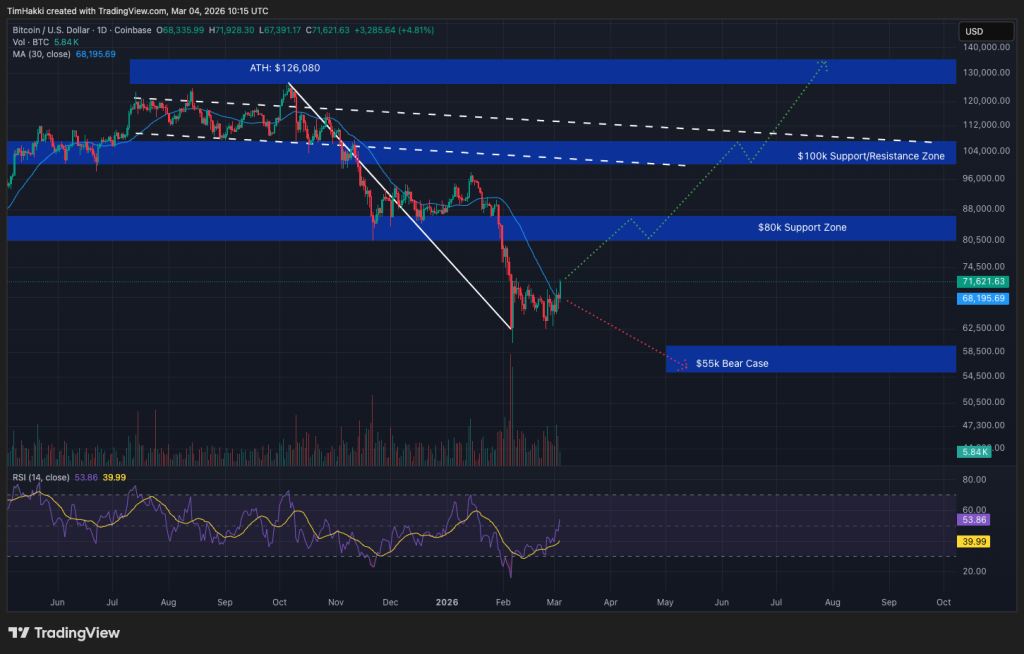
If Bitcoin holds above $70,500, the path to $74,000 opens up quickly. Clear that cleanly, and $75,000 is the next logical target. However, if the price loses $69,000, we likely re-test the weekend lows.
The current setup aligns with the VanEck macro bottom thesis, suggesting the $60,000-$63,000 zone was the final shakeout before the next leg up. Momentum indicators on the 4-hour chart have reset, giving bulls room to run.
Discover: The hottest new crypto around.
Market Resilience: Why Crypto Outperformed Gold and Oil
Traditional safe havens reacted predictably to the conflict. Oil jumped 7% on supply fears. Gold added 2%. Yet, Bitcoin’s 12% bounce from the $63,000 lows outpaced them both. This decouples Bitcoin from the “risk-on only” narrative.
While altcoins like Cardano and Dogecoin are lagging behind Bitcoin, the broader crypto price prediction landscape is turning bullish.
Billionaire Ray Dalio recently dismissed Bitcoin’s safe-haven status, yet the market ignored him. Bitcoin gained despite the war escalating. Institutional desks used the weekend gap, when traditional equity markets were closed, to bid on the asset that never sleeps.
The post Why is Crypto Up? Bitcoin Reclaims $71,000 as Market Shrugs Off Middle East Escalation appeared first on Cryptonews.


When airstrikes hit Iran on Feb. 28, crypto outflows from Nobitex spiked 873%, suggesting a “digital bank run” was ongoing. The reality may be more complex.
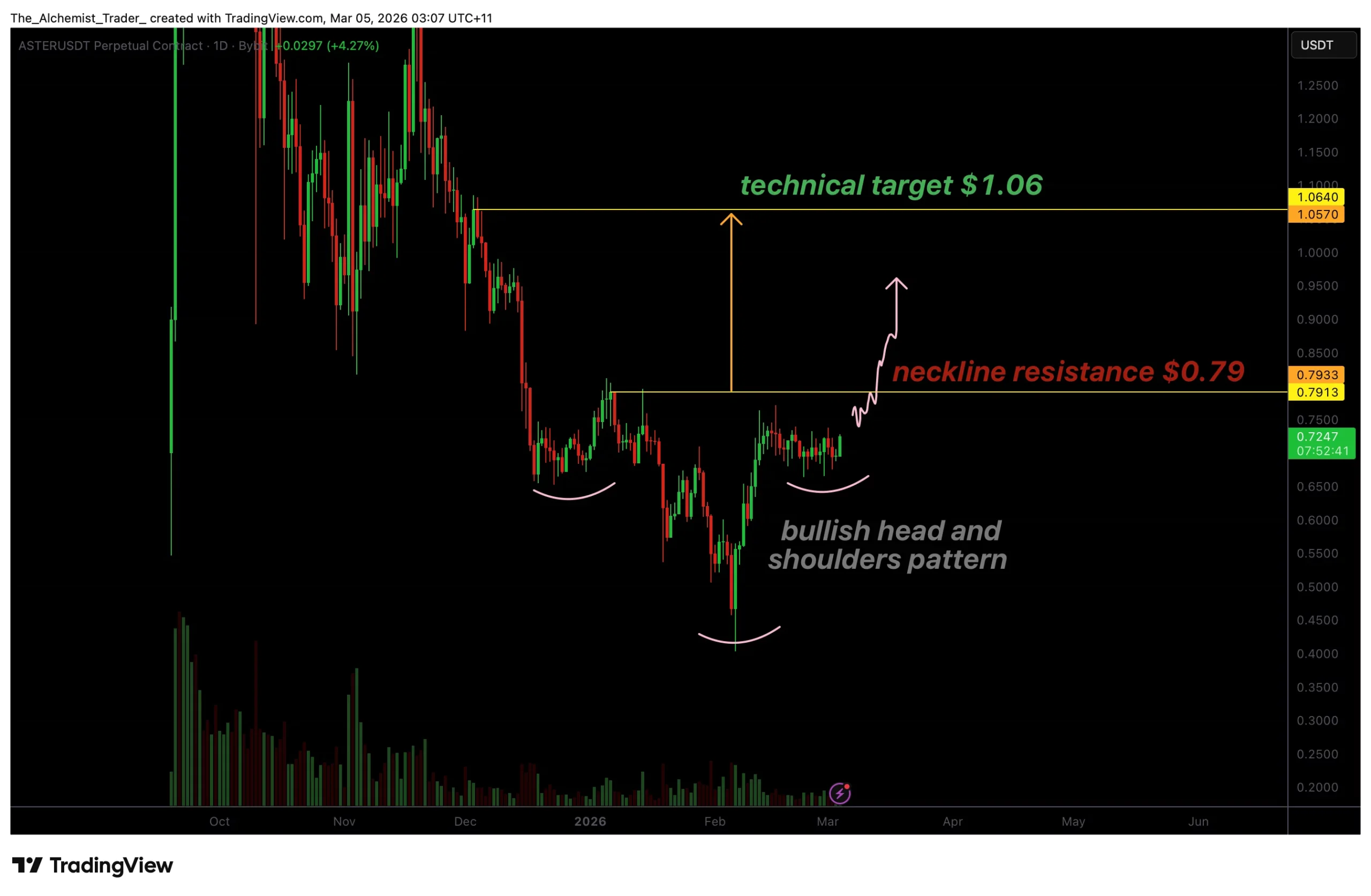
Aster price is forming a potential inverse head and shoulders pattern, signaling a possible trend reversal. A confirmed breakout above $0.79 could trigger a bullish rally toward the $1.06 resistance target.
Summary
- Inverse head and shoulders pattern forming
- $0.79 neckline key breakout level
- Breakout target projected near $1.06
Aster’s (ASTER) recent price action is beginning to show early signs of a structural reversal as a classic technical pattern emerges on the chart. After a prolonged corrective phase, the formation of an inverse head and shoulders pattern suggests that bullish momentum may be building beneath key resistance.
Aster price key technical points
- Bullish Reversal Pattern: Inverse head and shoulders formation developing
- Neckline Resistance: $0.79 acts as the key breakout level
- Technical Target: Breakout projects a move toward $1.06 resistance
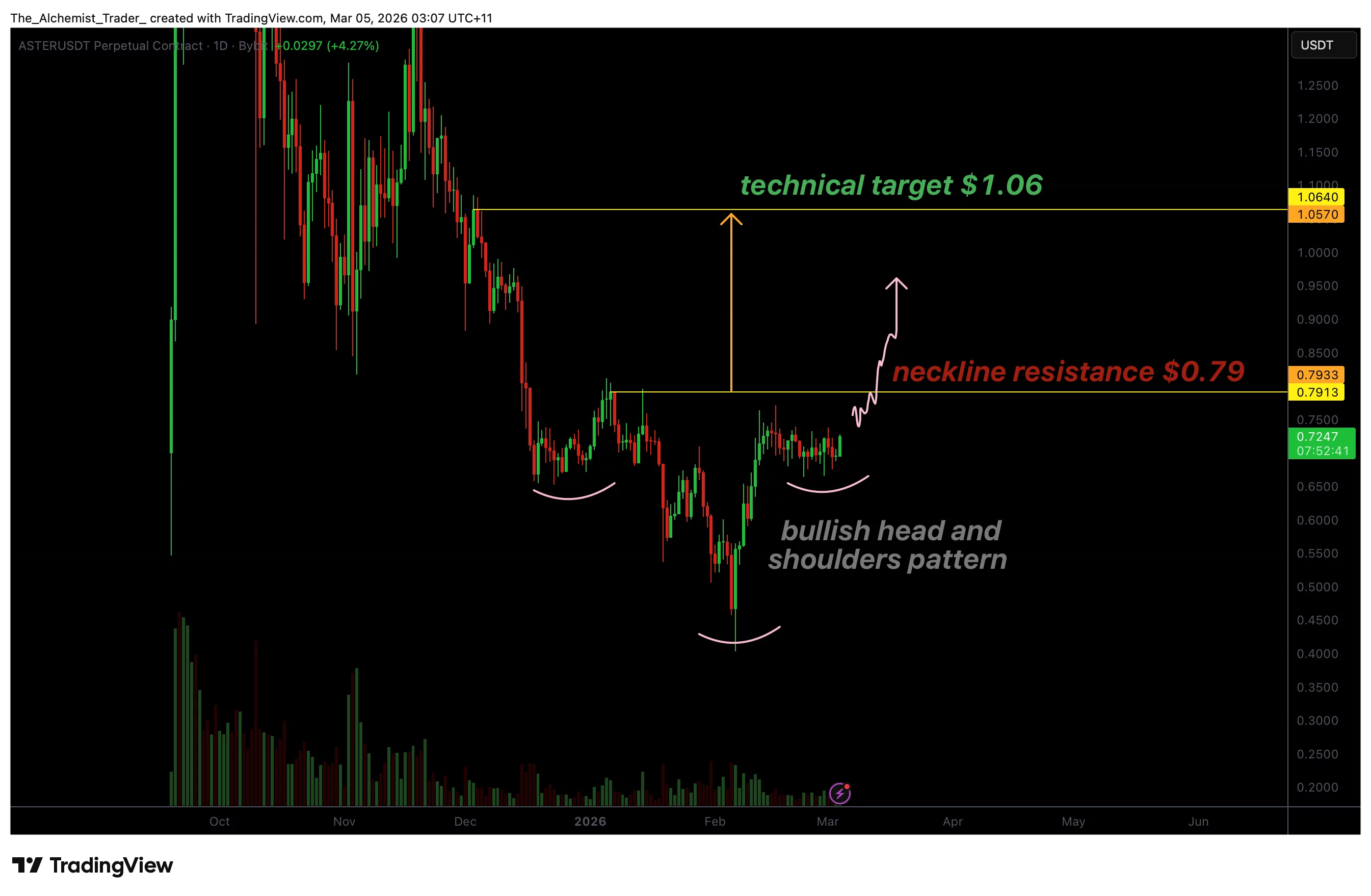
Aster’s current price structure closely resembles a classic inverse head and shoulders pattern, one of the most widely recognized bullish reversal formations in technical analysis. The chart shows a clear left shoulder, followed by a deeper head, and a developing right shoulder, indicating that selling pressure may gradually be weakening.
The defining feature of this formation is the neckline resistance, which in this case sits near the $0.79 level. Historically, this region has acted as a strong barrier for price action. Previous attempts to break above this zone resulted in bearish reactions, highlighting the presence of significant supply at this level.
However, repeated tests of resistance often weaken selling pressure over time. Each time the market approaches the neckline, sellers must absorb additional buying demand. Eventually, this process can lead to a decisive breakout if buying pressure becomes strong enough to overwhelm supply.
For the inverse head and shoulders pattern to activate, Aster must break and close above the $0.79 neckline. Confirmation of the breakout would indicate that buyers have regained control of market structure, potentially triggering a new bullish expansion phase.
Once confirmed, the technical target for the pattern sits near $1.06. This projection is calculated by measuring the distance from the head to the neckline and extending that range above the breakout point. Interestingly, this level also aligns with the next high timeframe resistance zone, adding further technical significance to the target.
Volume will play a crucial role in determining whether the breakout can succeed. Bullish continuation patterns typically require a noticeable increase in trading volume to confirm that market participation is expanding. Without strong volume support, breakouts can often fail and revert back into consolidation.
At the moment, the pattern remains unconfirmed, as price is still trading slightly below the neckline resistance. Until the $0.79 level is reclaimed on a closing basis, the inverse head and shoulders formation remains a developing setup rather than an activated signal.
From a market structure perspective, this consolidation beneath resistance may actually strengthen the potential breakout scenario. Prolonged compression below key levels often builds liquidity, which can lead to sharp expansion once the market resolves directionally.
If the breakout occurs with strong momentum, the path toward $1.06 could open quickly as short sellers are forced to cover positions and buyers chase the move higher.
What to expect in the coming price action
Aster is approaching a critical technical inflection point at $0.79. A confirmed breakout above this neckline with strong volume would activate the inverse head and shoulders pattern and project a rally toward the $1.06 resistance zone.
However, failure to break this level could keep price consolidating below resistance until sufficient momentum builds for a decisive move.
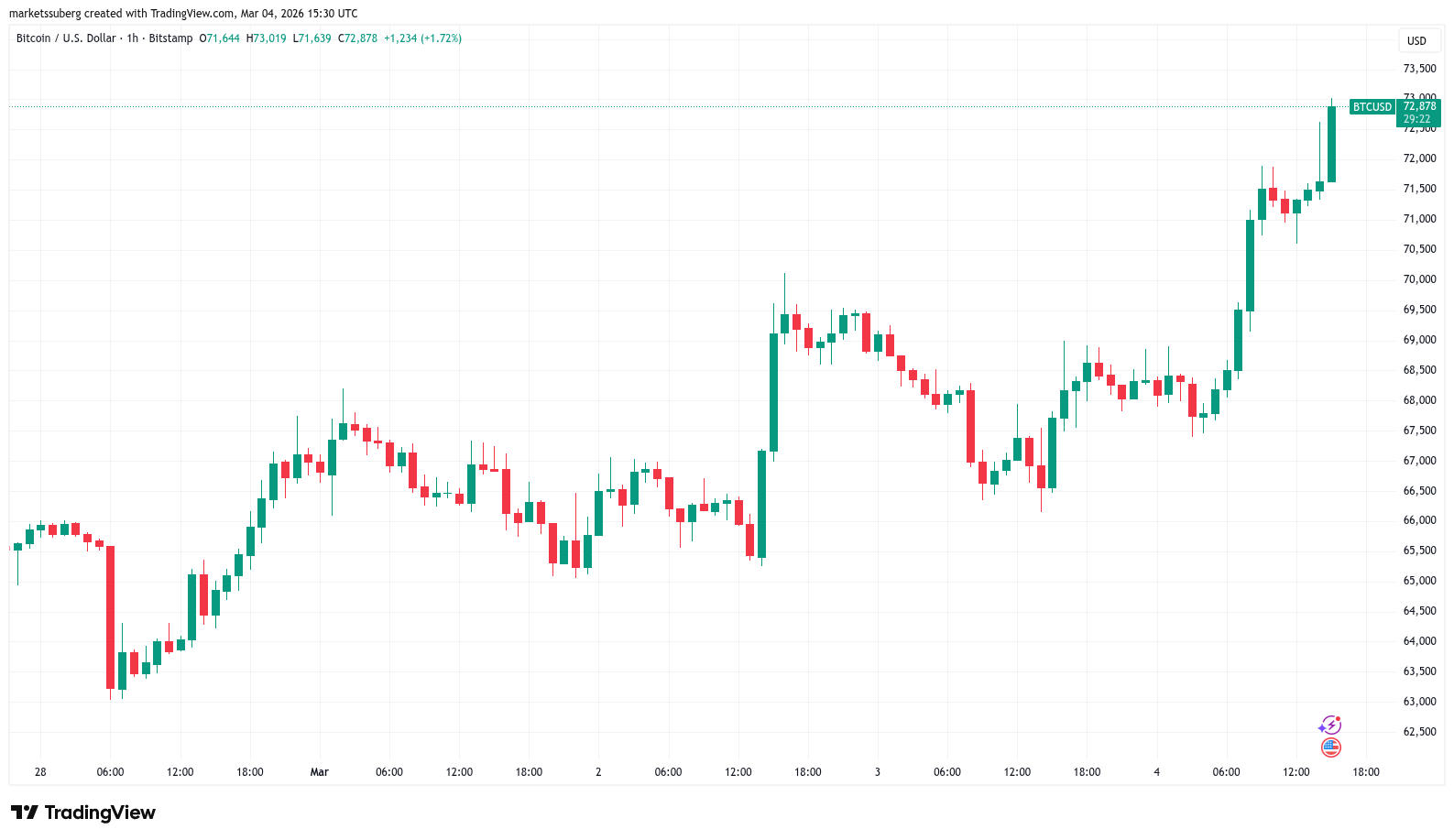
A new Bitcoin death cross would ensure continuation of the bear market unless a “major bullish catalyst” appears, per new BTC price analysis.
Bitcoin (BTC) needs a “major bullish catalyst” to avoid canceling out its March rally, says the latest analysis.
Key points:
-
New findings warn that short-term BTC price strength does not remove the risk of the bear market continuing.
-
Bitcoin faces plenty of overhead resistance in the mid-$70,000 zone.
-
A “death cross” formed of two weekly trend lines is still on course to confirm this week.
BTC price caught between multiple trend lines
In an X update on Wednesday, Keith Alan, cofounder of trading resource Material Indicators, warned that BTC price weakness was still present beyond low time frames.

Bitcoin hit monthly highs of $73,019 at the day’s Wall Street open, continuing a rebound that accompanied renewed conflict in the Middle East.
While this quickly led to predictions of a bull market comeback and even new all-time highs, Alan was frank about the BTC price outlook.
“This is an important candle to watch on the $BTC chart,” he summarized.
“On the surface, we’re seeing a short squeeze. From a technical perspective, this D candle is attempting to validate R/S Flips at the 21-Day SMA, the 2021 Top at $69k, and a Timescape Level at $71.3k.”

Alan referred to various key levels near the spot price, including the 21-day simple moving average (SMA) at around $67,550, per data from TradingView.
Also on the radar were the 50-day SMA at $76,350, along with the 21-week and 100-day SMA trend lines at $88,000 and $87,300, respectively.
“If bulls can push price up from here I expect some friction around psychological resistance ~$75k, technical resistance at the $50-Day MA, and the next Timescape Level at $78.3k,” he continued.
“A support test, sooner than later, would be healthy, but I’m not sure that the market is going to make it that easy on us. However this develops, IMO, the longer it takes to grind up, the more durable the rally will likely be.”
Bitcoin death cross still due this weekly candle
As Cointelegraph reported, long-term price expectations for the current bear market favor a bottom at or below the $50,000 mark.
Related: ‘This is not World War III:’ Five things to know in Bitcoin this week
A return to BTC price downside, Alan warned, could come as soon as next week, thanks to a so-called “death cross” involving the 21-week and 100-week SMAs.

A death cross occurs when the former trend line crosses below the latter, implying weaker recent price action compared to the longer-term trend.
“The caveat to that is the simple fact that next week we will print a death cross between the 21 and 100 Week MAs, and that will likely be a precursor to the next leg down unless we get a major bullish catalyst,” he concluded.
This article does not contain investment advice or recommendations. Every investment and trading move involves risk, and readers should conduct their own research when making a decision. While we strive to provide accurate and timely information, Cointelegraph does not guarantee the accuracy, completeness, or reliability of any information in this article. This article may contain forward-looking statements that are subject to risks and uncertainties. Cointelegraph will not be liable for any loss or damage arising from your reliance on this information.


Morgan Stanley (MS) has filed with the Securities and Exchange Commission (SEC) a prospectus outlining the structure of the proposed Morgan Stanley Bitcoin Trust, revealing that the fund plans to use Coinbase Custody (COIN) and the Bank of New York Mellon (BNY) to safeguard its bitcoin holdings, according to a form S‑1 submitted.
The two institutions will serve as the trust’s bitcoin custodians, responsible for storing the digital assets and facilitating transfers related to share creations and redemptions.
The filing outlines a custody structure designed to mirror traditional institutional standards. Bitcoin will largely be held in offline cold storage vaults, where private keys remain disconnected from the internet to reduce hacking risks. A portion of the assets may temporarily move to trading wallets during ETF creation or redemption activity. The trust notes that custody insurance exists but is shared across customers and may not cover all potential losses.
BNY will also play several additional roles within the ETF structure. The bank will serve as the fund administrator, transfer agent, and cash custodian, handling accounting, shareholder records, and cash flows tied to ETF transactions.
The ETF itself will be structured as a passive vehicle designed to track the price of bitcoin by holding the cryptocurrency directly rather than using derivatives or leverage.
The filing also states that the trust will calculate its net asset value using the CoinDesk Bitcoin Benchmark 4PM New York Settlement Rate, which aggregates trade data from major spot exchanges to determine the daily reference price for bitcoin.
Crypto World
Morgan Stanley (MS) Stock: Landmark Bitcoin Trust Partners with Coinbase and BNY Mellon

TLDR
- Morgan Stanley submits revised spot Bitcoin ETF filing
- Coinbase Custody selected to safeguard Bitcoin assets
- BNY Mellon assigned administrative and cash custody duties
- Trust valuation tied to CoinDesk 4PM NY Bitcoin benchmark
- MS stock gains ground amid crypto expansion efforts
Morgan Stanley (MS) has pushed forward with its digital currency ambitions by submitting an updated registration document for its Bitcoin Trust. The financial institution has designated Coinbase Custody Trust Company and BNY Mellon for critical custody and operational functions. MS stock registered at $168.78, climbing 1.71% during robust trading activity.
Bitcoin Trust Architecture and Asset Security
The investment giant has designed its proposed trust as a passive spot Bitcoin exchange-traded product. This fund will maintain direct Bitcoin ownership without employing derivatives or borrowed capital. Accordingly, shares will mirror the market value of the underlying Bitcoin reserves.
Coinbase Custody Trust Company has been selected to protect the digital currency holdings through institutional-grade custody solutions. The majority of Bitcoin will remain in offline cold-storage facilities to minimize cybersecurity threats. Small amounts may be moved to hot wallets exclusively during share creation and redemption processes.
BNY Mellon has been appointed to manage administration, transfer agency services, and cash custody operations for the trust. Its responsibilities encompass financial reporting, shareholder record maintenance, and liquidity management activities. Consequently, this operational framework matches conventional ETF industry protocols.
Valuation System and Risk Management
The trust’s net asset value will be determined through the CoinDesk Bitcoin Benchmark 4 PM New York Settlement Rate. This benchmark aggregates trading information from leading spot cryptocurrency platforms. The ETF will employ a publicly available daily pricing standard.
Regulatory disclosures indicate that custody insurance coverage exists but extends across numerous clients. Nevertheless, such insurance may not fully compensate for every conceivable loss scenario. This language mirrors standard disclosure practices among existing spot Bitcoin ETF providers.
Authorized market participants will deliver cash in exchange for Bitcoin when creating new shares. They may also convert shares back into underlying Bitcoin during the redemption mechanism. This structure enables the fund to preserve liquidity within established regulatory guidelines.
Broader Digital Currency Ambitions
Morgan Stanley originally submitted its Bitcoin Trust application in January. The institution simultaneously filed documentation for a separate Solana exchange-traded fund. These parallel initiatives demonstrate the bank’s comprehensive digital asset strategy.
The financial services company has additionally pursued a national trust bank charter. Regulatory authorization would enable Morgan Stanley to directly custody cryptocurrencies on behalf of institutional clientele. This capability would position the firm alongside specialized crypto custody providers.
Senior management has outlined intentions to broaden cryptocurrency accessibility throughout its brokerage operations, notably E*Trade. The retail-focused E*Trade platform functions under Morgan Stanley’s corporate umbrella. With roughly $8 trillion in assets under management, the institution seeks to consolidate custody solutions, trading capabilities, and supervisory functions within a unified infrastructure.

Crypto World
Market infrastructure firms warn tokenized securities face higher costs, split liquidity without interoperability


The world’s largest market infrastructure operators are warning that tokenized securities will struggle to scale unless the industry agrees on how blockchains and traditional finance systems connect.
In a joint white paper, the Depository Trust and Clearing Corporation (DTCC), Euroclear and Clearstream, working with Boston Consulting Group, argued that “interoperability is a prerequisite for digital asset security (DAS) adoption at scale.” Without it, they wrote, assets risk being trapped on isolated networks, leaving “operational costs high” and liquidity fragmented as trading volumes grow.
The group stopped short of endorsing any single technology. Instead, it framed the problem as structural. Dozens of public and permissioned blockchains now host pilots and live products. Each uses its own standards, smart contract logic and settlement design. That diversity, the paper says, makes integration harder and increases operational and regulatory risk.
The authors rejected the idea that one dominant ledger will emerge. The operating model, they said, is shifting toward a “network-of-networks, with standards, gateways, and regulated service providers” linking digital and traditional systems. In that environment, assets must move across platforms while preserving what the paper calls “the asset’s integrity, ownership rights and lifecycle, with full legal and regulatory compliance.”
They summarized the goal in a short phrase: “same asset, same rights, same outcome.”
The warning comes as tokenization gains ground in repo markets and pilot programs across the U.S. and Europe. While onchain securities remain small compared with global equity and FX markets, the paper notes that large-scale infrastructure is already in motion, including more than $300 billion in daily repo activity across major platforms.
Still, many workflows depend on legacy rails. Tokenized bonds may trade on-chain, but cash often settles through real-time gross settlement systems or bank payment networks. Custodians and central securities depositories still maintain books of record. The paper assumes this coexistence will last for years.
The framework also extends beyond technical bridges. Interoperability, the authors argued, must cover assets and liabilities, ownership recognition, lifecycle events, ledger finality and legal enforceability. Without alignment across those layers, cross-chain or cross-border transactions may require extra reconciliation steps that erode promised efficiency gains.
The group called on regulators and market participants to develop working groups focused on governance, standards and resilience. “Collective action today will shape resilient markets tomorrow,” the paper states.
That push comes as major Wall Street firms argue tokenization could reshape financial markets by enabling 24/7 trading, faster settlement and more efficient use of collateral. Executives at large banks and asset managers have said blockchain-based rails may eventually reduce back-office costs and free up capital tied up in multi-day settlement cycles. Some have described tokenized assets as a path toward more integrated global markets, where cash and securities move in near real time.
The paper does not dispute that vision. Instead, it suggests that achieving it depends less on launching new chains and more on aligning the rules that govern them.

Byreal launches first AI copy farming skillset for Solana DEX agents
17 Stylish Picks From Amazon’s Early 2026 Spring Blouse Drop

Politics Home | Andy Burnham Says Labour’s By-Election Defeat Shows “Chasm” Between Westminster And Voters


-

 Politics6 days ago
ITV enters Gaza with IDF amid ongoing genocide
-

 Politics1 day ago
Alan Cumming Brands Baftas Ceremony A ‘Triggering S**tshow’
-

 Fashion5 days ago
Weekend Open Thread: Iris Top
-

 NewsBeat7 days ago
Cuba says its forces have killed four on US-registered speedboat | World News
-

 Tech4 days ago
Unihertz’s Titan 2 Elite Arrives Just as Physical Keyboards Refuse to Fade Away
-
Sports5 days ago
The Vikings Need a Duck
-
 NewsBeat4 days ago
Dubai flights cancelled as Brit told airspace closed ’10 minutes after boarding’
-
 NewsBeat7 days ago
Manchester Central Mosque issues statement as it imposes new measures ‘with immediate effect’ after armed men enter
-

 NewsBeat3 days ago
‘Significant’ damage to boarded-up Horden house after fire
-
 NewsBeat4 days ago
The empty pub on busy Cambridge road that has been boarded up for years
-

 NewsBeat4 days ago
Abusive parents will now be treated like sex offenders and placed on a ‘child cruelty register’ | News UK
-

 Entertainment2 days ago
Baby Gear Guide: Strollers, Car Seats
-

 Business7 days ago
Discord Pushes Implementation of Global Age Checks to Second Half of 2026
-

 Business6 days ago
Only 4% of women globally reside in countries that offer almost complete legal equality
-
 Tech5 days ago
NASA Reveals Identity of Astronaut Who Suffered Medical Incident Aboard ISS
-
 NewsBeat3 days ago
Emirates confirms when flights will resume amid Dubai airport chaos
-
Politics4 days ago
FIFA hypocrisy after Israel murder over 400 Palestinian footballers
-

 Crypto World6 days ago
From Crypto Treasury to RWA: ETHZilla Retreats and Relaunches as Forum Markets on Nasdaq
-

 NewsBeat2 days ago
Is it acceptable to comment on the appearance of strangers in public? Readers discuss
-

 Tech3 days ago
Viral ad shows aged Musk, Altman, and Bezos using jobless humans to power AI