
Crypto World
XRP Faces Its Strongest Selling Pressure Since May: What’s Next for Ripple’s Price?


XRP’s price action has remained choppy this week. It briefly fell below $1 before a modest recovery. But that strength faded quickly, and it has since settled near $1.01.
New data suggests that selling pressure on the token has reached its highest level since May on Binance.
Downside Risk Grows
According to CryptoQuant’s latest findings, the exchange’s Taker Buy/Sell Ratio has fallen sharply to around 0.86, its lowest reading since last May. A reading below 1 means traders are executing more sell orders than buy orders, which indicates clear selling pressure in the derivatives market.
The ratio has stayed below 1 for most of the recent period. There have been brief moves above that level, but they failed to develop into a lasting trend. XRP has also continued to fall from the highs recorded in previous months. This adds to signs of weak spot demand and speculative interest.
However, the low ratio does not mean XRP must continue declining. It mainly shows a temporary imbalance between buyers and sellers in the market. If the ratio moves even lower, downward pressure on the asset could increase. On the other hand, if the ratio moves back above 1 and holds, buying interest could improve. This would be more significant if it came with a stronger price and higher buying volume.
But CryptoPatel also flagged high open interest as another warning sign. XRP futures OI stands at 435.1 million units, above the 30-day average of 403.6 million units, which gives it a Z-score of +1.20σ. The analyst explained that the combination of price weakness and elevated OI essentially means that leverage remains stacked in the market. If the asset falls further, the setup could turn into a liquidation cascade.
Meanwhile, CasiTrades expects XRP to see a deeper pullback before finding a stronger floor. The analyst identified $0.94 as a level where the token could find some relief, but $0.87 remains the bigger downside target.
Whales Take a Different View
Short-term traders may be leaning bearish, but whale wallets have been moving in the opposite direction. Earlier this week, Santiment found that the number of wallets holding at least 1 million XRP has risen by 32 over the past three months, even as the asset’s market cap fell 29%.
The analytics firm said this points to stronger holders absorbing the recent panic as “patience replaces price-driven hype” – a shift that could make future volatility more “interesting” for the bulls.
The post XRP Faces Its Strongest Selling Pressure Since May: What’s Next for Ripple’s Price? appeared first on CryptoPotato.



Citigroup CEO Jane Fraser has backed passage of the CLARITY Act while continuing to push for changes to its stablecoin reward rules, keeping the banking industry’s main concern with the crypto bill alive ahead of a Senate procedural vote expected next month.
Summary
- Citigroup CEO Jane Fraser supports passing the CLARITY Act but wants changes to its stablecoin reward rules.
- Fraser warned that stablecoin rewards could pull deposits from banks and reduce their ability to provide credit.
- A Senate compromise would ban rewards for simply holding stablecoins while allowing incentives tied to payments and transactions.
- The stablecoin yield dispute remains a key issue between banks and crypto firms ahead of the Senate vote.
Fraser told Fox Business on Thursday that Citigroup still wants lawmakers to improve parts of the legislation, but she supports getting a workable version through Congress because she believes the bill would benefit the financial system.
“So, we have not given up on pushing to get some improvements made to the bill, but we would like to see a good bill go through,” Fraser said. “I think it would be excellent for the system.”
Her support puts Citigroup in a less confrontational position than some other large banks, even as Fraser shares their concern over whether crypto platforms should be allowed to offer rewards tied to stablecoins.
Citigroup CEO says stablecoin rewards could affect bank deposits
Fraser’s main concern centers on the effect that stablecoin rewards could have on deposits held by U.S. banks, particularly institutions that rely on those funds to finance lending in communities with fewer credit options.
“If you are having a reward system on deposits, it could have a detrimental impact on their deposits, and therefore their ability to provide lending and access to credit in parts of the U.S. that crypto won’t reach, and frankly, the large banks don’t reach,” Fraser said. “So, I am worried about it from that perspective.”
Banking groups have made a similar argument during negotiations over the CLARITY Act. In July, the American Bankers Association, Independent Community Bankers of America and 76 state banking associations asked Senate leaders to tighten Section 404 before the legislation reached the floor.
As crypto.news reported in July, the groups warned that unclear reward provisions could encourage customers to move money from traditional bank accounts into payment stablecoins, reducing the deposits available to community lenders.
The dispute stems partly from the way stablecoin rewards are structured. The GENIUS Act, passed in 2025, prevents payment stablecoin issuers from directly paying interest or yield to holders. Crypto exchanges and other service providers, however, have used rewards programs that can pass benefits to users through arrangements not directly offered by the stablecoin issuer.
Banking groups have argued that customers may see little practical difference between interest paid by a bank and rewards received for keeping stablecoins on a crypto platform.
CLARITY Act compromise allows activity-based rewards
Senators Thom Tillis, R-N.C., and Angela Alsobrooks, D-Md., have tried to address the dispute through compromise language that separates passive yield from rewards linked to actual platform activity.
The proposal bars platforms from paying rewards simply because a customer holds a stablecoin. It still permits certain incentives connected with transactions, payments and other qualifying activities.
The compromise language circulated among crypto and banking representatives earlier this year after Tillis and Alsobrooks reached an agreement in principle in March. The draft prohibited passive yield while retaining activity-based rewards tied to payments, transfers or platform use.
A revised 309-page version released by the Senate Banking Committee in May retained that basic structure, allowing activity-based stablecoin rewards while prohibiting passive yield for simply holding the asset.
Lawmakers developed the language after months of disagreement between banks and crypto companies over whether third-party rewards would undermine the restrictions already placed on stablecoin issuers.
Banking groups remained dissatisfied after the compromise emerged. The American Bankers Association, Bank Policy Institute, Consumer Bankers Association, Financial Services Forum and Independent Community Bankers of America said in May that the revised provisions still did not adequately protect deposits.
The groups argued that incentives calculated using factors such as balances or holding periods could function much like deposit interest even if they were formally presented as rewards.
Crypto companies have taken the opposite position, arguing that restrictions extending beyond passive interest would prevent platforms from rewarding customers for legitimate activity.
Coinbase Chief Policy Officer Faryar Shirzad said during the May negotiations that banks had secured tighter restrictions while the compromise preserved rewards tied to actual use of crypto platforms and networks.
Stablecoin yield fight has divided banks and crypto firms
The dispute has become one of the most persistent issues surrounding the CLARITY Act, with banking organizations warning about deposit losses while crypto firms have pushed to preserve rewards that do not amount to passive interest.
Earlier this year, banking groups stepped up their lobbying as lawmakers prepared the legislation for Senate consideration. An American Bankers Association campaign sent thousands of messages to Senate offices as the industry sought changes to the stablecoin provisions.
Bank of America CEO Brian Moynihan has previously estimated that as much as $6 trillion could eventually move from bank deposits into stablecoins under a regulatory structure that lets the tokens compete more directly for customer cash.
The banking industry’s concerns extend to the lending consequences of such an outflow. Banks use deposits as a source of funding for mortgages, business loans and other credit, while stablecoin reserves are commonly held in cash, short-term U.S. Treasuries and similar liquid assets.
Crypto industry representatives dispute the scale of the risk. The White House Council of Economic Advisers challenged the deposit argument in April, estimating that prohibiting stablecoin yield would increase traditional bank lending by about $2.1 billion, or roughly 0.02% of total loans.
The council estimated that 76% of the additional lending associated with a yield ban would flow through large banks, undercutting claims that restrictions were primarily needed to protect smaller community institutions.
Coinbase CEO Brian Armstrong has also argued that banks are seeking to limit competition from stablecoins. During the negotiations, he accused large banks of trying to prevent consumers from receiving returns generated by stablecoin reserve assets.
Under the 2025 GENIUS Act framework, issuers must maintain qualifying reserves for payment stablecoins and cannot directly pay holders interest. Platforms such as Coinbase have offered rewards through separate programs, making the treatment of third-party incentives a central issue in the CLARITY Act talks.
Jamie Dimon has taken a harder position on the CLARITY Act
JPMorgan Chase CEO Jamie Dimon has gone further than Fraser in opposing the legislation as currently written.
During a Fox Business interview in May, Dimon said banks would fight the CLARITY Act because he believed its stablecoin provisions allowed crypto firms to provide interest-like returns without protections comparable to those imposed on banks. He said the industry would continue opposing the legislation even if it ultimately lost the vote.
Dimon also criticized Armstrong’s lobbying campaign during the interview, calling the Coinbase CEO “full of sh–” after the host referred to Armstrong’s claim that he represented the crypto industry’s position.
Fraser’s comments leave Citigroup supporting passage while seeking changes to the same issue that has driven much of the banking industry’s opposition.
The next procedural test is expected after lawmakers return from the Senate’s August recess. Senate Majority Leader John Thune has scheduled a cloture vote for Sept. 15, moving the initial vote into September after earlier delays.
Crypto World
Trump family ‘s World Liberty Financial (WLFI) delay plans to sell Maldives resort token


World Liberty Financial, the cryptocurrency project backed by the Trump family, delayed plans to sell a token related to a resort in the Maldives, Bloomberg reported on Friday.
The token was planned to go on sale next year, giving investors a share of revenue from loans financing the Trump-branded resort, but this has been pushed back due to the Iran war disrupting travel in the region, according to the report, citing people familiar with the matter.
World Liberty Financial tapped real-world asset (RWAs) platform Securitize in February to help represent loan interests tied to the resort’s development as a digital token that could be traded onchain.
It is unclear when the token will now be listed.
The venture is part World Liberty Financial’s plans in tokenization, the representation of RWAs on blockchains in token form. WLFI is exploring this concept not just in real estate, but in commodities like oil and gas.
A World Liberty Financial spokesperson declined to comment, according to Bloomberg’s report. The company did not immediately respond when contacted by CoinDesk for additional comment.
The protocol’s native token WLFI rose by 2.7% on the news before giving back all of the gains and returning to parity. It is now down by 88.5% from its record high in September, 2025.


Cointelegraph is committed to providing independent, high-quality journalism across the crypto, blockchain, AI, and fintech industries.
All news, reviews, and analyses are produced with full journalistic independence and integrity. For more details on our standards and processes, please read our Editorial Policy.
Crypto World
Volatility exits crypto, TradFi markets even as U.S.-Iran risks linger, sovereign debt rises: Crypto Daily
Scan the news and there are plenty of reasons for worry: continued U.S.-Iran escalation risks, mounting sovereign debt and rising bond yields among them. Crypto carries its own set of concerns, including regulatory disappointments, weak demand and hack risks.
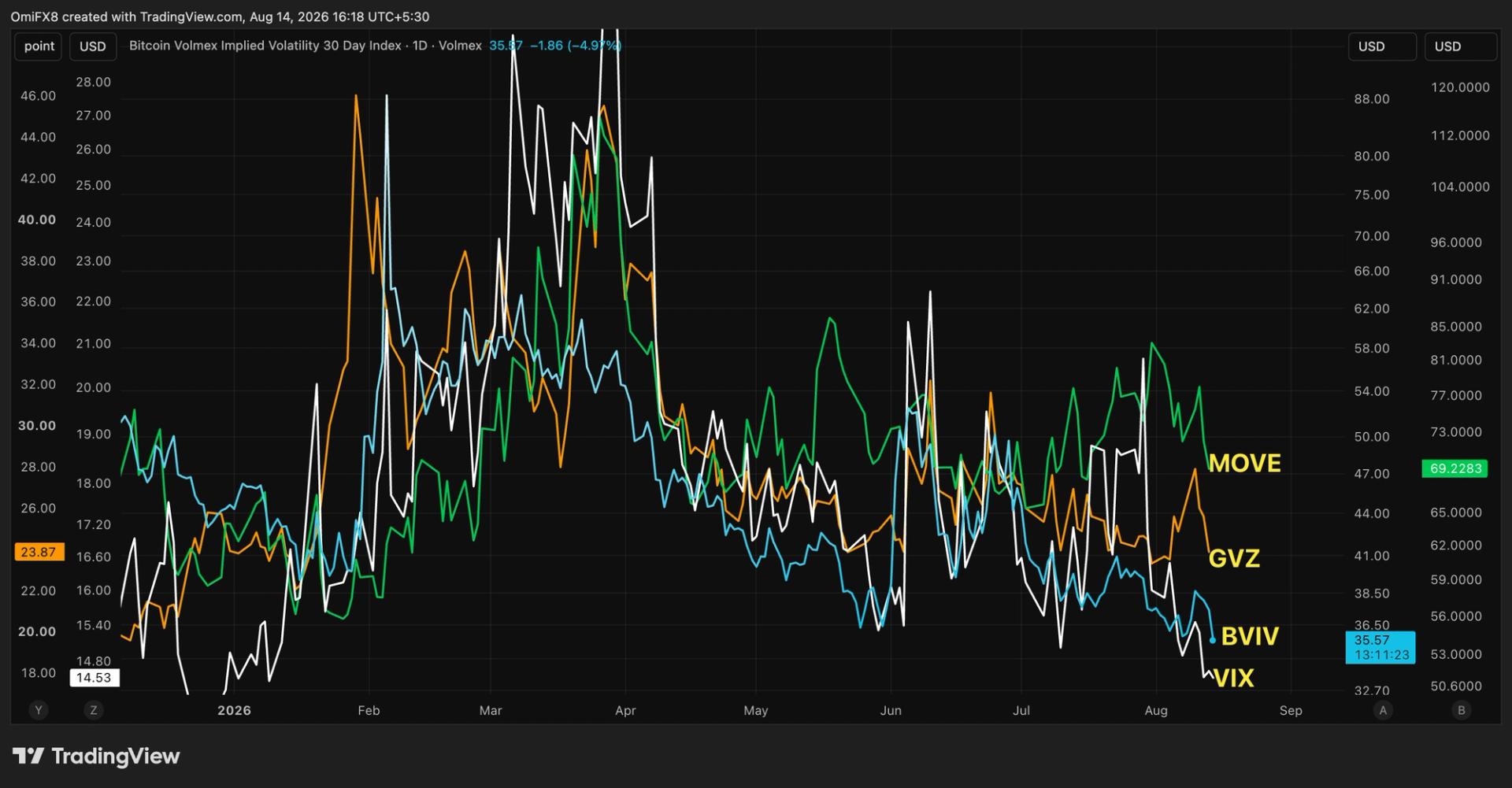
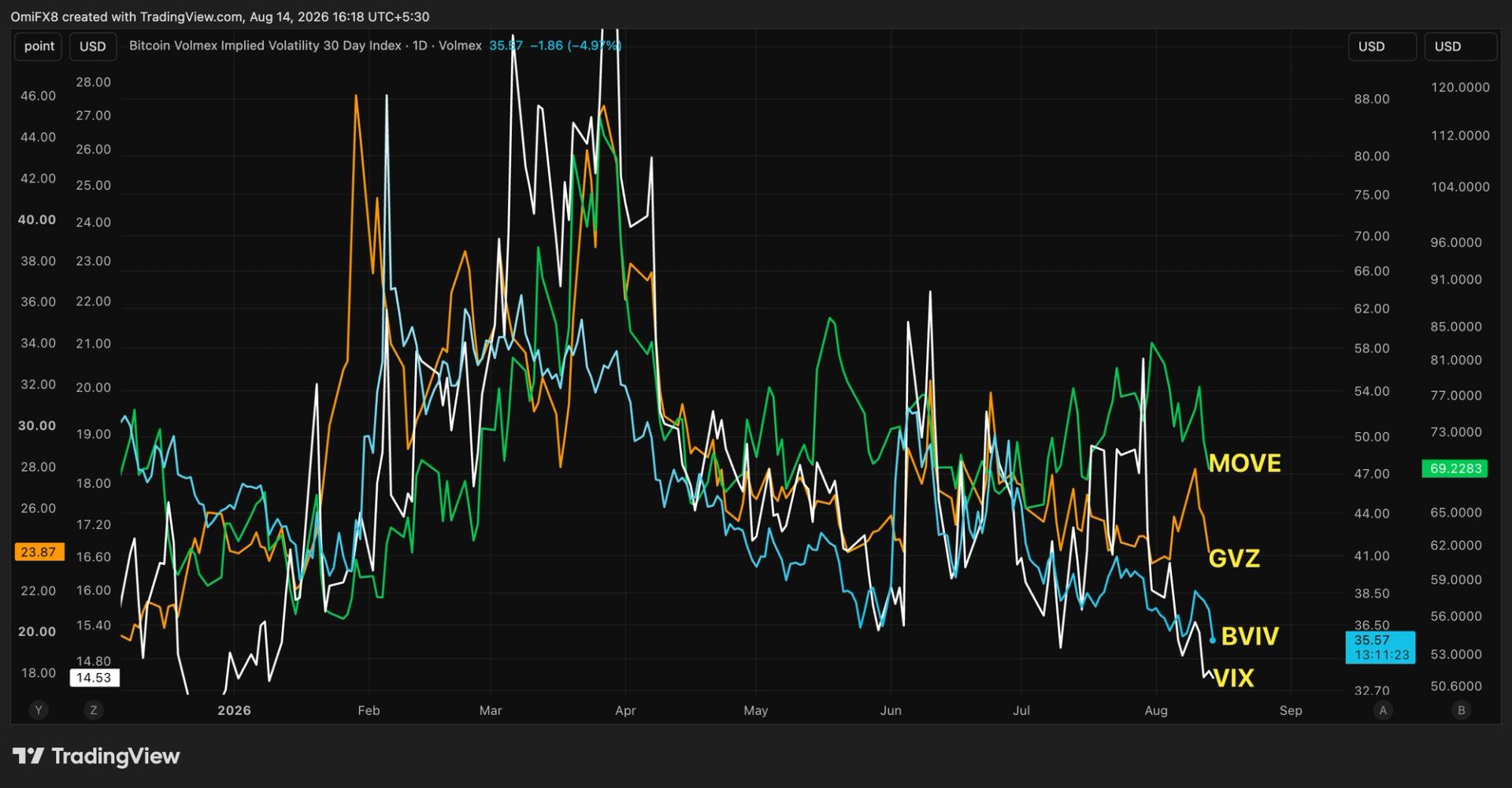
Yet crypto, stocks, bonds and even commodity markets remain sanguine. That is clear from implied-volatility readings across these markets. Implied volatility is a measure of expected price turbulence, and is calculated from the demand for options and other derivatives used to hedge against wild swings and uncertainty.
Bitcoin’s 30-day implied volatility index, BVIV, has dropped back to a 2026-low near 36%, reversing the minor pop to nearly 38% earlier this week, according to data source TradingView. The same is true for ether, the second-largest digital asset market value.
Wall Street’s VIX index, often called a “fear gauge” tracking uncertainty and volatility in the S&P 500, has declined to the lowest level since January. The Treasury market equivalent, MOVE, is also under pressure, hovering near the lower end of its multi-month range of 66% to 84%. Even gold and oil volatility indexes are falling.
Crypto World
“World’s First” Trump Prediction Market Product Killed, What Happened to Truth Predict?
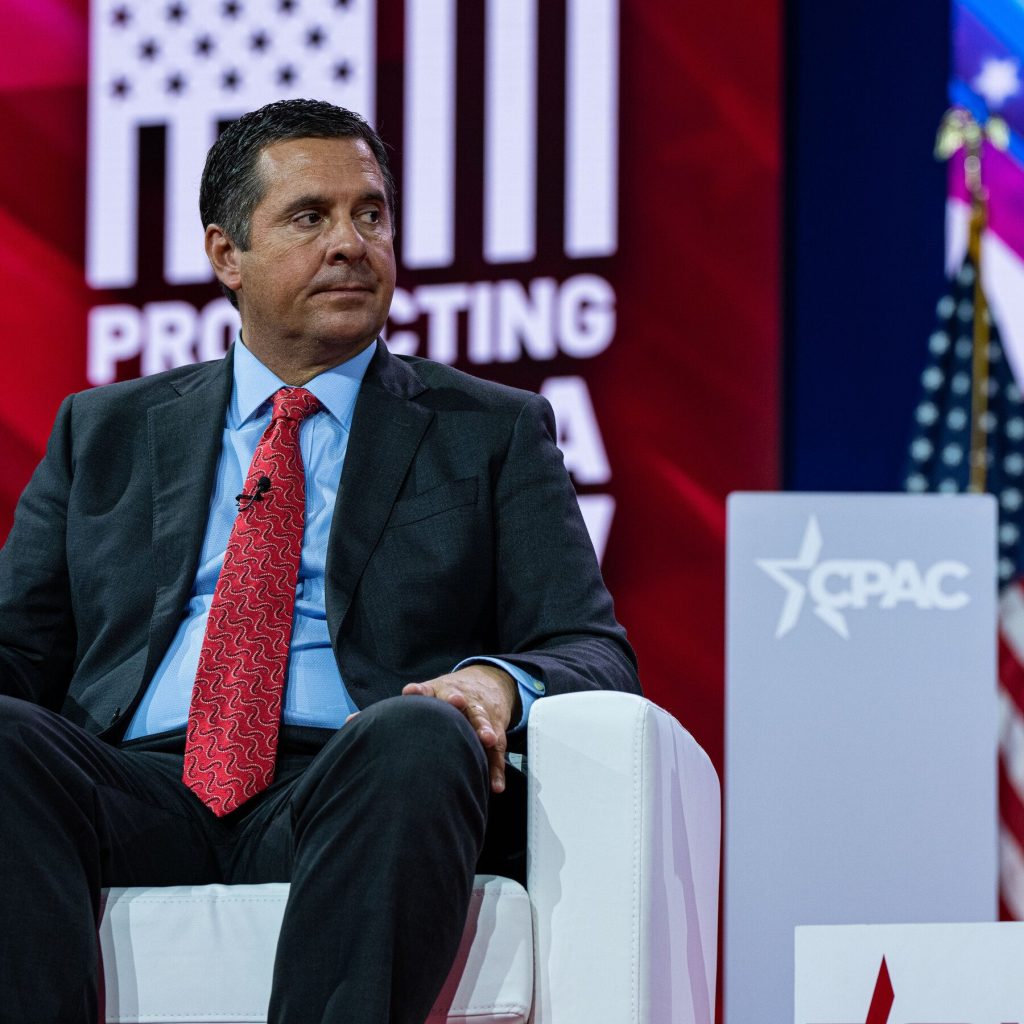
Trump Media has scaled back plans to embed a native prediction-market engine inside Truth Social, opting instead for a marketing arrangement that steers users toward Crypto.com’s existing event-contract platform.
The retreat lands ten months after Trump Media billed Truth Predict as a category-defining product, and it forces a blunt question: how much operating exposure was a Trump-linked platform ever willing to carry inside a market regulators still can’t agree on how to police.
Discover: Everyone’s Got a Take. Get Free $25 to Actually Trade Yours
Trump Prediction Market: From “World’s First” to a Marketing Deal
The original October 28, 2025 announcement was unambiguous. Trump Media said Truth Social would become the first social media platform to offer embedded prediction markets, built through an exclusive arrangement with Crypto.com | Derivatives North America (CDNA), a CFTC-registered exchange and clearinghouse.
The plan covered contracts on elections, interest and inflation rate changes, commodity prices, and every major sports league, with real-time pricing and a mechanism letting users convert Truth Social’s “Truth gems” into CRO to fund trades.
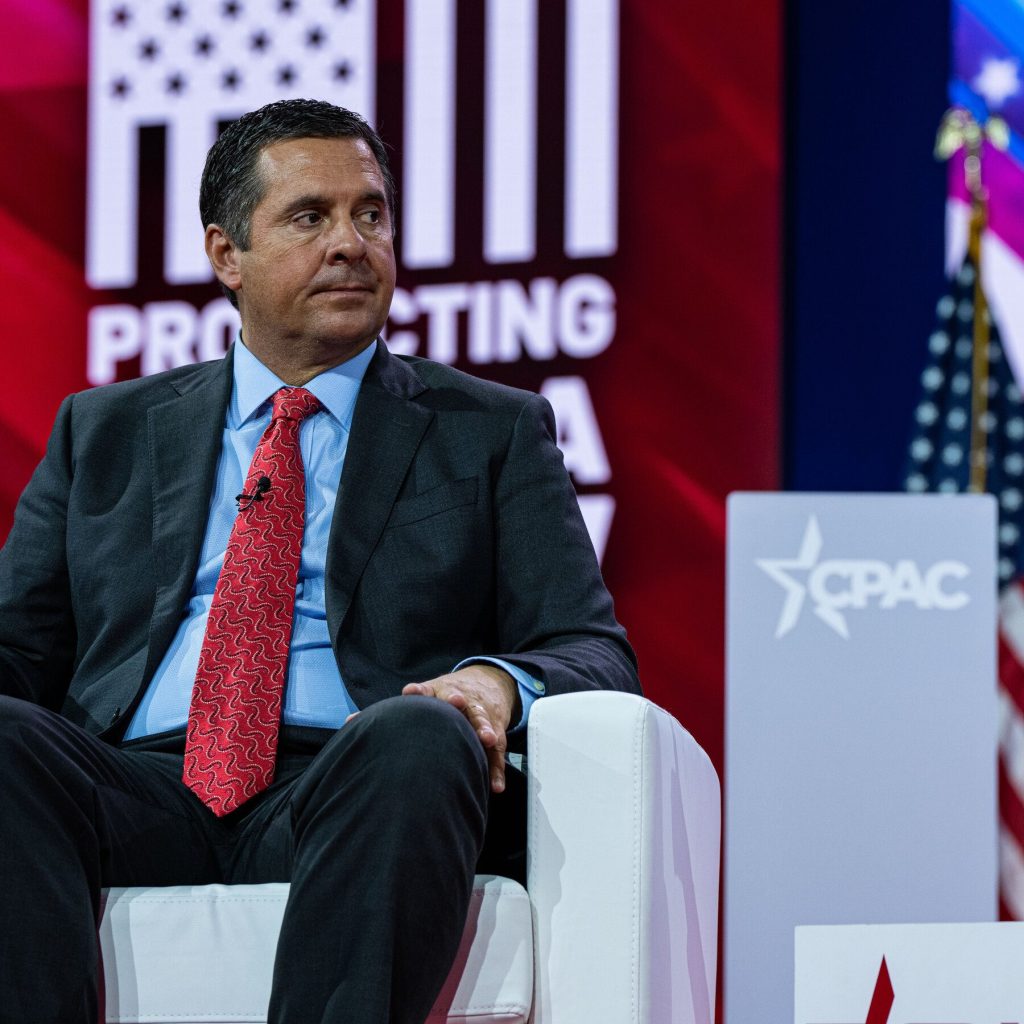
Then-CEO Devin Nunes framed the product as a way to democratize markets historically controlled by financial elites, while Crypto.com co-founder Kris Marszalek described prediction markets as a multi-decabillion-dollar opportunity for the two companies to build together. Neither framing survived intact.
Trump Media’s latest public filing now describes Truth Predict as still “in development,” with the initial rollout limited to a marketing and promotion collaboration that points users to OG.com, the Crypto.com-owned prediction markets app that launched in February 2026.
Discover: Your Market Calls Are Worth Something. Start With Free $25 on Kalshi
The CRO Treasury Deal Died With It
The prediction-market pullback wasn’t an isolated decision. Trump Media, Crypto.com and Yorkville Acquisition Corp mutually terminated plans for Trump Media Group CRO Strategy, the digital-asset treasury vehicle that was supposed to become the first and largest publicly traded holder of Crypto.com’s CRO token.
The companies pointed to shifting market conditions and stakeholder priorities, and interim Trump Media CEO Kevin McGurn said the goal now is to narrow the company’s focus rather than chase every crypto-adjacent product line.
The timing coincides with a broader crypto-treasury unwind: Bitcoin has fallen nearly half from its 2025 peak, and enthusiasm for token-hoarding stock vehicles has cooled sharply along with it.
McGurn said the prediction-market space is already crowded with established operators, making it a less attractive place for Trump Media to build back-end infrastructure than to sit on top of as a data and distribution partner.
That reframing matters more than the language suggests, it converts Trump Media from a would-be prediction-market front end into a promoter, a materially different operating posture.
A Jurisdiction Fight Trump Media Is Now Watching From the Sidelines
The retreat also lets Trump Media step back from an unresolved brawl over who actually regulates event contracts. The CFTC sued Arizona, Connecticut and Illinois in April 2026 to reaffirm what Chairman Michael Selig calls the agency’s exclusive jurisdiction over event contracts, arguing that a national framework beats a state-by-state patchwork.
States including Nevada, Wisconsin and Massachusetts have separately pursued prediction-market operators in court or through enforcement actions, arguing that sports event contracts amount to unlicensed gambling, a direct challenge to sports betting regulation as it currently exists at the state level.
That standoff is exactly the kind of exposure a company more directly involved in offering prediction markets could face. As a marketing partner routing traffic to Crypto.com’s infrastructure instead, Trump Media reduces its direct operating role while still capturing distribution value.
The broader federal-versus-state tension over who writes the rules for crypto markets is playing out in parallel fights over the SEC-CFTC jurisdictional divide, and the outcome of pending crypto market-structure rulemaking will shape how much room CDNA-style exchanges have to expand.
Don’t Miss Out on Our $1,000 USDT Airdrop on ByBit
The post “World’s First” Trump Prediction Market Product Killed, What Happened to Truth Predict? appeared first on Cryptonews.

In SEC crypto news today, the Securities and Exchange Commission canceled its August 14 open meeting, which had been scheduled to consider whether to propose new crypto-related rules.
An SEC spokesperson said the meeting would be moved due to an unforeseen scheduling issue, and no replacement date was announced.
What the SEC Crypto Meeting Was Supposed to Decide
Commissioners had been scheduled to vote on proposed exemptions that would allow crypto startups to raise capital without complying with traditional securities offering rules. Reuters reported that the SEC said the session would be moved because of an unforeseen scheduling issue, without providing a new date.
Under SEC Chair Paul Atkins, the agency has reversed parts of its previous crypto policy, including rescinding stringent crypto accounting guidance and dismissing lawsuits against Coinbase, Binance and other companies that had alleged the companies were flouting SEC rules. Reuters reported that Atkins has backed the view held by crypto companies that most tokens more closely resemble commodities than securities.
CLARITY Act Remains on a Separate Timeline
The SEC delay follows the Senate’s departure for a five-week recess without a vote on the CLARITY Act, the industry’s top legislative priority. Reuters reported that the missed vote suggested the bill’s chances of passage had dimmed. If passed, the bill would create new federal rules tailored to cryptocurrencies and put companies on firmer legal footing, according to lobbyists cited by Reuters.
The SEC meeting and the CLARITY Act involve separate approaches to crypto policy. The canceled SEC session concerned proposed exemptions for crypto fundraising, while the legislation would, if enacted, create new federal rules tailored to cryptocurrencies.
Atkins’ Startup Exemption Proposal
— Coach JV Warrior Academy (@CoachJVTop) August 13, 2026
 HUGE:
HUGE: The SEC Chair Paul Atkins will announce
NEW crypto RULES on Friday. pic.twitter.com/KKlCNrsg6v
In March, Atkins suggested that the SEC would propose a safe harbor intended to make it easier for companies to sell tokens and raise money. He also said the agency was considering a fit-for-purpose startup exemption that would allow crypto entrepreneurs to raise a certain amount of money or operate for a finite period while exempt from SEC rules.
The SEC is also working on an innovation exemption that Atkins has said would allow companies to experiment with new digital-asset business models, including blockchain-based stocks, without complying with all SEC disclosure and investor safeguards.
The canceled meeting had been scheduled to consider whether to propose the crypto fundraising exemptions. Its cancellation postponed that consideration, and the SEC did not announce a replacement date.
What Happens Next in the SEC Crypto Drama
No replacement date has been announced for the SEC meeting. The Senate is in a five-week recess after leaving Washington without voting on the CLARITY Act. The SEC proposal has not been considered at the canceled meeting, and the Senate has not voted on the legislation.
The post SEC Delays Vote on Exemptions for Crypto Fundraising appeared first on Cryptonews.
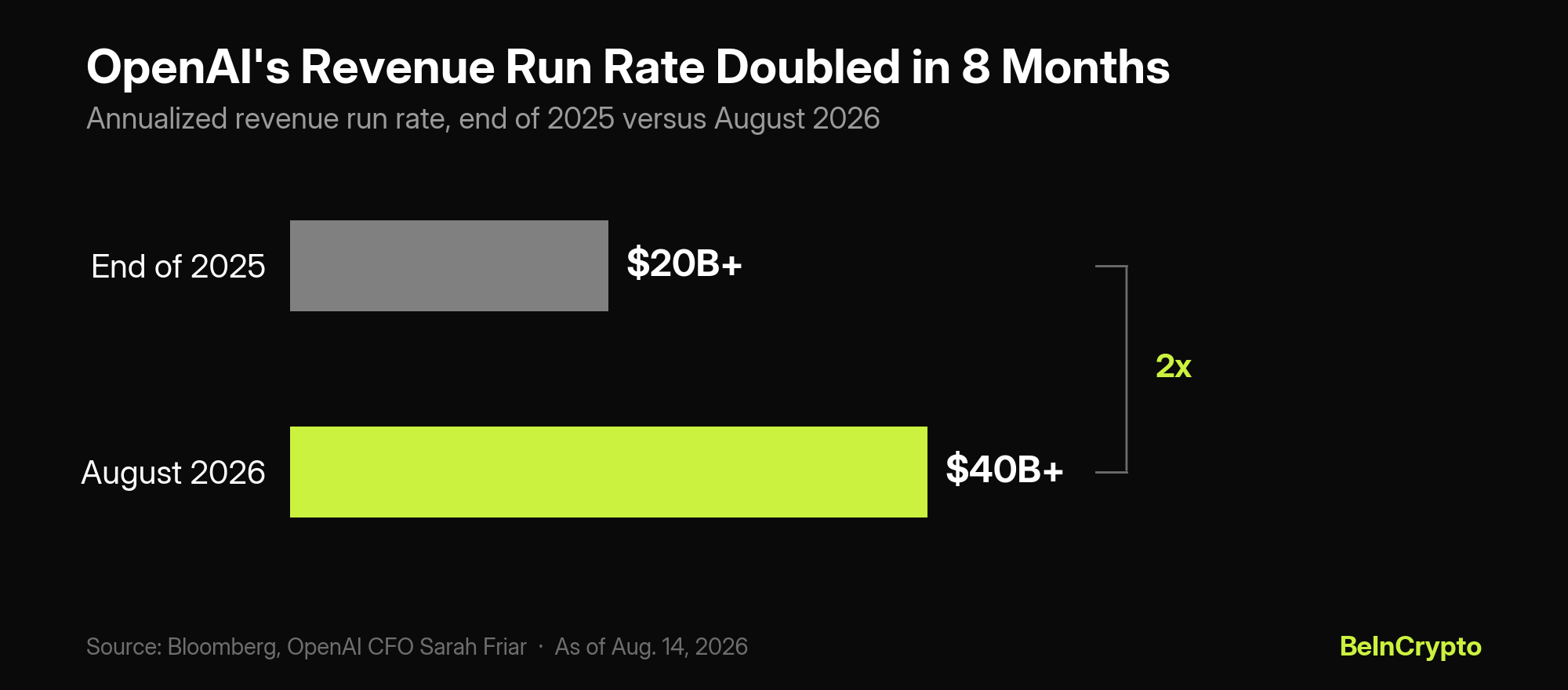
According to reports, OpenAI has pushed its annualized revenue run rate past $40 billion. That pace roughly doubles the figure the company recorded at the end of 2025.
The number strengthens the case for a public listing. Yet it arrives during a wave of senior departures at the top of the company.
What Drives the OpenAI Revenue Run Rate
Three engines account for most of the growth. ChatGPT subscriptions keep expanding, AI coding software has scaled fast, and a young advertising business now adds to the total.
President Greg Brockman told staff that revenue climbed more than 20% month over month in July. Similarly, an earlier internal update showed July alone outpaced the entire second quarter.
Pricing changes helped as well. OpenAI cut prices for customers in July as businesses grew more cost conscious. Rather than dent revenue, cheaper access pulled in more enterprise demand.
Demand for AI agents adds a third leg. Codex handles software work, while ChatGPT Work targets office teams. Both products push customers toward higher paying tiers.
Chief Financial Officer Sarah Friar had previously placed the 2025 exit figure above $20 billion. Management now wants enterprise customers to supply half of all revenue by the end of this year.
OpenAI declined to comment on the latest numbers. The $40 billion run rate is based on a Bloomberg report, which cites people familiar with the matter.

Executive Exits Cloud the IPO Path
Meanwhile, Chief Revenue Officer Denise Dresser will leave in the coming weeks. She arrived from Slack in December 2025, so her run lasted roughly eight months.
Dali Rajic takes over global revenue operations. He previously served as president and chief operating officer of Wiz, a cybersecurity company..
Dresser’s exit follows Brad Lightcap’s recent departure, after she had been set to absorb part of his operational remit. Fidji Simo also stepped back last month for health reasons.
The churn stretches back further. OpenAI has lost its head of ethics, its head of safety systems, and its former mission alignment chief over recent months. Brockman has responded by pulling operating duties under his own remit.
Meanwhile, the listing groundwork moves ahead. OpenAI has filed confidentially for an initial public offering and recently bought back employee shares worth $7 billion with its own cash.
Rival Anthropic may still reach the market first. The company could list in October at a valuation above $2 trillion. Whether revenue momentum outweighs leadership churn will decide how investors price OpenAI.
The post OpenAI Reportedly Hits $40 Billion Run Rate While Its Revenue Chief Walks Out appeared first on BeInCrypto.

The market has been in a rough patch for some time. The total crypto market capitalization is down 1.1% today, falling to $2.17 trillion, as pessimism continues to grow. The mood has been getting darker as prices struggle to regain momentum and traders become increasingly cautious.
At the same time, crypto “dead” chatter is rising again across X, Reddit, Telegram, and other crypto channels.
“Dead, Dying, Finished”
Terms such as dead, dying, over, ended, ending, and finished are gaining traction. According to Santiment’s latest update, this language reflects fear and often appears as retail patience weakens, prices remain stuck, and traders view temporary weakness as lasting failure.
Crypto markets can move against the crowd when bearish views become too certain. If “crypto is dead” talk rises while Bitcoin holds key levels, stronger hands continue accumulating, and forced selling declines, the market structure can become more attractive for patient buyers, the analytic firm explained.
Bitcoin has had its obituary written many times before, but it has repeatedly bounced back and gone on to deliver strong returns. The cryptocurrency once existed largely as a sideshow in the underbelly of the internet. Over time, however, it moved from the fringes into the center of mainstream finance. Now, despite all that attention and acceptance, Bitcoin is facing another period of weakness. Its price has been stuck around $63,000 for weeks, bringing back the familiar debate over whether it has lost its momentum.
The latest wave of fear is worth watching, especially as some investors see opportunity instead. In a recent tweet, Crypto Patel said investors calling Bitcoin “dead” may be missing the bigger picture. Retail traders often see fear when prices weaken. But, according to the analyst, whales may see the same period as a long-term BTC accumulation zone.
This trend is evident in recent reports, which also suggest that the largest wallets are growing again. The number of wallets holding at least 10,000 BTC returned to a six-month high. There are currently 90 such wallets, up by six over the past eight weeks. During this period, holdings among micro wallets have declined in August.
Collapsing Sentiment
Chiming in on the growing narrative, another market watcher, Allen Rodgers, said the trend is worth watching because similar spikes in the narrative have appeared during periods of extreme fear, often when the asset was close to finding a bottom. According to Rodgers, the pattern usually starts with the crowd turning bearish and social sentiment collapsing. The market can then begin to turn before traders feel comfortable buying again.
“Then the market starts turning before anyone feels comfortable buying. Not saying history has to repeat. But when everyone starts calling the same market ‘dead’ again…”
The post ‘Crypto Is Dead’ Talk Is Rising; Could Peak Fear Be a Contrarian Signal? appeared first on CryptoPotato.
Stablecoin payments company RedotPay delayed a planned $1 billion U.S. IPO to deal with legal issues, Bloomberg reported Friday, citing people familiar with the decision.
The listing, initially planned for this year, is unlikely to take place before 2027, the people told the financial news organization.
“Our strategy continues to focus on global regulatory compliance and business growth,” a RedotPay spokesperson told CoinDesk via Telegram. “This week we obtained a money transmitter license in the U.S. We are preparing to launch our product in the U.S.”
The spokesperson declined to comment on the IPO plan, which emerged in February. Hong Kong-based RedotPay is said to have tapped JPMorgan, Goldman Sachs and Jeffries for the potential listing.
RedotPay, which describes itself as the world’s largest stablecoin payment card issuer, faces a $470 million lawsuit lodged by Binance in Hong Kong alleging that it poached roughly 470,000 users when both firms had an agreement. Under the accord, the crypto exchange allowed its customers to use Binance Pay funds on RedotPay to convert crypto to fiat currency. Binance filed a parallel case in Singapore.
The RedotPay spokesperson said the company, which hit unicorn status in September, reported a record-high 8.5 million users in the second quarter and a record $180 million in annualized revenue. It reported nearly $12 billion in annualized revenue and 8 million users in the first quarter.


RedotPay has reportedly delayed a planned US initial public offering that could raise more than $1 billion as the Hong Kong stablecoin payments company works through regulatory approvals and legal disputes while preparing to enter the US market.
Summary
- RedotPay has reportedly delayed its US IPO while seeking regulatory approvals and dealing with legal disputes involving Binance.
- The company secured a US money transmitter license this week and is preparing to launch its products in the country.
- Binance affiliates are seeking nearly $473 million in damages from RedotPay’s founders in a Hong Kong lawsuit.
- RedotPay said its Q2 2026 results reached record levels for users, revenue, profit and margins.
Bloomberg reported on Aug. 14, citing people familiar with the matter, that RedotPay had pushed back its listing plans as the company seeks regulatory approvals and deals with legal disputes involving Binance.
A spokesperson for RedotPay declined to comment on the timing of the IPO when contacted by crypto.news, but said the company had secured a US money transmitter license this week and was preparing to launch its products in the country.
“Our strategy continues to focus on global regulatory compliance and business growth,” the spokesperson said. “This week, we obtained a money transmitter license in the US. We are preparing to launch our product in the US.”
The spokesperson also said RedotPay reported record users, revenue, profit and margins in its Q2 2026 investor update, without providing figures for the period.
RedotPay IPO plans have faced a delay
RedotPay’s potential US listing first emerged in February, when the company was reported to be considering a New York IPO that could raise more than $1 billion and value the payments firm at over $4 billion.
At the time, previous coverage showed that RedotPay was working with JPMorgan Chase, Goldman Sachs and Jefferies Financial Group on the proposed transaction, with a listing considered possible during 2026.
Founded in Hong Kong in April 2023, RedotPay provides stablecoin-based payment services, including crypto payment cards, multicurrency wallets and global payouts. By February, the company had more than 6 million users across over 100 markets and was processing billions of dollars in annualized payment volume.
The firm had also raised $194 million during 2025. A $107 million Series B financing led its December funding round, with Goodwater Capital, Pantera Capital and Blockchain Capital among its backers.
Before the Series B, RedotPay secured $40 million in a Series A round backed by Lightspeed, Galaxy and HongShan. The financing helped the company reach unicorn status before reports about its potential US listing surfaced.
RedotPay has separately been discussing another private funding round of as much as $150 million, according to earlier reports. The talks have taken place while the company adjusts its organizational structure and continues preparations for a possible public offering.
“As we transition from an early-stage startup to a unicorn, we are evolving our organizational structure and talent pool to support our ongoing growth trajectory,” the company said in March.
Binance lawsuit has added a $473 million dispute
Alongside the regulatory work needed for its US expansion, RedotPay is facing claims from Binance affiliates in Hong Kong seeking nearly $473 million in damages.
The Binance-linked plaintiffs sued RedotPay’s founders earlier in August, alleging they used confidential information obtained during their previous employment with Binance to establish a competing payments company and move hundreds of thousands of Binance customers to the new platform.
According to the claims, the confidential material was allegedly used to help RedotPay build its payments business and attract users who previously used Binance. RedotPay has rejected the allegations and said it would “vigorously defend all claims.”
The dispute also extends to Singapore, where the two companies have offered conflicting accounts of the status of a related case.
RedotPay said earlier this week that it expected Binance to discontinue the Singapore proceedings following an Aug. 7 hearing. Binance disputed that account and said it had not withdrawn its claims.
Legal pressure around Binance has extended into several markets during 2026. In July, nearly 1,700 British investors filed a London lawsuit seeking at least £150 million, or roughly $200 million, from Binance, founder Changpeng Zhao and other defendants over alleged losses linked to crypto derivatives.
The UK claim alleges that leveraged tokens, futures and options were offered without the required regulatory authorization. Binance said it would defend itself against the allegations.
US launch adds to RedotPay’s payment expansion
While its IPO timetable has reportedly been pushed back, RedotPay’s newly obtained money transmitter license gives the company another regulatory approval as it prepares to offer its services in the US.
The company has already been extending its stablecoin payment services into other markets. In June 2025, RedotPay launched payments in Brazil after integrating Circle Payments Network into its platform.
The service allowed users to send crypto directly to Brazilian bank accounts, where the assets were automatically converted into Brazilian reais. RedotPay had more than 4 million users when the Brazil service was introduced.
Circle’s network was used to handle the crypto-to-fiat payment process without requiring prefunded accounts between participating institutions. RedotPay CEO Michael Gao said at the time that the Brazil launch was focused on reducing the cost and time involved in payments for users in emerging markets.
The company has since continued building its user base and payment infrastructure while pursuing licenses in jurisdictions where it plans to operate.
For its next expansion, RedotPay has not provided a launch date for its US product. The spokesperson said preparations are underway following the money transmitter license approval, while the company continues to focus on regulatory compliance and business growth.
RedotPay has also not disclosed when it could revive the delayed IPO process or whether its reported discussions with JPMorgan Chase, Goldman Sachs and Jefferies remain unchanged.

Engine parts smashed Ryanair window that man’s head was sucked out of, report says

Citigroup CEO backs Clarity Act but warns stablecoin rewards could hurt banks

COPENHAGEN FASHION WEEK S/S 2027: THE TRENDS


-

 Fashion7 days ago
Weekend Open Thread: Mattifying Sunscreen
-

 Fashion7 days ago
Frugal Friday’s Workwear Report: Cap-Sleeve Pointelle Crewneck Sweater
-

 News Videos6 days ago
Can Astrology Help Find Gold and Silver Trends? A Financial Astrology Guide
-

 Tech7 days ago
Rinn Pharma & Biopharma to join NordicPharmaTrain network
-

 Business5 days ago
Datadog: Best Of Breed For Multiple Reasons
-

 Business5 days ago
How to Start a Cleaning Business: A Step-by-Step Guide
-

 Business5 days ago
BDC Weekly Review: Private BDC Q2 Numbers Are Strong
-
 NewsBeat3 days ago
Communication cards help banking customers access services or report scams
-
 Business3 days ago
Oil Price Today (August 11): Crude oil rises to $88 after Trump’s compensation demand dents Hormuz opening. Here’s why
-

 Fashion7 days ago
Weekly News Update, 8.6.26 – Corporette.com
-

 Fashion5 days ago
Amazon Sundays: Closet Care Before Fall
-

 Politics6 days ago
Be quiet, Miriam! – spiked
-

 Business6 days ago
Mutual Fund Manager Scoops Up Beaten-Down Stocks
-

 Politics5 days ago
Ben-Gvir’s crocodile project halted but abuses at Ketziot Prison continue
-

 Business6 days ago
SharkNinja Keeps Eating
-

 Entertainment7 days ago
Warren Hudson’s Dad Releases Audio Of Threats
-

 Politics7 days ago
Welsh independence campaign group YesCymru sets 2032 referendum target
-
 Entertainment6 days ago
10 R-Rated Drama Movies That Can Be Called Masterpieces
-

 Business5 days ago
5 Things You Must Know About Jorge Messi, the Father and Longtime Agent Who Shaped Lionel Messi’s Career
-
 Entertainment7 days ago
Jason Statham Officially Returns in 2 Weeks With Blockbuster New Release
You must be logged in to post a comment Login