

Crypto World
Xrp Ledger V3.2.0 Hits 66% Adoption Before July 29 Activation

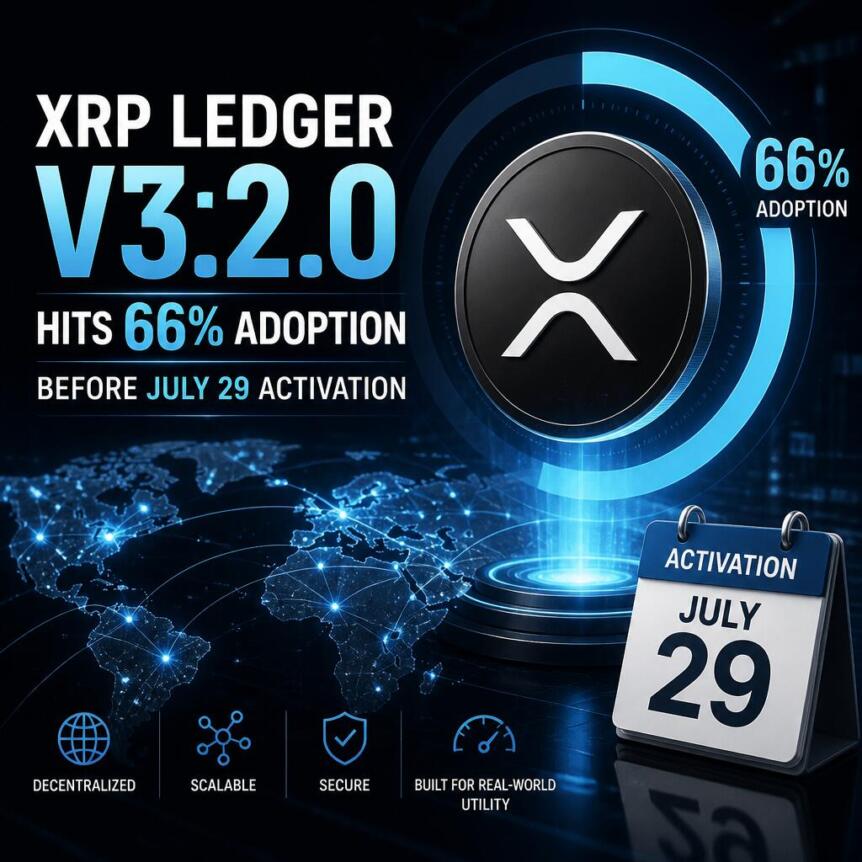
XRP Ledger’s v3.2.0 now runs on 66% of tracked validators as the network approaches a scheduled amendment activation. XRP Ledger’s v3.2.0 has reached 99 validators and 481 nodes across the monitored network. The July 29 activation remains on schedule because validator support continues above the required threshold.
Validator Adoption Expands Across The Network
XRP Ledger’s v3.2.0 currently operates on 57.33% of tracked nodes, according to recent XRPL Explorer data. The tracker recorded 481 updated nodes among 825 observed systems. Adoption has increased since the software became available in June.
However, many operators still use the earlier release across both validator and node infrastructure. Version 3.1.3 remains active on 42 validators, representing 28% of the monitored validator group. Another 323 nodes continue running that version, equal to 38.41% of tracked nodes.
XRP Ledger’s v3.2.0 gives operators access to maintenance fixes before the amendment changes ledger rules. Software installation and amendment approval remain separate processes under XRP Ledger governance. Updated servers receive the code, while validator votes determine whether consensus changes become binding.
Amendment Support Clears The Required Threshold
The fixCleanup3_2_0 amendment currently holds 85.71% validator support ahead of its planned activation. Thirty validators support the proposal, while five validators oppose it. The approval level exceeds the network’s required 80% threshold.
XRP Ledger’s v3.2.0 supports the amendment, but approval must remain above 80% during the full waiting period. XRP Ledger rules require that level for two consecutive weeks. A decline below the threshold would restart the countdown.
The network has scheduled activation for July 29, 2026, at 09:57 UTC. XRP Ledger’s v3.2.0 must remain available across participating infrastructure when the new rules take effect. Unsupported servers may become amendment-blocked and lose the ability to confirm the ledger’s valid state.
Update Addresses Existing Protocol Issues
XRP Ledger’s v3.2.0 fixes problems affecting vaults, lending functions, permissioned trading, and related domain features. The release addresses calculations involving Single Asset Vault deposits and issued shares. It also corrects accounting behavior within the Lending Protocol.
The update includes repairs for the Permissioned DEX, Multi-Purpose Tokens, and Permissioned Domains. XRP Ledger’s v3.2.0 applies maintenance changes to features already introduced through earlier amendments. The package does not center on new consumer-facing products.
The development team also renamed the main server software from rippled to xrpld. XRP Ledger’s v3.2.0 retires amendments that have remained active for more than two years. Developers also continued dividing libxrpl into smaller modules for simpler maintenance and future development.
XRP Ledger’s v3.2.0 remains on course for the July 29 amendment activation after reaching 66% validator adoption. Validator support remains above the required level, while operators using older software still face an update deadline.

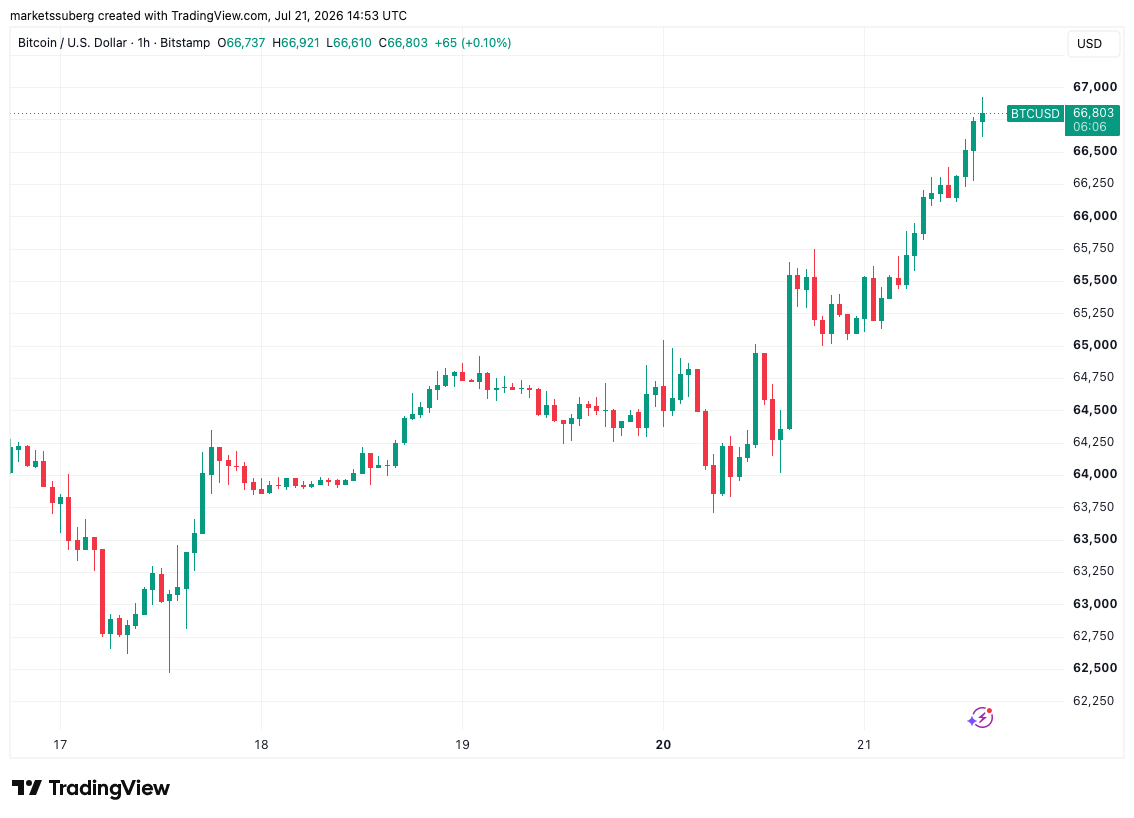
Bitcoin (BTC) built on gains at Tuesday’s Wall Street open as crypto echoed resilient US stock markets.
Key points:
- BTC price action approached $67,000 despite new geopolitical and macroeconomic pressures.
- Neither the US-Iran war nor proposed international trade tariffs were able to disrupt risk-asset upside.
- Bitcoin needed a reclaim of its 21-week simple moving average to challenge the bear market, analysis warned.
Bitcoin, stocks ignore Iran war, fresh US tariffs
Data from TradingView showed BTC/USD approaching $67,000, closing in on seven-week highs.
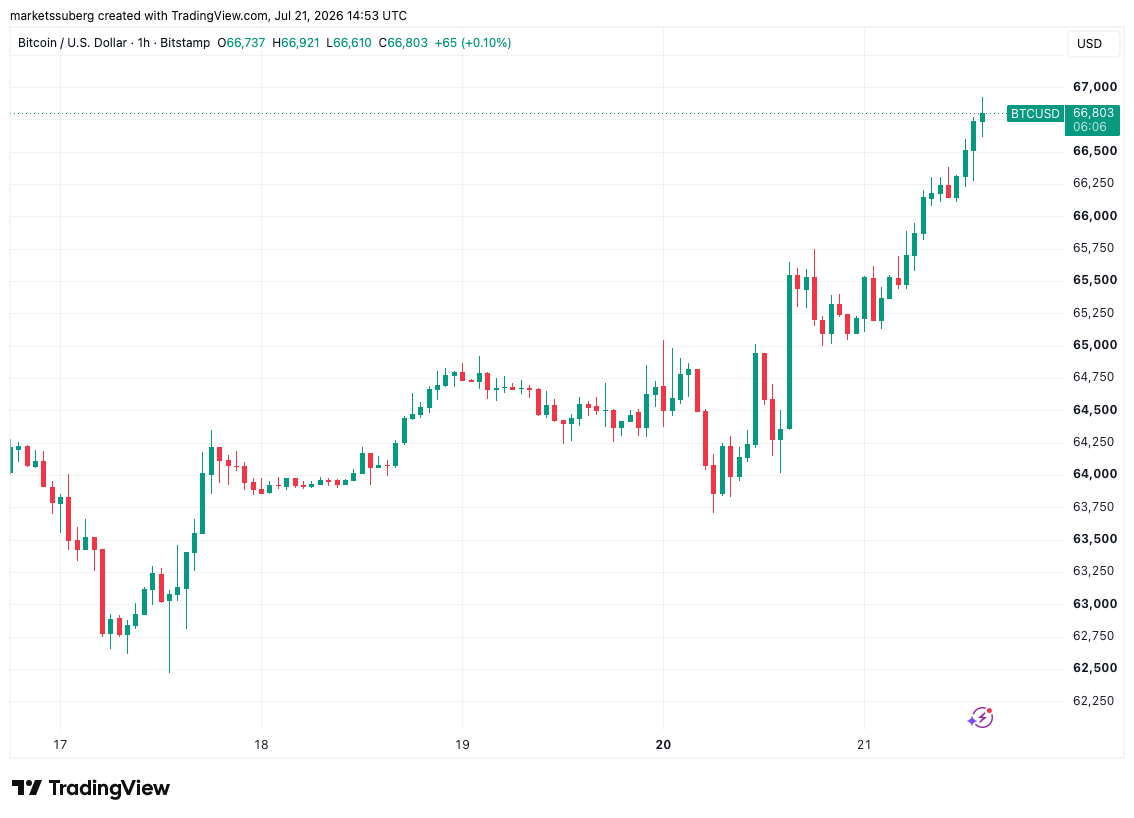
BTC/USD one-hour chart. Source: Cointelegraph/TradingView
Upward momentum that began the day showed little signs of stopping despite macro conditions that seem to favor a risk-off mindset.
The US-Iran war saw further escalation on the day as Iran struck Amazon facilities in Bahrain in response to US strikes, while the Strait of Hormuz oil route remained closed.
As a result, WTI crude oil prices reached their highest levels in over a month, nearing $85 per barrel.
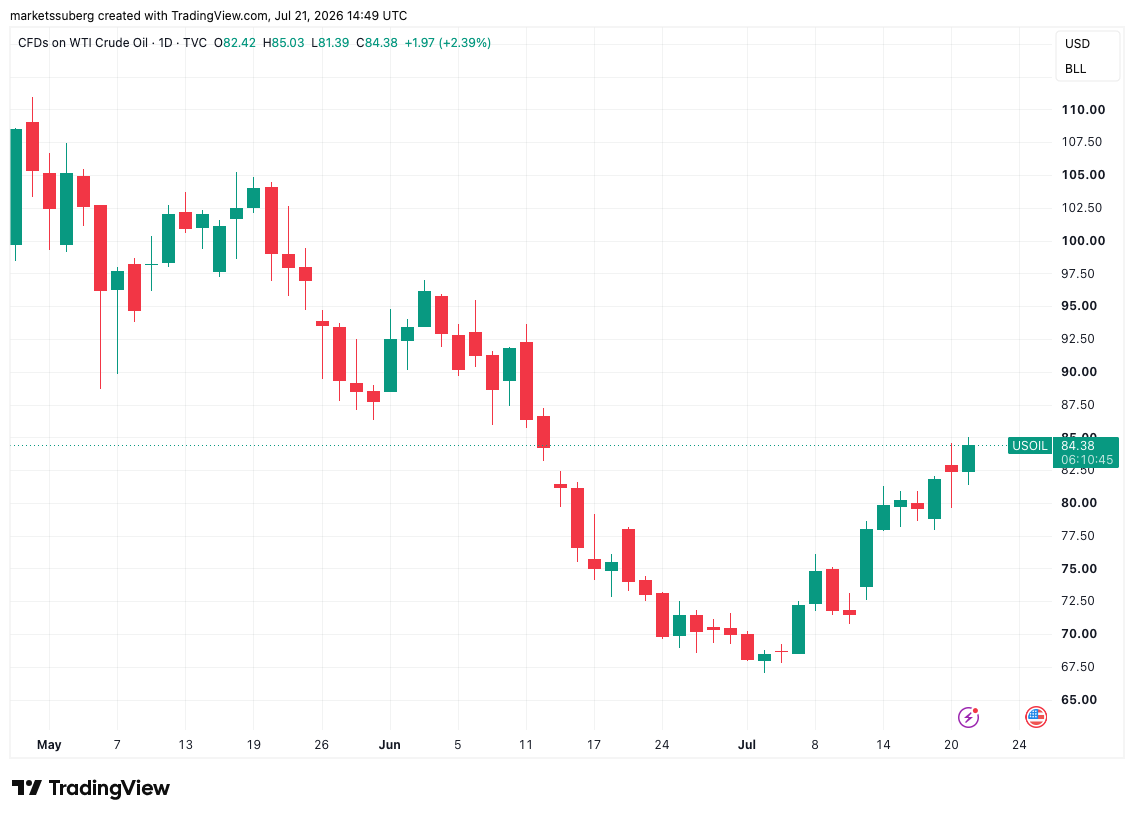
CFDs on WTI crude oil one-day chart. Source: Cointelegraph/TradingView
Multiple media reported US president Donald Trump plans to introduce new 10% international trade tariffs. These would follow 50% measures imposed on Canada this week.
Despite these notional headwinds for crypto and risk assets, traders attributed the lack of bearish reactions to expectations that the situation would ultimately resolve in markets’ favor.
“Markets are pricing in peace,” YouTube channel host Crypto Rover summarized in a post on X to their 1.6 million followers.
Caleb Franzen, creator of Bitcoin and macro analysis resource Cubic Analytics, was confident about the near-term trend in the S&P 500 index.
“I reiterate… I have zero fear, concern, or worry with S&P 500 futures looking like this,” he told X followers on Monday.
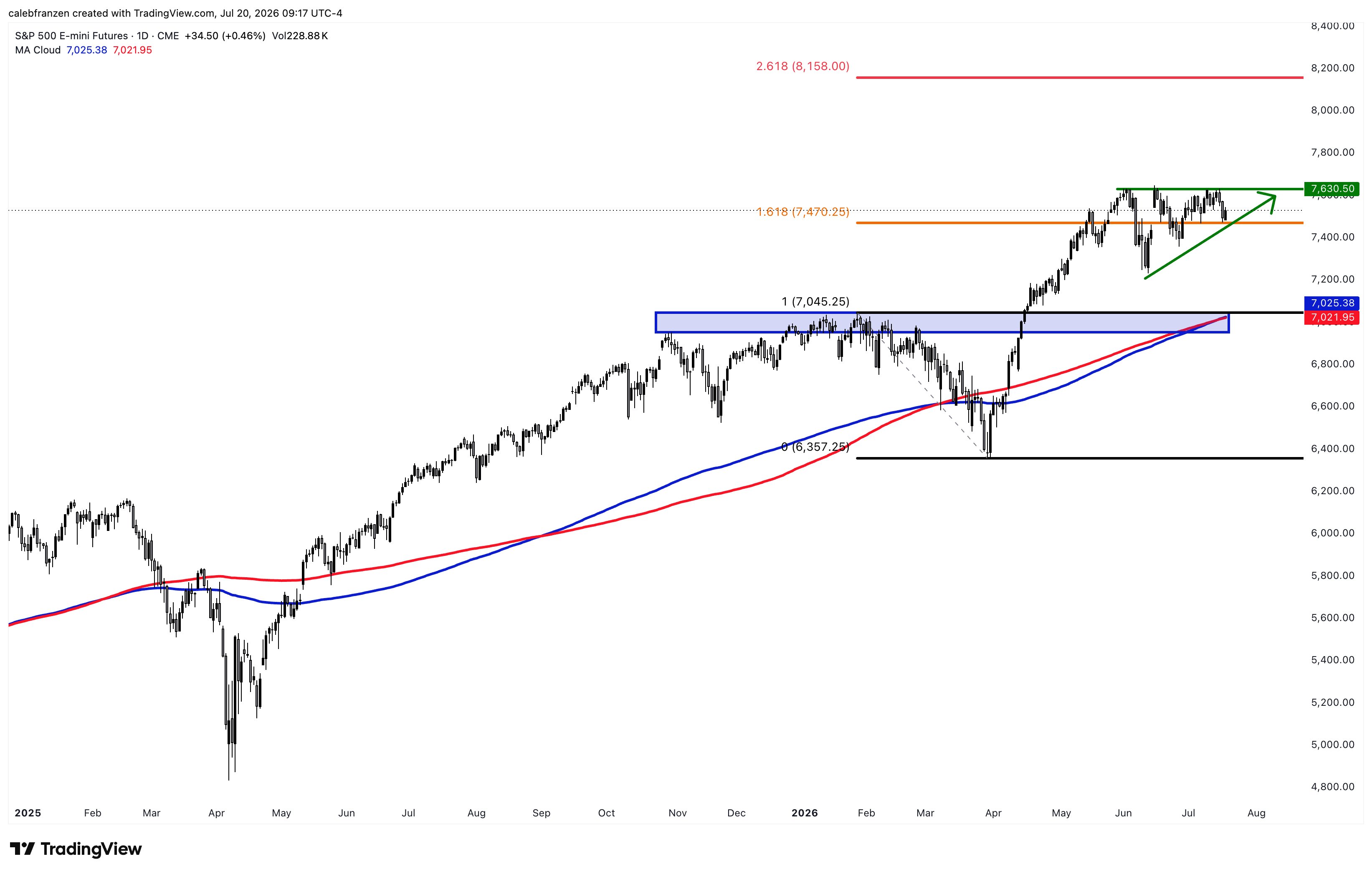
S&P 500 futures one-day chart. Source: Caleb Franzen/X
To be sure, words of caution came from figures such as JPMorgan CEO, Jamie Dimon, who warned that markets were treating current risks too lightly.
BTC price needs 21-week trendline reclaim: Analyst
While some traders looked for a retest of levels up to and including $70,000, Keith Alan, cofounder of trading resource Material Indicators, was conversely cautious on the BTC price outlook.
Related: Trader maintains $67K BTC price target: Five things to know in Bitcoin this week
Despite a “golden cross” involving the 21-day and 50-day simple moving averages (SMAs) on Monday, the bear market, he warned, had gone nowhere.
“Bear Markets don’t always look like Bear Markets, especially in lower timeframes,” he wrote in his latest X analysis.
“The macro trend will be challenged if Bitcoin pushes above the 21-Week SMA. Until that happens, the Bear Market remains intact.”
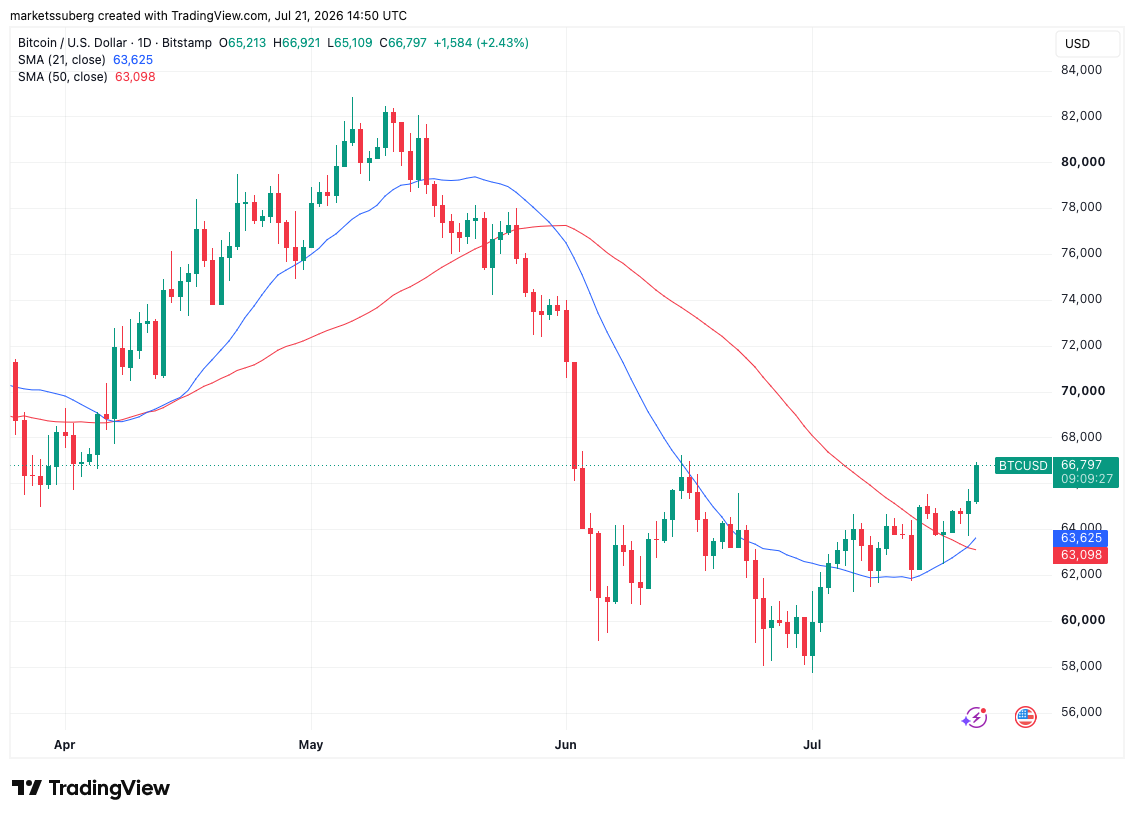
BTC/USD one-day chart with 21-week, 50-week SMA.
Source: Cointelegraph/TradingView
The 21-week SMA stood at $69,720 at the time of writing, coinciding with Bitcoin’s then-all-time high from 2021.
Alan acknowledged that there was “no real resistance” until $67,250.

Speculative activity in the Bitcoin market is showing signs of recovery even as spot market participation remains subdued, according to Glassnode’s latest findings.
The analytics firm said spot trading activity continues to lack conviction, as Spot Volume fell below the lower statistical band of $4.5 billion, which was indicative of persistently weak liquidity and muted investor participation. Such low trading volumes typically accompany periods of consolidation, where markets struggle to build enough momentum for a decisive breakout.
At the same time, Spot Cumulative Volume Delta (CVD) showed that aggressive taker selling has eased compared to the previous week. Although the metric remains in negative territory, the narrowing deficit signals that sellers are becoming less aggressive. The reading is now sitting comfortably within its statistical range as traders reassess their market direction.
While spot markets remain quiet, derivatives data points to a gradual return of speculative appetite.
Derivatives Activity Picks Up
Futures Open Interest, for one, has climbed to $32 billion. Glassnode said the steady increase indicates traders are gradually re-establishing leveraged positions, which has led to higher participation across the futures market.
Long-Side Funding Payments, however, have declined to $1.7 million and are now close to the upper statistical threshold. According to the report, this suggests bullish positioning is still dominant, but traders are paying a smaller premium to maintain long positions. This means that aggressive bullish conviction has moderated compared to recent sessions.
Meanwhile, Perpetual CVD has recovered sharply and has reversed from a net selling bias to a positive $123.2 million. The move into positive territory points to a shift in taker behavior, as aggressive buyers are now exerting greater influence on price action than sellers.
Options Positioning Shifts
Activity in the options market has also strengthened. Options Open Interest rose to $30 billion, as capital committed to derivatives positions increased, although the figure remains slightly below the lower statistical band of $30.3 billion. Glassnode said the trend suggests traders are actively opening new positions. This potentially raises the chances of volatility around major options strike prices.
Simultaneously, the Volatility Spread has narrowed sharply and now sits comfortably within its statistical range, which indicates that implied volatility has largely aligned with realized market movements and that options traders are demanding a smaller risk premium.
This trend was also evident in the Options 25-Delta Skew, which has retreated significantly amidst weaker demand for protective put options and a moderation in bearish hedging activity as sentiment becomes more neutral.
The post Bitcoin’s Spot Market Remains Sluggish, but Derivatives Tell a Different Story appeared first on CryptoPotato.
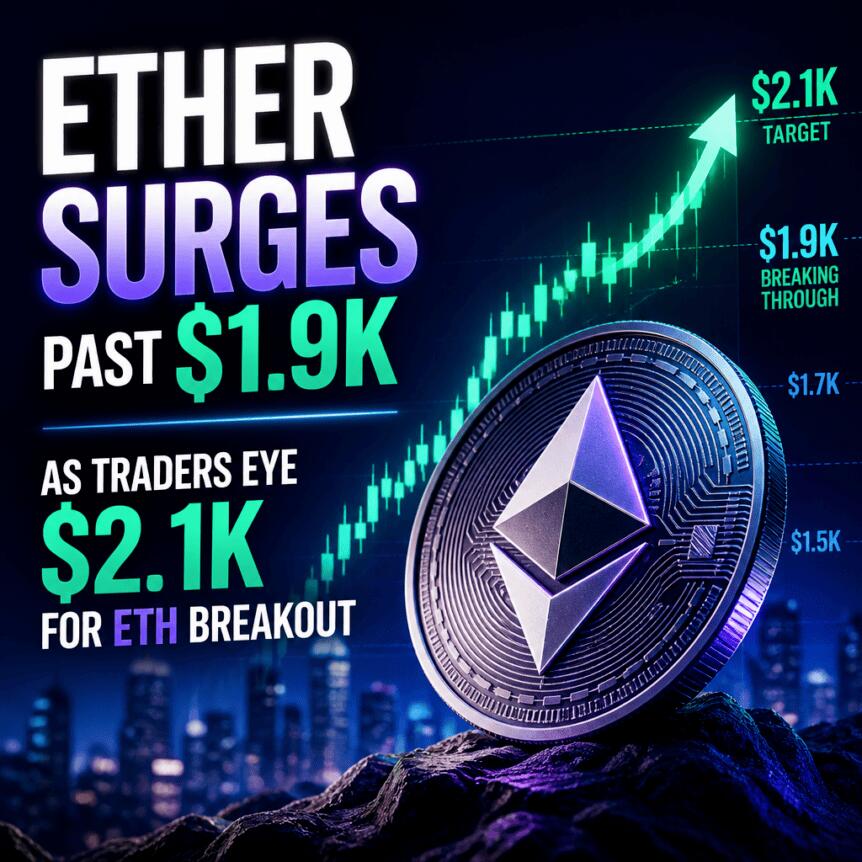
Ether (ETH) is back under fresh pressure from leveraged traders after a sharp push toward the $1,950 area. Tuesday’s uptick helped trigger around $62 million in liquidations tied to bearish positions, as ETH rose roughly 29% from its June 26 low near $1,500 and briefly tested $1,950 for the first time in about seven weeks.
The price move also mirrored a broader improvement in risk appetite. Bitcoin climbed above $66,500, while US equities strengthened after investors reassessed concerns about stretched valuations following the rapid rally in artificial intelligence-related shares.
Key takeaways
- ETH’s breakout attempt near $1,950 came with meaningful leverage-driven liquidations, signaling traders were positioned for downside.
- Ethereum’s fundamentals are not keeping pace: DApp revenues and weekly DEX volumes remain weak versus prior months.
- Record staking participation (34% of ETH supply, per StakingRewards) may dampen sell pressure, but it hasn’t yet translated into stronger onchain demand.
- Derivatives indicators are less bearish than late June, yet ETH perpetual funding has struggled to stay in the typical neutral band.
- Next week’s catalysts from major US tech earnings could determine whether the market’s optimism extends to crypto.
Price rally meets uneven participation across Ethereum
Despite the renewed bullish momentum, Ethereum’s activity metrics suggest caution. The network’s onchain data points to a market that is moving more because of broader sentiment than because usage is clearly re-accelerating.
According to DefiLlama, weekly revenue generated by Ethereum decentralized applications (DApps) fell to $9.8 million—the lowest level since September 2024. That matters because DApp revenue is often seen as a proxy for real demand and user willingness to pay for services, while price strength alone can be driven by derivatives positioning and macro flows.
DefiLlama data also shows decentralized exchange (DEX) volumes sliding to about $7.2 billion per week. In that environment, traders appear to be less enthusiastic about the kinds of high-turnover assets that typically boost activity, including memecoins and certain utility tokens.
The revenue picture is similarly mixed among top applications. DefiLlama notes that some prominent projects have been under pressure on the year, with losses of 50% or more year-to-date reported for tokens including Ethena (ENA), Mantle (MNT), and Arbitrum (ARB). While individual performance doesn’t automatically determine Ethereum’s direction, broad weakness in major ecosystems can limit organic demand during upswings.
Derivatives coolness suggests traders aren’t fully convinced
ETH’s rally has been accompanied by shifts in derivatives sentiment, but not a decisive reset to confident positioning. Laevitas data indicates that the annualized funding rate on ETH perpetual futures has had trouble remaining consistently in a “neutral” 6%–12% range during the past month.
That is an important nuance: when funding stays near neutral, it often indicates more balanced long and short demand. When funding persistently drifts away from that zone, it can suggest one-sided positioning that raises the risk of reversals.
Still, sentiment has improved compared with late June, when funding rates turned negative and reflected stronger bearish demand. The improvement aligns with expectations that staking activity could help reduce downside exposure.
Staking hits a new participation record, but the market still wants catalysts
A key support factor for ETH’s structure has been staking. StakingRewards data shows that a record 34% of the total ETH supply is now staked, up from 33% just one month earlier. In practical terms, higher staking participation can reduce the amount of liquid ETH available for selling, which may lower immediate sell pressure during price rebounds.
The staking narrative is reinforced by continued institutional accumulation activity. The article’s source references Tom Lee’s Bitmine Immersion (BMNR US), which reportedly added 156,719 ETH over the past month, bringing its stake to 4.8% of available supply. Separately, earlier coverage from Cointelegraph highlighted Bitmine’s Ethereum staking generation, underscoring how large holders are positioning through staking rather than liquid trading.
Even so, staking participation alone may not be enough to sustain an upswing if onchain demand remains subdued. The same onchain picture that shows low DApp revenue and declining DEX volumes also helps explain why the derivatives market hasn’t fully “opened the throttle” for longs. In other words: the capital on the sidelines may be more willing to absorb downside than to chase upside.
ETH is also still far from its August 2025 all-time high—reported as 61% below that peak—which can weigh on risk appetite. Traders may remain reluctant to pile in until they see clearer evidence that activity and demand are broadening beyond a macro-driven bounce.
Earnings from US megacaps could influence whether ETH breaks higher
Ether’s ability to extend gains toward the next major psychological level—often framed as $2,100—likely depends on whether risk appetite stays elevated across both traditional markets and crypto. On Tuesday, the immediate backdrop was favorable: stock strength helped ease concerns tied to valuation worries after a fast-moving AI-driven rally.
Looking ahead, the market will be watching corporate results for cues on whether the “risk-on” trend can persist. The report points to 3M Company’s (MMM) earnings after Tuesday’s open as part of the early week catalyst calendar. More importantly for the crypto complex, it also highlights Alphabet’s earnings scheduled for Wednesday after US markets close.
Investors are reportedly focused on cloud services growth, with expectations cited as 64% growth in cloud revenue, amid heavy AI investment. If results and guidance reinforce a stable macro backdrop, it could help restore confidence across risk assets—potentially giving ETH the additional momentum it needs to test higher levels without relying primarily on liquidation-driven moves.
For traders and long-term observers alike, the next signals to watch are straightforward: whether ETH can hold above the recent breakout zone after the liquidation wave, whether DEX volumes and DApp revenue continue to stabilize instead of drifting lower, and whether derivatives funding moves back toward a more sustainably neutral range as macro catalysts land.


BIS researchers have found that dollar-backed stablecoin inflows across more than 130 economies remain largely unaffected by capital controls, exposing a growing challenge for emerging-market governments.
Summary
- BIS found stablecoin inflows remain largely unaffected by capital controls across more than 130 economies.
- Dollar-backed tokens are expanding in emerging markets facing inflation, weak currencies and limited foreign exchange access.
- Nigeria and Latin America show growing stablecoin use for remittances, trade settlement and cross-border payments.
The BIS study compared stablecoin inflows with foreign-currency bank deposits to examine how households and businesses gain exposure to the U.S. dollar during periods of financial stress. Both forms of dollarization increased alongside sovereign crises, banking problems and strong exchange-rate pass-through, but only traditional deposits responded clearly to restrictions on foreign currency and capital flows.
Unlike bank deposits, dollar-pegged tokens can move through crypto exchanges, peer-to-peer markets and self-hosted wallets without passing through domestic banks. According to the researchers, this difference likely exists because “stablecoins are partly circulating outside the regulatory perimeter.”
The results indicate that restrictions designed for bank accounts may have limited influence over digital tokens. While governments can require approval for foreign-currency deposits or restrict transfers through financial institutions, users can still receive, hold, and send stablecoins through blockchain networks.
Researchers also found that deposit and stablecoin dollarization tend to persist once established. Their analysis showed little evidence that users simply replace foreign-currency deposits with stablecoins, suggesting the two channels can expand at the same time instead of competing for the same demand.
Capital controls are failing to contain stablecoin demand
Dollar-pegged tokens could weaken monetary sovereignty if households and companies increasingly store or transact in U.S. dollars outside regulated banks, the BIS study warned. The risk is more pronounced in emerging and developing economies where inflation, currency depreciation or restricted access to foreign exchange makes dollar assets attractive.
Capital controls have historically reduced some forms of deposit dollarization because banks must enforce domestic rules. Stablecoin inflows, however, were broadly similar in economies with and without such restrictions, according to the BIS.
Digital tokens have bearer-like features and can be transferred through unhosted wallets, making complete enforcement difficult. The BIS Annual Economic Report 2026 noted that blocking domestic intermediaries from handling unapproved stablecoins may limit some transactions, but such measures are likely to remain imperfect.
Despite the concern over monetary sovereignty, the study found little evidence that moderate deposit dollarization materially weakens monetary-policy transmission. Economies with higher foreign-currency deposits did, however, show a somewhat higher risk of elevated inflation.
Stablecoins may present different policy problems because their use can extend beyond savings into payments, trade settlement and remittances. As transactions leave the banking system, authorities may also lose access to information normally collected by regulated financial institutions, limiting their view of capital movements.
The BIS findings suggest policymakers may require controls designed for blockchain-based assets rather than relying only on rules created for bank deposits. Any response would need to account for foreign exchanges, peer-to-peer transfers and self-hosted wallets, all of which can keep activity outside domestic financial channels.
Emerging markets are driving stablecoin payment adoption
Nigeria illustrates how economic pressure can push stablecoins into daily financial activity. The International Monetary Fund found that stablecoins accounted for more than 65% of the country’s cross-border crypto inflows in 2024, with total inflows approaching the value of recorded remittances by 2025.
According to the IMF, Nigerian households use USDT and USDC for family remittances, crypto investments and access to dollar-denominated value. Small and medium-sized importers have also used the tokens to pay foreign suppliers, while some large companies have tested them for trade settlement.
Inflation, naira depreciation and limited access to foreign currency made stablecoins more attractive during 2023 and 2024, the IMF reported. When the Central Bank of Nigeria restricted banks from serving crypto users in 2021, activity moved toward less regulated peer-to-peer markets instead of disappearing.
Stablecoins can cut payment time and reduce dependence on correspondent banks, according to the IMF. However, the institution warned that heavy use of dollar tokens could lower demand for the naira and move more transactions beyond the reach of Nigerian regulators.
A similar pattern has emerged in Latin America. Bitso Business reported an 81% year-over-year increase in stablecoin payment volume during the first half of 2026. The company also found that Tether’s USDT and Circle’s USDC represented 40% of regional crypto purchases in 2025, overtaking Bitcoin for the first time.
Across the crypto market, stablecoin capitalization has risen to about $309.7 billion from roughly $260 billion a year earlier. The increase gives dollar-backed tokens a larger role in payments and savings while adding urgency to the regulatory concerns identified by the BIS.
BIS research has also separated privately issued stablecoins from tokenized bank money. Through Project Agorá, eight central banks and more than 40 regulated institutions have tested cross-border settlement using tokenized commercial-bank deposits and central-bank reserves, according to the institution’s 2026 report.
That model keeps tokenized payments inside a regulated two-tier banking system, while stablecoins can circulate beyond it. For policymakers, the contrast explains why existing capital controls may struggle to contain digital dollarization even as demand for faster cross-border payments continues to grow.
The White House has accepted what it calls the most extensive federal ethics restrictions ever proposed as the CLARITY Act seeks the Democratic votes needed to clear the Senate’s 60-vote threshold.
Summary
- The White House accepted extensive ethics rules addressing Democratic concerns over Trump’s crypto interests.
- CLARITY still needs Democratic support to reach the Senate’s 60-vote threshold.
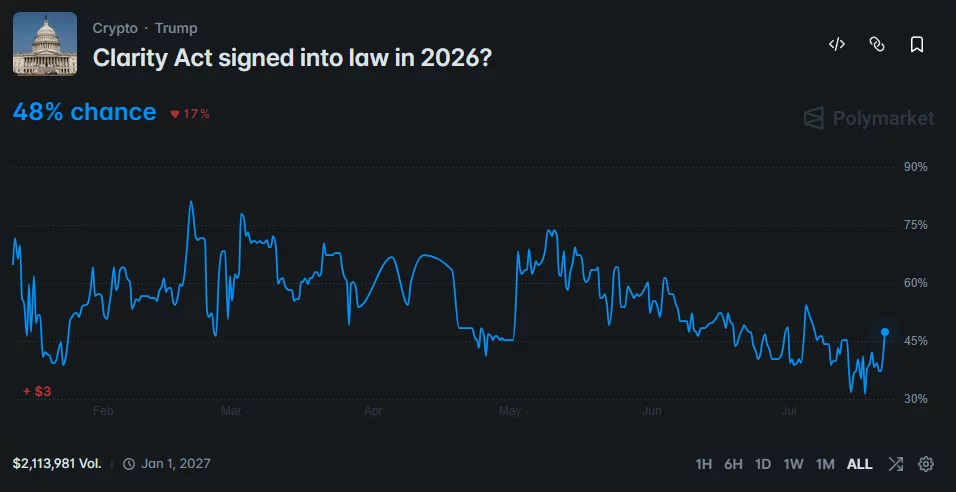
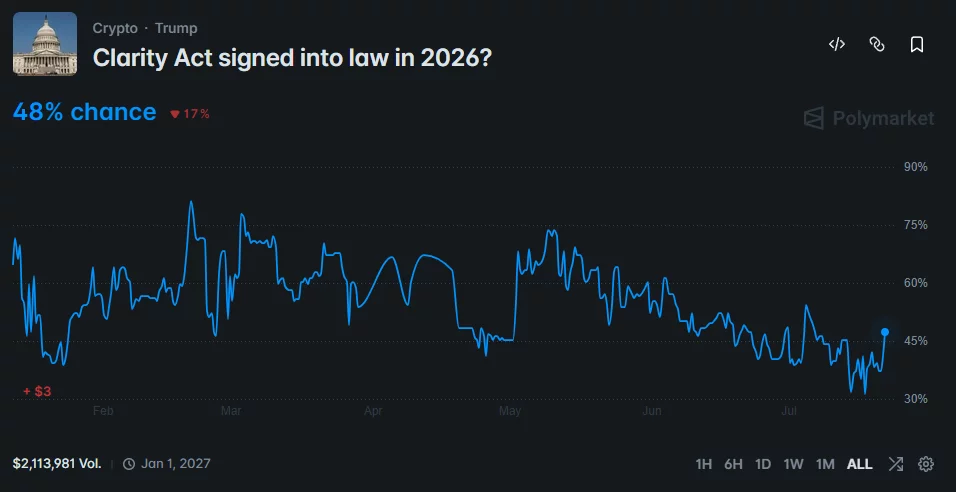
- Bitcoin topped $66,000, while Polymarket placed the bill’s 2026 passage odds at 48%.
Punchbowl News reported on Tuesday that White House officials reached an agreement on ethics language during talks with Republican Senators Cynthia Lummis and Bernie Moreno. The provision could apply to President Donald Trump’s crypto interests, although neither senator has released its wording or explained how it would be enforced.
A White House official confirmed the concession in a recent statement, describing the proposed language as “the most comprehensive and wide-ranging ethics provision in history.” According to the official, the administration had “bent over backward” to address concerns raised by Democratic lawmakers.
The agreement removes one of the main disputes holding up the Digital Asset Market Clarity Act, but it does not guarantee enough Democratic support for passage. The Senate has not published its final text or placed a floor vote on its calendar, leaving lawmakers with a limited window before the chamber’s August state work period.
Ethics deal removes a key Senate obstacle
Democratic senators have made restrictions on political crypto dealings a condition for supporting the legislation. Elizabeth Warren, Chris Murphy, Jeff Merkley and Chris Van Hollen previously argued that a market structure bill would be “worthless” unless it addressed Trump’s links to the digital asset industry.
Their concerns include Trump’s namesake memecoin and his family’s involvement with World Liberty Financial. Democrats have also requested congressional hearings into the president’s investments and other connections to crypto companies before the Senate holds a vote.
Details of the White House compromise remain unclear, including whether its limits would cover the president’s family and which authority would enforce them. Barron’s reported that some Democrats were concerned enforcement could rest only with the Trump-controlled Department of Justice instead of also allowing action by state attorneys general.
Earlier negotiations had shown how difficult the ethics issue could be. Patrick Witt, executive director of the President’s Council of Advisors for Digital Assets, told CoinDesk in May that the administration supported rules applying “from the president all the way down to the brand new intern on Capitol Hill,” but opposed provisions written against one official or family.
Senate negotiators have resolved or narrowed some other disputes while the ethics talks continued. Coinbase vice chair Ryan VanGrack recently said that Democrats had secured stronger customer safeguards, giving the Senate legislation “more teeth” than earlier versions.
“At the end of the day, this is about customer protections. The status quo lacks this infrastructure, lacks these protections, and the Democrats used this opportunity, wisely, to make sure that customers were first and foremost in [this bill].”
Stablecoin rewards, anti-money laundering controls, tokenized securities and protections for software developers have also complicated negotiations. As reported by crypto.news in May, the Senate Banking Committee advanced the bill with support from every Republican on the panel and Democratic Senators Ruben Gallego and Angela Alsobrooks, producing a 15-9 vote.
Despite backing the committee action, Gallego and Alsobrooks did not commit to supporting the eventual floor version because negotiations were still underway. Republicans would therefore need to preserve that support and attract more Democrats to reach 60 votes in the full Senate.
The House passed its CLARITY Act version in July 2025 during Republicans’ “Crypto Week.” The proposal would divide oversight of digital assets between federal regulators and set standards for deciding when tokens fall under securities or commodities rules.
Bitcoin rises while passage odds remain below 50%
Crypto-linked markets climbed after reports of the White House agreement. Bitcoin traded above $66,000 on Tuesday and reached a seven-week high, while Coinbase shares rose about 10% and Circle gained roughly 7%.
Prediction-market traders remained less convinced. A Polymarket contract shown on Tuesday assigned a 48% chance that the CLARITY Act would become law in 2026, down 17 percentage points, with about $2.11 million in recorded volume. The contract’s pricing indicated that traders still viewed passage as uncertain despite the reported ethics agreement.
President Trump had pressed senators to approve the legislation “in honor of” the late Senator Lindsey Graham, whom he described as a major supporter of the measure. Industry executives, including Coinbase representatives, have also urged Congress to establish federal market rules.
Still, the missing legislative text leaves the effect of the ethics compromise untested. Until Democratic senators review the provision, disclose their positions and help schedule a floor vote, the White House agreement remains a potential route to 60 votes rather than proof that the CLARITY Act will pass.
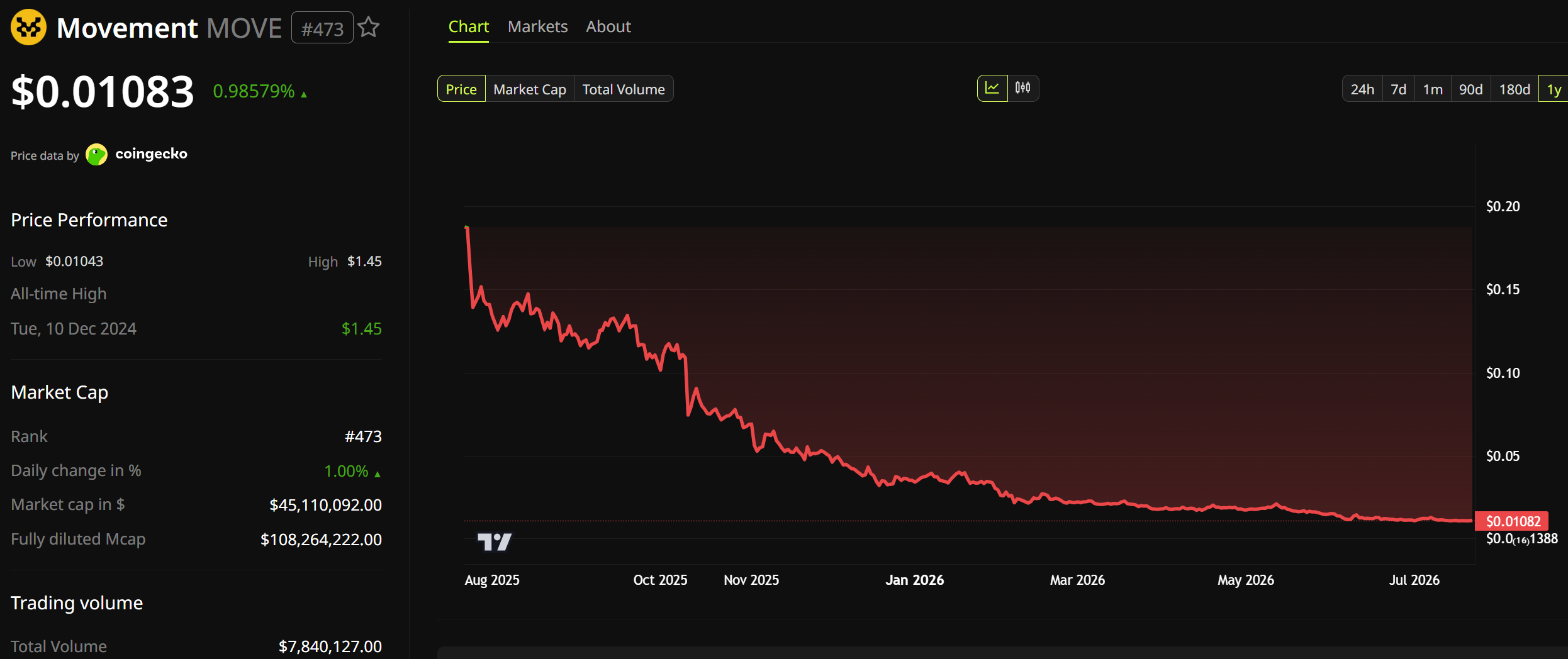
MVMT Labs, Inc., the original developer of the Movement blockchain, filed for Chapter 11 bankruptcy in Delaware on July 15, 2026. Days later, the Movement (MOVE) token slid to an all-time low of $0.0104.
Move Industries, the separate company that took over ecosystem development in 2025, says the case does not touch its operations. MOVE trades near $0.0108, down 94% over the past year.

Inside the MVMT Labs Bankruptcy Filing
Court records show a voluntary Subchapter V petition, a streamlined Chapter 11 track for small businesses. Case 26-11113 sits before Judge Thomas M. Horan in the District of Delaware.

The petition lists assets between $100,001 and $1 million against liabilities of $1 million to $10 million. Creditors number between 200 and 999.
The estate is a fraction of the project’s former scale. MOVE peaked at $1.45 in December 2024 before a disputed market making deal dumped 66 million tokens on launch day and crushed the price.
The fallout produced a market maker misconduct probe, a Binance ban on the account involved, and exchange delistings. MVMT Labs also faces a Delaware Chancery lawsuit from suspended co-founder Rushi Manche.
Move Industries Says It Is Full Steam Ahead
The remaining team rebranded to Move Industries in May 2025 under CEO Torab Torabi. It pivoted toward stablecoin payments for emerging markets this June. On July 21, Torabi rejected talk of a project collapse.
Follow us on X to get the latest news as it happens
Markets have yet to reward that confidence. MOVE holds a $45 million market cap at rank 473, and its price action this week will show whether traders buy the separation.
The court expects a restructuring plan by October 13, 2026, which may reveal what remains inside the bankrupt entity.
The post MOVE Hits All-Time Low After MVMT Labs Bankruptcy: What Happens Next? appeared first on BeInCrypto.


Aztec Network, an Ethereum Layer 2 built for private smart contracts, said on Tuesday that its Alpha V5 release is live on mainnet, calling it "the fastest private transactions we've ever shipped." The company said Alpha V5 proves a fully private transaction in about 2.5 seconds on a laptop and… Read the full story at The Defiant
Crypto World
Jack Mallers Questioned MicroStrategy’s Bitcoin Strategy, Now He’s Stepping Down From Twenty One
Jack Mallers has stepped down as CEO of Twenty One (XXI), the Tether-backed Bitcoin treasury firm. His exit lands months after he publicly pressed Michael Saylor over mNAV math and digital credit yields.
The Strike founder says he quit after clashing with the board over the company’s direction. Critics now tie his exit to the doubts he raised on stage earlier this year.
Board Disagreements End Jack Mallers’ Twenty One Tenure
Mallers announced the decision this week. XXI began trading on December 9, 2025, so his run lasted just seven months. The firm went public with roughly 43,500 BTC, worth about $4 billion at the time. Tether, Bitfinex, and SoftBank backed it.
Tether took full control in May 2026 by buying SoftBank’s entire stake.
He shared more detail in follow-up posts. He walked away, he said, because “the board and I couldn’t agree on the future of the company.”
He also denied a claim by X’s Grok chatbot that he collected $140.8 million in pay. His forfeited options, he noted, now expire worthless.
The exit leaves the second-largest corporate Bitcoin treasury fully in Tether’s hands. XXI is already rethinking its model. Incoming CEO Raphael Zagury wants cash flow, not just more Bitcoin buying.
The Saylor Questions That Resurfaced After His Exit
The backstory makes the exit sting more. At BTC Prague earlier this year, Mallers challenged Saylor from the audience over mNAV. The metric shows how much the market pays for each dollar of Bitcoin a treasury firm holds.
His concern was simple. Some firms count securities as equity even when they are far from turning into shares. That inflates the metric. In an interview at the event, he explained the question he put to Saylor.
“…do you agree with classifying out of the money securities as equity, which obviously that would inflate the equity value, which would make an MNAV metric more attractive,” Mallers said.
He used XXI’s own convertible bond as the example. The bond turns into stock at $13 per share. However, the stock traded near $5 at the time, so that switch was nowhere close.
On a panel the same day, Mallers took aim at digital credit. These products pay investors a big yearly dividend that never stops.
Stretch, sold by Strategy, paid 11.5% when Mallers spoke. SEC filings show the rate rose to 12% in July. His question was simple. Who pays that bill without real revenue?
“You’re not doing anything productive in the economy to produce cash flow that can afford the money that you want to give to your grandmother. So, who’s coming up with the money?” he said during the panel.
Saylor responded at length at the time. He framed mNAV as one metric among several and defended the model’s math.
Those clips are now everywhere again. Many read them as proof that Mallers doubted the sector’s core math long before he left it.
Rug Pull Claims Meet a Firm Denial
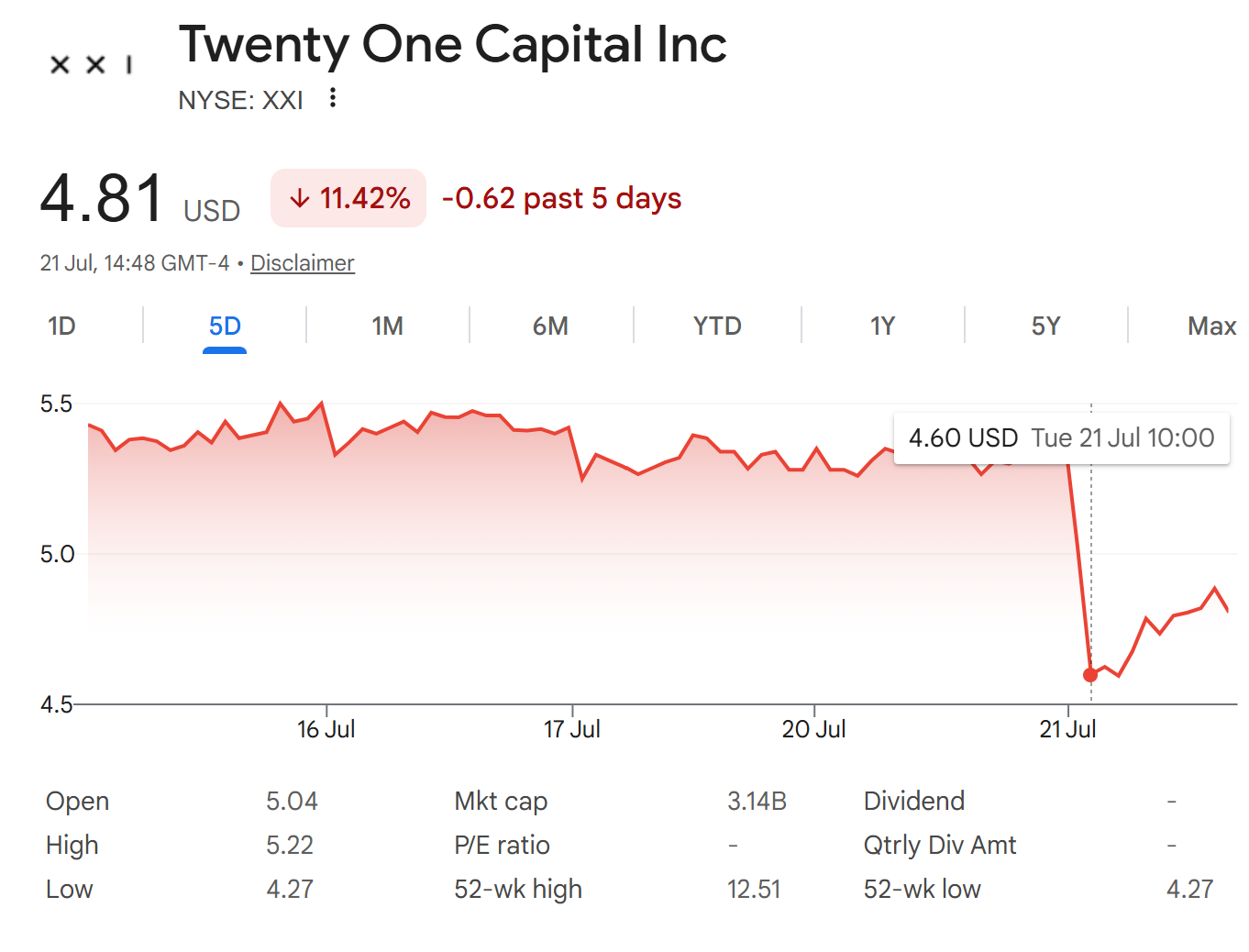
The market’s verdict was quick. XXI closed near $4.60 on Tuesday, down 13.5% in a day. Early backers paid $10 per share, so they have lost more than half their money.

Critics on X claim losses of up to 85% from the stock’s peak, and some accused Mallers of abandoning shareholders.
He pushed back hard.
“Rug pull? Who pulled what rug? I resigned voluntarily, took no severance, forfeited my options, and walked away because it was the right thing to do. Twenty One also never sold shares via an ATM while I was CEO,” Mallers replied on X.
Reactions split into three camps. Investor Mike Alfred praised the move as a sign of clarity and alignment. BnkToTheFuture founder Simon Dixon went further. He framed it as Mallers walking away from wrapped securities entirely.
A third camp sees a warning for the digital asset treasury (DAT) sector. The model looks strong while premiums grow, they argue. The real test starts when mNAV compresses and capital dries up.
The rankings could shift too. Metaplanet crossed 43,000 BTC in July. That nearly matches XXI’s stash of roughly 43,500 BTC, putting the second spot in play.

The debate lands with Bitcoin (BTC) near $66,600 on Tuesday, a five-week high. Mallers, meanwhile, returns his full attention to Strike. There, he wants cash flow, not dilution, to fund Bitcoin buying.
Whether his warnings prove right now depends on XXI’s next chapter under Tether. If the restructured company delivers without the metrics he questioned, his critique may fade with the drawdown that fueled it.
The post Jack Mallers Questioned MicroStrategy’s Bitcoin Strategy, Now He’s Stepping Down From Twenty One appeared first on BeInCrypto.


Russia’s State Duma approved a sweeping crypto bill on July 21 that brings trading into a licensed financial system. Industry critics say the rules could dismantle the market they claim to regulate.
Lawmakers passed Bill No. 1194918-8 in its second and third readings on the same day. It still needs approval from the Federation Council and President Vladimir Putin.
The main rules would start on September 1, followed by a transition period ending July 1, 2027.
A Legal Market With Narrow Doors
The bill allows individuals and companies to buy and sell crypto through licensed Russian intermediaries.
These will include brokers, asset managers, exchanges, digital depositories and a new class of registered crypto exchangers.
A digital depository would hold and record customers’ crypto, much like a traditional custodian. Crypto payments for goods and services inside Russia will remain prohibited.
Retail investors must pass a test and may buy only the most liquid assets selected under Bank of Russia criteria.
Their limit will be 300,000 rubles per year through each intermediary. Current criteria would likely admit Bitcoin, Ethereum, and USDT. Qualified investors face no purchase cap.
Foreign Exchanges Lose Their Banking Rail
From July 1, 2027, Russian banks will have to block direct payments to unlicensed foreign exchanges.
GMT Legal founder Andrey Tugarin said users will no longer be able to fund overseas platforms directly through Russian banks after that date.
Some crypto transfers will also face a 48-hour anti-fraud cooling period. The thresholds will be 300,000 rubles for transfers inside Russian infrastructure and 100,000 rubles when assets move into international infrastructure.
A Market Built From Scratch
Registered exchangers will need at least 15 million rubles in capital. They must install anti-fraud systems, separate client assets from company funds and meet strict compliance, staffing and cybersecurity rules.
“Crypto exchangers are a completely new legal form,” Tugarin said. No existing Russian company automatically holds that status.
However, the bill gives exporters, importers, miners, exchangers and depositories wider access to crypto for foreign trade. It also creates a clearer route for USDT, USDC and other stablecoins by classifying them as foreign digital instruments.
“This Is a Ban”
Exved founder Sergey Mendeleev said the industry had submitted detailed proposals since December 2025, but lawmakers largely ignored them.
He argued that the framework favours selected banks, exchanges and foreign-trade participants while restricting ordinary users and existing crypto businesses.
Traditional financial firms could also lose millions before realising crypto trading will not produce the margins they expect, he said.
“This is not regulation. It is a ban. Like casinos or forex,” Mendeleev concluded.
The bill creates legal crypto access through a tightly controlled domestic system. Its survival will depend on whether users and businesses accept those limits or continue operating outside it.
The post Russia’s Duma Approved a Crypto Bill That Could Destroy Its Market appeared first on BeInCrypto.
Bitcoin price has retreated from nearly $67,000 after escalating U.S.-Iran hostilities pushed oil prices higher and tempered optimism created by progress on the CLARITY Act.
Summary
- Bitcoin pulled back after briefly touching $66,965 as sellers defended the $67,000 resistance level.
- CLARITY Act progress, ETF inflows and short liquidations fueled BTC’s rapid advance.
- Rising oil prices and the U.S.-Iran conflict threaten a sustained breakout toward $70,000.
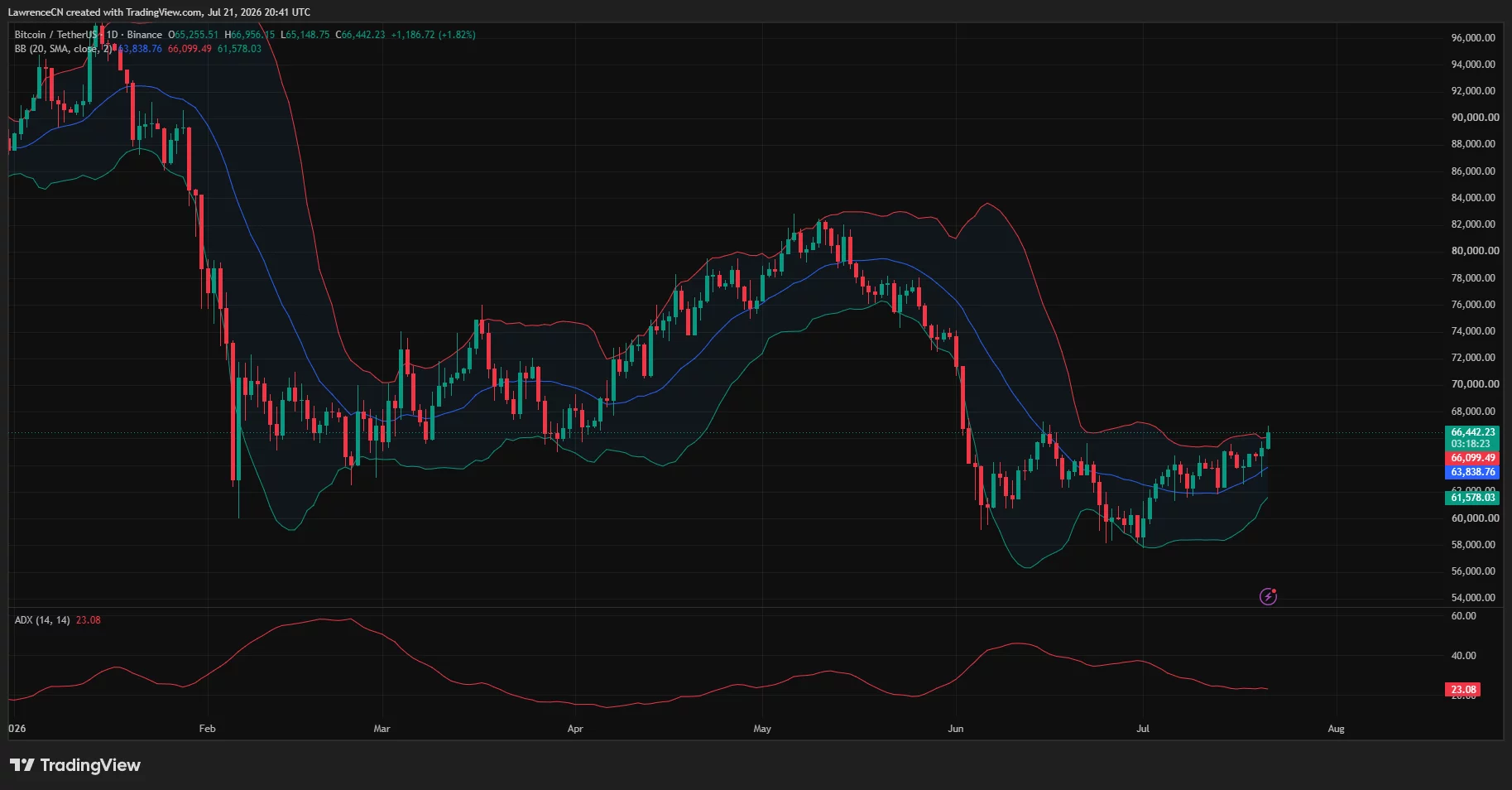
According to data from crypto.news, Bitcoin (BTC) price rose from an intraday low of $65,149 to $66,965 on July 21 before sellers forced the price back to about $66,440. The asset remained up 1.8% on the day, but its failure to hold $67,000 showed that traders were unwilling to chase the rally as energy and inflation risks returned.
CLARITY Act progress and ETF inflows have fueled Bitcoin’s rally
Bitcoin’s advance began after the White House and Senate negotiators reached an agreement on an ethics provision that had delayed the Digital Asset Market Clarity Act. Treasury Secretary Scott Bessent described negotiations as being at the “1-yard line,” while senators suggested the bill was close to a final vote.
The proposed ethics rules address concerns about elected officials and senior government figures holding or promoting crypto assets while in office. Reports that President Donald Trump had accepted the provision helped crypto-linked stocks rally, with Coinbase and Circle shares gaining as much as 10% during the session.
U.S. spot Bitcoin exchange-traded funds added another source of demand. According to SoSoValue data, the funds recorded about $227 million in net inflows on July 20, their fifth consecutive positive session and their longest inflow run since April.
The ETF streak followed a difficult June, when investors withdrew billions of dollars from the products. Five days of fresh allocations have helped absorb available supply while Bitcoin has recovered from its June low near $58,000.
Spot activity also remained firm during the latest advance. Commenting on the order flow, analyst Ted Pillows wrote:
“Consistent spot buying for BTC now. This looks much better.”
Leverage amplified the initial breakout. Market data showed roughly $223 million in crypto positions liquidated over 24 hours, including about $181 million in shorts. Forced purchases by bearish traders helped Bitcoin clear $65,000 and accelerate through the $66,000 resistance area.
A separate derivatives event later exposed the rally’s fragility. According to trader Daan Crypto Trades, a position worth more than $100 million appeared to close at market, erasing over $250 million in Bitcoin open interest within one minute.
BTC briefly fell toward $65,900 before recovering most of the decline, which Daan attributed to a possible execution error or an attempt to trigger cascading liquidations.
Oil risks and overhead supply have blocked a clean $67,000 breakout
Oil prices have complicated the bullish setup. U.S. crude climbed about 2.6% to $84.70 per barrel, its highest level since June 12, as supply fears grew across the Strait of Hormuz and the Red Sea.
Washington carried out a tenth consecutive day of strikes against Iran, while Trump warned that Tehran “will pay” for attacks that killed American soldiers. Reuters also reported damage to a tanker near the Strait of Hormuz and disruption involving Saudi crude shipments after threats from Iran-aligned Houthi forces.
Higher energy costs could feed into July inflation and give the Federal Reserve less room to support financial markets. The dollar strengthened as traders reassessed the chances of higher interest rates, creating a potential headwind for Bitcoin and other speculative assets.
On the daily chart, BTC has moved above the Bollinger Band midpoint at $63,839 and briefly exceeded the upper band near $66,100. Trading above the upper band confirms strong buying pressure, but the rejection from $66,965 raises the risk of a pullback toward the band’s midpoint.
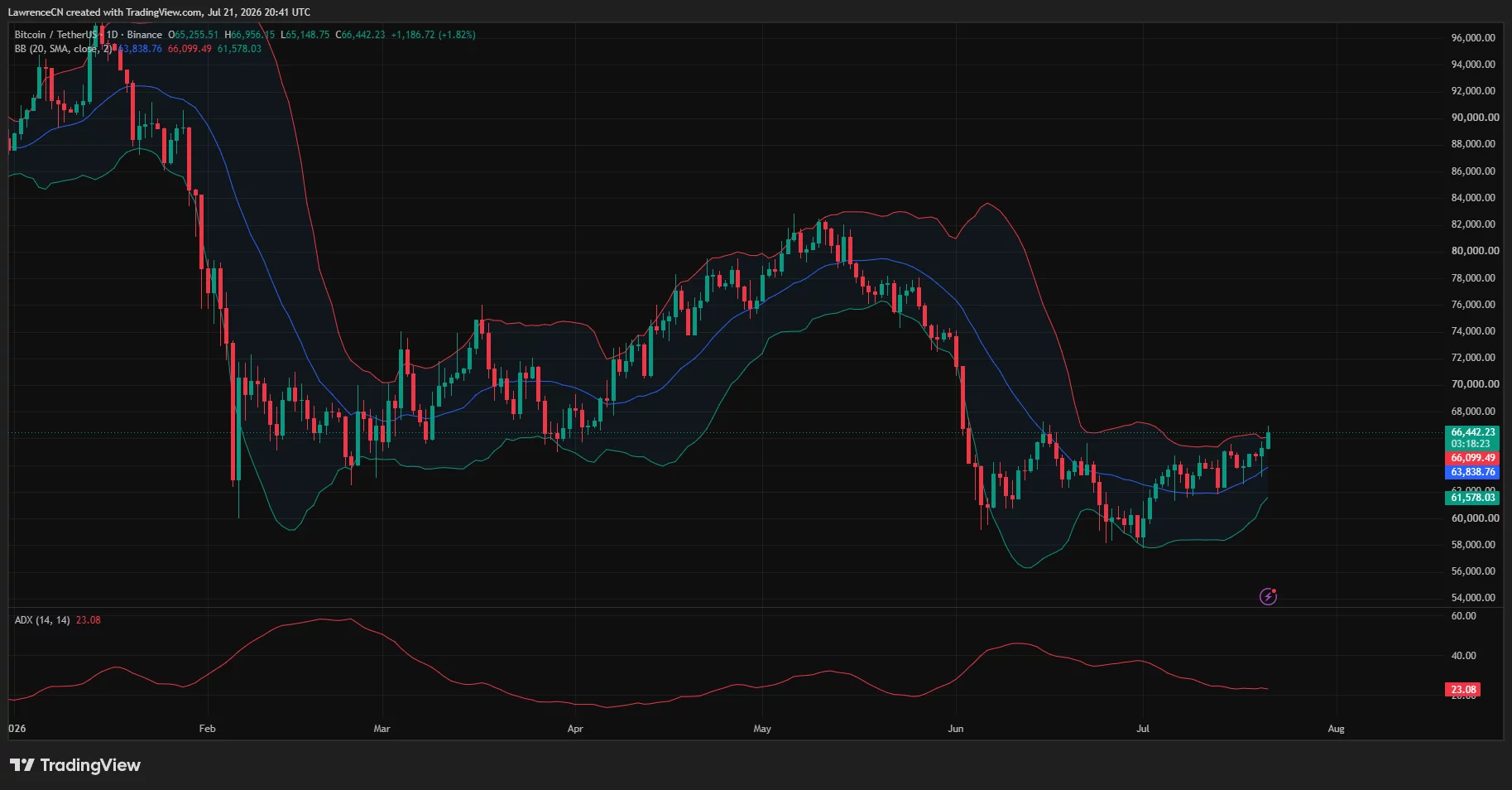
The Average Directional Index stood at 23.08. A reading below 25 means the daily trend has not yet gained enough strength to confirm a sustained directional move, despite Bitcoin’s recovery from the June trough.
Bitcoin has also reached the upper boundary of an ascending parallel channel on the four-hour chart. Resistance sits between $67,000 and $67,800, while the channel floor runs near $64,000. A four-hour close above $67,800 would clear the structure and expose $69,500, followed by the psychological $70,000 level.
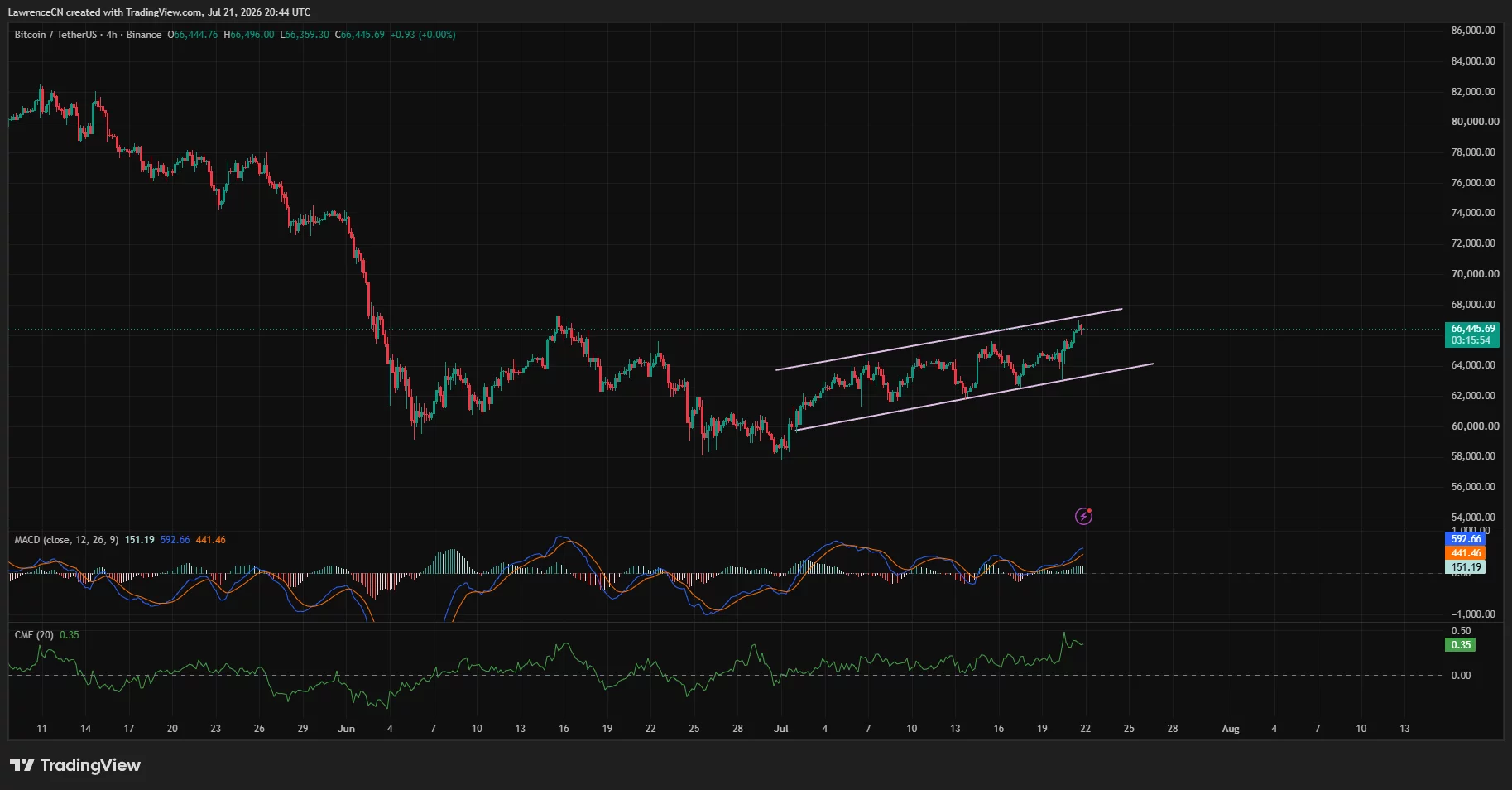
Momentum still favors buyers. The four-hour MACD line stood at 592.66, above its 441.46 signal line, while the positive histogram reached 151.19. The Chaikin Money Flow reading of 0.35 showed that capital continued to enter the market despite the rejection.
CoinGlass’ three-day liquidation heatmap places the closest overhead leverage around $66,800 to $67,300, with another concentration near $68,000. A move through those levels could force additional short closures. Below price, liquidation pools appear around $65,300, $64,800, and $64,200.
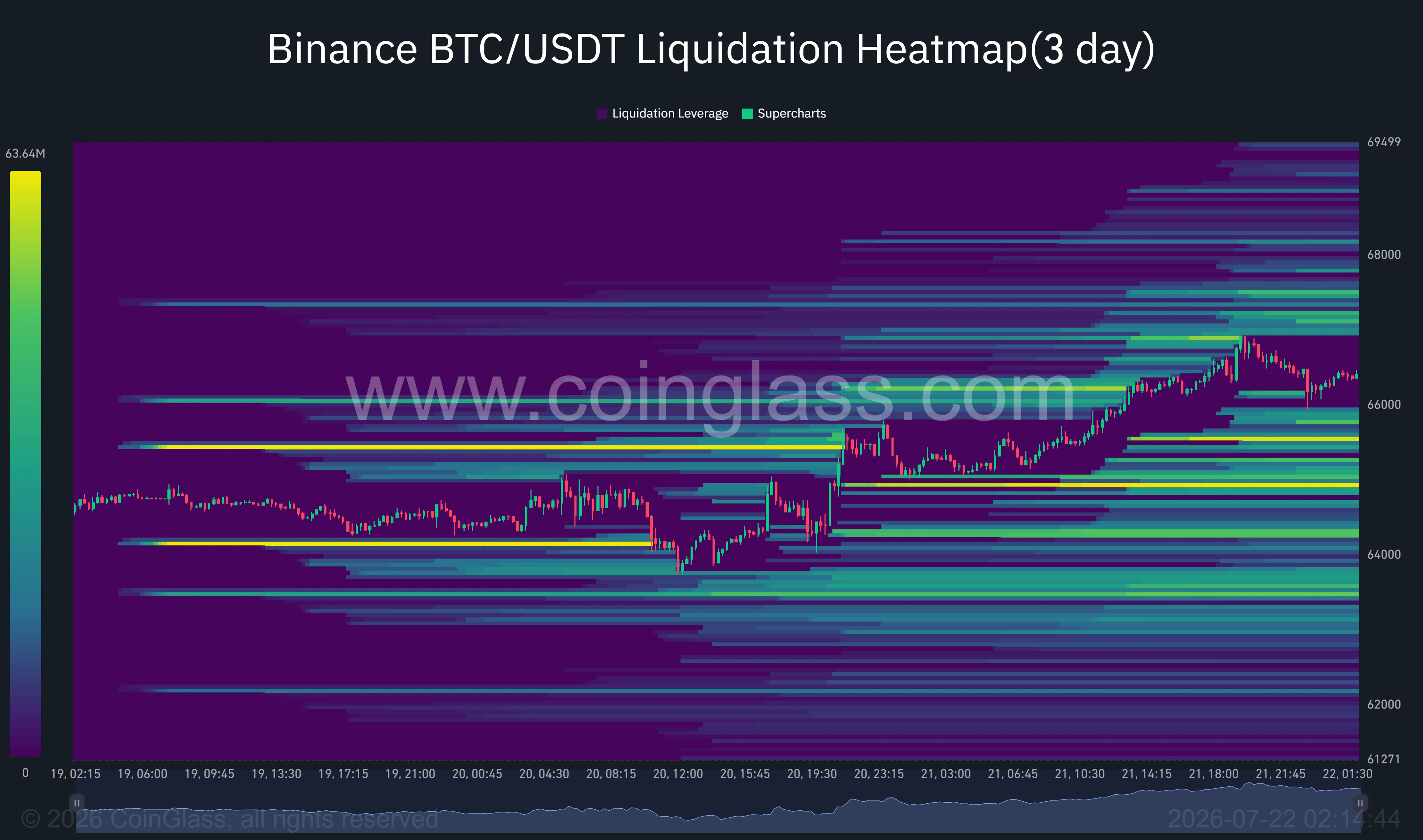
The bullish case would weaken if BTC closes below the channel floor and loses the daily Bollinger midpoint near $63,800. Such a breakdown could expose the lower daily band at $61,578, while renewed oil gains, further military escalation, or declining ETF inflows would add pressure. Bitcoin must therefore convert $67,000 into support before the latest recovery can extend toward $70,000.
Disclosure: This article does not represent investment advice. The content and materials featured on this page are for educational purposes only.

Punchmade Dev – Fast Money (Music Video)

Can YOU guess Burnham’s new Cabinet based on childhood photos?

(VIDEO) 10 Things to Know About TUIDE, HYBE’s Highly Anticipated New K-Pop Girl Group Set to Debut This Year


-
 NewsBeat5 days ago
London Mayor Sadiq Khan handed a peerage by Keir Starmer alongside 15 other Labour figures… just days before the PM leaves No10
-

 Fashion4 days ago
Weekend Open Thread – Corporette.com
-

 Politics4 days ago
The House | The City of London can help the new chancellor deliver growth in every postcode
-

 Politics7 days ago
Young campaigners urge incoming PM to act on outdoor junk food ads
-
 Crypto World5 days ago
Two July Windows Left: The CLARITY Act’s Senate Fight and What Failure Means
-

 Crypto World6 days ago
CFTC blocks Kalshi from unwinding Michigan trades after court order
-

 Crypto World4 days ago
Ripple Payments Joins MiCA With 14 Firms, Does It Mean Anything For XRP?
-

 Business6 days ago
Nvidia Stock Slips After Big Tuesday Rally as Huang Confirms Vera Rubin Chip Is Now in Production Today
-

 Politics2 days ago
Democrats look to World Cup watch parties to register thousands of voters
-
 Entertainment6 days ago
Disney’s Most Ambitious Failed Star Wars Attraction Is Coming to SDCC
-

 Crypto World4 days ago
Ripple wins EU-wide access as ESMA adds it to MiCA register
-

 Crypto World16 hours ago
Grayscale Files For Worldcoin ETF, WLD Registers Sharp Rise
-

 Crypto World5 days ago
Injective Submits SEC Transfer-Agent Registration to Onchain Ownership Records
-

 Business6 days ago
Palantir Shares Rise After Expanded Nvidia Partnership and Fresh Analyst Upgrades Ahead of Earnings Day
-

 Tech24 hours ago
Sail Virtually Aboard The “Itanic” With IA-64 Emulator
-
 Tech21 hours ago
Turtle Beach Command Series KB7 review: a nifty screen-equipped gaming keyboard
-

 NewsBeat5 days ago
Registration is now open for March for Men with Kev 2026
-

 NewsBeat2 days ago
Unregistered fitter used Gas Safe logo on business flyers
-
 Sports6 days ago
New Cornerback Enters Vikings Trade Rumor Mill
-

 News Videos5 days ago
Money | Class 12 Economics | CBSE Board Exam 2026-27
You must be logged in to post a comment Login