
Crypto World
XRP Price Analysis: Can XRP Resume Its Rally After Defending Key Support?

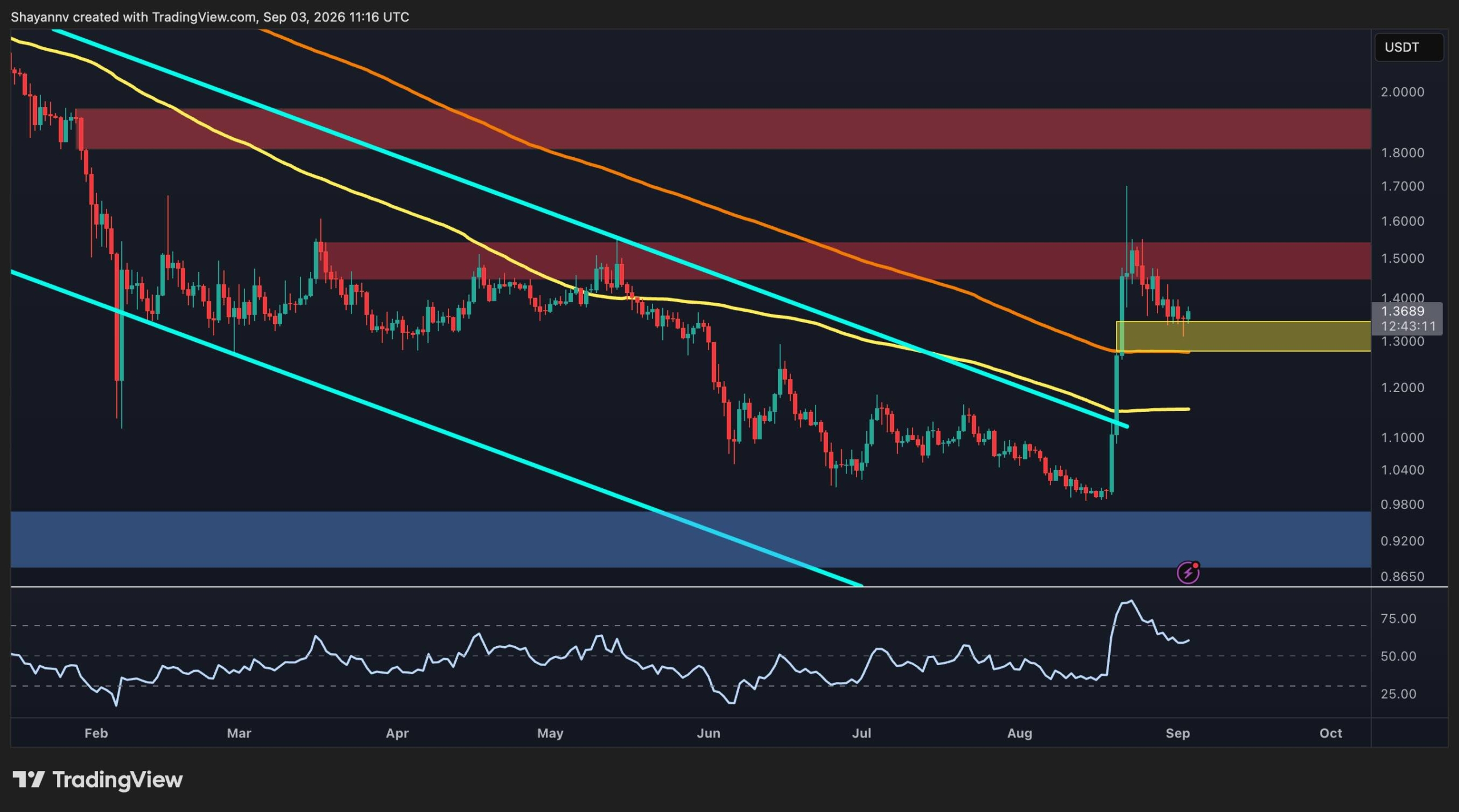
XRP is consolidating after its sharp late-August breakout, with the price now hovering close to $1.40. The charts suggest that the broader structure has improved considerably, but the token remains trapped beneath a major resistance zone. A breakout from the current corrective structure could determine whether the recent rally resumes or develops into a deeper retracement.
Ripple Price Analysis: The USDT Pair
On the daily timeframe, XRP has undergone a significant structural shift. After spending several months in a broad downtrend, the asset broke decisively higher in late August, surging from around $1.00 to a spike near $1.70. This move also pushed XRP above the previously declining long-term trendline and the major moving averages visible on the chart.
The subsequent pullback has brought XRP toward the $1.30 area, which is currently highlighted as an important demand zone at a clear bullish imbalance area. Meanwhile, the still price remains above the 100-day and 200-day moving averages, suggesting that the broader recovery structure is still intact despite the recent correction.
Above the current price, the $1.5 region represents the main resistance zone. It previously acted as a significant supply area and has already rejected XRP several times over the past year. Therefore, a daily close above this zone would significantly strengthen the bullish case and could pave the way toward the $2 region, which is an important psychological barrier for Ripple.
The momentum picture has also cooled substantially from the extreme levels reached during the initial breakout. The daily RSI has fallen below 75, relieving overbought conditions while remaining above the neutral 50 area. This is generally constructive because XRP has been able to consolidate without completely losing its momentum.
The 4-Hour Chart
The 4-hour chart provides a clearer view of the current correction. Since the late-August spike, XRP has been forming a descending structure defined by two downward-sloping trendlines. The price is currently near $1.37 and appears to be testing the upper boundary of this formation.
This makes the current area particularly important. A breakout above the descending resistance line, followed by a move through the $1.5 zone, would provide an initial signal that the corrective phase may be ending.
On the downside, the highlighted $1.25 bullish order block is the immediate support region. As long as XRP continues to hold this zone, the descending structure could eventually resolve to the upside. A breakdown below it, however, would increase the probability of a deeper retracement toward the lower order block around $1.1.
Overall, XRP is approaching a decision point. Holding $1.25 and breaking above the descending trendline would favor continuation above $1.5. Conversely, losing the $1.25 area would invalidate the immediate bullish setup and could send the price back toward the base of the recent rally.

The post XRP Price Analysis: Can XRP Resume Its Rally After Defending Key Support? appeared first on CryptoPotato.

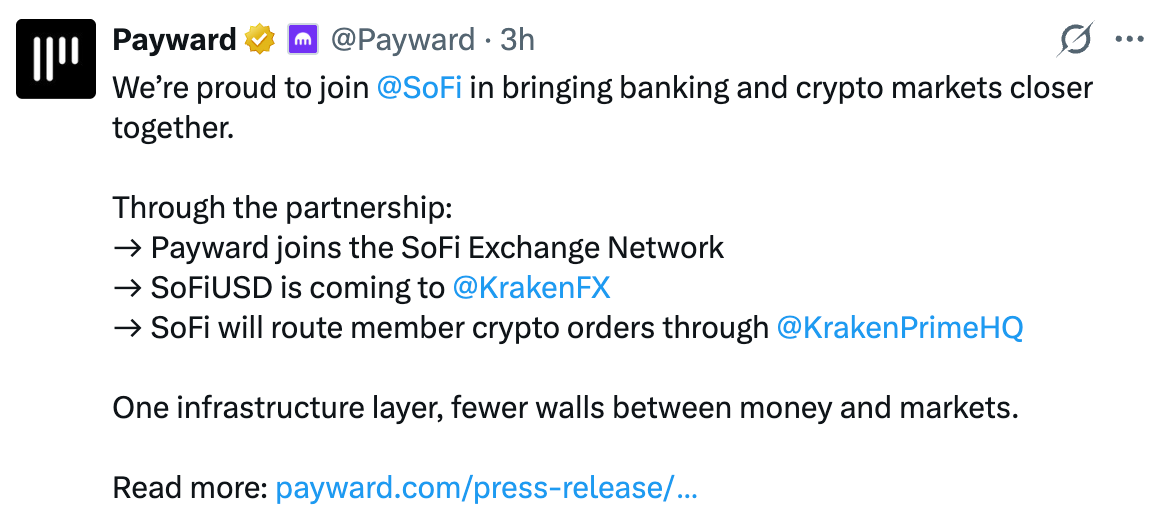
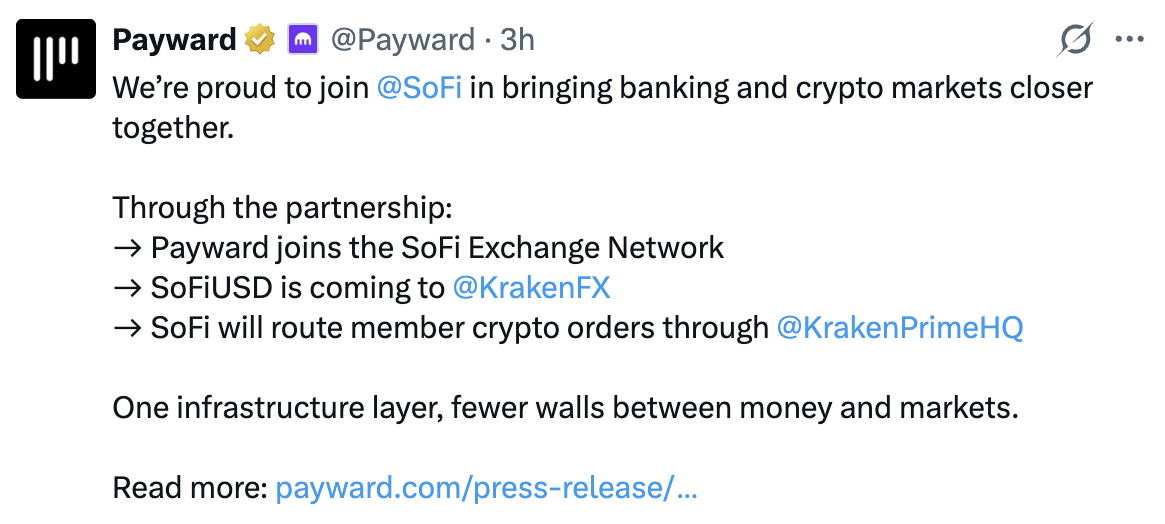
Kraken parent Payward has partnered with SoFi in a deal that will bring SoFiUSD to Kraken and connect the crypto platform to SoFi’s 24/7 dollar settlement network.
Under the partnership, SoFi will use Kraken Prime as an additional source of digital asset liquidity, while Payward will join the SoFi Exchange Network (SEN) and gain access to SoFi’s business banking services.
The companies said qualified custody services could be added as the partnership expands, while Kraken’s institutional and business clients will gain access to SEN for round-the-clock US dollar settlement.
SoFiUSD, issued by SoFi Bank, is a dollar-backed stablecoin launched in 2026 for payments and settlement, with reserves held in cash and short-term US Treasurys.
Source: Payward
According to a Thursday blog post from Kraken, SoFi will route digital asset orders through Kraken Prime, which uses smart order routing to evaluate pricing and market depth across supported venues in real time and route orders based on where they can be filled most effectively.
SoFi has 15.8 million members and already offers crypto trading through its app. Kraken said routing those trades through Kraken Prime will give SoFi access to liquidity across multiple trading venues rather than relying on a single order book.
Related: Kraken parent Payward acquires Magic Labs’ wallet business
Payward expands traditional finance ties
The SoFi partnership follows a series of moves by Payward and Kraken to expand beyond crypto markets and build ties with traditional financial institutions.
Earlier this week, London Stock Exchange Group reportedly partnered with Payward to offer tokenized versions of leading UK equities through LSE 24, a new 24/5 trading venue set to launch in 2027. In August, Kraken added round-the-clock exposure to the S&P 500 through its funded trading program, with commodities expected to follow.
Kraken has also expanded into public markets through xStocks, the tokenized equities platform developed by Backed Finance, which Kraken acquired in early 2026. The exchange has since used the platform to offer eligible users exposure to shares tied to the SpaceX and Jersey Mike’s IPOs through tokenized equities and, in some cases, direct share allocations.

Source: Kraken
Payward’s push into traditional finance comes as the company prepares to go public, although its IPO plans have reportedly been pushed back several times.
The company confidentially submitted a draft registration statement to the US Securities and Exchange Commission in November 2025. However, reports indicate that the listing has been pushed to the second quarter of 2027 at the earliest.
Magazine: Recovery specialists crack $1B crypto wallet… but find just $10

BitMEX co-founder Ben Delo gave Reform UK £4 million in April, effectively supplying 72% of everything the party declared for the second quarter.
The Electoral Commission published the register on Wednesday, showing that Delo sent the money as two cash payments. Both dwarf every other gift in British politics that quarter.

Seven Pounds in Every Ten Came From Delo
Commission records show £1 million arrived on April 17. Another £3 million followed on April 30. Reform banked each payment the next day.
The party declared 40 donations worth £5.55 million in total. Take Delo out and the largest was £180,000.
No other donor came close nationally. Labour’s biggest single gift was £550,000, from Lord David Sainsbury.
Reform Lost Its Other Crypto Backer
Delo is not new money. He gave £2 million in January and £2 million in March. His donations to Reform UK now total £8 million this year.
What changed is who stopped writing cheques. Christopher Harborne, the party’s other crypto-linked mega-donor, gave £3 million in January. He appears nowhere in the Q2 register.
Reform’s income fell with him, from £9.94 million to £5.55 million. That is a 44% drop in three months. Farage has already faced questions over crypto lobbying rules in Parliament.
Cash Slips Past the Crypto Donation Ban
Britain announced a ban on crypto asset donations in March. July brought a £100,000 cap on overseas donors. It holds for a full calendar year over anyone moving back to the UK.
Delo paid in cash, so neither rule touches his money. US prosecutors listed him in 2022 as living between Britain and Hong Kong.
The exchange behind that fortune is now closing. BitMEX closes on September 23 at 04:00 UTC. Owner HDR Global Trading Limited called time in July after a strategic review.
Delo admitted a Bank Secrecy Act violation in February 2022. BitMEX had run no proper customer checks. He paid a $10 million fine, then Donald Trump pardoned him in March 2025.
Reform’s next register lands in November. It will show whether the party can raise real money without him.
The post BitMEX Co-Founder Funded Reform UK Before Shutting Down the Exchange appeared first on BeInCrypto.

Bitcoin pushed higher during US trading hours, climbing about 5% to trade near $81,000. The rally coincided with renewed volatility in Japan’s yen, where investors appear to be responding to suspected Bank of Japan (BOJ) intervention and expectations for further rate action.
Alongside BTC’s move, the US Dollar Index (DXY) slid to around 99 as USD/JPY fell to 155.4. Historically, a weaker dollar has tended to support risk assets including crypto, and the latest unwind in the dollar’s strength helped Bitcoin find fresh momentum.
Key takeaways
- Bitcoin rose ~5% in US hours, reaching roughly $81,000.
- USD/JPY slid to 155.4, pressuring the DXY down to ~99.
- Polymarket odds for a BOJ hold collapsed from 12% to 1%, implying a strong rate-hike bias.
- Market pricing now favors a 25-basis-point hike on Sept. 18 with a 98% probability.
- Carry-trade unwind concerns have been revived, though some traders frame intervention as liquidity-supportive.
Yen strength, dollar weakness, and Bitcoin’s lift
At the time of writing, BTC was trading around $81,000, close to recent highs and within striking distance of levels seen earlier in the month. The move tracked developments in foreign exchange, particularly yen appreciation that market observers link to possible BOJ action.
Cointelegraph reported earlier this week that investors were watching for suspected yen defense, and the follow-through has been visible in the numbers. After USD/JPY fell to 158.5 on Wednesday, the pair continued lower to 155.4. That drop weighed on the DXY, taking it to roughly 99, a dynamic that has often coincided with better conditions for Bitcoin.
For traders, the key question is whether the dollar weakness is a temporary reaction or part of a broader repricing. If USD weakness persists, Bitcoin may continue to benefit; if it reverses, the catalyst behind the rally could fade quickly.
What BOJ expectations are saying about rates
The yen move has also reawakened attention on the BOJ’s upcoming policy decision. According to Polymarket pricing, the probability of a rate hold dropped sharply—from 12% to 1%—suggesting traders increasingly view action as likely.
Polymarket also shows a 98% probability that the BOJ will deliver a 25-basis-point hike at its Sept. 18 meeting. The shift matters because it reinforces the market’s expectation of tighter Japanese monetary policy, which can influence global liquidity and capital flows.
Even when the rate change itself is localized, the impact can spread. Moves in Japanese policy expectations often affect funding conditions for traders and funds positioned in yen carry trades—strategies that borrow in low-yield currencies to invest elsewhere.
Carry-trade unwind fears vs. liquidity-positive interpretations
With USD/JPY falling rapidly, some analysts and market participants are framing the latest yen defense as a potential signal of heightened risk for carry trades. The Macro Paper highlighted on X that a nearly 2.5% drop in USD/JPY over 24 hours would be difficult to explain without meaningful intervention. The post also linked the current setup to a similar episode in Q3 2024, when BOJ intervention and rate hikes occurred together.
That perspective is important for crypto investors because carry-trade unwinds can tighten financial conditions globally, sometimes pressuring liquidity-sensitive assets. In that scenario, Bitcoin’s rally could face headwinds if risk appetite deteriorates or if markets interpret intervention as signaling deeper policy urgency.
However, not everyone sees intervention purely as a source of stress. Arthur Hayes, CIO of Maelstrom, has previously argued that the FIMA repo facility can provide Japan with dollar liquidity backed by Treasury collateral—potentially easing overall liquidity conditions. While no funds appear to have been drawn from the facility so far, Cointelegraph noted that Treasury Secretary Scott Bessent raised the possibility in late July.
This creates a tension in how markets may interpret the same event. If intervention supports liquidity, it could bolster global risk assets. If it mainly triggers currency risk and forced positioning, it can do the opposite. For now, the data points—yen strength, DXY weakness, and BOJ pricing—are at least temporarily aligned with a positive impulse for Bitcoin.
Stocks tied to Bitcoin also participate
Bitcoin’s move wasn’t confined to crypto markets. Shares of Strategy—Michael Saylor’s MSTR—rose 8.6% on Wednesday, participating in the broader risk-on response. The stock is reportedly up 70% from its late-June lows, though it remains down roughly 10% year-to-date.
The rally also extended to Strategy’s perpetual preferred stock STRC. At the time of writing, STRC was trading around $97.80, below its stated par value of $100—a reminder that equity-linked crypto exposures can move together while still reflecting their own structural pricing dynamics.
Related coverage from Cointelegraph noted Strategy’s turn of 1,690 BTC into a $108.6M STRC buyback.
Going forward, traders will likely watch whether USD/JPY continues to slide and whether the DXY can hold lower levels. Equally important is whether BOJ rate pricing stays fixed into Sept. 18, or if new signals push Polymarket odds back toward a hold—either shift could change the near-term balance of forces driving Bitcoin’s next move.

Multicoin Capital has sold another 10% of its HYPE holdings, according to blockchain analytics platform Arkham Intelligence. Still, HYPE remains its largest holding, currently worth around $90.5 million.
The investment firm had accumulated the tokens between February and March this year and has held the position for more than six months.
Slashing HYPE
Arkham stated that Multicoin held 4 million HYPE at its peak and now owns just over 25% of that amount. Earlier this week, the firm moved a large amount of the token to Coinbase Prime. On-chain data showed three separate transfers totaling 261,555 HYPE, worth about $21.7 million. The batches contained 63,235, 101,144, and 97,176 units. The transfers drew attention because they came as the crypto asset traded near its recent highs.
In June, Multicoin said it projected that HYPE could hit $319. The target came from valuing $8 billion in expected 2028 earnings at 20 times, which results in a $160 billion valuation based on an adjusted supply of about 502 million HYPE tokens. Its base case assumes crypto derivatives volume grows 35% annually, DEXs reach 32% of the derivatives market, Hyperliquid captures a 30% share, and USDC balances rise with volume.
On the other hand, its bear case puts HYPE at $109, while its bull case reaches $689 on $17.3 billion in projected cash flow. In the same report, Multicoin also compared Hyperliquid’s growth path with Binance’s rapid rise in 2017.
HYPE has been one of the best-performing assets this year. It has been on an absolute tear. The asset has gained 50% over the past month alone and recently established an all-time high of $86.71. It has since suffered a minor pullback, but continues to hover above $82.
Hyperliquid was also discussed during Donald Trump’s meeting with major crypto executives at the White House last month. Trump said CFTC Chair Michael Selig is working to bring the perpetuals-focused trading platform into the US. He said the goal is to make Hyperliquid operate in a “fully compliant and legal fashion.” The meeting also covered Bitcoin, the Digital Asset Market Clarity Act, and efforts to expand crypto activity in the US.
Due for a Drop?
While the broader outlook remains bullish, one trader is betting on a drop. Pseudonymous market watcher “swarmik” shared a bearish view on the token. The trader said it could fall 17.2% based on a four-hour chart setup while pointing to signs of weakness in the market structure. Heavy selling liquidity could push the price lower.
However, a potential correction could create an opportunity for a short position, with three downside targets being $76.77, $72.68, and $68.49. The trade would carry a risk level of 1.5R, according to the analysis.
The post Multicoin Sells Another 10% of HYPE Stack as Holdings Fall From 4 Million Tokens appeared first on CryptoPotato.
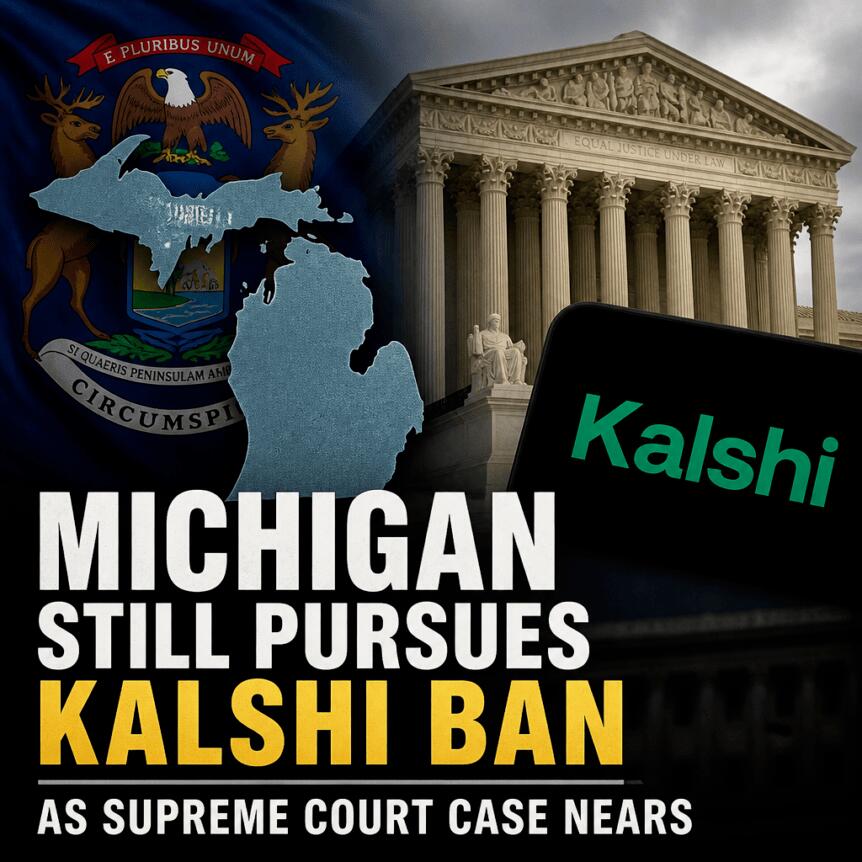
Michigan has escalated its efforts to rein in Kalshi, a prediction markets platform, by securing a preliminary injunction that blocks the company from offering event contracts to residents. The state’s attorney general said the order is meant to stop what officials described as “sports betting” operating under the guise of an investment product.
In a notice dated Wednesday, Michigan Attorney General Dana Nessel said the Circuit Court for the 30th Judicial Circuit in Ingham County approved the injunction after earlier court action. Nessel also noted that Kalshi could face penalties of up to $500,000 per day if it violates the order.
Key takeaways
- Michigan’s court issued a preliminary injunction barring Kalshi from offering event contracts to state residents.
- Attorney General Dana Nessel framed the case as “sports betting” disguised as an investment opportunity, with daily fines possible.
- The injunction follows a June temporary restraining order and comes amid an ongoing dispute over whether prediction markets fall under federal CFTC authority or state jurisdiction.
- New Jersey simultaneously moved to ask the US Supreme Court to weigh in, potentially affecting how courts resolve conflicting legal theories.
- Legislative proposals in Washington target insider trading risks in event contracts, but they may not resolve the broader jurisdictional fight on their own.
Michigan blocks Kalshi’s event contracts
According to a press release from Michigan’s attorney general, the Ingham County court order prevents Kalshi from offering “event contracts” to residents of the state. Nessel said the decision helps protect Michigan consumers from what she characterized as “predatory, unlicensed practices.”
Under the terms described by Nessel, Kalshi faces potentially steep financial exposure if it does not comply with the injunction. The attorney general’s filing is the latest step in a wider legal campaign targeting prediction market operations that state officials argue resemble sports wagering.
The Michigan litigation dates back to a lawsuit filed in March, when Nessel alleged Kalshi violated Michigan law related to sports gambling. Similar arguments have appeared in other states, reflecting how quickly prediction markets have moved from niche tools for forecasting into mainstream attention—along with intensified scrutiny from regulators.
From temporary restraining order to preliminary injunction
The preliminary injunction does not arrive in isolation. It follows a June temporary restraining order that previously barred Kalshi from offering sports betting-like products to Michigan residents.
During that earlier stage, the US Commodity Futures Trading Commission (CFTC) ordered Kalshi not to comply with Michigan’s temporary order and to continue operating. Kalshi later described the situation as placing it in an “impossible position,” according to an earlier account referenced by Cointelegraph.
After the June order, a Kalshi spokesperson told Cointelegraph that the company disagreed with Michigan’s decision and “will fight it in court,” while stating it was complying with restrictions imposed by the court.
That sequence—state court restrictions paired with federal regulator guidance—helps explain why the Michigan dispute has drawn broader attention beyond the state’s borders. The case is part of a larger effort by courts and regulators to determine what rule set governs prediction markets in the US.
New Jersey seeks Supreme Court review
Michigan’s most recent decision coincided with another development in New Jersey. State officials announced they filed a petition for a writ of certiorari with the US Supreme Court related to the Kalshi dispute.
The petition, as described in earlier coverage linked by Cointelegraph, raises the prospect that the justices could resolve competing legal theories about whether prediction markets are regulated by the CFTC or whether states retain the authority to ban and/or regulate such contracts.
In remarks provided to Cointelegraph, Melinda Roth, a visiting professor of practice at New England Law in Boston, said it would be reasonable for the Supreme Court to take up the matter. Roth also suggested the court might choose to wait until cases are decided on their merits rather than focus solely on procedural questions such as whether a preliminary injunction is appropriate.
“If and when SCOTUS takes it up, then this will likely decide whether sports event contracts are federally regulated by the CFTC or the states have the right to ban and/or regulate them as they see appropriate.”
Roth added that Congress could potentially act before Supreme Court review, either before or after any decision, which underscores how jurisdictional clarity might arrive through courts—or via legislation—depending on political and legal timelines.
Policy push targets insider information as legal battles continue
Alongside the court fights, some lawmakers have proposed legislation aimed at a different risk area: the use of insider information in event contracts. According to earlier reporting linked by Cointelegraph, Senators Adam Schiff and John Curtis introduced a bill in March that would prohibit CFTC-registered platforms from listing event contracts that “resembles a sports bet or casino-style game,” effectively channeling enforcement and jurisdiction toward states.
That proposal points to an emerging pattern in the broader prediction market debate: lawmakers and regulators are not only disputing jurisdiction, they are also trying to address market integrity concerns—particularly the potential for trading based on nonpublic information.
For participants in prediction markets, the practical takeaway is that the legal landscape may remain fragmented. Even as federal agencies and courts weigh in on authority, states like Michigan continue to pursue injunctions that can immediately affect access for residents, while Supreme Court review could later reshape the rules nationwide—if the case is taken up and decided.
Investors, traders, and developers should watch for how higher courts respond to the jurisdictional questions raised by the Michigan and New Jersey proceedings, as well as whether Congress advances a framework that addresses both integrity risks and the dividing line between state and federal oversight.


The UK political party and its leader, Nigel Farage, have accepted contributions from figures tied to the crypto industry, raising questions about potential influence on policies.
MongoDB (MDB) stock fell sharply Wednesday after the database software company reported fiscal second quarter results. MongoDB beat estimates, but analysts pointed to high expectations for MongoDB’s cloud software growth. New York-based MongoDB late Tuesday reported adjusted earnings of $1.90 per share from sales of $771 million for its July quarter. Analysts polled by FactSet were forecasting adjusted earnings of…
Copyright ©2026 Investor’s Business Daily, LLC. All rights reserved. 87990cbe856818d5eddac44c7b1cdeb8
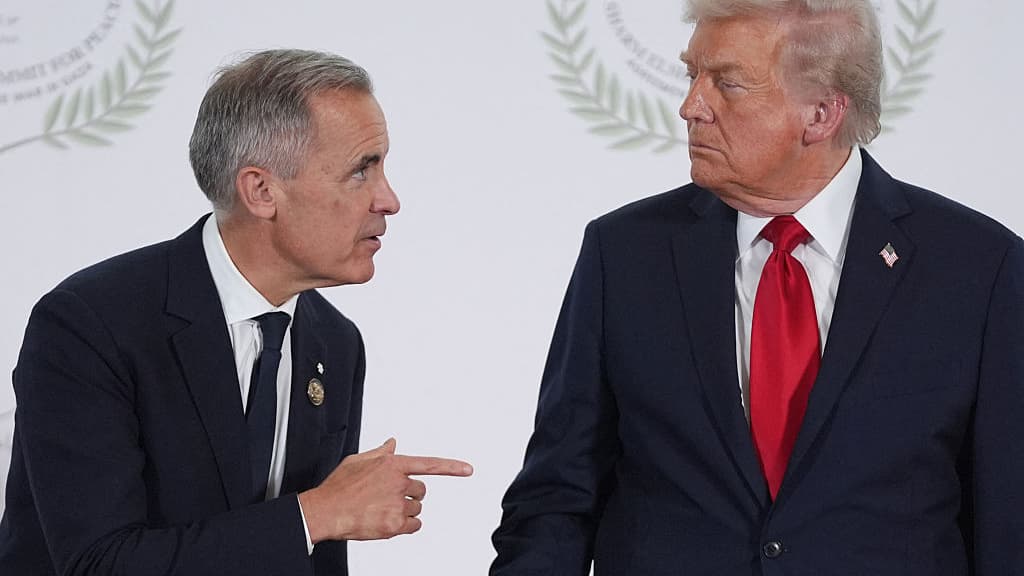
How do Canadians feel about the U.S.-Canada trade war?
The majority of Canadians—63%—said they feel that the country made the right choice to maintain its stance and walk away from trade talks with the U.S., “even if it meant higher costs and job losses,” according to an Ipsos poll conducted for Global News that was released on Aug. 29. Even more Canadians—73%—said they agreed with the nation’s decision to launch retaliatory tariffs on American products worth billions of dollars.
The poll did find, though, that support for those actions was lower among younger demographics than it was among older age groups. For instance, a little less than 50% of Gen Z adults backed Canada’s decision to remain firm in trade negotiations, compared to 80% for elderly boomers.
Another poll, conducted by the Canadian nonprofit Angus Reid Institute, found that about 76% of Canadians believe the country was right to suspend trade talks, and that 69% said they believe that Carney demonstrated “strength” by turning down a “bad deal.” A majority of Canadians—62%—also indicated support for retaliatory tariffs against the U.S., calling the move “about right under the circumstances.”


Cointelegraph is committed to providing independent, high-quality journalism across the crypto, blockchain, AI, and fintech industries.
All news, reviews, and analyses are produced with full journalistic independence and integrity. For more details on our standards and processes, please read our Editorial Policy.
Bitcoin heads into the final months of 2026 with all the ingredients for another major move, although the market is far from universally bullish. The Sam Altman-backed ChatGPT AI predicts the Bitcoin price at the beginning of 2027, which makes for interesting reading.
After a roughly +25% gain in August, BTC is trading around $77,000, with the $80,000 level emerging as an important psychological and technical barrier.
Check out the OpenAI chatbot’s answer on where BTC is likely to be trading come January 1, 2027, with the word-for-word answer listed below, which takes into account multiple factors, including ETF flows, technical analysis, and historical data.

ETF Flows Remain the Key Driver
The strongest argument for higher Bitcoin prices is institutional demand through spot ETFs. US Bitcoin ETFs attracted approximately $3.52Bn in August, their strongest month of 2026, while total ETF assets approached $100Bn.
The flows were particularly impressive during the second half of August, with roughly $3Bn entering the products over nine trading sessions.
There has been some volatility at the start of September, including a $236.5M net outflow on September 1. But that was followed by approximately $101M of net inflows on September 2. More importantly, BlackRock’s IBIT has accumulated approximately $63.4Bn in inflows since its launch.
If ETF demand continues at anything close to August’s pace, Bitcoin’s relatively limited supply could create significant upward pressure, potentially serving as a major catalyst for any bullish BTC USD move.

Discover: The Best Token Presales
ChatGPT AI Predicts Bitcoin: The Technical Picture Is Improving
Technically, Bitcoin appears to have repaired much of the damage from its weakness earlier in 2026. BTC has recently been trading above its 200-day moving average, while the 20-day EMA has moved above the 200-day EMA, a potentially bullish development.
The immediate hurdle is $80,000, followed by approximately $82,000-$85,000. A sustained break through that zone could open the door toward $90,000 and eventually six figures.
Conversely, losing the $72,000 area would significantly weaken the bullish setup, while a deeper break toward $68,000 would raise questions about whether the latest rally was merely a bear-market bounce.
Make Your BTC 2027 Prediction and Claim $25 For Free on Kalshi
Prediction Markets Remain Cautious
Prediction markets provide an interesting reality check. Current Polymarket data gives Bitcoin an 83.5% probability of reaching $75,000 and 61.5% of reaching $85,000, while the probability of reaching $90,000 is around 45%.
Its rival, Kalshi, has a market showing just a 3.7% chance that Bitcoin will be trading over $100,000 at the beginning of 2027, as traders remain cautious, with 12.7% of the $34.2M volume betting on it changing hands between $70,000 and $74,999.
The market has historically been much less confident about extremely bullish targets. Earlier pricing put the probability of Bitcoin reaching $150,000 before 2027 at just 21%.
Trade XRP on Bybit and Get a Chance to Win Our $1,000 USDT Airdrop
ChatGPT AI Predicts Bitcoin Price by January 1, 2027 Prediction
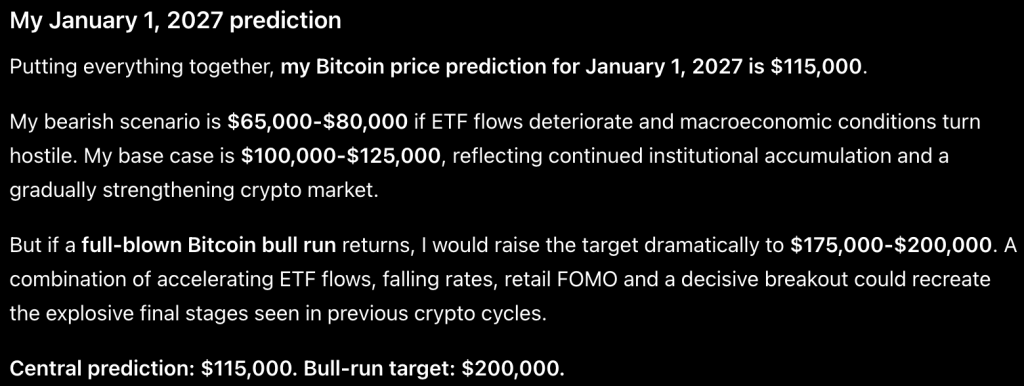
Putting everything together, my Bitcoin price prediction for January 1, 2027 is $115,000.
My bearish scenario is $65,000-$80,000 if ETF flows deteriorate and macroeconomic conditions turn hostile. My base case is $100,000-$125,000, reflecting continued institutional accumulation and a gradually strengthening crypto market.
But if a full-blown Bitcoin bull run returns, I would raise the target dramatically to $175,000-$200,000. A combination of accelerating ETF flows, falling rates, retail FOMO, and a decisive breakout could recreate the explosive final stages seen in previous crypto cycles.
Central prediction: $115,000. Bull-run target: $200,000+.
Bitcoin Hyper Targets Early Mover Upside as Bitcoin Sits Below Resistance
With Bitcoin sitting below resistance at $80,000, ChatGPT AI predicts Bitcoin could trade as high as $200,000 by the end of the year. However, even at that price, BTC simply can’t deliver the multiples that come from catching an asset before liquidity arrives. That’s the gap early-stage infrastructure plays are built to fill.
Bitcoin Hyper ($HYPER) is pitching itself as the first Bitcoin Layer 2 with full SVM integration. It boasts smart contracts running at Solana-grade speed while settling back to Bitcoin’s base layer.
The presale has raised $33M to date, with tokens priced at $0.0136856 and staking rewards on offer for early holders. Its decentralized canonical bridge and low-latency execution layer aim to solve Bitcoin’s two oldest complaints: slow transactions and zero programmability.
Gain Access to New Bitcoin Layer 2 Early Here
Discover: The Best Crypto to Diversify Your Portfolio
The post Sam Altman ChatGPT AI Predicts Wild Bitcoin Price in 2027 appeared first on Cryptonews.

Four new homes for Cambridge University students said to ‘enhance street scene’ approved

lululemon Q2: Why I'm Not Touching This Even After The 19% Drop

Beno Obano: Bath prop to move to Pau and put England career on ice





-

 Fashion6 days ago
Weekend Open Thread: Maeve – Corporette.com
-

 Crypto World7 days ago
Bitcoin’s 22% rally now needs real demand to outlast Treasury liquidity boost
-

 Business7 days ago
Apple Confirms September 9 Keynote and Reveals Its Full Pre-Order Schedule
-

 Crypto World23 hours ago
CLARITY Act could advance within weeks, Atkins says
-

 Business7 days ago
Salesforce Stock Soars 19% as Blowout Earnings and Agentforce AI Growth Silence Software Skeptics
-

 Business6 days ago
Onto Innovation Stock: AI’s Next Bottleneck Is Yield (NYSE:ONTO)
-

 Crypto World6 days ago
Bitcoin price tests $82K resistance as Brandt stays long
-
 Tech5 days ago
Hugging Face built a $4.5 billion empire on free AI models. Now Nvidia is buying it for $12.9 billion
-

 Business6 days ago
iPhone 18 Pro Pre-Orders Could Shift to Saturday as Apple Reportedly Avoids September 11 Anniversary
-

 Crypto World2 days ago
Elon Musk Says Grok 4.7 Lands in 10 Days and Will Beat Every Model
-

 Crypto World7 days ago
Truflation calls for Fed rate cut after PCE forecast
-
 Entertainment6 days ago
‘Adults’ Creators Break Down Season 2’s Most Shocking Moments and Tease a Potential Season 3
-

 Tech7 days ago
The fix for the AI agent that hijacked a company’s DNS: it can propose the change, but it can’t approve it
-

 News Videos5 days ago
Charlie Munger on Robinhood: No one should believe that Robinhood’s trades are free
-

 Tech6 days ago
PaperCut releases second emergency patch for exploited flaws
-

 Tech5 days ago
Tamagotchi Ring Takes the 30-Year Digital Pet and Places it on Your Finger
-

 Tech5 days ago
As the influencer economy drives retail sales, Seattle startup raises $22M to play matchmaker
-
 Crypto World2 days ago
Bitcoin slips below $77.5K as macro pressure offsets ETF inflows
-

 Crypto World18 hours ago
Kalshi seeks CFTC approval for WTI perpetual
-

 News Videos4 days ago
News kii Crypto ugu danbeeyey & Suuqa oo dhaqaaqey
You must be logged in to post a comment Login