
Crypto World
XRP Price Prediction: ETF Moves From Zero to Hero in 3 Months

XRP price trades at the $1.50 area right now, but that flat 24-hour print masks a wild three-week stretch from $1.00 to nearly $1.70 that defies bearish prediction. There’s a bigger story sitting underneath this chart, and it involves an ETF category that went from irrelevant to indispensable almost overnight.
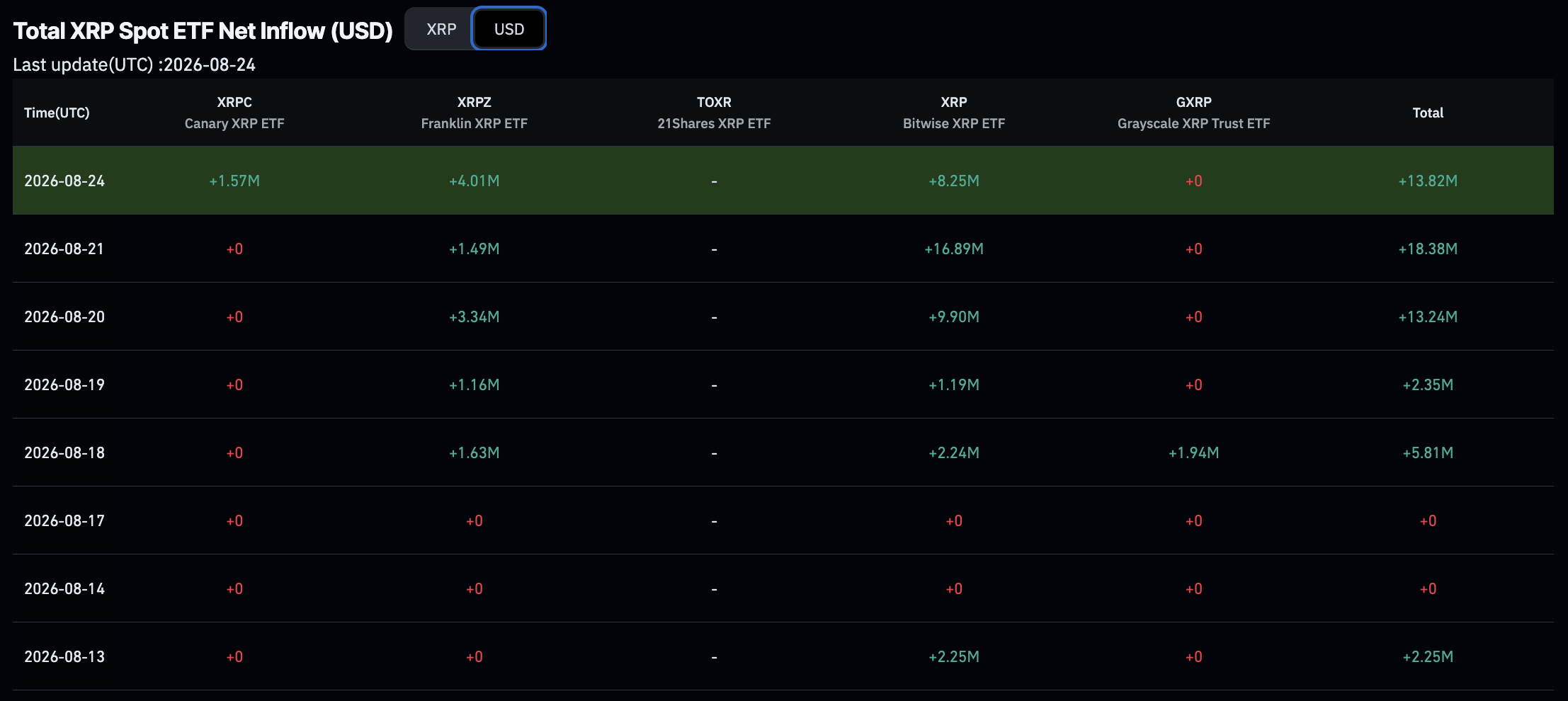
Spot XRP ETFs posted $39.78 million in net inflows last week, the strongest weekly haul since mid-May. It has pushed cumulative net inflows to roughly $1.55 billion. It’s a sharp reversal from the week ending Aug. 8, when inflows had collapsed to just $1.01 million. Zero to hero, indeed.

The shift coincides almost exactly with XRP’s breakout above $1.20. This is confirmation that institutional appetite for XRP exposure isn’t dead, it’s just impatient.
Discover: The Best Token Presales
XRP Price Prediction: Hit $1.60 This Week?
XRP sits at the $1.50 area, with an intraday range between $1.46 and $1.54, reflecting a market still digesting last week’s 50% surge. Volume has cooled from the breakout spike but remains elevated relative to early August.
The immediate technical fight is at $1.51 resistance, with $1.60 and the recent high of $1.7 as the next upside checkpoints. On the downside, $1.45 is the level bulls need to defend; a break below opens the door to $1.36 and, worst case, a retest of the $1.00 floor.

RSI is sitting in overbought territory on the daily chart, with price sandwiched between the EMA20 and EMA50 in a setup that often precedes consolidation rather than continuation.
If XRP can sustain its ETF inflows, it could push XRP through $1.51 and $1.60 toward new highs. But consolidation could also happen between $1.36 and $1.51 while momentum resets.
However, if inflows stall and RSI unwinds hard, $1.00 could come back into play.
Trade XRP on Bybit and Get a Chance to Win Our $1,000 USDT Airdrop
Bitcoin Hyper Targets Early Mover Upside as XRP Tests Key Levels
XRP holders riding the move from $1.00 have already banked real gains, but a token with a market cap north of $85 billion doesn’t double from here without a genuine catalyst.
Overbought RSI and stacked resistance near $1.60 suggest the easy money on this leg may already be made. That’s pushing capital toward earlier-stage infrastructure plays with more room to run.
Bitcoin Hyper ($HYPER) is building the first Bitcoin Layer 2 with full SVM integration. It boasts a smart contract execution faster than Solana itself, layered on top of Bitcoin’s security.
The presale has raised $33 million at a current token price of $0.0136852, with a high 35% APY staking already live for early buyers. The pitch: low-latency L2 processing, a decentralized canonical bridge for BTC transfers, and programmability Bitcoin was never built for.
Research Bitcoin Hyper directly for the full breakdown.
Discover: The Best Crypto to Diversify Your Portfolio
The post XRP Price Prediction: ETF Moves From Zero to Hero in 3 Months appeared first on Cryptonews.


“Together, there could be a possibility they’re quite lethal,” Trump said of the combined shot, which has been in use for more than 50 years and has a strong safety and efficacy record.
Doctors and vaccine scientists said Trump’s executive order and comments were unscientific and misleading. “As measles cases reach a 35-year high in the U.S. and with cold and flu season quickly approaching, [the] executive order on vaccines is not only disheartening but dangerous,” Dr. Andrew Racine, president of the American Academy of Pediatrics (AAP), said in a statement at the time.
An additional early dose of the vaccine can also be given to children aged 6 to 11 months under some circumstances, says Dr. Elizabeth Murray, a pediatric emergency medicine physician in Rochester, N.Y. “With the ongoing measles outbreak, make sure your children are immunized. If your child is under age 1, talk to your doctor. Depending on how much measles is circulating where you live, your doctor may recommend an earlier dose,” she says.

Bitcoin (BTC) broke higher last week, ending a multi-month range and closing near $77,700. The move followed a $62,750 weekly low, marking a nearly 24% rise as the leading cryptocurrency topped $71,000 on August 20.
The rally came despite August’s historically weak performance for Bitcoin, according to the Bitfinex Alpha report. The report noted that August has typically delivered negative median returns, making last week’s move a notable shift from the month’s historical pattern.
Liquidity and ETF Demand Strengthen Bitcoin’s Breakout
A key catalyst was the U.S. Treasury’s expansion of its bond buyback program. The announcement triggered a liquidity response, while $3 billion in Bitcoin short positions were liquidated over two days, marking the largest short-side wipeout on record.
Long liquidations remained limited, while futures open interest rose to $51 billion. That combination suggests fresh positions entered the market rather than the rally coming only from traders closing leverage.
Beyond the derivatives market, spot demand provided another source of support. U.S. Bitcoin exchange-traded funds (ETFs) posted about $1.92 billion in weekly net inflows, their strongest weekly total since October 2025. That lifted assets under management above $96 billion.
Corporate activity, however, remained subdued. Strategy, the largest publicly traded corporate Bitcoin holder, reported no BTC purchases or sales in its filing. The pause came after a period of activity and left its average acquisition price at around $75,385, below the market price. With BTC now above that level, the company has moved from a $9.5 billion paper loss to a $4.7 billion paper profit.
Mixed Signals Emerge Beneath the Breakout
Bitfinex analysts said Strategy could influence whether Bitcoin maintains the breakout because the company stopped selling shortly before BTC moved beyond its summer range. The shift removes one source of supply pressure that had been present during the consolidation.
Meanwhile, on-chain activity presents a more cautious picture. Bitcoin transfer volumes remain close to eight-year lows, suggesting network activity has not matched the price move. At the same time, short-term holders with cost bases near $64,500 and $73,500 have moved into profit.
Those holders could help turn previous resistance into support if the breakout holds. Bitfinex identified thin supply between current prices and a heavier concentration around $84,000 to $85,000, creating a potential next hurdle.
The broader liquidity backdrop also supports this interpretation. Mortgage rates fell for a second week while housing activity remained weak. Builders kept cutting prices as housing starts fell, suggesting easier financial conditions may reach asset markets before the wider economy.
The post Bitcoin’s Massive Breakout: Here’s Why Analysts Say This Rally Is Different appeared first on CryptoPotato.


Trades in a thinly traded Pendle yield market triggered $36.1 million of liquidations on Morpho early Tuesday, closing out leveraged positions in about 14 minutes while leaving lenders whole. Pendle and vault curator Steakhouse Financial both said the price feed did what it was built to do. The… Read the full story at The Defiant
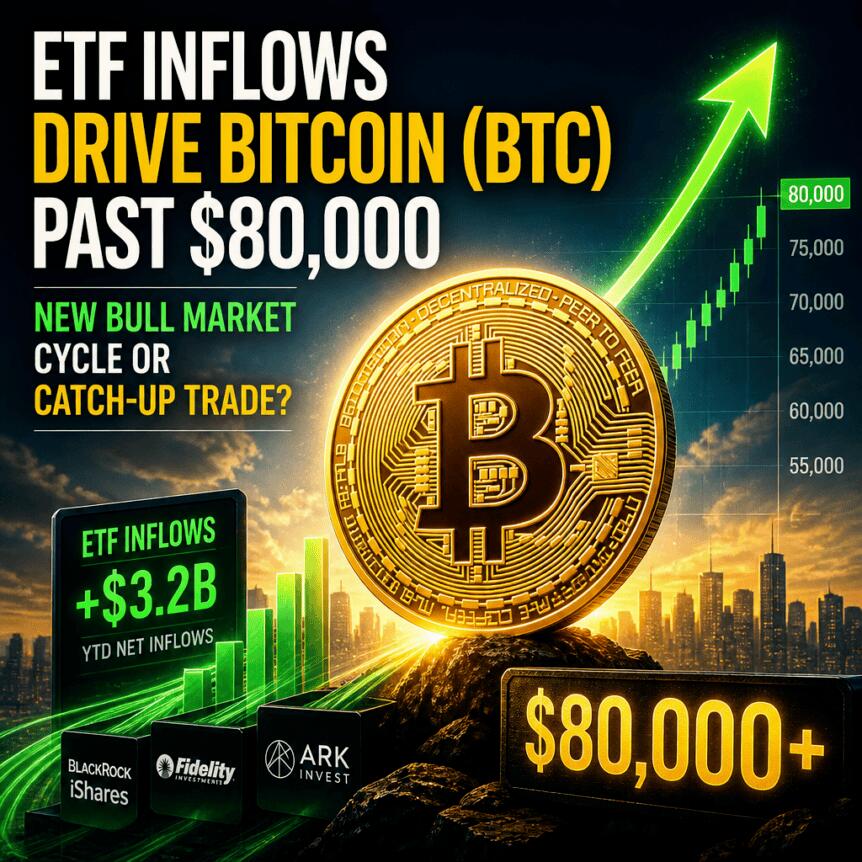
Bitcoin (BTC) crossed $80,000 for the first time since May on Tuesday, reaching a local high of $81,265 before retreating to $80,601. The flagship cryptocurrency’s recovery has seen it gain around 38% since falling to a low of $58,000 in late June.
Market watchers and analysts are cautiously optimistic about the rally translating into a bull market, primarily because of prevailing geopolitical uncertainty and inflation concerns.
Bitcoin Reaches Multi-Month High
Bitcoin (BTC) crossed $80,000 for the first time in 15 weeks, continuing its recent rally and gaining around 28% in little over a week. The flagship cryptocurrency’s rally has added $350 billion to its market capitalization as buyer interest returned after a period of subdued activity. The rally triggered market confidence, with the Bitcoin Fear & Greed Index rising to 81 on CoinMarketCap, firmly in “Extreme Greed” territory. While BTC’s rally has erased the losses accumulated since May, it now enters a zone that has previously witnessed heavy selling.
BTC is currently testing the resistance zone between $80,000 and $82,000. A close above these levels will confirm that demand persists. However, if the price fails to hold above $80,000, it could retrace towards $76,000, the nearest support zone. Several indicators support the short-term bullish structure. The Money Flow Index is currently above 77, indicating significant buyer interest. However, it is close to its overbought level, indicating chances of a reversal.
Analysts Cautiously Optimistic
While analysts and market watchers are optimistic, they believe the current rally is a catch-up trade rather than the beginning of a new bull cycle. Min Jung, associated researcher at Presto Research, stated,
“While it’s too early to call this a full-blown bull market, the move above $80,000 and the ETF inflows look like a catch-up trade since bitcoin has been lagging other risk assets for a while now.”
Jeff Mei, COO of BTSE, also struck a cautious note, highlighting tight liquidity conditions, inflation, and geopolitical uncertainty. Mei added they would consider a bull market only if BTC holds above $100,000, and the Federal Reserve cuts interest rates.
“I’d presume a bull market only after we sustain $100,000 for a month and the Fed signals rate cuts, which are still uncertain.”
Bitcoin’s Bull Case
However, some analysts believe Bitcoin’s rally and robust spot ETF inflows present a good case for a sustainable rally and bull market. Additionally, the broader cryptocurrency market has also rallied, with Ethereum (ETH), Ripple (XRP), and Solana (SOL) recording substantial double-digit increases. Justin d’Anethan, head of research at Arctic Digital, stated,
“The strength of the move, creating a large bullish engulfing candle on the daily, weekly, and potentially soon on the monthly, seems to hint at a radical trend change, from the boring accumulation to an ‘up’ market.”
d’Anethan added that the US Treasury’s decision to double bond buybacks is a strong indicator of easing monetary and liquidity conditions, which could fuel the rally further.
“More importantly, the key driver of this move (the U.S. Treasury decision to artificially lower rates by buying back bonds) sends a powerful and solid signal that monetary conditions and thus capital are easing up. It’s easy to see why BTC, which underperformed in the first half of 2026, would be the prime beneficiary of this.”
What Does Bitcoin Need For A Sustained Rally
Dominick John, analyst at Zeus Research, highlighted the macroeconomic conditions needed to sustain the current rally. According to the analyst, softer inflation numbers, lower treasury yields, and a weaker dollar were crucial to sustain the rally.
“A softer-than-expected reading could boost risk assets, while a hotter print could pressure yields and liquidity.”
Disclaimer: This article is provided for informational purposes only. It is not offered or intended to be used as legal, tax, investment, financial, or other advice.

India is reportedly preparing to test the issuance of tokenized corporate bonds, with a pilot expected to begin as early as September. The initiative centers on blockchain-based bond transactions that would be settled using India’s central bank digital currency (CBDC), according to Reuters.
REC Limited, a state-controlled power infrastructure finance company, is said to plan an initial bond issuance of less than 5 billion Indian rupees (about $57 million). Reuters reported the figure after consulting three sources familiar with the plans.
Key takeaways
- REC Limited is reportedly preparing India’s first tokenized corporate bond issuance as part of a September pilot.
- The pilot is expected to use India’s central bank digital currency for purchasing the tokenized bonds.
- Investors may need two separate digital accounts: a wholesale CBDC wallet and a new electronic securities wallet.
- India’s securities depositories are developing “DEMAT 2.0” to track bond ownership using distributed ledger technology.
- An initial three-month lockup is expected, with secondary-market trading targeted for development by December.
A pilot designed around CBDC settlement
Reuters says the tokenized bonds would be bought using India’s central bank digital currency, with participating investors required to hold two digital accounts. One would be a wholesale CBDC wallet provided by a bank, while the other would be a new electronic securities wallet that supports ownership records for the tokenized instruments.
This structure matters because it aims to connect two distinct parts of the financial plumbing: settlement (via CBDC) and securities ownership tracking (via a securities wallet built for tokenized assets). If the pilot proceeds as described, it would provide a practical test of whether wholesale CBDC can be used smoothly to move funds in tandem with tokenized bond transfers.
DEMAT 2.0 and the move toward distributed ownership records
A key component of the plan is the development of “DEMAT 2.0,” according to Reuters. The upgrade is being built by Indian securities depositories to record bond holdings using distributed ledger technology.
While tokenization is often discussed as a technical upgrade, the operational question is whether existing depository infrastructure can be adapted to manage tokenized securities reliably. The reported creation of DEMAT 2.0 suggests Indian market infrastructure providers are focusing on a more direct, ledger-based approach to tracking ownership—potentially reducing friction between issuance, transfer, and settlement workflows.
Reuters also reported that India’s central bank and securities regulator are involved: the Reserve Bank of India (RBI) and the Securities and Exchange Board of India (SEBI) are working with relevant stakeholders on the initiative.
Who will participate and how trading could evolve
The Reuters report indicates the initial pilot may be limited to a select group of investors, and that details could be unveiled during an annual financial technology event in Mumbai in September.
In addition, Reuters says the tokenized bonds would carry a three-month lockup period at the start. It also reports that exchanges are expected to develop a secondary market for the tokenized bonds by December.
That timeline points to a phased approach. First comes controlled issuance and settlement for a narrow group of investors, followed later by efforts to enable broader liquidity through secondary-market trading. For market participants, secondary-market availability is often the difference between a tokenized instrument that remains largely experimental versus one that can become a functional part of credit markets. Investors will likely watch whether secondary trading is implemented as expected and whether it supports price discovery comparable to traditional bond venues.
Regulators and the next checkpoint
Reuters reported that Cointelegraph contacted the RBI, SEBI, and REC for comment on the plans but had not received responses at the time of publication. That leaves some specifics—such as eligibility criteria for participating investors beyond “a select group,” and the precise mechanics of the secondary market—unclear.
Even so, the core framework described by Reuters is clear: tokenized corporate bonds would be issued by a major state-controlled finance entity, settled using wholesale CBDC, and tracked through a new ledger-enabled securities wallet (DEMAT 2.0). The next question for investors and builders is whether the pilot demonstrates operational readiness at each step—issuance, settlement, custody/recordkeeping, and eventual transfer into a secondary market.
For readers following crypto’s relationship with regulated finance, the key watch items are whether India’s pilot launches on schedule in September, how tightly the lockup/secondary-trading plan is executed, and what the RBI and SEBI ultimately confirm about the infrastructure and investor access requirements.


Goldman Sachs has backed Coinbase and Robinhood shares as Bitcoin’s 26% weekly rally has lifted the cryptocurrency above $80,000 despite an extended decline in market trading volume.
Summary
- Goldman Sachs maintained buy ratings on Coinbase and Robinhood, with targets of $196 and $124.
- Crypto trading volume fell 30% in July before declining another 21% in August.
- Goldman disclosed about $86.5 million of exposure across five spot XRP ETFs for the second quarter.
- Bitcoin reached roughly $81,255 before profit-taking pulled its price back toward $79,000.
Goldman Sachs expects crypto activity to recover
Goldman Sachs said in its latest Americas Brokerage and Crypto Industry report, circulated on X, that crypto trading volumes dropped 30% in July and another 21% in August. Analysts described the current slowdown as longer than the previous five volume contractions examined by the bank.
Trading activity has fallen by roughly 75% from its recent peak, according to the report. During the past week, however, the total cryptocurrency market capitalization has recovered about 21% to $2.8 trillion.
Goldman analysts said trading volumes could begin recovering if the market maintains its current valuation. Rising asset prices can bring more retail and institutional activity to exchanges, providing additional transaction revenue for platforms such as Coinbase and Robinhood.
Although the bank remains cautious about weak volumes, its view of the crypto sector has become more positive for the second half of 2026. The report pointed to stronger token prices, developing US regulations, and new products that allow trading platforms to earn revenue outside conventional spot markets.
Regulatory uncertainty remains the most common concern among institutional investors surveyed by the bank. According to Goldman, 35% of respondents identified uncertain rules as the largest barrier to entering the market, while 32% named regulatory clarity as the main catalyst that could encourage adoption.
Recent developments in Washington have addressed parts of that concern. The Securities and Exchange Commission has proposed Regulation Crypto Assets, a framework covering certain investment contracts involving digital assets.
As previously reported by crypto.news, the proposal includes one exemption allowing qualifying startups to raise up to $5 million over four years. A separate route would permit eligible issuers to raise as much as $75 million during a rolling 12-month period.
The SEC framework also includes disclosure requirements and a conditional safe harbor. It would not automatically exempt every cryptocurrency or token transaction from federal securities laws, and interested parties will receive 60 days to submit comments after the proposal completes the required publication process.
Coinbase and Robinhood receive buy ratings
Against that regulatory and market backdrop, Goldman Sachs maintained buy ratings on Coinbase Global and Robinhood Markets. Analyst James Yaro raised the bank’s Coinbase price target to $196 from $173, while Goldman set a $124 target for Robinhood.
Coinbase shares have gained more than 21% over the past week, while Robinhood has risen about 12%, according to the supplied market report. The advances followed Bitcoin’s recovery and renewed demand for US-listed companies connected to digital assets.
Goldman’s positive assessment was not based only on expectations for higher cryptocurrency trading. Analysts also pointed to the companies’ expansion into tokenized stocks, prediction markets, perpetual futures, and other financial products.
Such additions can provide income when spot cryptocurrency volumes weaken. They can also expose both companies to new regulatory questions involving derivatives, securities, and event contracts in the United States.
Coinbase’s prediction-market business reached $100 million in annualized revenue less than two months after its launch, according to a July examination of the company’s fastest-growing product. Sports-related contracts produced much of the early activity, although several state regulators have challenged whether certain contracts amount to unlicensed gambling.
Robinhood has also expanded its prediction-market operation while developing products tied to tokenized securities. Bernstein projected in June that Robinhood’s prediction-market revenue could increase from $150 million in 2025 to $586 million in 2026, supported in part by trading linked to the FIFA World Cup.
The brokerage launched Robinhood Chain in July as an Ethereum layer-2 network built for tokenized stocks and other financial assets. Eligible users can trade supported products outside normal US market hours, although tokenized instruments may not provide the ownership, voting, and shareholder rights attached to ordinary shares.
Coinbase, meanwhile, has pursued its “everything exchange” strategy by adding event contracts and time-based prediction markets. The company has also expanded its derivatives business, reducing some of its dependence on fees from spot crypto trading.
Goldman Sachs rebuilds its XRP ETF exposure
Goldman Sachs has also returned to XRP-linked exchange-traded funds after reporting no positions in the products during the first quarter.
The bank disclosed approximately $86.5 million across five spot XRP ETFs in its second-quarter Form 13F, according to figures cited in the supplied report. Its holdings covered funds offered by Franklin Templeton, Bitwise, Canary Capital, 21Shares and Grayscale.
Goldman previously reported $153.8 million across four XRP funds at the end of 2025. By the end of the first quarter, however, the bank had removed all reported XRP and Solana ETF positions from its filing.
A June review of Goldman’s XRP ETF exit found that the bank had also increased its positions in several crypto-related stocks during the first quarter. Its reported holdings included shares of Coinbase, Circle, Bullish, Strategy, and MARA Holdings.
Form 13F reports disclose certain long US securities positions held by qualifying institutional investment managers at the end of each quarter. They do not show every transaction made during the reporting period, identify whether positions are held for clients or the bank itself, or reveal trades opened and closed between filing dates.
The second-quarter disclosure therefore confirms that Goldman held the XRP ETF positions at the end of June. It does not establish that the bank made a directional bet on XRP or intends to maintain the holdings.
Apart from the reported XRP ETF positions, Goldman is adding crypto-linked products to its asset-management business. In August, the bank agreed to acquire Neos Investments for as much as $2.25 billion, subject to regulatory approval.
Neos manages more than $30 billion across 19 options-based income ETFs. Three of its products provide exposure linked to Bitcoin and Ethereum while using options strategies to generate income. The acquisition is expected to close during the first quarter of 2027 if regulators approve the transaction.
Bitcoin breakout supports crypto stocks
Bitcoin has risen about 26% over the past week, reaching an intraday high of roughly $81,255 before easing toward $79,000. The move has supported cryptocurrency-linked stocks and helped the total digital asset market recover from its recent decline.
As discussed in our previous Bitcoin analysis, the pullback followed a rapid rally and profit-taking around $81,000. Bitcoin briefly moved below the psychological $80,000 level after reaching its multi-month high, though it retained most of its weekly advance.
Trading volume increased by almost 75% over the latest 24-hour period, according to the supplied market data. Coinbase and Robinhood shares advanced alongside the cryptocurrency, giving Goldman’s stock recommendations additional attention as US investors sought regulated exposure to the market recovery.
The rally began after the US Treasury doubled the size of its long-dated bond buyback operations, which pushed Treasury yields lower and supported risk assets. President Donald Trump’s renewed call for Congress to pass the CLARITY Act also added regulatory momentum to the move.
Goldman CEO David Solomon has supported advancing the CLARITY Act even as banking groups have raised concerns about stablecoin rewards. A July report on the bill’s Senate vote prospects said Solomon backed federal market-structure legislation despite disagreements within the banking industry.
The legislation would establish rules for determining whether certain digital assets fall under SEC or Commodity Futures Trading Commission oversight. It faces a procedural Senate vote scheduled for Sept. 15, with lawmakers still divided over stablecoin incentives, consumer protections and provisions involving public officials’ crypto interests.
Investors are also awaiting Wednesday’s US personal consumption expenditures inflation report. The Federal Reserve’s preferred inflation measure can influence Treasury yields and expectations for interest rates, affecting Bitcoin and US-listed crypto shares, including Coinbase and Robinhood.
Ethereum has staged a decisive breakout from the multi-week consolidation structure, with ETH now trading just below $2.5K after reclaiming several important resistance levels. The move has significantly improved the higher-timeframe structure, although momentum has become stretched and ETH is currently testing a major resistance zone.
Ethereum Price Analysis: The Daily Chart
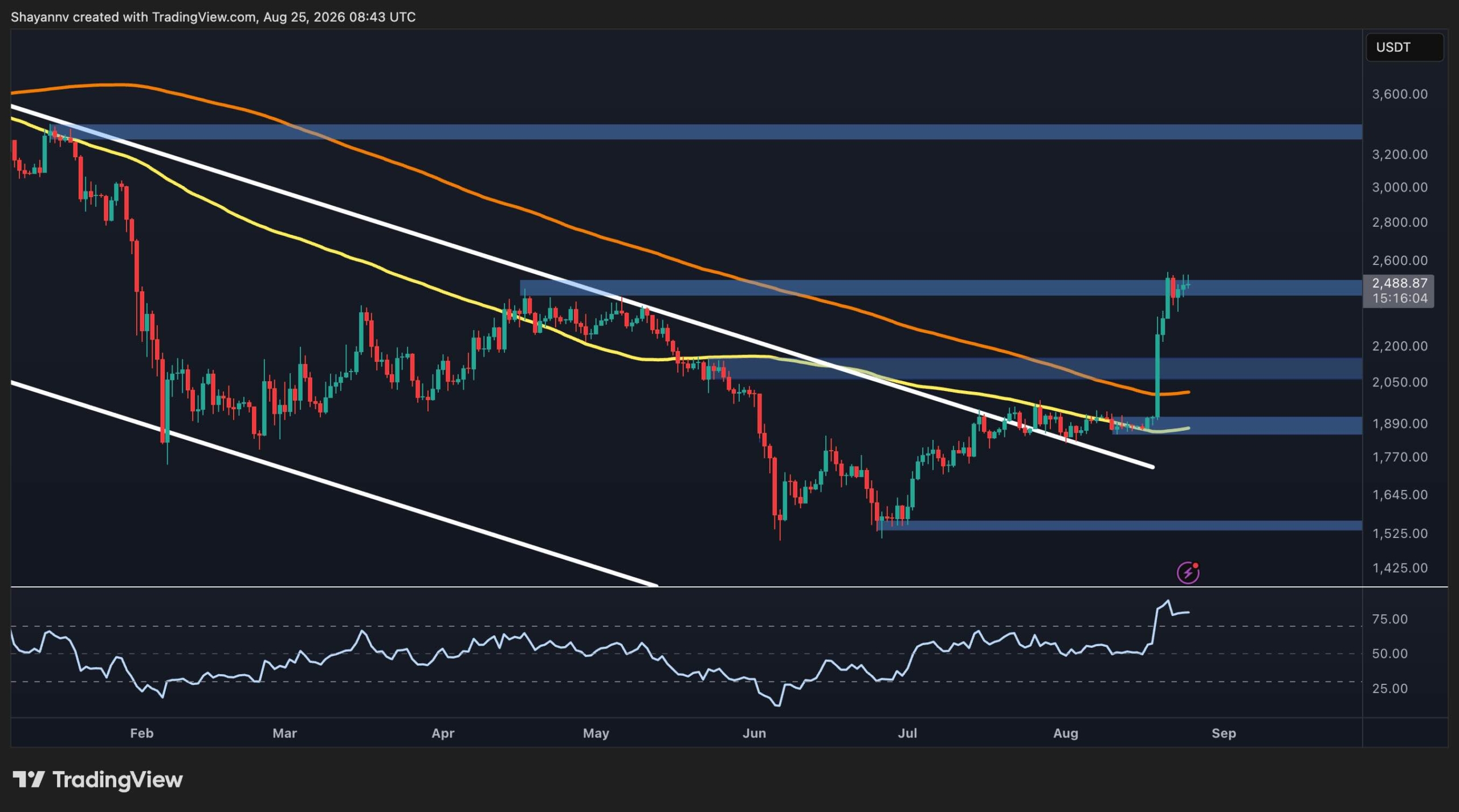
The daily chart shows a clear structural improvement. ETH spent much of the summer consolidating between roughly $1.5K and $2K while remaining inside a descending channel. The recent breakout above the upper trendline, the $2.1K resistance zone, and the 100-day and 200-day moving averages represent an important shift in market structure.
The breakout was followed by an exceptionally strong impulsive move toward the $2.5K area. ETH is now trading around $2.49K and testing the major resistance zone extending approximately from $2.45K to $2.5K. This area is particularly important because it has previously acted as a major resistance and is currently being tested after a steep vertical advance. A sustained daily breakout above $2.5K would strengthen the bullish case and could expose the next major resistance region around $3.3K.
On the downside, the former $2.1K resistance area has become the first major support zone. A deeper correction could bring ETH toward the $1.9K region, which previously served as an important consolidation area. The lower $1.5K zone remains the major structural support visible on the chart, although a move there would represent a substantial deterioration from the current setup.
ETH/USDT 4-Hour Chart
The 4-hour chart provides a clearer picture of the breakout itself. ETH had been moving sideways around the $1.85K-$1.9K area while gradually pressing against the rising trendline near $2K. The eventual breakout produced a very strong expansion in price, taking ETH through the $2.1K zone and then toward $2.5K.
The former consolidation around $1.85K-$1.9K is now the most obvious lower support area. Above it, the $2.1K zone should be considered the primary breakout-support region. As long as ETH remains comfortably above this area, the 4-hour structure remains strongly bullish.
Momentum, however, has cooled considerably from the initial breakout. The 4-hour RSI pushed into extremely overbought territory during the vertical advance before falling back toward 70. This is generally healthier than maintaining an RSI near extreme levels, but it also means that ETH could spend more time consolidating before attempting another breakout.
Overall, the bullish setup would become less convincing if ETH fails to reclaim the $2.5K area. In that case, a retracement toward $2.1K would appear increasingly likely. A deeper loss of that region would shift attention back toward the $1.85K-$1.9K breakout base.

Sentiment Analysis
The Ethereum Coinbase Premium Index adds an important nuance to the rally. The metric has remained predominantly negative through much of the recent price recovery, indicating that ETH’s advance was not accompanied by consistently strong US-based spot demand. The premium recently recovered sharply from deeply negative readings and is now approaching the neutral line, while ETH trades around $2.4K-$2.5K.
This improvement is constructive because the deterioration in the Coinbase Premium appears to be reversing as the price pushes higher. However, the index has not clearly moved into sustained positive territory on the provided chart. Therefore, the current rally does not yet show the strongest confirmation of aggressive US spot-market buying.
If the Coinbase Premium turns decisively positive while ETH holds above $2.4K-$2.5K, it would provide additional confirmation for a continuation of the breakout. Conversely, renewed deterioration in the premium alongside rejection from the current resistance zone could increase the probability of a short-term correction.

The post Ethereum Price Analysis: What Are ETH’s Key Levels After the Breakout? appeared first on CryptoPotato.
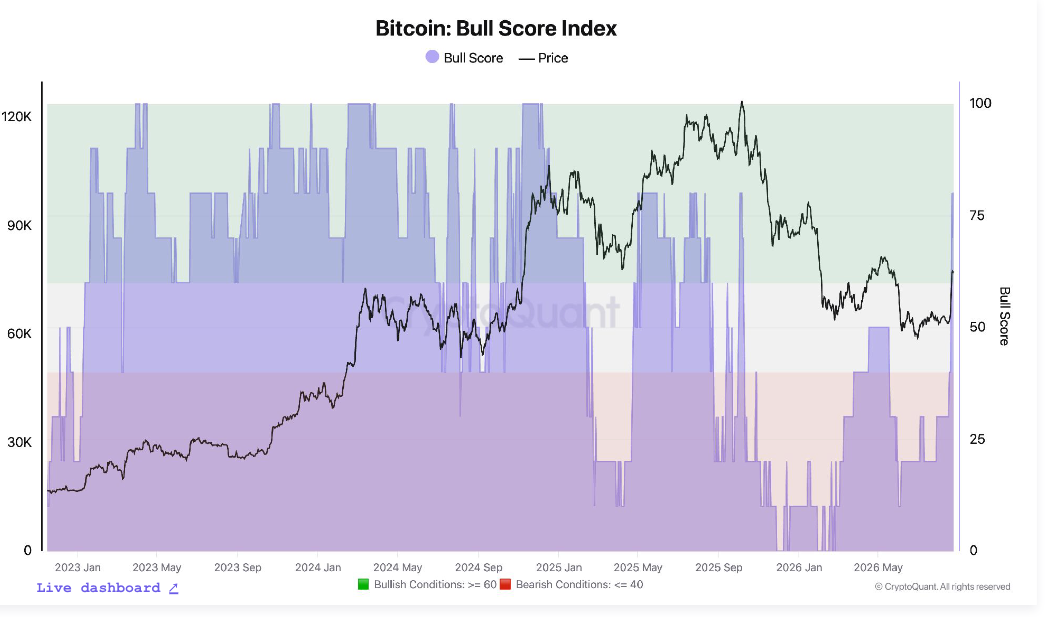
Bitcoin has entered the early stages of a new bull market after a 24% rally pushed key onchain and demand indicators into bullish territory, according to CryptoQuant.
The analytics firm’s Bull Score jumped to 80 from 30 over the past week, hitting its highest level since October 2025 as eight of the index’s 10 underlying indicators now flashing bullish.
Bitcoin (BTC) climbed above $80,000 during the rally, but CryptoQuant said a weekly close above its 365-day moving average, currently around $83,000, is needed to confirm the shift to a new bull market.
The shift has been supported by accelerating spot demand, while spot and futures demand are growing together for the first time since early October 2025, CryptoQuant said.
LMAX Group market strategist Joel Kruger also pointed to the May 2026 high of $82,820 as the next important level for Bitcoin.
“A clear break above that level would reinforce the view that a meaningful cycle low is now in place and shift attention towards the next major move through $100,000 and, ultimately, the 2025 record high,” Kruger told Cointelegraph.
At the time of writing, Bitcoin was trading around $79,000, according to CoinGecko data.
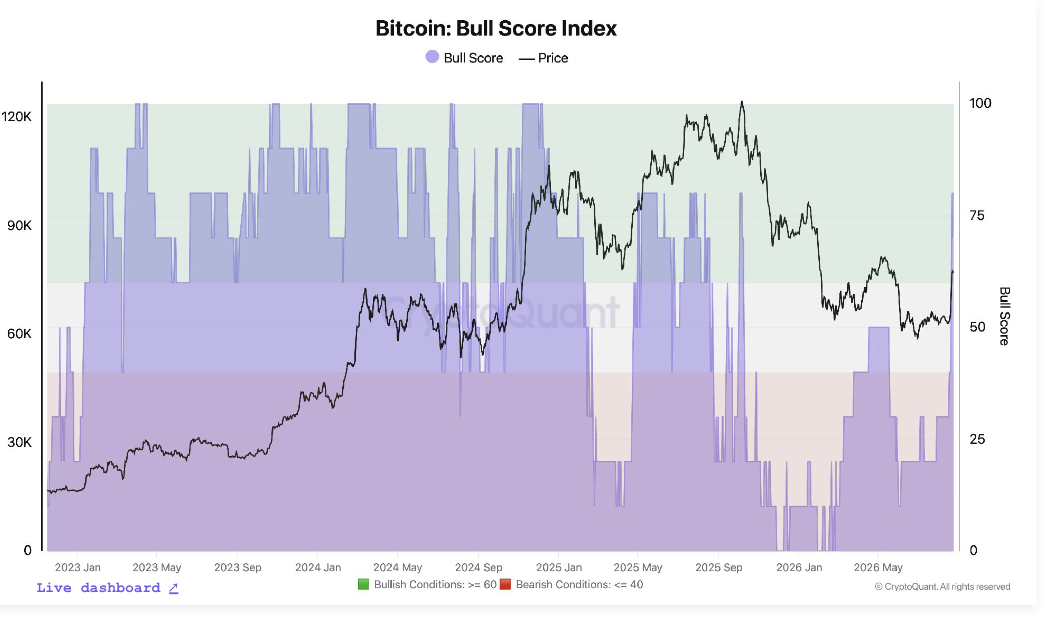
Bitcoin Bull Score Index. CryptoQuant report
Related: Bitcoin ETFs add $338M as six-day inflow streak hits $2.26B
Whales take profits as Bitcoin rally heats up
Despite the bullish signals, CryptoQuant warned that the rally may be overheated in the short term, pointing to rising trader profits, heavy profit-taking by whales and a spike in Bitcoin deposits to exchanges.
Traders’ unrealized profit margins have climbed to 20.5%, their highest since June 2025. CryptoQuant noted that Bitcoin fell about 30% after the metric reached 19% in early May, when BTC was trading near $82,000.
Short-term holder whales realized about $1.2 billion in profits between Aug. 20 and Aug. 22, including a record $614 million on Aug. 20, as Bitcoin traded near $78,000 to $79,000, according to the report.
Bitcoin exchange inflows also climbed to roughly 53,000 BTC, their highest since June, signaling that more coins are moving onto trading platforms where they could be sold.
Magazine: Korean bank taps Ripple for payments, Pakistan opens crypto licensing: Asia Express

Bitwise Asset Management has introduced automated investment portfolios built around Coinbase’s tokenized US stocks, aiming to give eligible non-US investors a way to follow model strategies while keeping the tokenized shares in their own non-custodial wallets. The product is designed to pair Bitwise’s portfolio construction with Glider’s automated execution and rebalancing.
In a Tuesday announcement, Bitwise said the portfolios will be deployed using Coinbase’s recently launched tokenized stocks. Glider will handle periodic trade adjustments to keep holdings aligned with Bitwise model portfolios, while users retain control of the underlying tokens.
Key takeaways
- Bitwise’s new automated portfolios rely on Coinbase tokenized US stocks and Glider’s rebalancing automation.
- Eligible investors outside the United States can participate while the tokenized assets remain in their non-custodial wallets.
- The initial lineup offers three strategies, including Mag7X (covering Apple, Nvidia, Microsoft, Tesla, and SpaceX) plus a robotics and AI leaders approach.
- Bitwise charges a 0.15% methodology access fee; trading and Glider platform fees are separate.
- Tokenized listed stocks have grown to $2.49 billion in aggregate value, with 2.25 million holders and $27.28 billion in monthly transfer volume, according to rwa.xyz.
How Bitwise’s automated stock portfolios work
Unlike traditional exchange-traded funds or managed funds where shares are held under a custodian, Bitwise says the tokenized stocks backing these portfolios stay in users’ non-custodial wallets. That custody model is central to the appeal for on-chain investors who want direct control over their assets.
The mechanics, as described in Bitwise’s announcement, split responsibilities between the portfolio designer and the automation layer. Bitwise sets the methodology for each model portfolio, while Glider manages the execution required to rebalance users’ holdings as the model’s target allocation changes. Users follow the preset strategies without having to manually trade each time allocations drift.
For investors, the fee structure is also explicit: Bitwise charges a 0.15% methodology access fee. The announcement clarifies that this cost does not include trading expenses or Glider’s platform fees, which means total carrying costs will depend on how frequently rebalancing occurs and on trading and execution pricing.
First set of strategies: from Mag7X to AI and robotics exposure
Bitwise’s launch begins with three strategies. One of them, Mag7X, focuses on large-cap technology and adjacent leaders. The initial model includes exposure to companies such as Apple, Nvidia, Microsoft, Tesla, and SpaceX.
Alongside Mag7X, the lineup is also described as covering “robotics and AI leaders,” reflecting Bitwise’s approach to selecting and weighting tokenized equities that fit those thematic criteria.
While the announcement confirms the initial holdings for Mag7X by listing the company examples above, it does not provide full allocation weights or portfolio construction rules in the excerpt provided. Investors considering these strategies should therefore review the specific portfolio methodology details associated with each model before subscribing.
Non-custodial equities and the DeFi pathway—plus its risks
Bitwise highlighted one key difference between tokenized stocks and conventional fund holdings: because users keep individual tokens in their own wallets, the assets may be usable in decentralized finance applications. The company said tokenized equities could, in principle, be used for lending or borrowing within DeFi—“subject to the risks of those protocols.”
This matters because tokenization can turn equities into programmable assets, potentially expanding use cases beyond buy-and-hold. However, it also introduces additional exposure points that don’t exist in traditional brokerage models, including smart contract risk, liquidation mechanics, and variability across lending markets.
For investors, the practical question is whether these portfolios are intended to be traded solely as automated stock baskets or whether the non-custodial model is also meant to integrate with DeFi strategies after rebalancing. Bitwise’s statement suggests the door is open, but it does not spell out a specific default DeFi workflow.
Momentum in tokenized equities and the timing with Coinbase’s Base launch
The Bitwise–Glider portfolios arrive shortly after Coinbase’s tokenized US stocks went live on Base. Earlier coverage from Cointelegraph noted that the Base rollout allows eligible non-US users to trade tokenized equities around the clock and to use them across DeFi applications.
That sequence is significant: tokenized equity availability is increasing on-chain, and now automated portfolio management is being layered on top. With Coinbase tokenized stocks acting as the underlying instrument, Bitwise’s approach can be read as part of a broader shift toward “traditional-style” portfolio strategies being implemented through blockchain-based infrastructure.
Separately, market activity indicators for the wider segment also point to growth. According to data compiled by rwa.xyz, tokenized listed stocks total $2.49 billion, up 5.18% over the past month. The same dataset reports 2.25 million holders and $27.28 billion in monthly transfer volume.
For readers tracking this sector, these figures provide context for why new portfolio products can gain traction: liquidity and participation appear to be expanding alongside the availability of tokenized assets. Still, the excerpt does not provide segment-level breakdowns for each issuer or venue, so investors should treat the aggregate numbers as directional context rather than a guarantee of execution quality for any specific portfolio.
As Bitwise and Glider roll out these automated strategies, the key variables to watch are the ongoing rebalancing cadence, total all-in costs (methodology plus trading and Glider fees), and whether the underlying non-custodial tokens will be integrated with more DeFi pathways over time. Equally important will be how reliably the model portfolios track their intended allocations as tokenized equity markets evolve.

A federal jury has convicted Las Vegas businessman Brent C. Kovar of defrauding at least 400 investors of $24 million through a crypto investment scheme.
Kovar owned Profit Connect, a Las Vegas-based company that operated from late 2017 through July 2021 and claimed to use artificial intelligence software on a supercomputer to mine crypto and verify transactions.
Crypto Fraud Conviction
According to the US Justice Department, Kovar falsely told investors that Profit Connect was profitable and could provide fixed annual returns of 15% to 30%, along with a 100% money-back guarantee.
He also claimed the company was backed by hundreds of millions of dollars in crypto reserves. Prosecutors said Kovar knew those claims were false. Profit Connect was not profitable, had no crypto reserves, could not pay the promised returns, and had no legitimate way to provide the money-back guarantee.
Instead, the businessman used money from investors to keep the company operating, purchase gifts for employees, and buy a house for himself. He also used the funds to repay other investors while making it appear that the money had come from crypto mining and transaction verification.
After a nine-day trial, the jury found Kovar guilty on 11 counts of wire fraud, two counts of mail fraud, and two counts of money laundering. Special Agent in Charge Christopher S. Delzotto for the FBI Las Vegas Field Office stated,
“The victims in this case thought they were engaged in revolutionary technological advancement, but it was merely a deception crafted by the falsehoods and trickery of Mr. Kovar.”
Meanwhile, Special Agent in Charge Ryan Korner with the Federal Deposit Insurance Corporation Office of Inspector General said Kovar also falsely told investors that their investment was insured by the FDIC. He is scheduled to be sentenced on November 30, 2026, and faces a statutory maximum penalty of 280 years in prison.
Another Conviction
Separately, a federal jury has convicted San Francisco resident Japheth Dillman of wire fraud and conspiracy to commit wire fraud after a 10-day trial over a crypto investment scheme. According to court documents and evidence presented at trial, Dillman, 48, and a co-conspirator defrauded more than 20 investors of nearly $1 million through false claims about Block Bits Capital, a crypto trading fund they helped establish.
From June 2017 to August 2018, they told investors the fund would generate profits through automated crypto trading using a software tool called “Autotrader,” which they claimed was complete and operational. Evidence showed Dillman knew the algorithm was not working and that investor funds could not be used as promised.
The money was also used for personal payments and to make risky investments in other crypto ventures, which ended up suffering major losses. Dillman remains released on bond and is scheduled to be sentenced on December 8, 2026. He faces up to 20 years in prison with a $250,000 fine for each count.
The post 280 Years in Prison Looms for Las Vegas Businessman in Crypto Case appeared first on CryptoPotato.

10 Essential PS5 Games Every Fan Must Play

Israel murders first child under ‘kill for kites’ order

France forward Nkunku leaves AC Milan to return to Leipzig





-

 Fashion4 days ago
Weekend Open Thread: Madewell – Corporette.com
-

 Business3 days ago
Musk’s Tesla, SpaceX Confirm $16.8 Billion ‘Terafab’ Chip Plant as World’s Largest Building in Texas
-

 Crypto World4 days ago
anatomy of crypto’s biggest liquidation event since 2021
-

 Politics3 days ago
6 months on, Irish renters crushed by effects of government housing bill
-
 NewsBeat3 days ago
The ‘Lucky Dip Gang’ causing carnage for clicks: After five thugs were killed speeding in the wrong direction on a motorway, GUY ADAMS investigates a sick new trend… and why police aren’t even allowed to pursue them
-

 Tech6 days ago
GLM-5.3 hits the API at $1.4/$4.4 per million tokens
-

 Business2 days ago
Mystery AI Model ‘Ox Alpha’ Draws Developers With Free Access as Chinese Lab Origins Remain Debated
-

 News Videos6 days ago
Don’t Leave Your Financial Future To Chance | August 19, 2026
-

 Crypto World19 hours ago
A $30 Billion AI Fund Implodes, Now the SEC Is Investigating Wall Street’s Role
-

 Business6 days ago
Marvell Shares Jump 7% as Google Chip Deal Confirms Custom AI Silicon Partnership, Analysts
-

 Business5 days ago
Five Below: Kids Discount Retailer Reaps Rich Rewards
-

 Business4 days ago
UK firms in critical financial distress rise 9% to 53,756
-

 Sports3 days ago
Deshaun Watson fires back at Browns fans after being booed: ‘It’s a disrespectful thing’
-

 Fashion6 days ago
Jimmy Choo Autumn 2026 collection
-

 Tech6 days ago
OpenAI confirms ChatGPT is down as logins and signups fail
-

 Crypto World5 days ago
Optimism-funded team's deciding vote shifts $49 million in OP tokens away from users
-
 Crypto World2 days ago
Google Gemini AI Predicts Ethereum Could Become the Trade Retail Misses in 2026
-

 Business5 days ago
PayPal and Venmo now accepted for tuition at several universities
-
 Sports6 days ago
Chaos! Daniil Medvedev loses cool, breaks two advertising boards at Cincinnati Open – Watch | Tennis News
-
 Entertainment6 days ago
10 Most Perfect Fantasy Shows of the Last 25 Years
You must be logged in to post a comment Login