

Crypto World
XRP Price Prediction: Judge in XRP Ruling Delivers Fresh Blow


Federal Judge Analisa Torres, the architect of XRP’s landmark 2023 securities ruling, has handed down another closely watched decision, leaving XRP price prediction debates wide open as the token trades at $1.09. The market is showing little urgency, with traders waiting for the legal dust to settle before making bigger moves.
Torres is best known for her July 2023 split ruling in the SEC’s case against Ripple. She found that programmatic XRP sales on exchanges were not securities, while institutional sales qualified as investment contracts. That decision became one of crypto’s most cited legal precedents. Even after the SEC and Ripple settled in 2025, her opinions still carry weight.
Her latest ruling comes from a different case, yet traders are reading between the lines anyway. Crypto markets have a habit of connecting dots, sometimes before the ink dries. Whether that reaction sticks depends on how regulators and courts interpret the decision in the months ahead.
For now, XRP continues to hold its chart structure despite the legal headlines. Price action remains relatively steady, but conviction is still in short supply. As always, the market loves certainty, and right now it is getting another legal puzzle instead of a clear answer.
Discover: The Best Token Presales
XRP Price Prediction: Recover Above $1.2 This Week?
XRP has been holding between $1.07 and $1.10 over the past 24 hours, reflecting a market that still lacks a clear winner. The past week’s range stretches from roughly $1.05 to $1.16, leaving support and resistance well defined. Traders are waiting for a catalyst, and so far, the chart has offered little more than a shrug.
Recent Ripple partnership headlines have done little to shake XRP out of that range. Sometimes good news knocks politely instead of kicking the door down. Even so, the series of higher lows remains intact, keeping buyers interested while preventing sellers from taking full control.

A bullish scenario starts with XRP defending the $1.05 to $1.07 support zone before reclaiming $1.16. A convincing breakout could then open the door to $1.25, where previous selling pressure emerged. That would finally give bulls something more exciting than another day of sideways candles.
The base case remains continued consolidation between $1.07 and $1.16 until a legal or macro catalyst tips the balance. On the flip side, a decisive close below $1.05 would weaken the current structure. If that happens, traders could begin watching the $1.00 area as the next meaningful support.
Don’t Miss Out on Our $1,000 USDT Airdrop on ByBit
LiquidChain Targets Early-Mover Upside as XRP Tests Key Levels
XRP trading sideways around $1.10, after a multi-year legal saga and a settlement that already priced in the good news, raises a fair question: where does the asymmetric upside actually come from here? Established large-caps with resolved regulatory overhangs tend to grind, not explode.
Traders looking for early-stage exposure with a different risk/reward profile are rotating attention toward infrastructure presales.
LiquidChain ($LIQUID) is a Layer 3 infrastructure project built around a single thesis: fragmented liquidity across Bitcoin, Ethereum, and Solana is the primary friction point in cross-chain DeFi.
All eyes are on LiquidChain.
⟁https://t.co/vqvBcdSQYC pic.twitter.com/GsuIe1xMnJ
— LiquidChain (@getliquidchain) July 7, 2026
Its Unified Liquidity Layer fuses all three ecosystems into a single execution environment, with Single-Step Execution, Verifiable Settlement, and a Deploy-Once Architecture that lets developers access BTC, ETH, and SOL liquidity without redeploying per chain.
The presale is currently priced at $0.01478 per $LIQUID, with $890K raised to date. For traders who want to assess the technical architecture before committing capital, research LiquidChain here.
Discover: The Best Crypto to Diversify Your Portfolio
The post XRP Price Prediction: Judge in XRP Ruling Delivers Fresh Blow appeared first on Cryptonews.

It’s that time of the week again, the weekend, in which the regular reader and investor might want to explore something lighter, fun, and more optimistic.
In this article, we will review the price predictions for bitcoin in 2026 made by some of the top AIs: ChatGPT, Gemini, Grok, and Perplexity. Sit back, enjoy, and let’s all hope at least one of the bullish targets below will be reached.
Let’s Be Realistic (but Also Hopeful)
Instead of starting with ChatGPT as we usually do in these articles, we will try something different and go for the less popular option, Perplexity. Its realistic take on the matter doesn’t envision a new all-time high, but the upper boundary is close to it: $95,000 to $125,000. Both of these sound quite impressive, given the current market state in which BTC fights for $64,000.
To be able to reach these yearly highs, though, Perplexity noted that several factors have to align: institutional ETF demand has to return, more favorable Fed policy, and renewed risk-on appetite from investors.
Grok’s opinion is largely in agreement, as its range is $90,000 to $120,000. No new all-time high, but still double-digit gains. Aside from the aforementioned factors, it outlined moderate macro improvement, no major recessions, and BTC’s increasing dominance as a store-of-value asset.
As with our similar article for XRP, Gemini was the least bullish. Its realistic targets are between $75,000 and $100,000, and it highlighted the same catalysts as above.
ChatGPT was more specific. It didn’t provide a wide range. Instead, it said that its realistic target for Bitcoin’s highest price in 2026 is $95,000.
“This scenario would not require a completely new speculative mania. Bitcoin would need ETF demand to stabilize, corporate buyers to stop reducing their exposure, and macroeconomic conditions to become moderately more supportive,” it said.
All Aboard the Bull Train
The other side of the coin sees bitcoin rocketing toward new all-time high levels. In fact, all of the AIs’ bull case predictions envisioned new records this year. ChatGPT, for example, noted that the primary cryptocurrency can jump past $130,000 and peak about five grand above that level.
Gemini’s target was even higher. Google’s AI noted that under extreme conditions, BTC can top at somewhere between $150,000 and $180,000. Grok’s most optimistic scenario predicted a massive rise toward $200,000 or even slightly above. Perplexity joined the $200,000+ narrative, setting a target of $210,000.
However, all AIs agreed that many, many factors would have to align for such high numbers to be even possible. It’s not just the ETFs and easing monetary policy mentioned above. BTC would need an accelerating global economy, peace deals among many of the warring parties, and a sweeping cross-asset bull run, combined with “expanding institutional digital-asset treasuries,” to propel the cryptocurrency toward new peaks.
The post Bitcoin Price Predictions for H2 2026: Which AI Sees the Biggest Rally and Why? appeared first on CryptoPotato.

Pakistan’s virtual-asset regulator is urging continued dialogue on how digital assets should be assessed under Islamic law, after a prominent scholar backed a religious ruling that certain crypto-based purchases are impermissible.
Pakistan Virtual Assets Regulatory Authority (PVARA) chairman Bilal bin Saqib met with Mufti Taqi Usmani, and in a post shared on Saturday he said the conversation covered blockchain technology, digital assets, stablecoins, and tokenized real-world assets (RWAs), alongside the need to shield Pakistanis from fraud and financial harm.
Key takeaways
- PVARA chairman Bilal bin Saqib called for scholars and regulators to keep discussing how Islamic law should apply to different categories of digital assets.
- Mufti Taqi Usmani and other scholars reportedly issued a ruling declaring crypto-based purchases impermissible, including transactions involving stablecoins such as USDT.
- Saqib did not directly dispute the religious ruling; instead, he emphasized differentiated technical and Shariah review rather than one uniform approach.
- The episode underscores a broader challenge for Pakistan’s move toward a regulated crypto industry: maintaining compliance both legally and religiously.
Religious ruling vs. regulator’s call for category-by-category review
According to Pakistani outlet Dawn, Usmani and five other scholars signed an Islamic legal ruling issued by Jamia Darul Uloom Karachi on Friday. Dawn reports the ruling states that purchases made using cryptocurrency—including stablecoins such as USDT—are not permitted because, under their interpretation of Islamic law, digital tokens do not constitute recognized property or wealth.
Speaking after his meeting with Usmani, Saqib chose a different emphasis. He said the discussion highlighted that digital assets are not a single, uniform instrument and therefore should not be judged through one lens. Instead, he argued for “careful technical assessment alongside rigorous Shariah examination,” suggesting that separate asset types and use cases may warrant distinct evaluation.
Pakistan’s regulated crypto pivot intensifies the stakes
The exchanges come as Pakistan moves away from years of broad restrictions and toward licensed oversight for virtual assets. In April, the State Bank of Pakistan reportedly allowed banks to open accounts for virtual asset service providers (VASPs) that are licensed by PVARA, ending an eight-year restriction on regulated institutions dealing with crypto.
That banking adjustment followed the passage of Pakistan’s Virtual Assets Act 2026 in March, which established PVARA as the statutory body responsible for licensing and monitoring virtual-asset activities. With this framework in place, the PVARA chairman’s comments indicate the regulator sees public acceptance and compliance scrutiny as tightly linked.
The religious question may carry particular weight in Pakistan’s social and political context. The 2023 national census reported that about 231.7 million people—96.35% of the population—identified as Muslim.
Stablecoins and tokenized RWAs at the center of the debate
Within Saqib’s remarks, stablecoins and tokenized real-world assets (RWAs) featured prominently, reflecting how mainstream crypto utility increasingly extends beyond volatile tokens. Stablecoins are designed to track a reserve-based reference value, while tokenized RWAs aim to represent exposure to conventional assets through blockchain mechanisms.
At the same time, the religious ruling reported by Dawn specifically flagged crypto-based purchasing—including stablecoin payments—as impermissible under the scholars’ view of what counts as legitimate property or wealth. Saqib’s response did not concede or reject the legal reasoning; rather, he stressed that regulators and scholars should continue distinguishing among categories of digital assets and examine their practical functions in addition to their Shariah interpretation.
What investors and builders should watch next
For Pakistan’s licensed crypto sector, the immediate question is whether ongoing engagement between PVARA, religious scholars, and industry participants leads to a clearer framework for how different tokens are treated in real-world transactions. Saqib’s call for continued dialogue suggests the regulator may seek more granular alignment rather than a blanket approach—something that could influence how VASPs structure products, payment rails, and consumer-facing services.
Readers should watch for follow-up statements from PVARA, the State Bank of Pakistan, and religious authorities clarifying how guidance may evolve for stablecoin payments and other crypto-enabled commerce, especially as the country’s regulated market expands.


Ripple CEO Brad Garlinghouse said the company seriously considered closing after the U.S. Securities and Exchange Commission sued it in December 2020. He said he and co-founder Chris Larsen discussed distributing Ripple’s XRP holdings to shareholders on a pro rata basis and dissolving the business. Garlinghouse described that choice as the easier path against an agency with “infinite power and resources.”
Summary
- Ripple considered dissolving and distributing XRP to shareholders before choosing to fight the SEC lawsuit.
- Garlinghouse said the company protected hundreds of jobs despite spending about $150 million on litigation.
- The case ended in 2025, while Ripple’s penalty and institutional sales restrictions remained in force.
The company rejected the shutdown plan because it would have ended hundreds of jobs. Garlinghouse said Ripple chose to defend itself even though the result remained uncertain. “I’m glad in retrospect, but that was not obvious at the time,” he said during a talk at the University of Kansas School of Business. He estimated that Ripple spent about $150 million on the legal fight. A Wu Blockchain post shared the remarks on July 12, bringing new attention to Ripple’s internal response during the lawsuit’s earliest months.
The case changed how Ripple could sell XRP
The SEC accused Ripple, Garlinghouse and Larsen of conducting unregistered securities sales through XRP. The agency said Ripple had raised more than $1.3 billion. The lawsuit placed pressure on the company’s U.S. business, partnerships and access to institutional clients. It also created years of uncertainty over how federal securities law applied to XRP transactions.
Garlinghouse also said he met SEC officials four times between 2017 and 2019 without a lawyer. He said officials never warned him that XRP could be treated as a security, which affected Ripple’s decision to challenge the case. Judge Analisa Torres issued a split ruling in July 2023. She found that Ripple’s programmatic XRP sales on public exchanges did not amount to securities transactions. However, she ruled that some direct sales to institutional buyers broke securities laws. The court later ordered Ripple to pay a $125 million civil penalty and barred it from repeating unregistered institutional sales.
Appeals ended, but the final judgment remained
Ripple and the SEC tried to settle the remaining dispute in 2025. Their proposal would have reduced the penalty to $50 million and removed the injunction. Judge Torres rejected the request because the court had already entered a final judgment. Both sides then dropped their appeals, and the Second Circuit closed the case on August 22, 2025.
A crypto.news review of the case said the end of the appeals did not erase the original judgment. Ripple still faced the $125 million penalty and the permanent injunction tied to future institutional XRP sales. Exchange-based XRP trading received clearer treatment under the 2023 ruling, but the decision did not create a single federal rule for every digital asset transaction.
Ripple expands while U.S. rules remain unfinished
Ripple continued to expand after the lawsuit. Recent crypto.news coverage reported that the company secured a full Markets in Crypto-Assets license in Luxembourg. The approval allows Ripple to offer regulated crypto services across the European Economic Area. That gives the company a clearer operating framework in Europe than it currently has in the United States. Crypto.news also reported that Ripple’s European approval arrived as U.S. legal clarity remained tied to federal legislation and the treatment of digital assets.
U.S. lawmakers continue to debate market structure rules that could define when digital assets fall under securities or commodities oversight. For Ripple, the near-shutdown disclosure shows how enforcement pressure shaped its strategy and spending for several years. The company survived the case, kept its workforce and expanded abroad, while some limits from the final judgment remain active.
Crypto World
Stablecoins see biggest drop since 2022 crypto winter led by Tether (USDT), Circle’s USDC decline


The combined market capitalization of major stablecoins fell from roughly $166 billion in March 2022 to $122 billion by September 2023, RWA.xyz data shows — a decline of over 26% as investors pulled money from the digital asset market.
Tether’s USDT fell from $78 billion to $65 billion between March and November 2022. For USDC, the downtrend took much longer to play out, falling from $55 billion in July 2022 to below $24 billion by November 2023, exacerbated by its banking partner Silicon Valley Bank’s collapse in 2023 March.
The implosion of TerraUSD, the algorithmic stablecoin of the Terra-Luna crypto project, also wiped out $18 billion from the stablecoin market.
The current decline is only a temporary setback in a long-term uptrend, one analyst said.
“The recent decline in stablecoin market cap represents a relatively small pullback in what we believe is a long-term growth market,” said Paul Howard, senior director at trading firm Wincent.
“Short-term fluctuations in liquidity are normal, but they don’t change our view that stablecoins will continue to play an increasingly important role in the digital asset ecosystem,” he added.
Increasing stablecoin competition
Looking beyond the headline decline, the trend appears more nuanced.
Part of the slowdown reflects a changing competitive landscape. As stablecoins move beyond crypto trading and into mainstream payments, new issuers have entered the market following regulatory progress such as the GENIUS Act in the U.S.
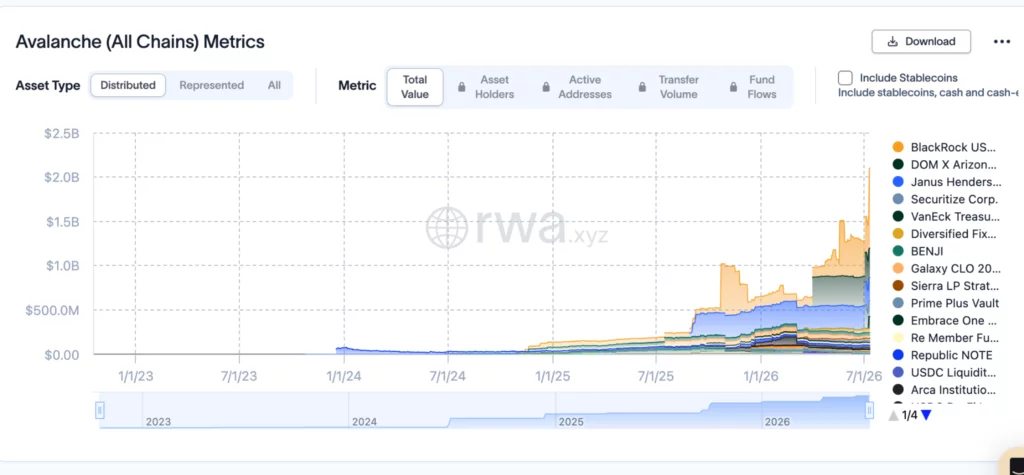
BlackRock’s USD Institutional Digital Liquidity Fund, known as BUIDL, has passed $900 million in assets on Avalanche. The figure rose from about $464 million within seven days, adding roughly $436 million and marking a 105% weekly increase.Wu Blockchain cited current RWA.xyz data when reporting the move on July 12.
Summary
- BlackRock’s BUIDL assets on Avalanche doubled within one week, passing the $900 million mark today.
- Avalanche now holds the second-largest BUIDL allocation behind Ethereum, according to the latest RWA.xyz data.
- BUIDL’s total value reached about $2.87 billion as tokenized Treasury demand continued growing across blockchains.
RWA.xyz’s BUIDL dashboard places the fund’s total asset value at about $2.87 billion across supported networks. Its Avalanche position now represents close to one-third of the full fund. Current data also puts Avalanche behind Ethereum as BUIDL’s second-largest network allocation. The increase comes without a change to the token’s target value of $1 per share.
BUIDL gives institutions on-chain Treasury access
BlackRock launched BUIDL in March 2024 through tokenization platform Securitize. The fund invests mainly in U.S. Treasury bills, cash, and repurchase agreements. Its stated goal is “current income” while maintaining liquidity and stability of principal. Investors receive tokenized fund shares and daily accrued dividends, subject to eligibility and transfer controls.
BUIDL first launched on Ethereum before expanding to Aptos, Arbitrum, Avalanche, Optimism, and Polygon in November 2024. It later reached Solana and BNB Chain.Crypto.news reported that the added share classes gave approved investors more options for transfers, settlement, and on-chain yield across several blockchain environments.
BNY Mellon supports the fund’s administration across digital and traditional systems. RWA.xyz lists a seven-day annualized yield of 3.40% and management fees ranging from 0.20% to 0.50%. These figures can change with short-term interest rates, expenses, and the share class used by each investor. BUIDL’s on-chain tokens record ownership, while the underlying portfolio remains managed under the fund’s legal structure. The fund reports a net asset value of $1.
Avalanche’s tokenized asset market expands
Current RWA.xyz Avalanche data shows about $2.10 billion in distributed real-world asset value on the network, up more than 58% over 30 days. Based on those figures, the Avalanche share of BUIDL accounts for roughly 43% of the network’s distributed asset value. Avalanche also hosts tokenized products from Franklin Templeton and other asset managers.
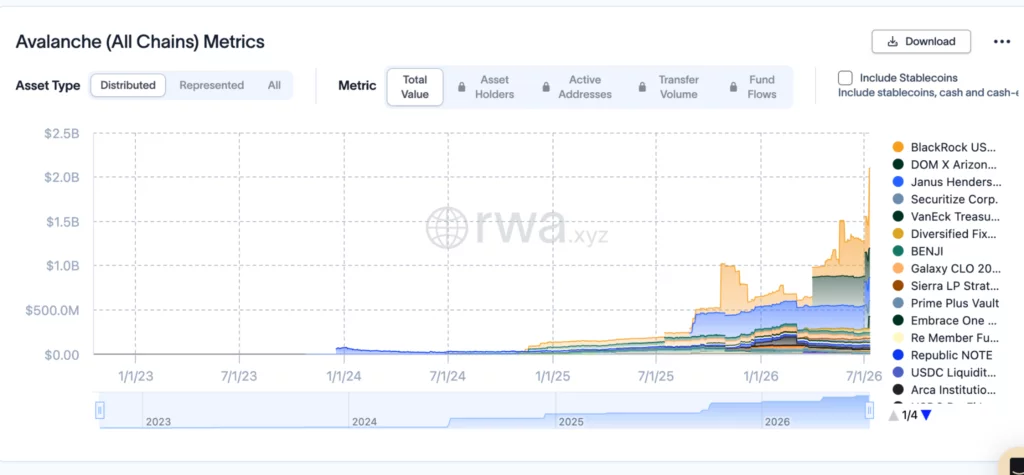
Source: RWA.xyz Avalanche data
BUIDL has also entered decentralized finance on Avalanche. Crypto.news reported that sBUIDL, a token backed one-to-one by BUIDL and issued by Securitize, became collateral on Euler in May 2025. Eligible users can borrow USDC or AUSD against the asset through curated lending markets.
Tokenized Treasury demand continues growing
The BUIDL increase comes as tokenized real-world assets gain a larger place in institutional crypto activity.Crypto.news reported in June that tokenized real-world assets had crossed $29 billion by April 2026. Tokenized U.S. Treasuries rose from about $380 million in 2023 to $13.4 billion during the same period.
BUIDL remains concentrated among a limited number of approved investors. RWA.xyz lists 113 holders, even as the fund approaches $2.87 billion in value. That structure reflects its focus on qualified purchasers rather than broad retail access. The latest Avalanche increase may therefore represent one or several large allocations rather than a broad rise in wallet numbers.
BlackRock and Securitize have not publicly identified the investors behind the weekly Avalanche increase. The available data confirms the asset growth but does not show whether the capital came from new subscriptions, network transfers, or both. Market participants can track future changes through the RWA.xyz dashboards as BUIDL’s multi-chain distribution develops.


Blockstream co-founder Adam Back and Strategy founder Michael Saylor have publicly opposed BIP 110, a proposed temporary soft fork for Bitcoin. A Wu Blockchain post summarized their comments on July 12. Back said the plan attempts to police transactions that other users choose to send. He argued that this approach conflicts with Bitcoin’s decentralized and permissionless design.
Summary
- Adam Back and Michael Saylor reject BIP 110, citing censorship concerns and potential fork risks.
- BIP 110 would temporarily restrict large data fields while preserving outputs created before network activation.
- Miner signaling remains near zero, far below the proposal’s required 55 percent activation threshold today.
Back also warned that supporters could create a separate chain if they enforce rules without broad agreement. Saylor made a similar case in his public statement. He said, “BIP 110 turns a spam dispute into a consensus change” that would reject some transactions that Bitcoin currently accepts. Saylor called that precedent “extremely dangerous” and said developers should focus on larger threats.
What BIP 110 would change
The official BIP 110 specification calls it the Reduced Data Temporary Softfork. It would apply extra consensus rules for about one year. These rules would restrict large data fields, some Taproot features, and several methods used to place images or other files inside transactions. The proposal keeps OP_RETURN outputs within an 83-byte limit and restricts several payloads to 256 bytes.
The proposal says these limits would reduce data storage on Bitcoin and keep the network focused on money. It exempts UTXOs created before activation, so existing outputs remain spendable under the old rules. Supporters say the measure would reduce storage demands on node operators. Critics say fee-paying users should decide how they use block space.
Luke Dashjr keeps backing the proposal
Bitcoin developer Luke Dashjr continues to support BIP 110. A July 6 crypto.news report said he rejected calls to withdraw it and stated, “It’s too late to cancel BIP110.” He argues that Ordinals, Runes, and similar uses place non-financial data on Bitcoin and raise the long-term cost of storing and serving the blockchain.
Earlier crypto.news report covered Back’s earlier response to supporters who claimed discussion channels had blocked the proposal. Back rejected that claim and said many participants had already reviewed the plan. The report found low node support and no clear backing from a major mining pool at that stage.
Miner support remains far below the threshold
BIP 110 uses a modified activation process. Miners can lock it in by signaling support in 1,109 of 2,016 blocks, equal to 55%. The specification sets mandatory signaling before block 963,648 and activation at block 965,664, expected around September 1, 2026. The temporary rules would then remain active for about one year.
Current support remains far below that level. Reporting published July 12 said miner signaling stood at zero in the active period and had never exceeded about 1% in earlier periods. No major mining pool had supported the proposal. Without broad adoption, nodes enforcing BIP 110 could follow a minority chain while other nodes continue accepting existing transaction rules.
Exchanges, wallets, miners, and node operators now face an August planning window. They must decide which software and rules they will support before the mandatory signaling period. Market participants can track centralized exchange reserves through DeFiLlama’s CEX dashboard, though those figures do not measure Bitcoin consensus support. The BIP 110 outcome will depend on software adoption, miner signaling, and user decisions across Bitcoin.
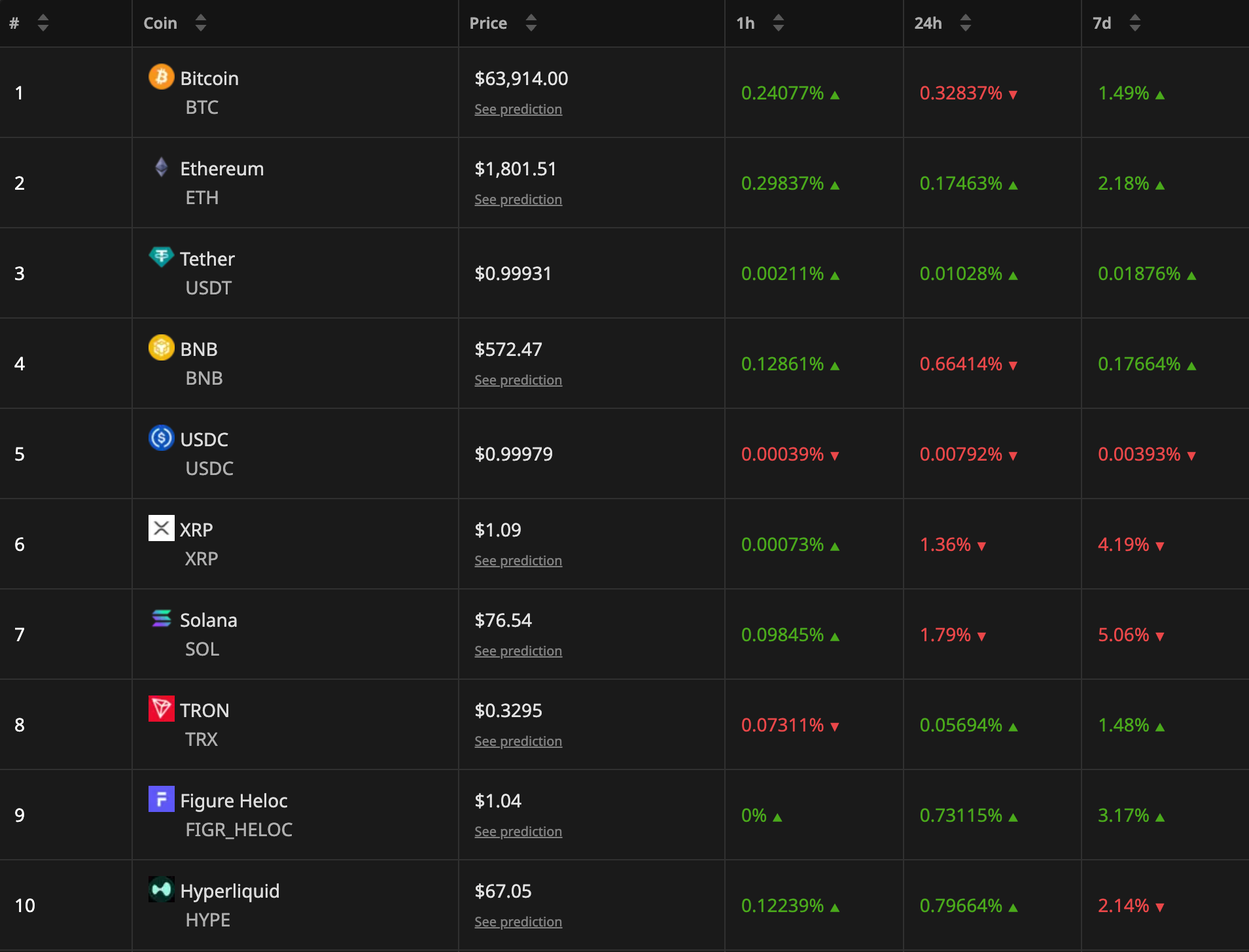
Crypto markets held firm on Sunday, with Bitcoin (BTC) near $64,000, as digital assets absorbed fresh US strikes on Iran and the closure of the Strait of Hormuz once more.
The muted move breaks from earlier in the war. Bitcoin fell about 2% and slid toward $61,000 after June’s escalation, a far steeper reaction than today’s 0.33% dip.
US Launches Third Round of Strikes on Iran
Iran declared the Strait of Hormuz closed and fired on a commercial vessel. The move defied a US demand to guarantee passage through the waterway.
In response, US Central Command (CENTCOM) launched a third round of strikes. Forces hit roughly 140 targets.
Those targets included missile and drone sites, naval assets, and coastal surveillance posts.
“During three nights of strikes this week, CENTCOM has struck more than 300 targets… to degrade Iran’s ability to attack civilian mariners and commercial vessels freely transiting the strait,” CENTCOM said.
The conflict widened across the Gulf. Iran claimed attacks on Bahrain, Kuwait, Jordan, Qatar, the UAE, and Oman.
Follow us on X to get the latest news as it happens
Crypto Shrugs Off the Escalation
Despite the escalation, major tokens barely moved. Bitcoin posted a 0.33% daily loss. Ethereum (ETH) traded around $1,801, up 2.18% over the past 7 days. XRP (XRP) and Solana (SOL) each fell less than 2% on the day.

Oil markets, shut for the weekend, could open higher on Monday. Brent held near $76 a barrel on Friday. Another prolonged closure could rattle energy markets and lift prices as traders price in tighter supply.
Subscribe to our YouTube channel to watch leaders and journalists provide expert insights
The post Crypto Markets Prove Resilient as Iran Closes Strait of Hormuz Again appeared first on BeInCrypto.
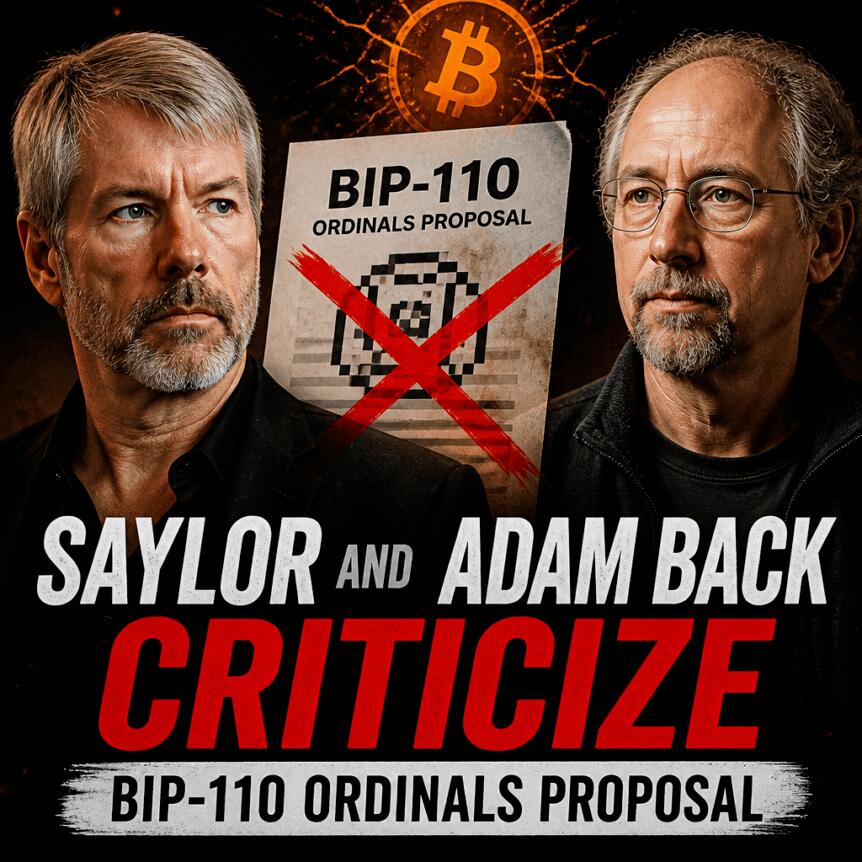
Michael Saylor and Adam Back have renewed their opposition to BIP-110, a proposed Bitcoin protocol change aimed at curbing certain “non-monetary” data activity associated with Ordinals-like inscriptions. Their critique highlights a recurring fault line in Bitcoin governance: whether developers should intervene at the protocol level to address perceived network bloat, and what such intervention could cost in terms of credibility and user safety.
BIP-110 was introduced in December 2025 with the stated goal of discouraging arbitrary data from clogging the blockchain and preserving Bitcoin’s core role as a peer-to-peer cash network. In response, Saylor argued the proposal is more likely to create harm than solve the problem, adding that the risks extend beyond “spam.”
Key takeaways
- Strategy’s Michael Saylor and Blockstream CEO Adam Back both oppose BIP-110, warning that a protocol-level fork could damage Bitcoin’s credibility and potentially disrupt normal transactions.
- BIP-110’s activation is contingent on broad node support: at least 55% of validating nodes must back the proposal during a Bitcoin “block period.”
- Recent data cited in the discussion suggests only a small fraction of blocks within the last evaluated period showed BIP-110 support.
- Ordinals activity has reportedly fallen sharply from its August 2023 peak, raising questions about whether a contentious fix is needed now.
A protocol fork framed as an anti-bloat measure
BIP-110 enters a sensitive part of Bitcoin’s history. Rather than addressing bloat through soft, non-contentious policy or user-level behaviors, it proposes a temporary fork intended to limit certain categories of non-monetary transactions. According to the proposal’s proponents, the aim is to stop Ordinals-like inscriptions and other arbitrary data from “spamming” the network while keeping Bitcoin focused on its cash-first design.
The proposal was introduced by a pseudonymous developer, “Dathon Ohm,” and received support from Ocean protocol founder Luke Dashjr. While both critics and supporters agree that inscriptive activity can increase on-chain data usage, the disagreement is over whether a temporary, protocol-enforced limit is the right tool—and whether the costs of implementing it outweigh the benefits.
Why Saylor and Back think the risk is bigger than “spam”
Saylor’s criticism centers on the potential for broader damage. In a post on X, he claimed there are “110 things more dangerous to Bitcoin than spam,” arguing that BIP-110 could invalidate ordinary transactions on the network.
Back’s objections are similarly pointed, but the framing is more philosophical. He described BIP-110 as a “quest to police other people,” emphasizing that Bitcoin’s decentralization should prevent any group from imposing its preferences on others. In his view, a permissionless, censorship-resistant money system is fundamentally incompatible with rules that effectively restrict activity based on the preferences of a subset of participants.
Together, their statements reflect a core tension within Bitcoin’s development culture: even if a change targets a real technical concern, critics worry that introducing protocol-level enforcement could undermine neutrality and the expectation that Bitcoin doesn’t require permission to use the network.
Support appears limited—and the Ordinals peak is already fading
Even if BIP-110 remains controversial, it is not automatically enforceable. The proposal would not activate unless 55% of Bitcoin nodes validating blocks support it across a Bitcoin block “period.” In the last evaluated period—period 475, covering blocks 955,584 to 957,599—only about 1% of blocks were reported as BIP-110-supportive.
The dispute is unfolding alongside what appears to be a major change in on-chain behavior. According to activity tracked by Dune Analytics, fewer than 10,000 Ordinals inscriptions have been recorded per day over the last month. That is a sharp decline from a peak in August 2023, when daily inscriptions reportedly exceeded 400,000.
This matters for the credibility of the urgency argument. If Ordinals activity has already receded toward near all-time lows, critics may see BIP-110 as an overreaction—especially one that requires hard coordination to enact a fork. Supporters, meanwhile, may argue that even if the peak has cooled, the underlying incentive structures and transaction patterns could rebound, and waiting could allow bloat to persist longer than is acceptable.
Supporters argue it won’t “split” the chain
Proponents of BIP-110 describe Ordinals-driven bloat as a “serious threat” to the network and have argued that an imminent fix is needed to protect Bitcoin’s long-term integrity. A frequent concern from skeptics is whether protocol changes like this could cause a chain split—an outcome that would force users and infrastructure to choose between incompatible rules.
According to proponents, BIP-110 is designed to reduce that risk by limiting the change’s scope and duration. They have stated it would not cause a chain split and have argued that the fork’s temporary, one-year limitation means it would not invalidate fee-paying transactions over the long term.
Still, the dispute is likely to persist because “temporary” enforcement at the protocol layer is exactly what many decentralization-focused critics resist. Back’s point about preventing one group from imposing views on others, and Saylor’s warning about invalidating ordinary transactions, both suggest that even a limited-duration change could create unpredictable outcomes—either technically or socially—depending on how different parts of the ecosystem implement and interpret the upgrade.
With reported node support so low in the latest block period and Ordinals activity already far below its earlier peak, the immediate question is whether BIP-110 can gain the kind of majority backing required for activation. Readers should watch next for shifts in validating-node support rates across subsequent block periods, as well as whether Ordinals inscription volumes remain depressed or start climbing again—both of which could reshape how participants weigh the urgency and acceptability of BIP-110.


Hedera-based lending protocol Bonzo Lend lost about $9.05 million after an attacker manipulated the price of SAUCE used as collateral. Bonzo Finance Labs said the incident began on July 11, 2026, when a wallet submitted a false SAUCE price to a third-party Supra oracle contract. The attacker deposited 250 SAUCE, worth only a few dollars, before the feed treated the tokens as highly valuable.
Summary
- An attacker inflated SAUCE’s oracle price and borrowed assets worth about $9.05 million from Bonzo.
- Supra’s verifier accepted a zeroed signature, allowing the false price update to reach Hedera mainnet.
- Bonzo paused lending while teams pursue recovery, fixes, and the promised return of white-hat funds.
Eight seconds after the false price reached the network, the wallet borrowed 6.63 million USDC and more than 34.5 million wrapped HBAR. Bonzo described the headline loss as “approximately $9.05 million.” The protocol paused Bonzo Lend at 01:41 UTC and stopped Bonzo Points later that morning. Bonzo Vaults, Bonzo Bridge, and single-sided BONZO staking continued operating.
Zeroed signature passed Supra’s verifier
Bonzo’s incident report traced the event to Supra’s signature verification process. The update carried a zeroed signature instead of a valid signature from Supra’s oracle committee. Bonzo said the verifier failed to reject zero-value inputs before sending them to Hedera’s pairing system contract.
The pairing check returned true because both values represented the mathematical identity point. Supra’s contract then treated that result as proof of a valid committee signature. Bonzo said “no valid oracle signature was forged” and SAUCE’s real market price did not rise. Supra has since deployed a fix to the affected verifier contract on Hedera mainnet, according to the report.
Bonzo says its lending contracts followed their code
Bonzo said its lending contracts read the manipulated value from the approved oracle feed and calculated borrowing power from that data. The team stated that the lending pool acted as designed after receiving the false input. Its report ruled out a Bonzo contract bug, a flash-loan attack, and normal market manipulation.
A second account borrowed about $1 million while the abnormal price remained active. That wallet later contacted the team and described itself as a white-hat responder. It said it planned to return the assets. Bonzo excluded that amount from its $9.05 million loss figure because recovery talks remain active. The published report had not confirmed the return.
Crypto.news tracked transfers before Bonzo confirmed the loss
Before Bonzo released its findings,crypto.news reported that security researchers had tracked more than $5.8 million moving from Hedera to Ethereum. Researchers said the wallet bridged assets through LayerZero and converted part of the holdings from wrapped Bitcoin into Ether. HBAR fell more than 2% as the transfers continued.
Bonzo’s oracle documentation lists Supra feeds for SAUCE, HBARX, XSAUCE, DOVU, PACK, KARATE, STEAM, and HST against wrapped HBAR. The incident affected the SAUCE pair. Bonzo said legitimate publishing restored that price to about 0.1964 HBAR at 01:36 UTC, five minutes before the lending pool pause.
The later Bonzo report raised the confirmed principal taken by the main attacker to about $9.05 million. A Wu Blockchain post also shared the protocol’s findings. Bonzo Lend remains paused while Bonzo Finance Labs and the Bonzo Finance Foundation work with partners on asset recovery, repairs, and withdrawal plans for liquidity providers. The team has not set a date for reopening the lending pool.

A new report from the Cambridge Centre for Alternative Finance places Ethereum’s post–Merge energy footprint among the less energy-intensive proof-of-stake (PoS) networks, even as it remains higher in absolute consumption than most single-network peers. The study estimates that Ethereum uses about 7.87 gigawatt-hours (GWh) of electricity per year.
More importantly for sustainability comparisons, Cambridge also calculated Ethereum’s energy intensity relative to market value, finding roughly 33 kilowatt-hours (kWh) per $1 million. That figure ranks as the second-lowest among the PoS networks assessed, behind BNB Chain.
Key takeaways
- Cambridge estimates Ethereum consumes about 7.87 GWh annually, based on modeled electricity use at the wall.
- Ethereum’s energy intensity is estimated at ~33 kWh per $1 million, the second-lowest among the PoS networks in the study.
- Solana is estimated to use the most electricity among the PoS networks considered, at ~13.48 GWh per year.
- Cambridge attributes Ethereum’s remaining emissions mainly to the electricity grids powering its validators and node operators, rather than network operations based on mining.
How Cambridge built its Ethereum power model
The Cambridge researchers estimated electricity use by measuring how much power Ethereum nodes consume under different software-client setups. According to the report, they modeled electricity demand across 20 combinations of the Ethereum network’s main software clients, using assumptions tied to typical home and professional hosting environments.
In the study’s modeling, a “typical home” node setup draws about 18 watts, while a more capable workstation setup uses roughly 153 watts. Cambridge then used Ethereum’s observed mix of residential and professionally hosted nodes to estimate an average power draw of approximately 105 watts per node.
To scale this to network-wide consumption, the report counted around 8,522 discoverable full nodes. Of those, 64% were described as running in cloud or enterprise environments, with the remaining 36% on residential connections. These proportions matter for sustainability comparisons because hosting environments can differ in electricity sourcing and energy efficiency.
Energy intensity vs. market value: why it changes the comparison
While absolute electricity consumption is one dimension of sustainability, Cambridge also calculated energy intensity adjusted for market value. This approach aims to answer a practical question for investors and policymakers: how much electricity a network uses relative to the scale of economic value attributed to it.
On this basis, Ethereum’s estimated ~33 kWh per $1 million places it near the lower end among PoS systems assessed—second only to BNB Chain. Solana, by contrast, tops the group in Cambridge’s dataset for both absolute annual electricity consumption and energy intensity.
The report estimates Solana uses about 13.48 GWh per year, corresponding to roughly 283 kWh per $1 million in market-value-adjusted energy intensity. Cambridge notes that this is around 8.5 times Ethereum’s figure, and that the networks in the comparison consumed about 38 GWh combined.
For readers, the implication is that rankings can differ depending on whether the metric is raw consumption or market-value-adjusted intensity. Cambridge’s dual approach highlights that sustainability arguments built on electricity alone may miss an important dimension of “efficiency per dollar of market value,” even if both metrics ultimately reflect real-world electricity usage.
What the post–Merge shift means for emissions
The study’s framing is closely tied to Ethereum’s transition from proof-of-work to proof-of-stake. Ethereum moved from mining-based validation to staking-based validation through the Merge in September 2022. After that change, the energy-intensive mining process that used specialized hardware to compete for block rewards was removed, replaced by validators securing the network by staking Ether.
Cambridge’s report builds on earlier estimates that the Merge sharply reduced Ethereum’s electricity use. After the upgrade, network power estimates showed a reduction of more than 99.9%, reflecting the removal of proof-of-work operations.
With mining gone, Cambridge says Ethereum’s remaining emissions are now driven primarily by the electricity grids supplying its nodes and validators. The report estimates that about 56.4% of Ethereum’s electricity mix comes from renewable and nuclear sources, with the remaining 43.6% attributed to fossil fuels.
This distinction is important for what comes next. Even if energy consumption stays relatively stable, the emissions profile could improve (or worsen) as electricity generation in the regions hosting nodes changes, or as enterprise and cloud operators shift their sourcing toward cleaner power.
Why these numbers matter for investors and policymakers
Cambridge describes the work as among the most detailed assessments yet of Ethereum’s post–Merge energy footprint. That matters because Ethereum is frequently used as a case study in broader sustainability debates around PoS blockchains—especially when regulators and institutional participants weigh environmental and operational considerations alongside financial risk.
By estimating node-level power draw, scaling it by observable node counts, and comparing results across different PoS ecosystems using consistent methodology, the report gives stakeholders a more current basis for evaluating claims about blockchain energy use after major protocol changes.
Still, the study’s methodology also implies where uncertainty may remain. The results depend on assumptions about node power consumption across client combinations and hosting types, as well as how discoverable node counts represent the broader network. The direction of change after the Merge is clear, but the granularity of the current baseline will continue to hinge on how node operations evolve.
Going forward, readers should watch for updated third-party assessments as node distribution, hosting practices, and grid energy mixes change over time—particularly because, under PoS, sustainability debates increasingly pivot from “mining infrastructure” to the electricity sources powering validators and node operators.

Banking & Finance Career Scope #careerwithriwas #banking #finance #chartedaccountant #bankingexam

The end of Bazball: England SACK Brendon McCullum as Test coach just a fortnight after Ben Stokes’ retirement – with Kiwi admitting he’s ‘gutted’ by the decision
Evaxion presents preclinical data on CMV vaccine candidate

No Jackpot Winner as $257 Million Prize Rolls Over to $269 Million Monday Draw

Renter of Home in Anne Heche Crash Denies Settlement With Son

Weekend Open Thread: Staud – Corporette.com
Banking & Finance Career Scope #careerwithriwas #banking #finance #chartedaccountant #bankingexam
![P Square - Taste the Money (Testimony) [Official Video]](https://wordupnews.com/wp-content/uploads/2026/02/1770240048_maxresdefault-80x80.jpg)
P Square – Taste the Money (Testimony) [Official Video]

How To Structure Your Retirement Portfolio (Like A Financial Planner)
-

 Fashion6 days ago
Open Thread: What Great Books Have You Read Recently?
-

 News Videos5 days ago
Whats Hidden Inside This Cash Register? #treasure #reselling #money
-

 Fashion2 days ago
Weekend Open Thread: Nutriplenish Leave-In Conditioner
-

 Fashion3 days ago
Loro Piana Fall 2026 Enters Houston’s Art Scene
-
 Tech5 days ago
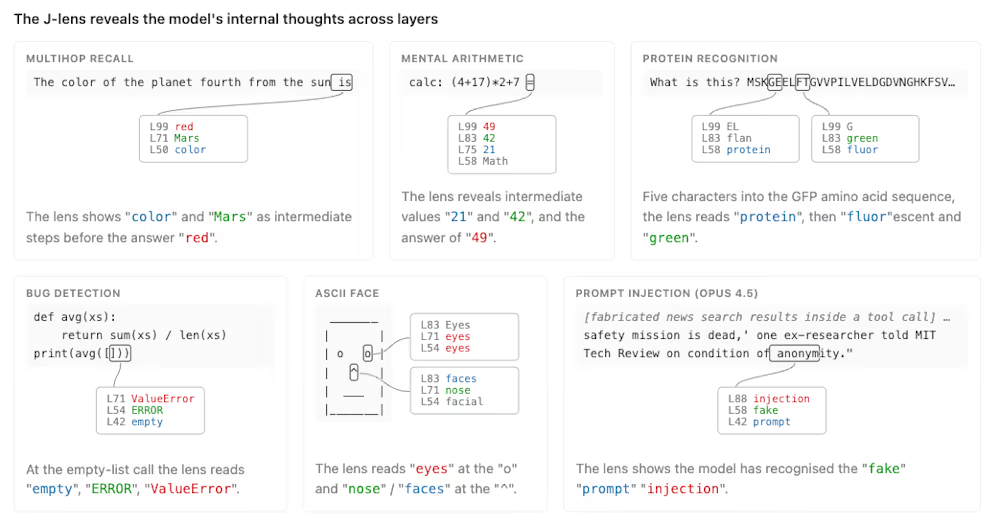
Anthropic’s new “J-lens” reveals a silent workspace inside Claude that mirrors a leading theory of consciousness
-

 Crypto World6 days ago
$1,000 Credit Alert! BlockDAG X Exchange Pre-Registration Now Officially Open, Polkadot Dips & Zcash Rebounds
-

 Business6 days ago
AXT Shares Jump Nearly 14% as Semiconductor Materials Maker Rebounds on AI-Linked Indium Phosphide Demand
-

 Crypto World7 days ago
South Africa proposes crypto tax guidance under existing rules
-

 Sports5 days ago
Joshua Pacio ‘more complete’ ahead of ONE rematch vs Malachiev
-
 Sports3 days ago
2026 Genesis Scottish Open Thursday TV coverage: Round 1
-

 News Videos6 days ago
Best Time to Enter Small Caps Right Now? Another Bull Run? | Financially Free
-
 Crypto World6 days ago
SK hynix (000660.KS) Stock Dips as $28B Nasdaq ADR Offering Drives AI Memory Expansion
-

 Tech4 days ago
Anthropic brings Claude Cowork to mobile and web as usage data shows most users aren’t coding
-

 Sports2 days ago
Super Eagles star Moses Simon opens up on Liverpool transfer regret
-

 News Videos6 days ago
Avoid entering in FOMO #bitcoin #cryptocurrency #trading #scalping
-
Sports5 days ago
We have punished the disrespect
-
 Crypto World5 days ago
Binance lists Strategy’s STRC stock as company expands Bitcoin funding
-

 Tech3 days ago
Character.AI enters the microdrama arena with its own productions, but there’s a twist
-
 Tech6 days ago
9 Best Keyboards (2025), Tested and Reviewed
-
 Business5 days ago
Enbridge: AI Tailwind Priced In (Rating Downgrade)
You must be logged in to post a comment Login