
Crypto World
XRP price rebounds above $1 as Peter Brandt favors Bitcoin

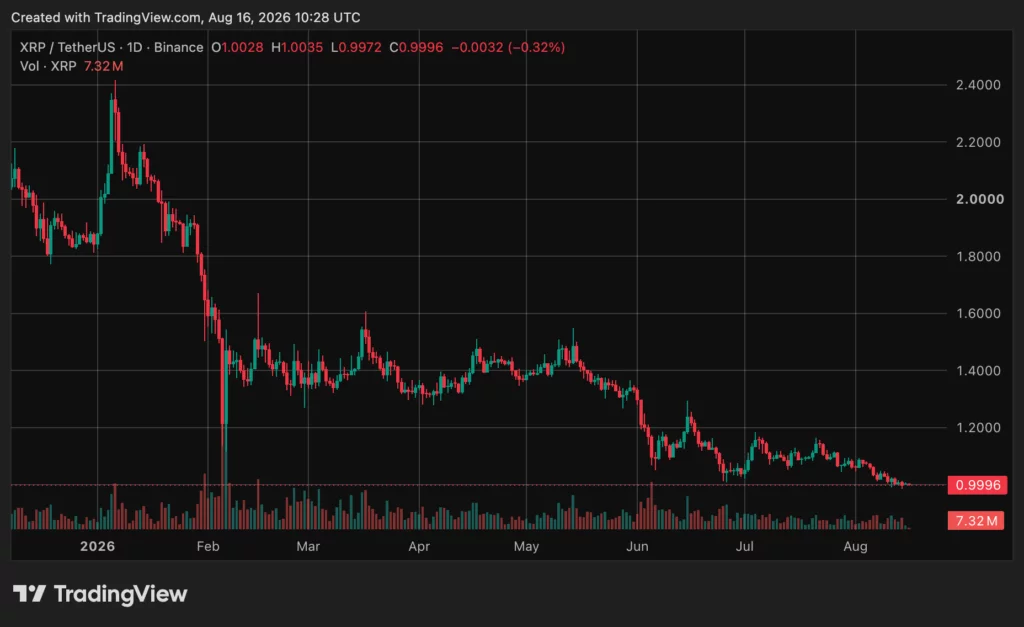
XRP briefly fell below the closely watched $1 level before rebounding on Aug. 16 as veteran trader Peter Brandt renewed his criticism of the cryptocurrency and said he would prefer Bitcoin even if given a large XRP position.
Summary
- Peter Brandt said he would immediately convert a hypothetical 500,000 XRP position into Bitcoin instead.
- XRP briefly traded below $1 before rebounding toward $1.06 during Sunday’s volatile cryptocurrency market session.
- CoinGecko places XRP’s record high at $3.65, reached on July 17, 2025, before current decline.
- Brandt had warned in March 2025 that XRP could fall toward $1.07 after support failed.
- Binance XRP whale inflows averaged $61 million over three months, their lowest level since 2021.
Brandt wrote in an X post that he was not interested in owning the token after another user challenged his views. “Who the heck even cares about XRP?” Brandt wrote, adding that he trades futures and “I would convert it immediately to BTC” if he owned half a million XRP. His remarks describe a personal asset preference, not a disclosed transaction or new trading position.
XRP rebounds after briefly falling below $1
XRP traded below $1 during Sunday’s session. A CoinGecko snapshot showed the token near $0.9993, while the latest market feed checked for this report put XRP at about $1.059. Bitcoin was trading near $62,926. The price movement has not been linked to Brandt’s post.
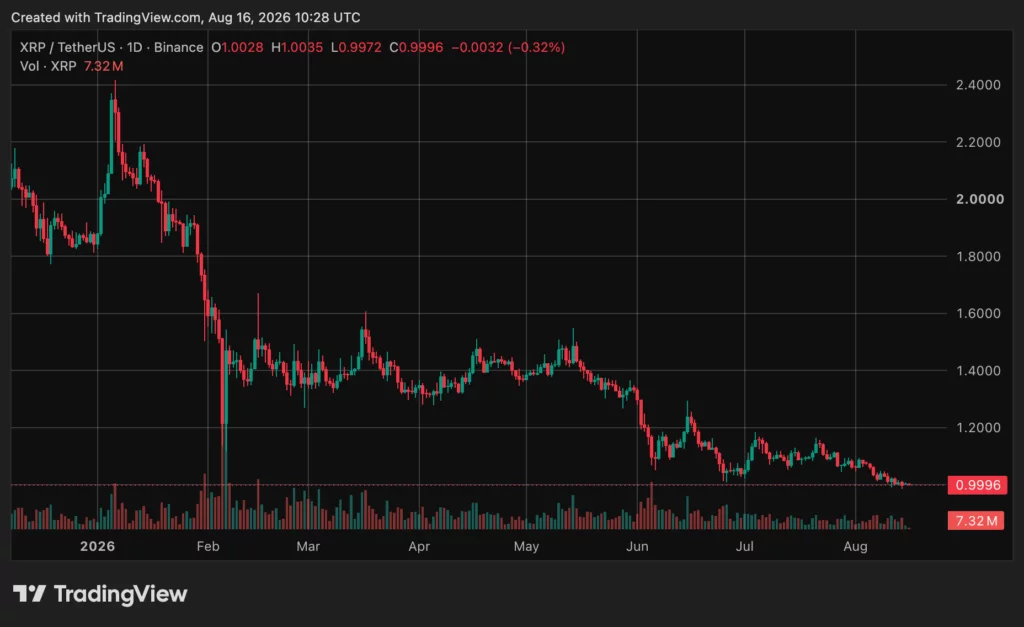
At $1.059, the hypothetical 500,000 XRP position discussed by Brandt would be worth about $529,500, equivalent to roughly 8.4 BTC at current prices. Brandt did not say he actually controls such a position.
The latest weakness leaves XRP about 71% below its record price. CoinGecko places its all time high at $3.65 on July 17, 2025. The same data source showed the token as much as 72.6% below that peak while XRP was trading under $1 earlier Sunday.
Brandt has repeatedly challenged XRP’s price outlook
Brandt’s latest comments continue a long running debate with XRP supporters. In March 2025, he identified what he called a textbook head and shoulders pattern. His chart suggested XRP could fall toward $1.07 if key support failed, while a move above $3 could invalidate the bearish structure.
XRP eventually traded near the level he identified, although reaching a technical target much later does not prove that the original chart caused or accurately predicted the decline. Market conditions changed materially between the March 2025 analysis and August 2026.
Brandt has also repeatedly criticized the conviction of some XRP traders. In December, he wrote that XRP and silver bulls were among the groups he had found easiest to provoke during his trading career dating to 1975.
His preference for Bitcoin also should not be interpreted as an immediate bullish Bitcoin forecast. As crypto.news recently reported, Brandt said Bitcoin could revisit roughly $58,000 after a large head and shoulders breakdown. He explicitly said he had not entered that trade and presented the decline as a possible scenario rather than a confirmed destination.
Onchain data shows reduced whale transfers to Binance
XRP’s test of $1 comes while one measure of potential exchange selling pressure has fallen sharply. CryptoQuant contributor Darkfost reported that the three month average of XRP whale inflows to Binance had declined to about $61 million, its lowest level since 2021.
As crypto.news reported, XRP whale inflows to Binance fell to their lowest level since 2021, compared with $456 million in January 2025 and $355 million in October. Lower exchange deposits can indicate less potential sell side supply, but they do not guarantee higher prices because demand can weaken simultaneously.
XRP had already been testing the same psychological level before Brandt’s latest comments. In related coverage, XRP traded near $1 as futures positioning increased, leaving traders focused on whether the support could survive sustained selling rather than a brief intraday break.
What happens next for XRP
The immediate market question is whether XRP can establish support back above $1 following Sunday’s recovery. A brief move below a round number does not by itself confirm a longer term breakdown. Traders would need additional price action, volume and market structure evidence before treating the move as durable.
Brandt has not published a new XRP price target alongside his Aug. 16 criticism. His comment was about preference between XRP and Bitcoin, not a forecast that XRP will fall further. Any attempt to present the post as a fresh bearish price prediction would therefore go beyond what he actually said.
For now, the verified developments are separate: XRP briefly lost $1 before recovering, whale deposits to Binance have fallen sharply, and Brandt remains unwilling to hold the token despite its current price being close to the $1.07 area he identified in a 2025 technical scenario.
Disclosure: This article does not represent investment advice. The content and materials featured on this page are for educational purposes only.



Harvard Management Company kept its position in BlackRock’s iShares Bitcoin Trust unchanged during the second quarter, ending two consecutive quarters of reductions in its publicly disclosed Bitcoin exposure.
Summary
- Harvard held 3,044,612 IBIT shares worth $101.4 million at June 30, unchanged from March quarter-end.
- Harvard previously cut its IBIT share count 43% during first quarter after trimming fourth-quarter exposure.
- Mubadala and Abu Dhabi Investment Council retained 22.9 million combined IBIT shares throughout second quarter.
- JPMorgan increased reported IBIT holdings while Morgan Stanley reduced its reported share count during Q2.
- Harvard held $171.2 million in gold ETFs, exceeding its $101.4 million Bitcoin ETF position substantially.
Its Aug. 14 SEC filing showed 3,044,612 IBIT shares worth $101.36 million as of June 30.
The share count was identical to March 31, when the position was worth about $116.97 million. The roughly $15.6 million decline in reported value therefore came from IBIT’s lower quarter end price rather than additional selling by Harvard.
Harvard stops selling after two quarters of IBIT cuts
Harvard had been reducing its Bitcoin ETF exposure since late 2025. It held 6,813,612 IBIT shares at the end of September before cutting the position about 21% to 5,353,612 shares in the fourth quarter. It then sold another 2.31 million shares during Q1, reducing the position 43% to its current 3,044,612 shares.
As crypto.news previously reported, Harvard cut its Bitcoin ETF position 43% and exited its Ether ETF entirely during Q1. The latest filing contains no BlackRock Ethereum ETF position, confirming Harvard did not rebuild that exposure during Q2.
Harvard’s IBIT position accounted for about 2.4% of the $4.26 billion in securities reported on its latest 13F. The filing listed 19 positions in total. Space Exploration Technologies was the largest at $2.21 billion.
Gold exposure remains larger than Harvard’s Bitcoin ETF stake
Harvard reported $149.5 million in the iShares Gold Trust and another $21.7 million in SPDR Gold Trust shares. Together, those positions were worth about $171.2 million, compared with $101.4 million in IBIT at June 30.
The comparison applies only to securities disclosed on Form 13F. It does not mean gold represents a larger allocation than Bitcoin across Harvard’s entire investment portfolio. SEC guidance says Form 13F covers qualifying securities over which an institutional manager exercises investment discretion, including U.S. listed ETFs. It does not provide a complete picture of private funds or other assets outside the reporting regime.
Dartmouth College also kept its crypto ETF share counts unchanged during Q2. As crypto.news reported, Dartmouth retained its Bitcoin, Ethereum and Solana ETF positions, although their combined quarter end value fell. Its SEC filing shows 201,531 IBIT shares, 178,148 Grayscale Ethereum Staking ETF shares and 304,803 Bitwise Solana Staking ETF shares.
Abu Dhabi funds keep nearly $764M in IBIT
Two Abu Dhabi investment entities also made no changes to their reported IBIT share counts. Mubadala Investment Company held 14,721,917 shares worth $490.1 million at June 30.
Abu Dhabi Investment Council reported another 8,218,712 shares worth $273.6 million. Together, the two filings show about 22.94 million IBIT shares valued at roughly $763.7 million at quarter end. Both share counts were unchanged from Q1.
That contrasts with Q1, when Mubadala added to its position while Harvard was reducing exposure. In related coverage, Mubadala increased its Bitcoin ETF holdings as Harvard sold shares.
JPMorgan adds IBIT while Morgan Stanley trims
Other institutional filings showed a mixed picture. JPMorgan reported about 10.4 million IBIT shares at June 30, up from approximately 8.3 million three months earlier. Morgan Stanley moved in the opposite direction, reducing its reported IBIT position about 4.5% to roughly 16.5 million shares worth $548.6 million.
Those filings should not automatically be interpreted as proprietary Bitcoin bets by the banks. The SEC says Form 13F can aggregate securities over which banks, broker dealers, investment advisers and related entities exercise investment discretion, including client accounts and trading activities.
Tudor Investment Corporation reported 688,529 IBIT shares worth $22.9 million, 109,446 more shares than in Q1. Its filing also included IBIT put and call options, showing that the reported equity position alone does not capture the manager’s complete exposure.
What happens next
The filings provide a snapshot only as of June 30. They do not reveal transactions made during the third quarter or show whether Harvard, the Abu Dhabi funds or other managers have changed their positions since then.
The next Form 13F cycle will disclose qualifying holdings as of Sept. 30. Until then, the latest verified data shows Harvard ended two quarters of IBIT selling without adding shares, while Mubadala and ADIC also maintained their positions. The wider institutional picture remained mixed, with JPMorgan and Tudor reporting higher IBIT exposure while Morgan Stanley trimmed its reported stake.
Payward, the parent company of Kraken, reported $508 million in adjusted revenue for the second quarter of 2026, up 17% year over year, while adjusted EBITDA dropped sharply to $23 million.
Summary
- Payward reported $508 million in Q2 adjusted revenue, rising 17% from the prior year period.
- Adjusted EBITDA fell to $23 million from $80 million reported for the second quarter previously.
- Total platform transaction volume declined 18% year over year to $310 billion during the quarter.
- Asset-based and other revenue represented 60% of total revenue, up from 55% one year earlier.
- Payward reported 6.6 million funded accounts, although its published metric definition changed from last year.
The company disclosed the results on Aug. 14 as weaker spot trading weighed on activity despite growth across other financial products.
The profitability decline was substantial. Kraken reported $80 million of adjusted EBITDA on $432 million of adjusted revenue in Q2 2025. Payward did not disclose net income in its latest release. Its earlier financial disclosures describe adjusted revenue and adjusted EBITDA as management measures that exclude certain expenses.
Payward revenue grew while transaction volume fell
Total platform transaction volume reached $310 billion, down 18% from the previous year. Payward attributed the decline partly to weaker crypto spot volumes, while saying traditional futures, equities and tokenized equities grew during the quarter. Futures daily average revenue trades increased 8%.
Revenue also became less dependent on transaction fees. Asset-based and other revenue accounted for 60% of total revenue, compared with 55% a year earlier. Payward said that shift reflects income generated from assets and services surrounding its trading operations rather than a retreat from trading itself.
Assets on the platform stood at $40 billion at quarter-end. Payward also reported $65 billion of what it calls “Real Assets on Platform,” calculated by holding prices at Q2 2025 levels to remove market-price effects. That adjusted measure increased 48% year over year, according to the company.
Funded accounts reach a record 6.6 million
Payward reported 6.6 million funded accounts, up 42% year over year and the highest level in its history. However, comparisons with Kraken’s previously published 4.4 million funded accounts for Q2 2025 require caution.
The newer Payward definition counts distinct funded accounts across its platforms and products and counts sub-accounts separately. Kraken’s 2025 disclosure instead described funded accounts as funded customers with balances above zero. The reporting perimeter has also expanded as Payward integrated businesses such as NinjaTrader and Bitnomial.
Bitnomial expands Payward’s regulated U.S. derivatives stack
Payward closed its acquisition of Bitnomial on May 1, adding a CFTC-regulated designated contract market, clearing organization and futures commission merchant. As crypto.news previously reported, the $550 million Bitnomial acquisition gave Payward a vertically integrated U.S. derivatives stack.
Payward said the infrastructure supported regulated U.S. perpetual futures and spot margin products during Q2. Separately, a July CFTC letter shows Kraken is reconsidering the future of Kraken Derivatives Exchange, the former Small Exchange it acquired in 2025, including potential partnerships or a sale following the Bitnomial transaction.
Its federal banking push is also unresolved. The OCC still lists Payward National Trust Company’s May 8 charter application among pending digital-asset licensing applications. As crypto.news reported, the proposed national trust company would give Payward a federally supervised custody entity if regulators approve it.
What happens next for Payward
Payward expects its second-half strategy to focus on broader trading products, banking, tokenization, payments and services sold to third-party platforms. It completed its Reap acquisition on July 1 and has agreed to acquire Magic Labs’ wallet infrastructure business, although that transaction has not yet closed.
Tokenized equities remain a major part of that strategy. In related coverage, Payward expanded xStocks beyond U.S. equities through its GTN partnership, while Kraken has also begun allowing eligible users to use selected tokenized stocks as collateral.
The next financial report will show whether Payward can maintain revenue growth while restoring profitability. For now, Q2 presents a mixed picture: revenue and funded accounts increased, but transaction volume fell and adjusted EBITDA declined from $80 million to $23 million.


Solana is now accessible on the XRP Ledger’s native decentralized exchange through a wrapped SOL asset issued through Axelar, extending interoperability between the two blockchain ecosystems.
Summary
- Axelar-issued SOL is now tradable through XRP Ledger’s native decentralized exchange using multiple ecosystem interfaces.
- XRPL Foundation director Hussein Zangana warned Axelar currently remains the only legitimate wrapped SOL issuer.
- Official XRPL EVM documentation identifies Axelar’s mainnet gateway address as rfmS3zqrQrka8wVyhXifEeyTwe8AMz2Yhw for cross-chain asset transfers.
- Axelar connected Solana to its interoperability network in June, enabling transfers with XRP Ledger ecosystems.
- Wrapped SOL represents Solana exposure on XRPL and should not be confused with native SOL.
Axelar confirmed the availability in an Aug. 14 post, directing users to SOL/XRP trading on XPMarket.
Hussein Zangana, known as Vet, warned users that Axelar is currently “the only legitimate issuer” of wrapped SOL on XRPL and told traders to beware of copycat assets. His warning matters because tokens on the XRP Ledger are identified by both their currency code and issuer account, rather than a ticker alone.
Solana becomes tradable through XRPL’s native DEX
Users can access the Axelar-issued SOL representation through interfaces including XPMarket, First Ledger and Magnetic. Xaman users can also reach the asset through the wallet’s swap interface. These platforms connect into XRPL’s native exchange infrastructure rather than operating separate order books for each front end.
On-chain data confirms activity involving SOL and the Axelar gateway. XRPScan identifies rfmS3zqrQrka8wVyhXifEeyTwe8AMz2Yhw as the Axelar Bridge account and records SOL-related transactions, including an OfferCreate transaction on Aug. 14. Official XRPL EVM documentation independently lists the same address as Axelar’s XRPL mainnet gateway.
Axelar’s issuer address is the key security check
Zangana’s warning reflects how XRPL-issued assets work. Official XRP Ledger documentation states that tokens are identified by the combination of an issuer and currency code. Two assets can therefore use the same ticker while being issued by different accounts.
That means seeing “SOL” in a wallet or DEX is not enough to establish authenticity. Bithomp’s verified-domain records associate the Axelar Bridge account with axelar.foundation, while XRPScan labels the same account Axelar Bridge. Interface checkmarks can help users, but users should verify the issuer address before creating a trust line or executing a trade.
Axelar connected Solana and XRPL before the DEX launch
The trading rollout builds on Axelar’s June 3 integration of Solana mainnet. Axelar said the connection enabled cross-chain messaging and asset transfers between Solana and more than 70 supported ecosystems, specifically naming XRP Ledger, Ethereum, Stellar, Sui and Hedera.
The interoperability has already moved in the opposite direction. As crypto.news previously reported, wrapped XRP expanded onto Solana through Hex Trust and LayerZero, giving XRP access to Solana-based wallets and DeFi applications.
Wrapped assets introduce additional dependencies beyond the underlying networks. In related coverage, cross-chain bridges have suffered billions of dollars in historical exploit losses, making issuer verification and bridge security important when handling representations of assets across chains.
What happens next for SOL on XRP Ledger
The immediate question is whether liquidity and user adoption deepen beyond the initial launch. XPMarket already lists an SOL/XRP market under the Axelar Bridge issuer, while Axelar’s broader Solana integration allows developers to build additional cross-chain applications between the two ecosystems.
No separate native SOL exists on the XRP Ledger. The traded asset is a cross-chain representation tied to Axelar infrastructure. Users should therefore treat claims that another issuer represents official SOL with caution unless Axelar or another authoritative source confirms a change. For now, Zangana’s warning remains clear: “Beware of fakes.”
In a rather interesting week in terms of reveals of who owns shares of the spot XRP ETFs, the funds actually ended it in the green, but only one day saw any action.
This is a recurring development that has frequently emerged, and the underlying asset has continued to suffer price-wise, dipping below $1.00 for the first time in nearly two years.
XRP ETFs Still in Green but…
There’s not really much to explain about what happened last week with the net flows into the spot XRP ETFs, as it has been a story on repeat for a while. Yes, the five-day trading period was in the green. But that’s about it in terms of good news. The actual numbers show a minor inflow of $2.25 million, which was just slightly higher than last week’s $1.01 million.
Just to put things into perspective, the exchange-traded funds tracking the cross-border token were raking in over $20 million weekly in late June and over $60 million in mid-May.
A deeper look into each day’s performance tells an even more worrisome story. All $2.25 million entered the fund in one day – on Thursday. The rest of the business week, meaning four out of the five trading days, saw no reportable action, with SoSoValue showing $0.00 against each of those days.
Moreover, six out of the ten business days in August have shown the same trend – $0.00. Consequently, the cumulative total net inflows have remained at just over $1.51 billion, with little to no movement over the past couple of weeks.
On the plus side, numerous large US institutions, such as Morgan Stanley, have revealed significant exposure to XRP through ETFs in the past week.
XRP Price Struggles
Perhaps due to the lack of actual institutional interest, since Ripple whales have been accumulating, the native token has consistently traded lower over the past few weeks. The asset was rejected at $1.10 recently and kept plunging until it eventually lost the $1.05 support. Almost inevitably, it dipped below $1.00 on a couple of occasions in just days, and it’s currently fighting to reclaim that level decisively.
From the technical and on-chain side, the landscape forward is quite contradictory. Some on-chain metrics show that the network activity has picked up lately, while the overall investor sentiment has deteriorated to a multi-month low. At the same time, the XRP Open Interest has reached its highest levels since the notorious October 2025 crash, which could result in intense volatility over the next few sessions.
The post Ripple (XRP) ETFs Remain in the Green, But the Actual Inflows Tell a Different Story appeared first on CryptoPotato.
Billionaire investor Mark Cuban says chips as an asset class will be the new crypto. The call arrives weeks before US markets open the first regulated futures on computing power.
Cuban added no elaboration. Chipmakers keep posting record demand; however, exchanges now move to standardize the market for processing power.
Why Chips as an Asset Class Echo Early Crypto
Cuban kept the argument to a single line.
Scarcity drives the comparison. Advanced processors remain in short supply, while buyers bid hard for every available unit. Bitcoin built its early narrative on the same logic.
Cuban has grown cold on digital assets. He sold most of his Bitcoin in May, and Blockstream CEO Adam Back challenged Cuban’s Bitcoin data days later.
Meanwhile, he keeps pushing policy ideas around artificial intelligence. In May, Cuban floated a federal AI token tax and compared his critics to early crypto opponents.
The parallel has clear limits, though. Tokens settle on public ledgers and trade around the clock. Chips, by contrast, sit in data centers, wear out, and lose value as newer models are shipped.

Wall Street Already Prices the Silicon
CME Group turns the idea into a live product on October 5. The exchange plans to list Silicon Data H100 and B200 rental index futures on NYMEX. Each contract covers one month of GPU rental costs.
Compute has become the currency of the AI age…our futures contracts will now turn compute into a standardized, tradable commodity.
Pete Keavey, CME Group global head of energy and environmental products, via CME
For now, hedging explains the early interest. AI developers and cloud operators face fluctuating rental bills, so a futures curve lets them lock in budgets months in advance.
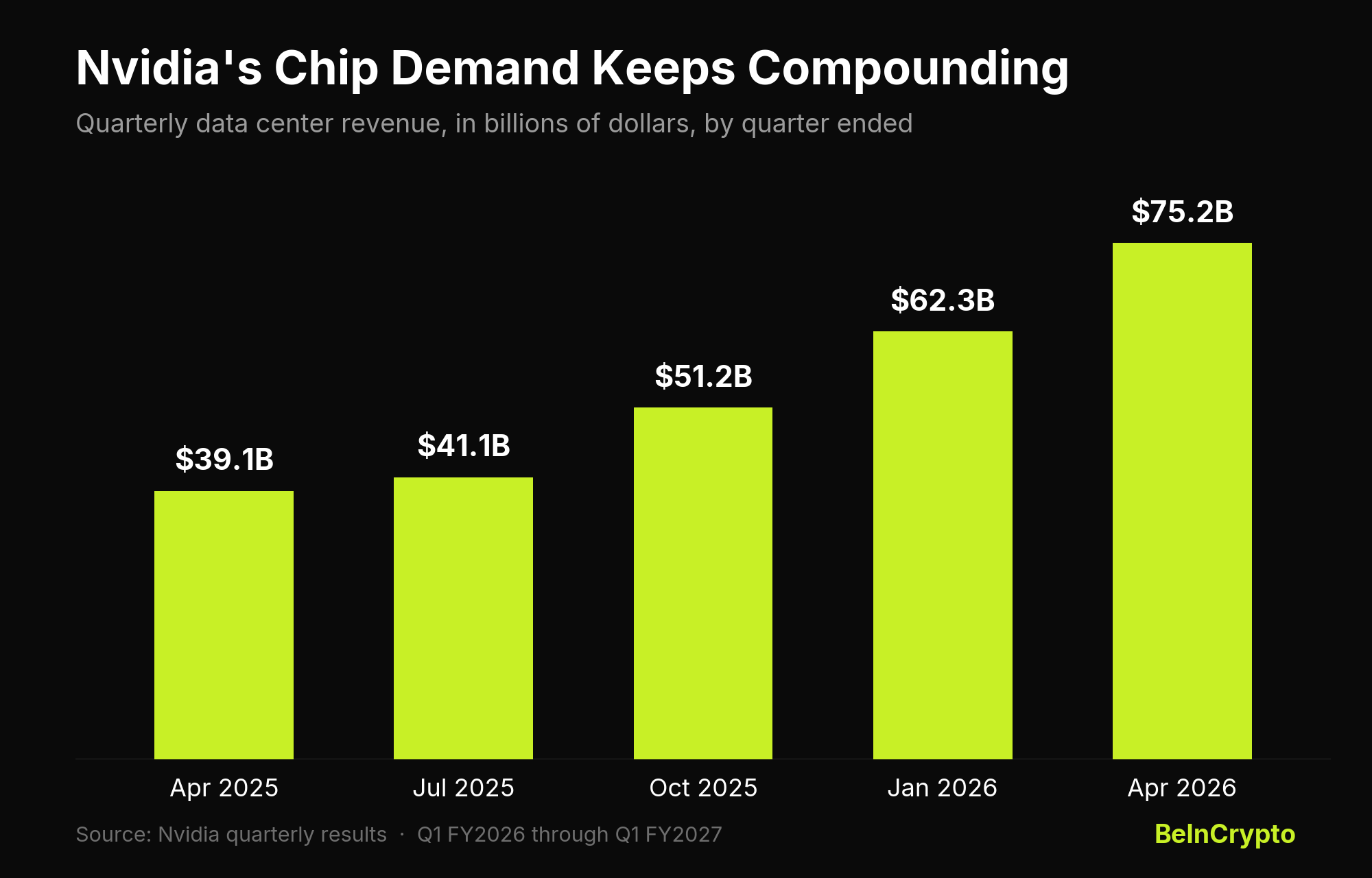
Demand numbers support the thesis. Nvidia booked $75.2 billion in data center revenue for the quarter ending April 26, up 92% year over year. Traders now watch Nvidia’s next earnings report closely.
Total company revenue reached $81.6 billion over the same three months, an 85% annual jump. Chief executive Jensen Huang described the AI buildout as the biggest infrastructure expansion ever attempted.
Moreover, supply politics add another layer. Chinese exports jumped 23.9% in July as global chip demand surged. However, US export limits also pushed Beijing toward domestic memory chip champions.
Cuban’s comparison cuts both ways. Crypto delivered outsized returns, yet it also produced brutal drawdowns and heavy speculation. Whether chips repeat that arc may depend on how the October futures contracts trade.
The post This Asset Class Will Become the Next Crypto, Says Billionaire Mark Cuban appeared first on BeInCrypto.

To address the 10,000 steps misperception, we should retire that arbitrary target as a one-size-fits-all prescription and replace it with a message grounded in evidence: start where you are, and do a little more. If you’re currently taking 3,000 steps a day, aim for 4,000. If you’re at 5,000, try for 6,000.
At the same time, we cannot ignore that the choice to exercise is not solely an individual one. It is also shaped by a person’s surroundings. In order to be able to make walking an exercise habit, there need to be safe sidewalks, neighborhood parks, and green spaces in the communities in which we live and work. We must prioritize policies that enable and support a healthy environment and healthy activity choices.
Perhaps our greatest missed opportunity comes from not starting earlier. By adolescence, physical inactivity is already common, with only 20-26% of teens reporting meeting physical activity guidelines. This means by adulthood, we are already working backwards.
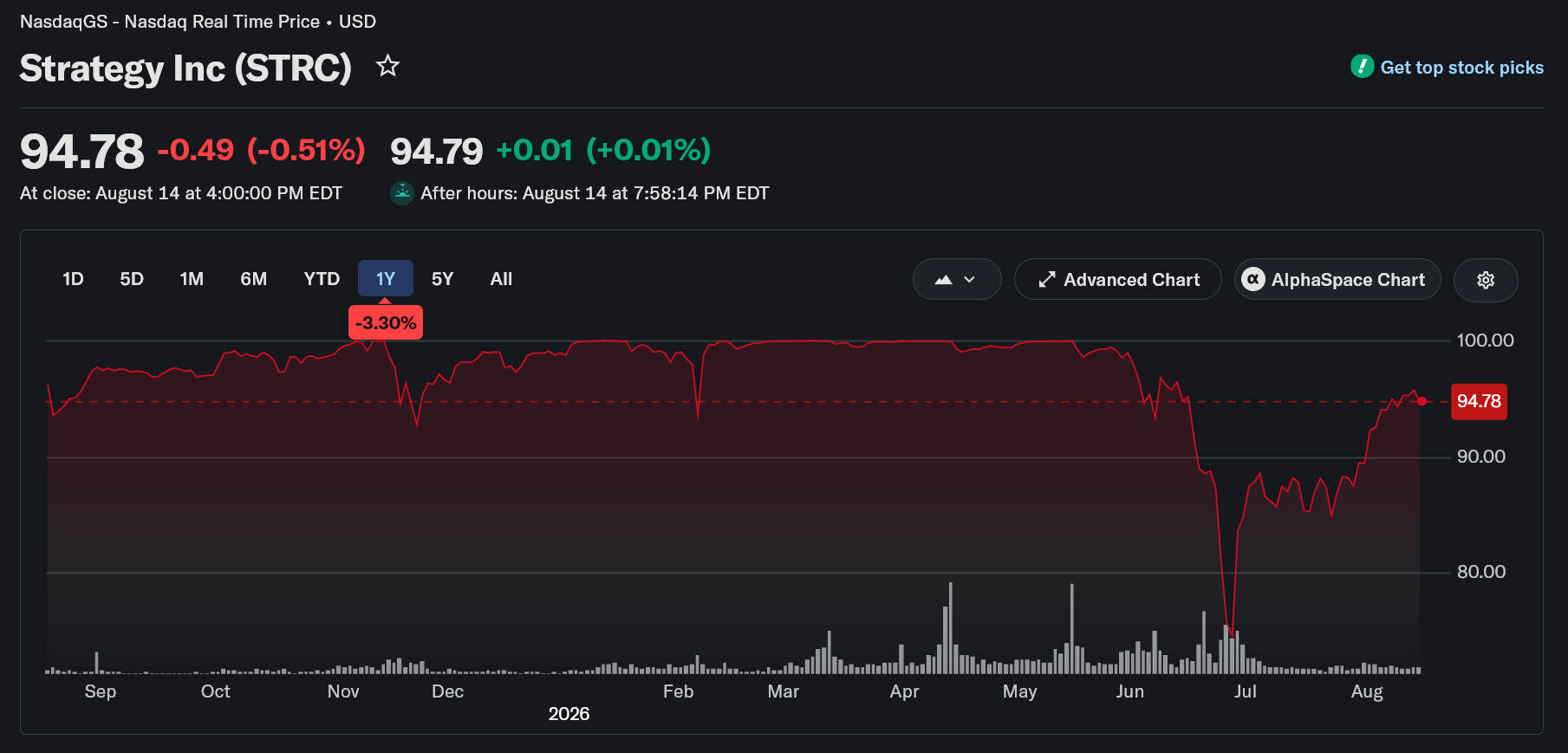
Michael Saylor published a one-year performance chart on Sunday showing that Strategy Preferred Stock outpaced Bitcoin. STRC gained 9% while Bitcoin (BTC) fell 47%.
The comparison runs from August 14, 2025, through August 14, 2026. It measures four Strategy credit instruments against the single asset backing the entire company.
Why Strategy Preferred Stock Held Up Better Than Bitcoin
Strategy issues four preferred securities, each of which pays income rather than tracking Bitcoin directly. STRC, formally the Variable Rate Series A Perpetual Stretch Preferred Stock, currently pays 12% annually in twice-monthly cash dividends.
The company moves that rate up or down to hold STRC near its $100 par value. However, the security slipped under par this summer. Therefore, Strategy sold 1,690 Bitcoin in August to fund STRC share buybacks.
The other three instruments lagged STRC. STRD fell 8%, STRF lost 9%, and STRK dropped 27%. Still, every one of them beat Bitcoin by a wide margin. Cash dividends and distributions cushioned part of each decline.

STRK explains that spread. Each share converts into 0.1 shares of MSTR, so it tracks the common stock more closely than the others do. None of the four carry a claim on Strategy’s Bitcoin.
Critics question how long the company can carry that payout load. Arca Chief Investment Officer Jeff Dorman warned in May that a $15 billion preferred stack strains the Bitcoin flywheel.
The Number Missing From Saylor’s Chart
The graphic leaves out MSTR, Strategy’s common stock. That omission matters. MSTR closed at $93.04 on August 14, roughly 75% below its level a year earlier, according to Yahoo Finance data.

The stock touched $367.57 at its 52-week high. Today it changes hands near the floor of that range. Common shareholders absorbed the leverage, while preferred holders collected the income.
In contrast, Bitcoin’s current price sat near $63,072 on Sunday, still deep inside a bear market that began last autumn.
Strategy has also flipped into a net seller. The company added 37 Bitcoin across two months, then sold 1,638 coins in a single week. Meanwhile, its treasury now sits at a lower level than it did in May.
Saylor addressed the credit risk head-on last week. His new model publishes floor prices for creditors, naming the Bitcoin levels where each security breaks.
The engineering worked as advertised for over 12 months. It turned one volatile asset into four calmer income streams. Whether those streams hold through a second year of falling Bitcoin prices is the question facing holders now.
The post MicroStrategy vs. Bitcoin: Who Won the 1-Year Performance Duel? appeared first on BeInCrypto.
Changpeng Zhao says the world now holds more millionaires than Bitcoin has coins. The Binance founder argues that a full coin will soon be out of reach.
His remark followed a reader who pointed out that the United States alone counts 23.6 million millionaires. Bitcoin will never exceed 21 million coins.
Bitcoin is Scarcer Than the World’s Millionaire Count
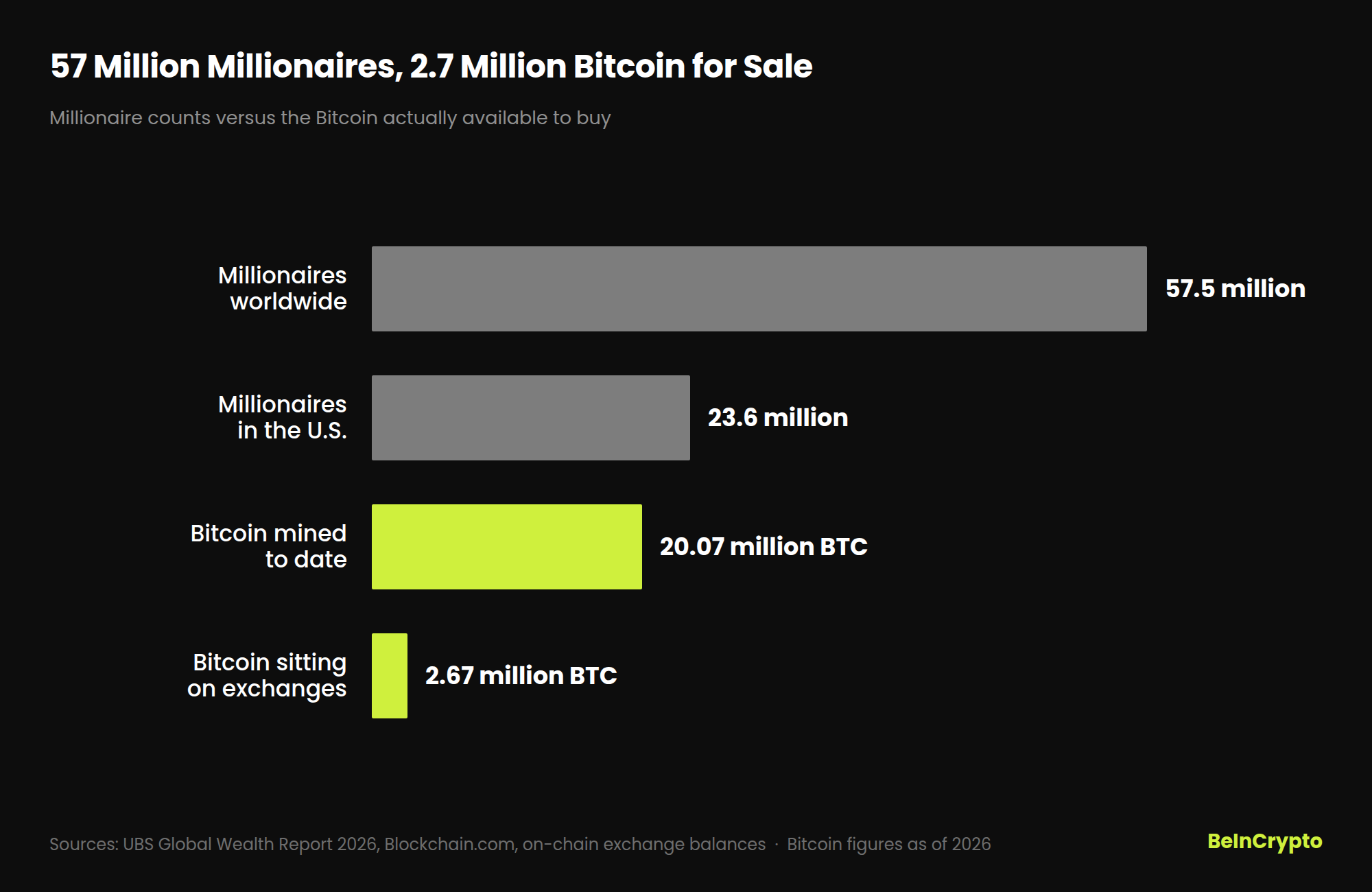
The Binance founder took to X with a supply update. Miners have produced 20.07 million coins so far. Therefore, only 4.4% of the total supply remains to be mined.
Those final 930,000 coins will not arrive quickly. Halving cuts the block reward every four years, and the last one should surface around 2140. He calls the result a deflationary asset.
Analyst Quinten François then ran the comparison. The United States counts roughly 23.6 million millionaires, according to the UBS Global Wealth Report 2026. Globally, the total reaches 57.5 million.
Those figures outnumber every coin ever mined by almost three to one. Split evenly, the mined supply leaves each millionaire with about 0.35 BTC. The reply came in a single line.
Debate over that ceiling has grown louder this year. In July, a Zcash founding scientist proposed scrapping Bitcoin’s 21 million cap in favor of 4% annual issuance. Most of the Bitcoin community rejects any such change.
Why Lost and Dormant Coins Shrink the Float Further
Mined supply overstates what buyers can actually reach. The crypto billionaire, who recently argued that exchanges are safer than self-custody, puts the share of lost or unrecoverable coins at 10% to 20%. Consequently, the tradable float may sit nearer 17 million.

Meanwhile, careless transactions lead to massive losses for users. One user recently wasted 1.6 BTC on a costly Bitcoin fee mistake and ended up moving nothing at all.
Additionally, long-term holders lock away even more. He made that point when a follower pressed him on real usable supply.
The float looks thinner still up close. Roughly 2.67 million coins sat on exchanges in early 2026, while more than 14 million were ranked as illiquid. Spread across 57.5 million millionaires, that trading float works out to 0.046 BTC each, or roughly $2,925.
“Yeah, many long term holders don’t move/spend their coins at all. Can’t buy those.”
Changpeng Zhao, founder of Binance, on X
Prices, however, tell a different story right now. Bitcoin trades near $63,030 after a 46% slide over the past year, and analysts still debate whether the current bear market bottom has been reached.

That gap matters for the affordability math. At the record of $126,080 set in October 2025, one coin cost roughly 12.6% of a seven-figure net worth. Today it costs about 6.3%.
Nothing prices millionaires out yet, in other words. The warning describes a future in which demand meets a supply that cannot grow, while skeptics counter that fractional ownership already solves the problem. His own dollar-cost-averaging advice points in that direction, toward buyers who collect slices rather than whole coins.
The post Millionaires Soon Won’t Be Able to Afford 1 Bitcoin, Says Binance Founder CZ appeared first on BeInCrypto.


Mark Cuban said on Aug. 16 that “chips as an asset class will be the new crypto,” offering a one-line prediction as artificial intelligence drives demand for advanced computing hardware.
Summary
- Mark Cuban said chips as an asset class could become the next crypto-like investment category.
- CoreWeave closed a $2.6 billion facility this month backed by long-term confidence in GPU demand.
- Nvidia reported quarterly data center revenue of $75.2 billion, rising 92% year over year recently.
- CoreWeave has pioneered GPU-backed financing, showing chips already function as collateral within institutional credit markets.
- Bitcoin advocate Pierre Rochard rejected Cuban’s analogy because chip manufacturing lacks halvings and difficulty adjustments.
Cuban did not identify a financial product, investment structure or timetable in his post.
The comment has been widely interpreted as referring to high-end AI accelerators such as GPUs. However, Cuban did not explicitly define which chips he meant. His claim therefore remains a broad investment thesis rather than an announced business venture or established asset category.
GPU-backed financing gives Cuban’s idea a precedent
AI hardware is already being used in financial structures that go beyond simply purchasing semiconductor stocks. CoreWeave closed a $2.6 billion delayed draw term loan facility on Aug. 10 to finance high-performance computing infrastructure. The company said the structure reflected lender confidence in long-term GPU demand.
The approximately five-year facility extends beyond the average three-year duration of the customer contracts supporting it. CoreWeave said lenders were therefore accepting renewal risk based partly on expectations for the future value of Nvidia GPUs deployed through its cloud platform. The transaction was also oversubscribed.
CoreWeave has pursued GPU-backed financing for several years. In May, it completed another $3.1 billion publicly syndicated facility and described AI infrastructure financing as an “emerging asset class.” That is CoreWeave’s characterization and does not mean individual GPUs currently trade like cryptocurrencies.
AI demand is supporting strong GPU economics
Nvidia’s latest reported quarter provides another measure of demand. The chipmaker reported $75.2 billion in data center revenue for the quarter ended April 26, up 92% from the previous year. Total quarterly revenue reached a record $81.6 billion, according to its May results.
Those figures do not establish chips as a standalone investment class. GPUs are physical assets that face technological obsolescence and depend on electricity, networking, data center capacity and customer utilization to generate revenue. Their supply also lacks the fixed issuance mechanics that distinguish Bitcoin.
Bitcoin advocate Pierre Rochard made that distinction in response to Cuban. He wrote that chip manufacturing has neither difficulty adjustments nor halvings and is therefore “not the new bitcoin.”
Cuban’s prediction follows his retreat from Bitcoin
Cuban’s latest comment comes less than three months after he sharply reduced his Bitcoin exposure. As crypto.news previously reported, he sold roughly 80% of his Bitcoin holdings after losing confidence in its hedge narrative. Cuban said Bitcoin was “not the hedge I expected” and had “lost the plot.”
He did not abandon every digital asset. Cuban said he continued holding Ethereum because he viewed smart contracts and decentralized finance as having clearer utility. His Aug. 16 chips comment did not say that he was replacing his remaining crypto exposure with hardware investments.
What happens next
The clearest test of Cuban’s prediction will be whether GPU financing becomes more standardized and accessible beyond specialist AI infrastructure operators. CoreWeave’s transactions show institutional lenders are already willing to finance computing infrastructure at multibillion-dollar scale and accept some risk around the future earning power of GPUs.
For now, however, “chips as an asset class” remains Cuban’s prediction rather than a defined market category. The underlying trend is measurable: Nvidia is reporting rapidly growing data center sales, while lenders are financing GPU-backed infrastructure in increasingly large transactions. Whether those developments eventually produce a liquid market resembling crypto remains unconfirmed.


Justin Sun said on Aug. 14 that Binance had clarified its coming restrictions on transactions involving HTX apply only to Binance users in the UK and European Union.
Summary
- Justin Sun says Binance restrictions involving HTX apply only to users in Britain and Europe.
- Binance will restrict transactions involving HTX and ten other platforms beginning on August 23, 2026.
- European Union rules list HTX among eleven crypto platforms facing transaction bans from August 23.
- Britain sanctioned Huobi Global in May and considers the HTX exchange covered by those measures.
- UK court records confirm settlement talks, while Sun also claims negotiations with European Union regulators.
His statement followed Binance’s notice that it will stop processing direct or indirect transactions involving HTX and ten other platforms from Aug. 23.
Sun said he had been communicating with Binance and that HTX does not conduct business in either region. He also said settlement negotiations with UK and EU regulators were underway. Binance’s public notice, however, does not itself state that the restrictions are limited to UK and EU customers. It says the exchange must comply with requirements in jurisdictions where it operates.
Binance restrictions match the EU’s Aug. 23 sanctions list
Binance named Rapira, Aifory Pro, ABCeX, WhiteBird, NoOnecrypto, Tradex, Monease, BitPapa, Exnode, HTX and EXMO in the Aug. 23 group. Transactions attempted after the deadline may be held for compliance review, while affected wallets can face restrictions during that process.
The list and effective date match an EU sanctions measure adopted July 23. Council Regulation 2026/1848 places the same eleven platforms under transaction restrictions from Aug. 23 and identifies them as entities providing crypto asset services outside the EU that significantly frustrate sanctions involving Russia. As crypto.news reported, Binance will stop processing transactions involving HTX and ten other platforms from Aug. 23.
Sun’s geographic clarification is absent from Binance’s notice
Sun wrote that “This matter concerns only Binance’s UK and EU users.” That geographic limitation comes from Sun’s account of his discussions with Binance. The exchange had not added equivalent wording to its public announcement as of Aug. 16.
Sun also said “HTX does not conduct business in the UK or EU.” That statement should be treated as HTX’s position. The UK Financial Conduct Authority said in February that HTX had stopped new UK users from registering after proceedings began, but existing users could still log in and access promotions. The FCA continues to list HTX as unauthorized.
HTX’s UK settlement talks are confirmed by court records
One part of Sun’s statement can be independently verified in Britain. A June 25 High Court order extended a stay in the FCA’s case against Huobi Global for another two months so the parties could try to settle the dispute. The regulator sued in October 2025 over alleged unlawful crypto promotions to UK consumers.
As crypto.news reported, HTX and the FCA entered settlement talks over the crypto marketing lawsuit. The talks are separate from sanctions. Sun also says negotiations are underway with EU regulators, but no separate official EU settlement announcement was identified in the materials reviewed.
UK and EU sanctions remain separate from the FCA case
Britain designated Huobi Global S.A. on May 26 under its Russia sanctions regime. The measures include an asset freeze and restrictions on correspondent banking and payment processing. The UK said it had reasonable grounds to suspect Huobi Global provided financial services or resources to A7 LLC and Garantex Europe OU.
HTX previously argued that Huobi Global was legally separate from the online exchange. UK sanctions authorities rejected that distinction for enforcement purposes. OFSI guidance states that it considers HTX subject to UK financial sanctions because it is owned by Huobi Global. The EU separately placed HTX on its transaction-ban list in July, as previously reported.
What happens next
The compliance response is spreading beyond Binance. Bitget announced on Aug. 15 that it will apply additional controls to the same eleven entities from Aug. 23. Direct or indirect transactions can face review or rejection, while related accounts may be restricted during compliance checks.
For HTX users, Aug. 23 is the next confirmed deadline under the EU framework and the restrictions announced by Binance and Bitget. Sun said affected users can contact HTX customer support and that the exchange will coordinate a resolution. That is an HTX commitment, not a guarantee that Binance, Bitget or regulators will release any transaction or wallet placed under compliance review.

9 specific reasons we’re loving this U.S. Amateur at Merion

Ituran Location And Control Remains A Buy After Strong Q2 Growth (NASDAQ:ITRN)

Harvard holds $101M Bitcoin ETF stake steady in Q2


-

 Fashion2 days ago
Weekend Open Thread: Ann Taylor
-
 NewsBeat5 days ago
Communication cards help banking customers access services or report scams
-
 Business5 days ago
Oil Price Today (August 11): Crude oil rises to $88 after Trump’s compensation demand dents Hormuz opening. Here’s why
-

 Crypto World5 days ago
Revolut wins French banking licence, creates second EU banking hub
-

 Fashion7 days ago
Amazon Sundays: Closet Care Before Fall
-
 Crypto World6 days ago
Why Did Nvidia Stock Fall on Monday Despite a $500 Billion Wall Street AI Deal?
-

 Business7 days ago
5 Things You Must Know About Jorge Messi, the Father and Longtime Agent Who Shaped Lionel Messi’s Career
-

 Politics7 days ago
Ben-Gvir’s crocodile project halted but abuses at Ketziot Prison continue
-

 Politics7 days ago
The Church of England’s ruinous reparations racket
-

 Politics7 days ago
Saudi Arabia used 86% of missile stockpile defending Iran attacks
-
 NewsBeat1 day ago
Myanmar says over 300,000 Rohingya refugees verified for repatriation as exodus enters ninth year
-

 Politics24 hours ago
SEQ Code: The Three Letter Boarding Pass Code That Could Give You The Worst Seat
-

 Crypto World7 days ago
Crypto Made a $9.6 Billion Record, But It’s Hiding a Crucial Truth
-

 Fashion6 days ago
Can You Wear Double Cloth Gauze Clothing To Your Office?
-
 Crypto World7 days ago
USDC and USDT Now Own 84% of Crypto Card Spend as the Euro Retreats
-
 Crypto World7 days ago
Is Clarity's delay a blessing in disguise?: State of Crypto
-

 Crypto World7 days ago
Kraken Delisting Deadline Nears: Holders of 21 Tokens Risk Near-Zero Payouts
-
 Crypto World6 days ago
Grayscale quietly drops Cardano, Polkadot and Hedera ETF plans
-
 Entertainment4 days ago
Keke Palmer Subtly Hints At Sean Evans Drama With Cryptic Post
-

 Politics5 days ago
In the Chris Kaba case, the police watchdog capitulated to the mob
You must be logged in to post a comment Login