

Crypto World
XRP price risks $1 breakdown as Binance selling pressure persists

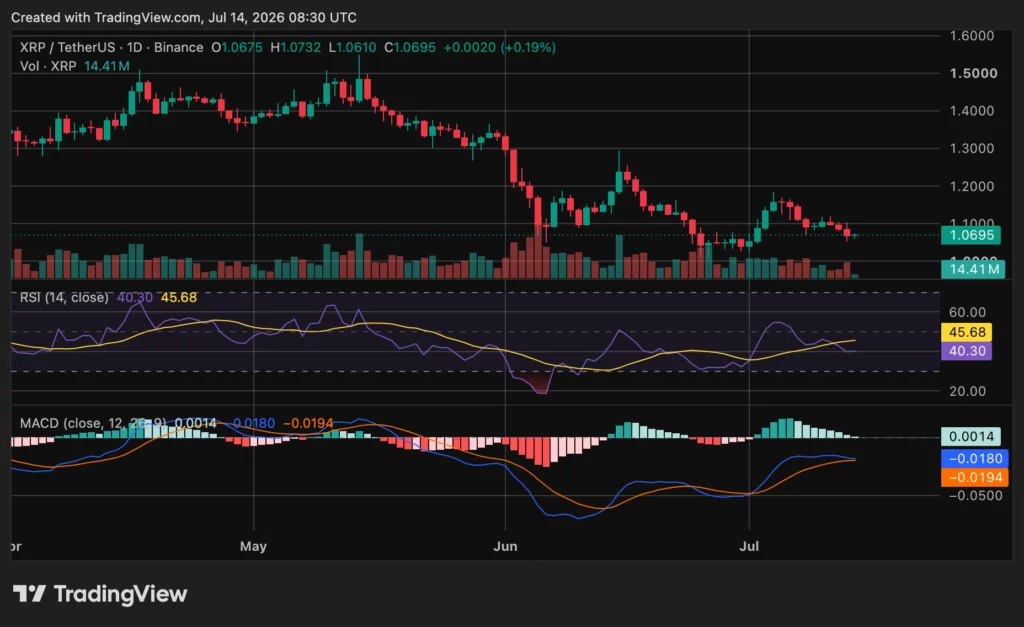
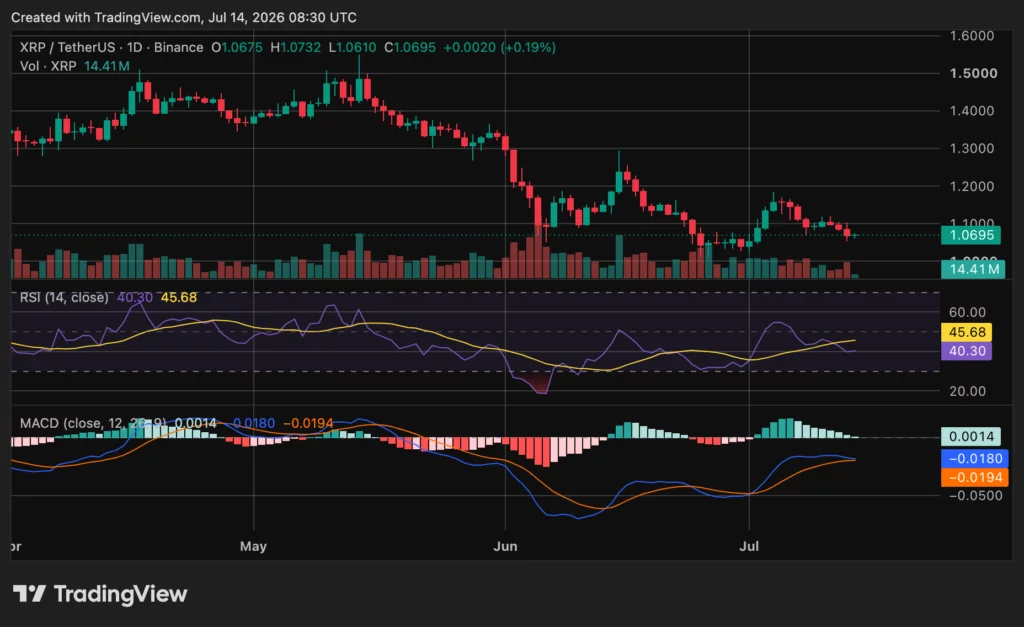
XRP traded near $1.07 on July 14 after losing about 1% over 24 hours.
Summary
- XRP trades near $1.07 as negative Binance CVD data shows sellers still control spot demand.
- The $1.08 resistance level remains crucial, while $1.05 and $1.00 form the nearest downside supports.
- Bullish XRP social sentiment may increase short-term risk because prices often move against crowded expectations.
The token moved between $1.06 and $1.08, with daily volume near $955 million and market capitalization around $66.7 billion. Ripple’s native token remained the sixth-largest cryptocurrency.
The price has fallen nearly 6% over seven days and about 7% over one month. It also sits more than 70% below its July 2025 record of $3.65. The latest data shows weak price action near a support area defended several times since late June, while buyers still lack a clear breakout signal.
XRP price remains below key resistance
The XRP/USDT daily chart shows a broader decline from the $1.40 to $1.50 region. Price has stabilized between $1.05 and $1.10, but buyers have not reclaimed the recent recovery zone near $1.15 to $1.20. Analyst Cryptorphic said lower levels remain possible “as long as $1.08 remains resistance.”
The nearest downside level sits around $1.05. A daily close below that area could expose the psychological $1.00 mark. A recovery above $1.08 would ease immediate pressure, while a move through $1.10 could open another test of $1.14 and $1.18.
The relative strength index stood near 40.30, below its signal average of 45.68. The MACD histogram turned slightly positive, but the MACD and signal lines stayed below zero. That setup points to minor stabilization rather than a confirmed trend change, because both momentum lines remain in negative territory.
Binance order flow continues to favor sellers
A CryptoQuant analysis by Arab Chain found that XRP’s Binance Cumulative Volume Delta remained negative at about 6.93 million. CVD measures the difference between market buy and sell orders. A negative reading means sellers executed more volume than buyers.
The 30-day Price-CVD Confirmation Score held near 0.84. The analyst said the reading confirms that price and order flow continue to move together, but does not show enough buying demand for a reversal. A sustained move in CVD above zero, with a rising score, would offer clearer evidence that buyers have returned.
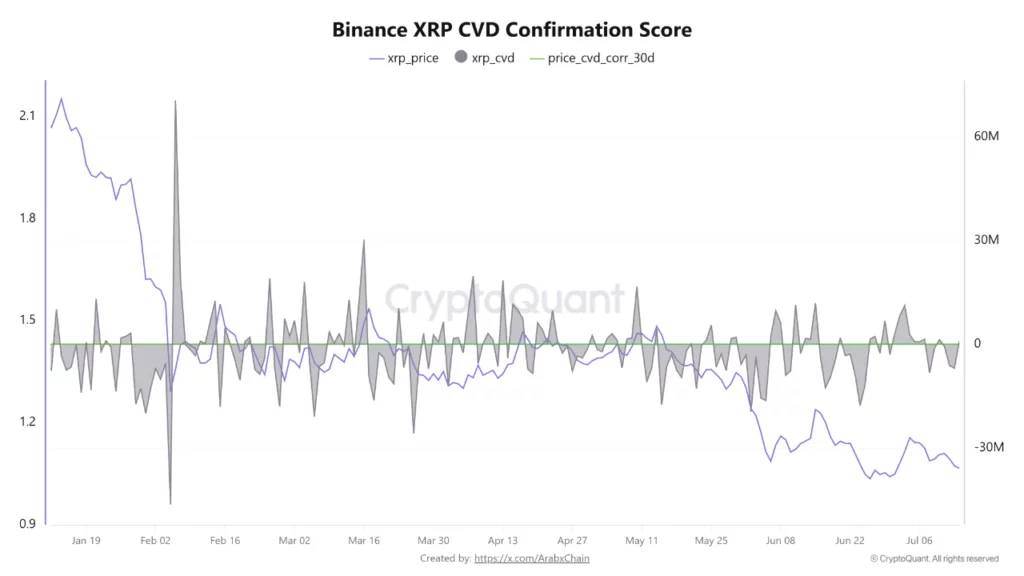
The data supports the short-term chart structure. The token has stayed close to $1.07 while spot sellers limit rebounds. Binance remains one of the largest XRP markets, making its order flow useful for judging whether price moves have support from spot demand.
Bullish social sentiment creates a mixed signal
Santiment said XRP recorded 3.02 bullish comments for every bearish comment on Monday. Ether followed at 2.31, while Bitcoin posted a more balanced ratio of 1.40. XRP therefore carried the strongest level of optimism among the three assets.
Santiment warned that crowded optimism can work against prices when markets already trade lower. “Crypto typically moves opposite to what the crowd is loudly expecting,” the firm wrote. It said strong bullish discussion around XRP and Ether could slow a rebound or create short-term downside risk.
The reading follows an earlier rise in XRP network growth and social interest near the $1 support region. New activity can attract buyers, but sentiment alone does not confirm demand. The split between positive commentary and negative Binance order flow keeps attention on both price and liquidity.
$50 XRP scenario depends on a $100 trillion crypto market
Crypto commentator Moon Lambo calculated that XRP could reach $50.10 if the total cryptocurrency market grew to $100 trillion and XRP retained a 3.13% share. That outcome would assign about $3.13 trillion in value to XRP, based on its circulating supply.
Moon Lambo stated, “I’m not making a prediction.” The calculation only shows price under fixed assumptions. At a 1% share of a $100 trillion market, XRP would trade near $16.01. A 5% share would place it around $80.08, while 10% would imply about $160.15.
Those figures do not describe XRP’s current market setup. The global crypto market would need to expand many times, while XRP would need to retain or increase its share. Supply changes, adoption, regulation and market structure would also affect future valuation.
XRP entered July between support around $1.00 to $1.06 and resistance near $1.18 to $1.20. Spot XRP exchange-traded funds also recorded $7.29 million in net outflows on July 8, their largest daily withdrawal since March.
Disclosure: This article does not represent investment advice. The content and materials featured on this page are for educational purposes only.

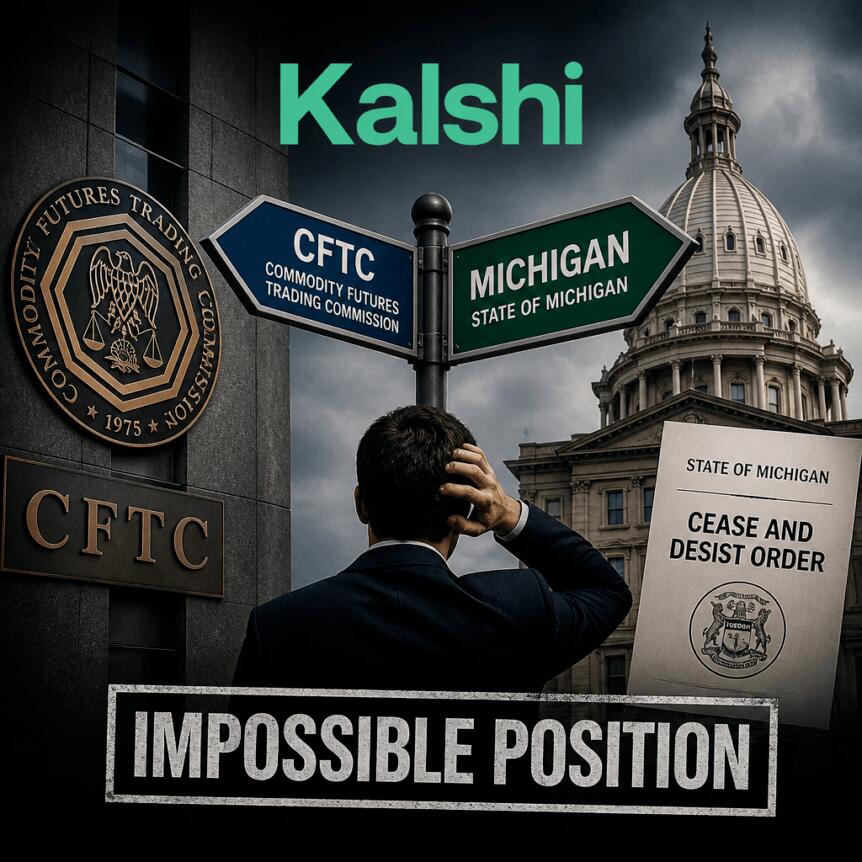
The U.S. commodities regulator has moved to prevent Kalshi, a registered prediction market platform, from reversing Michigan trades—sparking fresh legal friction between federal oversight and a state court order. The dispute centers on whether Kalshi must unwind already executed sports betting contracts for Michigan users while litigation over Michigan’s sports betting laws continues.
On Tuesday, the Commodity Futures Trading Commission (CFTC) ordered Kalshi not to comply with the Michigan order and instead continue operating. The clash follows an earlier ruling on June 29 by Ingham County Circuit Court Judge Rosemarie Aquilina, who directed Kalshi to stop offering sports betting contracts to Michigan users during the ongoing case.
Key takeaways
- The CFTC says canceling already executed prediction market trades would disrupt market certainty and create a cascading effect across derivatives markets.
- Kalshi argues the situation forces it to choose between conflicting obligations: comply with a state court directive or follow federal regulatory requirements.
- The controversy underscores an ongoing jurisdictional tension between the CFTC and multiple state regulators regarding prediction markets.
- CFTC Chair Michael Selig warned that the agency will continue legal action against states that attempt to impose penalties on CFTC-registered exchanges.
Michigan judge’s order vs. federal directive
Michigan’s court case began with a directive that targeted Kalshi’s ability to provide sports betting contracts to residents of the state. According to Cointelegraph reporting, Judge Aquilina ordered Kalshi to cease offering those contracts to Michigan users while the lawsuit proceeds over whether Kalshi’s offerings violate state sports betting laws. Earlier coverage from Cointelegraph described the scope of that order and the legal context surrounding it.
But on Tuesday, the CFTC intervened. In a press statement, the regulator ordered Kalshi not to comply with the Michigan directive and to continue operating despite the state order. The CFTC press release frames the issue as one of maintaining federal authority over registered entities and executed derivatives contracts.
Kalshi says it unwound trades—and now faces contradictions
Kalshi’s response highlights the practical dilemma regulators rarely address directly: companies caught between courts can end up violating one authority while trying to obey another.
In a statement posted on X, Robert DeNault, Kalshi’s head of enforcement and legal counsel, said the company is “disappointed” and described the federal action as placing Kalshi in an “impossible position.” DeNault’s statement on X argues that Kalshi already followed the Michigan court order by unwinding the trades, but the new CFTC directive appears to contradict that requirement.
DeNault’s wording underscores the core problem: Kalshi believes it is being pushed into a compliance conflict, where it may be required to reverse actions taken under state instructions while also meeting federal regulatory expectations.
Reuters reported that Kalshi is reviewing the CFTC’s order and considering its next steps. According to Reuters, the company is weighing how to respond given the opposing directives.
Why the regulator says “canceling” is a market-breaking precedent
The CFTC’s position is grounded in the mechanics of derivatives contracting. The regulator argues that canceling trades already executed is not just a procedural change—it threatens contract certainty across the marketplace.
In the same dispute framing, the CFTC characterized cancelation of executed trades as unprecedented and potentially destabilizing. The regulator’s message is that prediction markets operate through contractual certainty, and that undermining that certainty would ripple outward beyond any single platform.
The CFTC also emphasized that it will not allow states or state courts to pressure registered entities into violating the Commodity Exchange Act and CFTC regulations. That argument is aimed directly at the core tension at the center of the Michigan case: whether states can effectively override federal rules through injunctions and court orders applied to an exchange that is already registered with the CFTC.
Broader conflict: federal authority vs. state-by-state attempts
This is not presented by the CFTC as an isolated disagreement. The regulator has repeatedly argued that prediction markets fall within the federal scope when they are run through CFTC-registered structures.
As the dispute is framed, Michigan is described by the CFTC as the first state to attempt interference with executed derivatives transactions through a court order. That characterization matters because it suggests the CFTC views the issue as moving from “licensing and legality” arguments—traditionally handled at the state level—into the domain of how executed federal derivatives contracts must be honored.
During an appearance on Fox Business, CFTC Chair Michael Selig said it is “critical” that the regulator maintains its authority over prediction markets. Selig also stated that the agency has sued nine states and indicated it would continue to challenge states that attempt to impose criminal or civil fines against CFTC-registered exchanges. According to Selig’s remarks, the CFTC’s stance is that state actions cannot be allowed to erode the federal regulatory framework for these markets.
For investors and market participants, the practical implication is that prediction market compliance may remain a moving target. Even where a state court order appears clear, a federal regulator may step in to enforce a different standard. That dynamic increases uncertainty for platforms operating across state lines and could affect how traders evaluate jurisdictional risk when participating in events-based contracts.
What to watch next is how Kalshi navigates the contradiction between the Michigan directive and the CFTC’s order—and whether additional courts or appeals clarify which obligations control when state and federal requirements diverge for already executed derivatives contracts.
This is Part 4 in the technical article series about Bitcoin covenants by Cointelegraph Research. To read the previous article, click here.
The following opcodes do not independently implement full covenant functionality. Instead, they are building blocks for constructing covenants when combined with other opcodes or script elements.
OP_CHECKSIGFROMSTACK (OP_CSFS) and OP_CAT
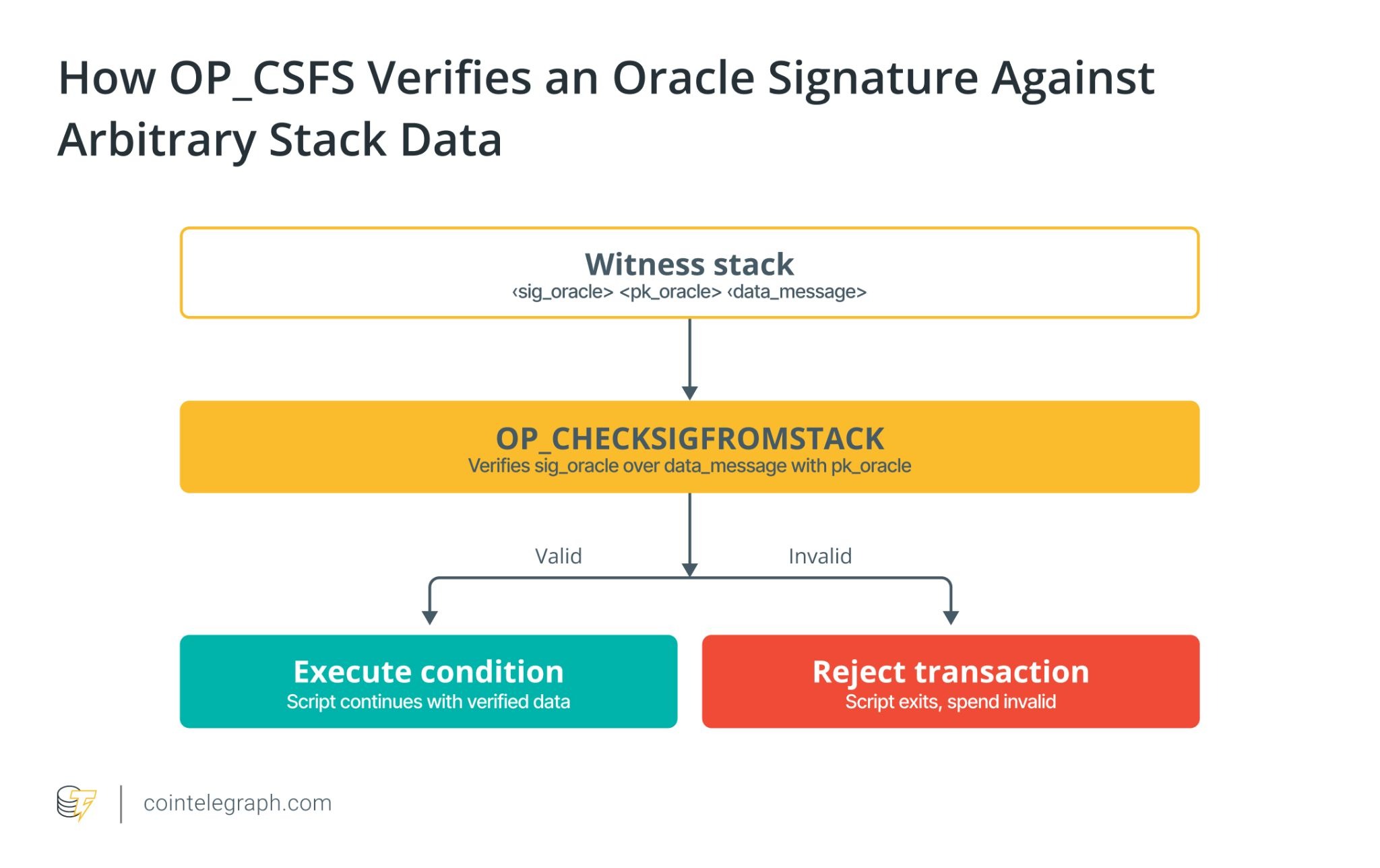
OP_CSFS is a proposed opcode that would allow Bitcoin script to verify signatures over arbitrary messages supplied on the stack. It is different from OP_CHECKSIG, which verifies signatures over the spending transaction according to the active SIGHASH mode. By enabling signature verification for data other than the serialized transaction details, OP_CSFS enables a broader class of constructions, including oracle-based scripts where an external party signs off-chain messages that represent real-world events. For example, a trusted oracle could publish Schnorr signatures over messages that encode external outcomes, and an OP_CSFS-based script could condition payments on the presence of a valid oracle signature.
On its own, OP_CSFS does not implement covenants. It can authenticate external data, but it does not bind that data to the structure of the spending transaction. That binding requires OP_CAT.
OP_CAT is a proposed opcode that enables the concatenation of two values on the script stack to form a single byte sequence instead of two distinct ones. When combined with OP_CSFS, it allows the script to assemble selected transaction fields into a canonical message and verify that a provided signature commits to that message.
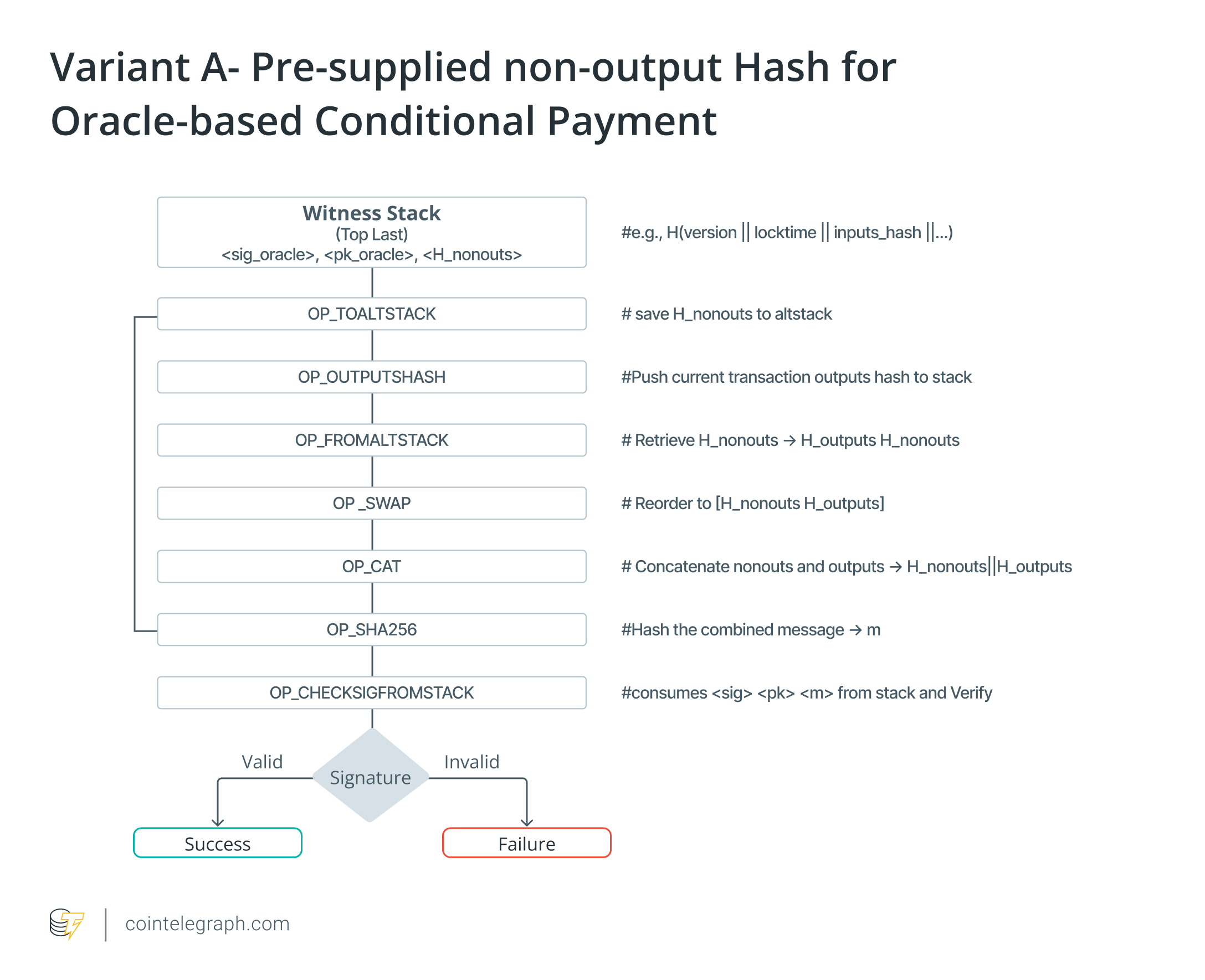
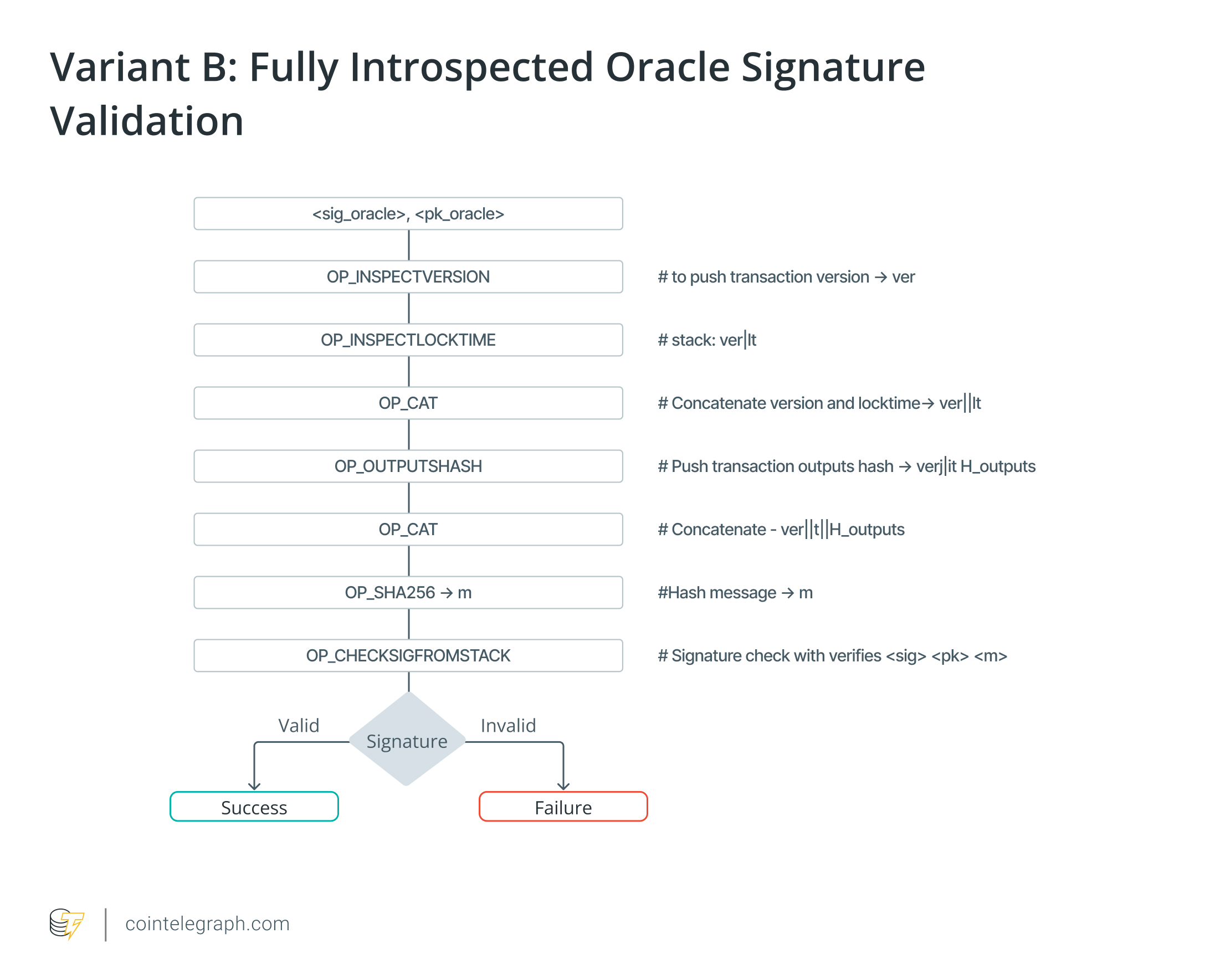
OP_CSFS and OP_CAT taken together can perform introspection by compelling the spender to provide transaction details on the witness stack. If both OP_CSFS and OP_CHECKSIG succeed for the same signature, it proves that the correct transaction details have been passed on to the witness stack and can be further reasoned about. By checking the transaction against a predefined template, a covenant construction, similar to OP_CTV, can be enforced. Two minimal assemblies show how this works:
OP_CAT + Schnorr Tricks
Using OP_CAT, covenant-like constructions can be enforced under Taproot without OP_CSFS by exploiting how Schnorr signatures interact with the Taproot sighash rules defined in BIP 341. The construction repurposes OP_CHECKSIG which is ordinarily used to authenticate ownership of a private key, to a transaction introspection tool.
A schnorr signature is a pair ⟨R, s⟩. Under normal circumstances, this schnorr signature is generated by selecting a secret nonce k, deriving the point R = kG, and computing the signature value s as a function of the message hash and the private key. The verifier then checks the signature pair ⟨R, s⟩ against a public key P and the message being signed. The randomness of k ensures that s is unpredictable and non-reproducible without knowledge of the private key.
The introspection trick works by eliminating randomness by fixing some of these variables in advance. Instead of choosing R randomly during signing, the script commits to a predetermined value of R and to a fixed public key P. Because Schnorr verification follows a deterministic equation, it becomes possible to construct these values so that the signature scalar s must equal a hash of specific transaction parameters.
The spender provides R and s on the witness stack. OP_CAT concatenates them into the signature pair ⟨R, s⟩ in the format OP_CHECKSIG expects. The script verifies this against the hardcoded public key P. Because R and P are fixed to the base point G, OP_CHECKSIG will only accept the pair if s equals the SHA256 hash of the actual transaction data computed by the protocol. The spender cannot fabricate an s that passes OP_CHECKSIG unless it genuinely reflects the real transaction data. The spender must grind the transaction data until its SHA256 hash ends in a specific byte, which takes roughly 256 attempts on average and adds negligible cost.
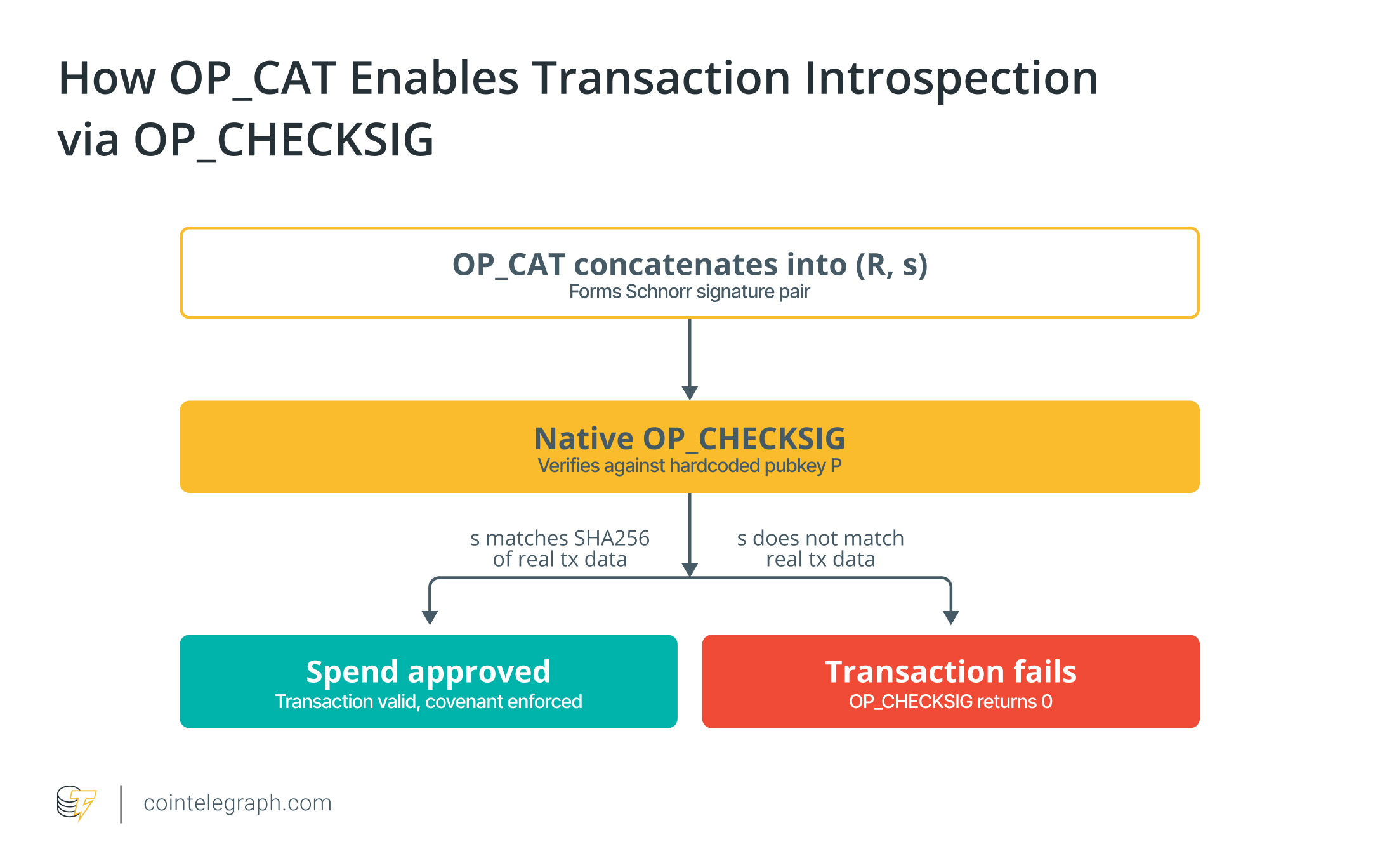
In this way, OP_CHECKSIG is no longer used to authenticate ownership of a secret private key but instead to enforce that the transaction matches a specific template. The expressiveness is broadly comparable to OP_CTV.
Because this approach depends on Schnorr signatures and the taproot sighash algorithm, it applies only to SegWit v1 outputs and does not extend to SegWit v0 outputs which uses the BIP-143 digest and ECDSA signatures.
In our next article we will commence our discussion of OP_CCV, which is even more capable than OP_CSFS and OP_CAT combined.
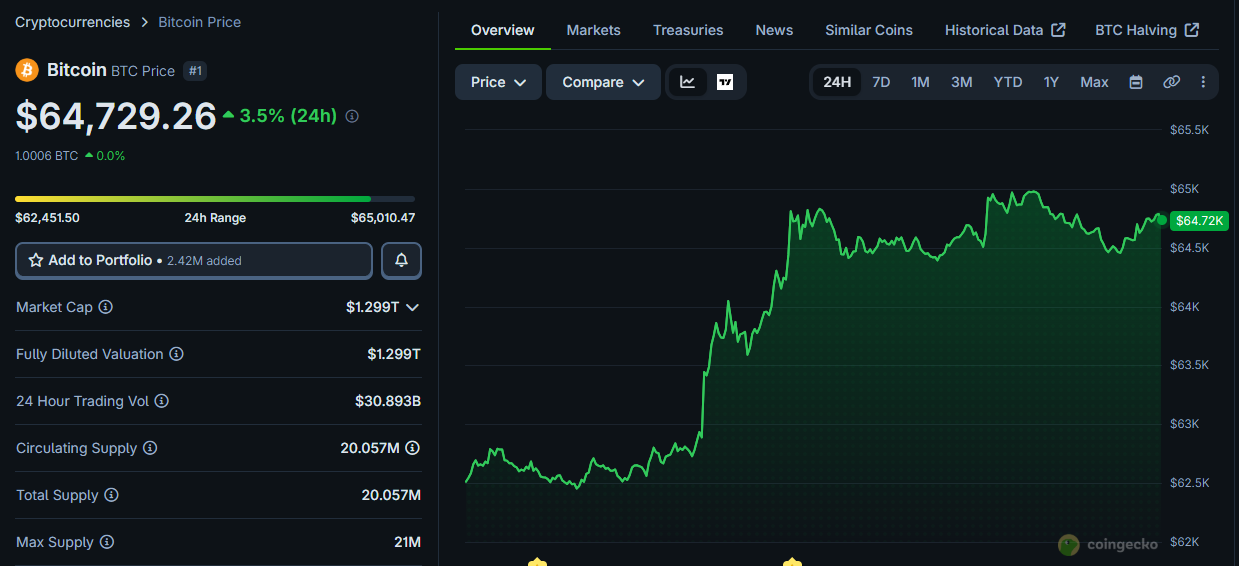
Bitcoin (BTC) tipped to $65,000 briefly, according to Coin Gecko, even as fresh US-Iran tensions flared. Meanwhile, Korean crypto trading volume skyrocketed as AI memory stocks struggle. Crypto traders, it seems, are shrugging these macro conditions off.
Bitcoin’s rally came as softer than expected US inflation data eased pressure on the Federal Reserve to keep rates higher for longer. That gave the coin room to push toward multi-week highs even as fresh US-Iran strikes continued.
Bitcoin Rally Signals Iran Fatigue
President Trump ordered airstrikes on Iran last weekend and threatened to reinstate a blockade on the Strait of Hormuz. That is the kind of headline that hammered crypto prices earlier this year.
This time the reaction was muted. Bitcoin recovered above $63,000 within days of the strikes. That marked a sharp contrast to past episodes, when similar headlines sent prices sharply lower.
The Bitcoin rally has held near that recovered range into this week before its recent spike on promising inflation data. Traders appear to be growing desensitized to the tit for tat in the Middle East rather than panicking every time tensions flare.

The pattern lines up with a broader rotation. The Altcoin Season Index has climbed to 58 while Bitcoin dominance has slipped toward key support as capital spreads into other tokens.
South Korea Adds Fuel to the Rotation
South Korea offers the clearest real-world evidence. The KOSPI is technically in a bear market, down more than 20% from its June record. Retail investors appear to be looking elsewhere for returns.
Much of that weakness traces back to just two stocks. Samsung and SK Hynix now account for roughly half the KOSPI’s total weight. eToro market analyst Zavier Wong said that a sharp swing in either name now drags the whole index with it.
At the same time this week, trading volume on Upbit, the country’s largest crypto exchange saw volume surge 1,318% in 24 hours to $4.2 billion as the stock rout deepened. XRP alone recorded more volume than Bitcoin.
Not all of it is conviction buying. Korea’s Financial Supervisory Service said 1.2 million leveraged accounts triggered margin calls this week. That’s a reminder that some of this is forced selling, not a clean bet on crypto.
SK Hynix’s Swings Point to a Brewing AI Bubble Debate
SK Hynix sits at the center of the KOSPI’s chip-driven volatility. Its own chart tells an AI bubble story in miniature. The stock climbed almost 233% from the start of 2026 to a June 25 record. It then retreated over 34% from that peak by July 13.

The swings intensified after SK Hynix listed American depositary receipts on Nasdaq on July 10. The $26.5 billion offering ranks among the largest foreign listings in US history. Investors are weighing surging demand for AI memory chips against how much of that demand is already priced in.
Iran tensions have not gone away, and neither has the AI bubble debate. But for now, crypto looks less like an asset caught in the crossfire. It looks more like the place traders go when headlines get tiring, whether from Tehran or Seoul’s chip floor.
The post Is Crypto Finally Shrugging Off Iran and AI Hype? Bitcoin and Altcoins Suggest Yes appeared first on BeInCrypto.
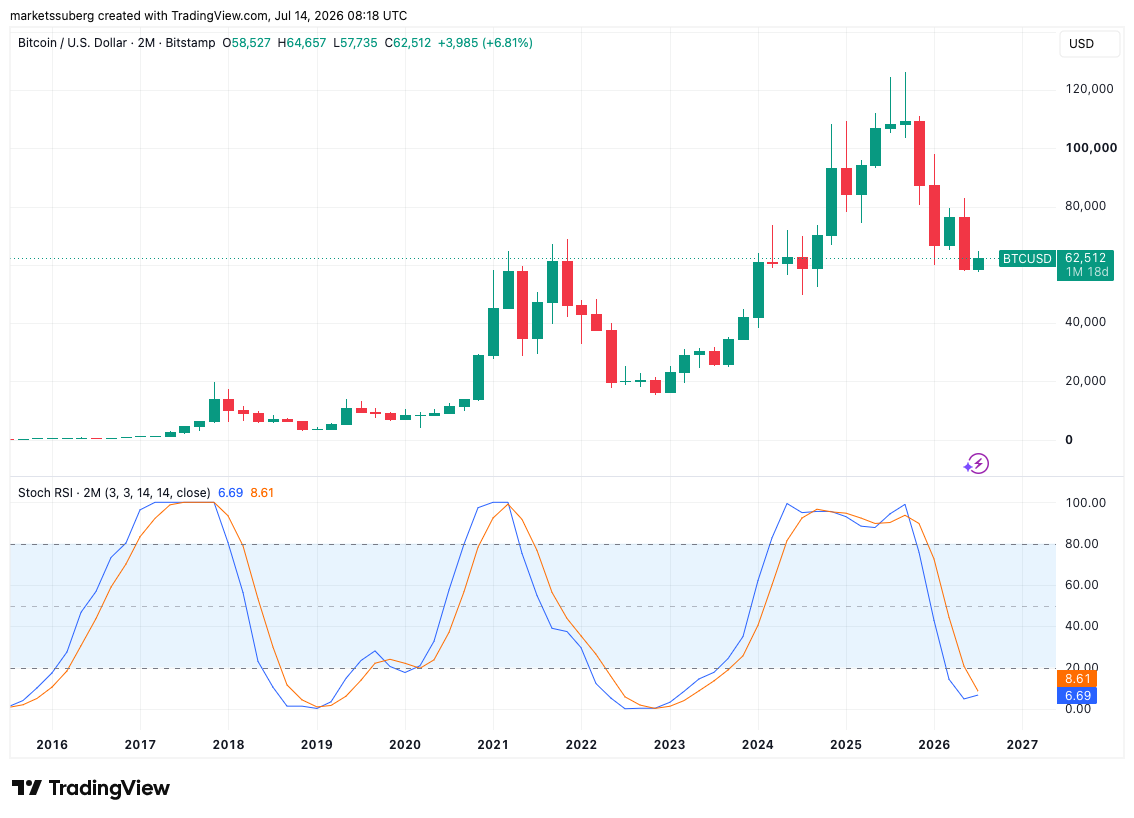
Bitcoin (BTC) should repeat history and put in a bear-market bottom when a classic indicator hits zero, a trader says.
Key points:
- Bitcoin classic two-month stochastic RSI signals are valid this bear market, Max Crypto said.
- The bear market will be over once the indicator reaches zero again.
- RSI divergences provided advance notice of the BTC price rebound beyond $64,000 this month.
Bitcoin stochastic RSI bottom signal “will happen again”
In an X post at the weekend, Max Crypto went on record to forecast the end of the 2026 bear market when the stochastic relative strength index (RSI) hits a new swing low.
“Stoch” RSI is a derivative of RSI, a popular leading indicator, with a greater bias on recent price moves.
“Every time the 2M Stoch RSI had a bullish cross and dropped to 0, $BTC bottomed,” Max Crypto wrote in accompanying commentary.
“This happened in 2014, 2018, and 2022, and it will happen again.”
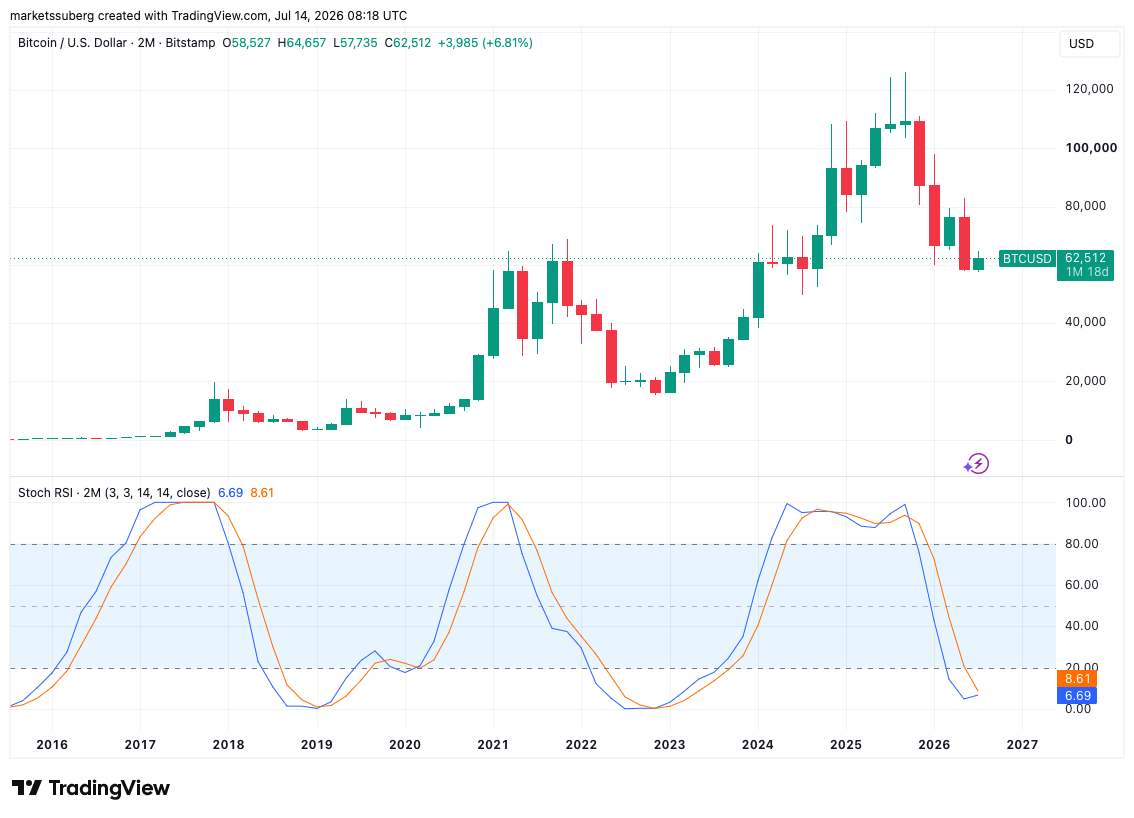
BTC/USD two-month chart with stochastic RSI data. Source: Cointelegraph/TradingView
Two-month stoch RSI measures 4.81, having dropped into its sub-30 “oversold” zone during March, data from TradingView confirms. Current levels were last observed just over three years ago.
Stoch RSI has already formed a focus for market participants this year, with daily moves previously drawing comparisons to the 2022 bear market.
In April, crypto trader Quantum Ascend described BTC price history as “playing out nearly perfectly.”
Bear-market RSI cues keep coming
Turning to traditional RSI data, traders continue to look for bullish cues as BTC/USD treads water above $60,000.
Related: BTC price bull market to begin in September? Five things to know in Bitcoin this week
On Sunday, trader and investor BitcoinHyper eyed a bullish divergence against the S&P 500.
At the start of June, daily RSI dropped to just 15, marking one out of just six of what trader Osemka later called “extremely powerful selling events.”
“There’s been one case where extreme $BTC RSI (1D at 15) failed to break the lows and only managed to sweep it. That was at the end of accumulation range in 2015,” he continued on Tuesday.
“I’m mentioning it now since we have also only swept the low on such powerful move down.”
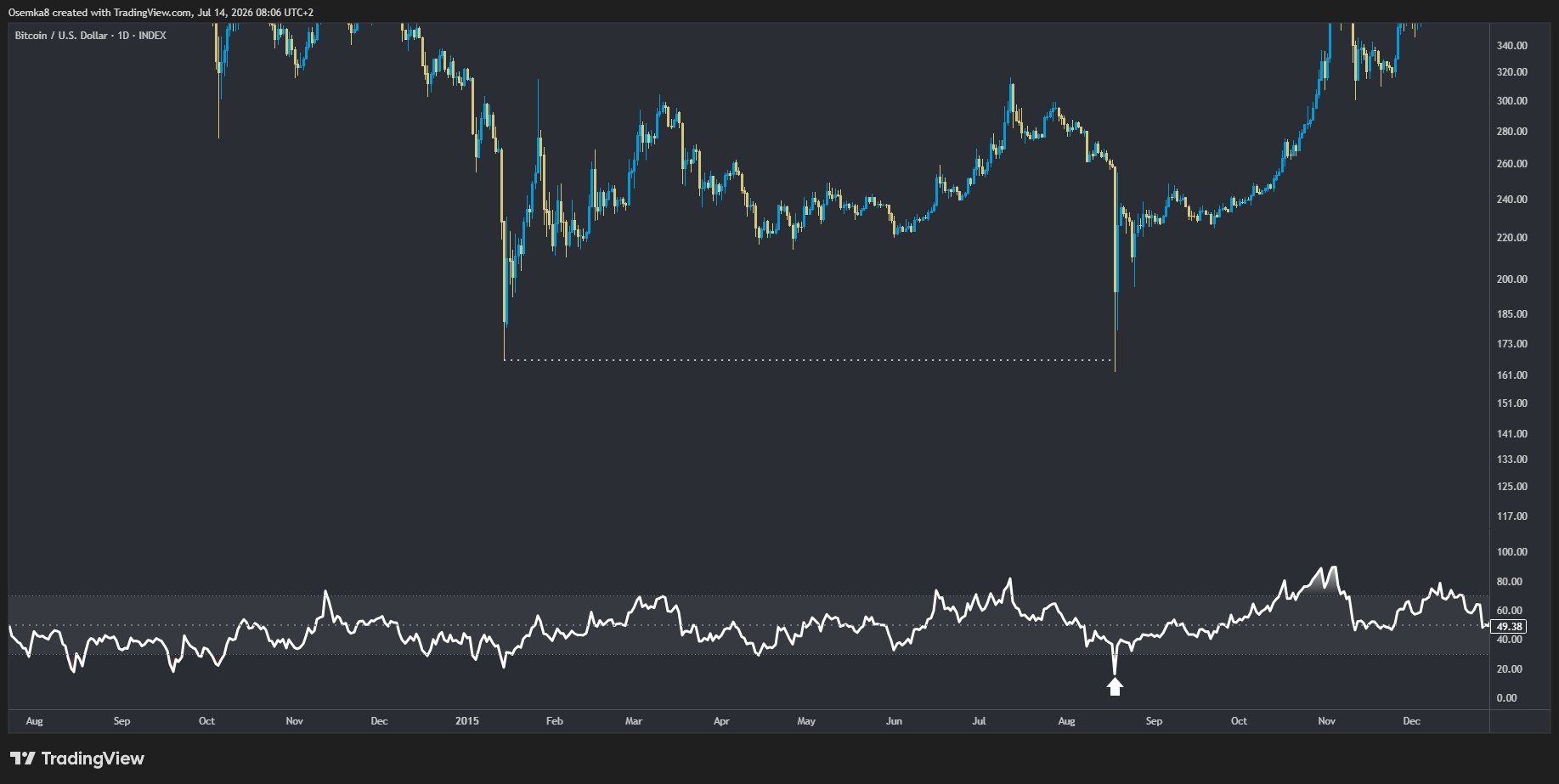
BTC/USD one-day chart with RSI data. Source: Osemka/X
Osemka implied that a deeper RSI retracement could still emerge, marking a price reversal in-line with previous bear markets.
Bitcoin’s return above $64,000 this month, meanwhile, came after bullish RSI divergences across multiple time frames.
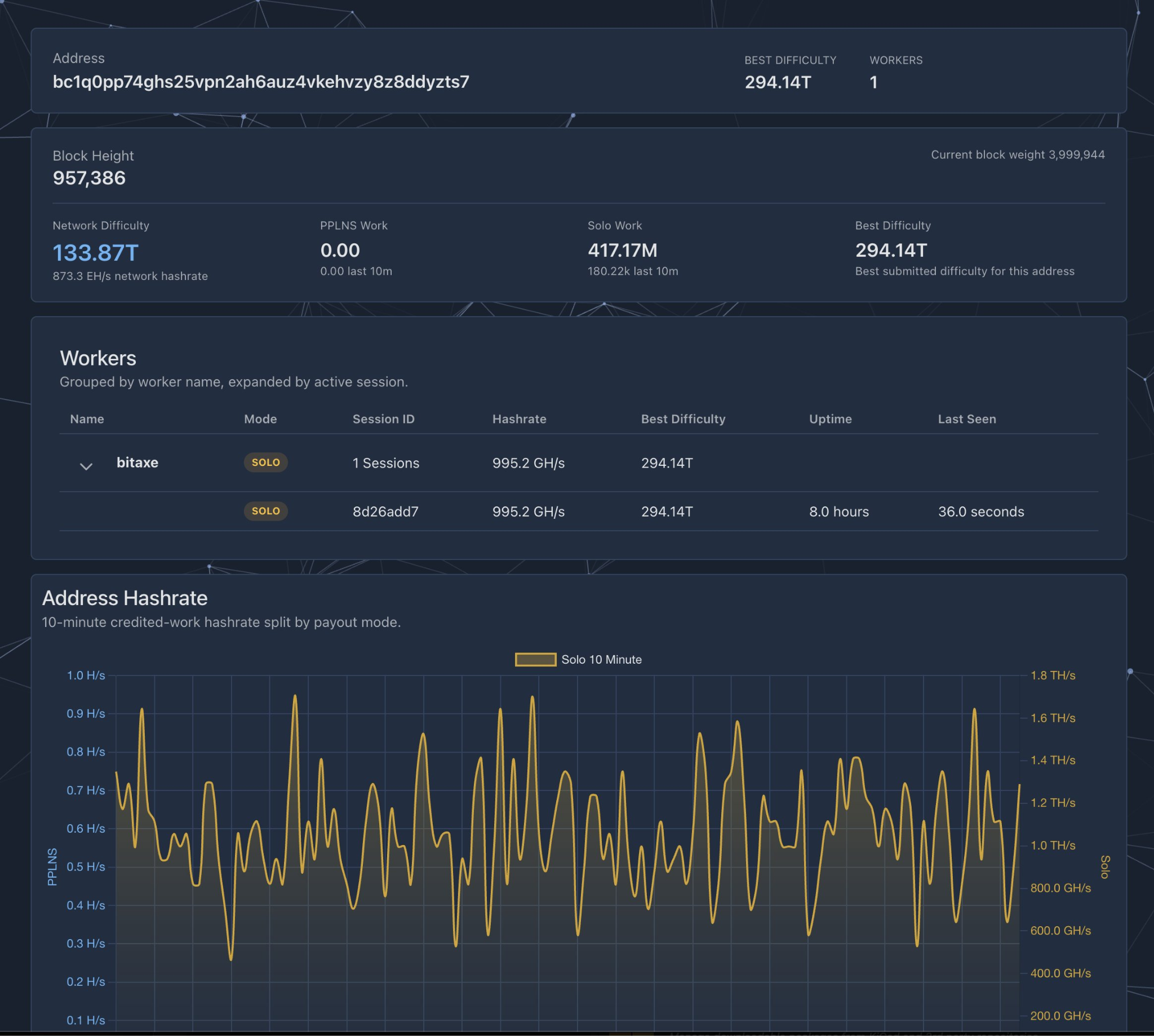
A solo Bitcoin miner hit the jackpot and validated a solo block with a single Bitaxe mining rig, marking a rare win that beat massive statistical odds.
The retail Bitcoin miner secured a 3.125 Bitcoin (BTC) block reward, currently worth about $200,000, on Friday at block number 957382, according to blockchain data from mempool.space.
The miner was using a single Bitaxe mining rig, according to the BTC mining pool Public Pool. The Bitaxe was a budget, lower-power Bitcoin miner that costs less than $200 and has a hashrate of about 1 terahash per second (TH/s), which is a tiny fraction of the global Bitcoin network.
The solo block reward shows that even a sub-$200 investment in a mining rig can lead to a statistically rare payday for retail miners.
Another solo Bitcoin miner validated a solo block in April, through CKPool’s solo mining service. Earlier in February, another retail miner validated a solo block using rented hashrate from a mining provider, meaning that he didn’t own the physical mining rig that solved the block.
Source: Public Pool
Solo BTC miners bag $4.7 million during the past year
While mining a solo block is statistically rare, this marks the 12th Bitcoin block validated by a hobby-level miner so far in 2026, pushing the past 12 months’ total payouts to more than $4.7 million for retail miners.
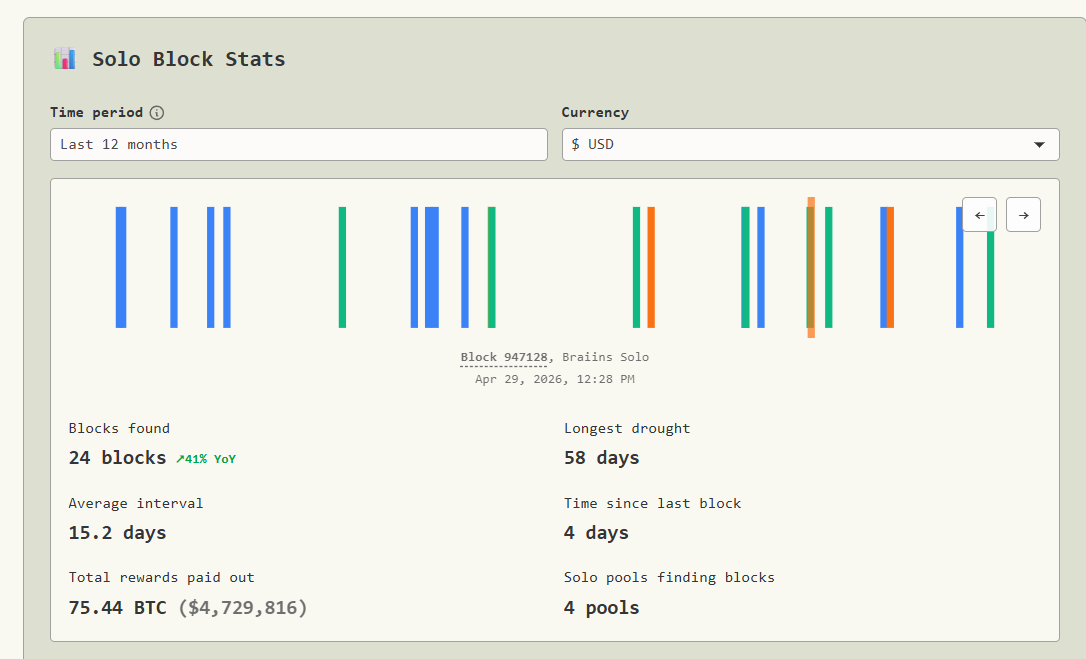
Solo block stats, one-year. Source: Bennet.org
Solo blocks mined increased by 41% year-on-year, as solo miners have validated a total of 24 blocks during the past year, according to solo miner data aggregator Bennet. This brings total rewards paid to solo miners to 75.4 Bitcoin, or $4.7 million, for the past year.
Related: Bitcoin whale moves $188M for first time in 7 years
The average interval for solo Bitcoin blocks stands at 15.2 days, while the longest drought without a successful solo block stands at 58 days.
Magazine: Bitcoin nearing late stages of bear market: Jamie Coutts, Real Vision

BitMine Immersion Technologies posted revenue of $46.5 million in the three months ended May 31, a 22x jump from a year earlier, even as a $9.1 billion nine-month net loss dominated its latest filing.
The loss stems almost entirely from a non-cash markdown on the company’s Ethereum (ETH) holdings. Underneath it, BitMine’s staking business scaled from almost nothing into the firm’s dominant revenue source.
Staking Drives BitMine’s Revenue
According to BitMine’s filing, revenue from staking and validation reached $45.7 million, about 98% of the total. A year earlier, that line was zero. The rest came from small self-mining and consulting lines, together under $800,000.
Follow us on X to get the latest news as it happens

As of the latest data, BitMine has staked 4.9 million ETH, roughly 85% of its holdings, through its MAVAN validator platform. The company projects annualized staking revenue near $242 million.
“Annualized staking revenues are now projected at $242 million. And this 4.9 million ETH is 85% of the 5.77 million ETH held by Bitmine. Bitmine’s own staking operations generated a 7-day yield of 2.70% (annualized),” said Tom Lee.
That income rests on a large ETH position. As of July 12, BitMine holds 5.77 million ETH, worth roughly $10.5 billion and equal to 4.8% of supply. The stake makes it the largest corporate ETH treasury.
The trend extends well beyond BitMine. One recent study found that staking accounted for 60% of disclosed revenue across listed ETH treasury firms in 2025.
A $9 Billion Loss That Missed the Numbers
The headline loss looks alarming, but the timing matters. BitMine’s $9.1 billion nine-month net loss came almost entirely from a $9.04 billion unrealized markdown on its digital assets, according to its SEC filing.
That damage landed as the value of its ETH holdings fell. In the three months ended May 31, the net loss narrowed to $83.6 million.
The period’s operating loss was $11.9 million. The bigger hit came from a $92 million loss on derivative contracts.
The split screen defines BitMine’s model. Its reported earnings will swing with ETH’s price, while its staking operation generates a growing revenue stream. The coming months will test whether staking income can offset that volatility.
Subscribe to our YouTube channel to watch leaders and journalists provide expert insights
The post BitMine Revenue Jumps 22x Even as It Posts $9 Billion Net Loss appeared first on BeInCrypto.
Fears that artificial intelligence would trigger a wave of catastrophic decentralized finance (DeFi) hacks in what was coined as a “hackpocalypse” have not materialized, according to Dragonfly managing partner Haseeb Qureshi.
While the incident count grew to a record high, the median size of hacks has dipped below $500,000 this year, down from over $2 million in 2025. Qureshi argued that this shows malicious actors using AI are targeting “small protocols and abandonware” while larger DeFi protocols have fortified themselves against AI’s threat.
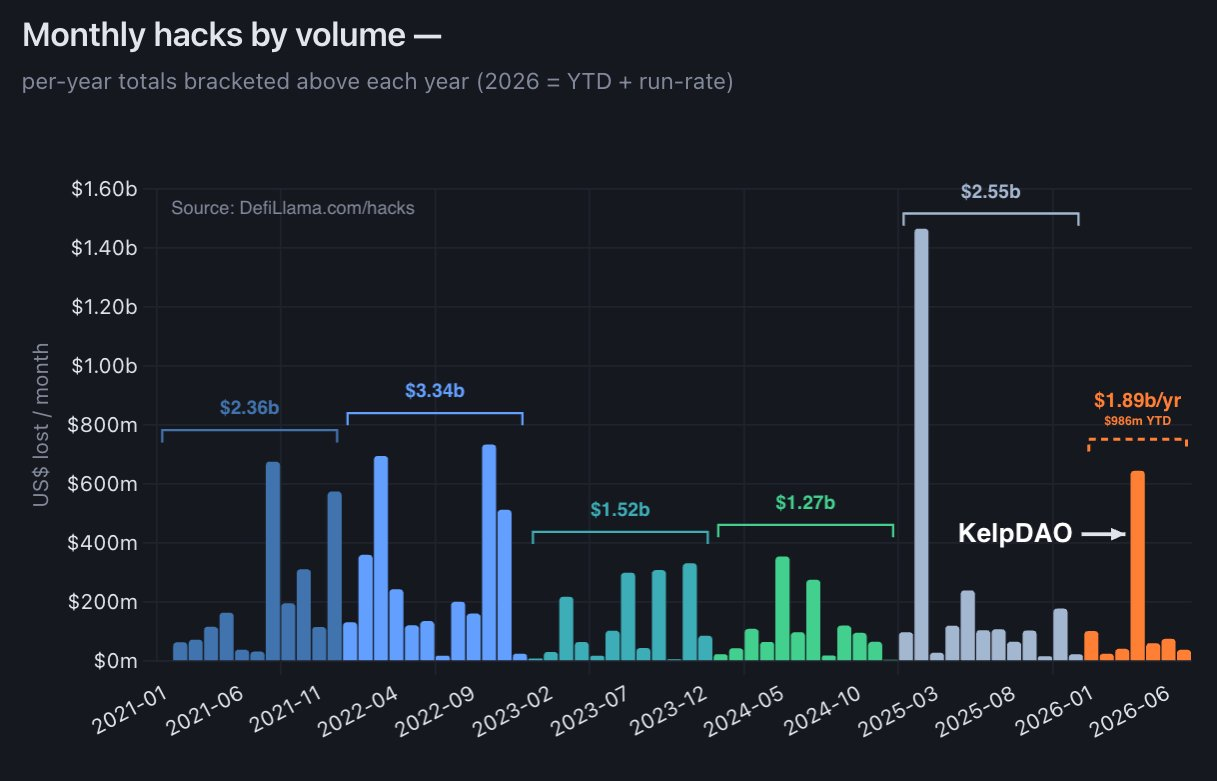
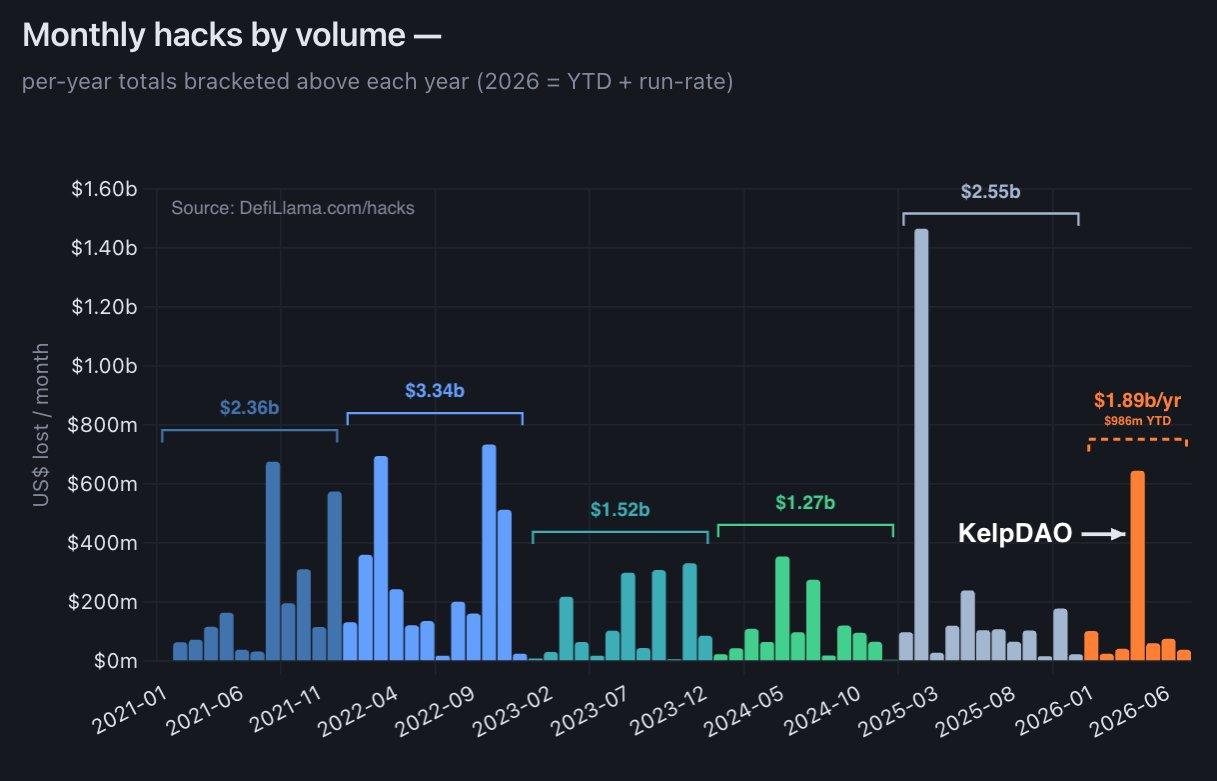
Excluding outlier months with large incidents, such as the Bybit hack in February 2025 along with the Drift Protocol and KelpDAO exploits in April of this year, 2026 has still seen less value hacked per month than the previous year, said Qureshi.
The comments come in response to concerns shared by blockchain security platform OpenZeppelin’s founder, Manuel Aráoz, who said that he considers “all of DeFi unsafe,” citing the growing ability of AI coding agents to identify smart contract vulnerabilities.
Broader industry datasets, which include centralized platforms, wallet compromises and phishing, as well as DeFi exploits, offer a less reassuring picture. In April, crypto hacks surged, resulting in losses of around $644 million, marking an over one-year high last seen in February 2025 when the $1.4 billion Bybit hack pushed monthly losses to $1.46 billion, according to DefiLlama.
Source: Haseeb
Crypto hacks fall 47% in H1, but crypto industry not necessarily safer: CertiK
Losses to cryptocurrency hacks fell 46.8% year-on-year to $1.32 billion in the first half of 2026, but blockchain security company CertiK argued that the Web3 industry’s lower headline losses do not necessarily mean the industry is safer.
Related: Belgian police arrest suspected phishing gang leader tied to $572K theft
While it marks a significant drop in dollar value, last year’s figures were skewed by the $1.4 billion Bybit hack, the largest in crypto history, CertiK told Cointelegraph.
During the second quarter of 2026, over 70% of the losses stemmed from the KelpDAO and Drift Protocol exploits, which were largely attributed to North Korean state-sponsored hackers.
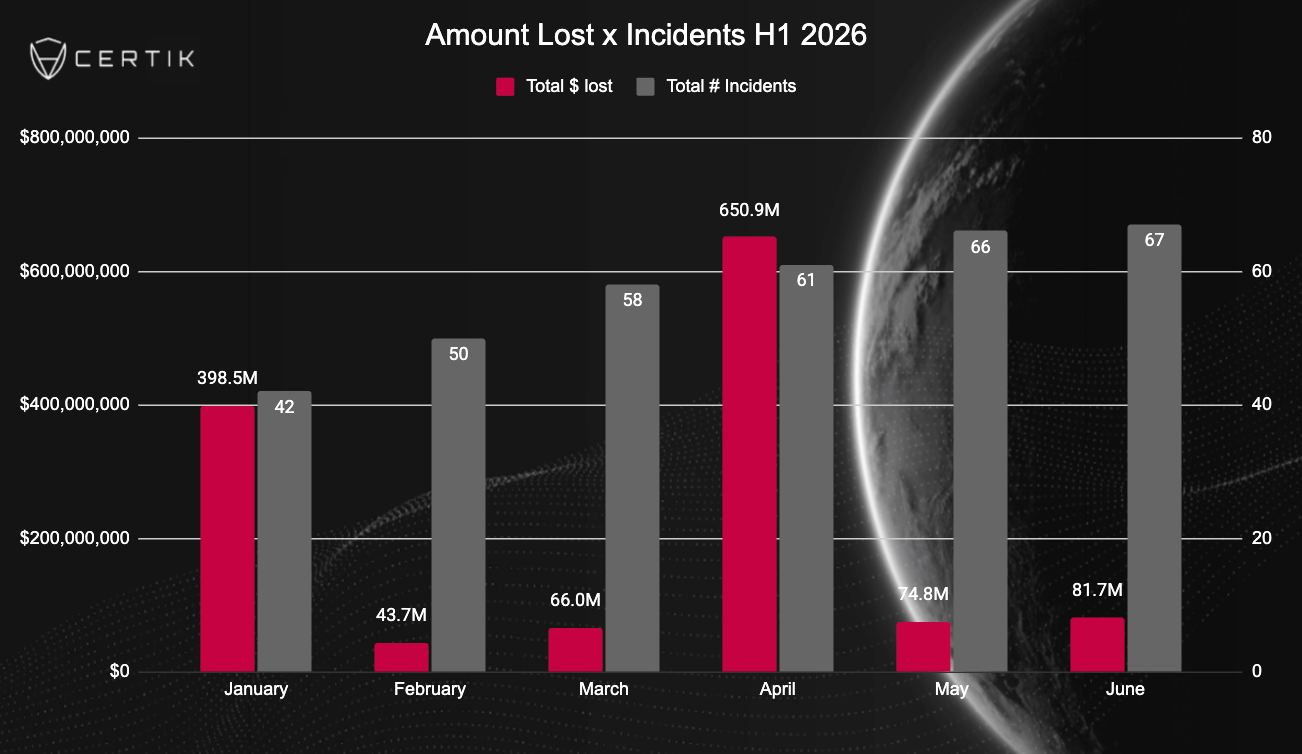
Monthly change in crypto exploit amounts and number of incidents across H1. Source: CertiK
The data underscores the continued threat that North Korean hackers pose to the crypto industry, having stolen more than $6 billion worth of crypto since 2017, TRM Labs estimated in April.
Magazine: Does Botanix’s failure prove Bitcoiners don’t care about DeFi?


Coinbase, among others, filled that gap in May 2025. Under x402, a server that wants payment answers a request with a 402 and a price. The client signs a stablecoin transfer, usually USDC, resends the request with the payment attached, and gets the data. The exchange takes seconds and needs no account, no card, and no prior relationship between the two sides.
That is why the AI industry cares. An autonomous agent cannot open a bank account, pass a credit check or sign a SaaS contract, but can sign a transaction. Google has wired x402 into its own agent payments protocol, and Cloudflare ships it in its agent toolkit.
The announcement included no usage figures, though x402 publishes them on its own homepage. The protocol handled about 75 million transactions over the past 30 days, or roughly 29 every second, moving about $24 million between some 94,000 buyers and 22,000 sellers.
That works out to an average payment of about 32 cents, meaning the machine-to-machine thesis works as designed, as no card network can process a such small charges profitably.
Still, $24 million a month is a fraction of what any of x402’s premier members move in a day.
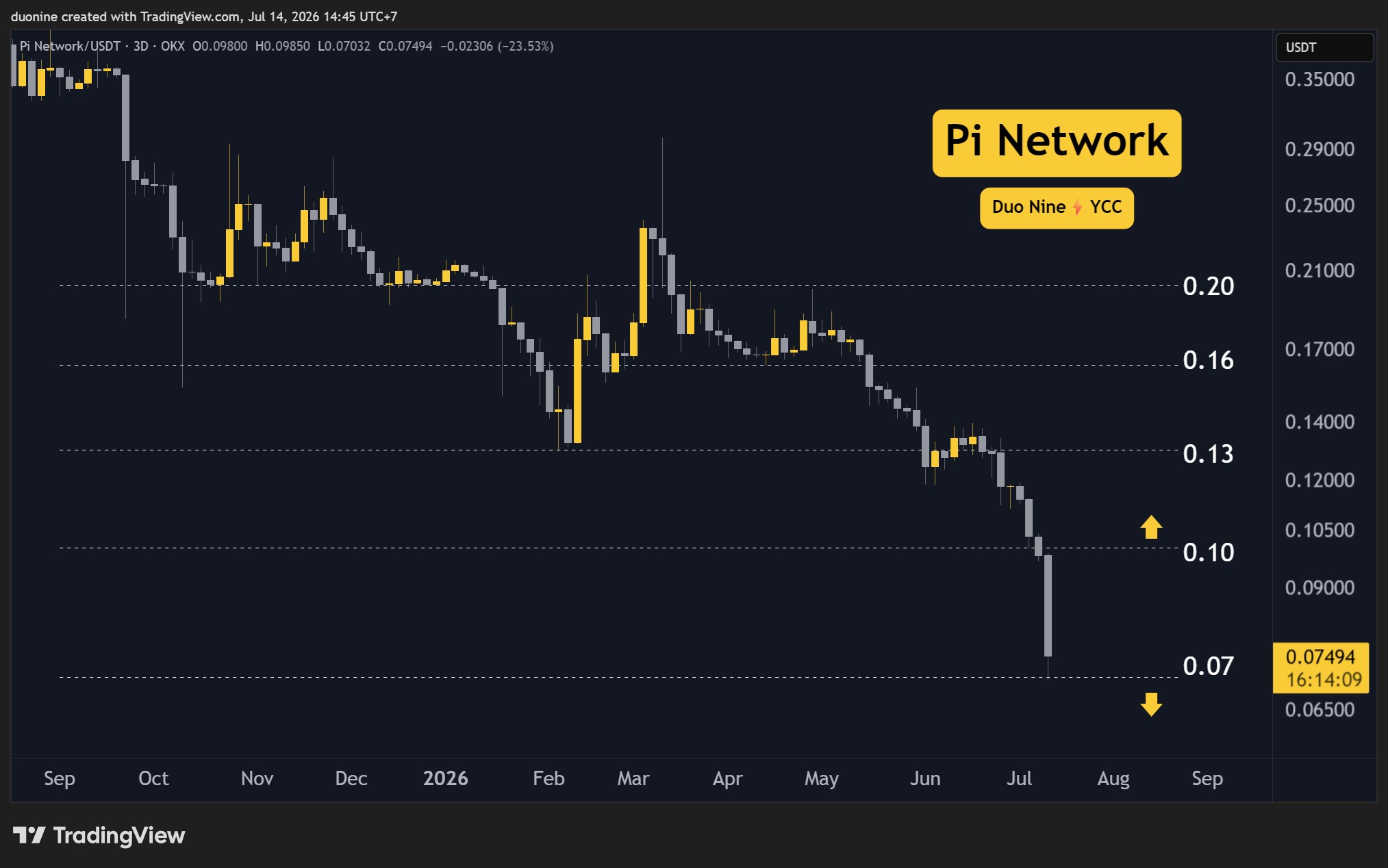
PI crashed 40% this week after a massive sell-off that drove it to consecutive all-time lows. However, it has rocketed by 10% since those lows, begging the question of whether the bottom is in.
PI Network (PI) Price Predictions: Analysis
Key support levels: $0.07
Key resistance levels: $0.10, $0.13, $0.16
PI Crashed to $0.07
PI just had one of the worst weeks in 2026 after the price lost support at $0.10. With this level turned into resistance, sellers rushed for the exits and sent the price into a nose-dive to $0.07, which became its latest record low.
With confidence gone, buyers had vanished. For example, in the past 10 days, only one day closed in the green. This shows that the sentiment is extremely bearish and the downtrend has entered a new phase where a bottom could be found much quicker.
More positive news came in the past several hours, with PI finally rebounding to $0.08 as of press time. However, it remains to be seen whether this is another dead-cat bounce.
Sell-Side Volume Exploded
As soon as the support at $0.10 was lost, sell volume began to pick up. This only made things worse and likely led to cascade liquidations that put even more pressure on the falling price.
While the sell pressure has decreased compared to yesterday, the day is not over, and this could still change. The price held above $0.07 and bounced to $0.08, but this could very well be just a temporary pause before new lows.

Momentum Indicators Are at Extremes
Due to heavy selling pressure, the momentum indicators have reached extreme levels. For example, the daily RSI is at 12 points, a level never seen before for this cryptocurrency. Extremes are also the place where bottoms are found.
Hopefully, this price action will bring about an end to the downtrend and allow PI to consolidate and confirm a bottom. If the support at $0.07 won’t hold, then buyers will likely retreat to $0.06 or even $0.05. The current resistance is at $0.10.

The post Pi Network Price Predictions for This Week as PI Surges 10% in 24 Hours (July 15) appeared first on CryptoPotato.
Crypto World
Finassets Raises Affiliate Revenue Share to 40%, Becoming One of the Highest-Paying Crypto Affiliate Programs
[PRESS RELEASE – Marbella, Panama, July 15th, 2026]
Finassets, a crypto payment gateway for businesses, announced an increase to its partner revenue share. The first-year referral rate rises to 40% of the processing revenue a referred merchant generates. From year two, the rate continues at 20% for five additional years while the merchant keeps processing, extending the total partner earning window to six years per referral, with the term extendable based on the merchant profile.
Payout speed, contract length, and dashboard visibility are among the key considerations affiliate marketers weigh when comparing crypto affiliate programs, and this update puts Finassets among the top crypto affiliate programs open to B2B partners.
A different model from trading-based programs
Many crypto exchange affiliate programs and trading platforms base payouts on trading fees generated by active traders, tying affiliate income to short-term trading volume through a fixed commission plan or a minimum payout threshold. Finassets ties partner earnings to a merchant’s ongoing processing volume instead — a relationship that can continue for the full six-year term.
One agreement, six years of revenue share
- Apply to become a partner. Submit an application and our team handles onboarding and sets clear terms from day one, with a personal referral link and dashboard account.
- Finassets onboards the merchant. KYB, compliance, and integration are handled entirely by Finassets.
- The partner earns. Revenue share is calculated per merchant and paid same-day, in crypto. The term can be extended based on the referred user profile.
A merchant referred through a partner’s affiliate link and processing $500,000 a month generates about $2,000 a month in processing fees at Finassets’ 0.40% rate. Here’s how that translates into partner earnings:

Based on a merchant processing $500,000/month at Finassets’ 0.40% fee. Illustrative; actual earnings depend on the merchant’s processing volume.
“Most cryptocurrency affiliate programs ask partners to keep generating referrals just to keep earning,” said Vitalijs F., CEO of Finassets. “We built this revenue share model so one merchant relationship can keep paying out for years, without additional marketing efforts from the partner after the introduction.”
Real-time visibility, reliable payouts
The agent dashboard tracks referral volume and revenue share per merchant in real time, with a full transaction history for reconciliation and one-click withdrawals. Deposits are typically credited within about 30 seconds of network confirmation, and partners are supported by dedicated account managers who respond quickly. Payouts are same-day, in crypto. Finassets supports 70+ cryptocurrencies across its full product suite, the same infrastructure referred merchants use to process payments.

The affiliate program is open to eligible B2B participants in selected international markets, subject to Finassets programme terms and applicable jurisdictional requirements.
More information and the partner application: https://www.finassets.io/en/affiliate-program/
About Finassets
Founded in 2021, Finassets is a Panama-registered crypto payment gateway supporting cross-border and crypto-driven businesses across eligible markets. Finassets provides crypto invoicing, payment links, payment buttons, mass payouts, API integration, crypto checkout, and an affiliate program within a structured, transparent environment for crypto payment processing.
Website: https://www.finassets.io
The post Finassets Raises Affiliate Revenue Share to 40%, Becoming One of the Highest-Paying Crypto Affiliate Programs appeared first on CryptoPotato.

Most mesmerizing money spread

Motorists warned about traffic light outage in Bury centre
Spain’s final 12-month EU-harmonised inflation at 3.6% in June


-

 Fashion6 days ago
Loro Piana Fall 2026 Enters Houston’s Art Scene
-

 Fashion4 days ago
Weekend Open Thread: Nutriplenish Leave-In Conditioner
-
 Sports6 days ago
2026 Genesis Scottish Open Thursday TV coverage: Round 1
-

 Sports5 days ago
Super Eagles star Moses Simon opens up on Liverpool transfer regret
-

 Tech6 days ago
Character.AI enters the microdrama arena with its own productions, but there’s a twist
-

 News Videos11 hours ago
XRP BOMBSHELL… XRP OMBOARDED FOR TRANSACTIONS!!!
-

 Tech1 day ago
Get Your ESP32 Sunny Side Up With This Solar Dev Board
-

 Tech11 hours ago
Dark Secrets Emerge When Jailbreaking LLMs
-

 News Videos6 days ago
Crypto Just Entered Its Most Important 6-Month Candle (Could Decide Everything!)
-
 NewsBeat6 days ago
Major update after Huntingdon train attack as man enters plea
-

 News Videos2 days ago
how to make coin bank box with cardboard #scienceproject #money #diy #shorts
-

 Sports7 days ago
39-year-old Djokovic wins five-hour thriller to enter Wimbledon semis | Other Sports News
-

 Tech6 days ago
Level Infinite Launches Gangstar Mirage City in India with Pre-Registrations
-
 Tech2 days ago
Cloudflare Precursor Watches Your Mouse and Keyboard To Decide If You Are Human
-

 Tech6 days ago
Entra passkey enrollment vishing targets Microsoft 365 users
-
 Crypto World6 days ago
DeFi Dashboard Zapper to Shut Down After 7 Years
-
 Crypto World6 days ago
Mark Cuban-Backed DeFi Dashboard Zapper Shuts Down After 7 Years
-

 Tech6 days ago
Claude’s New Reflect Dashboard Wants To Help You Log Off Of Claude
-

 Crypto World7 days ago
Microsoft Cuts AI Bill by Replacing OpenAI and Anthropic in Software Products
-

 Crypto World6 days ago
Fed minutes June 2026: officials split on rates
You must be logged in to post a comment Login