
Crypto World
XRPL is building what it refused. Xahau built it first

In 2023 a group of developers forked the XRP Ledger because its validators would not adopt smart contracts. Three years later the parent chain is shipping its own programmability layer, and the drafted specification names the fork’s technology as an inspiration. Here is what actually happened, what it means for XAH, and why three competing architectures now answer the same question.
Summary
- Xahau launched in 2023 as a fork of the XRP Ledger’s rippled codebase, carrying the Hooks amendment that XRPL validators never adopted, with its own token, its own validator set, and a governance system run through a genesis account hook.
- The XRP Ledger is now building programmability natively: XLS-100d Smart Escrows, using WebAssembly, sits among known amendments with a devnet live, and XLS-101 Smart Contracts is a drafted specification that cites both Hooks and the Ethereum Virtual Machine as influences.
- Xahau rejects the sidechain framing entirely, positioning itself as an independent Layer 1 that diverged in its own direction, with features the parent lacks and vice versa, and describing the borrowing as mutual.
- Three architectures now answer the same question for one ecosystem: Hooks on Xahau, Solidity through the EVM sidechain whose first year this publication audited at $25,741 in total value locked, and WebAssembly natively on the main ledger.
- The open question is what a fork is worth once the chain it left ships the capability it forked for, and XAH is the asset where that question gets priced.
Forks in crypto usually happen over money or ideology. This one happened over a feature. In 2023, after years in which the XRP Ledger’s validators declined to adopt Hooks, a lightweight smart-contract system that would let small pieces of code live on accounts and govern the transactions those accounts send and receive, the developers behind it stopped waiting. They took the ledger’s open-source rippled codebase, added Hooks, launched a network called Xahau with its own token and its own validators, and shipped the capability the parent chain would not. Ripple’s chief technology officer publicly supported the move at the time, saying he could not think of a better path forward for the technology. Three years later the parent chain is building programmability after all. XLS-100d, a WebAssembly-based Smart Escrows amendment, is among the known amendments with a devnet running, and XLS-101d, a drafted specification for general smart contracts, explicitly names both Hooks and the Ethereum Virtual Machine among its influences. This piece examines what that convergence actually means: for the ledger that spent years refusing, for the fork that stopped waiting, and for an ecosystem that now has three separate answers to the question of how a payments chain becomes programmable.
What Xahau took, and what it built
Understanding the fork requires understanding what it kept, because Xahau is not a departure from the XRP Ledger’s design so much as an addition to it.
The network preserved the core: the consensus protocol, the native decentralized exchange, and the fee-and-reserve logic that protects the ledger against spam by charging and burning fees in the native token. What it added was Hooks, small pieces of code installed on an account that impose rules on transactions before those transactions execute, enabling functions such as time locks on transfers, social-recovery arrangements for accounts, and self-custodial direct debits. The design philosophy is deliberately narrow. Hooks were never intended to replicate a general-purpose virtual machine; they are lightweight logic reacting to ledger events, executing fast enough to preserve settlement speed and cheap enough to suit a payments chain.
Two further design choices distinguish it. Xahau substituted a simpler token standard for the parent’s NFT implementation, and it built a governance system in which the genesis account itself is controlled by a hook that regulates matters including the emission of new XAH, administered through a two-tiered arrangement with up to twenty independently owned validators as participants. Governance by smart contract, on a chain whose reason for existing is smart contracts, is at least internally consistent. XAH functions as the network’s fee and reserve asset, with a balance-rewards mechanism that has no equivalent on the parent chain.
The launch was contentious in the way ecosystem splits usually are, with parts of the XRP community expressing unease at the lack of official involvement, and with the fork’s supporters arguing that validators refusing an amendment for years had left no alternative. The relevant point for today is that Xahau shipped and kept shipping, accumulating a validator set, an exchange listing history, and a working developer story around a capability the main ledger did not have.
What the parent is shipping now
The XRP Ledger’s current roadmap describes a different route to the same destination, and the specifications are public.
XLS-100d, Smart Escrows, brings WebAssembly-based conditional logic to escrow objects, allowing programmable conditions to govern the release of funds, and it appears among the ledger’s known amendments with a dedicated devnet for developers to test against.
That is a narrow, payments-native form of programmability: not a general computing environment, but escrows that can enforce arbitrary conditions written in a widely supported bytecode format. XLS-101d, Smart Contracts, is the broader specification, drafted in 2025, proposing general smart contract capability on the ledger and citing both Hooks and the EVM among the designs it draws from.
The choice of WebAssembly instead of a bespoke virtual machine is the interesting technical decision, because it imports an existing toolchain and developer base rather than asking builders to learn something proprietary. It is also, in its way, an admission: the ledger that resisted programmability for years is now adopting a mainstream execution standard, and doing so with public acknowledgment of the technology that forked away over exactly this question.
The timing places three approaches in the same ecosystem simultaneously. Hooks run on Xahau. Solidity runs on the XRPL EVM sidechain, whose first year this publication audited and found holding $25,741 in total value locked, a figure that remains the sharpest available evidence that architectural compatibility does not produce developer gravity by itself. And WebAssembly is arriving natively on the main ledger. Three answers, one ecosystem, and no consolidation in sight.
The fork refuses the frame
The narrative that writes itself, that a parent chain has absorbed the innovation its fork proved out, is one Xahau explicitly rejects, and its objection deserves fair treatment because it complicates the story usefully.
The current positioning from the Xahau side is that it is not a sidechain and never was one in any meaningful operational sense: it is an independent Layer 1, built from a fork of the XRPL codebase, that has evolved in a completely different direction with its own validators, its own governance, and its own economics. On this account the two networks occasionally adopt ideas from one another and otherwise develop separately, with features existing on each that do not exist on the other. The sidechain confusion, the argument goes, comes from early marketing history and not from present reality.
That framing is defensible on the technical facts and self-interested at the same time, which is normal for any project describing itself. Independence is real: separate consensus, separate validator set, separate token with its own monetary policy. Mutual borrowing is also real, since specifications flow in both directions among developers who largely know each other. But the asymmetry is equally real and no framing dissolves it. When the parent ledger ships general programmability, a developer choosing where to build weighs Xahau’s head start and Hooks’ elegance against the main ledger’s liquidity, its institutional relationships, its exchange support, and the ecosystem’s marketing gravity. Forks that exist to supply a missing capability face their hardest test at exactly the moment the capability stops being missing, and no amount of correct positioning about independence changes the competitive arithmetic a builder actually runs.
The threshold that decides everything
Everything in this piece depends on a governance mechanic that outsiders consistently underestimate, and the ledger’s own recent history supplies the cautionary case.
XRP Ledger amendments activate only when validators on the default list signal support at or above eighty percent, and that support must hold continuously for two weeks before the change takes effect. Fall below the line at any point in the window and the clock resets. There is no foundation that can force adoption, no core team veto, and no timetable: an amendment can sit in the known-amendments list indefinitely, gathering partial support, activating never. Hooks itself is the proof. The specification existed, the implementation worked, the technology was sound enough that the ledger’s own chief technology officer publicly endorsed the fork that shipped it, and the amendment still never reached the threshold on the main chain. Years of availability produced no activation, which is precisely why Xahau exists at all.
That history should discipline every forecast about XLS-100d and XLS-101d. A specification in the known-amendments list is a proposal that validators may or may not adopt, and a drafted specification like the general smart contracts proposal is a step earlier still. Both could activate this year; both could sit for three years; either outcome would be consistent with the ledger’s record. The ecosystem’s more recent experience cuts the same way in the opposite direction, since a maintenance amendment this summer sat near forty-eight percent support for a month before validators moved and carried it past the threshold at eighty-six percent, showing that stalled votes can turn quickly once the coalition assembles. Prediction is unwise in both directions.
The threshold also shapes the competitive dynamic between the two chains in a way neither side usually discusses. Xahau’s governance runs through a hook on its genesis account under a two-tier arrangement with up to twenty validators, which is a materially different mechanism from the parent’s eighty percent supermajority, and the fork’s ability to ship features it decides to ship is not a small advantage for a network whose entire premise is programmability. A chain that can adopt is structurally different from a chain that must persuade. Whether that speed advantage matters more than the parent’s liquidity is the actual competition, and it is a question about governance architecture more than about virtual machines.
For a reader tracking this, the practical instruction is simple: ignore roadmap announcements and watch the validator vote count, published continuously, on the specific amendments. Announcements are intentions. The count is the only thing that has ever decided what the XRP Ledger does.
What it means for XAH
The honest assessment splits into a bear case and a bull case that are both stronger than the ecosystem’s usual discourse allows.
The bear case is straightforward. XAH’s investment thesis has substantially been that Xahau is where XRPL-ecosystem smart contracts live. If XLS-100d and XLS-101d ship and function, that thesis erodes toward a narrower claim: Xahau is where a particular style of lightweight account-attached logic lives, competing against native WebAssembly contracts on a chain with vastly more liquidity, more integrations, and more attention. Fee-burn value accrual on a chain whose activity moves elsewhere is the same problem this publication has documented across the value-accrual arc, arriving in a smaller ecosystem with less cushion.
The bull case rests on three points that deserve their weight. First, shipping schedules: XLS-101d is a draft, amendments require validator adoption at an eighty percent threshold sustained over two weeks, and the ledger’s own history, including the years Hooks spent unadopted, is the strongest available evidence that XRPL amendments can stall indefinitely. Xahau’s capability exists today; the parent’s is a specification and a devnet. Second, design divergence: Hooks and WebAssembly contracts are not substitutes for every purpose, and lightweight event-triggered logic on accounts has properties a general contract environment does not. Third, and most underrated, the governance experiment: a chain whose emission and genesis account are administered by a hook under a two-tier validator arrangement is running a live test of on-chain governance that the parent has not attempted, and if that works at scale it is an independent reason for the network to exist.
The verdict this piece can honestly offer is narrower than either case: the fork’s premise has changed, and the market has not repriced it because the parent’s capability is not live yet. When XLS-100d activates, the question stops being theoretical, and XAH becomes the cleanest available measure of what a fork is worth after the reason for forking has been addressed at home.
What to watch
XLS-100d’s amendment vote. Smart Escrows crossing the eighty percent validator threshold and completing its two-week activation window is the event that converts this from a roadmap story into a live competitive fact. Watch the vote count, not the announcements.
XLS-101d’s progression. A drafted specification is a long way from an activated amendment. Whether the general smart-contract proposal moves toward candidate status within the year, or joins the long list of XRPL specifications that never reached a vote, determines the scale of the challenge to Xahau.
Developer migration signals. New deployments, tooling investment, and grant activity across the three environments are the leading indicators. The EVM sidechain’s first-year experience is the cautionary baseline: compatibility alone moved nothing.
Xahau’s differentiation response. The fork’s strongest move is to lean into what the parent will not copy, meaning its governance model, its balance rewards, and Hooks’ specific ergonomics. Whether the project pivots toward those or defends the general smart-contract ground is the strategic tell worth watching.
A closing observation about what this episode says about the ecosystem’s decision-making, since the technical story has a governance moral. The XRP Ledger’s amendment threshold is a genuine decentralization feature, the same property this publication has praised when validators declined to follow Ripple’s own signaling on other proposals, and it is also the reason a capability the ecosystem clearly wanted took six years and a fork to arrive. Both statements are true, and the tension between them is the permanent condition of any network that makes protocol change hard on purpose. Chains that can ship quickly capture opportunities and make mistakes quickly; chains that require supermajorities avoid mistakes and miss windows. Neither is a flaw to be fixed.
What the Xahau episode adds is the observation that in an open-source ecosystem, the slow chain does not actually prevent the feature from existing. It only determines where the feature lives, who benefits from it, and which token captures whatever value it generates. The developers who wanted Hooks did not wait; they left, built, and launched, and the parent chain’s caution cost it three years of programmability and handed a competitor its founding purpose. Now the parent is building the capability anyway, on its own timeline, with the fork’s work as a reference. That is either the system working exactly as designed, with experimentation happening safely outside the main ledger before the ideas mature into it, or an expensive way to arrive at a destination the ecosystem could have reached directly. Both readings have adherents, and the amendment vote will not settle which is right.
Disclaimer: This article is for information and educational purposes only and does not constitute financial or investment advice. Protocol specifications, amendment statuses, and roadmaps change, and drafted proposals may never activate. Nothing here is a recommendation to buy, sell, or hold any asset. Always do your own research. Information is accurate as of July 27, 2026.
Frequently Asked Questions
What is Xahau?
An independent Layer 1 blockchain launched in 2023 as a fork of the XRP Ledger’s open-source rippled codebase, created to implement Hooks, a lightweight smart contract system that XRPL validators had not adopted. It retains the parent’s consensus protocol, decentralized exchange, and fee-burning design while adding programmability, its own token XAH, its own validator set, and a governance system administered through a hook on the genesis account.
What are Hooks?
Small pieces of code installed on an account that impose rules on transactions the account sends or receives, executing before those transactions complete. They enable functions such as transaction time locks, social-recovery arrangements, and self-custodial direct debits. Hooks were designed for speed and low cost rather than to replicate a general-purpose virtual machine, which is the core design difference from EVM-style smart contracts.
What is the XRP Ledger building now?
Two things. XLS-100d, Smart Escrows, uses WebAssembly to allow programmable conditions on escrow releases and appears among known amendments with a devnet available. XLS-101d, Smart Contracts, is a drafted specification for general smart contract capability that cites both Hooks and the Ethereum Virtual Machine among its influences. Neither is yet activated on the main ledger.
Is XRPL copying Xahau?
Borrowing openly, in one direction, while the fork maintains that exchange runs both ways. The drafted XRPL specification names Hooks as an influence, which is a public acknowledgment. Xahau’s position is that it is an independent chain that has evolved in its own direction, with features on each network absent from the other, and that both occasionally adopt ideas from the other.
How many ways can you write smart contracts in the XRP ecosystem?
Three, currently. Hooks on Xahau, Solidity via the XRPL EVM sidechain, and WebAssembly natively on the main ledger once the relevant amendments activate. The EVM sidechain’s first year, which this publication audited at $25,741 in total value locked, is the ecosystem’s own evidence that offering an execution environment does not by itself attract developers.
What does this mean for the XAH token?
It puts pressure on the fork’s core premise. If the parent ledger ships working programmability, Xahau’s claim narrows from being the ecosystem’s smart contract chain to offering a particular style of lightweight logic against a far more liquid competitor. The counterweights are timing, since XRPL amendments require sustained eighty percent validator support and can stall for years, and genuine design differences between the two approaches.
Why did XRPL validators never adopt Hooks?
The amendment never reached the sustained supermajority the ledger’s governance requires, and no single public explanation covers it. Ripple’s chief technology officer stated at the time of the fork that he did not believe validators were voting on political grounds and that Xahau had made good decisions, describing the fork as a reasonable path forward for the technology.
What would settle the competition?
Activation and adoption, in that order. The amendment vote on Smart Escrows converts the parent’s programmability from a roadmap to a fact, and developer behavior afterward, new deployments and where tooling investment goes, decides which environment accumulates gravity. Ecosystem history suggests capability alone does not determine the outcome. This is educational analysis, not investment advice.


Law enforcement groups backed by key Democrats have suggested some changes to the CLARITY Act that would make it easier to prosecute some crypto software developers.
However, White House officials still feel like the suggestions made fall short of what they want.
Trump’s Crypto Adviser Rejects Proposal
Trump’s crypto adviser, Patrick Witt, dismissed the proposal, saying claims that they were the result of “productive negotiations” with the White House and Treasury were far from the truth. He added that the administration had made its position clear to Sen. Catherine Cortez Masto for weeks and that the latest revision was “not even close” to meeting its expectations.
A report from Politico shows that two major groups representing U.S. prosecutors have submitted fresh changes to the White House, aiming to break months of deadlock over the CLARITY Act.
“Newest language is the culmination of productive negotiations with law enforcement, the White House, and Treasury, and we feel good about the chance to resolve this issue once and for all,” said Masto in a statement.
The proposal focuses on the Blockchain Regulatory Certainty Act (BRCA), with the new language removing provisions that could protect developers from criminal prosecution in some cases. At the heart of the dispute is whether law enforcement should hold crypto developers responsible for crimes committed on the platforms they build.
The Trump administration says that the authorities should protect builders who do not hold customer funds to encourage innovation. On the other side, critics and law enforcement groups disagree, warning that the current language could make it easier for financial crimes to go unchecked.
New York Attorney General Letitia James also shares the sentiment, having recently said that the CLARITY Act could weaken state enforcement against crypto fraud. According to her, this is because the legislation would limit the state’s ability to hold digital asset firms accountable for crimes.
Police Groups and Security Officials Rally Behind Clarity Act
Not everyone seems to be against the latest revision, though. The Fraternal Order of Police, the largest police organization in the U.S., recently dropped its objections and backed the crypto bill after previously raising concerns about the BRCA.
The report also says several other groups have backed the legislation, including the National Organization of Black Law Enforcement Executives and the Federal Law Enforcement Officers Association.
Last month, over 160 former national security, intelligence, and other officials also wrote a letter to the Senate in support of the bill, arguing that it would strengthen efforts to combat illicit finance in the crypto space.
The post Trump’s Crypto Adviser Rejects CLARITY Act Developer Proposal appeared first on CryptoPotato.
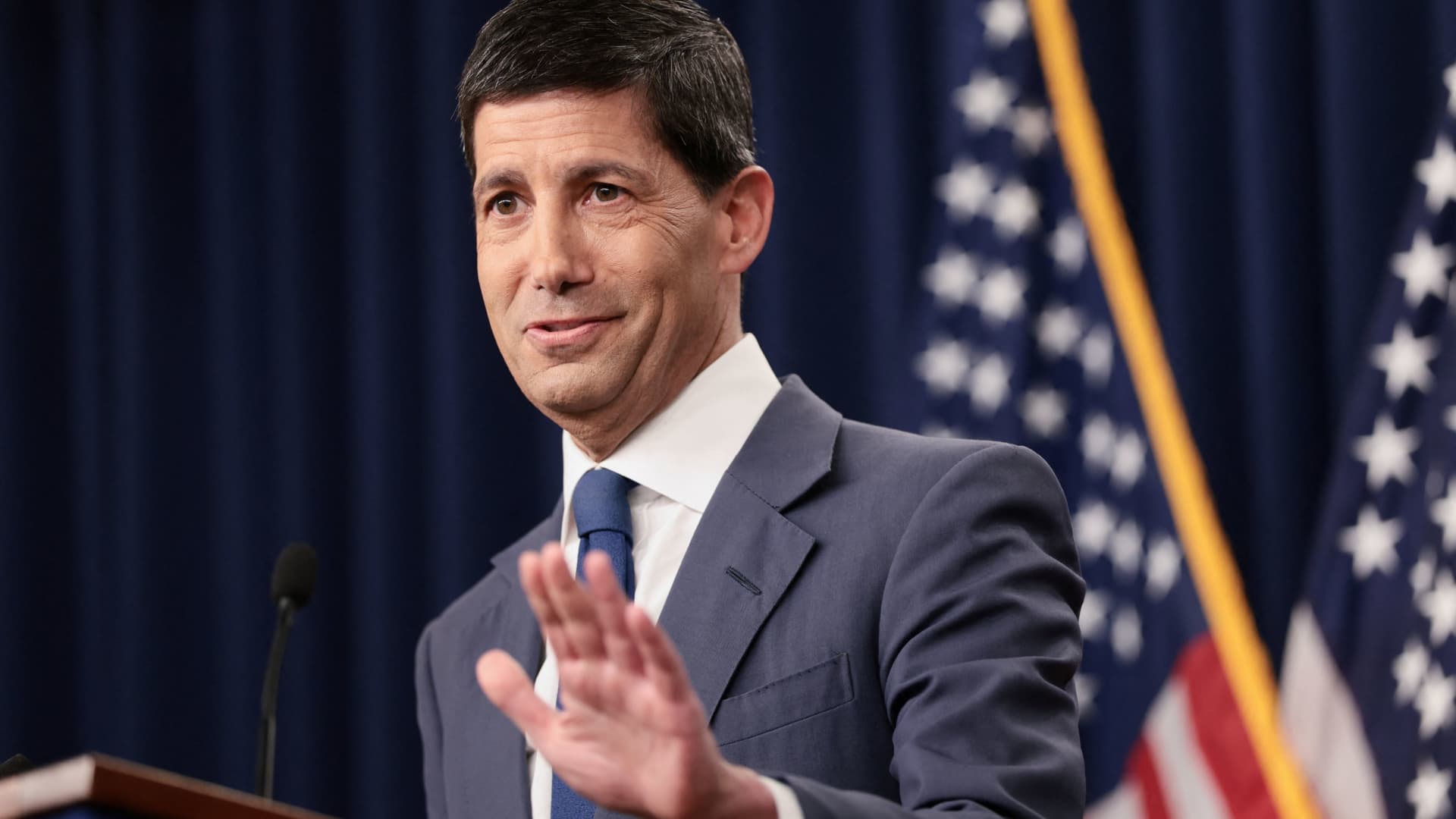
U.S. Federal Reserve Chairman Kevin Warsh holds a press conference following a two-day meeting of the Federal Open Market Committee (FOMC), as the Federal Reserve holds interest rates steady, at the Federal Reserve, in Washington, D.C., U.S. July 29, 2026.
Evelyn Hockstein | Reuters
The Federal Reserve on Wednesday followed through on expectations for no interest rate change, and Chairman Kevin Warsh offered little direction in his news conference. The meeting was notable for a surge in dissenting votes, while Warsh looked to provide some clarity on the board’s thought process.
Here are the five biggest takeaways from this week’s Fed actions:
- The “family fight” returns: Three voters on the Federal Open Market Committee voted against the hold, favoring instead a quarter percentage point hike. “I asked for a good family fight, and I got one. That’s the purpose. That’s the design feature,” Warsh said. “There was a lot more interaction between and among my colleagues. It was a real family fight.” All the “no” votes came from regional presidents: Lorie Logan of Dallas, Neil Kashkari of Minneapolis and Beth Hammack of Cleveland, none terribly surprising given previous statements they made.
- Another short and sweet statement: Other than detailing the “no” votes the statement was unchanged and still dramatically shorter than the Fed norm. “As before, the policy statement conveys just the facts. It’s steering clear of forecasting, a choice we consider especially prudent at these uncertain times,” Warsh said. “Uncertainty, however, does not mean a lack of clarity.”
- Dedication to slaying inflation, but …: Warsh again stated the Fed’s resolve to keep inflation under control, but braced markets and the public that it won’t be an easy fight nor will it end soon. “We’ve got no magic wand,” he said. “This isn’t something that we’re going to be able to carry out in days or weeks.”
- Revolt in the market: Despite the chairman’s tough talk on inflation, markets weren’t having it. Treasury yields at the long end of the curve soared, even as the policy-sensitive 2-year dipped. Translation: We think you’re going to keep short-term policy rates in check, and it’s going to create a ton of inflation later. The 30-year bond was the biggest gainer, roaring higher by 11.5 basis points to 5.211%, its highest yield since 2007 and seemingly undercutting Warsh’s inflation warrior credentials.
- No clues on September: Investors looking to get any further hints on whether the Fed will hike at the Sept. 15-16 FOMC meeting were largely out of luck. The statement offered no clues, either on forward guidance or even on the reaction function, and Warsh was at best cryptic on which way he will push. “So I take seriously that the pullback of forward guidance requires some transition. Reform isn’t easy, but our general judgment is going to help us make better decisions, and in so doing, satisfy our remit,” Warsh said.
They said it
“No doubt, in some of your commentaries today, you’ll talk about a divided Federal Reserve. Well, that’s not the feeling I felt the last couple of days and the couple days before. What I felt was a group of professionals, all the different perspectives, different views, different judgments, but eager to roll up their sleeves and have a family fight, and eager to reform the way in which the Fed does policy.” — Warsh, commenting on the tenor of the two meetings he’s chaired so far.
“We have long argued that September not July is when Warsh faces a binding credibility test/trap. If inflation and/or the war and energy run relatively hot over the summer he will have to hike in order to preserve his credibility. The key difference is that September is in a broad sense data-dependent while July was Warsh preferences dependent.” — Krishna Guha, head of global policy and central bank strategy at Evercore ISI.
“[T]he Warsh Fed seems to be turning a blind eye to the message the bond market’s higher yields are sending about the inflation risks. Stay tuned. The reform-oriented Federal Reserve under Chair Warsh is looking like a bust. The bond market wants answers, but is getting nothing in return.” — Chris Rupkey, chief economist at Fwdbonds.
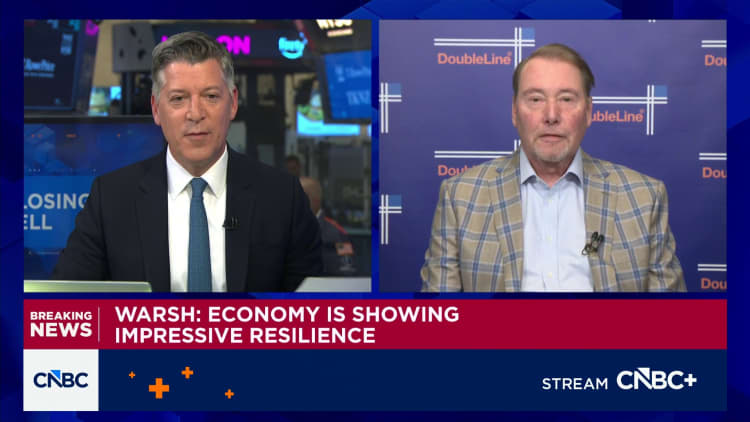

DoubleLine Capital CEO Jeffrey Gundlach said the Treasury market is signaling that the Federal Reserve will need to do more than talk tough if policymakers are serious about reaching their 2% inflation target.
“If you really want to get to 2%, I think you have to raise interest rates,” Gundlach said on CNBC’s “Closing Bell” Wednesday after the Fed’s latest policy decision. “I think getting 2% is going to take a long time. We might not get there over the course of the next couple of years.”
The Fed left its benchmark interest rate unchanged at a range of 3.5% to 3.75%, a decision that was widely expected. The move was not approved unanimously, however, with three policy members dissenting in favor of raising rates by a quarter percentage point.
Gundlach said the divergent moves across the Treasury curve following the announcement showed investors’ skepticism that the Fed will ultimately follow through.
“The two-year Treasury rallied today because it thinks the Fed is taking its time,” he said. “And the long bond yield went up significantly after the press conference, because the bond market vigilantes are saying, ‘If you really want us to believe your rhetoric, you’ve got to start acting.’”
The benchmark 10-year Treasury yield rose more than 7 basis points to 4.681%, while the 30-year bond yield surged to 5.213% for its highest level since 2007. Meanwhile, the policy-sensitive two-year Treasury yield fell 3 basis points to 4.244%.
The long end is generally tied to expectations for inflation and deficits, while the short end is closely related to interest-rate expectations in the shorter run.
Fed Chairman Kevin Warsh stressed that the Fed will take necessary steps to meet its 2% inflation goal.
“I understand the desire for rolling forecasts and commentary from this committee, but for our part, we need to observe market reaction to developments direct and unfiltered,” Warsh said. “I want to stress, of course, that decisions by this committee matter a great deal, and where necessary and appropriate, we will not hesitate to act.”


A federal judge has rejected the CFTC’s request to stop Wisconsin from enforcing state gambling laws against federally regulated prediction market platforms.
Summary
- Judge William Griesbach denied the CFTC’s request for a preliminary injunction against Wisconsin.
- The court found sports event contracts may fall within Wisconsin’s commercial gambling laws.
- Wisconsin is pursuing cases against Kalshi, Polymarket, Crypto.com, Robinhood, and Coinbase.
- The CFTC plans to appeal the ruling and continue defending its claimed jurisdiction.
Wisconsin court rejects CFTC injunction
Judge William Griesbach of the U.S. District Court for the Eastern District of Wisconsin denied the Commodity Futures Trading Commission’s attempt to block Wisconsin from applying its gambling laws to prediction market operators.
The CFTC filed the federal case in April after Wisconsin sued Kalshi, Polymarket, Crypto.com, Robinhood, and Coinbase. Wisconsin alleges that sports event contracts offered through these platforms amount to unlicensed sports betting.
Griesbach found that the CFTC had not shown that it was likely to succeed on the merits, face irreparable harm, or benefit from the balance of equities required for a preliminary injunction.
The court also rejected requests from Kalshi and Crypto.com to intervene and seek preliminary relief in the federal dispute.
The CFTC argued that sports event contracts qualify as swaps under the Commodity Exchange Act and therefore fall under its exclusive federal authority. However, Griesbach concluded that the agency had not shown that sports contracts meet the law’s definition of swaps.
That finding alone was enough to deny the injunction, according to the court’s reasoning.
State gambling laws may cover sports contracts
Griesbach also rejected the CFTC’s argument that the Commodity Exchange Act prevents Wisconsin from applying its gambling statutes to CFTC-regulated platforms.
“Wisconsin’s gambling statutes do not conflict with federal commodities regulations and are not preempted by them,” the judge wrote.
The decision suggests that federal registration does not automatically shield a platform from state gambling enforcement when its contracts are tied to sporting outcomes.
Wisconsin Attorney General Josh Kaul has described these contracts as sports bets presented as financial products.
“Thinly disguising unlawful conduct doesn’t make it lawful,” Kaul said when the state announced its lawsuits in April. “These companies’ alleged facilitation of sports betting in Wisconsin should be shut down.”
Legal analyst Daniel Wallach said the five state cases are likely to return to Wisconsin courts because the federal statute does not completely preempt state law. State judges could then consider injunctions preventing the platforms from offering sports contracts in Wisconsin.
CFTC faces pressure from 44 states
The ruling adds to a wider challenge to the CFTC’s attempt to establish national control over prediction markets.
Attorneys general from 44 states have urged the regulator to withdraw and rewrite proposed amendments to Rule 40.11. Their letter argues that the framework exceeds the CFTC’s authority under the Commodity Exchange Act and intrudes into gambling oversight traditionally handled by states.
Ohio Attorney General Andy Wilson led the coalition, which submitted its objections as the public comment period closed. The states argued that Congress had not clearly authorized the CFTC to assume control over sports betting markets.
“States have long regulated gambling—including sports bets. The federal government has not,” the letter stated, according to the filing covered by crypto.news.
The dispute matters for US users because platform access may increasingly depend on where they live. If state laws apply alongside federal commodities rules, Kalshi, Polymarket, and similar operators could face different licensing requirements or restrictions across the country.
Conflicting rulings leave prediction markets uncertain
Wisconsin’s decision contrasts with a ruling issued in Minnesota earlier this week.
U.S. District Judge Katherine Menendez temporarily blocked Minnesota’s new prediction market ban after finding that the CFTC, Kalshi, and Polymarket were likely to succeed in their federal preemption challenge. The injunction allows the platforms to continue operating in Minnesota while the case proceeds, according to the Associated Press.
The different outcomes leave the industry without a consistent national standard. Courts in Wisconsin and New York have favored state authority, while Minnesota’s ruling supports the CFTC’s claim that some event contracts fall under exclusive federal oversight.
A CFTC spokesperson said the agency was disappointed with the Wisconsin decision and would appeal. The next stage could determine whether Wisconsin’s lawsuits proceed in state court and whether the affected platforms must stop offering sports contracts there.

Dogecoin is trading near $0.07, up 0.3% over the past day after another quiet session. However, the muted move hides a weaker weekly trend. Billy Markus just reminded the market why people embraced DOGE in the first place. The full context offers another look at Dogecoin’s real-world utility.
Markus, posting as Shibetoshi Nakamoto on X, replied to a prompt from crypto retirement platform iTrustCapital about the most crypto thing he had done. He answered, “I bought a ride in the Vegas Loop with Dogecoin.” He added it was not that weekend, but it remained his favorite crypto experience. The comment referenced The Boring Company’s 2022 decision to accept DOGE through BitPay.
At launch, a single ride cost about $1.50, while a day pass cost $2.50. Elon Musk also backed the payment option, saying he would support Dogecoin wherever possible. Markus, still pointing to that purchase years later, says more about DOGE’s everyday appeal than many marketing campaigns.
Meanwhile, the post arrived during another difficult stretch for crypto markets. The Senate delayed further consideration of the Clarity Act before the August recess. At the same time, roughly $604 million in crypto positions were liquidated during a sharp market selloff. That combination kept pressure on risk assets, including Dogecoin.
Discover: The Best Crypto to Diversify Your Portfolio
Can Dogecoin Price Break Back Above $0.10 Before the Clarity Act Deadline?
At $0.07064, DOGE is holding just above the $0.07 floor, but only by a slim margin. The session low reached about $0.0693, showing sellers are still pressing that support. A decisive break below $0.07 could expose the $0.064 to $0.068 range, where buyers previously stepped in.
Futures open interest has eased alongside the recent price decline, suggesting leveraged longs continue leaving the market. That points to more than a simple spot weakness. Still, price has not confirmed a breakdown, leaving the current support level in focus for the next move.

The previous reference to $0.40 VWAP support is no longer relevant at current prices. Instead, analysts are watching whether DOGE can reclaim $0.08 before discussing a stronger recovery. Until then, the market remains well below major resistance, and momentum still favors caution.
If the Clarity Act advances before the August recess, sentiment could improve. Fresh catalysts from Elon Musk or renewed payment integrations may also help. In that case, a move back above $0.08 could reopen the path toward $0.10.
The base case remains a consolidation between $0.07 and $0.08 as traders weigh regulation and macro risks. However, a daily close below $0.07 with rising volume would strengthen the bearish outlook. Until DOGE creates a clear distance from that level, the utility story remains stronger than the chart.
Trade Dogecoin on Bybit and Get a Chance to Win Our $1,000 USDT Airdrop
Maxi Doge Targets Early Mover Upside as DOGE Tests Key Levels
DOGE at $0.07 with a multi-billion-dollar market cap means the math on a 10x from here requires a full bull cycle and sustained retail inflows. Traders rotating capital for higher-asymmetry exposure are looking earlier in the lifecycle, which is exactly where Maxi Doge ($MAXI) sits.
The Clarity Act delay and broader risk-off pressure are squeezing established meme coins hardest; early-stage presales carry their own risks but aren’t subject to the same open-interest unwind dynamics.
$MAXI is a meme token built on Ethereum (ERC-20) positioned around a 240-lb canine mascot embodying 1000x leverage trading culture, think gym-bro meets trading desk, which lands well with the retail demographic that drives meme coin volume.
The presale has raised $4.8 million at a current price of $0.0002831, with dynamic staking APY live for holders. Features include holder-only trading competitions with leaderboard rewards and a Maxi Fund treasury earmarked for liquidity and partnerships. DYOR applies harder here than on listed assets.
Discover: The Best Token Presales
The post Dogecoin Co-Founder Billy Markus Revives Viral Vegas Loop Payment Memory appeared first on Cryptonews.


Microsoft delivered another blockbuster quarter, beating Wall Street expectations on revenue, earnings, and operating income as Azure cloud services and artificial intelligence continued to drive growth.
The stronger-than-expected results reinforced investor confidence that massive AI infrastructure investments are translating into accelerating revenue, a closely watched trend across technology and crypto markets alike.
Microsoft Crushes Q4 as Azure Growth Fuels AI Boom
The software giant reported fiscal fourth-quarter revenue of $90.0 billion, surpassing analysts’ expectations of $87.7 billion. Adjusted earnings per share came in at $4.74, well above the consensus estimate of $4.25, while operating income reached $40.6 billion, also topping forecasts.
Azure Emerges as the Standout Performer
The biggest surprise came from Microsoft’s Intelligent Cloud business.
Revenue from the segment climbed 32% year over year to $39.3 billion, while Azure and other cloud services revenue surged 43%, comfortably ahead of prior company guidance that had pointed to growth closer to the high-30% range.
Microsoft Cloud generated $59.3 billion in quarterly revenue, up 27% from a year earlier. Meanwhile, commercial remaining performance obligations—a key measure of future contracted revenue—jumped 84% to $678 billion, highlighting sustained enterprise demand.
CEO Satya Nadella credited Microsoft’s AI strategy for the performance.
“We are advancing the frontier on the cost-to-outcome curve, ensuring every customer can turn tokens into business results,” Nadella said.
He also revealed that Azure generated more than $100 billion in annual revenue for the first time during fiscal 2026, while Microsoft 365 Copilot surpassed 30 million paid seats, demonstrating growing enterprise adoption of generative AI.
AI Spending Continues to Accelerate
Microsoft’s earnings also showed that its aggressive AI investments remain substantial.
Operating cash flow reached $55.4 billion during the quarter, while capital expenditures continued climbing as the company expanded data center capacity to support AI workloads.
Property and equipment spending reached nearly $35.8 billion during the quarter and almost $116 billion for the full fiscal year, underscoring Microsoft’s commitment to building AI infrastructure despite investor scrutiny over rising costs.
The company also returned $10.2 billion to shareholders through dividends and share repurchases during the quarter.
Why Crypto Investors Are Watching
Although Microsoft’s earnings are not directly tied to digital assets, the results carry important implications for crypto markets.
Bitcoin miners, AI-related blockchain projects, decentralized infrastructure networks, and tokenized computing platforms all benefit from continued enterprise investment in cloud infrastructure and artificial intelligence.
Strong demand for AI services also reinforces the broader investment narrative that has fueled capital flows into technology stocks and AI-linked crypto assets throughout 2026.
Microsoft’s results arrive as investors increasingly evaluate whether enormous AI infrastructure spending is generating sustainable returns. This quarter’s performance suggests demand continues to outpace supply, easing concerns that cloud providers may be overbuilding capacity.
What’s Next?
Attention now turns to Microsoft’s earnings conference call, where executives are expected to provide guidance on Azure growth, capital expenditures, operating margins, and fiscal 2027 expectations.
For investors across both traditional finance and crypto markets, Microsoft’s latest results offer another indication that enterprise AI adoption continues accelerating. Whether that momentum remains strong through the remainder of the year could influence sentiment across technology stocks, AI infrastructure providers, and digital asset sectors closely tied to the expanding artificial intelligence ecosystem.
The post Microsoft Crushes Q4 as Azure Growth Fuels AI Boom, How Should Traders Position? appeared first on BeInCrypto.

“BTC’s Yardstick is hovering near historic lows, while several sentiment indicators are approaching capitulation territory,” stated Fidelity in its Q3 Signals Report on Tuesday.
However, bitcoin is currently trading around 50% below its all-time high, which is still shallow compared to previous bear market bottoms.
October Eyed as Key Cycle Timeframe
The Yardstick metric compares bitcoin’s market capitalization to network hashrate via a normalized Z-score, with values below -1 standard deviation indicating undervaluation.
It essentially measures whether the asset is trading at a fair price relative to the “energy cost” of its security. Low or negative readings signal undervaluation or cheap bitcoin, while high readings signal overvaluation and expensive BTC. The metric has been firmly in the “undervalued” zone for 83% of the past 92 days.
Bitcoin miners have faced increasing pressure as prices have fallen, yet the total hash rate has only fallen around 22% from its peak, “highlighting miner resilience.”
“As a result, the Yardstick is currently hovering near historic lows. This suggests BTC may be trading at a substantial discount relative to the energy securing the network.”
Two signals we’re watching are approaching significant levels.
BTC’s Yardstick is hovering near historic lows, while several sentiment indicators are approaching capitulation territory.
Could the market be nearing a bottom?
Explore the data in our Q3 2026 Signals Report… pic.twitter.com/XsliCQG9Lx
— Fidelity Digital Assets (@DigitalAssets) July 28, 2026
This has likely happened because this cycle has lower price volatility than previous ones, and the mining industry has matured, with miners now managing energy costs more efficiently, said Fidelity.
Historically, this undervalued zone has aligned with accumulation phases and relative bottoms, which lasted almost 300 days in previous cycles.
“This bear market has experienced 203 days to date, suggesting October 2026 may represent a key timeframe for investors focused on cycle dynamics.”
Joao Wedson, founder of Alphractal, said, “Bitcoin is approaching a historically important zone.” BTC’s long-term holder to short-term holder realized cap ratio has reached 3.9, approaching the level above 4 that preceded major price bottoms in previous cycles.
The metric shows realized capital increasingly concentrated among long-term holders with strong conviction, while short-term speculative participation remains weak, indicating an advanced accumulation phase.
“This does not guarantee that the exact bottom is already in, but it shows that the market is approaching a zone previously associated with major cycle bottoms.”
BTC Price Outlook
Bitcoin has retreated by 5.5% from its five-week high of $67,000 on July 21, falling to just under $63,000 on Tuesday. However, the asset has made a minor recovery to tap $64,000 three times over the past 12 hours, failing to break resistance there.
Swissblock reported on Wednesday that Bitcoin’s “reconstruction phase” has hit another obstacle as momentum has escaped its most extreme negative readings but has now stalled.
“The structure continues to stabilize, but buying participation has not expanded enough to carry price forward,” they said.
The post Fidelity Flags October and Bitcoin Bottom as ‘Yardstick’ Hits Historic Lows appeared first on CryptoPotato.
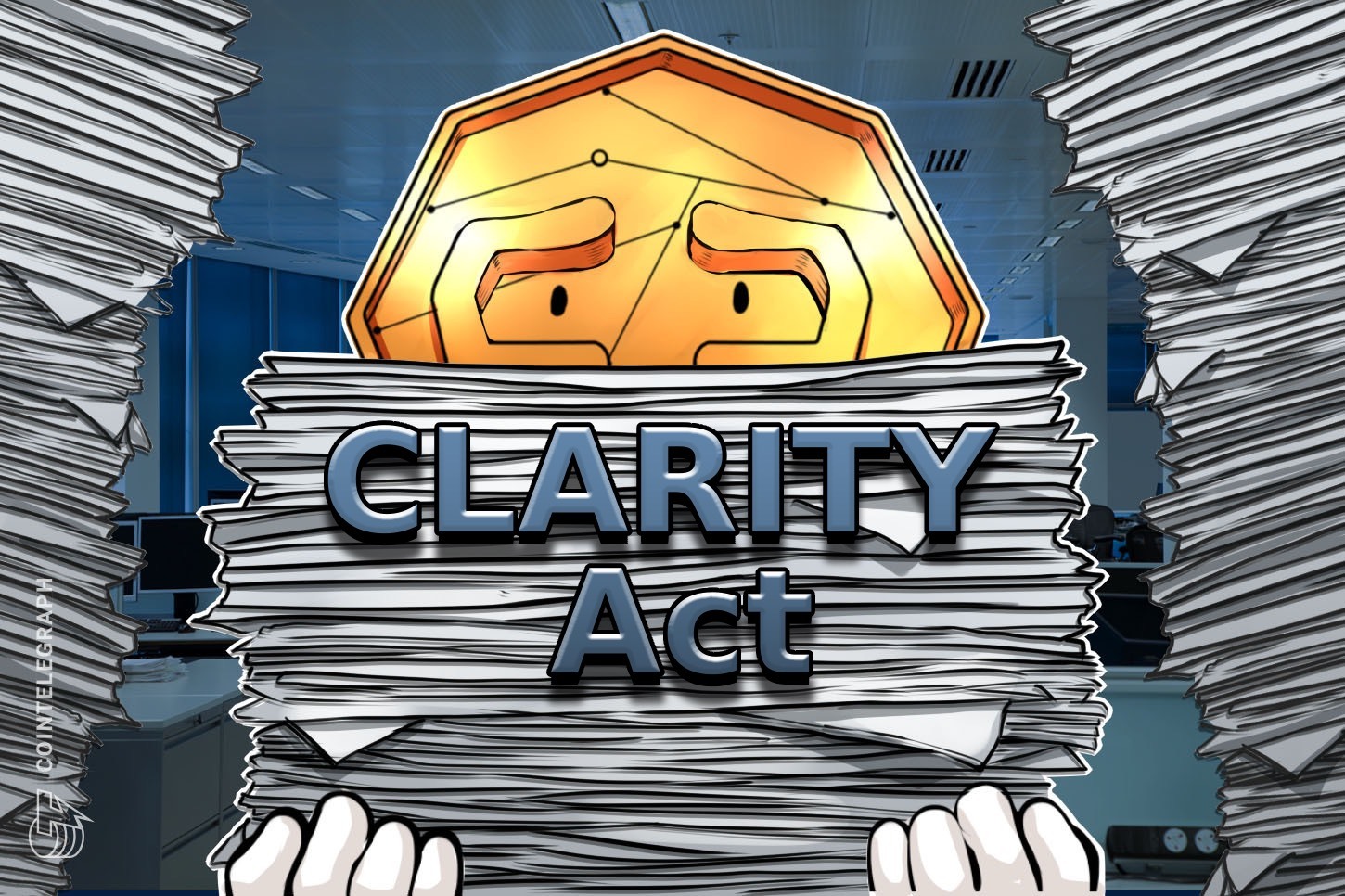
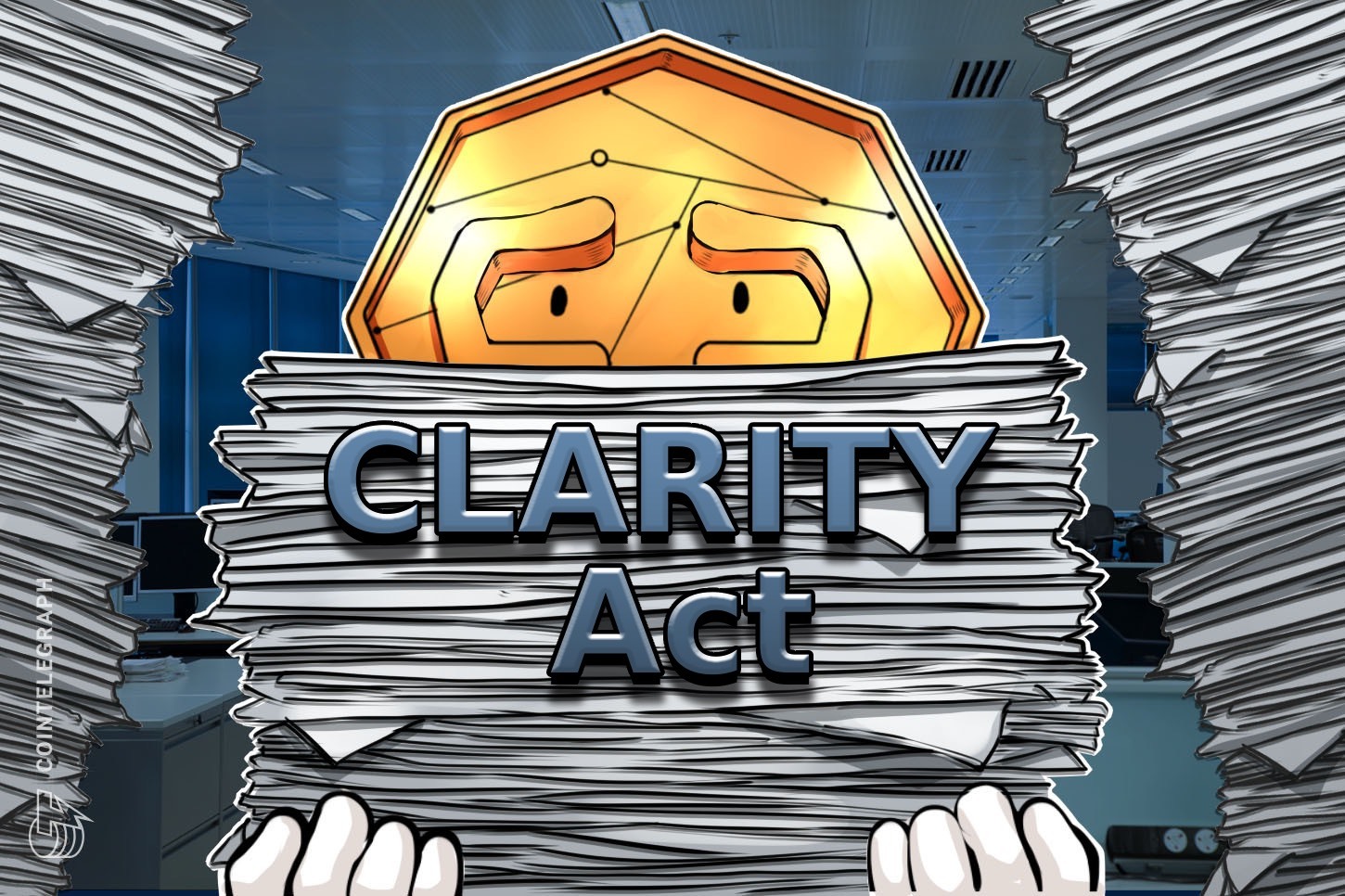
Organizations representing law enforcement officials in the US have reportedly proposed changes to a comprehensive cryptocurrency market structure bill under consideration in the Senate, with only days left until the chamber breaks for a month-long recess.
According to a Tuesday Politico report, the National Association of Assistant US Attorneys and the National District Attorneys Association sent a letter to the White House asking for changes on provisions regarding developers in the Digital Asset Market Clarity (CLARITY) Act. The changes proposed to the Blockchain Regulatory Certainty Act (BRCA) within the CLARITY Act included that guidelines on developers not “create, expand, or modify criminal liability under Federal law.”
In response to reports on the proposed changes, White House crypto adviser Patrick Witt said that the provisions were “not even close” to the Trump administration’s position, and implied that it was not the result of “productive negotiations.” Senator Catherine Cortez Masto has reportedly been pushing the White House to address the BRCA before any potential vote.
The provisions came as the CLARITY Act faces pushback from many Democrats over ethics rules in the bill regarding US President Donald Trump’s crypto investments, which netted him $1.4 billion in 2025. As of Wednesday, Senate Majority Leader John Thune had not scheduled a vote on the legislation before the chamber breaks for state work periods.
Related: Wyden urges Senate leaders to keep dev protections in crypto bill
The US Senate is scheduled to start state work periods from Aug. 7 to Sept. 14, giving lawmakers a limited window to pass crypto market structure before the recess and potential complications from the 2026 midterm elections in November. Thune told reporters last week that the Senate was unlikely to vote on the bill before the August recess.
”Even if CLARITY were brought up today, the procedural steps — cloture → amendment process → second cloture → up to 30 hours of debate — make finishing before recess extremely difficult without [unanimous consent] agreement to waive process, which is rare on contested bills,” said Anne Kelley, a partner at consulting firm Mercury Strategies, in a Monday X post.
CLARITY could shift crypto authority to US commodities regulator
One of the key points of the crypto market structure bill would be to change the regulatory purview over digital asset largely from the US Securities and Exchange Commission (SEC) to the Commodity Futures Trading Commission (CFTC), which currently has fewer tools and resources to address enforcement and oversight issues. Both agencies are also currently understaffed at the leadership level, with only one CFTC chair and three SEC commissioners.
Magazine: Here’s why the CLARITY Act’s ethics deal may be so hard to reach


Cointelegraph is committed to providing independent, high-quality journalism across the crypto, blockchain, AI, and fintech industries.
All news, reviews, and analyses are produced with full journalistic independence and integrity. For more details on our standards and processes, please read our Editorial Policy.
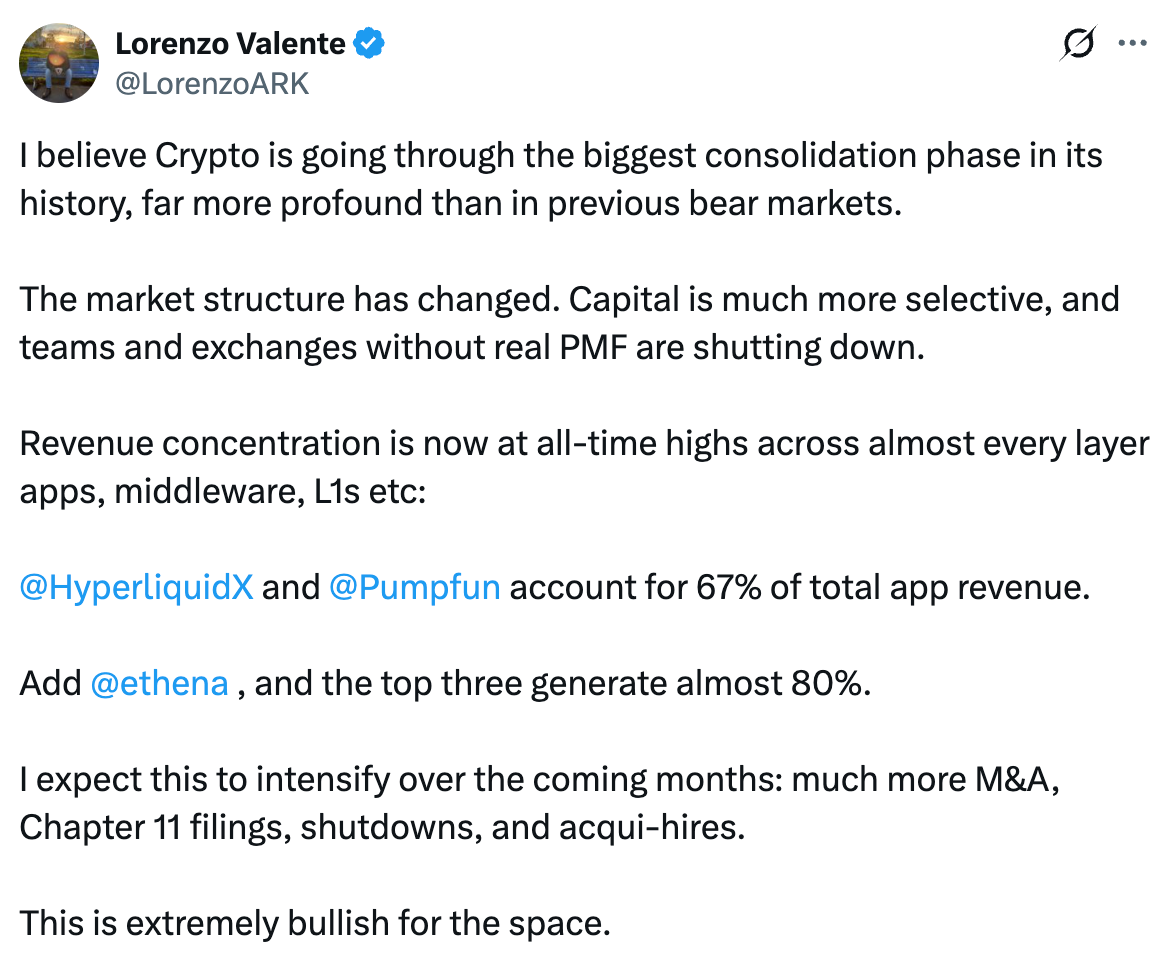
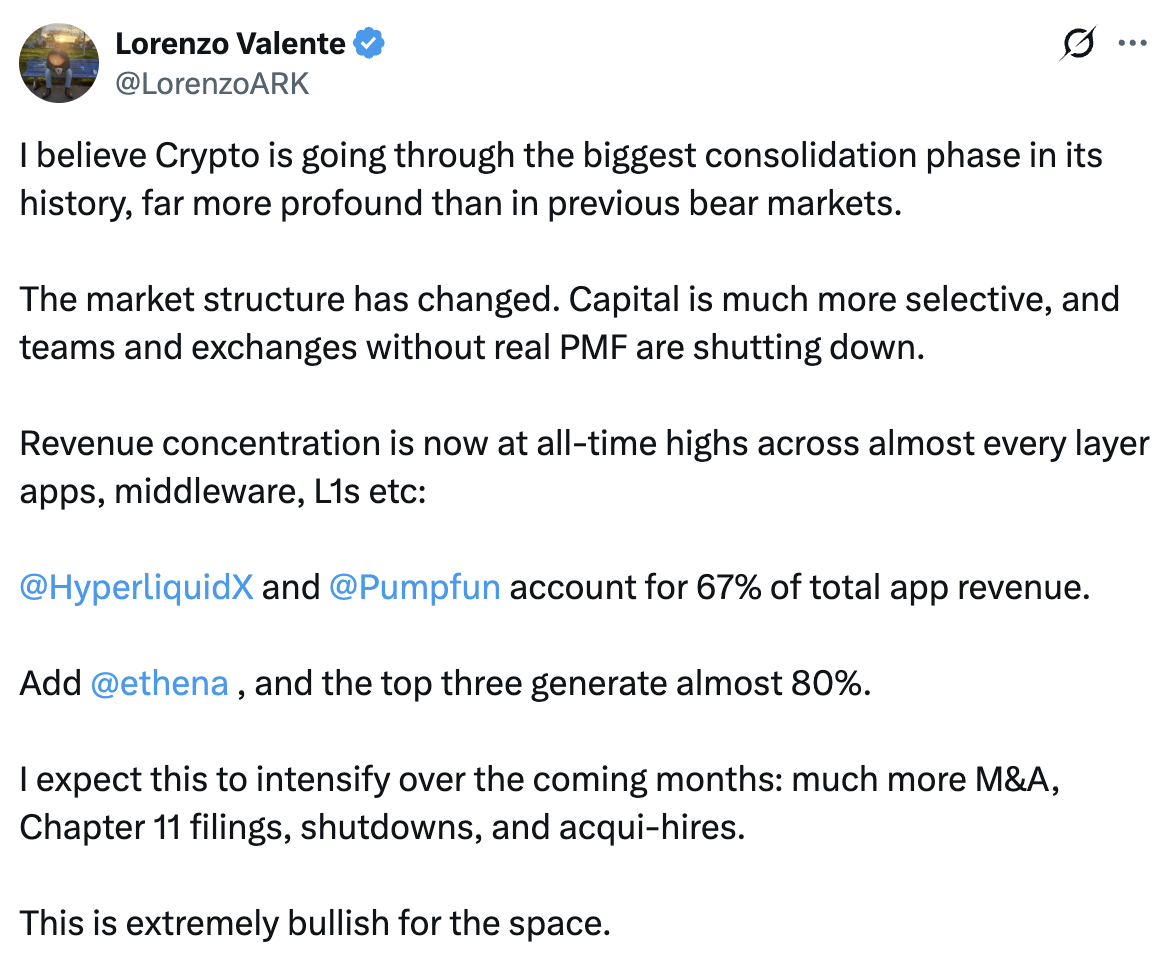
An ARK Invest analyst says the cryptocurrency industry is entering what he describes as its biggest consolidation phase yet, with revenue increasingly concentrated among a handful of dominant protocols.
In a Wednesday post on X, Lorenzo Valente, a research associate at ARK Invest, said investors have become increasingly selective, making it harder for crypto projects and exchanges without strong product-market fit to attract capital. As weaker projects struggle or shut down, revenue is becoming concentrated among a small number of dominant protocols, he said.
As evidence, Valente said perpetual futures exchange Hyperliquid and memecoin launchpad Pump.fun account for roughly 67% of total crypto application revenue. Including synthetic dollar protocol Ethena raises the top three’s combined share to nearly 80%, highlighting what he described as record-high revenue concentration across the sector.
Source: Lorenzo Valente
Valente added that he expects the trend to accelerate in the coming months, leading to more mergers and acquisitions, Chapter 11 bankruptcies, project shutdowns and acqui-hires. Despite the shakeout, he described the consolidation as “extremely bullish” for the crypto industry.
Related: ARK pushes back against a16z’s ‘TradFi wants blockchain, not DeFi’ claim
Exchange closures add to consolidation narrative
The comments come as several crypto exchanges have announced plans to wind down operations in recent days, underscoring mounting pressures across parts of the industry.
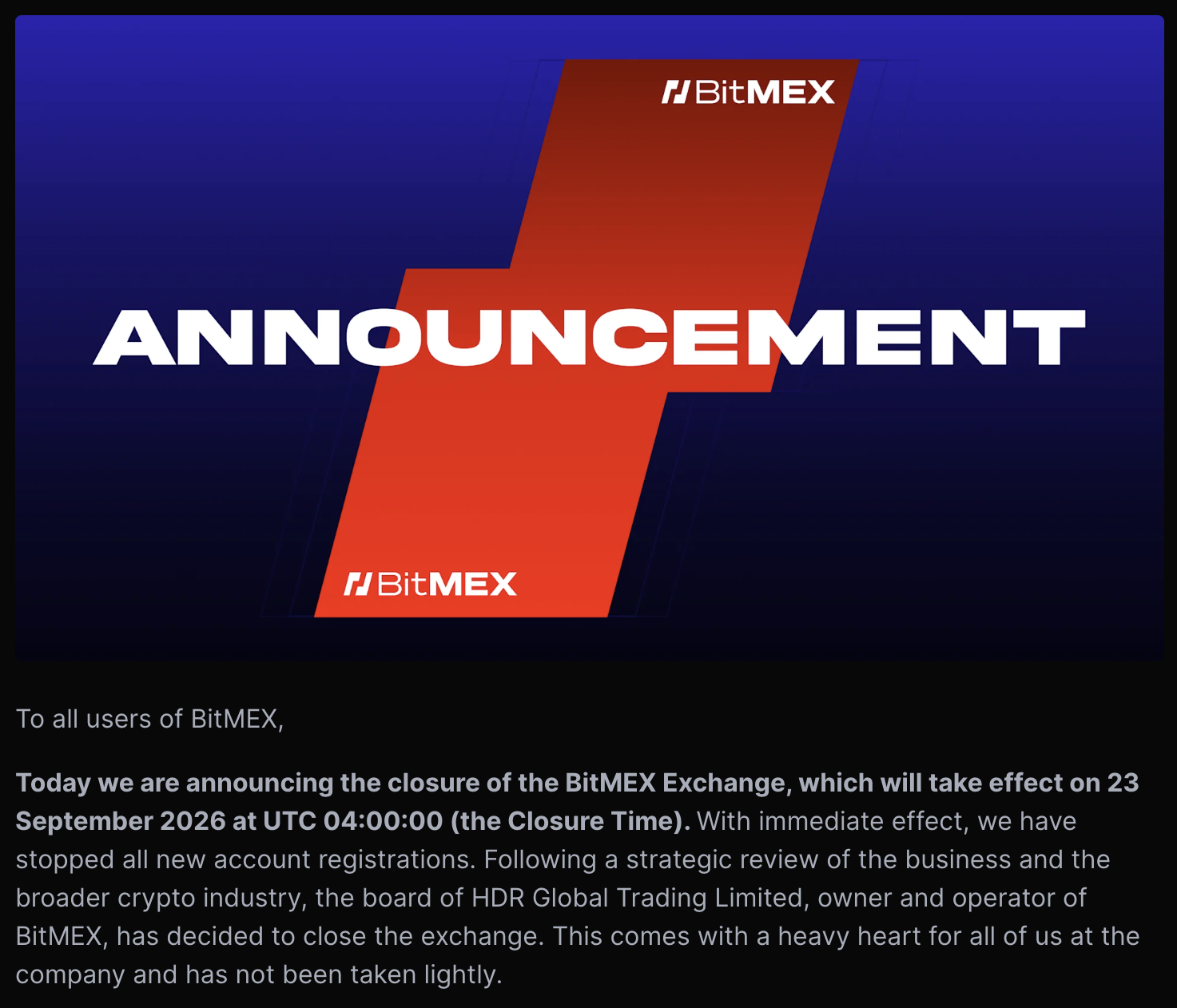
Last week, BitMEX announced it would shut down its exchange in September after a strategic review by owner HDR Global Trading. The exchange had recently accelerated the delisting of trading pairs and derivative contracts, citing insufficient trading interest.
Days later, BitMart announced it would end trading services on Aug. 26 before winding down operations entirely in January 2027. The exchange said the decision followed a review of its operating conditions, market environment and future strategic direction.
Consolidation has also come through acquisitions. Earlier this month, Bybit launched a locally operated exchange in Indonesia after acquiring a majority stake in local digital asset firm NOBI, expanding its presence in one of Asia’s largest crypto markets.
Source: BitMEX
Magazine: The 100x obsession: Fundamentals grow in importance as crypto matures

Everything’s a target: Israel’s war on reproductive health in Gaza

404 | Fox News

OpenAI Will Provide Free AI Models To Select Researchers


-

 Fashion5 days ago
Weekend Open Thread: Brooks Brothers
-
 Sports3 days ago
Commonwealth Games boxing: Jadumani Singh seals dominant 5-0 win over Pakistan’s Sumama Rehman to enter quarter-finals | Commonwealth Games News
-

 Tech3 days ago
Intel is reversing course and bringing hyper-threading back to its server chips
-

 Crypto World7 days ago
Ethics, other provisions in crypto Clarity Act to be further discussed
-

 Politics2 days ago
Luke Littler dismantles Gerwyn Price to retain title in Blackpool
-

 Crypto World4 days ago
Ripple bought a bank in pieces. The $4 billion audit
-
 Entertainment5 days ago
A New Post-Apocalyptic Gundam Anime Series Blasts Into SDCC
-

 News Videos3 days ago
BITCOIN JUST ENTERED THIS CRITICAL ZONE…
-

 Politics2 days ago
The Part of the Electric Transition Nobody Wants to Discuss
-

 Sports6 days ago
2026 3M Open leaderboard: Scottie Scheffler finds putter in Round 1, sits three back
-

 Fashion6 days ago
16 Dresses for the High Summer Event
-

 News Videos6 days ago
The Peugeot Family: How 200 Years of an “Old Money” Dynasty Died in A Boardroom
-

 Business17 hours ago
Major shareholder moves on Canyon
-

 Crypto World4 days ago
XRP Ledger adds $2.6B as RWA inflows rank second
-

 Politics3 days ago
Spain sweeps the board at 2026 World Cup with individual awards
-

 Crypto World6 days ago
Uniswap (UNI) pushes deeper into tokenized RWAs with permissioned trading pools
-
 Entertainment1 day ago
‘Stargate’ Creator’s New Sci-Fi Series Returns for Season 3 Tomorrow
-
Crypto World7 days ago
SEC Agrees to Overhaul Recordkeeping After Settling Coinbase Lawsuit Over Gensler’s Lost Texts
-

 Tech5 days ago
Anthropic launches Claude Opus 5, a cheaper AI model for coding, agents and enterprise workflows
-

 Entertainment4 days ago
Sara Gilson Killed By Husband After Viral “Pedophile” TikTok Video
You must be logged in to post a comment Login