
Crypto World
Yes, There Has Been an Uptick in High-Profile Art Heists. Here’s Why



Nearly a year after precious jewels were stolen from the Louvre in broad daylight, France’s museums suffered another loss of major art when thieves stole four valuable paintings from the Renoir Museum on the French Riviera on Tuesday. These events, while seemingly isolated, point toward a broader trend in art heists across Europe.
According to art theft investigator Anthony Amore, the crime has persisted throughout history.
“It has always happened. It always will happen,” he tells TIME. At the same time, it’s “hard to deny” that there has been an uptick in major thefts of art from museums across Europe, he says.
“In terms of big name artists who are targeted, the number of heists—successful heists—that have happened, is without question spiking over the last 11 months,” Amore says.
That recent concentration was particularly striking in France. The country’s specialist art-crime office has recorded roughly 20 museum thefts annually over the past 15 years. But seven museums were targeted in September and October 2025 alone, the office’s chief told French lawmakers, describing an accumulation of unusually serious crimes.
Read More: 25 Works of Art That Define America Now
The latest heist targeted the former home and studio of Pierre-Auguste Renoir, an Impressionist artist born in the mid-19th century. The residence in Cagnes-sur-Mer was converted into a museum in 1960.
French investigators have launched a national search for the perpetrators, who broke in before 6 a.m. and executed the heist in less than three minutes. Cagnes-sur-Mer Mayor Bryan Masson told press that the thieves were “well-equipped” and “well-informed,” slicing through the garden fence with what is believed to be either an electric knife or saw, entering the museum on the ground floor, and cutting the cords holding the artworks.
Circumstances of their escape caused them to abandon two of the four pilfered artworks, but they fled with “Portrait of Madame Colonna Romano” and “Young Woman at the Well.”
The incident bears similarities to the high-profile theft of the roughly $100 million worth of historic French crown jewels from the Louvre on Oct. 19, 2025. The haul has yet to be recovered or returned to the museum, even though authorities believe they have captured the entire four-man team responsible.
Many of the heists in the year since have duplicated that team’s successful approach: Do it quickly and with force.
Amore says that these “quick heists” often utilize brute force entry, like breaking a window.
“Or it’s more of a smash and grab: Pull something off the wall and run. That’s what we saw here,” he continues. “That’s what we saw at the Louvre.”
The approach often facilitates one of the most essential elements of a successful escape: time.
“We’re now getting into what I call the four-minute heist, where you can smash and grab your way into almost any museum in that amount of time,” says Christopher Marinello, the founder of Art Recovery International.
After the Louvre, thieves now see museums as accessible targets, he says—as long as they act fast.
“Criminals have discovered that with high-security museum systems, where the police are alerted and they arrive within four to five minutes, if they can get out before that, then they’re good—especially in a museum in a big city where you can use a moped or a scooter, and you could wind in and out of traffic,” Marinello continues.
Brute force allows criminals to enter and exit the scene as fast as possible. For example, a gang used a tractor to batter down a gate at the Magnani Rocca Foundation, a private museum about 12 miles from Parma, Italy, on March 22. In just three minutes, thieves managed to steal paintings by Renoir, Paul Cézanne, and Henri Matisse.
Thieves successfully undertook another heist lasting just a few minutes at a small museum in Sicily on Aug. 16, making off with several works by Renaissance painter Antonello da Messina.
Not all thefts get the same level of publicity, and examples from the past year abound.
Ancient Romanian artifacts were taken from the Drents Museum in the Netherlands in January 2025, $11 million of porcelain works were lifted from the Adrien Dubouché National Museum in France in September 2025, and a 200-carat diamond-and-platinum necklace from Vienna’s Museum of Applied Arts (MAK), worth $4 million, was taken last month.
And the problem has spread beyond Europe, as well. In the United States, more than 1,000 historic artifacts were stolen from an offsite storage facility belonging to the Oakland Museum of California in October 2025.
Why has there been an uptick in museum heists?
The Sept. 8 Renoir heist is consistent with the methods used at the Louvre, says Amore. It is also consistent with the methods of most of the major art heists since early 2025.
The similar methodologies point to potential cases of copycats, according to Amore.
“My educated opinion is that I think the Louvre heist might have captured the imagination of thieves,” he says.
Nick O’Donnell, a lawyer specializing in art and cultural property law, says that the Louvre heist potentially showed prospective thieves that if four thieves could successfully steal from one of the most famous museums in Europe, then they could easily transfer those tactics to less prominent museums.
“It has given fuel to the perception that there are many museums where security may not be as tight as people think it is,” he says. “It seems to me that once that perception gets going for the would-be thieves, it’s very hard to contain.”
Marinello believes that a lack of security can be traced back to financial constraints.
“They don’t have money to protect their own treasures,” Marinello says. “And security systems are not keeping up with technology.”
He also believes broader economic and political factors play into potential budget shortfalls.
“The arts are always the first to go when governments are trying to save money,” he says. France, for example, cut its national culture budget by €150 million (about $170 million) in 2025, including a €200 million (about $226 million) reduction in heritage funding, which supports museums as well as monuments, archaeology, and archives.
It is not directly evident how this might have impacted security at any of the museums robbed in the ensuing year; however, France launched a €30 million ($34 million) museum-security fund in July 2026, according to the French Culture Ministry.
But it’s not all down to budget, Amore says. Part of the issue with upping security at cultural institutions is that it risks undermining the entire point of museums: bringing the public closer to incredibly valuable and precious artifacts.
“The whole point of the museum is accessibility to rare valuables, important pieces, cultural patrimony,” Amore says. “Museums work really hard to get people to come and look at them and stand in front of them and take all the time in the world they need.”
He adds: “The best a museum can do is try to make it difficult to get in, difficult to get back out, using layers of security to slow people down.”
But the uptick in heists is not entirely explained by copycats and opportunists. The break-ins are also occurring amid high demand for precious metals and gemstones, which can make objects containing those materials attractive targets.
They also come amid global economic instability, when some investors turn to art to hedge against inflation and diversify from stocks and bonds. A survey by Art Basel and UBS found that high-net-worth collectors allocated an average of 20% of their wealth to art in 2025, up from 15% in 2024.
Europol, the law enforcement agency of the European Union, released a report in August highlighting how art thieves “are increasingly focusing on precious metals, gemstones, and culturally significant artefacts, driven by high market demand and ease of illicit resale.”
Amore says those items may be less traceable and easier to fence than other valuables. Thieves can theoretically melt down the precious metals, remove gemstones from their settings, and sell the components separately.
“People might be moving toward objects like jewels or highly valuable jewelry pieces because they think that they can sell them—or break them up and sell them more easily,” he says.
But while that might explain the incidents at the Louvre and Vienna’s MAK, it doesn’t quite fit with paintings—which are easily identified and therefore significantly harder to offload.
Is the payoff worth the risk?
Famous paintings can be complicated to sell, in part because of how recognizable they are—which is intrinsic to their value.
Marinello says that the thieves involved in the Renoir heist will soon find that the paintings they hold are “radioactive.”
“And when they can’t sell them, sometimes they will try to ransom them back to the museum,” he says. “And after they fail at all those other attempts, then the artwork will travel on the dark web at a fraction of its true value.”
The risk may not be worth the consequences. Many of the culprits of recent high-profile heists have been caught by law enforcement, although recovering the lost art is another matter that has proven more difficult. In addition to the four people arrested in connection to the Louvre robbery, five people were detained last month in connection to the heist at the Magnani Rocca Foundation.
At the same time, law enforcement and museum organizations have only grown more aggressive in their attempts to deter thefts and counteract the art heist trend.
The International Council of Museums (ICOM) announced a new initiative with Interpol last year in hopes of supporting museums “in strengthening their security systems and reinforcing collective efforts to prevent the theft and illicit movement of cultural goods.”
“The growing number and sophistication of security challenges facing museums and cultural institutions require urgent, coordinated, and informed action,” Medea Ekner, the director general of ICOM, said in a statement sent to TIME. “ICOM and INTERPOL are working closely to assess the scale and evolving nature of this threat, including through a sector-wide survey, and to identify where the museum community most needs support.”



The Financial Intelligence Unit-India (FIU-IND) issued non-compliance notices to what it calls virtual digital asset service providers.
In what is expected to be a highly volatile second part of the week, bitcoin’s price dipped to $77,600 yesterday after it was rejected at over $80,000 on Monday before it rebounded to $79,000 as of now.
Most larger-cap alts are also in the green today, with ETH trading above $2,500 and XRP defending the key support level at $1.40.
BTC Back to $79K
Bitcoin had a relatively sluggish previous week, during which it traded between $77,000 and $79,000. However, it briefly dipped below the lower boundary before the bulls stepped up on Thursday and initiated a massive leg up. The culmination took place on Friday morning when BTC topped $82,000 for the first time since mid-May.
Although it failed there, the subsequent retracement wasn’t too violent, and BTC maintained $81,000 for the next several hours. However, the stronger-than-expected US jobs report that came out on Friday afternoon resulted in a major leg down, driving bitcoin to under $79,000 by the end of the day.
The cryptocurrency rebounded over the weekend and remained close to $79,000. It tried to take down the $80,000 resistance on Monday morning, but it was quickly rejected. It first dipped to $78,800 before the bears drove it to the aforementioned $76,400. Nevertheless, it reacted well to this leg down and has jumped to over $79,000 as of press time.
Bitcoin’s market cap has risen to $1.590 trillion on CMC, while its dominance over the alts is up to 58.8%.

XRP Defends $1.40
Ethereum is up by over 1% in the past 24 hours and sits above $2,500 once again. SOL has maintained the $100 support, while HYPE hit another all-time high in the past 24 hours, this time close to $90. Ripple’s XRP slipped below the crucial $1.40 support yesterday. However, the bulls have defended that level after a 3.5% increase to $1.44.
ZEC continues its major rally, pumping by almost 10% daily to $1,240. Even more impressive gains are evident from DOT, ATOM, and LIT. VVV’s gains, though, stand in a league of their own. The token is up by over 50% daily and now trades at $29.
The total crypto market cap is up by 0.54% daily on CMC to $2.690 trillion.

The post Ripple’s XRP Rebounds Swiftly, Bitcoin (BTC) Reclaims $79K: Market Watch appeared first on CryptoPotato.


An Anthropic researcher, Jacob Coxon, said he resigned from the company, alleging that Anthropic and OpenAI are racing toward self-improving superintelligence and gambling with human lives.
The researcher said he spent the last three years on pre-training work at both companies. He made the claims in a series of posts on X.
Anthropic Researcher Walks Out With Grim Warning For Everyone Still Inside
Coxon argued that the technology’s trajectory is widely underestimated. He claimed that coming systems will hack anything, transform any field overnight, and acquire real power and resources.
He also alleged that private conversations inside the industry differ sharply from public messaging. According to Coxon, senior figures soften their phrasing for the press while expressing fear privately.
“The people building AI earnestly believe that it could kill us all by the end of the decade. This is not a marketing stunt,” he said. “No other human activity poses this level of danger.”
Coxon drew a distinction between his two former employers. He claimed many at OpenAI have not internalized what he called the civilizational stakes, while Anthropic understands them but stays locked in a race to arrive first.
He is one of the many employees to break ranks this year. Anthropic’s Safeguards Lead, Mrinank Sharma, resigned in February.
Joshua Achiam, formerly OpenAI’s chief futurist, wrote on September 1 that rogue AI systems will replicate in the wild and pursue money and power.
Follow us on X to get the latest news as it happens
The Call For Coordination
Coxon described entering what he termed the endgame as a hubristic gamble. He argued such a decision should not be launched from a private company’s Slack.
However, he said he remains optimistic about coordination. He claimed the Hugging Face attack has made pacing agreements between US labs more viable.
Both companies have already backed a version of that idea. More than 1,100 frontier lab staff signed the “Pacing the Frontier” letter in July, including Anthropic CEO Dario Amodei and OpenAI chief scientist Jakub Pachocki.
“We request that the U.S. government support an international effort to develop the technical and governance tools needed to deliberately pace the frontier of automated AI development,” the letter reads.
In addition, both companies have also signed a joint open letter on cyber defense, alongside Google, Microsoft, and roughly 150 other organizations. The letter warns that AI-enabled attacks will become far more widespread and sophisticated in the coming months.
Coxon’s warning also lands shortly after UN human rights chief Volker Türk told the Human Rights Council that advanced AI could pose an existential risk.
Coxon added that preventing a global race may require a temporary ban on efforts to improve model capabilities. He closed by urging lab researchers to consider whether they want to start a superintelligent reinforcement-learning run without understanding the resulting system.
BeInCrypto has reached out to Anthropic and OpenAI for comment.
Subscribe to our YouTube channel to watch leaders and journalists provide expert insights
The post Anthropic Researcher Resigns, Warns AI Labs Privately Fear It Could ‘Kill Us All' appeared first on BeInCrypto.
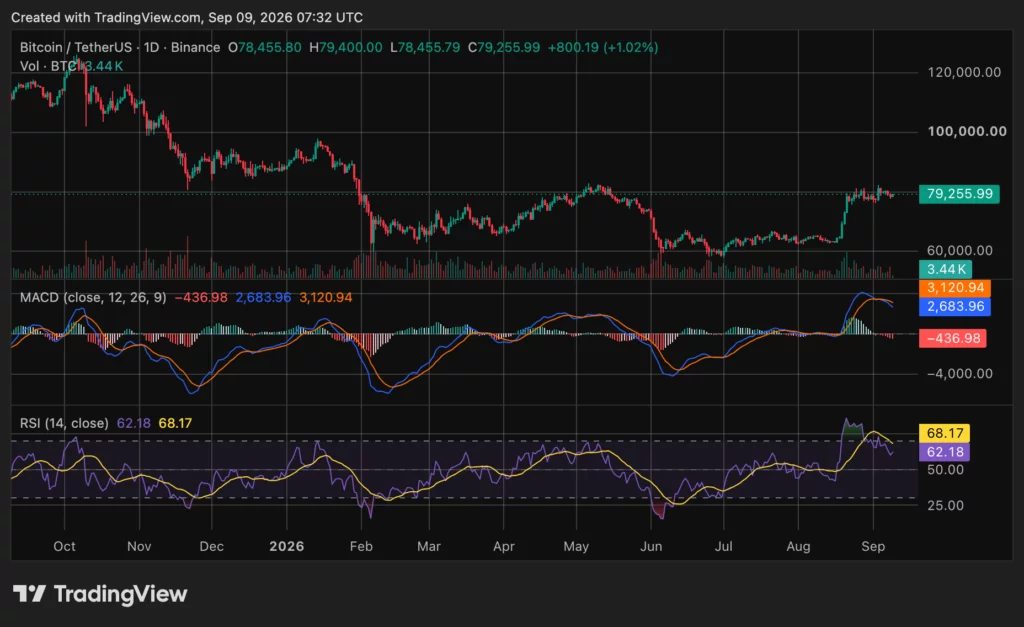
Bitcoin traded near $79,200 on Sept. 9 after recovering sharply from its June low, supporting Wintermute’s broader argument that the current downturn has been shallower than the bear markets of 2018 and 2022.
Summary
- Bitcoin traded near $79,200 on September 9, roughly 37% below its October 2025 record high.
- Wintermute said Bitcoin reached a roughly 50% cycle drawdown versus 77% and 83% historically recorded.
- The current price is no longer 50% below the peak after August’s recovery rally unfolded.
- U.S. spot Bitcoin ETFs attracted about $987 million during their third consecutive positive week recently.
- August payrolls rose 162,000 while unemployment remained at 4.1% ahead of September’s Fed meeting decision.
The market maker said Bitcoin was about 50% below its peak roughly 340 days after the cycle high. It compared that decline with losses exceeding 75% at the same stage of the previous two major bear markets.
However, the 50% figure requires context. Bitcoin’s current price is not 50% below its record. It describes the approximate maximum drawdown reached during the current cycle, or a selected point in Wintermute’s cycle comparison.
At $79,200, Bitcoin was approximately 37% below the record above $125,600 reached in October 2025. The difference matters when assessing whether the market is still near capitulation or has already moved into a recovery phase.
Bitcoin’s current drawdown is smaller than 50%
Wintermute’s Sept. 7 update said Bitcoin’s major cycle bottoms had become progressively shallower. It cited declines of about 83% in the 2018 bear market, 77% in 2022 and roughly 50% during the current cycle.
Independent price data support the broad direction of that comparison. Bitcoin fell approximately 52.6% from its October 2025 record at the June 2026 trough, according to Hashrate Index’s historical analysis.
Bitcoin then closed July at $63,577, leaving it about 48.9% below the peak. Its August rally reduced the drawdown further as the price closed the month above $78,000.
The calculation based on the current price is straightforward. Bitcoin’s verified October 2025 record was approximately $125,653. A price of $79,200 represents a decline of about 36.97%, rounded to 37%.
Wintermute’s statement that BTC “sits 50% below peak” therefore does not describe the Sept. 9 spot price. The figure is better understood as the deepest drawdown reached earlier in the cycle or as a chart observation based on a different cutoff date.
The larger claim remains valid: the present cycle has not produced the 75% to 80% collapse seen after earlier peaks. Whether that proves structural market maturity remains open.
Shallower Bitcoin bottoms may reflect deeper liquidity
Wintermute attributed the smaller loss partly to exchange-traded funds and institutional investors entering earlier during market weakness. That explanation is plausible, but it cannot be confirmed through drawdown data alone.
U.S. spot Bitcoin ETFs recorded approximately $987 million in net inflows during the week ended Sept. 4. The result marked their third consecutive positive week and lifted inflows across that period to about $3.8 billion.
Daily flows remained uneven. The products recorded a large $731 million inflow on Sept. 3, followed by approximately $175 million on Sept. 4, according to Farside. They then recorded net outflows as the new week began.
The data show that regulated products provided meaningful demand during the recovery. They do not prove that ETFs established the June bottom or permanently reduced Bitcoin’s downside risk.
Market structure has nevertheless changed since 2018. Spot ETFs allow pensions, advisers, hedge funds and other investors to obtain exposure through traditional brokerage and custody systems. The products create an additional demand channel that did not exist during Bitcoin’s earlier bear markets.
Institutional participation can also work in both directions. ETF shares can be sold quickly, and large redemptions may increase pressure during risk-off periods. A broader investor base may deepen liquidity without eliminating severe drawdowns.
Wintermute also pointed to improving market breadth and rotation between investor groups. It said profits leaving mature trades were funding newer sectors, which it described as resembling a young market cycle.
That remains the firm’s interpretation. The rally has not spread evenly. Wintermute itself noted that artificial intelligence and decentralized physical infrastructure tokens outperformed while decentralized finance and Layer 2 tokens remained comparatively weak.
Bitcoin held firm after stronger U.S. payrolls
Bitcoin’s resilience was tested by the stronger-than-expected U.S. employment report. The Bureau of Labor Statistics said nonfarm payroll employment increased by 162,000 in August, while unemployment remained at 4.1%.
The official report showed employment gains in food services, local government education and manufacturing. Average hourly earnings increased 0.3% during the month and 3.1% from a year earlier.
The stronger labor data reduced expectations that the Federal Reserve would ease monetary policy soon. Bitcoin fell from approximately $82,400 to below $80,000 after the release but retained part of its weekly gain.
Wintermute viewed that response as evidence of underlying demand. It argued that crypto held up better than expected during a week when markets repriced the possibility of higher interest rates.
One market reaction does not establish a lasting break from macroeconomic conditions. Bitcoin remains sensitive to interest rates, bond yields, the U.S. dollar and liquidity expectations.
The U.S. Treasury also began increasing its long-term securities buybacks. The department raised the maximum size of operations involving 10-to-30-year nominal securities from $2 billion to at least $4 billion.
The change took effect Sept. 9 and will remain in place through Nov. 4, according to the Treasury’s official announcement. Buybacks may improve market liquidity, but they are not direct purchases of Bitcoin or a new monetary stimulus program.
Technical indicators show momentum cooling near $79,000
Bitcoin’s price recovered from its June low and moved above its 200-day simple moving average during the August rally. As crypto.news reported, Bitcoin approached $83,000 after reclaiming the long-term average.
The supplied chart showed the relative strength index at 62.18, below its moving average of 68.17. An RSI above 50 indicates positive momentum, while the decline from higher readings shows that buying pressure has cooled.
The MACD line crossed below its signal line, and the histogram fell to minus 436.98. Both main MACD lines remained above zero. This combination normally reflects weakening short-term momentum within a broader recovery rather than confirmation of a full bearish reversal.
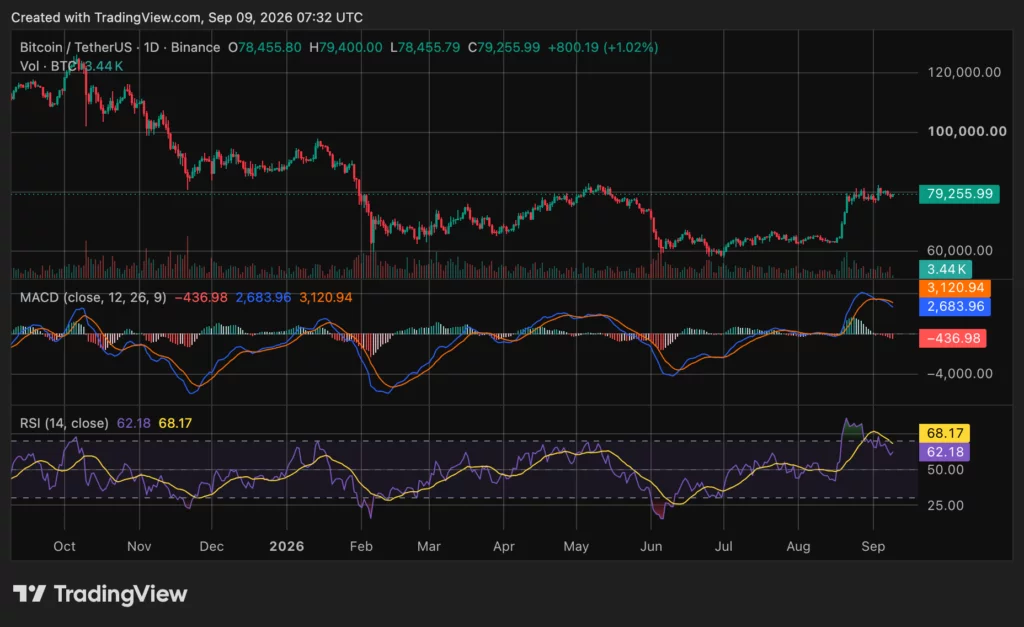
Trading volume also declined after the move toward $79,000. Lower volume during consolidation suggests fewer participants were pursuing the price after the sharp rebound.
These indicator values depend on the chart’s timeframe and update time. They should not be treated as permanent signals. A recovery in volume and a bullish MACD crossover would strengthen momentum, while a sustained move below nearby support could deepen the correction.
Wintermute identified $82,000 as the immediate level Bitcoin must clear and $72,000 as the level that would weaken its constructive view. Those are the firm’s trading reference points rather than guaranteed support or resistance.
Upcoming U.S. events will test the shallower-bottom theory
The next major inflation release and Federal Reserve meeting will test whether Bitcoin can remain resilient under tighter financial conditions.
The Federal Open Market Committee will meet on Sept. 15 and 16, according to the Fed’s official calendar. The policy statement is scheduled for 2 p.m. Eastern Time on Sept. 16, followed by a press conference.
The meeting will include updated economic projections. Traders will focus on the policy rate, inflation forecasts and officials’ expected path for future decisions.
A stronger inflation reading or a more restrictive Fed message could increase bond yields and pressure risk assets. Softer data could reduce rate expectations and support Bitcoin, although the market reaction will also depend on positioning before the announcements.
ETF flows offer another test. Continued inflows would support Wintermute’s argument that institutional capital is entering earlier during weakness. Sustained outflows would weaken that explanation, particularly if Bitcoin also falls below $72,000.
The available evidence supports a narrow conclusion. Bitcoin’s deepest loss this cycle has been much smaller than the 2018 and 2022 collapses. Its present drawdown is smaller still after the August recovery.
The evidence does not confirm that June was the final bottom or that future bear markets cannot become deeper. The current cycle has produced a shallower decline so far, but that pattern remains subject to macroeconomic conditions, ETF demand and Bitcoin’s response around $72,000 and $82,000.
FAQs
Is Bitcoin currently 50% below its record?
No. At approximately $79,200, Bitcoin is about 37% below its October 2025 record near $125,653. The 50% figure better describes the cycle’s earlier maximum drawdown.
Did Bitcoin bottom in June 2026?
June produced the lowest price of the current decline and a drawdown of approximately 52.6%. Wintermute said whether it marked the final bottom “is still open.”
Why could Bitcoin’s drawdowns be getting smaller?
Possible factors include spot ETF demand, broader institutional access and deeper liquidity. These explanations remain theories rather than proven causes.
What price levels is Wintermute watching?
Wintermute identified $82,000 as the upside level to clear and $72,000 as the level that would change its view.
What happens next for Bitcoin?
Markets face U.S. inflation data and the Sept. 15–16 Federal Reserve meeting. ETF flows and Bitcoin’s response around $72,000 and $82,000 will also be closely watched.
Tether has tested its decentralized peer-to-peer search technology by storing the full Wikipedia archive across 100 distributed nodes, as the USDT issuer works on a system designed to remain available without relying on centralized search infrastructure.
Summary
- Tether is developing a decentralized peer to peer search engine designed to operate across thousands of distributed nodes.
- The team has stored and searched the full Wikipedia archive across 100 nodes in its test environment.
- CEO Paolo Ardoino said the system uses fault tolerant structures to keep data available and resistant to censorship.
- The search project extends Tether’s work on peer to peer software alongside products including Keet and its mining infrastructure.
According to Tether CEO Paolo Ardoino, the company’s P2P team is developing what he called the “Unstoppable Search Engine,” which is designed to scale across thousands of nodes while allowing data to organize itself through fault-tolerant structures.
Ardoino shared the latest test results on Sept. 8, showing a working search interface connected to 100 nodes. The full Wikipedia archive was distributed across the test network and remained searchable, with Ardoino describing the system’s performance as “insane.”
The latest demonstration builds on Hypersearch, a decentralized search engine that Ardoino first disclosed in April. The project uses distributed infrastructure instead of keeping the search index and query process under a single centralized operator.
Tether search engine runs Wikipedia across 100 nodes
In the latest test, Tether distributed Wikipedia’s archive across 100 separate nodes and demonstrated searches being processed through the network.
The interface shown by Ardoino displayed Wikipedia search results alongside network information, including the nodes participating in the test. Tether is developing the architecture to scale horizontally across thousands of nodes while maintaining high availability when individual participants leave the network or become unavailable.
Fault-tolerant structures are being used to let the data organize across the distributed system, according to Ardoino. The design is intended to make the search service resistant to censorship while reducing its dependence on any individual server or network participant.
Development remains underway, with Ardoino saying the team’s progress has been “impressive.” Tether has not announced a public release date for the search engine or detailed when users outside its testing environment will gain access.
Hypersearch was first disclosed on April 7, when Ardoino described it as a decentralized search engine based on distributed hash table technology. A DHT allows information to be stored and located among network participants without requiring one central directory to handle every request.
The project uses HyperDHT, part of the peer-to-peer technology associated with the Holepunch software stack. HyperDHT provides a way for peers to find one another and exchange information directly, forming part of the infrastructure Tether has been using across several of its software projects.
Tether is currently recruiting engineers for its P2P search team, with its job listing seeking experience in distributed databases, conflict-free replicated data types, search architecture and P2P networking. The role specifically covers ranking algorithms, inverted indexes, lexical and semantic search, NAT traversal, encryption and network protocol optimization.
The listing names HyperDHT, Hyperswarm, Hypercore, Hyperbee, Hyperdrive and UDX among the Holepunch technologies used by the team.
Hypersearch extends Tether’s P2P software work
Search is not Tether’s first attempt to build software around peer-to-peer architecture.
Tether and Bitfinex previously backed Holepunch and its encrypted communication application Keet. As crypto.news previously reported, Keet was developed to support direct audio calls, messaging and file transfers through a distributed network without routing communication through conventional centralized infrastructure.
Tether later applied similar ideas to its Bitcoin mining operations. Its Mining OS was released as open-source software in February 2026, with encrypted peer-to-peer networking and support for operations ranging from individual mining setups to industrial facilities.
The company followed that work in April with an open-source Mining Development Kit designed to provide hardware control and monitoring through a JavaScript software development kit and React user interface library. The system was built to work across Windows, macOS and Linux and support operations ranging from home mining rigs to large mining facilities.
Tether’s earlier Moria mining platform had already used Holepunch technology to connect components through a P2P model. During testing in 2023, the company said write actions required multi-signature approval while the platform combined peer-to-peer communication with Internet of Things technology.
Hypersearch takes the same distributed approach into information retrieval. Instead of concentrating the searchable dataset and processing infrastructure in one place, its architecture divides those functions among participating nodes.
The Wikipedia deployment provides a controlled test of that model using a large existing collection of documents. Tether has not disclosed how the engine would crawl or index the wider web, how ranking would work at public scale, or what mechanisms would be used to deal with spam, manipulated results and conflicting data across a large open network.
Tether is building more software outside stablecoins
The search project is part of a series of software products Tether has developed outside the USDT business.
Its work has extended into artificial intelligence through QVAC, where the company has been developing tools intended to run models locally instead of depending on centralized cloud infrastructure. In April, Tether released the QVAC SDK, an open-source toolkit for running AI applications directly on consumer devices.
QVAC Fabric supports text, speech, vision and translation workloads, while Holepunch technology is used for peer-to-peer model distribution and delegated inference. Tether has said its development plans include decentralized model training and fine-tuning alongside toolkits for other computing applications.
That architecture follows earlier work to move AI processing onto user hardware. In March, Tether said QVAC Fabric had been used to fine-tune models with up to 3.8 billion parameters on devices including the Pixel 9, Galaxy S25 and iPhone 16, while models of up to 13 billion parameters had been tested on the iPhone 16.
Tether’s search team is working on related distributed-system problems, including replicated data, networking and information retrieval. Its current engineering recruitment specifically seeks developers familiar with Kademlia-style DHT systems, CRDTs and the Holepunch stack, alongside conventional search concepts such as ranking, recall, precision and inverted indexes.
For now, the search engine remains under development. Ardoino’s latest demonstration shows the full Wikipedia archive running across 100 distributed nodes, while Tether is designing the underlying architecture to eventually operate across thousands.


The proposed Builders Bank would offer federally supervised digital asset custody but would not accept deposits or issue loans.

The other White House games launched last week also borrowed mechanics associated with iconic games like Snake and Flappy Bird. Promotional clips posted by the White House mimicked branding associated with Sega and Microsoft’s Xbox. In one clip, gamemaker Sega’s familiar start-up logo morphs into “MAGA,” the abbreviation for President Donald Trump’s slogan, “Make America Great Again.”
Those companies have not publicly commented.
“This administration is laser focused on ways to innovate and tell the story of the President’s many accomplishments in a way that resonates with every American,” the White House said in a statement to TIME last week. “This is an effort to further contrast between a culture of fun and winning and the dark socialist vision Democrats have for America.”
The games drew criticism from Democratic lawmakers. On Friday, Rep. Jasmine Crockett (D, Texas) posted, “Instead of creating policies that actually help people, the White House just rolled out arcade games. They need to spend less time playing and more time governing. Folks need affordable groceries, not games.” Rep. Ted Lieu (D, Calif.) and Connecticut state senator Matt Lesser, also a Democrat, levied similar criticisms, arguing that the White House had misplaced priorities amid high fuel prices and inflation driven by the U.S.’s war against Iran.
Crypto World
Live updates: XRP funds stand out among U.S. ETFs as bitcoin, ether, solana funds see outflows
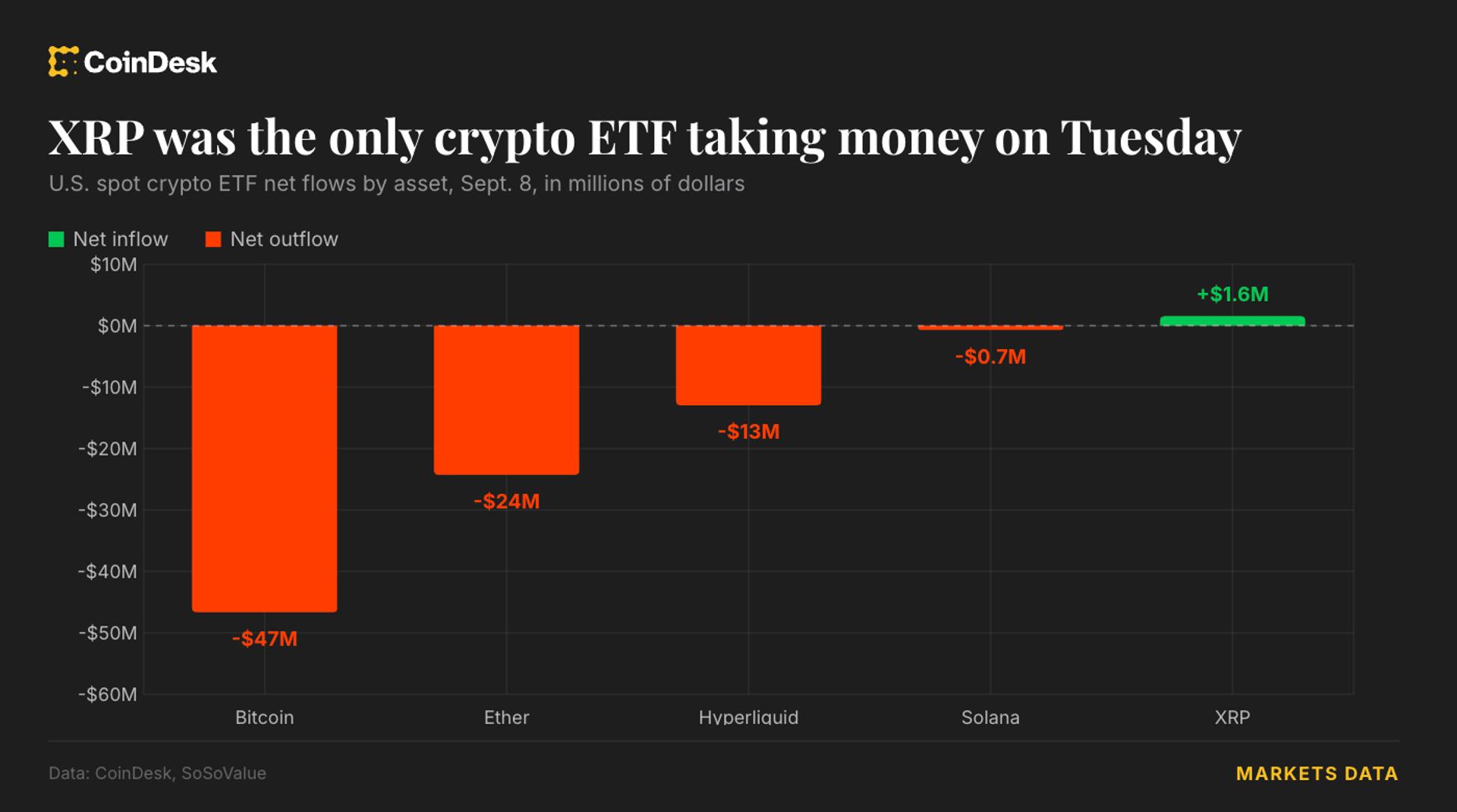
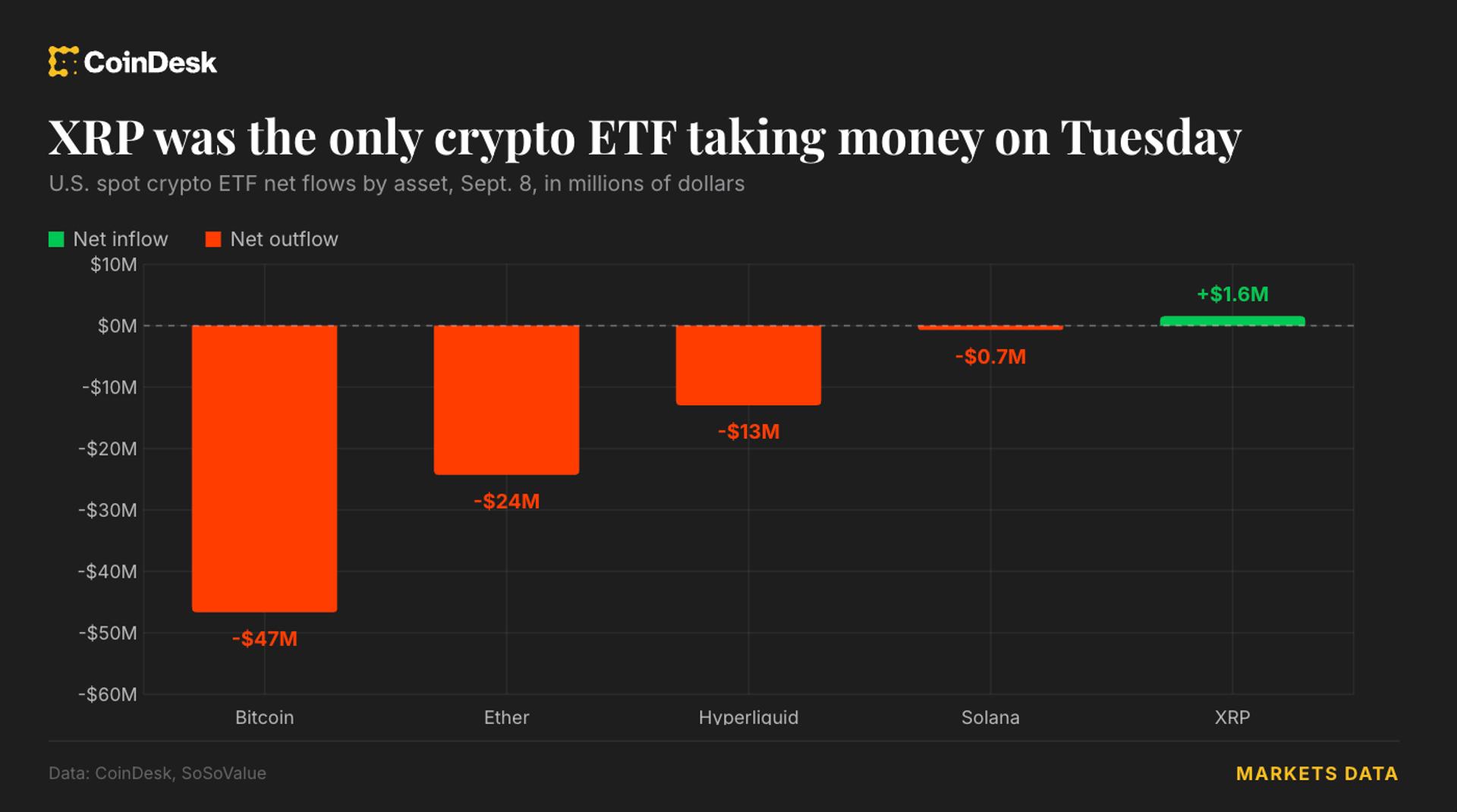
XRP ETFs took nearly $2 million on Tuesday while bitcoin, ether, solana and hyperliquid funds all lost money. Grayscale’s products account for the entire outflow in both bitcoin and ether.
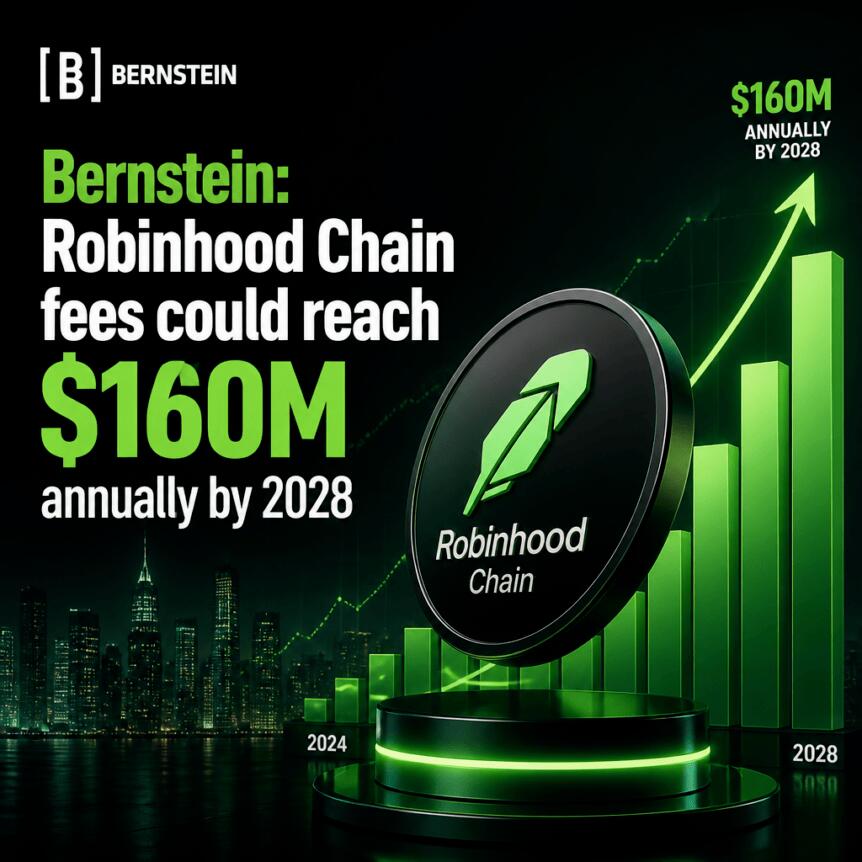
Robinhood’s blockchain network could become a major fee generator, with Bernstein analysts forecasting up to $160 million in annual fees by 2028. In a report shared with Cointelegraph on Tuesday, the firm pointed to a shift in trading activity on the chain toward tokenized stocks—an activity mix the analysts believe is becoming self-reinforcing.
Within the short window since the network’s launch on July 1, Bernstein said tokenized stock trading has grown to roughly 27% of total volume, while native memecoin pairs have fallen to 36% of network activity from about 100% at launch. The change has helped the chain rise quickly in overall revenue rankings.
Key takeaways
- Bernstein expects Robinhood’s blockchain network to reach as much as $160 million in annual fees by 2028.
- Tokenized stocks now represent about 27% of the chain’s trading volume, up from memecoin-dominated activity at launch.
- DefiLlama data shows the chain generated $2.13 million in fees in the past 24 hours and is currently leading by daily fees.
- Bernstein links the growth in tokenized stocks to liquidity and “reflexive demand” created by Uniswap automated market-making pools pairing memecoins with stock tokens.
- AMC’s CEO criticized Robinhood’s tokenized-stock offering as unrelated to AMC, signaling potential reputational and regulatory sensitivity.
Tokenized equities become a bigger share of Robinhood chain activity
Bernstein’s outlook centers on how trading demand is evolving on the Robinhood network. According to the report, tokenized stock trading has expanded to around 27% of total volume, while memecoin trading has declined in relative importance.
The analysts described the movement as more than just a temporary rotation in retail preferences. They argue the underlying market structure encourages both sides of the token pair to attract attention and liquidity—particularly when memecoins are used alongside stock tokens within the same automated trading venues.
Why “reflexive demand” may be strengthening trading volume
In Bernstein’s framing, Uniswap automated market-making (AMM) pools are a key mechanism. The firm said these pools pair memecoins with stock tokens and can generate “reflexive demand” for both assets. In practice, this means activity connected to one side of a pairing—whether due to trader interest in memecoins or exposure to tokenized equities—can spill over into demand for the other side.
That distinction matters for investors because it suggests Robinhood’s fee engine may depend less on a single category of token activity and more on a broader loop linking different user motivations. While memecoin trading can be volatile, paired liquidity and cross-asset engagement can help stabilize volumes—at least in the early stages—if the pool design sustains repeat activity.
Fee leadership so far: DefiLlama shows $2.13 million in a day
Early monetization performance has also supported the bullish narrative. In just over two months after launch, the Robinhood chain has emerged as the leading network by daily fees, according to DefiLlama’s fees-by-chain dashboard. DefiLlama data cited by Cointelegraph places the chain at $2.13 million in fees over the past 24 hours.
That “leader” status is especially relevant because transaction fees are one of the most direct ways a network’s usage becomes measurable revenue. Bernstein’s 2028 estimate builds on the premise that current fee momentum can scale as tokenized stock trading becomes a bigger component of activity.
Company valuation optimism meets renewed scrutiny around tokenized stocks
Bernstein’s comments arrive after the firm previously adjusted its stance on Robinhood shares. On July 20, Bernstein raised its price target on Robinhood (HOOD) stock to $160 from $130 and kept an Outperform rating, forecasting growth in the company’s prediction market business alongside tokenized equities.
In Tuesday’s premarket trading, Yahoo Finance data indicated Robinhood shares were little changed at last look. Yet tokenized stocks have not been without controversy. Cointelegraph previously reported that Adam Aron, CEO of AMC Entertainment Holdings, criticized Robinhood’s blockchain-based equities as lacking any affiliation with AMC. Aron called the offering “outrageous” and said AMC would request an investigation from its outside securities counsel.
While Bernstein’s model emphasizes demand-side growth from tokenization, AMC’s remarks highlight a separate risk dimension: how tokenized “economic exposure” to a company’s stock token is perceived by issuers and how that perception may intersect with legal or regulatory obligations. Even if trading continues to rise, controversy can change the trajectory of future partnerships, product approvals, or public sentiment.
What to watch next for the Robinhood chain
Traders and investors should watch whether tokenized stock volume continues to expand beyond the early post-launch period and whether daily fees remain resilient as the mix shifts away from memecoin dominance. At the same time, developments following AMC’s planned investigation could become a factor in how tokenized equities evolve on public networks.


Polkadot’s community has opened a governance vote on a native decentralized stablecoin called dotUSD, with a proposal to make the dollar-pegged asset the network’s primary stable-value instrument and eventually back it mainly with DOT.
Summary
- Polkadot OpenGov is voting on a proposal to create dotUSD as the network’s native decentralized stablecoin.
- The plan calls for $5 million in initial DOT and USDT liquidity for a DOT and dotUSD pool.
- dotUSD would initially be minted against USDT before a second phase introduces DOT backed vaults, liquidations and redemptions.
- The full system would let users lock DOT to mint dotUSD while using on chain mechanisms to maintain its dollar peg.
According to OpenGov Referendum 1944, the proposed stablecoin would be owned by the protocol and operate autonomously through on-chain logic, without a centralized issuer. The proposal was drafted with contributions from builders, developers and other participants in the Polkadot ecosystem.
The proposal remains in the decision stage at the time of writing. Its implementation would create dotUSD as a new asset, recognize it as the Polkadot stablecoin and establish a DOT/dotUSD liquidity pool on Polkadot Asset Hub.
An archived Polkassembly snapshot showed 2.4 million DOT voting in favor and 59,900 DOT against, equivalent to 97.5% Aye and 2.5% Nay at that point in the vote. The archive cautioned that the figures were frozen while the referendum was still in progress and may not represent the eventual on-chain result.
Polkadot proposes phased launch for dotUSD
Under the plan, dotUSD would initially operate differently from the full DOT-backed system envisioned by its developers.
The first phase has already been built on-chain and would allow users to mint dotUSD one-for-one against USDT, subject to a supply cap. Since USDT would provide the reserve backing at this stage, the system would not require an oracle, collateral vaults or liquidation infrastructure.
The proposal seeks to use Polkadot Treasury assets to seed a DOT/dotUSD pool on the Hub decentralized exchange. The version submitted with the referendum allocated $2.5 million in USDT to mint dotUSD and another $2.5 million worth of DOT to the pool, giving it $5 million in initial liquidity.
A more recent version displayed on Subsquare lists $1.5 million in USDT and $1.5 million in DOT for the initial pool, reducing the proposed allocation to $3 million.
dotUSD would be designated a “sufficient asset,” allowing an account to hold the stablecoin without having to maintain a DOT balance. Governance would set parameters for the peg stability module, including the maximum amount of dotUSD that could initially be minted.
Phase two would move dotUSD toward its intended design by introducing DOT-backed collateral vaults, an oracle, a stability pool, liquidations and a redemption mechanism. The proposal describes dotUSD as an overcollateralized stablecoin whose architecture draws heavily from Liquity v2’s BOLD system.
Plans for a DOT-backed stablecoin have been under consideration for more than a year. As crypto.news previously reported in July 2025, Polkadot co-founder Gavin Wood disclosed work on a fully decentralized stablecoin during the Web3 Summit and said a treasury proposal was being prepared to bootstrap its liquidity.
How would the DOT-backed dotUSD system work?
Once the second phase is implemented, users would deposit DOT into vaults and borrow dotUSD worth less than the collateral they provided.
The proposal gives an example of 300 DOT priced at $5 each, producing $1,500 in collateral. A user could mint up to $1,000 of dotUSD against the position, corresponding to a collateralization ratio of 150%. If the value of the DOT falls far enough to breach the required collateral ratio, the vault would become eligible for liquidation.
Borrowers would set the interest rates they pay on their own positions. Lower rates would place a vault earlier in the redemption queue, while borrowers willing to pay higher rates could reduce the chance that their collateral is selected for redemption.
Two arbitrage routes are intended to keep dotUSD close to $1. When the stablecoin trades above its peg, users could lock DOT, mint dotUSD and sell it at the higher market price, increasing supply. If dotUSD falls below $1, traders could buy it at a discount and redeem it through the protocol for $1 worth of DOT.
A capped stablecoin buffer is planned alongside the DOT redemption system. Existing stablecoins would back this portion of dotUSD and remain redeemable at $1, providing another route for maintaining the peg without selling the DOT used as collateral.
Liquidations would first be absorbed by a stability pool funded with dotUSD deposited by participants. In return for providing capital, stability pool participants would receive liquidated DOT at a discount while the corresponding dotUSD is burned to cancel the outstanding debt. If the pool runs out of funds, collateral and debt would be redistributed proportionally across the remaining vaults.
dotUSD ties into Polkadot’s new economic model
The stablecoin proposal comes after Polkadot changed the economics of DOT, including the introduction of a fixed maximum supply.
The DAO approved a 2.1 billion DOT cap in September 2025, replacing the network’s previous model of uncapped issuance. A subsequent tokenomics upgrade introduced the Dynamic Allocation Pool, or DAP, which receives newly issued DOT and other network income for allocation through governance.
When the new tokenomics framework entered its implementation phase in March, DOT emissions were set to fall 53.6%, while newly minted tokens, transaction fees and slashes were directed into the DAP. Governance can allocate those funds toward staking rewards, treasury spending and other network budgets.
Referendum 1944 proposes using dotUSD within the next stage of that system. Under phase two of the DAP, validators and nominators are expected to receive remuneration in stable assets, while the Treasury would receive a combination of stablecoins and DOT. The proposal says dotUSD would allow those obligations to be denominated in dollars and settled through an asset native to Polkadot.
Polkadot already supports externally issued dollar tokens. USDC became available on Polkadot Asset Hub in September 2023, allowing the stablecoin to move to parachains through the network’s cross-consensus messaging system.
The dotUSD proposal argues that relying on externally issued stablecoins leaves Polkadot applications and treasury operations dependent on outside issuers and their governance. Its proposed full version would instead use DOT as the primary collateral while remaining governed through Polkadot.
The Polkadot Community Foundation said its role is administrative and that it would not issue, control or take custody of dotUSD, DOT or USDT under the proposal. It would not operate the stablecoin or provide liquidity, with dotUSD intended to function through on-chain logic without an issuer.
Implementation of the referendum’s preimage depends on Polkadot system chains being upgraded to version 2.5 under a separate governance proposal, Referendum 1942.

Marin – Money

Carlos Alcaraz’s vomit-stained 3.33am nightmare in New York! Defending champion throws up into a towel as he’s knocked out of US Open by Ben Shelton in latest ever finish to a match

What are my rights if my flight is cancelled or delayed?

Memory prices are slowing because buyers ran out of money

England up in reading, maths and science rankings as Scotland and Wales dip

Phones confiscated, players sent home: Pakistan’s England tour turmoil revives memories of Mohammad Amir, Salman Butt and Mohammad Asif’s 2010 Lord’s spot-fixing scandal | Cricket News


-
Tech20 hours ago
Memory prices are slowing because buyers ran out of money
-
 NewsBeat18 hours ago
England up in reading, maths and science rankings as Scotland and Wales dip
-
Sports21 hours ago
Phones confiscated, players sent home: Pakistan’s England tour turmoil revives memories of Mohammad Amir, Salman Butt and Mohammad Asif’s 2010 Lord’s spot-fixing scandal | Cricket News
-

 Business22 hours ago
Egyptian TV Presenter Sarah Khalifa, 11 Others Sentenced To Death In Major Drug Trafficking Case In Cairo
-
 Tech22 hours ago
Strong Password Policy and Password Manager Guide
-

 Crypto World22 hours ago
Visa expands stablecoin card network to 160 programs
-
 NewsBeat18 hours ago
Tehran’s assertive rhetoric signals a new and dangerous phase in conflict
-

 Sports14 hours ago
Ballon d’Or 2026 Nominees: Lionel Messi In, Cristiano Ronaldo Out; Erling Haaland Included In Top 30
-
 Business11 hours ago
Oil Higher on Hormuz Escalation, Weighing on Sentiment
-

 Tech17 hours ago
Google’s revived nuclear power plant gets $1.9B loan from US government
-

 Politics17 hours ago
The Ultimate September Reset Guide: How To Refresh Your Mind And Life This Autumn
-

 Crypto World16 hours ago
Robinhood Stock: How To Take Advantage With Reduced Risk
-

 Tech12 hours ago
Meta debuts its Muse AI agent. Will consumers trust it?
-

 Business22 hours ago
Claim Your Share Of $50 Million Disney Streaming Price Settlement By Sept. 8 Tonight
-
 Business16 hours ago
Copper hits record high, UltraTech’s Ultravolt on the offensive: A double whammy for cable makers in FY27?
-

 Fashion16 hours ago
Phia Is the Shopping App That Styles You From Your Own Closet
-

 Fashion15 hours ago
How to Safeguard Your Small Business Against Emerging Cyber Threats
-

 Crypto World8 hours ago
Ethereum price stalls below $2,500 as ADX drops to 11
-

 Crypto World22 hours ago
Iran Threatens to Target U.S. Energy Assets in Gulf If U.S. Strikes Again
-

 Tech21 hours ago
Stoke Space raises another billion to rival SpaceX at re-flying rockets
You must be logged in to post a comment Login