

Crypto World
Yield-Bearing Stablecoins Lose $3.5B in Q2

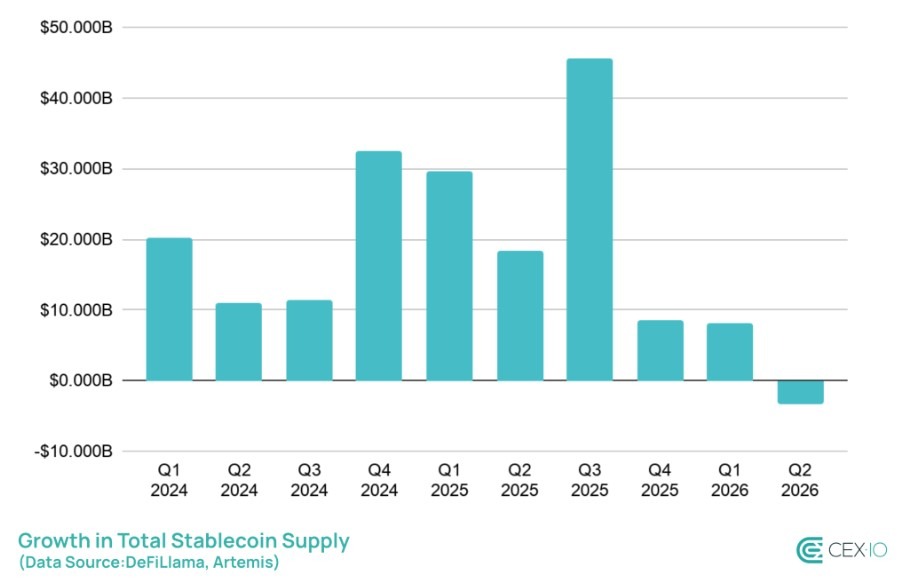
Yield-bearing stablecoin supply fell by more than $3.5 billion in the second quarter of 2026, reversing nearly three years of quarterly growth as crypto-native products contracted and Treasury-backed tokens expanded.
Crypto exchange CEX.IO reported Thursday that the category declined by 15% during Q2. Ethena’s sUSDe lost 52% of its supply, shedding nearly $2 billion, while Sky’s sUSDS declined by 16%.
Treasury-backed products moved in the opposite direction. BlackRock’s BUIDL grew by 2%, Circle’s USYC increased by nearly 16% and Ondo Finance’s USDY rose by over 66%, highlighting a widening divide between crypto-native yield assets and products backed by traditional assets.
The divergence came as the broader stablecoin market recorded its first quarterly contraction since the third quarter of 2023, according to CEX.io. Total supply fell to $312 billion in Q2, while adjusted transaction volume declined by 5.5%.
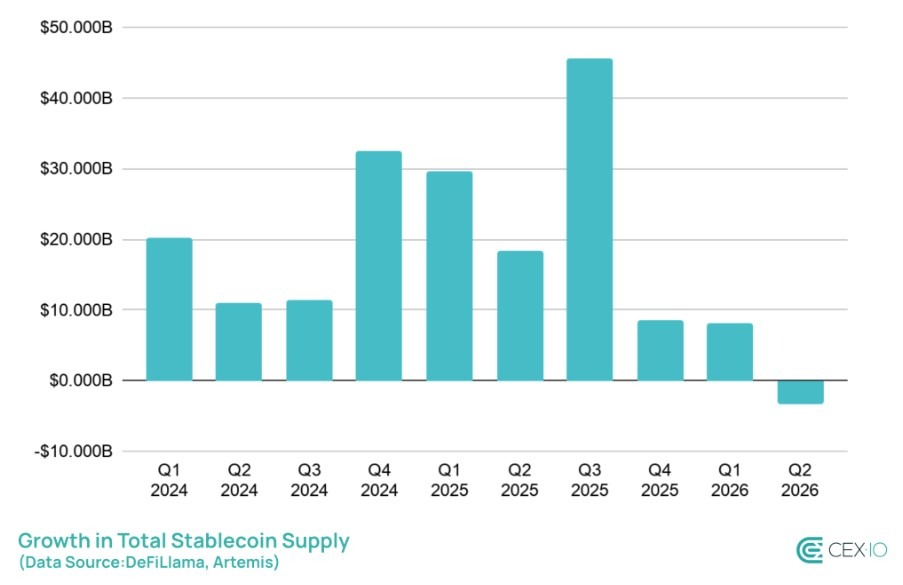
Supply growth per quarter, compiled by CEX.io. Source: CEX.io
Stablecoin slowdown deepens after weaker Q1 signals
The Q2 decline marks a sharp reversal from the start of 2026. In Q1, stablecoin supply increased by about $8 billion to a record $315 billion, with yield-bearing products among the main growth drivers.
However, signs of weakening organic demand had already emerged early in the year. During the first quarter, retail-sized transfers fell by 16%, while automated activity accounted for roughly 76% of stablecoin transaction volume.
The slowdown continued through Q2. According to CEX.io, total stablecoin transaction counts fell by 530 million to 4.48 billion, the largest quarterly decline on record. However, transfers below $250 increased by 5% to $19.39 billion, suggesting that smaller peer-to-peer payments were more resilient than larger automated and trading flows.
Related: Financial companies join forces for US dollar stablecoin, keeping reserve earnings
Contraction comes amid weaker crypto market activity
The stablecoin contraction also adds to broader concerns about weakening activity across crypto markets. On Wednesday, institutional data provider Talos identified declining stablecoin supply alongside spot Bitcoin (BTC) exchange-traded fund (ETF) outflows and slower Bitcoin purchases by Strategy as three key demand channels that weakened in Q2.
Tanay Ved, senior research associate at Talos, told Cointelegraph that a recovery in stablecoin supply would signal “fresh capital coming back into the ecosystem more broadly” and help support onchain liquidity.
Ved said spot ETF flows remain the most important demand channel to watch because they tend to reflect more durable shifts in institutional appetite. However, he added that ETF flows, corporate Bitcoin purchases and stablecoin supply often move together when market momentum changes.
Magazine: Japanese pension fund tips 1% in crypto, G7 urges action on NK hackers: Asia Express

XRP continues to consolidate in a narrow range on both USDT and Bitcoin-paired charts, with the broader trend still favoring the sellers.
However, the latest technical signals suggest downside momentum may be fading as the market defends key support while early signs of bullish divergence begin to emerge.
Ripple Price Analysis: The USDT Pair
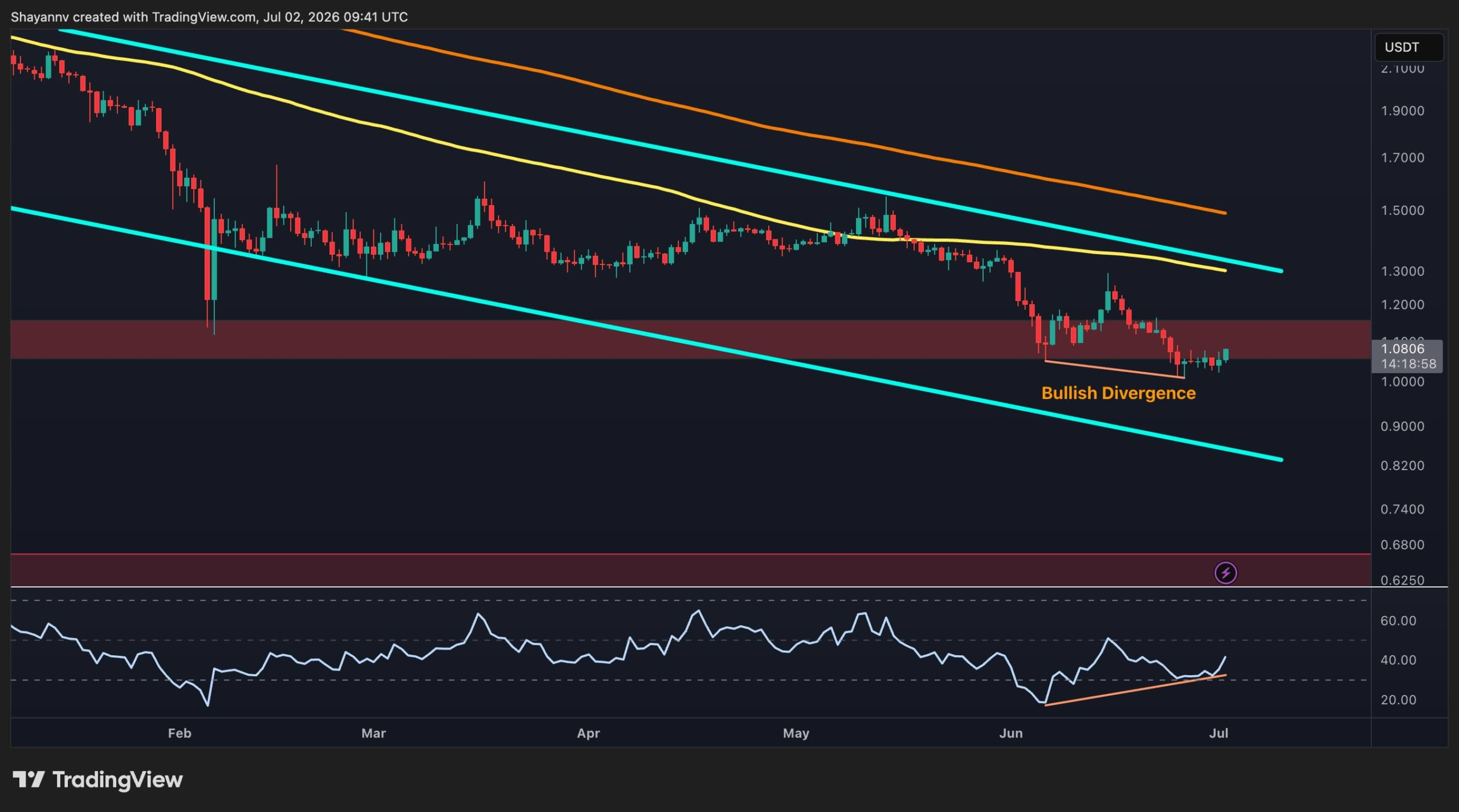
Against USDT, XRP remains confined within a well-defined descending channel, with the price trading below the 100-day and 200-day moving averages. This keeps the higher time frame structure bearish despite the recent stabilization.
The asset is currently holding around the $1.08 support area, which also coincides with a major horizontal demand zone. After the sharp sell-off in June, sellers have so far failed to extend the decline, allowing XRP to build a short-term base above support.
The RSI has formed a clear bullish divergence, printing higher lows while the price registered lower lows. This typically signals weakening bearish momentum and raises the probability of a relief rally if buyers manage to reclaim higher levels.
The first resistance lies around the $1.15 supply zone, while stronger resistance remains near the 100-day moving average around the $1.25 region. A recovery above these levels would improve the broader outlook, whereas losing the $1 support could expose the lower boundary of the channel near $0.80.
The BTC Pair
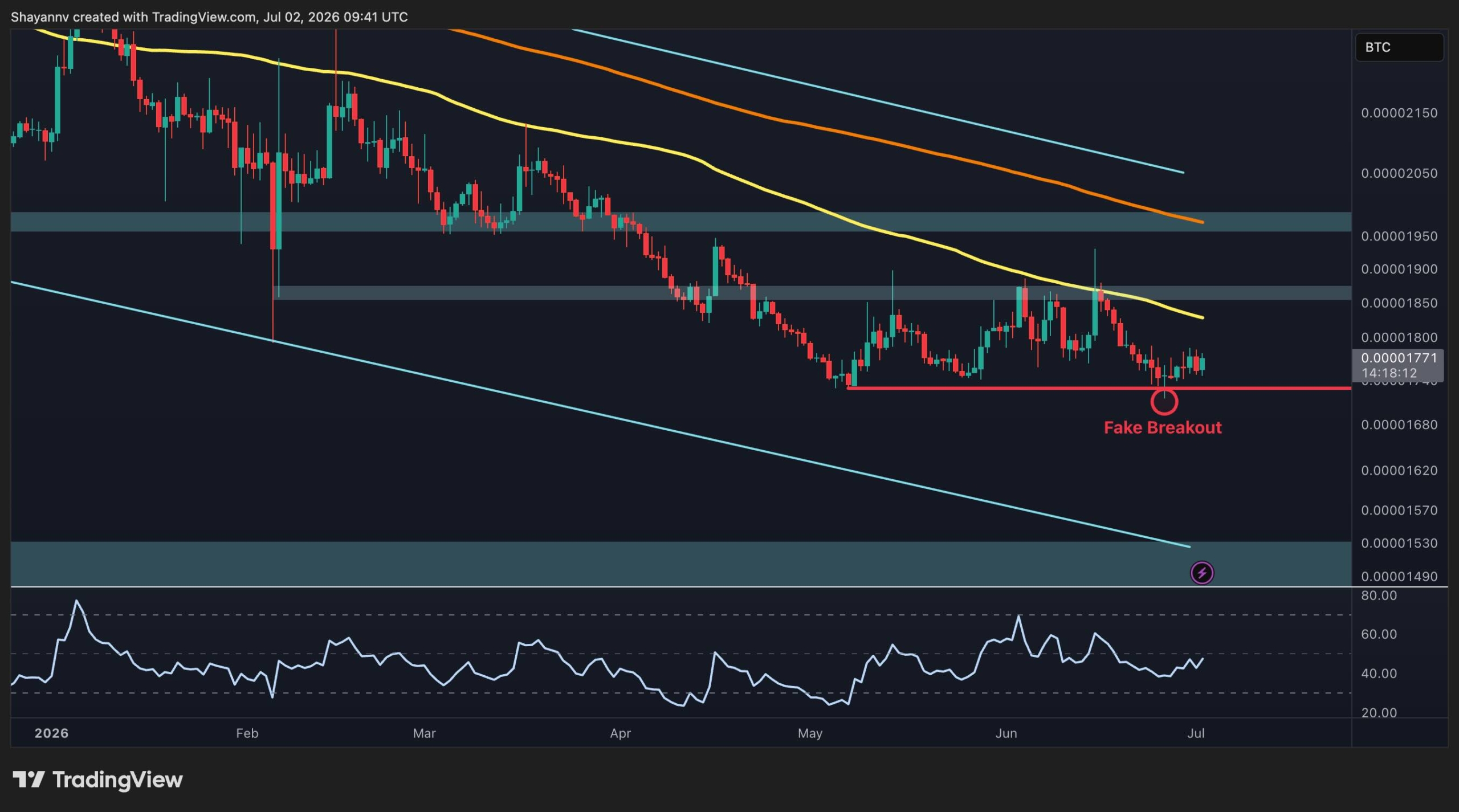
Against Bitcoin, XRP is also trading inside a long-term descending channel, reflecting persistent relative weakness. The pair remains below the major moving averages, indicating that the broader trend has yet to shift in favor of XRP.
Recently, XRP briefly broke below the key 1,700 sats low before quickly reclaiming it, creating what appears to be a fake breakdown. This rejection below support suggests sellers failed to maintain control and may have triggered a liquidity sweep before the price recovered back into the previous range.
Despite the recovery, the pair still faces immediate resistance around 1,850 sats, with a stronger supply zone located near 2,000 sats, where horizontal resistance converges with the declining 200-day moving average. A decisive move above these levels would strengthen the case for a broader recovery toward the upper boundary of the channel.
As long as XRP holds above 1,700 sats, the fake breakout scenario remains valid and could support additional upside. However, a confirmed daily close below this level would invalidate the bullish setup and likely open the door for another leg lower toward the critical 1,500 sats support area.
The post Ripple Price Analysis: Bullish Divergence Emerges as XRP Defends $1 Support Zone appeared first on CryptoPotato.
Crypto World
FBI Director Kash Patel Undisclosed Strategy Investment Raises Conflict-of-Interest Questions

FBI Director Kash Patel purchased between $100,001 and $250,000 worth of Strategy stock on November 21, 2025, and did not disclose the transaction until May 26, 2026. It is a gap of more than six months against the STOCK Act’s 45-day reporting requirement.
Why is it being questioned? The delay would be a routine compliance footnote if Strategy were an ordinary holding, but the company sits at the intersection of federal law enforcement, an active DOJ contracting relationship, and the world’s largest publicly listed Bitcoin treasury.
According to federal financial records reviewed by NOTUS, Patel explained the omission in a letter to the Office of Government Ethics, saying the transaction had been “inadvertently omitted” from an earlier filing. Two days later, Deputy Assistant Attorney General William Taylor attributed the delay to a miscommunication and stated that Patel remains in compliance with federal conflict-of-interest rules and that the stock purchase does not create a conflict with his duties as FBI director.
As of today, it is understood that DOJ ethics officials subsequently approved the corrected paperwork.
Discover: The Best Crypto to Diversify Your Portfolio
Kash Patel Under Scrutiny: A $200 Fine, Unenforced, and the Ethics Watchdog Response
Dylan Hedtler-Gaudette, acting vice president of the Project on Government Oversight, said: “Patel’s filing was clearly submitted after the legal deadline, calling it a violation of the STOCK Act.” The law sets a $200 civil penalty for first-time violations by senior executive branch officials, a figure that has drawn sustained criticism for being too low to deter. Although the Department of Justice has not issued any fine against Patel.
The procedural lapse is not isolated. According to NOTUS, more than 30 members of Congress have also filed late crypto disclosure and stock-trading reports under the STOCK Act over the past year. The nominal penalty structure makes voluntary compliance the primary mechanism, which is precisely why watchdog groups argue the existing framework is structurally inadequate for senior law-enforcement officials.
The pattern of senior government officials navigating financial disclosure rules around crypto-linked assets has added political weight to calls for tighter enforcement.
Discover: The Best Token Presales
Why Strategy Makes This a Crypto Market Issue, Not Just an FBI Compliance Story
Strategy, the company formerly known as MicroStrategy, trading under the ticker MSTR, is a Bitcoin Treasury Company and holds 847,363 BTC, a position currently valued at more than $50 billion. That concentration makes MSTR’s equity performance tightly correlated to Bitcoin price action, meaning Patel’s undisclosed position was, in practical terms, a leveraged directional bet on Bitcoin made by the director of the agency responsible for investigating cryptocurrency-related fraud.

Don’t Miss Out on Our $1,000 USDT Airdrop on ByBit
The conflict-of-interest question extends further. Strategy has secured millions of dollars in Department of Justice contracts over the past decade and continues to hold active federal business relationships. The FBI operates under the DOJ and routinely investigates crypto investment fraud, digital asset scams, and illicit blockchain activity.
Patel has publicly amplified the FBI’s crypto enforcement actions in recent months, including posts about major Bitcoin seizures and actions against fraud networks. Understanding the macro conditions that govern Bitcoin’s price trajectory through central bank liquidity cycles makes it clear why a senior official’s directional bet on MSTR is not a neutral financial decision.
DOJ ethics officials concluded the investment does not present a conflict of interest. Watchdog groups argue the opposite: that holding shares in a company with ongoing government contracts, particularly one whose core asset is under active federal law-enforcement scrutiny. It creates the appearance of a conflict regardless of intent.
Discover: The Best Crypto to Diversify Your Portfolio
The post FBI Director Kash Patel Undisclosed Strategy Investment Raises Conflict-of-Interest Questions appeared first on Cryptonews.


Strategy has become one of the largest corporate holders and buyers of bitcoin, with 847,363 BTC on its balance sheet. Its aggressive accumulation strategy has made the company a major source of demand for the cryptocurrency, meaning any shift toward selling the digital asset, even occasionally, could influence market liquidity, price dynamics and investor sentiment by introducing a new source of supply.
Demand for U.S. spot bitcoin exchange-traded funds (ETFs), the largest source of institutional crypto buying since their 2024 debut, has weakened sharply in recent months. The funds saw a record $4 billion in net outflows in June after a 13-day redemption streak pushed year-to-date flows into negative territory for the first time.
The bank said bitcoin came under pressure in late May and early June after Strategy disclosed in a June 1 regulatory filing that it sold 32 BTC between May 26 and May 31 to fund dividend payments. The sales compounded pressure from a broader repricing of Federal Reserve interest-rate expectations that had already weighed on bitcoin and gold.
JPMorgan noted that Michael Saylor’s Strategy has become one of bitcoin’s largest buyers, purchasing roughly $13.7 billion worth of the cryptocurrency year to date, about 70% of the bank’s estimate for total net digital asset inflows. The company holds around 4% of bitcoin’s total supply.
On 30 June, Prime Minister Keir Starmer unveiled the Defence Investment Plan, which includes a £15 billion increase in defence spending as part of a nearly £300 billion four-year budget. The market reacted quickly: on 1 July, shares of Babcock, BAE Systems and Rolls-Royce gained between 1.1% and 5.2%, providing support for the FTSE 100 during the session. Offsetting this strength, healthcare and energy stocks came under pressure, with AstraZeneca and GSK falling 1.7% and 2.5%, while Shell and BP lost more than 2% as oil prices declined. As a result, the index closed the day 0.2% lower. Over a longer-term horizon, investors remain focused on the Bank of England’s meeting on 30 July. The central bank has kept the base rate at 3.75%, while inflation risks remain elevated amid energy price dynamics and geopolitical tensions in the Middle East.
Technical Outlook
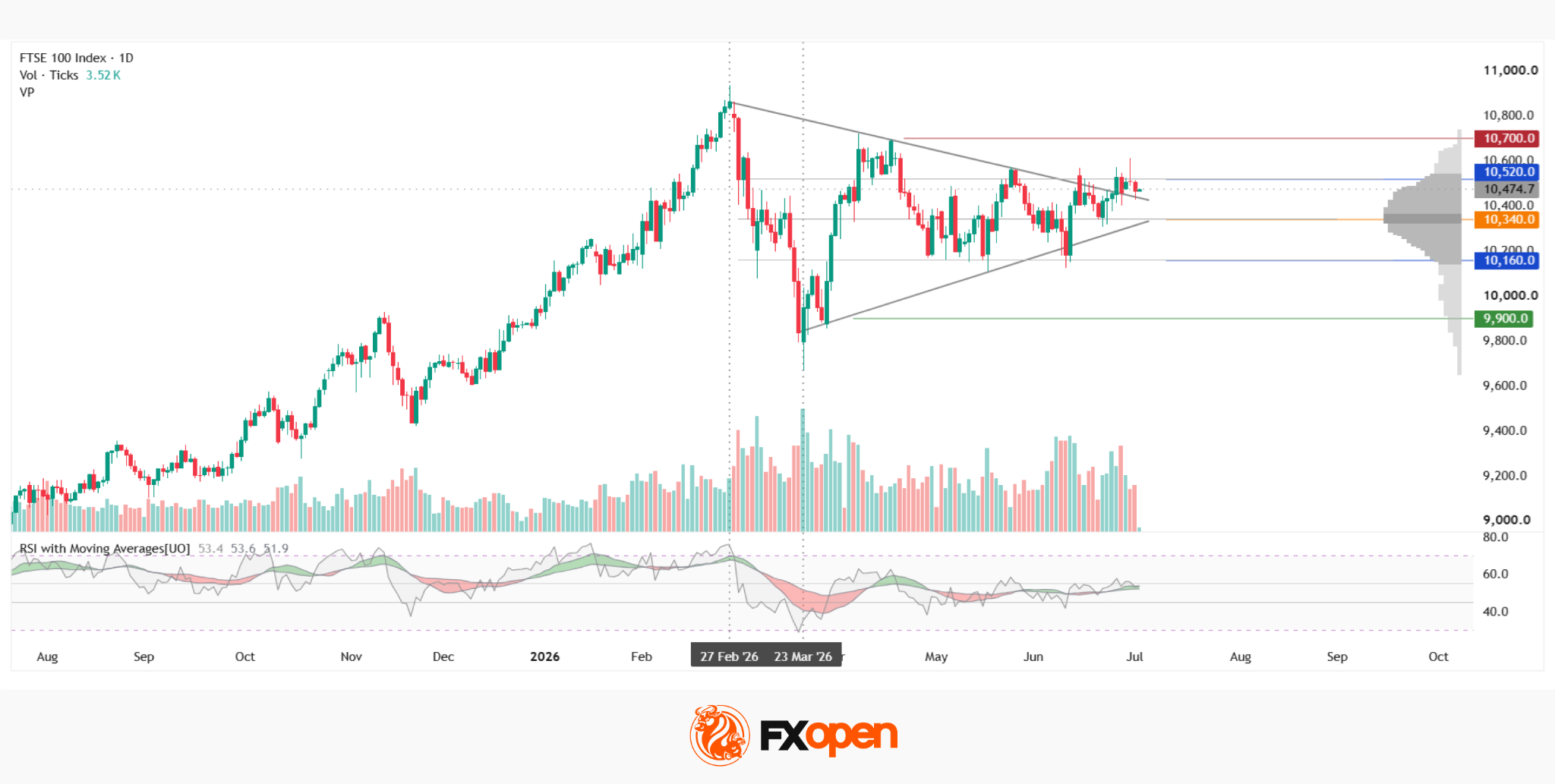
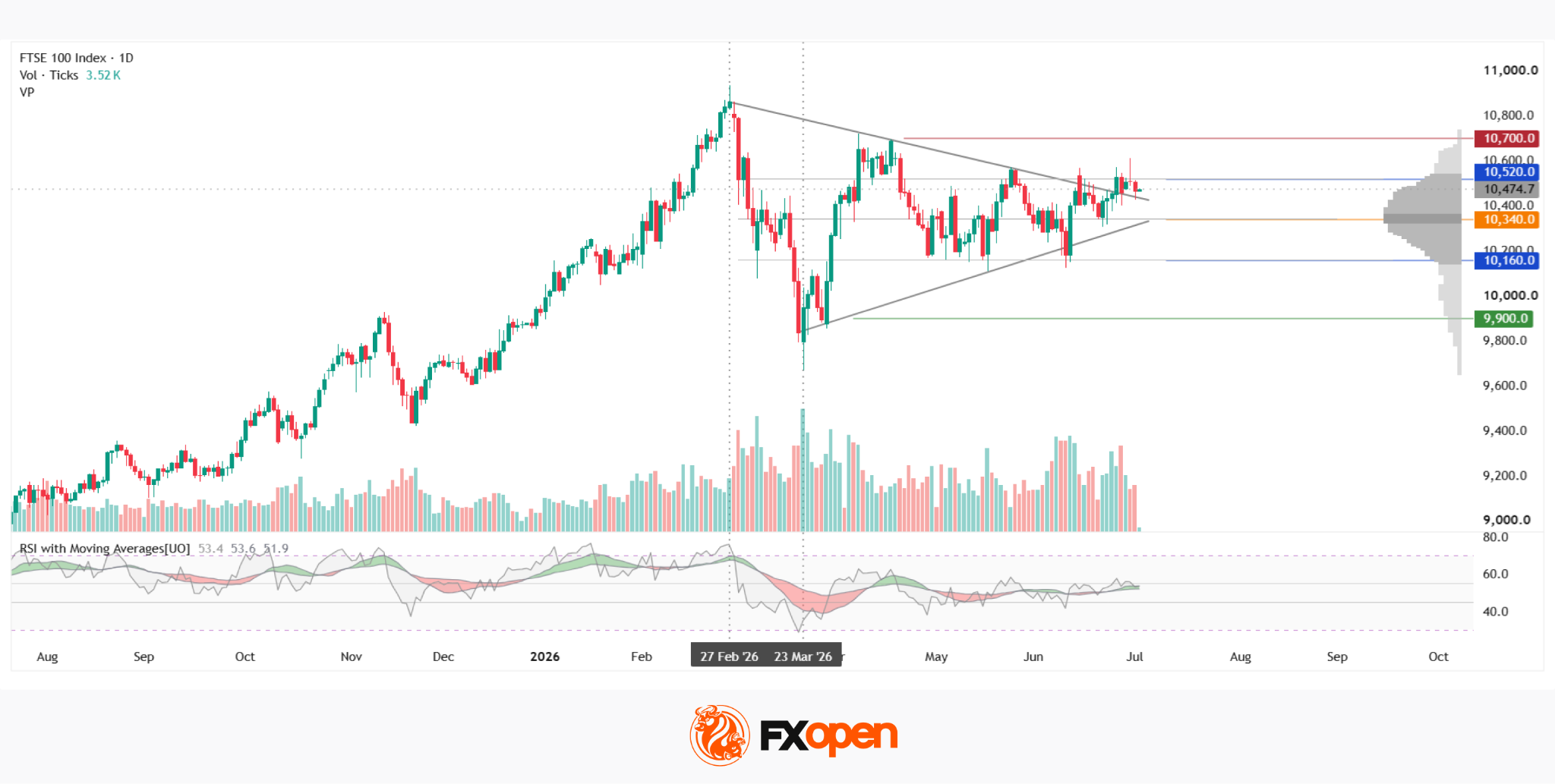
On the daily chart, the FTSE 100 (UK100 on FXOpen) has formed a symmetrical triangle, with price fluctuations narrowing between the February high and the March low. In recent sessions, the index has attempted to break above the pattern, but the move has so far been capped by the upper boundary of the current market profile at 10,520, making it too early to confirm a breakout. The key resistance level is located around 10,700, while major support lies near 9,900.
Should the index decline from current levels, the nearest support could come from the POC zone at 10,340 and the lower boundary of the market profile at 10,160. It is worth noting that trading volume remains firm, suggesting the current range may continue to develop. The RSI + MAs indicator currently reads 53, 53 and 51. All three values remain in neutral territory, confirming the current lack of directional conviction.
Summary
The narrowing price range within the symmetrical triangle points to declining volatility in the index amid a mixed fundamental backdrop. Geopolitical uncertainty surrounding US-Iran negotiations is coinciding with expectations ahead of the Bank of England’s upcoming meeting. The POC zone remains a key reference point within the current market structure.
Trade global index CFDs with zero commission and tight spreads (additional fees may apply). Open your FXOpen account now or learn more about trading index CFDs with FXOpen.
This article represents the opinion of the Companies operating under the FXOpen brand only. It is not to be construed as an offer, solicitation, or recommendation with respect to products and services provided by the Companies operating under the FXOpen brand, nor is it to be considered financial advice.
Most crypto investors still obsess over price charts. But in 2026, a growing share of attention is shifting back to improving the fundamentals of the protocols.
Ethereum, Solana and Avalanche are preparing some of their largest protocol upgrades in years, while Coinbase’s Base network rolled out its Beryl hard fork last Friday in a bid to streamline the network, with a native token standard and shorter withdrawal windows.
Bitcoin development however, remains frozen, with developers still arguing over controversial covenant proposals and post-quantum computing upgrades.
Tim Sun, a senior researcher at Hong Kong-based asset manager HashKey Group, told Cointelegraph that protocol upgrades have historically focused on adding features, speed and throughput.
However, in 2026, he said the emphasis is shifting toward reliability, predictable governance, and institutional-grade infrastructure that can support large-scale financial use cases.
Here are the top five major blockchain upgrades to watch in the second half of 2026.
Ethereum: Glamsterdam
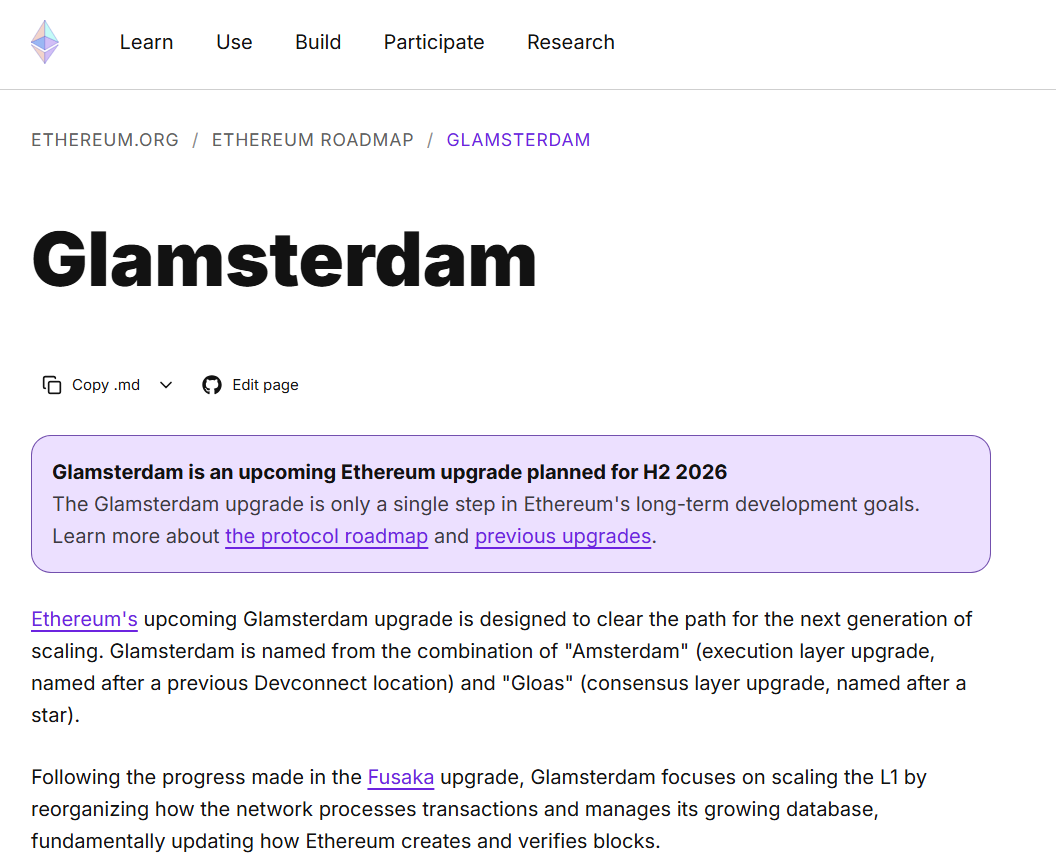
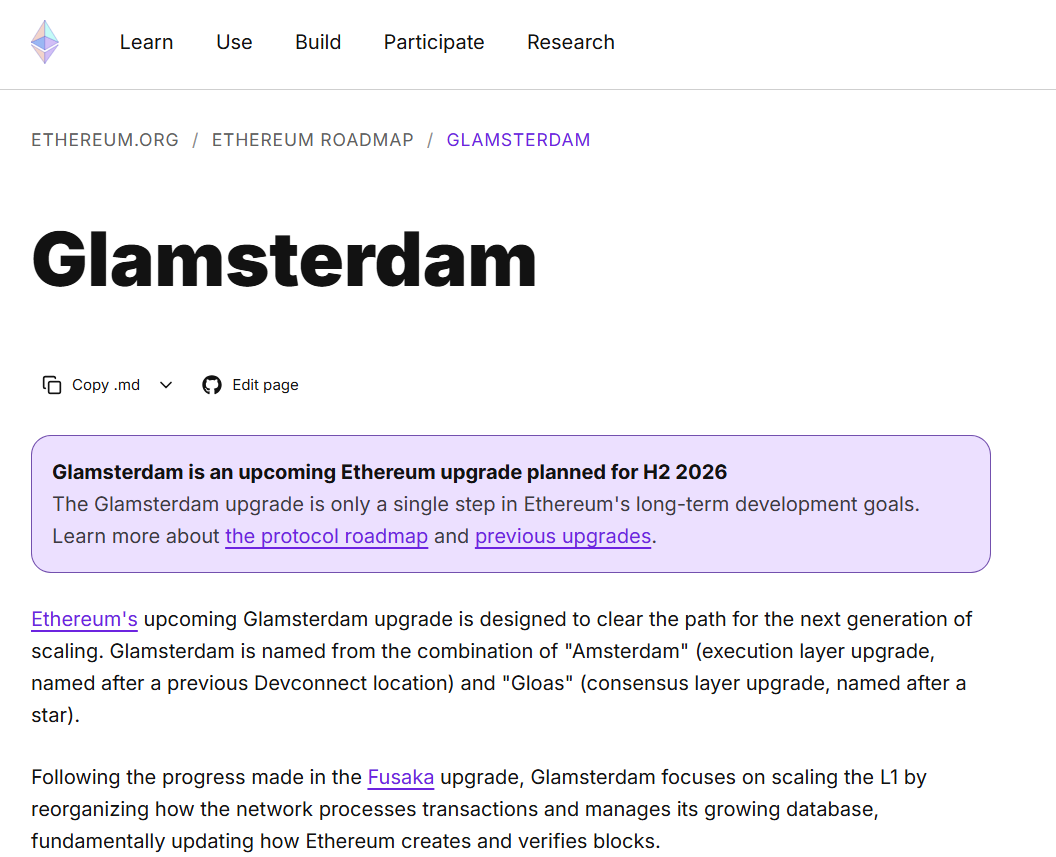
Glamsterdam is arguably the most consequential upgrade this year, and its already being tested on devnets. According to Ethereum’s public roadmap, Glamsterdam is designed to improve scalability, harden the layer-1, and make the network easier to use, with a mainnet launch expected sometime in the second half of 2026.
Sun said the upgrade should improve processing speeds by allowing more transactions to be processed simultaneously, expand capacity so Ethereum can handle more data at higher throughput, and reduce database bloat. Those changes should make the chain better suited for stablecoin settlement and real-world asset use cases, he said.
Related: Ethereum’s much-hated staking ‘tax’ may already be obsolete
Holly Atkinson, chief product and technology officer at 1inch, told Cointelegraph that Glamsterdam is viewed by many as Ethereum’s most significant upgrade since The Merge in September 2022, which transitioned the blockchain from proof-of-work to proof-of-stake.
Glamsterdam. Source: Ethereum.org
She said enshrined proposer-builder separation (ePBS) is a key change because most validators still depend on a small set of specialized builders and relays, which concentrates control over transaction ordering.
That setup amplifies maximal extractable value (MEV), censorship and centralization risks, she said. ePBS is designed to pull block building and proposing back into the protocol and make the process more transparent and accountable.
Pavan Kaur is a Solana Foundation judge and founder of RuleSpark, a compliance engine for digital asset marketing. She told Cointelegraph that ePBS is better understood as one step in Ethereum’s broader roadmap and does not eliminate MEV or fully solve builder centralization. “Practices like sandwich attacks may therefore migrate rather than disappear,” she said.
Solana: Alpenglow
Solana’s biggest change this year is Alpenglow, a consensus upgrade that reworks the network’s core protocol. Alpenglow has been billed by many, including Solana ecosystem lead David Liang, as the chain’s “most significant consensus upgrade yet.”
After being overwhelmingly approved through a governance process in September 2025, Alpenglow remains under development but is expected to ship alongside the Agave 4.1 validator client release later in 2026.
Arun Krishnakumar, vice president of institutional capital at R3 enterprise software firm, told Cointelegraph that Alpenglow will be a major tailwind that will reinforce the ‘internet capital markets’ thesis even more strongly.
Solana Network Updrades. Source: Solana
At its core, Alpenglow is designed to dramatically speed up how quickly the network reaches finality. Instead of relying on Solana’s existing TowerBFT-based consensus mechanism, it introduces a redesigned system built around a new voting component called Votor.
Related: Solana treasury firms resist Forward Industries’ consolidation push
The practical impact is a major reduction in confirmation times, with finality targeted at roughly 100-150 milliseconds in optimal conditions, compared to around 12.8 seconds today.
Beyond speed, the upgrade also removes onchain vote transactions, which currently account for a significant portion of network activity. By streamlining how validators communicate and agree on the state of the chain, Alpenglow is intended to make Solana both lighter and more efficient under load.
Hadley Stern, board director, DeFi Development Corp, told Cointelegraph that removing onchain vote transactions is the “real story” for institutional allocators because it “cleans up validator economics and gives you honest telemetry, which matters when you’re underwriting SOL as a treasury asset.”
He said that a network that can migrate its consensus layer as cleanly as is planned, would show the kind of “governed adaptability legacy financial infrastructure can’t match.”
Base: Beryl
Base’s Beryl hard fork went live on Friday, following a short sequencer-related outage, when block production stalled for around two hours following an invalid block that triggered a temporary consensus failure.
Base co-founder Jesse Pollak said user funds were unaffected during the incident. While he stressed that “all funds are safe,” he added that “a halt is not okay” and said that lessons learned from the episode will be used to further strengthen Base as a platform for “global, 24/7 finance.”
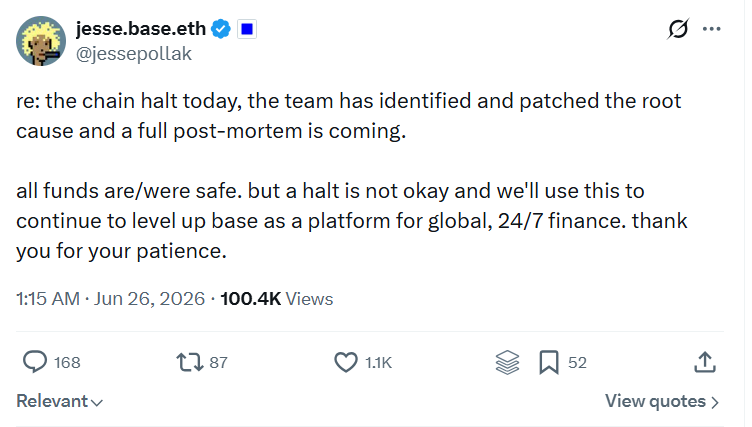
Jesse Pollak speaks about the chain halt. Source: Jesse Pollak
According to Base’s documentation, Beryl introduces a set of changes aimed at tightening the network’s performance and reducing friction at the edges. These include the B20 native token standard, a shortening of withdrawal finality from seven days to five, and integration with Reth V2, which is expected to reduce node storage requirements while improving execution efficiency.
Related: Coinbase’s Base resumes block production after 2-hour outage
Sun said Base has been moving toward a more unified “stack” approach, giving it greater control over how the network is built and upgraded, and allowing changes to ship more quickly than under the earlier Optimism Superchain model.
The trade-off, he said, is that liquidity, which once moved more freely across the broader Superchain ecosystem, may become more fragmented, even as Base deepens its integration with Coinbase’s wider user base.
Avalanche: Octane
Avalanche’s next chapter is less about a single branded hard fork than a broader push to improve performance while courting institutions and tokenized asset issuers.
Sun told Cointelegraph that Avalanche’s recent Etna hard fork replaced the old subnet model with sovereign Avalanche L1s, cutting the cost of launching a dedicated blockchain by more than 99% and making the network more attractive to institutional players.
It’s already seen success in this regard. Sun pointed to Progmat, which he said accounts for roughly 63% of Japan’s national security token market, which migrated more than $2 billion in tokenized assets to a dedicated Avalanche L1, as well as the Avalanche Payments Collective backed by firms including Franklin Templeton, VanEck and WisdomTree.
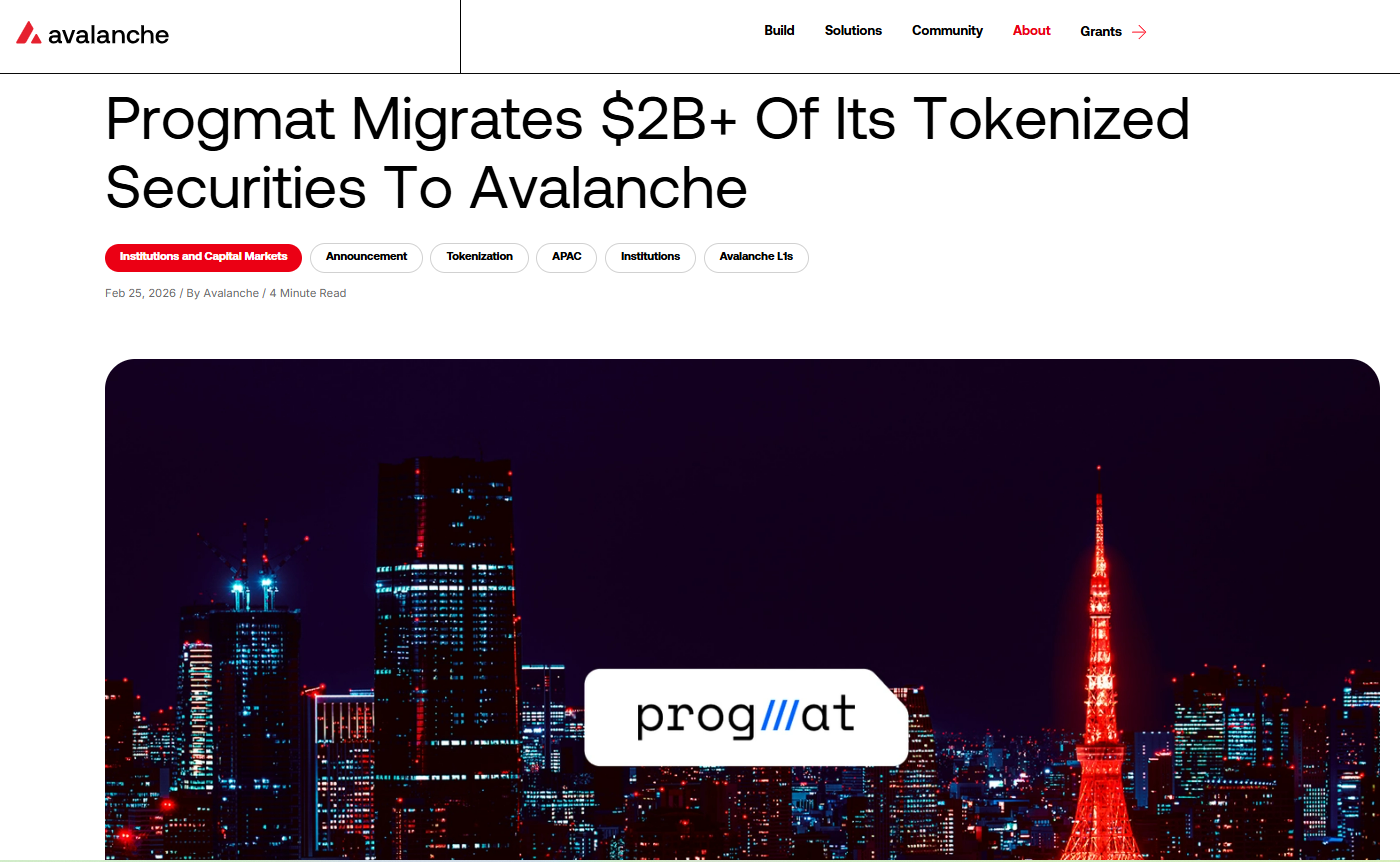
Progmat Migrates $2B+ of its Tokenized Securities to Avalanche. Source: Avalanche
Atkinson said Avalanche is also pushing two upgrades aimed at making its C-Chain one of the fastest Ethereum Virtual Machine (EVM) environments.
Related: Avalanche Treasury falls 16% as it debuts on Nasdaq
She described Streaming Asynchronous Execution as a way to separate transaction execution from consensus so the chain can run more continuously and size capacity closer to normal demand. For users, she said, the practical effect should be higher throughput and lower, steadier fees during periods of heavy activity.
Bitcoin: OP_CAT
Bitcoin is the outlier here because its biggest developments in 2026 are not scheduled upgrades but a continuation of passionate debates over whether the protocol should become more programmable and how urgently it should be hardened against quantum threats.
Bitcoin has not activated a major soft fork since Taproot in 2020, which upgraded Bitcoin’s scripting to make transactions more flexible and improve privacy.
Since then, discussion around covenant-related proposals such as OP_CAT, CheckTemplateVerify (CTV) and Lightning-focused ideas like LNHANCE has intensified. None of these changes has an agreed path to activation.
Researchers have also been debating BIP-360 and related proposals as ways to make it easier to migrate coins into quantum-resistant spending paths, if and when the quantum computing threat becomes real.
Atkinson described Bitcoin as the wildcard of the group. She said covenant proposals could unlock safer storage and richer scripting, but the subject remains divisive and subject to much debate.
Sun said those proposals could improve self-custody security, fee management and protocols such as Lightning and Ark, while giving institutions more programmable custody logic directly on the L1.
Bitcoin development is infamously slow, and any change to the protocol is pored over from every angle. There is general agreement that no covenant opcode is on track for activation this year, and reaching consensus on proposals like OP_CAT or CTV is still some distance away.
On the post-quantum side, BIP-360’s authors estimate that a full migration to quantum-resistant addresses and signatures would take years even under optimistic assumptions. It seems unlikely at this point that a quantum-resistance upgrade will be implemented before the end of 2026.
Magazine: How AI just dramatically sped up the quantum risk for Bitcoin
Crypto World
BTCC Exchange Sees Trading Volume Surge Ahead of Argentina Match Days as World Cup Showdown Campaign Heats Up

[PRESS RELEASE – George Town, Cayman Islands, July 2nd, 2026]
BTCC, the world’s longest-serving cryptocurrency exchange, is recording a standout result from its 15 Years in the Game: The BTCC World Cup Showdown campaign, with futures trading volume surging up to 55% ahead of Argentina’s World Cup match days. The surge is a direct result of the platform’s 1.25x volume boost for traders during the 24-hour window prior to kickoff.
As an official regional partner of the Argentine Football Association (AFA), BTCC built the perk to reward users who time their trading around La Albiceleste’s matches. The data speaks for itself:
- June 15 (day before Argentina vs. Algeria): Daily futures trading volume hit approximately $2.84 billion, about 15% above the average of the surrounding days.
- June 21 (day before Argentina vs. Austria): Volume climbed to approximately $2.35 billion, a 55% jump over the previous day.
The numbers confirm what BTCC aimed the campaign would deliver: real, measurable engagement tied to the excitement of the World Cup. Traders aren’t just watching the matches, they’re trading around them, and the 1.25x boost gives them a tangible reason to do both at once.
More Boosts Ahead
With Argentina set to face Cabo Verde on July 3, 2026 at 3:00 PM ET in a Round of 32 match, the 1.25x volume boost will once again be active in the 24 hours leading up to kickoff.
A win will send Argentina straight into the Round of 16, keeping Lionel Messi and his team on their path to defend their World Cup title and clinch a fourth crown.
For BTCC traders, the boost gives them another opportunity to climb the weekly and overall leaderboards, which are ranked by futures trading volume and share a combined prize pool of 690,000 USDT.
Campaign Finale: A Messi-Signed Jersey Awaits
Beyond the volume boosts and leaderboard prizes, the campaign’s lucky draw pool includes a jersey signed by Lionel Messi, alongside a Miami yacht getaway and a Hublot Spirit of Big Bang Titanium watch.
These premium prizes will be awarded once the World Cup concludes, which provides traders an added incentive to stay engaged through the campaign’s final weeks.
A Partnership Built for the World Cup
BTCC’s role as an official partner of the AFA is central to the campaign’s design. It is a natural fit for the exchange’s 15th anniversary, timed to one of football’s biggest global stages. The partnership puts BTCC’s brand in front of millions of football fans worldwide and cements its position as a platform built for champions, on the pitch and in the markets alike.
The BTCC World Cup Showdown runs through July 21, 2026. Full rules and registration are available on the official campaign page.
#BTCC15 | #BTCCxArgentineFA | #BuiltForChampions
About BTCC
Founded in 2011, BTCC is a leading global cryptocurrency exchange serving over 11 million users across 100+ countries. As the official regional sponsor of the Argentine Football Association (AFA) and with NBA All-Star Jaren Jackson Jr. as its global brand ambassador, BTCC offers secure and accessible cryptocurrency trading services, focused on delivering a user-friendly experience while adhering to applicable regulatory standards.
Official website: https://www.btcc.com/en-US
The post BTCC Exchange Sees Trading Volume Surge Ahead of Argentina Match Days as World Cup Showdown Campaign Heats Up appeared first on CryptoPotato.
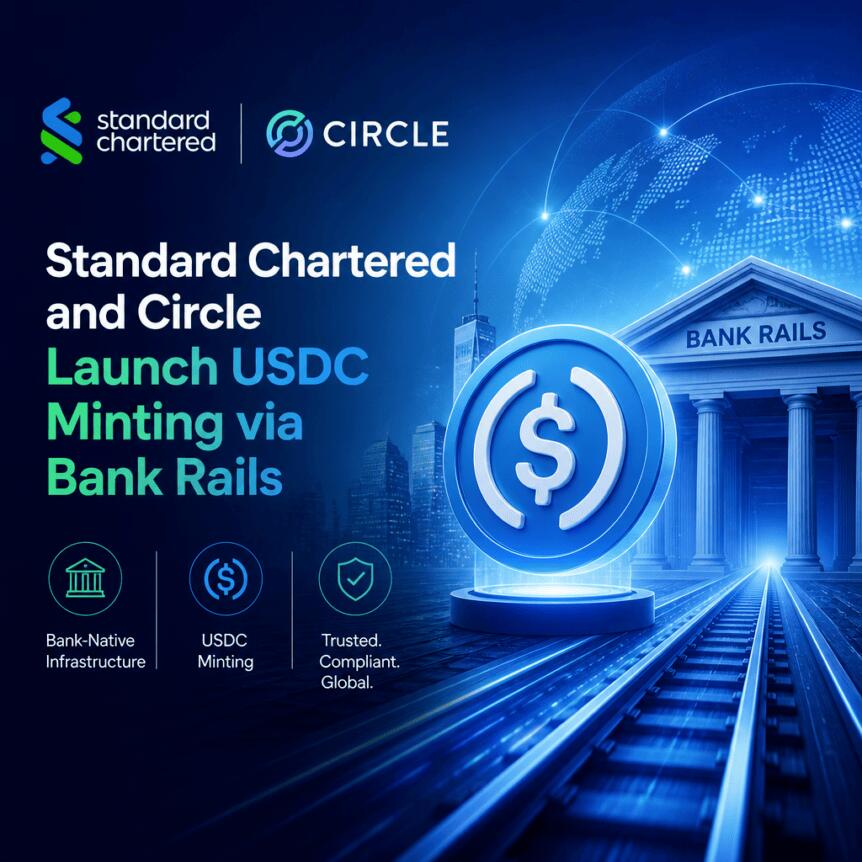
Standard Chartered and Circle have announced a new, bank-led workflow for institutional clients to mint and redeem USDC, positioning stablecoin access inside a traditional banking onboarding process. The system is designed to reduce the operational friction of dealing separately with a stablecoin issuer while aligning minting and redemption activities with the bank’s established risk, compliance, and governance controls.
In a press release, Standard Chartered said it will be the first Global Systemically Important Bank (G-SIB) to offer USDC minting and redemption through its own platform. Clients starting with the initial rollout will be able to mint and redeem the US dollar-backed stablecoin without opening additional accounts with Circle, with delivery beginning through the bank’s operations in the Dubai International Financial Centre (DIFC). The banks described the effort as an integrated offering that brings together banking, custody, and digital asset services under a single institutional relationship.
Key takeaways
- Standard Chartered and Circle are building a workflow that lets institutional clients mint and redeem USDC through a bank-led process.
- Standard Chartered says it is the first G-SIB to provide USDC minting and redemption services within its existing banking frameworks.
- The initial rollout is planned via Standard Chartered’s DIFC operations, with expansion to other jurisdictions depending on regulatory approval and client demand.
- The capability targets institutional needs such as on-chain settlement, treasury management, and liquidity management.
- The move reflects intensifying competition over stablecoin distribution, access, and governance as traditional banks deepen involvement in digital asset rails.
A bank channel for USDC minting and redemption
Standard Chartered said its collaboration with Circle embeds USDC access directly into the bank’s institutional offering. Instead of requiring clients to separately manage stablecoin issuance logistics with Circle, minting and redemption can be handled through the bank’s own platform. Standard Chartered framed this as a way to connect stablecoin operations to “banking, custody, and digital asset services” in one integrated setup.
For institutional users, the practical difference is that stablecoin issuance no longer has to be treated as an entirely separate operational track. Bank-led onboarding can also make it easier to map stablecoin activities to existing internal controls—particularly for firms that already depend on banks for custody, compliance, and settlement infrastructure.
Why DIFC first—and what comes next
According to the announcement, the service begins through the Dubai International Financial Centre, reflecting the role that regulated financial hubs often play in digital asset infrastructure rollouts. Standard Chartered also stated it intends to expand the capability to additional markets, but only “depending on regulatory approval and demand from clients.”
That conditional expansion matters for investors and institutional clients because the timeline for stablecoin access typically hinges less on technology than on licensing, regulatory interpretation, and operational approvals in each jurisdiction. Readers should expect further details as new markets are added and as banks refine which client segments and use cases can access the minting and redemption rails.
Institutional use cases now, payment rails later
Standard Chartered and Circle positioned the capability around current institutional workflows. The announcement says it supports on-chain settlement, treasury operations, and liquidity management. These are areas where firms often need predictable operational processes, clear governance boundaries, and connectivity to broader financial operations.
The collaboration also points beyond those immediate use cases. The banks described the system as providing infrastructure that could support payment-related use cases in the future—signaling a longer-term ambition to integrate stablecoin rails with payment and settlement workflows. While the announcement does not specify timelines or concrete payment deployments, the framing is consistent with how stablecoins are increasingly being assessed: not only as standalone tokens, but as components of regulated distribution and settlement stacks.
Stablecoin competition shifts toward distribution and governance
The Standard Chartered–Circle partnership arrives amid heightened attention on who controls stablecoin access and liquidity. Earlier coverage noted that Circle CEO Jeremy Allaire has publicly defended USDC’s network effects while responding to growing competition from new stablecoin entrants such as Open USD (OUSD). In that context, distribution channels and institutional partnerships can become decisive—even when multiple stablecoins are available—because liquidity and redemption pathways influence real-world usability.
Circle’s CEO previously said OUSD works closely with many of the founding members and expects those members to remain “large USDC partners and customers,” underscoring how relationships and access pathways are central to the stablecoin landscape. Standard Chartered’s announcement can be seen as an extension of that same logic: instead of focusing only on issuance, Circle and a major bank are working to embed USDC into an institutional distribution model that emphasizes governance and compliance.
More broadly, the integration trend suggests that traditional banks are not just observers of stablecoin growth. They are moving toward roles that resemble infrastructure providers—setting up onboarding, oversight, custody connections, and controlled minting/redemption access. For market participants, this can change how quickly stablecoin adoption spreads, because regulated, bank-mediated channels may lower barriers for large institutions that previously viewed direct stablecoin interaction as too operationally or compliance-heavy.
What to watch
As Standard Chartered rolls out USDC minting and redemption via DIFC, the key question will be how quickly the bank expands to other jurisdictions and which client segments gain access first. Observers should also watch whether similar integrations accelerate across other major banks, because the stablecoin race may increasingly be won—or slowed—by distribution, governance, and the ability to plug stablecoins into regulated settlement processes.
Crypto World
AMD (AMD) Stock Plunges 7%: Is This the Buying Opportunity Investors Have Been Waiting For?

Key Takeaways
- Shares of Advanced Micro Devices declined roughly 7% this week following reports that Meta could monetize surplus AI compute capacity, potentially impacting future chip orders.
- Analyst Gil Luria from D.A. Davidson maintained a positive rating, emphasizing that global AI compute demand continues to surpass available supply.
- Wells Fargo analysts increased their AMD price projection to $615 from $505, highlighting robust demand for EPYC processors and AI accelerators among hyperscalers.
- UBS elevated its forecast to $670 while Cantor Fitzgerald set a $700 target, designating AMD as their leading compute investment choice.
- Lisa Su, AMD’s chief executive, is scheduled to receive equity compensation valued at $36 million on August 15, alongside awards for additional senior leaders.
Advanced Micro Devices has experienced a significant retreat this week, yet major financial institutions continue to back the semiconductor giant.
Advanced Micro Devices, Inc., AMD
Shares of Advanced Micro Devices finished 6.89% down on July 1, 2026, triggered by news that Meta Platforms might begin offering surplus AI computing resources to external customers. The market concern centers on whether Meta’s excess capacity signals reduced appetite for additional chip purchases moving forward.
Despite this week’s pullback, AMD stock has delivered exceptional returns exceeding 150% year-to-date prior to the recent decline.
Gil Luria, covering the stock for D.A. Davidson, recognized the short-term headwinds in his latest research note while reaffirming his positive stance. Luria’s analysis suggests that while Nvidia maintains dominance in AI silicon, AMD continues capturing meaningful business from clients diversifying their supplier base. Crucially, he emphasized that worldwide AI infrastructure requirements still far exceed current capacity, supporting the investment thesis over the longer horizon.
Wall Street Analysts Boost Price Projections
Aaron Rakers at Wells Fargo increased his valuation target to $615 from a previous $505 while keeping his Overweight recommendation. His optimism stems from accelerating adoption of AMD’s EPYC server chip family as hyperscale cloud operators expand their AI infrastructure footprint. Rakers projects AMD could achieve earnings exceeding $20 per share annually ahead of consensus forecasts.
Timothy Arcuri from UBS raised his target significantly to $670 from $455, maintaining his Buy recommendation. Arcuri anticipates the emergence of agentic AI applications will fuel additional server CPU demand, positioning AMD to capture incremental market share as Intel works through its operational and technological challenges.
Cantor Fitzgerald holds the most optimistic view among major firms. Analyst C.J. Muse pushed his target price to $700 from $500 while reiterating an Overweight rating, naming AMD his preferred pick in the compute sector. Muse forecasts sustained momentum in AI chip and semiconductor tooling demand extending multiple years forward.
Executive Compensation Highlights Strong Performance
In a separate development, regulatory filings disclosed that CEO Lisa Su will be awarded equity compensation totaling $36 million on August 15, 2026, pursuant to the company’s 2023 Equity Incentive Plan. Additional senior executives will also receive substantial grants—CTO Mark Papermaster is set for $10 million, CFO Jean Hu will get $9 million, Chief Sales Officer Forrest Norrod receives $8 million, and EMEA President Darren Grasby gets $7.5 million.
These compensation decisions align with AMD’s impressive financial momentum. The company reported revenue growth of 38% year-over-year, reaching $10.25 billion during fiscal Q1 2026.
Based on TipRanks data, AMD holds a Strong Buy consensus rating derived from 28 Buy recommendations and seven Hold ratings.
The Street’s average price objective stands at $509.75, suggesting approximately 5.76% potential downside from present trading levels—indicating that even after the recent correction, valuations aren’t universally considered attractive.
In extended trading following Tuesday’s session, AMD stock declined an additional 1.19%.

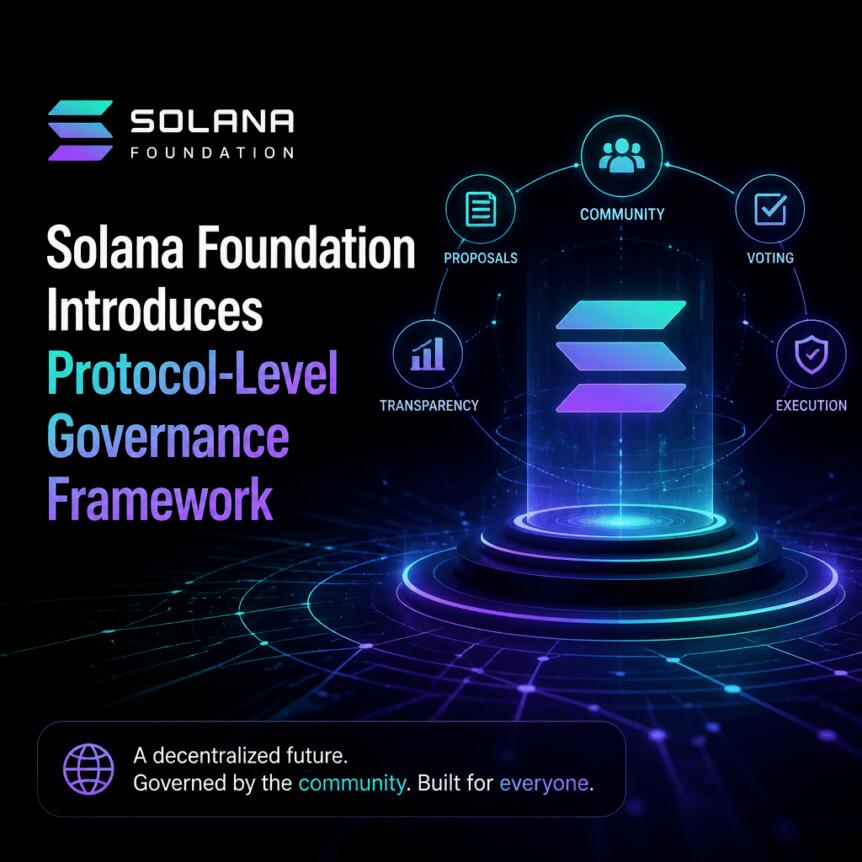
The Solana Foundation has unveiled a new protocol-level governance framework designed to let validators propose and vote on core changes directly onchain, using stake-weighted voting to reflect community preferences. The initiative, called Solana Governance Proposals (SGPs), aims to make major protocol decisions more transparent and reduce reliance on centralized coordination, while keeping the technical drafting of upgrades separate.
As the Foundation and related documentation explain, an SGP is meant to capture a stake-weighted “directional” choice from the ecosystem—distinct from the detailed technical work typically represented through Solana Improvement Documents (SIMDs). In other words, SGPs are positioned as a governance signal, not a replacement for the engineering process behind protocol features.
Key takeaways
- Solana Foundation launched SGPs, a governance standard for proposing and voting on protocol decisions onchain.
- Voting is stake-weighted, with voting power tied to delegated SOL.
- Validators need at least 15% support from actively staked SOL for a proposal to advance to a formal onchain vote.
- Delegators can override validator votes by submitting their own vote on the same proposal.
- SGPs and SIMDs are kept separate: SGPs signal community direction; SIMDs handle the technical upgrade details.
How Solana Governance Proposals work
SGPs were introduced through a framework intended to standardize how governance decisions are submitted and ratified for the Solana blockchain. According to the Foundation’s announcement on X [SolanaFndn on X], the process enables validators to submit core protocol proposals and vote on them onchain.
The stake-weighted nature of voting is central to the design. The Foundation’s accompanying GitHub repository [solana-governance-proposals on GitHub] describes SGPs as “stake-weighted directional” decisions that reflect what the community wants, emphasizing that the framework does not focus on the specific engineering detail of how to build a feature.
This separation of governance intent from implementation is a recurring theme in the documentation. It is also one way the Foundation attempts to preserve continuity for technical development: the community can express priority or direction through SGPs, while the actual proposal writing and protocol specification can remain in the SIMD process.
More broadly, stake-weighted governance mechanisms are not unique to Solana. The Foundation noted that similar approaches exist across other major networks, including Polkadot, Cosmos, Cardano, Tezos, and Avalanche.
Thresholds and eligibility for proposals
To qualify for a formal onchain vote, an SGP must first meet a minimum support requirement: endorsements from validators representing at least 15% of actively staked SOL. The Foundation’s framework describes this as a filtering step to reduce the likelihood of low-quality proposals moving forward.
On the validator side, the documentation sets an operational rule for who can open governance proposals. Validators with 100,000 SOL delegated can submit a new governance proposal via SGP. Delegators—SOL holders who stake by delegating to validators—are then able to participate in the governance process through their delegated stake.
The governance model therefore depends on two layers: (1) validator eligibility to bring items into the system, and (2) staking participation that determines how much influence each delegator ultimately has.
Delegators can override validator votes
One of the most notable governance mechanics in the framework is the ability for delegators to override their validator’s position on a specific proposal. The documentation states that if delegators disagree with how their validator has voted, they can override the validator by submitting their own vote on the proposal—effectively changing the outcome based on the delegated stake’s voting preferences.
This feature changes the typical dynamic of validator-led governance. Instead of treating delegation as a fixed vote, delegators are given an explicit path to correct or adjust how influence is applied for each SGP, provided the underlying system supports delegator-submitted voting for that particular decision.
For participants, the practical implication is clear: users who stake SOL should pay attention not only to which validators they delegate to, but also to how their own participation in voting affects each governance item as it appears.
SGPs vs. SIMDs: keeping signals separate from execution
The Foundation explicitly frames governance-level proposals as SGPs while reserving smaller technical work as SIMD-focused efforts. In an articulation shared alongside the launch, the Foundation wrote that “SIMDs should focus on protocol changes, SGPs should be signals from the ecosystem.”
That distinction matters because it aims to prevent governance processes from becoming overly bogged down in engineering minutiae. In many decentralized networks, the challenge is balancing legitimacy and clarity: governance outcomes need to be expressive and understandable to stakeholders, while implementation details must be handled carefully by developers.
At the same time, the separation also leaves readers with an important question: how exactly the ecosystem transitions from a stake-weighted directional signal to a concrete protocol change. The Foundation’s framing suggests SIMDs remain the place where technical execution lives, but watchers will want to track how consistently SGP outcomes influence or map onto subsequent SIMDs over time.
Why Solana’s governance redesign matters now
Solana’s push comes alongside continued efforts to formalize supporting infrastructure for its ecosystem. Earlier in April, the Foundation introduced STRIDE—a security program for evaluating, monitoring, and escalating security across Solana projects—described in a separate announcement as a structured approach for handling security risks across Solana-based protocols [Cointelegraph coverage of STRIDE launch].
While STRIDE addresses security operations, the SGP framework targets governance at the protocol level. Together, they suggest the Foundation is working on multiple layers of the network’s resilience: governance processes for direction and decision-making on one hand, and security evaluation and response tooling on the other.
From an investor and user perspective, governance clarity is not just philosophical. Onchain frameworks can influence how quickly the ecosystem coordinates around upgrades, how disputes are handled, and whether stakeholders feel their preferences are accurately reflected in protocol decisions. With stake-weighted voting and delegator override capabilities, Solana’s new model also increases the likelihood that governance participation will be granular rather than fully outsourced to validators.
As SGPs roll out, readers should watch for whether proposals that meet the 15% threshold proceed smoothly, how often delegators override validator votes, and—most importantly—how consistently successful SGP outcomes translate into corresponding SIMDs and real protocol changes.
Bitcoin’s price was able to return above $60,000 today following a volatile 24 hours that saw the asset drop towards $58,300 before staging a recovery.
At the time of this writing, BTC trades at around $60,500, up nearly 3% on the day, with its market capitalization back near $1.2 trillion.
BTC Price Back Above $60K
Bitcoin had slipped to an intraday low at roughly $58,300 before the bulls were able to step in and push the asset above $61,000 at one point. The recovery was not enough, however, to erase the broader downtrend. That said, it did help BTC regain a key psychological level after several days of selling pressure.

The total cryptocurrency market capitalization stands at a bout $2.16 trillion, which is up roughly 2% in the past 24 hours. Daily trading volume is above $83 billion, while the BTC dominance remains above 56%, suggesting that altcoins are unable to outperform, for the time being.
Ethereum also recovered alongside Bitcoin as it trades close to $1625 after gaining 3% over the past day. It remains far below levels seen earlier in the year, however.
BCH, SOL, ADA Turn Green
Most of the larger altcoins followed BTC higher. Solana is amongst the strongest performers from the top 10, rising by more than 4%, while Bitcoin Cash jumped by about 5%. Cardano (ADA) also increased by over 3%, and LINK gained similarly.
Ripple’s native cryptocurrency XRP is also up, trading near $1.06 following a modest gain. It’s worth noting that XRP-linked ETF products have managed to stand out with their inflows as Bitcoin and Ether ETFs suffer outflows.

The post Bitcoin Reclaims $60K as SOL, BCH Lead Alts Higher (Market Watch) appeared first on CryptoPotato.
Ripple Price Analysis: Bullish Divergence Emerges as XRP Defends $1 Support Zone

Travis Kelce’s Stylist Arrives in NYC Before Reported Wedding

Live Gold, Crypto Trading | 2 JULY | #goldtrading #cryptotrading #bitcoin – MANSI

No Jackpot Winner as $257 Million Prize Rolls Over to $269 Million Monday Draw

Renter of Home in Anne Heche Crash Denies Settlement With Son

Weekend Open Thread: Staud – Corporette.com
Live Gold, Crypto Trading | 2 JULY | #goldtrading #cryptotrading #bitcoin – MANSI

Once You Get Money, Upgrade These 10 Things Immediately

XRP DEATHCROSS CONFIRMED = XRP MOONS !!!! 42.5% OF XRP LOSING !!!! MR POOL BOOOOOOOOM !!!!
-
 Fashion6 days ago
Weekend Open Thread: Staud – Corporette.com
-

 Politics6 days ago
The House | Manchesterism won’t survive the painful trade-offs unless it gets citizens on board
-

 Crypto World2 days ago
Strategy authorizes up to $1.25B in Bitcoin sales under new capital plan
-

 Politics7 days ago
Potential 2028er World Cup attendee leaderboard
-

 Business6 days ago
Asia stock markets slide as tech shares slump
-

 News Videos4 days ago
MAJOR BITCOIN & MARKET UPDATE!!!! (MUST WATCH ASAP!!!)
-

 Tech7 days ago
A Look At A Gaggle Of Transputer Boards
-
 Crypto World7 days ago
Dell (DELL) Shares Tumble Over 5% Following Analyst Downgrade to Hold
-

 Crypto World5 days ago
Coinbase, Circle Deepen Crypto Stock Losses Despite Resilient S&P 500
-

 Business2 days ago
Australia treasurer says alleged access of prime minister’s bank data ’incredibly concerning’
-

 Crypto World5 days ago
Kraken's xStocks Opens Bending Spoons IPO Registration to EEA Retail
-

 Tech3 days ago
Anonymous researcher drops 0-day ‘exploitarium’ repo
-

 Sports6 days ago
FIH Pro League: India defeat Pakistan 7-1, register biggest win of campaign | Other Sports News
-

 Crypto World7 days ago
Bitcoin Sparks $600M Hourly Liquidations With $65,000 Set To Become Resistance
-

 Tech5 days ago
Bluekit phishing kit adopts browser-in-the-middle for login theft
-

 Tech5 days ago
Russian hackers now target Signal backup recovery keys
-
 Crypto World6 days ago
Hyperliquid Named on Singapore MAS Investor Alert Register
-

 Crypto World6 days ago
RTX holders must register wallets before token distribution begins
-

 Sports1 day ago
Broncos roster: OL Ben Powers (No. 74) entering final year of contract
-
 Business3 days ago
The AI boom won’t burst all at once. It will pop in ‘rolling bubbles’: Macquarie
You must be logged in to post a comment Login