Crypto World
Your Dog Really Can Tell When You're Happy


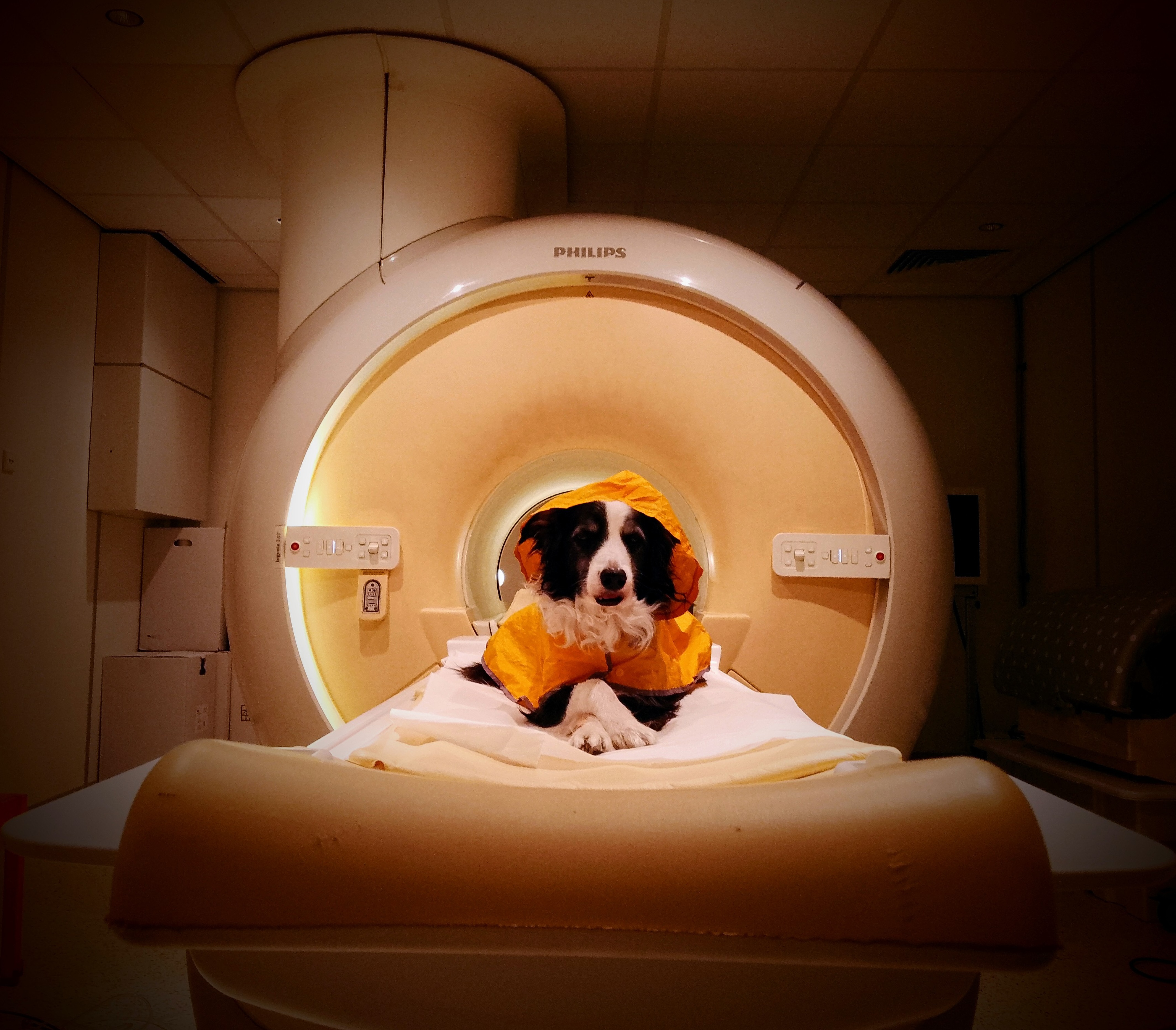
If you’ve ever suspected your dog can read your mind—sussing out through some canine intuition when you’re happy, sad, scared, or cross—you’re half right. Many dogs can do exactly that, but it’s not mind-reading that’s involved: it’s face-reading. That’s the word from a new study in the journal iScience, in which researchers not only established dogs’ ability to discern human moods by examining our facial expressions, but also pinpointed the spots in the brain where that processing takes place. They did this by scanning canine brains with functional magnetic resonance imaging (fMRI).
Figuring out how dogs read human emotions
“This ability to perceive emotions in humans is really hard to find in other species,” says Rául Hernández Pérez, professor of psychology at the University of Vienna and first author of the study. “Chimpanzees have a harder time than dogs. Wolves can also do it, but not at the same level as dogs can.”
Getting a dog to tolerate an MRI scanner is no small matter. The same things that so often freak people out about the MRI experience—the confined space and the infernal noise—can have a similar effect on a dog. That was an impediment to the kind of study the researchers planned to conduct. In order for a brain scan of the proper fidelity to be produced, the dogs must spend a minimum of six minutes in the machine, moving less than three millimeters in any direction. “If they move more than three millimeters, we can’t use the data,” says Laura Cuaya, professor of biological psychology at the University of Vienna and a co-author of the study.
Looking for dogs who could perform that feat, she and Hernández Pérez recruited 14 cooperative canines, consisting of 11 border collies—a highly trainable breed—two golden retrievers, and one Labrador, the last three of which were already working as service animals.
The animals then went through a series of at least 20 training sessions—the first involving just introducing them to the researchers and building a sense of trust. Next, the dogs were taught to lie still for just five seconds in the position they would have to maintain in the MRI scanner. “We reward them with treats, though some dogs prefer to play as a reward,” says Cuaya.
Over the course of several days, that brief five seconds was steadily extended to 10 full minutes. The dogs were then introduced to the headphones they would have to wear while in the machine to protect their hearing. “The headphones are not uncomfortable, but they’re weird,” says Cuaya. Finally, the dogs practiced holding their pose in a mock MRI scanner, and only then were they ready for the real, clanking, buzzing, banging machine.
In the study, the dogs were positioned in the machine and shown pictures of a human face wearing either a happy or neutral expression. All the while the fMRI churned on, peering through the dogs’ skulls into the brain below and looking for the areas that lit up as a result of the visual stimuli. When the dogs saw pictures of happy people, their temporal cortex and caudate nucleus became active. In humans, the temporal lobe plays a role in forming memories, mastering language, responding to visual cues such as familiar faces, and processing emotions. The caudate nucleus processes rewards and motivation and manages learning and memory. The neutral face did not elicit the same response in either region.
Next, the dogs were once again shown images of happy and neutral faces, but along with those they were also shown angry, frightened, and sad ones. The researchers were trying to determine whether the dogs processed human faces in a binary way—registering the positive, happy face in one part of the brain and the three negative ones together in one other part, or if each negative emotion had its own discrete brain region.
“This would mean that the dog brain is not only categorizing emotions between positive and negative,” says Cuaya. “We were using this [stage of the experiment] as a demonstration that there is more detailed processing.”
What dogs’ brains reveal about the dog-human bond
That was the result they got. Sadness and fear, for example, lit up the right rostral supra sylvian gyrus—which, in humans, contributes to the processing of visual information. Anger and fear were processed in the right ectosylvian gyrus and the left splenal gyrus—the former integrating visual, auditory, and other sensory information, and the latter managing visual perception, spatial orientation, and episodic memory.
“We found that the dog brain is not only categorizing emotions as positive or negative, but instead can exhibit more detailed processing, responding in different ways to emotions,” says Hernández Pérez.
This isn’t the first study to find that dogs respond in unique ways to human faces. Other research has shown that when a human face is happy, for example, dogs look more at the eyes than the mouth. They examine emotional faces longer than they examine neutral ones. And they have more difficulty reading the faces of people who are of a different gender from their principal caregiver.
There are benefits to the study—beyond the simple matter of adding to the body of knowledge on how dog brains operate. Hernández Pérez and Cuaya believe their work can also help improve the already deep ties dogs and humans share.
“Humans are not so good at perceiving the emotions of our dogs,” says Cuaya. “We are confused by them. Maybe this work can be an invitation to try to be more aware of the emotions of our dogs and how they are expressing [them].”
That understanding can also pay dividends when we are training our dogs. “When you are teaching something to your dog, you can have treats on hand, and you can give the treats when they are appropriate. But you can also show your emotion. You can say to the dog, ‘Very good!’ The dogs in our MRI machine were already reacting to the faces of strangers. Think about how much more activation there is with a familiar face expressing, ‘I love you so much. I am happy with you.’”
The dog-human love story—which has been going on for some 14,000 years now—has been a long and tender one. The more we understand the canine contribution to that bond, the more we can improve our own.
You must be logged in to post a comment Login