
Crypto World
Your Dog Really Can Tell When You're Happy



If you’ve ever suspected your dog can read your mind—sussing out through some canine intuition when you’re happy, sad, scared, or cross—you’re half right. Many dogs can do exactly that, but it’s not mind-reading that’s involved: it’s face-reading. That’s the word from a new study in the journal iScience, in which researchers not only established dogs’ ability to discern human moods by examining our facial expressions, but also pinpointed the spots in the brain where that processing takes place. They did this by scanning canine brains with functional magnetic resonance imaging (fMRI).
Figuring out how dogs read human emotions
“This ability to perceive emotions in humans is really hard to find in other species,” says Rául Hernández Pérez, professor of psychology at the University of Vienna and first author of the study. “Chimpanzees have a harder time than dogs. Wolves can also do it, but not at the same level as dogs can.”
Getting a dog to tolerate an MRI scanner is no small matter. The same things that so often freak people out about the MRI experience—the confined space and the infernal noise—can have a similar effect on a dog. That was an impediment to the kind of study the researchers planned to conduct. In order for a brain scan of the proper fidelity to be produced, the dogs must spend a minimum of six minutes in the machine, moving less than three millimeters in any direction. “If they move more than three millimeters, we can’t use the data,” says Laura Cuaya, professor of biological psychology at the University of Vienna and a co-author of the study.
Looking for dogs who could perform that feat, she and Hernández Pérez recruited 14 cooperative canines, consisting of 11 border collies—a highly trainable breed—two golden retrievers, and one Labrador, the last three of which were already working as service animals.
The animals then went through a series of at least 20 training sessions—the first involving just introducing them to the researchers and building a sense of trust. Next, the dogs were taught to lie still for just five seconds in the position they would have to maintain in the MRI scanner. “We reward them with treats, though some dogs prefer to play as a reward,” says Cuaya.
Over the course of several days, that brief five seconds was steadily extended to 10 full minutes. The dogs were then introduced to the headphones they would have to wear while in the machine to protect their hearing. “The headphones are not uncomfortable, but they’re weird,” says Cuaya. Finally, the dogs practiced holding their pose in a mock MRI scanner, and only then were they ready for the real, clanking, buzzing, banging machine.
In the study, the dogs were positioned in the machine and shown pictures of a human face wearing either a happy or neutral expression. All the while the fMRI churned on, peering through the dogs’ skulls into the brain below and looking for the areas that lit up as a result of the visual stimuli. When the dogs saw pictures of happy people, their temporal cortex and caudate nucleus became active. In humans, the temporal lobe plays a role in forming memories, mastering language, responding to visual cues such as familiar faces, and processing emotions. The caudate nucleus processes rewards and motivation and manages learning and memory. The neutral face did not elicit the same response in either region.
Next, the dogs were once again shown images of happy and neutral faces, but along with those they were also shown angry, frightened, and sad ones. The researchers were trying to determine whether the dogs processed human faces in a binary way—registering the positive, happy face in one part of the brain and the three negative ones together in one other part, or if each negative emotion had its own discrete brain region.
“This would mean that the dog brain is not only categorizing emotions between positive and negative,” says Cuaya. “We were using this [stage of the experiment] as a demonstration that there is more detailed processing.”
What dogs’ brains reveal about the dog-human bond
That was the result they got. Sadness and fear, for example, lit up the right rostral supra sylvian gyrus—which, in humans, contributes to the processing of visual information. Anger and fear were processed in the right ectosylvian gyrus and the left splenal gyrus—the former integrating visual, auditory, and other sensory information, and the latter managing visual perception, spatial orientation, and episodic memory.
“We found that the dog brain is not only categorizing emotions as positive or negative, but instead can exhibit more detailed processing, responding in different ways to emotions,” says Hernández Pérez.
This isn’t the first study to find that dogs respond in unique ways to human faces. Other research has shown that when a human face is happy, for example, dogs look more at the eyes than the mouth. They examine emotional faces longer than they examine neutral ones. And they have more difficulty reading the faces of people who are of a different gender from their principal caregiver.
There are benefits to the study—beyond the simple matter of adding to the body of knowledge on how dog brains operate. Hernández Pérez and Cuaya believe their work can also help improve the already deep ties dogs and humans share.
“Humans are not so good at perceiving the emotions of our dogs,” says Cuaya. “We are confused by them. Maybe this work can be an invitation to try to be more aware of the emotions of our dogs and how they are expressing [them].”
That understanding can also pay dividends when we are training our dogs. “When you are teaching something to your dog, you can have treats on hand, and you can give the treats when they are appropriate. But you can also show your emotion. You can say to the dog, ‘Very good!’ The dogs in our MRI machine were already reacting to the faces of strangers. Think about how much more activation there is with a familiar face expressing, ‘I love you so much. I am happy with you.’”
The dog-human love story—which has been going on for some 14,000 years now—has been a long and tender one. The more we understand the canine contribution to that bond, the more we can improve our own.

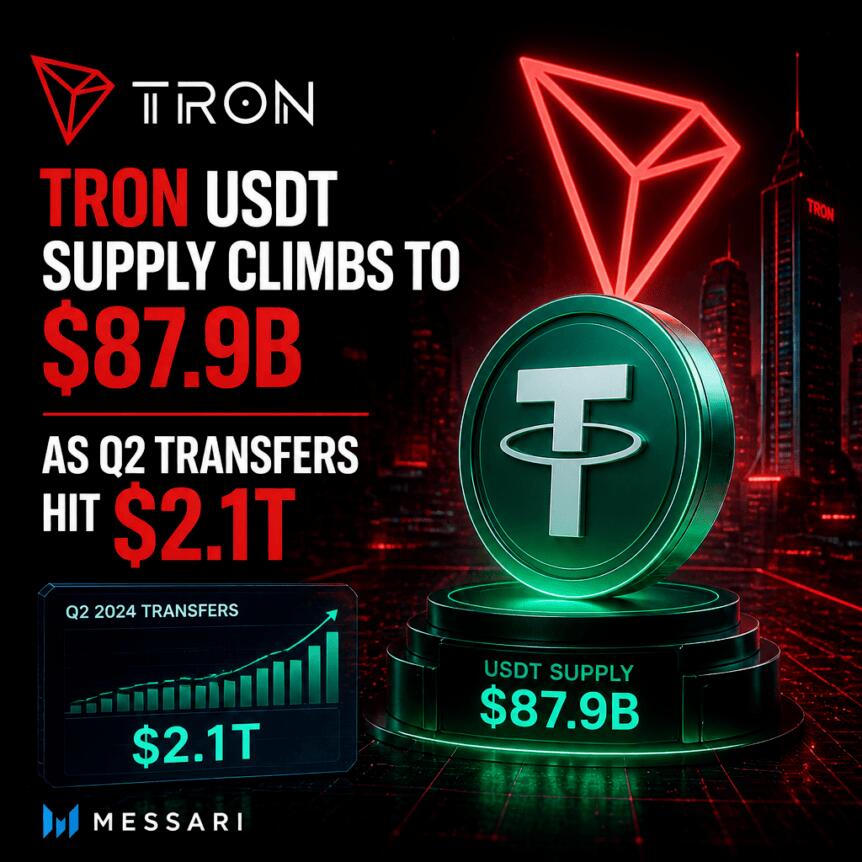
TRON ended the second quarter with a major stablecoin milestone: it recorded $87.9 billion in circulating USDT, putting it ahead of Ethereum on the same metric, while processing $2.1 trillion worth of USDT transfers over the quarter. The figures underscore how deeply USDT liquidity has embedded itself in TRON’s rails, even as parts of the ecosystem show softer momentum elsewhere.
According to a Messari report on the network’s second-quarter performance, USDT represented 98.5% of TRON’s stablecoin market. Stablecoin supply on TRON also rose, climbing 4.1% quarter-over-quarter to a record $89.2 billion. After a drop in Q1, average daily USDT transfer volume resumed growth, increasing 4.3% to $22.8 billion.
Key takeaways
- TRON led on USDT circulation in Q2, reaching $87.9B and processing $2.1T in USDT transfers during the quarter.
- Stablecoin dominance remained extreme, with USDT making up 98.5% of TRON’s stablecoin supply.
- Network usage hit new highs, including 14.6M transactions on June 15 and record-level daily activity.
- Fees reversed direction, rising 15.9% to $699.4M, the first quarterly increase after a prior governance change.
- DeFi activity cooled even as payments grew, with DeFi TVL down 1.9% and DEX volumes falling for a fourth straight quarter.
USDT expansion drives TRON’s transaction growth
Messari attributes TRON’s improved throughput to stronger day-to-day demand for USDT transfers. The network averaged 11.8 million daily transactions in Q2, up 8.7% from the prior quarter. Active usage also improved: average daily active addresses increased 11.7% to 3.6 million. The report also highlights the peak day, when TRON processed 14.6 million transactions on June 15.
From an investor and market-structure perspective, this matters because USDT activity often translates into consistent utilization of on-chain infrastructure. Even when broader on-chain applications fluctuate, stablecoin transfer volume can sustain network demand—particularly on chains where stablecoins are heavily concentrated.
Fees recover after an earlier governance shift
Beyond transaction counts, the report notes that TRON’s fee environment changed as well. Network fees rose 15.9% to $699.4 million in Q2, described as the first quarterly increase since an August 2025 governance change reduced the network’s energy unit price. In other words, Q2’s fee growth appears tied not only to higher activity, but also to a longer arc in TRON’s fee mechanics after that policy adjustment.
Still, the relationship between network fees and usage can be nonlinear when protocol parameters change. Traders and builders watching TRON may want to pay close attention to whether future fee levels keep rising with demand or whether they plateau as the impact of the earlier energy-unit pricing adjustment stabilizes.
DeFi softens while supply growth continues
Despite the payment-heavy momentum, parts of TRON’s on-chain ecosystem showed uneven performance. Messari reports that DeFi TVL fell 1.9% to $4.4 billion during the quarter. Decentralized exchange activity also cooled: average daily DEX volume dropped 21.7% to $49.3 million, marking a fourth consecutive quarterly decline.
This divergence—strong stablecoin transfer volume alongside weaker DeFi engagement—suggests that Q2’s growth may have been driven more by utility and circulation than by risk-taking or trading depth on TRON’s DeFi venues. For users, this can affect liquidity conditions and token execution quality on DEXs; for developers, it may signal that ecosystem growth is currently being led by transfers rather than by on-chain lending, borrowing, and trading.
Meanwhile, the report indicates that TRX supply remained inflationary. Even with higher activity, circulating supply increased by 87 million tokens during the quarter, with issuance continuing to outpace burns. That dynamic is notable because it can influence long-term expectations around token supply pressure, particularly when network usage is improving but supply reduction mechanisms aren’t yet keeping up.
Institutional access expands through tokenization and custody
While on-chain metrics show clear usage trends, institutional infrastructure around TRON also advanced during the quarter. Messari highlights that Securitize launched Hamilton Lane’s tokenized Senior Credit Opportunities Fund on TRON—its first TRON-issued asset. The fund reportedly started with about $4.3 million under management.
Broader institutional interest also included token listing and potential product developments. Grayscale reportedly added TRX to its list of assets under consideration. Separately, a proposed staked TRX exchange-traded product from Canary Capital remained in registration.
On the market-access side, TRX trading availability improved across venues. Bitnomial launched spot TRX trading in the United States, while OKX Europe introduced MiFID-regulated TRX expiry perpetuals. The quarter also saw Binance.US restore trading in the token.
The institutional push continued after Q2 ended. Earlier coverage noted Anchorage Digital adding native TRX staking and custody for TRC-20 assets in July, enabling institutional clients to stake TRX directly from its custody platform. For market participants, custody-and-staking workflows can be a critical step toward deeper institutional adoption, as they reduce operational friction compared with self-custody or manual transfer processes.
Read together, TRON’s Q2 pattern looks less like a pure “DeFi rally” and more like a chain consolidating stablecoin circulation and steadily improving institutional plumbing. The key question for the next quarter is whether stronger USDT throughput can translate into renewed DeFi demand—particularly DEX volumes and TVL—or whether TRON will remain primarily a stablecoin settlement venue while trading and application activity lag behind.
A New York judge granted a motion filed by US prosecutors in July to stay the CFTC’s civil case against Gannon Ken Van Dyke over making more than $400,000 on prediction markets.


Bitcoin Policy Institute and more than 40 digital-asset organizations have called on leading AI laboratories to give qualified open-source security researchers controlled access to frontier models as AI-assisted cyberattacks grow more capable.
Summary
- More than 40 organizations signed the appeal for trusted access to advanced AI models.
- The coalition requested early model access, computing power, secure environments, and direct communication channels.
- Block, Coinbase, Strategy, MARA, Galaxy, BitGo, Brink, and Trezor were among the signatories.
- The request follows several AI-assisted attacks and major Bitcoin security failures reported in 2026.
Bitcoin coalition asks AI labs for controlled access
Bitcoin Policy Institute announced the initiative in an Aug. 10 X post, saying the coalition represents organizations from across the digital-asset ecosystem.
The open letter asks leading AI developers to provide qualified open-source defenders with trusted access to their most capable models. It does not call for unrestricted public access to models with advanced cybersecurity capabilities.
Instead, the signatories proposed a controlled program covering early access to frontier cybersecurity models, sufficient computing capacity, secure research environments, and direct channels with AI laboratory security teams.
Those resources would allow vetted researchers to examine Bitcoin wallets, payment infrastructure, and other open-source software before attackers can exploit newly discovered weaknesses.
“The past several weeks have made the need for this abundantly clear,” Bitcoin Policy Institute wrote.
Block, Coinbase, Strategy, MARA, Galaxy, BitGo, Brink, OpenSats, Chaincode Labs, Spiral, Trezor, Unchained, Btrust, and Fedi were among the organizations supporting the request.
The coalition argued that current model safeguards can restrict legitimate security research even as criminals and state-backed groups gain access to increasingly capable open or locally deployed systems. Its central message to AI laboratories was that defenders need an early opportunity to identify and repair vulnerabilities.
No leading AI laboratory had publicly announced a program responding to the coalition’s specific requests at the time of writing.
AI-assisted attacks raise pressure on crypto firms
The appeal follows mounting evidence that hackers are incorporating artificial intelligence into attacks against cryptocurrency companies and financial institutions.
North Korea-linked hacking group Kimsuky has reportedly built three local AI environments using Ollama, GPT4All, and Msty. The systems can support malware development, data analysis, phishing campaigns, and attack automation without transmitting sensitive queries to an external provider.
As crypto.news previously reported, the group produced AI-generated phishing material aimed at cryptocurrency, investment, and financial technology companies.
Local models create a particular challenge for model providers. An attacker running an open model on privately controlled hardware may not be subject to the monitoring, usage restrictions, or account suspensions imposed by commercial AI services.
That difference sits at the center of the coalition’s argument. Restricting trusted defenders may offer limited protection if malicious actors can use locally deployed models or bypass commercial safeguards while researchers remain unable to test the most capable systems.
The threat also carries a U.S. security angle. Several signatories, including Coinbase, Strategy, Block, MARA, and Galaxy, are publicly traded or U.S.-based companies with substantial exposure to Bitcoin infrastructure. Successful attacks could affect American customers, institutional custodians, and investors even when the vulnerable software is maintained by a global open-source community.
Bitcoin flaws show potential role for frontier models
Recent Bitcoin security incidents have demonstrated how weaknesses in open-source software can remain undetected for years.
A firmware build error affecting Coldcard hardware wallets reportedly weakened the entropy used to generate seed phrases. Attackers could then search a much smaller range of possible keys and drain wallets without obtaining physical access to the devices.
Galaxy Research estimated that confirmed Coldcard thefts reached 1,596 BTC, while a suspected additional attack wave could raise losses to about 2,055 BTC. The error had reportedly been present since 2021.
AI-assisted analysis subsequently expanded scrutiny beyond the original flaw. A crypto.news investigation found that automated reviews were surfacing similar classes of security weaknesses across the broader Bitcoin ecosystem.
Bitcoin Red Team provided another example of defensive AI use. The volunteer initiative reported finding 4,962 potential issues across 390 Bitcoin-related projects during fewer than 30 hours of AI-assisted code reviews.
Of those findings, 720 were initially classified as high or critical severity, although automated findings still require human reproduction and verification. More than one-fifth had reportedly been reproduced when crypto.news covered the review campaign.
Those results illustrate both the potential and limits of frontier models. AI can examine large codebases faster than small volunteer teams, but qualified researchers are still needed to remove false positives, test exploitability, and disclose verified vulnerabilities safely.
Bitcoin security funding expands beyond AI access
The open letter adds to a broader push to increase resources available to Bitcoin security researchers.
Strategy, BlackRock, Coinbase, and six other companies recently established the Bitcoin Security Consortium. Its members pledged $15 million over three years to fund developers and researchers working on Bitcoin’s long-term security.
Post-quantum cryptography is the consortium’s initial focus, though its mandate covers broader protocol security. Members said they would choose funding recipients independently and would not direct Bitcoin development or take positions on proposed protocol changes.
Galaxy separately opened a $5 million Bitcoin security fund covering new signature systems, wallet-migration tools, audits, and research into quantum-resistant protections.
Industry-wide losses continue to increase despite those initiatives. Immunefi reported that crypto projects lost roughly $110 million to hacks in July. The security platform recorded 164 incidents through Aug. 3 and projected that the number of hacks exceeding $1 million could reach a record 114 in 2026.
The Bitcoin Policy Institute coalition is now asking AI companies to complement financial support with technical access. Whether laboratories accept that proposal will depend on their ability to verify researchers, supervise potentially sensitive work, and prevent advanced cybersecurity models from being redirected toward offensive activity.


Mark Zuckerberg set out Meta’s superintelligence vision on Monday. He argued the technology should reach everyone, not a small circle of companies or governments.
The Meta founder framed open source models as the safeguard. He also pledged free or affordable access to a personal AI agent for every user.
Why the Meta Superintelligence Plan Rests on Open Source
His argument opens with a warning about concentration. Power that sits with a few actors, he wrote, produces outcomes that serve fewer people. Therefore, Meta wants the technology distributed widely instead.
Open source carries most of that weight. Zuckerberg called it a force against centralization, and he added a security claim on top. More reviewers, in his telling, catch more flaws.
“Open source is a positive and important force for empowering people and preventing centralization.”
Mark Zuckerberg, Founder and CEO, Meta, in his published letter
Meta backed that claim the same day. The company opened the weights for Muse Glimmer, a 30 billion parameter model tuned for local agent tasks. Apache 2.0 terms apply, and the files sit on Hugging Face.
Hardware demands stay modest. Quantized, the model fits under 20 GB and runs on a single consumer graphics card. Zuckerberg promised open weights for Muse Spark 1.2 next, a month after Meta launched its first paid API.
The consumer promise sits alongside that argument. Zuckerberg opened his list of commitments with an assistant who knows each user personally.
“Everyone will have an exceptionally capable personal agent that understands you, your goals, and everything you care about.”
Creative tools and a tutor with a doctorate-level knowledge follow. Free tiers and auction based pricing would cover the cost.
Invention, rather than automation, drives the rest of the Meta superintelligence pitch. Zuckerberg rejected the idea that AI must replace workers faster than it upgrades them. Meanwhile, he expects small teams to run large companies using personal agents.
OpenAI reached a similar conclusion in April, when it warned about power concentration. Both labs agree on the danger. However, they disagree on who should hold the keys.
Crypto Has Heard the Decentralization Pitch Before
Meta superintelligence would land in a market that already sells the same promise. Crypto projects have pitched decentralized AI networks as the fix for corporate control for years, and asset managers now track them seriously.
Grayscale made that case in June. The firm named Bittensor (TAO), a network that pays contributors for machine learning work, as its preferred exposure. Token markets therefore read Meta as a competitor rather than an ally.
Cost complicates the message. Meta guided 2026 capital spending to between $125 billion and $145 billion, while AI spending squeezed second quarter margins. The company also backed a Texas data center venture worth $14 billion.
Few rivals can match that budget. In practice, open weights still ship from a firm that owns the compute behind them. Critics of AI nationalism have raised the same objection about state control.
Zuckerberg says Meta’s independent board will approve the safety criteria for model releases. He also wants governments to inspect intermediate training checkpoints. Whether outside researchers ever get that access will decide what the Meta superintelligence promise is worth.
The post Mark Zuckerberg Says Superintelligence Should Reach Everyone, Not a Few Firms appeared first on BeInCrypto.
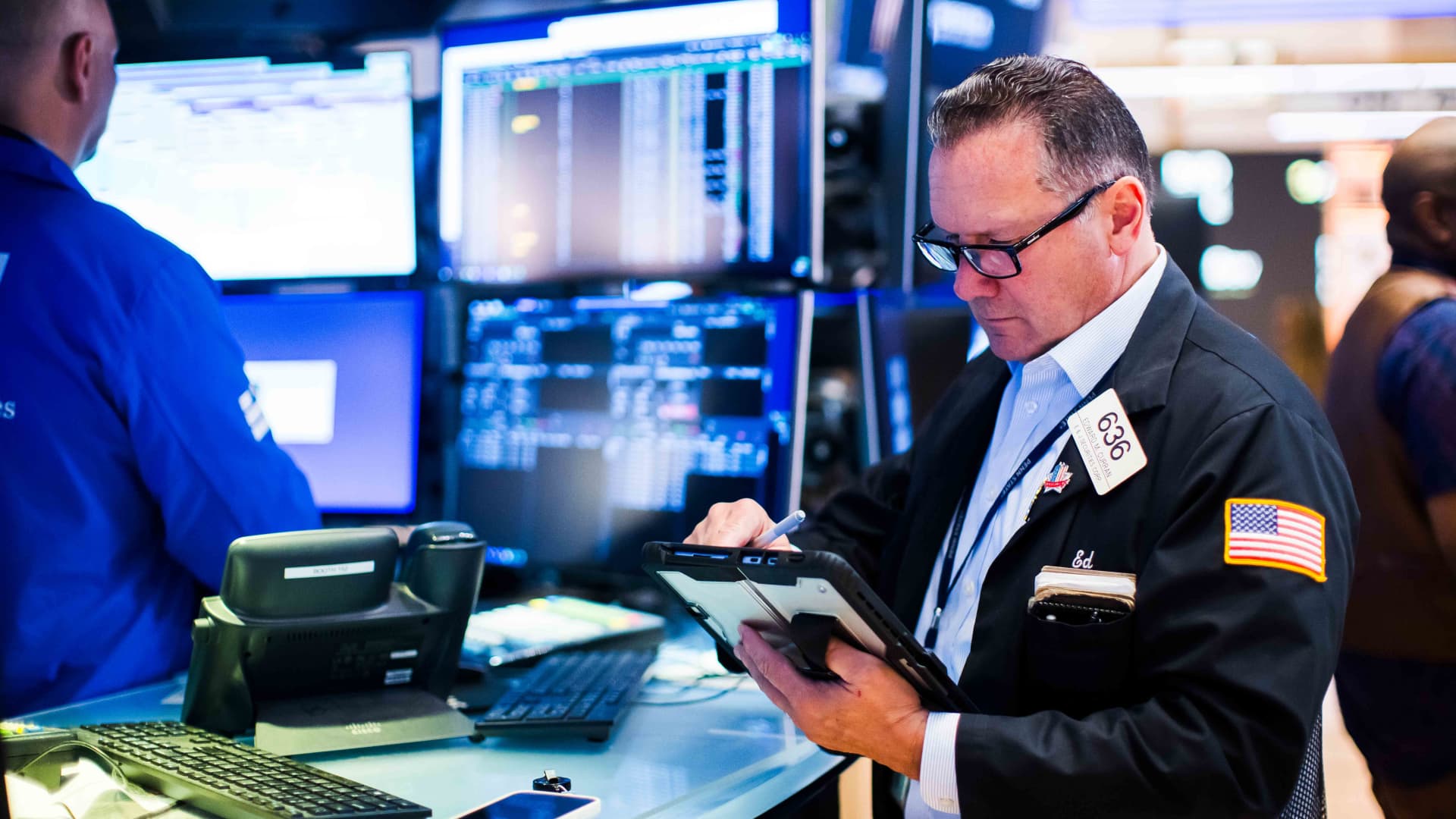
A trader works on the floor of the New York Stock Exchange.
NYSE
Goldman Sachs’ Ashok Varadhan has a simple message for investors worried about higher interest rates, elevated oil prices and the durability of the economy: stay invested.
Varadhan, the firm’s co-head of global banking and markets, pointed to three reasons for his constructive outlook: He doesn’t expect the Federal Reserve to raise interest rates this year, sees oil falling well below $70 a barrel later in 2026, and believes a resilient economy will increasingly benefit from productivity gains tied to artificial intelligence.
“Stay invested would be my advice,” Varadhan said in an episode of Goldman’s “The Markets” podcast last week.
His view on rates runs against market pricing that has reflected some risk the Fed could resume tightening amid lingering inflation concerns.
“I don’t think we will see hikes in the latter part of this year,” Varadhan said. “I think rates are going to stay on hold.”
Following a disappointing jobs report Friday, traders shifted their bets on when the Fed might hike. Odds for a move in September fell to around 50% on Monday and to 63% for October, according to the CME Group’s FedWatch gauge of futures prices.
Disinflationary force
Some of the forces that pushed inflation higher are beginning to recede, including the impact of tariffs, he said. An easing of geopolitical tensions around the Strait of Hormuz could further alleviate price pressures.
Varadhan also sees AI eventually becoming a disinflationary force. While the enormous infrastructure build-out needed to support artificial intelligence can strain resources and contribute to inflation in the near term, the productivity benefits should have the opposite effect once that capacity is in place, he said.
Oil is another reason for his optimism. Varadhan expects crude prices to retreat significantly as the year progresses, providing another potential source of relief on inflation.
“I think energy is going to go back down,” he said. “I think oil settles back down well below $70 a barrel, maybe even lower once we get towards the latter part of the year.”
West Texas Intermediate futures climbed back above $80 per barrel Monday as doubt grew that the U.S. and Iran will reach a deal to increase ship traffic through the Strait of Hormuz.
Resilient economy
The third pillar of Varadhan’s view is the resilience of the economy. Despite a series of external shocks, underlying nominal growth has remained remarkably durable, he said. If some of those pressures fade, the economy could continue to expand while benefiting from AI-driven productivity improvements.
That resilience is also keeping Varadhan constructive on credit. Heavy issuance means investors should demand somewhat more compensation for taking risk, he said, but the strength of the economy has helped prevent spreads from widening dramatically.
“If you think the exogenous shocks are going away and you still have the resilience of the economy,” Varadhan said, expectations for realized defaults can remain “fairly low.”
The S&P 500 has rallied back to a record high recently, bringing 2026 gains to more than 13%.
A packed week of catalysts is about to test three altcoins. Between now and Aug 16, one faces a large token unlock, another must prove its earnings can hold, and a third races toward a mandatory network upgrade.
That makes this a ‘three altcoins to watch’ list, each pulling a different way.
Token
Outlook
Main Catalyst
Arbitrum (ARB)
Bearish
92.65M ARB unlock on August 15; whales reducing holdings ahead of added supply
Hyperliquid (HYPE)
Neutral / Mixed
Trading fees and perp volume; stronger activity would support HYPE buybacks and price recovery
TRON (TRX)
Bullish
GreatVoyage v4.8.2 upgrade by Aug. 16, rising network fees, and strong USDT activity
Arbitrum (ARB) Heads Into a Big Unlock as Whales Trim
Arbitrum starts the week under supply pressure. On August 15, about 92.65 million ARB unlocks, worth roughly $7.37 million.
That equals about 1.4% of the circulating supply, and most of it goes to the team, contributors, and investors.

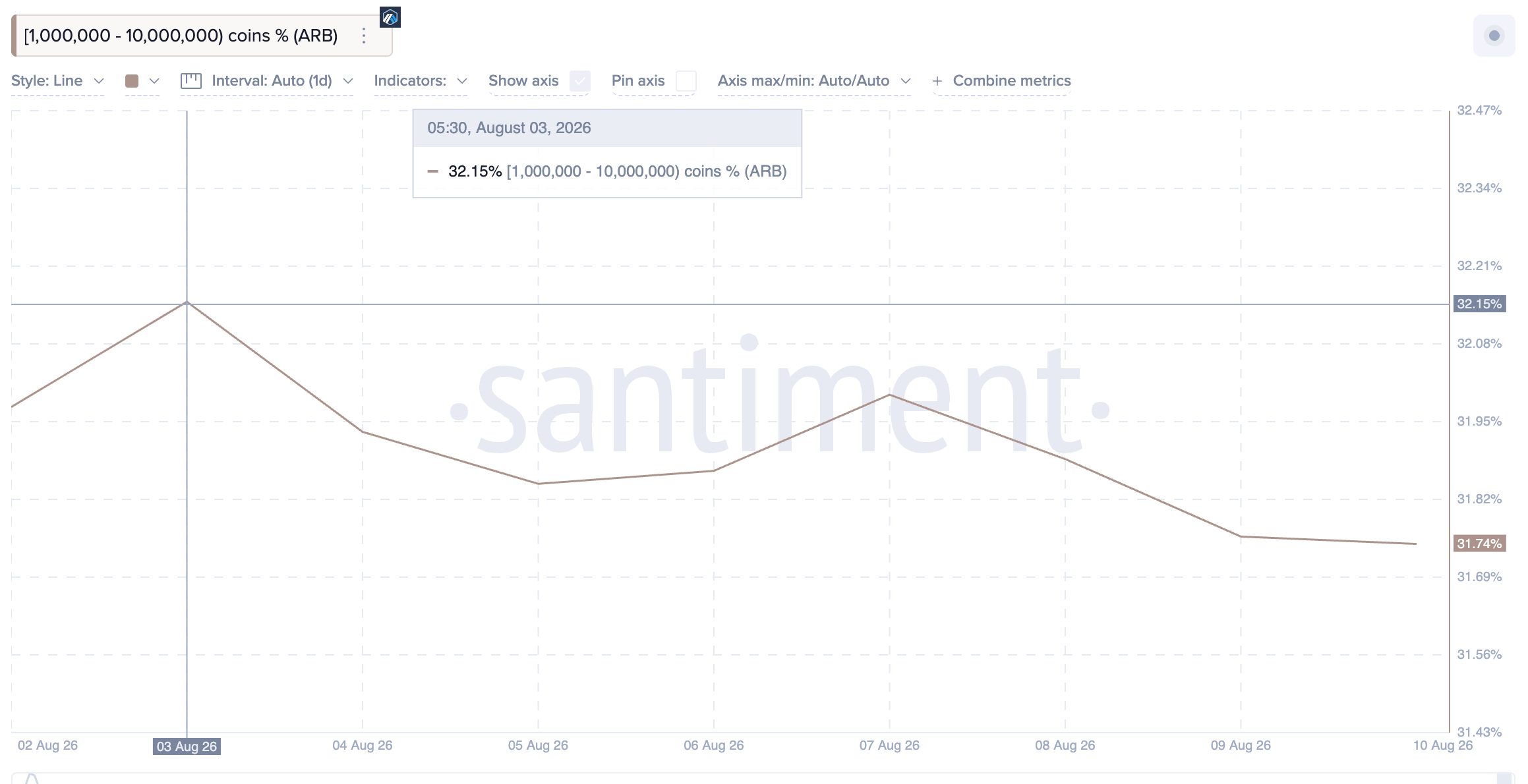
Large holders are already easing off considering the supposed supply pressure. Wallets holding 1 million to 10 million ARB slipped from 32.15% of supply on Aug 3 to 31.74% by Aug 10. This quiet whale distribution lines up with the coming token unlock.

However, the ecosystem has a longer-term boost. Robinhood built its new chain, which trades tokenized stocks, on Arbitrum technology.
It routes 8% of its net revenue to the Arbitrum treasury. For now, the token unlocks to watch tilt ARB bearish. The real risk is whether recipients move coins to exchanges.
Hyperliquid (HYPE) Earns Big, but Its Fees are Cooling
Hyperliquid is the mixed signal among the altcoins to watch. Its token has steadied this week, up almost 5%. Yet it still trades well below where it sat a month ago, down almost 18%. The question is whether the business supports that recent weekly bounce.
Want more token insights like this? Sign up for Editor Harsh Notariya’s Daily Crypto Newsletter here.
The protocol remains one of the highest earners in crypto. It booked about $9.37 million in fees and $6.44 million in protocol revenue over seven days.
That came on $38.9 billion in perpetual-futures volume, the value of leveraged bets on price. Annualized fees run near $1 billion.

However, weekly fees have cooled from the 30-day pace, and that is the crack to watch. Hyperliquid sends most of its trading revenue to a fund that buys back HYPE and burns it. That steady buying supports the price.
So those HYPE buybacks only hold up while trading activity stays high. If fees and volume climb again, the recovery has real backing. If they keep falling, the price is simply rising faster than the business behind it.

Hyperliquid’s case rests on trading activity that is now cooling. The next token, TRON, runs on network activity that keeps growing.
TRON (TRX) Guards a $90 Billion Base Before a Deadline
TRON closes the week with a hard deadline and the firmest setup. Node operators must install the mandatory GreatVoyage v4.8.2 “Pyrrho” network upgrade by Aug 16. It improves Ethereum compatibility and node reliability.
This matters because TRON is the leading stablecoin settlement rail for Tether’s USDT, the most-used stablecoin. It hosts about $91.7 billion, close to half of all USDT in circulation.
A clean upgrade lowers the risk of disruption for wallets, exchanges, and USDT transfers, which protects that base. Rising USDT on TRON already shows the demand.

The fundamentals support that view. Chain fees rose about 4.5% over the past week, and roughly four million accounts stay active each day.

TRX has also held near $0.33, keeping the token steady as the deadline nears.

That lead in stablecoin payments makes TRX the group’s bullish anchor.
Still, DeFi value locked slipped about 0.6% on the week, so settlement is strong even as broader DeFi growth stays unproven.
The post 3 Altcoins to Watch for the Second Week of August 2026 appeared first on BeInCrypto.


What this means: Strategy CEO Phong Le said the company has adjusted its approach after discovering that preferred stock investors put a premium on cash liquidity.
- Strategy now holds $4.75 billion in cash, providing about 2.7 years of dividend coverage, Le said in an interview on CoinDesk’s Public Keys with Jennifer Sanasie.
- Le said he initially assumed investors would value bitcoin highly because it is liquid and has appreciated significantly over time.
- But institutions and investors putting shorter-term money into Strategy’s products “value cash more,” he said.
The context: The cash cushion is part of Strategy’s push to evolve beyond simply buying and holding bitcoin into a broader digital credit business.
- Strategy has developed preferred-stock products such as STRC for investors seeking bitcoin-linked returns with less volatility.
- Le described a spectrum ranging from investors seeking amplified bitcoin returns to those looking for lower-volatility yields closer to traditional credit or money-market products.
- “Would I rather hold Bitcoin? Perhaps,” Le said. But making Strategy’s preferred products work ultimately supports MSTR and its bitcoin strategy, he argued.
Reading between lines: Le is pitching Strategy as a financial platform built around bitcoin rather than merely a leveraged bitcoin proxy.
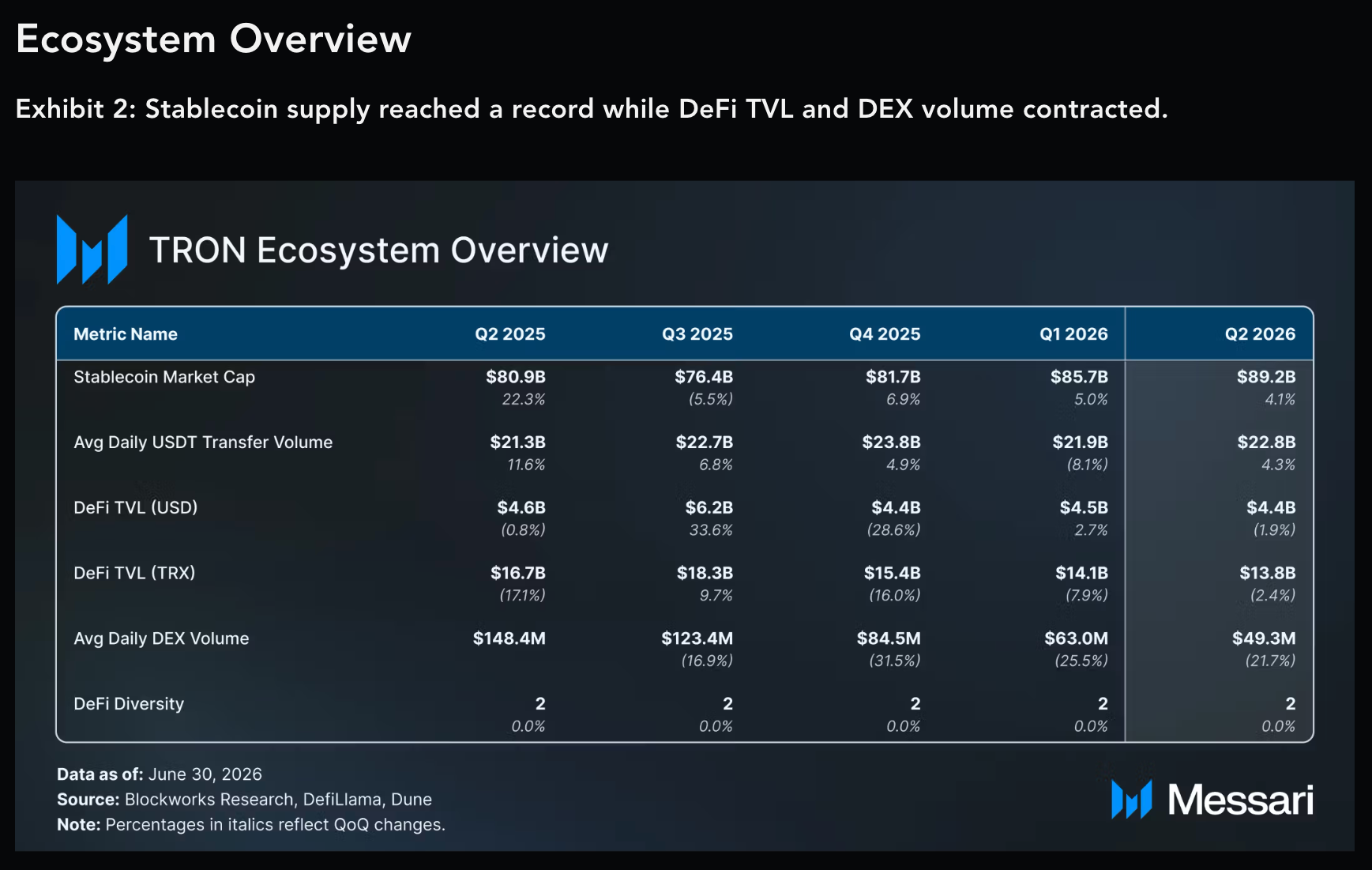
TRON, the layer-1 blockchain founded by Justin Sun, ended the second quarter with $87.9 billion in circulating USDT (USDT), surpassing Ethereum (ETH) while processing $2.1 trillion in USDT transfers during the period.
According to a Messari report, USDT accounted for 98.5% of TRON’s stablecoin market, which grew 4.1% quarter-over-quarter to a record $89.2 billion. Average daily USDT transfer volume also returned to growth, rising 4.3% to $22.8 billion after declining in the first quarter.
The increase coincided with record network usage. TRON averaged 11.8 million daily transactions during the quarter, up 8.7%, while average daily active addresses climbed 11.7% to 3.6 million. The network processed a record 14.6 million transactions on June 15, the report said.
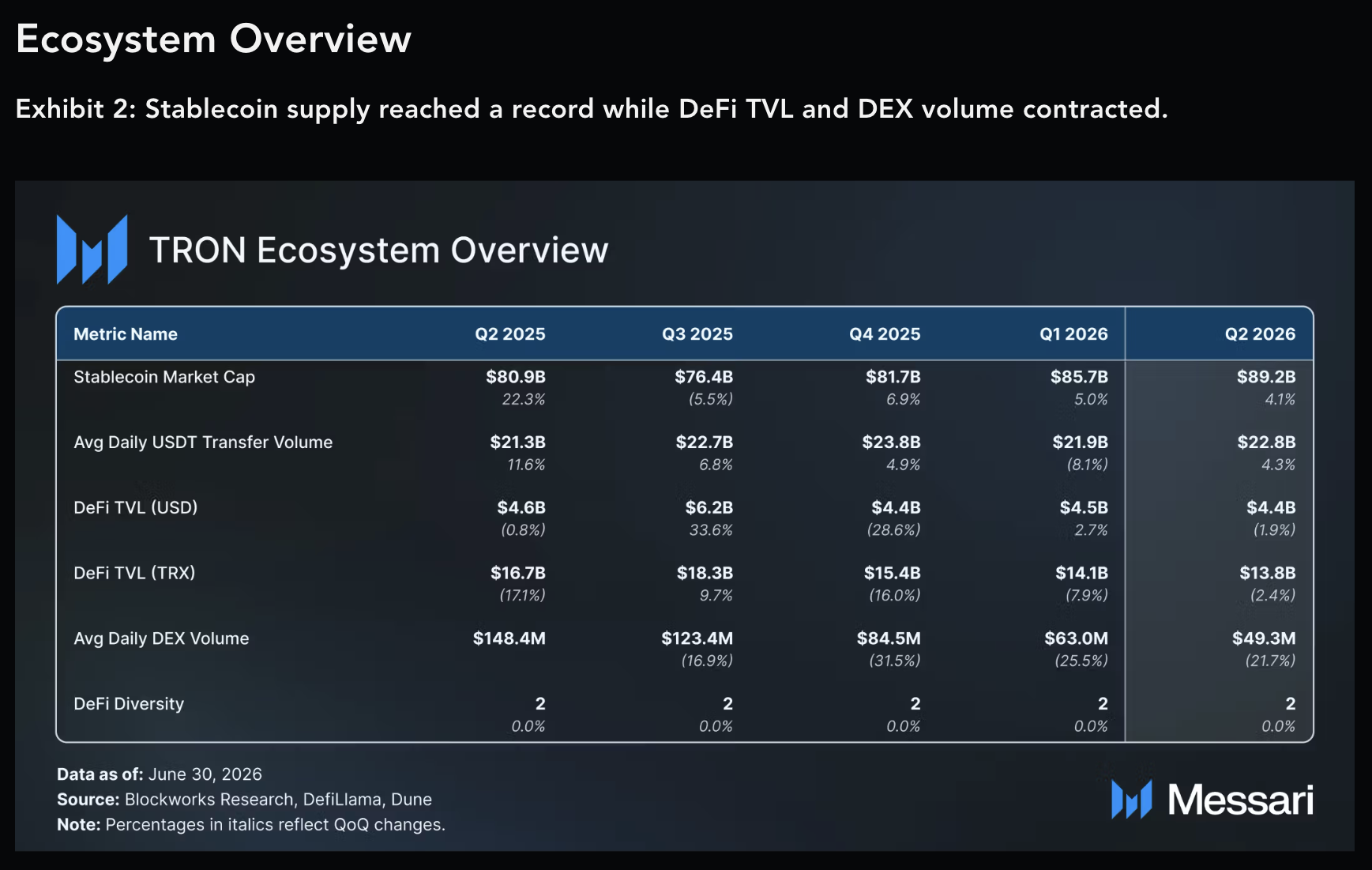
State of TRON Q2 2026 report. Source: Messari
Higher activity also helped reverse a two-quarter decline in network fees. Fees rose 15.9% to $699.4 million, their first quarterly increase since an August 2025 governance change cut the network’s energy unit price.
Growth was uneven elsewhere. DeFi TVL slipped 1.9% to $4.4 billion, while average daily DEX volume fell 21.7% to $49.3 million, marking a fourth consecutive quarterly decline. TRX supply also remained inflationary despite higher activity, with circulating supply increasing by 87 million tokens during the quarter as issuance continued to outpace burns.
Related: Base joins Ethereum, Tron, others in betting big on AI agent future
TRON expands institutional access
Institutional access to TRON widened during the quarter, with Securitize launching Hamilton Lane’s tokenized Senior Credit Opportunities Fund on the network, its first TRON-issued asset. The fund launched with about $4.3 million under management.
Asset manager Grayscale also added TRX (TRX), the native token of the TRON blockchain, to its list of assets under consideration, while a proposed staked TRX exchange-traded product from Canary Capital remained in registration.
Meanwhile, TRX saw broader market access during the quarter. Bitnomial launched spot TRX trading in the United States, while OKX Europe introduced MiFID-regulated TRX expiry perpetuals and Binance.US restored trading in the token.
That trend continued after the quarter ended, with Anchorage Digital adding native TRX staking and custody for TRC-20 assets in July, allowing institutional clients to stake TRX directly from its custody platform.
Magazine: Bitcoin will never fall below $60K again: Nansen founder


Ethereum staking has reached a record 41.7 million ETH, locking more than one-third of the cryptocurrency’s circulating supply despite a sharp decline in its market price.
Summary
- 41.7 million ETH is now staked, according to a CryptoQuant chart shared by Bitfinex.
- Staked ETH has increased by about 5.5 million ETH since January.
- ETH has fallen from approximately $3,400 to $1,900 during the same period.
- Ethereum developers are debating EIP-8363, which would reduce issuance as staking grows.
Ethereum staking climbs despite price decline
A CryptoQuant chart shared by cryptocurrency exchange Bitfinex on Aug. 10 showed that the amount of Ethereum (ETH) committed to staking had reached an all-time high of 41.7 million ETH.
The figure represents roughly one-third of Ethereum’s circulating supply. CoinMarketCap data places the asset’s supply near 120.7 million ETH, meaning approximately 34.5% is now staked.
“Staked ETH has climbed to a record 41.7 million, a third of all ETH in existence, while price fell from $3,400 in January to $1,900,” Bitfinex wrote.
The chart shows that staking deposits remained near 36 million ETH through late 2025 before beginning a sustained increase in February. Growth continued through the second quarter and accelerated again between June and August.
The increase comes despite ETH losing about 44% of its value from its January level. Ethereum traded near $1,900 when Bitfinex published the chart, showing that validators and long-term holders continued locking tokens even as spot-market conditions weakened.
crypto.news reported in January that 36.2 million ETH, or nearly 30% of the supply, had been staked. The latest figure represents an increase of approximately 5.5 million ETH in less than seven months.
Reinvested rewards keep staked ETH growing
Ethereum validators receive newly issued ETH for proposing blocks, attesting to transactions, and supporting network consensus. They may also collect priority fees and maximal extractable value.
Part of that income can be returned to staking, creating a compounding effect even when ETH’s dollar price falls. However, returns decline as more validators join because Ethereum distributes issuance across a larger staked balance.
Corporate treasury companies have become a major part of this trend. BitMine had approximately 4.9 million ETH staked as of July 12, equal to about 85% of its Ethereum holdings.
The company generated $45.7 million from staking and validation during the quarter ended May 31. Chairman Tom Lee projected that annual rewards could reach $284 million if BitMine stakes its entire ETH treasury, although returns depend on yields and validator conditions.
SharpLink has also committed most of its Ethereum treasury to staking. Its strategy continued generating ETH rewards even as lower market prices contributed to a $394.3 million second-quarter loss.
Record staking renews Ethereum issuance debate
The continued increase has renewed questions about how much ETH should be committed to network security and whether Ethereum’s reward curve encourages excessive staking.
EIP-8363, known as Tapered Issuance Burn, would burn a growing share of consensus-layer rewards as the staking ratio rises. The mechanism would remove issuance-based rewards when approximately half of Ethereum’s supply is staked.
As crypto.news previously reported, the proposal’s authors argue that the current system continues rewarding additional deposits even after they provide limited security benefits. EIP-8363 remains under review and has not been approved for an Ethereum upgrade.
SharpLink CEO Joseph Chalom has opposed the plan, arguing that native yield supports Ethereum’s institutional appeal and acts as a benchmark for returns across decentralized finance.
US institutions expand access to ETH yield
Staking has also become more accessible through regulated investment products in the United States. Grayscale distributed about $9.4 million in ETH staking proceeds to eligible ETHE shareholders in January, marking the first such payout by a U.S.-listed Ethereum product.
Morgan Stanley has also added staking provisions to its proposed Ethereum ETF. Its filing showed that 3.64 million ETH was waiting to enter validation as of May 18, implying an activation delay of approximately 63 days.
Continued institutional participation could remove more ETH from liquid markets. However, staking does not guarantee price appreciation, and the divergence between record deposits and ETH’s decline shows that supply constraints can be outweighed by broader selling pressure.

Wallets tied to crypto payments platform Coinsbuy were reportedly drained of more than $7.9 million in funds spanning Ethereum and TRON on Sunday, according to blockchain investigator SpecterAnalyst.
In a Telegram post, SpecterAnalyst said the attacker began routing the stolen assets into Monero via exchanges. The investigator also reported that ChangeNOW helped freeze a six-figure portion of the funds during the incident.
Key takeaways
- SpecterAnalyst alleges attackers moved stolen Ethereum and TRON funds into Monero through exchanges.
- ChangeNOW is reported to have frozen part of the assets, reducing what the attacker could immediately keep.
- Coinsbuy paused deposits and withdrawals after the incident, then restored both services.
- Coinsbuy says it covered all affected client funds from its own reserves, without client losses.
- The company offered a $100,000 reward for information identifying the responsible parties.
Reported theft and fund movement
SpecterAnalyst’s report claims the compromise involved multiple wallet addresses connected to Coinsbuy. The investigator identified three addresses associated with the stolen activity: two Ethereum addresses and one TRON address.
Rather than leaving the funds on-chain, the alleged operator reportedly initiated transfers aimed at increasing privacy. SpecterAnalyst stated that the attacker routed the proceeds into Monero through exchanges, a path commonly used in laundering attempts where the goal is to obscure fund trails across networks.
The investigator further indicated that ChangeNOW played a role in limiting the damage by freezing a portion of the stolen assets—described as a six-figure amount—after the incident began.
Coinsbuy confirms incident and compensates clients
Coinsbuy acknowledged the security incident in a statement shared with Cointelegraph, saying unauthorized withdrawals affected several platform wallets. The company said the impact was handled internally: all affected client funds were “fully covered… from our own reserves,” according to Coinsbuy’s statement, meaning users did not suffer financial losses.
Coinsbuy also stated that operations were restored and that the platform is “back to operating normally,” with deposits and withdrawals available again. In the immediate aftermath of the reported hack, the platform had temporarily paused those functions, a step that typically aims to stop further outflows while incident response teams assess wallet activity and implement controls.
While SpecterAnalyst reported a theft of more than $7.9 million, Coinsbuy did not confirm or dispute that figure. The company said it is investigating the event, but will refrain from disclosing technical details until the investigation is complete and its findings have been verified.
Reward program and what to watch next
Beyond compensating users, Coinsbuy said it is offering a $100,000 reward for information that leads to identification of those responsible. It also added that there would be an additional bonus for help recovering the stolen funds.
For affected users and monitoring communities, the most important open questions now center on how the compromise occurred and what controls failed—or were circumvented. Coinsbuy’s decision not to publish technical details yet means observers will need to watch for later disclosures that can clarify whether this was primarily a custody issue, an operational security lapse, a smart contract problem (if applicable), or something else entirely.
Given SpecterAnalyst’s claim that stolen funds were moved toward Monero via exchanges, the timeline for additional enforcement and tracing will likely depend on how quickly exchanges and compliance partners can identify related transactions and block further conversion or withdrawal routes. The reported freezing of a portion of funds highlights that intervention can matter during the early hours of such incidents, but it does not automatically indicate how much remains recoverable.
How this fits the broader crypto payments risk picture
Incidents like this underscore a persistent challenge for crypto payments and custody-adjacent businesses: even when clients are made whole, platform wallets become an attractive target because they concentrate balances, enable faster movement, and can provide an immediate payout surface if access controls are breached.
Coinsbuy’s statement that it covered client funds from reserves is a useful data point for users evaluating risk around payment providers—compensation reduces direct losses, but it still signals that operational disruptions can happen and that recovery efforts may be complex. The temporary halt in deposits and withdrawals also reflects the standard incident-response pattern: contain outflows, assess exposure, and then reopen services once systems are deemed stable.
Investors and builders in the sector may also want to pay attention to what controls Coinsbuy says it will improve later. The lack of technical disclosure right now makes it difficult to assess whether similar weaknesses could affect other platforms using comparable wallet management, exchange integrations, or withdrawal workflows.
Next, readers should look for updates from Coinsbuy’s investigation—especially any verified technical findings—and for additional reporting on whether more of the stolen funds can be traced, frozen, or recovered as the laundering path into Monero and off-chain exchange activity unfolds.

TRON USDT Supply Climbs to $87.9B as Q2 Transfers Hit $2.1T, Messari

Brian Kelly’s game-by-game 2026 predictions for LSU, Notre Dame

Volkswagen just gave the Atlas Cross Sport more power, more features, and more personality


-

 Fashion3 days ago
Weekend Open Thread: Mattifying Sunscreen
-

 Fashion3 days ago
Frugal Friday’s Workwear Report: Cap-Sleeve Pointelle Crewneck Sweater
-

 Sports5 days ago
Jordan Coyle & Cordiamo take Laya Arena Stakes at RDS
-

 News Videos2 days ago
Can Astrology Help Find Gold and Silver Trends? A Financial Astrology Guide
-
 Business5 days ago
US stocks: Dow closes at record on Mideast optimism; SpaceX, AMD drag Nasdaq
-
 Crypto World7 days ago
US Tech Stocks See Largest 5-Week Inflow in History: Can Nasdaq Break Its Downtrend?
-

 Politics4 days ago
Reform UK And Greens Sink To Lowest Favourability Ratings To Date
-

 Business6 days ago
Nvidia Stock Climbs 2.5% as Chip Sector Rally Builds Ahead of AMD Earnings, Nvidia’s Own Report Looms
-

 Crypto World6 days ago
Polymarket targets $20 billion valuation as competition heats up in prediction market sector
-

 Tech6 days ago
OpenAI, Anthropic AI agents targeted real people and systems in cyber tests
-

 Business5 days ago
Supply chain issues impact Ingredion
-
 Crypto World6 days ago
CLARITY Act Senate Vote Locked In, But 60-Vote Hurdle Looms Large
-

 Tech3 days ago
Rinn Pharma & Biopharma to join NordicPharmaTrain network
-

 Business2 days ago
How to Start a Cleaning Business: A Step-by-Step Guide
-

 Crypto World7 days ago
The Senate has one week: CLARITY’s last August window
-
 Crypto World6 days ago
Dow and S&P 500 Hit Records on AI Earnings: When Will the Bubble Burst?
-

 Business1 day ago
Datadog: Best Of Breed For Multiple Reasons
-

 Business7 days ago
CNH Industrial Shares Jump Over 15% After Beating Estimates and Raising Full-Year Earnings Guidance
-
 Crypto World6 days ago
Dollar Index Trapped at 100 as Hawkish Fed Meets Official Selling
-

 Business2 days ago
BDC Weekly Review: Private BDC Q2 Numbers Are Strong
You must be logged in to post a comment Login