
Crypto World
Your Shoe Size Can Change as You Age. Here’s Why


A study published in 2016 examined the foot measurements of 68 women aged 20 to over 80. It found that the widths of the balls of the feet increased by 3 to 4 millimeters per decade, while ball circumferences increased by about 5 to 7 millimeters, high-step circumferences 0.4 to 4.8 millimeters, and heel instep circumferences up to 2 millimeters.
“That may sound small, but these changes accumulate over several decades and can become enough to affect shoe fit,” Koury says.
If your feet seem to be getting wider or longer and you’re experiencing pain, swelling, numbness, tingling, or difficulty walking or doing other activities, see your doctor, Koury says. Also, talk to your doctor if you’re getting recurrent calluses, blisters, or skin breakdown, or if your bunions, hammertoes, or flatfoot are worsening. Sudden foot changes, especially if they only affect one foot, should also get checked, Srinivas says.


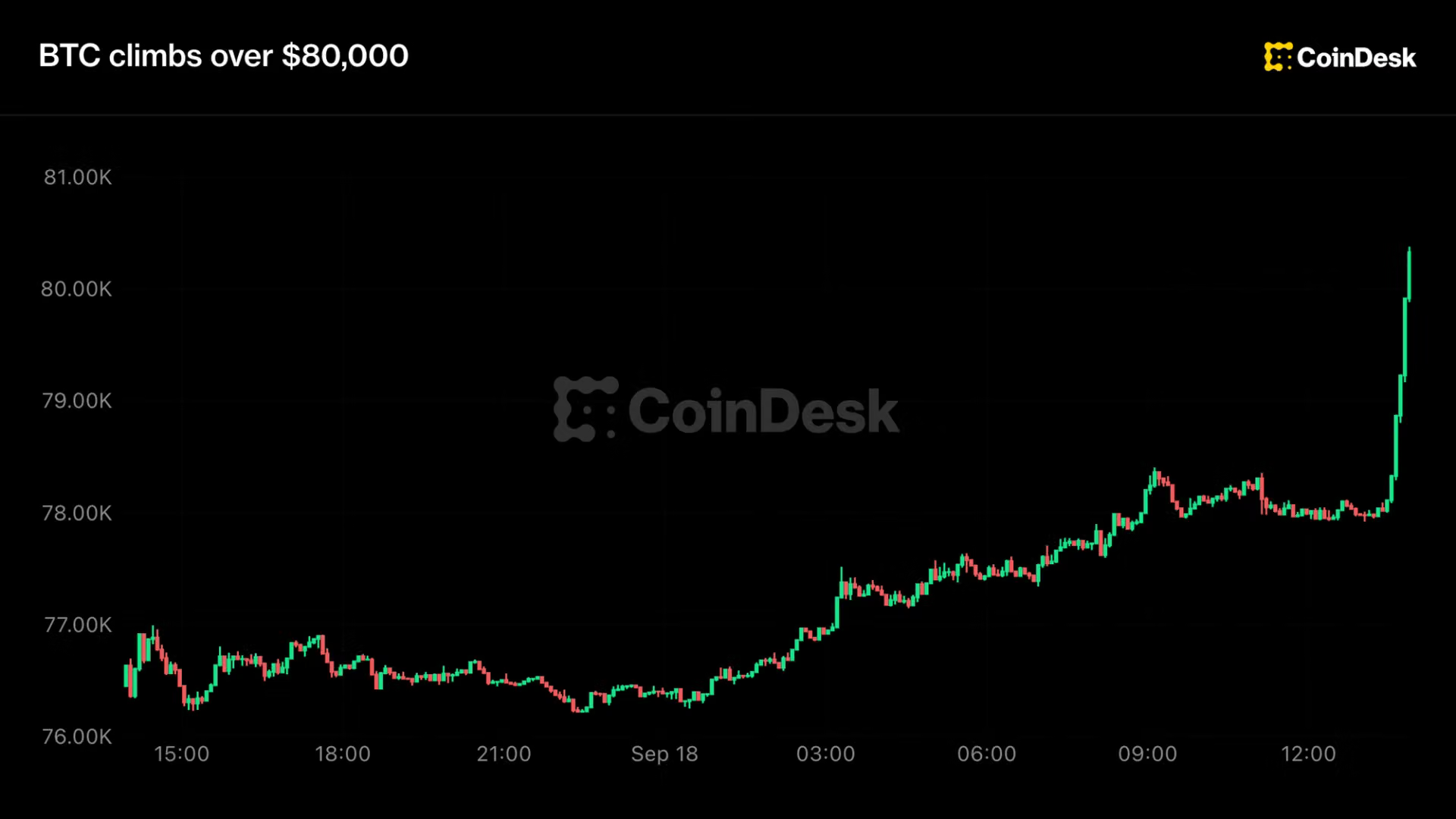
Bitcoin broke above $80,000 for the first time since September 7, while more than $183 million in short positions were liquidated within a single hour. Total liquidations during that hour reached $192 million. More than 100,000 traders were liquidated over the broader daily timeframe, but forced deleveraging on that scale does not by itself settle whether Bitcoin’s recent consolidation has ended.

Why Bitcoin Broke Higher Despite Recent Shocks
The move followed a volatile week for Bitcoin. The cryptocurrency fell to $75,000 on Tuesday evening following the setback to the CLARITY Act in the US Senate. A day later, the Federal Reserve raised its target range by 25 basis points to 3.75%-4.00%, its first increase since July 2023. Bitcoin rebounded almost immediately after the Fed shock and moved above $76,000.
Bitcoin then fluctuated in the following days before the Bank of Japan raised rates to a 31-year high. The decision was well received by the cryptocurrency market, with BTC rising to just over $78,000. It remained around that level for hours before rising above $80,000.

(Source – Coinglass, Bitcoin Liquidations – 4H)
CoinGlass data showed $192 million in over-leveraged positions liquidated in the final hour of the move, with shorts accounting for more than $183 million. BTC represented $119 million of those liquidations, and ETH another $36 million. Ethereum moved above $2,550 after a 2.3% hourly gain, while XRP rose above $1.35 after a 3% increase. SOL and BNB also posted gains.
The $80,000 Breakout and the $82,300 Test
The documented price sequence shows Bitcoin falling to $75,000 after the CLARITY Act setback, recovering above $76,000 after the Federal Reserve decision, later moving above $78,000 following the Bank of Japan’s rate increase, and then rising above $80,000. The $80,000 level had last been breached on September 7. The next step remains a technical question rather than a settled conclusion.
A move above $82,300 would therefore test whether the recovery can extend beyond the resistance that contained the August advance. A rejection at that level, by contrast, would be consistent with consolidation.
Don’t Miss: The Hottest Meme Coin Opportunities Silently Climbing the Crypto Ranks in September
The post Bitcoin’s $80,000 Return Faces an $82,300 Confirmation Test appeared first on Cryptonews.
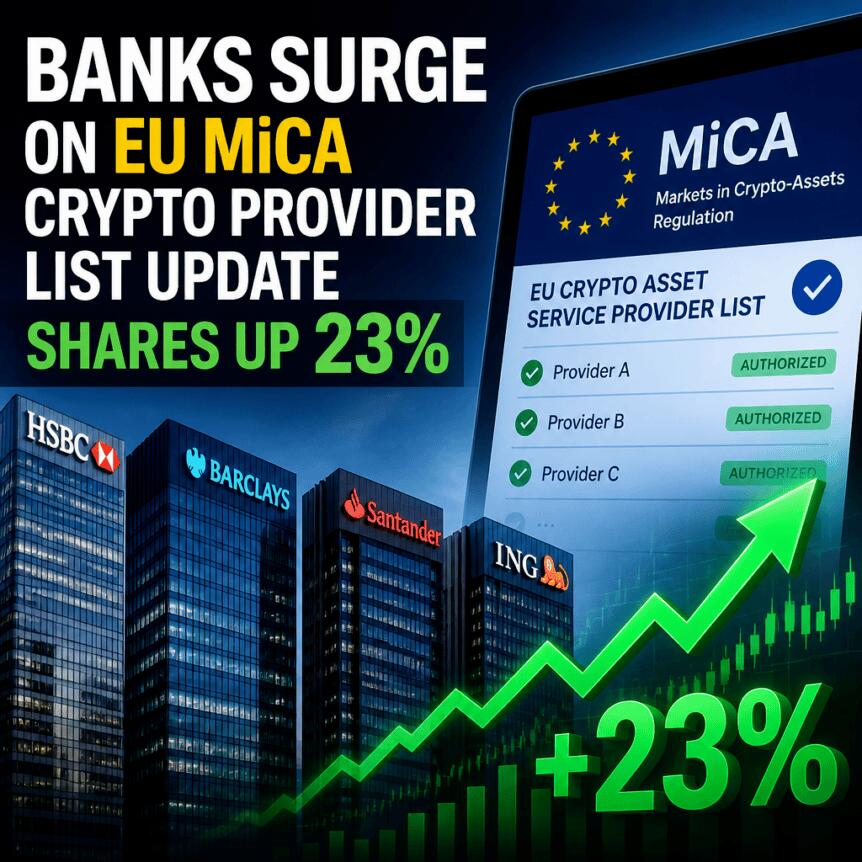
Banks are accelerating their push into Europe’s regulated crypto market, and the shift is showing up clearly in ESMA’s MiCA (Markets in Crypto-Assets) provider register. According to Cointelegraph’s analysis of ESMA data, banks expanded much faster than non-bank crypto-asset service providers over a roughly three-month window in 2026—changing the balance of who is listed under the EU’s MiCA framework.
Between June 26 and Sept. 16, the number of banks appearing on the MiCA register doubled to about 80 from roughly 40. Over the same period, the total count of listed crypto-asset service providers (CASPs) climbed from 243 to 349, but banks gained share as non-bank providers’ relative presence fell.
Key takeaways
- ESMA register data analyzed by Cointelegraph shows banks’ MiCA-listed footprint doubled to about 80 providers between June 26 and Sept. 16.
- Total CASPs rose to 349, but non-bank providers’ share slipped from around 84% to 77%—indicating faster bank growth.
- Banks increased from roughly 17% of the register in late June to nearly 23% by September.
- Germany is a major driver, with both large lenders and regional cooperative banks adding MiCA-covered capabilities.
MiCA register shows banks gaining share faster
The MiCA framework is designed to bring consistent rules to crypto-asset activities across the EU. In practice, the provider register offers a real-world view of which types of institutions are moving into compliance workflows.
Cointelegraph’s review of ESMA’s MiCA register shows that while the overall number of CASPs increased steadily—from 243 to 349—the change in composition matters. Non-bank providers still represent the majority of entries, but their dominance narrowed as banks expanded at a faster pace.
In late June, banks accounted for about 17% of the listed providers. By Sept. 16, that proportion was approaching 23%, even as non-bank providers remained the larger group in absolute terms. The implication for market participants is straightforward: regulated crypto services are no longer confined to crypto-native firms and fintech operators—incumbent financial institutions are increasingly participating.
Germany leads the banking expansion
Germany has been central to the acceleration. The additions include both major commercial institutions and a wave of cooperative and regional banks—suggesting the trend is spreading through established banking networks rather than remaining a large-bank niche.
Among the high-profile names is Deutsche Bank, Germany’s largest lender. It announced plans to launch digital asset custody services for institutional and corporate clients in Europe. In comments to Cointelegraph, a Deutsche Bank spokesperson said the bank expects to obtain regulatory approval for the offering under MiCA in October.
Beyond large institutions, Cointelegraph notes that Germany’s new entries also include numerous Volksbank, Raiffeisenbank, and VR Bank entities. That pattern matters because it points to a broader distribution of regulated crypto capabilities across the country’s regional cooperative banking base—potentially expanding access and competitive pressure well beyond the biggest banking groups.
Why banks can enter under MiCA’s Article 60 route
A key factor behind the speed of the bank listings is how MiCA treats credit institutions differently from standard crypto companies. While crypto firms that want to offer services typically must apply for authorization as CASPs, banks can provide certain crypto-asset services using a separate notification mechanism.
MiCA’s Article 60 allows a credit institution to provide crypto-asset services after it submits required information to its home regulator at least 40 working days before offering those services for the first time. In other words, banks can enter the market under a “notify and proceed” approach rather than running the full CASP authorization process that applies to many non-bank providers.
This procedural difference helps explain why the register’s composition can change quickly: banks have a pathway to start offering services sooner once their notification requirements are satisfied. For investors and other market users, it also means that more traditional institutions may show up on the compliance register—and potentially in real custody, trading, settlement, or other crypto-related workflows—before the market has time to fully price in their long-term scale.
At the same time, the notification route does not eliminate regulatory oversight; it changes the entry mechanics. The details of how each bank’s specific activities are scoped and how regulators review the notifications can vary in practice, so market watchers should focus not just on listings, but on what services are actually being launched and at what operational depth.
What to watch next as the register evolves
As banks keep growing their presence on ESMA’s MiCA register, the main question is whether this is a temporary surge driven by notification mechanics—or the beginning of a sustained reordering of Europe’s regulated crypto landscape. With Germany leading and large institutions like Deutsche Bank signaling custody plans, traders, institutional allocators, and crypto service users will likely want to monitor which banks move from listing to rollout, and how quickly non-bank providers adapt to the changing competitive environment.
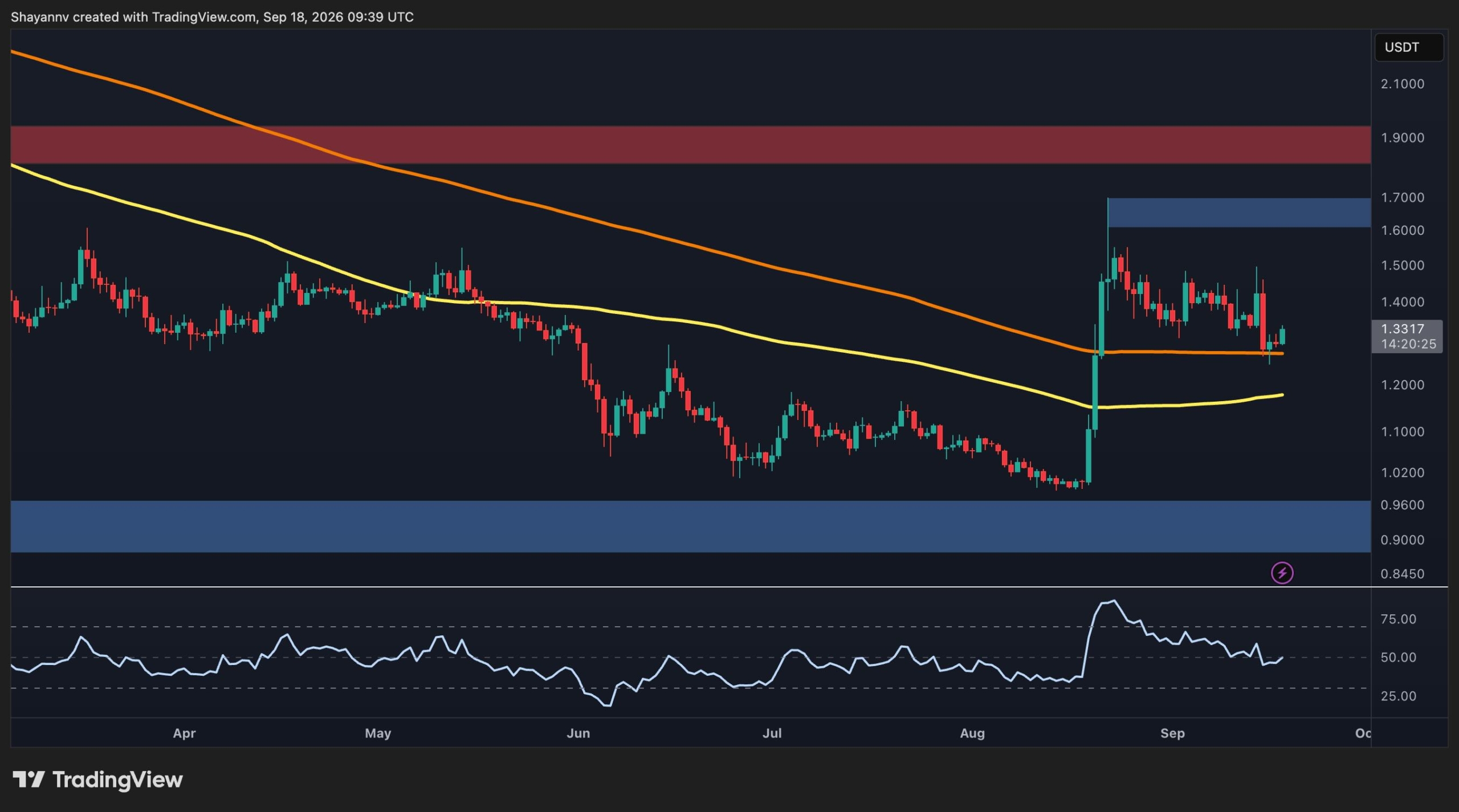
XRP is consolidating after a sharp recovery from the sub-$1 area, with the price now attempting to stabilize around $1.35. The daily chart shows a major structural improvement following the recent rally, while the 4-hour timeframe suggests that the asset is still trading inside a descending channel that is guiding a corrective price action.
Ripple Price Analysis: The USDT Pair
On the daily timeframe, XRP staged a strong impulsive move from the $1.00 support area to roughly $1.70 before entering a prolonged consolidation. The rally also pushed the RSI sharply into overbought territory, but the subsequent cooling-off phase has brought the indicator back toward the neutral 50 area.
The price is currently around $1.35, sitting just above the 200-day moving average at approximately $1.30. This is an important near-term area because holding above this zone would keep the recent structural recovery intact. The yellow 100-day moving average is also located lower, around $1.18, providing a deeper dynamic support area if the correction extends.
On the upside, the most visible resistance is the $1.60-$1.70 zone, marked by the recent swing high. A successful move through this region would put the larger $1.90 resistance zone back into focus.
On the downside, the chart’s major structural support remains around $1.00. This is substantially below the current market and therefore represents a broader invalidation area rather than an immediate support level.
The 4-Hour Chart
The 4-hour chart provides a more cautious picture. XRP has been moving inside a descending channel, with both the upper and lower trendlines sloping downward. The latest rejection from approximately $1.48 resulted in a sharp decline toward the $1.25 support zone and the lower boundary of the channel.
That support area has so far held, and XRP has started to recover toward $1.35. The immediate obstacle, however, is the $1.33-$1.37 resistance zone, which is currently being approached from below. A clean breakout and hold above this area would improve the short-term structure and could open the way toward the channel’s upper boundary around $1.40-$1.45.
Conversely, a rejection around this resistance area could lead to a move back toward the $1.25 support zone again. The lower channel trendline is also located in this area, making it an important level for the current consolidation and for investors, as losing it could lead to a much deeper correction in the coming weeks.

The post Ripple Price Analysis: What’s Next for XRP After an 8% Daily Surge? appeared first on CryptoPotato.
The New York Stock Exchange has spent roughly a year testing Avalanche technology and working with Ava Labs as it develops infrastructure for tokenized securities, according to Ava Labs President Charley Cooper.
Summary
- NYSE has spent roughly a year testing Avalanche technology while developing infrastructure for tokenized securities.
- Ava Labs President Charley Cooper said the two sides have built a close working relationship, but NYSE has not selected a blockchain.
- ICE said Avalanche meets many of its requirements as the exchange operator evaluates networks for its onchain plans.
- NYSE’s proposed platform would support tokenized U.S. stocks and ETFs with blockchain based settlement, subject to regulatory approval.
Cooper said during an appearance at the Avalanche Summit in New York on Thursday that NYSE had examined both the technology and economics behind Avalanche while assessing how the network could fit into its existing systems.
NYSE’s work with Ava Labs has involved questions extending beyond blockchain performance. Cooper said the exchange wanted to determine whether the company understood its business model and the requirements involved in operating one of the world’s largest securities markets.
“They weren’t just kicking the tires on our technology,” Cooper said. “They wanted to make sure that we understood their business and their economics.”
Ava Labs and NYSE have developed what Cooper described as a “close working relationship” during the process. He did not say that Avalanche had been selected as the blockchain for NYSE’s planned tokenized securities platform.
“I leave it to the NYSE guys to talk publicly about where they are in the whole process,” Cooper said.
NYSE has been evaluating Avalanche for its onchain plans
Intercontinental Exchange Head of Strategic Initiatives Michael Blaugrund appeared alongside Cooper at the Avalanche Summit, where the executives discussed ICE’s work on blockchain infrastructure and tokenized markets.
Blaugrund said ICE, which owns NYSE, has remained “very engaged” with the Avalanche team while evaluating potential blockchain networks.
“Avalanche checks a lot of those boxes for us,” he said.
NYSE has not publicly identified the blockchain or blockchains that will ultimately support its planned digital securities venue. Its proposed architecture is being designed to work with multiple blockchain networks for settlement and custody.
The exchange has been developing the project throughout 2026. In August, NYSE President Lynn Martin said the company was continuing to build onchain settlement infrastructure after the exchange first disclosed its digital trading platform plans in January.
The proposed venue combines NYSE’s Pillar matching engine with blockchain based post trade infrastructure. Subject to regulatory approvals, it is expected to support tokenized versions of existing securities alongside assets issued natively onchain.
Planned features include continuous trading, immediate settlement, fractional shares, dollar denominated orders and stablecoin based funding. Tokenized shareholders would retain conventional rights attached to the underlying securities, including dividends and governance rights.
NYSE’s plans do not mean its existing stock market will be moved entirely onto a blockchain. The company has described a separate digital venue that would operate through qualified broker dealers while connecting blockchain settlement with regulated U.S. market infrastructure.
ICE is building out its tokenized securities infrastructure
ICE has continued bringing outside infrastructure companies into the project while NYSE develops the trading and settlement system.
At the end of August, ICE agreed to invest in tZERO and license its blockchain patents as part of an arrangement covering infrastructure for the planned NYSE affiliated platform. Crypto.news previously reported that ICE tapped tZERO as a design partner for digital transfer agent and broker dealer systems.
Under the agreement, tZERO is expected to help develop infrastructure supporting the issuance, trading and onchain settlement of public securities. The companies did not disclose the size of ICE’s investment or provide a launch date for the platform.
The arrangement does not make tZERO the project’s exclusive infrastructure provider. NYSE had already signed a separate memorandum with Securitize in March, naming the company as its first digital transfer agent eligible to mint blockchain native securities for participating issuers.
ICE has left the underlying blockchain question open as those partnerships progress. The platform’s post trade architecture is intended to support several networks, leaving room for different blockchain systems to handle settlement and custody.
Avalanche has meanwhile been expanding its presence in regulated tokenization projects. In July, Japanese tokenization platform Progmat migrated its security tokens from Corda 5 to a dedicated Avalanche Layer 1.
Progmat said the migration covered every active security token project it managed, representing more than ¥452 billion in underlying assets and issued securities. The move gave the assets Ethereum Virtual Machine compatibility while allowing the platform to retain its existing issuance, ownership and transfer processes.
Institutional tokenization activity on Avalanche has continued outside Japan. Hanwha Investment & Securities reportedly completed a tokenized securities platform supporting Avalanche and Hyperledger Besu as South Korea prepares to bring blockchain based securities into its regulated capital markets framework in February 2027.
SEC exemption opens another route for tokenized stock trading
Regulatory conditions around tokenized equities changed this week after the U.S. Securities and Exchange Commission granted eligible venues conditional relief to trade tokenized U.S. stocks through permissioned automated market makers and liquidity pools.
The five year exemption applies to qualifying tokenized National Market System stocks under a set of conditions covering shareholder rights, smart contracts, trading limits and coordinated market halts.
Cooper pointed to the regulatory action while discussing how quickly onchain stock trading could develop. He expects some trading venues to begin offering 24 hour weekday access within the next year, though he stopped short of predicting that major exchanges would move on the same timetable.
“Will that be the mainstream exchanges? The largest in the world? The LSEs, the NYSEs, the CMEs? I don’t know about that,” Cooper said.
Smaller venues could move more quickly as they compete for liquidity, according to Cooper.
“There are a lot of smaller venues that are making a very compelling case to the world to put liquidity on them,” he said.
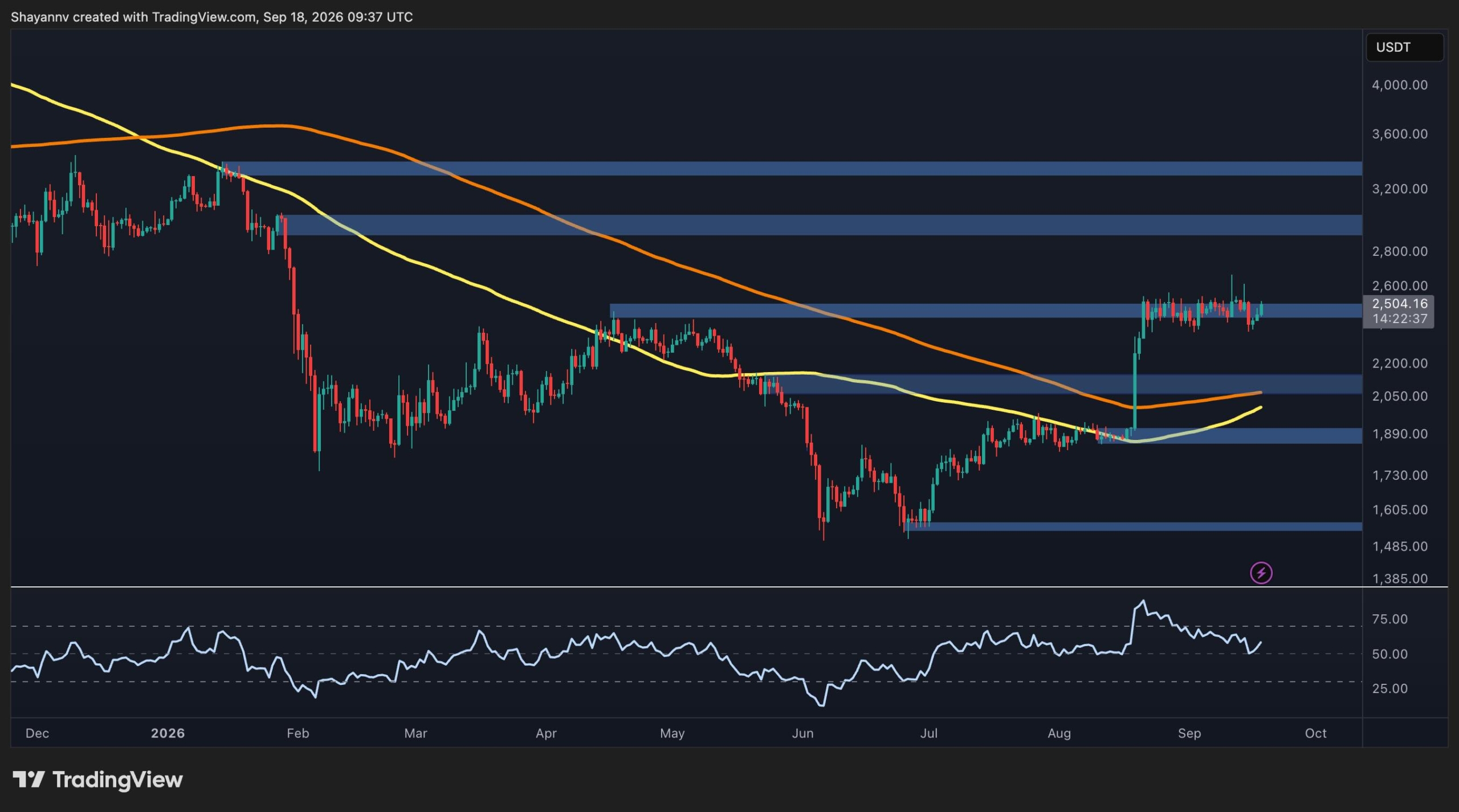
Ethereum has recovered sharply from its mid-year lows and jumped past the key $2.5K level on Friday. The charts show a constructive improvement in the broader market structure, although ETH remains below several important higher-timeframe resistance levels.
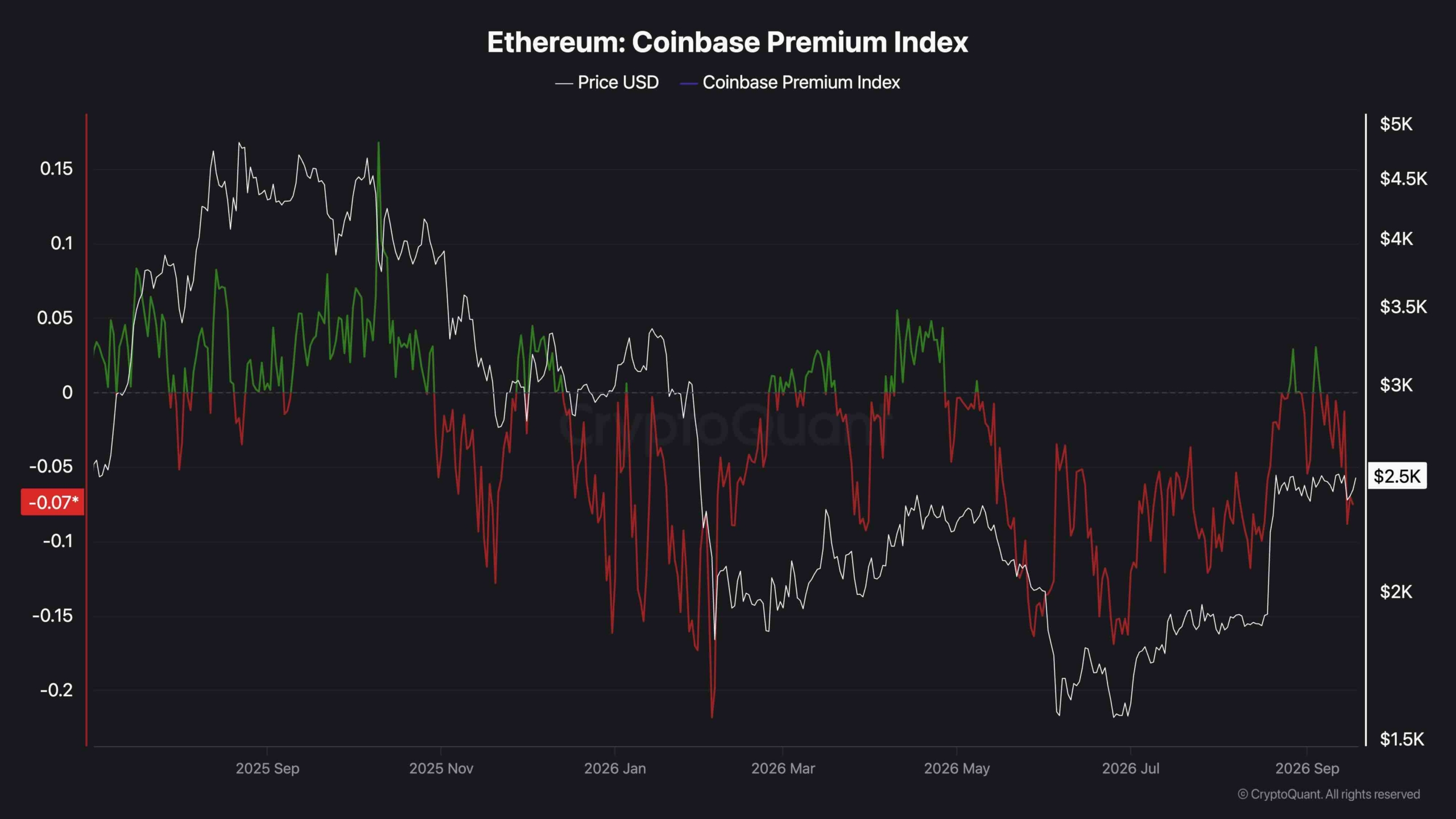
Meanwhile, the Coinbase Premium Index is once again negative, suggesting that the recent recovery has not been accompanied by consistently strong spot demand from U.S. investors.
Ethereum Price Analysis: The Daily Chart
On the daily timeframe, ETH has undergone a significant structural recovery from the $1.5K support area. The rebound has pushed price back above both the 100-day and 200-day major moving averages shown on the chart, with the 100-day yellow average aggressively pushing toward the 200-day one from below, likely to form a bullish crossover around $2K.
ETH is currently trading around $2.5K, directly inside a key resistance zone. This area has repeatedly contained price during the recent consolidation. Yet, a valid daily breakout above it can lead to continuation of the recovery.
A successful move above the $2.5K area could expose the next major resistance around $3.0K. Beyond that, the larger daily resistance zone sits around $3.3K-$3.4K, which coincides with the broader structure established earlier in the year.
On the downside, the first important support is around $2.1K, where the moving averages are also currently clustered. Below this area, the $1.9K zone becomes the next notable support. Still, the daily RSI is around the mid-to-upper 50s, meaning momentum is still bullish but not showing an overbought reading anymore. Therefore, there could still be room to the upside if sufficient demand emerges.
ETH/USDT 4-Hour Chart
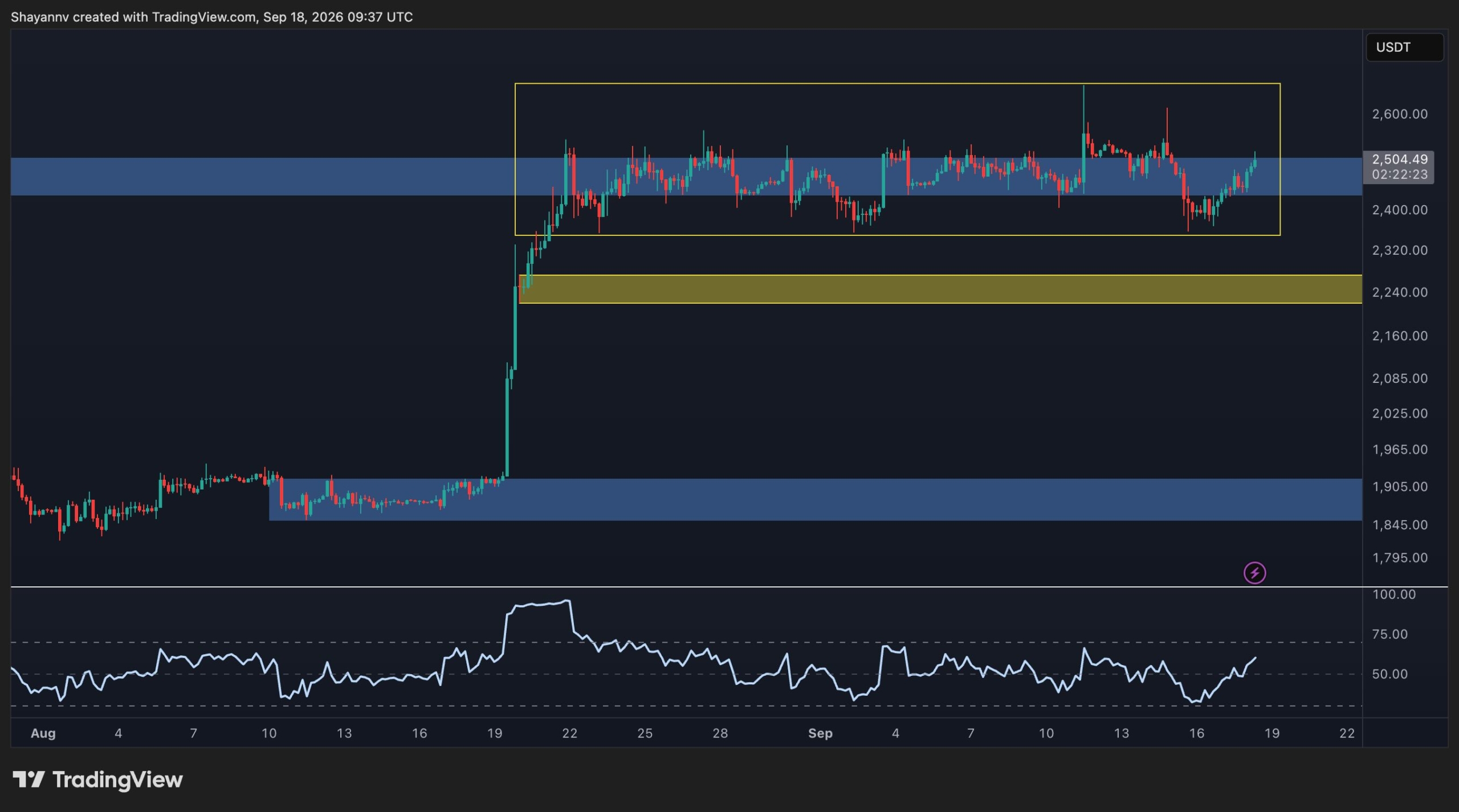
The 4-hour chart provides a clearer picture of the current consolidation. ETH has been trading inside a broad range roughly between $2.35K and $2.65K since the sharp late-August advance.
The latest price action shows ETH recovering from the lower portion of the range and returning toward the $2.5K area. The repeated reactions around the range boundaries suggest that the market is still in consolidation rather than an established directional breakout.
The immediate resistance is around $2.5K, followed by the upper range boundary near $2.65K. A decisive 4-hour breakout above the latter would provide a clearer structural shift and could open the way toward the higher daily resistance zones.
Conversely, rejection around the current resistance and a move back below $2.35K would weaken the short-term structure. Losing that zone would invalidate much of the current range-based bullish setup and bring the next major support into consideration, as a deeper retracement would be probable.
On-Chain Analysis
The Coinbase Premium Index is currently around -0.07, with the indicator spending much of the recent period below the zero line. The metric compares ETH prices on Coinbase with those on other major exchanges and is commonly used as an indication of relative buying or selling pressure from Coinbase’s predominantly U.S.-based market.
The notable point is the divergence between price and the premium index. ETH has recovered from roughly $1.5K to around $2.5K, yet the Coinbase Premium has generally remained negative during much of that advance. This suggests that the recovery visible on the price chart has not been accompanied by consistently strong US-based spot demand.
There have been brief positive spikes, particularly during parts of the summer, but they have not developed into a sustained positive trend. The latest reading has also returned firmly below zero.
This does not necessarily invalidate the broader recovery, since ETH can rise through demand from other venues and derivatives markets. However, a sustained move back above the zero line in the Coinbase Premium Index, particularly alongside a breakout above $2.5K, would provide additional confirmation that spot demand is strengthening, and that the recovery is likely to continue.
The post Ethereum Price Analysis: ETH Jumps Past $2.5K as Moving Averages Eye Bullish Cross appeared first on CryptoPotato.

The Trump Administration should push for technical exchanges on how to actually test models for dangerous capabilities and behaviors that neither country wants to see released into the wild. These include AI systems capable of helping amateurs develop bioweapons, or evading human oversight and control. American AI companies have been studying these risks for years, and they have also begun to appear in Chinese technical standards related to safety testing. Exchanging best practices and new insights about how to test for and mitigate these risks could render the systems built in both countries meaningfully safer.
These proposed technical exchanges would not depend on “trust” or even strict “reciprocity” between the two superpowers, nor would they require identical conceptions of AI risk. They would be driven by self-interest. As the most advanced AI models grow even more powerful, both countries have an interest in ensuring that these systems remain controllable, regardless of where they are built or deployed. That will require both countries to improve their model testing, monitoring and safeguards, and share promising findings that could enhance safety without surrendering a competitive edge or undermining national security.


Morpho has opened lending markets for five Coinbase tokenized stocks on Base, with users pledging $104,401 in stock tokens and borrowing $54,652 in USDC against them so far.
Summary
- Morpho has opened lending markets for five Coinbase tokenized stocks on Base, with $104,401 pledged as collateral and $54,652 borrowed in USDC.
- Apple, Alphabet, Nvidia, Meta and SpaceX tokens are supported, while five other Coinbase stock tokens currently have no Morpho markets.
- Borrowing jumped from $503 to $42,105 in roughly two hours on Sept. 16 and has since climbed to $54,652.
- All current borrowing is concentrated in variable rate markets, while Morpho’s 95 Midnight fixed rate markets have no outstanding loans.
According to Morpho, holders can now use the Coinbase issued assets as collateral and borrow USDC through variable rate markets or its Midnight fixed rate lending layer, giving eligible investors a way to access dollars without selling their tokenized stock positions.
The markets cover Apple (AAPLc), Alphabet (GOOGLc), Nvidia (NVDAc), Meta Platforms (METAc) and SpaceX (SPCXc). Coinbase currently has 10 stock tokens listed on Base, but Amazon, Microsoft, Strategy, SanDisk and Tesla do not yet have corresponding Morpho markets.
Morpho lending starts with five Coinbase stocks
Borrowing remained limited after the five markets were deployed on Sept. 7, with outstanding loans staying below $600 until Sept. 16. Morpho historical data showed borrowing climbing from $503 to $42,105 in roughly two hours that day before reaching $54,652 by Friday morning.
The lending activity follows Coinbase’s expansion of its tokenized equity products on Base. Coinbase initially released Apple, Nvidia, Meta and Alphabet tokens in August before adding six more stocks in September, taking the lineup to 10 assets. The second batch included Amazon, Microsoft, Strategy, SanDisk, SpaceX and Tesla.
Coinbase’s first four products are backed one for one by underlying shares held through a segregated custody arrangement, crypto.news previously reported. The tokens represent beneficial interests in the underlying securities and are designed to remain in self custodial wallets while interacting with supported applications on Base.
Coinbase Onchain SPV Ltd., an entity incorporated in the Abu Dhabi Global Market, issues the securities. The products are offered to eligible investors outside the United States and are not registered under the U.S. Securities Act.
Steakhouse Financial curates all five Morpho markets and determines parameters including collateral requirements. Its two Steakhouse High Yield USDC vaults account for 98.9% of the dollars supplied to the largest market.
For Apple, the two vaults supply $24,540 of the $24,805 deposited into the lending pool. Chipworks USDC accounts for another $262, while two wallets provide less than $3 combined.
Stock collateral carries different liquidation limits
Morpho’s Apple, Nvidia, Meta and SpaceX markets have a liquidation loan to value ratio of 62.5%, while Alphabet carries a higher 77% threshold.
Market contracts themselves do not enforce the geographic restrictions. Morpho said compliance controls are set through the stock tokens and their issuers, with the markets unavailable to U.S. persons and people in other restricted jurisdictions.
Coinbase’s tokenized stock structure already limits access to eligible non U.S. investors. Its first products launched under Regulation S, with each token representing an interest in an underlying security instead of a synthetic contract that simply tracks its price.
Chainlink introduced price feeds for the initial Coinbase stock tokens shortly after their Base launch, allowing lending protocols to calculate collateral values, borrowing limits and liquidations. Chainlink price feeds initially supported Apple, Nvidia, Meta and Alphabet, with each feed calculating the total return value of the corresponding token.
Morpho now uses its Chainlink V2 oracle adapter to price collateral in the five markets. The Apple feed showed $335.49 at 1:42 p.m. UTC on Friday, compared with a $337.52 price for the token on DefiLlama.
At a 62.5% liquidation loan to value ratio, the Apple market applies a 12.67% liquidation penalty. No liquidation has been recorded in the market since its deployment, while its largest borrower holds 113.46 AAPLc against a 20,360 USDC loan with a health factor of 1.17.
Variable rate markets hold all current borrowing
Borrowing has so far remained entirely on Morpho’s variable rate markets despite fixed rate alternatives being available through Midnight.
Apple, Alphabet and Nvidia are running at 90% utilization, matching the target set by their interest rate model. Borrowers in the markets pay 5.62%, while lenders receive 5.06%.
Meta has reached 97% utilization, pushing it past the model’s target and onto the steeper section of its rate curve. Borrowing costs have consequently reached 17.52%, with lenders earning 16.98%.
Morpho launched Midnight on Base in July as a fixed rate and fixed term lending system designed to let borrowers and lenders establish loan conditions without depending solely on variable rate models. The protocol was later expanded to Ethereum.
For each of the five Coinbase stock tokens, Midnight currently has 19 USDC markets, creating 95 fixed rate markets in total. Maturities run daily through Sept. 30 before moving to Oct. 30, Nov. 27, Dec. 25 and March 26, 2027, alongside an open ended market for each token.
None of the 95 markets has outstanding units, leaving the $54,652 in current stock backed borrowing concentrated in Morpho’s variable rate pools.
Tokenized stock collateral remains a small market
Around $11.4 million of the five supported stock tokens is outstanding on Base based on contract supply and Morpho’s oracle prices. The $104,401 deposited as Morpho collateral represents less than 1% of that amount.
Trading activity across Base’s tokenized stock sector has expanded more quickly. Token Terminal recorded $730.9 million in decentralized exchange volume over the 30 days ending Sept. 12, while daily volume reached a record $100 million.Base stock trading volume was led by Aerodrome, which processed $557.1 million during the measured period, with Uniswap v4 handling another $139.3 million.
Morpho holds $4.03 billion in deposits on Base and $10.42 billion across supported chains, according to DefiLlama. Base lists Aave and Euler alongside Morpho as protocols where eligible holders can borrow against Coinbase’s stock tokens.
MORPHO traded at $2.40 on Friday, up 11% over the previous 24 hours, with a market capitalization of $1.68 billion, according to CoinGecko. Bitcoin gained 4.9% over the same period, while ether rose 4.3%.

If youth is, as the saying goes, wasted on the young, then Horgan’s Alex is a character actually equipped to savor what little she has left of it. “I have 10 years left as a sexual person,” she determines in the premiere. With the petulant son, Ruarí (Aran Murphy, a near-clone of dad Cillian), whom she raised with minimal help from her ex-husband Lorcan (Owen McDonnell) packing up for uni, she’s resolved to end a long celibate streak. This search for not just a sex partner, but also the enduring love that has so far eluded her should be aided by Alex’s genuine youthfulness. But with guys like Lorcan and another former flame, Patrick (a rakish Rupert Friend), dodging adulthood with girlfriends decades their junior, the dating pool seems sparse. Set up on a blind date with a patient 67-year-old (Tim McInnerny’s Michael) who looks like he could be her dad, she can’t hide her disappointment. She treats him atrociously. Then again, the double standard that dictates she’s now too old for men her own age is also pretty atrocious.
Hyperliquid’s HYPE rose more than 11% to nearly $89 as of Asian morning hours Friday, the strongest move among the majors, according to CoinDesk data. Zcash’s ZEC added 8% to roughly $1,472 and Solana’s SOL 6% to just above $106.
BNB and DOGE each gained about 4%, with XRP, ether and bitcoin up 2%. TRX was the laggard at under 1%.
Bitcoin traded just below $78,000 after touching $75,972 during U.S. hours, recovering the whole of that overnight drop and marking a third consecutive day of gains. Total crypto market value rose 2% to roughly $2.66 trillion.
None of the 40 most liquid coins fell over the period, according to FxPro chief market analyst Alex Kuptsikevich, who said traders are “cautiously shifting their focus towards altcoins” even with the altcoin season index still subdued. NEAR led that group at 30%, followed by UNI at 26% and APT at 18%.
The move came with equities rising and a broader appetite for risk, a day after the Fed’s quarter-point hike landed without the reaction traditional markets had braced for.
Bitcoin faces the upper edge of its established trading range near $82,000. Kuptsikevich expects profit-taking into the weekend to delay any attempt at it.

Hacktron AI says it managed to hack OpenAI in less than 72 hours. The security research team revealed that it chained two separate vulnerabilities to gain access to ChatGPT and Codex accounts belonging to OpenAI employees. To prove the access was real, the researchers used an employee’s Codex account to open a harmless pull request in OpenAI’s internal monorepo rather than accessing sensitive code. The entire attack started with something that sounds relatively harmless: uploading an image.
Hacktron shared the details in a technical write-up on September 13, while also summarizing the exploit chain on X.
According to the researchers, the chain looked like this:
- HEIF upload → libheif heap overflow → remote code execution → OpenAI SSO flaw → ChatGPT/Codex takeover → connected GitHub → internal repository
Key Takeaways
- Hacktron AI says it compromised OpenAI systems in less than 72 hours.
- The attack began with a HEIF image upload and a vulnerability in libheif.
- An OpenAI SSO flaw allegedly allowed the researchers to move from the compromised forum to employee ChatGPT and Codex accounts.
- A connected GitHub integration provided a path to demonstrate access to OpenAI’s internal repository.
- OpenAI says it fixed its side of the issue about 14 hours after the report and later paid Hacktron a $6,500 bounty.
- The research highlights how AI can accelerate vulnerability research and exploit development, although Hacktron says human guidance was still necessary.
The Hack Started With a Heif Image
Hacktron was looking at the image-upload system used by OpenAI’s community forum, which runs on Discourse. The researchers noticed that HEIC and HEIF images were processed differently from other image formats. Because Discourse’s usual image-checking tool did not support HEIF, those files were passed to ImageMagick for conversion.
That meant the uploaded files eventually reached libheif, an image-processing library responsible for handling the format. Hacktron then discovered a heap buffer overflow in the version of libheif used by the environment.
According to the team, some security fixes had not been backported to the Debian package. This left the library vulnerable to a memory corruption attack that could provide out-of-bounds read and write capabilities. In other words, a specially crafted image could become much more than just an image.
AI Helped Turn the Bug Into an Exploit
This is where the story gets particularly interesting. Hacktron says it used AI models to help investigate and exploit the vulnerability.
The researchers initially worked with Claude Opus 4.8, asking it to examine the installed libheif package for potential security problems. The model helped identify the relevant vulnerability, but getting a reliable exploit working proved difficult when ASLR was enabled.
Then Anthropic released Claude Opus 5. Hacktron says the new model was able to produce a working ARM64 exploit within about three hours. The researchers then had it adapt the exploit to the x86-64 environment and the jemalloc configuration used by Discourse.
By the morning of July 25, the team says it had confirmed remote code execution through an image upload. And that was only the beginning.
The Openai SSO Flaw Changed Everything
Getting code execution on the forum wasn’t enough to reach OpenAI employee accounts. Hacktron discovered that the forum supported “Sign in with OpenAI” through OpenAI’s authentication infrastructure at auth.openai.com. The researchers believed this SSO setup could provide a route from a compromised forum account into other OpenAI services.
According to Hacktron, they were able to confirm that assumption. The researchers said they took over an OpenAI employee’s ChatGPT and Codex accounts. That employee’s Codex account was connected to OpenAI’s GitHub organization.
Rather than digging through OpenAI’s internal source code, Hacktron used the compromised Codex account to create a pull request in OpenAI’s internal monorepo. The team described the pull request as a harmless proof of concept and stopped testing after demonstrating the access.
OpenAI Fixed the Issue Within Hours
Hacktron reported its findings to OpenAI through the Bugcrowd bug bounty program on July 25. According to the team’s timeline, OpenAI confirmed that its side of the issue had been fixed at around 22:49 UTC, roughly 14 hours after the initial report.
The researchers also reported the underlying Discourse vulnerability to Discourse through HackerOne. Discourse responded the next day and had a fix ready by July 27. The company also added sandboxing for ImageMagick as an additional security measure.
OpenAI later awarded Hacktron a $6,500 bounty for the OpenAI-side vulnerability. OpenAI clarified that testing against the Discourse-hosted community forum was outside the scope of its bug bounty program.
The Bigger Concern Is AI-Assisted Hacking
For Hacktron, this wasn’t just another vulnerability disclosure. The researchers say the experiment shows how AI is changing the amount of time and expertise required to turn vulnerabilities into working exploits.
Hacktron said the OpenAI and Discourse attack took a few days for an AI agent and only a few hours of human effort. Its broader HEIF Heist research reportedly involved three researchers and cost less than $3,000 in AI tokens.
The team is careful to point out that the process wasn’t completely autonomous. Human researchers still provided guidance and made important decisions during the operation. Still, the speed is notable. Hacktron argues that tasks that once required highly specialized security expertise and significant amounts of time can increasingly be accelerated by AI.
The incident also shows why vulnerabilities in seemingly ordinary software can have much wider consequences when that software is connected to authentication systems and other services.

EA Sports FC 27 review – the best football game since FIFA

Wendy’s franchisee files for Chapter 11 bankruptcy protection
Bitcoin’s $80,000 Return Faces an $82,300 Confirmation Test



-

 Fashion7 days ago
Weekend Open Thread – Corporette.com
-

 Tech5 days ago
The Latest Weird Thing to Play Doom Is the Mapped-Out Brain of a Fruit Fly
-

 Crypto World4 days ago
Kraken Lets xStocks Holders Earn Yield Through DeFi
-

 Entertainment7 days ago
News Specials, Movies, Shows, More
-

 Crypto World2 days ago
US Charges Robinhood Engineers Over Crypto Listing Trades
-

 Crypto World6 days ago
Can AI Build a Startup in 72 Hours? Elon Musk's Team Will Livestream the Test
-

 Crypto World4 days ago
Elon Musk Drops a Bombshell: Grok 5 Could Be the AGI Breakthrough
-

 Business5 days ago
Rivals Sam Altman and Elon Musk Rally Behind Dario Amodei’s Call for a Slowdown in AI Development
-

 Crypto World3 days ago
What Is the Status of the U.S.-Iran Peace Talks? Here's What Both Sides Are Saying
-
 NewsBeat4 days ago
‘Sick conspiracy’: Trump says only guardrails AI needs is ‘a strong and smart (High IQ!) president’ in all-caps rant
-
 Crypto World5 days ago
New Tesla Roadster Uses SpaceX Tech. Will It Impact the Stock Price?
-

 Crypto World6 days ago
Robinhood Chain Never Stopped But its Blobs Did Stop Reaching Ethereum For 14 Minutes
-
 Entertainment7 days ago
New Horror Movie Officially Earns a Rare Stephen King Recommendation
-
 Crypto World3 days ago
NVIDIA Analysis: Attempted Rising Wedge Breakout Amid Pressure on the AI Sector
-

 Business6 days ago
Marvell: Most Potent Setup Of The AI Factory Decade
-

 Crypto World4 days ago
DOJ Seeks to Seize $61M in Iran Oil Funds From Binance Accounts It Vouched For
-

 Crypto World6 days ago
Bitcoin ETFs lose $462.7M as Ethereum funds gain $196.9M
-
 Crypto World4 days ago
3 Token Unlocks to Watch in the Third Week of September 2026
-

 Crypto World4 days ago
Revolut Attackers Warn of Ongoing Daily Customer Data Leaks
-
Business4 days ago
SK Hynix ADRs Fall More Than 6% as Memory Rally Breaks on Fears of Slower AI Spending
You must be logged in to post a comment Login