This year’s edition of EA’s all-conquering football game franchise adds an appealing social hub and much-needed tweaks to fundamental gameplay.
Right now, with the Premier League back in full swing, following the World Cup and the shortest of off-season periods, football feels more ubiquitous than ever, at least in the real world. In the world of video games, meanwhile, another bout of football fever is set to hit consoles and PC, with the arrival of EA Sports FC 27, the latest instalment of the world’s most successful football game.
The video game series once known as FIFA until – in what looks like an increasingly prescient move – EA split with the world football governing body in 2023 is, along with Call Of Duty and some American sports sims, one of the few annual franchises left in gaming. Which creates a yearly dilemma for fans of the franchise, over whether this year’s offering brings enough to the table to justify buying it and essentially abandoning last year’s game.
As ever, it’s equally difficult to offer a definitive verdict on that question, especially since FC 27, like its predecessors, is a sprawling and multi-faceted video game designed to appeal to a number of different gaming constituencies. From the online hardcore fan with pro player aspirations to those who enjoy five-a-side kickabouts, EA Sports FC is a franchise that aims to please everyone – even if it’s not always on target.
Advertisement
EA Sports FC 26 was pretty good, but FC 27 is demonstrably better than its immediate predecessor in many key, fundamental aspects – most notably improved mechanics that apply to the actual football which you play in the game. All of FC 26’s most glaring faults, such as an odd tendency for balls to ricochet unrealistically off intercepting defenders and into the path of lurking forwards, have been eliminated. Plus, judicious structural tweaks have been made to stop FC Ultimate Team (FUT) fans from creating teams full of super-players that turned the latter stages of that part of the game into a series of stalemates.
There’s one major new addition to FC 27 which EA clearly hopes will drive sales, out of a sense of curiosity at the very least. It’s called The Grounds and is simple enough to describe; it’s a new social hub for the game, designed to celebrate all aspects of modern football culture, which you can physically navigate as your own avatar. As such, it is conceptually similar to The City, a similar hub that can be found in 2K Games’ recent NBA 2K games.
Expert, exclusive gaming analysis
Sign up to the GameCentral newsletter for a unique take on the week in gaming, alongside the latest reviews and more. Delivered to your inbox every Saturday morning.
Mercifully, in execution The Grounds in no way resembles The City (the latter being annoyingly brash, commercially focused, and Americanised). It’s split into three areas inspired by English, French, and Argentinian football culture, and is sufficiently quirky and believable (for example, in the Argentinian area, you find random people having barbecues, while the English one has a pub which, sadly, you can’t actually enter) to provide an environment which is pleasant enough that you feel inclined to explore it fully.
Advertisement
It’s also studded with a large number of jump-in street football style minigames, ranging from 1v1 to 5v5 formats, along with plenty of quirkier variations, such as Balloon Ball. This gives each player three balloons that your rival must burst, by kicking balls at them and employing power-ups such as tyres that spawn and trip them up. All of The Grounds’ areas are dotted with green glowing targets, and you can spawn balls to drop kick at them; this often generates other targets (sometimes hidden behind metal dummies used to simulate stationary players in training), creating puzzles which are surprisingly satisfying. Although, at least until The Grounds is fully populated with real players, you aren’t rewarded much for solving them.
Renditions of real players including Kylian Mbappé, Paulo Dybala and Chloe Kelly act as your mentors in The Grounds, and you are rewarded for performing tasks they set. Those who despise microtransactions beware though, since The Grounds has its own new currency, along with shops filled with cosmetic items in which to spend said virtual cash.
The Grounds also operates as the game’s new home for Clubs, the 11v11 competition in which you control a single player, which is a popular destination for FC players who want to play online in a more casual manner. It makes sense that Clubs should reside within The Grounds, and The Grounds will particularly resonate with the sort of modern gamers who like to express themselves via outrageously dressed avatars.
Advertisement
Football strikes back (EA)
In FC 27, there’s particularly good news for those whose preferred first port of call in the game is Manager Career, the mode in which you take charge of a club (most likely the one you support) and demonstrate your managerial skills. This year, Manager Career has been extensively revamped to make it more realistic, taking greater account of the way in which modern player transfers come about.
That means those who insist on wringing every ounce of value out of transfers can negotiate individually with players’ entourages, as well as the clubs that own them, and even after negotiations are concluded it takes a while before players you buy can actually be deployed on the pitch. But you can also cave to demands, getting those players you really want quickly. As a Spurs fan, for example, I was easily able to offload Richarlison for a decent fee and replace him with Brentford’s Igor Thiago. EA could easily have made the transfer system more complicated than previously, but instead it just seems more logical and believable.
Another new element which plays into that transfer system, but mainly into the man-management of your squad, is Dynamic OVRs. OVRs are just your players’ overall ratings but whereas previously they were set in stone, in FC 27 they are affected by various factors including morale, form, and fitness. Which, again, seems to make more logical sense than the previous system and means that you have to rotate your players much more assiduously than before, over the course of a season.
Unhappy players will send you text messages, to which you must pick the right response, and the Dynamic OVR system also dangles the prospect of, for example, picking up players on the way back from injury on the cheap. Overall, FC 27’s Manager Career is a triumph, and if it’s your preferred element of the game, you’ll be impressed by how much better it is than its equivalent in FC 26.
Advertisement
Player Career, meanwhile, is quite similar to that of FC 26, with the obvious addition of Dynamic OVRs, but that isn’t necessarily a bad thing, since it previously worked pretty well and in FC 27 proves as addictive as ever.
One thing it does provide, though – as does Manager Career – is an opportunity to appreciate the much-needed tweaks EA has made to fundamental gameplay, going so far as to rip out various physics engines and rethink animations in certain scenarios. The free kick and corner taking systems have been rethought, so that having set your initial delivery you can then take control of the striker you’re aiming for before the set piece takes place. We still found that with corners, in particular, end results were a bit mixed, but they at least feel under your control, rather than semi-automated.
Crosses now actually go where you aim them, making them much more of a weapon, whereas previously you would have tended to get to the byline and pull the ball back along the ground. General player movement, especially of forwards, is also vastly better than it was previously. Attackers curve their runs more intelligently, so don’t stray offside so much, and it’s much easier to time productive passes from midfield into, for example, channels for wingers or inside forwards.
The tendency for central defenders to charge unhelpfully up the field has also been curbed, by simply giving you more control over your defenders’ movement; in FC 27, you spend more time making sure the correct one of your defenders is highlighted, but at least you feel in full control.
Advertisement
The women’s game is still covered very well (EA)
The nature of FUT, which develops as you collect player cards over the course of a whole season, means that it’s pretty much impossible to assess accurately until FC 27 has been on the market for quite a while. And yet FUT players are notoriously demanding and difficult to please.
But the changes that EA has made to it for FC 27 certainly make logical sense. The headline addition is a gallery, which offers a virtual repository for all the vast amount of players and ephemera that you will collect over the course of a FUT season. But it also offers a new means of progression in your FUT season, with its own collection challenges that provide a sort of echo of squad building challenges (SBCs), albeit without the complication for which SBCs became notorious.
A new addition for FUT is holographic player items, basically special versions of players that bring particular benefits as you flesh out your gallery. EA also says that it has tackled rumblings of discontent about many SBCs requiring tedious grinding by introducing a new Streamlined SBCs system. It’s too early to tell whether this new system will be successful, but anything that adds extra flexibility to SBCs must be welcomed.
The upshot is that FC 27 is one of the best FIFA/FC games in living memory. Not only does it fix the glaring technical faults that its immediate predecessor was saddled with, it offers something new and attractive to young, socially inclined players via The Grounds. Most importantly of all, the actual football that takes place on its pitches is better and more controllable than it has ever been. The same applies emphatically to Manager Career, which is now believable as well as totally compelling.
Advertisement
EA has, for years now, cultivated and listened to a brains trust of gamers loyal to the franchise, and that really shows in FC 27. Not that it has yet achieved anything near perfection. The menu system can still prove arcane and tedious to navigate – particularly when you’re in The Grounds and want to quickly shift to another part of the game.
The downside of The Grounds is that it adds yet another to the game’s myriad in-games currencies – parents, more than ever, will have to be vigilant to make sure their offspring don’t rack up huge microtransaction bills when playing it. Although children shouldn’t be playing FC 27 anyway, since those microtransactions have led PEGI to giving it a 16 rating.
Despite these issues, FC 27 has all the ingredients required to be considered a classic iteration of the FIFA/FC franchise, and given the lack of significant improvement in some yearly sequels, that practically makes this a must-have.
EA Sports FC 27 review summary
In Short: A vintage year for EA Sports FC, that fixes its predecessor’s various shortcomings and adds plenty of new and welcome features.
Advertisement
Pros: Brilliantly revamped manager mode and much improved gameplay dynamics. Sensible, if unproven, tweaks to FUT. The Grounds is unexpectedly pleasant to navigate, with fun minigames.
Cons: Corners still aren’t as controllable as they should be and The Grounds is filled with microtransactions. Amateur difficulty level is too easy.
Score: 8/10
Advertisement
Formats: PlayStation 5 (reviewed), Nintendo Switch, PlayStation 4, Xbox One, Xbox Series X/S, Nintendo Switch 2, and PC Price: £69.99 Publisher: EA Developer: Insomniac Games Release Date: 25th September 2026* Age Rating: 16
*available from 18th September 2026 with Ultimate Edition (£99.99) and Ultimate Edition Plus (£139.99)
Directed by Yeon Sang-ho, Train to Busan follows workaholic dad Seok-Woo (Gong Yoo) as he boards a train to Busan with his estranged daughter Su-An (Kim Su-an) on her birthday to see her mother.
While travelling, the duo and a group of other passengers become trapped on the train during a viral outbreak that transforms people into rabid zombies.
Train to Busan was an instant hit at the time of its release, spawning an animated prequel, Seoul Station, released in the same year, and a sequel, Penninsula, that followed in 2020.
Advertisement
Now, 20 years after its release, Train to Busan will be screened at select Cineworld cinemas on October 6 as part of Cineworld’s Horror Film Season.
What’s more, eager horror fans can scoop a ticket for just £5.99 when booked online, or £6.99 when brought from the cinema itself.
The film, directed by Yeon Sang-ho, follows a father and his estranged daughter who become trapped on a train with vicious zombies (Picture: Everett/Shutterstock)
Entertainment reporter Joel Harley shares his thoughts on Train to Busan
Much of what makes the film work is its powerful emotional core.
Yes, there are zombies, and they are terrifying (like Snyder and Danny Boyle, he opts for the controversial running variety), but at its heart, Train to Busan is a film about a father and his daughter.
Recent divorcee Seok-woo (Gong Yoo, now best known for playing Squid Game’s slimy recruiter) is travelling with young daughter Soo-an (Kim Su-an) to visit her mother in Busan.
Advertisement
In typical Spielberg style, he’s a workaholic and frequently absent from her life, leaving Soo-an feeling neglected and isolated.
But Seok-woo is forced to reconsider his priorities when a virus begins to transform the people of Seoul into bloodthirsty zombies.
Train to Busan is as much a Korean soap opera as it is an action-packed zombie horror film, never losing sight of the father/daughter relationship at its heart – even as the situation on the train goes from bad to much worse.
Train to Busan premiered in the Midnight Screenings section of the 2016 Cannes Film Festival and was released by Next Entertainment World in South Korea, quickly becoming the first Korean film of the year to break the audience record of over 10 million theatregoers.
It has been widely acknowledged as one of the greatest zombie films ever released, widely praised for its relatable characters, genuinely terrifying monster sequences, and its gut-punch ending.
Advertisement
The film holds a near-perfect 95% rating on Rotten Tomatoes, with the critics consensus reading: ‘Train to Busan delivers a thrillingly unique — and purely entertaining — take on the zombie genre, with fully realized characters and plenty of social commentary to underscore the bursts of skillfully staged action.’
In their review, film critic and Shelby Oaks director Chris Stuckmann said: ‘It could not be done better. They pulled no punches with this movie.’
Daily Telegraph gushed: ‘Characters you can’t help but care about? Check. A spot of amped-up social commentary? Double check. Lashings of bloody, bite-y mayhem? Triple check.’
Little White Lies said Train to Busan is ‘Funny, scary and with its heart in the right place,’ while Entertainment Weekly thought it was ‘first-class throughout.’
Advertisement
The tense zombie film is widely considered one of the greatest ever made (Picture: Everett/Shutterstock)
RogerEbert.com wrote: ‘The most purely entertaining zombie film in some time, finding echoes of George Romero’s and Danny Boyle’s work, but delivering something unique for an era in which kindness to others seems more essential than ever.’
Meanwhile, The Hollywood Reporter praised: ‘Yeon Sang-ho has instantly transformed himself into Korea’s go-to-guy for zombie movies.’
It comes after Sang-ho released his latest zombie flick, Colony, earlier this year – and it’s not set in the Train to Busan universe.
The standalone film begins with Professor Han Gyu-seong (Go Su) bringing his cantankerous ex-wife Kwon Se-jeong (Jun Ji-hyun), herself a brilliant biochemist, with him to the Chains Bio tech conference in an attempt to help her land a prestigious job.
The convention descends into chaos when scientist Seo Young-cheol (Koo Kyo-hwan) injects the Chains Bio CEO with a mysterious serum that change him into a vicious zombie – and Young-cheol’s blood contains the only antidote for the disease.
Advertisement
As you might expect, the virus spreads like wildfire across the conference centre, forcing a group of survivors is trapped in the conference centre to work together to survive.
Sang-ho released his latest film, Colony, earlier this year (Picture: Everett/Shutterstock)
Cineworld’s 2026 Horror Film Season in full
Manhunter: The Final Cut (40th Anniversary) – Friday, October 2
Train to Busan (10th Anniversary) – Tuesday, October 6
The Others (25th Anniversary) – Tuesday, October 20
From Dusk Till Dawn (30th Anniversary) – Saturday, October 24
Donnie Darko (25th Anniversary 4K Restoration) – Friday, October 30
2026 Classic Secret Screaming – Saturday, October 31
It’s a tall order to follow Train to Busan with another zombie film, but its a challenge Sang-ho told Filmhounds Magazine he relishes.
‘It is true that Train to Busan was a hugely successful film, and I feel that the pressure to achieve even greater success when making a movie has almost disappeared these days,’ he said.
‘I have become more interested in making more unique films. Of course, since a project like Colony involved a considerable budget, a certain level of box office success is very important, but rather than the pressure, the desire to create more unique films has grown.
Advertisement
‘I think that is what led me to start a project like The Ugly last year, which allows me to create a unique story on a much smaller budget.’
Train to Busan will be screened at Cineworld cinemas as part of its Horror Film Season on October 6. Tickets can be booked online.
In his new autobiography – exclusively serialised in the Daily Mail – the Earl claims Charles told him ‘we’ll forget her [Diana] soon enough’ during an argument over William and Harry’s involvement in her funeral.
Royal aides have acidly suggested that grief had clouded Earl Spencer’s ‘reason, judgment and memory’ in response to the book, while friends insisted Charles would never have spoken that way and was consumed by grief when she died.
But the Earl has insisted of his account, detailed in his tell-all account Swan Song: Diana, My Sister: ‘I can tell you here and now, those are exactly the words he said.’
Advertisement
Speaking to the BBC‘s Laura Kuenssberg from his Althorp estate in Northamptonshire, Earl Spencer said he had told friends and family of Charles’ alleged words at the time, labelling them ‘monstrous’.
‘I’ve only ever had two calls on the line with Prince Charles at any stage of my life,’ he said.
‘I was hyper alert to what he was saying and those are precisely the words that he said and I promise that to you now.’
Alluding to the Palace’s statement, he added: ‘Genuinely, that is what he said. I don’t hear him saying he didn’t say that.’
Advertisement
Earl Spencer has insisted he is ‘telling the truth’ about remarks made by the then-Prince Charles in the wake of Princess Diana’s death
His explosive memoir – Swan Song: Diana, My Sister – is one of the most anticipated books of the year and is due to be released next week
The earl claims Charles ‘went ballistic’ and ‘ranted for a while’ after he tried to tell the future King that Diana would not have wanted William and Harry to walk in her procession.
Advertisement
‘And then he stopped and I thought, oh now, now he’s gonna pull himself together and say something more appropriate,’ he said.
‘And then, he said, “we’ll forget her soon enough”.’
Earl Spencer added that the remark ‘stunned’ him, and that he hung up.
The book’s first astonishing extract made headlines around the world and is splitting society, with rival camps backing either side.
Advertisement
In the first extract, published online yesterday and in today’s Daily Mail, the earl claims:
The late Queen dramatically offered to restore Princess Diana’s royal title on the day of her funeral;
Diana told her father she could not go through with the marriage to Prince Charles a month before the wedding – but he told her it was ‘impossible to pull out’;
The day before the wedding Charles told Diana that while he was happy to marry her, he was not in love with her;
Diana was so unhappy that she considered suicide and drove herself ‘more than once’ to Beachy Head cliffs in East Sussex;
Charles sounded ‘giddily elated – like a lottery winner’ shortly after Diana’s death.
Announcing the book last month, Earl Spencer said that, ahead of the 30th anniversary of Diana’s death next year, he wanted to write down his own thoughts and memories ‘rather than having the discomfort of again reading the opinions of others’.
Prince Harry and Prince William, aged 12 and 15, ultimately did walk behind Diana’s coffin in her funeral procession in September 1997 alongside Charles, Prince Philip and Earl Spencer.
Prince Harry stands between Earl Spencer and Prince Charles outside Westminster Abbey during the funeral procession for Princess Diana on September 6, 1997
Harry would later tell Newsweek magazine of the decision: ‘My mother had just died and I had to walk a long way behind her coffin, surrounded by thousands of people watching me while millions more did on television.
Advertisement
‘I don’t think any child should be asked to do that, under any circumstances. I don’t think it would happen today.’
The Duke of Sussex, newly returned to the UK with his wife Meghan and their two children, is ‘aware’ of the book but has not read it, sources have told the Mail.
Swan Song: Diana, My Sister is due to be published next week.
Advertisement
However, several copies of the book were stolen from a lorry parked in a lay-by in the Netherlands earlier this week.
The tomes had been wrapped in black plastic to hide their contents, but publishing insiders believe they may have been deliberately targeted in an audacious bid to steal them before the official release.
Metro journalists select and curate the products that feature on our site. If you make a purchase via links on this page we will earn commission – learn more
If you’re looking to pick up one (or several) of September’s biggest games, we’ve rounded up the best deals available right now.
From there, it accelerates with Control Resonant and Silent Hill: Townfall on September 24, while The Witcher 3: Wild Hunt – Remastered closes out the month on September 29. The latter, however, will be free to anyone who bought the original game, so you might as well grab a copy on the cheap now before it comes out.
For those interested in the other titles, we’ve compiled the best deals on physical versions below. Control Resonant launches on September 24 but only digitally at £49.99 (or £54.99 for the deluxe edition), with the physical version set to come out on October 15, which might be a blessing in disguise to space out your purchases.
Expert, exclusive gaming analysis
Sign up to the GameCentral newsletter for a unique take on the week in gaming, alongside the latest reviews and more. Delivered to your inbox every Saturday morning.
As usual, Currys offers some of the best deals across multiple titles, due to its 10% off pre-order discount, while Amazon offers some exclusive extras you won’t find elsewhere. For a list of all the best deals, check out the relevant section below.
Whether it’s the siren call of the fridge at home or the packet of biscuits in the office kitchen, most of us face the temptation to snack on a near-daily basis.
While there’s nothing inherently wrong with snacking, it’s a habit that can quietly derail your health or weight goals. Those single squares of chocolate mindlessly taken from the cupboard have a way of adding up. It becomes especially frustrating when the habit feels out of control, leaving you trapped on a rollercoaster of energy spikes and crashes.
It turns out this isn’t simply a matter of willpower. A study from the University of East Anglia (UEA), published in the journal Appetite, found that the human brain continues to respond to tempting food cues even after we’ve eaten enough. Researchers monitored 76 volunteers using brain scans as they played a reward-based learning game involving foods like sweets, chocolate, crisps and popcorn, then fed them until they were genuinely full.
While participants reported a dramatically reduced desire for the food and their behaviour showed they no longer valued it, their brain activity told a different story, continuing to fire reward signals at the sight of food regardless of how full they were.
Advertisement
In other words, if you’ve ever felt like your brain has a mind of its own when a biscuit tin appears, you’re not imagining it.
Two separate problems are often tangled together: genuine physical hunger, and an automatic response to food cues that fires regardless of how full you are.
Emma Bardwell, nutritionist and best-selling author of The 30g Plan Cookbook, is known for her practical, no-nonsense approach to diet. Here, she explains why we find it so hard to stop snacking (both from physical and psychological cues), and shares practical strategies to help you break the cycle.
Advertisement
Emma Bardwell, author of The 30g Plan, says one of the biggest reasons for people grazing all day is not eating enough at mealtimes
1. You’re simply not eating enough at mealtimes
This is one of the biggest reasons people find themselves grazing all day. If breakfast is a coffee and a cereal bar, or lunch is a salad that barely touches the sides, it’s hardly surprising you’re raiding the biscuit tin by 3pm. Your body has a remarkable ability to compensate for under-eating earlier in the day by ramping up hunger later on. The answer is simply to make meals substantial enough to actually fill you up. Aim for meals that contain a decent portion of protein, healthy fats and fibre so you’re physically full for longer rather than constantly chasing your next snack.
2. Your meals are low in protein and fibre
Calories alone don’t determine fullness. A 400-calorie pastry will keep you satisfied for a very different length of time than a 400-calorie bowl of Greek yogurt, berries, nuts and oats. Protein and fibre are the two nutrients most consistently linked with satiety because they slow digestion, trigger fullness hormones and help keep blood sugar on a more even keel. Most adults in the UK fall short on fibre, averaging around 18g a day instead of the recommended 30g. If every meal contains around 25-30g of protein alongside fibre-rich foods such as wholegrains, beans, vegetables, fruit, seeds or nuts, you’ll often find those constant snack urges naturally begin to settle.
3. You’re skipping meals or eating erratically
Many people think skipping breakfast or delaying lunch will help them eat less overall, but for lots of us (especially women) it backfires. Going for long stretches without eating can leave you ravenous, making it much harder to make satisfying food choices later in the day. By the time you finally eat, you’re often reaching for whatever is quickest, easiest and usually high in calories. Keeping meal times regular helps prevent those extreme peaks and troughs in hunger and makes it easier to stay in tune with your body’s natural appetite signals.
Advertisement
4. You’re eating because of habit, not hunger
As the UEA study mentioned above proves, not all snacking is driven by physical hunger. Many of us have deeply ingrained habits: something sweet after dinner, crisps when watching Netflix or biscuits with every cup of tea. These behaviours become automatic through repetition rather than because our body genuinely needs more food. Before reaching for a snack, it can help to pause and ask, ‘Am I actually hungry, or is this simply what I always do at this time?’ Sometimes the answer is hunger, but often it’s boredom, routine or simply being on autopilot.
Constant snacking is often a sign that your meals aren’t quite working for you, rather than a lack of willpower, says Bardwell
5. Your environment is working against you
Willpower is overrated when tempting food is constantly within arm’s reach. Research consistently shows we eat more when food is visible, convenient and readily available. If there’s an open packet of biscuits on the kitchen counter or a bowl of chocolates on your desk, you’ll probably eat more without even thinking about it. That’s not a personal failing, it’s human nature. Making healthier options the easiest choice, keeping less tempting foods out of sight and avoiding buying snacks you know you struggle to resist can make a surprisingly big difference without relying on self-control alone.
6. You’re eating your emotions
Food doesn’t just fuel our bodies, it can soothe, distract and comfort us too. Stress, anxiety, loneliness, frustration and even procrastination can all trigger the urge to snack, particularly on foods high in sugar or fat that activate the brain’s reward pathways. Emotional eating isn’t about lacking discipline, but recognising what’s driving the behaviour. If you notice you’re only hungry after a difficult meeting or during a stressful evening, it’s worth asking whether food is solving physical hunger or helping you cope with uncomfortable feelings.
Advertisement
7. Poor sleep is making you hungrier
A bad night’s sleep doesn’t just leave you feeling tired. It also changes the hormones involved in appetite regulation, increasing levels of the hunger hormone ghrelin while reducing the fullness hormone leptin. At the same time, your brain becomes more responsive to rewarding foods, making biscuits, chocolate and crisps feel harder to resist. When you’re exhausted, your body is also looking for quick sources of energy. Prioritising sleep won’t eliminate snacking completely, but it often makes healthy food choices feel considerably easier.
8. You’re eating too quickly and not noticing fullness
It takes around 20 minutes for fullness signals from your stomach and gut to reach your brain. If you’re wolfing down lunch at your desk or eating dinner while scrolling on your phone, it’s easy to miss those signals and feel unsatisfied afterwards, even if you’ve eaten enough. Slowing down, chewing properly and paying attention to your meal gives your body time to register fullness. You don’t need to eat mindfully in silence, but simply putting your fork down occasionally or eating without constant distraction can help you feel satisfied for longer.
The management of Taylor’s Sports Bar and Grill in Headingley said they were planning to appeal against the decision by Leeds City Council.
Retrospective planning permission was refused after changes to the venue’s premises licence were separately agreed in July 2025.
The council said the planning decision did not automatically require the premises to cease trading, but enforcement action could be taken.
Advertisement
The Otley Road venue is near the start of the pub crawl, which has attracted complaints of rowdy behaviour among thousands of revellers at weekends.
Donovan Ather, general manager of Taylor’s, said: “Obviously, we are very disappointed.
“We are instructing our consultants to lodge an appeal to the Planning Inspectorate.”
Back-dated permission for change of use from a restaurant to a bar with expanded food provision would have allowed for alterations including a decked seating area.
Council documents show local opinion was split over the planning application, with 107 letters of support and 160 objections.
Those in favour said Taylor’s supported community sports teams and provided free Christmas dinners for pensioners.
One said: “Basically Taylor’s is a community hub where people can meet up safely.
Advertisement
“The outside decking area is a lovely addition where patrons can sit and watch the world go by. In summer it’s a lovely area to sit.”
Objectors included Labour Weetwood councillors Julie Heselwood, Emma Flint and Izaak Wilson.
They raised concerns over the impact of overcrowding, noise, littering and drunkenness on people living nearby
An objector wrote: “The levels of noise nuisance, shouting and anti-social behaviour is totally unprecedented in this area and is an outstanding example of the harm that is being done to Headingley and its residents.”
Advertisement
Council highways officers raised safety objections, saying the bar caused drinkers to drift across Otley Road, away from designated crossing points.
A council spokesperson said: “The retrospective planning application for the change of use and associated alterations at Taylor’s Sports Bar was refused planning permission.
“The council is currently considering enforcement action.”
The council pointed out that licensing and planning permissions were separate matters under the law.
Advertisement
The spokesperson said: “The refusal of planning permission does not automatically require the business to cease trading.
“Nor does it automatically affect any premises licence issued under separate licensing legislation, including a licence to serve alcohol.
“The applicant has the right to appeal the refusal of planning permission.”
Every generation discovers its own heroes. I found mine in 2026. He died in 1726 and his name is John Vanbrugh (1664-1726). I’m not the first to discover him, of course, and I am in stellar company. This year has seen the Vanbrugh300 tercentenary celebrations of Vanbrugh’s life and legacy, looking at him in the round as soldier, playwright, architect and all round fun person to know.
In the 18th century, John Soane acknowledged Vanbrugh as “the Shakespeare of architecture”. Soane was professor of architecture at the Royal Academy of Arts, London from 1806. He declared:
It is impossible to contemplate the works of Sir John Vanbrugh without feeling those emotions which the happy efforts of genius alone can produce. In his bold flights of irregular fancy, his powerful mind rises superior to common conceptions, and entitles him to the high distinctive appellation of the Shakespeare of architects.
Few large country houses still represent current political power and extreme wealth that they did in the 18th century. So why value them now? Post-second world war reconstruction threatened historic city centres, and country houses were being demolished at an alarming rate. This continued well into the 1960s. Arguments to protect nature, beauty and art finally resulted in changes to the planning system in 1968.
Now the conversation has widened to how much people benefit from access to green space, sources of awe and wonder, and the past as a pool of creative inspiration. Country houses have been opened up to large-scale tourism since at least the 1960s; deference has been replaced by leisure and pleasure.
Can we still put Vanbrugh on a pedestal next to Shakespeare? Academic discourse has begun to step away from the idea of the lone genius. “Great men” striding through history hide the hard work, team effort and lucky breaks that accompany creative work. Historic buildings are truly bespoke, everything hand made by teams of highly skilled artisans. Vanbrugh’s creative partnership with architect Nicholas Hawksmoor (1631-1736), for example, was essential to his success.
Hawksmoor had trained in constructing buildings and managing sites, having worked in the office of Sir Christopher Wren, the architect of St. Paul’s Cathedral in London. Vanbrugh had social connections, great client management skills and something extra – the “bold flights of irregular fancy” that Soane identified.
Vanbrugh’s buildings represent joint authorship, with both men contributing designs. It is hard to distinguish between them, but Hawksmoor never got the same applause in his lifetime or afterlife that Vanbrugh received. Perhaps this was to do with their differing social status, or the fact that Vanbrugh died when the monumental style was still fashionable.
Advertisement
Staging the country house
Vanbrugh’s architectural practice was almost entirely about building country houses, designing landscape settings for them and, rather endearingly, building homes for himself and his family members in the London borough of Greenwich. One of the joys of being an architectural historian is the chance to go and meet the buildings. Vanbrugh’s houses deliver on sensory impact and stirred emotions – the wow factor.
There is much to experience, as his major country houses survive and welcome visitors. The grandest and largest is Blenheim Palace in Oxfordshire, the nation’s gift to the soldier who beat the French at the battle of Blenheim, Bavaria, in 1704, John Churchill, Duke of Marlborough. Blenheim is a world heritage site, for the significance of the house in its original designed landscape.
The visitor route leads you through a massive golden stone archway, scaled up to make humans feel tiny – and this is just the side entrance. The house itself is best seen from the main entrance court, an architectural expression of national pride.
The skyline elevates the house into a theatrical scene, using the classical language of architecture but with massive masonry additions to emphasise verticality (Hawksmoor designed the sculptural tops of the towers), and Vanbrugh’s manipulation of the effects of light and shadow on the cliff-faces of walls that break forward and recede. This is the castle aspect recast in classical form.
Visitors could feel overwhelmed by the weight of history, acreage and the now alien way of life it enshrines. Instead, the present day interpretation breaks the site into several stories: the servant’s eye view; traditional showcase state rooms and the private rooms which are still lived in. We get to choose how we encounter its social history. Having a resident family with continuous occupation is a huge help in offering authenticity to the visitor experience.
Advertisement
In bracing contrast to Blenheim’s robustness, the fantastically fire-gutted Seaton Delaval Hall in Northumberland, is now owned by the National Trust.
Seaton Delaval suffered from a serious fire in 1822, destroying the interiors of the main house, but leaving the stone walls, marble floors and even plaster statues in place. The roofed ruin offers a theatrical spectacle of an ancient Roman house, especially in the great hall with Vanbrugh’s Roman arches beating out a visual rhythm.
Externally, you might recognise elements from Blenheim: the high central block and high towers at the corners. The unique seven-sided corner towers remind me of the Tudors and Stuarts, who also played with theatrical castle-like houses. The National Trust have kept the character of this stony monument, using the intact wings to “meet the family”, the rather jolly Delavals. Seaton is just north of Newcastle, surrounded by former mining towns; this estate offers a community garden and green space among urban development.
In Vanbrugh’s day, country house visiting was an activity for wealthy friends and family. Now we are invited in to share the experience on new terms, giving our cultural and civic support to the survival of works of art that we know will never be matched. Go and meet him.
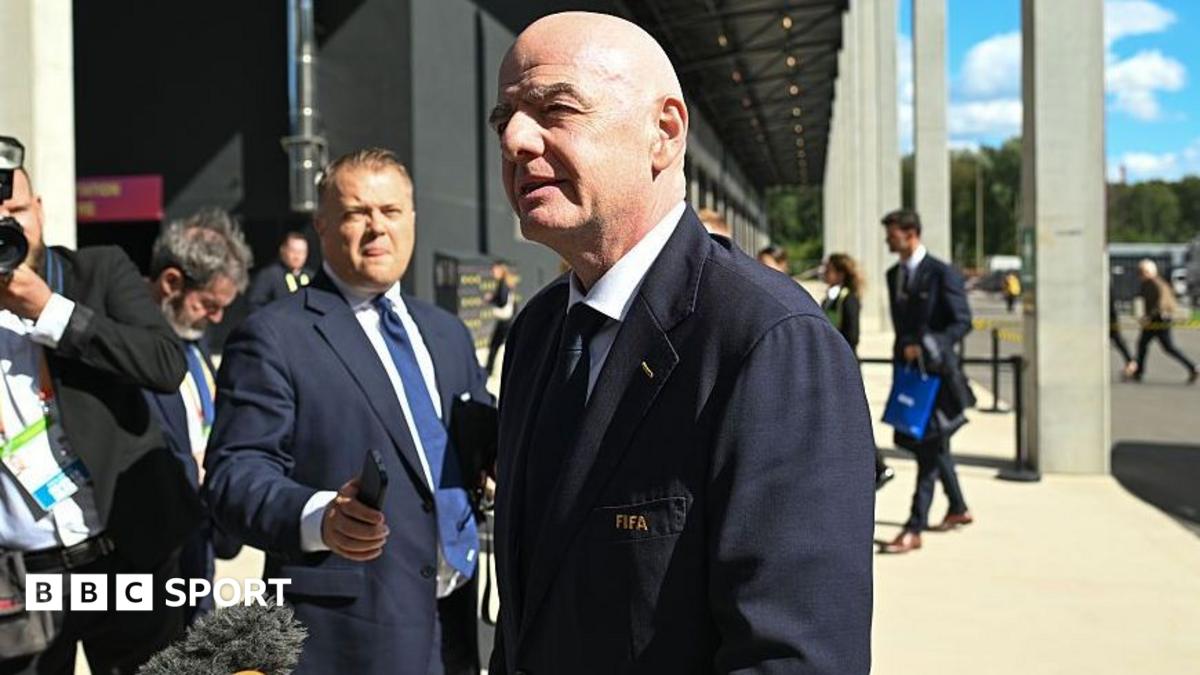
Uefa and Concacaf have written to Gianni Infantino calling on Fifa to pay at least $10m (£7.5m) from its cash reserves to each of the 211 member associations.
It is the latest chapter in the war of words between the governing bodies, in response to Fifa president Gianni Infantino’s aborted private equity proposal.
Fifa Forward Enterprise (FFE) would have meant a new company being created to manage commercial and ticketing rights of all competitions, including World Cups, with 21% sold off to an investment company.
The idea was scrapped after four days following widespread opposition from national associations.
Advertisement
The letter, seen by BBC Sport, was signed by Uefa president Aleksander Ceferin and his Concacaf counterpart Victor Montagliani.
It outlines that “Fifa is on course to close 2023-26 with reserves of approximately $6bn (£4.5bn)” which is “considerably more than is required” through to the 2030 men’s World Cup.
It said that Fifa should “make at least $10m available to each of its 211 member associations over the 2027-30 cycle” which should be used “for investment in infrastructure and football development”.
This “one-off release of reserves” would come at a cost of $2.11bn (£1.57bn), and would be in addition to the regular funding in the cycle.
Hewitt, a Fifa vice-president, said that the Fifa Council should also receive a written explanation for the cancelled suspension of United States forward Folarin Balogun at the World Cup.
Infantino was told he should make all documents available before the next Fifa Council meeting, which is on 15 October.
Officers also found two suspected ghost plates, four vehicles with tinted windows, and issues with tyres, brake lights, and number plates.
Advertisement
Five vehicles were given immediate prohibitions by the Driver and Vehicle Standards Agency because of tyre issues.
There were also 43 taxi licensing checks, with no issues recorded, while officers dealt with offences including no insurance, no driving licence, and failing to follow a no right turn.
GMP said Class A, B, and C drugs were seized, alongside 22 cannabis plants, more than 1,200 nitrous oxide canisters, illicit tobacco, 17 vehicles, a machete, cash, and luxury items.
Advertisement
Neighbourhood Chief Inspector Mike Jennings Wharton said: “What a way to kick off my brand new role as your Neighbourhood Chief Inspector.
Neighbourhood CI Mike Jennings-Wharton (Image: NQ)
“The results from this operation have been outstanding and are testament to the hard work, determination, and fantastic work ethic of our officers and partners. I have big ambitions for neighbourhood policing in Bolton.”
Officers also used Live Facial Recognition in Bolton town centre, generating five alerts and leading to three arrests within its first hour.
The technology assisted with arrests linked to offences including failing to appear at court, harassment, and drug supply.
Advertisement
GMP worked with Bolton Council, Trading Standards, safeguarding teams, and environmental officers during visits to businesses, seizing thousands of illegal vapes and illicit tobacco products.
(Image: NQ)
Bolton District Commander Helen Critchley said: “Days like Operation AVRO demonstrate what we can achieve when our officers, partners, and communities work together.”
A significant focus during the operation was the search for missing 13-year-old Lillia. Ms Critchley thanked the community for their support in the investigation.
MP Phil Brickell attended the operation, emphasizing the importance of reporting illegal activities. He stated, “I won’t tolerate criminality in our town centres.”
Advertisement
GMP said the operation focused on drug supply, dangerous driving, anti-social behaviour, and neighbourhood crime, with ongoing community engagement.
A seven-year-old boy fatally stabbed his aunt in the neck to ‘defend’ his mother after the pair had an argument about hair straighteners.
The tragedy occurred in Saint-Maur-des-Fossés, France, at around 4.30am on Friday, when emergency services were alerted to a situation involving a woman with a knife wound.
Initial findings revealed that her young nephew had inflicted the deadly injury.
According to local reports, police arrived to find a woman lying on the floor as two people attempted to apply pressure to her neck.
Advertisement
Firefighters arrived and provided initial first aid, before being relieved by a medical team.
Despite several resuscitation attempts, the woman was sadly pronounced dead at 5.17am due to severe blood loss.
Police arrived to find a woman lying on the floor as two people attempted to apply pressure to her neck (File pic)
Advertisement
At first, authorities went after a man who was seen in the vicinity brandishing a baseball bat, only to discover he had nothing to do with the crime.
He had exited his house armed, after hearing the woman’s cries for help in the street.
The police were then approached by the seven-year-old and his mother, who explained what had happened.
The 34-year-old woman recounted that they had been in the kitchen of the apartment when an argument broke out between the two sisters over hair straighteners.
Advertisement
As the argument escalated, the child allegedly grabbed a knife to defend his mother and stabbed the victim in the throat.
According to the mother’s testimony, the aunt exclaimed, ‘Your son stabbed me,’ before rushing out of the apartment.
‘Once in the street, she called for help before collapsing,’ a source close to the case explained, according to Le Parisien.
‘According to statements gathered from the mother, no one else was present in the apartment at the time of the tragedy,’ the source added.
Advertisement
The boy reportedly confessed to the crime, with Le Parisien reporting that he said: ‘Yes, it’s me. I don’t want to go to prison. I don’t want you to put my mother in prison, I defended my mum.’
The mother was taken into custody, and the boy was taken to hospital.
The public prosecutor and the Departmental Service of the Judicial Police are now conducting the necessary investigations into the circumstances of the crime.
The child is scheduled to be questioned, local media reports.
Imagine you are at a cocktail party. The room is crowded, people are coming and going, and you can barely hear your friend as they tell you some juicy gossip about the date they went on last week.
The fact you can still follow what they’re saying is down to your brain performing some very complex operations amid all that noise. Out of all the sound waves reaching your ears, it is successfully isolating the one of interest while filtering out the rest.
Trying to understand how the brain does this has kept auditory neuroscientists occupied since the 1950s, when British cognitive scientist Colin Cherry first coined the term “the cocktail party problem”.
This was initially studied in experiments that asked volunteers to listen to two speeches simultaneously – but only repeat one of them aloud afterwards. Cherry found that listeners could follow and repeat the pre-selected message remarkably well, despite both speeches being played simultaneously, one in each ear. In contrast, they recalled very little of the other message.
Advertisement
These experiments laid the foundation for decades of selective attention research. But it is only in the past 15 years that scientists have studied this phenomenon in experiments that more closely resemble the complicated, multi-layered way we listen in the real world – using technology that accurately tracks the brain’s activity as speech unfolds.
The most common non-invasive option, electroencephalography (EEG), uses what looks like a swimming cap fitted with small sensors. These measure very fast changes in the electrical activity of populations of neurons (the brain’s nerve cells) with millisecond precision.
In a 2014 study, neuroscientists found that, within 200 milliseconds of hearing someone speak, the brain favours the conversation someone is focusing on over all other noise. This prioritised attention shows up most markedly in secondary brain areas such as the superior temporal gyrus, which are responsible for piecing together the sounds we hear into meaningful speech.
This suggests that our attentive brain is not just enhancing the voice of who we are listening to, but helping us make sense of their words while filtering out all other conversations and background noise.
Advertisement
Video: The Wall Street Journal.
Attention switching
The original cocktail party problem did not investigate the full range of people’s listening experiences, which are often much less static. In everyday life, we repeatedly switch and reorient our auditory attention – for example, when hearing our name called across a crowded room, or when a door slams.
But what happens in that brief moment when we stop listening to one person and turn our attention to another? Can the brain switch from one voice to another instantly, or does it briefly have to process both? These were questions we investigated in our latest study with colleagues from the Eriksholm Research Centre in Denmark, which is funded by Danish hearing aid manufacturer Oticon.
Clarifying how the brain manages these rapid shifts in attention can help explain why some conversations are easy to follow while others become difficult, especially in noisy environments.
Coming back to the cocktail party: here you are, focused on your friend’s voice as they reveal the identity of their recent date. But then another familiar voice suddenly reaches your awareness. Your partner is (secretly) telling a friend about the surprise birthday gift they are planning for you. Your attention immediately shifts to your partner’s voice, while still giving the appearance of listening to your friend.
Advertisement
When we tested such a scenario in our laboratory, we found something striking. During this attention reorienting, the brain does not simply drop one voice and turn to the other. Rather, for a short period of between one and two seconds, the neural signals associated with the two voices overlap. In other words, the brain starts tuning into the new speaker before it has completely let go of the old one.
This mechanism may help explain how we navigate the constantly changing soundscape around us, moving our attention from one voice or sound to another while maintaining enough information about the previous speaker to make that transition seamless. This efficient processing strategy could be described as the brain maintaining a smooth “attention continuum”.
Improved hearing aid design?
These insights have some important real-world applications. For example, traditional hearing aids are often designed to favour sounds coming from in front of the listener, which is obviously limiting in many situations.
But using enhanced attention decoding techniques, hearing aids could be neurally steered not only to enhance the speaker that is currently attended to, but to switch between different speakers, almost in real time, as the listener’s attention is dynamically reoriented.
Advertisement
More generally, understanding how the brain shifts, maintains and combines information from different speakers can give us a clearer picture of how attention shapes what we ultimately hear, understand and remember.
The approach introduced in our study could be particularly useful for studying how individuals vary in their attentional strategies, particularly in noisy environments – and for relating these differences to the mental effort they use to follow and understand speech.
Ultimately, this brings us closer to understanding how the brain makes successful communication possible – at cocktail parties and everywhere else.





























































You must be logged in to post a comment Login