

Crypto World
Yuno Partners With Triple-A to Bring Stablecoin Payments to Global Merchants


Yuno has announced a new partnership with Triple-A aimed at expanding stablecoin payment acceptance for businesses worldwide.
The collaboration integrates Triple-A’s regulated stablecoin infrastructure directly into Yuno’s global payment orchestration platform, allowing merchants to accept stablecoin payments alongside traditional payment methods through a single integration.
The move reflects growing momentum around stablecoins as real-world payment infrastructure for cross-border commerce, e-commerce, SaaS platforms, gaming, travel, and digital services.
Stablecoins Continue Moving Into Mainstream Commerce
Through the partnership, merchants using Yuno’s payment infrastructure will gain access to stablecoin payment capabilities without needing to manage wallets, blockchain integrations, custody, or compliance systems independently.
Yuno currently connects businesses to more than 1,000 payment methods, payment service providers, and fraud prevention tools through a unified API.
According to the companies, the integration is designed to help businesses:
- reduce cross-border payment friction
- improve checkout conversion
- expand payment access in underserved markets
- support customers who prefer digital asset payments
Triple-A says its infrastructure currently supports more than 1,000 enterprise clients globally and reaches over 700 million digital currency users.
Crypto Payments Infrastructure Expands Globally
The announcement highlights how stablecoins are increasingly evolving beyond crypto trading and becoming part of mainstream financial infrastructure.
Businesses operating internationally are increasingly exploring stablecoins for:
- faster settlement
- lower transaction costs
- 24/7 payment processing
- international transfers
- reduced dependence on traditional banking rails
The stablecoin market has grown rapidly over the past several years, becoming one of the most active sectors within the digital asset industry.
Regulated Stablecoin Services Become a Key Industry Focus
Triple-A operates under regulatory frameworks in several major jurisdictions, including the United States, Singapore, and Europe.
The partnership comes as regulators and financial institutions worldwide continue paying closer attention to stablecoin adoption and payment infrastructure.
Industry observers increasingly view stablecoins as one of the clearest real-world blockchain use cases currently scaling across global commerce and financial services.
Yuno and Triple-A say the integration is intended to simplify stablecoin adoption for merchants while maintaining compliance, reliability, and operational scalability for enterprise businesses.

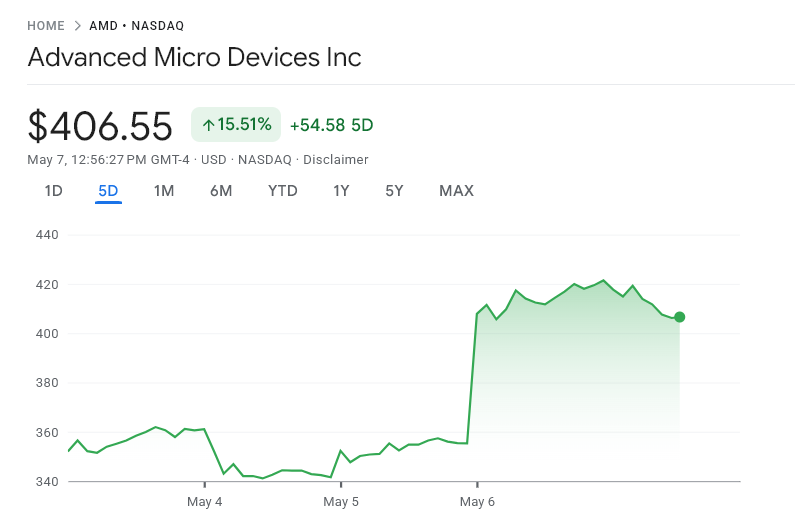
AMD stock price broke out 18.61% to a record $421 on May 7. This happened after Q1 earnings nearly doubled the server CPU growth forecast due to agentic AI demand. The chart now projects a $679 measured-move target on the trend-based extension.
The breakout is mirrored on-chain by Bittensor (TAO), the decentralized AI compute network. TAO rallied in lockstep through the same window.
Both assets price the same agentic AI demand cycle from opposite sides of the compute stack, sharpening the bull thesis underwriting AMD’s path higher.

AMD Stock Breakout Confirmed After Q1 Earnings
AMD stock cleared a quick consolidation on May 6 with a gap-up to $421. This opened the next leg of a structural breakout. The setup followed a +89.14% rally from $192 to $363 through mid-April.
Want more insights like this? Sign up for Editor Harsh Notariya’s Daily Newsletter here.
AMD price consolidated in a tight descending flag before breaking higher on the heaviest single-day volume in the visible range. Vertical moves into earnings can mean-revert regardless of fundamentals, so volume confirmation continues to matter.

The measured move from the flag projects $679, an +89.24% extension of the prior leg. AMD posted Q1 2026 revenue of $10.25 billion, up 38% year over year and ahead of the $9.89 billion consensus.
Data center revenue reached $5.8 billion, up 57% from $3.67 billion a year earlier, with adjusted EPS of $1.37, beating the $1.29 estimate.
The structural reset came on the call.
CEO Lisa Su raised the server CPU TAM growth forecast from 18% to greater than 35% annually through 2030, citing agentic AI workloads as the driver.
Total Addressable Market (TAM) is the full revenue opportunity available if a product or service captured 100% of demand within its target market, used as the upper-bound sizing benchmark for forecasts.
Independent forecasts back the framing. Gartner predicts 40% of enterprise applications will embed task-specific AI agents by the end of 2026, up from less than 5% in 2025, an eightfold deployment jump that maps onto the demand wave AMD’s data center segment serves.

With AMD stock price holding at $420 and projecting toward $679, the same demand wave is showing up on the decentralized side of the compute stack.
Bittensor Mirrors AMD’s Breakout as On-Chain AI Compute Demand Tightens
The on-chain mirror of AMD’s agentic AI thesis is Bittensor (TAO), the leading decentralized AI compute network. TAO climbed from roughly 160% between early February and late March. Its recent leg, mirroring AMD’s growth, is already up almost 40%.
Two pure-play AI compute assets, two parallel rallies, one underlying demand cycle. This sets a key connection between on-chain and Wall Street.

On-chain commitment runs deeper than the price chart. The total stake on the Bittensor network sits at 7.28 million TAO, equivalent to roughly $2.2 billion at current prices, and locks up about 67% of the circulating supply.
Of that stake, 70.28% backs the network through root validators, while 29.72% flows directly into subnets running specific AI services.

Network usage validates the positioning.
24-hour subnet trading volume reached 381,940 TAO, equivalent to roughly $117 million in a single day, with 65% of that flow concentrated in Alpha tokens.
Bittensor reportedly generated $43 million in AI usage revenue during Q1 2026, and subnet capacity is doubling from 128 to 256 in early May, structurally mirroring the TAM step-change AMD priced into its server CPU forecast.
Both assets received institutional validation the same week. AMD posted its Q1 beat on May 5. Grayscale and Bitwise filed for spot TAO ETFs on April 28. The market priced both as the same trade from opposite sides of the compute stack.
With centralized chips and decentralized compute both confirming the thesis, Wall Street’s repricing of AMD shows how the analytical community is now treating the move.
Wall Street Repricing And The $2.9 Trillion Macro Backdrop
Wall Street is repricing the agentic AI thesis in real time. Wells Fargo analyst Aaron Rakers reiterated a BUY rating on AMD on May 7 and raised his price target from $345 to $505, projecting 19.84% upside on accelerating data center momentum. That alignment matters because $505 sits near a key technical level.

The macro backdrop supporting that repricing is enormous. McKinsey’s midpoint scenario projects that AI-powered agents and robots could generate roughly $2.9 trillion in US economic value annually by 2030, representing automation of about 27% of current work hours.
IDC projects worldwide AI spending will reach $1.3 trillion by 2029, growing at a 31.9% compound annual rate through the period, with agentic AI applications as the primary driver.
Bittensor’s data anchors the same thesis on the decentralized side. The 7.28 million TAO staked into AI compute subnets, and the $43 million Q1 AI usage revenue are not crypto-isolated metrics.

Both proxies track the same workload Lisa Su called out, but through different settlement layers. As long as both sides accelerate together, the cross-asset thesis holds, and AMD’s higher price levels remain in play.
The remaining question is whether AMD’s price structure can hold the technical levels required to translate the macro thesis into the projected upside.
AMD Stock Price Outlook
AMD currently trades at $421, sitting just below the 0.5 Fib at $422. This marks the immediate resistance the breakout must reclaim. A daily close above $443, the 0.618 Fib level, would confirm trend continuation. It would open the path toward $472 and the full 1.0 Fib at $508.
That $508 zone aligns within $4 of Wells Fargo’s $505 target, providing both technical and fundamental confirmation of the move.
Beyond $508, the 1.618 Fib extension at $615 marks the structural extended target, with the +89.24% measured move pointing toward $679.
Capital inflows back the bullish setup. The Chaikin Money Flow (CMF), an institutional proxy, sits at 0.41 and continues to trend higher along an ascending support line drawn from early April.
CMF holding that line tells the story of capital rotating into AMD aggressively enough to support continuation toward higher Fib targets, the same capital rotation that Bittensor’s stake lockup is recording on-chain.

The downside ladder defines the risk side. A failure to reclaim $422 with rising volume could trigger profit-taking back toward the $402 and $377 levels.
A break of $337 would extend the bullish trend and signal a deeper retrace.
The post AMD Stock Eyes $600 Breakout as Crypto Joins Wall Street’s Agentic AI Rally appeared first on BeInCrypto.

Key Takeaways
- Hedge fund legend Paul Tudor Jones believes the AI rally will continue for “another year or two”
- Jones recently increased his exposure to AI stocks through diversified basket investments
- The investor draws parallels between today’s AI surge and Microsoft’s PC revolution in 1981 plus the 1995 internet explosion
- According to Jones, we’re approximately 50–60% through this cycle with potential for 40% additional gains
- A major correction looms when market capitalization reaches 300–350% of GDP, Jones cautions
Legendary hedge fund manager Paul Tudor Jones maintains a bullish stance on artificial intelligence stocks, asserting the current rally has significant momentum remaining. During his Thursday appearance on CNBC’s “Squawk Box,” Jones revealed he recently expanded his AI equity positions and expects the upward trend to persist.
Jones explained his investment approach focuses on diversified equity baskets rather than concentrated positions. “I’m a macro trader, so I just buy baskets,” he noted.
The billionaire investor drew comparisons between today’s AI revolution and two previous technology-driven productivity explosions. The initial example was Microsoft’s emergence during the early 1980s. The subsequent parallel was the internet’s commercial breakthrough circa 1995.
Jones highlighted Anthropic’s Claude Code launch in January as analogous to Microsoft’s personal computer debut in 1981. According to Jones, both events represented inflection points for widespread commercial implementation.
“Those were both the beginning of productivity miracles that lasted four to five and a half years,” Jones explained.
He calculates the current AI expansion is roughly 50% to 60% mature. Using this framework, he projects the market has “another year or two to run.”
Echoes of the Dot-Com Bubble
Jones identified striking similarities between current market dynamics and late 1999 conditions, approximately twelve months before technology stocks crested in early 2000. He observed that contemporary valuation ratios and earnings indicators closely resemble that timeframe.
He referenced the forthcoming election cycle and incoming Federal Reserve Chairman Kevin Warsh as catalysts that might maintain accommodative monetary conditions, comparable to how Y2K anxieties constrained the Fed during 1999.
Jones indicated his expectation for an additional 40% market appreciation before reaching a cyclical top.
Caution Flags on the Horizon
While maintaining his optimistic perspective, Jones emphasized substantial downside risks ahead. He suggested that once stock market capitalization climbs to 300% to 350% of gross domestic product, a severe correction becomes probable.
“You just know that there’ll be some breathtaking kind of corrections,” he stated.
Jones additionally expressed apprehension regarding artificial intelligence’s existential threats. He argued that governmental intervention through regulation will become necessary and that unregulated AI development poses genuine risks to civilization.
Jones established and leads Tudor Investment Corporation as founder and chief investment officer. He gained widespread recognition for successfully anticipating and capitalizing on the 1987 Black Monday market crash.
He currently serves as chairman of Just Capital, a nonprofit organization that evaluates U.S. publicly traded companies based on social and environmental performance criteria.
Jones delivered his analysis at a conference prior to his Thursday CNBC interview. He declined to disclose the specific AI securities purchased or precise timing of the transactions.


A cooling tower is seen at the nuclear-powered Vogtle Electric Generating Plant in Waynesboro, Georgia, U.S. August 13, 2024.
Megan Varner | Reuters
Odds that the U.S. and Iran reach a nuclear deal at some point in 2026 jumped on prediction markets platform Kalshi after an Axios report on Wednesday that the two countries were close to an agreement to end the war in the Middle East.
Kalshi traders now see a 58% chance that a deal is reached by 2027. They even see a 47% chance an agreement is reached by September.
Those levels are higher than before the Axios report, but still lower than the odds in the middle of April when there was more hope for a resolution to the conflict. At one point on April 17, odds that the two countries reach a nuclear deal by June were more than 70%.
The event contract resolves to “yes” if the U.S. announces, signs or accepts a deal from Iran regarding its nuclear program.
While the Axios report said the countries were close to an agreement to end the war, it added that the countries were only nearing a framework for negotiations around the nuclear issue. However, the deal to end the war could include a moratorium on Iranian nuclear enrichment.
Iran said it was reviewing the U.S. proposal on Wednesday, though neither country detailed any new developments on Thursday.
Traders on Polymarket were more optimistic about a deal before 2027, placing odds of 65% on the bet.
Disclosure: CNBC and Kalshi have a commercial relationship that includes customer acquisition and a minority investment.
Markets shift and headlines fade, but the core principles of building long-term wealth remain constant. Join us for our third CNBC Pro LIVE, where investors of all backgrounds – from financial professionals to everyday individuals – come together to cut through the noise and gain actionable strategies for smarter, more disciplined investing. No matter where you’re starting from, you’ll leave with clearer thinking, stronger strategies. Enter your email here to get a discount code

South Korea will implement a long-delayed tax on cryptocurrency gains, with the levy slated to take effect on January 1, 2027. Finance Ministry officials confirmed the plan during an emergency parliamentary forum on virtual asset taxation in Seoul, marking what appears to be the first public affirmation from the ministry that the crypto tax framework will move forward after successive postponements.
Under the current Income Tax Act, profits from the transfer or lending of virtual assets will be categorized as “other income” starting in 2027. Investors earning more than 2.5 million won annually from crypto activities would be subject to a 22% tax, comprising a 20% national income tax and a 2% local tax. The rule is projected to affect roughly 13.26 million investors. This framework aims to formalize crypto gains within the broader tax system while raising considerations for taxpayers and market participants alike.
According to Edaily, Moon Kyung-ho, director of the Ministry’s income tax division, reiterated that “we will proceed with virtual asset taxation as scheduled in January next year,” signaling a high-level commitment to the January 2027 effective date after a sequence of delays. The discussion occurred at a forum hosted by Representative Park Soo-young of the People Power Party and the Korea Tax Policy Association.
Key takeaways
- The crypto gains tax is scheduled to become effective on January 1, 2027, with profits from transfers or lending treated as other income under the Income Tax Act.
- A 22% tax applies to annual crypto profits above 2.5 million won (20% national tax plus 2% local tax), affecting an estimated 13.26 million investors.
- The National Tax Service is preparing formal guidance and has engaged with five major local exchanges to draft a notice, with legislative review planned in 2026.
- Past delays and political dynamics have persisted, including a prior push by the ruling party to scrap the tax; oversight and readiness remain central concerns for exchanges and firms.
- Separately, proposed AML rule amendments targeting overseas transfers have drawn industry pushback, underscoring compliance feasibility and enforcement questions for major exchanges.
Tax framework and industry implications
The forthcoming tax regime places crypto gains within the broader umbrella of taxable income, reclassifying profits from virtual asset transfers and lending as “other income” starting in 2027. The key numeric thresholds establish a 2.5 million won annual profit floor above which the 22% rate applies, a structure that will influence individual taxpayers, crypto traders, and service providers alike. While the exact revenue impact remains a matter of ongoing analysis, the policy aligns with efforts to normalize crypto activity within a formal tax and regulatory framework, which in turn could affect reporting practices, capital exposure, and financial planning for households and institutions involved in digital asset markets.
Moon Kyung-ho’s remarks underscore a commitment to advancing the tax despite earlier postponements. The administration’s position appears to reflect a balance between revenue considerations, consumer protection, and the practicalities of tax administration. For market participants, this signals that preparatory steps—such as tax accounting for crypto gains, tracking of taxable events, and readiness for reporting obligations—will be essential as the 2027 date approaches.
Guidance development and industry engagement
The National Tax Service is actively shaping the operational framework to implement the new system. In discussions with the five largest domestic exchanges—Upbit operated by Dunamu, Bithumb, Coinone, Korbit, and Gopax—the tax authority is formulating a draft notice intended for legislative review in 2026. Moon clarified in subsequent comments that the guidance would arrive within this year, though not on an immediate schedule, indicating a measured rollout tied to regulatory processes and stakeholder feedback.
The collaboration with exchanges aims to address practical issues such as tax reporting mechanics, record-keeping obligations, and the delineation of taxable events, particularly as it relates to transfer versus lending activities. As the guidance progresses, institutions operating in the Korean crypto space will need to align their compliance programs with the forthcoming regulatory instructions to mitigate risk and ensure consistent reporting across the market.
Regulatory backdrop: delays, politics, and AML considerations
Korea’s crypto policy has longstanding tension between the need for robust oversight and concerns about market readiness and regulatory burden. The tax framework’s repeated postponements—from an originally planned 2025 start to the 2027 date—have reflected political disagreements and industry pushback over implementation preparation and threshold design. In parallel, the ruling party has at times signaled openness to revisiting or even scrapping the tax, highlighting how political dynamics can influence how and when policy takes effect.
In a related regulatory track, amendments to South Korea’s anti-money laundering (AML) rules have sparked significant industry pushback. The proposed changes would require exchanges to flag overseas-linked transfers of 10 million won or more as suspicious activity. Industry association DAXA, which represents 27 registered virtual asset service providers, warned that such a threshold would swell reporting volumes dramatically—from about 63,000 cases last year to as many as 5.4 million, potentially rendering compliance burdens impractical in practice. The Financial Services Commission and the Financial Intelligence Unit have opened a public comment period on these AML changes, with final rules expected in July after the review period, which runs through May 11.
These overlapping regulatory streams—taxation, AML, and exchange operations—collectively shape the environment in which crypto firms, banks, and investors operate. The interplay between tax policy and enforcement priorities will influence licensing considerations, cross-border engagement, and the level of due diligence required for domestic and overseas crypto flows. As enforcement bodies sharpen their oversight, institutions will need to harmonize tax, AML, and KYC processes to address evolving compliance expectations while maintaining operational viability.
Closing perspective
With January 2027 on the horizon, Korea’s crypto tax framework is moving from concept toward operational guidance, anchored by formal notices and stakeholder consultation. The coming months will define the specifics of reporting requirements, the practicalities of compliance for exchanges and individuals, and the balance between regulatory ambition and market practicality. Watching how the National Tax Service finalizes guidance, how the AML amendments unfold, and how political dynamics influence enforcement will be pivotal for institutions navigating Korea’s evolving digital assets regime.


Blockchain security firm Blockaid linked the exploit to the same operator behind the March 2025 1inch Fusion V1 incident, though it stems from a different vulnerability.
Crypto World
‘Polkadot Is Kind of Done.’ The Once Hyped Layer 0 Faces Falling Usage, and Controversy


Former Polkadot insiders report lack of direction and support from leadership, treasury overspending, and even failure to pay contributors for their work.
TLDR:
- ether.fi ran 70,000 active cards and 300,000 accounts uninterrupted during a full live chain migration.
- Separating card payment accounting from onchain settlement was the architectural decision that made zero downtime possible.
- Gnosis Safe’s deterministic deployment eliminated address reconciliation — a common blocker in cross-chain moves.
- Since closing the migration, TVL has surged from $220M to $347M, signaling strong post-migration confidence.
ether.fi completed a full migration to OP Mainnet on April 15, moving $220M in total value locked across chains in three days.
The platform ran 70,000 active cards and 300,000 accounts throughout the process without a single migration-related card decline.
No maintenance window was announced. No customers were notified. The infrastructure underneath millions of dollars in daily payments changed quietly while transactions kept processing.
The Architecture Behind a Live Migration
The migration began with ether.fi’s Scroll deployment staying fully operational. The OP Mainnet environment was built alongside it, not as a replacement ready to flip on, but as a parallel system coming online gradually.
Core contracts deployed first on OP Mainnet, mirroring the exact ownership configuration running on Scroll. New users were provisioned directly onto OP Mainnet during the build phase.
Three assets moved through bridges in stages. USDC, USDT, and WETH each traveled from Scroll to Ethereum before taking separate paths to OP Mainnet.
Every other asset migrated as an OFT, cutting out the Ethereum leg entirely. That separation kept the bridging process manageable and reduced single points of failure.
Gnosis Safe’s deterministic deployment across OP Stack chains meant ether.fi kept identical multisig addresses on OP Mainnet without reconciling address differences. That resolved one of the more persistent complications in cross-chain infrastructure moves.
Custom monitoring tools were built specifically for the migration period. Not one unexpected alert triggered from start to finish. Optimism’s permissionless infrastructure meant core deployments required no special access.
As Charles Mountain, DeFi Ecosystem Lead at ether.fi, put it: “OP Mainnet is the only place where the team that built the stack co-pilots your migration, and where the liquidity is already deep before you arrive.”
How Card Payments Kept Processing Through the Transition
ether.fi paused deposits and withdrawals during the migration window. Card payments, however, never stopped. The platform’s accounting system tracks every card spend independently from onchain settlement.
That separation meant authorizations could continue processing while assets were physically moving between chains.
If something had broken mid-migration, the team could have continued routing through Scroll while investigating. The fallback was built into the structure from the beginning, not added as an afterthought.
Institutional observers running compliance desks and treasury operations at scale took note. The most common reaction from those who watched the move closely was: “wait, how did that actually work?”
Once the migration closed, the team settled all outstanding activity onchain on OP Mainnet. Deposits and withdrawals reopened without incident.
OP Mainnet’s performance floor held throughout — sub-250ms finality through Flashblocks, $0.00001 median transaction fees, and 99.99% uptime.
Pyth Network oracle feeds for EURC/USD, ETHFI/USD, and eUSD/USD were confirmed live before migration day, with Chainlink serving as a fallback.
Mountain added: “We closed the move in three days with zero downtime, and we’re already building the next chapter.”
Since closing, TVL has grown from $220M to $347M. Gold Vaults, a Euro card, and native stablecoin support are next on the roadmap.
Crypto World
Hedera Activity Grows & Zcash Rallies Past $420, But BlockDAG’s Casino & 246X ROI Are Pulling Bigger Crowds

The crypto market this May is full of mixed signals. The latest Hedera price prediction shows HBAR stuck below $0.10 despite huge enterprise wins, while the Zcash ZEC price is climbing fast as buyers rush into privacy coins. Both stories tell different sides of the same market, one about partnerships that fail to lift price, the other about momentum tied to a single narrative.
BlockDAG, meanwhile, is doing both: building real demand and real distribution. Its casino is going live soon, BDAG is already listed on 13 exchanges, and a 246X ROI is still on the table. With all these catalysts, BlockDAG is shaping up as the top crypto to buy this cycle.
Hedera Activity Grows, But the Price Refuses to Follow
The current Hedera price prediction reflects a frustrating gap between network growth and market reaction. HBAR is trading around $0.0889, still 75% lower than a year ago and 84% below its all-time high of $0.57. The token has been stuck in a tight range between $0.09 and $0.10 for weeks now.
On the network side, the news looks strong. Hedera has 39 Fortune 500 companies on its council, with McLaren and Accenture joining recently. Real-world asset projects, post-quantum cryptography work, and HederaCon 2026 are all moving forward.
Yet the price keeps drifting. Until HBAR breaks above $0.10 with strong volume, the Hedera price prediction stays cautious, which is why many traders do not yet see HBAR as the top crypto to buy this month.
Zcash ZEC Price Climbs as Privacy Coins Heat Up
The Zcash ZEC price has staged a strong comeback this week, rising to a four-month high of $428 before settling near $418. ZEC is up over 8% in 24 hours, with capital rotating into privacy coins after recent DeFi hacks revived fears around quantum threats and data exposure.
Futures activity backs the move. Over $2.7 billion has flowed into new long positions, with $10 million in short liquidations adding fuel. On the spot side, two straight days of negative netflow point to real accumulation, not just leverage-driven hype.

Momentum indicators have stayed bullish for a full month. If buyers hold the line, the Zcash ZEC price could push toward $430 and then $450. A failure here drops it back to $400. Even with this rally, ZEC’s run depends on the privacy narrative staying hot, which makes it a less obvious pick for top crypto to buy in steady terms.
BlockDAG Brings the Casino, the Listings, and the Liquidity
BlockDAG is doing something neither HBAR nor ZEC can match this month. In May 2026, BDAG goes live with the first Layer 1 casino, turning the token into a daily-use asset where players can bet, win, and transact directly on-chain. This kind of utility creates real, repeating demand instead of one-time hype, which is why so many traders now see BDAG as the top crypto to buy ahead of the launch.
What turns this from a launch into a full market event is the distribution. BDAG is already listed on 13 global exchanges, including Biconomy, Bifinance, CoinStore, P2B, AscendEX, BTSE, XT, BTCC, LBANK, BitMart, WEEX, Pionex, and WEBOT. Even better, more tier-1 exchanges have been confirmed and are on the way.
That means when the casino flips on, buyers around the world will have instant access to BDAG without friction. Casino demand brings the buyers in. Exchange listings deliver the supply. Together, they push the price into discovery mode.
The price story makes the timing sharper. Batch 5 of the aftersale is the final stop, with BDAG still available at just $0.000000976 and a projected 246X ROI on the table. The window closes on May 7, the same day the casino goes live. After that, the presale price disappears for good, and BDAG enters its market-driven phase. With miners shipping, listings expanding, and the utility about to switch on, BlockDAG is shaping up as the top crypto to buy before the door closes for good.
Final Thoughts
The market this May is offering very mixed signals. The Hedera price prediction shows that even big partnerships and enterprise wins do not always move the chart, leaving HBAR stuck under $0.10. The Zcash ZEC price is enjoying a strong rally, but it depends on the privacy coin narrative staying loud, which can fade as quickly as it arrived. Both coins can deliver gains, but the path is uneven.
BlockDAG, on the other hand, is built on solid ground. The casino launches on May 7, bringing real, daily utility that turns BDAG into a working asset, not just a token to hold. With more tier-1 listings confirmed and a 246X ROI still on the table, the setup is rare. As the aftersale window shuts and demand stacks up, BlockDAG stands out as the top crypto to buy this cycle.

Presale: https://purchase.blockdag.network
Website: https://blockdag.network
Telegram: https://t.me/blockDAGnetworkOfficial
Discord: https://discord.gg/Q7BxghMVyu
Disclaimer: This is a Press Release provided by a third party who is responsible for the content. Please conduct your own research before taking any action based on the content.
Ethereum continues to trade within a broader consolidation structure as the market struggles to establish sustained bullish momentum. Nevertheless, weakening momentum indicators and growing signs of seller activity suggest that the market could be preparing for another corrective move in the short term.
Ethereum Price Analysis: The Daily Chart
On the daily timeframe, ETH is showing a notable bearish divergence between the RSI indicator and price action. While the asset recently attempted to stabilize near the $2.3K-$2.4K region, the RSI has been forming lower highs, signaling weakening bullish momentum beneath the surface. At the same time, the recent price action has become increasingly choppy and indecisive, further highlighting the presence of sellers around the current levels.
This combination of bearish divergence, weakening momentum, and unstable price behavior increases the probability of a downward move toward lower support zones in the coming days. If such a decline unfolds, the 100-day moving average around the $2.2K region will likely become the next important defensive line for buyers. A loss of this level could expose Ethereum to deeper corrections toward the broader $2K support range.

ETH/USDT 4-Hour Chart
On the 4-hour chart, ETH is currently facing a significant hurdle at the upper boundary of the recent short-term range near the $2.4K region. Despite several attempts, buyers have repeatedly failed to secure a breakout above this resistance area, signaling a lack of strong bullish momentum and continued seller presence at higher prices.
As a result, the market appears vulnerable to another corrective move toward the lower boundary of the range around the $2.2K support zone. This level is particularly important because price behavior there will likely determine the next directional move. If the $2.2K region fails to hold, Ethereum could quickly extend its decline toward the major $2K support area, which remains one of the most critical demand zones on the higher timeframes.

Sentiment Analysis
From an on-chain perspective, the Exchange Reserve metric is beginning to show signs of increasing sell-side pressure. This indicator tracks the amount of ETH held on centralized exchanges, and rising exchange reserves are typically interpreted as a signal that more coins are becoming available for potential selling activity.
Recently, the chart has displayed a noticeable surge in exchange reserves, suggesting that market participants may be preparing to distribute holdings or reduce exposure. If this increase continues in the coming days, it could add further selling pressure to the market and support the bearish scenario currently reflected in the technical structure as well.
Overall, Ethereum remains trapped within a fragile consolidation phase beneath key resistance levels. The weakening momentum, bearish RSI divergence, and rising exchange reserves collectively suggest that the market could face renewed downside pressure unless buyers manage to reclaim the $2.4K region with stronger momentum.

The post Ethereum Price Analysis: Failure at $2.4K Spells More Trouble Ahead for ETH appeared first on CryptoPotato.

Decentralized Finance (DeFi) began as an experimental alternative to traditional banking, but by 2030, it may evolve into one of the foundational layers of the global financial system. What started with simple token swaps and yield farming is gradually transforming into a complex digital economy powered by automation, interoperability, artificial intelligence, and decentralized ownership.
While today’s DeFi ecosystem still faces issues with scalability, regulation, security, and user experience, the pace of innovation suggests the next five years could dramatically reshape how individuals and institutions interact with money.
The Evolution from Speculation to Financial Infrastructure
Early DeFi growth was largely driven by speculation. High annual percentage yields, liquidity mining incentives, and token launches attracted users seeking rapid returns. However, many of these systems relied on unsustainable liquidity cycles rather than genuine economic productivity.
By 2030, DeFi may shift away from short-term incentive models toward infrastructure-level utility. Protocols are likely to prioritize sustainable revenue generation through trading activity, real-world asset integration, lending markets, payment systems, and decentralized capital formation.
In this future landscape, successful protocols may resemble autonomous financial networks rather than speculative applications.
AI-Powered Autonomous Finance
One of the most significant developments expected by 2030 is the integration of artificial intelligence into DeFi systems.
AI agents may eventually manage entire portfolios without human intervention. Instead of manually moving assets between protocols, users could define risk preferences and investment goals while autonomous systems optimize allocations in real time.
These AI-driven systems may handle:
- Yield optimization across multiple chains
- Automated risk management
- Smart hedging strategies
- Real-time market analysis
- Liquidation prevention
- Dynamic liquidity provisioning
The combination of AI and smart contracts could create financial systems capable of reacting instantly to market conditions without centralized intermediaries.
In many ways, DeFi may become less about “using apps” and more about deploying intelligent financial agents that operate continuously on behalf of users.
Cross-Chain Liquidity Becomes the Standard
Today’s blockchain ecosystem remains fragmented. Assets, liquidity, and users are distributed across numerous networks, often requiring bridges and complicated transfers.
By 2030, interoperability could become one of the defining features of DeFi infrastructure.
Cross-chain execution layers may allow users to interact with multiple blockchains simultaneously without even noticing which network is being used underneath. Liquidity could flow seamlessly between ecosystems, reducing inefficiencies and improving capital utilization.
The idea of being “stuck” on one chain may eventually disappear entirely.
Instead, DeFi platforms may evolve into unified liquidity environments where transactions, swaps, lending, and settlement occur automatically across interconnected networks.
Real-World Assets Enter the Blockchain Economy
Tokenization is expected to play a major role in the future of decentralized finance.
By 2030, real-world assets (RWAs) such as real estate, government bonds, commodities, invoices, intellectual property, and equities could become deeply integrated into DeFi ecosystems.
This transition may fundamentally alter how global markets operate.
Potential benefits include:
- 24/7 trading availability
- Fractional ownership
- Instant settlement
- Reduced administrative costs
- Increased access to global markets
- Transparent on-chain auditing
For emerging economies, tokenized finance may provide broader access to investment opportunities previously limited to institutional participants.
As regulatory frameworks mature, DeFi protocols could increasingly serve as the infrastructure layer for global capital markets rather than existing outside them.
Institutional Participation Expands
In earlier stages, institutions approached DeFi cautiously due to regulatory uncertainty and security concerns. By 2030, this relationship may look very different.
Large financial institutions may adopt hybrid models that combine decentralized settlement systems with compliant identity layers and regulated custody solutions.
Banks, asset managers, and payment providers could eventually use DeFi rails for:
- International settlements
- Collateral management
- Treasury operations
- Yield generation
- Tokenized securities trading
- Automated market making
This institutional adoption would likely increase liquidity, stability, and legitimacy across the sector.
Ironically, the systems originally designed to bypass traditional finance may eventually become the technology stack powering it.
Identity and Reputation Systems Replace Anonymous Risk
Completely anonymous finance creates efficiency, but it also introduces challenges involving fraud, compliance, and credit assessment.
Future DeFi ecosystems may adopt decentralized identity and reputation systems that allow users to prove credibility without sacrificing privacy.
Instead of relying solely on collateral, lending protocols could incorporate:
- On-chain reputation scores
- Verified financial history
- Behavioral analytics
- Proof-of-income systems
- Decentralized identity credentials
This evolution may unlock undercollateralized lending markets, enabling broader participation while maintaining transparency and risk management.
Privacy-preserving cryptography could become essential in balancing compliance with decentralization.
Security Will Become the Primary Competitive Advantage
The next phase of DeFi growth may be defined less by innovation speed and more by resilience.
As billions or even trillions of dollars move on-chain, security standards will likely become significantly more advanced. Smart contract exploits, bridge hacks, and governance attacks remain major obstacles today, but future ecosystems may rely on:
- AI-assisted auditing systems
- Formal smart contract verification
- Decentralized insurance markets
- Automated threat detection
- Real-time protocol monitoring
- Multi-layer security architectures
Protocols with strong security reputations may dominate liquidity flows, while poorly secured systems could struggle to survive.
In a mature DeFi economy, trust may be built through transparency and mathematical verification rather than corporate branding.
Regulation Will Shape the Industry — Not Eliminate It
Regulation is often viewed as a threat to decentralized finance, but by 2030, it may instead function as a catalyst for broader adoption.
Clear legal frameworks could encourage institutional participation while protecting users from systemic risks and fraudulent platforms.
Rather than eliminating decentralization, regulation may push DeFi toward more sophisticated governance structures that balance openness with accountability.
Jurisdictions that successfully integrate blockchain innovation into financial policy may become global hubs for digital capital formation.
The future of DeFi is unlikely to be fully unregulated or fully centralized. Instead, it may evolve into a hybrid ecosystem where decentralized infrastructure operates within transparent legal boundaries.
The Future May Be Invisible
Perhaps the most important prediction about DeFi in 2030 is that users may stop referring to it as “DeFi” altogether.
Just as people rarely think about internet protocols while browsing online, blockchain infrastructure could eventually fade into the background.
Users may simply interact with financial applications that are:
- Faster
- Global
- Automated
- Programmable
- Accessible 24/7
- More transparent than traditional systems
At that stage, decentralized finance would no longer exist as a niche industry. It would simply become finance.
Conclusion
The path toward DeFi in 2030 will not be linear. Market cycles, regulatory battles, security failures, and technological limitations will continue to shape the industry along the way.
However, the broader direction remains clear: financial systems are becoming increasingly programmable, automated, and decentralized.
If current trends continue, the next decade could transform DeFi from an experimental ecosystem driven by speculation into a global financial infrastructure layer capable of supporting both digital and real-world economies.
The protocols that survive this transition will likely be those that prioritize sustainability, interoperability, security, and genuine economic utility over short-term hype.
In the long run, the future of decentralized finance may not be about replacing traditional finance entirely, but about rebuilding it into something faster, more transparent, and fundamentally more accessible.
REQUEST AN ARTICLE

Peel Land respond to Hulton Estate eviction notice claims

Papa John’s International, Inc. (PZZA) Q1 2026 Earnings Call Transcript

AMD Stock Eyes $600 Breakout as Crypto Joins Wall Street’s Agentic AI Rally

Manchester United reach agreement with Casemiro over contract clause amid transfer speculation

US brings back mandatory military draft registration

Steven Gerrard disagrees with Gary Neville over ‘shock’ Chelsea and Arsenal claim | Football


-

 NewsBeat4 days ago
Channel 5 – All Creatures Great and Small series 7 new post
-

 Crypto World9 hours ago
Upbit adds B3 Korean won pair as Base token gains Korea access
-
 Tech6 days ago
Trump’s 25% EU auto tariff breaches Turnberry Agreement that also covers semiconductors and digital trade
-
 NewsBeat10 hours ago
NCP car park operator enters administration putting 340 UK sites at risk of closure
-
 Sports6 days ago
Paul Scholes issues Marcus Rashford reality check as agreement emerges over Man United star
-

 Entertainment6 days ago
Met Gala 2026 Rumored Guest List Is Turning Heads
-

 Business6 days ago
Strait of Hormuz Blockade Persists Amid US-Iran Standoff, Sending Oil Prices Soaring
-
Entertainment6 days ago
New on Prime Video in May 2026 — Full List of Movies and Shows
-

 Sports6 days ago
Cavaliers vs. Raptors Game 6 live score, updates, highlights from 2026 NBA playoffs first-round series
-

 Entertainment6 days ago
Kylie Jenner Hit With Second Lawsuit From Ex-Housekeeper
-
 Sports6 days ago
David Benavidez responds to team Canelo saying the fight will never happen
-
Entertainment5 days ago
New Netflix Movies in May 2026 — My Top 3 Picks to Stream
-

 Tech6 days ago
Meta ends Sama contract after Kenyan workers report seeing intimate footage from Ray-Ban smart glasses users
-

 Entertainment6 days ago
Young and the Restless Next Week: Cane Arrested & Matt’s Deadly New Scheme!
-
 Sports6 days ago
IPL 2026: ‘Love you darling’- Hardik Pandya’s reaction to MS Dhoni steals the show |Watch | Cricket News
-

 Business5 days ago
Luka Doncic Injury Update: Doncic’s Hamstring Recovery Slows Lakers’ Hopes Against Thunder: Can He Run Yet?
-
Crypto World5 days ago
Pi Network Mandates Protocol 23 Upgrade for All Mainnet Nodes Before May 15 Deadline
-

 Entertainment5 days ago
Melissa Joan Hart and More Stars Attend 2026 Kentucky Derby
-

 Sports6 days ago
Bayern won’t hand bottom side Heidenheim ‘gifts’ despite PSG game
-

 Sports6 days ago
What Preity Zinta Said After Punjab Kings’ First Defeat Of IPL 2026
You must be logged in to post a comment Login