

Crypto World
Zcash Foundation fixes Orchard bug with Zebra emergency upgrade



Zcash Foundation released Zebra 4.5.3 and Zebra 5.0.0 after engineers found and fixed a critical soundness bug in the Orchard Action circuit.
Summary
- Zcash Foundation fixed an Orchard circuit bug before known exploitation and urged urgent Zebra upgrades.
- Zebra 4.5.3 disabled Orchard actions, while 5.0.0 re-enabled them through NU6.2 at mainnet height 3,364,600.
- Zcash said no unauthorized value appeared, and Sapling plus transparent transactions kept working normally during incident.
The foundation said Zebra 4.5.3 activated an emergency soft fork at mainnet block height 3,363,426. The release temporarily rejected transactions and blocks containing Orchard actions while engineers prepared a corrected circuit.
The soft fork went live at about 02:00 UTC on June 2 after an earlier coordination attempt faced patch deployment issues. The foundation said private coordination with miners and exchanges started on May 31 to reduce the chance of exploitation before public disclosure.
NU6.2 restores shielded transactions
Zebra 5.0.0 activated the NU6.2 hard fork at mainnet block height 3,364,600. The upgrade re-enabled Orchard actions with a corrected circuit and routed Orchard proofs to a new per-circuit verifying key. The release also marked the second security-driven protocol upgrade in Zcash history since 2016.
A hard fork was needed because a zero-knowledge proof circuit fix requires a new pinned verifying key.
“We strongly urge all node operators to upgrade to Zebra 5.0.0 as soon as possible,” Zcash Foundation said.
No known exploit found
The bug was discovered on May 29 by independent security researcher Taylor Hornby during a protocol audit for Shielded Labs. ZODL engineers Daira-Emma Hopwood, Kris Nuttycombe and Jack Grigg confirmed the issue within hours and began work on a fix.
The foundation said the flaw could have allowed invalid state changes inside Orchard and possible double spending within that pool. It also said Zcash’s turnstile mechanism protected total ZEC supply, and “There is no evidence of unauthorized value creation.” The affected code included older halo2_gadgets, orchard and zcash_primitives releases, plus zcashd versions 5.0.0 through 6.12.3.
Why Orchard remains important
Orchard is Zcash’s newest shielded pool and a core part of its privacy system. It launched with NU5 in 2022 and uses Halo 2, which removed the need for a trusted setup. That design made Orchard a key part of Zcash’s current privacy roadmap.
Related market coverage has recently focused on rising Zcash shielded use. A recent report said about 30% of ZEC supply had moved into shielded pools, with Orchard holding 4.2 million ZEC and most of the recent growth.
The foundation said user privacy was not harmed during the incident. Sapling and transparent transactions also continued operating normally while Orchard actions remained paused.
Node operators now face the main task of upgrading to Zebra 5.0.0, rather than relying on older releases. Operators that stayed on an incorrect fork after NU6.2 may need to resync from scratch or restore from a backup made before activation.


A set of U.S. law enforcement groups and a coalition of Catholic organizations have urged caution as the CLARITY Act (the Blockchain Regulatory Certainty Act, part of the broader legislation) advances toward a key House hearing scheduled for July 17. In separate letters sent this week to senior White House officials, the organizations argued that certain provisions—particularly Section 604—could unintentionally create oversight gaps affecting investigations into illicit financial activity.
The letters arrive as the bill continues its legislative path. The CLARITY Act cleared the Senate Banking Committee in May, reportedly with most Democrats voting against it, and the measure has faced pushback from parts of the banking sector that say it may enable crypto firms to offer stablecoin-related yields without the same regulatory treatment applied to traditional financial institutions. For compliance stakeholders, the central question is whether the legislation clarifies responsibilities—or narrows enforcement reach in ways that complicate AML and sanctions compliance.
Key takeaways
- Law enforcement groups warn that Section 604 could create “oversight gaps” that hinder probes into crimes including money laundering and other illicit activity.
- Human trafficking advocates contend that provisions in Section 604 may increase regulatory ambiguity, potentially making monitoring of abuse-related illicit finance more difficult.
- Crypto industry policy officials argue Section 604 narrowly prevents non-custodial software developers from being misclassified as money transmitters.
- The bill’s hearing on July 17 is expected to focus on whether the statute best balances regulatory certainty with accountability, AML/KYC alignment, and investigative authority.
Law enforcement letters to White House officials
According to the letters, four law enforcement organizations—including the National District Attorneys Association, the National Association of Assistant United States Attorneys, the International Association of Chiefs of Police, and the National Sheriffs’ Association—contacted acting Attorney General Todd Blanche and White House digital assets adviser Patrick Witt regarding the CLARITY Act’s likely operational impact on enforcement.
The groups stated that regulatory certainty for digital assets should not come at the expense of accountability, transparency, victim protection, or public safety. In their view, the specific design of Section 604 risks weakening longstanding compliance and investigative frameworks, including requirements connected to KYC and anti-money laundering (AML).
The law enforcement organizations’ concern focuses on how Section 604 treats certain categories of participants and activities. The provision addresses the regulatory framework for digital asset service providers and seeks to protect non-controlling developers, open-source contributors, self-custody tools, and certain decentralized finance (DeFi) infrastructure from being automatically classified as money transmitters.
The letters distinguish between writing or publishing software code—described as not the target of their criticism—and the scope of exemptions related to transactions they believe could interfere with criminal investigations. They argued that broad exemptions may shield individuals or entities whose activity facilitates digital-asset movement, creating obstacles to oversight and weakening investigative authorities used by law enforcement.
“Our concern is with broad exemptions that may shield individuals or entities whose activities facilitate the movement of digital assets, create obstacles to legitimate oversight, or weaken longstanding investigative and enforcement authorities relied upon by law enforcement.”
Section 604’s scope contested: enforcement risk vs. misclassification prevention
In response to the law enforcement objections, Lindsay Fraser, chief policy officer at the Blockchain Association, said the letters reflect a misunderstanding of what Section 604 accomplishes. She characterized the provision as doing a limited, technical job: ensuring that non-custodial software developers are not misclassified as money transmitters when they do not custody assets or control transactions.
“It does not immunize criminals. It does not limit sanctions enforcement. It does not stop prosecutions for money laundering, fraud, or terrorist financing.”
For compliance and legal teams, the dispute underscores a practical policy challenge: how lawmakers should calibrate liability and regulatory status for participants across the digital-asset stack. Section 604 is designed to provide clearer boundaries for developers and infrastructure contributors, but critics worry that real-world illicit finance frequently relies on networks where the line between “developer,” “infrastructure,” and “facilitator” can be difficult to operationalize.
This is especially salient for institutions that must perform AML/KYC controls and evaluate counterparties under evolving U.S. expectations. If exemptions are interpreted too broadly, regulators and supervised entities may struggle to determine which actors remain subject to the same compliance obligations, potentially affecting monitoring coverage, suspicious activity reporting workflows, and sanctions-risk management.
Human trafficking coalition raises a rights-and-abuse lens
A separate letter from the Alliance to End Human Trafficking—founded by U.S. Catholic Sisters—told senators that Section 604 may create “broad carveouts and regulatory ambiguities” that could make it harder to responsibly monitor illicit financial activity tied to trafficking, organized crime, child exploitation, and other forms of abuse, including sanctions evasion.
The coalition’s framing places the bill within a broader compliance and human-rights context, asserting that financial-system design should be measured by its effectiveness in safeguarding human life and dignity, not only by innovation outcomes. That emphasis aligns with the perspective of victim-centered enforcement priorities, where investigators depend on clear obligations and predictable compliance duties to trace illicit proceeds.
“The test of any financial system is not simply whether it generates wealth or innovation, but whether it safeguards human life and dignity.”
In contrast, a key proponent of the CLARITY Act, Senator Cynthia Lummis, took an opposing view. She argued publicly that regulatory ambiguity harms builders and benefits criminals, and that the measure draws an important line: writing code is not money transmission. Her statements suggest the bill is intended to reduce legal uncertainty for legitimate developers while closing gaps she believes bad actors exploit.
Why the July hearing could matter for regulated entities
The House hearing scheduled for July 17 will likely focus on the same central tension raised in both letters: whether Section 604 appropriately narrows the definition of money transmission liability for non-custodial participants, or whether its exemptions expand in practice to the point that they complicate AML/KYC enforcement and related investigative authority.
While the debate is framed as a question of regulatory certainty, institutional impact will depend on how supervised firms and enforcement agencies interpret and operationalize the statutory language. The concerns raised by law enforcement organizations point to potential friction in illicit-activity probes, including the ability to pursue certain investigative pathways or obtain cooperation that relies on regulated status. Meanwhile, industry policy arguments emphasize that the bill is meant to prevent misclassification and reduce overreach toward software development and decentralized infrastructure.
Because digital-asset compliance regimes in the U.S. are also shaped by enforcement practice and interagency expectations—alongside parallel international approaches such as the EU’s MiCA framework—U.S. legislation that clarifies who counts as a covered “money transmitter” or analogous regulated actor can have cross-border ramifications. For example, the way exemptions are structured may affect how firms design compliance programs for U.S. users, assess jurisdictional risk, and document governance responsibilities for technology providers.
Unresolved issues remain: the exact boundaries of “non-controlling” developers, how “self-custody tools” and DeFi infrastructure are treated under real enforcement scenarios, and whether the legal certainty promised by the bill will translate into consistent compliance obligations for institutions that must detect, prevent, and report financial crime.
Closing perspective
As the CLARITY Act approaches its July 17 House hearing, the most consequential question for compliance and legal stakeholders is how Section 604 will be interpreted in practice—especially regarding the line between non-custodial technical contribution and activity that can be viewed as facilitating transactions. The outcome could influence how firms operationalize AML/KYC controls and how regulators assess responsibility across the digital-asset ecosystem.
Crypto World
House Sets July CLARITY Act Field Hearing as Lummis Presses for a Senate Floor Vote Before the Recess
The House Financial Services Committee has scheduled a July field hearing dedicated to the CLARITY Act, the digital-asset market-structure bill, hours before Senator Cynthia Lummis renewed her push for a Senate floor vote before the August recess. The two moves narrow the legislative calendar to a… Read the full story at The Defiant


SBI Group, the Japanese financial conglomerate with $252 billion in total assets, plans to issue JPYSC, its yen-linked stablecoin, as early as this week. Cointelegraph reported Monday morning, citing Nikkei, that SBI has received FSA approval and will proceed with issuance within days. The launch… Read the full story at The Defiant

OpenPayd, a London-based financial infrastructure provider focused on stablecoin rails, says it has obtained authorization under the European Union’s Markets in Crypto-Assets Regulation (MiCA). The approval enables the firm to provide crypto services across the European Economic Area (EEA) through passporting, expanding its ability to operate under a unified EU framework.
In announcing the authorization, OpenPayd said its status as a crypto asset service provider (CASP) allows it to support fiat-to-stablecoin on-ramping and off-ramping. The company framed MiCA as a milestone that should increase confidence for businesses looking to use digital asset technology for payments, treasury workflows, and growth initiatives.
Key takeaways
- OpenPayd received MiCA authorization from the Malta Financial Services Authority (MFSA), allowing EEA-wide service delivery via passporting.
- The CASP authorization covers use cases such as fiat-to-stablecoin on- and off-ramping.
- OpenPayd said it serves more than 1,100 businesses globally and processes annualized transaction volume exceeding $240 billion.
- The news arrives shortly before the July 1 MiCA transitional deadline, when firms increasingly need formal authorization to continue operating.
- OpenPayd is also pursuing a potential US public listing tied to a proposed Nasdaq merger deal.
MiCA authorization and what it allows OpenPayd to do
OpenPayd’s new authorization positions it as a CASP under MiCA. According to the company’s statement seen by Cointelegraph, the license supports services aimed at connecting traditional fiat payments with stablecoin settlement—specifically fiat-to-stablecoin on-ramping and off-ramping.
OpenPayd’s leadership linked the approval to broader adoption of stablecoins within financial infrastructure. CEO Iana Dimitrova said stablecoins are becoming part of mainstream financial plumbing, and that MiCA provides businesses with more confidence to integrate digital asset technology into payments and treasury operations.
The authorization was issued by the Malta Financial Services Authority (MFSA), an OpenPayd spokesperson told Cointelegraph.
Why the timing matters: MiCA’s July 1 transitional deadline
OpenPayd’s license comes just days ahead of July 1, a transitional deadline under MiCA that has accelerated efforts by crypto firms across Europe to secure formal authorization. The closer the deadline approaches, the more business continuity planning depends on receiving regulatory clearance rather than relying solely on transitional arrangements.
Cointelegraph reports that activity is already ramping up across jurisdictions. For instance, Bitcoin Suisse secured a MiCAR (MiCA-adjacent) license in Liechtenstein on Tuesday, while Ripple announced preliminary CASP approval in Luxembourg. OpenPayd’s MFSA authorization fits into this wider push for EU compliance as companies prepare for what becomes increasingly a “real license” environment across the bloc.
OpenPayd’s operating footprint and customer base
This new MiCA status follows about a year after OpenPayd launched stablecoin infrastructure designed to help businesses manage both fiat currencies and digital assets from a single platform. The company says it processes more than $240 billion in annualized transaction volume and supports over 1,100 businesses worldwide.
OpenPayd also highlighted existing relationships, listing clients including Kraken, eToro, OKX, and B2C2. For investors and counterparties, these details matter because MiCA authorization is not only a compliance milestone—it can also reduce operational friction for regulated providers that want stablecoin rails that meet EU standards.
OpenPayd’s broader MiCA positioning also places it in the growing set of firms already moving through EU licensing routes. The authorization follows examples of other market participants that have publicly described receiving MiCA approvals, including OKX and Gemini (information referenced in the original reporting), signaling that the compliance landscape is becoming more crowded—and more competitive—across Europe.
Link to OpenPayd’s Nasdaq listing plan
Regulatory progress is arriving while OpenPayd pursues a potential public listing in the United States. Earlier in June, the company announced a proposed merger with a special purpose acquisition company, Titan Acquisition Corp, which OpenPayd said would target a Nasdaq listing. Under the plan, the shares would trade under the ticker “OP,” subject to approval.
OpenPayd has said the transaction values the firm at about $1.1 billion and is expected to close in the fourth quarter of 2026, with completion dependent on shareholder and regulatory approvals. While MiCA licensing mainly affects OpenPayd’s European operating permissions, the company’s listing strategy points to how compliance traction may be used to support fundraising and broader market access.
What to watch next
With July 1 approaching, the next key signals will be whether more providers secure MiCA authorizations before the deadline and how quickly firms convert those approvals into expanded product rollouts. For market participants relying on stablecoin on- and off-ramping, OpenPayd’s MFSA clearance underscores the direction of travel: regulation is becoming a gating factor for cross-border crypto services inside the EEA.
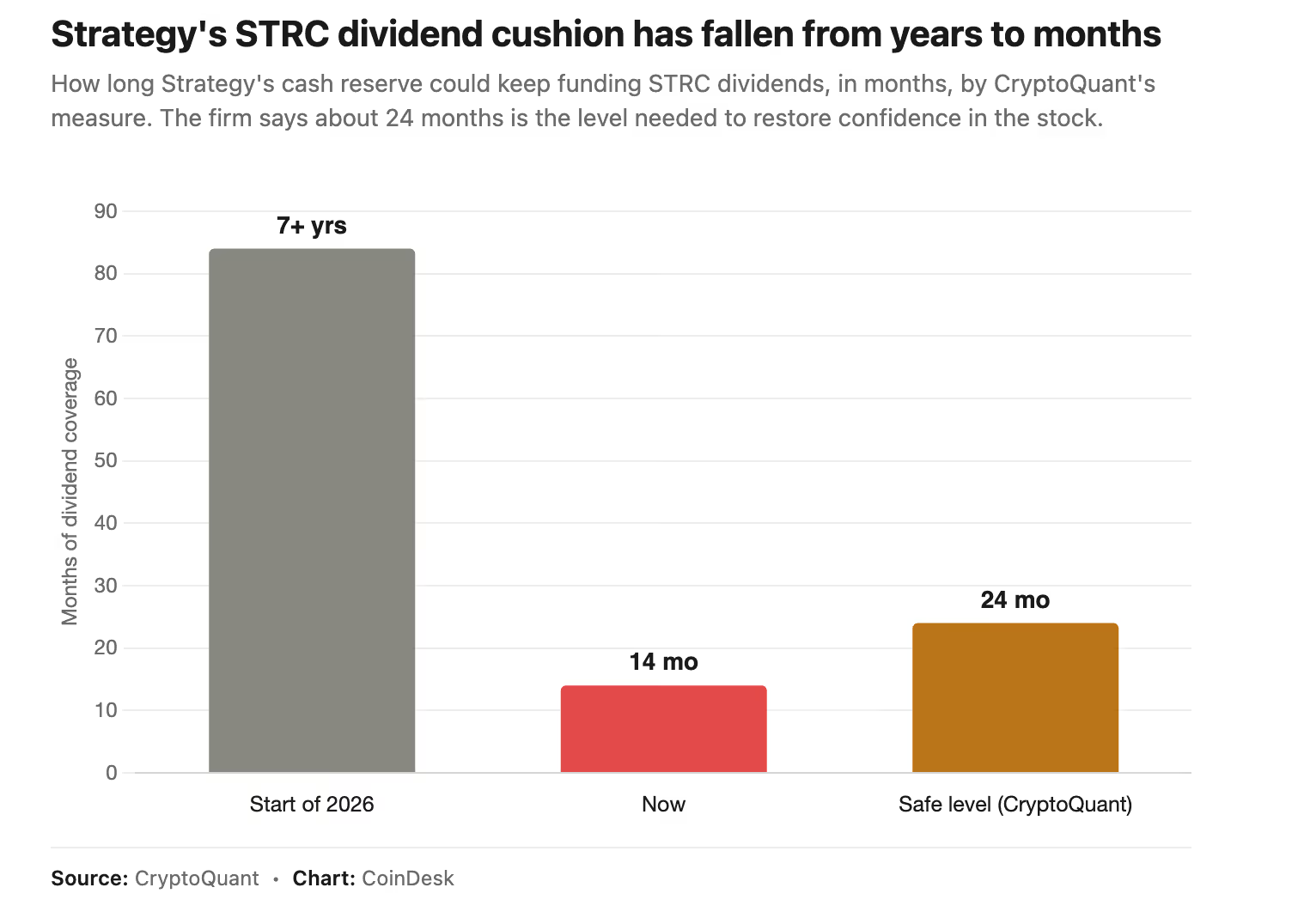
The squeeze comes from both directions. As Strategy issued more STRC to fund bitcoin purchases, its annual dividend obligations ballooned from about $300 million at the start of 2026 to $1.2 billion now, a near fourfold jump in under six months.

CryptoQuant noted the reserve needed to reach about $2.8 billion, or 24 months of coverage, for STRC to recover. As such, Strategy reported a $1.1 billion reserve in mid-June.
So its bitcoin offers less of a backstop than its size suggests.
“The company sits on a $10.6 billion unrealized loss, with all Bitcoin purchased in 2024, 2025, and 2026 underwater,” CryptoQuant said. “Any forced BTC sale at current prices would crystallize large losses and destroy shareholder value.”
A forced sale is unlikely soon, though. Strategy is not required to sell bitcoin to defend STRC and can instead raise the dividend or sell new shares to signal it can keep paying, tools it is already using.
CryptoQuant’s prescription is for Strategy to pause its bitcoin buying and rebuild the reserve first, then adopt a systematic approach to timing purchases rather than buying whenever it raises capital.
Strategy cannot simply switch the payments off to save cash. STRC’s dividends are cumulative, meaning any skipped payment still has to be made up later, and CryptoQuant said the company is unlikely to suspend them anyway because doing so would damage its credibility with the preferred holders it needs.
The report is a sharper read than the one Benchmark-StoneX offered on Tuesday.
A wave of selling in the technology sector that emerged earlier this week has weighed on European equities. The trigger was investor concern over the profitability of large-scale debt-funded investments by major US tech companies in AI infrastructure. The Nasdaq and S&P 500 fell to their lowest levels in more than a week, with semiconductor manufacturers bearing the brunt of the decline.
In Germany, Infineon Technologies (-5.86%), Siemens Energy (-3.93%) and Vonovia (-3.21%) were among the worst performers, while SAP and Airbus ended the session in positive territory, gaining around 2% each. Geopolitical factors also remain in the background: a memorandum signed in June between the United States and Iran has yet to remove uncertainty, with implementation of the agreement still subject to ongoing negotiations.
Technical picture
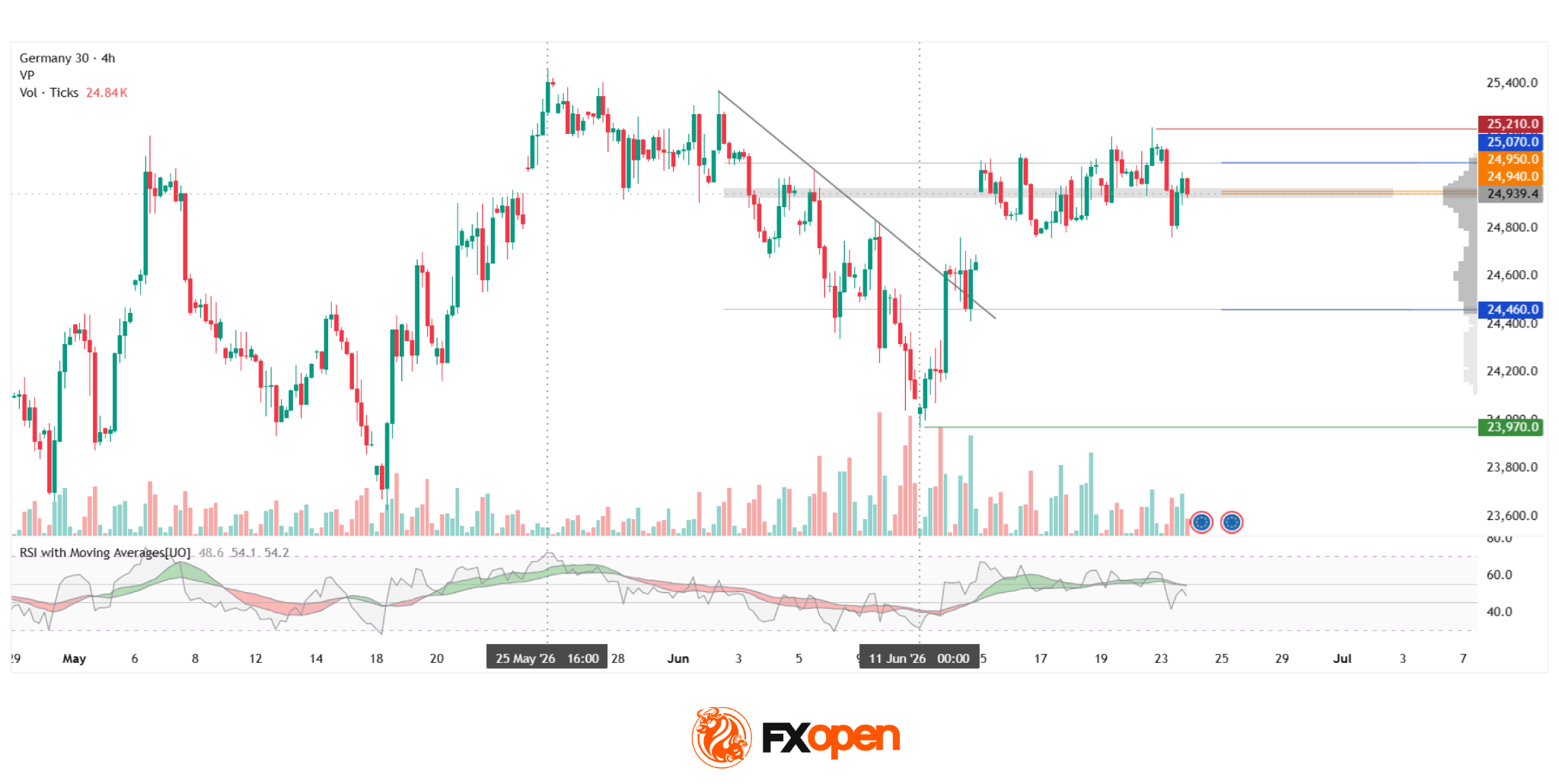
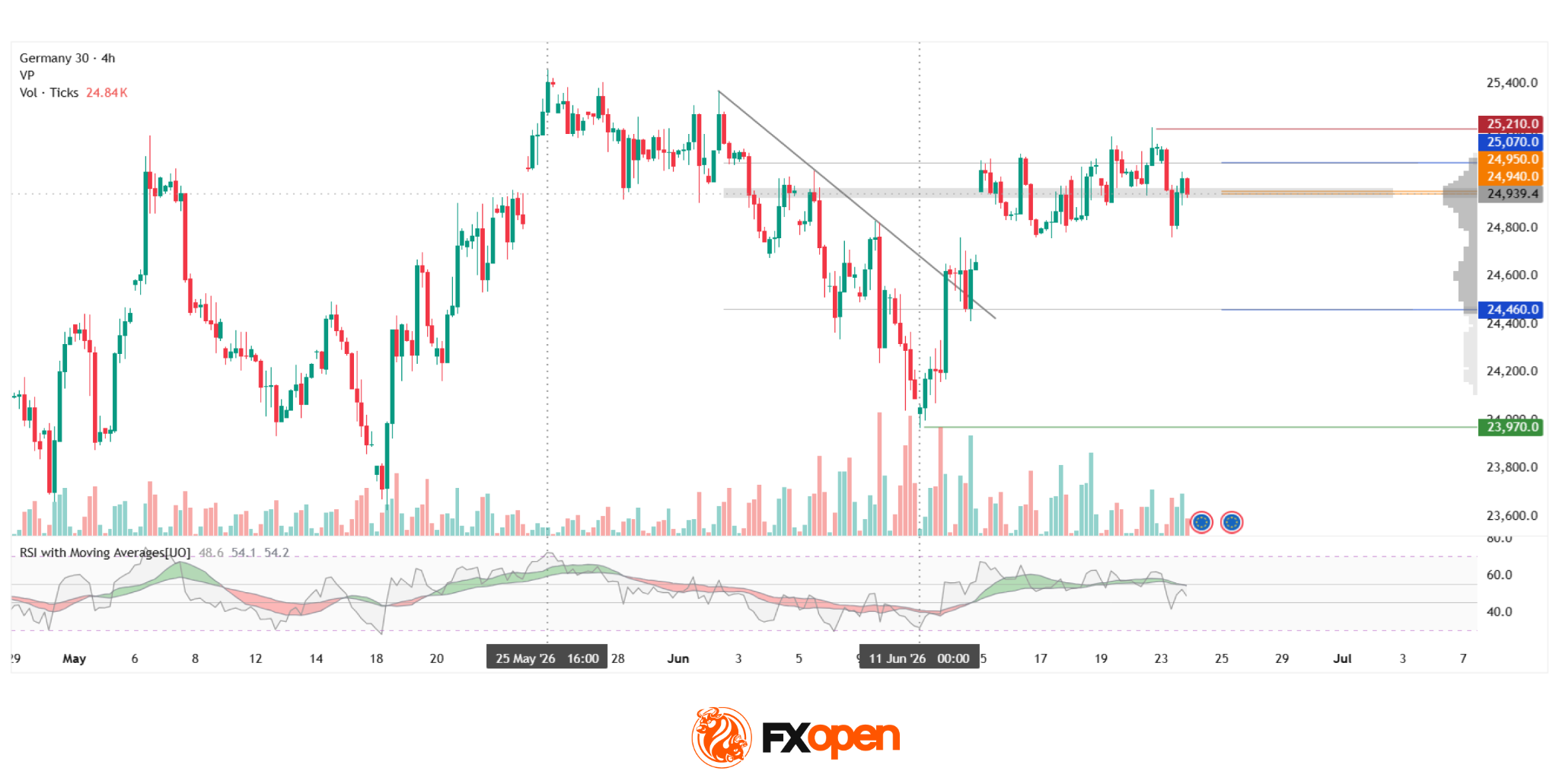
On the H4 chart of the DAX 40 index (GDAXIm on FXOpen), after peaking around 25,450 at the end of May, price declined towards the 23,970 area, forming a downward trend structure. Following an attempted breakout of the downtrend and a gap on 15 June, the index moved into a sideways range, forming a POC zone at 24,940–24,950 and an upper boundary of the current profile at 25,070, with price now trading between these levels.
The nearest resistance is located around 25,210, which could cap the market if the upper boundary of the profile is breached. Support is seen in the 23,970 area, which could be reached if the lower boundary at 24,460 is broken. Volume remains moderate, confirming the consolidation phase. The RSI and moving averages are at 48, 54 and 54 respectively; the oscillator is below its moving averages, while the averages are converging towards neutral levels, indicating a lack of clear momentum within the current range.
Summary
Pressure on the DAX 40 is driven by a global reassessment of AI infrastructure valuations, which has triggered a sell-off in the semiconductor sector worldwide, including German equities. Price has returned to a balance area after the rebound, while the RSI remaining below its moving averages signals a lack of directional momentum on either side.
Trade global index CFDs with zero commission and tight spreads (additional fees may apply). Open your FXOpen account now or learn more about trading index CFDs with FXOpen.
This article represents the opinion of the Companies operating under the FXOpen brand only. It is not to be construed as an offer, solicitation, or recommendation with respect to products and services provided by the Companies operating under the FXOpen brand, nor is it to be considered financial advice.


The US Senate passed sweeping bipartisan housing legislation Monday by a vote of 85-5, sending a package that includes a statutory ban on a Federal Reserve central bank digital currency through December 31, 2030 toward the president's desk. The 21st Century ROAD to Housing Act (H.R. 6644), led by… Read the full story at The Defiant

Strategy’s perpetual preferred stock Stretch (STRC) is under serious financial stress due to two simultaneous pressures, reported onchain analytics firm CryptoQuant on Tuesday.
The Bitcoin bear market means that all BTC purchased between 2024 and 2026 is underwater, with $10.6 billion in unrealized losses, and cash reserves are depleted, down 38% since early 2026 after a $1.5 billion convertible senior note repurchase in May.
Strategy pays dividends on its Stretch product, which offers an 11.5% yield and is designed to trade at $100. However, it fell to a record low of $82.5 last week, a record 17.5% below par.
At current prices of $87.4, the current effective yield is 13.2%, according to the STRC tracker.
Stop Buying Bitcoin
The core problem is that Strategy’s dividend obligations have nearly quadrupled to $1.2 billion per year, while the cash to cover them has shrunk, collapsing dividend coverage from more than seven years to just 14 months.
Last week, Strategy claimed that it had 32 years of dividend coverage using its $55 billion Bitcoin stash, but the argument was flawed.
At current dividend obligations, restoring just 24 months of coverage would require a cash reserve of approximately $2.8 billion, roughly twice what Strategy holds today, said CryptoQuant.
STRC issuance has been an effective capital-raising mechanism for Bitcoin purchases, but the rapid growth of dividend obligations has become a structural liability that could weigh on its sustainability.
“The market appears to be pricing this risk; the STRC price decline reflects not only near-term cash reserve weakness but also long-term concerns about the company’s ability to service its growing dividend burden.”
They added that any forced Bitcoin sale at current prices would crystallize its unrealized losses scale, destroy shareholder value, and potentially catalyze another leg down for BTC spot markets.
CryptoQuant recommended that the company “pause Bitcoin purchases until cash reserves and dividend coverage are restored.”
Strategy’s annualized dividend obligations have nearly quadrupled to $1.2B, while its cash reserve has fallen 38% in 2026.
Dividend coverage collapsed from 7+ years to just 14 months.
The company needs to stop buying Bitcoin and rebuild cash. pic.twitter.com/TR0oaAnT5k
— CryptoQuant.com (@cryptoquant_com) June 23, 2026
Saylor seems adamant, however, with the firm’s latest purchase of 520 BTC for $35 million while increasing its USD reserve by $300 million to $1.4 billion on Monday.
STRC, MSTR, and BTC Declining
The move gave some brief respite to STRC, which returned to $88 on Tuesday, but it remains in trouble, trading below par.
Company stock (MSTR) has also taken a beating, tanking a further 5% on Tuesday to end the day trading at $103.84, its lowest level since early 2024, according to Google Finance.
The move coincided with another Bitcoin dip as the asset failed to hold $64,000 and fell to $62,000 on Tuesday. BTC reclaimed $63,000 during the Asian trading session on Wednesday, but had already started to fall back from that level at the time of writing.
The post Saylor Should Stop Buying Bitcoin, Says CryptoQuant appeared first on CryptoPotato.
The Ethereum Foundation has cut 54 employees, roughly 20% of its staff, in the most concrete austerity measure the organization has taken since pledging to reduce its treasury spending rate. The Foundation announced the changes Tuesday, saying the cuts conclude a months-long reorganization tied to… Read the full story at The Defiant
Cboe Global Markets has launched its new prediction markets platform, Cboe Predicts, as the company enters the prediction trading market with a new suite of securities-based products.
The new offering includes binary option contracts tied to the Mini-S&P 500 Index, trading under the symbols XSPBW and XSPBX, which are already available through Interactive Brokers. Access through Charles Schwab is expected in the coming months. Cboe also said additional brokerage firms are likely to add support over time, broadening access to the new contracts.
New Prediction Markets Suite
According to the official press release, the new products allow traders to make predictions on where the Mini-S&P 500 Index, or XSP, will settle at expiration. Traders can take a “yes” position if they believe the index will close at or above a specified level or choose a “no” position if they expect it to finish below that level. The XSP index tracks the performance of the S&P 500 Index but is scaled to one-tenth the size of the larger SPX contract, which makes it a smaller, more retail-friendly alternative.
The new products also expand Cboe’s existing S&P 500 offerings. The company said it plans to add XSP vertical spreads in the future through its Quoted Spread Book system, which is designed to make more complex options strategies easier to understand. The framework aims to help traders who are familiar with simple yes-or-no contracts gradually learn more advanced trading strategies while keeping risks defined.
The products are cleared through the Options Clearing Corporation, which manages the settlement process. According to the company, the contracts will also operate under the same regulatory rules that apply to other options listed in the United States.
Commenting on the latest development, James Kostulias, Head of Trading Services, Charles Schwab, said,
“We support approaches that bring transparency, defined risk, and investor education to financial-related prediction markets. We plan to offer clients access to these binary options contracts in the coming months, building on our existing platform and demand from active traders.”
Earlier Skepticism
The latest development comes months after Charles Schwab CEO Rick Wurster expressed skepticism about prediction markets. In December, Wurster told The Wall Street Journal that event contracts tied to sports or entertainment could blur the line between investing and gambling, while adding that prediction markets were “not high on our list at the moment.”
Charles Schwab has also been expanding into new asset classes in recent months. Earlier this year, the brokerage rolled out Schwab Crypto, allowing retail clients in most US states to directly trade Bitcoin and Ethereum alongside traditional investments through the same platform.
The post CBOE Launches Prediction Markets With S&P 500 Binary Contracts appeared first on CryptoPotato.

Valaris: Small Arbitrage Play Short-Term, Large Consolidated Upside Long-Term (NYSE:VAL)

Law Enforcement and Catholics Urge Changes to CLARITY Act
Jerry O'Connell weighs in on “that ”conversation with wife Rebecca Romijn's ex-husband John Stamos


-

 Fashion5 days ago
Weekend Open Thread: Miami – Corporette.com
-

 Entertainment3 days ago
Renter of Home in Anne Heche Crash Denies Settlement With Son
-

 Tech2 days ago
Microsoft accidentally kills epic Outlook email threads
-

 Business3 days ago
Soccer-U.S. defends Iran World Cup travel restrictions, says discussions ongoing
-
 Sports13 hours ago
Two goals and an assist by sheer aura: Cristiano Ronaldo just entered the World Cup chat
-
Crypto World5 hours ago
Bitcoin (BTC) Dips Below $62K, Ethereum (ETH) Plunges 6% Daily: Market Watch
-

 Politics6 days ago
BBC Reporter Discusses Cross Party Criticism Of Trumps Iran Deal
-
Business8 hours ago
Entergy settles forward sale agreements, raises $672 million in cash proceeds
-
 Business4 days ago
Wall Street Week Ahead: Investors see Micron earnings as pulse check of AI rally momentum
-

 Politics4 days ago
Andy Burnham and the meaning of Makerfield
-

 Tech6 days ago
AWS enters the context layer race with a graph that learns from agents, not manual curation
-
 Crypto World4 days ago
Can Charles Hoskinson Really Rescue Cardano?
-

 Crypto World4 days ago
HIVE shares jump as $220M AI deal speeds Bitcoin mining pivot
-

 Crypto World4 days ago
Jake Chervinsky accuses CME of protecting derivatives monopoly
-

 Crypto World2 hours ago
Securitize Wraps Roubini's SEC-Registered ETF as Dubai VARA Digital Security
-

 NewsBeat5 days ago
Keir Starmer Allies Question His Chances For No 10
-

 Tech2 days ago
Nearly 7,000 fake Amazon domains registered ahead of Prime Day 2026, researchers warn
-

 Business5 days ago
Brexit cost 6% of UK economy, Bank of England company data suggests
-

 Sports5 days ago
FIFA World Cup 2026: Canada beat 9-men Qatar 6-0 to register first ever win | FIFA World Cup 2026
-
 Tech3 days ago
Signal’s Meredith Whittaker says AI chatbots ‘are not your friends’ and calls Copilot agents a backdoor
You must be logged in to post a comment Login