
Crypto World
Zcash Holders Back Faster Block Times, Keep Halving Schedule

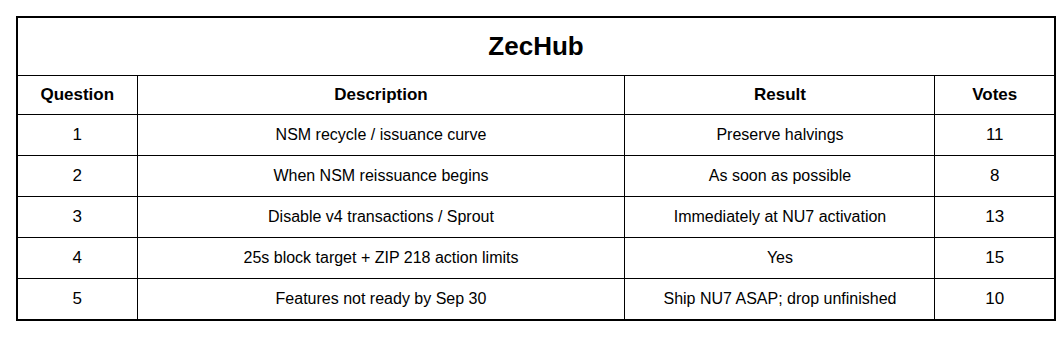
Zcash token holders backed cutting the network’s target block time to 25 seconds from 75 seconds and preserving its existing halving schedule in a poll on the next major upgrade.
The faster-block proposal received 99.9% of the Zcash (ZEC)-weighted vote, while 98.9% supported keeping halvings, according to results published Monday. Voting power reflected eligible ZEC holdings, with both percentages including abstentions.
The shorter interval would reduce the expected wait for a transaction’s first confirmation, according to the proposal. The amount of new ZEC issued per block would fall to keep scheduled daily issuance unchanged.
The changes are proposed for NU7, a Zcash network upgrade whose activation date remains undetermined. Token holders also favored excluding features not implemented by Sept. 30.
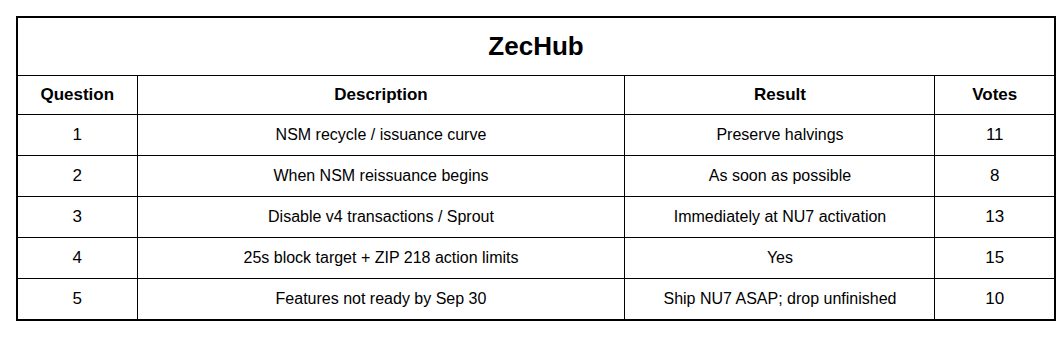
Results of the NU7 sentiment poll. Source: forum.zcashcommunity.com
The coinholder vote was separate from polls of ZecHub, the Zcash Community Advisory Panel and other community groups. Eligibility was limited to spendable ZEC in the Ironwood shielded pool at the voting snapshot. Developers plan to ship the final items for the upgrade by the Sept. 30 cut-off deadline, with testnet and mainnet activation not yet determined.
Halvings are scheduled cuts that reduce the issuance of new ZEC by half. The winning coinholder option would preserve that schedule while allowing funds removed from circulation under a separate proposal to be returned through future block rewards.
The advisory-panel results showed a closer split, with 57 members favoring a gradual issuance curve that would replace halvings and 54 favoring keeping them.
Related: Anthropic’s Mythos AI finds no more ‘serious’ bugs in Zcash: Wilcox
Zcash coinholders favor delaying reissuance
Another major feature considered for NU7 inclusion was the Network Sustainability Mechanism (NSM), a proposed upgrade to Zcash’s economic model that aims to recycle a portion of transaction fees back into a pool, rather than relying solely on block rewards.
About 97% of token holders voted to delay NSM reissuance until February 2031, with 2.3 million ZEC tokens voting to delay the motion, while only about 70,239 tokens voted to start it as soon as possible.
NSM was proposed in January in response to the network’s long-term security budget concerns, as the declining block rewards may eventually be insufficient to incentivize miners to validate transactions. The model’s three-part mechanism seeks to burn and recycle 60% of ZEC transaction fees into future block rewards, without exceeding the token’s 21 million maximum supply.
ZEC rose 3.8% in the past 24 hours, extending its 132% rally seen during the past month, according to CoinMarketCap data.
Magazine: The legal battle over who can claim DeFi’s stolen millions

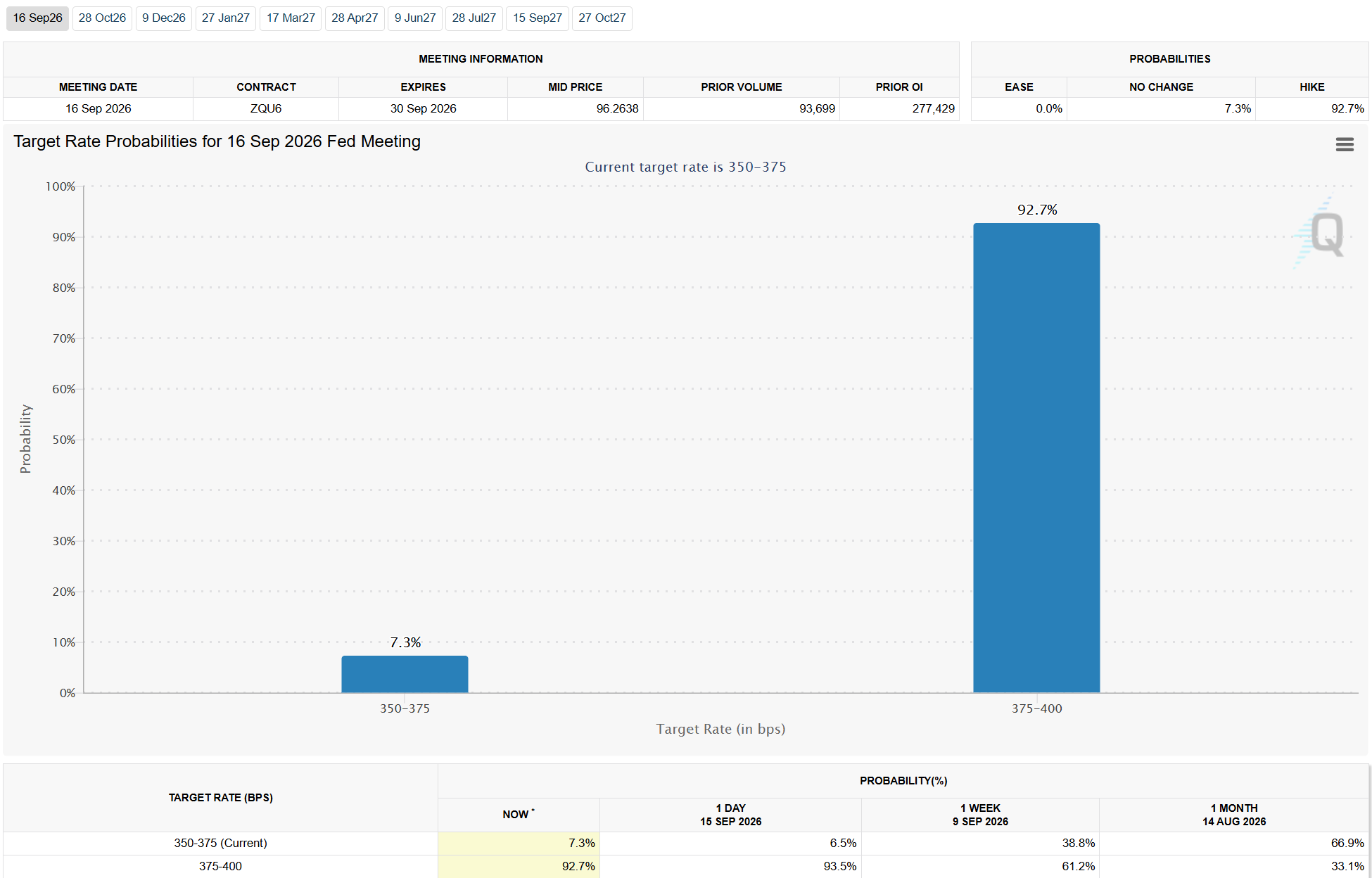
Interest rate futures put a 92.7% chance on the Federal Reserve raising rates on Wednesday. That leaves traders worried across both the crypto and stock markets. Because Donald Trump appointed Kevin Warsh with one single promise: cut interest rates. But Warsh can’t deliver that with inflation running at 3.4%
So, how will the market react, and which way will Bitcoin move?
Why a Pause is the Closest thing Warsh can give Trump
The Fed’s target range sits at 3.50% to 3.75%. The CME FedWatch tool put the odds of no change at 7.3% on Wednesday morning, with zero odds of a cut.

Trump picked Warsh for the job and watched him sworn in at the White House in May. Even ahead of the swearing-in, the president was already treating his would-be chair as an ally.
Wharton professor Jeremy Siegel has argued that Trump pressure and midterms are the only forces still blocking a hike. White House economic adviser Christopher Phelan said a move this week would be a mistake. Midterm elections are seven weeks away.
Former Fed governor Stephen Miran made the data case against hiking in an interview this week.
“If you held in June and July and become more hawkish as the inflation data come down, it speaks to an incoherent reaction function,” he shared.
Follow us on X to get the latest news as it happens
What Bitcoin and Gold Did the Last Time the Data Surprised
Rate expectations set the cost of holding assets that pay no interest. Bitcoin and gold both sit in that group, so cheaper money tends to help them.
The Bitcoin price held near $76,022 as of this writing, down 1.17% in 24 hours. Gold traded around $4,340 an ounce, up 1.4% on the day.

The August inflation report on September 11 showed how fast both react. Bitcoin fell from roughly $77,100 to $76,050 inside a minute. Gold slid from $4,353 to $4,292, then recovered.
BeInCrypto flagged hike odds near 90% that day. Pricing has since hardened to 92.7%.
KPMG chief economist Diane Swonk told the Associated Press that a hike now could pull long-term rates lower later. Warsh’s press conference, not the quarter point itself, is what traders will parse.
The post 93% Chance of a Fed Rate Hike Today. What Happens to Bitcoin Now? appeared first on BeInCrypto.

The CLARITY Act did not receive enough support in the US Senate, so it could not move to official discussion. This triggered a correction in the broader cryptocurrency market, while the upcoming FOMC meeting may worsen the sector’s condition.
The prevailing expectation is that interest rates in the USA will rise by 0.25%, yet analyst Ali Martinez assumed the central bank may be forced to keep the benchmark unchanged, which could propel a BTC price rally. Here’s why.
Influence From Trump?
Martinez started his thesis by noting the CLARITY Act failure and describing it as “a major setback for one of Trump’s crypto-policy objectives ahead of the November midterms.”
Then, he revealed that the odds of a 25-basis-point rate hike following the FOMC meeting, scheduled for later today (September 16), are roughly 93%, with only a small minority expecting the figure to stay the same.
According to the analyst, the smaller group may actually get it right this time. He pointed to the approaching midterms in the US, arguing that Trump needs a political win and that another rate increase could create more economic pressure, possibly hurting his chances of success.
“That could weigh on Kevin Warsh and the FOMC’s decision-making,” he said.
Martinez thinks that such a surprise move could trigger a powerful rally across risk assets, with BTC (which has rarely risen after the past 14 FOMC decisions) potentially surpassing $82,000.
“This is my wild prediction. Not the consensus view. Trump needs a win. A no-hike decision could give markets exactly the surprise they need to rally,” he concluded.
However, another angle is worth considering. The widely expected rate hike may already be priced in, making Fed Chair Warsh’s press conference the key event to watch. It will take place immediately after the FOMC meeting, and any signals of further rate increases could negatively impact BTC and altcoins. On the other hand, a softer tone and remarks that the central bank has made progress on inflation could lead to a solid rebound.
Massive Shorts Ahead of the Meeting
X user Max Crypto revealed that a mysterious whale opened a $50 million short position on BTC and a $15.8 million short on ETH ahead of the central bank’s crucial decision.
Usually, such major bets fuel speculation that the trader may have access to inside information. However, the whale’s win rate is around 40.6%, meaning their track record is far from flawless.
Meanwhile, another anonymous trader (with a staggering 100% win rate) recently opened multi-million shorts on BTC, ETH, and ZEC before the CLARITY Act vote. As mentioned above, the bill did not move forward for official discussion, and the crypto market headed south.
The post Wild Bitcoin Prediction Ahead of the FOMC: Here’s What Could Trigger a Pump appeared first on CryptoPotato.
XRP fell about 8% over the past 24 hours, one of the worst showings among the top cryptocurrencies, after the US Senate failed to advance the Digital Asset Market CLARITY Act on Tuesday.
The drop left XRP down well over 10% for the week, well behind Bitcoin and most other major coins, and it shows how closely tied the token’s price still is to progress on crypto legislation in Washington.
The Selling Was Not Just Profit-Taking
XRP’s price ran from around $1.46 per CoinGecko data to near $1.27, with analyst Xaif Crypto noting that its cumulative volume delta (CVD) cratered to negative 10.5 million as the price dumped.
“Sellers aren’t hiding anymore, this is aggressive dumping not just profit taking,” they wrote on X.
The selloff tracked the Senate vote almost exactly. Cloture on the bill, formally known as H.R. 3633, needed 60 votes and got 49. Every yes vote came from Republicans, and four of their own broke ranks to vote no.
Furthermore, Senators Gillibrand, Warner, Booker, Warnock, Gallego, Alsobrooks, and Cortez Masto all voted no after months of talks, meaning no Democrats crossed over to support it.
The CLARITY Act is meant to divide oversight of digital assets between the SEC and CFTC and bring exchanges, brokers, and dealers under a new federal registration regime, provisions the market had been pricing ahead of the Tuesday vote.
At the time of writing, CoinGecko data put XRP around $1.28, down over 8% in 24 hours and more than 10% in seven days. The picture looks different further out, with the Ripple token still up close to 29% over the past 30 days, even after this week’s drop, although it remains down more than 56% across one year and about 65% below its all-time high of $3.65 from July 2025.
Bitcoin and the Rest of the Market Also Slipped
The broader market was also under pressure, with Bitcoin slipping around 2.0% over the same 24 hours to trade near $75,000, while its share of the total crypto market remained above 56%. On its part, Ethereum dropped close to 4%, which saw it trading a few bucks under $2,400.
Stellar dipped even harder than XRP, shaving nearly 9% from its value, while BNB was only slightly ruffled, with its price dropping less than 1%.
Zcash gained about 3%, and Hyperliquid fell more than 2% over the same period, while Dogecoin slipped 3.7% and Solana lost over 4%, in line with the rest of the market’s retreat.
For XRP, the immediate price damage does not change its legal position, as pointed out by Ripple CEO Brad Garlinghouse, who also stated that his company “has never been stronger” despite the CLARITY setback.
The post Why XRP Was Hit Hardest After the CLARITY Act Senate Failure appeared first on CryptoPotato.
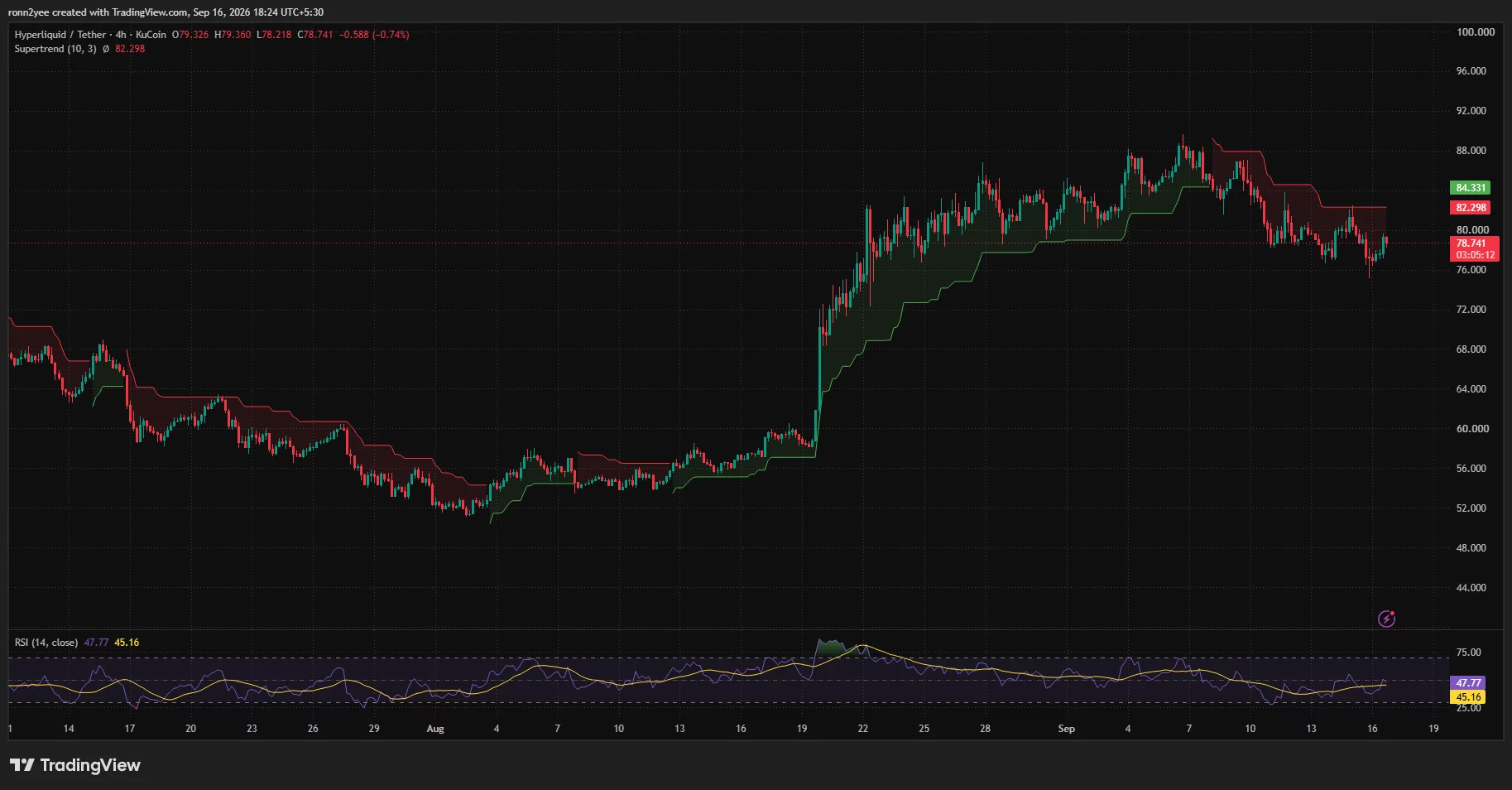
Hyperliquid’s HYPE token fell about 7.5% over the past week, retreating from $83.55 to around $78.70 as legal concerns and weaker technical momentum weighed on its recent rally.
Summary
- HYPE price has fallen 7.5% since Sep. 10 after setting a record high near $89.
- 4-hour Supertrend resistance sits at $82.30, keeping the short-term structure bearish.
- Bollinger Band support at $75.83 remains the main level protecting the broader uptrend.
- Hyperliquid reportedly bought and burned 36,720 HYPE worth $2.84 million within 24 hours.
HYPE price retreats from record high
Hyperliquid (HYPE) price traded near $78.70 on Sep. 16 after falling from an opening price of $83.55 on Sep. 10. The move represented a weekly decline of about 7.5%, although the token remained well above its August trading range.
The correction followed HYPE’s rally to a record high near $89 in early September. Daily candles show that buyers repeatedly failed to hold prices above the $88 area before sellers pushed the token below $82.
HYPE briefly dropped toward $76 on Sep. 16 before rebounding to around $78.70. The recovery showed that buyers remained active near the lower end of the week’s range, but price had yet to reclaim the technical levels that would signal a stronger reversal.
The pullback also followed federal charges against two former Robinhood engineers accused of using confidential listing information to trade perpetual futures on Hyperliquid.
Separate federal complaints alleged that Huaisong “Jerry” Xiang and Hefu Chai traded ahead of Robinhood’s public announcements. Prosecutors said each defendant earned more than $50,000 through the alleged activity. The allegations concern the individuals’ conduct and do not accuse Hyperliquid or its developers of participating in the scheme.
Short-term HYPE structure remains bearish
The 4-hour chart shows HYPE trading below the Supertrend indicator, which had shifted to resistance at $82.30. The indicator will continue to favor sellers unless the token closes above that level and holds it as support.
HYPE’s 4-hour Relative Strength Index stood at 47.77, while its RSI-based average was 45.16. The readings place momentum near neutral territory after recovering from a recent approach toward oversold conditions.
Price action has also formed a series of lower highs since the Sep. 7 peak. A rebound toward $80 stalled before reaching the Supertrend line, suggesting that sellers continue to defend rallies.
The $80 psychological level is the first barrier for buyers. A sustained move above it could allow HYPE to test the $82.18–$82.30 area, where the daily Bollinger Band midpoint and 4-hour Supertrend resistance converge.
A close above that zone would weaken the bearish short-term setup and expose $84.30, followed by the upper Bollinger Band near $88.53. The record area between $89 and $90 would become relevant only if HYPE clears those intermediate levels.
Daily Bollinger support protects the larger uptrend
The daily chart presents a less bearish picture than the 4-hour setup. HYPE remained above the lower Bollinger Band at $75.83 despite trading below the middle band at $82.18.
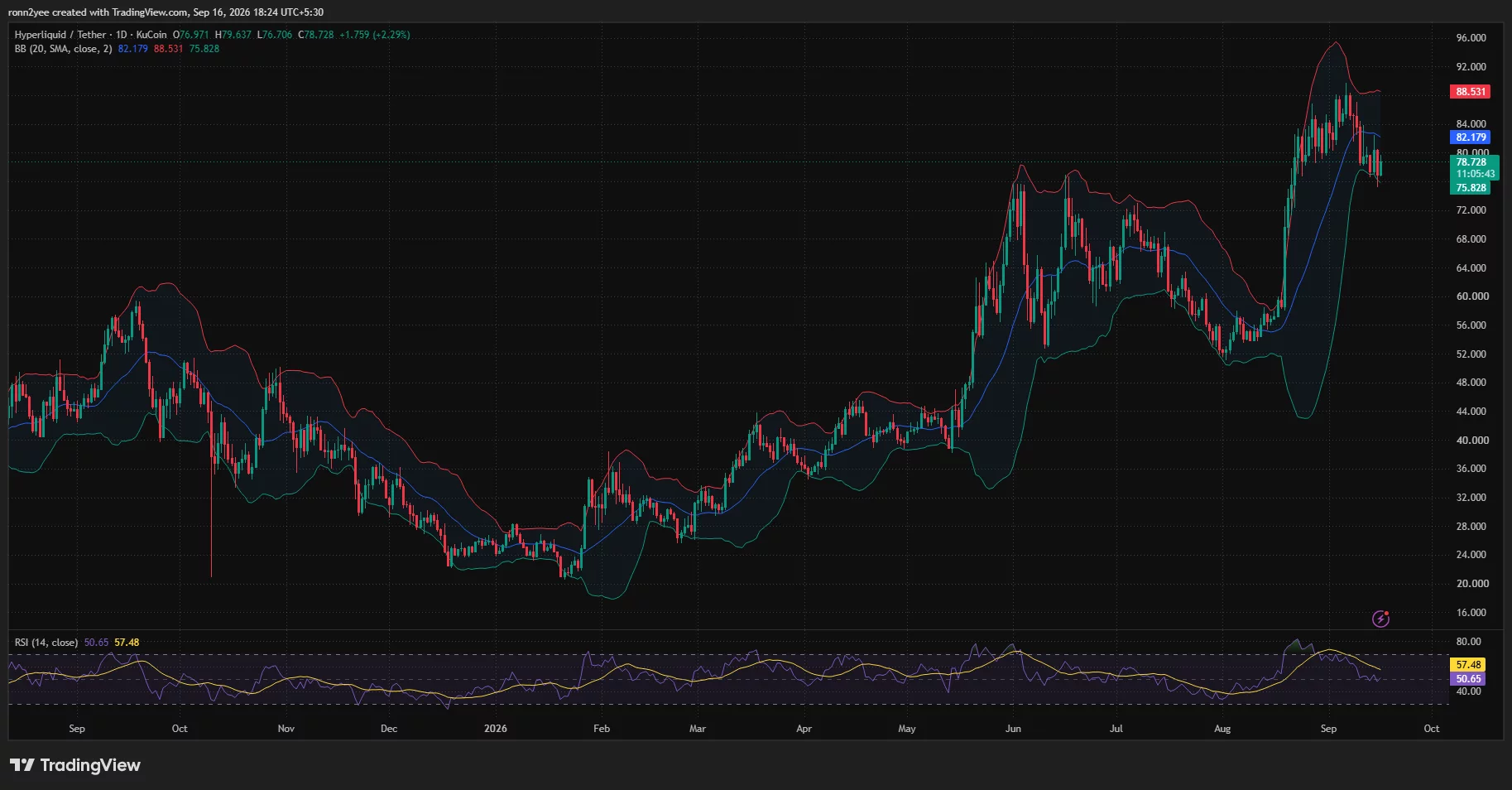
Daily RSI stood at 50.65, down from an overbought reading reached during the early-September rally. The indicator’s average remained higher at 57.48, showing that momentum has cooled faster than its recent trend.
A daily close below $75.83 would mark a more serious technical breakdown. The next visible support zone lies around $72, where HYPE consolidated before its late-August advance. A deeper correction could then bring the $68–$70 region back into focus.
The wider chart still shows a sequence of higher lows from the August bottom near $51. HYPE would therefore need to lose the mid-$70s support area before the larger recovery structure faces a clearer threat.
Holding $75.83 while reclaiming $82.30 would instead support a consolidation scenario between the lower and middle Bollinger Bands.
Liquidation map places liquidity near $80
CoinGlass’ 24-hour liquidation heatmap shows a dense liquidity cluster between roughly $78.40 and $78.90, close to HYPE’s current price. A second concentration appears between $79.70 and $80.50.
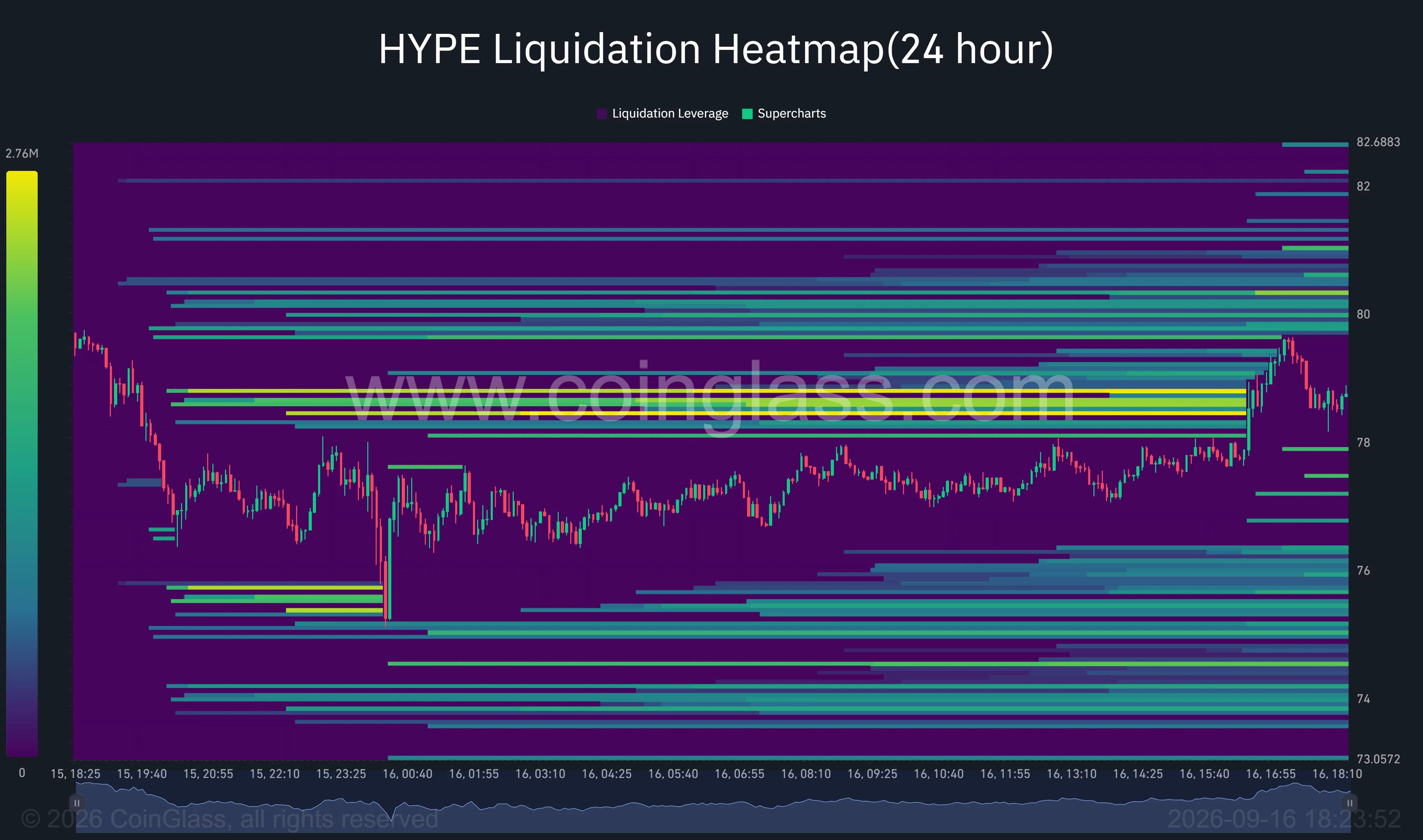
Those bands could attract price during a rebound because leveraged positions tend to accumulate around crowded levels. The heatmap does not show that all positions in those zones have already been liquidated; it identifies areas where forced closures could increase if price reaches them.
Above the market, the strongest nearby liquidity sits around $80.30. A move through that level could accelerate toward $81 and $82 as short positions face pressure.
Liquidity is also visible below price around $75–$76, aligning with the daily lower Bollinger Band. A break under $77 could therefore expose HYPE to a sweep of leveraged long positions before buyers attempt another recovery.
Token burns offer support during the correction
Onchain Lens reported that Hyperliquid bought and burned 36,720 HYPE worth about $2.84 million during a 24-hour period, at a volume-weighted average price of $77.31.
The account said lifetime burns had reached 48.67 million HYPE, valued at approximately $3.78 billion and equal to 4.87% of the token’s maximum supply. It also reported $2.14 million in rolling 24-hour fees and $2.07 million in HYPE-directed revenue.
The buyback mechanism may absorb part of the available sell-side supply, but the charts show that it has not yet restored bullish short-term momentum.
For HYPE, the immediate setup depends on whether buyers can defend $75.83 and push the price above $82.30. Remaining below that resistance would leave the token vulnerable to further consolidation, while a confirmed reclaim could reopen a path toward $84.30 and $88.53.
Disclosure: This article does not represent investment advice. The content and materials featured on this page are for educational purposes only.


Zero-knowledge technology could let companies verify who you are without storing your identity documents. So why isn’t it already standard practice?
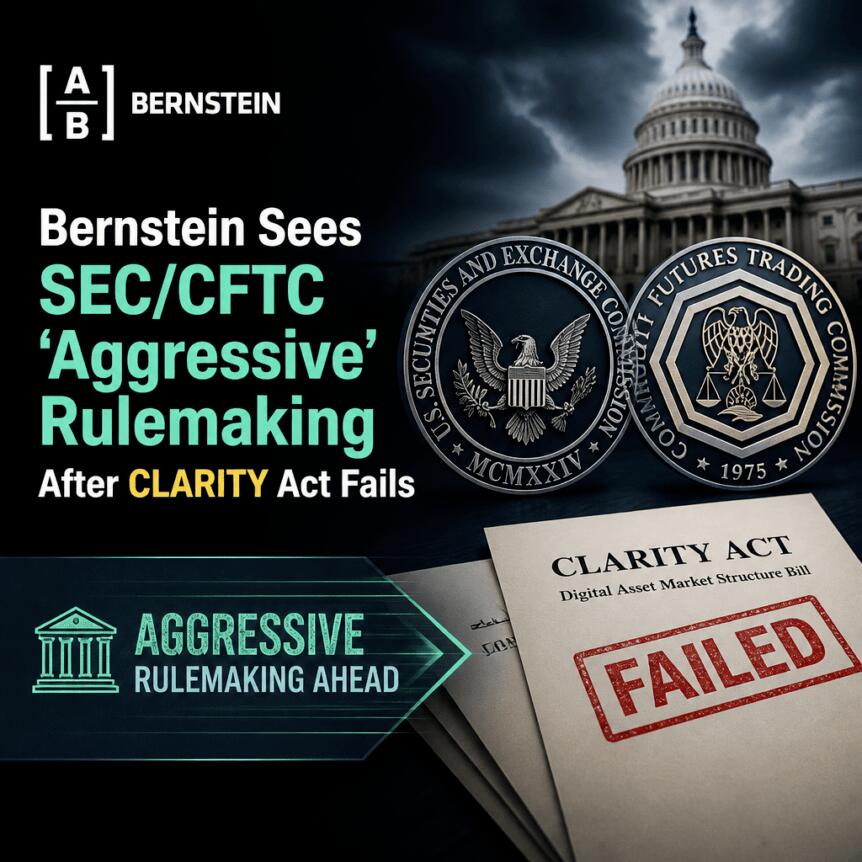
The U.S. Senate’s failure to advance the Digital Asset Market Clarity (CLARITY) Act has prompted expectations of faster, more direct rulemaking from the SEC and CFTC, according to analysts at Bernstein. With the bill not moving forward after a cloture vote on Tuesday, Bernstein said regulators are likely to “make up for the time lost” in developing their own frameworks for crypto markets.
In a Wednesday note shared with Cointelegraph, Bernstein argued the shift could still deliver meaningful regulatory guidance for the industry, even if the legislative approach that would have “fool-proofed the industry against political regime shifts” did not materialize. The analysts expect new agency rules to address issues ranging from how tokens are categorized to how certain decentralized finance (DeFi) activities might be treated.
Key takeaways
- With CLARITY failing to clear a cloture vote, Bernstein expects the SEC and CFTC to accelerate rulemaking instead of relying on a new statutory framework.
- New guidance may include token taxonomy for fundraising and investor protections aimed at developers and self-custodial protocols.
- Bernstein anticipates “innovation exemptions” that could support equity tokenization efforts under defined conditions.
- The SEC’s earlier proposal to clarify treatment of certain “investment contracts” provides a starting point for how regulators may structure safer harbors.
Why CLARITY’s setback changes the regulatory playbook
Earlier coverage from Cointelegraph noted that the U.S. Senate failed to advance the CLARITY Act after a cloture motion did not pass on Tuesday. The bill, according to Bernstein, would have offered the country’s first dedicated regulatory framework for digital assets.
Bernstein’s central point is that the regulatory agencies now have a new timeline pressure. Rather than continuing negotiations tied to the legislation’s prospects, the SEC and CFTC are expected to publish regulations meant to provide clarity more immediately. Bernstein also suggested that bringing the act back for another vote is unlikely, citing a limited window and concerns about ethics provisions.
For market participants, the practical implication is that uncertainty may persist—but it could shift form. Instead of waiting for Congress to define broad categories and boundaries, firms may need to adapt to agency rules that are narrower in scope yet faster to implement.
SEC groundwork: proposed rules for “certain investment contracts”
Bernstein’s expectations build on actions the SEC has already taken. On Aug. 19, Cointelegraph reported that the SEC proposed new rules to establish what the agency described as a “clear and fit-for-purpose framework for certain investment contracts involving crypto assets.” Those proposals are designed to let entities raise capital while preserving investor protection.
As reported by Cointelegraph, the SEC’s proposal includes exemptions that would allow crypto firms to issue up to $5 million in tokens over four years and up to $75 million over 12 months, along with a safe harbor intended to exempt cryptocurrencies from being treated as “investment contracts.”
Bernstein’s note implies that the agencies may use this approach as a template—tightening, expanding, or operationalizing rule details in response to the missed legislative path. Investors and token issuers, in turn, may focus on how their offerings fit within the boundaries of these frameworks, particularly around how contracts and rights are structured.
What Bernstein expects from the SEC and CFTC next
Bernstein said it expects agency regulations to cover several concrete areas for crypto businesses. The analysts highlighted token taxonomy for raising capital—an issue that matters because how regulators classify tokens can determine whether an offering or program is treated like an investment contract or falls under other regulatory categories.
Bernstein also pointed to developer protection measures for DeFi and self-custodial protocols. For builders, this could be significant: it suggests rulemaking may aim to address common architectural realities in DeFi where developers may not control user custody or operational decisions, while still addressing how investor protection principles apply.
In addition, Bernstein expected “innovation exemptions” for equity tokenization, implying regulators may carve out room for certain issuance models that resemble traditional equity structures—potentially with conditions intended to prevent broad sales practices from evading oversight.
Finally, Bernstein referenced faster approval times for real-world asset (RWA) perpetual futures and amendments to rules around federal sports even contracts and their classification as swaps. While these items are more technical and specific, they point to the agencies’ willingness to address market structure questions, not just fundraising token frameworks.
For traders and liquidity providers, the takeaway is that regulatory clarity might arrive in multiple layers: rules affecting issuance and governance may be complemented by guidance on derivative products and contract classifications.
Signals of urgency from SEC leadership
The sense that the SEC would move quickly without CLARITY is reinforced by public messaging from SEC leadership. Cointelegraph previously reported that on July 27, SEC Chair Paul Atkins told CNBC the agency was “ready, willing, and able to come out with rules” on digital assets if the Senate failed to pass the CLARITY Act.
This matters because it frames the likely regulatory response as proactive rather than reactive. If Bernstein’s expectation holds, firms should anticipate rulemaking momentum that is less dependent on congressional timing, even if the details ultimately differ from what a bill like CLARITY would have provided.
Where the picture remains uncertain is how comprehensively the agencies will harmonize their approaches across token issuance, DeFi developer responsibilities, and the treatment of derivative products. Bernstein expects a compensating wave of regulatory work, but the industry will still need to watch how the rules are finalized and how they apply in practice.
Next, market participants should monitor the SEC and CFTC for concrete drafts and timelines—especially around token taxonomy and any safe harbor or exemption mechanics that could determine how token offerings, DeFi participation, and certain derivative structures are regulated once CLARITY is off the table.


Circle has launched the public mainnet of Arc on Sept. 16, bringing its USDC-powered Layer 1 blockchain online with institutional validators, more than 20 fiat stablecoins and tokenized funds available from launch.
Summary
- Circle launched Arc mainnet with USDC as gas and deterministic sub-second settlement for financial applications.
- Arc supports twenty-two fiat stablecoins, while BUIDL, USYC, JAAA and JTRSY launch natively at launch.
- Eleven institutional validators join Circle initially, including BlackRock, DTCC, Visa, Mastercard and Standard Chartered globally.
- Circle minted ten billion ARC tokens, while stating no public token launch has occurred yet.
- Circle previously agreed to sell 807.5 million ARC tokens privately for $242.2 million in proceeds.
Circle said in itsofficial Arc mainnet announcement that the network uses USDC as its native gas asset, provides deterministic settlement in under one second and supports Ethereum Virtual Machine applications, allowing developers to use Solidity contracts and familiar Ethereum development tools.
The public opening follows an Arc testnet that processed more than 700 million transactions, according to Circle’s launch announcement. Circle’s second-quarter SEC filing had recorded 502 million cumulative testnet transactions and 2.8 million transacting wallets as of June 30, showing that activity continued climbing before the September launch.
Circle Arc mainnet uses USDC for transaction fees
Arc’s fee design removes the need for users to hold a separate volatile network asset to submit ordinary transactions. Fees are denominated and paid in USDC, while Arc’s gas documentation says the network is designed to keep costs predictable as transaction demand changes.
The network pairs that model with deterministic sub-second finality. Once Arc finalizes a transaction, the network design does not rely on the probabilistic confirmation periods associated with some other blockchain systems. Arc is running under a permissioned Proof-of-Authority model at launch.
EVM compatibility gives developers access to Ethereum-based tooling without requiring them to rewrite Solidity applications for a separate programming environment. Arc’s mainnet uses chain ID 5042, while USDC functions as its native currency for gas accounting.
Circle has connected Arc with Cross-Chain Transfer Protocol and Circle Gateway, extending asset movement and liquidity access across more than 20 supported blockchain networks. The company says developers can use burn-and-mint and lock-and-mint infrastructure to distribute supported assets between Arc and other chains.
As crypto.news previously reported, Arc combines an EVM execution environment with a stablecoin-denominated fee model and institutional validator structure.
Circle’s Q2 2026 filing with the SEC confirms that the private mainnet started in May. More than 100 partners were participating by July 20 across payments, capital markets, digital assets and technology.
BlackRock, Visa and DTCC join the validator cohort
Arc begins public operations with Circle and 11 named institutional founding validators.
Circle’s founding validator announcement identified BlackRock, DTCC, Galaxy, ICE, Mastercard, MoneyGram, SBI Group, Standard Chartered, Sumitomo Corporation, Visa and Worldpay, now part of Global Payments.
BlackRock’s digital-assets head Robbie Mitchnick said purpose-built networks can serve specific financial-market uses and stated that Arc “appears clearly well positioned to serve stablecoin and payment use cases at scale.” The statement represents BlackRock’s assessment of the network, not a guarantee of adoption.
Banks working with or building around Arc include BNY, BTG Pactual, HSBC, Lead Bank, Societe Generale, Standard Chartered and State Street, according to the Arc mainnet ecosystem announcement.
Payment firms named in the same launch materials include Mastercard, MoneyGram, Visa, JCB, Global Payments and Thunes.
Crypto.news reported on Circle’s institutional Arc rollout and validator plans, including the involvement of major financial and payments companies.
Circle CEO Jeremy Allaire described Arc as the company’s most important product introduction since USDC and said, “USDC was step one. Arc is the network built for what comes next.” His statement describes Circle’s strategy and does not guarantee future network adoption.
More than 20 stablecoins and tokenized funds are available
Arc’s day-one asset list includes 22 fiat-linked stablecoins: USDC, EURC, AUDD, AUDF, BRLA, CADD, CHFAU, EURAU, GBPA, JPYC, KRW1, MXNB, QCAD, SEKAU, TRYB, wARS, wBRL, wCLP, wCOP, wMXN, wPEN and ZARU.
Circle StableFX is live on Arc for programmable foreign-exchange activity across more than 20 fully reserved stablecoins. Circle says the service uses atomic payment-versus-payment settlement, while participating market makers provide FX liquidity.
Tokenized financial products available natively include BlackRock’s BUIDL, tokenized by Securitize; Circle’s USYC; and Janus Henderson’s JAAA and JTRSY products. Circle states that these assets can interact with lending, trading and collateral markets available through Arc applications.
Access restrictions still apply to individual products. Circle specifically states that USYC is available only to non-U.S. persons under its Securities Act definition, with further eligibility restrictions possible. Arc’s existence does not remove those product-level requirements.
Circle introduced cirBTC on Arc as a programmable representation of Bitcoin. The company says cirBTC can be converted 1:1 from BTC, cbBTC or WBTC without conversion fees and is intended for collateral and liquidity applications.
On the application side, Aave and Morpho are supporting Arc’s lending markets from launch. Aero and Uniswap provide trading infrastructure, while Circle named a longer group of applications covering swaps, perpetual trading, NFTs and cross-chain execution.
Binance, Bybit, Kraken, KuCoin, OKX, Upbit and several other exchanges are listed by Arc as live access points. Circle said Coinbase is expected to become available later, making its status different from the exchanges described as live on launch day.
Agent wallets and developer tools arrive on day one
Circle has placed automated software transactions near the center of Arc’s product design. Circle Agent Stack provides policy-controlled wallets and USDC nanopayments, while Arc Portal allows users to create agent wallets, specify spending limits and authorize defined financial tasks. Arc Studio uses natural-language prompts to generate application components and smart contracts for deployment on the network.
Circle’s launch release cited Dune data showing USDC accounted for 98.8% of agent-driven transaction volume measured in the referenced dataset. The figure relates to the cited agent-payment activity and should not be interpreted as USDC’s share of every autonomous software payment globally.
Arc App Kits provide packaged software components for applications. Onramp Kit supports fiat-to-USDC funding through methods including debit cards and Apple Pay, while Earn Kit connects applications to lending opportunities such as Morpho without requiring users to leave the original interface. Privacy, however, is not fully deployed across the network. Circle’s launch release describesopt-in privacy as “in development for network-wide release.”
Circle has proposed confidential smart-contract infrastructure intended for institutional applications. Circle’s current disclaimer says the scope, functionality and rollout schedule can still be changed, delayed or discontinued.
Arc supports optional post-quantum signatures today, according to Circle, while further protections remain under development. Circle cautions that quantum-resistant cryptography remains an evolving research area and does not guarantee future immunity from security threats.
Circle minted 10 billion ARC but public launch remains undecided
Circle completed the genesis mint of 10 billion ARC tokens in the United States during launch week, creating the network’s planned initial supply. Network transaction fees continue to be payable in USDC. TheARC token whitepaper describes the token as a potential coordination asset for network security, governance and other functions if Arc moves from Proof of Authority to Proof of Stake.
Circle currently points to 2027 for exploring that transition, but its launch documents make clear that the timing and final design remain subject to change. Circle states that the genesis mint “is not a commitment to publicly launch ARC.” Its Arc launch post separately says “No ARC token has been launched,” referring to public availability.
Public availability should be distinguished from Circle’s existing private token-sale agreements.
The company’sJune 30 Form 10-Q says Circle had agreed to sell 807.5 million ARC tokens to institutional investors at $0.30 each, producing approximately $242.2 million in gross contracted proceeds.
Circle had received $222 million by June 30 and booked the presale proceeds as deferred revenue. The private sale implied a $3 billion fully diluted network valuation, according to the same SEC filing.
The initial $222 million round involved investors including a16z crypto, BlackRock, Apollo Funds, ARK Invest, ICE, Janus Henderson and Standard Chartered Ventures. Circle’s subsequent SEC disclosure states that purchasers face lockups lasting at least one year after Arc transitions to Proof of Stake or delegated Proof of Stake, with further transfer restrictions potentially extending until four years after that transition.


Key takeaways
- Bitcoin traded near $75,950 after falling more than 1% on Tuesday.
- Ethereum and XRP declined more than 4% and 9%, respectively.
- BTC remains above its 50-day, 100-day, and 200-day EMAs.
Bitcoin (BTC) traded near $75,950 on Wednesday after declining more than 3% during the previous session as the CLARITY Act failed to advance in the US Senate.
Ethereum and XRP suffered steeper losses, falling more than 4% and 9%, respectively. Despite the market-wide pullback, Bitcoin remains above its major exponential moving averages, preserving its broader bullish structure.
Traders now await the Federal Reserve’s interest-rate decision and Chair Kevin Warsh’s forward guidance, which could determine the cryptocurrency market’s next major move.
CLARITY Act failure pressures crypto prices
The cryptocurrency market weakened on Tuesday after the CLARITY Act failed to secure sufficient support to advance in the Senate.
The setback reduced expectations that Congress would soon establish a comprehensive regulatory framework for the US digital-asset market. Bitcoin fell more than 3%, while greater selling pressure across altcoins pushed Ethereum and XRP sharply lower.
Prices stabilized on Wednesday, but uncertainty surrounding US monetary policy kept buyers cautious.
The Federal Reserve’s rate decision and subsequent guidance could influence liquidity expectations, Treasury yields, and demand for risk assets. A more restrictive outlook could extend the crypto market’s correction, while a less hawkish message may support a recovery.
Bitcoin maintains bullish EMA structure
Bitcoin continues to trade above its 50-day, 100-day, and 200-day exponential moving averages, which are clustered between approximately $71,400 and $73,600.
The 50-day EMA stands at $73,581, while the 200-day EMA is positioned slightly lower at $73,108. The 100-day EMA provides additional support at $71,391.
This configuration remains constructive because BTC is trading above all three averages and the shorter-term 50-day EMA remains above the longer-term indicators.
However, Bitcoin must defend this support cluster to prevent the recent pullback from developing into a deeper correction.
Bitcoin’s Relative Strength Index has slipped to approximately 49, placing it near neutral territory.
The reading indicates that neither buyers nor sellers have established strong momentum. However, the decline from higher levels shows that bullish demand has weakened following Tuesday’s sell-off.
The Moving Average Convergence Divergence indicator remains negative and below the zero line. This suggests that Bitcoin’s broader bullish structure is still intact, but short-term momentum currently favors consolidation or further downside.

The 50-day EMA at $73,581 represents Bitcoin’s first important support level. If sellers push BTC below that level, the 200-day EMA at $73,108 could provide the next line of defense. A deeper correction would place the 100-day EMA at $71,391 in focus.
Failure to hold the entire moving-average cluster could expose the lower horizontal support levels at $66,500 and $62,300.
On the upside, Bitcoin faces significant resistance near $85,000. A sustained recovery above that barrier would signal renewed bullish strength and potentially restart the broader uptrend.


Key takeaways
- ETH traded near 0.03167 BTC as its performance against Bitcoin weakened.
- A potential double top has formed with two peaks around 0.03344 BTC.
- A close below the 0.03078 BTC neckline could trigger a 10% decline toward 0.0283 BTC.
Ethereum is showing signs of further underperformance against Bitcoin as a potential double-top pattern develops on the ETH/BTC daily chart.
Ether traded near 0.03167 BTC on September 16 after failing to sustain its latest advance. Weakening momentum, growing regulatory uncertainty, and a sharp increase in ETH deposits to Binance support a cautious near-term outlook.
A confirmed breakdown below 0.03078 BTC could send the pair approximately 10% lower toward 0.0283 BTC.
ETH/BTC double top signals potential decline
The ETH/BTC chart has formed two comparable peaks near 0.03344 BTC, with the first appearing in August and the second in September.
This structure resembles a double top, a bearish reversal pattern that develops when buyers repeatedly fail to break through the same resistance level.
The pattern’s neckline sits near 0.03078 BTC. Ethereum would need to record a decisive daily close below this level to confirm the bearish setup.
Subtracting the pattern’s height from the neckline produces a downside target around 0.0283 BTC. Reaching that level would represent an approximately 10% decline from Ether’s current value against Bitcoin.
Ethereum momentum weakens
The ETH/BTC Relative Strength Index has fallen toward 50 after previously moving above the overbought threshold of 70.
Although the RSI remains slightly above neutral, its retreat indicates that the momentum supporting Ethereum’s August-to-September recovery is fading.
Ether is still holding marginally above its 20-day exponential moving average at approximately 0.03162 BTC. A strong rebound from this moving average could delay or prevent the bearish breakdown.
A sustained move above the two peaks at 0.03344 BTC would invalidate the double-top scenario and restore a more bullish relative outlook for ETH.
The bearish technical setup emerged as the US Senate failed to advance the Digital Asset Market Clarity Act on September 15.
The procedural vote received 50 votes in favor and 49 against but fell short of the 60 votes required to move the legislation forward. A procedural vote change by Senator Thom Tillis preserves the possibility of reconsidering the measure.
The setback triggered a wider cryptocurrency sell-off. Bitcoin declined approximately 4% to around $75,900, while shares of major crypto companies, including Coinbase and Circle, also fell.
Regulatory uncertainty can encourage traders to favor Bitcoin over more risk-sensitive assets such as Ethereum. This could increase pressure on the ETH/BTC pair and bring the 0.03078 BTC neckline back into focus.
Binance receives 709,400 ETH in one day
Ethereum deposits to Binance have also increased sharply, creating another potential source of selling pressure.
Approximately 709,400 ETH moved onto the exchange on September 11, marking the highest daily inflow since June, according to CryptoQuant. Several recent sessions also recorded inflows exceeding 500,000 ETH, considerably above typical July and August levels.
Rising exchange inflows increase the amount of ETH immediately available for trading. Although transfers to exchanges do not necessarily mean holders intend to sell, unusually large deposits can precede higher market supply and increased volatility.

The elevated inflows reinforce the cautious outlook created by Ethereum’s weakening relative momentum and the CLARITY Act setback.
ETH/BTC bulls must defend 0.03078
The bearish scenario depends on ETH/BTC closing decisively below the 0.03078 BTC neckline. Confirmation could open the path toward the measured target of 0.0283 BTC.
However, support from the 20-day EMA near 0.03162 BTC could allow Ether to rebound. A break above 0.03344 BTC would invalidate the double top and signal renewed Ethereum strength against Bitcoin.
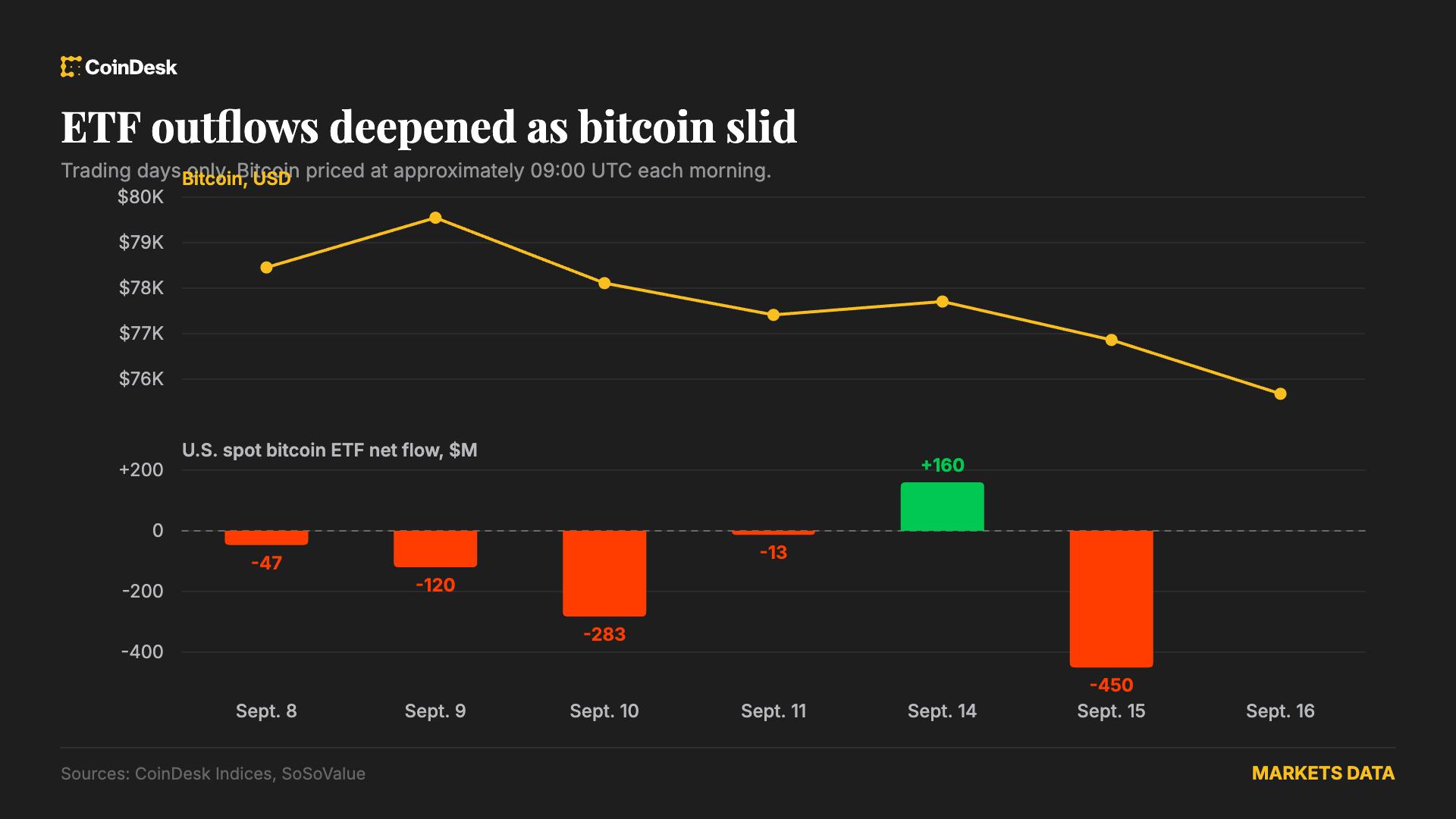
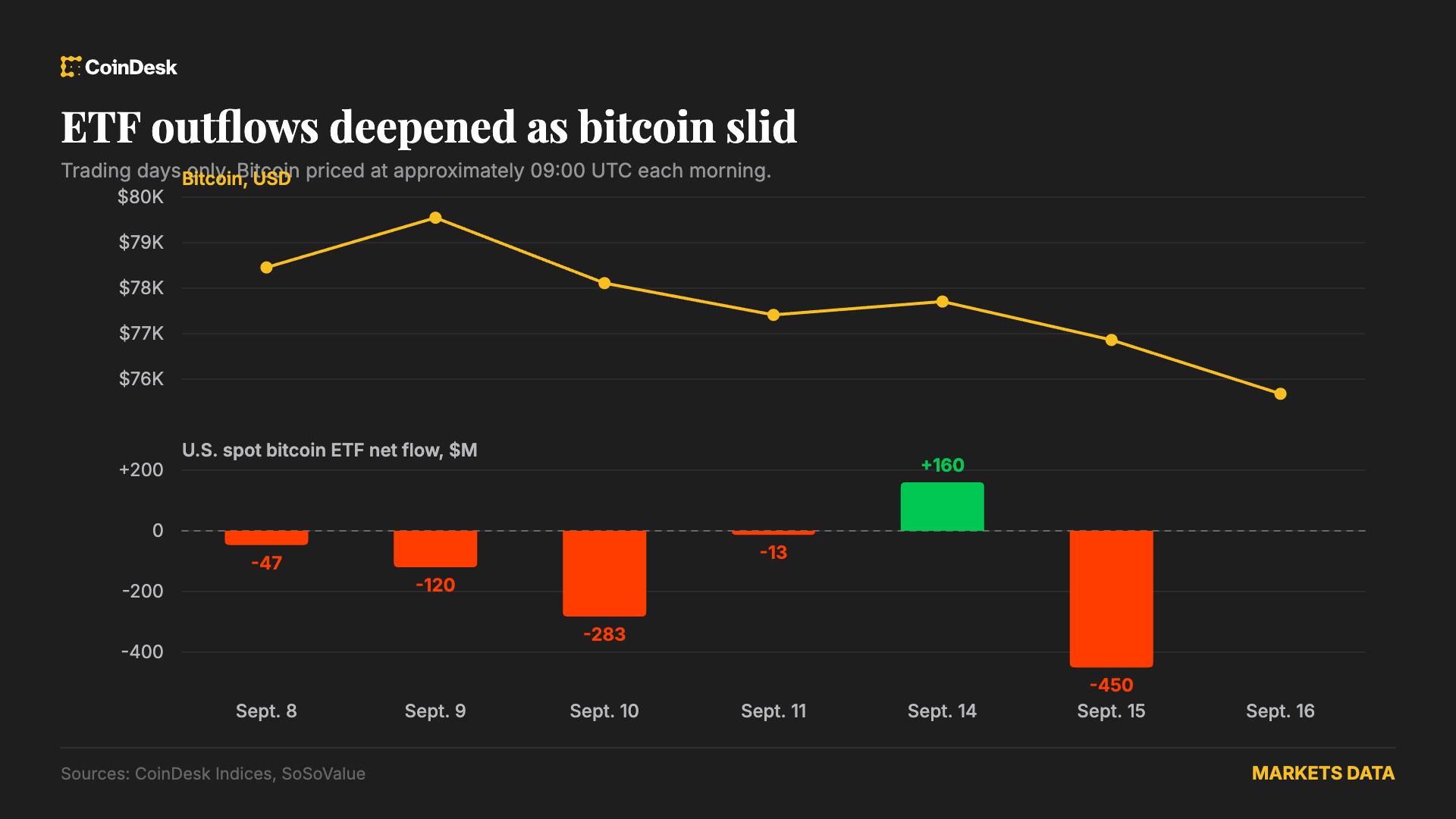
U.S. spot bitcoin ETFs shed $450 million on Tuesday, according to SoSoValue, the heaviest single-day outflow since June 25, after the U.S. Senate declined to advance the Digital Asset Market Clarity Act.
Bitcoin is little changed since midnight UTC, after dropping following the vote, which garnered around 10 fewer votes than the 60 required. Among those opposing the motion were seven Democrats who had spent months negotiating the text.
The CoinDesk 20 Index also held its loss, dropping less than 0.1% since midnight after falling 4.6% on Tuesday in the steepest decline since June 5.
Attention now switches to the Federal Reserve, which announces its interest-rate decision later today, with an increase having been the market’s base case going into the meeting.
The bill’s failure effectively ends any prospect of market structure legislation clearing the Senate this year, with Congress expected to be under split control in January.
Bitcoin’s 24-hour drop of 1.7% seems muted compared with slides in the tokens most exposed to U.S. regulatory treatment.
Stellar fell 9.6% over 24 hours and XRP lost 8.1% Among CoinDesk 100 constituents, a full 95 lost value over the period.

Prime suspect in ‘Putney pusher’ case found dead at his west London home
Why is Space Exploration Technologies stock rallying today?

93% Chance of a Fed Rate Hike Today. What Happens to Bitcoin Now?



-

 Fashion5 days ago
Weekend Open Thread – Corporette.com
-

 Business7 days ago
Micron Stock Climbs Above $1,031 as AI Memory Crunch and a $50 Billion Outlook Fuel the Rally
-

 Tech3 days ago
The Latest Weird Thing to Play Doom Is the Mapped-Out Brain of a Fruit Fly
-

 Business7 days ago
AMD Stock Climbs After Management Lifts 2027 Data Center Outlook Toward $70 Billion in AI Sales
-

 Business5 days ago
10 Most-Streamed Songs On Spotify In 2026 So Far, Led By Ella Langley’s Dominant Run On The Charts This Year
-

 Crypto World5 days ago
XAG/USD: Silver’s Short-Term Rally Meets Its Moment of Truth
-

 Crypto World6 days ago
2 Chip Stocks Broke Out This Week. Neither Was Nvidia
-

 Tech6 days ago
Battery life is the only iPhone 18 Pro and iPhone Duo upgrade I care about. Apple didn’t disappoint
-

 Crypto World7 days ago
Pi Network ships Protocol 27 on a network with 14 million users and zero DeFi
-

 Crypto World6 days ago
OKX launches 10x OpenAI, Anthropic X-Perps in Europe
-

 Crypto World5 days ago
Diesel Tops $6 a Gallon for the First Time as 28 States Set Records
-

 Tech7 days ago
Apple Watch Ultra 4 vs Watch Ultra 3: Should you really spend another $799?
-

 News Videos5 days ago
Facing Financial Fears
-

 Crypto World7 days ago
Bitcoin price risks $70K if $78K neckline breaks
-

 Business6 days ago
Western Digital Slips 2.7% as AI Storage Rally Cools After Record Cash and Guidance
-

 Entertainment7 days ago
Case Sees Major Update As Jury Deliberations Begin
-

 Business3 days ago
Rivals Sam Altman and Elon Musk Rally Behind Dario Amodei’s Call for a Slowdown in AI Development
-
Crypto World7 days ago
Ripple Price Prediction: What to Expect for XRP as a Major Macro Week Approaches
-

 Crypto World2 days ago
Elon Musk Drops a Bombshell: Grok 5 Could Be the AGI Breakthrough
-
Crypto World6 days ago
Ethereum Price Analysis: Consolidation at $2.5K Tests Momentum as On-Chain Activity Surges
You must be logged in to post a comment Login