
Crypto World
Zcash price falls 20% to hit 4-month lows under $220



- Zcash price plunged to $217, hitting a four-month low amid a 20% dip.
- The privacy coin dumped as bears pushed Bitcoin under $70,000.
- ZEC traded around $228 at the time of writing, but risks breaching support at $200.
Zcash (ZEC) has declined by more than 20% in the past 24 hours, accelerating its sharp descent amid an increasingly bearish cryptocurrency market.
The privacy coin’s dip to below $220, the first time in four months, came as Bitcoin crashed to $69,500 and Ethereum fell to lows of $2,070.
Among other top altcoin losers on the day was Cardano, which broke to $0.26.
Monero, Dash, and Decred all tanked as privacy coins suffered the bearish flip, hurting cryptocurrencies.
Notably, BTC’s dip has Michael Saylor’s Strategy sitting on approximately $4.5 billion of unrealised losses on the company’s 713,502 BTC.
Meanwhile, BitMine’s 4.2 million ETH currently has about $7.5 billion in unrealised losses.
Top privacy coin turns bearish
Zcash’s plunge stands out among privacy coins, especially after the ZEC price recently jumped to highs above $744 as Bitcoin struggled.
Headwinds amid waning demand now see Zcash changing hands at lows of $217, just a few weeks after it topped $540.
The more than 20% dip in the past 24 hours and 40% nosedive in the past week put Zcash at risk of further technical breakdown.
Capitulation among holders has accelerated sell volumes, with a 36% spike to $538 million in the past day.
Despite the losses, Zcash tops Bitcoin, Bitcoin Cash, and Monero in terms of overall performance over the past year.
Bitwise CIO Matt Hougan shared this view via X.
The relative returns of different monetary crypto assets since Jan. 1, 2025, is remarkable:
Bitcoin (BTC): -22%
Bitcoin Cash (BCH): +23%
Monero (XRM): +97%
Zcash (ZEC): +347%Lots of confounding variables here, including that BTC holders were sitting on the biggest…
— Matt Hougan (@Matt_Hougan) February 5, 2026
Zcash risks plunge below $200
Bears have relentlessly pressured ZEC bulls since the cryptocurrency’s 2025 peak above $740, when early privacy hype drove explosive growth.
Now, after dipping to $217 on February 5, 2026, ZEC risks testing sub-$200 levels.
On Feb. 5, the altcoin came close to the critical psychological support after failing to recover following Electric Coin Company’s core team exit.
Continued regulatory scrutiny on privacy tokens and market-wide profit-taking amid Bitcoin’s latest price crash are key negative triggers.
While ZEC has shattered its key trendline support at $250, a daily RSI deep in oversold territory suggests a rebound is likely.

However, the downturn highlights the privacy coin’s struggles amid broader market volatility, and breaching $200 might result in a new downtrend.
Key support levels beneath this would be $173 and $125 – levels reached in October 2025 before the parabolic surge to the multi-year highs above $700.
Per CoinMarketCap data, ZEC traded around $228 across major exchanges during the early US session on Thursday.
This aligned with Bitcoin’s slight bounce above $70,500, and Monero looked to hold $345.



Crypto firms offered concessions on stablecoins, including reserve-sharing with banks, to ease tensions blocking a major digital asset bill.
The crypto industry has reportedly proposed sharing stablecoin reserves with community lenders as it steps up efforts to win over skeptical banks.
The move aims to preserve the stalled crypto market structure bill that could significantly alter the financial system.
Deposit Fears and the Search For Compromise
A Bloomberg report revealed that crypto firms have spent weeks trying to win over doubtful banks by offering new concessions focused on stablecoins, which have become the central point of disagreement.
According to sources cited in the report, the latest ideas include giving community banks a larger role in the stablecoin ecosystem. One proposal would require issuers to hold a portion of their reserves at these financial institutions. Another recommendation would make it easier for these firms to issue their own dollar-pegged digital assets.
However, the two sides have not agreed on any resolution, and it remains unclear whether the proposals would go far enough to address fears of customers moving deposits out of the banking system.
A separate report from analyst Geoff Kendrick had warned that stablecoins could lead to the exit of as much as $500 billion in bank deposits across industrialized nations by the end of 2028. This comes as the overall digitalized dollar market continues to experience notable growth, with the total supply in circulation having risen by roughly 40% over the past year.
Digital Asset Firms Remain Divided
On the other hand, not all crypto companies are aligned with the suggestions. One of the biggest points of contention is whether platforms like Coinbase should be allowed to pay users rewards for holding stablecoins. Traditional financial institutions also argue that these payouts could pull customers away from checking and savings accounts, which threatens a major source of deposits for them.
You may also like:
In an attempt to resolve this, the Trump administration convened a meeting at the White House on Monday between crypto and banking trade groups, but the talks ended without agreement on how to resolve these core issues.
Despite the friction, the development is still being viewed as a positive sign that the market-structure bill will keep moving in Congress. This is after the legislation was passed by the House of Representatives last year, but has since slowed in the Senate due to unresolved disagreements between the two sectors.
Meanwhile, in a recent interview with Fox News, Tim Scott, the chairman of the Senate Banking Committee, expressed his optimism about finding a compromise.
“We can protect consumers and community banks while still allowing innovation and competition to lower prices and expand access,” the senator said. “Both sides are working toward a compromise that keeps innovation here in America.”
SECRET PARTNERSHIP BONUS for CryptoPotato readers: Use this link to register and unlock $1,500 in exclusive BingX Exchange rewards (limited time offer).
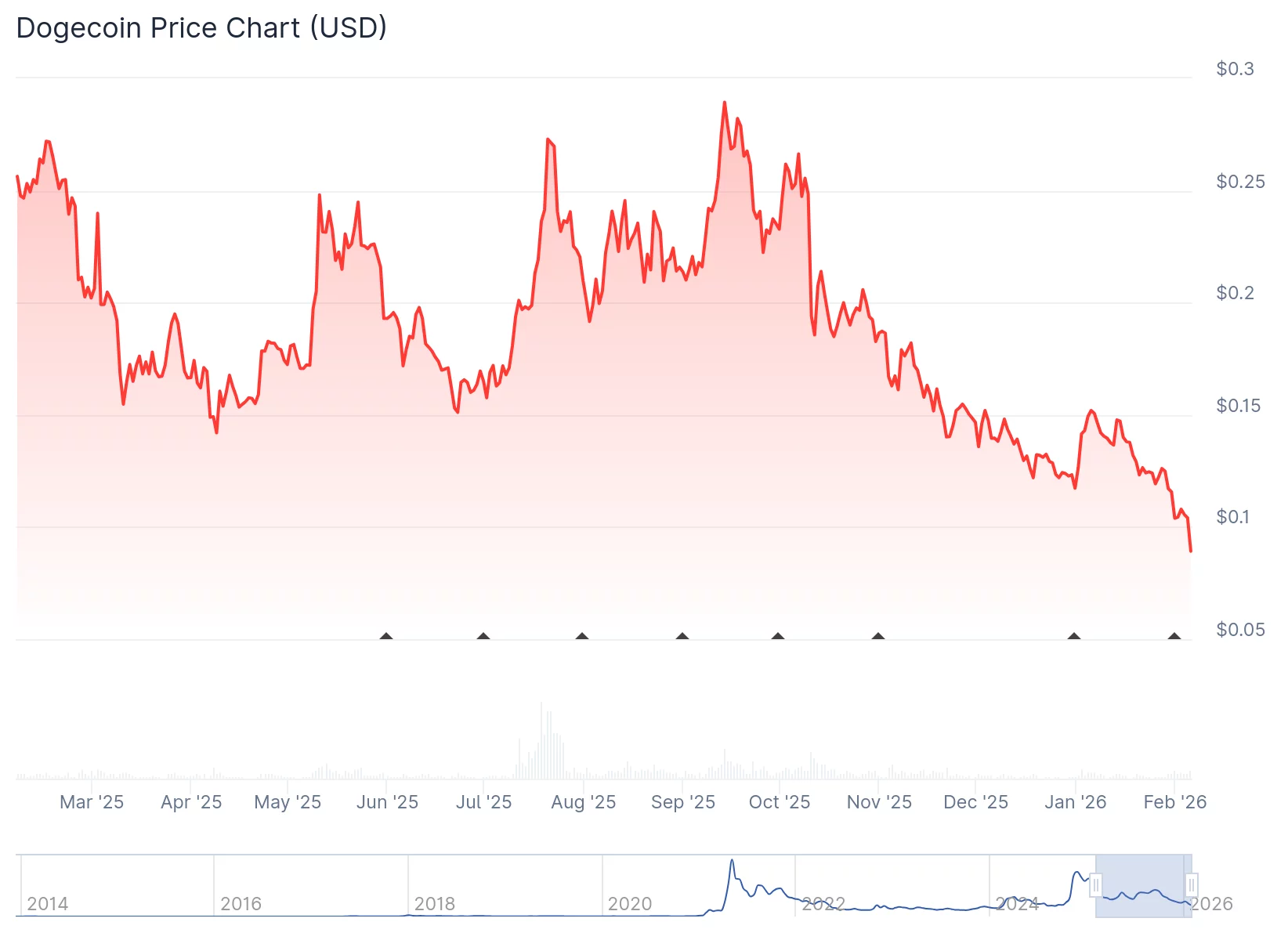
Dogecoin and Shiba Inu slid deeper into selloff territory even as on-chain activity spiked, underscoring a growing disconnect between network usage and price action across the meme-coin sector.
Summary
- Despite a 36% surge in Dogecoin active addresses, prices fell 3%, with Shiba Inu also losing 2%.
- Increased network activity is driven more by distribution than accumulation, signaling vulnerability to further declines.
- Trading at $0.00000641, SHIB is down 92% from its 2021 peak, facing weak transaction volumes and uncertain future utility.
Dogecoin (DOGE) active addresses jumped 36% over the past week to more than 71,400, signaling renewed participation on the network.
But the surge failed to support prices, with DOGE falling 3% to about $0.102 and Shiba Inu dropping 2% to roughly $0.0000066.
Heavy net outflows, weakening technical structures, and broken support levels suggest both tokens remain vulnerable to further downside, as increased activity appears driven more by distribution than accumulation.
Dogecoin, originally created as a joke in 2013, briefly soared to a $90 billion market cap in 2021 but has since lost over 90% of its value.
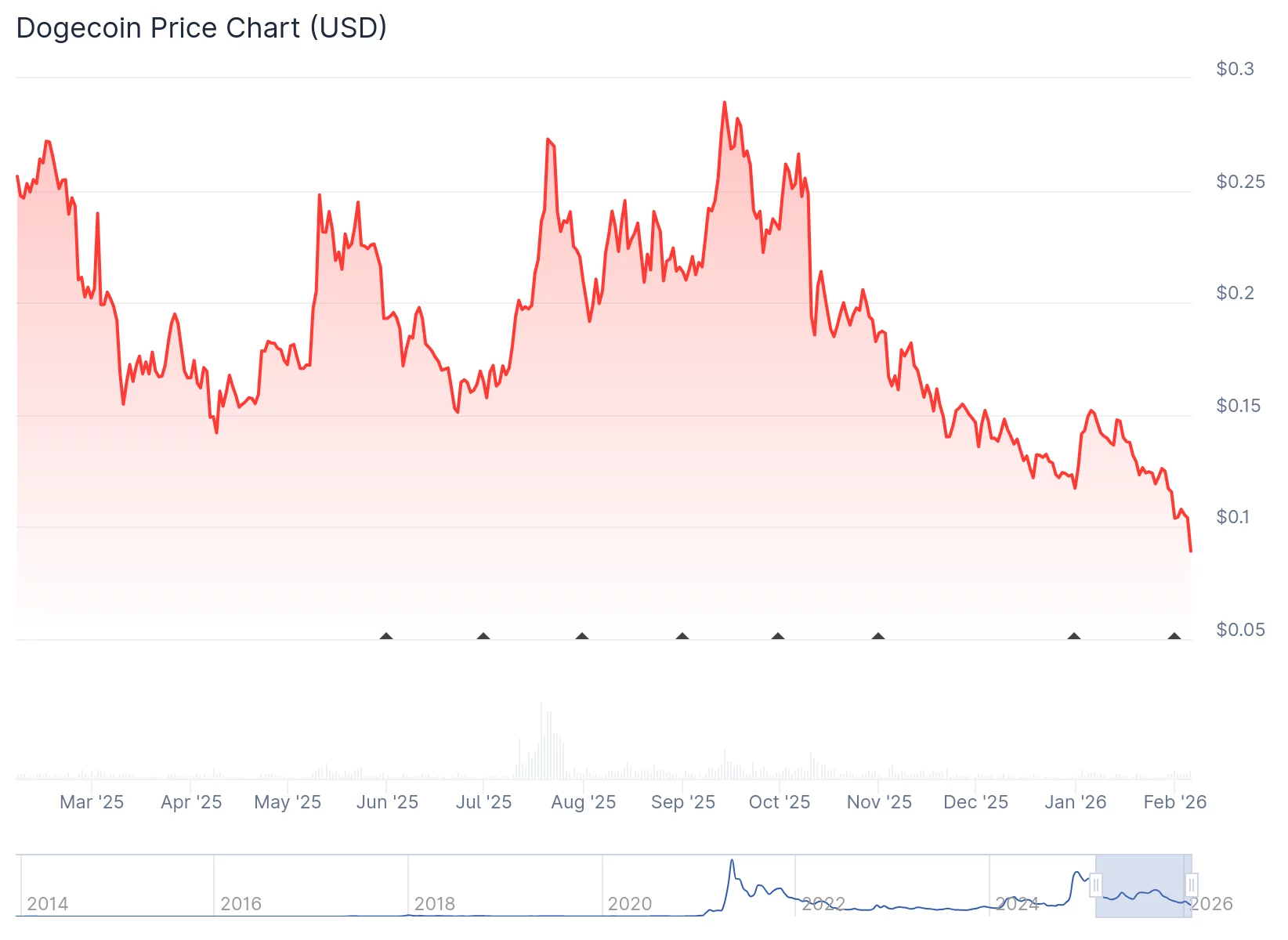
Despite a rally in late 2024, the meme coin remains down 62% in 2025 and lacks a real use case like Bitcoin or Ethereum.
Its speculative nature and endless supply—leading to constant dilution—make it vulnerable to further declines. With no fundamental catalysts in sight, a 50% drop in 2026, potentially returning Dogecoin to its 2022 low of $0.05, seems likely.
Shiba Inu is the pits
Shiba Inu (SHIB) has been volatile after recently hitting a monthly low of $0.0000065 on February 1, following a high of $0.0000097 on January 6.
These price swings reflect SHIB’s sensitivity to sentiment and liquidity.
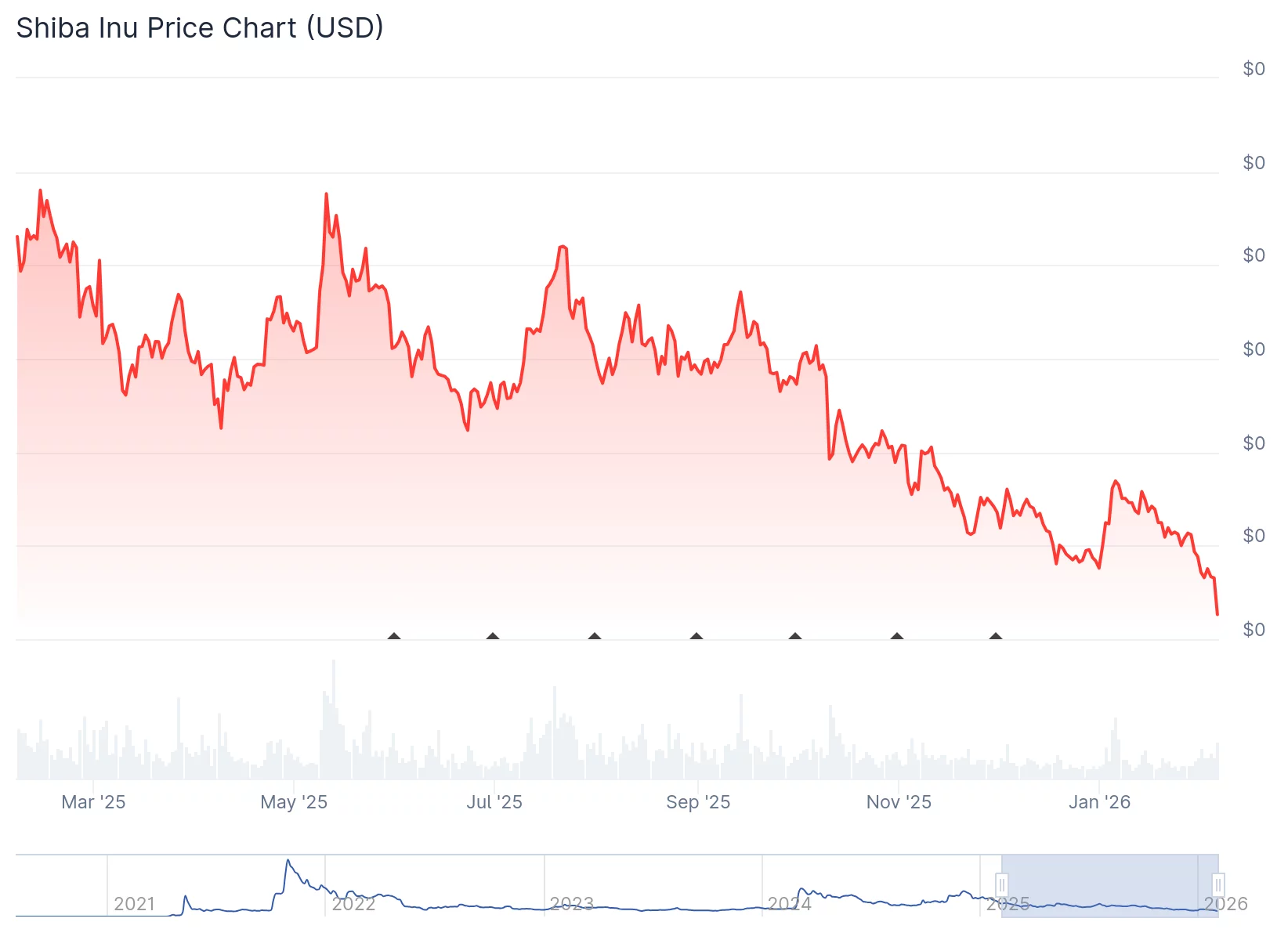
Shiba Inu is currently trading at $0.00000641, a 92% drop from its October 2021 all-time high. The token is below key moving averages, and while the RSI shows oversold conditions, no reversal has occurred. SHIB is testing critical support at $0.00000638, and a breakdown below this level could push it to $0.0000055.
The Shiba Inu ecosystem is facing challenges, including weak daily transaction volume and a lack of sustained utility, despite its integration of Fully Homomorphic Encryption (FHE) in Q2 2026, which could boost privacy and security. The launch of a crypto ETF by T. Rowe Price could also attract regulated capital, but approval odds are low.
According to one report, Shiba Inu’s price could range between $0.000015-$0.000025 by 2027 if privacy upgrades succeed and the ETF is approved, with conservative estimates placing it between $0.000010–$0.000015.
Key resistance levels are $0.00000732, $0.0000078, and $0.00000851. Monitoring Shibarium transaction volumes and burn rates, along with Bitcoin’s performance, will be key for investors tracking SHIB’s potential recovery.


The security firm also revealed that wrench attacks are on the rise.
Crypto users lost about $370.3 million to exploits in January, according to data from security analytics firm CertiK.
CertiK said in a post on X that $311.3 million of the total was linked to phishing, with a single social engineering scam accounting for about $284 million. Phishing is a type of cybercrime in which attackers impersonate reputable entities (such as banks or employers) to deceive individuals into revealing sensitive information.
The firm said the single large incident targeted an individual user rather than exploiting a smart contract bug. This means that only about 16% of total losses were linked to non-phishing incidents, such as code flaws, price manipulation, or wallet compromises, according to CertiK’s breakdown.
The findings suggest that even as protocols improve their defenses against technical exploits, it can still be difficult to prevent losses tied to human behavior. Scams that rely on deception, trust, and errors in judgment continue to account for a large share of losses.
Physical Attacks Are Also Rising
CertiK also found a rise in physical attacks linked to crypto theft in its Skynet Wrench Attacks Report. The firm said so-called wrench attacks increased 75% in 2025, resulting in $40.9 million in confirmed losses, though it noted the figure is likely underreported.
These attacks involve using force or threats to gain access to crypto wallets or private keys. Kidnapping remained the most common method, while physical assaults rose 250% year over year. Europe accounted for more than 40% of reported cases, with France recording the highest number of attacks.
CertiK said the trend shows that physical violence is becoming a real risk for crypto holders, especially founders and people known to control large amounts of digital assets. The firm added that protecting crypto now requires thinking beyond software security to include personal safety.


Exactly one year ago, “crypto czar” David Sacks hosted a press conference alongside Representative French Hill, Senator John Boozman, Senator Tim Scott, and Representative GT Thompson to announce they hoped to advance a stablecoin regulation bill and a cryptocurrency market structure bill out of both the Senate and the House within 100 days.
Despite these bold commitments, neither of these bills was passed within those first 100 days.
Eventually, the stablecoin regulation bill would be passed, in the form of the GENIUS Act, but well after the self-imposed deadline had lapsed.
Read more: David Sacks sends silly legal threat to the New York Times
However, the market structure bill has proven to be more contentious and more difficult to get legislative consensus on.
This bill would place the Commodity and Futures Trading Commission (CFTC) at the center of crypto regulation, a position that the SEC has largely filled before (though the CFTC has always had some role to play).
Members of the Democratic Party have been advocating for amendments to the bill that they believe would limit the president’s ability to continue to profit from the crypto industry while also shaping regulations and opportunities in the space.
Read more: Tether’s new USAT stablecoin led by Trump’s former advisor Bo Hines
However, members of the Republican Party have shown solidarity with the president, refusing to include that type of limitation.
Currently, the bill has cleared the Senate Agricultural Committee, along partisan lines, but has yet to clear the Senate Banking Committee.
Once the committee approves its draft of the bill the two different committee versions will need to be harmonized before it can come up for a vote, where it will need substantial support from senators in the Democratic Party to pass.
Once the Senate has passed it, then it will return to the House, which has previously approved an earlier version of the bill.
Got a tip? Send us an email securely via Protos Leaks. For more informed news, follow us on X, Bluesky, and Google News, or subscribe to our YouTube channel.
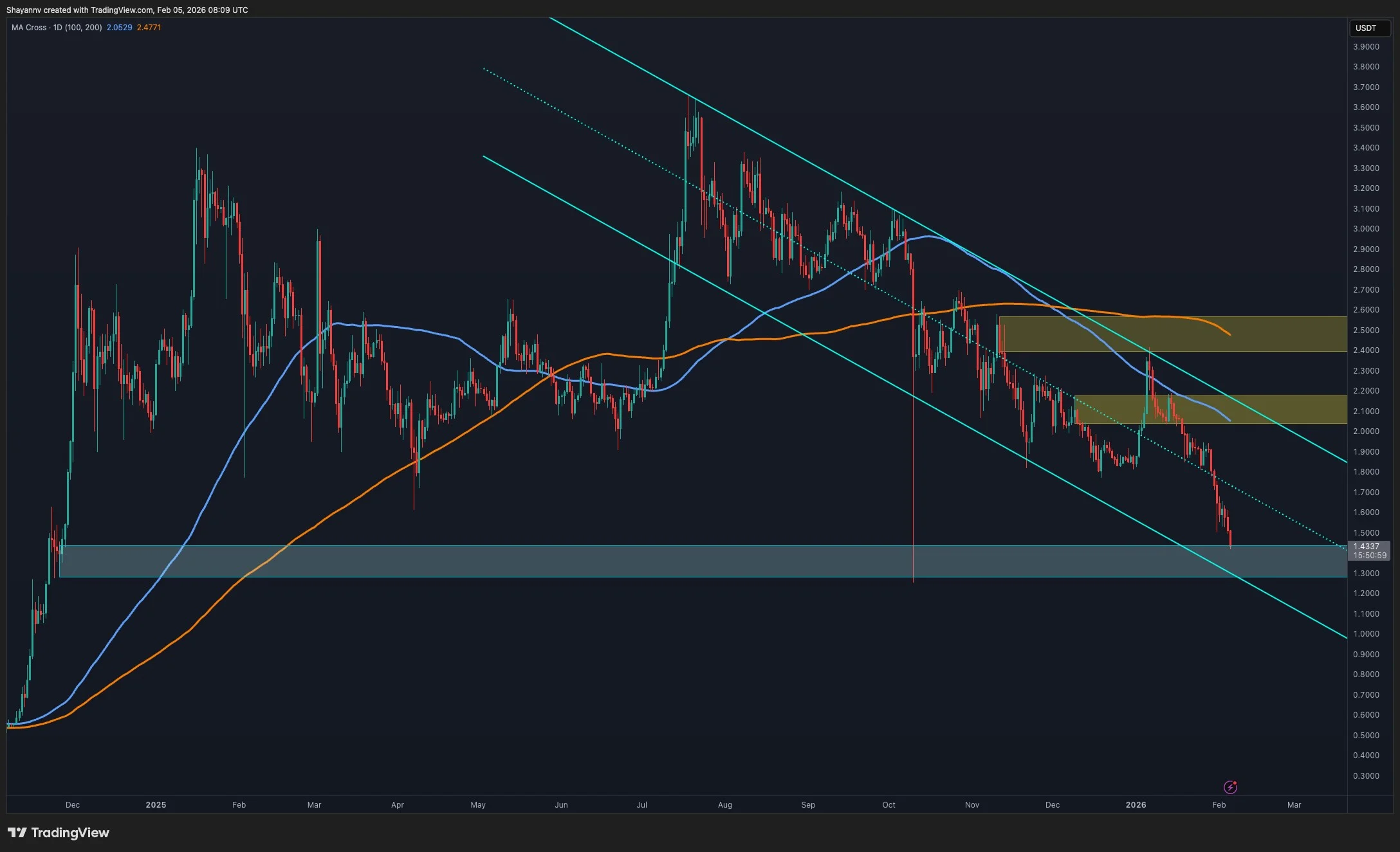
Ripple’s XRP remains under sustained bearish pressure, with the price continuing to print lower lows and failing to reclaim key supply zones. The broader structure still reflects a dominant downtrend, and the recent price action suggests sellers remain in control as the market approaches a critical demand area that could define the next directional move.
Ripple Price Analysis: The Daily Chart
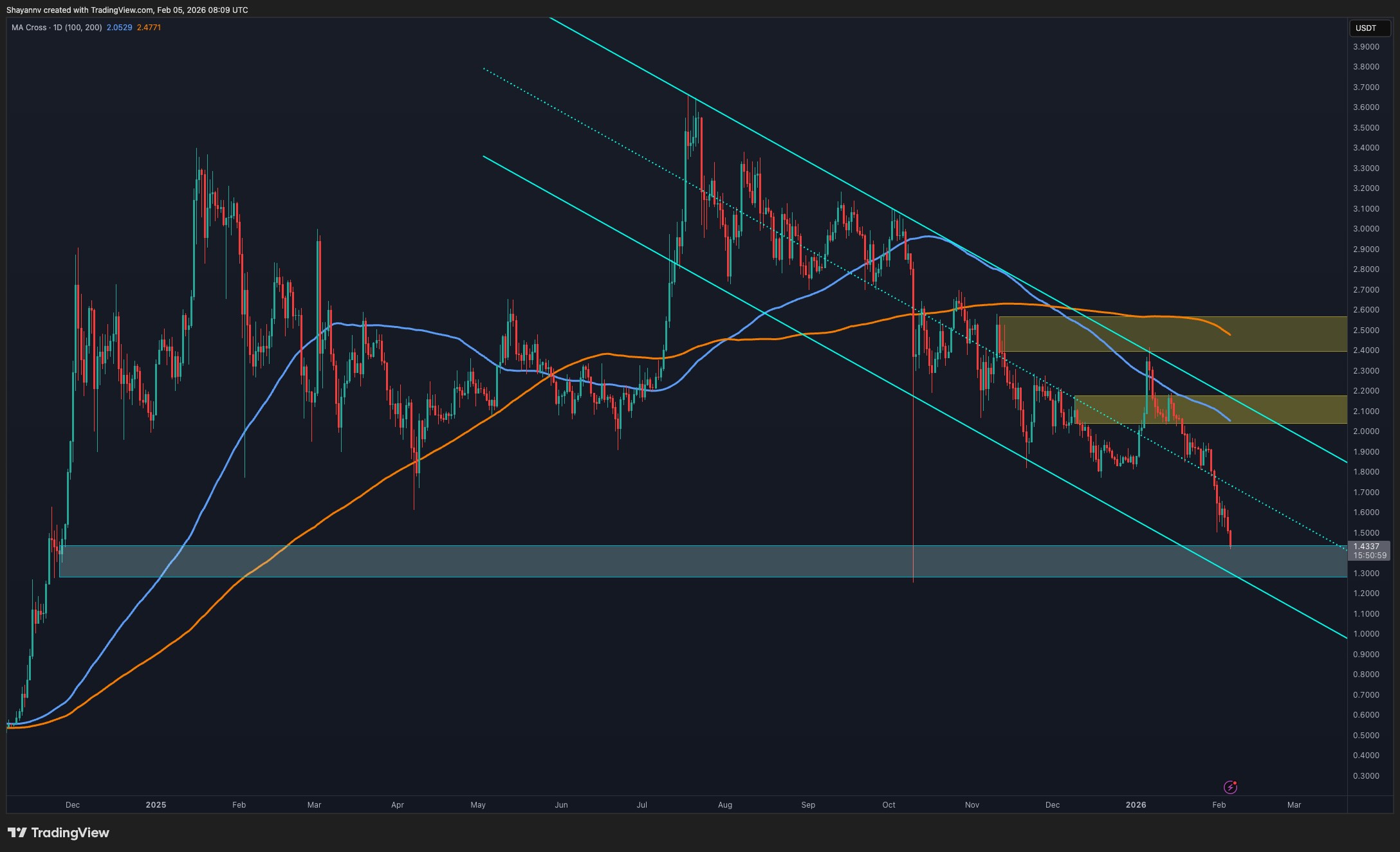
On the daily timeframe, XRP is trading deep within a bearish market structure, having lost multiple former support levels that have now flipped into resistance. The price is currently pressing into a well-defined demand zone at the $1.3 range highlighted on the chart, an area that previously acted as a base before the last impulsive upside move. This zone represents the first meaningful area where buyers may attempt to slow the decline.
However, the broader daily trend remains decisively bearish. Each corrective bounce over the past months has been capped by lower supply zones, and the asset has consistently respected these areas before continuing lower. As long as XRP remains below the channel’s mid-trendline of $1.6, any bounce from the current demand should be treated as corrective rather than trend-reversing.
Nevertheless, a failure to hold this demand zone would significantly weaken the structure and open the door for a deeper continuation toward lower, untested liquidity levels. Conversely, a strong daily reaction from this area would be required to signal short-term relief, but not yet a confirmed trend shift.
XRP/USDT 4-Hour Chart
The 4-hour chart provides additional clarity on the internal structure of the downtrend. Recent price action shows a sharp rejection from successive supply zones, confirming that sellers are aggressively defending these levels.
Following the latest rejection, the asset accelerated lower and is now approaching the $1.3 critical support, which also aligns with the broader demand zone visible on the daily timeframe. This confluence increases the probability of at least a short-term reaction, as short sellers may begin to take profits and reactive buyers step in.
That said, the presence of multiple stacked supply zones above the current price at $1.6 and $2 significantly limits upside potential in the near term. Any rebound toward these levels would likely face renewed selling pressure, unless accompanied by a clear break in structure and acceptance above the channel. Until such confirmation appears, the 4-hour trend remains firmly bearish, with rallies best viewed as pullbacks within a broader downtrend.

SECRET PARTNERSHIP BONUS for CryptoPotato readers: Use this link to register and unlock $1,500 in exclusive BingX Exchange rewards (limited time offer).
Disclaimer: Information found on CryptoPotato is those of writers quoted. It does not represent the opinions of CryptoPotato on whether to buy, sell, or hold any investments. You are advised to conduct your own research before making any investment decisions. Use provided information at your own risk. See Disclaimer for more information.


Meanwhile, XRP continues to be the poorest performing altcoin today.
Bitcoin has officially wiped out all gains registered after the reelection of Donald Trump to step back in the White House at the end of 2024. The cryptocurrency plummeted to just over $65,000 minutes ago, which actually puts it in a minor loss since the presidential elections.
Moreover, this means that it has lost almost $25,000 since last Wednesday. It has also shed nearly 50% of its value since the all-time high marked in early October 2025.
Naturally, investors tend to ask themselves what the most probable reason is behind this crash. As with all previous declines from the past several weeks, it doesn’t seem to be aligned with problematic fundamentals within the BTC ecosystem as a whole.
Analysts from the Kobeissi Letter indicated that the actual reason behind the consecutive price dumps is “emotional” selling. Riskier assets, such as BTC, tend to move frequently due to investor sentiment, and the current bearish trend appears to be driven by a mass exodus without any fundamental basis.
BREAKING: Bitcoin falls below $66,000 for the first time since October 2024, now down -$11,000 this week alone.
This is beginning to feel like “emotional” selling. pic.twitter.com/SMUczlcNzo
— The Kobeissi Letter (@KobeissiLetter) February 5, 2026
Doctor Profit, an analyst known for their rather bearish calls who has been predicting a substantial crash for months, noted that they have placed “big buy” orders at around $57,000-$60,000, which could be the current trend’s bottom.
The analyst added that they plan to hold for 2-3 months, and they are not interested in buying higher than that.
You may also like:
“I consider $57k-$60k as a great entry to make money for the short term and gain some serious % before we continue going down.”
On the other hand, MMCrypto said he believes BTC is indeed in a bear market, but it’s almost over time-wise.
I think this Bitcoin Bear Market is almost over (time wise).
We are in the last capitulation move, which may continue for a bit. Once we have MAX PAIN, it’s over, soon!
I am getting ready NOW already.
MONEY MAKING TIME IS APPROACHING! 🚀
— MMCrypto (@MMCrypto) February 4, 2026
Elsewhere, the altcoins are getting obliterated as well, and XRP is the poorest performer for some reason. The token has plummeted by almost 20% in just 24 hours and now struggles below $1.25.
SECRET PARTNERSHIP BONUS for CryptoPotato readers: Use this link to register and unlock $1,500 in exclusive BingX Exchange rewards (limited time offer).


The question now is whether a price dump below $1.00 is inevitable at this point.
The past 24 hours, just like several other such periods in the past few weeks, will go down in the history books as highly volatile and violent for the entire cryptocurrency market.
Although BTC and most altcoins are deep in the red, XRP has emerged as the worst-performing coin from the top 100 digital assets, which is somewhat strange and unexpected since it’s the third-largest altcoin.
The token has plunged by almost 22% in a day, a pattern more commonly seen in small caps. However, XRP’s demise is spectacular on different timeframes, not just daily.
For instance, it has plunged by 32% in the past week. Furthermore, it traded at $2.40 on January 6, meaning that its current dump to $1.20 came after a 50% monthly decline. On a more macro scale, the cross-border token has erased 67% of its value since its all-time high of $3.65 registered in mid-July 2025.
At the time of this writing, it’s not clear why XRP has crashed so much harder than most other larger-cap cryptocurrencies. After all, the company behind it continues to expand and make major announcements. However, ETH, BNB, and BTC are down by more modest 10-11%.
Nevertheless, some members of the XRP Army remain unfazed by the ongoing crash. ERGAG CRYPTO, who is among the most vocal supporters of Ripple’s token, admitted that the asset’s breakdown has been confirmed.
Still, they told their 92,000+ followers on X that they “pulled the trigger after 3 years” by buying XRP at $1.28 as a swing trade. On the plus side, they plan to hold that position until the price bounces to $2.20 if it reclaims $1.85. If the $1.28 suppor cracks decisively, they are comfortable holding the tokens as it’s a small allocation.
You may also like:
#XRP – Sweep & Bounce or Breakdown (Update):
The breakdown is now confirmed.
I pulled the trigger after 3 years: I bought #XRP $1.28 as a swing trade.
My plan:
▫️ If price reclaims $1.85, I’ll hold for a move toward $2.20
▫️ A confirmed close above $2.50 → reassess the… pic.twitter.com/2O5inqQlSo— EGRAG CRYPTO (@egragcrypto) February 5, 2026
SECRET PARTNERSHIP BONUS for CryptoPotato readers: Use this link to register and unlock $1,500 in exclusive BingX Exchange rewards (limited time offer).
Bitcoin plunged under $66,000 while most altcoins cratered.
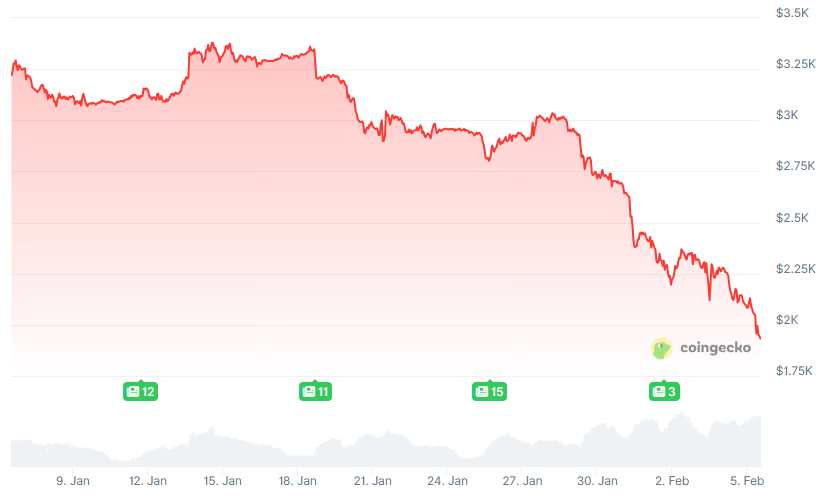
Ethereum (ETH) traded under $2,000 on Thursday, Feb. 5, for the first time since May 2025, amid a broader sell-off across crypto markets.
ETH fell about 10% over the past 24 hours to trade near $1,925, extending its weekly losses to 30%. Paul Howard, senior director at Wincent, said Ethereum’s move lower was driven by a broader shift away from risk in global markets, rather than a crypto-specific event.

“The defining characteristic of the sell-off was a synchronised de-risking across asset classes, marked by forced unwinds and elevated volatility even in assets typically viewed as hedges, including precious metals,” he said.
Howard also explained that the shift’s catalyst was the markets “rapidly repricing the outlook for monetary policy” following the nomination of Kevin Warsh as Federal Reserve chair.
Meanwhile, data from Lookonchain showed that Ethereum co-founder Vitalik Buterin has sold 2,961.5 ETH (around $6.6 million) at an average price of $2,228 over the past three days.
Bitcoin and Altcoins
Bitcoin (BTC) dropped roughly 10% on the day to around $65,700, extending its seven-day losses to nearly 21%. Among other major tokens, BNB slid 9% to $646, while XRP plunged nearly 20% to about $1.24. Solana (SOL) fell 12% on the day to trade near $82.
“Bitcoin is now testing key technical support between $60,000 and $70,000, the base of the pre-election rally. A sustained break below this range would increase the risk of a more protracted move lower, while stabilization here would point to a corrective reset rather than a structural shift,” Diana Pires, VP at sFOX, told The Defiant.
Total cryptocurrency market capitalization declined to approximately $2.33 trillion, down about 10% over the past 24 hours. Trading activity during the same period totaled roughly $259.5 billion.
A small number of tokens traded higher despite the broader downturn. Rain (RAIN) rose about 7% over the past 24 hours, while MYX Finance (MYX) gained 5.4%. MemeCore (M) added 1.6%.
On the downside, XRP fell more than 16%, while Zcash (ZEC) dropped 15.4%. Monero (XMR) slid nearly 14%.
Liquidations and ETF flows
More than $1.44 billion in leveraged positions were liquidated over the past 24 hours, according to CoinGlass, with long positions accounting for roughly $1.23 billion of that total.
Bitcoin recorded the largest liquidations at about $738 million, followed by Ethereum at $338 million. Solana posted liquidations of around $77 million. In total, more than 304,000 traders were liquidated on the day.
Spot Bitcoin ETFs recorded $544.9 million in net outflows on Feb. 4, while Ethereum ETFs saw $79.5 million in net outflows. Spot Solana ETFs recorded $6.7 million in net outflows. By contrast, spot XRP ETFs posted $4.8 million in net inflows.
Tech Selloff Continues
Elsewhere, political developments are also weighing on digital assets, driven by uncertainty in Washington as lawmakers continue to negotiate key budget and immigration measures.
Weakness in U.S. tech stocks has also placed pressure on the situation, contributing to a broader pullback across global markets.
Meanwhile, gold prices have fallen 1.3% on the day, while silver dropped more than 9%, after hitting all-time highs recently.
The Trump family’s DeFi protocol was forced to sell $5 million of BTC today to cover an Aave loan.
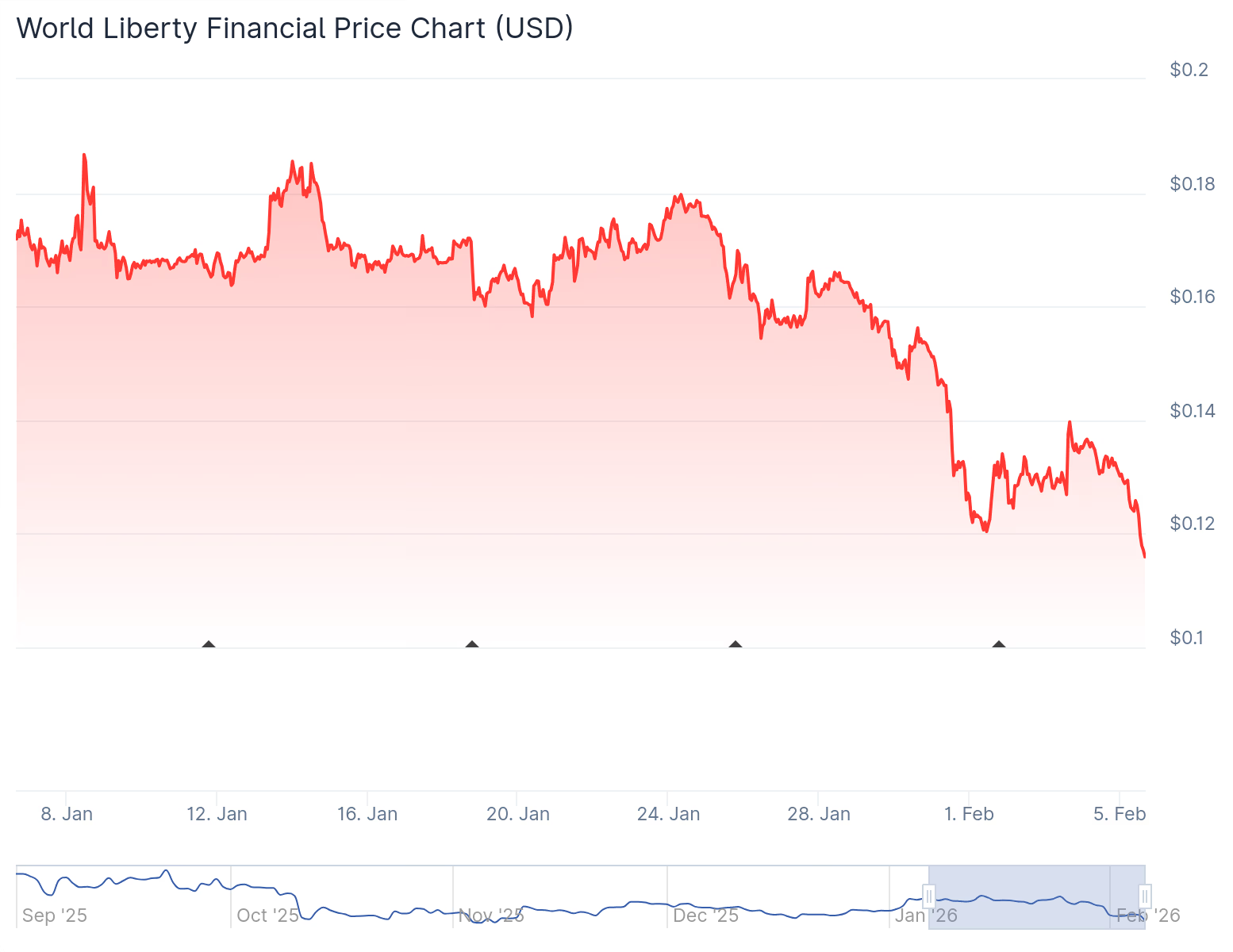
World Liberty Financial (WLFI), the decentralized finance (DeFi) protocol affiliated with President Trump’s sons, was forced to sell some Bitcoin at roughly $67,000 today to avoid liquidation on Aave.
According to Arkham Intelligence, the WLFI wallet was forced to liquidate more than 170 BTC, worth roughly $11 million, to repay its loans on Aave.
Meanwhile, the WLFI token is down 14% today, slightly underperforming BTC and ETH, which are both down 13%.

WLFI has been in a consistent downtrend since its token launch in September. The token started trading on Sept. 1 at $0.23, or a $6.6 billion market capitalization, and now trades 65% lower at $0.115.
In addition to the protocol’s financial woes, Trump’s political opponents continue to call for probes and investigations into the DeFi protocol.
Today, U.S. Representative Ro Khanna announced that he has launched an investigation into a $500 million investment in WLFI from the United Arab Emirates. Back in November, Senators Elizabeth Warren and Jack Reed claimed that the protocol is tied to malicious actors from North Korea and Russia; however, it remains unclear if there has been any progress on this probe.
Warren, in particular, is no fan of cryptocurrency, broadly referring to DeFi users as “scammers” and labeling the GENIUS bill as a “grift.”
Bitcoin touched new lows under $64,000 as market selling reached a historic level, and analysts warn that the bottom is not in. Does data support analysts’ sub-$60,000 prediction?
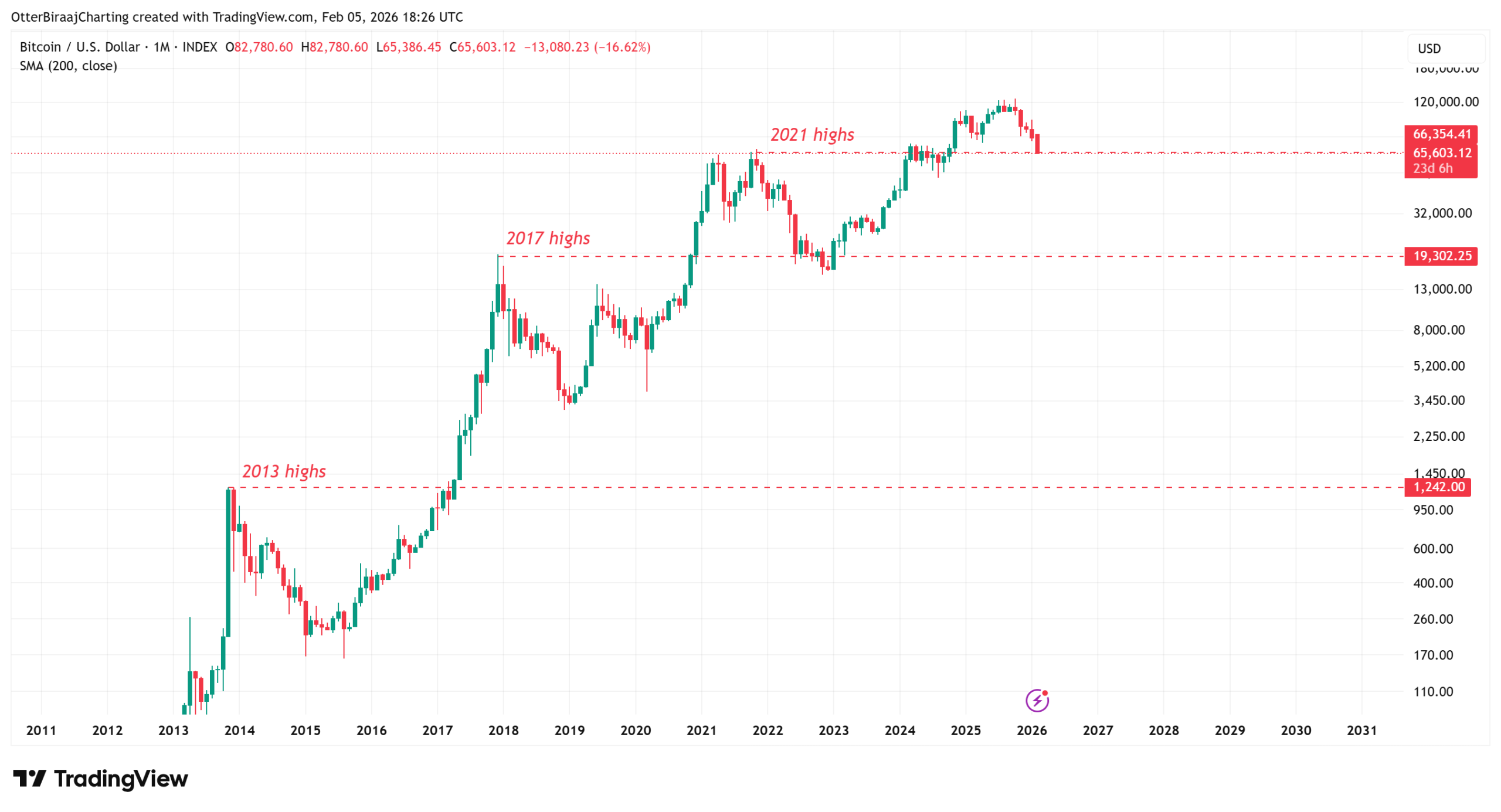
Bitcoin (BTC) has fallen 13% over the past four days, sliding to $63,844 from $79,300. It is currently trading below $69,000, which is the 2021 bull market high, a level many see as a support level.
The drop was matched by a sharp decline in futures activity, with BTC’s open interest falling by more than $10 billion over the past seven days.
Analysts are now focusing on the long-term technical zones and onchain indicators that may signal a major turning point for BTC.
Key takeaways:
-
Bitcoin has dropped 13% in four days, slipping below the 2021 cycle high near $69,000 after a sharp leverage reset.
-
A key Bitcoin demand zone from $58,000 to $69,000 is supported by heavy transaction volume and the 200-week moving average.
-
Oversold technical and sentiment indicators suggest downside pressure may be peaking for BTC, even if a relief rally fails to manifest.
Why the $69,000 level matters for Bitcoin
The $69,000 level represents the peak of the 2021 bull market. Prior cycle tops have historically acted as support during bear markets. In the last cycle, Bitcoin bottomed near the 2017 high of $19,600 before briefly dipping lower to about $16,000 in November 2022.

The current drop below $69,000 may follow this pattern. However, past cycles also show that prices can fall below prior highs before forming a final bottom. This keeps downside risk open for BTC.
Bitwise European Head of Research André Dragosch noted that a large share of recent transactions occurred between $58,000 and $69,000. This range also aligns with the 200-weekly moving average near $58,000, reinforcing it as a key demand zone.

Meanwhile, crypto analyst exitpump highlighted that large BTC bids are visible on order books between $68,000 and $65,000, suggesting buyer interest on dips.
Related: Bitcoin price may drop below $64K as veteran raises ‘campaign selling’ alarm
BTC flashes record oversold signals
Market analyst Subu Trade said that Bitcoin’s weekly relative strength index (RSI) has fallen below 30. Bitcoin has reached this level only four times, and in each case, the price rallied by an average of 16% over the next four days.

Crypto analyst MorenoDV also noted that the adjusted net unrealized profit/loss (aNUPL) has also turned negative for the first time since 2023. This means the average holder is now at a loss. Similar conditions in 2018–2019, 2020 and 2022–2023 all led to price recoveries for BTC.
While a relief rally might not take shape immediately, Moreno pointed out that the current “speed of sentiment deterioration” is much faster than the previous cycles. The analyst added,
“This rapid transition suggests an acute sentiment reset rather than a gradual decline, potentially shortening the capitulation phase.”

Related: Three signs that Bitcoin price could be near ‘full capitulation’
This article does not contain investment advice or recommendations. Every investment and trading move involves risk, and readers should conduct their own research when making a decision. While we strive to provide accurate and timely information, Cointelegraph does not guarantee the accuracy, completeness, or reliability of any information in this article. This article may contain forward-looking statements that are subject to risks and uncertainties. Cointelegraph will not be liable for any loss or damage arising from your reliance on this information.
Earnings call transcript: Knowles Corp Q4 2025 sees revenue and EPS beat

Crypto Industry Proposes Sharing Stablecoin Reserves with Community Banks: Report

France 36-14 Ireland: Les Bleus open Six Nations defence with thumping win in Paris


-

 Crypto World6 days ago
Smart energy pays enters the US market, targeting scalable financial infrastructure
-

 Politics6 days ago
Why is the NHS registering babies as ‘theybies’?
-
 Crypto World7 days ago
Adam Back says Liquid BTC is collateralized after dashboard problem
-

 Video3 days ago
When Money Enters #motivation #mindset #selfimprovement
-

 Fashion6 days ago
Weekend Open Thread – Corporette.com
-

 Tech2 days ago
Wikipedia volunteers spent years cataloging AI tells. Now there’s a plugin to avoid them.
-

 NewsBeat7 days ago
Donald Trump Criticises Keir Starmer Over China Discussions
-

 Politics4 days ago
Sky News Presenter Criticises Lord Mandelson As Greedy And Duplicitous
-

 Crypto World6 days ago
U.S. government enters partial shutdown, here’s how it impacts bitcoin and ether
-

 Sports5 days ago
Sinner battles Australian Open heat to enter last 16, injured Osaka pulls out
-
 Crypto World5 days ago
Bitcoin Drops Below $80K, But New Buyers are Entering the Market
-
 Crypto World4 days ago
Market Analysis: GBP/USD Retreats From Highs As EUR/GBP Enters Holding Pattern
-

 Business4 hours ago
Quiz enters administration for third time
-

 Crypto World6 days ago
KuCoin CEO on MiCA, Europe entering new era of compliance
-
Business6 days ago
Entergy declares quarterly dividend of $0.64 per share
-

 Sports4 days ago
Shannon Birchard enters Canadian curling history with sixth Scotties title
-

 NewsBeat11 hours ago
Still time to enter Bolton News’ Best Hairdresser 2026 competition
-

 NewsBeat3 days ago
US-brokered Russia-Ukraine talks are resuming this week
-

 NewsBeat3 days ago
GAME to close all standalone stores in the UK after it enters administration
-

 Crypto World2 days ago
Russia’s Largest Bitcoin Miner BitRiver Enters Bankruptcy Proceedings: Report