Entertainment
10 Hilarious Sitcoms That Ended Before They Got Bad

For as long as television has been part of our lives, situation comedy, or what we call sitcoms, has been a staple of programming that has long made light of our normal, banal lives. Unlike stretch comedy, the sitcom allows us to watch as our protagonists engage in humorous situations week-to-week, often with a message that follows behind it.
Over the years, we have been treated to some of the best that the sitcom genre has to offer, but oftentimes, these types of shows have been notorious for overstaying their welcome. True, shows in other genres have a tendency to do this as well, going stale when it should have ended on a fresh note, but none have had as many examples of this as sitcoms have. So, we want to turn this somber premise on its head and give you the most hilarious sitcoms that, thankfully, ended right before they started to go past their sell-by date. So, without further ado, let’s dive in.
10
‘Arrested Development’ (2003–2006, 2013–2019)


We look back fondly on Fox’s Arrested Development because it’s a show that ended at exactly the right time. Created by Mitchell Hurwitz, Arrested Development was a masterclass in how to do absurdist humor in a primetime format. The sitcom follows the Bluth family, an extremely wealthy bunch who live very extravagant lifestyles. But when the patriarch of the family, George Bluth St. (Jeffrey Tambor), is arrested, the family loses their wealth, but they still try to live the lives they’ve always known, much to the chagrin of Michael Bluth (Jason Bateman), who desperately tries to keep his family together.
There is little question that Arrested Development was ahead of its time, being the pioneers of the “mockumentary” style that would become more prevalent in the 2010s. Not only that, but the writing and comedic performances were simply top-notch. But absurdist humor does have a shelf life, and thankfully, Arrested Development ended before things went off the rails.

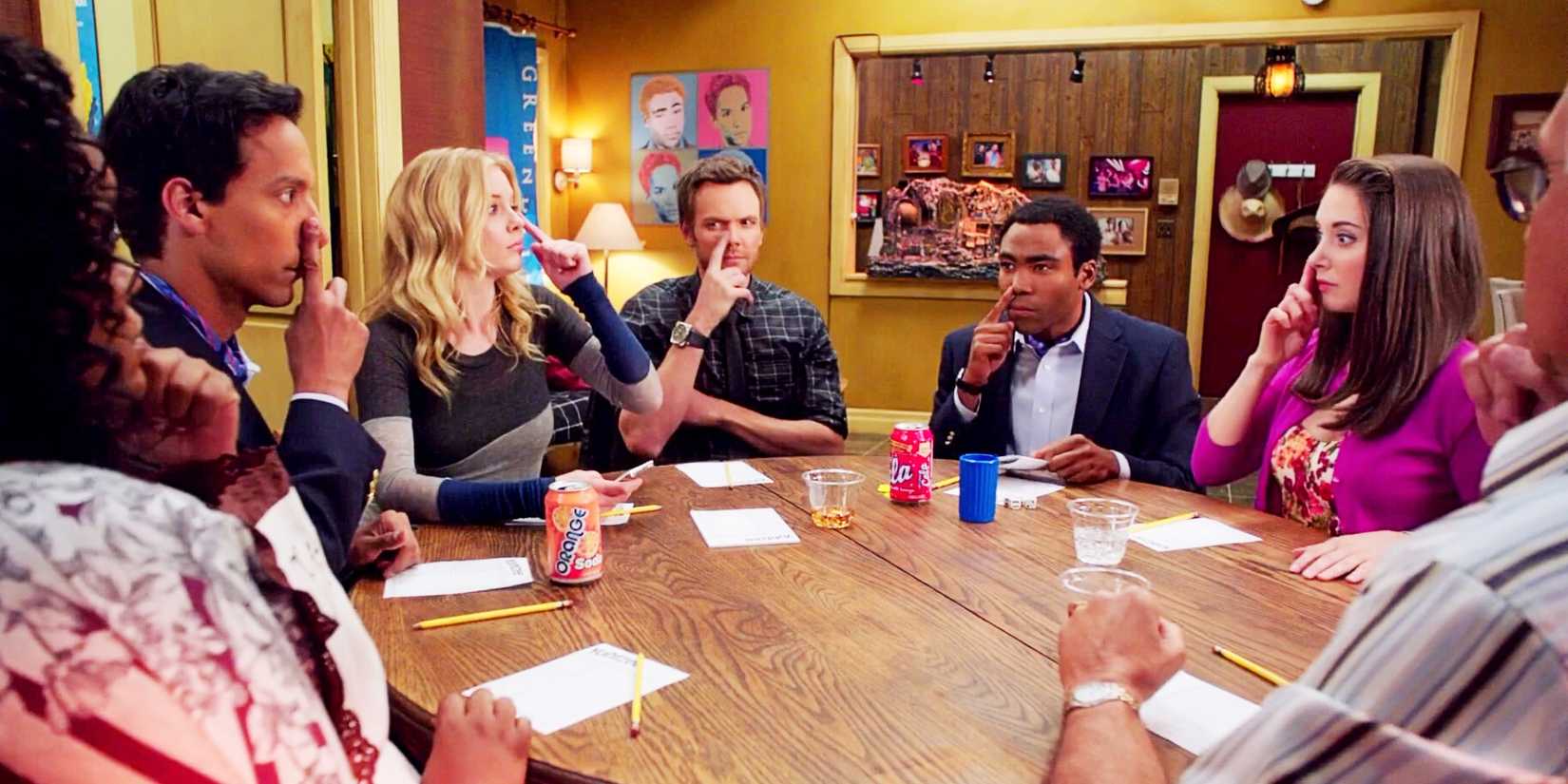
This is such an underrated sitcom, a show that should be more beloved than it actually is. Community brought together a wide range of great comedic actors and made sitcom gold that didn’t feel like it was overstaying its welcome. Created by Dan Harmon, the show follows Jeff Winger (Joel McHale), who winds up being disbarred and suspended from his law firm after it turned out he was lying about getting his degree from Columbia University. To get that degree, he enrolls in a community college in Colorado and meets a class full of eccentric classmates.
Community is so beloved because it uses the “high-concept” model to absolute perfection. While episodes themed around such absurd plotlines, such as a paintball war, could have easily been seen as shameless slapstick, Community elevated these storylines to an art form, making them hilarious, and also quite crucial to the overall vibe of the sitcom. Community ended in a satisfying way, and it didn’t need to go beyond six seasons. Instead of remembering its downfall, we remember Community for the high-concept comedy it brought us week-after-week.
8
‘My Name is Earl’ (2005–2009)

There are plenty of people who believe in good karma, but Earl Hickey (Jason Lee) took this belief to another level entirely. The central premise of the underrated sitcom My Name Is Earl follows Earl, a small-time thief who, after losing a winning lottery ticket, becomes convinced that he has to turn his life around in order to be the best version of himself. How does he do it? By believing in the power of karma.
Much like Community, if My Name Is Earl was spearheaded by a showrunner who never got the overall premise, this sitcom would have gone bad in a hurry. But series creator Greg Garcia knew what this show could be, and, thankfully, NBC knew how long they could keep a show like this going. There are only so many bad deeds that Earl could fix, and stretching this series beyond its four-season run would have been overkill, with the series turning into slapstick comedy and situations to make things work.
7
‘A Different World’ (1987–1993)

Image via NBC
With Black sitcoms focusing more on the success of African Americans, the late 1980s was the right time to look at the rising popularity of Historical Black Colleges and Universities (HBCUs). In 1987, NBC greenlighted a spin-off of The Cosby Show titled A Different World, which initially follows Denise Huxtable (Lisa Bonet) as she goes to her father’s alma mater, Hillman College.
A Different World would later go on to showcase the different personalities that made up Hillman after Debbie Allen took over as Executive Producer, allowing the show to thrive as a socially responsible sitcom. The issues drove the storylines of each episode of the sitcom, and the show had a deeper impact on higher education, with HBCUs gaining the respect that these institutions long deserved. A Different World was the right sitcom at the time, with the right timeframe, as you can only focus on a college for so long without going to great lengths to tell its story, which would have meant degrading the vibe that it worked so hard to build.
6
‘One Day at a Time’ (2017–2020)

In 1975, the late Norman Lear developed the sitcom One Day at a Time, which told the story of a divorced mother looking to rebuild her life in the big city of Indianapolis. 33 years after the initial series ended, developers Gloria Calderón Kellett and Mike Royce had the idea of rebooting that underrated classic for the modern era, and they hit it out of the park.
The re-tooled One Day at a Time follows Penelope Alverez (Justina Machado), an Army Nurse Corps veteran who struggles to return to civilian life. Not only does she have to deal with PTSD, but she has to do this while taking care of her kids. This could have been a flop, but the premise was very interesting, and the show had emotional heart to go along with the comedy. The show ended after four seasons, but that isn’t a bad thing, as it fell into the rut of running out of ideas, which would have strangled the overall message the series wanted to give to its viewers.
5
‘New Girl’ (2011–2018)

The 2010s were a particularly rough time for millennials. The economy was in bad shape, which meant the job prospects for those entering the workforce were bleak. So, we turned to our friends to get us through those dark times. That’s what makes Fox’s New Girl one of the 2010s’ best sitcoms.
Created by Elizabeth Meriweather, New Girl stars Zooey Deschanel as Jessica “Jess” Day, a school teacher who moves into a huge loft with three guys. With the show centered around Jess’ quirky personality, New Girl was a very enduring show that was comfortable to watch in the dark, cold economic climate that hung over the decade. This was a group of people who refused to grow up, and until they had to, and the series ended on the note that it was finally time to move on from their perpetual adolescence. Had the series gone on any longer, New Girl would certainly have run out of ideas, and we would be speaking of the show as a good one that went on longer than it should. Thankfully, we don’t have to think about it in that light.
4
‘Atlanta’ (2016–2022)

Some may question what Atlanta is here, but at its heart, the FX series is a sitcom, just not in the traditional sense. Created by Donald Glover, who rose in star power with NBC’s Community, the series follows Earn (Glover) in his daily life in a surreal version of Atlanta, Georgia. And by surreal, we do mean every letter of the word.
Atlanta was delightfully weird, but this surreal nature had a message to it, which allowed the show to talk about strong topics such as race, poverty, and celebrity culture without having to keep things PG-13. Atlanta was groundbreaking in its comedy and commentary, but after the underwhelming Season 3, it was evident that this show had a shelf life. Thankfully, the showrunners saw this too, and the series ended on a satisfying note in Season 4. Sure, the ending had more questions than answers, but that was the entire point.
3
‘Cheers’ (1982–1993)

Sometimes, you want to go where everybody knows your name, and for 11 seasons, that’s exactly where viewers went in the iconic NBC sitcom Cheers. The premise of Cheers was simple. It followed a former baseball pitcher, Sam Malone (Ted Danson), who owns and runs Cheers, a bar in Boston, and the patrons who frequented the bar.
While romance was a big part of the overall storyline, the main focus was on the bar itself and how it acts as a social institution within the neighborhood. With a premise as straightforward as Cheers, this show could easily have run for 15-plus seasons, but after Diane Chambers (Shelly Long) left after Season 5, the signs were there that this premise could not last for very long without its central couple. Sure, Cheers should have ended after Season 7, but there were still some great moments up until its finale in Season 11. Anything longer, and this beloved groundbreaking sitcom would have definitely overstayed its welcome, without a doubt.
2
’30 Rock’ (2006–2013)

There is no question about it, Tina Fey is a comedic genius. This was showcased during her time on Saturday Night Live, and looking to tell the story of her experience as a head writer on the iconic NBC sketch comedy series, she created 30 Rock, which looks at a fictional sketch comedy show that was airing on NBC.
The title 30 Rock refers to the address of NBC’s headquarters in New York, and Fey’s comedic writing was sharp as a tack. Fey is an expert when it comes to writing satirical, self-referential scripts, and nowhere was this stance put to good use than on 30 Rock. But even a show like this has its limits, and the cracks began to show late in Season 6, displaying that it was time for 30 Rock to come to an end, which it did after Season 7.
1
‘The Fresh Prince of Bel-Air’ (1990–1996)

Let’s be honest for a second, Will Smith didn’t have to go into acting. By the end of the 1980s, he had firmly made a name for himself as a hip-hop artist, winning Grammy Awards and pumping out hit albums. But Quincy Jones and Benny Medina had an idea, one that would change Smith’s life forever.
In 1990, NBC premiered The Fresh Prince of Bel-Air, which followed a fictionalized version of himself after he moved from West Philadelphia to the wealthy Los Angeles enclave of Bel-Air to live with his uncle (James Avery) and his family. While The Fresh Prince of Bel-Air hit all the sitcom tropes, it also dealt remarkably well with serious topics, especially child abandonment, which was the focus of one of the most emotionally powerful moments in television history. Acting as a fictional re-telling of Smith’s life, there were only so many seasons that this show could run without it becoming stale, and once the story was told, the show wrapped instead of extending it even further.
You must be logged in to post a comment Login