Entertainment
10 Movies From 1986 That Are Now Considered Classics

1986 was a year of contrasts: glossy studio hits alongside challenging arthouse films, earnest dramas sharing space with stylized excess, crowd-pleasing spectacle rubbing shoulders with moral unease. On release, some of these movies probably looked like a flash in the pan, but they have actually had surprising staying power.
Four decades later, the defining films of 1986 continue to shape how genres are understood, how performances are measured, and how audiences define cinematic greatness. Without further ado, here are the most enduring of that year’s classics.
10
‘Little Shop of Horrors’ (1986)


“The Audrey Two is not a healthy girl.” Adapted from the off-Broadway musical, Little Shop of Horrors centers on Seymour (Rick Moranis), a shy florist’s assistant working in a struggling skid row flower shop who discovers a strange plant (later named Audrey II after the woman Seymour is in love with) that brings in customers but reveals a horrifying appetite for human blood. Seymour feeds the plant to protect his newfound success and win Audrey’s (Ellen Greene) affection, but at an increasingly terrible cost.
The film spins this B-movie premise into a vibrant musical fable about ambition, temptation, and the price of getting what you wish for. What makes it so memorable is how confidently it embraces its tonal tightrope: the songs are catchy yet character-driven, the humor is outrageous but never cynical, and the practical effects give the carnivorous plant an uncanny personality that feels tactile and alive. Dark comedy is perfectly balanced with real emotional stakes.
9
‘The Name of the Rose’ (1986)


“The devil is the arrogance of the spirit.” Based on Umberto Eco’s acclaimed novel, The Name of the Rose is a medieval mystery set within a remote abbey plagued by a series of murders. The story follows Franciscan friar William of Baskerville (Sean Connery) and his novice Adso (Christian Slater) as they investigate the deaths. Each murder seems tied to forbidden knowledge, turning the abbey into a labyrinth of secrets, and the characters are forced to navigate a combustible climate of censorship, fear, and religious politics.
Along the way, the plot balances intellectual inquiry with thriller mechanics, using theological debates as genuine sources of tension. Books become dangerous objects, laughter becomes heresy, and truth itself is treated as a threat. The atmosphere is unique and immersive, too; all candlelit corridors, whispered conversations, and a pervasive sense of dread. All in all, while not quite as good as the original book, this movie is an unusually smart and compelling historical mystery.
8
‘Blue Velvet’ (1986)

“Now it’s dark.” Blue Velvet begins as a deceptively wholesome mystery. College student Jeffrey Beaumont (Kyle MacLachlan) returns to his idyllic hometown and discovers a severed ear in a field. His curiosity pulls him into a hidden underworld of sexual violence, corruption, and emotional terror, centered around the volatile Frank Booth (Dennis Hopper) and the haunted nightclub singer Dorothy Vallens (Isabella Rossellini). As Jeffrey descends deeper, the movie becomes increasingly brutal and surreal.
On release, Blue Velvet‘s weirdness shocked most audiences, but over the years, it has come to be seen as a defining work of American psychological horror. It doesn’t explain away evil or offer neat catharsis. Instead, it presents violence and desire as inescapable parts of human experience. The contrast between sentimentality and savagery remains unsettling, and its influence on filmmakers exploring the rot beneath normalcy is undeniable. Many consider it to be one of David Lynch‘s very best films.
7
‘Platoon’ (1986)

“I think now, looking back, we did not fight the enemy; we fought ourselves.” Informed by director Olive Stone‘s own wartime experiences, Platoon follows a young American soldier (Charlie Sheen) sent to Vietnam, where he becomes trapped between two opposing moral forces embodied by rival sergeants. He grows more and more disillusioned as he witnesses brutality, moral collapse, and the psychological toll of warfare. Rather than focusing on strategy or heroics, his story emphasizes chaos and internal conflict.
The narrative is episodic and fragmented. Moments of terror alternate with stretches of numbness, reinforcing the sense that survival is arbitrary. All this rejects romanticized notions of combat and instead frames war as corrosive to both body and soul. Where Apocalypse Now was a grand and operatic vision of war as madness, Platoon is more restrained and ground-level, trying to show us what it was like to be an ordinary soldier thrown into that environment.
6
‘The Fly’ (1986)
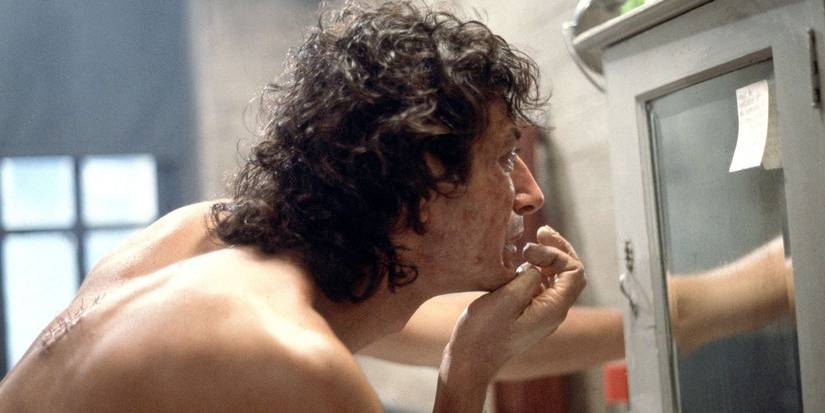
“Be afraid. Be very afraid.” The Fly is a sci-fi horror that doubles as a tragic love story. Scientist Seth Brundle (Jeff Goldblum) invents a teleportation device and, in a moment of hubris, tests it on himself. Unbeknownst to him, a fly enters the machine, fusing their DNA. Thus begins a gradual, horrifying transformation as Seth’s body and mind deteriorate. As Seth becomes more powerful and more grotesque, his relationship with journalist Veronica Quaife (Geena Davis) becomes increasingly painful to watch.
In this, the movie is like a pulpy riff on Kafka‘s Metamorphosis (but with more exploding baboons). The story is one of slow decay, mirroring real-world fears of illness and loss of identity. The tragedy lies in watching intelligence, tenderness, and humanity erode. Over time, The Fly has been reinterpreted as a powerful metaphor for terminal illness and bodily betrayal. Under the far-fetched elements and gory effects, it’s a really poignant and personal statement.
5
‘Stand by Me’ (1986)

“I never had any friends later on like the ones I had when I was twelve.” Rob Reiner delivered a remarkable run of masterpieces between the late ’80s and early ’90s, none of them better than this Stephen King adaptation. Stand By Me focuses on four boys who set out on a journey to find the body of a missing child. Along the way, they confront fear, loyalty, grief, and the painful awareness that childhood is slipping away. Their morbid quest turns into an unexpected rite of passage.
The plot unfolds over a single summer, but its emotional scope is vast, touching on universal feelings and experiences. It’s one of the definitive films about growing up. A huge part of what makes Stand By Me stand out is its honesty. The film doesn’t sentimentalize youth or exaggerate its innocence. The boys are funny, cruel, brave, and scared in equal measure. Their conversations feel lived-in, their bond fragile but profound.
4
‘Ferris Bueller’s Day Off’ (1986)

“Life moves pretty fast. If you don’t stop and look around once in a while, you could miss it.” A high school senior (Matthew Broderick) skips school for one perfect day in Chicago, dragging along his anxious best friend (Alan Ruck) and his tightly wound girlfriend (Mia Sara). From here, we get a series of escalating antics as Ferris evades authority, particularly a vindictive school principal (Jeffrey Jones) determined to expose him.
On the surface, Ferris Bueller’s Day Off is a carefree comedy. Beneath that, it’s a meditation on youth, anxiety, and self-assertion. Ferris embodies confidence and freedom, while his friend Cameron represents paralysis and fear. The day becomes a turning point, forcing Cameron to confront his emotional stagnation. In hindsight, the movie has very much become a cultural touchstone. Its style, humor, and fourth-wall breaks influenced countless teen comedies. More importantly, its message remains intact: joy requires risk.
3
‘Hannah and Her Sisters’ (1986)

“I don’t know what I’m supposed to do with my life.” Hannah and Her Sisters weaves together the intersecting lives of three sisters (played by Mia Farrow, Barbara Hershey, and Dianne Wiest) and their extended family over several years. Through these characters and their overlapping relationship, the movie dives deep into themes of infidelity, ambition, insecurity, and even existential dread. Conversations drive the narrative, shot through with neurosis and melancholy humor. Comedy arises naturally from discomfort and self-awareness rather than punchlines.
Fundamentally, Hannah and Her Sisters captures the messiness of adult life without cynicism, allowing characters to be flawed without being cruel. The result is one of the most fully realized ensemble dramas of its era. Its structure feels modern, its observations sharp but compassionate. Decades later, the movie still feels intimate, perceptive, and quietly wise. It understands that meaning is often found not through grand revelation, but through small acts of connection.
2
‘Top Gun’ (1986)

“I feel the need… the need for speed.” Top Gun is one of the most straightforwardly entertaining action movies of the ’80s, an unabashedly muscular and kinetic blockbuster with a hearty slice of military propaganda. Tom Cruise turns in one of his most iconic performances as naval aviator Pete “Maverick” Mitchell. We follow him as he trains at an elite fighter pilot school, competing with rivals while struggling with his own recklessness and unresolved grief.
From here, the movie blends together romance, heated personal rivalry, and jaw-dropping aerial combat, building toward the ultimate test of the characters’ mettle. In this, Top Gun is unapologetically mythic. The relationships are simple but effective, the performances sturdy, the big action set pieces well-choreographed. The movie’s style influenced music videos, advertising, and blockbuster pacing for years, and its sheer confidence has solidified its place as a defining cultural artifact of its era.
1
‘Aliens’ (1986)

“Get away from her, you bitch.” Aliens picks up decades after the original, following Ellen Ripley (Sigourney Weaver) as she returns to the planet where her crew was slaughtered, this time accompanied by a squad of marines. Their military operation quickly devolves into survival horror as the team is overwhelmed by xenomorphs. The plot shifts the franchise from horror to action without sacrificing tension. Combat sequences are relentless, but character development remains central, particularly Ripley’s transformation into a protector figure.
On top of that, the movie ups the ante by serving up the alien queen, a feat of monster design that’s somehow just as ingenious as (if not better than) H.R. Giger‘s original alien. For all these reasons, Aliens is widely regarded as one of the greatest sequels ever made. It expanded its universe while deepening its themes of motherhood, trauma, and resilience. For many, it remains the pinnacle of the franchise.


Aliens
- Release Date
-
July 18, 1986
- Runtime
-
137 minutes
- Director
-
James Cameron
- Writers
-
James Cameron
You must be logged in to post a comment Login