Nothing beats watching a sitcom after a long day — but some ’80s sitcoms just wouldn’t sit well with today’s audiences. The art of making people laugh is as timeless as the genre itself, and sitcoms are especially appealing because of their ensemble casts and episodic stories, making them easy to enjoy without committing to a serialized plot. While iconic hits like Seinfeldand modern favorites likeAbbott Elementary often dominate the conversation, plenty of underrated sitcoms are just as capable of delivering laughs.
That said, some of these forgotten gems would likely spark controversy if they premiered in today’s more socially aware climate, where audiences have higher expectations for how sitcoms handle sensitive topics. Whether due to poorly written scripts, unconvincing ensemble chemistry, or intentionally provocative themes, here are the ’80s forgotten sitcoms that have aged like milk.
Advertisement
‘Married… with Children’ (1987–1997)
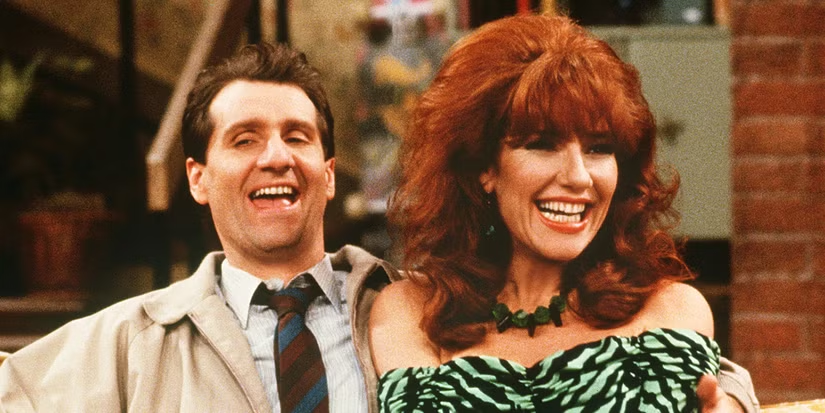
Al (Ed O’Neill) and Peggy (Katey Sagal) laughing together in Married With Children.Image via FOX
Married… with Children follows Al Bundy (Ed O’Neill), a former high school football star who now works as an underpaid shoe salesman. Despite his downfall, Al can’t help but dream of his glory days. Back at home, Al lives under the same roof as his spendthrift wife, dim-witted daughter, and awkward son. When they’re not bickering over dwindling paychecks, they’re probably fighting with their neighbors. But that’s not stopping Al from trying to get him and his family out of suburban purgatory.
Considering the Bundys are a problematic family by design, Married… with Children intentionally utilizes provocative humor that ranges from sexism to fat-shaming. Many episodes revolve around offensive gags, from Al buying Peggy (Katey Sagal) a new bra so men will stare at her breasts, turning sexual harassment into a joke, to his repeated insults toward overweight women shopping at the shoe store. The series also introduces NO MA’AM — the National Organization of Men Against Amazonian Masterhood — where members celebrate resisting women and complain about how women supposedly ruin men’s lives.
Advertisement
‘Charles in Charge’ (1984–1990)
Scott Baio as Charles stands in front of shelves and looks serious in Charles in Charge.Image via CBS
There’s a new nanny in New Brunswick — and he’s a dude. Charles in Charge follows 19-year-old college student Charles (Scott Baio). Choosing an unconventional side gig, he ends up working as the live-in housekeeper and babysitter for the Pembroke family. In exchange, he gets sweet perks like his own room and board. Little does he realize that taking care of the family’s three children is much harder than any homework he brings from his classes.
Relying on outdated humor, Charles in Charge frequently makes casual microaggressions by objectifying women. One of its creepiest storylines has Charles supervising a slumber party full of teenage girls, with the jokes framing him as “lucky” to be surrounded by them. The show is even more unsettling in hindsight after co-star Nicole Eggert accused Baio of sexual misconduct in 2018, alleging he made advances toward her when she was 14. Co-star Alexander Polinsky also accused Baio of verbal abuse and physical assault.
Advertisement
‘It’s Your Move’ (1984–1985)
A man and woman pose with a young teen in It’s Your Move.Image via NBC
It’s Your Move follows Matthew Burton (Jason Bateman),a charming teenage con artist whose endless scams keep everyone fooled. However, he meets his match when Norman Lamb (David Garrison), a former teen con artist turned teacher, moves into the neighborhood. When Norman starts dating Matthew’s widowed mother and becomes one of his teachers, the two constantly try to outsmart each other with their never-ending hijinks. Recognizing every trick in Matthew’s playbook, Norman becomes his greatest rival.
With Matthew being a kid himself, It’s Your Moverisks giving the wrong idea to impressionable young viewers of the same age. Throughout the show, he’s an expert liar and schemer, pulling off elaborate cons, tricking adults into believing his lies, and gaslighting people to get out of trouble — including repeatedly trying to break up his mom’s relationship with Norman. The problem is that these behaviors are played for laughs, making it seem like being manipulative or mean is funny instead of showing the real consequences.
Advertisement
‘Small Wonder’ (1985–1989)
Three small children in ‘Small Wonder’Image via Metroland Video Productions
Sci-fi meets sitcom in Small Wonder. Out of the blue, robotics engineer Ted Lawson (Dick Christie) secretly brings home V.I.C.I. (or Vicki), a childlike android he created to help disabled children. Pretending she’s their newly adopted daughter, the Lawson family must hide Vicki’s (Tiffany Brissette) true identity while she learns how to act human. Their biggest challenge doesn’t come from the government. Instead, it’s their nosy neighbors, the Brindles, who threaten to expose Ted’s greatest experiment and the family’s biggest secret.
Robots have always been a touchy subject in sci-fi, so turning a little girl into a sentient android was bound to raise some eyebrows. Back in the ’80s, though, the idea felt more kitschy than unsettling, since conversations about AI, robots, and autonomy were practically nonexistent outside of fiction. Looking back, however, the premise is harder to ignore. Vicki is expected to obey her parents without question, and if she doesn’t, she can simply be dismantled. Even as she displays increasingly human behavior, she’s treated more like property than a person, stripping her of any real autonomy.
Advertisement
Collider Exclusive · Sci-Fi Personality Quiz Which Sci-Fi Hero Are You Most Like? Paul Atreides · Captain Kirk · Princess Leia · Ellen Ripley · Max Rockatansky
Advertisement
Five iconic heroes. Five completely different ways of facing an impossible universe. One of them shares your instincts, your values, and your particular way of refusing to back down. Eight questions will tell you which one.
🏜️Paul Atreides
🖖Capt. Kirk
✊Princess Leia
🔦Ellen Ripley
Advertisement
🔥Max Rockatansky
Advertisement
01
How do you lead when the stakes couldn’t be higher? The way you lead under pressure is the most honest thing about you.
Advertisement
02
What is your greatest strength in a crisis? The quality that keeps you alive when everything else fails.
Advertisement
03
What is the thing you’d sacrifice everything else for? Your deepest motivation is your truest compass.
Advertisement
04
How do you relate to the people around you? Who you are to others under pressure is who you really are.
Advertisement
05
You’re facing a threat that no one else believes is real. What do you do? How you respond when you’re the only one who sees it defines everything.
Advertisement
06
What has your heroism cost you personally? Every hero pays. The question is what — and whether they’d pay it again.
Advertisement
07
How do you feel about the rules of the world you’re in? Every hero has a relationship with the system. What’s yours?
Advertisement
08
When everything is on the line, what keeps you going? The answer is the most honest thing about you.
Advertisement
Your Hero Has Been Identified Your Sci-Fi Hero Is…
Your answers point to the iconic sci-fi hero who shares your instincts, your values, and your particular way of facing the impossible.
Advertisement
Arrakis · Dune
Paul Atreides
You carry a weight most people would crumble under — the knowledge of what you’re capable of, and the burden of what you might have to become.
You see further ahead than others and you plan accordingly, even when the vision frightens you.
You are driven by loyalty to your people and a sense of destiny you didn’t ask for but can’t escape.
Paul Atreides is not simply a hero — he is someone who understands the cost of power and chooses to bear it anyway.
That gravity, that willingness to carry what others won’t, is exactly you.
Advertisement
USS Enterprise · Star Trek
Captain Kirk
You lead with instinct, warmth, and an absolute refusal to accept a no-win scenario — because you’ve always believed there’s a third option nobody else has thought of yet.
You take the mission seriously without ever taking yourself too seriously.
Your crew would follow you anywhere, not because you demand it, but because you’ve earned it.
Kirk’s genius isn’t tactical — it’s human. He reads people, bends rules with purpose, and wills outcomes into existence through sheer conviction.
That combination of warmth, audacity, and relentless optimism is unmistakably yours.
Advertisement
The Rebellion · Star Wars
Princess Leia
You are the kind of person who holds the line when everyone else is losing faith — not because you’re fearless, but because giving up simply isn’t something you’re capable of.
You lead through conviction. Your voice carries because your belief is unshakeable.
You gave up everything ordinary the moment you chose the cause, and you’ve never looked back.
Leia is not a supporting character in her own story — she is the moral centre of the entire rebellion.
That same fierce, principled, unbreakable core is what defines you.
Advertisement
The Nostromo · Alien
Ellen Ripley
You are not reckless, not grandiose, and not particularly interested in being anyone’s hero — you just refuse to stop when it matters.
You see threats clearly, you document the truth even when no one listens, and when the time comes you handle it yourself.
Ripley’s heroism is earned, not performed. She doesn’t have a speech — she has a flamethrower and a plan.
You share her composure under the worst possible pressure, and her refusal to pretend the monster isn’t there.
When it counts, you don’t flinch. That’s everything.
Advertisement
The Wasteland · Mad Max
Max Rockatansky
You have been through fire that would break most people — and what came out the other side is something the world underestimates at its peril.
You don’t ask for help, don’t need validation, and don’t wait for anyone to tell you the rules no longer apply.
Your loyalty, when it finally arrives, is absolute — but it’s earned in silence and tested in action, not in words.
Max is not a nihilist. He is someone who lost everything and found, against his will, that he still has something worth protecting.
That bruised, stubborn, ultimately human core is exactly yours.
Advertisement
‘Mama’s Family’ (1983–1990)
The cast of Mama’s Family all smile except for Mama, as they look at the camera with a plain pink background.Image via NBC
Advertisement
Mama’s Family follows sharp-tongued widow Thelma “Mama” Harper (Vicki Lawrence) as her quiet household is turned upside down when her recently divorced son Vinton (Ken Berry) moves in with his teenage children. Things get even more chaotic after Vinton marries their bubbly neighbor Naomi (Dorothy Lyman), adding another personality to the already crowded home. Spun off from The Carol Burnett Show, the sitcom follows the Harper family’s constant arguments, quirky personalities, and everyday misadventures.
Much of Mama’s Family’s chemistry comes from the family’s nonstop bickering. While sarcastic remarks are common in many sitcom families, the show often pushes them into full-blown screaming matches that cross the line. Whether it’s Mama constantly berating her children or the family turning on Mama, verbal abuse is often played for laughs. On top of that, when Vinton tries to express his feelings instead of yelling, his vulnerability is treated as something “wrong” or too feminine, reinforcing outdated stereotypes about masculinity.
‘She’s the Sheriff’ (1987–1989)
Hildy (Suzanne Somers) stands with her arms crossed next to her deputy in She’s the Sheriff.Image via Lorimar Telepictures
Advertisement
It takes a woman to do a man’s job properly. She’s the Sheriff follows Hildy Granger (Suzanne Somers), a widowed mother of two who unexpectedly becomes sheriff of fictional Lakes Country, Nevada, after her husband’s sudden death. With no law enforcement experience, Hildy must balance raising her children while learning the ropes of her new job and handling the town’s daily problems. Making matters harder is Deputy Max Rubin (George Wyner), who believes he deserved the position instead.
She’s the Sheriff had the chance to be a progressive sitcom in the ’80s, but instead it played into the same ditzy stereotype Somers was known for in Three’s Company. Rather than portraying Hildy as an empowered working woman, the show often depicts her as more focused on her personal life than her duties as sheriff. It also doesn’t help that her male colleagues frequently dismiss her responsibilities as a mother, treating them as interference with the job.
‘Dear John’ (1988–1992)
The cast of ‘Dear John’Image via NBC
Advertisement
Dear John follows John Lacey (Judd Hirsch), a Manhattan prep school teacher whose life falls apart after his wife leaves him for his best friend. Instead of a proper goodbye, his 10-year-marriage ends when he receives a “Dear John” letter. After losing his home and custody of his son, John starts over in Queens and joins the One-to-One Club, a support group for divorced and widowed singles. Together with his new unlikely friends, he gets through post-separation life one day at a time.
Where there’s divorce, there’s usually the question of who’s to blame. Dear John often frames women as the reason marriages fall apart, largely through John’s bitter perspective of his ex-wife. That one-dimensional view also extends to characters like Louise (Jane Carr), who is frequently portrayed as sex-obsessed for laughs. At a time when conversations about women’s sexual liberation were only beginning to gain traction, the show missed an opportunity to treat the topic with more nuance instead of turning it into a recurring joke.
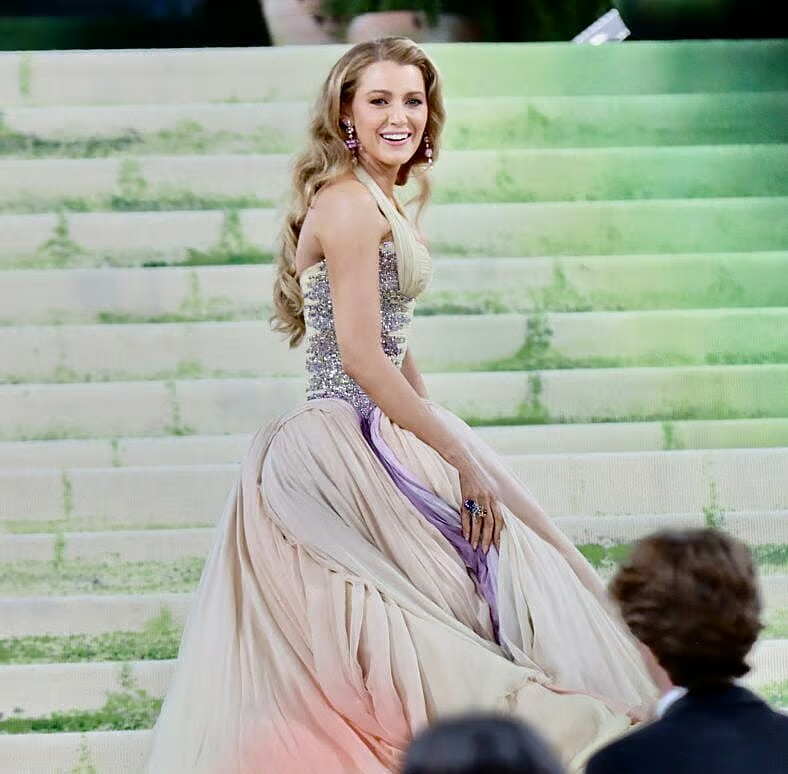
Blake Lively has reportedly made peace with the end of her once-close friendship with Taylor Swift, but one insider claims the actress still knows plenty about the singer’s private life. Their alleged falling-out became one of 2025’s biggest pop culture stories after Swift was pulled into Lively’s legal battle with “It Ends With Us” director and co-star Justin Baldoni. The tension has carried into 2026, with Lively reportedly left off the guest list for Swift’s massive wedding celebration earlier this month. While Swift initially appeared eager to distance herself from the controversy, sources now suggest Lively may no longer be the one with the most to lose.
5Nancy Rivera/MEGA
A veteran studio executive claimed Lively is no longer fighting to repair her relationship with Swift. “Blake has made peace with this friendship ending,” the source told the Daily Mail. “Ironically, she’s no longer the one with the most to lose. Taylor is now the one protecting a billion-dollar brand.”
When the friendship first began unraveling publicly, many Hollywood observers reportedly believed Lively had “lost” Swift, and everything that came with being associated with one of the world’s most famous performers. However, the executive’s remarks suggest Swift’s carefully maintained public image could now face more risk from questions about why she remained close to Lively for so long before distancing herself during a crisis.
Taylor Swift Was Pulled Into Blake Lively’s Legal Battle
The reported breakdown occurred amid Lively’s legal dispute with Baldoni. Alleged text messages released through court documents appeared to show the actress invoking her powerful relationships while discussing the filmmaker.
“I happen to have a few dragons. For better or worse, but usually for better. Because my dragons also protect those I fight for. So really, we all benefit from those gorgeous monsters of mine. You will too, I can promise you,” Lively allegedly told Baldoni. The “dragons” reference was widely interpreted as including Swift, although the singer was not named within the supplied message.
Swift was later served with a subpoena during the legal proceedings. A source from the singer’s circle subsequently claimed she “wanted to keep as much distance from the controversy as possible.” The decision to step away reportedly convinced many observers that the friendship between Swift and Lively had reached its breaking point.
Advertisement
Sources Claim Lively’s Difficult Reputation Predated The Lawsuit
A longtime talent agent claimed Lively’s polarizing reputation within the entertainment industry did not begin with her dispute involving Baldoni. “Blake’s reputation didn’t suddenly appear because of a lawsuit. People in Hollywood have been saying the same thing for years,” the agent alleged.
Some industry insiders have reportedly viewed Lively as confident and ambitious, while others have characterized her as demanding or difficult. Those conflicting perceptions raise questions about what initially brought Swift and Lively together and why their friendship remained strong for years.
However, neither Lively nor Swift built an identical public image. While Lively’s reputation was reportedly more divisive, Swift developed a highly successful brand centered partly on relatability, loyalty, friendship, romance, and surviving public heartbreak.
Blake Lively Was Left Out Of Taylor Swift Wedding Celebrations
Swift’s extravagant wedding to Travis Kelce reportedly brought together approximately 1,000 guests, including numerous figures from entertainment, sports, and the couple’s wider social circle. Adam Sandler officiated the ceremony, while reported attendees included Selena Gomez and Kristin Cavallari.
However, Lively and her husband, Ryan Reynolds, were noticeably absent from the celebrations. On the night of Swift and Kelce’s rehearsal dinner, the couple was photographed in Lake Placid, New York.
Lively was reportedly present for important chapters of Swift’s personal life, including the beginning of her relationship with Kelce. “Blake knows everything,” a source described as close to Lively claimed. “She was there from the very beginning with Taylor and Travis. She knows plenty that has never become public.”
There is no indication that Lively plans to reveal any private information about Swift. Still, the claim highlights how much two longtime friends may learn about each other over the course of a close relationship, and why a quiet friendship breakup can create tension even without either person speaking publicly.
Advertisement
For now, Lively may have lost her place inside Swift’s celebrated inner circle. However, if the insider’s claim is accurate, she walked away with intimate knowledge of a friendship and a chapter in Swift’s life that the public has never fully seen.
Roomies, Raven-Symoné and Adrienne Bailon just reminded everybody why their chemistry is unmatched. The longtime friends recently linked up for a hilarious moment that had fans doing double takes, and let’s just say one of them fully committed while the other looked like she was trying to keep the peace.
In a TikTok shared to social media, the pair appeared to be standing outside under red lighting with what looked like a black covering draped over them. Adrienne rocked a robe while Raven stepped out in a striped jacket and matching striped pants. As DMX’s iconic hit ‘Party Up (Up in Here)’ blasted in the background, Raven delivered every lyric bar for bar with full intensity, while Adrienne looked completely caught off guard.
At one point, Adrienne hilariously tried to hold Raven back like she didn’t want any smoke before eventually hopping onto her back in an attempt to calm her down. The playful interaction had the perfect mix of chaos and comedy, leaving fans cracking up over Adrienne’s priceless reactions and Raven’s unwavering commitment to the performance. Needless to say, Roomies are calling this one of the funniest celebrity TikToks they’ve seen in a minute.
Roomies Think Raven Was Sending A Message
Roomies wasted no time running to TSR’s Instagram comment section, and they definitely had plenty to say about Raven-Symoné and Adrienne Bailon’s hilarious TikTok. Some fans joked that Raven’s passionate performance targeted Kiely Williams, while others celebrated seeing Raven and Adrienne share laughs together again. Overall, fans filled the comments with nostalgia, jokes, and love for the duo’s undeniable chemistry.
Advertisement
One Instagram user @moniquesroom shared, “I know who this fa 😂😂🤣”
This Instagram user @itsoceanbreeze claimed, “They’re having a balll I love it . This be me when I ain’t seen my friend in a while”
And, Instagram user @princedre._ added, “Kurupt Was Having A Good Day Till This😂”
Meanwhile, Instagram user @chitownsfinest1_ joked, “Yeah, this for that Promith Promith girl😭😭”
Advertisement
While Instagram user @ayannataylorrr commented, “This for you Kiely 😭”
Finally, Instagram user @sophisticatednclassii wrote, “Raven came to let it be known who’s really the queen around here !!!”
The TikTok Comes Amid Recent Kiely Williams Drama
While Raven and Adrienne’s latest TikTok has fans laughing, some believe it comes on the heels of recent online drama involving former Cheetah Girls member Kiely Williams. After news of the franchise reboot surfaced, an X user called Kiely an “underrated superstar” of both 3LW and The Cheetah Girls, suggesting the behind-the-scenes tension during those years must have been severe for her not to return.
The conversation quickly escalated when Kiely’s sister responded to the post with harsh criticism aimed at Raven-Symoné, Adrienne Bailon-Houghton, and Sabrina Bryan. Her comments quickly circulated across social media, reigniting conversations about the group’s longtime rumored fallout. While some Roomies are now joking that Raven threw subtle shade, neither Raven, Adrienne, Sabrina, nor Kiely has publicly addressed the speculation or responded to the recent online claims.
“I spent that day dancing and singing and crying with her and it made the film,” Gosling previously revealed of the mop, which wore “glasses and a dress” on set.
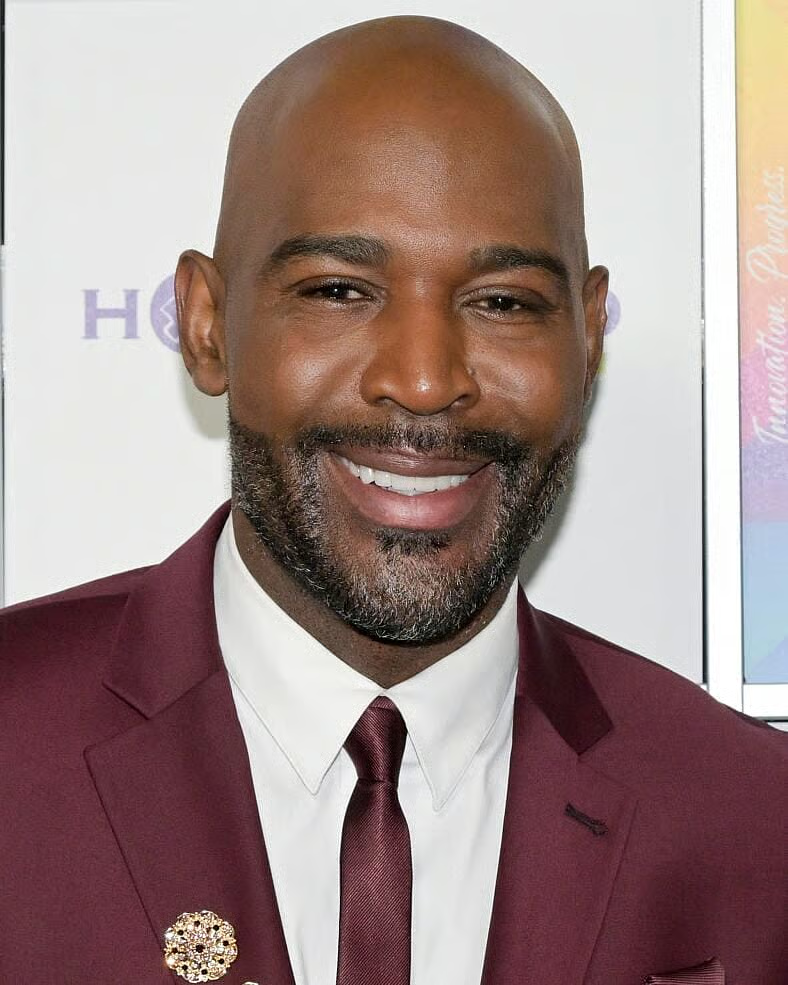
Karamo Brown’s decision to walk away from “Queer Eye” after 10 seasons did not happen in a vacuum. Months after his strained relationship with his co-stars became public, the former culture expert is revealing more about the treatment he allegedly endured behind the scenes, including an explosive confrontation in which an unnamed executive threatened to fire him and destroy his career. Brown claims he was initially punished for creating the same emotional moments that eventually became central to the Netflix show’s success.
5ZUMAPRESS.com / MEGA
Tension surrounding Brown’s departure first surfaced when he abruptly withdrew from two interviews promoting the final season of “Queer Eye.” His absence forced his fellow cast members to answer questions without him and fueled speculation about whether the feel-good camaraderie depicted on the show extended beyond the cameras.
In a statement provided to “CBS Mornings,” Brown explained that protecting his peace meant removing himself from the promotional appearance. “Though the show is ending, I hope everyone remembers the main theme I have tried to teach them over the past decade, which is to focus on and to protect their mental health/peace from people or a world who seek to destroy it; which is why I can’t be there today,” he said.
Brown later claimed that his mother overheard his colleagues having a conversation about him behind his back. “The thing I know is the tears I saw in my mother’s eyes,” he told PEOPLE. “[She kept repeating], ‘I thought they were your friends.’ It made me realize I can no longer stay silent about how often I was made to feel like an outsider.”
Advertisement
An Executive Allegedly Threatened To End His Career
While appearing at ViewerCon in New Jersey this month, Brown revealed that his feelings of isolation allegedly began during the first season.
As the show’s culture expert, Brown was responsible for helping participants confront emotional obstacles while the other members of the Fab Five focused on areas such as fashion, grooming, food, and design. “On my show, season one, episode two, I had made the person cry. And it’s now become something part of… People know I’m going deep… get to the core of it,” Brown recalled, per Daily Mail.
According to Brown, an unnamed white executive entered a trailer and confronted him in front of approximately 25 people. “And there was a white executive that came into the trailer in front of like 25 people and said, ‘If you make one more motherf-cking person cry, you are f-cking fired! You are worthless! You ain’t got…don’t you f-cking do it! You are f-cking nothing!’”
Brown said other people present have since confirmed witnessing the alleged incident, claiming, “And I can talk about this… because everyone has confirmed it. They said, ‘Yeah, we were there.’ And he said, ‘If you do this one more time, I promise you, you are f-cking never going to work in this town again.’”
Brown claimed he responded to the threat by refusing to let the executive determine how he performed his job or whether he belonged in Hollywood. “And so I said, ‘Well, listen, I got to just do what I do.’ If you think you have that much power to [not have] me work in town, then I’m not in the right business because you don’t ordain my step. So… I gotta do what I do,” he said.
He returned to set and continued pushing the participant toward an emotional breakthrough. “And I went back to set, and I did it again. And the person cried, and the person cried, and they were pissed,” Brown continued.
Advertisement
The show’s reaction after its first season made the confrontation even more striking for Brown. According to the television personality, “Queer Eye” was originally supposed to use the slogan “Turning red states pink.” By the second season, however, the marketing campaign had shifted to “We’re not crying, you are.”
“And then from season two on, every network conversation was, ‘How do we get this to be more emotional? How do we get to the heart?’” Brown recalled.
Karamo Brown Says The Approach They Fought Helped Win Emmys
As the show embraced deeper emotional storytelling, Brown continued using the approach executives had allegedly discouraged. “I said, ‘I’m just keep doing what I’m doing. Y’all can try to figure it out, but I’m going to keep doing what I’m doing.’ And we won Emmys off of this idea that we can get to the heart,” he said.
Brown argued that the show ultimately celebrated an idea he was once publicly and privately discouraged from pursuing. “Which is what they fought against every day publicly, not just privately, me not doing,” he claimed.
Even with the show’s success, the alleged treatment began affecting how Brown viewed himself. “And so that breaks you down because… even though you’re trying to be strong, you have people trying to tell you to question yourself, telling you like, ‘Maybe you’re not doing it,’” he explained. “That’s what hurt so much because I knew that I was doing right, I knew I was being true, but then I had people telling me that I was not worth it.”
Brown said Hollywood’s insular environment eventually made him internalize the messages he received. “And when you’re in the bubble of Hollywood, sometimes you could start, and this is the problem: I was helping everybody, but I wasn’t helping myself,” he admitted.
“I was allowing myself to start to believe these things. I would start to believe that like, ‘oh you know what, I could be in the middle. I can’t be in the middle. No, they’re the stars.’ I started to believe these things,” he continued.
Long before audiences fell in love with love stories on screen, most of the time, readers were already captivated by their wit, chemistry, heartbreak, and happily-ever-afters found on the page of a beloved novel. Of course, adapting a cherished book is never easy, especially when fans have spent years imagining the story for themselves. Yet, the very best romance adaptations manage to capture the spirit of the source material, while also bringing something fresh to the table.
And on the rare occasion, there are some that have somehow achieved the unthinkable: earned near-universal admiration from critics and audiences alike—many of whom love to nitpick on the nitty-gritty details. It’s difficult to express how impressive a feat like this is. As such, we felt it was important to highlight these films that have not only remained faithful to the emotional heart of their literary counterparts, but stand confidently as exceptional movies in their own right.
Advertisement
6
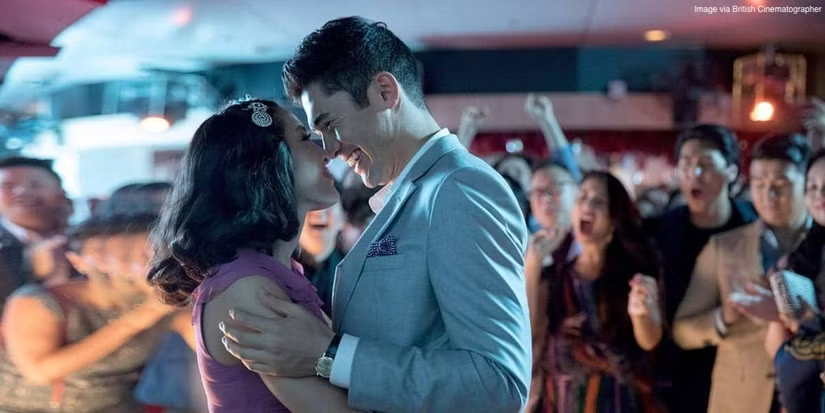
‘Crazy Rich Asians’ (2018)
When economic professor Rachel Chu (Constance Wu) accompanies her longtime boyfriend Nick Young (Henry Golding) to Singapore for his best friend’s wedding, she goes on the trip simply expecting to finally meet his family. Instead, she’s left completely blindsided by the revelation that Nick hails from one of Asia’s wealthiest dynasties. Suddenly thrust into a world of staggering luxury, family expectations, and relentless social scrutiny, Rachel finds herself not only fighting for her relationship but also her place within Nick’s complicated family.
Kevin Kwan‘s bestselling novel was already beloved, but the film adaptation of Crazy Rich Asians elevated it into a modern romantic classic (and everyone’s favorite airplane watch). Of course, while the extravagant wedding, lavish parties, and jaw-dropping displays of wealth are undeniably entertaining, the emotional core lies in Rachel’s relationship with Nick—and particularly her clashes with Eleanor Young (Michelle Yeoh), Nick’s extremely disapproving mother. Wu and Golding make for an irresistible leading pair, alongside Yeoh, who delivers one of the genre’s most nuanced “antagonists”, turning what could’ve been a simple culture-clash romance into a thoughtful story about identity, sacrifice, and family. It’s crazy that we’re still waiting for that sequel.
Advertisement
5
‘Stardust’ (2007)
Claire Danes as Yvaine and Charlie Cox as Tristan try to escape a Gothic mansion in Stardust.Image via Paramount Pictures
When a young man named Tristan Thorn (Charlie Cox) promises to retrieve a fallen star for the woman he believes he loves, he crosses the wall separating his sleepy English village from the magical kingdom of Stormhold. There, he discovers the “star” is a woman named Yvaine (Claire Danes), who is also being hunted not only by ruthless princes, but by a trio of witches who seek her heart to restore their youth.
Based on Neil Gaiman‘s beloved novel, Stardustcaptures the sense of wonder that defines the very best fantasy romances. Matthew Vaughn perfectly balances fairytale adventure, swashbuckling action, and heartfelt emotion without ever losing the story’s whimsical charm. Better still, Cox and Danes share an effortlessly sweet chemistry, while an all-star supporting cast—including the likes of Michelle Pfeiffer, Robert De Niro, and Mark Strong—add humor and unforgettable personality. Equal parts romance and fantasy epic, Stardust remains one of the most charming (and underrated) literary adaptations of the 21st century.
Advertisement
4
‘The Notebook’ (2004)
Allie (Rachel McAdams) laughing while Noah (Ryan Gosling) tries to get ice cream on her face in The NotebookImage via New Line Cinema
After a passionate summer romance, Noah Calhoun (Ryan Gosling) and Allie Hamilton (Rachel McAdams) are forcefully separated due to societal pressure. Years later, Noah never forgets the woman he loves, while Allie comes back engaged to another man from her own social circle. But when fate brings them back together, the pair are forced to confront lingering feelings and decide whether their love is powerful enough to overcome time, distance, and the expectations placed upon them.
Few romantic films have become as culturally iconic as The Notebook. Adapted from Nicholas Sparks‘ bestselling novel, it embraces sweeping emotion without apology, delivering grand romantic gestures that have become instantly recognizable to generations of movie-goers. Gosling and McAdams bring remarkable sincerity to Noah and Allie’s relationship, making every reconciliation and heartbreak feel earned. And let’s not forget the other subplot that sees them in the future. That itself completes the film as a tale all about enduring love, memory, and devotion. What a tearjerker.
Advertisement
Collider Exclusive · Oscar Best Picture Quiz Which Oscar Best Picture Is Your Perfect Movie? Parasite · Everything Everywhere · Oppenheimer · Birdman · No Country
Advertisement
Five Oscar Best Picture winners. Five completely different visions of what cinema can be — and what it can do to you. One of them is the film that was made for the way your mind works. Ten questions will figure out which one.
🪜Parasite
🌀Everything Everywhere
☢️Oppenheimer
🐦Birdman
Advertisement
🪙No Country for Old Men
Advertisement
01
What kind of film experience do you actually want? The best movies don’t just entertain — they leave something behind.
Advertisement
02
Which idea grabs you most in a film? Great films are driven by a central obsession. What’s yours?
Advertisement
03
How do you like your story told? Form is content. The way a story is shaped changes what it means.
Advertisement
04
What makes a truly great antagonist? The opposition defines the protagonist. What kind of opposition fascinates you?
Advertisement
05
What do you want from a film’s ending? The final note is the one that lingers. What do you want it to sound like?
Advertisement
06
Which setting pulls you in most? Where a film takes place shapes everything — mood, stakes, what’s even possible.
Advertisement
07
What cinematic craft impresses you most? Every great film has a signature — a technical or artistic element that makes it unmistakable.
Advertisement
08
What kind of main character do you root for? The protagonist is the lens. Who you choose to follow says something about you.
Advertisement
09
How do you feel about a film that takes its time? Pace is a choice. Some films sprint; others let tension accumulate slowly, deliberately.
Advertisement
10
What do you want to feel walking out of the cinema? The best films leave a mark. What kind of mark do you want?
Advertisement
The Academy Has Decided Your Perfect Film Is…
Your answers have pointed to one Oscar Best Picture winner above all others. This is the film that was made for the way your mind works.
Advertisement
Parasite
You are drawn to films that operate on multiple levels simultaneously — that begin in one genre and quietly, brilliantly migrate into another. Bong Joon-ho’s Parasite is a film about class, desire, and the architecture of inequality that manages to be darkly funny, deeply suspenseful, and genuinely shocking across a single extraordinary running time. Your instinct is for cinema that hides its true intentions until the moment it’s ready to reveal them. Parasite is exactly that — a film that rewards close attention and punishes assumptions, right up to its devastating final image.
Advertisement
Everything Everywhere All at Once
You want it all — and this film gives you all of it. The Daniels’ Everything Everywhere All at Once is one of the most maximalist films ever made: action comedy, multiverse sci-fi, family drama, existential crisis, and a genuinely earned emotional core that sneaks up on you amid the chaos. You are someone who responds to ambition, who doesn’t want cinema to choose between being entertaining and being meaningful. This film refuses that choice entirely. It is overwhelming by design, and its overwhelming nature is precisely the point — because the feeling of being crushed by infinite possibility is exactly what it’s about.
Advertisement
Oppenheimer
You are drawn to cinema on a grand scale — films that understand history not as a backdrop but as a force, and that place their characters inside that force and watch what happens. Christopher Nolan’s Oppenheimer is a film about the terrifying gap between what we can do and what we should do, told with the full weight of one of the most consequential moments in human history behind it. You want your films to feel important without feeling self-important — to earn their ambition through sheer craft and the gravity of their subject. Oppenheimer does exactly that. It is enormous, complicated, and refuses easy comfort.
Advertisement
Birdman
You are drawn to films that foreground their own construction — that make the how of the filmmaking part of the what it’s about. Alejandro González Iñárritu’s Birdman, shot to appear as a single continuous take, is cinema examining itself through the cracked mirror of a fading actor’s ego. You respond to formal daring, to the feeling that a film is doing something that probably shouldn’t be possible. Michael Keaton’s performance and Emmanuel Lubezki’s restless camera create something genuinely unlike anything else — a film that is simultaneously about creativity, relevance, self-destruction, and the impossibility of ever truly knowing if your work means anything at all.
Advertisement
No Country for Old Men
You are drawn to cinema that trusts silence, that refuses to explain itself, and that treats dread as a form of meaning. The Coen Brothers’ No Country for Old Men is a film about the arrival of a new kind of evil — implacable, arbitrary, and utterly indifferent to the moral frameworks we use to make sense of the world. It is one of the most formally controlled films ever made, and its controlled restraint is what makes it so terrifying. You want your films to haunt you, not comfort you. You are not interested in resolution if resolution would be dishonest. No Country for Old Men is honest in a way that most cinema never dares to be.
Advertisement
3
‘Bridget Jones’s Diary’ (2001)
Image via Miramax Films
Advertisement
Thirty-something Londoner Bridget Jones (Renée Zellweger) resolves to take control of her chaotic life by keeping a brutally honest diary documenting her career, insecurities, and romantic misadventures. But when she’s suddenly caught between charming rogue Daniel Cleaver (Hugh Grant) and seemingly reserved barrister Mark Darcy (Colin Firth), Bridget must stumble through awkward encounters and embarrassing mistakes—all the while searching for happiness on her own terms.
Loosely inspired by another literary classic, Helen Fielding‘s novel became one of the most beloved romantic comedies of its era, and the film adaptation loses none of its charm. Zellweger’s performance is endlessly relatable, allowing Bridget’s flaws to become her greatest strength rather than something to overcome. Better still, Grant and Firth make the perfect romantic foils, letting each of their moments with Bridget have their own special quirks. And yet, there’s no doubt that Bridget carries the rest of the film with her warm, resilience, and self-deprecating humor. Funny, heartfelt, and refreshingly honest about modern relationships, Bridget Jones’ Diaryis a timeless rom-com that’s perfect just the way they are.
2
‘The Princess Bride’ (1987)
A wounded Wesley (Carey Elwes) protects Buttercup (Robin Wright) with a sword in the forest in The Princess BrideImage via 20th Century Studios
Advertisement
In a story read by a caring grandfather, a young farmhand named Westley (Cary Elwes) is presumed killed at sea, forcing his beloved Buttercup (Robin Wright) to begrudgingly agree to marry the cruel Prince Humperdinck (Chris Sarandon). Little does she know, Westley is actually alive and has since become a swashbuckling man in a mask. And when Buttercup is suddenly kidnapped by a trio of bandits before her wedding day, Westley goes on an adventure to rescue her.
William Goldman‘s adaptation of his own novel has truly stood the test of time, regardless of a viewer’s age or genre preferences. Yes, the epic romance between Westley and Buttercup provides the emotional foundation, and yet The Princess Bridesucceeds because every supporting character—from Inigo Montoya (Mandy Patinkin) to Vizzini (Wallace Shawn) and Fezzik (André the Giant)—is equally memorable. Its endlessly quotable dialogue, playful storytelling, and complete sincerity have made it a timeless favorite, proving that happily-ever-afters don’t have to take themselves too seriously. Easily one of Rob Reiner‘s best films of all time.
1
‘Pride & Prejudice’ (2005)
Darcy and Elizabeth dance at a ball in ‘Pride and Prejudice’.Image via Universal Pictures
Advertisement
When spirated Elizabeth Bennet (Keira Knightley) meets the wealthy but seemingly arrogant Mr. Darcy (Matthew MacFadyen), their first impressions of one another could hardly be worse. But as misunderstandings, family pressures, and rigid social expectations threaten to keep them apart, Elizabeth gradually discovers that there is far more to Darcy than his exterior suggests, forcing both of them to confront their true feelings.
It’s no surprise that Jane Austen‘s novel has been adapted countless times, and yet Joe Wright‘s film remains one of the most beloved interpretations. Knightley and MacFadyen bring extraordinary emotional nuance to the iconic romance, capturing the slow transformation from mutual irritation to profound admiration with remarkable chemistry. Where the sweeping cinematography and gorgeous score offer a breathtaking sense of romantic yearning, the screenplay carefully preserves Austen’s wit about class and society. More than two centuries after Pride & Prejudice‘s publication, Elizabeth and Darcy’s love story remains every bit as captivating—and this adaptation is a major reason why.
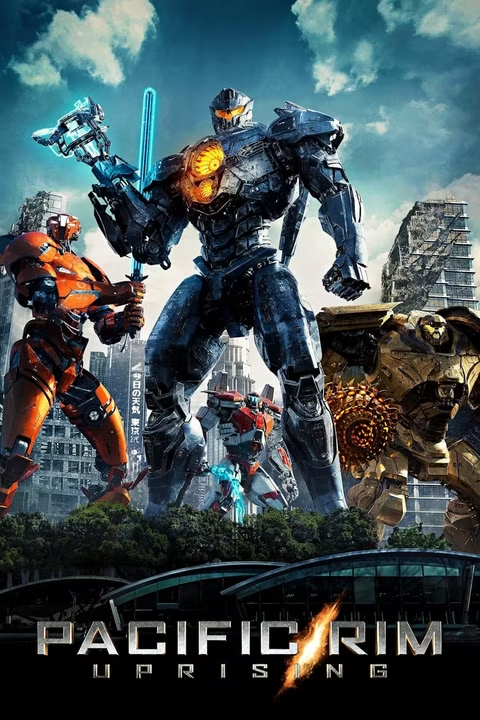
After being earmarked for success several years ago, Cailee Spaenyhas lived up to her potential with her recent work. She earned an Oscar nomination and won the Volpi Cup for her performance in Sofia Coppola‘s unconventional biopic Priscilla, and more recently, received acclaim for her work in Civil War, Wake Up Dead Man: A Knives Out Mystery, and the second season of Netflix’s Beef. Spaeny also experienced box-office success with Alien: Romulus, which grossed $350 million worldwide. She will next star in the most expensive A24 movie ever made, director Alex Garland‘s fantasy adaptation Elden Ring. One of Spaeny’s earliest leading roles came in a movie that was even more expensive. The movie in question underperformed at the box office and brought its franchise to a screeching halt. But it saw a resurgence on HBO Max recently, eight years after its theatrical release.
The film also featured Star Wars: The Force Awakens star John Boyega and Clint Eastwood‘s son, Scott. The movie marked the feature directorial debut of Steven S. DeKnight, who remains best known for his work on Marvel’s Daredevilseries on Netflix and for creating the Starz show Spartacus. The movie served as a sequel to Guillermo del Toro‘s first large-scale project, Pacific Rim, which grossed around $410 million globally against a reported budget of $190 million in 2013. That film was distributed by Warner Bros., but the sequel was distributed by Universal. The second movie was produced mainly because of the extraordinary performance of its predecessor in China; to further capitalize on the Middle Kingdom audience, the sequel cast Chinese stars such as Jing Tian and Zhang Jin in supporting roles.
Advertisement
Collider Exclusive · Sci-Fi Survival Quiz Which Sci-Fi World Would You Survive? The Matrix · Mad Max · Blade Runner · Dune · Star Wars
Advertisement
Five universes. Five completely different ways the future went wrong — or sideways, or up in flames. Only one of them is the world your instincts were built for. Eight questions will figure out which dystopia, galaxy, or desert wasteland you’d actually make it out of alive.
💊The Matrix
🔥Mad Max
🌧️Blade Runner
🏜️Dune
Advertisement
🚀Star Wars
Advertisement
01
You sense something is deeply wrong with the world around you. What do you do? The first instinct is often the truest one.
Advertisement
02
In a world of scarcity, what resource do you guard most fiercely? What we protect reveals what we believe survival actually requires.
Advertisement
03
What kind of threat keeps you up at night? Fear is useful data — if you’re honest about what you’re actually afraid of.
Advertisement
04
How do you deal with authority you don’t trust? Every dystopia has a power structure. Your approach to it determines everything.
Advertisement
05
Which environment could you actually endure long-term? Survival isn’t just tactical — it’s physical, psychological, and very much about where you are.
Advertisement
06
Who do you want in your corner when things fall apart? The company you keep is the clearest signal of who you actually are.
Advertisement
07
Where do you draw the line — if you draw one at all? Every survivor eventually faces a moment that tests what they’re actually made of.
Advertisement
08
What would actually make survival worth it? Staying alive is one thing. Having a reason to is another.
Advertisement
Your Fate Has Been Calculated You’d Survive In…
Your answers point to the world your instincts were built for. This is the universe your temperament, your survival instincts, and your particular brand of stubbornness were made for.
Advertisement
The Resistance, Zion
The Matrix
You took the red pill a long time ago — probably before anyone offered it to you. You’re a systems thinker who can’t help but notice the seams in things.
You’re drawn to understanding how the system works before figuring out how to break it.
You’d find the Resistance, or it would find you — your instinct for spotting constructed realities is the machines’ worst nightmare.
You function best when you have access to information and the freedom to act on it.
The Matrix built an airtight prison. You’d be the one probing the walls for the door.
Advertisement
The Wasteland
Mad Max
The wasteland doesn’t reward the clever or the well-connected — it rewards those who are hard to kill and harder to break. That’s you.
You don’t need comfort, community, or a cause larger than the next horizon.
You need a vehicle, a clear threat, and enough fuel to outrun it — and you’re good at all three.
You are unsentimental enough to survive that world, and decent enough — just barely — to be something more than another raider.
In the wasteland, that distinction is everything.
Advertisement
Los Angeles, 2049
Blade Runner
You’d survive here because you know how to exist in moral grey areas without losing yourself completely.
You read people accurately, keep your circle small, and ask the questions others prefer not to answer.
In a city where humanity is a legal designation rather than a feeling, you hold onto something that keeps you functional.
You’re not a hero. But you’re not lost, either.
In Blade Runner’s world, that distinction is everything.
Advertisement
Arrakis
Dune
Arrakis is the most hostile environment in the known universe — and you are precisely the kind of person it rewards.
Patience, discipline, and political awareness are your core strengths — and on Arrakis, they’re survival tools.
You understand that the long game matters more than any single victory.
Others come to Dune and are consumed by it. You’d learn its logic and earn its respect.
In time, you wouldn’t just survive Arrakis — you’d begin to reshape it.
Advertisement
A Galaxy Far, Far Away
Star Wars
The galaxy far, far away is vast, loud, and in a constant state of violent political upheaval — and you wouldn’t have it any other way.
You find meaning in being part of something larger than yourself — a cause, a crew, a rebellion.
You’d gravitate toward the Rebellion, or the fringes, or whatever pocket of the galaxy still believes the Empire’s grip can be broken.
You fight — not because you have to, but because standing aside isn’t something you’re capable of.
In Star Wars, that willingness is what makes all the difference.
Advertisement
The Sci-Fi Sequel Received Mediocre Reviews
We’re talking, of course, about Pacific Rim Uprising. Produced on a reported budget of $176 million, the movie grossed $291 million worldwide. It now holds a 42% score on the aggregator website Rotten Tomatoes, where the consensus reads, Pacific Rim Uprising won’t win any points for subtlety or originality, but it delivers enough of the rock ’em-sock ’em robots-vs.-kaiju thrills that fans of the original will be looking for.” According to FlixPatrol, it was among the most watched movies on the domestic HBO Max chart this week, when the leaderboard was topped by The Long Walk. Stay tuned to Collider for more updates.
Advertisement
Advertisement
Release Date
March 23, 2018
Advertisement
Runtime
111 minutes
Director
Advertisement
Steven S. DeKnight
Writers
Emily Carmichael, Kira Snyder, Steven S. DeKnight, T.S. Nowlin, Travis Beacham
Advertisement
Producers
Guillermo del Toro, Jon Jashni, Mary Parent, Cale Boyter, Thomas Tull, Femi Oguns
Warren Hudson is now detailing the hours after he and his friends left Horn Island on July 4, while reacting to the viral pool party photo showing Nolan Xavier Wells.
Warren Hudson Details What He & His Friends Allegedly Did After Leaving Horn Island
In part three of Warren Hudson’s sit-down interview, published via Officer Tatum’s YouTube channel, Tatum asks the teen to explain how he became concerned about Wells after he and the others left the island. In response, Hudson explained that “running in” from the island was “very chaotic,” presumably due to the group’s issue with the boat allegedly taking on water.
“If the boat doesn’t get in, then no one gets in,” Hudson said.
Furthermore, he explained that after docking the boat on shore, he went back to a “buddy’s house.” There, they ate and “napped for a little bit.” Afterward, Hudson said he and the friend went to a girl’s house, who was having a Fourth of July party with “fireworks and stuff.”
Advertisement
“So we all went over there, and swam, and you know, hang out,” Hudson said.
He Speaks On Viral Pool Party Photo Showing Nolan Xavier Wells
At that point, Officer Tatum brought up the photo that had gone viral earlier this month, showing Nolan Wells in a pool surrounded by several individuals. As The Shade Room previously reported, the photo turned heads because it was initially labeled as being taken during the early hours of July 5. To note, another alleged friend of Wells, Tracestin Shephed, previously asserted that the photo was actually taken on June 27.
“That picture is taken on June 27,” Hudson said. “A week before the Fourth of July, we all went to a friend of ours… Nolan was in that picture. And if you look in that picture, my arm is around him. And that was a week before the Fourth of July.”
Circling back to the series of events on July 4, Hudson said that Wyatt mentioned Wells. In response, he asked if anyone had heard from him, to which everyone declined.
Advertisement
“It’s a little bit concerning. I mean, I’m not freaking out or anything. But I’m trying to find out where Nolan is,” Hudson recalled.
At that point, he allegedly texted Wells’ friend Javaughn. This, to ask for Wells’ mom’s phone number. Once he received it, he called her and informed her of the situation and that he was going to call the Coast Guard. Hudson noted that this was around 11 pm.
“My friends and I have been on the water our whole life. Stuff happens. People die all the time. I know people who have died out there. It’s a fun place to be, but it’s also dangerous if you’re not handling it right,” Hudson said. “I’m thinking, I’d rather be safe than sorry. I’d rather call the Coast Guard 100 times and lose my mind over it, and my buddy be okay, than not, and me not know where he is and he not be okay.”
Warren Hudson Has Been Recapping The Disappearance Of Nolan Xavier Wells In New Interview
As The Shade Room previously reported, Warren Hudson broke his silence in an interview that began being released through Officer Tatum’s YouTube channel earlier this week. During the conclusion of part 3, Hudson explained that he woke up on July 5, “freaked out,” finding out that Wells was missing.
He alleged that he and his family took a boat out to Horn Island to look for Wells. But by that time, multiple agencies were searching the island and nearby landmasses. On July 6, once he heard that Wells’ body was found, he allegedly “broke down” and “cried.”
Advertisement
“It was really, really hard on me… it was traumatic,” he said. “…I can’t even put into words how upset I was.”
Per Hudson, on July 7, he spoke with the police, telling “everything [he] knew.”
“Everybody cooperated with police, fully,” he said. “We were fully cooperative.”
As the interview concluded, Tatum asked Hudson about the role of race in the case. This, to which Hudson responded that Wells never felt “uncomfortable” around him and his friends. And if he did, he wouldn’t have hung out with them.









:max_bytes(150000):strip_icc():format(jpeg)/molly-ringwald-ryan-gosling-project-hail-mary-072426-a04fde3656714156be674369846e64f7.jpg)
:max_bytes(150000):strip_icc():format(jpeg)/ben-casey-chris-affleck-072426-9d0ab9733c1240fda45a75e53125f618.jpg)


:max_bytes(150000):strip_icc():format(jpeg)/alyssa-farah-griffin-the-view-072426-62bab9b8e49b4fb1a6f422c3d89690bc.jpg)




:max_bytes(150000):strip_icc():format(jpeg)/big-brother-jason-1-b0a44c3ba6bb429aa86bf400223528b5.jpg)






































You must be logged in to post a comment Login