
Entertainment
Disney’s Cancelled 8-Part Star Wars Series Officially Becomes a Late-Night Sleeper Hit


Despite being one of its most original shows, this Star Wars entry was cancelled too soon before viewers could see its ambitious take on the sci-fi universe reach its full potential. Many may argue that the mystery thriller is not particularly unique compared to the likes of Andor, widely regarded as one of the best Star Wars productions of all time, which concluded its two-season run last year. However, it distinguishes itself by exploring an untapped franchise era, focusing on dark-side perspectives largely removed from the shadow of the Galactic Empire.
Due to reported low viewership and its high production costs, Star Wars: The Acolyte was cancelled in August 2024, just one month after its finale. The series was created by Leslye Headland for Disney+, and is set at the end of the High Republic era, long before the events of the Skywalker Saga. It arrived two years after Andor and a year after Ahsoka, the latter of which is set to return for a second season. The Acolyte follows a former Padawan who reunites with her Jedi Master to investigate a series of crimes, only to uncover a far more sinister conspiracy tied to the rise of the dark side.
Having premiered with its first two episodes on June 4, 2024, The Acolyte concluded just over a month later on July 16. Disney reported that the sci-fi adventure drew 4.8 million views on its first day and 11.1 million within its first five days, making it Disney+’s biggest series premiere of 2024 at the time. However, that five-day total still trailed behind Ahsoka, which reached 14 million views in the same window. Now two years after its cancellation, The Acolyte has found renewed interest in the U.S., resurfacing on Disney+ charts overnight as one of the platform’s most-watched shows. At the same time, the most recent franchise entry, Star Wars: Maul – Shadow Lord (which debuted with a perfect score of 100% on Rotten Tomatoes), has also been performing strongly, topping global charts.
Who Stars in ‘Star Wars: The Acolyte’?
In The Acolyte, Hunger Games star Amandla Stenberg leads an ensemble cast as twin sisters Osha and Mae Aniseya. The girls were separated by a tragedy when they were young. Osha is the former Padawan learner of Sol, who left the Jedi Order, while Mae, initially presumed dead, is a dangerous warrior using the dark side of the Force. Other stars included Squid Game icon Lee Jung-jae as respected Jedi Master Sol and Manny Jacinto as the Stranger, Mae’s Sith master, alongside Charlie Barnett, Dafne Keen, Rebecca Henderson, Jodie Turner-Smith, and Carrie-Anne Moss.
The Acolyte is available to stream on Disney+.

- Release Date
-
2024 – 2024-00-00
- Showrunner
-
Leslye Headland
- Directors
-
Leslye Headland, Alex Garcia Lopez
- Writers
-
Leslye Headland, Charmaine De Grate, Kor Adana
- Franchise(s)
-
Star Wars

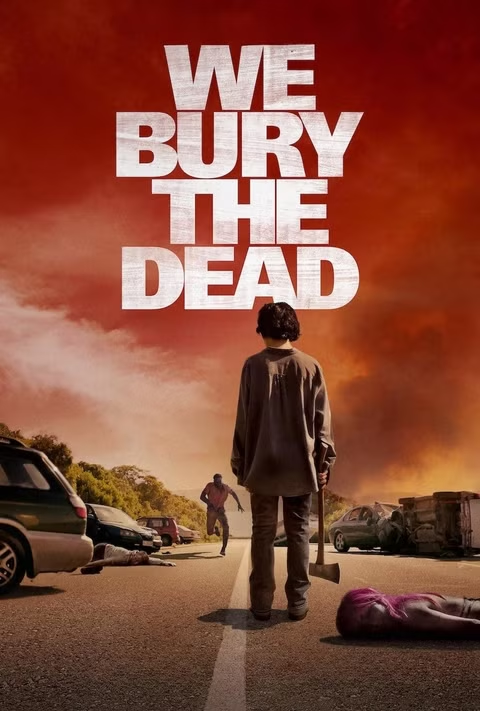
The zombie genre has seen a resurgence in recent times, thanks to The Walking Dead, The Last of Us, and Danny Boyle’s 28 Days Later, among others. There is an odd satisfaction in watching a protagonist go up against a horde of brain-eating creatures and coming out on top. With many filmmakers riding the wave with their own spin, fans are spoiled for choice.
Star Wars icon Daisy Ridley’s latest film, We Bury the Dead, tackles zombies but also brings in the psychological thriller angle and empathy that make it stand out. We follow Ava (Ridley), who joins a body-retrieval unit while grappling with personal grief to search for her husband after a US military weapon accidentally triggers a disaster in Tasmania, turning the deceased into violent, reanimated, undead “shamblers”. While most people will think of high-octane action, the Zak Hilditch-directed film provides a slow-burning drama wrapped in themes of grief and closure. The film also sees zombies in a more empathetic light, like 28 Years Later: The Bone Temple, as they are framed as once-loved human beings. However, it has divided audiences as seen in its Rotten Tomatoes score: 88% from critics and 46% from audiences.
The feature is a decent watch, already making waves on PVOD, with Ridley’s performanceuniversally appreciated. The movie also cast Brenton Thwaites as Clay, Mark Coles Smith as Riley, Kym Jackson as Lt. Wilkie, Matt Whelan as Mitch, Chloe Hurst as Katie, Deanna Cooney as Bianca, Salme Geransar as Private Clarkson, and many others. For fans who’d like to check out the film, it’s a good time. We Bury the Dead is finally coming to Hulu on May 8. Furthermore, it will also be released on 4K UHD and Blu-ray on July 8.
Where Will We See Daisy Ridley Next?
Ridley is well known for playing Rey in Star Wars, and her return to the franchise is imminent in a standalone movie. While the updates are far and few, she previously teased, “I think the story will be wonderful. I think the wait will be worthwhile. I think it will be a discovery, as all roles are, of where Rey is when we meet her again.” Further, she’ll also be seen in Ti West’s Ebenezer: A Christmas Carol, where she’ll share the screen with Johnny Depp, Sam Claflin, and more. Then there is Stelana Kliris’ Me vs. Me, Pierre Morel’s The Good Samaritan, which also stars Josh Duhamel and Sharlto Copley.
Meanwhile, check out We Bury the Dead when it drops on Hulu on May 8. Stay tuned to Collider for more updates.

- Release Date
-
January 2, 2026
- Runtime
-
95 minutes
- Director
-
Zak Hilditch
- Writers
-
Zak Hilditch
- Producers
-
Grant Sputore, Joshua Harris, Kelvin Munro, Mark Fasano, Ross M. Dinerstein

2026 kicked off strongly for young adult book-to-screen adaptations with the release of Finding Her Edge on Netflix earlier in January. Now, nearly five months into the year, fans are eagerly anticipating several more releases, with the most high-profile being The Hunger Games: Sunrise on the Reaping, which is slated to hit theaters this November. Another equally exciting title—arguably Netflix’s most anticipated YA adaptation of the year — is the final Heartstopper movie, which has now officially received a premiere date.
Titled Heartstopper Forever, the coming-of-age movie is a feature-length finale to the Netflix hit rather than a fourth season. Heartstopper Forever is directed by Wash Westmoreland and written by Alice Oseman, who created the near-perfect teen series, which premiered in 2022. The film is an adaptation of the sixth volume of Oseman’s Heartstopper graphic novel series, which follows Nick Nelson (Kit Connor) and Charlie Spring (Joe Locke), two teenagers whose friendship at Truham Grammar School develops into a romantic relationship.
Heartstopper last aired in October 2024, when all of its Season 3 episodes were released. Now, nearly two years later, fans will finally see Nick and Charlie’s love story come to a close—hopefully on a satisfying note. With that said, Heartstopper Forever is set to premiere on Netflix on July 17, 2026. Alongside the release date announcement, the streamer shared a short video compilation highlighting the cast’s journey throughout the seasons. Kit Connor and Joe Locke will reprise their roles as Nick and Charlie, while also serving as executive producers on the film. William Gao, Yasmin Finney, Corinna Brown, Kizzy Edgell, Tobie Donovan, Jenny Walser, Rhea Norwood, and Leila Khan also star.
Will ‘Heartsopper’ End on a Satisfying Note?
Heartstopper Forever will pick up directly from the Season 3 finale, which saw the lead couple – like some of their friends – take the relationship to a new level. As teased in the film’s synopsis, Nick and Charlie are inseparable. Still, as Nick prepares to leave for university and Charlie finds new independence at school, the reality of a long-distance relationship begins to weigh on them. Doubts take hold, and their relationship faces its biggest challenge yet. Meanwhile, their friends are also navigating the ups and downs of love and friendship, confronting the bittersweet challenges of growing up and moving on. Can first loves really last forever?
The final Heartstopper entry arrives on Netflix this summer.

- Release Date
-
2022 – 2024-00-00
- Showrunner
-
Alice Oseman
- Directors
-
euros lyn, Andy Newbery
- Writers
-
Alice Oseman
Entertainment
31 sloths allegedly died ahead of Orlando Sloth World attraction's grand opening: FWC report
:max_bytes(150000):strip_icc():format(jpeg)/Sloth-World-Two-toed-sloth-042326-aa1cb3dc5d0d4df3af673770cf63c221.jpg)
“Every visit to Sloth World plays a big role in supporting responsible sloth care,” the upcoming attraction’s website reads.
Universal love is one of the hardest things a movie can earn, because audiences are cruel in ways history quietly records. They get tired of hype. They punish sentiment if it feels false. They punish seriousness if it feels stiff. They punish popularity just because too many people agreed. It’s ridiculous how much a movie has to survive to navigate every one of those reactions and still keep people coming back with a real feeling in their chest.
Weirdly though, that is what these films did. They stopped being hits or classics and became shared emotional property. People quote them to each other. Hand them to their children. Revisit them in bad years and good years. Keep arguing about them because the argument itself is part of loving them.
8
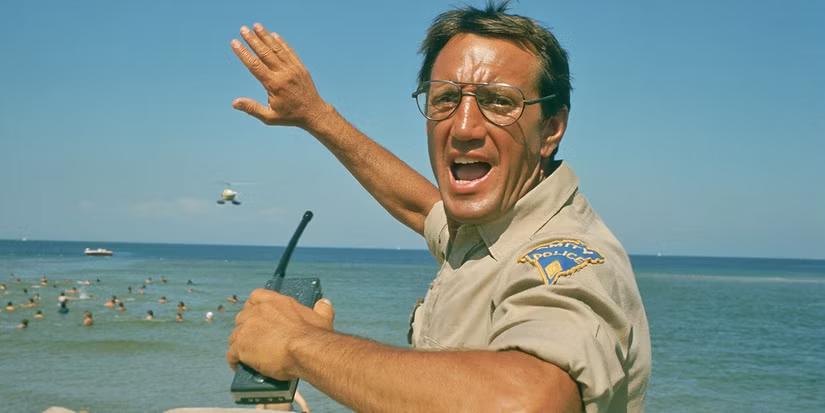
‘Jaws’ (1975)

People love Jaws because it works on every level at once, and the levels keep feeding each other. The shark is terrifying. Amity’s denial politics are infuriating. Brody (Roy Scheider) is deeply human in that exact American way where duty arrives before confidence does. He is a police chief who hates the water, which is already such a perfect pressure point, and the movie keeps twisting it. He knows something is wrong after Chrissie Watkins (Susan Backlinie)’s death. He gets overruled. Then Alex Kintner (Jeffrey Voorhees) dies, and the movie crosses a line it never uncrosses. At that point the shark is no longer just the threat but the thing exposing everyone’s cowardice, ego, or seriousness.
Then the film gives us Quint (Robert Shaw) and Hooper (Richard Dreyfuss) and suddenly it becomes even bigger. Quint has trauma in his bones. Hooper has expertise and curiosity and enough class privilege to irritate Quint into full mythic grump-sage mode. Brody is stuck between them while trying to keep this whole thing from becoming one more body count attached to his name. That is why the Orca section is so beloved. It is not just men hunting a shark. It is three different relationships to fear locked on a boat with no exit. By the time Quint tells the Indianapolis story, Jaws has already become part monster movie, part character piece, part American fable about people waiting too long to admit danger is real. That is serious movie alchemy.
7
‘Singin’ in the Rain’ (1952)

This movie is beloved because it makes joy feel earned, and that matters more than people admit. Pure charm can get old. Precision never does. Singin’ in the Rain has absurd precision. The whole silent-to-sound transition is sure a clever setup for jokes about bad diction and industry panic but also the pressure cooker that reveals everyone. Don Lockwood (Gene Kelly) gets to stop performing one version of himself and move toward another. Kathy Selden (Debbie Reynolds) gets to prove that the talent buried under male vanity and studio packaging is the real engine of the story. Lina Lamont (Jean Hagen) becomes one of the funniest comic disasters in American film because the movie understands a brutal truth about old Hollywood: one new technology can turn a star into a problem overnight.
And then there is the movement of the thing. “Good Morning” is famous because it is delightful, sure, but it is also story rhythm disguised as euphoria. The title sequence — Don has finally crossed from romantic misery into emotional release, and the rain becomes permission. The ending works because the movie has built toward a beautiful public correction: Kathy gets seen. Lina gets exposed. Don gets honest. People love Singin’ in the Rain because it is dazzling without ever losing contact with effort, embarrassment, ambition, and relief.
6
‘The Wizard of Oz’ (1939)

This movie has universal love because The Wizard of Oz understands homesickness and longing at the same time, and that is a deeper trick than it first appears. It’s not just a masterpiece for kids either for the same reason. Dorothy (Judy Garland) wants more before she wants to go home. That is why the movie lasts. She begins with emotional appetite and innocence. Kansas feels small, gray, and emotionally unrewarding. Then Oz arrives and gives her everything the imagination could want: color, danger, novelty, companions, impossible roads, glittering cities, witches with personal vendettas. The movie is smart enough to make that dream intoxicating before it teaches her what home actually means.
And the companions are why the film gets people forever. The Scarecrow (Ray Bolger) wants brains, the Tin Man (Jack Haley) wants a heart, the Lion (Bert Lahr) wants courage, and every child understands those desires instantly while every adult eventually realizes they never stopped wanting the same things. The Wicked Witch of the West (Margaret Hamilton) gives the movie real danger, the Wizard (Frank Morgan) gives it the great American disappointment of spectacle covering ordinariness, and the ending gives you one of the great emotional reversals in popular cinema: the place she wanted to escape turns out to be the place already carrying the love she needed. That would be sentimental mush in a lesser movie. Here it lands like truth because the journey was vivid enough to make the return mean something.
5
‘It’s a Wonderful Life’ (1946)

People love It’s a Wonderful Life because George Bailey (James Stewart) hurts. That is the center of it. He hurts in the way decent people hurt when their lives become a long chain of necessary self-denials that everyone else benefits from and almost nobody fully sees. George Bailey is bright, energetic, ambitious, funny, romantic, and absolutely alive as a young man. He wants travel, scale, architecture, movement, escape from Bedford Falls. Then duty keeps calling his number. His father dies. The Building and Loan needs him. The town needs him. The family needs him. Mary Hatch Bailey (Donna Reed) loves him enough to build a real life with him, and even that love becomes part of the trap because it gives him something beautiful he can’t abandon without becoming someone else.
When the money goes missing, it isn’t just a plot crisis. It is the final insult to a man who has already given away too much of himself while trying to remain grateful and decent. Clarence (Henry Travers) matters because the film has already built George’s emotional case against his own life with terrifying thoroughness. Then the alternate Bedford Falls sequence arrives and the whole movie turns its knife: this is what your goodness prevented; this is what your presence meant; this is how many people were living inside your life without your permission. The ending still destroys people because it gives George recognition at the precise second he had lost the ability to recognize himself.
4
‘Casablanca’ (1942)

Casablanca understands adult sacrifice better than most movies with twice the runtime and ten times the self-importance. The film follows Rick Blaine (Humphrey Bogart)’s café. It contains everything already: refugees, opportunists, Nazis, gamblers, broken lovers, patriots, cynics pretending not to care, idealists running out of time. Rick stands in the middle of all of it performing detachment, and Bogart plays him like a man who got good at emotional self-containment because the alternative nearly killed him once already. Then Ilsa Lund (Ingrid Bergman) walks in, and the whole movie catches fire without ever raising its voice too much.
Then there’s a Paris flashback. It is crucial because it gives the romance real innocence before history poisons it. Suddenly Rick’s bitterness makes sense. Ilsa’s hesitation makes sense. Victor Laszlo (Paul Henreid) stops being a plot obstacle and becomes the reason the movie has moral scale. Everybody wants something emotionally justifiable, which is why the film stays so alive. Then “La Marseillaise” happens. The ending remains immortal because Rick chooses with pain. He gives up the woman he loves because the world is on fire and love alone is not the whole story. That hurts every time and maybe that is why people keep loving it.
3
‘The Godfather’ (1972)

People love The Godfather with a kind of reverence that would crush a lesser film. This one survives it because the movie is alive from the inside out. It has lessons projecting far beyond a film or a fictional story. The wedding at the beginning already contains the whole system: joy, obligation, business, family, status, threat, old-country ritual, modern ambition, and the fact that love in this world is always standing next to power. Vito Corleone (Marlon Brando) is unforgettable. He can grant favor like a king and talk to a frightened undertaker like an uncle. That complexity is all over the film.
And then there is Michael. That is the tragedy that keeps people obsessed. Michael Corleone (Al Pacino) begins at a distance from the family story. He has Kay Adams (Diane Keaton), the war record, the clean suit, the confidence of a man who believes he can remain adjacent to history without being absorbed by it. Then Sollozzo (Al Lettieri) and Captain McCluskey (Sterling Hayden) force the issue, and from the hospital scene onward The Godfather becomes a slow, horrifying coronation. The scenes in Sicily change Michael. It lets us see what kind of life he might have had. Sonny Corleone (James Caan)’s death matters because the family is now being stripped toward inevitability. The baptism montage, the return, the revenge, it all works because it reveals how completely he chose the loss. That level of tragic design is why people don’t just admire this movie. They carry it with them. They learn and utilize it like power.
2
‘Star Wars’ (1977)

Image via Twentieth Century-Fox
People love Star Wars because it gives them story oxygen. It moves with the force of myth told by somebody who loves speed, humor, danger, and clean emotional stakes. Luke Skywalker (Mark Hamill) staring at the twin suns condenses an entire feeling into one shot: wanting life to begin somewhere larger than where you are. Then the movie starts feeding that desire exactly what it needs. Leia Organa (Carrie Fisher) is instantly under pressure. The droids crash into a hostile world. Ben Kenobi (Alec Guinness) arrives carrying sadness and history in his voice. Han Solo (Harrison Ford) gives the story a vibe, selfishness, and the possibility that charm can become courage if pushed hard enough.
Then Darth Vader (David Prowse) enters and the whole galaxy gets a face for fear. And the beauty of the film is how cleanly it expands. Mos Eisley, the Death Star, rescue, escape, sacrifice, and rebellion all locking together. It keeps getting better. Obi-Wan’s death matters because it hands Luke grief and destiny at once. Han’s return matters because the film has made selfishness emotionally legible enough that his choice to come back actually means something. The trench run still gives audiences a pulse spike because it turns everything simple and sacred: belief, timing, friendship, risk. That purity is why people keep loving it.
1
‘The Shawshank Redemption’ (1994)

This is number one because people love The Shawshank Redemption in a way that almost transcends genre. Prison drama, friendship story, institutional critique, escape film, spiritual endurance narrative, it lives in all those categories and somehow feels bigger than all of them. Andy Dufresne (Tim Robbins) enters Shawshank carrying intelligence, grief, and a deep stillness that everyone around him initially misreads. Red (Morgan Freeman) becomes the film’s genius move because he gives the audience a witness who can slowly understand Andy the way the prison does not. Their friendship is what turns the whole movie into something beloved rather than merely impressive. We watch one man endure through another man’s eyes, and that point of view is everything.
The details matter so much. Andy asking for Rita Hayworth and the rock hammer. The rooftop beers. Brooks Hatlen (James Whitmore) and the crow and the unbearable ache of a man who cannot survive freedom after institutionalization has rewritten him. The library. The Mozart scene. Tommy Williams (Gil Bellows). Warden Norton (Bob Gunton)’s corruption hardening into panic once Andy stops being useful and starts being dangerous. Then the escape comes, and it lands with such force because the movie has made patience emotional. Every year mattered. Every humiliation mattered. Every inch of tunnel mattered. And then Red reaches the beach, and the movie gives people the ending they most desperately want from cinema: earned grace. One of the greatest films of all time, easily.

The Shawshank Redemption
- Release Date
-
September 23, 1994
- Runtime
-
142 minutes
- Director
-
Frank Darabont
- Writers
-
Frank Darabont
Entertainment
Snooki says “Jersey Shore” cast plans to film show 'until we're in a nursing home': 'It's not over for us'
:max_bytes(150000):strip_icc():format(jpeg)/O-G-Jersey-Shore-d4926de1d5724285b528013c7c7feb16.jpg)
MTV has announced a final season for “Jersey Shore: Family Vacation,” but the cast is determined to keep the party going.
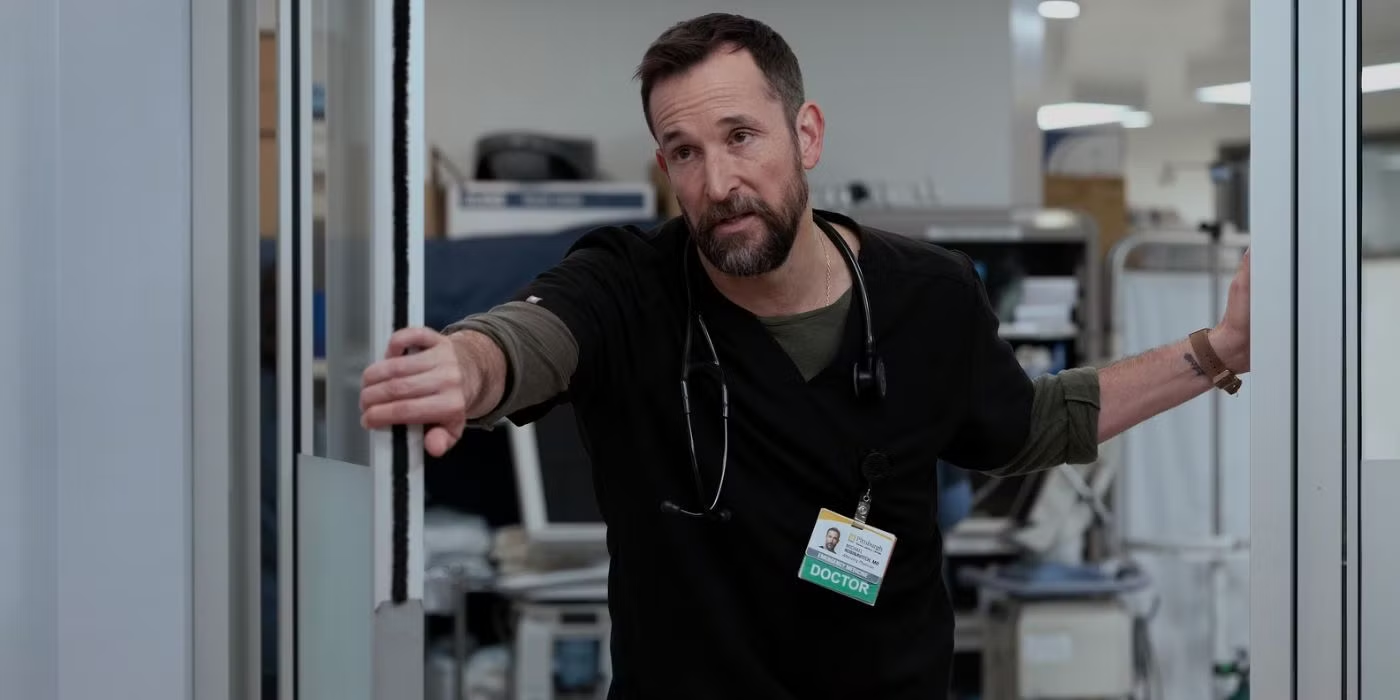
After 15 weeks of nail-biting cases, heart-wrenching moments, and gnarly injuries, The Pitt Season 2 has come to a close. Across just 30 total episodes, the HBO Max hit has revitalized the medical procedural genre and turned its cast into A-list stars. Leading the charge is Dr. Robby actor Noah Wyle, who previously starred in shows like Falling Skies and the iconic medical drama ER. The Pitt earned the actor renewed attention, critical acclaim, and a great deal of awards, including an Emmy for his performance.
Season 2 pushed Robby to the brink, tracking his fraying mental and emotional state over the course of one hectic, deeply stressful Fourth of July shift. Wyle never wavered in his portrayal, giving an unflinching look at a man steadily losing his will to survive. It’s a blistering, incredible performance, but it can understandably leave viewers wrung out by the end of an episode, not to mention the entire season. Interestingly, though, Wyle gave a very different performance on another streaming show around the same time that The Pitt Season 1 was exploding in popularity, and it’s a wild thing to watch after Robby’s grueling day. Now that Season 2 has finished airing, Wyle fans should wind down with Prime Video’s Leverage: Redemption.
‘Leverage: Redemption’ Is the Ideal Escapist Show for Right Now
Serving as a revival of the fan-favorite TNT series Leverage, the series premiered on Amazon Freevee in 2021 and adopted its predecessor’s premise of a group of criminals using their very specific skills — grifting, hacking, thieving — to con horrible people and protect the little guy. It brought back original stars Gina Bellman, Christian Kane, and Beth Riesgraf, while Aldis Hodge returned in a recurring capacity. Wyle was one of two newcomers to the central team — along with Aleyse Shannon — and played Harry Wilson, a corporate lawyer seeking redemption for his years of assisting white-collar criminals.
Leverage: Redemption is a gift to the fans of the original series, exploring timely new cases while including plenty of callbacks to the TNT show. At the same time, it’s very accessible to newcomers. While the first episode especially assumes viewers are up-to-date on the main characters’ relationships from Leverage, it’s also easy to pick things up and come along for the ride without the deeper context. The chemistry between Sophie (Bellman), Eliot (Kane), Parker (Riesgraf), and Hardison (Hodge) is just as heartwarming and compelling as it was before, making the Leverage crew the very definition of found family.
Redemption is also the perfect show for this exact moment in time. Every day brings more headlines about injustices being perpetrated across the globe, yet there often isn’t any kind of positive resolution. Leverage: Redemption imagines a reality where good, honorable people take down corrupt politicians, unethical billionaires, and, in something of a thematic connection to The Pitt, broken healthcare systems. There’s nothing more satisfying than watching these characters go from targeting tech developers preying on people’s privacy to dismantling parasitic pyramid schemes. It does prove to be a concept that requires a significant suspension of disbelief, particularly when the overall tone verges into campy, but it’s an escapist blast all the same.
Noah Wyle’s ‘Leverage: Redemption’ Performance Shows a Different Side of the Dr. Robby Actor
If The Pitt is Wyle at the peak of his dramatic talents, Leverage: Redemption shows what he can do with over-the-top comedy. Prior to the start of the series, Harry is the very person the Leverage team would typically target, but his change of heart makes him eager to join them, even though he has no experience conning people whatsoever. This gives Wyle ample opportunity to explore his funny side as Harry bumbles his way through heists, assumes new personalities (including a brief, meta stint as a doctor), and fights to save the day with his newfound friends.
Wyle’s performance, coupled with Leverage: Redemption‘s overall optimistic tone, makes it the perfect palate cleanser after The Pitt‘s emotionally heavy season. Every character could arguably lead their own crime comedy, but when they’re all together, they fit seamlessly. The series moved to Prime Video for its third season, which aired in 2025 just after The Pitt Season 1 came to a close. The service is also home to the original Leverage, setting up a good, sustained binge.
Unfortunately, Leverage: Redemption was canceled after three seasons, and at the time of this writing, it seems unlikely that it will be revived. Still, the series packed in a lot within the time it got, serving up several thrilling, entertaining cons that restore viewers’ faith in humanity. One gets the impression that the world would truly be a better place if the Leverage team were real. For anyone looking for wholesome, silly fun and a different side to The Pitt‘s Dr. Robby, Leverage: Redemption is a must-watch.
With covert operations, high-stakes missions, and amazingly thrilling characters navigating worlds built on secrecy and deception, spy television has long been an entertaining genre to swim through. While there exist many flashy hits that have dominated the spotlight over the years, there are also others that have been horribly overshadowed, despite offering compelling storytelling, depth, and fascinating tension. Over the course of many years, these overlooked spy shows have only grown more captivating and far more impactful today, despite their lack of audience.
Shows in the spy genre like the 2007 series The Company, which explores decades of CIA operations during the Cold War, and Sleeper Cell, which chooses to focus more on moral complexity rather than spectacle, are somehow two forgotten gems in the realm of spy television. Compiled on this list are shows that may have slipped from memory for many viewers, but have also only grown better with time.
‘Archer’ (2009–2023)
This bold adult animated series is definitely an unconventional approach to the spy genre. Archer follows the narcissistic spy Sterling Archer (H. Jon Benjamin), who works at a dysfunctional private spy agency where Lana Kane (Aisha Tyler), his mother Malory Archer (Jessica Walter), Cheryl Tunt (Judy Greer), and Cyril Figgis (Chris Parnell) turn every operation into a contest of vanity, competence, and personal sabotage.
With an entertaining mesh of absurd humor and espionage, Archer delivers a uniquely toned watch that remains fresh across multiple seasons. It’s a distinct spy show that has only grown more appreciated by its niche fanbase over time. Archer‘s writing is dense enough that it has survived repeat viewing by audiences, and because of its retro-modern visual design that still looks terrific, it stands as an underrated gem that has aged quite nicely over the years.
‘Alias’ (2001–2006)

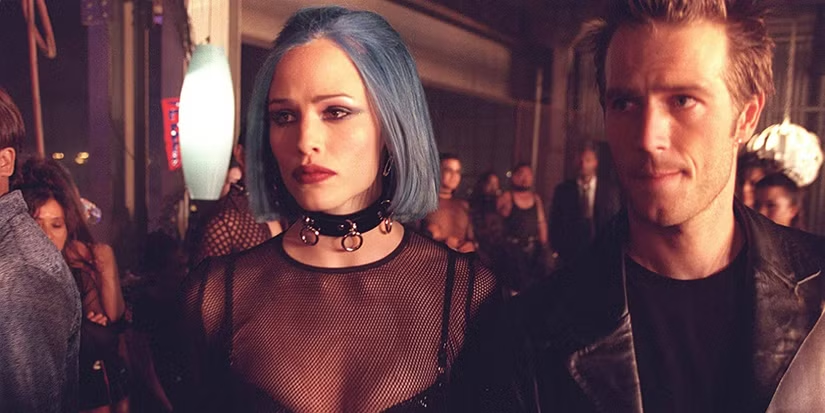
Alias offers audiences its merger of genuine emotional strain and costume-change caper energy that is still a blast to watch today. The series centers around Sydney Bristow (Jennifer Garner), who begins as what seems to be a young operative in a black-ops organization, only for her to learn that SD-6 is not a legitimate branch of the CIA at all.
Alias has aged so well over time due to its early seasons being ruthlessly engineered entertainment. From the father-daughter material that still lands, to Garner remaining a star-level center of gravity, and the show’s puzzle-box plotting that now reads less as an overcomplication and more as an early template for serialized genre television on American broadcast networks, Alias wields an enduring appeal. It’s a series whose storytelling laid the groundwork for many modern spy shows, and its mix of action and emotion makes it a defining entry that continues to hold up quite well.
‘Sleeper Cell’ (2005–2006)

This series may have had a short run, but it’s a sleeper hit that delivers a grounded and intense look at undercover counterterrorism. Sleeper Cell focuses on FBI agent Darwyn Al-Sayeed (Michael Ealy), who is sent undercover into a jihadist sleeper cell led by Farik (Oded Fehr), whose charisma and discipline make the infiltration morally and psychologically unstable from the start.
With its exploration of the complexities of infiltration, Sleeper Cell offers audiences a rather realistic tone. The show’s realism gives it a lot of weight that still resonates with viewers quite well. Sleeper Cell is a powerful and often overlooked spy drama that has aged very nicely due to its avoidance of chest-thumping patriotism, instead favoring a raw and nuanced portrayal of counterterrorism. The series wields a seriousness that is now even more valued today because it refuses to present a cartoon view of terror or counterterror. Sleeper Cell may be largely overlooked due to its short run and its specificity to a particular historical moment, but it is still considered a compellingly grounded take on the spy genre that continues to impress.
‘Covert Affairs’ (2010–2014)

Covert Affairs is a spy thriller that blends emotional stakes with globe-trotting missions. The spy series follows young CIA agent Annie Walker (Piper Perabo), who is pushed into CIA field work far faster than expected because of her analytic instincts, language skills, and connection to a high-priority target.
Covert Affairs ages so well because it is actually a lot smarter than its packaging suggests. The series may initially begin as a sleek young-agent procedural, but it takes a gradual turn as it dives into a more serialized story about burned assets, confidence games, and the heavy price of Annie’s increasing willingness to improvise outside formal approval. Despite its writing quietly maturing across its run, Covert Affairs remains pretty underappreciated. While the show is mostly forgotten, it does stand as a spy series that hosts a mix of espionage and character-driven storytelling, which allows it to be just as enjoyable as it was over a decade ago.
‘Patriot’ (2015–2018)

This uniquely offbeat approach to espionage with dark humor has definitely earned itself quite a cult following. Patriot focuses on non-official-cover intelligence officer, John Tavner (Michael Dorman), whose task sounds simple—stop Iranian nuclear funding by getting money from one place to another—but whose execution becomes a flood of false identities, bad improvisations, broken bones, and emotional collapse.
Patriot may not be as old as the other entries on this list, but over the years, since the show’s premiere, it has aged extremely well due to its originality—nothing else moves or sounds like it. From the ritual humiliation and the deadpan folk songs to the corporate camouflage, each small fix tends to often spiral into deeper moral consequences. Unfortunately, due to poor marketing, Patriot has gone mostly unnoticed and has never found its mainstream audience. The series is a uniquely layered and underappreciated espionage good time that has definitely earned its place on this list of finely aged gems.
‘Nikita’ (2010–2013)

Nikita is an action drama that is perfect for any enthusiast of spy thrillers, as it gifts audiences a reimagined story of a rogue operative seeking revenge. The series centers on the rogue escapee of the secret agency Division, Nikita (Maggie Q), as she wars against the organization.
With a strong female lead and action sequences that give it a lasting appeal, Nikita has aged really well over the years since its release, with its much cleaner and tougher story than its CW branding suggests. The show remains a solid example of character-driven espionage that wields legible action and strong emotional continuity. Nikita may have been filed away by reviewers as an all-early-2010s CW action show under disposable teen TV, leading it to go pretty much forgotten by any mainstream audience, but it still delivers intriguing characters, strong action, and an enduring charm.
‘The Little Drummer Girl’ (2018)

This immersive thriller offers audiences a slow-burn espionage story rooted in psychological tension. The Little Drummer Girl focuses on a young actress, Charlie (Florence Pugh), whose gift for performance makes her irresistible to an Israeli intelligence operation targeting a Palestinian militant network.
The Little Drummer Girl is a finely aged series, thanks to its visually and emotionally rigorous narrative. The show’s control of rhythm and image gives it tactile seductiveness that audiences still appreciate, but its true strength comes from the series’ moral architecture. The Little Drummer Girl has found itself trapped as a forgotten gem because of its rather finite miniseries format, which often disappears in the vast and fast-paced world of streaming. It may not be the most acknowledged series of today, but it definitely stands as a beautifully aged spy thrill ride.
‘The Company’ (2007)

The Company is an ambitious spy series that is constantly overlooked for the flashier hits in the genre. The TNT series follows three CIA operatives over the course of several years, tracing their careers from post–World War II Europe through the height of the Cold War.
The Company is a genuinely unique watch and remains so even now. It has aged so well over the years due to the easier granted acceptance of ambitious series. In the early 2000s, The Company came across as much too overstuffed to be truly entertaining. Today, even with a very minimal audience, the series is lauded as an underrated gem that offers audiences a historical scope as it delivers espionage elements through a broader lens than what is usually seen within the genre. The Company may not be the most watched spy series out there, but it’s a fantastically ambitious project that has aged quite nicely.
‘Spy’ (2011–2012)

This British spy drama offers audiences a comedic twist to the espionage genre. The 2011 series, Spy, centers around a failed salesman and struggling father, Tim Elliott (Darren Boyd), who believes he’s applying for a dull office job and instead gets recruited into MI5 training.
With comedy that makes its entirety genuinely charming, Spy delivers a refreshing break from traditional spy shows. The series reimagines the spy world through a lighthearted lens as an unlikely agent navigates absurd missions. Spy ages so well because the series’ comedy is rooted in character rather than mere outrageous parody. It has been largely forgotten since British sitcoms tend to vanish with alarming speed without endless streaming circulation and word-of-mouth worship. Spy is a fantastic counterexample to the idea that spy television has to be serious to be any good, making it an extraordinary watch for modern TV, despite it going mostly unnoticed today.

Entertainment
Mike Vrabel says he is working to be the 'best version of me,' as new pics of him canoodling with Dianna Russini emerge
:max_bytes(150000):strip_icc():format(jpeg)/Mike-Vrabel-press-conference-040826-9eaac3e67ef24b02a51929b9c3b1cca1.jpg)
The New England head coach addressed the media ahead of the NFL Draft.

Here’s a rundown of Us Weekly‘s top stories making headlines in celebrity news, sports and entertainment on April 22, 2026. Here are key takeaways:
• Vrabel-Russini photos: New photos published by Page Six appear to show New England Patriots head coach Mike Vrabel and former Athletic reporter Dianna Russini kissing at a New York City bar in March 2020. Vrabel, who announced he would miss the third day of the NFL Draft to attend counseling, said in a statement he was committed to being “the best husband, father and coach that I possibly can be.”


• Bachelorette season 22 update: Disney unscripted TV chief Rob Mills told Variety and Deadline the network is taking it “one day at a time” on whether Taylor Frankie Paul‘s shelved Bachelorette season will air. ABC pulled the season in March after footage of a 2023 domestic violence incident involving Paul surfaced, though the Salt Lake City District Attorney’s Office has since declined to press additional charges.
• Summer House relationship drama: Cast member Jesse Solomon said on a podcast he’s unsure whether costars West Wilson and Amanda Batula will last as a couple, adding, “I don’t think he’s ready for a relationship.” The pair confirmed they were dating last month, surprising castmates including Amanda’s estranged husband, Kyle Cooke.
Edited by Samantha Benitz. Story produced with AI assistance
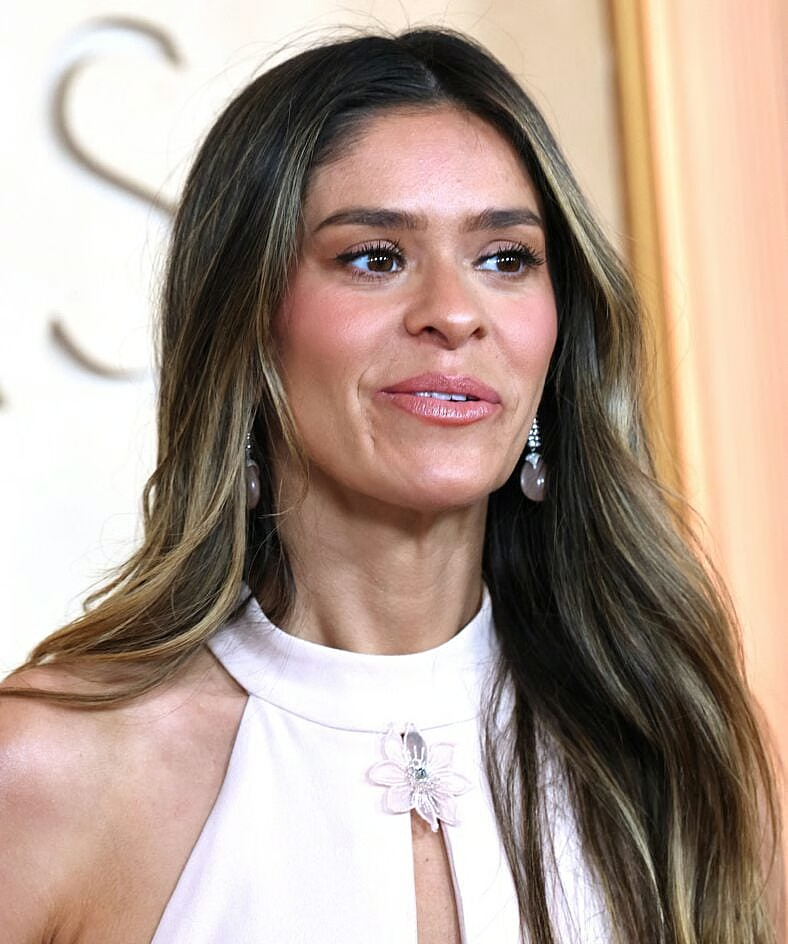
Taylor Frankie Paul is making a bold statement about the criticism regarding her social media usage in the aftermath of avoiding charges in a domestic violence incident with ex-boyfriend Dakota Mortensen.
Paul, whose viral popularity is the reason why she was tapped to star in Hulu’s “The Secret Lives of Mormon Wives,” has left fans shocked by deactivating both her Instagram and TikTok accounts.
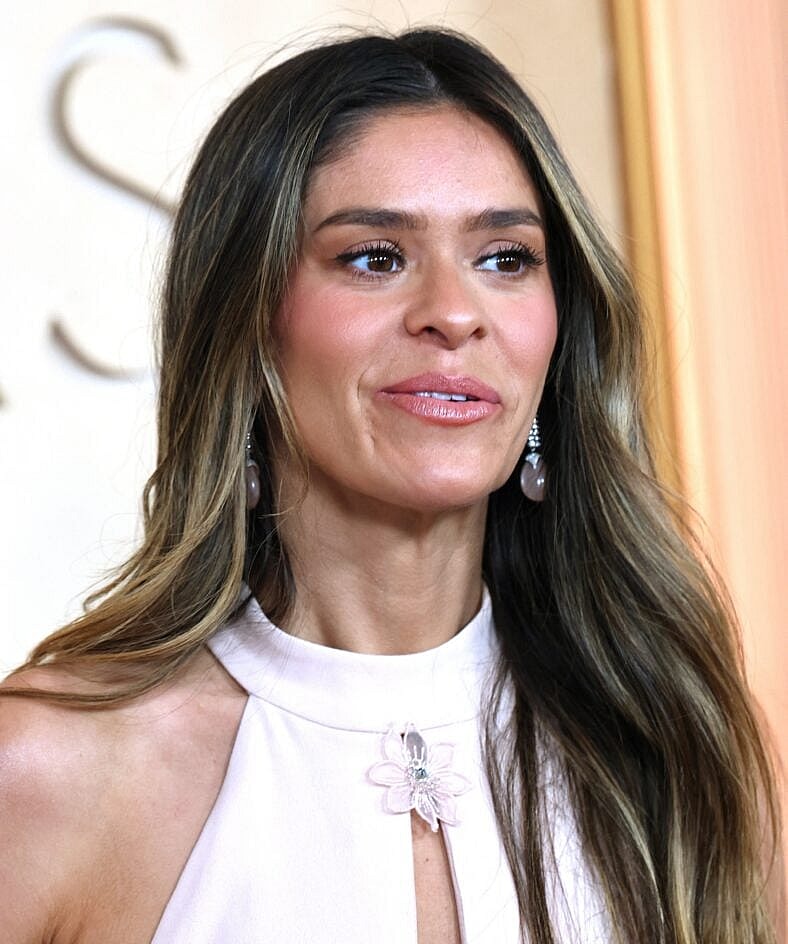
Fans realized on Thursday, April 23, that Paul deactivated her Instagram and TikTok accounts.
A source close to the MomTok founder told PEOPLE that Paul’s decision to deactivate her accounts is not permanent.
“Taylor is taking a breather,” the insider told the outlet. “It’s been a lot the last couple months to consume and [she] will be back shortly to continue sharing her story. She’ll decide when the time is right to return to filming on ‘Secret Lives.’”

“That sounds like the reasonable answer, however I will be doing the opposite,” she wrote in reply. “I’ll continue sharing on social media showing how ugly healing truly can be.”
Disney Addressed Future Of Paul’s ‘Bachelorette’ Season Airing

In an exclusive interview with Deadline, Disney’s reality television chief, Rob Mills, spoke about the possibility of Paul’s season of “The Bachelorette” airing at some point.
“The day all of that stuff happened, really our first sort of concern was really for Taylor and the family and everyone involved in that, it was really more on a human level,” he said.
“Now, we’re sort of taking it a day at a time,” Mills said, after “The Secret Lives of Mormon Wives” star avoided domestic violence charges. “I think her season is a wonderful season, by ‘Bachelor’ standards. If it gets seen, I’m sure people will absolutely enjoy it.”
There have been rumors that if Paul’s “Bachelorette” season doesn’t air on ABC, as it has since its inception, it could possibly stream on Hulu instead. However, neither option has been confirmed.
After The Reality Star Escaped Domestic Violence Charges, Prosecutors Explained Why

The office of Salt Lake City district attorney Sim Gill released a statement confirming that no charges against Paul would be filed, citing a lack of evidence and the statute of limitations as the reasons.
“After reviewing reports and evidence submitted to the Draper Police Department and West Jordan Police Department, the Salt Lake County District Attorney’s Office has declined to file charges against Taylor Frankie Paul,” the statement read, per Deadline.
“The complainant in these cases reported several incidents – some of which occurred more than three years ago,” the statement said. “Any incidents of misdemeanor offenses which are alleged to have occurred more than two years ago are barred by the statute of limitations. Incidents which are alleged to have occurred within the statute of limitations have also been reviewed.”
The DA’s statement continued, “Several incidents that were submitted do not rise to the level of criminal offenses. The remaining incidents lack sufficient evidence to support filing criminal charges where the State must be able to prove such allegations beyond a reasonable doubt. Such incidents lack specificity as to when and what actually occurred or corroboration.”
The Door Is Open For Taylor Frankie Paul’s ‘Mormon Wives’ Return

Per The Hollywood Reporter, the “Mormon Wives” production team is letting Paul take the lead on when (and in what capacity) she wants to return to the show.
An inside source close to the reality star also revealed to the outlet that production continues to remain supportive of Paul, and is ready to film with her at her own pace “if and when she is ready.”
Paul previously shut down claims from PEOPLE that the show would resume production without her, writing in the Instagram comments of the post, “Interesting, that’s not the call I got.”

Warren Buffett’s advice on what to invest in

Beverley Callard pulls out of I’m A Celeb’s final on medical advice | Lifestyle
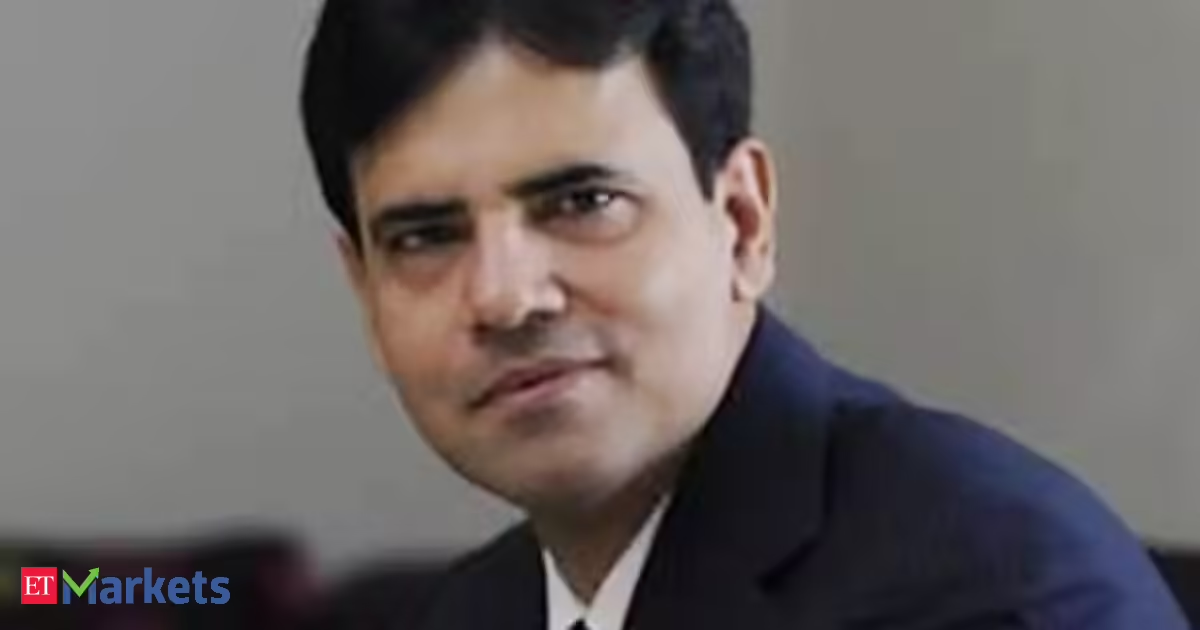
Sandip Sabharwal sees strength in financials, warns of IT sector headwinds

Manchester United reach agreement with Casemiro over contract clause amid transfer speculation

US brings back mandatory military draft registration

Steven Gerrard disagrees with Gary Neville over ‘shock’ Chelsea and Arsenal claim | Football
![LISA - 'MONEY' 2023 WORLD TOUR [BORN PINK] KYOCERA DOME OSAKA](https://wordupnews.com/wp-content/uploads/2026/02/1770253317_hqdefault-80x80.jpg)

-

 Sports7 days ago
NWFL Suspends Two Players Over Post-Match Clash in Ado-Ekiti
-

 Fashion7 days ago
Weekend Open Thread: Theodora Dress
-

 Politics6 days ago
Palestine barred from entering Canada for FIFA Congress
-
Entertainment4 days ago
NBA Analyst Charles Barkley Chimes in on Ice Spice McDonald’s Fiasco
-

 Tech5 days ago
Auto Enthusiast Scores Running Tesla Model 3 for Two Grand and Turns It Into Bare-Bones Go-Kart
-

 Business5 days ago
Powerball Result April 18, 2026: No Jackpot Winner in Powerball Draw: $75 Million Rolls Over
-

 Politics5 days ago
Zack Polanski demands ‘council homes not luxury flats for foreign investors’
-

 Crypto World6 days ago
Russia Pushes Bill to Criminalize Unregistered Crypto Services
-

 Politics3 days ago
Gary Stevenson delivers timely reminder to register to vote as deadline TODAY
-

 Business2 days ago
Rolls-Royce Voted UK’s Most Iconic Trade Mark as IPO Register Hits 150
-

 Politics2 days ago
Disabled people challenge government SEND proposals over segregation concerns
-

 Politics2 days ago
Making troops accountable for war crimes threatens US alliance, ex-SAS colonel warns
-

 Crypto World6 days ago
Russia Introduces Bill To Criminalize Unregistered Crypto Services
-

 Politics2 days ago
Starmer handler McSweeney to be dragged from shadows by Foreign Affairs Committee
-
Politics2 days ago
Wings Over Scotland | How To Get Away With Crimes
-

 Politics2 days ago
Zack Polanski responds to home secretary’s taser threat
-
 Crypto World5 days ago
Kelp DAO rsETH Bridge Hack Drains $292M as DeFi Losses Top $600M in Two Weeks
-

 Politics1 day ago
‘Iran is still a nuclear threat’
-

 Crypto World2 days ago
New York sues Coinbase, Gemini over prediction market offerings
-
 Sports7 days ago
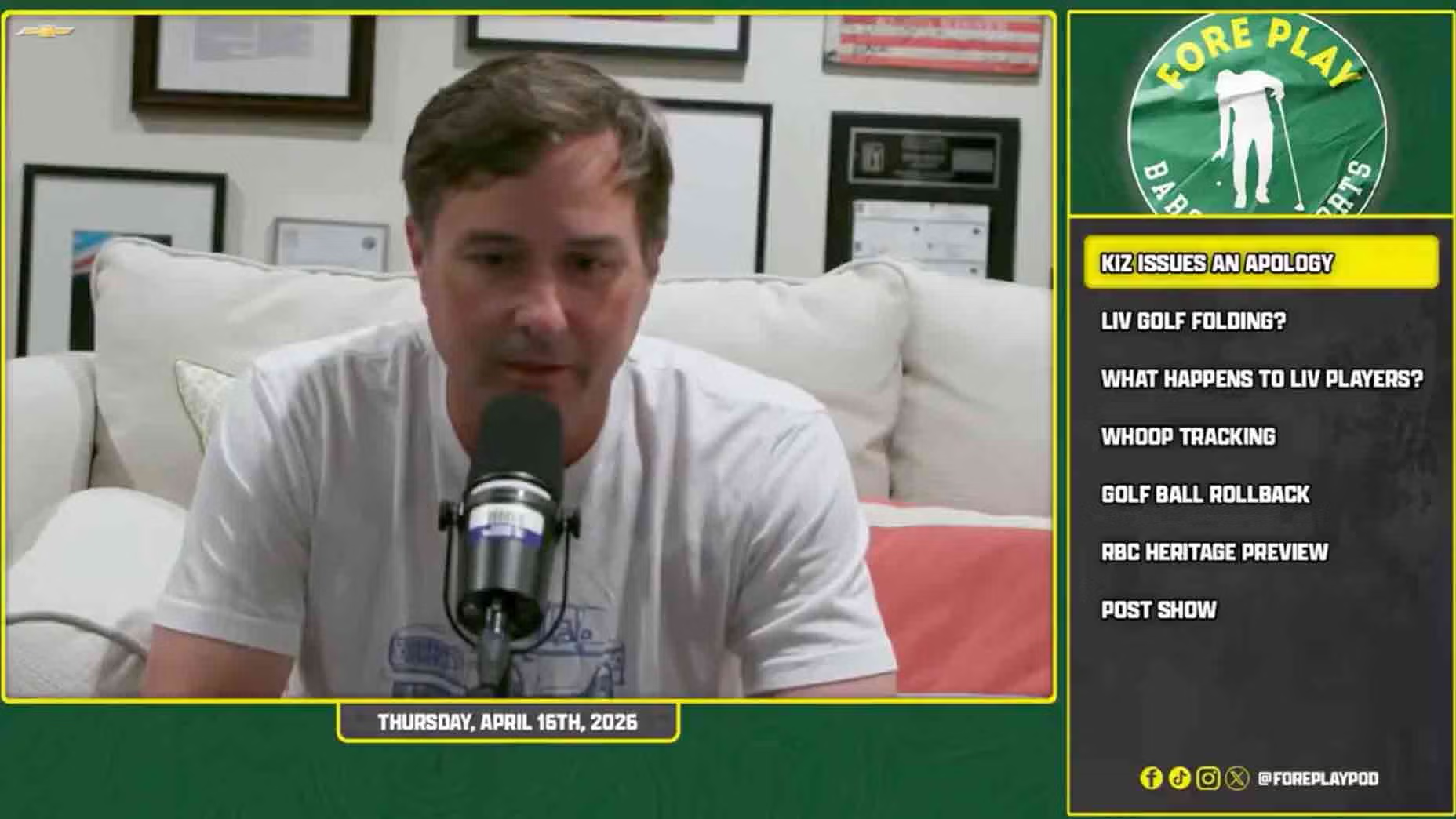
Kevin Kisner apologizes for Masters criticism: ‘I crossed the line’
You must be logged in to post a comment Login