
Entertainment
Eric Swalwell’s Accuser’s Husband Threatens Lawsuit

The husband of one of Eric Swalwell’s accusers has threatened legal action if the congressman “disparages” his wife, Ally Sammarco, amid multiple sexual assault and harassment allegations against the politician.
“I wish the best for his family, and I hope he gets the help he needs,” former DNC field director Adam Parkhomenko wrote via X early on Sunday, April 12. “If Eric Swalwell or his attorney makes a single statement that disparages my wife, I will be filing a lawsuit against him.”
Sammarco is among the four women who have accused Swalwell, 45, of sexual misconduct and sexual harassment — including a former staffer who claims the gubernatorial hopeful raped her.
Sammarco claimed in a Friday, April 10, CNN investigation that the politician previously offered to “share her resume” with other congressional offices before sending “very inappropriate” messages via Snapchat. (Sammarco claimed that Swalwell’s messages insinuated that the pair should “get together and hook up.”)

Congressman Eric Swalwell is facing sexual assault allegations from multiple women, a Manhattan District Attorney’s investigation and calls from top Democrats to end his campaign for California governor. Four women — including a former staffer who claims the politician raped her — accused Swalwell in April 2026 of sexual misconduct and harassment. Swalwell has categorically […]
“I’ve already made clear that if he believes anything I’ve said is untrue, he should sue me immediately,” Parkhomenko added on Sunday. “As he considers his next steps in the coming days, he should be very careful about what he chooses to say. He should also resign immediately.”
Us Weekly has reached out to Swalwell’s communications director for comment.
Swalwell, who was elected to represent California’s 14th district in the House of Representatives in 2023, is currently the frontrunner in the state’s race for governor. He has vehemently denied the accusations.
“These allegations of sexual assault are flat false. They are absolutely false. They did not happen,” Swalwell said in a Friday social media video, addressing the accusations. “They have never happened. And I will fight them with everything I have.”

Nancy Pelosi, Hakeem Jeffries and more prominent Democrats are reacting to claims Eric Swalwell, a Democratic congressman representing California’s 14th congressional district, sexually assaulted and harassed multiple women. “This extremely sensitive matter must be appropriately investigated with full transparency and accountability,” Pelosi said in a statement in response to the allegations. “As I discussed with […]
He continued, “They also come on the eve of an election, where I have been the frontrunner candidate for governor of California. I do not suggest to you in any way that I am perfect or that I’m a saint — I have certainly made mistakes in judgment in my past, but those mistakes are between me and my wife. And to her, I apologize deeply for putting her in this position.”
Swalwell has been married to Brittany Watts, with whom he shares three children, since 2016. Watts has not publicly addressed the scandal.


Parkhomenko, meanwhile, slammed Swalwell’s denial video after it was uploaded to social media.
“My wife’s name is Ally Sammarco. Obviously you know that, but she’s not named anonymous,” he tweeted on Friday. “She also went on the record with CNN, so that hopefully this does not happen to other women and maybe it would help other women come forward. … I’ve been very supportive of you over the years but even I learned a lot today. And she has my full support.”
If you or someone you know has been sexually assaulted, contact the National Sexual Assault Hotline at 1-800-656-HOPE (4673).

Continue Reading
Justin Bieber is not letting outside noise faze him after receiving mixed reviews for his 2026 Coachella set.
“This is Justin in 2026. He doesn’t have anyone pushing him to do these huge pop spectacles like a 3D concert movie anymore. It’s all about vibing and enjoying where he’s at now,” a source exclusively tells Us Weekly. “There’s a lot less pressure on him, which allows him to put on the show that he wants to.”
Bieber’s highly-anticipated Coachella performance on Saturday, April 11, primarily featured tracks from his Swag and Swag II album, but he also showed YouTube clips from his original music videos on his laptop to reminisce.
While the minimalist set received some criticism from fans, the insider tells Us that the now-viral clips from Bieber’s YouTube performances “were only a small part of a much larger set.”

Hailey Bieber remains her husband’s biggest fan. After Justin Bieber announced he will perform at the 2026 Coachella Valley Music & Arts Festival, multiple sources exclusively tell Us Weekly that his wife was the one to encourage him to book the gig. “Hailey was a big influence on Justin’s decision to headline Coachella,” one source […]
“He didn’t sit behind a computer the whole time,” the source explains. “Anyone who watched the full show saw that.”
The insider explains that Bieber’s YouTube segment was an “homage” to how the musician “got his start.”
“It was meant to show his journey from posting videos on YouTube to performing on one of the world’s biggest stages, also on YouTube,” the source shares. “Hailey [Bieber] thought it was adorable and very Justin. It was exactly what he planned and rehearsed.”
Us Weekly reached out to Bieber’s team for comment.

After Justin Bieber nearly bared it all on the 2026 Grammy Awards stage, he and wife Hailey Bieber opted for a wardrobe change. Justin, 31, topped the pink boxers he wore onstage Sunday, February 1, with a pair of low-slung, baggy denim jeans with an open, terrycloth hoodie. Hailey, 29, meanwhile, traded her strapless black […]
While performing, Justin, 32, made sure to give a shout-out to wife Hailey, 29, and the couple’s son, Jack. (The pair welcomed their first child in 2024.)
“Hailey, babe, hallelujah,” Justin sang while performing “Everything Hallelujah,” per social media footage. “Baby Jack, hallelujah.”
Hailey was seen blowing a kiss back to him and waving at Justin from the audience. Justin is scheduled to return to the main stage on Saturday, April 18, during the second weekend of Coachella.
Ahead of the singer’s duel performances, a separate source told Us that Bieber’s crew is “filming both weekends for a special project.” The news came after an unconfirmed Deuxmoi blind item reported that Justin was part of a documentary-style film with Netflix.
“Justin doesn’t feel he has something to prove, but at the same time, he wants to flex that he can put on a memorable show without a huge team like he once had,” the insider said of his Coachella set, referring to his 2023 split from longtime manager Scooter Braun. “It’s all his vision, brought to life by just a few people.”
Entertainment
When does “The Punisher: One Last Kill” come out? Inside Frank Castle's next blood-soaked rampage
:max_bytes(150000):strip_icc():format(jpeg)/Punisher-One-Last-Kill-Jon-Bernthal-041026-1da8d2516faa407d8399909b05221be3.jpg)
Jon Bernthal is back as the gun-touting vigilante in the gritty Disney+ special.
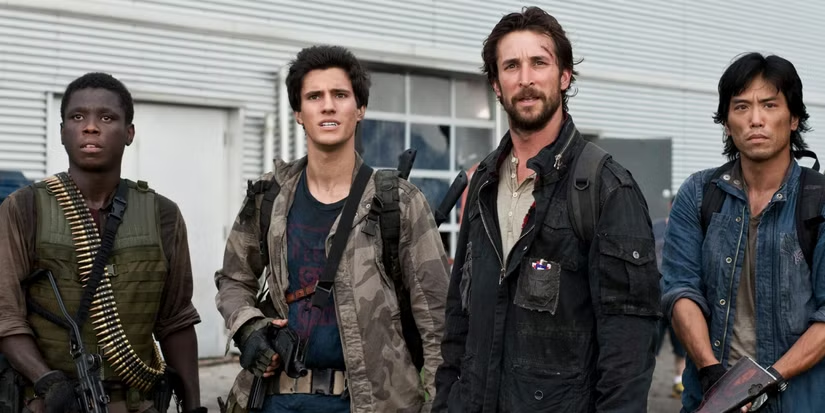
In 2011, for a short time, cable television produced a new science fiction show that attracted 5.9 million viewers on its first day. Falling Skies, which starts after the end of the world, was created by Robert Rodat and executive-produced by Steven Spielberg.
Those 5.9 million viewers didn’t happen by chance, but the show is rarely mentioned when the subject of defining sci-fi in the 2010s is concerned. The show faded from the spotlight, and it appears more than a little overdue for a second look.
What Happens in ‘Falling Skies’?

Falling Skies doesn’t provide us with the exciting invasion scenes that most other TV shows offer. The Earth has already been invaded, the worst has already happened, and most of the human race has perished or scattered apart from each other, struggling to survive. The format of that particular show sees us follow Tom Mason (Noah Wyle), who was once a history professor and now leads the civilian resistance group called 2nd Mass. He lacks the usual advantages of strength or firepower, but he wields the power of knowledge, which is limited by having to learn how to play the game of war again outside the old rules of warfare.
As this group continues to move around in their search for food and weapons, they always play cat and mouse with the aliens that are taking over the place. The show does a good job of showing the challenges of everyday survival during these bad days, including arguments over strategy, short supplies, and the quiet weight of people they’ve lost. It builds tension without overstating it. The alien threat adds another layer that hits harder than expected. Children are captured and fitted with biomechanical harnesses, turning them into extensions of the enemy.
Why ‘Falling Skies’ Deserved More Attention During Its Original Run

The first stretch leans on familiar ideas, and you can feel it searching for its voice; then it starts to settle. By the middle seasons, the writing tightens, and the characters begin to feel more defined. What helps is how the story opens up. When it comes to the invading aliens, a larger entity lies behind their presence on Earth — resource extraction, control, and a broader conflict that humans have been drawn into without understanding it. New factions appear, alliances shift, and the stakes grow without pulling attention away from the central group.
The genesis of the show depends on the continual balance between their being there and the ongoing success of maintaining their own being in a world that no longer functions as it once did. Wyle anchors that approach as his performance never tips into theatrics; he plays Tom as someone who’s exhausted but keeps moving forward anyway, which makes the leadership feel earned rather than assumed.
A lot of long-running genre series struggle to close things out. Falling Skies doesn’t stall when it reaches the end. The final season brings the larger conflict into focus, including the force behind the invasion itself. The story narrows in a way that works, pushing toward a direct confrontation rather than stretching the narrative beyond what it needs to. The resolution leans on sacrifice, and it doesn’t try to soften that. Characters pay for the choices they’ve made, and the outcome reflects the tone the show has carried from the start — hard-won, uneven, but still forward-moving. There’s a quieter moment at the end that lands just as well, when Tom is offered a leadership role in rebuilding what’s left of the world, and he turns it down. After everything, stepping away feels like the only honest choice.
Why ‘Falling Skies’ Is Worth Watching Now

That 5.9 million viewer premiere stands out more now than it did at the time. Back then, it made Falling Skies one of cable’s biggest launches of the year. The series benefited from weekly releases, which gave it time to grow and gave viewers space to stay engaged. Five seasons felt like a complete run, not an overextension like many shows these days.
These days, now that the show has been on Netflix, it is much easier to catch up with it if you haven’t seen it before. The pacing is consistent, you understand what happens, and once the show hits its stride, it moves with purpose so you don’t feel like you’re going around in circles. If you are watching for the sci-fi elements, those are all present — aliens, large-scale conflict, evolving mythos. Conversely, if you are watching because of the characters, they are all there, too. The show told a complete story from beginning to end and said goodbye when it reached its goal. Because of that, the show is far more impressive today than it was when it first aired on TV.

When the first movie is the great one, you can at least say the series began at its peak. When the last movie is the great one, you can argue the whole thing was building toward payoff. But when only the middle chapter becomes the masterpiece, it usually means the trilogy hit a level of confidence, emotional precision, and narrative intensity that the other two films never fully reached before or after. That middle film becomes the one time the machine is running at exact temperature.
And that does not always mean the other two are bad. Sometimes the first film is strong. Sometimes the finale is respectable, ambitious, or even moving in places. But the middle one is where character, stakes, conflict, and craft suddenly stop feeling like pieces of a franchise and start feeling inevitable. The middle-films I’ve listed below pass that test with excellent marks.
6
‘X2: X-Men United’ (2003)

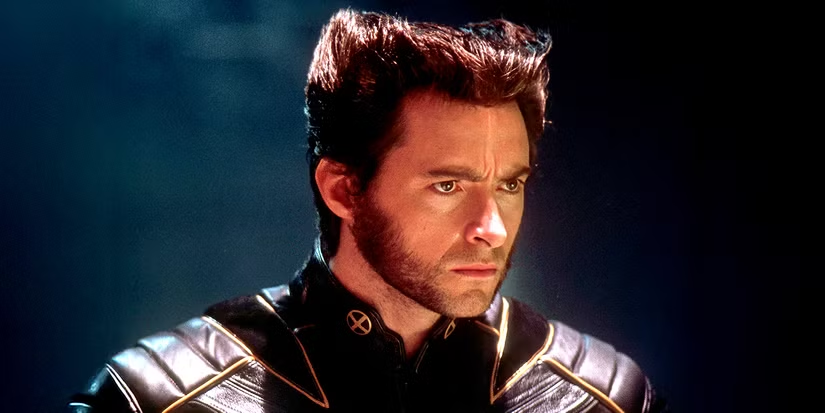
I have affection for the first X-Men, and I think The Last Stand has fragments of a much better movie trapped inside it, but X2: X-Men United is the one time that original trilogy truly feels complete. The reason is simple: it stops acting like the mutants are just a superhero team and starts treating them like a political, emotional, and biological crisis from every angle at once. The school attack alone tells you the movie has leveled up. Wolverine (Hugh Jackman) is not just the cool outsider anymore. He is suddenly in a position where the kids need him, and the mansion feels less like a comic-book base than a fragile refuge being violated.
The other reason why X2: X-Men United is extremely special is how well it spreads dramatic pressure across the whole cast. William Stryker (Brian Cox) being power-hungry, Magneto (Ian McKellen) gets to be dangerous, charismatic, and perversely right about how far humans will go, Mystique (Rebecca Romijn) becoming more than attitude and blue makeup, all of it is spot on. Then Jean Grey (Famke Janssen), Scott Summers (James Marsden), Storm (Halle Berry), Nightcrawler (Alan Cumming), Rogue (Anna Paquin), Pyro (Aaron Stanford), and Iceman (Shawn Ashmore) all feel like they belong to the same morally loaded story instead of separate subplots jostling for space. And then the film’s act with the uneasy alliance between Professor Xavier (Patrick Stewart)’s team and Magneto’s side is where X2: X-Men United really earns masterpiece status.
5
‘Dawn of the Planet of the Apes’ (2014)

I like Rise. I admire War. But Dawn of the Planet of the Apes is the masterpiece because it is the one that fully understands tragedy as a social process. It is not just a sequel about apes and humans clashing. It is a movie about trust being built slowly and then destroyed by fear, pride, grief, and opportunism. That is much richer material, and the movie handles it beautifully. What makes Dawn of the Planet of the Apes so devastating is Caesar (Andy Serkis). By this point, he is no longer simply the emotionally intelligent center of a franchise reboot but a leader carrying history in his body.
He remembers captivity. He remembers revolt. He has built a world for his people in the forest, a world with family, rules, and dignity. So when the humans arrive needing access to the dam, the whole movie immediately gains pressure because coexistence is possible, but only barely. That barely is where the film lives, and it is why every exchange matters. Malcolm (Jason Clarke) reaches for peace in good faith. Ellie (Keri Russell) sees the apes as beings, not obstacles. Dreyfus (Gary Oldman) wants survival badly enough that fear keeps turning into hardline logic. Koba (Toby Kebbell), most importantly, carries trauma like acid. And Koba is why Dawn of the Planet of the Apes becomes a masterpiece. He is the embodiment of what happens when memory of abuse never stops organizing your worldview.
4
‘Before Sunset’ (2004)

This one may be the quietest entry here, but emotionally it might be the most lethal. Before Sunrise is beautiful. Before Midnight is fearless and bruising. But Before Sunset is the masterpiece because it is the one that turns romantic possibility into emotional reckoning with almost unbearable precision. Nine years have passed, and Richard Linklater understands the most important thing about that gap: it is not just time. It is accumulated life. Failed relationships, compromises, self-invention, regret, the stories people tell themselves about why they didn’t choose differently, all of that is in the room before Jesse (Ethan Hawke) and Céline (Julie Delpy) even properly reconnect.
That is why Before Sunset is realistic. It runs on conversation, but the conversation is not casual. It is excavation. Every smile has history under it. Every joke is covering pain or testing intimacy. Jesse arrives with a novel that has obviously kept this one night alive inside him for almost a decade. Céline arrives with anger, intellect, charm, and that very particular kind of adult self-protection where someone can sound breezy while actually trying not to reopen a wound. Hawke and Delpy are so good here. The film lets attraction and disappointment coexist in every scene. It is not “do they still like each other?” Of course they do. The real question is whether recognition came too late to matter. At each stage they get less able to lie cleanly. The Paris sunlight almost makes the movie feel easy at first, which is cruel, because by the time Céline talks about the environmental work she throws herself into and Jesse starts revealing how dead his marriage feels, you understand what this movie is actually doing: measuring the damage of one missed chance.
3
‘The Empire Strikes Back’ (1980)

This is one of the clearest examples of the middle chapter outgrowing the trilogy around it. I love Star Wars. I think Return of the Jedi has real emotional payoff. But The Empire Strikes Back is the masterpiece because it takes everything the first film made mythic and then subjects it to difficulty, failure, and emotional complication without losing one ounce of adventure power. The brilliance starts immediately with Hoth. The rebellion is not triumphant and mobile anymore. It is freezing, cornered, improvising under pressure.
Luke Skywalker (Mark Hamill) gets pulled further into the Force, but the movie is careful not to make that growth clean or easy. Yoda (Frank Oz)’s training is not there to hand him cool powers. It is there to reveal impatience, fear, and incompleteness in him. Han Solo (Harrison Ford) and Leia Organa (Carrie Fisher), meanwhile, are getting one of the best romance-through-friction arcs ever put into a blockbuster. And then there is Darth Vader (David Prowse). This is the movie where he stops being a great villain design and becomes something much worse and better: a personal catastrophe. The film ends on pain, uncertainty, and separation. That is why The Empire Strikes Back remains untouchable.
2
‘The Dark Knight’ (2008)

The reason The Dark Knight towers over the trilogy is that it is the one chapter where the franchise stops being primarily about Batman and becomes about what Batman does to the moral chemistry of Gotham. Batman Begins is strong because it builds Bruce, fear, and the city. The Dark Knight Rises has ambition, but it buckles under the weight of its own ending. The Dark Knight is the one that feels like a total statement. Nothing in it is merely setup or cleanup. Everything is active pressure.
Batman (Christian Bale)’s existence has produced a new class of criminal response. Harvey Dent (Aaron Eckhart) is introduced not as a replacement hero in a simplistic sense, but as the legitimate public face Gotham desperately needs so Batman can imagine becoming unnecessary. Rachel Dawes (Maggie Gyllenhaal) sits in the middle of Bruce and Harvey not just as romance, but as a measure of which version of Gotham still feels possible. Then the Joker (Heath Ledger) comes in and does not simply threaten lives. He attacks the terms by which the city understands order, heroism, and moral choice. That is why the major sequences all matter beyond spectacle. The bank robbery, fundraiser, interrogation scene, and then Batman taking the blame at the end is the final proof that this chapter understood sacrifice at the level of myth and politics at once.
1
‘The Good, the Bad and the Ugly’ (1966)

This is #1 because it does something very few middle chapters ever do: it becomes so monumental that it practically rewrites the scale of the trilogy around it. A Fistful of Dollars is great. For a Few Dollars More is excellent. But The Good, the Bad and the Ugly is the masterpiece because Sergio Leone stops making just westerns and starts making a world. Bigger, dirtier, more ironic, more tragic, more expansive, more musically mythic. It feels like the trilogy suddenly realizing how enormous it can be. The thing people undersell is how well The Good, the Bad and the Ugly is written. Blondie (Clint Eastwood), Tuco (Eli Wallach), and Angel Eyes (Lee Van Cleef) are not just types.
Their motives are incredibly clean, and the movie keeps tightening the lines between them until the whole treasure hunt becomes a study in greed, dependency, humiliation, and tactical patience. Tuco is a huge part of why the film clears the others. Wallach gives him so much hunger, resentment, cunning, and wounded pride that the movie stops being a cool-guy western whenever he is on screen. He makes it human and ugly in the right way. Blondie is brilliant too — someone always slightly withholding moral clarity, which keeps the film from becoming simple hero mythology. And Angel Eyes is one of the great western villains. Then the Civil War material enters and The Good, the Bad and the Ugly becomes even richer. Not to mention that it had a perfect ending too.
The Real Housewives of Atlanta’s Drew Sidora has publicly addressed a court order that instructed her to vacate the home she shares with estranged husband Ralph Pittman.
According to court documents obtained by TMZ on Friday, April 10, Sidora, 40, was ordered to vacate the former couple’s marital residence in Georgia “by May 31.” The outlet also reported that Sidora and Pittman, 43, “will share joint legal custody” of their two children: son Machai, 10, and daughter Anija, 8. (Sidora is also mom to son Josiah, 15, from a previous relationship.)
Sidora addressed the legal situation via an X statement on Sunday, April 12. “Good morning. Some details regarding my divorce have recently become public, although the process is not yet finalized. During this time, Ralph and I are committed to co-parenting and doing what’s best for our children,” she wrote. “While certain things are beyond my control, my focus remains on showing up every day as the best mother I can be.”
Her statement continued, “Living in the public eye comes with challenges, but I’m choosing to move forward with grace, growth, and intention. My children are my priority, and I’m committed to leading with love, peace, and positivity. There is no ill intent toward anyone, just a continued focus on healing, evolving, and becoming the best version of myself.”

Drew Sidora is keeping it real when it comes to her divorce from her estranged husband Ralph Pittman. “It’s still not settled and yes, we’re still living together under the same roof,” Sidora, 39, told People in an interview published Friday, July 19. The Real Housewives of Atlanta star went on to share that her […]
Us Weekly has reached out to a representative for Sidora for comment.
TMZ also noted that a judge said “due to the current financial circumstance of the parties,” Sidora will “continue splitting the expenses” until she “leaves the home.”
Sidora, who joined RHOA in 2020’s season 13, told Us Weekly in November 2025 that despite Pittman filing for divorce from her after eight years of marriage in February 2023, he remained living in the basement. (Sidora filed her own divorce petition after Pittman’s was filed, and the pair have been going back and forth in court for months amid accusations spanning alleged infidelity and unpaid loans.)

Hours after their split news broke, Drew Sidora and Ralph Pittman’s divorce is already getting messy. The Real Housewives of Atlanta star accused her estranged husband of cheating and abuse in new court documents. TMZ obtained the Bravo star’s amended divorce complaint on Wednesday, March 1. In the paperwork, Sidora states that she cannot take […]
“Him downstairs, still there, and we’re still going through the process,” Sidora told Us at BravoCon 2025. “I was actually supposed to be in my final trial today, so this has been a very difficult, challenging day, but the judge allowed me to be here because it was so important for me to show up and be here. So I’m grateful.”
A representative for Sidora told TMZ on Friday, “This matter is still being actively litigated, and is in the middle of the final trial. The Second Temporary Order is, in fact, temporary, and does not reflect the final outcome of the case.”
For years, animation was considered a cinematic genre aimed at entertaining children, while adults mostly endured it. That notion can’t be further from the truth, though. Through the work of visionaries like Hayao Miyazaki, Guillermo del Toro, and the late Satoshi Kon, animation is seen as a proper medium nowadays, perfect for exploring daring and imaginative storylines with endless possibilities. Animation is the place where true dreams are realized, allowing for far more creativity than a live-action picture.
We’re halfway through the 2020s, but the decade has already produced a few animated efforts that have defied all expectations and proven themselves absolute masterworks of the medium. Whether they’re surreal fantasy tales, reinventions of the classic fairy tale, or minimalistic stories full of heart, these animated movies of the 2020s are true masterpieces. They inspire audiences, provoking all manner of emotions and, most importantly, staying in our hearts and minds long after the credits roll, in the unique and beautiful way that only genuine works of art can.
‘Puss in Boots: The Last Wish’ (2022)

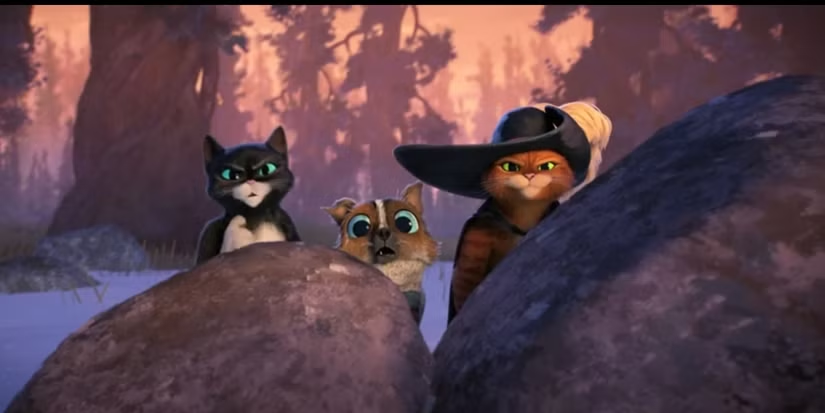
Puss in Boots: The Last Wish follows the legendary feline swordsman Puss (Antonio Banderas) as he realizes he is down to his last life after wasting the previous eight. After a near-death encounter with a dangerous wolf (Wagner Moura), Puss settles for a boring life as a domestic cat. Things change when he learns about the mythical last wish, which has the power to restore his nine lives. Joined by his former lover, Kitty Softpaws (Salma Hayek), Puss embarks on the adventure, but he’s not the only one looking for the last wish.
Who would’ve thought that a sequel to a mostly forgotten 2011 animated movie would turn out to be one of the greatest animated triumphs of the last decade? Indeed, Puss in Boots: The Last Wish far surpasses its predecessor in every possible way. The storyline is complex, the animation is truly stunning, and the emotional payoff is among the most emotionally powerful and cathartic in any animated feature. The film’s handling of heavy themes, most notably anxiety and death, is commendable, presenting them in a way that younger audiences can understand without dumbing them down. Puss in Boots: The Last Wish is perfect proof that animation can be colorful, funny, and whimsical while still delivering poignant and layered narratives about some of life’s tougher issues.
‘The Boy and the Heron’ (2023)

Speaking of heavier narratives in animated form, it’s time to discuss Hayao Miyazaki‘s latest effort. The Boy and the Heron follows Mahito (Luca Padovan), a young boy dealing with his mom’s passing and his father’s new marriage to his aunt. While at his new home, Mahito meets a mysterious grey heron (Robert Pattinson), who convinces him to enter a new and mystical world full of danger and confusion. There, Mahito will have the adventure of a lifetime and will come to terms with some of the most complicated emotions battling inside of him.
A fantasy masterpiece of the 2020s, The Boy and the Heron is one of Miyazaki’s most personal efforts, containing several autobiographical elements, thus serving as an intimate portrayal of one of animation’s most defining figures. It’s all in favor of an introspective and highly symbolic story about the nature of creation and the sacrifices it demands. The visual style complements this elusive but engaging narrative, with some of the most fluid and striking animation in Studio Ghibli’s already impressive library. Many might find The Boy and the Heron‘s allegorical and almost oneiric approach unyielding and perhaps a tad challenging. However, all those who are willing to engage with its admittedly distant nature will find a powerful tale that engages on an emotional and psychological level.
‘Spider-Man: Across the Spider-Verse’ (2023)
In 2018, Spider-Man: Into the Spider-Verse reinvented the rules of animation with its distinct and highly influential visual language and gentle exploration of the nature of heroism and the expectations of legacy. Five years later, its sequel not only reached the same levels but arguably surpassed them. In Spider-Man: Across the Spider-Verse. Miles Morales (Shameik Moore) meets a team of Spider-People, the Spider-Society, led by Spider-Man 2099 (Oscar Isaac). The young hero soon finds himself at odds with them over a difference of opinions about how to best deal with a new multiversal threat, The Spot (Jason Schwartzman).
Spider-Man: Across the Spider-Verse does everything the original did, including just as much wildly inventive action enhanced by some of the most beautiful and jaw-dropping visuals in modern cinema. Where it arguably surpasses it is in its treatment of the traditional superhero tale: whereas Into the Spider-Verse perfects it, Across the Spider-Verse subverses it by challenging its ideas about what it truly means to be a hero. The film is full of something sorely missing from many other superhero movies: something to say about the action-driven characters at the center of its story. Here, superheroes are not defined by their suit or affiliations, and the story is about more than just action sequences and setup. Yes, it does end on a cliffhanger, but Across the Spider-Verse never sacrifices storytelling for spectacle.
‘Robot Dreams’ (2023)

2023 might just be one of the best years for cinema, because not one or two but three animated masterpieces came out during those now-iconic twelve months. The last one in this list is the Spanish tragicomedy Robot Dreams, about the lovely and powerful connection born between a lonely Dog and his Robot companion. The two spend an unforgettable summer together, but when circumstances separate them, these two unlikely companions will need to find a way back to each other.
I won’t lie: Robot Dreams is one of the most heartbreaking animated movies you will ever experience. The film pulls no punches in its depiction of sorrow and how life’s unpredictability can lead to unspeakable emotional tragedy. Through Robot and Dog’s relationship, the film explores ideas of connection, loss, the nature of love, and the importance of letting go of the past. Here, life is something you endure, but in between the pain and misery, there are moments of beauty and joy that make it all worth it. Robot Dreams doesn’t reinvent the formula, but it presents it with such emotional intelligence that it makes it seem novel, not to mention genuinely heart-wrenching. The final moments are as great a representation of catharsis as has ever been depicted on the silver screen. You’ll laugh through the tears, and you’ll surely never forget this delightfully sad gem.
‘Flow’ (2024)

No movie was a bigger surprise in 2024 than Flow, the Latvian animated feature that defied all expectations to become a runaway critical and commercial success. It features no dialogue and is set in a seemingly apocalyptic world, focusing on a black cat who joins forces with other animals — including a capybara, a dog, a lemur, and a whale— to survive as the water level rises dramatically.
Dialogue-less movies can be challenging for modern audiences. Luckily, Flow offers more than enough visual marvel to not only engage but genuinely compel. It’s truly astounding just how riveting this tale of survival is, as we follow the cat and his friends trying to stay afloat, literally. It’s not about making sense out of the situation — these are, after all, animals acting on instinct and not at all concerned with the “why” of their predicament. Thus, Flow becomes an exercise in specificity, allowing us to connect to it on a deeper, more visceral level. More impressively, it was made using Blender, a free and open-source software, proving that animation is truly limited only by the creator’s imagination. The result is one of the most beautiful and unforgettable animated movies of the last decade, a genuine step forward for the venerable medium.
Entertainment
The 3-Part Series That Launched Alan Ritchson’s Career Is About to Vanish From Streaming

Before Alan Ritchson was leading action franchises and getting fan-cast in basically every tough-guy role under the sun, he was Thad Castle. And honestly, for a lot of people, that’s still one of his most iconic performances. Blue Mountain State was chaotic, ridiculous, and completely committed to its own brand of college-football insanity. It never cared about being tasteful, and that was exactly why it found such a loyal audience. Now, Netflix subscribers are about to lose not just the series, but its follow-up movie too.
Blue Mountain State is currently listed to leave Netflix on May 2, while Blue Mountain State: The Rise of Thadland is set to leave a day earlier on May 1. That means fans doing a full Thad Castle rewatch are officially on the clock.
What Is ‘Blue Mountain State’ About?
Created by Eric Falconer and Chris Romano, the original series follows the players of fictional football powerhouse Blue Mountain State University as they juggle games, parties, and the kind of terrible decision-making that made the show a cult favorite. Darin Brooks stars as quarterback Alex Moran, Ritchson plays team captain Thad Castle, Chris Romano plays Sammy Cacciatore, and Ed Marinaro stars as Coach Marty Daniels.
Following the show’s conclusion, a feature-length follow-up Blue Mountain State: The Rise of Thadland hit in 2016, with Ritchson returning to lead the mayhem. Then, in 2024, news broke that a sequel series was in active development. Though no network has yet been confirmed, Prime Video (home of Ritchson’s breakout hit Reacher) and Netflix (where BMS picked up its cult following) were both floated as contenders. The revival is expected to see Ritchson back as Thad, alongside Romano and Brooks.
Blue Mountain State: The Rise of Thadland picks up after the series and brings Alex, Thad, and Sammy back together for one more gloriously stupid adventure. In the film, Alex tries to save the Goat House by convincing newly drafted NFL star Thad to buy it, which naturally leads to an outrageous party spiraling into total chaos.
Blue Mountain State and The Rise of Thadland both leave Netflix next month. You can also watch Ritchson’s breakout hit War Machine on the streaming platform.

- Release Date
-
2010 – 2011-00-00
- Writers
-
Eric Falconer, Chris Romano
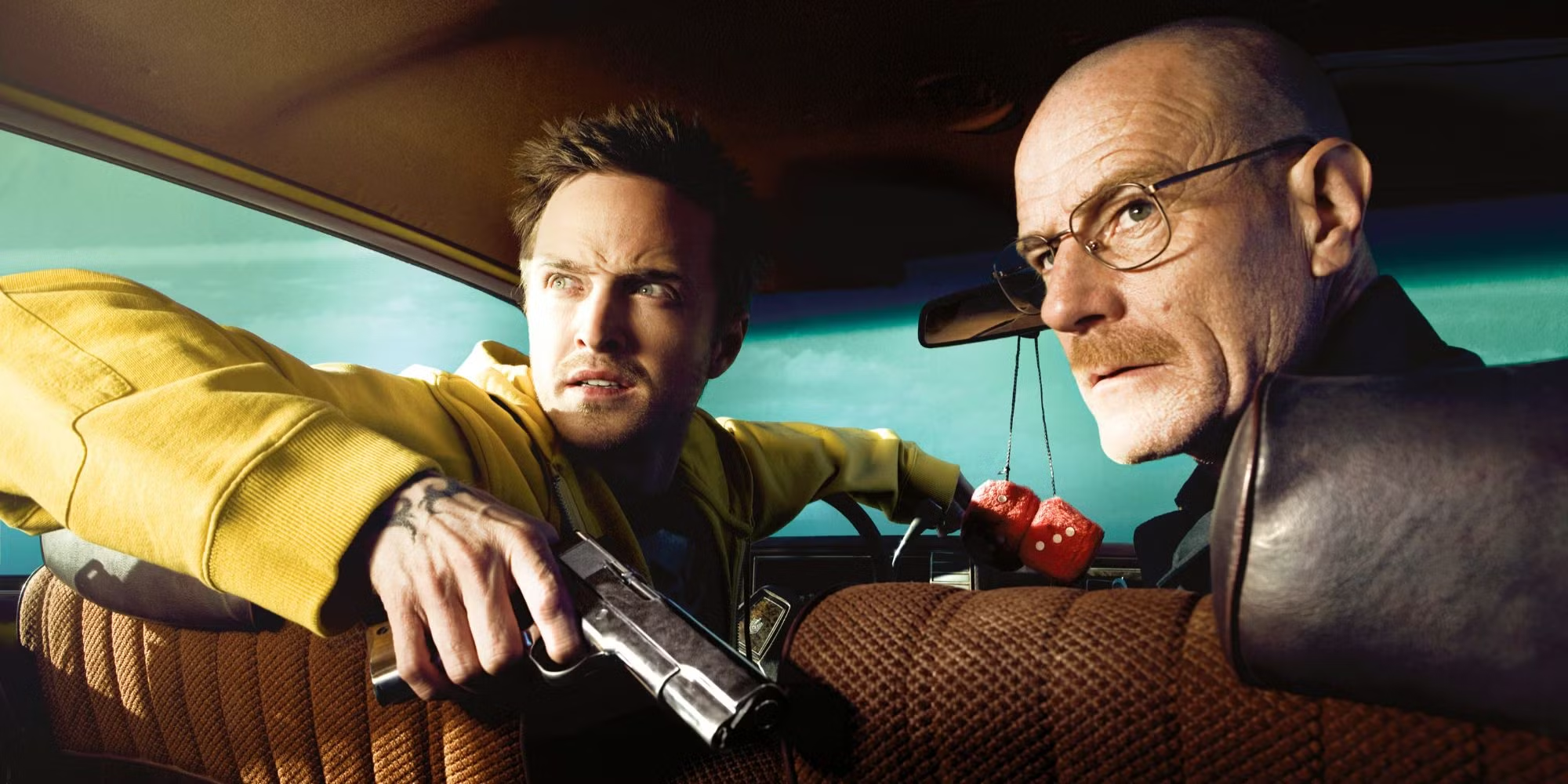
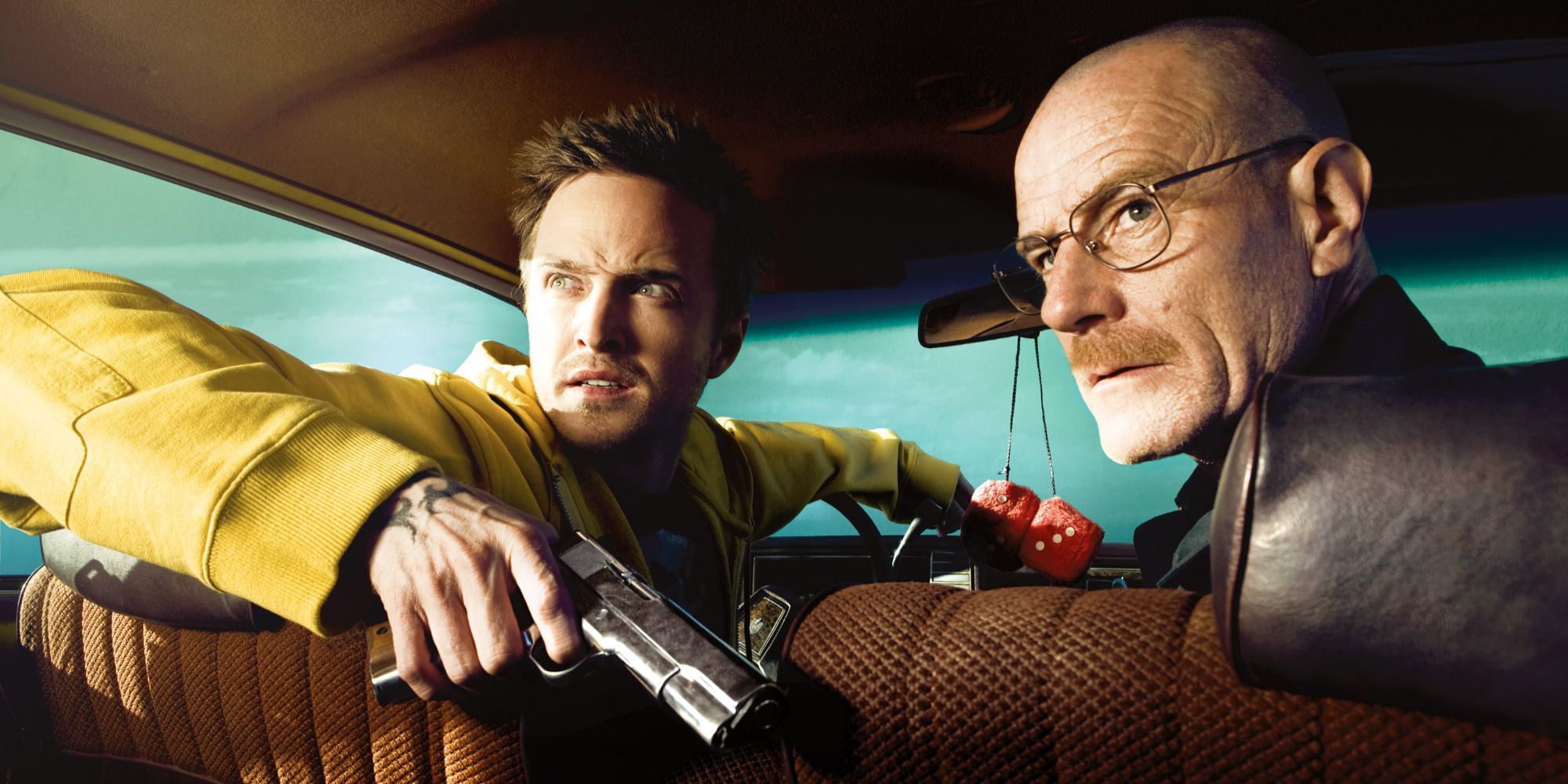
It takes a lot for a show starring Bryan Cranston to not immediately get framed through the lens of Breaking Bad, and Your Honor definitely had that hanging over it from the jump. The setup was always catnip for that comparison too: a good man makes one terrible decision, then keeps making worse ones in the name of protecting family. But whatever shadow it started in, the series found a real audience of its own, especially once Netflix gave it a second life. That run is now coming to an end.
Your Honor is listed to leave Netflix on May 31, with both seasons departing at the end of the month. The show first arrived on Netflix in the U.S. on May 31, 2024, after originally airing on Showtime, where it ran for two seasons from 2020 to 2023.
Adapted from the Israeli series Kvodo, Your Honor centers on respected New Orleans judge Michael Desiato, whose life unravels after his son is involved in a fatal hit-and-run involving the child of a mob boss. Cranston stars as Michael, with Hope Davis as Gina Baxter, Michael Stuhlbarg as Jimmy Baxter, Hunter Doohan as Adam Desiato, Carmen Ejogo as Lee Delamere, and Isiah Whitlock Jr. as Charlie Figaro.
Is ‘Your Honor’ Worth Watching?
Collider’s review stated that Your Honor Season 2 does not hit as hard as the first season, but it still proves there was more story left to tell. After the brutal ending of Season 1, this new chapter shifts away from pure panic and into the fallout of everything Michael Desiato did. That change gives the show a different energy. It is slower, darker, and more focused on grief and consequences than nonstop tension.
“Your Honor effectively shows the fallout and aftermath of violence. We’ve been so conditioned to revel in stories about powerful gangsters, glamorizing them and the lives they lead. Whether it’s the Baxters in their ivory tower or the Desire gang on the lower ninth, these characters can not hide behind the face of money and power. Michael Desiato is a living example of the destruction that organized crime can cause — and how it’s almost impossible to fully stop. The show sometimes falls behind all these themes and conversations that it tries to execute, but when it does catch up, it makes for an unsettling but sobering depiction of what happens when it feels like all trust and hope are gone. It’s grim, slow, and not as exciting as the first season, but Your Honor Season 2 paints an authentic image of grief, corruption, and the fight for power.”
Your Honor leaves Netflix next month on May 31.
When you hear the words “sci-fi horror” spoken in succession, it’s very likely you immediately think of Ridley Scott’s 1979 masterpiece, Alien. Maybe you specifically even think of the film’s iconic poster, an ominous hatching space egg and the brilliant tagline, “In space, no one can hear you scream.” Scott and 20th Century Fox’s space-set thriller was an instant box-office sensation, won an Oscar for its visual effects, and these days appears in virtually every conversation around the best movies ever made in the horror and science fiction genres, respectively.
What made the film so special? It’s hard to overstate what Scott brought to the original film as a master stylist. Alien is simultaneously visually stunning and intentionally unremarkable, taking a cue from the lived-in futurism that made George Lucas‘ Star Wars so fresh two years prior. Dan O’Bannon‘s script is excellent, naturalistically immersing us in the day-to-day of space truckers without a clear protagonist until the third act, when Sigourney Weaver’s cool-headed Ellen Ripley emerges as the sole survivor, blowing H.R. Giger‘s disturbingly sexualized Xenomorph into space in a breathless stinger ending.
Alien is a restrained, yet timelessly disturbing and terrifying landmark film that indeed lives up to its reputation, and as a defining work of sci-fi horror, it’s nearly impossible to beat. The following three movies are masterpieces, too, and they’re the only sci-fi horror movies that are even greater than Alien.
3
‘The Thing’ (1982)

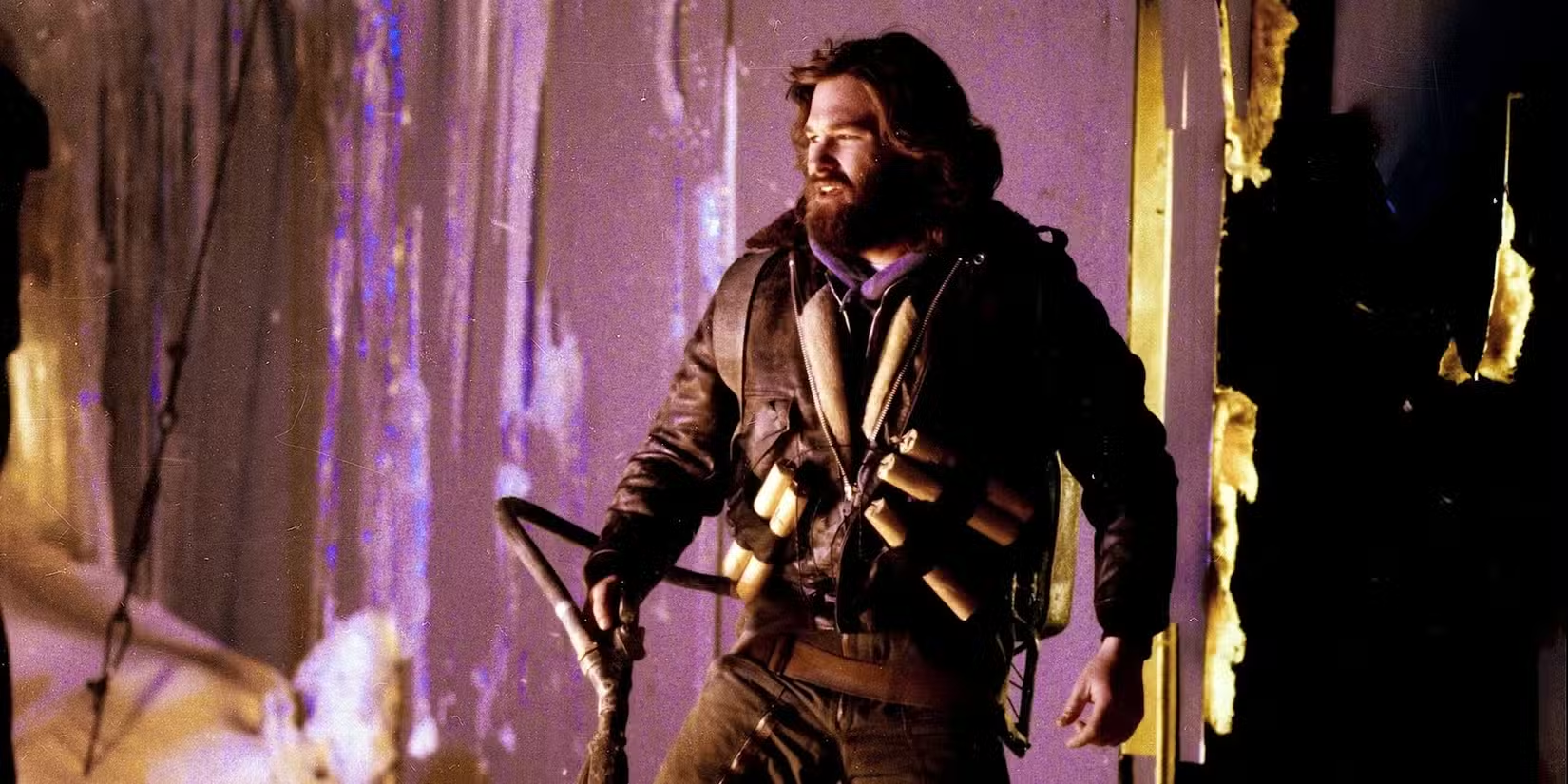
The financial and critical failure of The Thing upon release in 1982 is a complicated and shameful situation. The grisly R-rated remake of Howard Hawks‘ 1951 The Thing from Another World opened in the wake of Steven Spielberg‘s E.T. the Extra-Terrestrial, a hopeful and family-friendly sci-fi that captured hearts and became the highest-grossing movie ever made. Now, contrast that with John Carpenter‘s bleak and terrifying cosmic body horror, and it’s a little easier to understand the reception. Still, there’s really no forgiving the misguided vitriol at the time. The Thing was reviled, and Carpenter’s career was never the same. None other than Roger Ebert, who’d previously championed Carpenter’s work, especially Halloween, said the following in an infamous negative review:
“The Thing” is basically, then, just a geek show, a gross-out movie in which teenagers can dare one another to watch the screen. There’s nothing wrong with that; I like being scared and I was scared by many scenes in “The Thing.” But it seems clear that Carpenter made his choice early on to concentrate on the special effects and the technology and to allow the story and people to become secondary.
Take it from someone who adores Ebert and has read a remarkable percentage of his decades of output: this is the worst thing he ever wrote. Over the years, and thanks to home media and television, The Thing has come to be recognized as arguably Carpenter’s finest film, an extraordinary study in paranoia and isolation. The characters in the film are exactly as they were intended to be, engagingly and recognizably ordinary, as was the case with Alien. It makes the film all the more effective. It’s one of those rare, great horror movies where there’s an external threat, but the question is ultimately whether that’s even the greatest threat at all.
2
‘The Fly’ (1986)
The thing that’s most top of mind with The Fly is perhaps the most surprising for the uninitiated: David Cronenberg‘s landmark work of body horror is one of the best romantic movies of the 1980s. This is one of the most affecting and well-acted cinematic love stories, full stop. Jeff Goldblum gives the performance of his career (a woeful Oscars snub) as Seth Brundle, a scientist whose obsession drives him to fuse with the DNA of a housefly. Brundle’s gradual tragic mutation goes down just as he’s started to fall in love with science journalist Veronica Quaife (Geena Davis). There’s a surprisingly sympathetic love triangle with Veronica’s editor (John Getz), and The Fly packs a staggering amount of story into 96 minutes.
The Fly is body horror that works on many levels. Thanks to the excellent lead performances, it’s most potent as an allegory for the helplessness of watching someone you love succumb to terminal illness. This is a profoundly sad movie that, ironically, is made a little easier to stomach because of the science fiction and horror elements. The makeup effects here won the Oscar, because how the hell could they not? The Fly received substantial critical acclaim upon release, and if anything, it’s only become more beloved over time.
1
‘Aliens’ (1986)

This may seem like a cheap shot, but so be it. Seven years after the runaway success of Alien, up-and-coming director James Cameron took the helm, in a move that would make or break his career following the breakthrough success of The Terminator. Weaver returned as Ripley, reportedly serving as peacemaker on occasion between the British film crew and tyrannically perfectionist Cameron. It was a troubled shoot, but absolutely no one could deny the juice was worth the squeeze. Aliens takes everything that made the original work and expands upon it, with the added element of it being an action film this time around. Alien is a textbook example of a slow-burn masterpiece; Aliens is one of the most unremittingly intense movies ever made, even when watching it a full four decades later.
Weaver received an Academy Award nomination for her work here, all but entirely unprecedented for genre filmmaking at the time. The actress herself once said that “Aliens made Alien look like a cucumber sandwich,” and while that may seem a bit exaggerated, so much of what gives the sequel the slight edge over the original comes down to this great performance, which is one of the best-loved in film history. James Cameron writes believable action heroines better than anyone, and Ripley’s evolution into matriarch savior is so compelling, especially in a wildly imaginative, frankly nuts finale with Stan Winston‘s Alien Queen.
Aliens enjoyed even more critical and financial success than the first, and Cameron had proven he was no fluke. Alien and Aliens are, deservedly, untouchable landmarks of cinema, and not just genre filmmaking. Both are considered among the finest films ever made, and your personal preference over which is the better of the two will vary.

aliens
- Release Date
-
July 18, 1986
- Runtime
-
137 minutes
- Director
-
James Cameron
- Writers
-
James Cameron
A good opening scene is a necessity if you want the rest of the movie to be good, for obvious reasons. You could technically win someone over after a messy opening, but it would be hard, and the only real examples are when the messiness is intentional in a way that makes sense once more of the movie has played out (think One Cut of the Dead, which has an extended opening sequence that feels amateurish, but then the rest of the movie makes clear why it felt that way, and then that whole stretch of the film works in hindsight).
So, examples of flawed openings to great movies are rare, if outright non-existent. But in the interest of trying to find some potentially unique angle regarding opening scenes, what about some that are pretty great, if not perfect? This whole intro hasn’t been very good, truth be told, but that’s spiritually in line with the topic and whatever. Some of these movies are good, if a little flawed, like their openings, and some of these movies get better after a strong – but not flawless – opening sequence.
10
‘Titanic’ (1997)

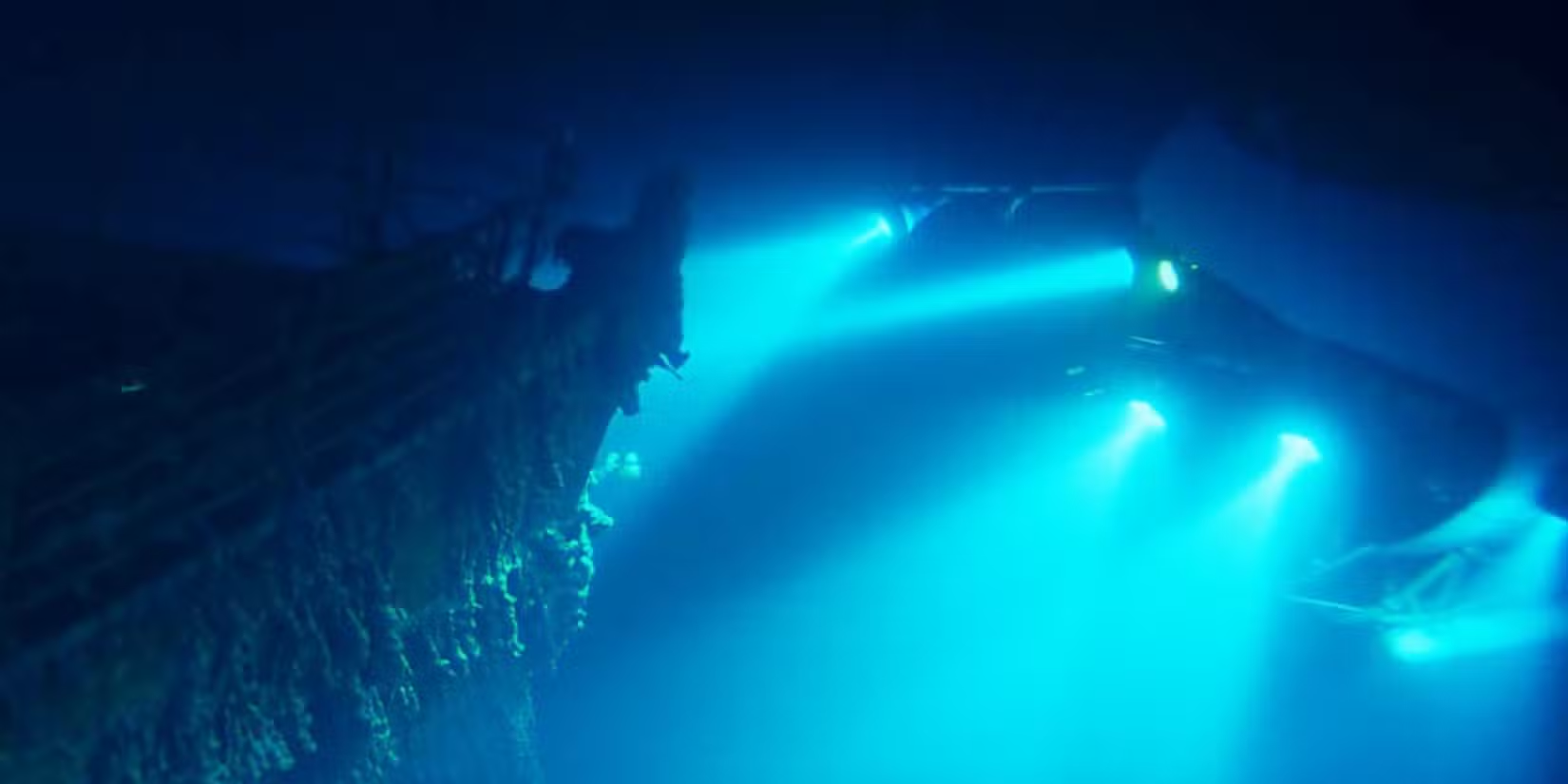
Titanic starts off low-key, but it’s got the time and space to do so, since this is a long movie, to say the least. The prologue here is therefore also pretty drawn-out, involving an exploration of the wreck of the titular ship, with a discovery within (or lack thereof) getting the explorers in touch with an elderly woman who was, more than 80 years earlier, on board the ship during its one and only voyage.
There’s an additional reason to care about the inevitable disaster, and some exposition here that helps once the main chunk of the movie’s playing out. How much time spent on the framing device here and the stuff in the present day feels a little confusing early on (and maybe James Cameron showcases a little more underwater footage than he needs to, but the man does love his underwater stuff), but this part of Titanic is eventually important… albeit not quite as memorable as either the love story or the sequences that show the disaster itself.
9
‘Dawn of the Dead’ (1978)

Of the first three zombie movies George A. Romero directed, Dawn of the Dead is the most fun, and the least bleak. There’s a somber quality to much of the relatively quiet Night of the Living Dead, while Day of the Dead is claustrophobic and also has a post-apocalyptic feel, but Dawn of the Dead is almost like a hangout movie, for a good chunk of its runtime. A slice-of-life movie about life during a zombie outbreak.
Four people hide out in a shopping mall for much of the film, which is bookended by two huge sequences: one with society going to hell and starting to collapse, and then one about the safe haven that was the mall starting to collapse. The ending is a little stronger, in terms of showcasing zombie-related carnage and mayhem, with the opening throwing you into things almost too forcefully. At least it feels that way, at first, but you can appreciate why Dawn of the Dead does that initially once the dust, to some extent, settles.
8
‘Star Wars: The Force Awakens’ (2015)

The best Star Wars trilogy remains the original one, and it’ll probably always be that way, but the less loved sequel trilogy does some things right, only really collapsing (like, well and truly) with The Rise of Skywalker. The Force Awakens was the first of the new/post-George Lucas Star Wars movies, and as a re-introduction to the whole franchise and its world, it’s honestly pretty good.
It was directed by J.J. Abrams, and he does have a reputation for starting things better than he ends them (though criticizing him for Lost’s ending is silly, because he wasn’t involved with that show much after season 1, and also, the Lost ending was honestly good). Anyway, The Force Awakens does a good job at making the First Order feel like a genuine threat straight away, albeit maybe too effectively, since they’re considerably less intimidating in pretty much every subsequent scene/movie. But Kylo Ren does make an impression, as does Poe, even if you could also criticize some of the humor jammed into this otherwise dark/intense opening sequence.
7
‘Uncut Gems’ (2019)

There is an opening scene to Uncut Gems which is far removed from the rest of the film, but does establish where a narrative-important black opal comes from, before getting a bit psychedelic (this doesn’t happen again until the very end). The opening also extends to the action that takes place in New York City, with the chaotic tone of the movie being established in a brutally effective way.
Put simply, Uncut Gems is a bit much when it starts, because it feels particularly loud, frantic, and incomprehensible, as opposed to the rest of the movie, which is also all those things, but in a good/thrilling way. For this kind of film, though, maybe the start of it had to feel a little like being thrown into the deep end of a pool without any flotation device. The drowning sensation, it could be argued, is just part of the overall experience.
6
‘Magnolia’ (1999)

There is an undeniable confidence to the way Magnolia begins and ends, and lots of the stuff in between those two points too, sure. The ending boldly has something big and kind of wild happen that does finally draw all the different characters together, since there’s a massive event that affects them all, but the beginning of the movie is something else entirely, since it’s a series of vignettes about coincidence, fate, and tragedy.
It does a phenomenal job at setting the mood for Magnolia, and letting you know you’re in for something a bit offbeat, even if it’s relentless and then you get a bit overwhelmed by the point at which various actual prominent characters are introduced, with those introductions also being relentless. It’s maximalist and messy, and it doesn’t feel like the ideal way to start a movie (even an admittedly messy/extravagant one), yet, again, that could all be the point. Ribbit.
5
‘Gangs of New York’ (2002)

It’s a Martin Scorsese gangster movie set in New York, sure, but a little different from what you might expect, since Gangs of New York goes back in time about a century and a half. There’s a fearsome gangster who runs a surprising amount of the area, and a young man who wants to kill said gangster because when he was a boy, that man killed his father.
For what it’s worth, the rest of the film (including the way it ends) is also pretty great.
So, Gangs of New York is about revenge, and then it’s also about lots of other things and general chaos, lawlessness, and violence. You get that established pretty early on, owing to the memorably brutal opening battle scene (it’s almost big enough to feel like a battle), which is stylistically a little at odds with much of the rest of the film, thanks to some jarring creative/editing decisions, but it at least makes a big impression. For what it’s worth, the rest of the film (including the way it ends) is also pretty great, and Gangs of New York feels more than a bit over-hated at times.
4
‘The Naked Gun: From the Files of Police Squad!’ (1988)

To say something like “uh there are other scenes in the first Naked Gun movie that are funnier than the opening scene” is a weird and pretty much pointless thing to say, but that’s what’s being said here. It’s more a testament to how good the rest of the movie is, though, because Frank Drebin eventually revealing himself to a meeting filled with America’s greatest enemies (purportedly, and at the time) before beating them all up is great.
It gets funnier once the rest of the movie starts, because the opening scene has pretty much nothing to do with the rest of The Naked Gun: From the Files of Police Squad!, and, generally speaking, with this kind of parody movie, the most absurd things get, the better. It’s also a good way to parody an exaggeration of the stakes you’d expect when a TV show gets a movie, as that’s what happened with the short-lived series Police Squad! being taken to the big screen with The Naked Gun movies.
3
‘Reservoir Dogs’ (1992)

This one’s an easy example. Reservoir Dogs gets off to a great start, with the dialogue being funny and clever, and various characters establishing themselves pretty well, even if they’re talking about largely inconsequential things. It’s a very confidently written and put-together scene, so Quentin Tarantino can be commended for that, as the writer/director… but then he’s also one of the actors in the scene.
And he gives himself a lot of dialogue here, and he does stick out as inferior to the other actors. Beyond the first couple of minutes of Reservoir Dogs, he’s really not in it that much, but… well, it’s not a bad first impression, since this scene is iconic. It’s just that it could’ve been a perfect first impression if there had been a slightly better actor ranting about Madonna’s “Like a Virgin” and some other things right as the film starts.
2
‘Drive’ (2011)
Since there is driving early on in Drive, the opening gets the job done by default. Oh, hey, the opening is also about someone having to do a job, and they do it well. The job involves driving. There is a guy known only as Driver, like, in the credits and everything, and he drives well, getting some criminals away from the scene of the heist they’ve just pulled off.
It’s probably the most exciting part of Drive, and there is only one other big driving-related action scene later on, so that’s potentially misleading. But if you know you’re in for something that’s more about mood and style than action and a genuinely complex story, then that’s all good. The vibes matter more, and the opening set piece establishes such vibes pretty darn well.
1
‘La La Land’ (2016)

The ambition of La La Land’s opening sequence can be admired, and there are things about it that are spectacular and unique. It takes place on a highway congested with traffic, and it does not look like the sort of thing that was easy to film, even before taking into account the fact it was done in one take (or if there are cuts, they’re undeniably well hidden).
There are lots of extras, a distinct setting, and the song itself (“Another Day of Sun”) is memorable/catchy, but there are issues with how some of it looks and bits of the choreography, or lack thereof. There’s a video here that breaks it down/critiques it quite effectively, though watching it if you’re a fan of La La Land is a bit like hearing someone tell you how a magician pulled off all their tricks (and, further, suggesting how maybe the magician could’ve done those tricks better).

La La Land
- Release Date
-
December 16, 2016
- Runtime
-
129 minutes
- Director
-
Damien Chazelle
- Writers
-
Damien Chazelle

Crypto World36 seconds ago
Crypto ETP Inflows Hit $1.1 Billion, Strongest Since January
Sports4 minutes ago
The hidden Masters advantage Rory McIlroy used to crack Augusta code

Tech5 minutes ago
Basic-Fit hit by hack affecting members across multiple countries, including 200,000 in the Netherlands


-

 Politics3 days ago
US brings back mandatory military draft registration
-

 Fashion3 days ago
Weekend Open Thread: Veronica Beard
-
 Sports3 days ago
Man United discover Nico Schlotterbeck transfer fee as defender reaches Dortmund agreement
-

 Tech6 days ago
How Long Can You Drive With Expired Registration? What Florida Law Says
-

 Politics22 hours ago
World Cup exit makes Italy enter crisis mode
-

 Crypto World4 days ago
Canary Capital Files SEC Registration for PEPE ETF
-

 Business3 days ago
Tesla Model Y Tops China Auto Sales in March 2026 With 39,827 Registrations, Beating Cheaper EVs and Gas Cars
-

 Crypto World5 days ago
Bitcoin recovers as US and Iran Agree a Ceasefire Deal
-

 Politics3 days ago
Malcolm In The Middle OG Turned Down ‘Buckets Of Money’ To Appear In Reboot
-

 Fashion6 days ago
Let’s Discuss: DEI in 2026
-
 NewsBeat14 hours ago
Pep Guardiola and Gary Neville agree over Arsenal title problem that benefits Man City
-

 Business3 days ago
OpenAI Halts Stargate UK Data Centre Project Over Energy Costs and Copyright Row
-

 Business2 days ago
Ireland Fuel Protests Enter Day 5 as Blockades Spark Shortages and Government Prepares Support Package
-

 Politics3 days ago
LBC Presenter Mocks Trump Over Iran War Failures
-

 Crypto World3 days ago
Federal judge blocks Arizona from bringing criminal charges against Kalshi
-

 Tech4 days ago
A version of Windows 10 released a decade ago is now eligible for additional security patches
-
 NewsBeat1 day ago
JD Vance announces ‘no agreement’ with Iran over nuclear weapons fear
-

 Business3 days ago
IMF retains floor for precautionary balances at SDR 20 billion
-
Business2 days ago
Coreweave CSO Venturo sells $5.5m in class a common stock
-
Sports2 days ago
1st-Round WR Enters Vikings Mock Draft Orbit
You must be logged in to post a comment Login