Praise be! The wicked world of Gilead continues its religious oppression in The Testaments, the sequel series to The Handmaid’s Tale. Hulu’s adaptation of famed author Margaret Atwood’s 1985 dystopian thriller saw Elisabeth Moss in a career-defining performance as its main protagonist, June Osborne, aka Offred. Throughout its run, The Handmaid’s Tale won 15 Emmys, captivating millions of viewers across six nail-biting seasons.
One year after the series finale of The Handmaid’s Tale, The Testaments looks to be yet another timely tale about privilege and complicity told through a coming-of-age story, but how does it tie into its predecessor? Let’s take a look at everything you need to remember about The Handmaid’s Tale before watching the premiere of its sequel series.
Advertisement
How Does ‘The Handmaid’s Tale’ End?
The final season of The Handmaid’s Tale was markedly much less tragic and painful than previous seasons, but it was not without moments that tugged at your heartstrings. Season 6 focused largely on the rebellion movement, as well as the efforts of June and the main resistance group, Mayday, to liberate Boston from Gilead’s oppression.
Episode 8 sees the Handmaids leading a massive rebellion during Serena’s (Yvonne Strahovski) marriage to Commander Wharton (Josh Charles), which began after a wedding cake laced with sedatives immobilized Gilead’s high society. Episode 9 takes a turn with Gilead’s retaliation through the capture of June and dozens of other Handmaids before efforts to murder them via public execution. However, at the perfect moment, the Mayday-led rebellion emerges and frees the women before slaughtering as many Commanders and Gilead army members as possible.
Then, in yet another triumph, June works with Commander Lawrence (Bradley Whitford) to kill the most powerful remaining oppressors with an airplane bomb, which unfortunately involves the Commander sacrificing himself in the process, taking Nick (Max Minghella), the father of June’s second child, Nichole, along with him. June and the Handmaids finally win, liberating Boston and leaving Gilead the same empty shell its incarcerated Handmaids once were, for so long. Though Gilead is destroyed in Boston, it remains intact throughout the rest of America and is strategizing to maintain power.
Don’t forget about these shows when the world ends.
Advertisement
In Episode 10, “The Handmaid’s Tale,” rebel forces mobilize to try to take the country back. June finally reunites with Nichole, and she and Luke (O-T Fagbenle) decide to end their marriage while vowing never to stop searching for their daughter, Hannah, who remains firmly in Gilead’s grip. Aunt Lydia (Ann Dowd) experiences a huge change in personal morality, no longer supporting the men of power in the oppressive regime, and after receiving June’s forgiveness, Serena sets out for a refugee camp with nothing but her infant son Noah and a plastic bag of personal belongings. Our one-eyed favorite, Janine (Madeline Brewer), is saved by June from an abusive Commander and reunited with her daughter, Charlotte, and Emily (Alexis Bledel) is also shown to be liberated from her circumstances.
As The Handmaid’s Tale ends, it takes things right back to the beginning, with June returning to the mansion where she once served as a Handmaid. There, she confidently begins to record her story, making it clear that Gilead will continue to fall across the United States, and that she will continue to fight undercover as part of the resistance until she finds Hannah.
Advertisement
‘The Testaments’ Takes Place Four Years After ‘The Handmaid’s Tale’
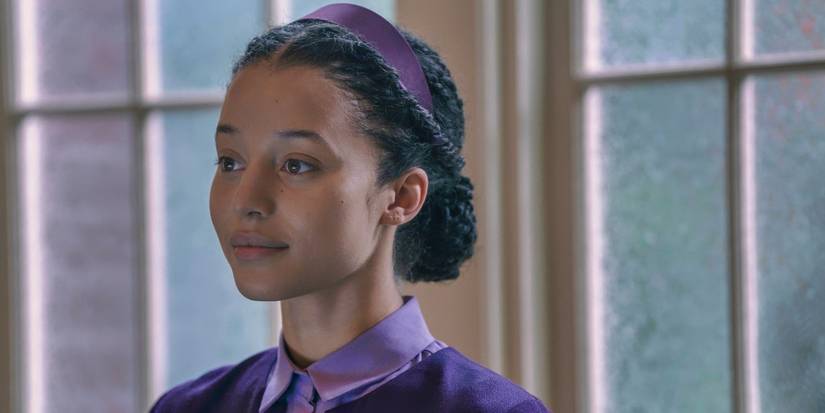
Chase Infiniti in The Testaments Episode 3Image via Hulu
The Testaments novel takes place more than 15 years after the events of The Handmaid’s Tale, but the TV adaptation will pick back up in the same world as its predecessor, set just four years after the events of The Handmaid’s Tale finale. While the setting remains inside the Republic of Gilead, the plot doesn’t revolve around the Handmaids. Lydia’s evolution will continue as she moves from being a ruthless zealot and disciplinarian to a double agent desperately searching for a way to overthrow Gilead from the inside out.
According to The Hollywood Reporter, while Season 1 of The Testaments will shed light on Aunt Lydia’s life before Gilead through a series of “strategically placed flashbacks,” the sequel’s narrative largely centers on a completely different generation at an elite prep school where a group of young women, raised in luxury and advantage, are being groomed for marriage.
Advertisement
‘The Testaments’ Tells a New Coming-of-Age Story
Aunt Lydia’s school is more like an authoritarian refining academy, where young women are sent to learn how to carry out the various wifely duties expected of them as future spouses of Gilead’s most highly ranked Commanders. At this school, servitude and obedience are prioritized over education, and uniform colors are coordinated — the Pinks are the youngest girls, the Plums are older teens, and the Greens are the eligibles ready for marriage. The transition to Green only occurs if a Plum gets her period, which is marked by a public confession and praise ceremony.
Having grown up inside the regime as the daughter of a powerful Gilead leader, Agnes MacKenzie (Chase Infiniti), who is also June’s daughter, Hannah, knows no other lifestyle beyond the regime’s oppression and brutality. In training as a wife-to-be, Agnes is dutiful and pious; however, she changes her mind and decides to become an aunt instead of marrying her arranged husband. New arrival Daisy (Lucy Halliday), who is a few years younger than Agnes, enters Gilead and the school as a committed convert, but she is soon revealed to have ulterior motives.
Advertisement
Advertisement
Collider Exclusive · Sci-Fi Survival Quiz Which Sci-Fi World Would You Survive? The Matrix · Mad Max · Blade Runner · Dune · Star Wars
Five universes. Five completely different ways the future went wrong — or sideways, or up in flames. Only one of them is the world your instincts were built for. Eight questions will figure out which dystopia, galaxy, or desert wasteland you’d actually make it out of alive.
💊The Matrix
🔥Mad Max
🌧️Blade Runner
Advertisement
🏜️Dune
🚀Star Wars
Advertisement
01
You sense something is deeply wrong with the world around you. What do you do? The first instinct is often the truest one.
Advertisement
02
In a world of scarcity, what resource do you guard most fiercely? What we protect reveals what we believe survival actually requires.
Advertisement
03
What kind of threat keeps you up at night? Fear is useful data — if you’re honest about what you’re actually afraid of.
Advertisement
04
How do you deal with authority you don’t trust? Every dystopia has a power structure. Your approach to it determines everything.
Advertisement
05
Which environment could you actually endure long-term? Survival isn’t just tactical — it’s physical, psychological, and very much about where you are.
Advertisement
06
Who do you want in your corner when things fall apart? The company you keep is the clearest signal of who you actually are.
Advertisement
07
Where do you draw the line — if you draw one at all? Every survivor eventually faces a moment that tests what they’re actually made of.
Advertisement
08
What would actually make survival worth it? Staying alive is one thing. Having a reason to is another.
Advertisement
Your Fate Has Been Calculated You’d Survive In…
Your answers point to the world your instincts were built for. This is the universe your temperament, your survival instincts, and your particular brand of stubbornness were made for.
Advertisement
The Resistance, Zion
The Matrix
You took the red pill a long time ago — probably before anyone offered it to you. You’re a systems thinker who can’t help but notice the seams in things.
Advertisement
You’re drawn to understanding how the system works before figuring out how to break it.
You’d find the Resistance, or it would find you — your instinct for spotting constructed realities is the machines’ worst nightmare.
You function best when you have access to information and the freedom to act on it.
The Matrix built an airtight prison. You’d be the one probing the walls for the door.
The Wasteland
Mad Max
The wasteland doesn’t reward the clever or the well-connected — it rewards those who are hard to kill and harder to break. That’s you.
Advertisement
You don’t need comfort, community, or a cause larger than the next horizon.
You need a vehicle, a clear threat, and enough fuel to outrun it — and you’re good at all three.
You are unsentimental enough to survive that world, and decent enough — just barely — to be something more than another raider.
In the wasteland, that distinction is everything.
Los Angeles, 2049
Blade Runner
You’d survive here because you know how to exist in moral grey areas without losing yourself completely.
Advertisement
You read people accurately, keep your circle small, and ask the questions others prefer not to answer.
In a city where humanity is a legal designation rather than a feeling, you hold onto something that keeps you functional.
You’re not a hero. But you’re not lost, either.
In Blade Runner’s world, that distinction is everything.
Arrakis
Dune
Arrakis is the most hostile environment in the known universe — and you are precisely the kind of person it rewards.
Advertisement
Patience, discipline, and political awareness are your core strengths — and on Arrakis, they’re survival tools.
You understand that the long game matters more than any single victory.
Others come to Dune and are consumed by it. You’d learn its logic and earn its respect.
In time, you wouldn’t just survive Arrakis — you’d begin to reshape it.
A Galaxy Far, Far Away
Star Wars
The galaxy far, far away is vast, loud, and in a constant state of violent political upheaval — and you wouldn’t have it any other way.
Advertisement
You find meaning in being part of something larger than yourself — a cause, a crew, a rebellion.
You’d gravitate toward the Rebellion, or the fringes, or whatever pocket of the galaxy still believes the Empire’s grip can be broken.
You fight — not because you have to, but because standing aside isn’t something you’re capable of.
In Star Wars, that willingness is what makes all the difference.
As the two young women navigate the opulent halls of an institute where obedience is brutally instilled with divine justification, they form an intense bond neither of them truly understands. It will soon become the catalyst for upending their past, present, and future, with Daisy’s honesty leading Agnes to question the world around her in ways that threaten to change her life forever.
Advertisement
Just like with The Handmaid’s Tale, don’t expect The Testaments to be a true adaptation. While it will draw on the novel’s main characters, their world, and their situations, the show is expected to take specific liberties to explore the characters’ lives beyond what just one novel could. Remaining a political cautionary tale, The Testaments feels likea warning against both complicity and complacency, as well as a love letter to friendship and an eye-opening reminder of the power of teenage girls to change the world.
The Testaments premieres April 8 with its first three episodes on Hulu.



You must be logged in to post a comment Login