Ahead of the launch party in Malibu, California on June 16, The Kardashians star shared that Thompson, 8, is already taking after her in one unexpected way.Khloé Kardashian/Instagram
“She doesn’t wear fragrance on a daily basis, but she has the Squishmallows fragrance, which is so cute and age-appropriate, and then she has all of mine on her counter, and sometimes she sprays herself, and sometimes she doesn’t, but they’re into scents, these kids,” she explained during a virtual press day.
When Kardashian’s daughter does decide to borrow one of the reality television star’s favorites, she has her own way of doing things.
Advertisement
“I do let her use it, but it’s everything in moderation and she’s so great. She sprays her clothes and not herself, which I’m like, ‘Okay, elevated.’ I love when kids are smarter and more creative than we are. So, she doesn’t spray her body, which I’m fine with.”Khloé Kardashian/Instagram
It’s a far cry from Kardashian’s own spritzing habits growing up.
“When I was younger, it was Bath and Body Works. … I mean, we doused ourselves in the most potent of stuff.”
These days, though, Kardashian is chasing vacation vibes with her signature scent.
Advertisement
“XO Blue is very tropical, in my opinion. I think when you put it on, you immediately get this woody coconut. I feel very transported onto a beach with a piña colada. … It’s still something that you can wear, but I just love where it transports me to.”Khloé Kardashian/Instagram
And for the Khloé In Wonder Land podcast host, the appeal goes beyond an island getaway.
“I just want you to feel the sexiest at your core, and that doesn’t have to be this aesthetic thing.”
“For me, that’s all energetically. I just want you to feel just super sexy and feminine and that you can manhandle anyone and do whatever you want to do, and you’re just that girl. … You want to be in a summer dress or a tank top. It’s so silly that that’s how I feel when I’m wearing it, but I feel like the less clothes, the better.”
Advertisement
Greg Swales
The Khloud founder is just as passionate about what goes into her body as what goes on it.
“I love peptides. I don’t know if that’s a secret. I feel like everyone takes a peptide. … I take injections, which I love, and they just make you feel good and you look good. … I’m also a big vitamin girl and just staying active. There’s not one thing that’s gonna make anything all better.”
Director Guy Ritchie finds himself in a bittersweet situation. Not very many of his recent films have worked at the box office, but virtually all of them have found their audience on home video. Ritchie’s last hit was Wrath of Man, which was released in 2021. The theatrical marketplace was still finding its feet after the pandemic — this was before both Spider-Man: No Way Home and Top Gun: Maverick “saved cinema” — and rather surprisingly, Wrath of Man came along and grossed more than $100 million worldwide. None of Ritchie’s subsequent movies — and there have been four theatrical features since — did well at the box office. One of them was designed as a franchise-starter, and although it remains hugely popular on streaming, chances of a sequel are low.
The movie in question is currently streaming in the United States on Peacock, but it’ll be removed from the platform soon. It was released theatrically in 2024, when it grossed around $29 million worldwide against a reported budget of $60 million. The movie marked the second collaboration between Ritchie and Henry Cavill, who had previously worked together on another failed franchise-starter, The Man From U.N.C.L.E., which made around $110 million globally against a reported budget of $75 million in 2015. They have since collaborated on another film, the recent In the Grey, which grossed just $17 million globally against a reported budget of $70 million.
Advertisement
Advertisement
Collider Exclusive · Action Hero Quiz Which Action Hero Would Be Your Perfect Partner? Rambo · James Bond · Indiana Jones · John McClane · Ethan Hunt
Five legends. Five completely different ways of getting out alive — with style, with muscle, with charm, with luck, or with a plan so intricate it probably shouldn’t work. Ten questions will reveal which action hero was built to have your back.
🎖️Rambo
🍸James Bond
🏺Indiana Jones
Advertisement
🔧John McClane
🎭Ethan Hunt
Advertisement
01
You’re dropped into a dangerous situation with no warning. What do you need most from a partner? The first few seconds tell you everything about who belongs beside you.
Advertisement
02
You have to get somewhere dangerous, fast. How do you travel? How you get there is half the mission.
Advertisement
03
You’re pinned down and outnumbered. What does your ideal partner do? This is when you find out what someone is really made of.
Advertisement
04
The mission is paused. You have one evening to decompress. What does your partner suggest? Who someone is when the pressure drops is who they actually are.
Advertisement
05
How do you prefer your partner to communicate mid-mission? Good communication is the difference between partners and a liability.
Advertisement
06
Your enemy is powerful, well-resourced, and has the upper hand. How should your partner approach them? The approach to the enemy defines the partnership.
Advertisement
07
Things go badly wrong and you’re captured. What do you trust your partner to do? Who someone is when you need them most is the only thing that matters.
Advertisement
08
What does your ideal partner bring to the table that you couldn’t replace? A great partner fills the gap you didn’t know you had.
Advertisement
09
Every partnership has a cost. Which of these can you live with? No one comes without baggage. The question is whether you can carry it together.
Advertisement
10
It’s the final moment. Everything is on the line. What do you need from your partner right now? The last question is the most honest one.
Advertisement
Your Partner Has Been Assigned Your Perfect Partner Is…
Your answers have pointed to one action hero above all others. This is the person built to have your back — for better or considerably, spectacularly worse.
Advertisement
Rambo
Your partner doesn’t talk much, doesn’t need to, and will have assessed every threat in your immediate environment before you’ve finished your first sentence. John Rambo is not a man of plans or politics — he is a force of nature shaped by survival, loyalty, and a capacity for endurance that goes beyond anything training can produce. He will not leave you behind. He has never left anyone behind who deserved to come home. What you get with Rambo is the most capable, most quietly ferocious partner imaginable — one who has been through things that would have broken anyone else, and who chose to keep going anyway. You’ll never need to ask if he has your back. You’ll just know.
James Bond
Advertisement
Your partner will arrive perfectly dressed, perfectly briefed, and with a cover story so convincing it’ll take you a moment to remember what’s actually true. James Bond is the most professionally dangerous person in any room he enters — and the most disarmingly charming, which is the point. He operates in a world of layers, where nothing is what it appears and every advantage is used without apology. You’ll never be bored. You’ll occasionally be furious. But when it matters — when the mission is genuinely on the line and the margin for error has collapsed to nothing — Bond is exactly the partner you want. He has survived things that have no business being survivable. He does it with style. That is not nothing.
Indiana Jones
Your partner will know the history, the language, the cultural context, and exactly why the thing everyone else is ignoring is actually the most important thing in the room. Indiana Jones is brilliant, reckless, and occasionally impossible — but he is also one of the most resourceful, most genuinely knowledgeable partners you could find yourself beside. He approaches every situation with a scholar’s eye and a brawler’s instinct, which is an unusual combination and a remarkably effective one. He hates snakes and gets personally attached to objects of historical significance, both of which will slow you down at least once. It doesn’t matter. What Indy brings is irreplaceable — and the adventures you’ll have together will be the kind people write books about. Assuming you survive them.
Advertisement
John McClane
Your partner was not supposed to be here. He does not have the right equipment, the right information, or anything approaching the right odds. He has a sarcastic remark and an absolute refusal to accept that the situation is as bad as it looks. John McClane is the greatest accidental hero in the history of action cinema — a man whose superpower is stubbornness, whose contingency plan is improvisation, and whose capacity to absorb punishment and keep moving would be alarming if it weren’t so useful. He will complain the entire time. He will make it significantly more chaotic than it needed to be. And he will absolutely, unconditionally, without question come through when it counts. Yippee-ki-yay.
Advertisement
Ethan Hunt
Your partner has already run seventeen scenarios by the time you’ve finished reading the briefing, and the plan he’s settled on involves at least two things that should be physically impossible. Ethan Hunt operates at the absolute edge of human capability — technically, physically, and intellectually — and he brings the same relentless precision to protecting his partners that he brings to dismantling organisations that shouldn’t exist. He is not easy to know and he will never fully tell you everything. But he will carry the weight of the mission so completely, so absolutely, that your job is simply to trust him — and the remarkable thing is that trusting him always turns out to be the right call. The mission will be impossible. He will complete it anyway.
Advertisement
The Movie Was Widely Embraced by Audiences
Ritchie and Cavill’s 2024 movie was The Ministry of Ungentlemanly Warfare, a World War II-era espionage action movie purportedly based on real events. The film also stars Alan Ritchson, Henry Golding, Hero Fiennes Tiffin, Eiza González, Alex Pettyfer, and more. The Ministry of Ungentlemanly Warfare now holds a 60% critics’ score on Rotten Tomatoes, where the consensus reads, “Cranking up a true story of derring-do into a high-octane action flick that’s heavy on spectacle if not suspense, The Ministry of Ungentlemanly Warfare is another solid entry into Guy Ritchie’s pantheon.” But the movie’s audience score on the aggregator website is far higher, at a “Verified Hot” 91%. You can check it out on Peacock until August 18, and stay tuned to Collider for more updates.
Fantasy movies are in one way the best genre there is because there is a promise most other genres don’t even try to keep. Things will turn out okay in the end. Magic will fix what’s broken. The person who deserves to win will win. That promise is why people still tear up at a fairy tale ending even when they already know exactly how it goes. That happy ending is a real comfort in a story that keeps its word.
These ten movies take that comfort and pull it out from under you, right when you’re leaning on it hardest. Each one plays by fantasy’s rules long enough to earn your trust, real magic, real curses, real quests, and then breaks the one promise the genre is supposed to keep, on purpose. That’s the part that stays with you longer than a happy ending ever could.
Advertisement
10
‘Edward Scissorhands’ (1990)
Edward with blood on his scissors.Image via 20th Century Studios
Most fairy tales about outsiders end with the outsider learning to fit in, whether that means a wedding or some kind of big change that finally lets them belong. Edward Scissorhands (Johnny Depp) never gets that kind of ending, mostly because the inventor who built him died before finishing the job, which is why he still has scissors instead of hands. Kim (Winona Ryder) and her mother, Peg (Dianne Wiest), bring him down from his empty castle into their quiet, pastel neighborhood, where everyone treats him like an exciting new toy at first.
That excitement doesn’t last. Once Edward kills Jim (Anthony Michael Hall) in self-defense near the end, the same neighbors who welcomed him turn on him just as fast, chasing him back up the hill to the castle he came from. He stays there alone for the rest of his life, while Kim grows old without him and only tells the story to her granddaughter decades later, as a memory. Tim Burton takes the usual Beauty and the Beast formula, where the beast eventually gets the girl and a place in the world, and simply never lets Edward have either one.
Advertisement
9
‘Beetlejuice’ (1988)
Beetlejuice (Michael Keaton), a horrific and shambolic undead entity, sports an evil grin in ‘Beetlejuice’ (1988).Image via Warner Bros. Pictures
Betelgeuse (Michael Keaton) is the title character, yet he barely shows up in his own movie, adding up to less than twenty minutes of screen time total, and he isn’t even the one the story wants you rooting for. That role belongs to Adam and Barbara Maitland (Alec Baldwin and Geena Davis), a married couple who just died and now find themselves haunting the house they used to live in, trying and failing to scare off the wealthy, rude family that’s moved in and started redecorating.
Most haunted house movies want the audience afraid of the ghosts, but this one flips that completely, since the Maitlands are the gentle, awkward ones who can barely manage a decent scare, while the humans, aside from Lydia (Winona Ryder), the one person who can actually see them, are the real nuisance. Betelgeuse only enters the story because the Maitlands get desperate enough to hire him, and once he’s loose, he nearly wrecks everything for the characters we’ve spent the whole film rooting for.
Advertisement
8
‘The Green Knight’ (2021)
Dev Patel wearing an armor and looking down in image from ‘The Green Knight’Image via A24
The medieval poem this is based on ends with Gawain surviving his ordeal essentially unscathed, having proven his honor to everyone’s satisfaction. David Lowery’sversion doesn’t let him off that easily. Gawain (Dev Patel) spends the whole film wearing a magic girdle that guarantees he can’t be killed, a cheat he never tells anyone about, right up until the moment he’s supposed to keep his promise to the Green Knight and let himself be beheaded.
Before he does, the film shows an entire imagined future where Gawain removes the girdle, flees the challenge, and lives out decades as a hollow, cowardly king, watching everything he built collapse. Then it cuts back to the real moment, where the girdle is still on his waist, and lets him choose. A quest story built entirely around a fight ends instead on a man deciding, alone, whether he’s willing to actually be brave.
Advertisement
7
‘The Shape of Water’ (2017)
Elisa (Sally Hawkins) touches a rain-streaked bus window in The Shape of Water.Image via Searchlight Pictures
Beauty and the Beast stories almost always end with the beast turning human. Guillermo del Toro‘s version ends with the human choosing to become something else instead. Elisa (Sally Hawkins), a mute cleaner at a Cold War research facility, falls for an amphibious creature (Doug Jones) being tortured and studied by Strickland (Michael Shannon), and it is never visible that their relationship is real.
By the end, Elisa doesn’t get her voice back, and the creature doesn’t get legs. Instead, Elisa is pulled into the water and transforms into something that can breathe there alongside him, which reverses the direction every version of this story usually goes. It’s the human who changes to fit the fantasy world, not the other way around, and a genre film built on that premise went on to win Best Picture, a category it almost never gets invited into.
Advertisement
Collider Exclusive · Oscar Best Picture Quiz Which Oscar Best Picture Is Your Perfect Movie? Parasite · Everything Everywhere · Oppenheimer · Birdman · No Country
Advertisement
Five Oscar Best Picture winners. Five completely different visions of what cinema can be — and what it can do to you. One of them is the film that was made for the way your mind works. Ten questions will figure out which one.
🪜Parasite
🌀Everything Everywhere
☢️Oppenheimer
🐦Birdman
Advertisement
🪙No Country for Old Men
Advertisement
01
What kind of film experience do you actually want? The best movies don’t just entertain — they leave something behind.
Advertisement
02
Which idea grabs you most in a film? Great films are driven by a central obsession. What’s yours?
Advertisement
03
How do you like your story told? Form is content. The way a story is shaped changes what it means.
Advertisement
04
What makes a truly great antagonist? The opposition defines the protagonist. What kind of opposition fascinates you?
Advertisement
05
What do you want from a film’s ending? The final note is the one that lingers. What do you want it to sound like?
Advertisement
06
Which setting pulls you in most? Where a film takes place shapes everything — mood, stakes, what’s even possible.
Advertisement
07
What cinematic craft impresses you most? Every great film has a signature — a technical or artistic element that makes it unmistakable.
Advertisement
08
What kind of main character do you root for? The protagonist is the lens. Who you choose to follow says something about you.
Advertisement
09
How do you feel about a film that takes its time? Pace is a choice. Some films sprint; others let tension accumulate slowly, deliberately.
Advertisement
10
What do you want to feel walking out of the cinema? The best films leave a mark. What kind of mark do you want?
Advertisement
The Academy Has Decided Your Perfect Film Is…
Your answers have pointed to one Oscar Best Picture winner above all others. This is the film that was made for the way your mind works.
Advertisement
Parasite
You are drawn to films that operate on multiple levels simultaneously — that begin in one genre and quietly, brilliantly migrate into another. Bong Joon-ho’s Parasite is a film about class, desire, and the architecture of inequality that manages to be darkly funny, deeply suspenseful, and genuinely shocking across a single extraordinary running time. Your instinct is for cinema that hides its true intentions until the moment it’s ready to reveal them. Parasite is exactly that — a film that rewards close attention and punishes assumptions, right up to its devastating final image.
Advertisement
Everything Everywhere All at Once
You want it all — and this film gives you all of it. The Daniels’ Everything Everywhere All at Once is one of the most maximalist films ever made: action comedy, multiverse sci-fi, family drama, existential crisis, and a genuinely earned emotional core that sneaks up on you amid the chaos. You are someone who responds to ambition, who doesn’t want cinema to choose between being entertaining and being meaningful. This film refuses that choice entirely. It is overwhelming by design, and its overwhelming nature is precisely the point — because the feeling of being crushed by infinite possibility is exactly what it’s about.
Advertisement
Oppenheimer
You are drawn to cinema on a grand scale — films that understand history not as a backdrop but as a force, and that place their characters inside that force and watch what happens. Christopher Nolan’s Oppenheimer is a film about the terrifying gap between what we can do and what we should do, told with the full weight of one of the most consequential moments in human history behind it. You want your films to feel important without feeling self-important — to earn their ambition through sheer craft and the gravity of their subject. Oppenheimer does exactly that. It is enormous, complicated, and refuses easy comfort.
Advertisement
Birdman
You are drawn to films that foreground their own construction — that make the how of the filmmaking part of the what it’s about. Alejandro González Iñárritu’s Birdman, shot to appear as a single continuous take, is cinema examining itself through the cracked mirror of a fading actor’s ego. You respond to formal daring, to the feeling that a film is doing something that probably shouldn’t be possible. Michael Keaton’s performance and Emmanuel Lubezki’s restless camera create something genuinely unlike anything else — a film that is simultaneously about creativity, relevance, self-destruction, and the impossibility of ever truly knowing if your work means anything at all.
Advertisement
No Country for Old Men
You are drawn to cinema that trusts silence, that refuses to explain itself, and that treats dread as a form of meaning. The Coen Brothers’ No Country for Old Men is a film about the arrival of a new kind of evil — implacable, arbitrary, and utterly indifferent to the moral frameworks we use to make sense of the world. It is one of the most formally controlled films ever made, and its controlled restraint is what makes it so terrifying. You want your films to haunt you, not comfort you. You are not interested in resolution if resolution would be dishonest. No Country for Old Men is honest in a way that most cinema never dares to be.
Advertisement
6
‘Pan’s Labyrinth’ (2006)
The Pale Man with eyeballs in his palms in Pan’s Labyrinth.Image via Warner Bros. Pictures
Advertisement
Guillermo del Toro has never confirmed, in any interview, whether the fantasy world in this film is real or something Ofelia (Ivana Baquero) invented to survive fascist Spain, and he’s said that ambiguity is deliberate. Her stepfather, Captain Vidal (Sergi López), is hunting resistance fighters in the forest above the labyrinth, and every fantastical creature Ofelia meets underground, including a faun (Doug Jones) who sets her three brutal tasks, exists right alongside real torture and real executions happening a few feet away.
Ofelia dies at Vidal’s hands in the last act, shot in the real world with no rescue arriving in time. The film’s final scene shows her reunited with a magical mother and father in an underworld kingdom, crowned and welcomed home. Whether that’s actually happening, or just what a dying child imagined in her last few seconds, is something the film never settles for you
5
‘Being John Malkovich’ (1999)
Cameron Diaz in Being John Malkovich close-upImage via USA Films
Advertisement
There’s a door on the 7½th floor of an office building that leads directly into actor John Malkovich‘s mind for exactly fifteen minutes at a time, and the strangest thing about this movie is how fast everyone treats that as a business opportunity. Craig Schwartz (John Cusack) starts charging people two hundred dollars a ride, while his wife, Lotte (Cameron Diaz), and his coworker Maxine (Catherine Keener) start using the portal to work out their own tangled feelings for each other.
John Malkovich plays an exaggerated version of himself, increasingly horrified as strangers start controlling his body from inside his own skull. The story ends with Craig trapped permanently inside the consciousness of a young girl, watching her life through her eyes with no way out, which turns the fantasy of becoming someone else into a life sentence instead of an escape.
4
‘Brazil’ (1985)
Image via Universal Pictures
Advertisement
Terry Gilliam fought his own studio so hard over this film’s ending that he eventually took out a full-page ad in Variety demanding they release his cut instead of theirs, and once you see the ending, it’s obvious why he refused to budge. Sam Lowry (Jonathan Pryce) spends the film escaping a suffocating, paperwork-choked dystopia through elaborate flying daydreams, and by the final scene, he seems to actually pull it off, rescuing Jill (Kim Greist) and driving free into open countryside.
Then the camera pulls back, and it turns out none of that happened. Sam is strapped to a chair, having just been tortured into a lobotomy by the same bureaucracy he’d been dreaming his way out of, smiling blankly at nothing. The fantasy ending was real inside the film. It just wasn’t real for him.
3
‘Spirited Away’ (2001)
Chihiro standing among flowers and looking up in ‘Spirited Away’.Image via Studio Ghibli
Advertisement
Chihiro’s parents get turned into pigs about fifteen minutes into this movie, punished for eating food that wasn’t theirs without asking first, and Hayao Miyazaki never really lets the story go back to being gentle after that. Chihiro (voiced by Rumi Hiiragi) has to take a job at a bathhouse run by a witch named Yubaba to survive, and the film refuses to give Yubaba a clean villain arc, letting her run the place with genuine competence rather than pure cruelty.
Chihiro and Haku (voiced by Miyu Irino), the boy who helps her, never get a romantic ending, not even a kiss goodbye. She’s told not to look back as she leaves the spirit world, and the film cuts away before showing whether she’ll remember any of it once she’s home. This is a coming-of-age fantasy that hands its hero actual growth and then takes the memory of it away. Very subversive.
2
‘Princess Mononoke’ (1997)
San and Moro from ‘Princess Mononoke.’Image via Studio Ghibli
Advertisement
Lady Eboshi (Minnie Driver) gives lepers and former sex workers real jobs and real dignity inside the walls of Irontown, something almost nobody else in the story is willing to offer them. She’s also cutting down the forest that keeps her furnaces running, and by the film’s climax, her hunters are chasing down the Forest Spirit to take its head. Hayao Miyazaki never gives you a clean reason to hate her for either one.
San (Claire Danes), raised by wolves and ready to kill any human who threatens her home, doesn’t get positioned as the clear hero either. Ashitaka (Billy Crudup), the one character trying to hold both sides together, carries a curse on his arm that never fully goes away, not even by the last scene. The forest grows back changed, not restored, and San and Ashitaka choose to live apart instead of ending up together. Nobody wins here the way a fantasy movie usually lets somebody win.
1
‘Shrek’ (2001)
Shrek and Donkey looking confused in Shrek (2001).Image via DreamWorks Animation
Advertisement
Shrek is based on a girl named Fiona (Cameron Diaz) who spends her whole life locked in a curse, turning into an ogre every night until true love’s kiss can supposedly fix her for good and make the change permanent. She finally gets that kiss from Shrek (Mike Myers), and it does make the change permanent, just not in the direction she or anyone in the castle was expecting.
Lord Farquaad (John Lithgow) had already offered Shrek a kingdom in exchange for rescuing her, a crown and a castle and a permanent place at court, exactly the ending most fantasy movies build their whole story toward. Shrek and Fiona turn it down anyway and go home to the swamp that started this whole mess . There’s no lingering shot of the throne they’re leaving behind at all. They just leave, and Donkey (Eddie Murphy) follows them there too, instead of staying behind in the fancy castle he could have had for himself.
Trans actress Dylan Mulvaney has spoken publicly about President Donald Trump comparing her to CNN reporter Katilan Collins.
“To the president — thank you for reminding me that I am more powerful than I even knew. To quote my favorite recording artist, Shea Diamond, I am America,” Mulvaney, 29, said, referencing the 2020 track by fellow trans woman Diamond, 48, in a a Sunday, July 26, TikTok video before concluding her statement with “love ya” and blowing a kiss to the camera.
Trump, 80, compared Collins, 43, to Mulvaney during a speech at the rescheduled White House Correspondents’ Dinner on Friday, July 24. After Collins received an award for her coverage of his highly publicized Oval Office meeting with Ukrainian president Volodymyr Zelenskyy, the president took aim at Collins: “I thought Kaitlan had really made it big with a major new sponsorship, but then I informed that it wasn’t her on the Bud Light can, it was Dylan Mulvaney,” he told the crowd.
Mulvaney’s TikTok response began by congratulating Collins, noting that she felt “incredibly honored to be compared to her in any way, and I hope that she keeps doing all the great work.” Mulvaney then moved onto why she believed the president brought her into his speech.
CNN correspondent Kaitlan Collins seemingly clapped back at President Donald Trump for attacking her at the rescheduled White House Correspondents Dinner. Collins, 34, shared an empowering quote from former first lady Eleanor Roosevelt via her Instagram Story on Saturday, July 25, which read, “No one can make you feel inferior without your consent.” Her response […]
“The president also brought up a video I did over three years ago, and, mind you, I’ve been kind of flying under the radar … doing my little musicals, singing, dancing. And yet, I’m still his hot topic of conversation all these years later. It seems to me like I might be, like, the one that got away,” she told fans, adding that she has made a profound mark on critics of her transgender identity.
Advertisement
“I am permanently burned into their retinas, I am microchipped into their minds,” she joked.
Dylan MulvaneyJeff Spicer/Getty Images for Netflix
Mulvaney then stated that she refused to let herself get upset over serving as a “diss track” subject for the president. “A few weeks ago, I would have probably been more upset about this, but luckily, I was ghosted last month by a hook up who I really liked, and what I realized was from that experience [was] I shouldn’t want to be with someone who doesn’t really want to be with me,” she explained. “So maybe, I shouldn’t want to be professionally supported by an administration that doesn’t personally support me or so many others in this country.”
Mulvaney then turned her reference within the president’s speech into a positive. “In fact, maybe being publicly mocked and criticized by this administration is actually, like, the greatest compliment of all because it puts me in the company of some of the most brilliant, empathetic people in our world today,” she said. “I do still wonder, like, why is it so important to them that I don’t find success? What is it that I have that they don’t? Oh my God, [it’s] freedom.”
Thank You!
You have successfully subscribed.
Advertisement
Kaitlan CollinsRob Kim/Getty Images for Tribeca Festival
The TikTok followed Mulvaney’s more subtle support of Collins via her Instagram Stories one day prior. Sharing an inspirational quote attributed to former first lady Eleanor Roosevelt, which was the same quote Collins shared via Instagram in a recap of the annual fundraiser intended to celebrate the First Amendment, Mulvaney seemingly nodded to the reporter.
“No one can make you feel inferior without your consent,” the quote read.
If you or someone you know is struggling or in crisis, help is available. Call or text 988 or chat at 988lifeline.org. https://988lifeline.org/
Tom Holland is confirming that he has previously promoted projects he privately believed audiences were better off skipping. The actor said his latest press tour has been far more enjoyable because he is genuinely proud of both “The Odyssey” and “Spider-Man: Brand New Day,” unlike some of his past work.
Holland did not identify the movies he regretted promoting, but several of his poorly reviewed projects have faced harsh criticism over the years.
Holland has admitted that promoting movies he wasn’t proud of was one of the most difficult parts of his job, revealing there were times he had to convince audiences to buy tickets despite privately believing they were better off skipping the film.
Advertisement
Speaking on the “Dish” podcast, the actor said it’s far easier to promote a movie when he genuinely believes in it.
“I’m absolutely loving it. When you’re doing press for movies you’re really proud of, it’s really easy,” Holland said. “I’ve had experiences before when people say, ‘Why should you see this movie?’ And in the back of your mind, you’re like, ‘You shouldn’t, because it’s sh-t.’”
Holland is currently promoting both “The Odyssey” and “Spider-Man: Brand New Day,” projects he described as a “victory lap” because he’s “super proud” of both films.
When talking about movies he has done fans should never watch, Holland did not name any titles specifically. However, like most other actors, the Englishman has several critically mauled projects that could fuel speculation about which movies he privately disliked.
His lowest-rated starring films include “Chaos Walking,” “Cherry,” and “Uncharted,” which hold Rotten Tomatoes scores of 21%, 37%, and 41%, respectively. “Dolittle,” in which he voiced Jip, sits even lower at 15%.
Advertisement
“The Crowded Room” also struggled with critics, but Holland publicly stood behind the Apple TV+ series and its message about seeking help for mental health struggles.
Still, he admitted the production took a serious personal toll. Holland said the role left him struggling to separate himself from his character and contributed to his decision to take a year-long break from acting.
Holland’s days of reluctantly promoting movies he disliked could now very well be far behind him, with the actor seemingly enjoying the biggest high of his career. After several years of balancing Marvel blockbusters with more divisive projects, the British star is now leading two of Hollywood’s most anticipated releases.
Christopher Nolan’s “The Odyssey” opened to a massive global debut and has earned widespread acclaim, while “Spider-Man: Brand New Day” is already generating major buzz ahead of its release.
The momentum has also been backed by those around him. Sony Pictures chairman Tom Rothman reportedly described Holland’s work in “Brand New Day” as his “finest performance.”
Holland’s role in “The Odyssey” has also placed him closer than ever to Hollywood’s awards conversation.
Although the actor is not currently projected as a leading Oscar contender, Christopher Nolan’s epic has emerged as one of the year’s biggest awards hopefuls, with early forecasts predicting nominations across major categories, including Best Picture and Best Director.
If the film lives up to those expectations, Holland will have played a key role in one of the most acclaimed movies of his career, further cementing his evolution from blockbuster superhero to respected dramatic leading man.
How Christopher Nolan Elevated Tom Holland’s Career
Working with Christopher Nolan also appears to have reshaped Holland’s approach to filmmaking.
Per Variety, the actor was so determined to star in “The Odyssey” that he personally called Sony boss Tom Rothman to request a delay to “Spider-Man: Brand New Day” after the two productions landed on conflicting schedules. The gamble ultimately paid off, with Holland later saying the extra development time helped Marvel make “the best version” of the film.
The London-born star has since credited Nolan’s meticulous process with influencing how he approaches future projects, telling TheWrap there was “a lot more preparation” on the Oscar-winning filmmaker’s sets than he had previously experienced.
Advertisement
“[With Marvel,] sometimes we come to set without scripts and stuff like that, and you’re having to improvise and try and find ways to tell the story. Whereas Chris’s script, I don’t think it really changed at all from the first time I read it to the movie that you saw yesterday,” Holland said, adding that he carried those lessons into the production of his latest “Spider-Man” movie.
This week, it was confirmed that one of the defining action thrillers of the ’90s, the 1991 cult classicPoint Break, will be making a splash back in theaters for its 35th anniversary. The film starred Keanu Reeves as FBI Agent Johnny Utah, alongside the likes of Patrick Swayze, Lori Petty, and Gary Busey, and remains one of the biggest early turning points in a career that would soon blossom into Hollywood immortality. Excitingly, Point Break will return to theaters nationwide on August 16 and 19 in the form of a new 4K restoration released by Resurgence Media Group, Saga Arts, and Fathom Entertainment.
The film will technically be the third release for Reeves in 2026, and the second of this summer, following his reprisal of the hilarious Duke Caboom alongside the voices of Tom Hanks, Tim Allen, and Joan Cusack in Toy Story 5. That particular release is certainly his best of the year, receiving widespread acclaim and proving so popular it is expected to become the third film of the year to hit $1 billion at the box office. His other 2026 release is perhaps one Reeves would rather get less noticed, considering the terrible reviews it received upon arrival.
The film in question is Outcome, the latest directorial project from Hollywood funnyman Jonah Hill, which stars Reeves as Reef Hawk, a once globally popular movie star who is forced to take a hiatus from the industry after struggling with heroin addiction, alongside the likes of Matt Bomer, Cameron Diaz, Susan Lucci, Laverne Cox, David Spade, and more. The movie marked Hill’s second narrative feature after his debut with the skateboarding dramedy mid90sin 2018, and was also penned by the Wolf of Wall Street star alongside Ezra Woods.
Advertisement
Advertisement
Collider Exclusive · Action Hero Quiz Which Action Hero Would Be Your Perfect Partner? Rambo · James Bond · Indiana Jones · John McClane · Ethan Hunt
Five legends. Five completely different ways of getting out alive — with style, with muscle, with charm, with luck, or with a plan so intricate it probably shouldn’t work. Ten questions will reveal which action hero was built to have your back.
🎖️Rambo
🍸James Bond
🏺Indiana Jones
Advertisement
🔧John McClane
🎭Ethan Hunt
Advertisement
01
You’re dropped into a dangerous situation with no warning. What do you need most from a partner? The first few seconds tell you everything about who belongs beside you.
Advertisement
02
You have to get somewhere dangerous, fast. How do you travel? How you get there is half the mission.
Advertisement
03
You’re pinned down and outnumbered. What does your ideal partner do? This is when you find out what someone is really made of.
Advertisement
04
The mission is paused. You have one evening to decompress. What does your partner suggest? Who someone is when the pressure drops is who they actually are.
Advertisement
05
How do you prefer your partner to communicate mid-mission? Good communication is the difference between partners and a liability.
Advertisement
06
Your enemy is powerful, well-resourced, and has the upper hand. How should your partner approach them? The approach to the enemy defines the partnership.
Advertisement
07
Things go badly wrong and you’re captured. What do you trust your partner to do? Who someone is when you need them most is the only thing that matters.
Advertisement
08
What does your ideal partner bring to the table that you couldn’t replace? A great partner fills the gap you didn’t know you had.
Advertisement
09
Every partnership has a cost. Which of these can you live with? No one comes without baggage. The question is whether you can carry it together.
Advertisement
10
It’s the final moment. Everything is on the line. What do you need from your partner right now? The last question is the most honest one.
Advertisement
Your Partner Has Been Assigned Your Perfect Partner Is…
Your answers have pointed to one action hero above all others. This is the person built to have your back — for better or considerably, spectacularly worse.
Advertisement
Rambo
Your partner doesn’t talk much, doesn’t need to, and will have assessed every threat in your immediate environment before you’ve finished your first sentence. John Rambo is not a man of plans or politics — he is a force of nature shaped by survival, loyalty, and a capacity for endurance that goes beyond anything training can produce. He will not leave you behind. He has never left anyone behind who deserved to come home. What you get with Rambo is the most capable, most quietly ferocious partner imaginable — one who has been through things that would have broken anyone else, and who chose to keep going anyway. You’ll never need to ask if he has your back. You’ll just know.
James Bond
Advertisement
Your partner will arrive perfectly dressed, perfectly briefed, and with a cover story so convincing it’ll take you a moment to remember what’s actually true. James Bond is the most professionally dangerous person in any room he enters — and the most disarmingly charming, which is the point. He operates in a world of layers, where nothing is what it appears and every advantage is used without apology. You’ll never be bored. You’ll occasionally be furious. But when it matters — when the mission is genuinely on the line and the margin for error has collapsed to nothing — Bond is exactly the partner you want. He has survived things that have no business being survivable. He does it with style. That is not nothing.
Indiana Jones
Your partner will know the history, the language, the cultural context, and exactly why the thing everyone else is ignoring is actually the most important thing in the room. Indiana Jones is brilliant, reckless, and occasionally impossible — but he is also one of the most resourceful, most genuinely knowledgeable partners you could find yourself beside. He approaches every situation with a scholar’s eye and a brawler’s instinct, which is an unusual combination and a remarkably effective one. He hates snakes and gets personally attached to objects of historical significance, both of which will slow you down at least once. It doesn’t matter. What Indy brings is irreplaceable — and the adventures you’ll have together will be the kind people write books about. Assuming you survive them.
Advertisement
John McClane
Your partner was not supposed to be here. He does not have the right equipment, the right information, or anything approaching the right odds. He has a sarcastic remark and an absolute refusal to accept that the situation is as bad as it looks. John McClane is the greatest accidental hero in the history of action cinema — a man whose superpower is stubbornness, whose contingency plan is improvisation, and whose capacity to absorb punishment and keep moving would be alarming if it weren’t so useful. He will complain the entire time. He will make it significantly more chaotic than it needed to be. And he will absolutely, unconditionally, without question come through when it counts. Yippee-ki-yay.
Advertisement
Ethan Hunt
Your partner has already run seventeen scenarios by the time you’ve finished reading the briefing, and the plan he’s settled on involves at least two things that should be physically impossible. Ethan Hunt operates at the absolute edge of human capability — technically, physically, and intellectually — and he brings the same relentless precision to protecting his partners that he brings to dismantling organisations that shouldn’t exist. He is not easy to know and he will never fully tell you everything. But he will carry the weight of the mission so completely, so absolutely, that your job is simply to trust him — and the remarkable thing is that trusting him always turns out to be the right call. The mission will be impossible. He will complete it anyway.
Advertisement
Critics Weren’t Keen on ‘Outcome’
Despite even featuring a cameo from Hollywood icon Martin Scorsese as a washed-up talent agent, Outcome didn’t impress critics, even being called “a tonal nightmare” in Nate Richard‘s 4/10 review for Collider. Nevertheless, the film has bounced back on streaming, maintaining a consistent popular place on Apple TV. At the time of writing, Outcome has surpassed the 100-day mark on the Apple TV top ten in the U.S.
Advertisement
Outcome is streaming on Apple TV. Stay tuned for more streaming stories.
Kris Jenner is facing an emotional milestone just days after saying goodbye to her beloved mother, Mary Jo “MJ” Campbell.
The Kardashian-Jenner matriarch marked her mom’s first birthday since her passing with a heartfelt social media tribute, giving fans another glimpse into the family’s grief.
The touching post came only ten days after MJ died at age 91, as Kris and daughter Kim Kardashian continued honoring the woman they both credited with shaping their lives.
Rather than mourning the day in silence, Kris Jenner chose to celebrate her mother’s life by filling Instagram with photographs spanning decades of family memories.
“Happy Heavenly Birthday Mommy. I love you,” she wrote alongside the touching post honoring what would have been MJ’s 92nd birthday.
Advertisement
The carousel opened with a radiant portrait of MJ wearing a vibrant floral jacket before moving through intimate snapshots of mother and daughter together.
Some captured the pair sharing quiet conversations, while others showed warm embraces that reflected their close relationship.
Kris also included several multi-generational family photos featuring Kim Kardashian, Khloé Kardashian, Kendall Jenner and other relatives gathered around MJ, along with candid images of the beloved matriarch smiling and flashing her trademark peace sign.
Jenner’s Fans Flood Her Tribute With Heartfelt Messages
ZUMAPRESS.com / MEGA
Kris Jenner’s emotional tribute quickly resonated with fans, many of whom flooded the comments section with messages of love, support and birthday wishes for the late family matriarch.
“Love you Kris. I am so sorry for your loss. We have all lived seeing MJ on our screens for years. A truly classy, wonderful woman,” one supportive fan remarked.
Advertisement
Another user acknowledged how painful the “firsts” after losing a loved one can be, encouraging Kris to give herself grace as she adjusts to life without her mother.
The commenter added, “I’m sure MJ is smiling from above. I believe they can only see the good things there. My heart goes out to you. Thank you for sharing your beautiful mother with all of US.”
A third person also wrote, “Kris. You have always been a wonderful person. Prayers for her and happy birthday to her for blessing this earth.”
Kris Jenner Previously Called MJ ‘The Heart Of Our Family’
The birthday tribute echoed the emotional message Jenner shared when announcing her mother’s death earlier this month.
“There are no words that could ever capture what she has meant to me or the heartbreak of having to say goodbye,” she wrote on Instagram at the time.
Advertisement
The socialite went on to describe MJ as “the heart of our family,” explaining that her mother taught generations of loved ones to put family first, show kindness freely and never take time together for granted.
Those sentiments have continued to resonate throughout the Kardashian-Jenner family. A source told PEOPLE that MJ’s death has been devastating for everyone, describing her as “such an important person for all the girls” and revealing that the family has been left completely “heartbroken” by the loss.
Kim Kardashian Reflected On New Discoveries About Her Grandmother
True to the insider’s words, the heartbreaking loss has been just as difficult for Kris Jenner’s daughter, Kim, who has repeatedly spoken about the special relationship she shared with her grandmother.
The reality TV star also shared her own tribute on MJ’s birthday, revealing that spending the past week sorting through her grandmother’s belongings had introduced her to stories and memories she had never known before.
“Happy Heavenly 92nd Birthday grandma! It’s only been a week but wow the amount of things I’ve learned about you this week from going through all of your stuff with mom has been beautiful!” Kim wrote.
Advertisement
She admitted she thought she already knew everything about MJ before adding, “Makes me respect you and love you more if that’s even possible.”
Kim closed the message by promising to celebrate her grandmother’s life while acknowledging how deeply she missed her.
Kris Jenner’s Daughter Previously Remembered MJ As Her ‘Forever Twin’
The birthday tribute wasn’t the first emotional message Kim shared following her grandmother’s passing.
Days earlier, the SKIMS founder posted another collection of family photos on Instagram while remembering MJ as “My sweet Grandma MJ, my best friend, my gossip buddy, my forever twin…”
She also credited her grandmother with shaping the woman she has become, writing, “You taught all of us the importance of family, and those values are something we’ll carry with us forever!!!!!! You were the woman who showed me what it meant to be a hardworking businesswoman.”
Advertisement
According to the PEOPLE source, MJ’s death has been especially painful for Kim because of the extraordinary bond they shared over the years.
“Kim truly idolized her as a self-made woman. She talked with MJ very frequently, and she feels they had a really special bond,” the insider explained.
Whether it is as Sonny Corleone in The Godfather or as Walter Hobbs in the Christmas classic Elf, the late, great James Caanhas delivered countless iconic performances. In 1974, he reprised his performance as Sonny in a cameo role in The Godfather: Part II, one of three performances he is credited with in that year. Alongside starring as Freebie in the buddy cop black comedy Freebie and the Bean, Caan dazzled audiences as literature professor and gambling addict Axel Freed in The Gambler, based on the novel of the same name by Fyodor Dostoevsky.
As did many other iconic action thrillers from a similar time, The Gambler became the latest of its kind to catch the attention of Hollywood execs in the 2010s, with a remake eventually being released in 2014. Directed by Rupert Wyatt, best known for the 2011 blockbuster Rise of the Planet of the Apes, the remake starred Mark Wahlberg in one of his most surprising performances of the decade, as Jim Bennett, a fill-in for Caan’s Axel Freed.
Sadly, the movie faced a tough run theatrically, earning just $39.2 million worldwide against a reported production budget of $25 million. This was undeniably partially caused by the movie’s negative reception from critics, illustrated by a 43% average score on review aggregator Rotten Tomatoes. “Potentially gripping, but never generates enough tension,” wrote one reviewer, with another saying, “The Gambler is a solidly acted and directed piece that somehow can’t decide what kind of film it is.” 12 years later, it is bouncing back, officially placing as one of the ten most-streamed movies on Paramount+ in the U.S.
Advertisement
Advertisement
Collider Exclusive · Action Hero Quiz Which Action Hero Would Be Your Perfect Partner? Rambo · James Bond · Indiana Jones · John McClane · Ethan Hunt
Five legends. Five completely different ways of getting out alive — with style, with muscle, with charm, with luck, or with a plan so intricate it probably shouldn’t work. Ten questions will reveal which action hero was built to have your back.
🎖️Rambo
🍸James Bond
🏺Indiana Jones
Advertisement
🔧John McClane
🎭Ethan Hunt
Advertisement
01
You’re dropped into a dangerous situation with no warning. What do you need most from a partner? The first few seconds tell you everything about who belongs beside you.
Advertisement
02
You have to get somewhere dangerous, fast. How do you travel? How you get there is half the mission.
Advertisement
03
You’re pinned down and outnumbered. What does your ideal partner do? This is when you find out what someone is really made of.
Advertisement
04
The mission is paused. You have one evening to decompress. What does your partner suggest? Who someone is when the pressure drops is who they actually are.
Advertisement
05
How do you prefer your partner to communicate mid-mission? Good communication is the difference between partners and a liability.
Advertisement
06
Your enemy is powerful, well-resourced, and has the upper hand. How should your partner approach them? The approach to the enemy defines the partnership.
Advertisement
07
Things go badly wrong and you’re captured. What do you trust your partner to do? Who someone is when you need them most is the only thing that matters.
Advertisement
08
What does your ideal partner bring to the table that you couldn’t replace? A great partner fills the gap you didn’t know you had.
Advertisement
09
Every partnership has a cost. Which of these can you live with? No one comes without baggage. The question is whether you can carry it together.
Advertisement
10
It’s the final moment. Everything is on the line. What do you need from your partner right now? The last question is the most honest one.
Advertisement
Your Partner Has Been Assigned Your Perfect Partner Is…
Your answers have pointed to one action hero above all others. This is the person built to have your back — for better or considerably, spectacularly worse.
Advertisement
Rambo
Your partner doesn’t talk much, doesn’t need to, and will have assessed every threat in your immediate environment before you’ve finished your first sentence. John Rambo is not a man of plans or politics — he is a force of nature shaped by survival, loyalty, and a capacity for endurance that goes beyond anything training can produce. He will not leave you behind. He has never left anyone behind who deserved to come home. What you get with Rambo is the most capable, most quietly ferocious partner imaginable — one who has been through things that would have broken anyone else, and who chose to keep going anyway. You’ll never need to ask if he has your back. You’ll just know.
James Bond
Advertisement
Your partner will arrive perfectly dressed, perfectly briefed, and with a cover story so convincing it’ll take you a moment to remember what’s actually true. James Bond is the most professionally dangerous person in any room he enters — and the most disarmingly charming, which is the point. He operates in a world of layers, where nothing is what it appears and every advantage is used without apology. You’ll never be bored. You’ll occasionally be furious. But when it matters — when the mission is genuinely on the line and the margin for error has collapsed to nothing — Bond is exactly the partner you want. He has survived things that have no business being survivable. He does it with style. That is not nothing.
Indiana Jones
Your partner will know the history, the language, the cultural context, and exactly why the thing everyone else is ignoring is actually the most important thing in the room. Indiana Jones is brilliant, reckless, and occasionally impossible — but he is also one of the most resourceful, most genuinely knowledgeable partners you could find yourself beside. He approaches every situation with a scholar’s eye and a brawler’s instinct, which is an unusual combination and a remarkably effective one. He hates snakes and gets personally attached to objects of historical significance, both of which will slow you down at least once. It doesn’t matter. What Indy brings is irreplaceable — and the adventures you’ll have together will be the kind people write books about. Assuming you survive them.
Advertisement
John McClane
Your partner was not supposed to be here. He does not have the right equipment, the right information, or anything approaching the right odds. He has a sarcastic remark and an absolute refusal to accept that the situation is as bad as it looks. John McClane is the greatest accidental hero in the history of action cinema — a man whose superpower is stubbornness, whose contingency plan is improvisation, and whose capacity to absorb punishment and keep moving would be alarming if it weren’t so useful. He will complain the entire time. He will make it significantly more chaotic than it needed to be. And he will absolutely, unconditionally, without question come through when it counts. Yippee-ki-yay.
Advertisement
Ethan Hunt
Your partner has already run seventeen scenarios by the time you’ve finished reading the briefing, and the plan he’s settled on involves at least two things that should be physically impossible. Ethan Hunt operates at the absolute edge of human capability — technically, physically, and intellectually — and he brings the same relentless precision to protecting his partners that he brings to dismantling organisations that shouldn’t exist. He is not easy to know and he will never fully tell you everything. But he will carry the weight of the mission so completely, so absolutely, that your job is simply to trust him — and the remarkable thing is that trusting him always turns out to be the right call. The mission will be impossible. He will complete it anyway.
Advertisement
What Else Is Popular on Paramount+?
The Gambler might be the most surprising current hit on Paramount+, but it only places tenth, with other movies scoring even higher in the ranks. This includes Johannes Roberts‘ latest horror project, Primate, the latest in a huge horror franchise, Scream 7, the cinema-saving blockbuster Top Gun: Maverick, Channing Tatum‘s true-crime gem Roofman, and the current chart-topper, Rebecca Thomas‘ crime flick Wardriver.
Advertisement
The Gambler is one of the ten most-streamed movies on Paramount+ in the U.S. Make sure to stay tuned to Collider for all the latest streaming stories.
Taylor Sheridan has had a big year over on Paramount Plus, releasing new TV shows in droves, but the Yellowstone writer is preparing to return to filmmaking soon after focusing strictly on TV the last few years. Sheridan penned the script for a brand-new Sicario-style action thriller, F.A.S.T., which is coming to theaters on April 23, 2027. Sheridan’s long-time collaborator Ben Richardson is directing the film, which stars Brandon Sklenar, Sam Claflin, Jason Clarke, and LaKeith Stanfield. Sheridan is also working on a new Call of Duty movie set to be released in 2028, and it was just announced in the last few weeks that the film will be set in the Modern Warfare universe. Casting for the Peter Berg-directed action feature is expected to be announced before the end of the year.
While it’s Sheridan’s TV shows that have taken over the conversation in recent years, many fans who have been following his work for a while know he’s just as adept at writing movies as he is series. Back in 2021, Sheridan penned the script for the polarizing Tom Clancy adaptation, Without Remorse, starring Michael B. Jordan opposite Jodie Turner-Smith. Without Remorse was originally planned to be released theatrically, but it fell under poor timing due to the COVID-19 pandemic, and the film was ultimately dumped straight to streaming on Prime Video, where it still streams even to this day. Fans criticized Without Remorse for deviating from the source material, but some would push back that these changes were necessary to bring the book into live-action. Fans have been rewatching Without Remorse at such a high clip that the film has surged back into the Prime Video top 10.
Advertisement
Collider Exclusive · Taylor Sheridan Universe Quiz Which Taylor Sheridan Show Do You Belong In? Yellowstone · Landman · Tulsa King · Mayor of Kingstown
Advertisement
Four worlds. All of them brutal, complicated, and built on power, loyalty, and the price of survival. Taylor Sheridan doesn’t write heroes — he writes people who do what they have to do and live with the cost. Ten questions will reveal which one of his worlds you were made for.
🤠Yellowstone
🛢️Landman
👑Tulsa King
⚖️Mayor of Kingstown
Advertisement
01
Advertisement
Where does your power come from? In Sheridan’s world, everyone has leverage. The question is what kind.
02
Advertisement
Who do you put first, no matter what? Loyalty in Sheridan’s universe is always absolute — and always costly.
03
Advertisement
Someone crosses a line. How do you respond? Every Sheridan protagonist has a line. What matters is what happens after it’s crossed.
04
Advertisement
Where do you feel most in your element? Sheridan’s worlds are as much about place as they are about people.
05
Advertisement
How do you feel about operating in the grey? Nobody in a Sheridan show has clean hands. The question is how they carry the dirt.
06
Advertisement
What are you actually fighting to hold onto? Every Sheridan character is fighting a war. The real question is what they’re defending.
07
Advertisement
How do you lead? Authority in Sheridan’s world is never given — it’s established, maintained, and constantly tested.
08
Advertisement
Someone new arrives and tries to change how things work. Your reaction? Every Sheridan show has an outsider disrupting an established order. Sometimes that outsider is you.
09
Advertisement
What has your position cost you? Nobody gets to where these characters are without paying for it. The bill is always personal.
10
Advertisement
When it’s over, what do you want people to say? Sheridan’s characters all know the ending is coming. The question is what they leave behind.
Sheridan Has Spoken You Belong In…
Advertisement
The show that claimed the most of your answers is the world you were built for. If two tied, both are shown — you’re complicated enough to straddle two Sheridan universes.
🤠 Yellowstone
Advertisement
🛢️ Landman
👑 Tulsa King
⚖️ Mayor of Kingstown
Advertisement
You are a Dutton — or you might as well be. You understand that some things are worth protecting at any cost, and that the modern world’s indifference to history, to land, to legacy, is not something you’re willing to accept quietly. You lead from the front, you carry your family’s weight without complaint, and when someone threatens what’s yours, you don’t escalate — you finish it. You’re not cruel. But you are absolute. In Yellowstone’s world, that combination of ferocity and loyalty doesn’t make you a villain. It makes you the only thing standing between everything that matters and everyone who wants to take it.
You thrive in the chaos of high-stakes negotiation, where the money is enormous, the margins are thin, and the wrong word in the wrong room can cost everyone everything. You’re a fixer — the person called when a situation is already on fire and needs someone with the nerve to walk into it. West Texas oil country rewards exactly what you are: sharp, adaptable, unsentimental, and absolutely clear-eyed about what people want and what they’ll do to get it. You’re not naive enough to think this world is fair. You’re smart enough to be the one deciding who it’s fair to.
Advertisement
You are a Dwight Manfredi — someone who has served their time, paid their dues, and arrived somewhere unexpected with nothing but their reputation and their wits. You adapt without losing yourself. You build loyalty through respect rather than fear, though you’re not above reminding people that the two aren’t mutually exclusive. Tulsa King is for people who are still standing when everyone assumed they’d be finished — who find, in an unfamiliar place, that they’re more capable than the world gave them credit for. You don’t need a throne. You build one, wherever you happen to land.
You carry the weight of a system that is broken by design, and you do it anyway — because someone has to, and because you’re the only one positioned to do it without the whole thing collapsing. Mike McLusky’s world is for people who are comfortable operating where there are no good options, only less catastrophic ones. You speak every language: law enforcement, criminal, political, human. That fluency makes you invaluable and it makes you a target. You’ve made your peace with both. Mayor of Kingstown belongs to people who understand that keeping the peace is not the same as being at peace — and who do the job regardless.
Advertisement
Advertisement
What Is Tom Clancy’s ‘Without Remorse’ About?
The official synopsis for Tom Clancy’s Without Remorse, which was directed by Stefano Sollima, reads as follows: “Elite Navy SEAL John Kelly (Michael B. Jordan) seeks vengeance after Russian assassins murder his pregnant wife, dragging him into a deadly conspiracy that reaches the highest levels of government. As he uncovers a shadowy plot destined to spark war between the U.S. and Russia, Kelly transforms into the operative who will become Tom Clancy’s iconic hero: Rainbow Six’s John Clark.” Without Remorse director Stefano Sollima worked with Sheridan in 2018 on Sicario: Day of the Soldado. Without Remorse did not accumulate any box office earnings, but the film earned poor scores of 45% from critics and 41% from audiences on Rotten Tomatoes.
Check out Without Remorse on Prime Video, and stay tuned to Collider for more updates and coverage of Taylor Sheridan’s future projects.
The Great American novel is a kind of mythical concept, an ideal that critics still argue about and that a few ambitious (delusional?) writers still strive to reach. Nevertheless, there are some consensus picks for contenders, books that capture crucial aspects of the American experience and which have hugely influenced the country’s literature.
Just as delusional is the rather daunting task of ranking these masterpieces, but here we are. The titles below span a range of styles and settings, from the Mississippi River to the Dust Bowl, Jazz Age mansions to the violence of the Old West. However, they are all essential in their own way, titanic entries into the ongoing medium.
Advertisement
10
‘Beloved’ (1987)
Image via Knopf
“Freeing yourself was one thing; claiming ownership of that freed self was another.” Beloved confronts one of the darkest chapters in American history. Set after the Civil War, the novel follows Sethe, a formerly enslaved woman whose home is haunted by the ghost of the daughter she killed rather than allow her to be returned to slavery. When a mysterious young woman calling herself Beloved appears, buried trauma resurfaces in devastating ways.
Here, Toni Morrisonfuses historical realism with supernatural elements, using ghosts to represent memories too painful to suppress. The haunting becomes as literal as it is symbolic, switching between intimate emotional moments and broader historical reflections and making the book both personal and political. Not for nothing, Beloved earned Morrison the Pulitzer. Even now, the book still hits hard, and it continues to be challenged and banned in many American school districts.
Advertisement
9
‘A Farewell to Arms’ (1929)
Image via Scribner
“The world breaks everyone.” One could make the case for several Hemingway novels to appear on this list, though perhaps the most well-rounded of them is A Farewell to Arms. Set during the First World War, it centers on American ambulance driver Frederic Henry and his romance with British nurse Catherine Barkley. Their relationship develops against a backdrop of military collapse and relentless violence.
One of the greatest anti-war novels ever written, and drawing heavily upon Hemingway’s wartime experiences, the novel strips away romantic notions of heroism in favor of emotional honesty. Here, war is chaotic and indifferent, unforgiving, unpredictable, and inescapable. Frederic’s and Catherine’s love offers a fragile refuge from it, yet it can’t fully avoid the surrounding devastation. The book’s prose style is minimalist, objective, and stark, mostly built out of short, unadorned sentences.
Advertisement
8
‘The Corrections’ (2001)
Image via Simon & Schuster Audio
“We all live with the consequences of our choices.” This book caused a sensation on release, with some critics immediately hailing it as one of the best novels of the 21st century. The Corrections is Jonathan Franzen‘s vivid portrait of the Lambert family. Aging parents Alfred and Enid Lambert attempt to reunite their three adult children for one final Christmas together, but decades of resentment and unresolved conflict gradually come to the surface.
Franzen combines razor-sharp social observation with extraordinary psychological insight. Each member of the Lambert family is three-dimensional, with a layered backstory and competing motivations. Through them, the book paints a powerful picture of family dynamics and generation gaps. Frequently funny but never flippant, The Corrections takes its characters’ emotions seriously, delving deep into their ambitions, failures, romantic disappointments, and lingering childhood wounds.
Advertisement
7
‘Invisible Man’ (1952)
Image via Random House
“I am invisible, simply because people refuse to see me.” Invisible Man by Ralph Ellison (not to be confused with the H.G. Wells sci-fi story) is an exploration of race and individuality. Its unnamed narrator recounts his extraordinary journey through American society, moving from the segregated South to Harlem while repeatedly discovering that people refuse to see him as a complete human being. Instead, they continually impose their expectations, prejudices, and political agendas upon him.
Along the way, the story oscillates between realism, surrealism, and satire, balancing social critique with character study. It gets incredibly philosophical, too, commenting on many different ideologies, from Marxism and Black nationalism to the work of Booker T. Washington. Invisible Man went on to win the National Book Award and, notably, Barack Obama has said that he used it as a model for the structure of his memoir Dreams From My Father.
Advertisement
6
‘The Sound and the Fury’ (1929)
Image via Vintage Classics
“Caddy smelled like trees.” Chronicling the decline of the once-proud Compson family in Mississippi, William Faulkner‘s magnum opus unfolds through four radically different perspectives, each revealing another aspect of the family’s collapse. The book’s use of stream of consciousness, shifting chronology, and fragmented POVs was groundbreaking and transformed the possibilities of fiction. In particular, the famously difficult opening section, narrated by the intellectually disabled Benjy Compson, is one of literature’s boldest achievements.
The book is challenging the whole way through, certainly no beach read, yet it rewards those who stick with it. It’s a dark but masterful Southern Gothic, with a lot to say about modernity and tradition, nihilism, and even religion — famously, several of its scenes mirror or subvert Jesus stories. Many people found all this way too bleak back in 1929, but in the following decades, The Sound and the Fury slowly matured into a classic.
Advertisement
5
‘The Catcher in the Rye’ (1951)
Image via Little, Brown and Company
“Don’t ever tell anybody anything.” The greatest YA novel of all time. The Catcher in the Rye plunges us into the vivid, unstable mind of 16-year-old Holden Caulfield. Following his expulsion from boarding school, he wanders through New York City over several lonely days, struggling to make sense of a world he increasingly dismisses as “phony.” We experience Holden’s growing emotional crisis from the inside, making even ordinary encounters carry surprising weight.
The character’s distinctive voice transformed American fiction. Cynical, vulnerable, funny, contradictory, and emotionally raw, Holden feels real and surprisingly relatable, even 75 years later. His story makes for a quintessential coming-of-age tale, as well as a powerful study of loss and mental health. Holden’s grief over his younger brother Allie’s death quietly shapes nearly every aspect of his behavior. His tough exterior hides profound sadness and melancholy, making him resonate with millions.
Advertisement
4
‘The Grapes of Wrath’ (1939)
Image via Penguin Classics
“Wherever they’s a fight so hungry people can eat, I’ll be there.” The quintessential novel of the Great Depression. Forced from their Oklahoma farm by drought and economic hardship, the Joad family joins thousands of other migrants traveling west to California in search of work and a better life. Instead, they encounter exploitation, poverty, prejudice, and a society unwilling to provide dignity to those most in need.
In telling their story, Steinbeck combines intimate family drama with sweeping social commentary, transforming the Joads into representatives of countless Americans displaced by the upheavals of that era. However, he never reduces them to caricatures or mere symbols, instead portraying them with remarkable empathy. Likewise, while the book is frank, never watering down or softening the edges of the characters’ struggles, The Grapes of Wrath does contain some seeds of hope. The Joads’ resilience is inspiring, even against all odds.
Advertisement
3
‘The Great Gatsby’ (1925)
Image via Scribner
“So we beat on, boats against the current…” If The Grapes of Wrath is an emblem of the Depression, then The Great Gatsby is the Roaring Twenties preserved in amber. Narrated by the thoughtful Nick Carraway, the novel follows the mysterious millionaire Jay Gatsby, whose extravagant parties conceal an all-consuming desire to reunite with his first love, Daisy Buchanan. His relentless pursuit of an impossible ideal becomes a powerful metaphor for ambition, reinvention, and the American Dream.
Despite clocking in at less than 200 pages,The Great Gatsby is full of wisdom and great lines, like “There are only the pursued, the pursuing, the busy and the tired”, and “I hope she’ll be a fool. That’s the best thing a girl can be in this world, a beautiful little fool.” Not to mention, its symbolism, from the green light to the eyes of Doctor T. J. Eckleburg, has become permanently embedded in pop culture.
Advertisement
2
‘Blood Meridian’ (1985)
Image via Random House
“War was always here.” The defining project by Cormac McCarthy. Loosely inspired by historical events, Blood Meridian follows the Kid, a runaway teenager who joins the notorious Glanton gang as they roam the American-Mexican borderlands during the mid-19th century. There, they commit unimaginable acts of brutality while pursuing profit through scalp hunting. The gang includes Judge Holden, one of the greatest antagonists in 20th-century fiction.
Holden is brilliant, charismatic, physically imposing, and intellectually enigmatic, prone to delivering impromptu philosophical speeches that are as haunting as they’re insightful. Blood Meridiandescends into the darkest depths of the Western, presenting the American frontier as a landscape of mythic violence, a place where civilization is gossamer-thin. Here, the world offers little protection against humanity’s most destructive instincts. To hammer the message home, McCarthy tells the story through grand, almost biblical prose.
Advertisement
1
‘The Adventures of Huckleberry Finn’ (1884)
Image via Page Classics
“All right, then, I’ll go to hell.” The Adventures of Huckleberry Finn is widely regarded as the cornerstone of American literature, the reference point for everything that came after. Escaping his abusive father, young Huck Finn joins the runaway enslaved man Jim on a journey down the Mississippi River. Their shared adventures touch on the contradictions at the heart of American society. In particular, Huck’s decision to help Jim despite believing society condemns it is a moving act of ethical courage.
Themes aside, Mark Twain revolutionized American fiction through his use of vernacular language here. Rather than using formal literary conventions, he allows Huck’s distinct voice to guide the entire narrative, giving the reader direct access to the character’s feelings. This approach lends the book an authenticity and relatability that influenced generations of writers. Today, its impact appears inexhaustible, as authors continue to draw on and reimagine ideas and plot points from it.
There’s no doubt that horror is one of the biggest genres of 2026, all thanks to two names in particular. The first, A24’s Backrooms, took a viral internet creepypasta and transformed it into a visually impressive must-watch theatrical release, which helped 20-year-old filmmaker Kane Parsons become the youngest director ever to claim the #1 spot on the North American box office charts. The second, Curry Barker‘s breakout masterpiece, Obsession, continues to be the talk of Tinseltown two months after it made its theatrical debut.
On a sub-$1 million budget, Obsession has now made over $400 million to date, and is still breaking box office records despite now proving a streaming sensation. The film’s success has led many to speculate about some future Academy recognition, especially for Inde Navarrette, whose star-making central turn inspired Collider’s Hannah Hunt to call it “one of the year’s best” in her review. But the path was paved for the dominant horror movies of the past couple of months by the big hits of early 2026, namely Send Help, which marked the thrilling return to horror for The Evil Dead director Sam Raimi after 17 years.
Starring Rachel McAdams and Dylan O’Brien as co-workers stranded on an island following a deadly plane crash, the movie blends Triangle of Sadness and Ready or Not for a fun, furious, and brilliantly gory viewing experience. The movie is “a hell of a lot of fun with two dynamite performances,” wrote Aidan Kelley in Collider’s official review, adding, “It’s also one that, more often than not, plays to Sam Raimi’s scripts, whose previous horror hits have always been firmly in the fun-and-campy category.” Six months after it was released, Send Help is one of the most-watched movies on Hulu in the U.S., at the time of writing.
Advertisement
Advertisement
Collider Exclusive · Horror Survival Quiz Which Horror Villain Do You Have the Best Chance of Surviving? Jason Voorhees · Michael Myers · Freddy Krueger · Pennywise · Chucky
Five killers. Five completely different ways to die — if you’re not smart enough, fast enough, or self-aware enough to avoid it. Only one of them is the villain your particular set of instincts gives you a fighting chance against. Eight questions will figure out which one.
🏕️Jason
🔪Michael
💤Freddy
Advertisement
🎈Pennywise
🪆Chucky
Advertisement
01
Something feels wrong. You can’t explain it — you just know. What do you do? First instincts are the difference between the survivor and the first act casualty.
Advertisement
02
Where are you most likely to find yourself when things go wrong? Setting is everything in horror. Where you are determines which rules apply.
Advertisement
03
What is your most reliable survival asset? Every survivor has a quality the villain didn’t account for. What’s yours?
Advertisement
04
What kind of fear is hardest for you to fight through? Knowing your weakness is the first step to not dying because of it.
Advertisement
05
You’re with a group when things start going wrong. What’s your role? Horror movies are brutally clear about who survives group situations and who doesn’t.
Advertisement
06
What’s the horror movie mistake you’re most likely to make? Honest self-assessment is a survival skill. Denial is not.
Advertisement
07
What’s your best weapon against something that can’t be stopped by conventional means? Every horror villain has a weakness. The survivors are always the ones who find it.
Advertisement
08
It’s the final scene. You’re the last one standing. How did you make it? The final survivor always has a reason. What’s yours?
Advertisement
Your Survival Odds Have Been Calculated Your Best Chance Is Against…
Your instincts, your strengths, and your particular way of thinking under pressure point to one villain you actually have a fighting chance against. Everyone else — good luck.
Advertisement
Camp Crystal Lake · Friday the 13th
Jason Voorhees
Jason is relentless, but he is also predictable — and that is the gap you would exploit.
Advertisement
He moves in straight lines toward his target. He doesn’t strategise, doesn’t adapt, doesn’t outsmart. He simply pursues.
Your ability to keep moving, use the environment, and resist the panic that freezes most victims gives you a genuine edge.
The Crystal Lake survivors were always the ones who stopped running in circles and started thinking about terrain, water, and distance.
You think like that. Which means Jason, for all his indestructibility, would face someone who simply refused to be where he expected.
Haddonfield, Illinois · Halloween
Michael Myers
Michael watches before he moves. He is patient, methodical, and almost impossible to detect — until it’s too late for anyone who isn’t paying close enough attention.
Advertisement
But you are paying attention. You notice the shape in the window, the car parked slightly wrong, the silence where there should be sound.
Michael’s power lies in the invisibility of ordinary suburbia — the fact that nothing ever looks wrong until it already is.
Your spatial awareness and instinct to map every room, every exit, and every shadow before you need them is precisely the quality Laurie Strode had.
You are not a victim waiting to happen. You are someone who already suspects something is wrong — and acts on it.
Elm Street · A Nightmare on Elm Street
Freddy Krueger
Freddy wins by getting inside your head — using your own fears, your own memories, your own subconscious as weapons against you. That strategy requires a target who can be destabilised.
Advertisement
You are harder to destabilise than most. You’ve faced uncomfortable truths about yourself and you haven’t looked away.
The survivors on Elm Street were always the ones who understood what was happening and chose to face it rather than flee from it.
Freddy’s greatest weakness is that his power evaporates in the presence of someone who refuses to give him the fear he feeds on.
Your psychological resilience — the ability to stay grounded when reality itself becomes unreliable — is exactly the quality that keeps you alive here.
Derry, Maine · It
Pennywise
Pennywise is ancient, shapeshifting, and feeds on terror — but it has one critical vulnerability: it cannot function against someone who genuinely stops being afraid of it.
Advertisement
The Losers Club didn’t survive because they were braver than everyone else. They survived because they faced their fears together, and faced them honestly.
You ask the questions others avoid. You look directly at what frightens you rather than turning away.
That directness — the refusal to let fear fester in the dark — is Pennywise’s worst nightmare.
It chose the wrong target when it chose you. You are exactly the kind of person whose fear tastes like nothing at all.
Chicago · Child’s Play
Chucky
Chucky’s greatest advantage is that nobody takes him seriously until it’s already too late. He exploits the gap between how something looks and what it actually is.
Advertisement
You don’t have that gap. You take threats seriously regardless of how they present — and you never make the mistake of underestimating something because of its size or appearance.
Chucky relies on surprise, on the delay between recognition and response. You close that delay faster than almost anyone.
Your instinct to treat every unfamiliar thing with appropriate scepticism — rather than dismissing it because it seems absurd — is the exact quality that keeps you breathing.
Against Chucky, not laughing is already winning. You are very good at not laughing.
Advertisement
Was ‘Send Help’ a Box Office Hit?
Although the likes of Obsession and Backrooms have made horror the go-to box office genre of this summer, it wasn’t always the case. Earlier this year, the likes of 28 Years Later: The Bone Temple struggled to find success, despite earning rave reviews. Thankfully, Send Help proved a modest hit on Raimi’s return, earning just under $100 million worldwide against a reported production budget of around $40 million.
Send Help is one of the most-watched movies on Hulu in the U.S. Make sure to stay tuned to Collider for more streaming stories.





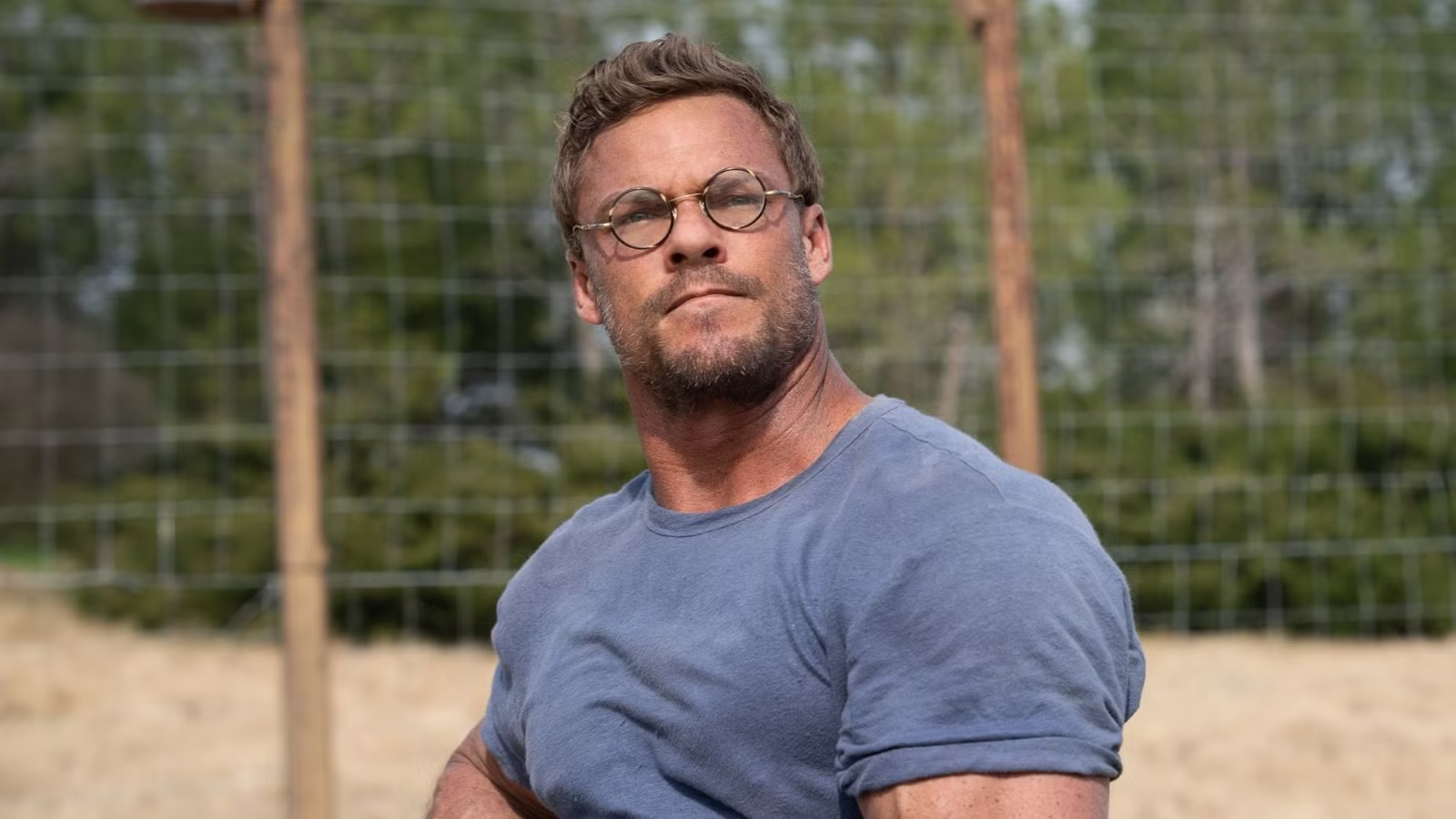


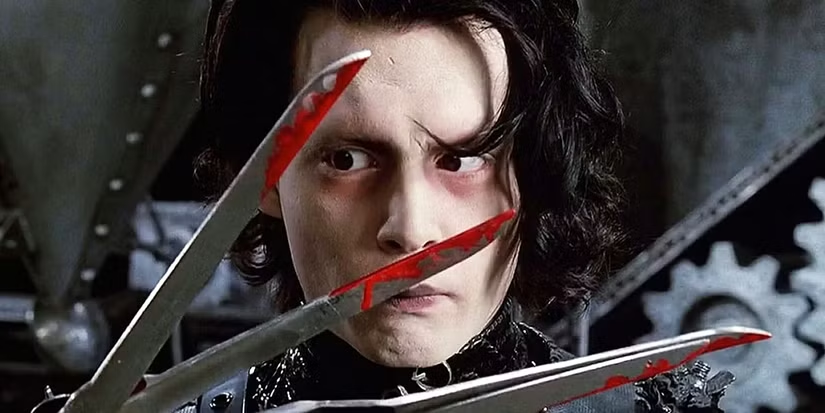








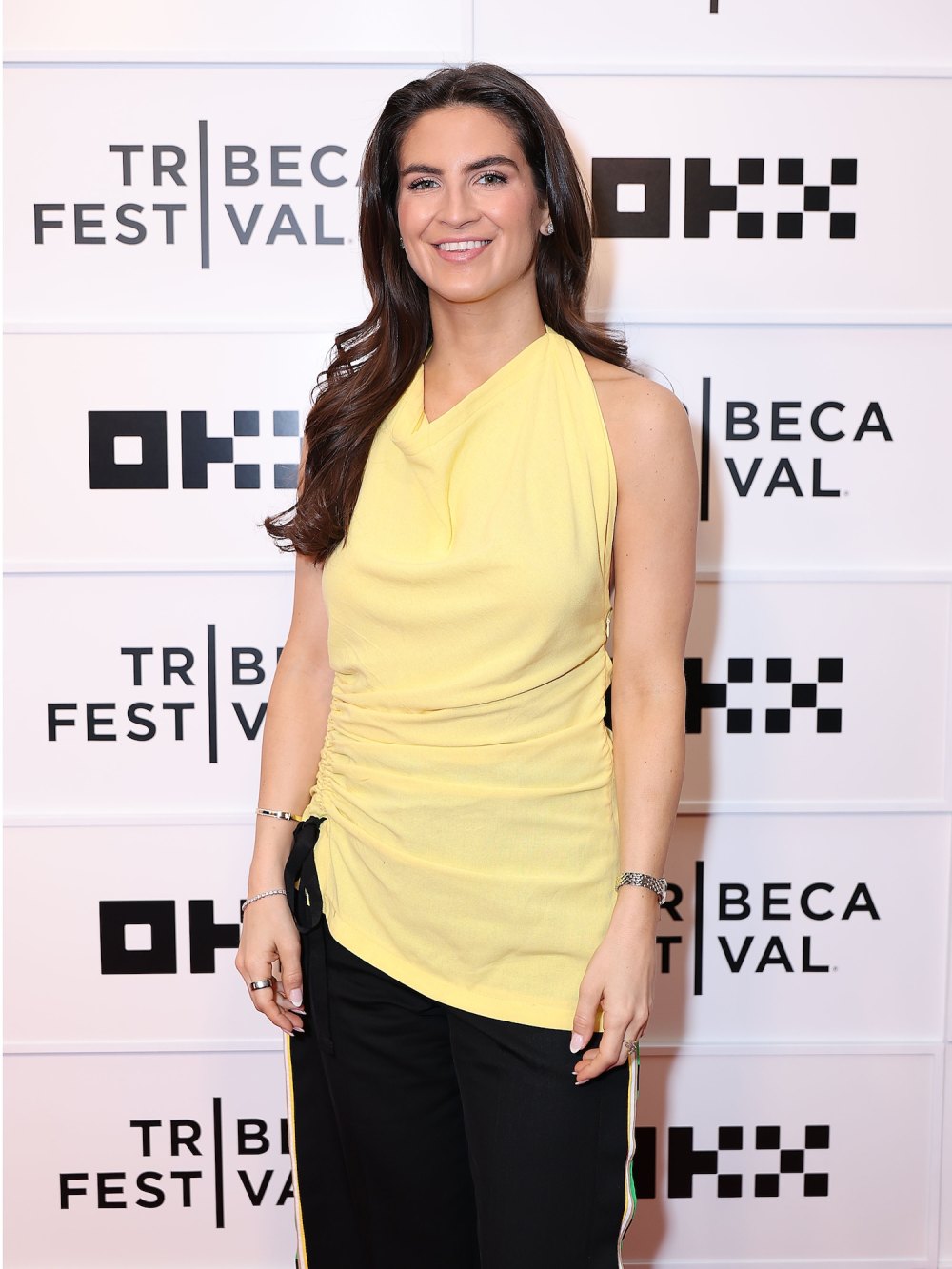
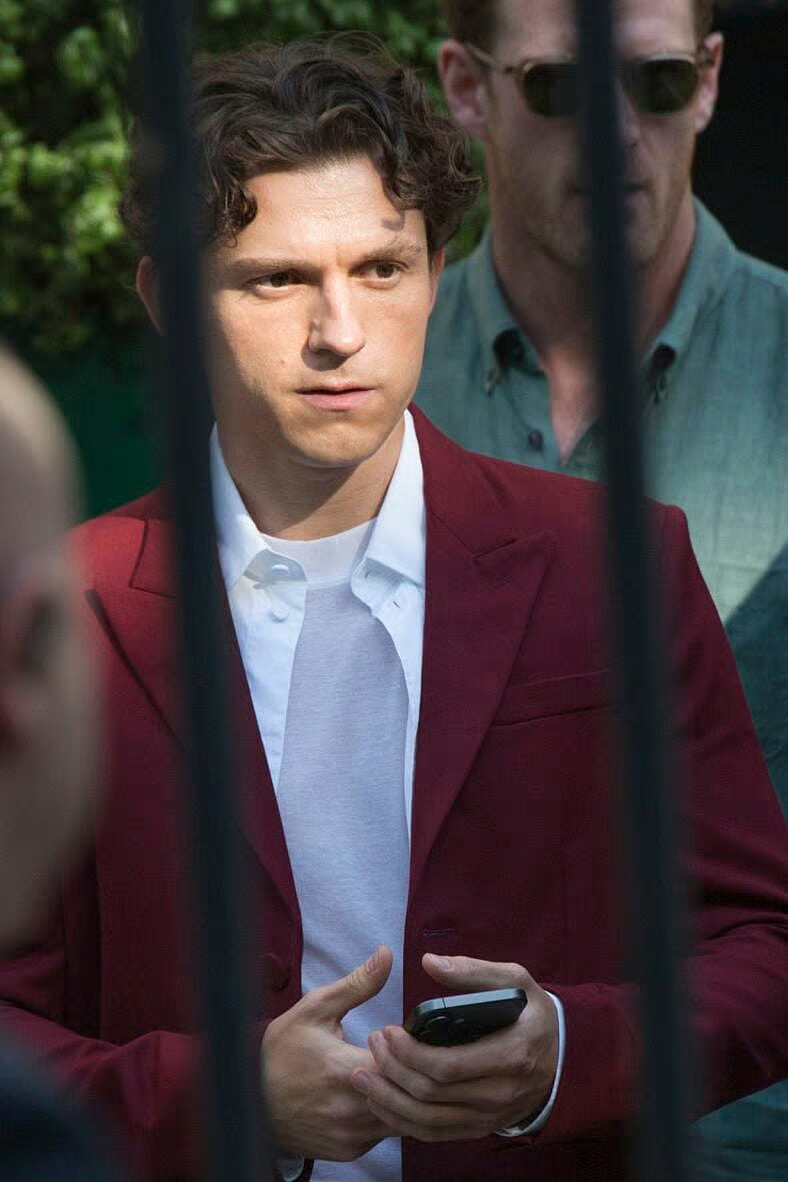


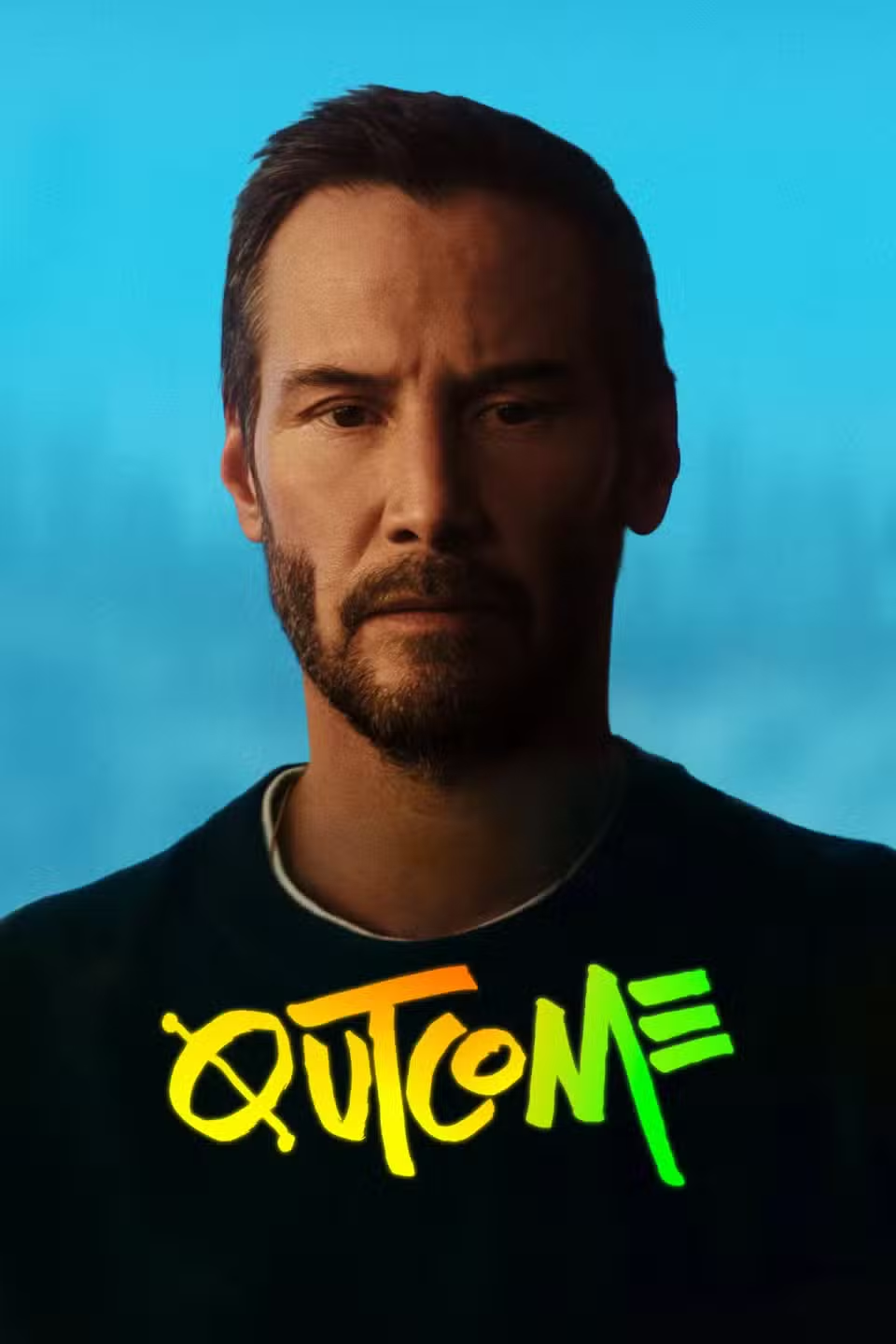

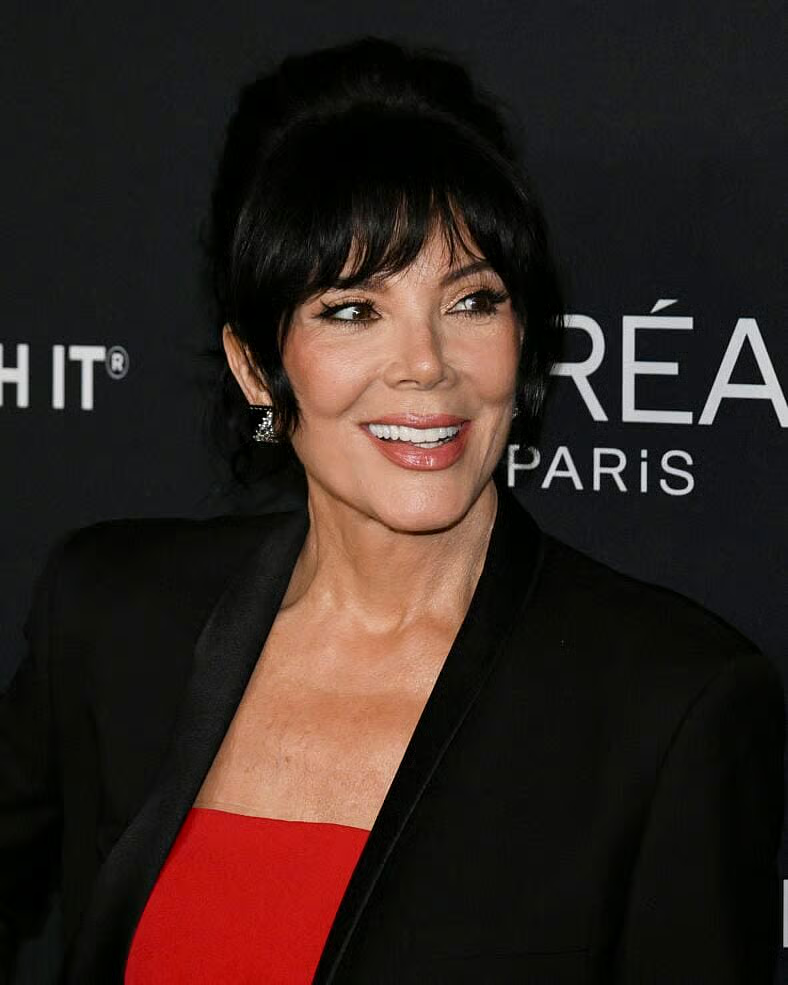
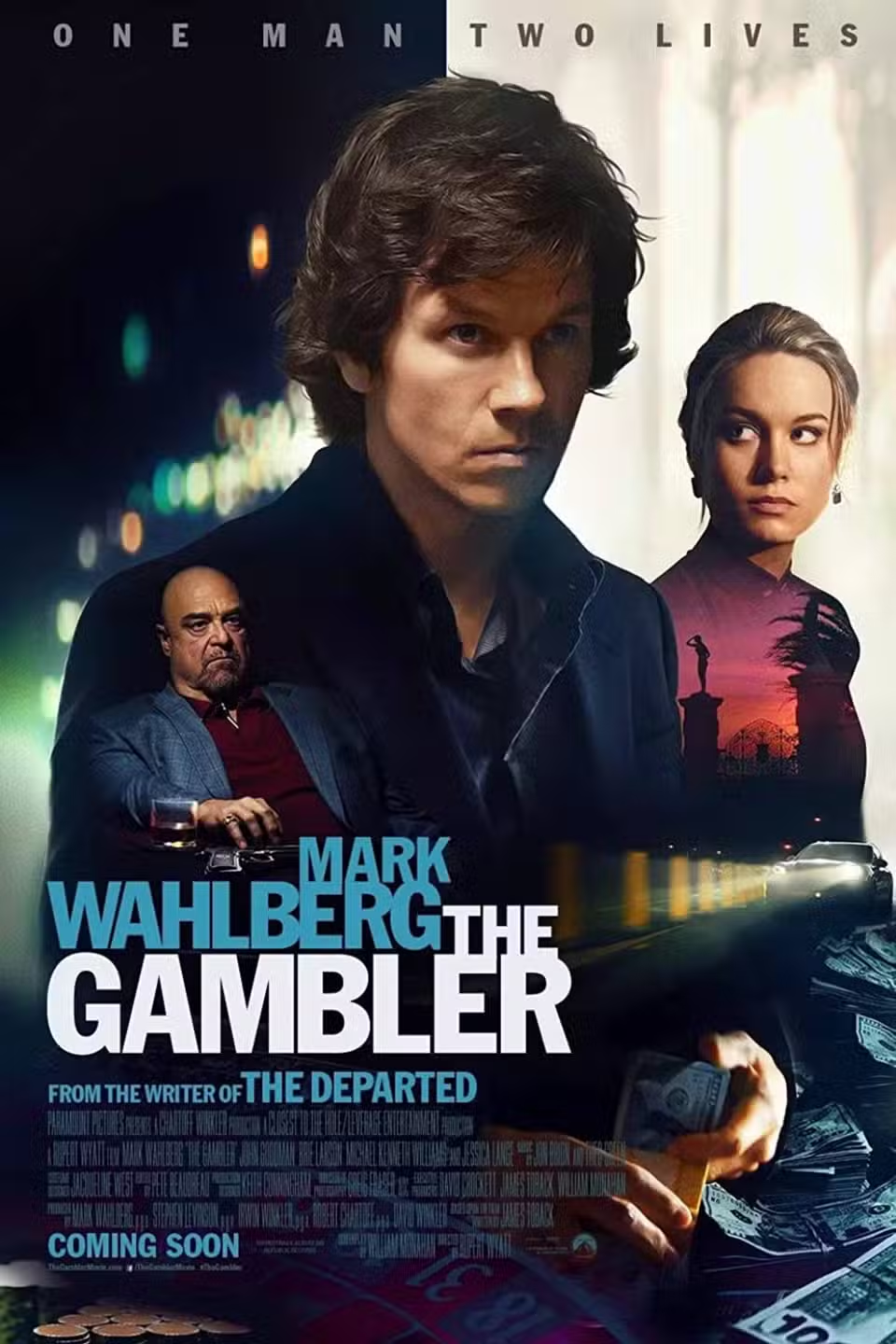

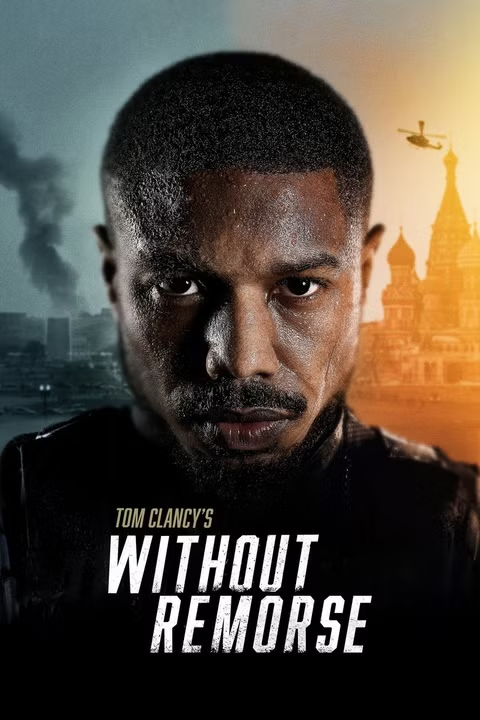

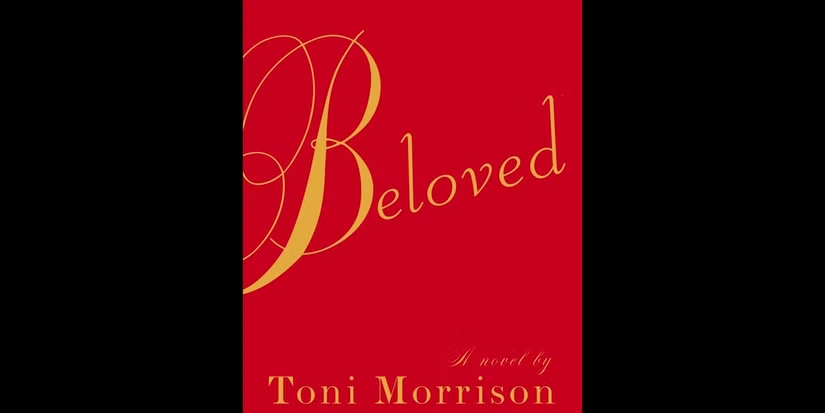


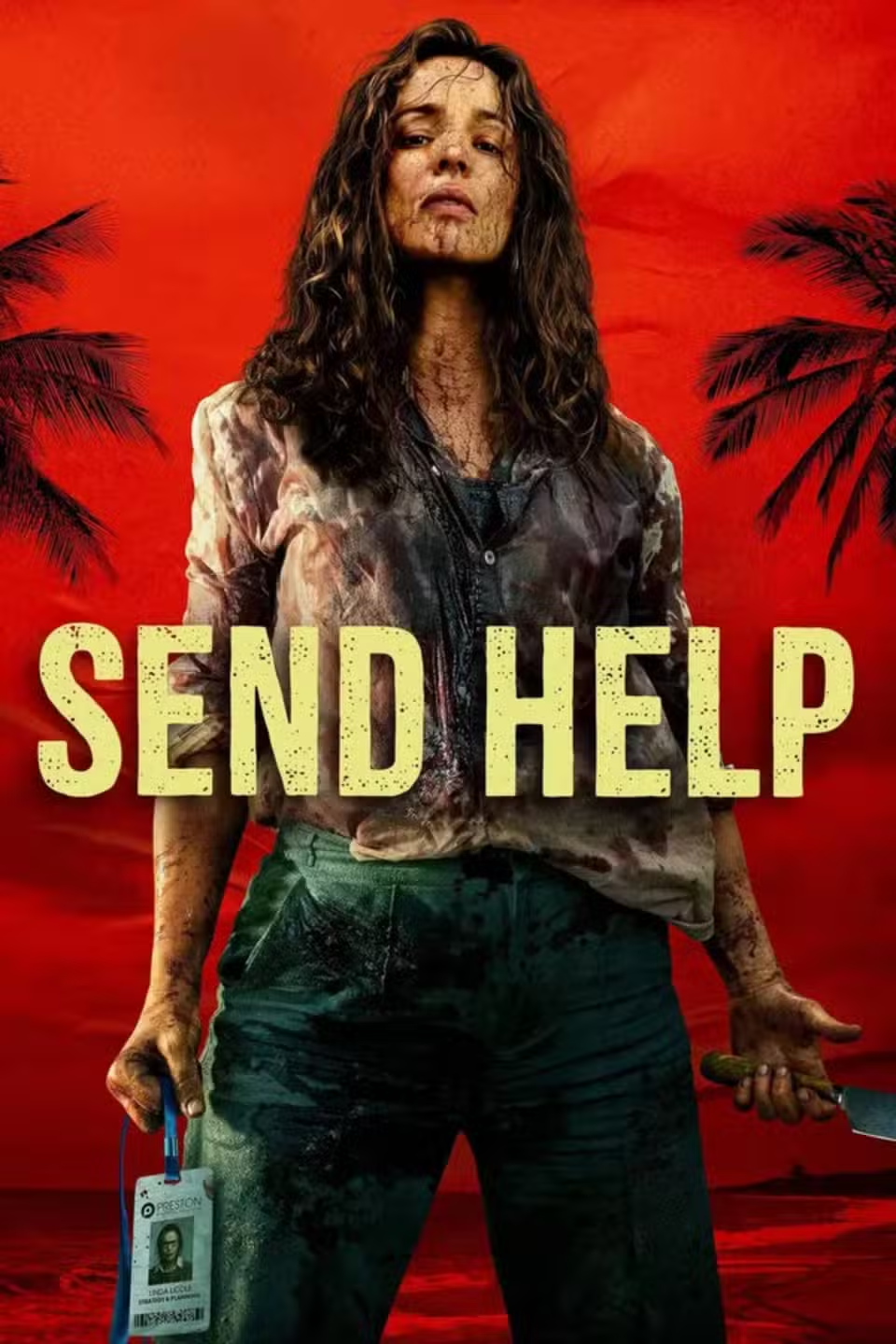




































You must be logged in to post a comment Login