A man in Los Angeles died Friday night after cutting off his own genitalia … TMZ has confirmed.
The Los Angeles Police Department received a call about a man harming himself in Downtown Los Angeles around 3:40 AM.
Advertisement
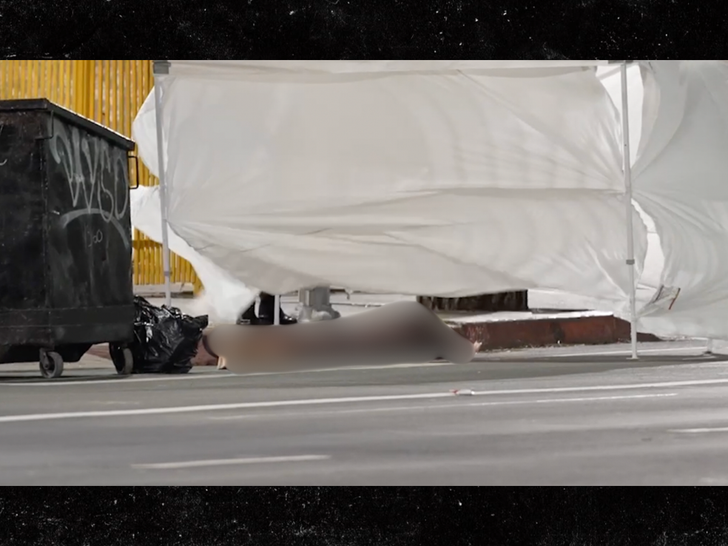
After arriving on the scene, they set up a white tent to keep onlookers from seeing the man’s body … though a videographer at the scene captured pools of blood staining the sidewalk.
Law enforcement sources tell TMZ … the man cut off his penis, sliced his throat and stabbed himself with a sharp instrument. We’re told he also tried to cut off his arm.
Advertisement
It’s unclear at this time what he used to harm himself. Officers also do not know the man’s motivation … or if he was on drugs at the time.
Advertisement
If you or someone you know is struggling or in crisis, help is available. Call or text 988 or chat 988lifeline.org.
Maggie Gyllenhaal’s The Bride! is set in 1936 Chicago, but takes inspiration from Mary Shelley’s renowned Frankenstein novel, published in 1818. The events of Frankenstein have actually occurred, but Mary Shelley’s existence is also a part of the same timeline.
Frankenstein’s monster (Christian Bale) goes by Frank in the film and has become hopelessly lonely over the past century and some change. He craves companionship and the stinkiest form of sex since The Bride! goes out of its way on multiple occasions to point out how much Frank smells.
“The Bride! is a two-hour hodgepodge of dancing, movie-obsessed nonsense.”
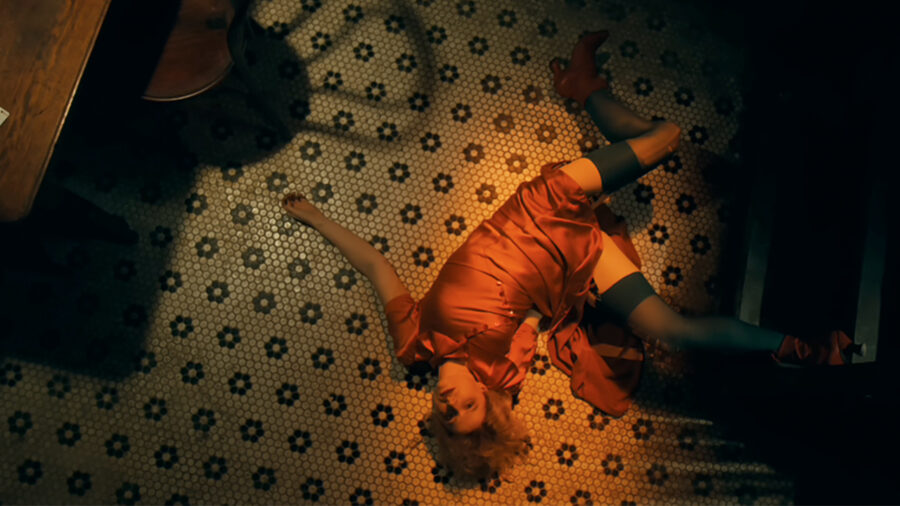
A woman named Ida (Jessie Buckley) dies after making a scene at a restaurant. Ida’s husband Clyde (John Magaro) works for a mob boss named Lupino (Zlatko Buric), and all of these factors play into how Ida dies. Frank seeks help from Dr. Cornelia Euphronius (Annette Bening), a scientist.
Euphronius’ research and publications have led Frank to believe that she could create a mate for him. The two of them dig up Ida’s body and bring her back to life, but Ida has no memory of who she used to be or even what her name is. Frank spends the entirety of the film trying to convince her to stay with him for eternity, while the bride just wants to discover her own identity.
The Bride! has a lot going on with its narrative, and there’s even more to divulge. Det. Jake Wiles (Peter Sarsgaard) and his assistant, Myrna Mallow (Penelope Cruz), are the ones investigating Frank and his bride as they travel from Chicago to New York. Frank has a fascination with movie theaters and movies in general, particularly any film with singing, dancing, and starring Ronnie Reed (Jake Gyllenhaal). The bride’s actions, mostly seen as a woman in 1936 exercising independent thought, spark a female movement that not only inspires them but also prompts women to dress like her and copy the black marks on her face and the rest of her body.
Advertisement
“Christian Bale is pure excrement as Frank.”
Who Ida has become as the bride, and what happens right before her death, are important yet highly spoilerish. Ida is now this split person, and that concept triggers this truly unhinged performance from Jessie Buckley.
The script is borderline atrocious with Buckley spewing a never-ending line of synonyms at the top of her lungs as if she’s about to crap out every edition of The Merriam-Webster Thesaurus right there in the back alleys of Chicago. Something is trapped within her that will seemingly never leave or escape. This is all happening while she struggles to remember who she is. Buckley has a mesmerizing on-screen presence, even if the gibberish she’s saying makes you fight the urge to turn away.
I take no joy in saying that Christian Bale is pure excrement as Frank. The character is written as a feeble monstrosity ashamed to exist, and it feels like Bale takes the role too seriously for it to work.
“The script is borderline atrocious with Buckley spewing a never-ending line of synonyms at the top of her lungs as if she’s about to crap out every edition of The Merriam-Webster Thesaurus.”
The character is somewhat intriguing at first, but slowly morphs into Jared Leto as Joker in the Suicide Squad version of Frankenstein’s monster. Yes, he licks the bride’s black vomit (it’s like brought-back-to-life phlegm or something), he also has sex with her while getting a tattoo of her “name” on his chest, while knowing it isn’t her actual name.
The Gothic romance film can’t really decide what type of film it wants to be. Apart from an American History X curb stomp and the biting off of someone’s tongue, The Bride! is not a horror film. Its few moments of comedy aren’t funny, and nothing in the film is entertaining. The film feels like it’s trying to have some sort of female uprising moment, but the sexual violence in the film kills that momentum at nearly every turn. It may be accurate for the time period, but it doesn’t really add anything to the film as a whole.
The film also builds up Myrna’s big moment as a detective, trying to get recognized as one and going out on her own. The concept is literally introduced in her first scene. Just as that recognition seems within her grasp, she ultimately lets it slip away in the final sequence, leading to a familiar, expected ending.
Advertisement
“Nothing makes a monster movie come together like a bunch of Goddamn dancing.”
Several characters in The Bride! are just as wishy-washy as the storytelling. Halfway through the film, the bride contemplates whether or not being with Frank is what she wants, and there’s this giant standoff where someone gets shot, and she goes off with Frank anyway. This is all after she made a point to thrust Frank’s underpants monster into her mouth, and after they’ve had a bunch of sex anyway.
Nothing makes a monster movie come together like a bunch of Goddamn dancing. Frank and the bride bounce from movie theater to movie theater after every crime they commit. One sequence sees Jake and Myrna go to one theater while Frank and the bride literally go to one across the street; splitting up to cover both theaters apparently wasn’t an option. Frank also bounces around to Ronnie Reed’s pictures. How it takes so long for this detective, and his secretary (that’s what she starts off as), for them to catch up to Frank and the bride is legitimately mind-boggling.
Every time Frank watches a movie, he imagines himself in the picture, usually dancing or singing. The drive-in sequence is bizarre, though, since everyone there can hear Frank and the bride’s dialogue that was previously seemingly only in his head. Slight spoiler, but Frank gets shot at one point and refuses to go to the hospital. The bride scoffs at the idea and takes him to a movie instead. You can bleed out somewhere where Mommy can fetch some Sour Patch Kids.
Maggie Gyllenhaal is going for something here, but the problem is that The Bride! has far too many things going on at once and never capitalizes on any of them; even the romance isn’t constant. The idea of these two born-again corpses having nothing together is this half-baked idea drowned out by Frank’s sobbing dick and the bride constantly reminding everyone with a pair of eyes and working ears that she’s an entitled, calamitous shrew. The Bride! is a two-hour hodgepodge of dancing, movie-obsessed nonsense.
The Bride! is now playing in theaters everywhere. Stay home and watch any other version of Frankenstein instead.
Jennifer Lopez opened up about how her divorce from her third husband, Marc Anthony, made her want to “give up” during a monologue on opening night of her Las Vegas residency.
The singer has reportedly been working extra hard to bring her new shows to life, as a source notes she’s looking to rewrite the narrative surrounding her in Hollywood.
Jennifer Lopez also recently shared that she’s now in her “happy era” following the dissolution of her marriage to Ben Affleck.
Article continues below advertisement
Advertisement
Jennifer Lopez Reveals She Almost Gave Up After Her Third Divorce
Anna Pocaro/imageSPACE / MEGA
Lopez showed her vulnerable side to her fans on the opening night of her Las Vegas residency, “The JLo Show: Up All Night,” as she discussed a moment in her life where she almost gave up hope.
Before belting out some of her greatest hits, the 56- year- old singer stood on stage and told fans that she was ready to “give up on it all” after she and her then-partner, Marc Anthony, split.
“After my third divorce – that’s when I really started getting good at it,” she said, per the Daily Mail. “Seriously, that’s not funny.”
She continued, “It was actually a really tough time. I was really about to give up on it all. I mean, I was a single mom with two three-year-old twins.”
Article continues below advertisement
Advertisement
Lopez and Anthony were married for seven years, and share 18-year-old twins Emme and Max. They announced that they had gone their separate ways in July 2011, but it wasn’t finalized until June 2014
Article continues below advertisement
The Singer Shared The Powerful Advice Her Late Mentor Gave Her
During the show, Lopez dished about the advice that helped her stay strong and focused after her divorce from Anthony,
“I called up one of my mentors. Her name was Louise Hay. Some of you might know who she was. She passed away. But she said to me, ‘Jennifer, you’re a dancer, right?’ I said, ‘Yes, I am.’ She said.
Advertisement
“‘When you’re learning a dance, and you get the steps wrong, what do you do?’ I said, ‘I just keep going until I get the steps right,’ And she said, ‘That’s right, Jennifer. Always keep dancing.’”
“And I wish the same for each and every one of you that no matter what life throws at you, that you dance and you dance and you dance again and again and again. I love you so much!” she noted as she paced the stage in her glittery gown with her feathery wrap trailing by her heels.
Article continues below advertisement
Jennifer Lopez Is Working Overtime To Deliver A Spectacular Show For Her Fans
MEGA
Meanwhile, insiders claim the “Hustlers” actress has been working 13-hour days just to ensure everything goes smoothly.
“Jennifer is rehearsing night and day to make sure the show is spectacular, better than ever,” a source told the news outlet.
Advertisement
“She is working 13-hour days at a studio in North Hollywood with her backup dancers to make certain she looks like she is on top of her game. She always says she wants to be ‘better than yesterday,’ it’s her thing,” the insider shared.
Article continues below advertisement
The Actress ‘Loves To Work’ And ‘Never Complains’
MEGA
The insider further claimed that Lopez is working hard on her new Las Vegas show in order to clear the doubts that she has passed her prime and can’t bring the roof down anymore.
“Everyone is going to the Sphere these days; that is the town’s big deal, so she wants to prove that a more old-fashioned concert at the Colosseum is still the place to be,” the source said, “Jennifer loves to work; she never complains, it’s her jam.”
They added, “Some people like to vacation on the beach in Hawaii, and some like to work nonstop. Jennifer is the latter. She feels proud to be doing so well at her age and as a Latina woman.”
Advertisement
Jennifer Lopez Is In Her ‘Happy Era’
Xavier Collin/Image Press Agency/MEGA
Lopez recently expressed how grateful she is to her fans and thanked them for standing by her all these years.
During a chat with Extra, the actress revealed she is in a better state of mind and feels “fortunate” to have her fans.
“I’m in my happy era, and I have that in the show. I’ve never looked at it as a job. It’s just what I love to do,” Lopez said,
She continued, “And I just feel fortunate that I have these amazing fans who’ve supported me for so many years, and there’s so much love that I feel that I always want to be giving the love back to them. It’s just been an incredible blessing in my life. I don’t know what I would do without it.”
The recently released Oscar contender Hamnet concludes with a scene that is scored to Max Richter‘s moving piece “On the Nature of Daylight.” The track was first released in 2004 and has since become something of a favorite across media; it can be heard in trailers, commercials, and other films. In Hamnet, it plays during the climactic scene in which Jessie Buckley‘s character finally begins to process the grief of her husband, William Shakespeare, while watching his play Hamlet. But this isn’t the most memorable use of the track in cinema. “On the Nature of Daylight” became iconic as a motif in one of the most touching sci-fi movies of the century, a movie that was both a critical and commercial hit and is celebrating its 10th anniversary this year.
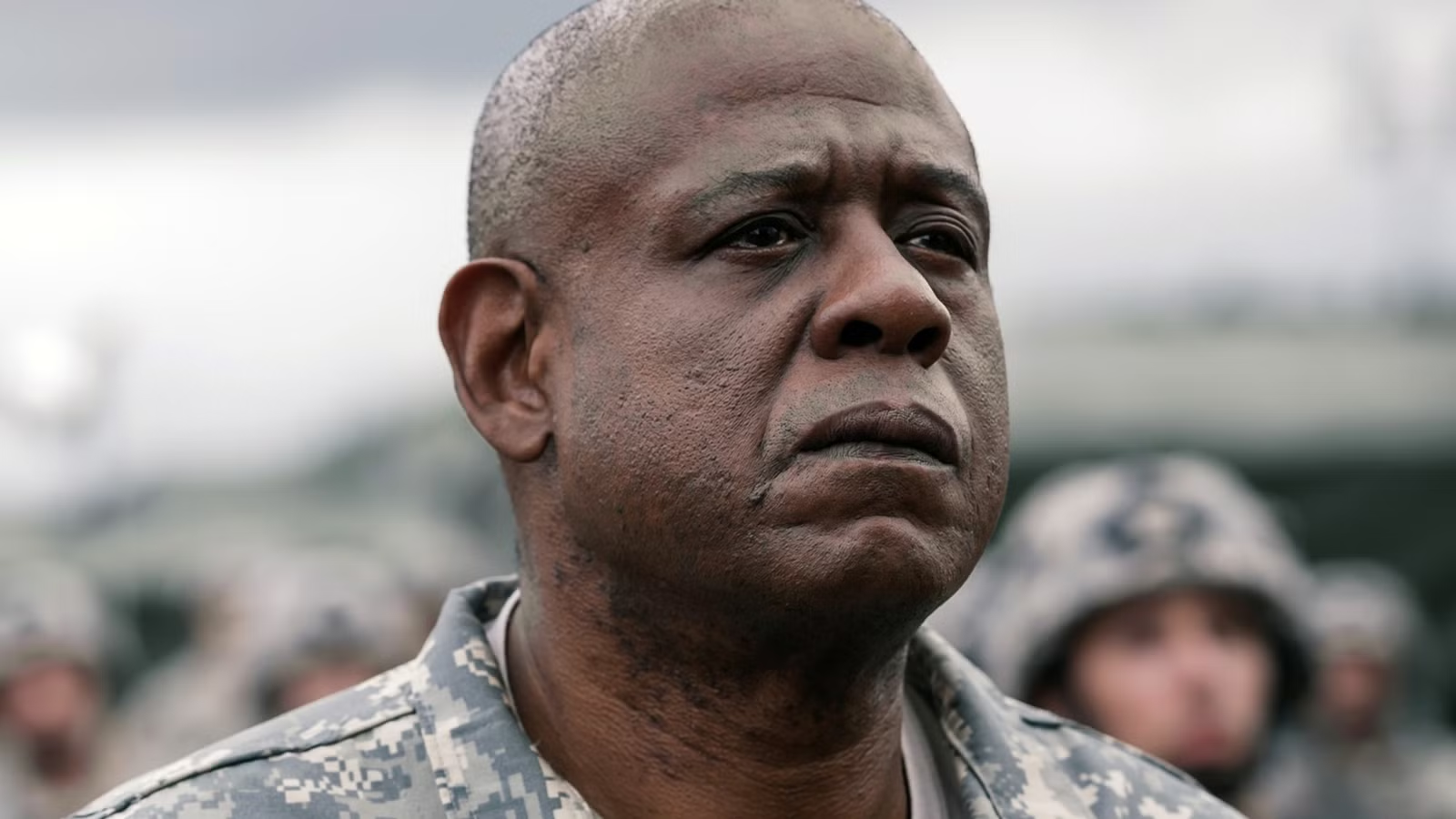
Like Hamnet, the film in question dealt with the impossibly complex theme of losing a child. It starred Amy Adams, Jeremy Renner, and Forest Whitaker, and followed a linguist’s first interactions with alien lifeforms. The film was widely acclaimed, and served as a launchpad for director Denis Villeneuve to tackle bigger sci-fi projects such as Duneand Blade Runner 2049. He has since gone on to direct Dune: Part Two, and is preparing for the release of Dune: Part Three later this year. Villeneuve will subsequently move on to direct the James Bond reboot for Amazon.
Can you answer these movie questions, wherein each correct response begins with a successive letter of the word “Collider”?
Advertisement
Here’s the Sci-Fi Masterpiece That’s Streaming for Free
His generational streak began in Canada, where he made a handful of French-language films before moving to Hollywood and making his debut with the thriller Prisoners. The sci-fi follow-up, of course, is Arrival. Released in 2016, the film grossed more than $200 million at the worldwide box office against a reported budget of almost $50 million. Arrival holds a “Certified Fresh” 94% score on the aggregator website Rotten Tomatoes, where the critics’ consensus reads, “Arrival delivers a must-see experience for fans of thinking person’s sci-fi that anchors its heady themes with genuinely affecting emotion and a terrific performance from Amy Adams.” The movie was nominated in eight categories at the Oscars, including Best Picture, but Adams was shockingly snubbed. She has been nominated six times in her career.
Arrival is currently streaming for free in the United States on the Pluto TV service. Stay tuned to Collider for more updates.
Advertisement
Advertisement
Release Date
November 11, 2016
Runtime
116 minutes
Advertisement
Director
Denis Villeneuve
Advertisement
Writers
Eric Heisserer
Producers
Advertisement
Aaron Ryder, David Linde, Karen Lunder, Shawn Levy, Dan Levine, Dan Cohen
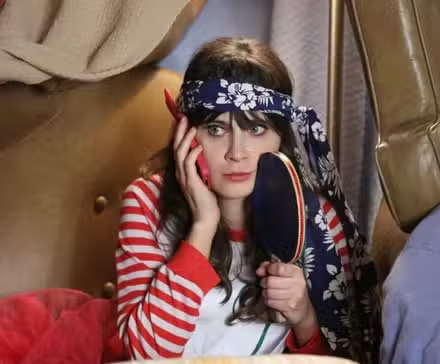
There is a wide variety of sitcoms available on streaming, but nothing is quite like New Girl. Starring Zooey Deschanel, the series began in 2011, but 15 years later, it is just as incredible as it was when it originally aired. The concept is simple: Jess (Deschanel) moves into a new apartment with Nick (Jake Johnson), Schmidt (Max Greenfield), and Winston (Lamorne Morris). However, it’s that simplicity that’s key, as it easily sustained the sitcom for seven seasons.
Many shows become stale as they go on, but the Fox seriesavoided that fate with many memorable episodes in the later seasons, particularly New Girl‘s ending. Its relatable story and lovable characters truly make the show a classic, placing this series in rare company.Even while many comedies age poorly, New Girl remains as hilarious as ever.
Advertisement
‘New Girl’s Characters Get Better Each Season
New Girl begins by creating an unlikely group of friends as Jess moves into apartment 4D. Contrasting personalities provide many conflicts and keep the story moving, offering moments for each resident to take center stage. From Nick and Schmitt’s argument about showing affection that leads to Nick’s cookie-related breakdown to Winston’s reaction to Jess believing she’s hiding meth during his police background check, the conflicts among them are unpredictable and endless, but never cross the line into toxic friendships.
Not only are Jess, Nick, Schmidt, and Winston a unique blend of personalities, but the strong friendships that develop among them are unbeatable. Nick and Schmidt are one of the best TV duos, but Winston and Jess are never left out, nor is Coach (Damon Wayans Jr.) when he lives with them, or even Cece (Hannah Simone). In fact, Winston and Cece become an unlikely duo of their own, providing “Classic Winston-and-Cece mess arounds” throughout the series. Because each friendship offers a distinct dynamic, different combinations keep the story fresh even as the series goes on.
Another way the series prevents itself from getting repetitive is by letting the characters evolve. Schmidt goes from a womanizer in need of the “douchebag jar” to a loving husband and father. Nick slowly gets his life together, chasing his passion by publishing his novel. Even if the concepts are repetitive, like Jess and Nick’s on-and-off relationship, the characters’ growth makes each iteration different, which keeps the audience engaged.
‘New Girl’ Deserves Its Continued Success 8 Years After It Ended
The series may have wrapped up in 2018, but it remains popular to this day, finding considerable success on streaming. Max Greenfield acknowledged the show’s popularity, saying, “It’s the perfect binge show.” Now that the show is easily accessible, new fans seem to be latching onto it all the time, proving that the show has aged well.
Advertisement
New Girl remains so funny because it is relatable, even years after its run. The characters are not only quirky, but they face problems that most adults have experienced both in their personal and professional lives. They struggle to find the right careers, and Winston, in particular, tries many things before he realizes his passion. Jess has storylines about asking for a promotion and starting a job in a drastically different environment. In their personal lives, each character has failed relationships, which provide a myriad of romantic problems people can easily see themselves in. More broadly, the characters are constantly learning to deal with conflict and communicate with difficult people, which often includes each other. New Girl deserves every bit of attention it has received, both during and after its seven-season run.
Advertisement
Release Date
Advertisement
2011 – 2018
Network
FOX
Advertisement
Showrunner
Elizabeth Meriwether
Advertisement
Directors
Trent O’Donnell, Jay Chandrasekhar, Max Winkler, Fred Goss, Jesse Peretz, Steve Welch, Lynn Shelton, Josh Greenbaum, Russ T. Alsobrook, Bill Purple, Christine Gernon, Lorene Scafaria, Michael Schultz, Peyton Reed, Tristram Shapeero, Eric Appel, Alec Berg, Jason Winer, Michael Spiller, Steve Pink, Alex Hardcastle, Andrew Fleming, Craig Zisk, Daniel Attias
Writers
Advertisement
Berkley Johnson, Kim Rosenstock, Rob Rosell, Matt Fusfeld, Alex Cuthbertson, David Feeney, Nina Pedrad, Rebecca Addelman, Kay Cannon, Sarah Tapscott, Joe Wengert, Ethan Sandler, Adrian Wenner, David Iserson, Nick Adams, David Walpert, Lamar Woods, Veronica McCarthy, David Quandt, Joni Lefkowitz, Lamorne Morris, Rachel Axler, Christian Magalhaes, Robert Snow
“It is with profound sorrow that we share the sudden passing of Jeff’s fiancée and partner of 10 years, Stephanie,” a social media statement from a spokesperson for Buttermore’s fiancé, Jeff Nippard, read. “As many of you know, Stephanie meant the world to Jeff.”
The statement continued, “She will be remembered for her warmth and compassion, her love for her family and her Ph.D research on ovarian cancer. We kindly ask for privacy as we navigate this tragic loss. Thank you for your understanding and support during this difficult time.”
A cause of death was not immediately revealed for Buttermore, who got engaged to bodybuilder Nippard in 2022 after six years of dating.
Fitness influencer Stephanie Buttermore has died. She was 36. “It is with profound sorrow that we share the sudden passing of Jeff’s fiancée and partner of 10 years, Stephanie,” a Friday, March 6, Instagram statement from bodybuilder Jeff Nippard’s team read. “As many of you know, Stephanie meant the world to Jeff.” The statement continued, […]
Keep scrolling to learn more about Buttermore’s life and legacy:
Advertisement
Stephanie Buttermore Was a Fitness Educator and Social Media Star
Stephanie Buttermore was an influencer with more than 528,000 Instagram followers and 1 million YouTube subscribers at the time of her death. She shared content about fitness training, nutrition, beauty and other lifestyle subjects.
Stephanie Buttermore Researched Ovarian Cancer
Long before Stephanie Buttermore started posting on social media, she received her Ph. D and worked as a cancer scientist.
“I obtained my Ph.D. in pathology and cell biology with a focus on the molecular mechanisms that drive ovarian cancer progression,” a biography on her YouTube page reads. “I mix science and fitness into all facets of life. I currently do cancer research but LOVE to workout and eat good food.”
Stephanie Buttermore Was a Proud Advocate of Body Positivity
“I heard every fat-phobic slur under the sun when I gained weight,” Buttermore wrote via Instagram in March 2023, alongside a handful of swimsuit photos. “But, you know what, I look back at these pictures like DAMNNN … I was HAWWWT 🔥.”
She added, “The sentiment of ‘F the haters’ never personally worked for me. I mean, I wish it did, it would make life so much easier. I prefer to just focus on me, my goals and giving my energy to those who deserve it.”
Months later, Buttermore proclaimed via social media that she felt “super happy and comfortable” in her skin.
“I can live my life eating intuitively and my body feels naturally settled here,” she captioned a May 2023 upload.
Advertisement
Stephanie Buttermore and Jeff Nippard Were Together for 10 Years Before Her Death
Jeff Nippard and Stephanie Buttermore.Courtesy of Jeff Nippard/ Instagram
Stephanie Buttermore started dating bodybuilder Jeff Nippard in 2016 after he slid into her DMs. After six years of dating, Nippard proposed in October 2022.
“We got along like best friends right away because we established a foundation of shared interests and values from the beginning,” Nippard gushed via Instagram at the time. “We grew together as we learned from each other, travelled the world together, always supported each other, and used the power couple equation to build each other up in so many different ways.”
Stephanie Buttermore Took a Social Media Hiatus Ahead of Her Death
Stephanie Buttermore took a step back from posting content on Instagram in the years preceding her death.
Thank You!
You have successfully subscribed.
Advertisement
“My mental health has been the best it’s ever been,” Buttermore noted in a May 2024 Instagram post about her online hiatus. “I no longer struggle with anxiety. At all. It was almost crippling a few years ago to the point I felt I couldn’t breathe or leave my house. Now I really don’t have to care whether people liked what I posted or if they are saying negative things about me.”
Leaving Instagram behind also allowed Buttermore to focus on her relationships.
“When I’m with my family or Jeff, I’m much more immersed in the moment,” she said. “I take photos for the sake of saving memories and not because I’m going to post it on my story. I never get caught not listening to someone because I’m checking comments, and I’m in a better mood because I’m not anxious. Family time is family time.”
Science fiction is often at its best when it’s a mirror of our own world, and there is no shortage of great books, films, and series that prove it — but what if, instead of a mirror, we could see what could have been? That’s what Apple TV’s best sci-fi series, For All Mankind, is all about.
With Season 5 premiering later this month and a spin-off set to bow in May, For All Mankind has arguably the single best premise in modern sci-fi: what if the space race never ended? The simple answer is that the world would look different, but the series goes beyond, looking at possible ramifications and providing a much-needed optimistic outlook on the potential our own world still has.
Advertisement
What Is ‘For All Mankind’ About?
It’s June 1969, and everyone is glued to their TV screens watching Soviet cosmonaut Alexei Leonov. The USSR has beaten the United States to the moon by a full month, planting its flag on the surface and irrevocably taking the lead in the space race. This simple historical twist turns For All Mankind‘s alternate history upside down, since, in reality, the Soviets never reached the moon, and the space race ended six years after the Apollo 11 mission.
However, For All Mankind rewrites history; with the Soviets in the lead, the pressure is now on the U.S. not just to catch up, but actually to overtake them, since they missed all the important “firsts,” and being the runner-up essentially equals second place in the Cold War. So, the U.S. government begin to consider NASA’s space program a priority, determined to beat the USSR to other milestones in space. In other words, this defeat ultimately has a positive effect, as it drives American scientists and astronauts to go beyond what the Soviets have already achieved.
Each season of For All Mankind takes place in a different decade, tweaking some important historical milestones and adding others. It’s impossible for the series to skip a few key moments in the space race, such as Neil Armstrong’s moon landing, but they end up being very different from how they historically happened. Other projects, like the Sea Dragon, do see the light of day in the series, serving as a reminder of everything that could have been accomplished, but ultimately wasn’t.
In ‘For All Mankind,’ the Whole World Benefits From Space Exploration
With so much funding and attention being directed to NASA and space exploration, technology is developed not only at a much faster pace, but also in completely different directions in For All Mankind compared to what has happened historically. One mission is quickly followed by another, forcing engineers to get creative and find alternatives that eventually find their way into day-to-day life. In that sense, the series’s alternate world looks closer to what science fiction writers imagined the future would look like decades ago.
Advertisement
Another major difference is how important and easily widespread green energy has become. Cars are mostly electric in For All Mankind, thanks in no small part to improvements made through space exploration. Mining missions have also made this process much cheaper and easier down on Earth, with access to alternative energy sources becoming a financial and political issue. The space race takes place simultaneously with the consolidation of the nuclear age, and that plays a major role in decisions concerning the whole world, especially those at the bottom of the societal chain.
Progress Isn’t Limited to Space and Technology in ‘For All Mankind’
Astronauts stand on a dusty, barren landscape and look out to the distance in For All Mankind.Image via Apple TV+
One of the best parts of every new installment of For All Mankind is the quick reel that plays at the beginning of the premiere, showing what has happened in the world between seasons. It situates the audience in the series’ current time period, but also offers a sense of just how much has changed thanks to everything that happened previously. As one can imagine, reaching the moon first has a profound impact on Soviet politics, renewing their strength and turning them into a much more powerful global player.
Advertisement
However, U.S. politics arguably change the most. The Soviets know all about their rivals’ civil rights and equality struggles at the dawn of the space age, and take advantage of that by adding more “firsts” to their accomplishments. Again, this forces the U.S. to catch up and reshuffle its departments on pretty much every level to address representation. Women achieve leadership positions that, in our world, hardly ever go beyond speculation, and civil rights quickly become as important an issue in space as they are on Earth.
With For All Mankind‘s space race reaching well beyond its real-life limits, the series also incorporates contemporary aspects of space exploration, like the role of corporate players. Important as it is, NASA is still a government agency, and, just like in the real world, the private sector takes an interest in space, becoming a contender in itself as the race continues. All that makes For All Mankindthe best modern work in the alt-history subgenre of sci-fi, as well as inspiring and honest about the possibilities in our own future.
Disaster movies have always thrived on one simple promise: Go big, then somehow get even bigger. Few filmmakers understand that formula better than Roland Emmerich, the director behind end-of-the-world spectacles like Independence Day and The Day After Tomorrow. By the time Moonfall arrived in 2022, though, Emmerich wasn’t just trying to top himself — he was practically trying to launch himself into orbit.
That’s exactly why Moonfall has become such a strange kind of modern favorite. Four years later, the movie’s sheer commitment to chaos, nonsense, and go-for-broke sci-fi insanity has helped it earn the kind of reputation most polished blockbusters can only dream of. Now, that beautifully unhinged experience is even easier to revisit, because Moonfall is now streaming free on Fawesome.
The film stars Halle Berry as former astronaut and NASA executive Jo Fowler, Patrick Wilson as disgraced astronaut Brian Harper, and John Bradley as conspiracy theorist K.C. Houseman, whose oddball theories turn out to be a little more useful than anyone expected. The supporting cast includes Michael Peña as Tom Lopez, Charlie Plummer as Sonny Harper, Kelly Yu as Michelle, Donald Sutherland as Holdenfield, Eme Ikwuakor as Doug Davidson, and Carolina Bartczak as Brenda Lopez.
Daylight Saving Time starts this weekend. Before we lose an hour of sleep, here’s a quiz about movie titles that contain Daylight, Saving, or Time.
Advertisement
So, How Bad Is ‘Moonfall’?
Patrick Wilson in MoonfallPatrick Wilson in MoonfallImage via Lionsgate / Courtesy Everett Collection
Collider’s review statedthat Moonfall sees director Roland Emmerich once again leaning into the global destruction spectacle that has defined much of his career — but this time the formula feels tired, repetitive, and far less impressive than his previous disaster epics. Ross Bonaime adds that the premise is as ridiculous as it sounds, and to the film’s credit, Emmerich seems aware of that absurdity. As the moon drifts closer, it looms ominously over the planet like a slow-moving horror villain. Its shifting orbit causes massive disasters — tidal waves, earthquakes, and volcanic eruptions — creating the familiar sense that global catastrophe is imminent.
“But even compared to Emmerich’s previous apocalyptic action films, Moonfall is more rinky-dink and on a smaller scale than we’ve seen from him. Films like Independence Day and 2012 had a massive scope to them, and even a film like White House Down showed that Emmerich could make an enthralling action film with a smaller focus. Yet Moonfall is the type of film that requires that sort of insane, over-the-top production, and it never quite reaches that point.
Moonfall, unfortunately, becomes a mixture of Emmerich’s usual clichés that are starting to show their age, a script that only occasionally embraces the insanity of this idea (even though the third act goes all-in on getting mind-numbingly stupid), and a scope that doesn’t do this story justice. Maybe it’s just time for Emmerich to finally leave the world alone.”
Before Jason Statham fully settled into his modern action-star groove, he led a different kind of crime movie — one with less brute-force chaos and more old-school heist tension. It had the swagger you’d expect from a Statham vehicle, but it also came with a messier web of corruption, secrets, and double-crosses than a standard smash-and-grab thriller.
That movie was The Bank Job, and it’s now found a new streaming life. Eighteen years after its 2008 release, the film is currently streaming free on Fawesome, which lists it in the platform’s crime lineup. Directed by Roger Donaldson and written by Dick Clement and Ian La Frenais, The Bank Job is based on the real-life 1971 Baker Street robbery, with the film framing the heist around not just money, but compromising secrets tucked away in a London bank’s safety deposit boxes. It was made on a reported $20 million budget and grossed about $66.1 million worldwide, making it a solid performer for a mid-budget thriller.
The cast is led by Statham as Terry Leather (sensational name, that one), with Saffron Burrows as Martine Love, Stephen Campbell Moore as Kevin Swain, Daniel Mays as Dave Shilling, and James Faulkner as Guy Singer. The film also stars David Suchet as Lew Vogel, Keeley Hawes as Wendy Leather, Richard Lintern as Tim Everett, Peter Bowles as Miles Urquhart, Alistair Petrie as Philip Lisle, Colin Salmon as Hakim Jamal, and Peter De Jersey as Michael X.
Daylight Saving Time starts this weekend. Before we lose an hour of sleep, here’s a quiz about movie titles that contain Daylight, Saving, or Time.
Advertisement
Is ‘The Bank Job’ Worth Watching?
Jason Statham walks with a costar down a city street in The Bank Job.Image via Lionsgate
Jim Emerson, writing for RogerEbert.com, stated that The Bank Job is a perfectly serviceable B-grade heist thriller that delivers a familiar mix of crime, conspiracy, and double-crossing, but ultimately struggles to rise above the many caper films it clearly draws inspiration from. However, despite the sensational elements of royal scandal, espionage, gangsters, blackmail, and corruption, the film rarely feels as thrilling as its premise suggests. Director Roger Donaldson moves the story along efficiently, but the execution often feels routine compared to classic heist films that explore similar territory.
“One semi-redeeming element is that the film was inspired by true events. The shocking 1971 Lloyds Bank robbery was a big story, until four days later when it suddenly wasn’t. The whole thing abruptly and mysteriously vanished from the papers, radio and television, reportedly due to a ‘D-Notice’ issued by the highest authorities banning all press coverage. And it’s such a good story. What a shame it isn’t more memorably told. The director is the bewilderingly uneven Roger Donaldson (Smash Palace, No Way Out, Cadillac Man, Cocktail). The cast are fine (as British grammar would have it). Sorry there isn’t more to report.”












:max_bytes(150000):strip_icc():format(jpeg)/daryl-hannah-Dree-Hemingway-030626-23e060ed1a2c4ee2bd342a62883b7431.jpg)