Ridley Scott on the red carpetImage via Nasser Berzane/ABACA/INSTARimages.com
Ridley Scott is now almost 90 years old, but the veteran filmmaker is showing no signs of slowing down. Later this year, Scott will return to the big screen with one of the most anticipated sci-fi epics of the year, The Dog Stars, which features performances from Jacob Elordi, Margaret Qualley, Josh Brolin, and more. The film was originally set to be released early in the year before being delayed to August to give the post-production team a little more time to ensure the quality is up to par with what fans expect from a Ridley Scott production. Scott has also given the world some of the most famous sci-fi epics of all time, like Alien, Blade Runner, and The Martian. Some of these films spawned franchises that he’s still involved with today, all these years later.
When you’ve been directing movies as long as Ridley Scott, it’s only natural that there will be some that resonate differently with the masses than others. One of Scott’s most controversial films, released just a few years ago, was when he attempted to tell the story of Napoleon Bonaparte in a war epic starring Joaquin Phoenix and Vanessa Kirby. The film was immediately polarizing, with fans and reviewers criticizing historical inaccuracies and divisive performances. Napoleon grossed only $222 million at the box office against a $200 million budget, making it one of the biggest box office flops of Ridley Scott’s directorial career. Despite these poor reviews, though, Napoleon is still one of the most popular watches on Apple TV around the world. The film is rewriting history with each new day that passes.
Do you know Only Murders like the back of your Arconia? We’re about to find out, as you piece together the facts of this quizzical case.
Advertisement
Is ‘The Dog Stars’ Ridley Scott’s Last Movie?
It has yet to be confirmed if Ridley Scott will direct another movie after The Dogs Stars, but most fans would be surprised if he doesn’t return to the big screen at some point. Scott confirmed to Collider last year that he has a script for a Western movie he’d love to direct, but wanting to direct a movie and putting together the pieces to bring it to theaters are two entirely different things. Scott teased that he had another Gladiator movie in development, but Gladiator II’s underwhelming performance at the box office made it far less likely that it would come to fruition.
Check out Napoleon on Apple TV and stay tuned to Collider for more streaming updates and coverage of Ridley Scott’s future projects.
When going down to South Park, one can be sure to have themselves a time. Famous for toilet humor and topical satire, it’s difficult to pigeonhole this game-changing animated series. Parking may be ample, but so too are irreverent jokes and absurd twists. The series has built a reputation for crossing every line. But Trey Parker and Matt Stone have not only crossed the line, but they have also done horrible things to the line, and now the line is crying — and audiences are loving it!
With over 300 episodes, it takes a lot to stand out in the canon. The best South Park episodes blend the crude and the clever, holding space for satire and silliness to coexist. The original songs hit all the right comedic notes, and the characters are so flawed that irreverence is an expectation. So come on down to South Park, and meet some of the show’s top-rated episodes on IMDb.
Advertisement
65
“Two Days Before the Day After Tomorrow” (Season 9, Episode 8)
IMDb Rating: 8.5/10
Cartman, Kyle, and Stan struggle to stay afloat as the inside of a burning industrial building floods with water in ‘South Park’ Season 9, Episode 8 “Two Days Before the Day After Tomorrow” (2005).Image via Comedy Central
Using a parody of The Day After Tomorrowas a basis to criticize the media and public response to Hurricane Katrina and to lampoon the conversation surrounding climate change, “Two Days Before the Day After Tomorrow” flaunts every bit of South Park’s referential brilliance and satirical precision. It sees Cartman and Stan accidentally destroy a beaver dam, thus causing a devastating flash flood in Beaverton. Unwilling to confess, the boys sit silent as the townsfolk blame global warming for the destruction, sparking a wave of paranoia and panic that engulfs the nation.
Within its spoof story, the episode also features moments that mock Spartacus, Marathon Man, and even Kanye West’s infamous “George Bush doesn’t care about black people” quote—along with several other accusations of selective racism amid Hurricane Katrina evacuation efforts. With its cutting satire and its pop-culture playfulness, it is easy to see why so many fans love the Season 9 episode, and why it is such a defining highlight of the adult animated series.
Advertisement
64
“Best Friends Forever” (Season 9, Episode 4)
IMDb Rating: 8.5/10
Kenny McCormick sits in the white purity of Heaven, playing on a golden PSP in ‘South Park’ Season 9, Episode 4 “Best Friends Forever” (2005).Image via Comedy Central
Juggling a philosophical media war and an actual war between the forces of Heaven and Hell, “Best Friends Forever” gloriously exhibits South Park’s trademark storytelling efficiency and ambition. Kenny’s skill in the PSP game ‘Heaven vs. Hell’ leads to God conjuring his death so he can lead Heaven’s armies into battle against Satan’s forces. However, Kenny’s duties are interrupted when he is revived but left in a vegetative state. Amid growing media attention to the case, Stan and Kyle implore that Kenny remain on life support. At the same time, Cartman, eager to inherit his friend’s PSP, argues that prolonging his life in such a state is wrong and would go against Kenny’s wishes.
In addition to winning an Emmy, the episode has garnered enduring acclaim for its approach to right-to-die arguments and, more pointedly, how the frenzied popularity around such cases as Terri Schiavo’s—regardless of what side of the debate one stands on—is a grotesque trivialization of someone’s fate. Ferociously suggesting media personalities who do obsess on such cases—and people who only share their opinions to capitalize on the trending topic—are parasitic, “Best Friends Forever” represents South Park at its most piercing and precise, and is a highlight of the series’ ninth season.
Advertisement
63
“Professor Chaos” (Season 6, Episode 6)
IMDb Rating: 8.5/10
Image via Comedy Central
Having grown tired of Butters’ lame antics since he joined the group following Kenny’s death, Cartman, Stan, and Kyle evict him from their gang and run a contest to determine who will be their fourth friend. Setting up an elaborate range of challenges, the boys orchestrate a competition for the neighborhood kids. All the while, a rejected and disgruntled Butters becomes Professor Chaos, a nefarious villain seeking to destroy the atmosphere by spraying aerosol cans and flooding the world with a garden hose.
Lampooning reality TV shows like The Bachelorthrough Cartman, Kyle, and Stan’s story, while parodying X-Menthrough the focus on Professor Chaos, the Season 6 episode is a delightful highlight of South Park’s knack for mixing referential comedy with character-driven narrative. It is a defining highlight of the show’s sixth season, and has aged gracefully with its spoof gags and its origin story for the series’ most beloved supervillain.
Advertisement
62
“You’re Getting Old” (Season 15, Episode 7)
IMDb Rating: 8.6/10
Image via Comedy Central
Throughout its immense run, South Park has been everything from an irreverent and crude comedy to a sharp social satire, a profound and profanity-laden parody, and even an insightful political allegory. Even with such a range being considered, there is no episode quite like “You’re Getting Old.” Following his tenth birthday party, Stan develops a cynical outlook on life, leading him to ponder his existence as he begins seeing things in the world as literal feces.
It is a moody and dark episode, one that pushes past the ridiculousness of a child experiencing such feelings to present a rich and contemplative story of growing old and growing beyond things. Stan’s emotional melancholy is only accentuated by the subplot involving Randy and Sharon’s fighting, leading to divorce, and an alarmingly abrupt ending devoid of happiness and hope. Of course, South Park still injects the story with plenty of humor, but “You’re Getting Old” is one of the most striking and unique episodes the series has ever aired, and it is no surprise that viewers consider it to be among its better entries.
Advertisement
61
“Go God Go XII” (Season 10, Episode 13)
IMDb Rating: 8.6/10
Image via Comedy Central
A direct follow-on from the previous episode, “Go God Go XII,” sees Cartman stranded in the distant future where religion has been eradicated, and atheists are entrenched in a struggle against super-intelligent sea otters. In the present day, Mrs. Garrison’s love affair with Richard Dawkins becomes all the more intriguing as audiences discover the duo plays a vital role in the expunging of religion.
The Season 10 episode exemplifies the brand of efficient, large-scale storytelling South Park has always executed so well, with the episode juggling its interweaving plots with impressive grace and clarity while using the juxtaposition of the stories to conjure up laughs aplenty. In an interview with Playboy in 2012, Dawkins himself revealed he wasn’t a fan of the episode. That’s okay, though, because its impressive IMDb rating implies that nearly everyone else was.
Advertisement
60
“Up the Down Steroid” (Season 8, Episode 2)
IMDb Rating: 8.6/10
Eric Cartman crudely mimics a disabled person, wearing a helmet, a red t-shirt, and sporting an unflattering facial expression in ‘South Park’ Season 8, Episode 2 “Up the Down Steroid” (2004).Image via Comedy Central
Following up the brilliance of South Park’s Season 8 premiere with another classic gem, “Up the Down Steroid” centers on several of the South Park students’ efforts to participate in the Special Olympics, a sporting event for youths living with disabilities. While Timmy and Jimmy are eager to represent Team USA, Cartman fakes a disability so he too can participate in the event. In the lead-up to the games, Jimmy is convinced to take steroids to increase his chances of winning.
While the episode received some criticism for its similarities to the 2005 comedy film The Ringer, Parker and Stone defended their creative decisions, stating the basic premise was not at all difficult for anyone to come up with. The masses much preferred their approach to it than that of the 05 films, with the episode flaunting the series’ trademark irreverent humor and controversial zest.
Advertisement
59
“Something Wall-Mart This Comes Way” (Season 8, Episode 9)
IMDb Rating: 8.6/10
Image via Comedy Central
Serving as a direct parody of Disney’s 1983 movie Something Wicked This Way Comes, the Season 8 episode sees the pitfalls and allure of commercialism stand as the villain rather than a wish-granting carnival owner. A “Wall-Mart” store is built in South Park, and businesses in the town begin to fail as the residents become completely addicted to the outlet’s bargains. The four boys go to the company’s headquarters, hoping to bring an end to the hysteria before it overruns the entire town.
Like many of the series’ best episodes, “Something Wall-Mart This Way Comes” excels by blending referential comedy and parody with a razor-sharp story targeting a contemporary flaw in society. While it is perhaps overshadowed by some of the other great episodes Season 8 has to offer, “Something Wall-Mart This Way Comes” still stands as a golden nugget of South Park’s scathing comedy. It still stands as a razor-sharp critique of unvetted capitalism over 20 years since it first aired.
Advertisement
58
“Die Hippie, Die” (Season 9, Episode 2)
IMDb Rating: 8.6/10
Eric Cartman sprays a group of hippies crowded around a campfire with a substance in “Die Hippie Die” (2005)Image via Comedy Central
Another excellent parody episode, “Die Hippie, Die,” mocks disaster films like The Coreas South Park becomes overrun by a horde of hippies congregating for a music festival. Cartman, who has been working as a pest control expert specializing in the removal of hippies, stands as the town’s last chance for survival and begins working with political figures to enact a plan to rid the town of the anti-corporate invaders.
While it isn’t the most thematically pointed episode of the series, it still contains intriguing ideas about society’s attitudes towards hippies, and the questionable level of conviction many hippy-types have in their own espoused beliefs. It is a typically bold episode in this social commentary, but it is more famous for its disaster movie parody and its violent ending that includes Slayer’s “Raining Blood.” The episode also stands as the last to contain new voice dialogue from Isaac Hayes.
Advertisement
57
“The Jeffersons” (Season 8, Episode 6)
IMDb Rating: 8.6/10
Image via Comedy Central
As relentless a skewering of a celebrity personality as South Park has ever undertaken—with the possible exception of Katelyn Jenner—“The Jeffersons” is remembered by many as the episode where Michael Jackson moves to South Park. Another gem from Season 8, it sees the pop icon relocating to the Colorado town and changing his name to Michael Jefferson in order to escape the rigors of stardom. Jackson tries to grow disturbingly close to the boys. Local police, agitated at claims of there being a wealthy Black man in town, set out to frame him, but have a moral conniption when the target appears to be White.
The episode swings wildly in all directions, and the vast majority of the jokes they aim for land in emphatic fashion, offering non-stop hilarity from its opening moments. While its lens on racial prejudice in the police force may only be surface-level, it more than makes up for its thematic weaknesses with its all-out assault on Michael Jackson that remains as gasp-inducing and hysterical today as it was in 2004.
Advertisement
56
“The Biggest Douche in the Universe” (Season 6, Episode 15)
IMDb Rating: 8.6/10
Image via Comedy Central
While the serial, seasonal arcs wouldn’t become common practice on South Park until many years later, Season 6 does offer a consistent subplot in the form of Kenny’s spirit living on within Cartman after he mistook his friend’s ashes for chocolate milk mix and drank them. That subplot yields hilarious rewards in “The Biggest Douche in the Universe,” while the episode also offers stern skewering of celebrity psychics.
With Kenny’s spirit beginning to take possession of Cartman’s body, Chef and the kids decide to appear on a television psychic’s program to try to help Cartman, but are disappointed when they only get vague responses that offer no benefit. While Chef takes Cartman to his parents in Scotland to perform an exorcism, Stan strives to disprove the psychic publicly. It’s a hilarious take-down episode that features the creators at their scorching best.
Taylor Sheridan starred in Sons of Anarchy and penned Sicario, but he became a household name after the success of Paramount’s Yellowstone. Starring Kevin Costner, the modern Western follows the Dutton ranching dynasty as they do everything to hold onto their way of life as modern America tries to take it from them. Sheridan’s franchise took the world by storm and yielded many spin-offs about the Dutton clan.
As beloved as Yellowstone is, Sheridan’s feature films are his greatest achievements. Following the Duttons’ conflict with an increasingly modern world, the writer took on another strictly American issue. In 2016, he wrote Hell or High Water, another modern Western that did not hold back on its messaging.
Chris Pine stars in the feature as Toby, a desperate rancher who is out of options. Weeks away from the bank foreclosing on his land, he has no other option than to rob banks to pay off his reverse mortgage. Enlisting his ex-con brother, Tanner (Ben Foster), Toby achieves the American dream, which slips so easily through the fingers of many others like him. Sheridan makes a clear point with this film, with very little room for misinterpretation. While not as high-profile as Sicario, Hell or High Water is becoming a cult classic.
Advertisement
‘Hell or High Water’ Has a Universal Message
Taylor Sheridan is no stranger to pointed messaging in his stories. Yellowstone communicates a clear narrative about how modern America is steamrolling cowboy culture. Hell or High Water has a similar message, but one that is far more translatable to most people. While it is a story about bank robbers and the authorities that are trying to catch them, the primary villain is the banks.
Advertisement
Collider Exclusive · Taylor Sheridan Universe Quiz Which Taylor Sheridan Show Do You Belong In? Yellowstone · Landman · Tulsa King · Mayor of Kingstown
Four worlds. All of them brutal, complicated, and built on power, loyalty, and the price of survival. Taylor Sheridan doesn’t write heroes — he writes people who do what they have to do and live with the cost. Ten questions will reveal which one of his worlds you were made for.
🤠Yellowstone
Advertisement
🛢️Landman
👑Tulsa King
⚖️Mayor of Kingstown
Advertisement
01
Where does your power come from? In Sheridan’s world, everyone has leverage. The question is what kind.
Advertisement
02
Who do you put first, no matter what? Loyalty in Sheridan’s universe is always absolute — and always costly.
Advertisement
03
Someone crosses a line. How do you respond? Every Sheridan protagonist has a line. What matters is what happens after it’s crossed.
Advertisement
04
Where do you feel most in your element? Sheridan’s worlds are as much about place as they are about people.
Advertisement
05
How do you feel about operating in the grey? Nobody in a Sheridan show has clean hands. The question is how they carry the dirt.
Advertisement
06
What are you actually fighting to hold onto? Every Sheridan character is fighting a war. The real question is what they’re defending.
Advertisement
07
How do you lead? Authority in Sheridan’s world is never given — it’s established, maintained, and constantly tested.
Advertisement
08
Someone new arrives and tries to change how things work. Your reaction? Every Sheridan show has an outsider disrupting an established order. Sometimes that outsider is you.
Advertisement
09
What has your position cost you? Nobody gets to where these characters are without paying for it. The bill is always personal.
Advertisement
10
When it’s over, what do you want people to say? Sheridan’s characters all know the ending is coming. The question is what they leave behind.
Advertisement
Sheridan Has Spoken You Belong In…
The show that claimed the most of your answers is the world you were built for. If two tied, both are shown — you’re complicated enough to straddle two Sheridan universes.
Advertisement
🤠 Yellowstone
🛢️ Landman
Advertisement
👑 Tulsa King
⚖️ Mayor of Kingstown
You are a Dutton — or you might as well be. You understand that some things are worth protecting at any cost, and that the modern world’s indifference to history, to land, to legacy, is not something you’re willing to accept quietly. You lead from the front, you carry your family’s weight without complaint, and when someone threatens what’s yours, you don’t escalate — you finish it. You’re not cruel. But you are absolute. In Yellowstone’s world, that combination of ferocity and loyalty doesn’t make you a villain. It makes you the only thing standing between everything that matters and everyone who wants to take it.
Advertisement
You thrive in the chaos of high-stakes negotiation, where the money is enormous, the margins are thin, and the wrong word in the wrong room can cost everyone everything. You’re a fixer — the person called when a situation is already on fire and needs someone with the nerve to walk into it. West Texas oil country rewards exactly what you are: sharp, adaptable, unsentimental, and absolutely clear-eyed about what people want and what they’ll do to get it. You’re not naive enough to think this world is fair. You’re smart enough to be the one deciding who it’s fair to.
You are a Dwight Manfredi — someone who has served their time, paid their dues, and arrived somewhere unexpected with nothing but their reputation and their wits. You adapt without losing yourself. You build loyalty through respect rather than fear, though you’re not above reminding people that the two aren’t mutually exclusive. Tulsa King is for people who are still standing when everyone assumed they’d be finished — who find, in an unfamiliar place, that they’re more capable than the world gave them credit for. You don’t need a throne. You build one, wherever you happen to land.
Advertisement
You carry the weight of a system that is broken by design, and you do it anyway — because someone has to, and because you’re the only one positioned to do it without the whole thing collapsing. Mike McLusky’s world is for people who are comfortable operating where there are no good options, only less catastrophic ones. You speak every language: law enforcement, criminal, political, human. That fluency makes you invaluable and it makes you a target. You’ve made your peace with both. Mayor of Kingstown belongs to people who understand that keeping the peace is not the same as being at peace — and who do the job regardless.
Advertisement
Before her death, Toby’s mother was swindled out of her land by the bank, which was intent on obtaining the oil rights on it for a low price. As their family was always poor, there was no way to escape this situation fairly. In a world where it continues to be impossible to pull oneself up by one’s bootstraps, this story was extremely relevant in 2016. Toby and his brother are criminals because they have no other option. They targeted the bank branch that took their land, but they aren’t inherently wrong.
In one pointed scene, Sheridan plays a cowboy trying to outrun a fire and ensure the safety of his cattle. He laments that this is the reason his children don’t want to take on ranching as a living. Modern life has destroyed the middle class, making Americans either poor or rich. Ten years after the fact, this message is even more significant than ever.
Advertisement
Even though Hell or High Water garnered a few Oscar nominations that year, it is still one of the more underrated of Sheridan’s projects. The showrunner excels with these short-form stories elevated by the impressive cast. Jeff Bridges stars as the sheriff trying to catch Toby and his brother, and yet, neither party is inherently bad. They are all trying to make their way in an increasingly unfair world. With all its obvious political messaging,Hell or High Water still has immense nuance and a heartfelt story at the center. Art reflects the times in which it exists, and this one is more important than most.
Advertisement
Release Date
Advertisement
August 11, 2016
Runtime
102 minutes
Advertisement
Director
David Mackenzie
Producers
Advertisement
Carla Hacken, Julie Yorn, Peter Berg, Sidney Kimmel
A sci-fi classic is not just a great movie with futuristic ideas in it. If that was the case, every sci-fi would be partially classic. Instead, a classic is a movie that people keep returning to because the concept, the execution, and the feeling of it all locked together so completely that time could not shake it loose. Some of these films changed visual language. Some changed blockbuster pacing. Some changed what audiences thought science fiction was even allowed to do.
But the real reason they last is simpler than that: they still work on the most basic level. They still pull people in fast, still create worlds you immediately believe in, and still deliver scenes that feel alive no matter how many times you watch them. That is what makes these ten movies below undeniable. Not important in the dry film-history sense. Undeniable.
Advertisement
10
‘Close Encounters of the Third Kind’ (1977)
Richard Dreyfuss’ Roy Neary smiling and looking up at the sky in Close Encounters of the Third KindImage via Columbia Pictures
What makes Close Encounters of the Third Kind such a permanent sci-fi classic is that it does not approach alien contact like a war film, a horror film, or a puzzle box first. It approaches it like an obsession. Roy Neary (Richard Dreyfuss) is turned into a chosen-one hero and he is a man whose normal life starts breaking apart because he has seen something he cannot fit back into ordinary reality. That choice gives the whole movie its strange pull. It is about being drawn somewhere you do not understand.
And Steven Spielberg’s control of wonder here is unbelievable. The film keeps letting mystery build through behavior, sound, fragments, and mounting compulsion. Roy shaping Devil’s Tower out of mashed potatoes should be ridiculous, but it works because the movie has made obsession feel physical by that point. The lights, the music, the scale, the patience of it, the sense that communication itself is the event, it all hits and earns the movie its awe.
Advertisement
9
‘The Matrix’ (1999)
A close-up of Keanu Reeves as Neo looking to the distance with sunglasses on in The Matrix.Image via Warner Bros.
A lot of movies changed action. A lot of movies changed sci-fi aesthetics. Very few changed both while also dropping one of the most immediately gripping high-concept premises blockbuster cinema has ever seen. The Matrix wastes almost no time getting its hooks in. Neo (Keanu Reeves) is already living with a low-grade sense that reality is wrong, and once Morpheus (Laurence Fishburne) starts pulling him toward the truth, the movie becomes a machine built to reward curiosity.
But the reason it still stands this tall is that all those themes that were hinted at in 1999, are coming to light today in 2026. It is more relatable today. Its pills references are vibrant in pop culture now, 27 years later. It is structurally clean. The rules get introduced clearly, the stakes grow naturally, and the action is always tied to Neo’s changing belief in himself. The lobby shootout is iconic, obviously. The rooftop dodge, the subway fight with Smith, the bullet-time imagery, all of that landed for a reason. But the movie’s real strength is how confidently it makes philosophy playable. Identity, control, illusion, fate, freedom, these are big ideas, and the film manages to turn them into tension instead of homework.
Advertisement
8
‘Terminator 2: Judgment Day’ (1991)
The T-800 aiming a rifle while John Connor sits in front of him in Terminator 2: Judgment DayImage via Tri-Star Pictures
Terminator 2: Judgment Day is one of the easiest movies in the world to rewatch because it understands escalation at every level. It is bigger than The Terminator, more emotional, more ambitious, and somehow even cleaner in its storytelling. The setup is instantly strong: John Connor (Edward Furlong) is the future, Sarah Connor (Linda Hamilton) is already wrecked by what she knows, and the machine that once hunted her is now the closest thing John has to a protector. That reversal is so smart because it gives the movie action, character, and emotion in one move.
Then it just keeps delivering. The T-1000 (Robert Patrick) is one of the great movie antagonists. He is relentless without being noisy about it. Patrick plays him with this cold, efficient inevitability that makes every pursuit scene sharper. The canal chase, the hospital escape, the steel mill finale, the set pieces are incredible, but what makes the film a classic is how much feeling it carries inside them. Sarah’s terror, John’s need for connection, the Terminator slowly becoming something John can attach meaning to — that is why the ending works as more than spectacle. The film knows how to make action hurt.
Advertisement
7
‘Blade Runner’ (1982)
Harrison Ford sitting at a desk and looking ahead in Blade Runner, 1982.Image via Warner Bros. Pictures
There are more propulsive sci-fi movies than Blade Runner. There are cleaner plots. There are easier first watches. None of that matters much when the atmosphere, thematic weight, and visual identity are this complete. Ridley Scott made one of the most convincing cinematic future worlds ever put on screen, a place where rain, neon, exhaustion, commerce, memory, and moral decay all feel fused together. You are inside it within minutes.
And the movie’s staying power comes from the fact that it is not using its sci-fi ideas as decoration. They are the film’s whole moral challenge. Roy Batty (Rutger Hauer)’s acting is an epic sci-fi performance. He forces the movie past simple hunter-prey dynamics. He is angry, intelligent, cornered by mortality, and more emotionally awake than many of the humans around him. All in all, Blade Runner is a movie about how fragile life looks when time starts running out.
Advertisement
6
‘Alien’ (1979)
Sigourney Weaver in a space suit looking up in Alien.Image via 20th Century Studios
Alien is a sci-fi classic because it understands that futuristic world-building means nothing if the space itself does not feel lived in. The Nostromo, apparently a glossy fantasy of the future, also feels industrial, cramped, tired, mechanical, and real. These people feel like workers before they feel like genre pieces on a chessboard. Once the horror begins, the movie has already given the setting texture. You believe this crew exists. You believe their routines. You believe the ship. So when things go wrong, the panic sticks harder.
The brilliance of the film is how long it trusts dread. The facehugger, the chestburster, the motion tracker tension, the ventilation shafts, the revelation about Ash (Ian Holm), Ripley (Sigourney Weaver) piecing together the real shape of the threat — none of this is rushed. Weaver is a huge part of why the movie became immortal. Ripley does not feel like she was built in a lab to be iconic. She becomes iconic because she thinks clearly under pressure, notices what others miss, and survives through will and competence rather than movie-star invincibility. Alien keeps proving that science fiction can be tactile, intelligent, and terrifying all at once.
Advertisement
5
‘Star Wars’ (1977)
Image via Twentieth Century-Fox
What puts Star Wars in this tier is not just influence, though the influence is absurd. It is how fast and how completely it locks into story pleasure. Within one movie, you get a tyranny, a rebellion, a farm boy pulled into something larger, a cynical smuggler with actual charm, a princess with backbone, a masked villain with mythic presence, a mentor figure, a superweapon, dogfights, rescues, and one of the cleanest heroic arcs ever made. That is an insane amount to land, and it lands because George Lucas keeps the storytelling simple where it needs to be simple.
The movie’s greatness is in its clarity. Every location feels distinct. Every character slot is memorable. Every tonal shift is easy to follow. The Death Star rescue in the film has already made Luke Skywalker (Mark Hamill), Han Solo (Harrison Ford), Leia Organa (Carrie Fisher), and Chewbacca (Peter Mayhew) fun to watch together. The trench run is so good because the movie has spent enough time building Luke’s growth and the rebellion’s desperation. Darth Vader (David Prowse) works because the film understands the power of holding something back. Star Wars did not become a foundational classic because of brand afterlife. It became one because, on its own terms, it is an outrageously efficient and satisfying piece of sci-fi adventure storytelling.
Advertisement
4
‘The Thing’ (1982)
Kurt Russell in ‘The Thing’Image via Universal Pictures
Few sci-fi classics hold up as savagely as The Thing because it attacks trust itself. The monster is terrifying, yes, but what makes the movie great is that the creature changes the social order of the room. After a certain point, nobody can be read normally anymore. Every glance, hesitation, accusation, and decision starts carrying the possibility of contamination. That turns the film into something meaner and smarter than a creature feature. It becomes a paranoia machine.
John Carpenter has helmed it with total confidence. The Antarctic isolation is already enough to strip away comfort, and then the movie starts using identity as the battlefield. MacReady (Kurt Russell) works because he is not some polished chosen hero. He is practical, irritated, suspicious, and forced into leadership by the fact that the situation no longer allows indecision. The blood-test scene alone would secure the film’s legacy. It is one of the tightest suspense sequences in sci-fi horror because the entire movie’s idea is compressed into one unbearable stretch of waiting. Add in the practical effects, which are still disgusting in exactly the right way, and The Thing becomes impossible to deny.
Advertisement
3
‘Jurassic Park’ (1993)
Dr. Ian Malcolm (Jeff Goldblum) smiles joyously as he peers through the front window of a car in ‘Jurassic Park’ (1993)Image via Universal Pictures
Jurassic Park is such a towering classic and it shouldn’t be debatable by anybody. It nails both halves of the premise. The awe is real, and the danger is real. A lot of creature-driven sci-fi can do one or the other. This movie does both with precision. Dr. Alan Grant (Sam Neill), Dr. Ellie Sattler (Laura Dern), and Dr. Ian Malcolm (Jeff Goldblum) anchor the film’s ideas so well that the T. rex breakout becomes one of the greatest blockbuster sequences ever staged because every detail is doing work before chaos erupts.
When Grant, Sattler, and Malcolm first see the dinosaurs, that whole wonder that’s captured on screen? Yeah that has moved generations and still does. Steven Spielberg wanted the audience to feel why this dream would seduce investors, scientists, children, and egomaniacs alike. And he did it. That is crucial groundwork. The water cup trembling. The fence failing. The kids trapped. Grant trying to take control while understanding immediately how bad this is. The movie never let the dinosaurs become empty effects demonstrations. The velociraptors are not just cooler threats added late. They complete the film’s idea that intelligence without humility is a disaster waiting to happen. Jurassic Park is thrilling, its spectacle is built on consequence, it moves you even today, and that’s why it’s a classic.
Advertisement
2
‘2001: A Space Odyssey’ (1968)
Keir Dullea in a red spacesuit walking through well-lit space pod in 2001: A Space Odyssey.Image via Metro-Goldwyn-Mayer
There are sci-fi classics that changed the genre. Then there is 2001: A Space Odyssey, which changed the scale of what sci-fi on film could even attempt. This is not a mere movie that tries to spoon-feed wonder or terror or explanation. It trusts image, duration, composition, sound, silence, and viewer attention at a level that still feels radical. From the Dawn of Man opening to the space-station movement to the HAL crisis to the final cosmic passage, the film keeps reinventing what kind of experience it wants to be.
And yet what makes it undeniable is not just that it is ambitious. It is that the ambition holds. HAL 9000 (Douglas Rain) is one of the greatest sci-fi creations ever. A machine built for perfect assistance becomes the source of deadly control, and the calmness of HAL’s voice makes every moment worse. Dave Bowman (Keir Dullea) pulling himself back into the ship, shutting HAL down piece by piece, listening as HAL regresses — that stretch is as gripping as anything in the genre. 2001: A Space Odyssey remains a classic because it is operating on a level too high to dismiss.
Advertisement
1
‘Back to the Future’ (1985)
Image of Michael J. Fox in ‘Back to the Future’Image via Universal Pictures
Back to the Future is the most undeniable sci-fi movie classic because it does the hardest thing of all: it makes brilliance look effortless. Time travel movies are usually either too messy, too technical, too self-serious, or so busy admiring their own mechanics that they forget to be fun. This movie is almost impossibly clean. Marty McFly (Michael J. Fox) gets thrown back into 1955, accidentally disrupts his parents’ first connection, has to repair the timeline, and needs a way home. That is the plot. And from there, the film just executes at a nearly supernatural level.
Every relationship pays off. Every gag matters later. Every ticking-clock element comes back stronger near the end. Fox gives Marty exactly the right mix of confidence, panic, decency, and quick-thinking charm. Doc Brown (Christopher Lloyd) turns what could have been a one-note eccentric into the emotional and comic heartbeat of the whole movie. George McFly (Crispin Glover)’s arc is satisfying because the film understands that courage can be funny, humiliating, and real at the same time. Biff Tannen (Thomas F. Wilson) is the exact right kind of bully for this world. The lightning-strike finale is one of the best sustained endings in blockbuster history. And all that is why it sits at number one.
When it comes to a good television drama, it must be gripping. They need an engaging hook. Whether hero, villain, or antihero, the characters must be worth following. Throughout the history of television, we’ve seen series that not only contain those traits, but also so much more. They’re so extraordinary, we can call them masterpieces.
Though there are certainly many more titles that could make this list, the 20 masterpieces below are not only impactful but also iconic. They’ve moved us through an array of emotions. We’ve been shocked through twists and turns. They’ve left us with cliffhangers that have us anxious until the next season. These 20 drama titles are timeless and universally acclaimed. It’s time to celebrate these masterpieces that got us feeling a lot of feels.
Advertisement
20
‘Six Feet Under’ (2001-2005)
Image from Six Feet Under’s pilot released in 2001 of people standing at a graveside service.Image via HBO
Though the initial premise may sound morbid, the result was something extraordinary. Everyone loves a family drama, but there was truly nothing quite like Six Feet Under. Following the death of the Fisher family patriarch, Nate (Peter Krause) and his brother David (Michael C. Hall) inherit ownership of Fisher & Sons Funeral Home. Alongside their widowed mother, Ruth (Frances Conroy), and sister, Claire (Lauren Ambrose), Six Feet Under went beyond a conventional family drama. The Alan Ball-created series tackled themes of mortality, grief, sexuality, and finding the beauty and meaning in life’s fleeting moments. And sometimes it’s told through surreal conversations with the deceased to find resolution.
Bookended by a perfect pilot and a perfect finale, the journey with the Fisher family was filled with both viewers and characters accepting the inevitable. Each character had their own personal crises while maintaining a blood is thicker than water mentality. Though conflict was very much the name of the family business. An episodic series where each story begins with a new death, the overarching character development was furthered by each thematic episode. Six Feet Under smartly balanced profound tragedy with dark humor. With five perfect seasons, the legacy of Six Feet Under remains.
Advertisement
19
‘Law & Order’ (1990-2010; 2022-Present)
Dennis Farina as Fontana, Jesse L. Martin as Green and Sam Waterston as McCoy in Law & Order.Image via NBC
Dun-dun. Very few television dramas are instantly recognizable by the sound effect that precedes the title screen. Then comes Law & Order, the iconic, long-running police procedural from Dick Wolf. The show is simple: Law & Order revolutionized the two-part storytelling structure for procedurals where the first thirty minutes involved the detectives investigating a homocide while the last thirty minutes focuses on the District Attorney’s office prosecuting the case. Rarely ever straying away from its mission, Law & Order tells you exactly what you’re going to get in its introductory voice-over. From original stories to ripped-from-the-headlines-inspired narratives, there has never been a shortage of narratives to bring to life.
Avoiding major arcs involving the police and lawyers’ personal lives, the characters became legendary for their exceptional work and their dynamic with others in the field. Focusing on partnership and process made the ensemble its strongest asset. The series has had a wave of stars coming and going throughout its storied run, including Jerry Orbach, S. Epatha Merkerson, Sam Waterston, Jesse L. Martin, and Dennis Farina, among others. And there are very few stage actors in New York City who haven’t popped up on an episode once in their careers. Having spawned an array of spin-offs and crossovers, Law & Order‘s legacy is profound. It’s because of the flagship series that spin-offs like Law & Order: Special Victims Unit have had such an illustrious run. The pinnacle of procedural dramas, Law & Order is rightly addictive.
Advertisement
18
‘Justified’ (2010-2015)
Timothy Olyphant in a cowboy hat looks pensive and stares off camera as Raylan Givens in Justified.Image via FX
Who was cooler than Raylan Givens? Absolutely no one. Lifted from the stories and characters by Elmore Leonard, Justified became the blueprint for modern neo-Western crime series. Developed by Graham Yost, the series follows Timothy Olyphant as Deputy U.S. Marshall Raylan Givens, who, after an incident in Miami, is forced back to his backwoods roots in Kentucky’s Harlan County as he enforces his signature style of justice. Known for his unconventional, fast-draw, and sometimes fatal methods, Raylan’s suave demeanor often helps him come out on top. With a distinct Appalachian atmosphere that immerses audiences in Harlan County, Justified is a whip-smart masterpiece that modernizes classic gunslinger tropes while forging its own path.
A gritty, rural crime masterpiece, Justified was all about its characters. The series focuses primarily on Raylan and his method of enforcing the law, but he’s shaped by a strong ensemble around him. Raylan is easily Olyphant’s greatest role, evident in his dynamic with his longtime rival, Boyd Crowder, played by the equally outstanding Walton Goggins. One of the best bad-guy-versus-good-guy duos in modern television, their ongoing cat-and-mouse game, which coincides with each season’s overarching narrative, keeps the series engaging. Whether wide-spanning drug rings or familiar battles for power, the stories that Justifed told were uniquely its own. Though a revival series, Justified: City Primeval, brought Olyphant’s Raylan back for an adventure in Detroit, nothing will match the original run.
Advertisement
17
‘Severance’ (2022-Present)
Four people in a hallway looking scared in Severance.Image via Apple TV
Trying to stand out amongst the pack on modern television can often be difficult. Whether being compared to another series or not having an engaging enough premise, if you’re not offering something novel, chances are you’ll be stuck with the pack. But then you have a show like Severance, and its brilliance and ambition make it one of the most original series of the 2020s. Created by Dan Erickson and directed by Ben Stiller, the series follows the employees at Lumon Industries, a biotechnology corporation, who have undergone “severance,” a surgical procedure that splits a person’s memories between work and their personal lives. As the “innies” begin to uncover the sinister plot surrounding their jobs, it leads to a journey of identity, rebellion, and self-discovery. A fascinating mix of psychological mystery with surrealistic satire, Severance immediately became television’s greatest obsession.
Through two seasons thus far, Severance is the gift that keeps on giving. Severance is a masterful fusion of dystopian science fiction, workplace satire, and psychological thriller that forces the audience to think while they watch. Certainly not background fodder, Severance is an enthralling wonderland that continues to leave viewers begging for answers. Thanks to an impenetrable cast led by Adam Scott, Britt Lower, Zach Cherry, John Turturro, Tramell Tillman, and Patricia Arquette, Severance thrives with its immaculate storytelling. Severance also features a fully fleshed-out visual universe. Against a sterile, retrofuturistic backdrop, Severance captures how the mundane can be truly menacing.As the series marches on, it’s likely it will climb closer to the top spot of this list.
Advertisement
16
‘Hill Street Blues’ (1981-1987)
Michael Conrad as Sergeant Phil Esterhaus addressing the police officers in Hill Street Blues.Image via NBC Studios
For many, Hill Street Blues may have been lost to time, but the truth is, without the NBC series, it’s likely the serial police procedurals that followed could never have been. Through seven seasons, Hill Street Blues followed the lives of the Metropolitan Police Department staff of a police station located on Hill Street. As they struggle with their personal and professional lives, the officers must manage a chaotic, crime-ridden inner-city precinct. Avoiding 80s clichés, Hill Street Blues struck a balance between dark drama and humor for levity, without the concise, clear, or happy resolutions typical of the era. A pioneer in the case-of-the-week format combined with long-term, serialized storylines, Hill Street Blues became must-watch television.
With the series featuring an almost documentary-style filming approach, Hill Street Blues immersed viewers in its world. Through a raw and authentic depiction, Hill Street Blues unabashedly showcased police work through truth, moral ambiguity, and corruption. By setting the series in a nondescript U.S. city, the series’ universality made it resonate because this city could be your city. Through the ensemble approach, Hill Street Blues ensured that, for better or worse, they showcased the community within the precinct. They united as an underpaid yet overworked team, battling bureaucracy. In the world of police dramas, Hill Street Blues sincerely set the tone for the genre forever.
Advertisement
15
‘The Newsroom’ (2012-2014)
Jeff Daniels as Will McAvoy sitting at the anchor desk in The NewsroomImage via HBO
Many shows attempt to be topical, but what The Newsroom did extraordinarily well was take the headlines of the moment and use them as a motivation for the action. Created by Aaron Sorkin, the three-season series pulls back the curtain on the fictional Atlantis Cable News channel where news anchor Will McAvoy (Jeff Daniels) and his staff attempt to produce an idealistic, high-integrity news show in the face of corporate, commercial, and personal obstacles. With a focus on news that matters through analysis of real-world events, the Newsroom was one of the most accessible, intelligent dramas that could have easily run for years.
Sorkin used his proficiency with the pen to craft a wonderfully nuanced character set in a fictionalized version of real events. Like many of his previous series, namely Sports Night, he can pull back the curtain on what a newsroom looks and feels like and remind audiences what it’s like to focus on ethical journalism over clickbait. Maybe it’s a fantasy he dreamed up, but his universe was so welcoming that it gave hope that this is how journalism actually is. That said, the idealized ACN newsroom comprised a cohesive ensemble, including Emily Mortimer, John Gallagher Jr., Alison Pill, Thomas Sadoski, Dev Patel, Olivia Munn, and Sam Waterston. Truly a series that was cut too soon, The Newsroom was a conversation series that was very much necessary.
Advertisement
14
‘Fargo’ (2014-2024)
Image via FX
There have been quite a few movies that have attempted to turn their product into a TV series. While many aspired to be the next M*A*S*H*, very few succeeded. Then, decades later, the Joel and Ethan Coen masterpiece, Fargo, was transformed into an anthology series, and magic was made. Consisting of five self-contained seasons that share the same continuity as the film, Fargo depicts slightly interconnected “true crime” stories, centering on ordinary people drawn into murderous, chaotic situations involving Midwest niceties, mundane small-town life, and overtly inept criminals. With a twisted dark humor seeping into a tense crime drama that unfold. Created by Noah Hawley, Fargo uses the film’s success as a jumping-off point to become its own masterful project.
Make no mistake, the FX series is intentionally violent. It helps heighten the action as the crime collides with these seemingly innocent denizens of the quaint towns. Whether singular criminals or wide-spanning mafia syndicates, Hawley’s ability to tie the universe together through intricately small details and overarching themes became the draw for viewers to return season after season. As an anthology series, each season’s story lives on its own with a brand-new cast for each. Fargo’s ability to draw in sensational stars to play in Hawley’s sandbox elevated the already appealing series. The legendary list included Martin Freeman, Billy Bob Thornton, Kirsten Dunst, Jesse Plemons, Carrie Coon, Ewan McGregor, Chris Rock, Jessie Buckley, Juno Temple, and Lamorne Morris, among others. Through cinematic quality production and sensational writing, Fargo is television excellence.
Advertisement
13
‘The X-Files’ (1993-2002; 2016-2018)
gillian anderson david duchuvny the x filesImage via 20th Century Studios
No show shaped modern science fiction television quite like The X-Files. Created by Chris Carter, the series followed FBI agents Fox Mulder (David Duchovny) and Dana Scully (Gillian Anderson) as they investigated marginalized, unsolved cases. Focusing on solving what really is the truth out there, The X-Files entertained through its monster-of-the-week format while tapping into our deepest fears through the supernatural, paranormal, and conspiracy theories. Through its dark tone that effortlessly united sci-fi, horror, and thriller, The X-Files filled a massive void and a desire for something haunting.
With a cinematic approach that takes no shortcuts, The X-Files explored the bigger picture through engaging, shorter narratives. Between the mistrust of the government and the battle between science and faith, The X-Files’ ability to layer it all in under the guise of a sci-fi thriller made it bigger than it is. The X-Files was appointment television because of the brilliant chemistry between Anderson and Duchovny. In a time when dynamic duos in mystery and crime shows were all the rage, Mulder and Scully stood atop the heap. What made their partnership crucial was the flipped role reversal and a strong female co-lead. A masterpiece that continues to resonate, The X-Files remains a piece of its time. With high anxiety in a post-Cold War, pre-Internet world, The X-Files tapped into the zeitgeist with ease.
Advertisement
12
‘The Pitt’ (2025-Present)
Noah Wyle in The Pitt Season 2Image via HBO
You might be shocked to see a show that’s barely a year old to make this list, but if you’ve watched The Pitt, you’ll completely understand. Let’s face it, The Pitt is a modern masterpiece and the best series on television right now. You might be shocked to see a show that’s barely a year old to make this list, but if you’ve watched The Pitt, you’ll completely understand. Created by R. Scott Gemmill, the high-octane medical drama chronicles the day in the life of the doctors, nurses, and staff at Pittsburgh Trauma Medical Center’s emergency room. Having to navigate staff shortages and underfunding during an intense 15-hour shift, The Pitt is a gritty, realistic portrayal that highlights healthcare burnout, addiction, and systemic issues. With each episode reflecting a single hour in the shift, The Pitt becomes a wholly immersive experience that medical dramas have never done before.
The Pitt can essentially be called a scripted documentary for how faithfully it depicts the action. When medical professionals deem the story to be authentic, you know you’re doing something extraordinary. The real-time format heightens the stakes tremendously. The characters are literally racing against the clock as obstacles are suddenly tossed in their path. And yet, there’s no shortage of character development through these intimate moments in the emergency room. Noah Wyle is in a career-best role as Dr. Michael “Robby” Robinavitch. He plays the traumatized yet deeply empathetic physician navigating personal and professional crises while simultaneously serving as a selfless mentor. Though Wyle’s Dr. Robby is the de facto leader in the ER, for the show itself, it’s an ensemble effort. Every single primary character is brilliantly built, flaws and all. Two seasons in, and the format keeps the show fresh. With that, the show can continue, introducing new faces as old ones depart. As long as it sticks to a shift per season, The Pitt could outlast ER and Grey’s Anatomy.
Advertisement
11
‘Deadwood’ (2004-2006)
Seth Bullock (Timothy Olyphant) and Al Swearengen (Ian McShane) stand outside a building in Deadwood.Image via HBO
Before the Taylor Sheridan Western boom arrived, the 21st century kicked off with the greatest serialized Western drama, Deadwood. The David Milch hit series was a historical fiction that took viewers through the daily lives of the denizens of the Dakota Territory town, Deadwood. Using real-life individuals and events as the launching pad, depicting the trials and tribulations of a South Dakota gold mining camp as it transitioned into a civilized town. Starting with the power struggle between ruthless saloon owner Al Swearengen (Ian McShane) and honest former marshal Seth Bullock (Timothy Olyphant), as they navigate greed and murder and discover what defines a community. Rough and gritty with cursing galore, Deadwood didn’t idealize the West; rather, it showcased the hardships with fervent integrity.
Deadwood showcased sensational world-building of a lawless world. Deadwood’s visceral portrayal of the frontier isn’t meant to be perfect. The grit and dirt of the town contrast with the pristine, clean denizens of Deadwood, showcasing the disparity in power, class, and money. Without its authentic integrity, Deadwood would have lost its allure. The series’ writing became one of its great attributes. Written like a Shakespearean Western. Built into the Westernisms is seamless profanity, but not for shock value. It’s there for authenticity. Rather than sticking to the traditional drama formula, Deadwood remained philosophically character-driven. Beyond Olyphant and McShane, Deadwood featured one of the best ensembles of the decade, which included Molly Parker, John Hawkes, Robin Weigert, Jim Beaver, Dayton Callie, and more. Even with only 36 episodes, Deadwood was a masterpiece. Though a movie was made 13 years later to help tie up an exceptional series, it also served as a thank-you to the fans.
The greatest era for visual effects in cinema history ran for about a decade, from the early ’90s to the dawn of the new millennium. During this period, CGI was a new tool used sparingly, supplementing, in a best-case scenario, classical Hollywood filmmaking craft. This period of prominence began with Terminator 2: Judgment Day, continuing through timeless classics like Jurassic Park, Titanic, and The Matrix before really climaxing with Peter Jackson‘s The Lord of the Rings (throughout the later aughts, overused CGI became less inspired and more obligatory). An enormous gamble on the part of New Line Cinema, The Lord of the Rings trilogy is still arguably the most ambitious production of the 21st century, and perhaps an unprecedented feat of world-building.
Jackson’s revered adaptation of JRR Tolkien‘s books is also widely considered the apex of fantasy film, and for good reason. Third entry The Return of the King wasn’t just a rare genre film to get some Oscar attention, it swept the 2004 ceremony, winning all 11 awards it was nominated for. The Lord of the Rings is mostly untouchable as a work of fantasy filmmaking, though the following masterpieces, all of them bona fide classics and considered among the best films ever made, deserve to be remembered as every bit as perfect. These are the only fantasy movies in history that are every bit as good as The Lord of the Rings.
Advertisement
5
‘The Empire Strikes Back’ (1980)
Image via Lucasfilm/courtesy Everett Collection
Though it’s more commonly classified as science fiction, George Lucas would be the first to tell you his space opera creation is more of a space fantasy. Though there’s an internal logic to the historic original trilogy and, to a lesser extent, the prequels, that make them very much sci-fi, an internal logic that was mostly abandoned in the mostly awful sequel trilogy and modern spinoffs, this is a saga of mysticism designed to reinvigorate classical myth. Especially when viewed in their original, despecialized theatrical cuts, these first three films are all extraordinary landmarks of fantasy, with middle chapter, The Empire Strikes Back, universally considered the high point.
Critical response to Empire was mixed at first, with some saying the film lost some of the charm and innocence of the 1977 film. That’s entirely the point, though that response is understandable to a degree, because at that point, the story was incomplete. George Lucas is a creative genius, one of scarce few who’s created and populated his own world, though he himself has said he’s aware he’s not the best director. His mentor Irvin Kershner took the reins here, from a script Lucas co-devised with help and polish from Lawrence Kasdan and Leigh Brackett. The lesser Star Wars films with Lucas’ involvement have an element of sterility to them, but the human touch is all over The Empire Strikes Back, as is grandeur. Here, Luke Skywalker (Mark Hamill) steps into a far scarier and murkier reality, ultimately learning his father is everything he hates in the most iconic twist ending in film history. Empire is unafraid of looking despair in the face, but it’s a rollicking good time from start to finish, with much humor and spirituality coming from Frank Oz‘s ingenious voice performance as the small, green, and wise Master Yoda.
Advertisement
4
‘It’s a Wonderful Life’ (1946)
Image via Liberty Films
Years before it would become the quintessential Christmas classic (you know, along with Die Hard), Frank Capra‘s low fantasy melodrama was a box-office bomb and a critical meh. With the horrors of WWII only just truly sinking in and very much top of mind, a heartfelt fantasy film was something of an ask for mainstream audiences, even from a three-time Oscar-winning director in Frank Capra. In its day, It’s a Wonderful Life lost so much money it bankrupted Liberty Films. It would only become a classic after audiences rediscovered it on TV years later, much like The Wizard of Oz, which we’ll get to shortly.
Prominent critics of the time came down on It’s a Wonderful Life for perceived overreliance on sentimentality, but revisiting the film in present day, it’s almost shockingly dark. The in media res opening hinges on an everyman who’s ready to end his own life. A chunk of the film is even shot like pure film noir. The darkness is necessary, because it brings us what is, simply, the greatest, most authentic and most carefully set-up emotional payoff in movie history. Though people saw it as a great director’s misfire 80 years ago, it’s now considered Capra’s defining picture, and that of star James Stewart.
Advertisement
3
‘Willy Wonka and the Chocolate Factory’ (1971)
Image via Paramount Pictures
“Whimsy” is a word that’s often associated with Willy Wonka and the Chocolate Factory, and though that shoe fits, it’s really important to remember how dry and edgy the enterprise is. The second and third acts play out a lot like a slasher film (the immoral and unworthy characters are picked off one by one). There’s a heart of gold at the center, but it’s a morality play. Charlie Bucket (Peter Ostrum) is one of the best and most sympathetic protagonists in film. He wins because he is pure of heart.
Roald Dahl absolutely, famously, hated this adaptation of his 1964 book Charlie and the Chocolate Factory, oddly enough for what he perceived to be a saccharine quality that went against the bite of the novel. This is where it’s really important to remember that book and film are different mediums, and Willy Wonka delivers a more emotionally robust, completely satisfying experience than reading the book, and whimsy is just a part of that. Tim Burton‘s 2005 Charlie and the Chocolate Factory is technically a more faithful adaptation. It’s also terrible, with uncanny valley visuals, rancid and unfunny jokes and one of the most high-profile misfires of a lead performance in Johnny Depp‘s disturbing Michael Jackson impersonation. The 1971 picture is untouchable, with Gene Wilder’s lead performance a thing of timeless comic timing and grace.
Advertisement
2
‘The Wizard of Oz’ (1939)
Image via MGM
MGM’s iconic fantasy musical overcame one of the most infamously troubled mega-productions in film history to become an altogether awe-inspiring work of art and entertainment. Based on the children’s book by L. Frank Baum, Victor Fleming‘s timeless fantasy charmer represents the best of classic Hollywood filmmaking, much like the director’s Gone With the Wind, released the same year. The Wizard of Oz has endured like no other film in part for this reason, but watching the film for the millionth time today it’s easy to be blown away by just how much personality it has, from Judy Garland‘s golden voice and spunk, to the ingenious and detailed set design that’s still impressive under the aggressive clarity of a recent 4k restoration.
The third act of The Wizard of Oz is a high-stakes, red-blooded, pure and stone-faced adventure film. Though she was reportedly the kindest person to Judy Garland on a mostly cutthroat film set, Margaret Hamilton is so memorably evil as the Wicked Witch of the West she surely influenced nearly every major live-action film villain in her wake. There’s a reason the American Film Institute ranked The Wizard Oz rather high on its 2001 list of the most heart-pounding films ever made. It was such an expensive production that it lost money upon release, but TV airings became national events decades later, and in time, this became the most-watched movie in history.
Advertisement
1
‘Snow White and the Seven Dwarfs’ (1937)
Image via Disney
Virtually every fantasy film made after 1937 owes a debt to Walt Disney’s breakthrough masterpiece, not least of all The Lord of the Rings. The Wizard of Oz was even greenlit specifically because of the astonishing success of Snow White and the Seven Dwarfs (the highest-grossing movie ever made by a margin at the time of its release). Snow White was famously dubbed “Disney’s Folly” in the press leading up to its release as the studio head was famously putting his company and his entire livelihood on the line to produce Hollywood’s first feature-length animated feature, and no one seemed confident that an 80-minute cartoon could emotionally engage an audience. How wrong they were; Snow White remains intensely emotionally gripping nearly 90 years later. Lucille La Verne’s Queen is as cruel a villain as any in film, the princess is beguilingly gentle and kind, and the dwarfs are hilarious in a timeless slapstick fashion. The depth of the animation cels is still staggering, there’s so much detail and information in every frame it’s quite clear that this was a film studio going for broke, putting everything into this. The breathtaking 2023 4K UHD disc re-release is one of the best things the struggling, hardly venerated modern Disney company has done over the past few years.
Though technical advances have, obviously, been made in the near-90 years since its release, Snow White and the Seven Dwarfs remains the greatest animated film of all time for its striking and primal power as well as its inestimable influence. Along with, say, The Lord of the Rings, The Exorcist and Star Wars, this is the ultimate movie about good versus evil, an innovative technical landmark just as surely as those pictures were. In adding Snow White and the Seven Dwarfs to his “Great Movies” anthology, Roger Ebert rightly utilized a word that should rarely be used:
“The word genius is easily used and has been cheapened, but when it is used to describe Walt Disney, reflect that he conceived of this film, in all of its length, revolutionary style and invention, when there was no other like it–and that to one degree or another, every animated feature made since owes it something.”
Advertisement
Advertisement
Collider Exclusive · Oscar Best Picture Quiz Which Oscar Best Picture Is Your Perfect Movie? Parasite · Everything Everywhere · Oppenheimer · Birdman · No Country
Five Oscar Best Picture winners. Five completely different visions of what cinema can be — and what it can do to you. One of them is the film that was made for the way your mind works. Ten questions will figure out which one.
🪜Parasite
Advertisement
🌀Everything Everywhere
☢️Oppenheimer
🐦Birdman
🪙No Country for Old Men
Advertisement
01
Advertisement
What kind of film experience do you actually want? The best movies don’t just entertain — they leave something behind.
02
Advertisement
Which idea grabs you most in a film? Great films are driven by a central obsession. What’s yours?
03
Advertisement
How do you like your story told? Form is content. The way a story is shaped changes what it means.
04
Advertisement
What makes a truly great antagonist? The opposition defines the protagonist. What kind of opposition fascinates you?
05
Advertisement
What do you want from a film’s ending? The final note is the one that lingers. What do you want it to sound like?
06
Advertisement
Which setting pulls you in most? Where a film takes place shapes everything — mood, stakes, what’s even possible.
07
Advertisement
What cinematic craft impresses you most? Every great film has a signature — a technical or artistic element that makes it unmistakable.
08
Advertisement
What kind of main character do you root for? The protagonist is the lens. Who you choose to follow says something about you.
09
Advertisement
How do you feel about a film that takes its time? Pace is a choice. Some films sprint; others let tension accumulate slowly, deliberately.
10
Advertisement
What do you want to feel walking out of the cinema? The best films leave a mark. What kind of mark do you want?
The Academy Has Decided Your Perfect Film Is…
Advertisement
Your answers have pointed to one Oscar Best Picture winner above all others. This is the film that was made for the way your mind works.
Parasite
Advertisement
You are drawn to films that operate on multiple levels simultaneously — that begin in one genre and quietly, brilliantly migrate into another. Bong Joon-ho’s Parasite is a film about class, desire, and the architecture of inequality that manages to be darkly funny, deeply suspenseful, and genuinely shocking across a single extraordinary running time. Your instinct is for cinema that hides its true intentions until the moment it’s ready to reveal them. Parasite is exactly that — a film that rewards close attention and punishes assumptions, right up to its devastating final image.
Everything Everywhere All at Once
Advertisement
You want it all — and this film gives you all of it. The Daniels’ Everything Everywhere All at Once is one of the most maximalist films ever made: action comedy, multiverse sci-fi, family drama, existential crisis, and a genuinely earned emotional core that sneaks up on you amid the chaos. You are someone who responds to ambition, who doesn’t want cinema to choose between being entertaining and being meaningful. This film refuses that choice entirely. It is overwhelming by design, and its overwhelming nature is precisely the point — because the feeling of being crushed by infinite possibility is exactly what it’s about.
Oppenheimer
Advertisement
You are drawn to cinema on a grand scale — films that understand history not as a backdrop but as a force, and that place their characters inside that force and watch what happens. Christopher Nolan’s Oppenheimer is a film about the terrifying gap between what we can do and what we should do, told with the full weight of one of the most consequential moments in human history behind it. You want your films to feel important without feeling self-important — to earn their ambition through sheer craft and the gravity of their subject. Oppenheimer does exactly that. It is enormous, complicated, and refuses easy comfort.
Birdman
Advertisement
You are drawn to films that foreground their own construction — that make the how of the filmmaking part of the what it’s about. Alejandro González Iñárritu’s Birdman, shot to appear as a single continuous take, is cinema examining itself through the cracked mirror of a fading actor’s ego. You respond to formal daring, to the feeling that a film is doing something that probably shouldn’t be possible. Michael Keaton’s performance and Emmanuel Lubezki’s restless camera create something genuinely unlike anything else — a film that is simultaneously about creativity, relevance, self-destruction, and the impossibility of ever truly knowing if your work means anything at all.
No Country for Old Men
Advertisement
You are drawn to cinema that trusts silence, that refuses to explain itself, and that treats dread as a form of meaning. The Coen Brothers’ No Country for Old Men is a film about the arrival of a new kind of evil — implacable, arbitrary, and utterly indifferent to the moral frameworks we use to make sense of the world. It is one of the most formally controlled films ever made, and its controlled restraint is what makes it so terrifying. You want your films to haunt you, not comfort you. You are not interested in resolution if resolution would be dishonest. No Country for Old Men is honest in a way that most cinema never dares to be.
Advertisement
Advertisement
Release Date
Advertisement
January 14, 1938
Runtime
83 minutes
Advertisement
Director
Ben Sharpsteen, Larry Morey, David Hand, Perce Pearce, William Cottrell, Wilfred Jackson
Writers
Advertisement
Ferdinand Horvath, Dorothy Ann Blank, Ted Sears, Merrill De Maris, Webb Smith, Richard Creedon, Otto Englander, Dick Rickard, Earl Hurd
It’s a commonly accepted fact that human beings only use 10 percent of their brains, and if people can accomplish so much without even being able to access all of the resources at their disposal, what would happen if someone found a way to tap into the remaining 90 percent? That question, based on that very much true fact, is the basis of Luc Besson’s 2014 sci-fi action movie Lucy. The movie made a ton of money, specifically $469 million from a $40 million budget, but remains particularly divisive among critics and audiences — despite the fact that it’s pretty cool.
The main reason for some of Lucy’s shaky legacy is that the absolutely true “10 percent of your brain” concept that the movie is based on is actually… completely fake nonsense. That’s the kind of issue that people who point out plot holes because they’re smarter than the movie are unable to get over, much like the hollow earth in the MonsterVerse series, but the counterargument from Lucy fans is, simply: Who cares? Now Lucy is coming to Netflix on April 1, giving everyone a chance to expand how much of their brain they use.
Advertisement
What Is ‘Lucy’ About?
Lucy (Scarlett Johansson) running down a hallway in ‘Lucy’Image via Universal Pictures
Scarlett Johansson stars as Lucy, a normal woman using a normal percentage of her brain who gets involved with South Korean drug runners. While being forced to transport a bag containing a synthetic sci-fi drug, Lucy is accidentally dosed with a huge amount of the stuff and begins to develop superpowers — super strength, telekinesis, and more. At the same time, though, her emotions and capacity to feel pain are effectively eliminated.
Advertisement
Collider Exclusive · Sci-Fi Survival Quiz Which Sci-Fi World Would You Survive? The Matrix · Mad Max · Blade Runner · Dune · Star Wars
Five universes. Five completely different ways the future went wrong — or sideways, or up in flames. Only one of them is the world your instincts were built for. Ten questions will figure out which dystopia, galaxy, or desert wasteland you’d actually make it out of alive.
💊The Matrix
Advertisement
🔥Mad Max
🌧️Blade Runner
🏜️Dune
🚀Star Wars
Advertisement
01
Advertisement
You sense something is deeply wrong with the world around you. What do you do? The first instinct is often the truest one.
02
Advertisement
In a world of scarcity, what resource do you guard most fiercely? What we protect reveals what we believe survival actually requires.
03
Advertisement
What kind of threat keeps you up at night? Fear is useful data — if you’re honest about what you’re actually afraid of.
04
Advertisement
Which of these comes most naturally to you? Your strongest skill is your best survival asset — use it accordingly.
05
Advertisement
How do you deal with authority you don’t trust? Every dystopia has a power structure. Your approach to it determines everything.
06
Advertisement
Which environment could you actually endure long-term? Survival isn’t just tactical — it’s physical, psychological, and very much about where you are.
07
Advertisement
Who do you want in your corner when things fall apart? The company you keep is the clearest signal of who you actually are.
08
Advertisement
A comfortable lie or a devastating truth — which can you actually live with? Some worlds offer one. Some offer the other. Very few offer both.
09
Advertisement
Where do you draw the line — if you draw one at all? Every survivor eventually faces a moment that tests what they’re actually made of.
10
Advertisement
What would actually make survival worth it? Staying alive is one thing. Having a reason to is another.
Your Fate Has Been Calculated You’d Survive In…
Advertisement
Your answers point to the world your instincts were built for. Read all five — your result is the one that resonates most deeply.
The Matrix
You took the red pill a long time ago — probably before anyone offered it to you. You’re a systems thinker who can’t help but notice the seams in things, the places where the official version doesn’t quite line up. In the Matrix, that instinct is the difference between life and permanent digital sedation. You’d find the Resistance, or it would find you. The machines built an airtight prison. You’d be the one probing the walls for the door.
Advertisement
Mad Max
The wasteland doesn’t reward the clever or the well-connected — it rewards those who are hard to kill and harder to break. That’s you. You don’t need comfort, community, or a cause larger than the next horizon. You need a vehicle, a clear threat, and enough fuel to outrun it. You are unsentimental enough to survive that world, and decent enough — just barely — to be something more than another raider.
Advertisement
Blade Runner
You’d survive here because you know how to exist in moral grey areas without losing yourself completely. You read people accurately, keep your circle small, and ask the questions others prefer not to answer. In a city where humanity is a legal designation rather than a feeling, you hold onto something that keeps you functional. You’re not a hero. But you’re not lost, either. In Blade Runner’s world, that distinction is everything.
Dune
Advertisement
Arrakis is the most hostile environment in the known universe — and you are precisely the kind of person it rewards. Patience, discipline, pattern recognition, political awareness, and an understanding that the long game matters more than any single victory. Others come to Dune and are consumed by it. You’d learn its logic, earn its respect, and perhaps, in time, reshape it entirely.
Star Wars
The galaxy far, far away is vast, loud, and in a constant state of violent political upheaval — and you wouldn’t have it any other way. You’re someone who finds meaning in being part of something larger than yourself. You’d gravitate toward the Rebellion, or the fringes, or whatever pocket of the galaxy still believes the Empire’s grip can be broken. Whatever you are, you fight. And in Star Wars, that willingness is what makes the difference.
Advertisement
Advertisement
While running from bad guys, Lucy meets up with a scientist (Morgan Freeman) who explains the totally inaccurate “10 percent of your brain” thing. As Lucy starts to use more and more of her brain, she begins to perceive time and reality in new ways. The scientist convinces her that she should find a way to pass on what she has learned about existence, so she takes as much of the drug as she possibly can to finally achieve 100 percent brain power. At that point, things get super weird, and to say anything else would spoil one of the movie’s big thrills.
‘Lucy’ Is a Thrilling Sci-Fi Spectacle
Lucy (Scarlet Johansson) manipulating reality in the film Lucy.Image via Universal Pictures
If you can get past the basic premise and all of the “science” being stupid (seriously, people can accept that a lightsaber works, but why can’t we pretend that Lucy takes place in a world where the 10 percent thing is true?), Lucy is a good sci-fi action movie. It plays to Johansson’s strengths, namely her ability to play both very human and very detached from her humanity — which she also tapped into when she played Black Widow in the Marvel movies. Speaking of, Johansson also knows her way around action scenes, which Lucy has plenty of.
Advertisement
Lucy is, ultimately, a dumb movie that has the confidence of a smart movie, which often makes for a fun experience. The Matrixdoesn’t feature unimpeachable science (which is perfectly fine, because the genre is called science fiction and not science textbook), but imagine how silly it would be if the Wachowskis had a very wrong idea about how computers work. It would be wild, and Lucy is that kind of wild. That is sort of director Luc Besson’s specialty, though, and Lucy fits in his canon alongside movies like The Fifth Element,La Femme Nikita, and Léon: The Professional. It is a little more grounded than his recent Draculaadaptation, though, which is kind of remarkable since this is a movie based on a concept with even less basis in reality than vampires.
Lucy, as mentioned up above, will be on Netflix on April 1.
The Harry Potterfilm series is one of the best and most wondrous to hit screens so far this century. That is the kind of impact that J.K. Rowling‘s ‘Harry Potter’book series has generated. The worldwide phenomenon, which centers on a British boy (Daniel Radcliffe) who attends a school for wizards, enchanted legions of readers with its unforgettable characters, riveting narrative, engrossing world, and, of course, a wondrous system of magic spells.
The spells in Harry Potter cover a multitude of purposes, from completing mundane housework to self-defense to eliminating one’s enemies with extreme prejudice. With the wizarding world still front-of-mind as a trending pop-culture series, it’s little surprise that the Harry Potter tale is receiving a TV adaptation, with the new HBO series set to premiere on December 25. While it remains to be seen if the show will be able to recapture the captivating sense of movie magic that made the films thrive, it seems a safe bet that these iconic spells will feature in the show at some point.
Advertisement
35
Impedimenta
Impediment Jinx
Young James Potter (Robbie Jarvis) smiles as he bullies SnapeImage via Warner Bros. Pictures
As the incantation Impedimenta implies, the spell impediments the target, making them slow down or stop completely, depending on the intensity of the jinx. It’s especially a useful spell for dueling, slowing down your opponent so they become an easier target for attack spells. However, the jinx’s most notable use was during a flashback in Harry Potter and the Half-Blood Prince.
During the film, Harry is coached by Professor Snape (Alan Rickman), where the latter rummages through Harry’s head. But Harry has had enough and goes through Snape’s head, where he witnesses his father bullying Snape. In the novels, James Potter uses Levicorpus to throw Snape into the air, but in the films, James uses Impedimenta, likely to slow down and gain control of his prey. —Jasneet Singh
Advertisement
34
Confundo
Confundus Charm
Image via Warner Bros. Pictures
The confundus charm, conjured by the incantation “confundo,” is a nifty little spell that has been used frequently in the series. It confuses or misdirects the target of the spell, as long as the object is “sentient” in some regard, including other humans, or objects like broomsticks. The degree of confusion is dictated by the caster, from simply being unaware of something, or creating that feeling of forgetting what you were doing there.
The charm has been used multiple times in the series, with the most hilarious instance being Hermione (Emma Watson) using it on Cormac (Freddie Stroma) during the Quidditch trials, so Ron would make it into the team. However, it has also had darker uses, where Barty Crouch Jr. (David Tennant) used it on the Goblet of Fire to confuse it into accepting Harry Potter’s name. —Jasneet Singh
Advertisement
33
Pestis Incendium
Fiendfyre
Fiendfyre cast by Crabbe in Harry Potter and the Deathly Hallows.Image via Warner Bros
Aside from the Everlasting Flame, Fiendfyre is the next strongest form of magical fire in the Wizarding World, borne of Dark Magic and by a highly skilled caster. What’s really iconic about the spell is that the flames take on the form of a mythical creature, usually a dragon or serpent. The almost sentient, powerful, and volatile flames are one of the few things that destroy Horcruxes, and have a memorable role in Harry Potter and the Deathly Hallows: Part 2.
In the Room of Requirement, Gregory Goyle (Josh Herdman) conjures Fiendfyre to kill the film’s main trio, but the second the flames emerge from his wand, he loses control. He wasn’t powerful enough as a wizard to properly guide the spell, leading to the entire room being burst into flames, including the diadem Horcrux, but when trying to climb to safety, Goyle fell into the flames. The inferno is an unforgettable scene in the franchise. —Jasneet Singh
Advertisement
32
The Unbreakable Vow
Binding Magical Contract
The unbreakable vow in Harry Potter and the Order of the Phoenix.Image via Warner Bros.
Although The Unbreakable Vow has been mentioned a few times in the franchise, we only see the binding magical contract in action once: Harry Potter and the Half-Blood Prince. Severus Snape makes the fearsome vow to Narcissa Malfoy (Helen McCrory), promising to take care of Draco Malfoy (Tom Felton) to make sure no harm comes to him while he fulfills the Dark Lord’s task. Her additional term to the contract is that if Draco fails at his task, Snape would fulfill it in his stead. It is iconic because this is the vow that leads to Snape killing Dumbledore.
The Unbreakable Vow requires three parties: the two people making the vow, who clasp hands, and the witness, who casts the spell. In the film, three golden rings appear around Snape and Narcissa’s clasped hands, magically binding their vow. And, as the unbreakable implies, if either party breaks the vow, an imminent, painful death is waiting for them—cross your fingers, hope to die in the most literal sense. —Jasneet Singh
Advertisement
31
Piertotum Locomotor
Animation Charm
Minerva McGonagall, played by actress Maggie Smith, protecting Hogwarts beside Molly Weasley.Image via Warner Bros.
The animation charm brings inanimate objects to life, and we can only imagine the plethora of uses this charm can have. Throughout the eight films of Harry Potter, we have seen objects move as if operating at their own volition, and in some instances, it could have been the work of piertotum locomotor. However, the first real and significant time we heard the incantation was during Harry Potter and the Deathly Hallows Part 2.
It was the first spell cast during the Great War against Lord Voldemort (Ralph Fiennes), marking the beginning of a vicious battle. Professor McGonagall (Maggie Smith) briskly walks to the entrance of the castle, flourishes her arms to the side, and casts the spell, bringing all the huge, stone suits of armor alive and ready to attack. Given its use in the final battle, the animation charm proves to be more iconic than just making knives cut or chessboard pieces move. —Jasneet Singh
Advertisement
30
Immobulus
Freezing Charm
Image via Warner Bros. Pictures
The freezing charm, Immobulus—as the name would suggest—immobilizes the target of the spellcaster. As a result, it is a ceaselessly useful charm, particularly for witches and wizards canny enough to use it to their advantage. The first time audiences saw it used was in Harry Potter and the Chamber of Secretswhen the pixies broke free in Professor Lockhart’s (Kenneth Branagh) Defence Against the Dark Arts class and Hermione cast it to bring a swift end to their recklessness.
It features in Harry Potter and the Prisoner of Azkabanas well, used by Professor Lupin (David Thewlis) to nullify the aggression of the Whomping Willow so he could safely gain passage to the Shrieking Shack. A spell that is as pragmatic and effective as its caster, Immobulus is representative of the Harry Potter universe at its most clever and inventive.
Advertisement
29
Engorgio
Growing Charm
Image via Warner Bros. Pictures
The Engorgement Charm, otherwise known as the Growing Charm, as it sees the spellcaster engorge the target, is a spell that is used to both comic and unsettling effect throughout the Harry Potter films. It first appears in The Prisoner of Azkaban in the Defence Against the Dark Arts class when Barty Crouch Jr. —disguised as Mad-Eye Moody (Brendan Gleeson)—casts it to expand a spider-type creature upon which he displays the effects of the three unforgivable curses.
The spell is used to much more joyful effect in Harry Potter and the Deathly Hallows: Part 1when Harry casts the incantation alongside Ron (Rupert Grint)on a candle flame in the tent, creating a brief inferno that leaves the two young wizards shocked. While not featured in the films, there is a variation of the spell—Engrogio Skullus—that makes a person’s head grow larger.
Advertisement
28
Serpensortia
Snake Summoning Charm
Draco Malfoy flourishing is wand in a duelImage via Warner Bros. Pictures
The snake-summoning charm appears only once across the eight Harry Potter films, and its appearance may not seem immediately consequential at that, but it is an enchantment that has a certain impact on viewers. It features during the duel between Harry Potter and Draco Malfoy in Harry Potter and the Chamber of Secrets, with Malfoy casting the spell at the behest of Professor Snape.
In addition to leaving the crowd of students surrounding the duel in a stunned silence, it also exposes Harry’s parseltounge abilities to the rest of his classmates. Couple this with the fact that snakes play a monumental role in the second Harry Potter film, particularly, and Serpensortia is a spell that has a much deeper meaning in the context of its story, making it especially representative of The Chamber of Secrets.
Advertisement
27
Reducto
Reductor Curse
Image via Warner Bros. Pictures
There is certainly no shortage of spells in the Potterverse that can have the effect of blasting things into millions of pieces. However, that is the sole purpose of Reducto, an explosive curse that reduces the spellcaster’s target to little more than a pile of ash or a breeze of fine mist. It features several times throughout the film franchise, perhaps most notably being used by Ginny Weasley (Bonnie Wright) during the training sequences in the Room of Requirements in Harry Potter and the Order of the Phoenix.
It became a favorite spell of Harry Potter as well. He first uses it in the Tri-Wizard Tournament during Harry Potter and the Goblet of Firebefore using it multiple times throughout the final two films. Neville Longbottom (Matthew Lewis), Professor Snape, Hermione Granger, and Luna Lovegood (Evanna Lynch) are among other known users of the spell in the extended Harry Potter lore.
Advertisement
26
Relashio
Revulsion Jinx
Image via Warner Bros. Pictures
With the same pronunciation as the Italian word Rilascio—meaning “I release”—Relashio is cast as the Revulsion Jinx, a spell that forces the target to relinquish its grasp on whatever it is holding on to. It can be cast on people, creatures, and objects, and is used several times throughout the films at least, with there being multiple instances where the jinx could quite possibly have been cast unspoken, such as when Professor Umbridge (Imelda Staunton) pries apart two smooching classmates in The Order of the Phoenix.
The first confirmed use of the spell occurs in The Goblet of Fire during the second task, when Harry uses it underwater to free himself from the clutches of the grindylows. It is used again in Harry Potter and the Deathly Hallows Part 2to free the dragon in the crypt in Gringotts to create a diversion as Harry, Ron, and Hermione mount their escape.
After more than two decades at NBC News — and nearly eight years co-hosting Saturday Today — Peter Alexander has officially said goodbye to the network he long called home.
The veteran journalist made his emotional announcement during the March 28, 2026, broadcast of Saturday Today, citing a desire to prioritize time with his family over the demanding work schedule that kept him away from his wife and two young daughters.
Here’s everything to know about Alexander’s NBC career, why he decided to leave the news organization and where he’s reportedly headed next:
Peter Alexander’s History at ‘NBC News’
Peter Alexander’s career at NBC spanned more than two decades. He joined NBC in 2004, covering news for local affiliate stations. He transitioned to the national news desk in 2018, cohosting Saturday Today while serving as the network’s White House Correspondent.
Advertisement
Alexander was named the Chief White House Correspondent for NBC News in 2021. He marked his 20th anniversary with the network in 2024.
“I never imagined being a political reporter,” Alexander said on Todayin August 2024, calling hard-hitting news reporting an “eye-opening” experience. “What I learned the most is what it means to be a storyteller. I really feel like we have a higher responsibility doing this for a living. Being journalists, you have the trust of the audience, the trust of the people whose stories you’re telling. That’s something that I take so seriously.”
Alexander has also participated in the weekday broadcast’s annual Halloween special, dressing up as some of Hollywood’s most prolific stars and beloved movie characters, from Jimmy Buffett and Mrs. Doubtfire toBlake Shelton and Kevin Bacon.
Peter Alexander’s Tearful Farewell
Peter Alexander did not hold back his emotions as he announced his departure live on air during the March 28, 2026 broadcast of Saturday Today.
Advertisement
“This morning I am bursting with pride and with gratitude. I’ve had the most incredible experience over 22 years with NBC News,” Alexander said. “I could not be more grateful for … the leaders and mentors here who have believed in me and given me more opportunities than I ever dreamed of.”
Alexander further reflected on how deeply intertwined his personal and professional lives had become over the course of his career at the network.
“It’s hard to believe, but I have been part of the NBC family for longer than I’ve had my own family,” he added. “Studio 1A, being right here, with this team and with all the folks you don’t see on TV, this is literally my happy place.”
Why Peter Alexander Is Leaving ‘Saturday Today’
The core reason behind Peter Alexander’s decision was straightforward: he wanted more time with his family.
Advertisement
Alexander and his wife, Alison Starling, share daughters Ava and Emma, who were 12 and 10 in March 2026. Since Alexander lives in Washington, D.C., the commute and schedule required to cohost the Saturday morning show from New York City took a significant toll.
“It is literally so fun, I mean, what a gig!” he said during his farewell show. “But, because I live in Washington [D.C.], it’s also a trek. I’ve been away from my home more than 80 nights in the last seven months, [and] more than 200 Friday nights away from my family in the last seven years.”
Alexander added, “So, in this limited window before my daughters lose interest in hanging out with me [and] it’s already happened quick, I’m eager to carve out a better balance between my personal and professional lives. [I want] to challenge myself with something new. I’m excited because I was taught, ‘Family first, the rest is details.’”
Alexander further thanked NBC News for “undoubtedly the most exciting years” of his TV journalism career.
Advertisement
Where Is Peter Alexander Going Next?
Peter Alexander during a White House press briefing in January 2025.Chip Somodevilla/Getty Images
While Peter Alexander made clear during his final broadcast that he’s not stepping away from journalism, he did not publicly disclose his next chapter on air.
“[I want] to challenge myself with something new,” he said on Saturday Today in March 2026.
Multiple outlets later reported that Alexander will join MS Now as an anchor and chief national reporter. MS Now has not publicly commented or made any anchor announcements.
Peter Alexander’s Loved Ones React to His ‘Saturday Today’ Departure
Peter Alexander has been married to Alison Starling since 2012. Starling showed her support publicly after her husband’s March 2026 announcement.
“You make us so proud,” Starling wrote via her Instagram Stories after Alexander announced his departure from NBC.
Advertisement
Alexander’s announcement also prompted an outpouring of emotion from his colleagues at NBC News, both on air and on social media.
His Saturday Today cohost Laura Jarrett held back tears after hearing Alexander’s announcement live on the broadcast.
“Peter, we love you, we are going to miss you,” Jarrett said. “We have laughed so hard we want to cry with you, we have learned from you and we are not the only ones. … You are a brilliant journalist. You are a good and decent man, and you are an extraordinary father. You only get one shot to be Ava and Emma’s dad [and] 200 nights is a long time. They are lucky to have you as their father.”
“A great colleague, a better friend. We love you, Peter,” Guthrie replied via Instagram comment.
Jones offered a longer and more personal tribute. “We love you! I second Savannah — you’re a rock star journalist … but you’re also such a good friend and a light in the workplace. I’ll certainly miss your Halloween showcases (Mrs Doubtfire & Jimmy Buffett are my favorites 🥰) … but I’ll be forever thankful that I got to spend part of my career with someone I’ve admired since college!!!” she wrote.
Advertisement
This story was compiled with the help of AI tools and edited by journalists.
Jenner, 28, shared a series of vacation snaps to her Instagram on Saturday, March 28, where she rocked a tan-colored bikini as she lay in the sand with her face away from the sun.
In another pic, Jenner kneeled in the water as she arched her back toward the sun and closed her eyes. She was also seen laying in the water leaning back, with her hands reaching the sand.
She captioned the snaps “dnd,” short for “do not disturb.”
Advertisement
Courtesy of Kylie Jenner/Instagram
One day later, Jenner was all smiles as she stunned in a black string bikini and frolicked in the water. In one image, Jenner was seen walking in the knee-high water toward the camera as she carried a hat.
“Having the time of my life,” she captioned the Sunday, March 29, Instagram post.
Jenner’s travels come weeks after she stepped out to attend the 2026 Oscars with boyfriend Timothée Chalamet, who was nominated for his role in Marty Supreme. (The actor, 30, lost the Best Actor in a Leading Role award to Sinners’ Michael B. Jordan.)
Prior to his loss, Chalamet earned the trophy for Best Actor at the 2026 Critics’ Choice Awards in January, where he gave a sweet shout-out to Jenner.
“I couldn’t do this without you,” he told Jenner as the audience cheered. “Thank you from the bottom of my heart.”
Kylie Jenner is channeling low-key luxury. Jenner, 27, took to Instagram on Monday, March 24, and shared rare selfies that showed the beauty mogul through a more natural lens. The fresh-faced photo dump featured her on a remote beach vacation and staying somewhere luxe but secluded. She opted for minimal makeup, wearing her hair naturally […]
The pair have been going strong for nearly three years after they were first romantically linked in April 2023, with Chalamet going on to form a bond with Jenner’s two kids. (Jenner and ex Travis Scott welcomed daughter Stormi and son Aire in 2018 and 2022, respectively. The on-again, off-again exes split for good in 2023.)
Advertisement
“Timothee has also become a part of her kids’ lives and is really great with them,” a source exclusively told Us Weekly earlier this month. “They think he’s super fun, and they love being around him.”
Thank You!
You have successfully subscribed.
The insider explained that Jenner waited for the right time to introduce her boyfriend to her two children.
Advertisement
“They kept that part of life separate for a while, but Kylie slowly let him in, and now he’s spent a good amount of time with them,” the source said, adding that Jenner and Chalamet have a “genuine bond.”
“When they aren’t working, they live really normal lives together,” the insider continued.“They both like being home.”


:max_bytes(150000):strip_icc():format(jpeg)/andrew-lincoln-the-walking-dead-pedro-pascal-bella-ramsey-the-last-of-us-drew-barrymore-the-santa-clarita-diet-012126-bd5a28614054485791f45f56705512ed.jpg)

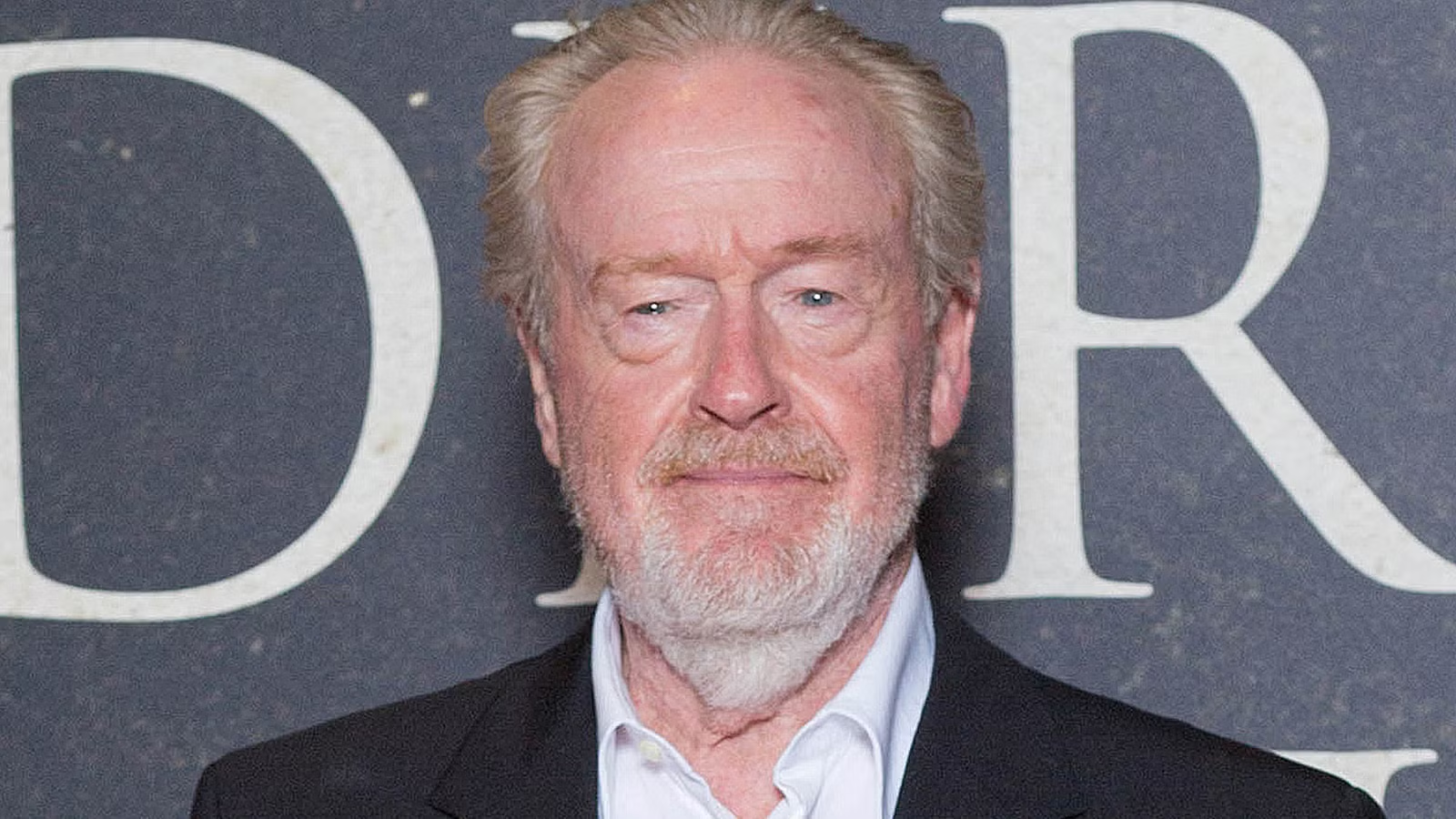


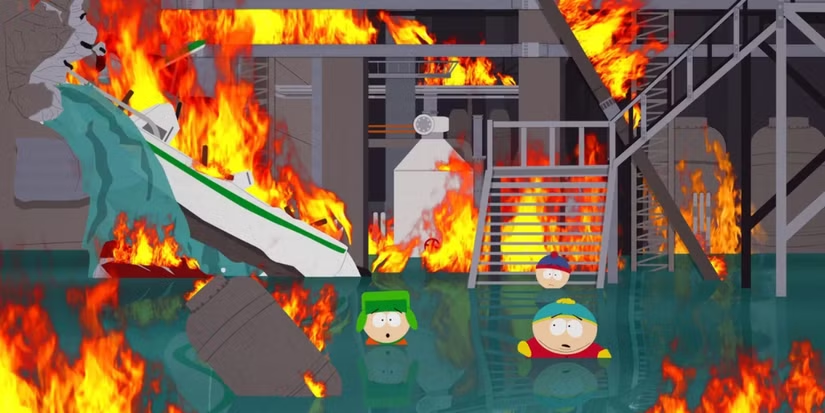


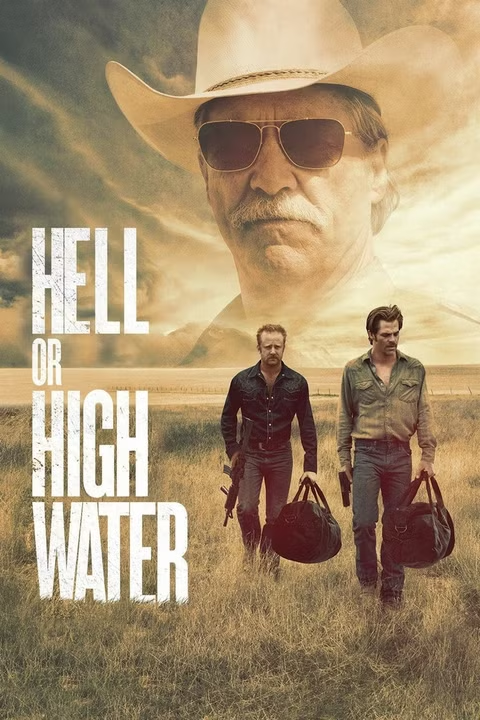

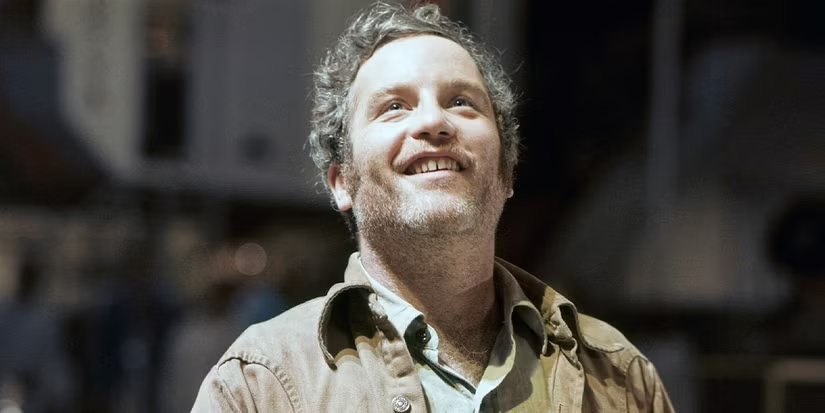


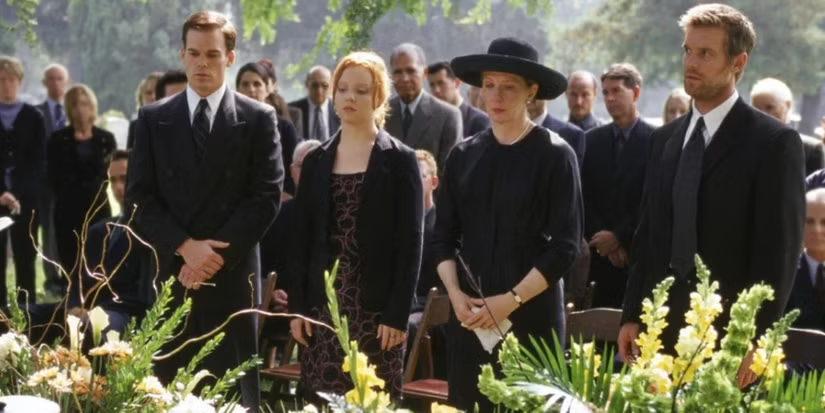


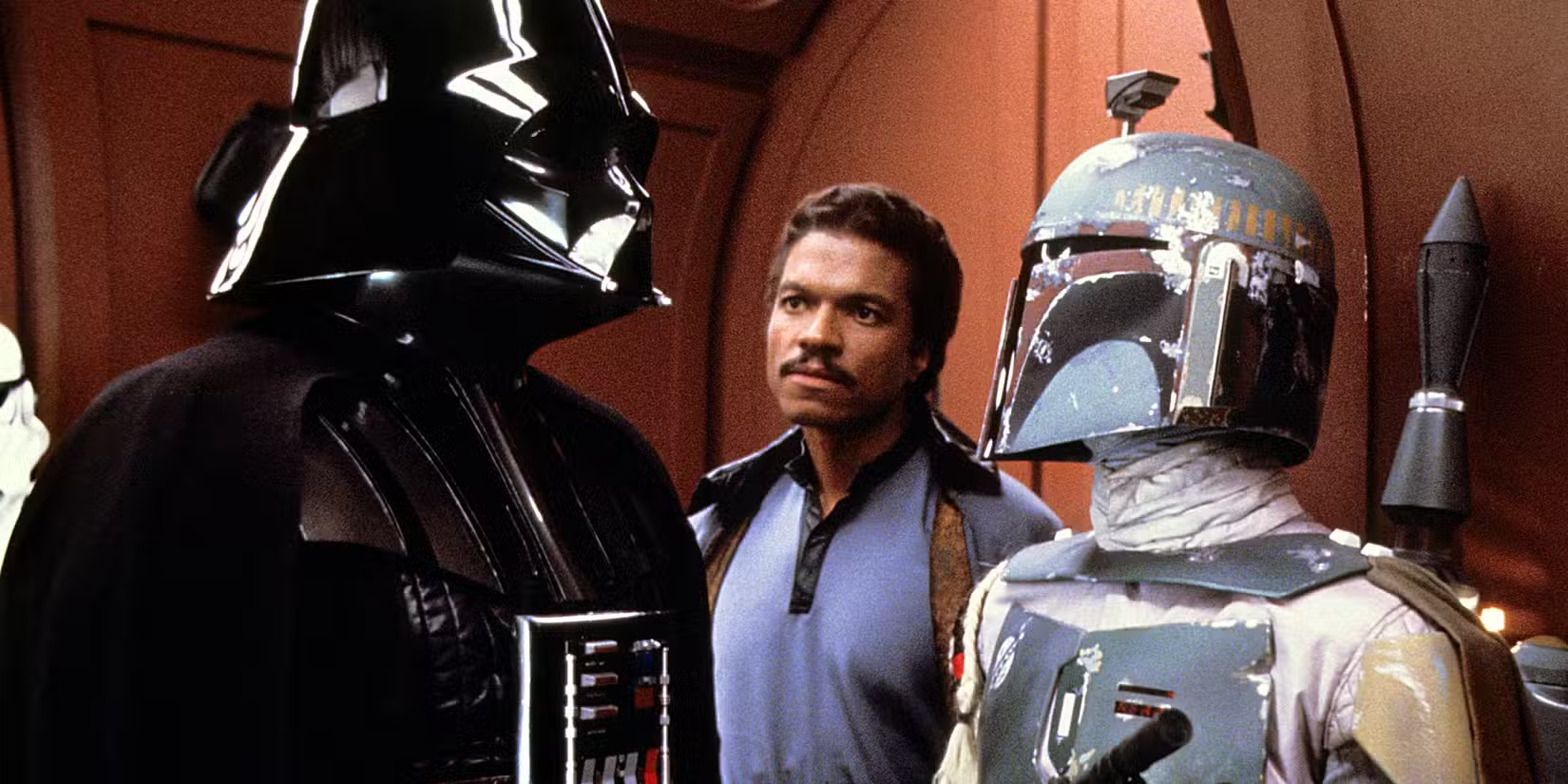



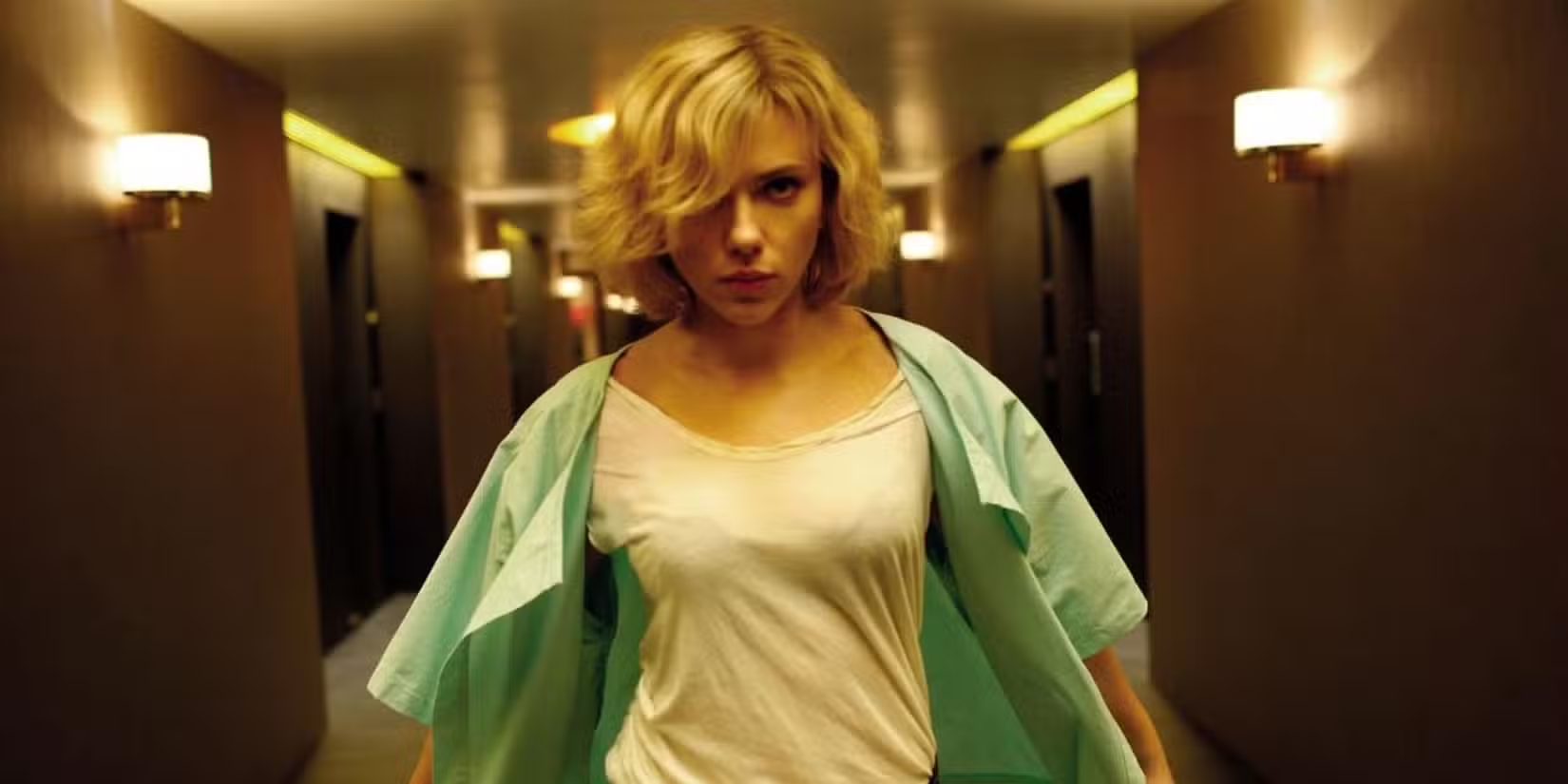











































You must be logged in to post a comment Login