Related: Jessica Alba’s Sweatpant Jeans Are the Trend Everyone’s Wearing
Advertisement



Us Weekly has affiliate partnerships. We receive compensation when you click on a link and make a purchase. Learn more!
Kate Middleton has a way of making even the simplest accessories feel like the must-have items of the season. And this summer, it’s all about raffia clutches. The woven bags are popping up everywhere, thanks to their ability to instantly add a vacation-ready feel to everything from sundresses to wedding guest outfits.
On June 6, the Princess of Wales stepped out for a wedding carrying a chic woven clutch that instantly caught our attention. She paired the woven bag with a beige tweed dress, pointed-toe stilettos and a wide-brim straw hat, proving the summer staple works just as well for special occasions as it does for beach getaways. Unsurprisingly, her exact Forever New bag sold out quickly.
Get the Freie Liebe Raffia Crossbody Clutch for $22 at Amazon! Please note, prices are accurate as of the publishing date but are subject to change.
The good news? You don’t need a royal budget to recreate the look. We found the Freie Liebe Raffia Crossbody Clutch at Amazon, and it’s just $22. The straw construction gives it that breezy, sunny look that’s synonymous with summer, while the gold-tone closure adds a polished touch. Available in natural straw, black and white, it’s the kind of accessory that works just as easily for seaside dinners and weekend brunches as it does for weddings and special events.

Jessica Alba just proved that denim can actually be comfortable. The actress recently stepped out wearing a pair of light-wash ‘sweatpant jeans’ styled with a pink off-the-shoulder sweatshirt, pointed-toe stilettos, oversized sunglasses and a floral handbag. The look struck the perfect balance between casual and polished — and made a strong case for the comfy […]
The purse is also surprisingly versatile. While you can carry it in your hand like a classic clutch, the bag also has a removable chain strap that lets you wear it as a crossbody. That style comes in handy when you want to go hands-free while grabbing drinks during cocktail hour or dancing post wedding ceremony. No matter how you style it, the bag delivers effortless warm-weather appeal that makes raffia accessories a seasonal favorite year after year.
Shoppers are equally impressed. One reviewer who praised its “high-end look” said, “[It] goes with so many different outfits and occasions.” Another loved the woven design for adding a “touch of elegance,” noting the size is “just right for carrying essentials,” like your cell phone, keys and more.
Whether you’re headed to a summer wedding, brunch with friends or a vacation by the water, this raffia clutch purse delivers the same vacation-ready feel as Middleton’s sold-out style for just $22.
Get the Freie Liebe Raffia Crossbody Clutch Purse for $22 at Amazon! Please note, prices are accurate as of the publishing date but are subject to change.
Looking for something else? Explore more from Freie Liebe here and don’t forget to check out all of Amazon’s Daily Deals for more great finds!

Jennifer Lawrence has a knack for making practical pieces feel instantly cool, and her latest summer shoe choice is proof. While flip-flops tend to dominate warm-weather wardrobes, the actress is making a strong case for something a little more unexpected: jelly sandals. Playful, comfortable and surprisingly chic, the nostalgic style is quickly becoming one of […]
Apparently, Simone Biles and Avril Lavigne have unfinished business from Taylor Swift‘s wedding!
The world-class gymnast attended the very private wedding ceremony between the singer and her NFL player beau, Travis Kelce, earlier in the month, and is revealing that a famous vocalist parted with one of her prized possessions.
Simone Biles attended the wedding at Madison Square Garden, accompanied by her husband, Jonathan Owens, and dressed to impress in a stunning red number by Vietnamese designer Đỗ Long.
@jujonthatbeatz Insider info right here #taylorswift #simonebiles #avrillavigne #taylortravis ♬ original sound – julia!!
The Olympic medalist detailed the unexpected moment she discovered her expensive eyewear was no longer in her possession as she enjoyed the night at Swift and Kelce’s wedding ceremony.
Biles and her NFL player husband joined hundreds of other celebrities from the sports and music world to witness the lovebirds exchange their vows. On Sunday, July 26, during an appearance at the Faces of Fitness festival in Chicago, the athlete revealed that Lavigne might have unknowingly left the venue with her prized eyewear.
As shared by US Weekly, she added that she eventually reached out on Instagram with a light-hearted message asking if the accessory could be returned, but she does not think the “Complicated” singer has seen it yet. Biles’ story about her missing eyeglasses continues to complete the puzzle of things that may have gone down at Swift and Kelce’s union.
While her eyewear remains unreturned, the athlete can take solace that her statement-making dress left a lasting impression on internet users.
The outfit, which includes a halter neckline with a half-open back, created an optical illusion of rippling chainmail, with layers of leather interwoven with silver metallic jewels and red eyelets.
Biles paired her look with silver accessories, matching purses, and heels, styling her hair in a high bun with a side-swept fringe detail. Owens matched her aesthetic in a burgundy-and-black suit, prompting fans to gush endlessly about their flawless styling and appearance.
“The epitome of perfection. You’ve earned it all! Truly stunning and pure grace,” impressed fans wrote, declaring that Biles has set the bar high for beauty.

Swift and Kelce’s wedding was a gift that kept on giving, and it did give two guests an unexpected brush with Tom Cruise. During an appearance on “Watch What Happens Live,” alongside Kevin Hart, Marcello Hernández said the biggest surprise of the night wasn’t the star-studded guest list but getting the chance to chat with Cruise.
The SNL comedian shared with host Andy Cohen that the two bonded over growing up in households surrounded by women, calling the conversation one of the highlights of the evening. As noted by PEOPLE, Hart then jokingly teased Hernández for supposedly sneaking videos despite the wedding’s no-phone policy.
Hernández quickly laughed it off and insisted he never broke the rules, even playfully addressing Kelce to clear his name. Former NFL star Greg Olsen also had a memorable encounter at the superstar’s wedding.
In his podcast, days after the wedding, Olsen said he remembers that at the cocktail hour, Cruise went out of his way to compliment his hat, and a conversation started outside the men’s restroom that lasted but a few moments.

The American sports commentator detailed another memorable moment at the duo’s wedding, which began as soon as the groom laid eyes on Swift for the first time while she took a walk down the aisle. Appearing on The Athletic’s Starkville podcast, the veteran sportscaster recalled that Kelce became visibly emotional throughout the ceremony.
USA Today noted that Buck recalled the NFL star first tearing up as his nieces walked down the aisle before becoming even more overwhelmed when Swift made her entrance. Buck also commended the length, sincerity, humor, and personal commitment in the couple’s vows.
He revealed that the ceremony felt genuine, leaving him convinced the July 3 celebration at Madison Square Garden was the couple’s official wedding rather than a symbolic event. The reception was equally special, as he had the chance to meet Tom Cruise, Brad Pitt and Scarlett Johansson.
Paul McCartney’s “I Want to Hold Your Hand” was another highlight of the night for the media personality. He noted that despite an estimated 1000 people present, he spent the night wondering who would come along and tell him he was not supposed to be there.

Not just for the happiest days of their lives, Swift also showed up for Biles during one of the lowest moments of her career as a gymnast. As reported by The Blast, when Biles announced her decision to step back from several events at the Tokyo Olympics due to mental health reasons, Swift was there to lift her.
The singer praised Biles’ courage in a promotional video, commending her willingness to be so open about her struggles. She described that move as a remarkable part of her encouraging story and journey, which has made her a champion and an inspiration.
Biles responded to the gesture, thanking Swift for her thoughtful words, which moved her emotionally. Swift added that the gymnast’s lifestyle had taught her valuable lessons about resilience and emotional strength.
Since making that decision in 2021, Biles had remained open about mental health topics and prioritized therapy. Although she made a remarkable return and dominated the charts at the Paris Olympics, winning three gold medals and one silver, she is still on the fence about competing in 2028.

Harry Jowsey is embracing a new era after gaining fame as a playboy on multiple dating shows.
The reality TV star is the male lead in Netflix’s latest dating show, “Let’s Marry Harry,” which premieres on August 5. As the name suggests, it follows Jowsey’s journey to find a wife.
As for why Harry Jowsey finally decided to settle down, a heartbreaking incident became the turning point of his life. He opened up about the tragedy and more in a new heart-to-heart interview.

The “Too Hot to Handle” alum has starred in multiple dating shows, but he doesn’t believe his efforts to find love make him a playboy. “It couldn’t be more inaccurate,” Jowsey declared, noting that he accepted the title in the past before realizing it wasn’t the real him.
Jowsey accepted that he hadn’t “shown up in the most respectful ways,” but at 29 he could no longer maintain the flirtatious womanizer persona. However, age wasn’t the primary reason the entertainer decided to change; he credited his father’s passing with his epiphany.
His dad died from a terminal illness in 2024, with Jowsey telling US Weekly the moment was the wake-up call he needed to change. “Being with my dad as he passed and having a final conversation with him saying, ‘I wish you could meet my children,’ was such a humanizing experience,” he recalled, adding:
“[I was like,] ‘This is something I’ve neglected and something I need to put energy and time into.’”
Jowsey explained that losing his dad made him realize it was time to be more serious about life and love. Additionally, watching his sisters enjoy their husbands’ support while grieving and having their children be “the best distraction” from the pain fueled his motivation to settle down.
“Everyone has a moment where it clicks, and unfortunately mine was my dad dying,” Jowsey lamented. When asked if his parents’ divorce and tumultuous relationship had affected his perspective on love, the entertainer confessed there was a time he thought love needed friction.
According to Jowsey, in his early 20s he believed if his partner wasn’t yelling at him, then there was something wrong in their relationship. But these views changed when he started going on dating shows, and realized love didn’t have to be like his parents’ relationship.
Jowsey made good on his decision to shed the playboy image by starring on Netflix’s new marriage show. “Let’s Marry Harry,” set to premiere on August 5, follows the TV personality’s journey to find a wife among 20 potential suitors.
Entertainment Weekly reported that the streaming giant described the show as “The Bachelor” meets “Too Hot to Handle,” but with a twist. Instead of relying on his own judgment to find a wife, Jowsey’s longtime pals would help him find the perfect match.
“Dancing With The Stars” alum Amanda Kloots, “Too Hot to Handle” star Georgia Hassarati, and abstract artist Sonny Henty star alongside Jowsey to help him find a wife. The unscripted series is produced by Alex Cooper’s Unwell company, with executive producers Matt Kaplan, Mina Lefevre, and showrunner David Friedman.
The buzz around Jowsey’s new reality TV show started last year, with The Blast reporting that he claimed he would happily tie the knot with a particular singer. In September 2025, he was stopped by reporters at LAX airport, who questioned him about the upcoming show.
The TV personality declared he was fully committed to walking down the aisle but admitted the contestants might not stand a chance if Sia joined the show. He described the “Chandelier” hitmaker as one of the most “incredible people” he knew, implying they had a close relationship.
On the other hand, Sia gave mixed vibes about tying the knot with Jowsey. Earlier that year, she promoted the marriage show on social media, calling women to apply to be the entertainer’s wife. “I’m signing up and so should you… He’s a dream,” she captioned the post.

Before deciding to settle down, Jowsey had been in multiple relationships. While starring on the New Zealand dating show “Heartbreak Island” in 2018, he began dating fellow contestant Georgia Bryers and won the season they were competing in.
PEOPLE reported that the reality TV star claimed they drifted apart because Bryers didn’t like the attention Jowsey received from women. He moved on with Francesca Farago while filming season one of “Too Hot to Handle” in 2019, but they split that same summer.
Although they reconciled months later, the duo parted ways a second time in 2020. Then Jowsey enjoyed a summer romance with influencer Julia Rose in 2020, followed by Georgia Hassarati in 2022 and Jessica Vestal in 2023, among others.

A Michigan man shot and killed his wife and their six children in an apparent murder-suicide. In addition, Kristopher Karolkiewicz reportedly set the house on fire after murdering his family.
Ottawa County Sheriff’s Office Capt. Jacob Sparks said during a press conference on Monday, July 27, that firefighters responded to reports of smoke on Friday, July 24, per WOODTV.
Firefighters arrived at a home on Riverside Trail near 148th Avenue and Mercury Drive in Grand Haven Township at around 8:30 a.m. However, no fire was detected, and the firefighters left, only to return at approximately 11:40 a.m.
As flames were put out, the bodies of 39-year-old Mandy Karolkiewicz, a 5-year-old boy, an 11-year-old boy, a 12-year-old boy, a 15-year-old boy, and two 11-year-old adopted girls were found inside the home (the two 11-year-old girls were adopted).
“The investigation shows that this was a murder-suicide, with a fire being started after the murders,” deputies noted in a press release.
Additionally, Captain Sparks noted the incident as an “unspeakable tragedy.”
“This is an unspeakable tragedy that we may never completely understand why it happened. But we will do our best to find the answers and to honor the memory of those victims,” he said.
The authorities believe that Karolkiewicz, 47, shot and killed his wife and their six children before he set the home on fire and shot himself dead. Multiple pets also died in the fire, including several dogs and one cat.
Karolkiewicz reportedly worked remotely as a national vice president of sales and marketing for the American Heart Association. However, the AHA confirmed that he was employed from September 2023. However, his employment ended earlier this month for an undisclosed reason, per News 8.
The police are still investigating the murder-suicide, which Sparks said will be “thorough, detailed, complete.”
“We’re trying to get answers for the family. We’re trying to get answers for the community. We’re trying to get answers for our own responders. And the only way to get those answers is to do a full, fair, thorough, detailed, complete investigation,” he said. “That takes some time.”
According to WZZM13, a family friend said that Karolkiewicz had been fired from the American Heart Association several weeks before the murder-suicide.
In addition, the company noted that his “employment ended” in July of this year. Mandy worked at Grand Haven Area Schools as a substitute teacher.
“Mandy goes above and beyond for students, especially when they’re having a hard day, responding with empathy, patience, and care,” read a post on Facebook from January. “She pours her heart into her work, is always willing to help wherever needed, and helps make Peach Plains a better place to learn and work.”
What Do You Think Roomies?

Hey Big Brother fans, let’s look at the powers and punishments available in the BB Time Capsule. They unveiled all 6 punishments and all 6 rewards available with the Time Capsule on Unlocked.
And of course, you already saw Angela Murray get the Hard Boiled Detective punishment. That was an entire week of her in that big old costume. And now, another houseguest was selected for the BB Time Capsule.
This time it was another icon, Rick Devens (BB28). And unlike Angela, he smacked the big red button at the right time and got an incredible power. We’ll talk about his when we hit it on the list.
First, let’s do punishments. I already mentioned the Egg Detective with the big magnifying glass. The first time we saw that was in BB27 when Vince Panaro lost a power of veto competition while on the chopping block.
Ava Pearl nominated him and Vince wound up with it during the prizes and punishments POV comp. Another punishment they revealed that I love is Lord of the Latrine. This one was from BB23 in the Kingdom of Curl-a-lot POV comp with prizes and punishments.
Derek Xiao was the HOH and he got the POV but then his nominee Britini D’Angelo was last to choose and took his POV and gave him Lord of the Latrine. This is more of a whole-house punishment.
Big Brother locked the downstairs bathroom and for 24 hours, any houseguest who needed to potty had to find Derek. Then ask his permission, and he’d escort them to the bathroom then blow a horn and announce their entry to the bathroom.
He’d say stuff like “Lady Tiffany’s now using the porcelain throne, is it a one or a two?” Fortunately, this punishment was only for 24 hours and not a whole week like so many of the worst BB punishments are.
Alright, another punishment they brought back is Hamazon. This was something Fessy Shafaat was hit with in BB20 and involved eating pork but because he’s Muslim, they had to accommodate with vegan ham.
Fessy got this in BB20 which was tech themed and it was from a BB APP store twist. Houseguests that were trending got a power app, an advantage of some sort. And those trending least got a crap app.
Fessy was least trending in Week 1 of this twist and he chose it from a list of 4 options with no idea what it was other than eating something. So, for a whole week, whenever Big Brother delivered ham, Fessy had to eat the entire package.
Deliveries were frequent, irregularly timed and could come day or night. One of the 2 a.m. deliveries he forced himself to eat came right back up and Fessy was throwing up the vegan ham while Kaitlyn Herman, the puzzle-challenged BB20 houseguest, patted his back.

The Camp Guide punishment is also in the mix. This was from BB19‘s Summer of Temptation. The comp was adventure themed and it was typical prizes and punishments comp.
Alex Ow had the five-thousand-dollar cash prize and Elena Davies went last and got the camp guide punishment. Then, she broke a deal with Alex, grabbed her cash and stuck her with the punishment.
For the week, Alex had to wear a scouting type uniform and carry heavy gear on her back all the time. Then, when a bugle blared, Alex had to go to the backyard, pitch a big full-sized tent. Then she had to cook hot dogs for everyone and then break down the camp again.
Sometimes Big Brother would sound the bugle again right after she broke camp. Alex was so mad, she’d curse Elena late at night while building the tent like a mantra. This next punishment I’m super excited about because I’d been hoping to see a partner-punishment.
They brought back Adam and Eve from BB16. Caleb Reynolds and Victoria Rafaeli played in the Battle of the Block versus another duo. The best way to win that comp was to incur punishments.
But then you’d get safety for the week. So, Caleb and Victoria wound up with three punishments: Adam and Eve, two weeks of slop and also one had to shave the other’s head. Caleb nicely volunteered to be shaved.
They wore Adam and Eve unitards with leaves on them. They were tethered by a vine for 48 hours with the usual: eat together, sleep together, bathroom together, tethered for showers, and of course, tethered outside the door while the other had Diary Room sessions.
And finally, the last punishment’s a classic – the Red Unitard from BB8, 9 and 10 before Big Brother started doing more elaborate punishment costumes. This is probably the least problematic of the punishments unless you’re body shy. You wear it a week – that’s it.
Now let’s talk about the Powers at play – and I’ll tell you which one Devens just won. First, there’s Replay. We saw this in BB22 and it’s a good power because it lets the outgoing HOH play for the next Head of Household comp instead of being on the bench.
The holder of the power can use it on themselves or gift it to someone. This was won in BB22 by Dani Briones who then gifted it to Memphis Garrett so he could use it in Week 8. It’s not a particularly strong power since it only gives you a shot to win the HOH power.
But at least you have a shot where otherwise, as outgoing HOH, you’re at everyone’s mercy. Next up is the Mystery Competitor. This is from last season also, BB27. It’s when a past houseguest comes in and plays a comp on your behalf.
Keanu Soto got this power during the BB Break-In comp where the mastermind stole the HOH key and hid that and three powers in the sewers. Jimmy Heagerty found the HOH key and nominated Keanu who activated this power.
Big Brother sent in BB20 winner Kaycee Clark to play in the POV comp also which doubled Keanu’s chance to win POV. Keanu was eliminated early but Kaycee went on to win the comp for Keanu.

The next power’s more about making your Big Brother experience more tolerable, not something that helps you get to the end. It’s the Never-Not Pass. This power’s been more frequently rewarded.
Jeremy McConnell got it in BB15, Becky Burgess got it in BB17, Natalie Negrotti got it in BB18. Hot mess Raven Walton got it in BB19. And Dani Donato was the last to hold it in BB22. Simply put, when you get the pass, you can never be made a Have Not.
This next power is a bit stronger than just skipping slop. It’s the BB Bribe. It first popped up in BB18 and it gives the holder cash to bribe another houseguest to do something for them. The holder can’t keep the money and if they don’t use it, it’s lost.
In BB18 the power was only live for one week. You could use it to buy someone’s vote, use or don’t use the POV, throw a comp, or affect nominations. Corey Brook got it in BB18. He bribed Victor Arroyo to vote against Michelle Meyer which he already planned to do.
But the cash was a gesture of good will towards the alliance they were both in. Next we have the Coin of Destiny from BB23. Claire Rehfuss won it during Tiffany Mitchell‘s HOH. Claire won it in a casino-style comp. When she activated it, she chose heads.
Then HOH Tiffany flipped the coin and it came up heads so she was dethroned. In that season it was a waste because Claire was allied with Tiffany (or thought she was since this was the Cookout season).
Claire kept the nominations the same when she could’ve changed them. Claire told Tiffany and Hannah Chaddha she had the power and the Cookout covered for Claire.
Okay now the superpower of superpowers – this is the power that Devens got from the BB Time Capsule – the Diamond Power of Veto. This first showed up in BB4 but with more limited powers. A higher-powered version unleashed in BB12 thanks to Pandora’s Box.
So, at the end of the veto meeting after the regular Golden Power of Veto is played or not played, the Diamond POV holder can stand up, activate the power. They get to take a nominee off the chopping block – themselves or someone else.
And this is where the Diamond Power comes in – the power holder gets to make the renom, not the Head of Household. This can be a big move to throw an ally of the HOH on the block and blindside the house.
Matt Ratcliffe was on the block in BB12 – Brendon Villegas put him up as replacement nom in revenge for Rachel Reilly’s eviction. Everyone was poised to vote Matt out. But he used the Diamond POV, told Brendon “better luck next time, you dummy.”
Then he took himself off the block and renommed Kathy Hillis who was evicted. Matt was safe. And the house was stunned because he kept it secret – no one knew so it was an epic blindside.
I’d love to see a return to this style of old school Big Brother play where houseguests actually keep their mouths shut about stuff.
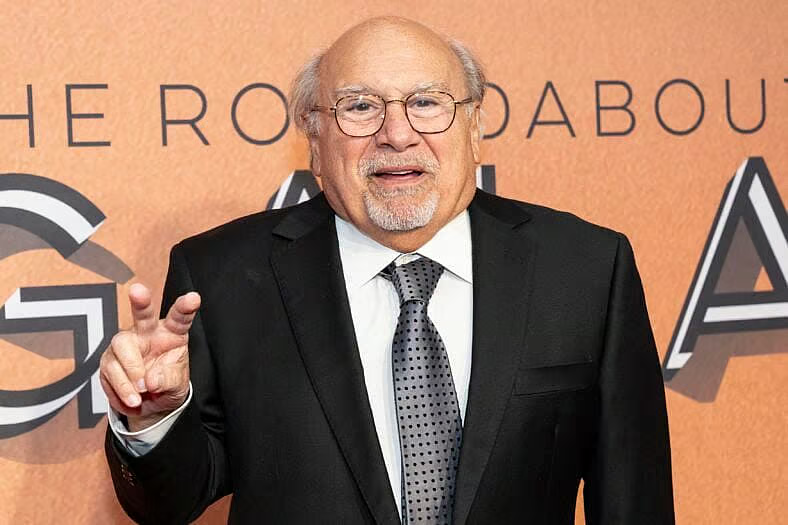
Michael Douglas has revealed how Danny DeVito got hilarious revenge on him while filming the dark 1989 comedy “The War of the Roses.” By the time DeVito stepped behind the camera to direct Douglas and Kathleen Turner in the movie, the trio had already endured grueling shoots together on “Romancing the Stone” and “The Jewel of the Nile.” DeVito apparently had not forgotten what Douglas put him through and he found the perfect opportunity to settle the score during one of the film’s most dramatic scenes.

The prank unfolded while Douglas and Turner were preparing to film the movie’s climactic chandelier sequence. In the scene, their bitterly feuding characters, Oliver and Barbara Rose, end up hanging high above the floor before plunging to their deaths. Filming required both actors to climb into position atop the chandelier while DeVito directed from below.
“We got up on the chandelier,” Douglas recalled in an interview for AARP The Magazine, “and they say, ‘OK, everybody ready?’ ‘Yeah, we’re ready.’ And Danny goes, ‘OK, that’s lunch!’”
Rather than immediately bringing his stars back down, DeVito walked away and left them suspended above the set. “He left us up on top of the chandelier for five, 10 minutes, and we’re yelling, ‘Danny! What’s going on?’” Douglas continued.
Danny DeVito allowed the joke to continue before returning and finally revealing his motivation. “Danny milked it for a while, and then he came back and said, ‘What you put me through for Romancing, this is payback time, Mikey!’ ” Michael Douglas shared.

The “Romancing the Stone” shoot had taken Douglas, Turner, and DeVito far outside the comfort of a traditional Hollywood set.
The 1984 adventure film required the cast to work through heat, mud, and difficult conditions while shooting on location. They reunited the following year for its sequel, “The Jewel of the Nile,” before joining forces again for “The War of the Roses.” That shared history meant Douglas and Turner already understood DeVito’s unpredictable sense of humor when he became their director.
The chandelier stunt allowed Danny DeVito to turn their past experiences into a joke without leaving his longtime friends stranded for too long. After enjoying their confusion for several minutes, he returned and allowed production to continue. The prank also fit the unusually dark comedic tone of “The War of the Roses,” which follows the spectacular collapse of a wealthy couple’s marriage as their hostility escalates into increasingly destructive acts.

Michael Douglas described Danny DeVito as someone who instinctively searches for comedy in unexpected and uncomfortable moments. “He’s got a wonderful, wiggy sense of humor,” Douglas said. “He sees the absurdity of situations and finds the humor in the absurdity. And he’s always testing boundaries.”
The chandelier story demonstrated that trait perfectly. DeVito took an already absurd visual, two major movie stars suspended in the air, and pushed it further by casually announcing lunch and walking away. Still, the prank never appeared to threaten their friendship. Instead, it became another memorable chapter in a relationship that began long before either man became famous.

Douglas and DeVito first met while studying acting in New York during the 1960s and later shared an apartment as they attempted to establish their careers.
In a previous interview, Douglas described the two as sharing a similarly dark sense of humor, a connection that has remained intact across decades of friendship and numerous collaborations.

Michael Douglas and Danny DeVito’s professional relationship extends beyond the three films they made with Turner. The two later reunited onscreen in the 2009 drama “Solitary Man,” and their shared history also includes the acclaimed 1975 film “One Flew Over the Cuckoo’s Nest.” Douglas produced the movie, while DeVito portrayed Martini.
Their bond has allowed them to work together as actors, director and performer, and creative collaborators. For Douglas, DeVito’s ability to test boundaries is inseparable from the qualities that have made him such an enduring presence in entertainment.

Prime Video has unveiled the first official trailer for Blade Runner 2099, giving fans their first extended look at the highly anticipated television continuation of Ridley Scott’s legendary sci-fi universe. Starring Michelle Yeoh and Hunter Schafer, the series arrives this November and promises to expand the franchise with a new mystery set decades after the events of Blade Runner 2049.
Set 50 years after Denis Villeneuve’s acclaimed 2017 sequel, Blade Runner 2099 takes audiences back to Los Angeles in a world where replicants have dramatically altered the balance of power. Humanity no longer sits at the top of society, creating a fresh backdrop for a noir-inspired story filled with conspiracies, identity, and survival.
Hunter Schafer stars as Cora, a fugitive who assumes the identity of a Blade Runner in an effort to secure a future for her brother. Alongside her is Olwen, played by Michelle Yeoh, a replicant Blade Runner nearing the end of her lifespan. Together, they pursue a mysterious runaway whose secrets could reshape the fragile future of Los Angeles.

Hunter Schafer as Cora in Blade Runner 2099 [prime video]
The series is created by Silka Luisa, with Ridley Scott and Michael Green serving as executive producers, ensuring the new chapter remains deeply connected to the films that inspired it. Visually, the trailer embraces the franchise’s signature neon-soaked atmosphere while introducing a brighter yet equally unsettling version of the dystopian future.
After years of anticipation, Blade Runner 2099 looks poised to deliver another thought-provoking entry in one of science fiction’s most influential franchises when all eight episodes premiere exclusively on Prime Video this November.
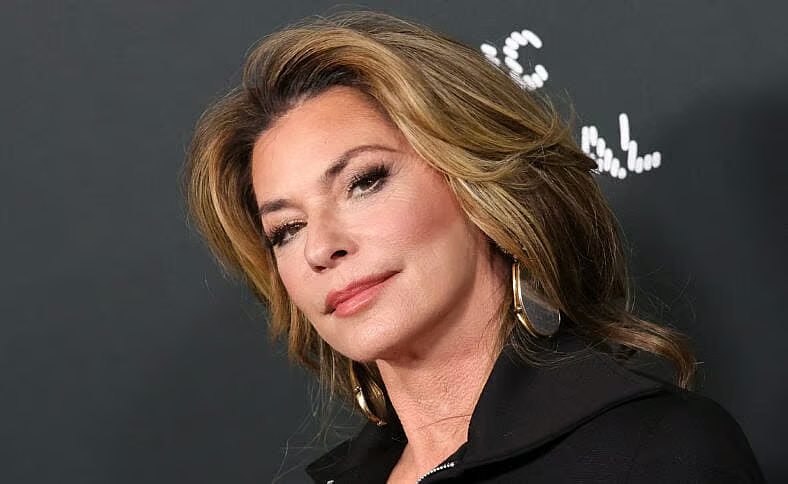
Shania Twain is entering a new chapter of her career with a renewed appreciation for everything that brought her there.
As the country music superstar celebrates the release of her seventh studio album, “Little Miss Twain,” she is also reflecting on the tragedies, setbacks, and personal battles that shaped her long before she reclaimed the spotlight.
Looking back on decades of loss and resilience, Twain says those experiences didn’t break her. Rather, they taught her how to keep moving forward.

Behind Shania Twain’s record-breaking success is a story marked by hardship that began years before fame ever found her.
The Canadian singer, who has sold more than 100 million albums, earned five Grammy Awards, and became the best-selling female country-pop artist in history, grew up in poverty in Timmins, Ontario, where she also endured an abusive childhood.
Despite those difficult circumstances, Twain remembers embracing the outdoors and refusing to let anything stop her from fitting in.
During a recent chat with PEOPLE, she laughed while recalling that she once “double bra-ed it” so she could play football with the boys, adding, “You just can’t take the woods out of the girl. That’s for sure.”
At 22, her life changed forever when her mother, Sharon, and stepfather, Jerry, were killed in a car accident, leaving her to care for her three younger siblings.
Rather than allowing grief to consume her, Twain said she learned one of life’s most important lessons.
“I had to learn how to be brave really early on and not crumble,” she explained, crediting education and self-therapy with helping her navigate one of the darkest periods of her life.

Even after achieving international success, Shania Twain continued to face deeply personal challenges.
Her highly publicized split from producer Robert John “Mutt” Lange dominated headlines, while Lyme disease threatened the career she had spent years building after it damaged her vocal cords and eventually led to surgery.
Instead of viewing those moments as defeats, the 60-year-old said they strengthened her determination.
“I’ve gotten through difficult times by being capable of finding courage, being brave and pushing through the fear,” she said, further noting, “Fear fuels me.”
Today, she sees those experiences differently than she once did. Time has allowed her to replace pain with perspective, leaving her with a deeper confidence in both herself and the path that brought her here.

That outlook is woven throughout “Little Miss Twain,” an album the singer describes as deeply rooted in the experiences that shaped her life.
Rather than running from the past, she embraced it, using memories of childhood, family, loss, and personal growth to create a project that reflects both where she has been and where she is today.
“I’ve already spent all of my life processing the challenges [I’ve had],” Twain told the outlet, adding, “I’m at a place where I really enjoy looking back on it with a smile.”
The album also gave her the opportunity to collaborate with artists she deeply admires, including Tanya Tucker, Josh Homme, The War and Treaty, and her 25-year-old son, Eja Lange.
Recording alongside Tucker proved especially memorable for Twain, who admitted the experience was “very, very surreal.”
After decades of navigating unimaginable personal and professional obstacles, she now finds herself celebrating not just another album, but the resilience that made it possible.

Shania Twain’s resilience isn’t the only thing captivating fans. Recently, the country music icon also reminded audiences why she remains one of entertainment’s most magnetic performers during an intimate New York City concert.
For the event, Twain paired dazzling fashion with a career-spanning set that celebrated both her biggest hits and the music that continues to define her latest creative chapter.
Wearing sparkling diamond jewelry, black hot pants, a sheer caped blouse over a black bustier, and knee-high suede boots, she transformed the small venue into a star-studded celebration.
She treated fans to classics including “Come On Over,” “Any Man of Mine,” “That Don’t Impress Me Much,” “You’re Still the One,” and “Man! I Feel Like a Woman!” while also performing songs from Little Miss Twain, including “Dirty Rosie,” “I’d Be Loving Me,” “Stranger Things,” “Faded Blue Jeans,” and the title track.
Between performances, Twain shared stories from her childhood in Ontario, paid tribute to her late mother, and even acknowledged her sister, who was in attendance.
Twain’s intimate New York City performance celebrated her enduring stage presence, but a separate concert across the Atlantic reminded fans that not every appearance lands the same way.
While opening for Harry Styles at London’s Wembley Stadium late in June, the songwriter sparked a wave of online debate after performing “Man! I Feel Like a Woman!” in a black lace ensemble that quickly became one of social media’s biggest talking points.
A TikTok video shared by user @simpllysara captioned the moment, “This was not on my bingo card for 2026,” and soon drew thousands of comments.
Some viewers called the look “so tacky,” while another wrote, “Just because you can doesn’t mean you should.”
Others joked, “That don’t impress me much,” referencing one of Twain’s biggest hits, while one commenter suggested she and Madonna should “consult with Cher’s stylist.” Another added, “Please stop this. Too talented and beautiful for this.”
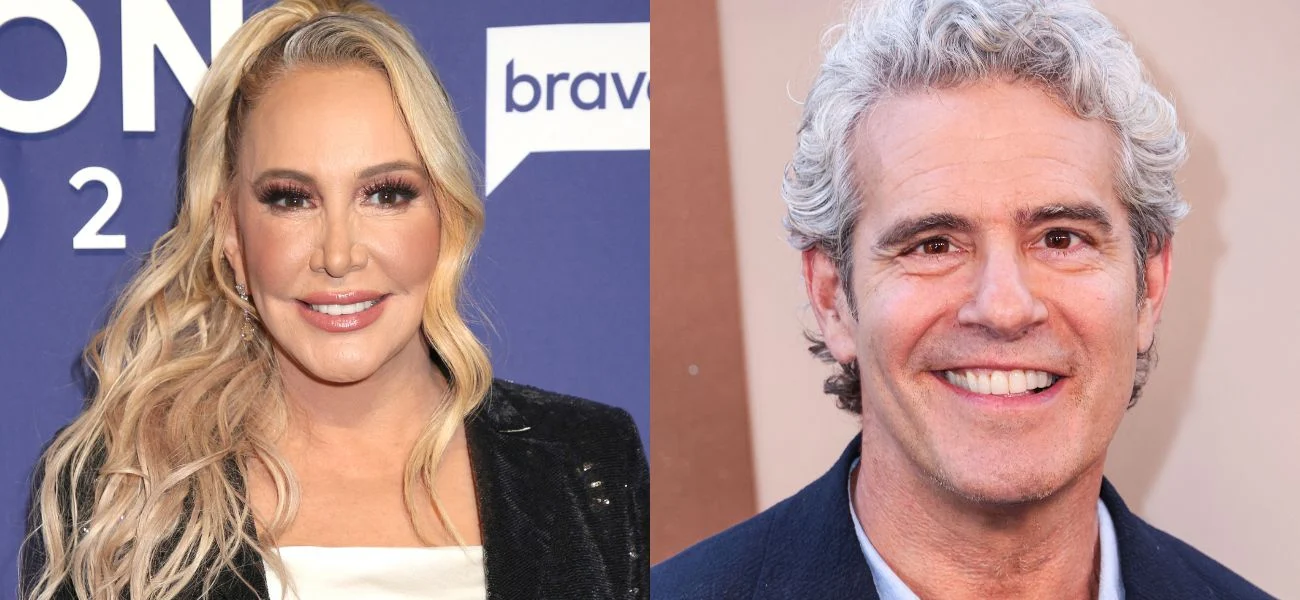
“Real Housewives of Orange County” star Shannon Beador says she was “bothered” and “embarrassed” that a California restaurant didn’t let her and Andy Cohen eat for free.
Beador, who joined “RHOC” during season 9 in 2014, recently appeared on a podcast and discussed her headline-making night out with Cohen at the Orange County staple The Quiet Woman.
During her interview, Beador blasted the eatery for returning to their table with a $540 bill after her meal with Cohen and six of her castmates.
On the “Hate to Break It to Ya” podcast, Beador told host Jamie Kennedy that she was “bothered” the staff at The Quiet Woman in Orange County didn’t immediately comp her meal with Cohen during a recent night out.
For those who may be unfamiliar, The Quiet Woman has been featured on Bravo’s “Real Housewives of Orange County” for years and has been the site of some of the show’s most explosive fights.
“I have been frequenting this restaurant…for years now,” Beador said. “I’ve had some scenes there that have been, I guess, memorable.”
She continued, “But when I went to a restaurant and coordinated this dinner with six of my castmates and Andy Cohen, it’s kind of a big deal. So when Andy asks for the bill, and they brought one, I was bothered by it.”
Beador apparently threw a fit after receiving a bill over $500. “I said, ‘This is ridiculous. You have Andy Cohen here, who’s never been to Orange County, and he’s chosen your establishment,’” she said. “What else do you need?”
While Beador said she wasn’t “having a meltdown,” she did voice her frustration because she believes Cohen put the local eatery “on the map.”
“I said, ‘It’s Business 101. You just had Andy Cohen in here with six housewives,’” she added.
After Cohen paid the bill and left a reported massive tip for the waiter, Beador said the general manager came running after them and canceled the tab. However, that wasn’t enough for the Bravo star.
“It should’ve been discussed prior,” she said. “It should’ve been figured out because it was embarrassing to me.”
Beador finished by saying that she would be taking “a break” from The Quiet Woman moving forward.
Beador’s comments come after her co-star, Tamra Judge, opened up about the moment on her podcast, “Two Ts In A Pod.” She claimed that Beador made a big fuss out of the situation and had a “meltdown” over the bill.
During an episode of “Radio Andy,” Cohen said the story wasn’t as big of a deal as it’s been made out to be. In fact, he called it “the greatest night” and “so much fun.”
“I loved being there with the women and the staff at The Quiet Woman. I was so happy to meet them,” he said. “I was so happy to meet the owner and the manager, and they love the Housewives, and they love what the show has done for their business.”
Cohen also confirmed that the manager offered to comp their bill, which he was against because he wanted to tip the staff. “We figured that out, and that’s all I know,” the “Real Housewives” producer said. “I don’t think there’s any big kind of drama to this story.”
Beador’s comments come amid the start of “RHOC” season 20, which features the return of OG Vicki Gunvalson.
While speaking with OK!, Beador got candid about what it means to her to be part of a series that’s had so much staying power for two decades.
“It’s insane when you think about it because not many television shows have been on for that long,” Beador said. She also explained that when she began in 2014, she thought she was “late” to the game. “Now, it’s my 12th year, which is also quite a long time; but you need to be real. When I get asked, ‘What would you tell Season 9 Shannon?’ I’d say, ‘Do the same thing.’ When you tell the truth, and you’re honest, sometimes to my detriment, it makes it easy to follow the story because some people don’t.”
Beador also shed some light on Gunvalson’s comeback season, calling her return to the series so much “fun.”
The reality star said they often get together to film about various things, but by the end of the scene, they end up discussing something totally different.
“She and I have this banter that can’t be duplicated. We’ve stayed very close,” Beador said. “It’s what I’m most excited about this season, because the last couple of years have been a lot of drama for me. Now, I’m able to be silly and have fun. It’s great to have Vicki right next to me to have that fun.”

Drew Sidora has the internet asking questions after she shared a link-up video with fellow actor Pooch Hall on Instagram. The two actors worked together on the sitcom ‘The Game,’ and fans want to know what the duo is up to now.
Drew Sidora shared the link-up video of herself with Pooch Hall on Tuesday, July 28, and it features the two actors dancing to Chef Boy’s ‘Take It Off.’
The video has the internet going crazy as folks wonder if the duo is working on another project together. In addition to working together on ‘The Game,’ Hall recently appeared in an episode of Sidora’s reality show, ‘The Real Housewives of Atlanta.’
Sidora didn’t note what the two actors are working on, but she captioned the post, “Never a dull moment with @iampoochhall @bravotv #RHOA #theGametvshow.”
Folks have long memories, and many fans can still remember Hall’s character, Derwin, on ‘The Game’ cheating on his girlfriend (played by Tia Mowry) with Sidora’s character. Several fans teased the duo over their former collaboration, while a few others speculated about the meaning of their video shenanigans.
User @ joked, “Why yall stirring up trauma 🤔😒 like dang.”
@tiffany_dolce wrote, “I’m calling Med School, I don’t like it 🙄😂”
@kearajanay added, “Uggggh excuse me, we’re still not over this! I don’t approve this 😂😂😂.”
User @brownskinempress2 added, “See no lol I’m not healed.”
@elite_camaraderie exclaimed, “oh hell naw drew, you know we ride at dawn for girl melanie 🤣🙌.”
@iamtone_ joked, “After all these years he still ain’t learned his lesson 😂.”
User @_itsjayvia added, “I still ain’t forgave her yet …… button >>>>>.”
@msparker_legalbrains added, “Nope, too soon very inappropriate 😅.”
@urbanf*ckgirl added, “wtf yall doing together 😡.”
User @thebucketbillionaire joked, “A sprite commercial 😎😂.”
In addition to reuniting in the video and in an episode of The ‘RHOA,’ the two actors are also starring in a stage play called ‘Whispers.’
Sidora teased Hall during a video call during the episode.
Sidora asked her co-star about his sex life, and she was not prepared for his reply.
Sidora asked Hall, “How many women have you slept with?”
He replied, “Are you serious? LOST COUNT!”
“Oh my God! … Damn! You lost count is crazy,” she replied.
What Do You Think Roomies?
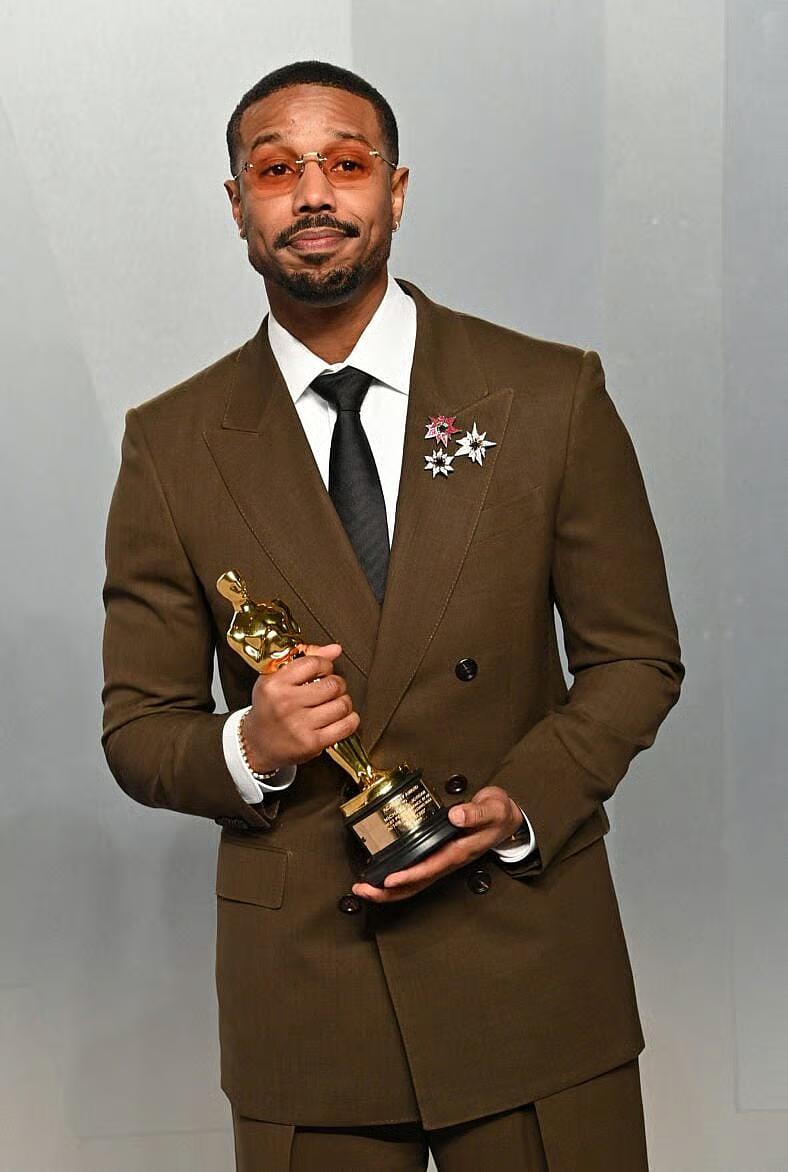
Michael B. Jordan has given fans another glimpse of his next big-screen role after unveiling a striking new poster for his upcoming film.
The newly released artwork features the actor in a sharp tuxedo as he takes on the title role in the modern remake of the 1968 heist classic “The Thomas Crown Affair.”
Jordan has previously spoken about his personal connection to the film, revealing that he grew up loving the 1999 version starring Pierce Brosnan. He later became an even bigger fan after watching the original 1968 classic starring Steve McQueen.
More than a year after revealing that filming had begun on his remake of “The Thomas Crown Affair,” Michael B. Jordan has given fans another look at the project by unveiling its first official poste.
Jordan appears in an elegant ivory-white tuxedo jacket paired with a crisp white shirt and black bow tie. A black leather-gloved hand adjusts the bow tie, reinforcing the polished, sophisticated image of the master thief he portrays in the film.
Above the title is the tagline, “REVENGE IS A WORK OF ART,” hinting that vengeance could play a central role in the story.
The bottom of the poster confirms an IMAX release and a theatrical debut on March 5, 2027, and credits the creative team Jordan partnered with to bring the project to life.

Although the film is still nearly a year away from its theatrical release, fans are already eagerly anticipating its arrival.
“I’ve never seen the version from the 1960s or 1990s, but I plan to watch them before I go see this one,” one fan wrote.
“Classic movie. One of my favorites. Definitely think MBJ can pull it off,” a second Instagram user commented.
“The one with Pierce Brosnan was awesome… I can only imagine what awesomeness will come from this one,” another fan shared.
“This man doesn’t miss. Not once. March 5 officially booked,” another user wrote, while another added, “The original is so good! Can’t wait for this.”

During an appearance on Variety’s Awards Circuit podcast last November, Jordan discussed his lifelong admiration for “The Thomas Crown Affair” franchise and why he chose it as his next MGM project after the critically acclaimed Creed series.
“I loved the 1999 version as a kid — Pierce Brosnan, the slickness, the art. I didn’t grow up going to museums, so that film showed me a different side of New York. My mom’s an artist, so I was raised around paints and leather dyeing. It shaped my taste more than I realized,” he said.
Jordan added, “Later, I saw the 1968 Steve McQueen version — the split screens, the style. After Creed, MGM asked what I wanted to do next. I said, ‘Thomas Crown Affair.’ I need that.”

For his remake of “The Thomas Crown Affair,” Michael B. Jordan temporarily relocated to England, where the film was shot.
The move left him feeling homesick, but the biggest challenge came from balancing several responsibilities beyond starring in the film.
“It’s the second hardest thing I’ve ever had to do outside of Sinners,” the actor said, comparing the project to his award-winning 2025 horror film. “Directing, producing, writing, acting. It was a lot.”

Earlier this year, Jordan teased that his remake of “The Thomas Crown Affair” would feature plenty of unexpected twists that would keep fans guessing.
“It’s a big movie. It’s international. It’s sexy. It’s a lot of fun. A lot of twists and turns. It’s going to have some things that I think audiences won’t be expecting that might be a nice treat for them,” he told The Hollywood Reporter in January.
During a subsequent appearance at MGM Studios’ CinemaCon in April, Jordan offered further insight into what drew him to “The Thomas Crown Affair.”
“I’ve been daydreaming of making this movie for years,” he shared. “I saw the ’99 Thomas Crown Affair when I was around 9 years old. It was a guy who was smart, sophisticated, and always three steps ahead.”




Weekend Open Thread: Brooks Brothers

Commonwealth Games boxing: Jadumani Singh seals dominant 5-0 win over Pakistan’s Sumama Rehman to enter quarter-finals | Commonwealth Games News


Intel is reversing course and bringing hyper-threading back to its server chips


Ethics, other provisions in crypto Clarity Act to be further discussed


Luke Littler dismantles Gerwyn Price to retain title in Blackpool


Ripple bought a bank in pieces. The $4 billion audit

A New Post-Apocalyptic Gundam Anime Series Blasts Into SDCC


2026 3M Open leaderboard: Scottie Scheffler finds putter in Round 1, sits three back


BITCOIN JUST ENTERED THIS CRITICAL ZONE…


16 Dresses for the High Summer Event


The Part of the Electric Transition Nobody Wants to Discuss


The Peugeot Family: How 200 Years of an “Old Money” Dynasty Died in A Boardroom


Major shareholder moves on Canyon


Spain sweeps the board at 2026 World Cup with individual awards


XRP Ledger adds $2.6B as RWA inflows rank second


Uniswap (UNI) pushes deeper into tokenized RWAs with permissioned trading pools

‘Stargate’ Creator’s New Sci-Fi Series Returns for Season 3 Tomorrow
SEC Agrees to Overhaul Recordkeeping After Settling Coinbase Lawsuit Over Gensler’s Lost Texts


Anthropic launches Claude Opus 5, a cheaper AI model for coding, agents and enterprise workflows


Sara Gilson Killed By Husband After Viral “Pedophile” TikTok Video



You must be logged in to post a comment Login