

Entertainment
Young and the Restless: Diane’s Shocking Arrest Sparks Massive Fan Outrage!

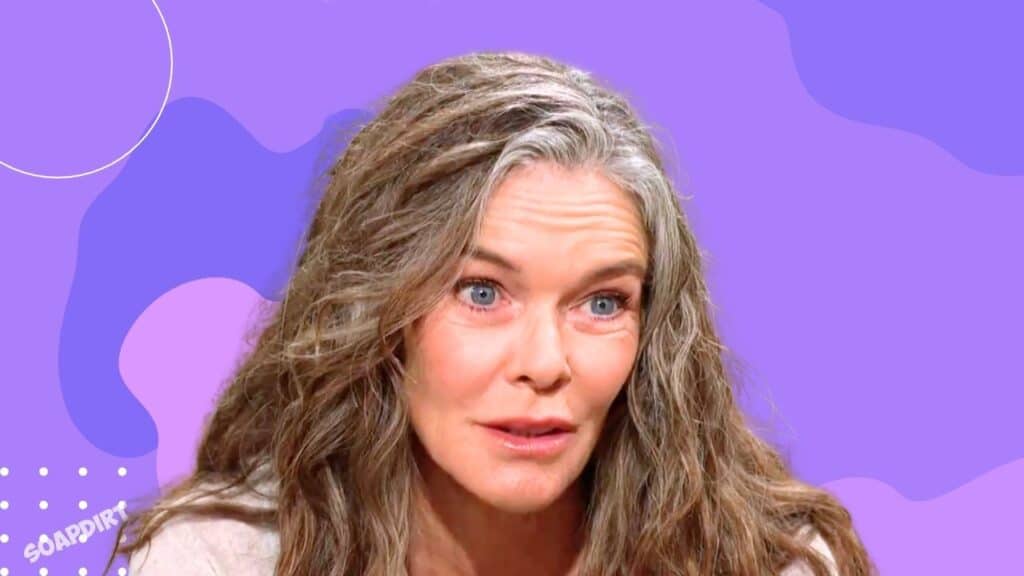
Young and the Restless unveils that Diane Jenkins Abbott (Susan Walters) is never seen at the GCPD after her arrest. That’s all happening off-screen after she’s accused of stabbing Jack Abbott (Peter Bergman).
And it’s all because Patty Williams (Stacy Haiduk) said Diane did it. And Detective Burrow (Matt Cohen) took Patty’s word based on zero evidence. It’s kind of wild that this woman’s plan to frame Diane for attacking her and stabbing Jack seems to be working.
And I mean, it is ludicrous. So, I’m seeing right now nothing but fan outrage on soap social media over this ridiculousness. We’ve got crazy Patty successfully framing Diane for trying to kill both her and Jack. It’s insane.
Young and the Restless: The Flaws in Diane’s Arrest
Viewers know that Patty stabbed Jack in the gut and then slashed her own arms to set up Diane. And right off the bat, everybody in Genoa City except for the detective and the DA know that Patty is literally certifiably insane. Until very recently, Patty was getting treated by Dr. Markham (Jere Burns) in a mental institution. The very fact that Patty has been locked away for years and has a history of mental illness and violence makes her a witness with zero credibility.
Diane’s only past crime was the fraud of faking her own death. So, you put Patty and Diane on a scale of who can be trusted and who’s likely to be violent and not, and you can see Patty shouldn’t have gotten the time of day from a GCPD detective. Granted, he’s new in town, but come on, there’s a criminal record that he could look up for her.
Patty’s Violent History on Y&R
Patty shot Jack before trying to kill him. Nearly did it. Patty also shot Victor Newman (Eric Braeden). He needed a heart transplant after that. Patty’s the reason that Traci Abbott’s (Beth Maitland) daughter, Colleen, is dead. And Dr. Markham, who was holding Diane in his home, was also allowed to be a witness.
Jack’s whole family knows that Patty kidnapped and molested Jack just a few weeks ago. And Traci and Kyle Abbott (Michael Mealor) know Patty was blackmailing Jack and forced him to evict all of them from the mansion so that Patty could live there alone with Jack. That is ongoing insane behavior.
Plus, both Diane and Kyle have the same exact story that Markham was holding Diane captive at his house and Kyle had to break in to help Diane get out. She even admitted to drugging Markham because he was holding her captive and Kyle was there to witness this happening.
Not one single Abbott has spoken out against Diane. That’s another thing. Not one of them had any doubts about who attacked Jack. Every Abbott says immediately Patty did this. Yet Diane was arrested because Detective Burrow took Patty’s word.
Young and Restless: Poorly Executed Writing
In addition to it being badly written, it’s also poorly executed. I mean, honestly, this feels like a low point on Young and the Restless. Diane was processed off-screen, unless I missed it. Didn’t get to see her mugshot. Didn’t see any evidence gathered because there’s not any, you know, it’s just what we saw, which was not much. And that’s just lazy on top of being so improbable that you can’t even justify it by saying, “Okay, sometimes soaps do wild things.” This is outside of that scope.
Also, Kyle and Diane arrived at the mansion together. Kyle is her alibi, and despite him being her son, he’s credible. He’s got no history of criminality or being institutionalized. And Markham did confirm that Diane drugged him to get out of his house. So, how do the cops think that she got from Markham’s place to the Abbotts if not with Kyle? As has been stated, she’s got no phone to call an Uber.
Her car is not in her possession. And the Abbotts have security cameras. That has been mentioned in years past on Y&R and other storylines. And I guess that’s another thing the now-terminated headwriter forgot. Those cameras would show Kyle and Diane arriving home together in the same vehicle, getting out of the car, and going inside. That would reinforce her alibi. It’s just wild how badly this is being done on Young and the Restless.
Young and the Restless: Good Riddance to Josh Griffith
Josh Griffith has honestly written the dumbest storyline ever that was already screwed up by the Beyond the Gates crossover mistakes. If you remember on Y&R, they already had Diane missing for quite a while. Kyle was worried and he was telling Jack that Diane was MIA from work, hadn’t been sleeping in her bed at the Genoa City Athletic Club.
Then all of a sudden during the crossover, Diane was at a political fundraiser with Kyle and Jack. Happy as can be. Their marriage was blissful. They weren’t estranged. And then after the crossover on the next Y&R episode, we’re back to Diane suddenly missing. This plot has been disastrous the whole time and it’s getting worse by the day.
We’ve got DA Christine Williams (Lauralee Bell) ready to charge Diane with two counts of attempted murder over Patty and Jack. Come on. Christine was Patty’s sister-in-law. She knows how crazy that she is. Christine knows Patty’s horrifying history of criminal insanity and her arrest and her crimes and convictions. Christine is being written as the world’s dumbest district attorney on top of Detective Burrow as the world’s dumbest cop.
Y&R Fans See Through the Sloppy, Lazy Writing
Translation: Josh Griffith is the world’s sloppiest, laziest, and most inept soap writer in the history of Young and the Restless. He’s writing as if nobody knows Patty’s history. I mean, clearly he doesn’t, but soap fans don’t have amnesia like these characters. Nobody in Genoa City would realistically take Patty’s word for anything, especially when everybody knows that Diane went missing a while ago and that Patty kidnapped Jack quite recently.
And then to top it off, Diane had a cell phone in her hand that could have dialed 911 at any time. Locked cell phones can dial 911. In fact, even if the cell service has been cancelled and the phone has no coverage, it will still dial 911. Did you know that? I don’t know if Josh Griffith is dumb or he thinks fans are dumb. It’s kind of hard to say at this point.
This Y&R Storyline is Happening Off-Screen
And speaking of off-screen antics, Diane was arrested and out on bail in one episode, most of it off-screen. To get bail in a murder or attempted murder case, that requires a hearing in front of a judge and that takes several days to happen with a violent crime like that because they need to process evidence, all that stuff. But no, off-screen and instantaneous. So, a whole bunch of Young and the Restless, honestly, is pretty much happening off-screen. And on screen, we get Noah Newman (Lucas Adams) in his shiny disco shirt trying to act macho.
At any rate, we’re also going to see Patty telling Dr. Markham this week that Jack has to die so that he can’t wake up and tell the truth. So, it seems like there should be a cop guarding his room. And with Diane charged with his attempted murder, seems like that cop should not allow Jack’s supposedly murderous wife in to sit at his bedside. That’s where she’s at right now, though. I literally think a toddler could write a better storyline.
Young and the Restless: Fan Outrage Over Bad Writing
Here are just a few comments from outraged fans on social media. One said, “The writers must think we’re really stupid.” Another said, “The writers have zero respect for the audience.” Somebody else said, “Patty went full circle psycho by accusing Diane. How much more stupid can this show be?” Another said, “We soap fans will forgive a lot of unbelievable story lines, but Patty framing Diane for stabbing Jack. The writers are completely insulting our intelligence.”
Another person said, “Arresting Diane is lazy writing at its finest.” Somebody else said, “Diane has blood on her hands from trying to help Jack and they arrest her. Make it make sense.” Last one that I’m going to share, and there were literally hundreds, maybe even thousands of comments like this. This last one: “The fact that they let Patty accuse Diane on the spot and haul her off while Jack is bleeding out is peak bad soap writing.” I agree.

Continue Reading
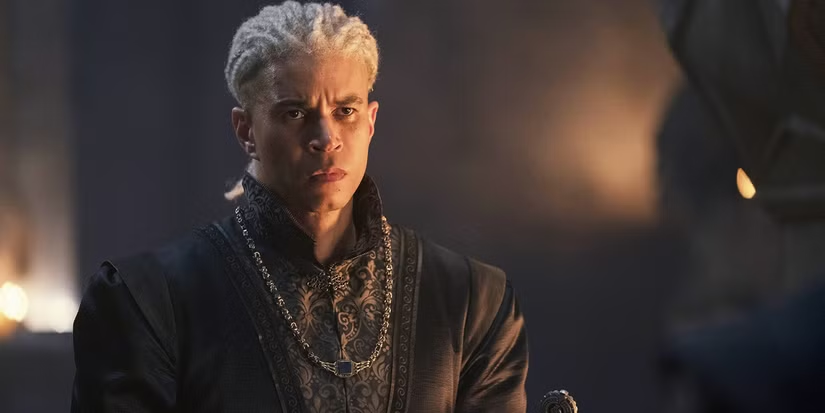
The following article contains spoilers.As the highly anticipated spin-off series to Game of Thrones, House of the Dragon took the world by storm by propelling its audience back to the wild world of Westeros. Filled with fantasy back-stabbing, royal chess moves, and an army of dragons, this show shines with its streamlined narrative focus on the complex Targaryen dynasty. Now three seasons in, the Dance of the Dragons is in full swing, with the conflict growing bloodier and more devastating with each passing episode.
As the story continues to unfold, let us not forget the iconic moments of the past. From King Viserys’ (Paddy Considine) mighty entrance to the throne room, to Rhaenyra’s (Emma D’Arcy) and Alicent’s (Olivia Cooke) confrontation, these events have stayed in the minds of fans since the show’s initial airing. And yet, where those scenes are poignant and impactful, this list will track the show’s WTF moments. The wild moments that took us off guard and possibly made us wonder what exactly we were watching. And let’s be honest, in this world, there are a lot of moments that qualify.
15
Faking Laenor’s death
Season 1, Episode 7 (2022)

From the very beginning, it was clear that Rhaenyra and Laenor’s (John MacMillan) union was to be one of convenience. Politically advantageous for both their houses, the two came to an agreement to do their duty as heirs, whilst finding their own outlets for happiness. Unfortunately, this never fully came to fruition as they never conceived their own biological children. And though cordial and close in their own platonic ways, the two even struggled to attain true happiness. At least, until they didn’t.
Wanting to secure a formidable partner to face the wrath of the Greens, it appeared that Rhaenyra and Daemon orchestrated the murder of Laenor to expedite their marriage. However, all was not as it seemed, as it was quickly revealed to be a ruse. The true victim was a poor servant whose body was made to resemble Laenor’s, allowing him to make his escape and sail off to freedom with his lover, Ser Qarl (Arty Froushan). A twist in the story that even shocked Fire and Blood book readers.
14
Criston Cole attacks Joffery
Season 1, Episode 5 (2022)

While Rhaenyra and Laenor were happy with their marital arrangement, not all parties were pleased. Indeed, Ser Criston Cole (Fabien Frankel) made it clear that he did not like the thought of being the princess’ “whore,” a statement made all the more ironic by his later actions.
In the final episode, before the show’s 10-year time jump, Cole is left bitter and angry, resenting himself for breaking his Knight’s oath of chastity. And unfortunately for Joffrey, Laenor’s lover, confronting Cole about his relationship with the Princess came at just the wrong time: on the night of Rhaenyra and Laenor’s betrothal celebration. Indeed, perceiving it as a threat of blackmail, Cole snaps and beats Joffrey (Solly McLeod) to a pulp, right in front of all to see, killing him instantly. Talk about a party killer. Honestly, what makes this even wilder is how Cole never received any lasting consequences (nor for anything else, for that matter).
13
Rhaenys dies at Rook’s Rest
Season 2, Episode 4 (2024)

When Criston Cole’s army lays siege to Rook’s Rest, Princess Rhaenys (Eve Best) answers the call by riding her veteran dragon into battle. Initially gaining the upper hand against Aegon (Tom Glynn-Carney) and his dragon, Rhaenys proves exactly why she’s regarded as one of the most experienced dragon riders in Westeros. Sadly, the battle changes dramatically when Aemond (Ewan Mitchell) arrives aboard the colossal Vhagar (among the largest dragons in the Game of Thrones franchise).
The Battle of Rook’s Rest is one of the defining moments of the Dance of the Dragons because it demonstrates just how catastrophic dragon warfare truly is. And for Rhaenys, rather than fleeing when an opportunity arose, she instead chose to turn back and fight for her Queen, fully aware of the odds stacked against her. Her final stand is equal parts heroic and heartbreaking, even as Vhagar delivers the fatal blow. It’s an unforgettable sequence and one that leaves a large impact on Team Black and the audience itself.
12
Aemond loses his eye
Season 1, Episode 7 (2022)

Where the first half of the series saw the beginnings of the division between the Greens and the Blacks, audiences were introduced to how it eventually manifested within the children. Conditioned to be at odds with one another, the tension reached an all-time high following Laena Velaryon’s (Nanna Blondell) funeral.
Seizing the opportunity before him, Aemond (Leo Ashton) sneaks off to boldly claim the newly riderless Vhagar as his own. Though successful in his efforts, he is quickly met with adversity as Laena’s daughters, Baela (Shani Smethurst) and Rhaena (Eva Ossei-Gerning), perceive it as dragon theft. A fight ensues between Aemond and the girls, with Jacaerys (Leo Hart) and Lucaerys (Harvey Sadler) offering support to their cousins. But things take a fiercely violent turn as their squabble ends with Aemond’s eye getting sliced out by the hands of young Lucaerys. Yikes.
11
Daemon and Rhaenyra’s sexual escapade
Season 1, Episode 4 (2022)

Incest is not new to the Game of Thrones universe, especially when it comes to the Targaryens. Indeed, from the very first time we saw Rhaenyra (Millie Alcock) and Daemon (Matt Smith) clap eyes on one another, it was evident that they shared the same sort of fire. But all this doesn’t negate how wild it was to witness them break past the familial barriers and dabble in a more sexual relationship.
Upon his return from the Stepstones, Daemon helps Rhaenyra sneak out of the Red Keep to show her the streets of King’s Landing and the seedy things they have to offer. Ending their journey in the confinement of a brothel, the two begin to test the boundaries of their relationship in just the ways you think they would. As uncle and niece, this was a bizarre thing to watch, especially since Rhaenyra was a teenager. But what felt even more strange was how we, as the audience, were practically rooting for them.
10
Laena’s death
Season 1, Episode 6 (2022)

Following the 10-year time jump, audiences are introduced to a grown-up Laena, married to Daemon with two children and one on the way. Incest aside, the two appeared to share a marriage built on the foundations of genuine affection. That’s why it was so heartbreaking to see Laena go through a difficult birth.
Indeed, House of the Dragon was not afraid to explore the many traumas of childbirth, as almost every one ended in tragedy. And Laena’s was no different. However, what set her apart was how her tragic end at least happened on her own terms. Knowing that other men were going to make decisions about her own body and potentially cut her open, Laena crawled her way to Vhagar and opted to die by dragonfire. This was the scene where audiences saw the true bond between a dragon and its rider. It was harrowing and shocking, but powerful nonetheless.
9
Fake Daeron Targaryen
Season 3, Episode 3 (2026)

After Rhaenyra (Emma D’Arcy) finally captures King’s Landing, Daemon is sent to confront Ormund Hightower (James Norton) to offer surprisingly generous surrender terms: disband the Hightower attack, return to Oldtown, and hand over Prince Daeron—Alicent and Viserys’ youngest son. At first, the mysterious Lord appears to comply, producing a silver-haired boy into Daemon’s custody. But that all changes when Rhaenyra allows Alicent to meet her son, as it’s immediately clear that she does not recognize the boy at all.
Instead, it’s quickly revealed that he is an innocent child whose hair has been dyed and who was threatened to play the part while the real prince remains safely hidden with the Hightowers. The introduction of Daeron’s impostor is a bizarre act of deception because it fools almost everyone, including the audience. But it also raises the question of why. One could argue that it sets up Ormund as a cunning strategist. But for the most part, it simply stands out because it’s so audaciously simple (and funny).
8
Larys Strong
Season 1, Episodes 6 & 9 (2022)

Apologies, but this man deserves an entire entry of his own purely for the shocking things he did in only a short amount of time. Indeed, Larys Strong (Matthew Needham) has proven himself to be the grimiest and creepiest character on the show. Cunning, manipulative, and all-around gross, fans now brace themselves whenever he is seen on-screen.
Making a name for himself as Queen Alicent’s number-one obsessor, his desperation to prove his loyalty went so far as to arrange a fire to brutally kill his own father and brother. Cut to a few episodes later, we see that Larys remains in Alicent’s inner circle, but at a price. In order to secure his spies’ intel, she must satisfy his foot fetish. Yes, that’s right, folks, we get a scene of a grimy man getting sexually aroused at seeing a woman’s toes. No kink shaming, as we were just disgusted at the exploitation.
7
Daemon beheads Vaemond Velaryon
Season 1, Episode 8 (2022)

As one of the most complex characters of the show, one can never really predict the actions and motivations of Daemon Targaryen. Long perceived as the Iron Throne’s heir-presumptive, the man is ambitious, reckless, and, more often than not, ruthless. But, despite his moral grayness, there’s no denying how fiercely protective he is of his family and loved ones, albeit in his own special way.
Such traits are clearly evident in the trial of Driftmark’s succession. Upon his determination to contest young Lucerys as the heir, Vaemond Velaryon (Wil Johnson) bursts into a fury, declaring Princess Rhaenyra (D’Arcy) as a you-know-what and her sons as “bastards.” But alas, in true Daemon fashion, he quickly silences the room by slicing Vaemond’s head in half. Honestly, we can’t say we’re that surprised. It is Daemon, after all. Perhaps it was just the pure shock of the image’s graphic nature. At least it taught everyone not to mess with his wife and kids.
6
Aemond burns Aegon
Season 2, Episode 4 (2024)

There’s no doubt that the Battle of Rook’s Rest delivered some of Season 2’s most jaw-dropping moments. But perhaps none was more shocking than Aemond’s betrayal of his own brother—especially since this did not happen in the book. Indeed, as Aegon recklessly charges into battle atop Sunfyre, Aemond arrives on Vhagar and unleashes dragon fire that engulfs both king and dragon. As a result, Aegon is left horrifically burned and gravely injured, while his dragon is wounded.
Whether Aemond acted out of calculated ambition or simply seized an unexpected opportunity, the moment completely transforms the Greens’ internal dynamics. In just one moment, the cunning Prince fully showcased his true colors and how his schemes had no boundaries. It’s a wonderfully ruthless twist that perfectly captures House of the Dragon‘s obsession with familial betrayal and reiterates exactly why Aemond is a deeply troubling foe.
The current news cycle seems to be doing its level best to break all of us psychologically, but many of us still enjoy watching movies about characters losing their ever-loving minds. Psychological thrillers are one of the most popular kinds of thrillers, and they’ve been a genre staple for decades. Maybe it’s because some of us like a little schadenfreude in our films, so we watch the ones that put their protagonists through the most pain and punishment. Maybe we feel safer watching someone on a screen go crazy, confident that it could never be us. Maybe we’re all just a little more sick in the head than we’re all willing to admit. Who knows, but let’s look at some psychological thrillers.
The category of crazy today is psychological thrillers that will keep you hooked from start to finish — movies that dig deep into your psyche and don’t let go. They reel you in with intrigue and maybe even some mystery, and then they capture you in a big butterfly net and refuse to let you go. We’ve got classics from the ’30s, ’40s and ’50s, surreal trips from the ’60s and ’70s, a slasher’s return in the ’80s, a master filmmaker’s ’90s remake, and three singular sociopaths in the 21st century. These are the psychological thrillers that hook you from the start and don’t let go until they’re finished.
‘M’ (1931)

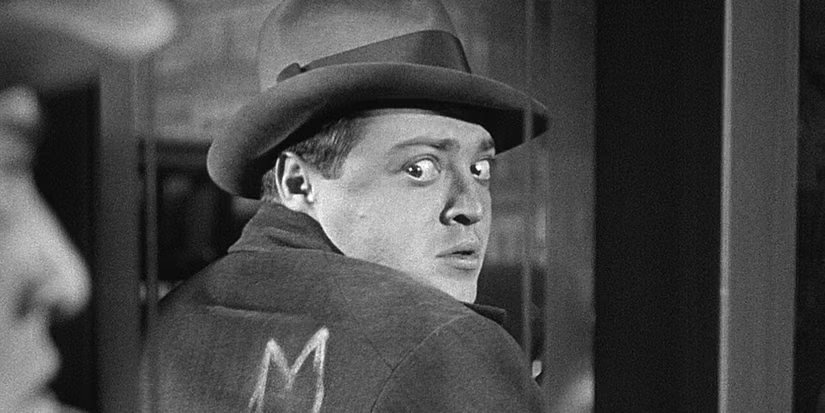
Step into the mind of a murderous madman in Fritz Lang‘s serial killer thriller M. Starring Peter Lorre as a child killer and following a procedural plot where both the police and the criminals of Berlin try to entrap him, the film is totemic within the crime genre. It’s a bleak view of violence and the nature of villainy that strikes a harrowing chord thanks to Lang’s striking use of visuals and Lorre’s intense lead performance. While he’d become Hollywood’s favorite creep for years after this breakthrough, nothing quite approaches the unsettling nature of Hans Beckert.
All of Berlin is on high alert thanks to a series of child killings. The police are desperate to catch the killer, which also puts pressure on the city’s criminal underworld. These organized criminals decide to take matters into their own hands and capture Hans, which leads to a mock trial where the madman laments his compulsion in a monologue that is deeply discomforting. Lorre lets you into the psyche of his “psycho,” and Lang lays out a landscape where a mind like his can prey on the innocent. M may be almost 100 years old, but it still knows how to grip you tight.
‘Gaslight’ (1944)

The term “gaslight” has proliferated far and wide across our cultural consciousness. It’s not unusual to hear it used by a Boomer, Millennial, or Gen X and Z. It’s become cemented into our vernacular, but many people don’t know it originated in a movie. George Cukor‘s classic psychological thriller Gaslight from 1944 was based on a play by Patrick Hamilton, which had previously been adapted in 1940 as a British film. Cukor’s take is the far superior and more iconic version, following a husband who goes to extraordinary lengths to convince his wife she’s losing her mind.
Paula (Ingrid Bergman) is an opera singer married to Gregory (Charles Boyer). After Paula finds a letter addressed to her murdered aunt, her world begins to crumble: she can’t seem to remember doing things her husband says she did, and she’s apparently hallucinating about the dimming gaslights in their home. Of course, all of this is the work of her husband Gregory, who has some secrets of his own that he can’t let Paula find out about, so he’s been systematically undermining her, making her question her own sanity. Gaslight is a classic psychological thriller draped in gothic and noir stylings. It was nominated for multiple Academy Awards, winning for Bergman’s performance and the art direction, but its legacy has lived on well beyond its celluloid origins.
‘Les Diaboliques’ (1955)

It’s one thing to make someone think they’re going crazy, but what about literally scaring them to death? That’s part of one of the most iconic scenes in Henri-Georges Clouzot‘s Les Diaboliques. Based on a novel by Boileau-Narcejac, who also wrote the book that inspired Alfred Hitchcock‘s Vertigo, the film is a psychological thriller so intense that it’s become considered a classic of the horror genre as well. There’s nothing supernatural about the film, unless you consider the inhuman lengths some people will go to drive someone insane.
Michel (Paul Meurisse) is the tyrannical headmaster of a boys’ boarding school. He’s married to Christina (Vera Clouzot), who has a serious heart condition, and is having an affair with teacher Nicole (Simone Signoret). Michel subjects both women to different forms of abuse, which leads them to join forces to murder him. When his body disappears, they become convinced that his spirit is haunting the school grounds, which eventually leads to a twist ending that’s among the most iconic in cinema. Les Diaboliques has influenced dozens of thrillers and horror films since its release, but none of them dig in quite as deep as this classic.
‘What Ever Happened to Baby Jane?’ (1962)

While women are often the victims in this subset of thrillers, due to many of them being an unfortunate reflection of society’s gender inequalities, they can also be some vicious villains. Nowhere is that more evident than in the progenitor of the psycho-biddy subgenre, What Ever Happened to Baby Jane? Starring Hollywood icons Bette Davis and Joan Crawford as antagonistic sisters of former fame, the movie proves that actresses can do crazy just as well as their male counterparts, and they can do it backwards and in heels.
Jane (Davis) is a former child star of vaudeville whose career has long since been eclipsed by her movie star sister Blanche (Crawford), who later becomes paralyzed in a car accident. Years later, the two ladies share a crumbling mansion as Jane slips further into alcoholism and subjects her sister to horrific abuse. The legacy of What Ever Happened to Baby Jane? extends beyond its contributions to the thriller and horror genres, with the alleged feud between Crawford and Davis on set fueling years of tabloid journalism and even serving as the basis for a couple of television series. Regardless of the truth behind the tension, the two actresses make for a crackling onscreen duo in this camp classic psychological thriller.
‘Don’t Look Now’ (1973)

Grief and trauma have become popular themes in the current era of “elevated horror,” but fantastic filmmakers have been using the strong emotional responses to fuel all kinds of terrifically terrifying films for years. Take Nicolas Roeg‘s surreal Don’t Look Now, a Hitchcockian thriller updated with more visceral violence and sexual content, as well as a fracture editing style that mimics the unstable psychological state of its married protagonists. It’s a frightening depiction of the damaging effects of loss and grief with two superlative lead performances.
John (Donald Sutherland) and his wife Laura (Julie Christie) are struggling to piece their lives back together after the drowning death of their young daughter. Moving to Venice, the couple begin to experience strange sightings that make them question their own sanity. John believes he may be seeing the specter of their deceased daughter, while a serial killer is also stalking the same streets he wanders. There’s an unsettling aura all around Don’t Look Now, which gives a gothic bend to its tale of tragedy that makes its discordant ending all the more effective. It’s a movie that demands attention and hooks you up high to let you struggle to find a foothold in its layered narrative.
‘Psycho II’ (1983)

While Hitchcock merely inspired Roeg, the master of suspense gets directly sequelized by director Richard Franklin for the psychological slasher Psycho II. While some decried the mere idea of making a sequel to Hitchcock’s seminal horror thriller, Franklin’s film carves out its own colorful place to exist alongside it. Featuring Anthony Perkins reprising his iconic role as Norman Bates, it’s a movie that uses the universal knowledge of its predecessor to keep the audience, and its own characters, guessing until the very end.
Written by cult filmmaker Tom Holland, the sequel picks up with Norman 22 years later as he’s being released from a psychiatric hospital. He moves back into his old home and tries to ease himself back into normal society, but a series of phone calls from “Mother” let him know he isn’t free of his demons yet. Then the bodies start piling up. Just like the first film, there are plenty of twists in this psychological film, and even more gruesome kills befitting its ’80s era. It may not measure up to the original masterpiece, but Psycho II will keep you on the hook the whole time.
‘Cape Fear’ (1991)

With the recent Apple TV adaptation, Cape Fear now exists in three distinct eras of thrillers. The original 1962 film, based on the novel The Executioners by John D. MacDonald, is a straightforward thriller executed perfectly. The newest streaming series convolutes the plot considerably and recontextualizes it for the modern era, but the most psychotic version remains Martin Scorsese‘s 1991 remake, which features a towering and terrifying performance by Robert De Niro. It’s a remake that not only amplified the violence and gore for audiences who’d been fed a steady diet of slashers for a decade plus, but also added darker shades to all of its characters, plumbing some upsetting psychological depths in the process.
Max Cady (Robert De Niro) is a convicted rapist who only has one thing on his mind when he’s released from prison: revenge. Cady has his sights set on lawyer Sam Bowden (Nick Nolte) and his family. Cady blames Bowden, who was his defense attorney, for his conviction after discovering he had buried evidence. His torment of the family goes far beyond the limits shown in the 1962 original, particularly in an updated version of Cady’s interaction with teenager Danielle (Juliette Lewis). In the original, their encounter is a thrilling chase sequence, but in Scorsese’s remake it becomes a stomach-churning seduction. Cape Fear is a terrifying thriller that hooks and tortures you with two hours of total terror.
‘One Hour Photo’ (2002)

Robin Williams was, of course, known for his brilliant comedic mind and manic energy. It’s what made his softer, dramatic turns in films like Dead Poets Society so affecting. It’s also what made his dark turn in the 2000s so terrifying. In 2002, Williams starred in both Christopher Nolan‘s Insomnia and Mark Romanek‘s One Hour Photo. Both films showcased Williams as different kinds of disturbed men, but it’s his turn in One Hour Photo that truly cuts to the bone. As Romanek’s feature directorial debut, it’s an assured and disturbing film about the intersection of profound loneliness and dangerous obsession.
Sy Parrish (Williams) is a photo tech who is devoted to his work since he has no family or friends. It’s through his work that Sy forms an unhealthy obsession with one particular family. Developing their photos, Sy forms a parasocial attachment to them and their idyllic lives. When that perfect illusion is shattered, Sy’s obsession takes a dark turn, and Williams’ mannered performance turns from tragic to terrifying. One Hour Photo is a portrait of an alienated man inspired by films like Taxi Driver. Whereas Travis Bickle used a .44 Magnum, Sy uses a digital camera.
‘Nightcrawler’ (2014)

Heir apparent to the toxic mantle held by Travis and Sy is Lou Bloom. Played by a rail-thin Jake Gyllenhaal in Dan Gilroy‘s neo-noir nightmare Nightcrawler, Lou is another disaffected loner who finds beauty in the bloodshed. Set in the world of stringers, freelance photojournalists who sell footage to television stations, the film is a dark odyssey into the hearts of men who take the motto “if it bleeds it leads” a little too seriously. Between Gilroy’s razor-sharp script and Gyllenhaal’s committed performance, Nightcrawler is just like carnage on the late-night news: hard to stomach, but impossible to look away from.
Lou is a schemer and a con man who finds a new lucrative opportunity when he discovers the money available to those who capture violent footage of accidents and crimes for unscrupulous news stations. He quickly escalates from recording the violence to tampering with it to actively engaging in it, and the strange energy which Gyllenhaal brings to the character keeps you entranced the entire time. Nightcrawler is both a sharp satire of the modern media landscape and a tautly made psychological thriller that invites you into the mind of a man who loves to gaze into the abyss, and then record it and sell the footage.
‘Nightmare Alley’ (2021)

There’s room for one more creepy con man on this list, and he comes in the form of Bradley Cooper‘s Stan Carlisle, a drifter turned carnival worker and eventual mentalist in Guillermo del Toro‘s Nightmare Alley. Adapted from the novel of the same name by William Lindsay Gresham, which was previously made into a 1947 cult classic, the film is just as dark, if not darker, than any of Del Toro’s horror films. Carlisle is a man driven by pure ambition who will lie, cheat, steal and even kill to get what he wants. That ambition leads him into some dark alleys, and by the end of the film, his life truly has become a nightmare.
After Carlisle literally burns down his old life, he finds his way to a traveling carnival where he ingratiates himself. Learning the tricks of the trade, Carlisle quickly finds success as a psychic performer. Moving to the city, his act attracts even more attention from the wealthy elite, as well as a cold and calculating psychologist. Any fan of noir knows where this story is headed, but Cooper is magnetic in the lead role, and Del Toro’s pulpy visuals give the film a real viscerality. It’s a psychological thriller made by a master of the macabre playing in the black waters of crime dramas.
By Chris Snellgrove
| Updated

From the very beginning, the Marvel Cinematic Universe has conditioned fans to keep their butts in their seats until the movie’s inevitable post-credits scene. Often, these scenes make major changes to this fictional world, like introducing Tony Stark to the Avengers or simply introducing Thanos to the audience. However, outside of the MCU, post-credits scenes are not always guaranteed. Case in point: when X-Men ‘97 Season 2 dropped on Disney+, none of the first three episodes had any such scene. For that reason, most viewers didn’t stick around during the fourth episode, bailing as soon as the credits started.
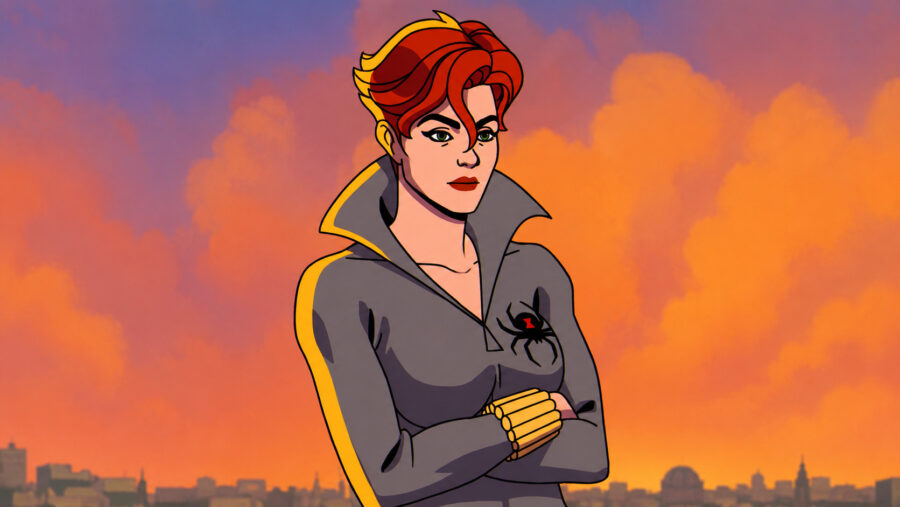
If you did that with the most recent episode (“The Rise of Apocalypse, Part II”), though, you actually missed out on a pretty epic post-credits scene featuring cameos from two fan-favorite Avengers. We see Logan meeting up with Captain America and Black Widow, and they deliver him a file folder labeled “Weapon X.” Cap expresses concern about the X-Man tackling this place on his own, but Logan enigmatically says that he’s put a crew together. This sets up one of the most important plot points of Season 2: Wolverine getting his adamantium back. Plus, if his crew includes former Weapon X test subjects, we might even get an X-Men ‘97 cameo from everyone’s favorite Merc With a Mouth: Deadpool!
Logan And The Cap’n Make It Happen

Most of “The Rise of Apocalypse, Part II” takes place in Ancient Egypt, where some major events go down. Apocalypse makes his inevitable heel turn, assuming command of a high-tech spaceship that will help him in his plans to conquer the entire world. Thanks to Bishop, most of the X-Men are zapped back to the ‘90s, but Magneto stays behind to stop Apocalypse, the mutant threat he accidentally unleashed. This leads to a climactic fight between Apocalypse and the master of magnetism that is likely to leave you crying. After the credits, we get a scene of Wolverine in the present day, meeting with Captain America and Black Widow.
There’s a bit of humor in this X-Men ‘97 scene: Wolverine mentions how he smelled Cap “from a mile away” before being startled by Black Widow, who successfully snuck up on him. Because he’s the only one who dressed incognito (he looks like a bank robber on lunch break), Wolverine also teases Cap about wearing his extremely recognizable uniform. Getting down to business, Cap (who mentions last seeing Wolverine 50 years ago) gives the X-Man a file folder labeled “Weapon X.” The Avenger warns Wolverine not to fight these guys alone, to which the mutant replies that he’s gotten “a crew” and that he’s “getting the old band back together.”
Let’s Talk About X, Baby

So, what does this X-Men ‘97 scene mean? While we can’t predict the future (you’ll need to talk to Mystique’s girlfriend for that), it’s possible to make some educated guesses. Last season, Wolverine had all of the adamantium stripped from his bones by Magneto. The metal was originally attached to him by Weapon X, a shady organization that also implanted him with false memories. It’s a reasonable assumption that Wolverine’s mission will result in him having adamantium bones and claws once again. It’s possible that Apocalypse will be involved, as he’s the one who restored Wolverine’s adamantium in the comics so the violent mutant could serve as one of his Horsemen.
Who is the “crew” that Wolverine has assembled for an attack on Weapon X? This may refer to Team X (a CIA-backed covert force) or other members of the Weapon X program. Either way, that means we’re likely to see Sabretooth, Wolverine’s hated foe (though they made a kind of amends back in X-Men: The Animated Series). We’ll also likely see Maverick, who was teased in the X-Men ‘97 Season 2 prequel comic. While it’s likely to just be those two joining Wolverine for his secret mission, there’s a nonzero chance the team will include Deadpool, who was also a Weapon X test subject.
Old (Like, REALLY Old) Friends

At any rate, there’s plenty to love about this X-Men ‘97 post-credits scene. We get fun interactions between Cap and Wolverine, confirming they haven’t worked together in over half a century; this is a reference to a classic X-Men issue where they (along with Black Widow) teamed up back during World War II. Plus, seeing the Avengers onscreen has renewed fans’ hopes for an interconnected Marvel Animated Universe (hey, it’s gotta be better than the current MCU!). All of this combined to make the post-credits scene just one element of another awesome episode in the greatest Marvel show in television history.
The 2000s had a specific kind of studio confidence that could make a bad R-rated blockbuster feel almost unbelievable. These movies had money, stars, violent premises, recognizable brands, massive historical figures, aliens, assassins, video-game worlds, and apocalyptic threats and would still somehow turn out bad. They were not tiny failures hidden on a shelf and were big enough to know better.
That is why this list hurts more than ordinary bad-movie ranking. An R rating should give a blockbuster force, danger, adult tension, and a little honesty about violence. These six use that freedom badly.
6
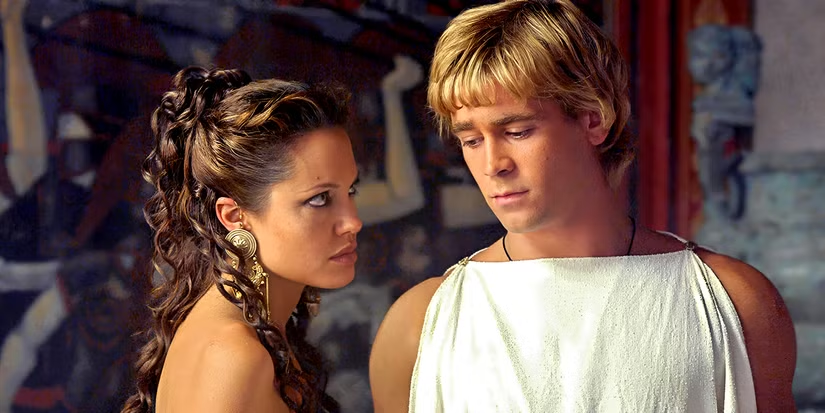
‘Alexander’ (2004)

A film about Alexander the Great should never feel this heavy and unfocused at the same time. Oliver Stone had conquest, family damage, political ambition, battlefield ego, ancient-world spectacle, and one of history’s most mythologized rulers to work with. Somehow, Alexander turns that material into a long, uneven, emotionally distant epic where every major relationship feels buried under explanation.
Alexander (Colin Farrell) gives effort, and there are moments where his vulnerability almost finds the movie Alexander needed. The film around him keeps wobbling between intimate psychodrama, military chronicle, palace intrigue, and history lecture. Anthony Hopkins’ narration keeps telling viewers what the drama should have made clear. Queen Olympias (Angelina Jolie) is pitched at such a strange level that her scenes pull attention for the wrong reasons. King Philip (Val Kilmer) brings more raw force yet the family conflict never locks into a fully satisfying tragedy. The battles have scale, but the storytelling keeps turning momentum into confusion. For a massive R-rated epic, Alexander feels weirdly trapped inside its own notes.
5
‘Hitman’ (2007)

Agent 47 (Timothy Olyphant) should be simple to sell on screen: clean kills, cold discipline, international targets, corporate conspiracy, and a lead character whose lack of emotion should make every tiny change in behavior important. Hitman understands the bald head, the barcode, the suit, and the guns. That is about where the understanding stops.
Olyphant is not the problem. He has enough sharpness to suggest a better version, one where 47’s restraint becomes tense rather than empty. The movie keeps forcing him through generic spy-thriller material that makes the character less mysterious with every scene. The assassination politics are dull, the action is cut without enough pleasure, and the relationship with Nika (Olga Kurylenko) pushes 47 toward emotions the script has not earned. Dougray Scott spends too much time chasing a movie that never gives his investigation real pressure. A good Hitman film should feel controlled, stylish, and ruthless. This one feels assembled from surface details by people who had the costume before they had the character.
4
‘Gamer’ (2009)

Gamer is exhausting in a way that feels almost hostile. The premise has bite: prisoners and civilians are controlled by players in a future where entertainment, violence, celebrity, technology, and exploitation have merged into one public spectacle. Kable (Gerard Butler) is a death-row inmate forced to fight in a live combat game while trying to survive long enough to reach the people controlling his life. That concept has real anger inside it.
The movie buries that anger under visual noise, ugly humor, and nonstop editing aggression. Neveldine and Taylor clearly want the film to feel frantic, obscene, and plugged into the worst parts of media culture. The problem is that watching it becomes unpleasant long before the satire becomes sharp. Kable barely gets enough inner life beyond rage and escape. Ken’s (Michael C. Hall) villain performance has a few strange sparks, especially when the film lets him be theatrical, but even that gets swallowed by the overall chaos. The movie wants to attack dehumanizing entertainment, then spends most of its runtime creating the same numbness it is supposedly condemning.
3
‘Doom’ (2005)

The betrayal of Doom is almost impressive. The game had hellish imagery, monsters, weapons, claustrophobic corridors, military panic, and a simple enough premise to support a brutal R-rated creature-action film. The movie decides the best move is to remove most of the demonic identity and replace it with a genetic experiment plot on Mars. That choice alone drains the adaptation of the one flavor it absolutely needed.
Sarge (Dwayne Johnson) and John (Karl Urban) should give the movie enough physical presence to survive weak writing, but the story keeps locking them into bland squad dynamics and repetitive facility exploration. The monsters rarely feel iconic. The research-base setting becomes monotonous. The dialogue has very little personality. Even the first-person shooter stretch, the one part fans usually remember, feels more like a reference than a reward. It is clever for a minute, then the film has to continue being Doom, and it still has not figured out what that means. A violent Mars horror movie should have been easy to enjoy. This one makes demons, soldiers, mutants, and guns feel strangely routine.
2
‘Aliens vs. Predator: Requiem’ (2007)

A Predator fighting xenomorphs in a small town sounds impossible to make boring. Aliens vs. Predator: Requiem has a crashed ship, a Predalien, facehuggers, civilians, soldiers, darkness, panic, and two legendary monster franchises crossing paths again after the first film already disappointed fans. The opportunity was obvious: go nasty, go clear, go terrifying, let the creatures dominate.
Instead, the movie is infamous for being difficult to see, and that is not a minor complaint. Horror can use darkness. This film often looks underlit to the point of sabotage. Monster action, kills, locations, and character movement become hard to read, which destroys the basic pleasure of watching these creatures attack. The human drama is thin and forgettable, built from small-town conflicts that feel included only to place bodies in danger. The maternity ward material reaches for shock value without enough filmmaking control to make it feel horrifying in a meaningful way. The Predator has moments of competence, and the Predalien design has potential, but the movie keeps burying its own selling points. It is a monster showdown that frequently denies viewers the satisfaction of seeing the showdown properly.
1
‘The Happening’ (2008)

The Happening is No. 1 because every part of it seems to misunderstand every other part. The film is built around a mass crisis where people suddenly begin killing themselves, possibly because plant life is releasing a toxin in response to human behavior. That idea could have produced a disturbing environmental thriller. Invisible threat, public panic, scientific uncertainty, ordinary people losing control of their bodies, no easy enemy to fight. The bones of a scary movie are right there.
Then the dialogue starts, and the film never recovers. Mark Wahlberg plays a science teacher who spends too much of the movie sounding confused by ordinary sentences. Alma (Zooey Deschanel) is written with strange emotional detours that make the marital tension feel misplaced rather than revealing. Characters speak in ways that rarely resemble panic, grief, logic, or basic conversation. The suicides are graphic, but the surrounding drama often becomes accidentally funny, which ruins the dread the film needs. The old woman in the farmhouse adds more awkwardness instead of terror. By the end, the movie has delivered wind, trees, confused faces, and one of the strangest serious-studio disaster films of the decade. A true 0/10 because the premise could have worked, and the execution keeps making the worst possible choice.
Horror’s most enduring franchises tend to have one common trait: They vary wildly in quality from entry to entry. Nightmare on Elm Street fans get treated to sequels like A Nightmare on Elm Street 3: Dream Warriors, but then also have to wade through Freddy’s Dead: The Final Nightmare. Halloween fans get Halloween and … arguably, any of the sequels. Hellraiser gave us both Hellbound: Hellraiser II and Hellraiser: Hellworld. It’s tough to think of any series that doesn’t suffer these kinds of dips…except for one.
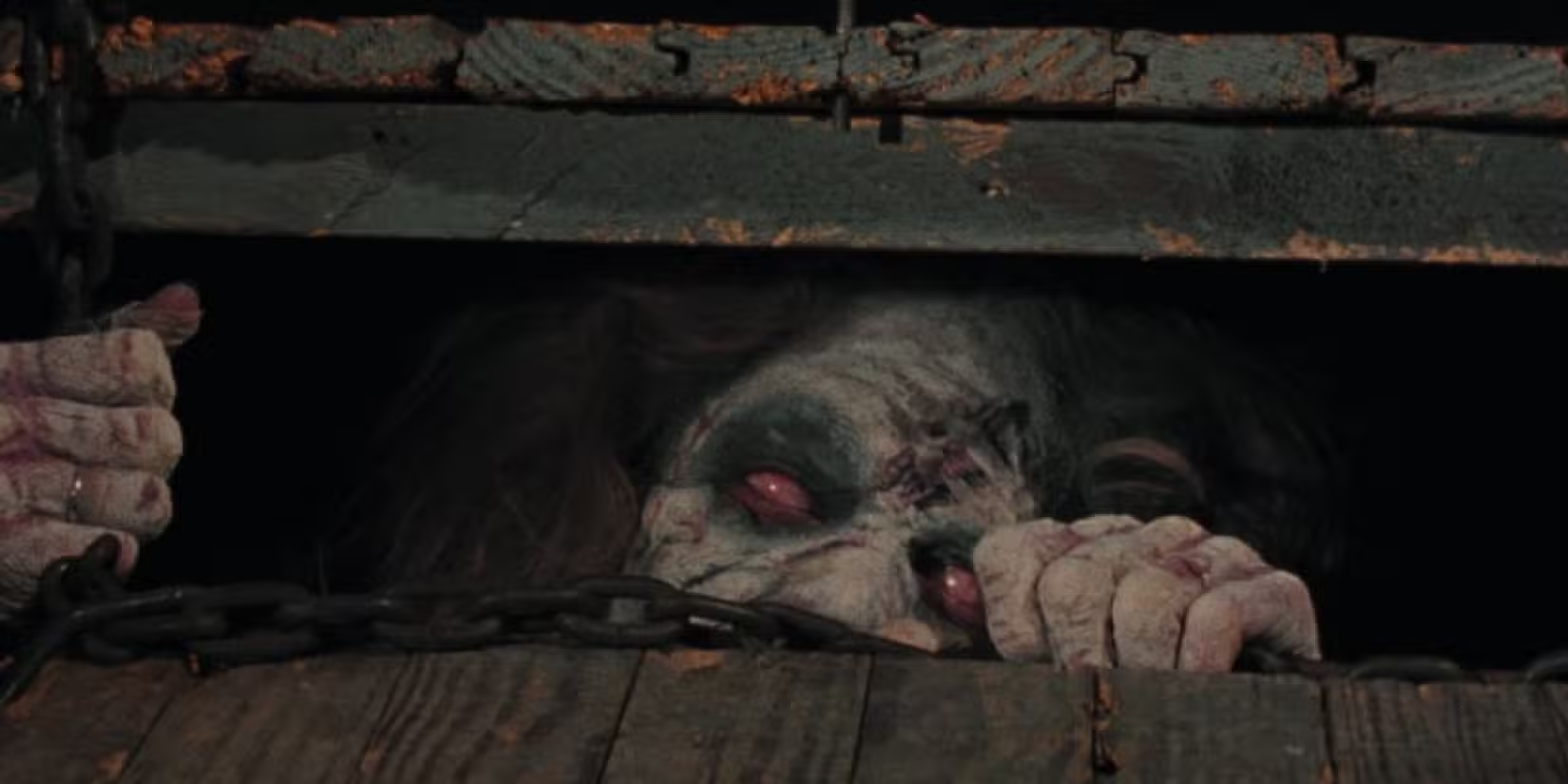
For more than 40 years and five films, Sam Raimi’s breakneck Evil Dead series hasn’t produced a single dud. It’s a laudable accomplishment for a series that includes everything from a straight remake to multiple ventures into comedic territory.
In 1981, audiences were shaken by the scrappy, malevolent energy of The Evil Dead, and its 2013 remake somehow managed to capture some of its blood-soaked, downright mean lightning in a bottle. Even 2023’s Evil Dead Rise, flaws and all, didn’t betray the series’ ruthless roots, with its bloody set pieces and fearless attitude toward kids and violence. On Friday, the sixth entry (and third of the modern era), Evil Dead Burn will hit theaters — and there’s good reason to believe the franchise will continue its winning streak.
Why Horror’s Wildest Franchise Is Also Its Most Consistent

Sam Raimi and his friends put 1981’s The Evil Dead together with little more than about $90,000 and incredible determination; the story of the film’s hellish production is legendary. However, once Stephen King saw the finished product and hailed it as visionary, studios took notice and the relentless horror film was on screens across the country, X-rating and all. American audiences — even those familiar with the nascent slasher film template or, say, The Exorcist — weren’t prepared for the sheer level of mayhem Raimi was able to spray across the screen. At that point, the only comparison for The Evil Dead‘s hallucinatory splatter were some of the more ferocious Italian genre films by masters like Dario Argento and Lucio Fulci.
The success of the first film made a sequel inevitable — even though it took some six years and concessions to producer Dino De Laurentiis for it to arrive. It did take the series in a more overtly comedic direction (the sequel resembles one of Peter Jackson‘s early “splatstick” comedies more than hallucinatory Italian horror), but that wasn’t a problem — Evil Dead II: Dead by Dawn upped the ante in terms of pure wildness and creativity, and was critically praised for it. Even Roger Ebert, who famously loathed many 1980s horror classics, confessed that the film was a blast.
And by the time Army of Darkness arrived in 1991, the series’ transition to comedy-horror was in full bloom, with Bruce Campbell‘s Ash cementing himself as an action hero and Raimi diving into his goofiest set pieces yet, all set in Medieval England. Still, with Raimi and longtime cinematographer Bill Pope behind the camera, the bloody energy and fun never lagged, and Army of Darkness remains a genre classic to this day.
Even the Modern ‘Evil Dead’ Films Have Kept Up the Bloody Standards
Fede Álvarez‘s 2013 reimagining of the original film shouldn’t have worked. Given horror trends of the time and the era’s string of disastrous remakes, the odds were against it. But the first-time writer-director pulled off a bloody, relentless good time with aplomb. Much like the original, 2013’a Evil Dead initially earned an NC-17 rating for its extreme violence, and several eye-popping moments of self-mutilation deserve spots in the gore hall of fame. Álvarez also managed to match Raimi’s pace and dedication to little other than scares; it’s a lean and mean genre film that’s still incredibly rewatchable.
Lee Cronin’s original sequel, Evil Dead Rise, got more lukewarm critical notices than the remake, but it’s almost as much of a ferocious good time. While the film succumbs to the 2020s horror trend toward trauma-porn and underlighting-as-atmophere, it doesn’t disappoint in the demonic visuals and mutilation departments. Cronin also proved he had few qualms with putting kids in danger, and delivered some delightfully vile carnage including scalping and eyeball-spitting … high-quality chaos that sits among the best in the genre.
Sébastien Vaniček Was a Canny Choice to Helm ‘Evil Dead Burn’

So far, the modern Evil Dead films have had a different director for each entry, and that’s proven a surprisingly effective strategy, given how crucial Raimi’s auteurship was to the first three pictures. With this weekend’s Evil Dead Burn, the producers have enlisted second-time French director Sébastien Vaniček to bring the mayhem to life. Given the strengths of his prior film, Infested (Vermines), they may have made the right choice.
An old-fashioned creature feature brought viciously into the modern day, Infested boasts some of the most skin-crawling, genuinely squirmy horror set pieces of the last decade, as overgrown spiders take over an apartment block. And, like Raimi, Vaniček did it using largely practical effects, including real spiders. Only a viewer made of stone will be able to make it through the entire film without squirming at some point — and for arachnophobes, just watching might be hilariously out of the question.
If Vaniček brings the same atmospherically chaotic but visually precise intensity and dedication to discomfort to his entry in the long-running series, audiences are in for a treat with Evil Dead Burn. It’s just his unapologetically gross, tense siege-film mentality that the series requires. And if that’s the case, then may horror’s most consistent franchise never die.

- Release Date
-
July 10, 2026
- Runtime
-
120 Minutes
- Director
-
Sébastien Vanicek
- Writers
-
Florent Bernard, Sébastien Vanicek, Sam Raimi

When it comes to cozy mysteries, Britain proves the perfect backdrop. Whether it’s the quaint village of Midsomer or the gorgeous island of Shetland, the very best of British detective stories are regularly huge hits across the pond in the U.S. Right now on Netflix, Millie Bobby Brown, Henry Cavill, and co have returned in Enola Holmes 3, earning more than 20 million views in its first five days and topping the streaming charts across the world. This is despite facing backlash from both critics and fans, with many calling this threequel “forgettable.”
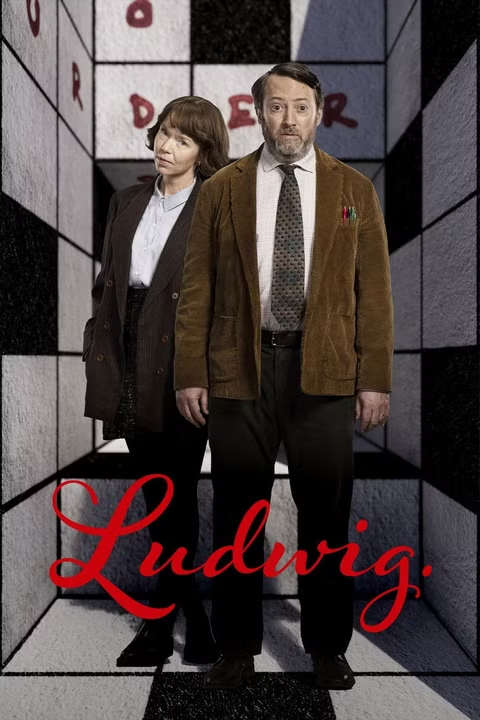
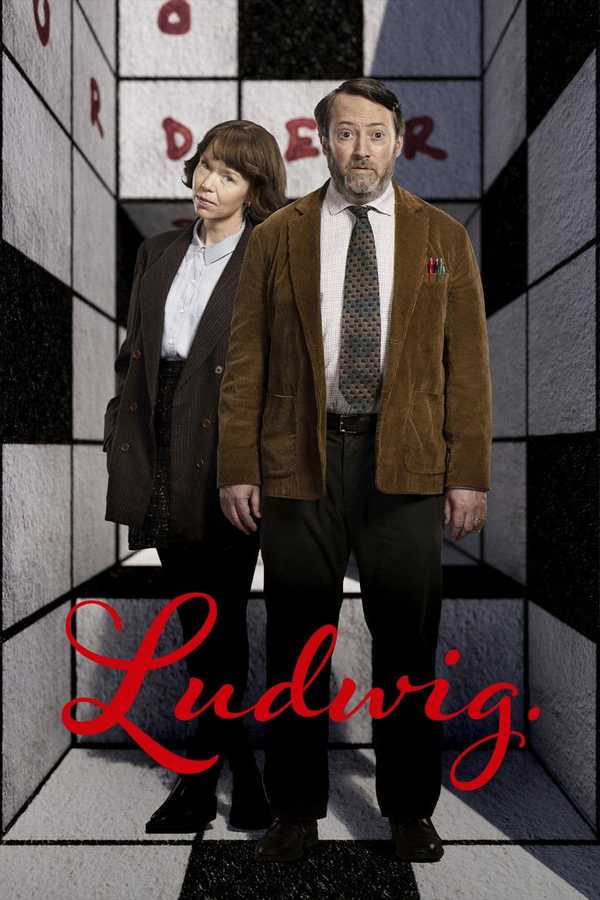
From one British crime solver to another, the future of a modern British gem has now been announced on the BBC. The charming detective series Ludwig stars Peep Show and Upstart Crow star David Mitchell, as he must assume the identity of his missing DCI twin brother to crack the case surrounding his disappearance. The second season of the near-perfect series is set to debut on the BBC later this year, with Anna Maxwell Martin, Dipo Ola, Dylan Hughes, Dorothy Atkinson, Ralph Ineson, and Karl Pilkington joined by Mark Bonnar and Fleabag‘s Sian Clifford in a tantalizing cast.
‘Ludwig’ Just Received a Massive Update
Before the second season has even debuted, Ludwig has received a massive update from the BBC, with it confirmed in a press statement that the detective series would officially return for a third season. Mitchell’s puzzle setter-turned-amateur detective will be back alongside Maxwell Martin as Lucy Betts-Taylor for Season 3, confirming the fate of both in the upcoming second. Season 3 will consist of six 60-minute episodes and will once again be written by Brotherhood. Chris Foggin will direct. In a statement, Mitchell said of the renewal:
“I am delighted that Ludwig will be returning to solve more of Mark Brotherhood’s brilliant mysteries. I can’t wait to get started and have renewed the subscription on my denouement-learning app.”
Jon Petrie, outgoing BBC director of comedy commissioning, said: “Ludwig is exactly the kind of smart, distinctive, audience-pleasing show we love at BBC Comedy. Sharp writing, a compelling story, big laughs and, naturally, a generous helping of puzzles. The team at [producers] Big Talk have crafted something truly distinctive and much-loved, and we’re excited to see what mysteries Ludwig tackles next.”
Ludwig Season 2 will air later this year. Stay tuned to Collider for more news.
- Release Date
-
September 25, 2024
- Network
-
BBC One
- Directors
-
Jill Robertson, Robert McKillop
- Writers
-
Mark Brotherhood
-

David Mitchell
John ‘Ludwig’ Taylor / James Taylor
-

Anna Maxwell Martin
Lucy Betts-Taylor
Entertainment
Joy Behar balks, calls “The View ”cohost a ‘biatch’ for referencing her age during chat about Mitch McConnell’s health
:max_bytes(150000):strip_icc():format(jpeg)/the-view-joy-behar-mitch-mcconnell-alyssa-farah-griffin-070826-6335863bb0bf48ee802dceb675e601ee.jpg)
Alyssa Farah Griffin invoked Behar’s age during a discussion about the mystery surrounding Sen. Mitch McConnell’s health.

Riley Burruss is ready to pull back the curtain on her dating life.
During the Wednesday, July 8, episode of Bravo’s Next Gen NYC, viewers were able to meet Riley’s boyfriend, Christian.
“I got a new boyfriend,” Riley, 23, shared in a confessional interview. “He’s super sweet, super caring and he’s a little bit of a nerd, which I love. We play music videos and just dance.”
While meeting for dinner in the Big Apple, the pair discussed their recent trips together — which don’t always make Instagram.
“I feel like we’ve barely spent time in New York,” Riley told her boyfriend. “[My favorite trip was] Korea.”
Christian replied, “I feel like it’s really hard to find someone you don’t get annoyed with after two weeks together. I like the fact that we can go places and not fight.”
Elsewhere in the dinner, Riley seemingly helped keep Christian up to speed on any and all drama surrounding her friend group.
Before season 2 of Next Gen NYC premiered in June, Riley dropped a few hints that her romantic life may be part of future episodes.
“I am very private about it,” she exclusively shared with Us Weekly. “I really appreciate this relationship, so you may see a glimpse. You never know.”
At the same time, the former Real Housewives of Atlanta star was aware that if you share your dating life on reality TV, people may become invested. She pointed to her mom, Kandi Burruss, who had her 2014 wedding to Todd Tucker documented on a Bravo special titled Kandi’s Wedding. (The pair later split in November 2025 after 11 years of marriage.)
“I think I’ve seen my mom’s relationship, of course, throughout the years, and how that path went for her,” Riley explained. “I kind of already see how it is. I listen to my mom. I hear her and I listen to her experiences. I’m just going to see. This would be the first time for me, but we’ll see.”


One person who is a big fan of Christian is Riley’s own mom. During a 2025 appearance on Sherri, the musician sang her praises for the man in her daughter’s life.
“I love him because he’s smart, and he’s really pushing her to do better,” Kandi, 50, revealed on Sherri Shepherd’s talk show. “He has his own thing going on. He’s educated. He’s doing big things. … I’m so much happier for the future.”
Next Gen NYC airs on Bravo Wednesdays at 9 p.m. ET. Stream new episodes the next day on Peacock.
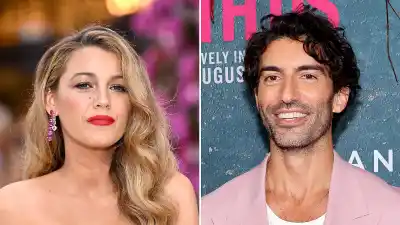
Justin Baldoni and his wife, Emily Baldoni, are speaking out on their new normal after his legal battle with Blake Lively was settled.
“We have not done this in a while, so we have not spoken publicly for the better part of the last two years and it’s not because we haven’t had anything to say,” Justin, 42, began an Instagram video shared Wednesday, July 8. “Lord knows we have, but it just felt like every time we went to make a video like this where we wanted to speak, something was telling us not to. It just doesn’t feel like the right time. We were talking about it and feeling into it and praying about it.”
Emily, 41, chimed in, revealing that “this feels like the moment” to speak out.
“That being said, there is so much to say and it makes it hard to speak, it makes it hard to figure out what is right for us for this specific moment,” Emily noted. “But what does feel important is that we can genuinely say that we are sitting here today feeling immense gratitude for so many things and so many people and so many people that have happened to us.”

After 18 months of seemingly endless PR mudslinging and more than 1,400 court filings, the bitter legal battle between Blake Lively and Justin Baldoni appears to finally — mercifully — be winding down. In early May, two weeks before their high-profile trial was set to start, attorneys announced they’d settled the case out of court. […]
In late 2023, Justin was named in a lawsuit by his It Ends With Us costar Lively, 38, who accused the director of sexual harassment, fostering a hostile work environment and attempting to destroy her reputation. Justin vehemently denied the accusations, subsequently filing a defamation suit against Lively, which was ultimately dismissed by a judge.
In the midst of the legal battle, Justin and Emily refrained from speaking publicly. The Jane the Virgin alum further noted on Wednesday that gratitude “saved” the couple, who share two children.
“I also feel that it’s important as we say that, in that gratitude, it doesn’t negate the injustice and the pain that we have also felt in the last few years,” Emily continued. “We’ve had to wrestle with so many things and try to understand so many things, like, ‘How could something like this even happen?’ Let alone disguise[d] as a fight for women. So much to unpack, and the truth is that there’s been a lot of trauma for us to move through as a family, which also makes it hard to speak.”
Justin further acknowledged that there have been many “painful things that have been spoken into existence” as a result of the lengthy legal battle.

Justin Baldoni celebrated his 41st birthday with his family by his side amid ongoing legal drama. “Happy birthday, my love,” the actor’s wife, Emily Baldoni, wrote via Instagram on Friday, January 24. “Celebrating the man, husband and father that you are. I’d choose you again and again.” Emily, 40, also uploaded a photo of the […]
“That created so much noise and we didn’t want to add to the noise,” he explained of the couple’s reasons for staying quiet. “We just wanted to let the justice system run its course.”
A judge ruled in May to dismiss the majority of Lively’s lawsuit claims. The rest were settled within weeks before the pair were expected to begin trial.
“The truth and the facts have spoken for themselves,” Emily stated on Wednesday. “And here we are.”
In the months since the legal drama concluded, Justin and Emily have been focused on “healing.”
“We are healing, and if you’ve ever been through something traumatic, you know that healing isn’t linear,” Justin said. “It looks different every day, and we have had to rethink for ourselves what is real and what matters and it’s this, it’s our family, it’s our friends, it’s our community [who] have been there for us, it’s our faith.”
He continued, “I think we’re closer and more devoted and steadfast in our faith that we’ve ever been. Also, and this has been on both of our hearts, there were so many of you who, when we didn’t have a voice, were our voice. … So many of you had discernment and you used your intuition and you trusted that, and you have given your time to fight for us. Thank you does not feel like enough, but we’re here in large part because of so many of you and all of our friends and family.”
According to Justin, he and his wife learned one major lesson from the ordeal.
“One thing that we learned is that when God presses the reset button and everything else is stripped away, that’s when love shows up,” he said. “And we feel so loved.”
Justin and Emily closed out their four-minute video, stressing that they will have “more to say” in due course.
“That time will come,” Emily noted. “For now, we are going to focus on continuing the healing and hanging out with our kiddos and enjoying life.”
Entertainment
This 4-Part Sci-Fi Series Officially Changed the Winning Formula for Steamy TV Romance
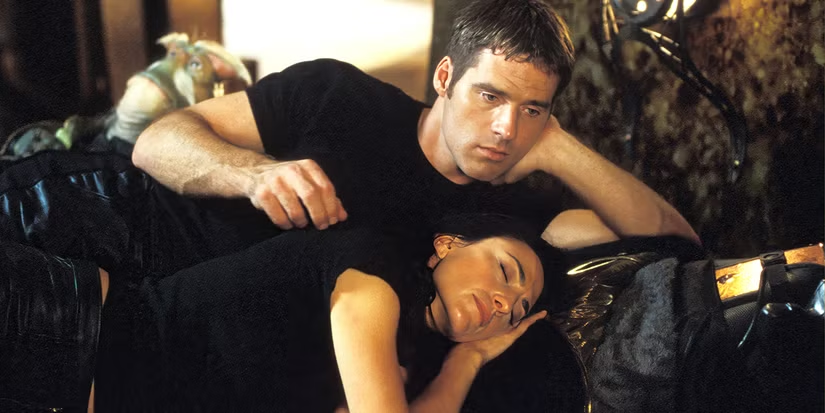
Farscape: the definition of “if you know, you know.” If you’re an outlier in this equation, allow us some evangelizing. Within cult classic circles, Farscape is the Sci-Fi Channel series guaranteed to make you weep over farting, lustful alien puppets designed by the incomparable Jim Henson Company. In many ways, a summation like “an American guy gets stuck in an Australian BDSM fever dream” isn’t wrong. In other ways, Farscape‘s reputation as the defining “found family in space,” proto-Guardians of the Galaxy story is untouchable and nigh-impossible to replicate.
Part and parcel of this content feast is the series’ most irrefutable fact: Farscape is a romance. Normally, love stories aren’t a selling point for traditional science fiction. You have your Mulder and Scully, your Sheridan and Delenn, even your Aral and Cordelia if you include books. But love stories are one plot among many, a complementary feature emerging from a series’ character pool that sometimes enhances the whole.
Farscape doesn’t just brandish its weeping, swooning, whack-a-doodle heart on its sleeve; it bellows it into a space megaphone. Creator Rockne S. O’Bannon and co-producer Brian Henson crafted this oddball gem as a sweeping love story set against the backdrop of an equally sweeping space opera. John Crichton (Ben Browder) and Aeryn Sun (Claudia Black) are a destined love written by the stars. More importantly, because Farscape also defined itself through enviably exemplary script work, John and Aeryn resonate as palpably human.
Their connection is as delicate as a whispered secret and as wrenching as an open wound. These two are everyone’s favorite love story across decades of science fiction — yes, everyone’s, because I said so. And if Farscape‘s team hadn’t broken the television industry’s rules about romance, then this revered couple — the concept baked irreparably into Farscape‘s DNA — might never have unfolded.
How Was ‘Farscape’s Romance Different?

When Farscape premiered on the Sci-Fi Channel in 1999, television romances were defined by the “will they won’t they.” A dynamic as timeworn as, say, Little Women‘s Jo and Laurie, series like Moonlighting, Cheers, The X-Files, Friends, and Gilmore Girls notoriously toyed with fans’ hearts by dangling potential love stories and denying them resolution season after season. By those standards, Farscape hits the ground running and never stops long enough to beat around the bush (or asteroid belt). John Crichton, a human astronaut transported to another galaxy through a wormhole and stuck with a group of murderous criminal misfits, might be outrunning villains who want to master wormhole technology. Still, John Crichton and Aeryn Sun simply are the A-plot of Farscape. The two kiss halfway through Season 1 and sleep together three episodes later.
And they keep sleeping together into Season 2! They catch “I’ve never felt this before” feelings and tentatively reckon with their significance! Yet John and Aeryn are far from a rushed, empty attempt to increase ratings via sex (in space, no one wears anything but leather). The writers’ room uses the seasonal episode counts to their advantage. They time emotional arcs beat for beat, prioritizing the characters’ separate and shared growth and letting situations organically emerge from that conflagration. John and Aeryn’s romance consumes them without ever subsuming.
If Farscape had adhered to television practices contemporaneous with the 1990s, a romance executed to this caliber — a full series of this caliber, where people talk more than they shoot — wouldn’t exist. In May 2023, Shout! Factory TV held The Farscape Fandemonium Marathon. Reflecting on the series, Rockne S. O’Bannon and Brian Henson left no doubt about their intentions with John and Aeryn. Farscape intentionally broke with established industry practice. “The television rules with a potential romance were, don’t ever let them get together,” Henson explained. “But Rockne, you knew really early, this was going to be a huge romance. We are not going to keep them apart.” O’Bannon elaborated: “I wanted it to be a classic, classic romance. […] I wanted to keep them at odds as long as possible […], but it was all kind of this planned thing to make sure that we made it as unlike other shows as possible, the way other shows would follow tropes [and never let them get together].”
If Farscape hadn’t crossed out the rules with permanent marker then shredded the rule book and ejected the scraps into space’s cold vacuum, the most exquisitely poignant and agonizingly raw romance known to science fiction probably wouldn’t deserve those adjectives. What a disappointing world that would be.
What Made John and Aeryn a Compelling Romance on ‘Farscape’?
By bucking the confines of the will-they-won’t-they, Farscape lets John and Aeryn’s galaxy-spanning love story exist. Sometimes their love thrives, sometimes it withers, but it’s always lived in, always breathing, and always reactive to the wider narrative and proactive in its evolution. Watching John and Aeryn is compelling not just because of the superior writing and the actors’ chemistry (an embarrassment of riches, there), but because Farscape makes good on its scope — microcosm and macro. At first, these grown 30-somethings dance around each other like smitten, awkward teens. It’s simultaneously endearing and tragic given the abusive brainwashing the Peacekeepers subjected Aeryn to. For a soldier conditioned to never feel, being vulnerable with John breaks every rule. What’s more, Aeryn’s been hurt before. A hulking space monstrosity? No big deal. Hand the lady a gun. True emotional vulnerability is a risk from which Aeryn flees time and time again. She’s a desperately frightened rabbit in a trap, trembling inside her protective Peacekeeper shell.
Yet to paraphrase the perennially applicable Jane Eyre, there’s a string binding John and Aeryn together. It pulls them taut, an irresistible gravitational pull. Their primary emotional conflict and division stem from finding the courage to love and be loved in a ruthless galaxy where pain, loss, and tragedy lurk predatorily around every corner. Who couldn’t root for that? Just the way the camera frames their kisses or tracks John’s yearning blue eyes is worthy of scholarly study. Their empathy’s aching tangibility warrants assuming the fetal position. John and Aeryn’s romance is a testimony to the lengths we’ll go to protect this fragile yet innately human thing called love. Farscape devastates you to a pulp and then offers catharsis.
A solid foundation compounded by genuine stakes and “no other show has the guts, I’m scarred for life” tragedies makes John and Aeryn’s romance oscillate like a tuning fork on repeat. Farscape makes the psychological stakes equivalent to the plot’s stakes — which are the height of space opera. Whether the crew survives, whether these two wild kids can make it work, matters as much as preventing the totalitarian villains from conquering the universe. Personal conflict balances with spectacle; they work together to escalate tension like a storytelling pas de deux. John and Aeryn survive plot twists that should be ludicrous but are earned by their sincerity. They don’t even break up (a tired trope) so much as grow. Sometimes, growing means unraveling your tangled knots before reuniting.
Their relationship evolves because the characters exist in constant metamorphosis. Science fiction can equal escapism, but isn’t a realistic relationship inside an outrageous situation the most pleasing outcome? Farscape tells the best story: one where every joint in the architecture informs the rest until it’s a symphony, with John and Aeryn’s romance as the leading motif. (Yes, I’ve mixed my metaphors. John Crichton would be proud.)
25 Years Later, ‘Farscape’s John and Aeryn Are Still Amazing

John and Aeryn even call gender stereotypes a rude name before punching the concept, because why not add egalitarian feminism and healthy masculinity to the victory lap? The radiant Aeryn Sun with her cutting features is the stoic, closed-off one. She’s the action woman who never leaves Moya without her guns. John Crichton eventually can aim for more than the broadside of a barn, but he’s a wise-cracking pop culture maven attuned to his emotions. He’s starstruck, reverent, and open, and unrepentantly cries at a hat drop. John and Aeryn balance one another by coincidence and understand each other by design. Shades of Peter Quill and Gamora exist here, but Quill couldn’t manage this level of male-wife.
As for the actors carrying 2000s science fiction on their backs, Ben Browder and Claudia Black are, in the words of Brian Henson, “magic.” Chemistry that one in a million can’t be manufactured. They’re attentive performers who match, regulate, and dynamically improve their scene partner. Both deliver a Masters curriculum on how to act your ass off. And even with scripted exchanges like “Do you love Aeryn Sun?” “Beyond hope,” Browder and Black convey that enormity without words. It’s a testament to the risks Farscape took and the rewards it reaped. Moya’s family of misfits, criminals, and morally bankrupt broken people defined the era. John and Aeryn defined the sci-fi genre. Next year marks the series’ 25th anniversary. No science fiction love story has surpassed the reformed Peacekeeper and her nerdy astronaut — and good luck trying.
Farscape is available to stream on Peacock in the U.S.

Farscape
- Release Date
-
1999 – 2003-00-00
- Writers
-
Rockne S. O’Bannon, David Kemper, Justin Monjo, Richard Manning


NewsBeat1 minute ago
CCTV image after razors stolen from Bootham Sainsbury’s
Business2 minutes ago
Wolfe Research downgrades Ryan Specialty stock rating on valuation

Crypto World3 minutes ago
Bitcoin (BTC) price climbs to $63,000 as markets shrug off Iran airstrikes: Crypto Markets Today


-

 Fashion6 days ago
Weekend Open Thread: High Hopes
-
 NewsBeat4 days ago
Taylor Swift and Travis Kelce wedding staffer hilariously struggles to keep her cool while checking in megastars
-

 Fashion3 days ago
Open Thread: What Great Books Have You Read Recently?
-

 Crypto World6 days ago
Standard Chartered Secures MiCA License as ESMA Adds 37 New Crypto Firms
-

 Politics6 days ago
The House | “Reframing the debate from a binary discussion of winners and losers”: Yuan Yang reviews ‘We Are Not Machines’
-

 News Videos2 days ago
Whats Hidden Inside This Cash Register? #treasure #reselling #money
-
 Tech2 days ago
Anthropic’s new “J-lens” reveals a silent workspace inside Claude that mirrors a leading theory of consciousness
-

 Business3 days ago
AXT Shares Jump Nearly 14% as Semiconductor Materials Maker Rebounds on AI-Linked Indium Phosphide Demand
-

 Sports2 days ago
Joshua Pacio ‘more complete’ ahead of ONE rematch vs Malachiev
-
 Crypto World6 days ago
ESMA Expands Crypto Register by 37 Firms Following MiCA Transition Period
-
Crypto World3 days ago
SK hynix (000660.KS) Stock Dips as $28B Nasdaq ADR Offering Drives AI Memory Expansion
-

 Crypto World4 days ago
South Africa proposes crypto tax guidance under existing rules
-

 News Videos3 days ago
Best Time to Enter Small Caps Right Now? Another Bull Run? | Financially Free
-

 Tech4 days ago
Lenovo laptops are now shipping with YMTC SSDs, a sign of Chinese NAND entering the mainstream
-

 Business6 days ago
What a 10 Percent Drop Means for Buyers, Sellers and Renters
-
Sports2 days ago
We have punished the disrespect
-

 Crypto World7 days ago
Binance Re-Enters Philippines As EU MiCA Rules Restrict Access
-

 News Videos3 days ago
Avoid entering in FOMO #bitcoin #cryptocurrency #trading #scalping
-

 Crypto World6 days ago
Alibaba bans Claude Code over alleged backdoor security concerns
-

 Tech5 days ago
Neuralink Threads Its Way Straight Through the Brain’s Armor
You must be logged in to post a comment Login