
When you ask people when they knew Covid was going to be a huge deal, they give a range of answers. “When Tom Hanks got sick” is a popular one. So is “when the NBA suspended the season.” The most plugged-in people will sometimes cite early rumblings from Wuhan in December 2019/January 2020.
Tech
The AI economy needs a break-the-glass plan. We don’t have one.


- AI is scaling faster than any past tech boom, and it’s likely to produce an economic emergency — a moment when policymakers will suddenly accept big risks and big changes. The US isn’t ready.
- These crisis windows open dramatically but close fast. In 2008 and 2020, near-universal cash payments and huge bailouts won bipartisan support, then vanished within months. Assuming AI will permanently shift politics toward generous policy is wishful thinking.
- Today’s proposals fall short on both ends: AI labs offer sweeping ideas — sovereign wealth funds, portable benefits — with none of the detail legislation needs, while DC figures like Gina Raimondo push undersized fixes like retraining, too small for a transition that could wipe out whole categories of work.
- Whoever has a detailed, ready-to-pass plan when the moment hits gets to shape it — the way TARP came straight from a “break the glass” plan drafted months earlier.
For me, the turning point came on March 17, 2020, when Republican Sen. Tom Cotton proposed sending every American checks from the government.
To be clear, at this point, my then-employer Vox had already sent everyone to work from home indefinitely, and it was clear something dramatic was happening. But I hadn’t yet internalized that the Overton Window in American politics had shifted dramatically.
True, there were some Republican Senators who, by 2020, were expressing more openness to safety net programs, and rethinking Reagan-style laissez-faire economics. Tom Cotton, though, was not one of these senators. I didn’t think he really had strong economic policy opinions at all; he was a defense and culture war guy. He cared about defeating China and, secondarily, defeating Woke. Universal cash handouts were not his bag. And yet here was Cotton, not just calling for near-universal cash payments, but also for welfare work requirements to be suspended and for big block grants to states to expand unemployment insurance.
This turned out to be an early indication of the actual policy the US would pursue. Within a couple of weeks, with the US unemployment rate fast headed for what would be a record high of 14.7 percent in April, a Republican Senate and president had signed off on the CARES Act, which included payments of up to $1,200 per eligible adult, $2,400 for eligible married couples, and $500 per qualifying child, along with a $600 per week unemployment insurance and a massive business bailout program. The Senate vote was unanimous, and the House approved the final Senate amendment by voice vote.
If you had told me literally any of that would happen in February 2020, I would have laughed at you. But the normal rules had stopped applying. All that was solid had melted into air. Much, much bigger things were, suddenly, possible.
I’ve been thinking about that moment a lot as advanced AI models grow more and more capable, and more and more central to many businesses’ strategies. As of May, Anthropic is reporting an annualized revenue rate of $47 billion, equaling the likes of Coca-Cola and exceeding Netflix. That’s up from $30 billion a month earlier. If their revenue keeps growing at 56.7 percent a month, they will outpace Amazon, currently the highest-revenue company in the world at $717 billion a year, by late November or early December. The AI boom is already unfolding faster than the internet or mobile booms before it and may yet speed up even further. The debate over whether this tech is real and valuable is, essentially, over. The only question is what, and how large, its effects on our lives will be.
This is happening unbelievably fast, and it seems likelier and likelier that we will face a moment, like that in March 2020, when the speed and disruption of AI progress begins to constitute an emergency that policymakers will be willing to take surprisingly large risks to confront. There will likely be a moment of unusual policy freedom and flexibility, a moment which is brief — but could enable large changes for the better.
The US is currently not ready for that moment. But we need to get ready, fast. And we need your help. My colleagues at the Center for Shared AI Prosperity, a new DC-based research group, are attempting to collect a menu of detailed policy ideas that can meet this moment. In fact, we have an open Request for Ideas with funding that can go to the best proposals people submit for how to set up the tax code and safety net in a way fit for the AI era. Now is the time to act.
These moments don’t last forever
I sometimes talk to friends in the tech world who assume that the power and economic impact of advanced AI will permanently shift our politics, and that the policies necessary to keep everyone afloat (like, say, a guaranteed income, or a sovereign wealth fund) will materialize without much effort. After some 17 years as a journalist covering US politics and policy, I think this is overly optimistic, so say the least. Congress is like jello: flick it and it will shake, but it eventually settles back to normal.
Take Covid. Within a couple of months, the apparent consensus had evaporated, and Republicans were back to resisting safety net expansion. By May, Cotton had pivoted to pushing the No Bailouts for Illegal Aliens Act, which “amends the CARES Act to prohibit sending future funds to states or municipalities until they certify they aren’t issuing stimulus checks or other payments to those in the United States illegally.” By August he had a bill to deny virus-related federal employment funds to people convicted of federal offenses because of “riots.” The pandemic was still raging but the policy emergency, and the bipartisan window for much larger-scale action, had mostly closed.
The 2008 financial crisis offers another example. There, the window was open somewhat longer. At the very beginning of the recession, in February 2008, the Bush administration went against its normal laissez-faire commitments and supported a stimulus package championed by then-Speaker Nancy Pelosi built around per-person checks to nearly all Americans, including many of those not owing income tax. In July, President George W. Bush signed a bailout of Fannie Mae and Freddie Mac in the face of strong opposition from fellow Republicans in the House, but having mostly won over his party in the Senate.
In September, when Lehman Brothers collapsed and the possibility of a cascade of massive bank failures seemed very real, Bush demanded a sweeping $700 billion bailout that proposed purchasing toxic assets from at-risk banks (the “Troubled Asset Relief Program,” or TARP). As the subsequent years would demonstrate, bailing out banks failing due to their own irresponsibility was not exactly a popular position in the general public. Members of Congress are not stupid, and they realized this at the time. On September 29, the House voted down the proposal, with huge numbers of both parties defecting from Bush and Pelosi’s position. That led to a large stock sell-off that terrified lawmakers. That experience, some last-minute tweaks, and truly herculean lobbying from the administration, the Fed, and others led the House to switch course and pass the bill on October 3, though within weeks of its passage, Treasury abandoned asset purchases in favor of buying equity stakes in the banks directly.
The full course of 2008 shows the value of, and power inherent in, being prepared. The February 2008 stimulus package was very roughly improvised. It worked a little bit, but proved nowhere near big enough. If Pelosi and Bush had had a more thought-through proposal on hand, perhaps one that automatically repeated and scaled the checks depending on where the unemployment rate went, then the recession would have been much less severe and the 2009 stimulus might not have proven necessary.
TARP was an example of a case where some key actors were prepared. The structure of the program came from the “Break the Glass Plan,” a proposal put together by Bush Treasury officials Neel Kashkari and Philip Swagel in April 2008 explicitly designed as a “just in case” plan for the extreme situation where the whole financial sector needed recapitalization. That case, of course, came to pass, and because Kashkari and Swagel had a plan, there was something for Congress to quickly pass. That was good — TARP played an important role in preventing the financial crisis from worsening.
But it also meant that the plan reflected Kashkari, Swagel, and their boss Hank Paulson’s overall conservative worldview. One could imagine a plan like that which saw the US government instead outright nationalizing major banks, or imposing strict capital requirements on them in perpetuity as a condition of the bailout money, or banning them from owning hedge funds or doing speculative trading. A different administration with different views might have designed a different emergency plan — and because it was genuinely an emergency, that plan would likely have passed, with very different consequences over the next few years.
What stocking the shelves for AI means
One way to think of the project of AI economic policy in 2026 is as designing the equivalent of the Kashkari-Swagel plan: something detailed, opinionated, and actionable that can be deployed quickly when the situation gets dire. What that plan looks like will, of course, depend on one’s values and commitments; the America First Policy Institute’s emergency plan will not look like the AFL-CIO’s.
The Center for Shared AI Prosperity was founded with an aim to produce plans of this nature designed to make sure any economic windfall from AI is widely shared, and that workers and low-income Americans are not left behind in the transition. We were also founded out of a frustration at the inadequacy of the proposals we were seeing from two ends of the AI policy debate.
On the one side are ideas from the AI labs themselves. These tend to be ambitious — indeed ambitious enough to seem like plausible answers to a problem of the magnitude of AI completely reshaping the economy — but woefully unspecific. They more closely resemble dorm-room philosophizing rather than legislative drafting.
OpenAI’s “Industrial Policy for the Intelligence Age” from this past April, is one such example, laying out a number of very broad ideas: taxing capital more, a sovereign wealth fund invested in the AI economy, portable job benefits. It’s light on the specifics: What kinds of capital taxes? How big a hike is too big? How do you make health benefits portable without disrupting people’s current plans? How does the sovereign wealth fund get its money? Anthropic’s Economic Policy Framework is somewhat more specific, offering paragraphs per idea where OpenAI has a sentence or two, but still nowhere near the level of detail necessary to actually write legislation.
On the other side are proposals from within the DC policymaking world, which are firmly rooted in what seems politically viable right now but would be woefully inadequate in the face of the likely economic disruption that’s coming. Former Commerce Secretary Gina Raimondo and her group RAISE US have centered employee retraining; Raimondo’s recent New York Times op-ed centered ideas like new credentials from community colleges and expanded apprenticeship programs as the answer to mass AI unemployment. These are sensible tools for ordinary labor-market churn, but they are mismatched to a transition that could displace whole categories of work on a compressed timeline. The dawn of machine intelligence will demand more from our leaders than certificate programs.
The best case for this kind of caution is that ideas on the scale of the labs — sovereign wealth funds, universal capital accounts for all Americans, permanent relief funds for the long-term unemployed — are dead in the water in DC. Which might be true — now, at least.
But this is where Tom Cotton’s brief love of cash transfers becomes relevant. We should not overindex on the way the politics look right now. The world is about to become very strange, and we may be surprised by the scale of change in response that can earn even bipartisan support.
Indeed, it’s notable that both the 2008 relief measures and the 2020 CARES Act came under Republican presidents with Democrats controlling at least one chamber in Congress, which is also the likely situation after the midterms this year. Democrats are always willing to vote for big new safety net programs to protect unemployed and low-income people. But Republicans are often willing to compromise their usual anti-welfare stances when they’re the party in the White House, and their approval ratings depend on the country’s basic economic health.
What action they might take in a 2027 or 2028 featuring massive AI-based economic disruption is still unclear. But right now, we all have an opportunity to help shape it. The Center for Shared AI Prosperity is running a request for ideas, seeking proposals for shared AI ownership, new AI-related taxes and revenue raisers, and new safety net programs to share the gains widely. We want ideas from economists and think tanks, of course — but also from the labs, from independent researchers and academics, and from ordinary citizens with an interest in where this technology is going.
Stocking the shelves is hard work, and we don’t have all the answers. But you just might, and we’re going to need all the help we can get if the US is going to emerge from the AI transition as a prosperous, functional nation.

Continue Reading


OpenAI says it has reduced the price of two GPT-5.6 models, cutting Luna’s API price by 80% and Terra’s by 20% as it works to make its models more efficient.
As per the updated pricing, GPT-5.6 Luna now costs $0.20 per million input tokens and $1.20 per million output tokens, down from $1 and $6.
Likewise, Terra has dropped from $2.50 to $2 per million input tokens and from $15 to $12 per million output tokens.

Source: OpenAI
In a post on X, OpenAI also noted that the new prices affect how it counts usage in Codex and ChatGPT Work.
For example, if new tasks use these models, they deduct less from customers’ allowances, so you can complete more work under the same quota.
OpenAI is also upgrading Auto-review in the ChatGPT app and Codex CLI from GPT-5.4 to GPT-5.6 Luna, which should reduce the cost by approximately ten times.
GPT-5.6 Sol gets a faster API option
OpenAI has also built a Fast mode for API customers, but there won’t be any changes to Sol’s standard pricing, at least not now.
GPT-5.6 Sol Fast mode is up to 2.5 times faster than standard processing without reducing the model’s intelligence.
The extra performance comes at twice the standard API price, which means it’s particularly designed for time-sensitive coding, research, and agentic workloads.
In all other use cases, you really don’t need GPT-5.6 Sol Fast mode.
According to the company, GPT-5.6 Sol’s recent improvements have allowed it to achieve the efficiency gains behind the Luna and Terra reductions.
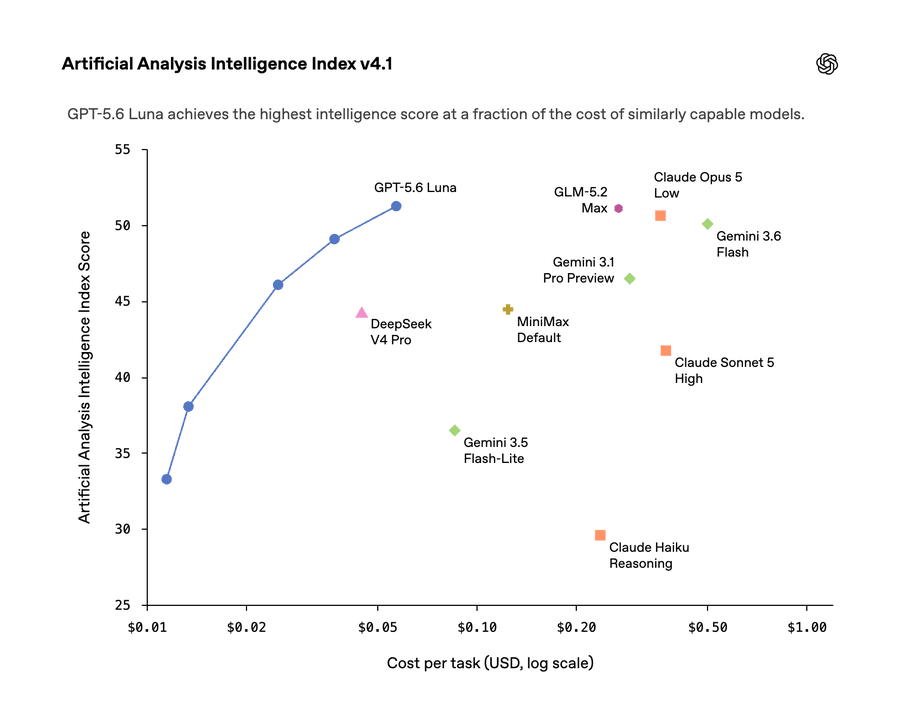
In its own test results, OpenAI also places Luna at the top of its intelligence index among the compared models, despite its substantially lower cost per task.

Security teams log 54% of successful attacks and alert on just 14%. The rest move through your environment unseen.
The Picus whitepaper shows how breach and attack simulation tests your SIEM and EDR rules so threats stop slipping by detection.


Meta’s answer to the “pervert glasses” problem was a small light. It switches on when the camera records, to warn anyone nearby. A sticker costing a couple of dollars switches it off.
Engadget’s Karissa Bell tested the workarounds now on sale, cheap LED-blocking stickers marketed as “privacy” accessories. One kit cost $16.99 for a dozen. On her second-generation Ray-Ban Meta glasses, worn outside, the recording light was undetectable. It never tripped Meta’s tamper warning.
That is the clever, ugly part. Meta pushed a mandatory update that disables the camera if the LED is physically broken. The stickers do not break it. They leak just enough light to fool the sensor, so no alarm fires, and it is hard to trace who is hiding the light.
The crackdown was already failing
The stickers arrive weeks after Meta announced a ban on people filming themselves harassing strangers with the glasses. It is not biting. An Oligarch Watch investigation, surfaced by Futurism, still found hundreds of such videos live on Meta’s platforms.
Many come from “pickup artists” who accost women in public and rate their bodies on camera. One account has posted dozens of clips since the ban. Another creator, with more than 500,000 followers, draws millions of views insulting women’s weight in the street. In one clip, a man films a girl who tells him she is 17.
Some flagged accounts came down after the report, a drop in the ocean. Instagram boss Adam Mosseri had promised to crack down “every way we can.” Meta now says it is exploring ways to detect tampering, will pull the listings that sell it, and will ban repeat offenders.
A device that watches its own users, too
The recording light is not the only worry. Meta’s glasses have exposed the people wearing them. Contractors reportedly reviewed intimate footage captured by the devices, and Meta uses some clips to train its AI. Its facial-recognition plans have alarmed US lawmakers and privacy groups.
Rivals face the same bind. Apple has reportedly agonised over whether to fit a camera at all, wary of the creepy label. Building a face computer that people trust is proving harder than building one that sells.
None of it is denting sales
Because the glasses are selling. Revenue from smart glasses nearly doubled year on year in the second quarter, according to Ray-Ban maker EssilorLuxottica, first reported by Gizmodo. Meta shifted roughly 7 million pairs in 2025. The backlash is loud. The sales chart is louder.
The pushback does have a punchline. DuckDuckGo has released $35 sunglasses with no camera, no microphone and no AI, billed as “anti-surveillance eyewear.” They join a small run of camera-free glasses. For now, the glasses that record and the glasses that pointedly refuse to are both booming.
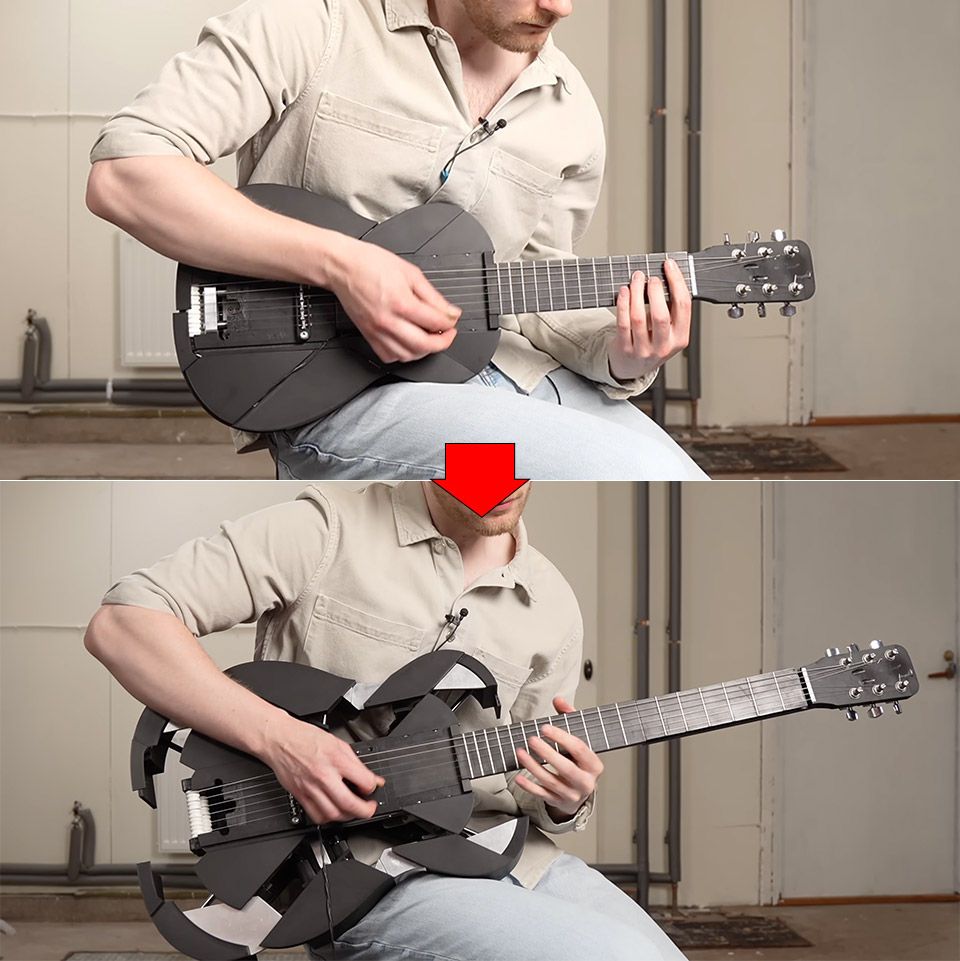
Swedish maker Mattias Krantz has spent years turning ordinary instruments into strange new ones. His latest project starts as a compact electric ukulele that fits in a backpack. One firm pull on the neck and the whole thing stretches, expands, and becomes a full-size guitar while the music is still going.
Krantz set out to address what he saw as the ukulele’s most serious shortcoming. People could easily pick it up and carry it around, yet despite its portability, it remained a curiosity. His response was straightforward: create one that can transform into a guitar in the middle of a song, eliminating the need for the musician to stop and pick up another instrument.

LEGO Editions Olivia Rodrigo’s Dual Guitar 43031
- ROCK YOUR CREATIVITY – Embrace the 2 sides of your favorite pop star’s music with the LEGO Editions Olivia Rodrigo’s Dual Guitar…
- SUPERSTAR SYMBOLS – Discover 3D decorations that represent the singer’s career and passions, including a purple butterfly, a love heart, new star…
- OLIVIA RODRIGO MINIFIGURES – Open the electric side of the guitar model to reveal 2 detailed Olivia Rodrigo minifigures, each with their own mini…
The first significant challenge was the neck. Ukuleles don’t have the same length neck as guitars. Early attempts to crumple it up so that it could fold resulted with half of the object hanging out, which was not particularly handy for playing. Krantz preferred that the excess length just disappear when needed, rather than sticking out uncomfortably. He eventually went with a telescopic design. As the neck stretches, the fretboard components rise up and lock into place directly on top of one another. Adam Damato (his coworker on this project) suggested adding a steel rod to ensure that the pieces snap into position when it’s time to play and don’t simply bend in two with the slightest touch. After several failed prototypes, he finally had a neck that felt solid and familiar under his left hand.
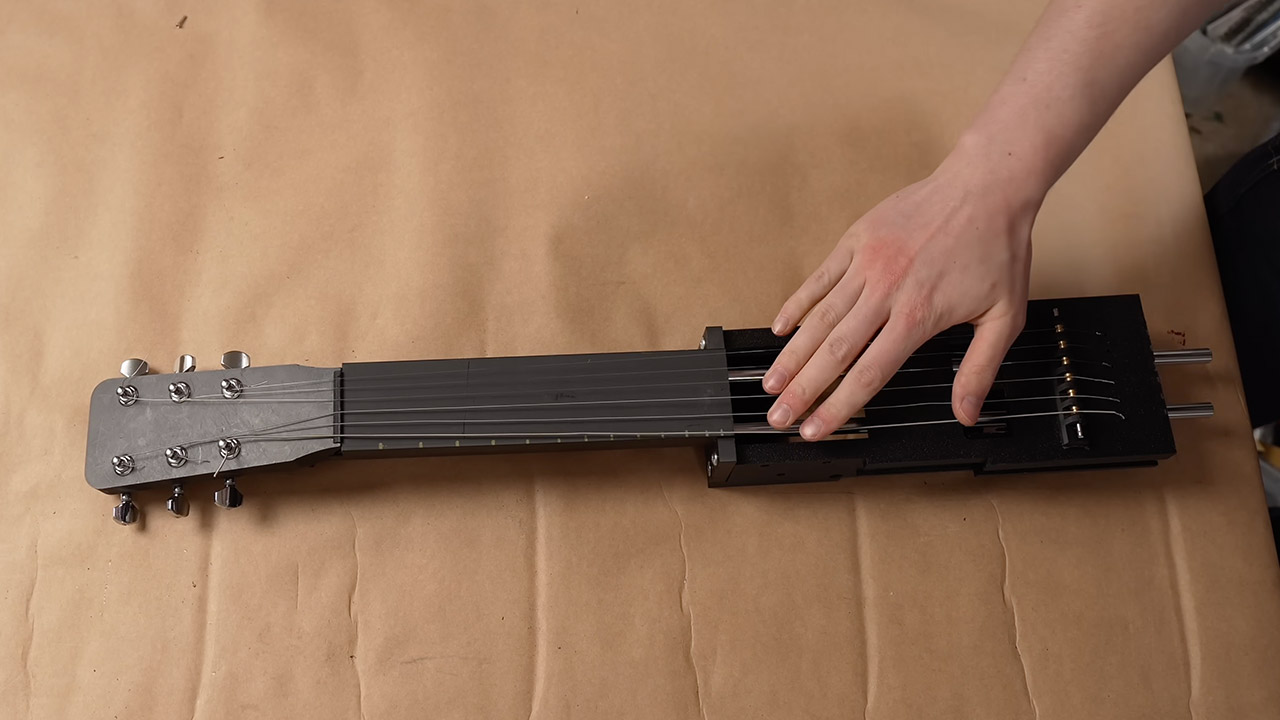
He then had to deal with the strings, which could not be stretched or compressed because they were made of metal. Attaching them when the object is short will retain it in that shape indefinitely. Attach ’em when it’s lengthy, and they’ll simply slink away as the thing collapses. Rubber bands produced a faint, muffled sound. A fishing reel design that allowed extra length to feed out worked in theory, but in fact, the rope stretched or snapped, putting the tune entirely out of sync whenever the size of the object changed. They ended up with strings that were twice as long as normal. They just wrap around some internal rollers when the device lowers, and then pay out well as it extends back up. The tension remains steady, while the tuning is stable.
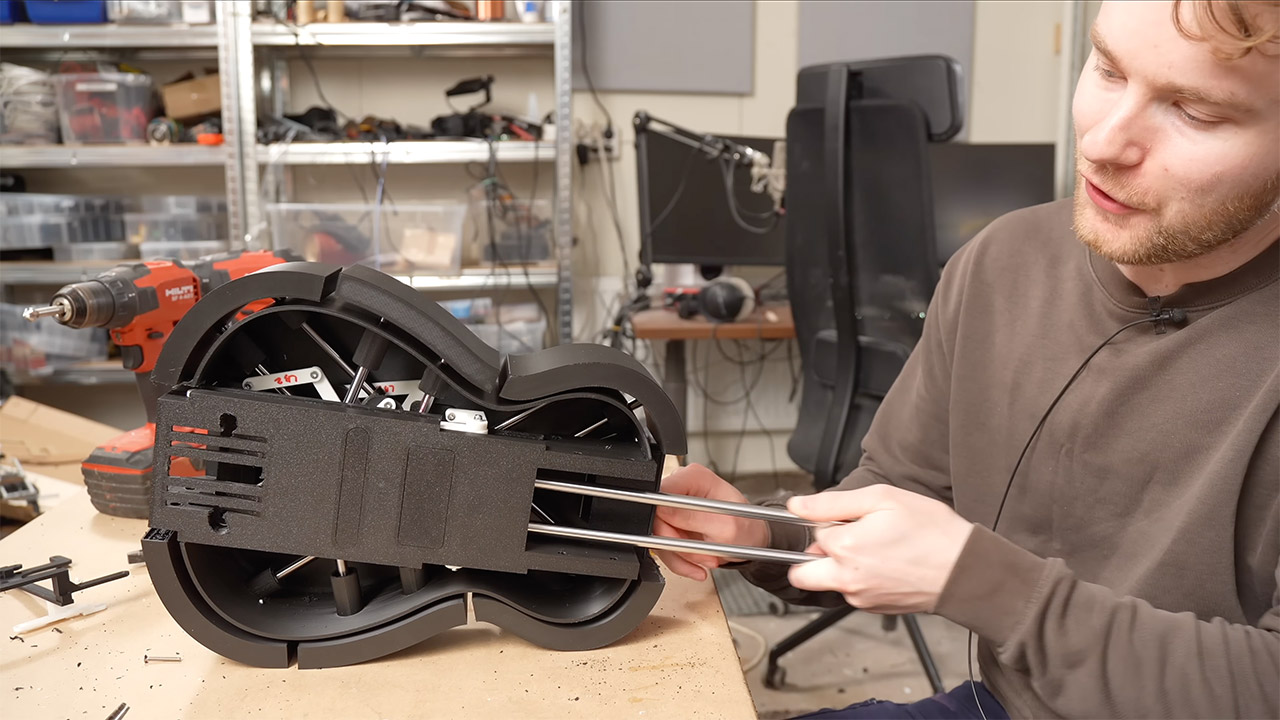
The ukulele body also had to grow up a little, as ukuleles are small, whereas guitars are much larger and have a different shape. It wasn’t just about enlarging the body; different components had to cover many distances and angles at the same time, which was a nightmare. The earlier plastic versions tended to jam. They eventually converted to metal and changed the hub, and six movable panels opened and closed beautifully. They added some decorative plates so that when it grows into a full guitar, it will resemble one.
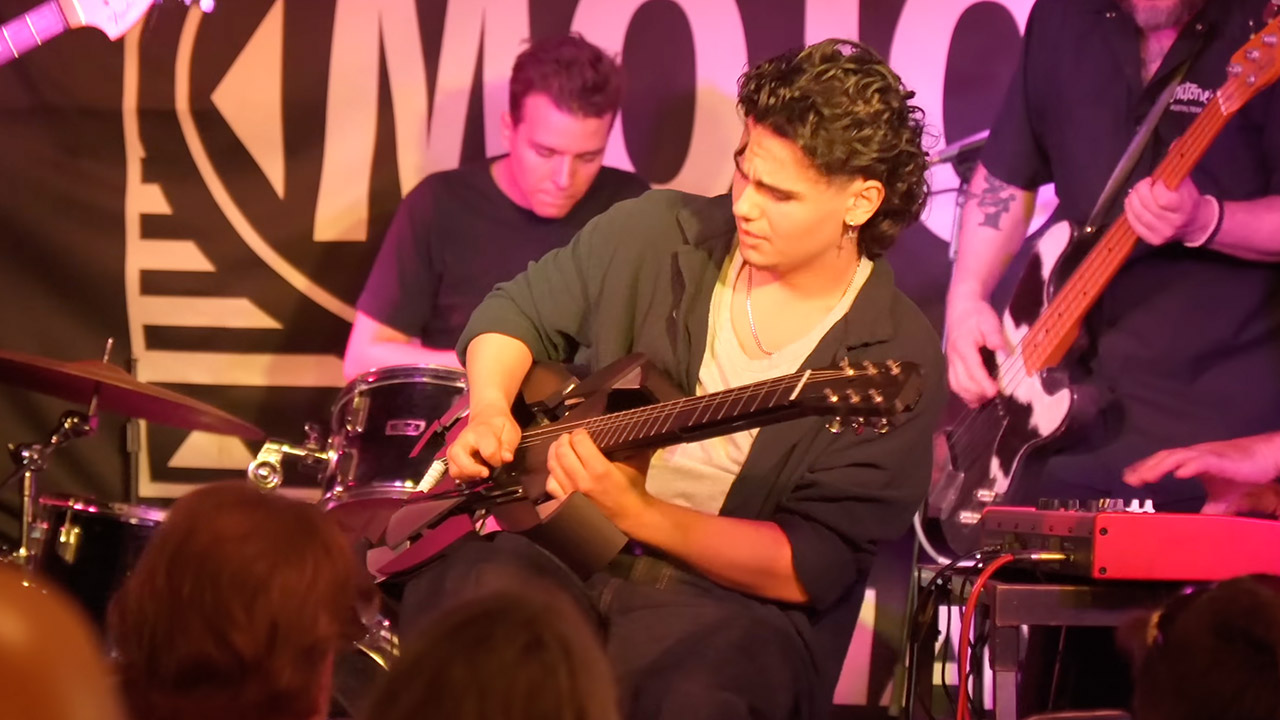
The finished device is small enough to fit in a backpack, so Krantz would take it out on the street and play it in its compact state. Most people would pass by and handle it as if it were any other ukulele, until he yanks out the neck. The change takes just seconds. Suddenly, the same person who was playing ukulele is rocking out on a full-fledged guitar. A musician even played a few performances with a full band after that, and as soon as the body locks into position, the song continues uninterrupted.
[Source]
The cotton and wool layers are GOTS-certified organic, while the Dunlop latex carries the GOLS certification. The finished product does not have any certifications beyond Greenguard Gold, but the material is undyed, which is great for anyone bothered by industrial dyes. As with most of these organic options, the Coyuchi is made without chemicals, foam, or glues, and comes with a 100-night trial, which means you can get a full refund if it doesn’t work for you.
Coyuchi’s Natural REM organic mattress is made to order in the United States. The company offers a 100-night trial, up to an 180-day return policy (there is a restocking fee of $150 if you go over the 100-night trial), and a 25-year warranty.
Coyuchi Natural REM ranges from $1,400 for a twin to $2,400 for a California king.
The Best Kids Organic Mattress
-
Courtesy of My Green Mattress
-
Courtesy of My Green Mattress


My Green Mattress
Kiwi Children’s (Twin)
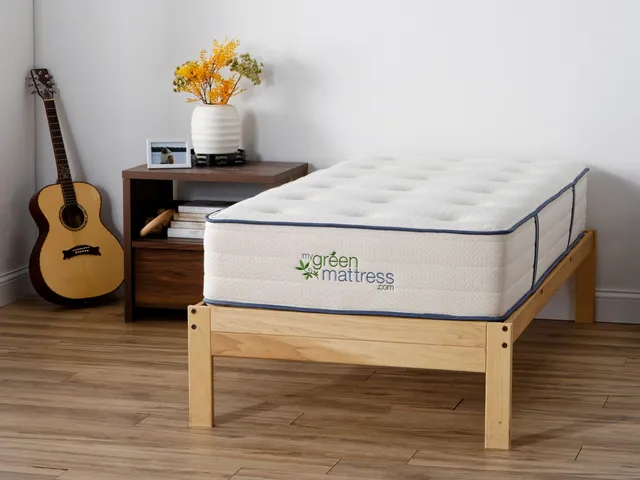
Beds for my kids are what started me down the organic mattress road. I care a lot more about what they’re sleeping on than what I’m sleeping on. Still, as much as I love the Avocado Green mattress, it’s not cheap. For my kids, I bought the more affordable Kiwi Mattress by My Green Mattress. The Kiwi is similar to our top pick Avocado. It’s a hybrid model with pocketed springs and natural materials: certified organic cotton, wool, and latex. It’s also something of a rarity; organic twin mattresses are somewhat difficult to find.
One nice twist that makes the Kiwi appealing for kids is the two-sided option. It costs a little more upfront, but being able to flip it over extends its life, which is handy if your kids think beds are actually trampolines in disguise. The Kiwi is definitely a firmer style, but I think it’s comfortable, and my children loved it when they were younger.
As with our top pick Avocado, My Green Mattress’s Kiwi uses GOTS Certified cotton, GOLS Certified latex, and has both GreenGuard Gold certification and MadeSafe certification.

Six twentysomethings in East London have built what they say is the anti-San Francisco hacker house. The goal is a “holistic improvement in life,” rather than “12 weeks, Demo Day is coming,” Rowan Aldean, 26, explained.
Intrigued, I spent an afternoon visiting the house, meeting its residents, and doing a vibe check. I arrived after Aldean escorted me through the clean sidewalks of a new East London development to where the six-story building stood facing the water.
The house is called the London Island Founder House — or “Lift House” — and Aldean and his wife, Zahraa, 22, an upcoming pharmaceutical research PhD candidate, have lived there since May, just a few months after it officially launched in March. Aldean sold his previous company last year for millions, he said, and now runs an “applied AI” startup that helps companies learn how to deploy agents.
Like all hacker houses, Lift House is part startup workspace, part co-living space. The house is named after both its lift — that is, its elevator — and its mission to uplift tech founders, Aldean said. It’s one of the very few co-living hacker houses to exist in London (compared to San Francisco, where dozens — if not hundreds — are scattered around the city at any given time).
Lift House is a bet that U.K. founders can build successful companies without mimicking the over-the-top hustle culture of Silicon Valley.
Founders have described stories of San Francisco hacker houses illegally running in warehouses, throwing full-on galas, or setting up in a tent or espousing punishing, 72-hour sprints typical of the “996” work culture.
“I don’t expect the performative and over-the-top events will be a thing here,” Aldean said, and pointed to one of London’s most successful AI companies, DeepMind. “They’ve won Nobel prizes and built frontier innovation without any song and dance.”
Instead, Lift House is part of a trend called “Londonmaxxing,” in which founders attempt to optimize everything the London tech scene offers. The London ecosystem feels less showy and less startup bro-y than San Francisco, but its founders share similar ambitions: success, wealth, and market domination.
London AI startups have raised $12 billion so far in 2026, out of $14.7 billion raised by all London startups, according to Dealroom. Six companies have raised more than $500 million: Wayve, Superintelligence, ElevenLabs, Recursive, Ineffable Intelligence, and Isomorphic Labs, the latter three of which were founded by DeepMind alumni.
The excitement from AI has boosted the morale of the U.K. tech scene, inspiring a new generation of founders, like those in the Lift House, to take big swings.

Journaling vs. demo day
The timeline for living on Lift House is flexible — some people have stayed for a month; others intend to stay for at least six months. They buy their own groceries, Aldean said, although they often cook together and share ingredients. Cleaning is split among the group. Everyone declined to share information about the rent they pay.
The residents of Lift House aim for a balanced approach toward ambition, each one of them tells me — an almost unheard-of idea by San Francisco startup standards.
On Sundays, the group will journal together, a practice introduced by David Amor, 28, who runs a brain coaching and training company, helping founders and business leaders understand more about their brain and how it can help optimize business performance. The idea of journaling is to help everyone track how much time they spent in nature that week, how well they ate, and how much they moved their bodies.
“I’m eating healthier, working out more, and sleeping more,” Luke, 27, who runs an AI-marketing company, said about living in the house. “I always make sure to have lunch now, which is something that is simple, but I wasn’t doing before I lived here.” (Luke asked that his last name be withheld.)
Tuesdays evenings are for volleyball, where the founders play on the house team in a local league.
After dinner on other evenings, Wan Ying L, 25, who just left an AI startup and is working on a new idea, might play the piano in the living room. Sometimes the group plays Catan or visits art exhibitions together.
Presence Plumb, 25, is a tech strategist. She likes to host rooftop dinner parties, serving dishes that reflect the different nationalities in the house — from Iraqi to Spanish — while invited founders, researchers, investors, and operators chat about tech trends and investments.
“It’s a bit calmer, balanced, authentic in a way,” she said of people in the London ecosystem. “They don’t want too much of that only startup tech bro vibe. They want a bit of balance.”
Each founder follows their own schedules for a typical workday. Amor, for example, is up by 8 a.m. and gives himself exactly 30 seconds after waking up before jumping into his morning work. “I have a clear objective of ‘this is what I want to do in the first half of the day, when there’s no distractions.’” After his morning work routine, he takes a cold shower, “because it increases your dopamine by 250% and that gives me that motivation, that spark,” he said.

Luke, meanwhile, is up at around 8:30. His co-founder, Varun, 27 (who asked that his last name be withheld), typically travels to the Lift House to co-work, and the duo starts work at around 9 a.m. with a team call.
Aldean rarely wakes before 10 a.m. unless something big is happening, like a “crazy angel [investor] call,” he said.
When asked what makes this house uniquely British rather than a wellness-focused Silicon Valley founder house, Aldean joked: “Well, we drink tea together like Brits, and in SF folks just drink filtered coffee.”
More seriously, he spoke of how British founders face a different kind of pressure than those in the U.S. They must navigate a cultural aversion to risk, an inclination toward humility, and a shame associated with failure. Instead of forgoing sleep for hustle and grind, they deal with what they call the “tall poppy syndrome,” when the media builds one up only to ruthlessly tear them down should they become too successful, investors and founders say. It makes some founders in the ecosystem wary of displaying too many wins.
Still, Luke said London is a strong choice for an early-stage founder: There’s a good network, ample early capital opportunities, and an option for a life outside of tech. In many ways, it is much more like New York culturally for founders than in San Francisco.
“London is so diverse that if you look properly enough, you’ll always find something fun to get involved with,” Amor added, “whether that’s a founder-run club, wellness events, [or going] to jazz nights.”

Luke and Varun largely avoided venture capital funding by taking advantage of the U.K. government’s SEIS/EIS, which is supposed to help attract more angel investments into local startups. “There’s people who will pay basically the same rate of tax if they give us the money versus if they pay income tax,” Luke explained as another reason he liked starting out in London.
Aldean also feels the London ecosystem is less cutthroat than the Valley. He recalls his days living in a hacker house in the Bay — everyone’s desk had to face the wall, and it was heads-down, product-building. He felt the ecosystem, at times, was too willing to gossip, which is apparently done quite differently in the U.K.
“There’s nothing like ‘oh my god did you hear that the CTO just, like, did this,’” Aldean said. “It’s like you’re always worried,” he said, that someone would spread negative stories, especially if it benefited them.
Aldean also thinks London startups, more than Silicon Valley ones, sell into slow-moving large corporations rather than to each other, meaning one could build without having to kiss up or posture to get their peers to like them.
To the selling point, Varun and Luke mentioned another difference between the U.S. and U.K. ecosystem. “It’s a relatively fleeting market,” Varun said of the U.S. “You get quick wins. Here, it’s hard to close a customer, but if they close, they stay with you longer.”
Coming to America
Eventually, though, the road for many U.K. startups goes straight to the U.S.
In the U.K., founders have access to affordable top talent from universities like Oxbridge and a time zone that makes it easier to work with the rest of Europe, the Middle East, Asia, and parts of North America. In the U.S., however, they have access to the world’s largest economy and, most importantly, a lot of investors willing to write large checks, from pre-seed to growth stages.
“It’s almost like a factory line in a way,” Varun said. “You start here, and then you expand there or vice versa.”
American investors are also playing a role in luring British talent away from the country. I told the Lift House residents about one startup founder who said a top investor wouldn’t even back the company unless she relocated to the U.S. She ended up doing so, though decided to keep her family based in the U.K. to raise her children.
“We had an investor in Miami who said the same thing,” Luke said of an investor trying to get him and Varun to move to the U.S. “It’s quite a common practice.” He and Varun have already begun their U.S. expansion, and despite loving London, the duo hasn’t ruled out moving to the U.S. to be closer to their customers.

That’s the tension bubbling beneath not just the U.K.’s tech ecosystem but most of Europe’s. “I work with a lot of people trying to support the European ecosystem more,” Plumb said.
Yet, founders “talk about London; everyone is bullish on the country until they get the opportunity to leave,” Aldean added.
The Lift House lease has about a year left, and there is sentiment in the house to keep it going for as long as they can. After all, there aren’t too many in London, though the city sees many short-term gatherings, like the Solana Hacker House meet-up series. Some of the more public co-living hacker houses are part of a global chain, like the San Francisco-based network The Residency, which expanded into London last year, and BaseJump, which is announcing a London version of its hacker house program soon.
In 2024, two founders tried the opposite version of the Lift House called “The London Founder House,” which Sifted covered under the headline “The people here don’t want work-life balance.” That home is noted as London’s first-ever hacker house, and though it wound down last year, it left an influence through its concept, events, and connected players around the ecosystem. To even be considered for the London Founder House, one had to have raised at least half a million dollars.
For Lift House, prospective residents need to show a hobby outside their companies and an interest in fitness. It’s the same pitch many in the Londonmaxxing ecosystem are using to keep people from leaving: That here one can have it all.
“The culture is to build something that lasts,” Aldean said, “not necessarily burn out chasing a flash.”
When you purchase through links in our articles, we may earn a small commission. This doesn’t affect our editorial independence.
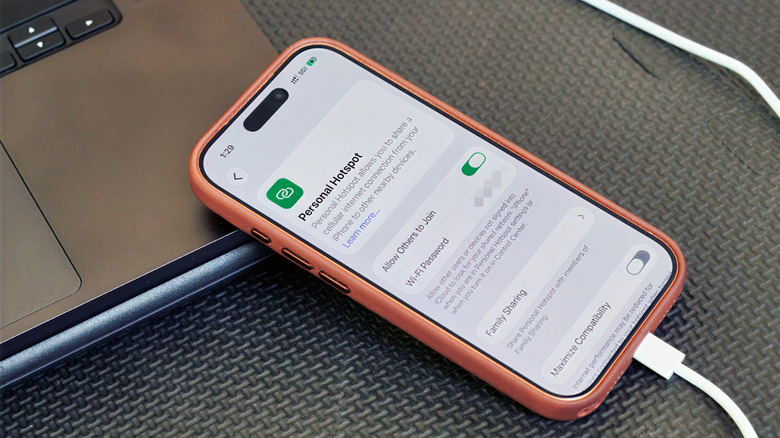
There are times when a physical connection works better. Here’s how to set it up.
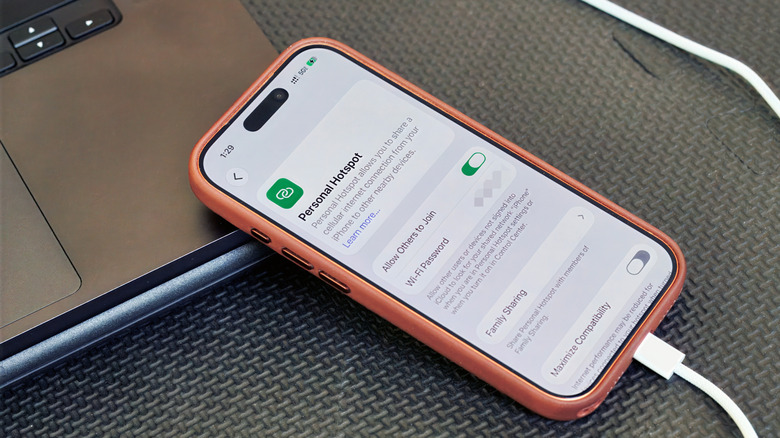
When you think of using a smartphone as a mobile hotspot, the wireless version is probably what comes to mind. But there’s also USB tethering, which lets you share your phone’s cellular connection with a computer over a cable. Here’s how it works, what it’s good for and how to set it up.
Why USB tethering?
For most people, a wireless hotspot is still the easiest way to get a laptop online when you’re away from regular Wi-Fi. It’s more flexible, supporting multiple simultaneous connections. And unlike the USB kind, you’re free to move your phone away from the computer.
But there are some cases where USB tethering could make sense. A wired connection can be more stable, which is handy for crowded places like convention centers or airports. It also means you aren’t broadcasting a visible network in public. As a bonus, your phone might charge while it’s connected.
How to set up USB tethering
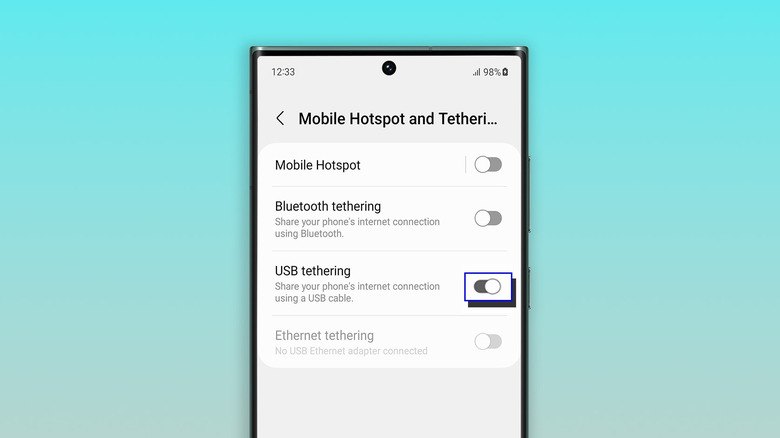
Before we dive in, note that there’s one big catch: Android phones can’t tether via USB to a Mac. (You can still use a Wi-Fi hotspot instead.) Otherwise, USB tethering works with other phone-to-computer setups, including Android to Windows and iPhone to Mac or Windows.
If you’re tethering from an iPhone to Windows, you may need to install the Apple Devices app or iTunes for Windows from the Microsoft Store.
On Android:
- Connect your phone to a Windows PC using a USB cable.
- On your phone, navigate to Settings > Network & internet > Hotspot & tethering. (On some devices, it’s under Settings > Connections > Hotspot & tethering.) You can also swipe down to open Quick Settings, then press and hold Hotspot to jump to the tethering menu.
- Toggle on USB tethering. If the option is grayed out, make sure you’re using a data-capable USB cable and not a charge-only one.
On iPhone:
- Plug your iPhone into a computer using a USB cable.
- You may see authentication prompts. If your iPhone asks whether to trust the computer, tap Trust and enter your passcode. If you’re connecting to a Mac and see an “Allow accessory to connect” prompt on your computer, click Allow.
- On your iPhone, go to Settings > Personal Hotspot. (If you’ve never used a hotspot before, you may need to start under Settings > Cellular > Set up Personal Hotspot.)
- Turn on Allow Others to Join.
A few things to keep in mind
USB tethering usually makes more sense for one device than as a full hotspot replacement. So, for example, if you’re trying to get both your laptop and tablet online at the same time, a Wi-Fi hotspot is the solution.
Keep in mind that laptops can burn through data with background tasks like updates and cloud syncing. Your carrier may also limit hotspot use, charge extra for it, count it against a separate data allowance or not support it at all. So it’s worth checking your plan before tethering over USB or Wi-Fi.
And while a wired connection can be more stable than a wireless hotspot, it’s still relying on your phone’s cellular signal. Spotty service will still mean spotty internet, no matter how you connect.


Apollo Automobil rolled its first finished production car onto the Goodwood Festival of Speed grounds in July 2026, and the machine looked ready to rewrite the rules of what a track hypercar can be. Named Caribbean Dragon, this is unit one of just ten Apollo EVOs that will ever leave the German workshop. Twenty years after the original Gumpert Apollo began deliveries, the brand has returned with something sharper, lighter, and more uncompromising than before.
Caribbean Dragon has an incredible 75+ carbon-fiber panels that are all expertly crafted. You see, the paint job alone is a huge operation, with eight coats done by hand that took over 1000 hours. When the sun hits the pearlescent white coat, a diamond dust flake forms, resulting in a little light show. All of this color contrast has a big impact, with the ocean blue of the carbon accents and tinted blue finishes grabbing attention, much like bright sand meets deep water. Apollo CEO Niko Konta believes the name was inspired by comparing the brilliant white and deep blue colors. Forged wheels continue the concept, with white in the front and blue at the back, while blue brake calipers round out the look.
Sale

LEGO Technic Koenigsegg Jesko Absolut Grey Hypercar, Sports Car Building Set for Boys and Girls, Vehicle…
- A hypercar toy for kids ages 10 and up – This LEGO Technic Koenigsegg Jesko Absolut Grey Hypercar car building toy set for kids features authentic…
- Build the features of this sport car toy – Builders explore lots of engineering concepts as they assemble the articulated V8 engine and the…
- Realistic door design – The model features a dihedral synchro-helix door system, which allows the doors to rotate 90 degrees while moving outwards…
Underneath the elegant bodywork is a full carbon-fiber monocoque weighing a whopping 165 kg, 15% stiffer and 10% lighter than the Apollo IE. The front and rear carbon subframes, as well as the specific crash components that comprise the chassis, are likewise the subject of extensive engineering. Overall, the dry weight is a lean 1300 kilograms. With adaptive aero generating 1350 kilos of downforce, this car has a bit more grunt than its own mass. The aggressive geometric form, X-shaped front LED lights, and vertical W-shaped rear lamps indicate that the bodywork is going for impact, yet each surface is actually engineered to push air around rather than just look showy.
Inside the beast is a naturally aspirated 6.3-liter V12 from Ferrari’s F140 family, but it has been completely modified by HWA AG. With 800 metric horsepower and 765 nm of torque, it can reach 8500 rpm using only its own strength. That’s right, no turbo, no electrics, just good old-fashioned power delivered directly to the back wheels via a strong 6-speed sequential gearbox with paddle shifters. According to official numbers, it takes 2.7 seconds to accelerate from 0 to 100 km/h and has a top speed of 335 km/h, which is impressive for a monster. Carbon-ceramic brakes and Michelin Pilot Sport Cup 2 tyres absorb speed as needed.

The Dragon Skin exhaust system, as Apollo refers to it, is easily visible. It is essentially a one-piece 3D-printed titanium rod, made from a single block of natural titanium, with no welding necessary. It took 123 hours to print alone, as there’s a lot of titanium. The design is also really neat; it’s sturdy, lightweight, can withstand severe temperatures, and fits snugly into the car’s aero package. After a few heat cycles, the titanium develops a gorgeous blue tinge, like to a badge of honor.
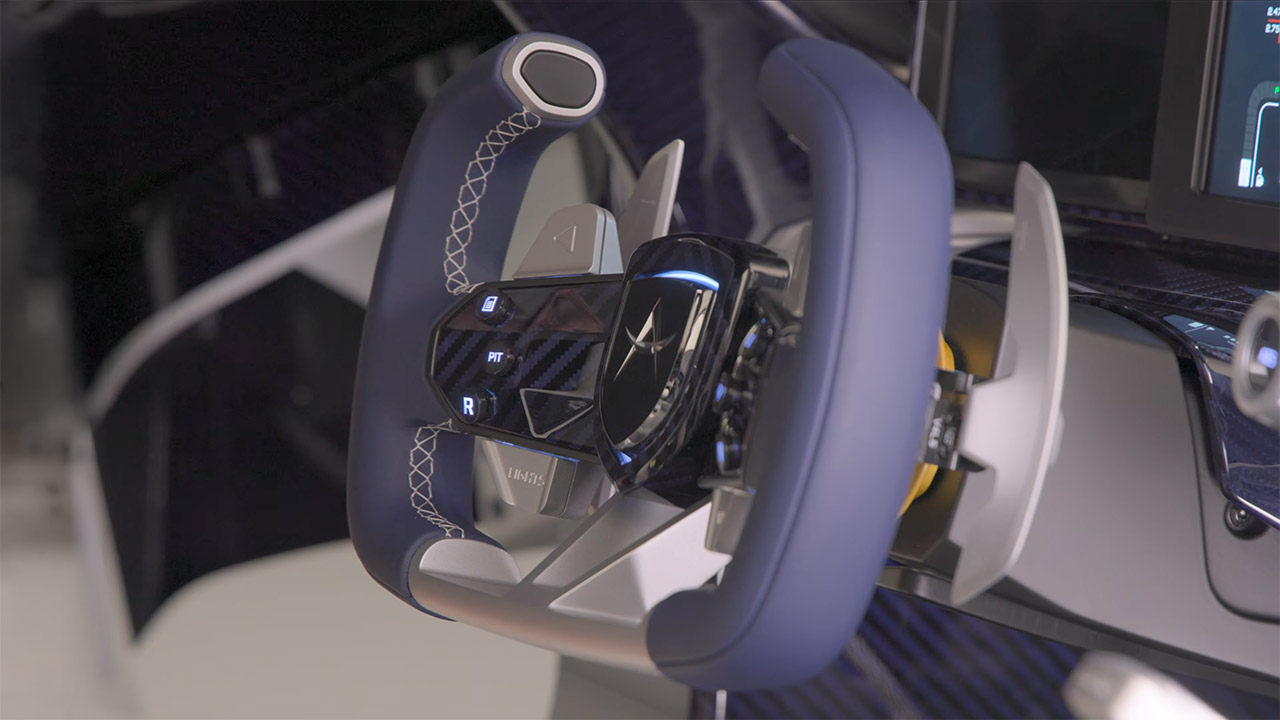
Inside the cabin, Brose created the 3D-printed aluminum framework that connects everything, as it is these precise structural pieces that hold the controls together. All of the switchgear, pedals, and other hardware are similarly manufactured in a tidy reinforced framework, reducing weight while still allowing for some fairly complicated designs that standard machining cannot match. This car’s seats are one-of-a-kind, made of bright white and ocean blue leather with blue stitching, and the Apollo emblem is embroidered directly onto each headrest. The cushion patterns are hand-trimmed and look rather special. The steering wheel is solid machined aluminum blended with blue carbon fibre and ocean blue suede, and it’s a stunning piece of craftsmanship. The dashboard is a blend of high-tech digital displays and traditional gauges, with some classic racing-style tell tales to add flair.

Apollo created the EVO with track days in mind, not road excursions. There will be ten automobiles in total, and each one will be hand-built using the Forged software, meaning no two will be alike. Remember that the base model costs a stunning 3 million euros before taxes. The first car was handed over to its new owner at Goodwood, signaling the commencement of deliveries and commemorating the company’s 20th anniversary. Around 70-80% of the car is completely new compared to the IE, as the suspension geometry has been altered, safety measures have been strengthened up to match current LMDH norms, and the entire upper body has been re-engineered from the ground up.
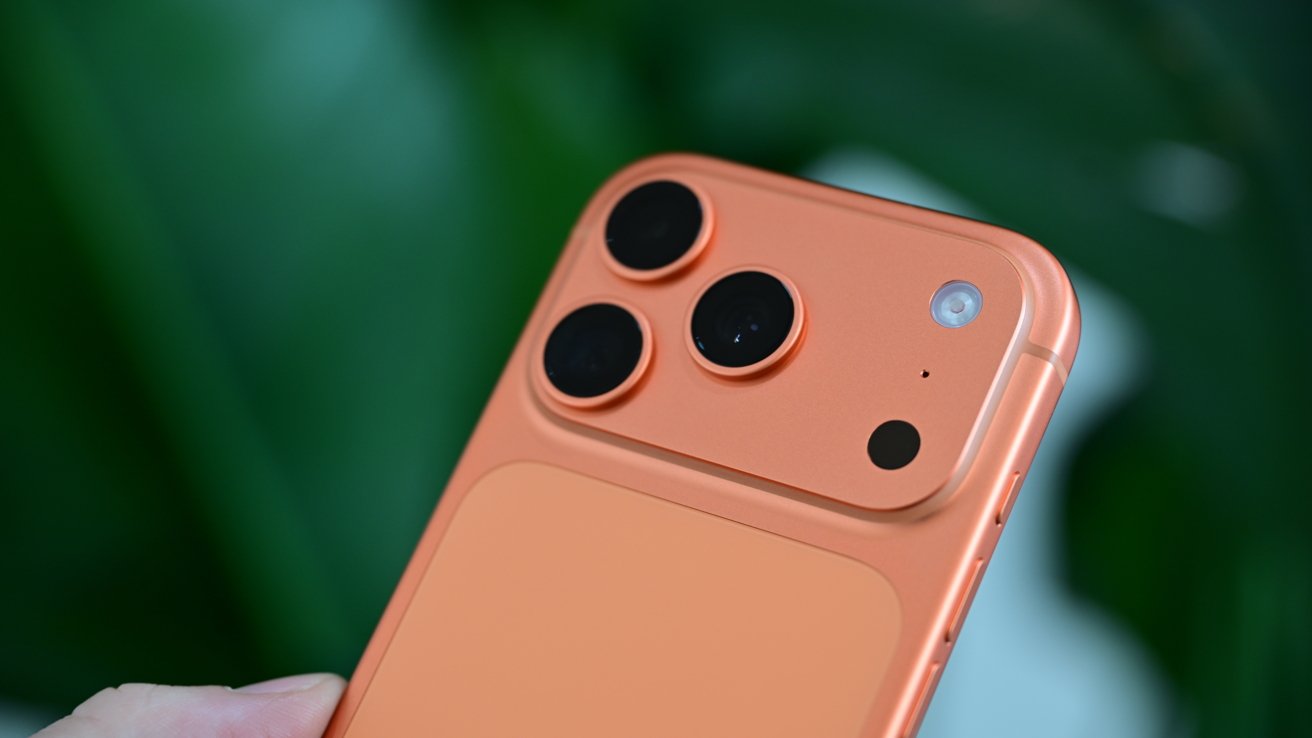
A Canadian artist dropped her iPhone 17 Pro from a plane at 3,600 feet, then found it sitting face-up and virtually untouched in a canola field. Here’s why this is more common than you’d think.
Heather Cline, a mixed-media artist from Saskatchewan, Canada, routinely takes to the skies with her husband, David, in their small plane. The goal is to gain inspiration for her artwork, which often depicts the Canadian landscape from aerial perspectives.
Recently, during an outing above Regina, Heather decided to use her new iPhone 17 Pro to help gather inspiration for a new project. Her husband wasn’t so sure about her choice.
“I had ordered a grip for it that would make it feel more like a traditional camera but it hadn’t come yet,” Heather says in a video posted to CBC’s Instagram account. “And it was a great day for flying.”
Heather settled on wearing a lanyard-style case around her neck. Unfortunately, while attempting to take the perfect shot, she inadvertently passed her phone through an airstream, which sucked it out of its case and out of the plane from more than 3,600 feet.
Thinking quickly, David prompted Heather to look for the device with Find My. The pair got a rough idea of where the phone landed and decided to track it down once they landed.
Sure enough, Heather was reunited with her iPhone. And even better: it had miraculously survived the fall and was found unscathed in a canola field.
“I go up, and I think it’s gonna be buried in the dirt, smashed, crazy,” Heather recalls. “I literally look down, the phone’s sitting there, face-up, just up against few strands of canola. And it’s like, pristine.”
Heather ends the video by laughing and saying that she’ll not be making the same mistake twice and plans on making sure her iPhone is secure before she takes to the skies again.
“Maybe we’ll cable tie it to my hand,” she jokes.
“Not a bad idea,” Dave chimes in.
Free falling
While it might seem improbable that an iPhone could survive a fall from a plane, it’s actually not that far-fetched. It’s not even the first time we’ve heard this story.
Flat objects, like an iPhone, typically stabilize to fall “flat” fairly quickly during particularly long falls. Not only does this slow the phone down dramatically, it also puts it in the most ideal positioning for impact.
If you’ve ever dropped your phone from a short distance, you’ll know it can be devastating. That destruction is due, in part, because it usually doesn’t fall flat. Edge impacts, especially those on the corners, are far more devastating.
There isn’t enough time for the phone to rotate to flat, so all of the force from the fall can be delivered to a corner or edge. Less area of impact, means all that force is delivered to a small area, very quickly.
So, if you’re wondering why Heather’s iPhone survived a 3,600-foot drop into a crop, and yours broke from four feet onto carpet or concrete, you can blame the physics of aerodynamics and complex impact physics for that.
We’re not going to write 5000 words on this. Not today, at least, so let’s make it simple.
After some discussions we’ve had with the US National Institute of Standards and Technology, some case manufacturers, and Apple over the years, we know that a phone reaches maximum velocity that is notably lower than terminal velocity of a spherical object falling, after about a 335-foot fall.
A six-foot iPhone fall impacts the surface it hits at about half the speed of that 335-foot fall. And, since it hasn’t time had to flatten out on the short fall, a corner or edge impact is far likelier.
Also, the landing surface matters. Concrete stops the phone instantly, causing an immediate energy transfer. Grass or dirt cushions the blow by extending the stopping time, which drastically lowers the peak impact force.
In the case of airplane drops, it seems that more often than not, the fallen iPhones land on fields or grass, rather than a building, sidewalk, or road. And, they nearly always land on the front or back of the phone, rather than a corner, spreading the force of the fall over a larger surface.
All this contributes to why an iPhone can improbably survive a fall from 3,600 feet. Even if it wasn’t in a case.
It still takes a massive engineering effort to crash-proof an iPhone, and we don’t want to dismiss that. But there are reasons why iPhones can fall from a great distance and survive, while not surviving a short fall.

- ISBNdb ships up to a million books anonymously to AI labs
- Pre-2022 books are prized because chatbots never touched their text
- Spine-cutting scanners destroy originals to speed up digitization for training
AI companies are increasingly turning to printed books published before 2022 as preferred training material because those works predate the widespread use of AI-generated content.
Large-scale scanning operations reportedly involve cutting book spines, separating pages, and destroying physical copies to create digital datasets for large language models.
The practice has attracted growing criticism because some books entering these pipelines are reportedly extremely rare, raising concerns about irreversible cultural losses.
Latest Videos FromTechRadar
Pre-2022 books become valuable AI training material
Reports by 404 Media found data broker ISBNdb supplies physical books in bulk to AI developers seeking human-written material unaffected by modern chatbot output.
The company argues books published before 2022 offer cleaner datasets because they cannot contain text generated by contemporary large language models.
They are often considered “dense, edited, authoritative,” in contrast to internet content increasingly filled with machine-generated material of uncertain quality.
The approach also attempts to avoid so-called model collapse, in which AI systems gradually lose quality after repeatedly training on synthetic content generated by earlier models.
ISBNdb additionally argues that older printed works avoid deliberate data-poisoning techniques authors increasingly use to disrupt AI training through carefully modified documents.
However, there are reports that many of these books are scanned using high-speed equipment.
This equipment requires workers to remove the spine before feeding individual pages through automated imaging machines.
That process reportedly destroys the original volume, making rapid digitisation considerably cheaper than slower preservation methods designed to keep books physically intact.
Secrecy and legal rulings fuel preservation concerns
ISBNdb openly acknowledges reputational concerns surrounding the practice while offering strict non-disclosure agreements that keep customer identities confidential throughout commercial engagements.
Its website reportedly states, “‘AI company destroys two million books’ is not a headline that generates sympathy,” while suggesting clients describe the process as digital preservation.
Such a level of destruction is an order of magnitude bigger than the loss of the Library of Alexandria. Yet, it is unfolding with none of the outrage that history reserves for burned libraries.
Booksellers interviewed by 404 Media said some volumes entering these scanning programmes have very few surviving copies after enduring wars, fires, and centuries of handling.
Critics argue that unlike websites or widely available modern publications, exceptionally scarce historical works cannot simply be reproduced after their physical copies disappear forever.
A recent United States court ruling involving Anthropic found that scanning legally purchased books for AI training constituted fair use under specific circumstances.
Part of that reasoning held that destroying each printed copy during scanning meant one legal copy effectively replaced another rather than creating multiple copies.
In response to a critic (@Hedgie) of this method on X, Elon Musk said, “I’ve asked the SpaceXAI team to preserve any rare books in a library and scan them the hard way,” suggesting an alternative approach.
If significant awareness is not created, this quiet erasure of irreplaceable books risks becoming the defining act of cultural loss for this era, remembered only after it can no longer be undone.

Follow TechRadar on Google News and add us as a preferred source to get our expert news, reviews, and opinion in your feeds.


For more than four decades, the U.S. Navy’s Ticonderoga-class guided missile cruisers have served as some of the fleet’s most capable surface combatants. Designed around the powerful Aegis Combat System, they have played a central role in protecting aircraft carriers, defending against enemy aircraft and missiles, and coordinating complex naval operations around the globe. However, after years of service, the Navy has begun retiring the aging class, with more ships scheduled to leave service over the remainder of the decade.
The challenge is that the Navy has no direct replacement waiting in the wings. Unlike previous generations of warships that were succeeded by clearly defined new classes, the retirement of the Ticonderoga-class vessel leaves a capability gap the service is still working to address. While several options are being considered including relying more on destroyers, no single platform is expected to immediately assume every mission currently performed by these cruisers. That uncertainty has made the future of the Navy’s large surface combatant fleet one of the most closely watched questions in modern naval planning.
Why the Ticonderoga fleet is disappearing
The Navy originally built 27 Ticonderoga-class cruisers beginning in 1983 at a cost of roughly $1 billion each. Over time, however, age has taken its toll. 20 of these ships have already been decommissioned while the remaining seven vessels are expected to retire by 2030 as maintenance costs continue to rise and the ships become increasingly expensive to modernize. Although several cruisers have received temporary service-life extensions, Navy officials have made clear that the class is approaching the end of its operational life.
That doesn’t mean the Ticonderoga-class cruiser has become ineffective. On the contrary, they remain among the Navy’s most capable air-defense platforms. The problem is that keeping 40-year-old warships mission-ready has become increasingly difficult and costly, particularly as newer technologies continue to emerge. Earlier efforts to modernize portions of the fleet ultimately proved unable to keep every cruiser in service. As a result, retirement has become less about combat capability and more about balancing readiness, maintenance demands, and long-term fleet modernization.
What could replace the Ticonderoga-class?
For now, the Navy’s most practical solution is not another cruiser at all. Instead, many of the Ticonderoga’s responsibilities are expected to transition to the latest Flight III Arleigh Burke-class ships such as the USS Ted Stevens sporting the DDG (guided missile destroyer) classification. Equipped with the advanced SPY-6 radar and the latest version of the Aegis Combat System, these new destroyers can assume many of the fleet air-defense and command responsibilities traditionally handled by the retiring cruisers. While they cannot replicate every capability of the Ticonderoga class, they provide the Navy with an effective bridge while longer-term plans continue to develop.
Looking further ahead, the Navy expects its future DDG(X) program to eventually become the next generation of large surface combatants. However, that program remains years away, with the first ships not expected until the early 2030s. Until then, the Navy finds itself in the unusual position of retiring one of its most successful classes of warships without a direct one-for-one successor ready to take its place. Upgraded destroyers may help fill much of the gap, but exactly what ultimately replaces the Ticonderoga-class remains an open question — one that will shape the future of the U.S. surface fleet for years to come.

Entertainment57 seconds ago
‘Project Hail Mary’ Fans Shouldn’t Miss This $723 Million Sci-Fi Masterpiece Next Month

News Videos3 minutes ago
OMG BRAD IS BACK!!! HE JUST DROPPED A XRP NUKE…

NewsBeat4 minutes ago
Can you get stronger without pushing yourself to the limit?


-
 Sports6 days ago
Commonwealth Games boxing: Jadumani Singh seals dominant 5-0 win over Pakistan’s Sumama Rehman to enter quarter-finals | Commonwealth Games News
-

 Business3 days ago
Why Trees Belong on the Risk Register
-

 Fashion1 day ago
Weekend Open Thread: Wit & Wisdom
-

 Tech6 days ago
Intel is reversing course and bringing hyper-threading back to its server chips
-

 Politics1 day ago
Meta enters AI-training agreement with far-right ‘propaganda rag’ Newsmax
-

 Politics5 days ago
Luke Littler dismantles Gerwyn Price to retain title in Blackpool
-

 Crypto World7 hours ago
MicroStrategy Post-Earnings CLARITY Act Push Could Add New Catalyst for Its Stock
-

 Politics5 days ago
The Part of the Electric Transition Nobody Wants to Discuss
-
 Entertainment4 days ago
‘Stargate’ Creator’s New Sci-Fi Series Returns for Season 3 Tomorrow
-

 News Videos6 days ago
BITCOIN JUST ENTERED THIS CRITICAL ZONE…
-

 Business4 days ago
Major shareholder moves on Canyon
-

 Crypto World7 days ago
XRP Ledger adds $2.6B as RWA inflows rank second
-

 Politics6 days ago
Spain sweeps the board at 2026 World Cup with individual awards
-

 News Videos2 days ago
Bitcoin Enters the 3rd Stage of the Bear Market
-
Crypto World16 hours ago
XRP Ledger v3.3.0 brings five institutional features
-

 Entertainment7 days ago
Sara Gilson Killed By Husband After Viral “Pedophile” TikTok Video
-

 Crypto World4 days ago
Kraken Enables Retail Access to Jersey Mike’s IPO via Tokenized Shares
-

 Tech5 days ago
New macOS Sequoia & Sonoma security updates for older Macs
-

 News Videos4 days ago
Claude: Build Financial Dashboards in Minutes (2026)
-

 Politics2 days ago
Luke Littler’s dominance sparks GOAT debate
You must be logged in to post a comment Login