



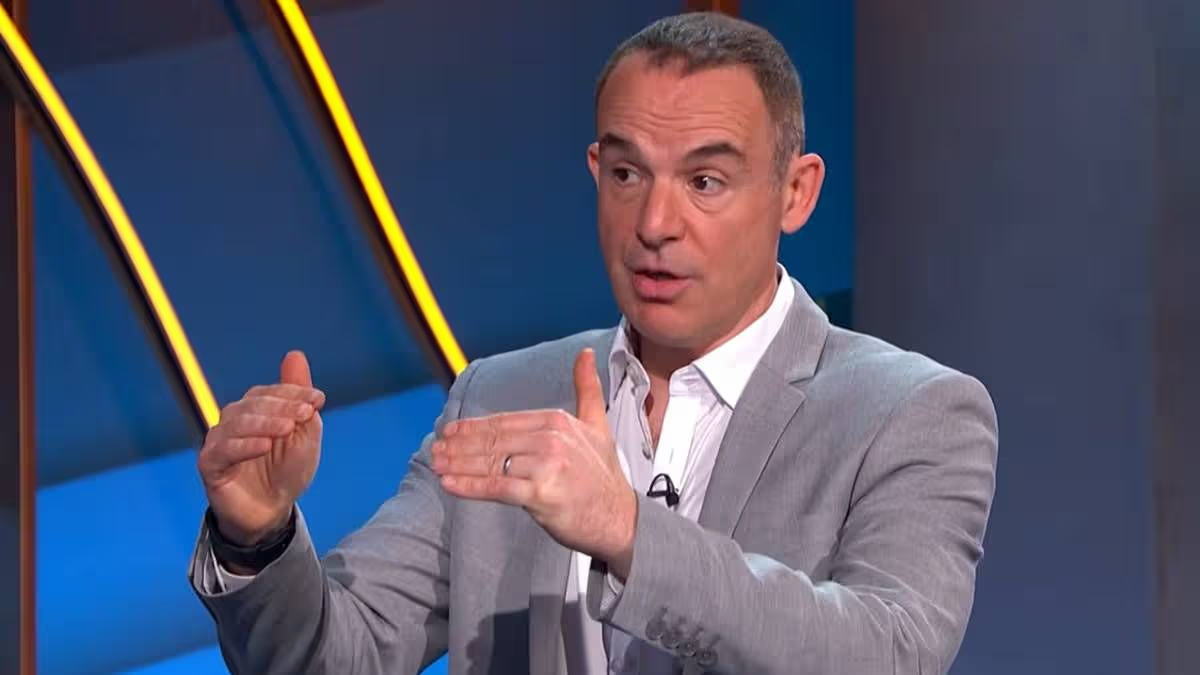
Martin Lewis shared advice for a listener who was thinking about paying to fill gaps in her National Insurance record to qualify for the full state pension
Martin Lewis has shared guidance on determining your state pension entitlement. He offered comprehensive advice following a query from a listener to his BBC podcast regarding National Insurance contributions.
He also discussed how state pension regulations might evolve in future, including the potential shift towards a means-tested arrangement. Generally, you require 35 years of National Insurance (NI) contributions to receive the full new state pension, which currently amounts to £241.30 per week, or £12,547.60 per year.
These figures increased by 4.8 per cent in April through the triple lock mechanism. The triple lock ensures yearly rises to the state pension matching whichever is greatest: 2.5 per cent, the rate of inflation, or average wage growth. A podcast listener submitted a query as she was contemplating paying to fill some gaps in her NI record.
You can voluntarily purchase contributions if your record contains any gaps from the past six tax years. The listener revealed she had two years of absent contributions as she had been studying and residing abroad.
He noted she is currently 36, and if she bought the two years of contributions, this would bring her total to 10 years. She enquired whether Mr Lewis considered it worthwhile purchasing those two years now, given she’ll probably contribute the 35 years needed for the full new state pension throughout her working career.
Based on current regulations, her state pension age will be 68, meaning if she continues making National Insurance payments until then, she would accumulate an additional 32 years, taking her total to 42 years of contributions should she pay for the two missing years. This would likely be more than adequate to qualify for the full new state pension under present arrangements, reports the Mirror.
In his response, Mr Lewis outlined the key regulations worth grasping. He stated that the “minimum number of years” needed is 10 years to receive any state pension when claiming the benefit.
He explained: “That is the minimum. If you have less than 10 years, nothing counts.” Mr Lewis then described why filling National Insurance gaps can be exceptionally advantageous for increasing your state pension.
He added: “An extra National Insurance years is worth around £360 a year of state pension for you. So if you’re going to retire on less than the full state pension and you can buy a year, even if it costs you £1,000, because it’s going to add £360 a year to your state pension, even if you live just a few years once you get your state pension, you make your money back.”
Buying a single National Insurance year typically increases your state pension entitlement by £6.89 weekly, equivalent to approximately £358 per year. The price of purchasing NI years differs according to which tax year the contributions relate to. For the previous two tax years, you’ll pay the original rate for that period, while for any earlier years, you’ll pay the current year’s rate.
These are the current rates you would have to pay:
- 2026/2027 tax year – £956.80 (£18.40 a week)
- 2025/2026 tax year – £923 (£17.75 a week)
- 2024/2025 tax year – £907.40 (£17.45 a week)
- 2023/2024 tax year – £956.80 (£18.40 a week)
- 2022/2023 tax year – £956.80 (£18.40 a week)
- 2021/2022 tax year – £956.80 (£18.40 a week)
- 2020/2021 tax year – £956.80 (£18.40 a week)
Mr Lewis also pointed out to listeners that, due to the triple lock boosting payments each year, maximising your state pension is frequently “completely unbeatable” in terms of potential returns. Nevertheless, he issued a note of caution to younger people that “the current system could change” before they reach pensionable age.
Turning to the woman’s particular circumstances regarding her two missing years, Mr Lewis advised her to first examine her state pension forecast. You can do this on the gov.uk website.
He suggested checking whether she’s set to receive the full state pension when she retires. Sharing his thoughts on her circumstances, Mr Lewis explained: “If you are, I think this is probably overkill, because it’s not like once you get to the full state pension, you earn more National Insurance years, you get an even bigger state pension. It doesn’t work like that.”
He said there is a widespread misunderstanding here: “Many older people complain saying, I’ve now got enough for my full state pension, why do I have to keep paying National Insurance? That’s because National Insurance is a tax in reality, it’s just a tax that happens to be demarked as your contributions towards getting your state pension when you are older.”
While Mr Lewis advised against purchasing the two years in the woman’s situation, he did highlight one exception, specifically “if you can buy these years really, really cheaply”. He elaborated: “If any of these are part years, where you’ve almost got all the contributions you need to get a year but you’re not quite there. It is binary.
“I know people who have been able to buy part years for £15. Normally a full year is going to cost you around £900, but if you could buy a part year for £15, £20 or maybe even £50. Even at your age, just in case something happens in future as you can only buy back a certain amount, you can only buy back six years, I would be tempted just to do it just on the off chance I might need it in the future.”
Nevertheless, Mr Lewis indicated that, given her age and the prospect of future changes to the state pension, it might not be worth paying to bridge the gap. He said: “You are so young at 36 for doing this.
“There are a lot of risks that you are just going to buying money, throwing it away. There are big risks for you that the state pension might become means tested once you’re older.
“We don’t know that. I don’t think that’s going to happen imminently, I don’t think it’s going to happen for people who are retiring now, but you’re talking about retiring in 30 to 35 years, and who knows what will be happening to state pensioners in the UK in 30 to 35 years. So there are a lot of risks in doing it now.”
Modifications to state pension eligibility are presently being introduced, with the qualifying age rising incrementally from 66 to 67 between April 2026 and April 2028. Legislation is also in place for an additional rise from 67 to 68 between April 2044 and 2046.
Another worry is whether the triple lock could be removed and substituted with a less favourable annual uplift mechanism. Labour has committed to maintaining the policy throughout this Parliament, meaning it will remain in effect for at least the next few years.



















































You must be logged in to post a comment Login