The former Gogglebox star was eliminated from the ITV series just one day before the final
I’m A Celebrity South Africa fans were ‘devastated’ as Scarlett Moffatt was eliminated from the series just one day before the ITV reality show’s final.
Advertisement
Thursday night (April 23) marked the final pre-recorded episode of the Ant and Dec series which was filmed last year. Dominated by drama, the series will crown the second ever ‘Jungle Legend’.
Ant and Dec will be joined by the finalists and the eliminated stars on Friday night (April 24) for a live final. Broadcast live from London, there could be some tension between the stars who didn’t get on too well in South Africa.
Click here to get the biggest stories straight to your inbox in our Daily Newsletter
The final five campmates in South Africa were Coronation Street icon Craig Charles, former football manager Harry Redknapp, actor Adam Thomas, Gogglebox’s Scarlett and Olympic hero Sir Mo Farrah. Both Harry and Scarlett won their respective seasons of I’m A Celebrity.
Advertisement
It was a busy night in the jungle, with the stars receiving emotional messages from their families back home in the UK. Shortly after this, they were seen taking part in the fan favourite Celebrity Cyclone challenge. They had no time to relax as they soon had to meet Ant and Dec away from the camp.
Once there, they were informed that they would be taking on a challenge called Keep Your Eye on the Ball. The celebrities sat it in individual compartments as three different-coloured balls travelled through clear pipes.
They had to track the count for each colour while facing various unwelcome distractions. At the end of the trial, Ant and Dec selected the blue ball at random and asked the celebrities to provide the precise count.
Harry’s answer was closest to the correct answer, with his answer just seven away from the total amount of blue balls. Adam’s was second closest, whose answer was 13 out.
Shortly after Craig was confirmed to be in the final four, it was a tense moment as the ITV series took an ad break before confirming if it was Mo or Scarlett joining the three men in the final.
Sadly, it was confirmed that Scarlett was further away with her answer and she was immediately sent home. This means that Craig, Harry, Mo and Adam make up the final four.
Those watching the episode at home were left devastated as they rushed to X, previously known as Twitter, to express why they were left gutted by her exit.
Advertisement
@nciskxcy said: “no I’m so devastated I wanted Scarlett to be in the final #imaceleb.” @alig1972 added: “No!!! Gutted for Scarlett! She deserved to be in the final.”
@RyanSoapKing25 wrote: “Devastated for Scarlet – she is a beautiful soul inside and out and deserved to make the final. Gutted for her! #ImACeleb.” @blue_laur11 posted: “Gutted Scarlett is going home she was amazing !! For me now Adam for the win #Imaceleb.”
@xxncisaddictxx commented: “That’s a tough way to go for Scarlett, all down to bad memory. Tbf that was a tough trial, she’s been amazing. #ImACeleb #imacelebrity.” @gillyn4 stated: “Scarlett has been robbed of being Queen! #ImACeleb.”
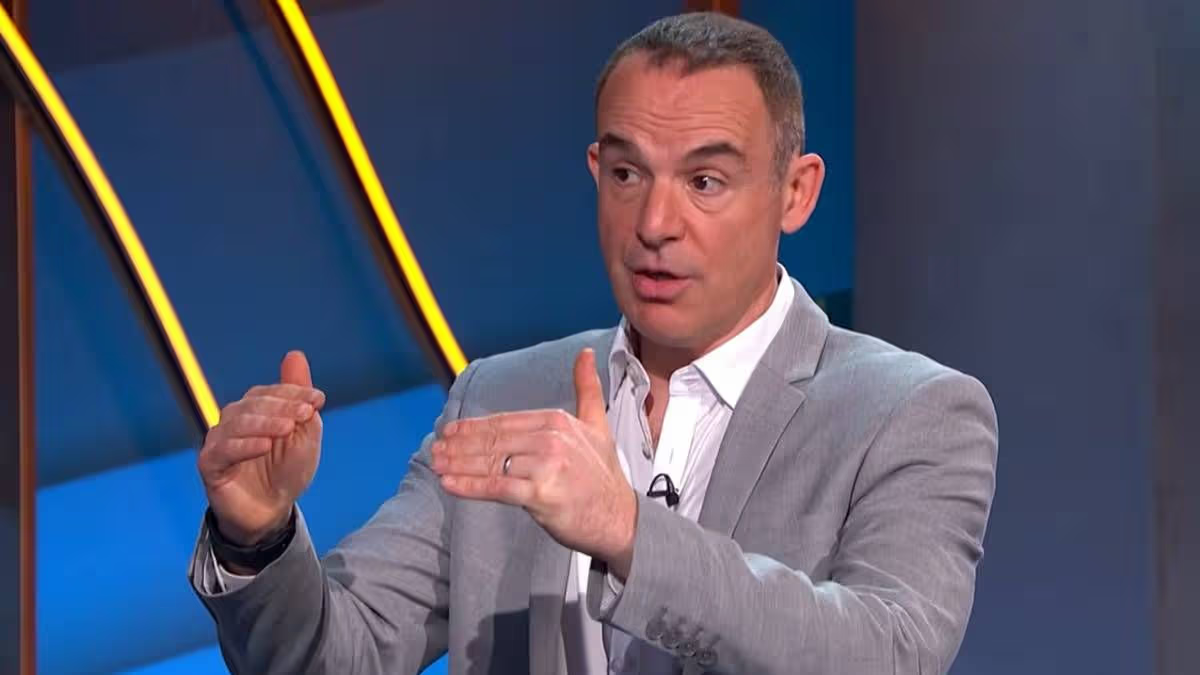
Martin Lewis shared advice for a listener who was thinking about paying to fill gaps in her National Insurance record to qualify for the full state pension
Martin Lewis has shared guidance on determining your state pension entitlement. He offered comprehensive advice following a query from a listener to his BBC podcast regarding National Insurance contributions.
Advertisement
He also discussed how state pension regulations might evolve in future, including the potential shift towards a means-tested arrangement. Generally, you require 35 years of National Insurance (NI) contributions to receive the full new state pension, which currently amounts to £241.30 per week, or £12,547.60 per year.
These figures increased by 4.8 per cent in April through the triple lock mechanism. The triple lock ensures yearly rises to the state pension matching whichever is greatest: 2.5 per cent, the rate of inflation, or average wage growth. A podcast listener submitted a query as she was contemplating paying to fill some gaps in her NI record.
You can voluntarily purchase contributions if your record contains any gaps from the past six tax years. The listener revealed she had two years of absent contributions as she had been studying and residing abroad.
He noted she is currently 36, and if she bought the two years of contributions, this would bring her total to 10 years. She enquired whether Mr Lewis considered it worthwhile purchasing those two years now, given she’ll probably contribute the 35 years needed for the full new state pension throughout her working career.
Advertisement
Based on current regulations, her state pension age will be 68, meaning if she continues making National Insurance payments until then, she would accumulate an additional 32 years, taking her total to 42 years of contributions should she pay for the two missing years. This would likely be more than adequate to qualify for the full new state pension under present arrangements, reports the Mirror.
In his response, Mr Lewis outlined the key regulations worth grasping. He stated that the “minimum number of years” needed is 10 years to receive any state pension when claiming the benefit.
He explained: “That is the minimum. If you have less than 10 years, nothing counts.” Mr Lewis then described why filling National Insurance gaps can be exceptionally advantageous for increasing your state pension.
He added: “An extra National Insurance years is worth around £360 a year of state pension for you. So if you’re going to retire on less than the full state pension and you can buy a year, even if it costs you £1,000, because it’s going to add £360 a year to your state pension, even if you live just a few years once you get your state pension, you make your money back.”
Advertisement
Buying a single National Insurance year typically increases your state pension entitlement by £6.89 weekly, equivalent to approximately £358 per year. The price of purchasing NI years differs according to which tax year the contributions relate to. For the previous two tax years, you’ll pay the original rate for that period, while for any earlier years, you’ll pay the current year’s rate.
These are the current rates you would have to pay:
2026/2027 tax year – £956.80 (£18.40 a week)
2025/2026 tax year – £923 (£17.75 a week)
2024/2025 tax year – £907.40 (£17.45 a week)
2023/2024 tax year – £956.80 (£18.40 a week)
2022/2023 tax year – £956.80 (£18.40 a week)
2021/2022 tax year – £956.80 (£18.40 a week)
2020/2021 tax year – £956.80 (£18.40 a week)
Mr Lewis also pointed out to listeners that, due to the triple lock boosting payments each year, maximising your state pension is frequently “completely unbeatable” in terms of potential returns. Nevertheless, he issued a note of caution to younger people that “the current system could change” before they reach pensionable age.
Turning to the woman’s particular circumstances regarding her two missing years, Mr Lewis advised her to first examine her state pension forecast. You can do this on the gov.uk website.
He suggested checking whether she’s set to receive the full state pension when she retires. Sharing his thoughts on her circumstances, Mr Lewis explained: “If you are, I think this is probably overkill, because it’s not like once you get to the full state pension, you earn more National Insurance years, you get an even bigger state pension. It doesn’t work like that.”
Advertisement
He said there is a widespread misunderstanding here: “Many older people complain saying, I’ve now got enough for my full state pension, why do I have to keep paying National Insurance? That’s because National Insurance is a tax in reality, it’s just a tax that happens to be demarked as your contributions towards getting your state pension when you are older.”
While Mr Lewis advised against purchasing the two years in the woman’s situation, he did highlight one exception, specifically “if you can buy these years really, really cheaply”. He elaborated: “If any of these are part years, where you’ve almost got all the contributions you need to get a year but you’re not quite there. It is binary.
“I know people who have been able to buy part years for £15. Normally a full year is going to cost you around £900, but if you could buy a part year for £15, £20 or maybe even £50. Even at your age, just in case something happens in future as you can only buy back a certain amount, you can only buy back six years, I would be tempted just to do it just on the off chance I might need it in the future.”
Nevertheless, Mr Lewis indicated that, given her age and the prospect of future changes to the state pension, it might not be worth paying to bridge the gap. He said: “You are so young at 36 for doing this.
Advertisement
“There are a lot of risks that you are just going to buying money, throwing it away. There are big risks for you that the state pension might become means tested once you’re older.
“We don’t know that. I don’t think that’s going to happen imminently, I don’t think it’s going to happen for people who are retiring now, but you’re talking about retiring in 30 to 35 years, and who knows what will be happening to state pensioners in the UK in 30 to 35 years. So there are a lot of risks in doing it now.”
Modifications to state pension eligibility are presently being introduced, with the qualifying age rising incrementally from 66 to 67 between April 2026 and April 2028. Legislation is also in place for an additional rise from 67 to 68 between April 2044 and 2046.
Another worry is whether the triple lock could be removed and substituted with a less favourable annual uplift mechanism. Labour has committed to maintaining the policy throughout this Parliament, meaning it will remain in effect for at least the next few years.
MasterChef series 22 viewers were left scratching their heads during Thursday night’s quarter-final
Olivia Wheeler Content Editor Screen Time
23:11, 23 Apr 2026
MasterChef viewers were left puzzled by Thursday evening’s quarter-final challenge.
The 22nd series features renowned chef Anna Haugh and restaurant critic Grace Dent replacing Gregg Wallace and John Torode as judges. The duo will put 48 of Britain’s finest amateur cooks through their paces with a series of demanding challenges.
Advertisement
During Thursday’s opening quarter-final of series 22, the initial task required the home cooks to prepare pancakes, making full use of the available fresh ingredients.
Yet it was the second challenge that confused audiences. Throughout the programme, distinguished food critic Jay Rayner appeared as a special guest to set a task for the contestants.
Jay, 59, said: “The challenge I’ve set you sounds very simple. I’ve asked you to make a salad. But we do not want a limp bowl of lettuce, we want structure, texture, we want a killer dressing… something that will rock us back on our feet.” The contestants were subsequently given 90 minutes to prepare their salads, reports the Mirror.
Nevertheless, audiences were perplexed by the salad challenge, taking to Twitter, now X, to express their views. One viewer posted: “#masterchef A salad …, a salad, are you for real” while another account responded: “Salad? Or a mix of things #MasterChef.”
Meanwhile, another fan made a reference to The Simpsons, joking: “#Masterchef You don’t win friends with salad, you don’t win friends with salad…” Another puzzled viewer simply wrote: “A salad?! #MasterChef” while a different fan joked: “No good story ever started with ‘I was having a salad and then’”.
After the task, Jhané and Sabina impressed Anna, Grace and Jay with their outstanding salads. Jhané created a Thai-influenced salad featuring grilled pork, pork skin, sugar snap peas, lettuce, mint, fennel and Thai basil. She accompanied it with deep-fried rice paper and a lime sesame dressing, which received praise for its ‘clever’ presentation.
Guest Jay was thrilled, saying: “This is exactly what I was hoping for when I set the salad challenge!”
Advertisement
Sabina also wowed the judges with her ‘harmony salad’, comprising of spiced black pea falafel, gem lettuce, carrot, pomegranate, salted chicken skin, beetroot quail eggs, puffed rice and curry leaves. It came with a confit garlic and mustard oil dressing. Jay described the salad as “amazing”.
Once all the competitors had presented their dishes, Jay acknowledged: “It was a tough challenge asking them to make a salad, some of them embraced it brilliantly!”
At the programme’s conclusion, Jhané and Sabina were confirmed as progressing to the next stage, alongside fellow competitor Jim.
Advertisement
MasterChef season 22 is available to stream on BBC iPlayer
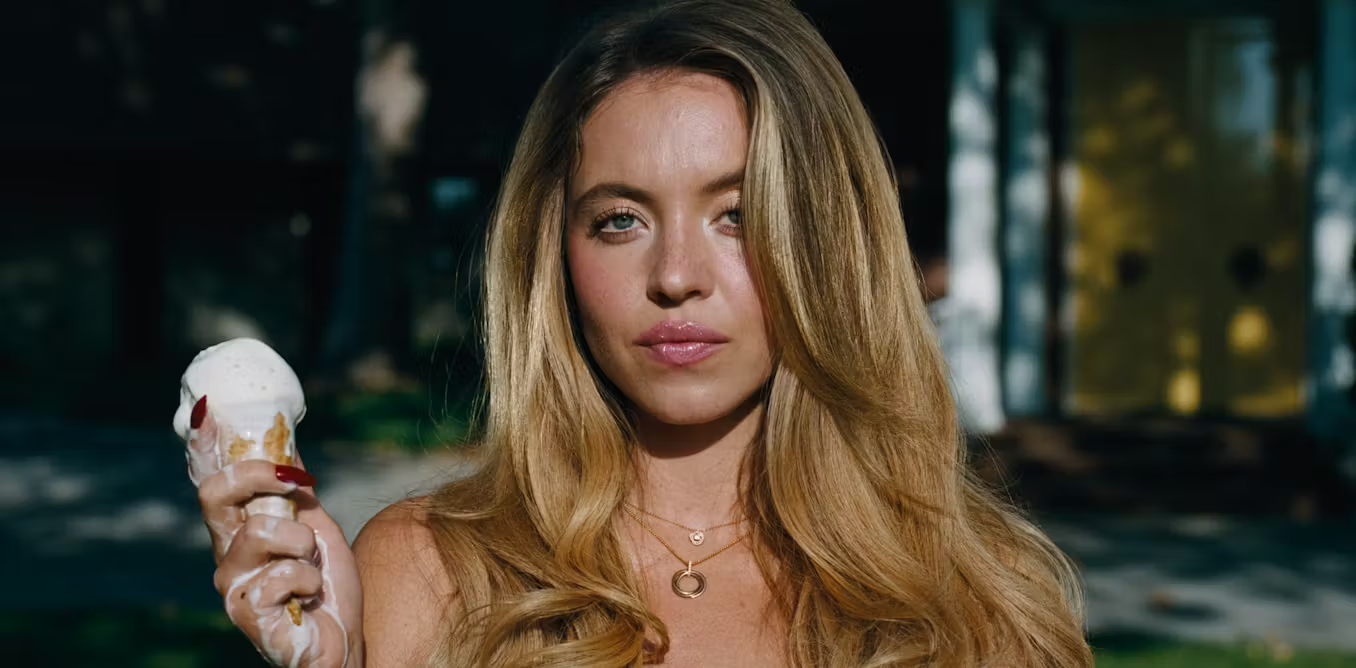
There has been much talk about the sex work storylines in the recent series of the show Euphoria. One of the main characters, Cassie Howard (played by Sydney Sweeney), starts an OnlyFans account to fund her upcoming wedding. In the last two episodes, viewers have watched her create videos for different “audiences”.
In one video, for instance, she dresses up as a dog in a bid to attract those interested in the kink sub genre known as “pup play”. This is a form of fetishistic animal play in which canine traits are adopted through apparel and dog-like behaviours.
In another video, she acts sexually provocative while dressed as a baby with a dummy and pigtails. When explaining why to another character, she says it’s related to a subculture of people who want to dress as babies. She explains people want to see her with “teething rings, bassinets, some people even want to see me wear a diaper”.
This has drawnconcern from viewers over the portrayal and potential normalisation and glamorisation of adult sexual content styled to evoke infancy. As researchers of harmful sexual behaviours and online sexual cultures, we shared their concerns over the scene.
Advertisement
The writer of the show, Sam Levison, has stated that this storyline was intended as a dark satire of the nature of online sexual content. For Euphoria, this is simply part of a shock tactic, nothing more. However, the implications and cultural impact are far more harmful and far-reaching than that.
Warped logic
Cassie’s storyline does highlight a growing normalisation of sexual content that blurs the boundaries of damaging sexual interests and behaviours. However, how it handles this seems to imply that content like Cassie’s is acceptable and even legitimate.
It is important to note that OnlyFans’ acceptable use policy prohibits “illegal activity including actual, claimed, or role-played: exploitation, abuse, or harm of individuals under the age of 18.”
What Cassie is creating is content that sexualises children and young people; she is dressing up as a baby and acting provocatively. In our research, we see some people use warped logic to present their consumption of such content as legitimate. If the content features an adult role-playing as a child, they argue, then it is an acceptable way to indulge their sexual interest. It is not, according to their logic, reflective of harmful sexual interests in children, but a totally separate thing.
Advertisement
However, what researchers have found is that this sort of thinking, and the content that caters to it, confuses the boundary between adulthood and childhood. It also perpetuates, instead of stops, the sexualisation of childhood.
Shows such like Euphoria, especially ones aimed at young people, should have cultural accountability. We know that repeated exposure to these issues reshapes norms around sexuality, power and protection, particularly for young audiences navigating already complex digital environments. So such storylines in mainstream shows like Euphoria do really run the risk of aiding the normalisation and escalation of exploitative viewing practices.
One in 20 children in the UK experiences sexual abuse each year, and there is extensive work being done by charities on prevention, recovery and early intervention. Cultural portrayals that bear no relation to the profound pain, trauma and lifelong impact experienced by survivors run the risk of aestheticising, glamourising or trivialising sexual harm and risks undermining the work.
This storyline must also be understood within a wider socio-cultural context shaped by the exposure to prolonged and systemic sexual exploitation of children by powerful men, most notably through the Jeffrey Epstein case. Epstein’s abuse was enabled not only by individual actions, but by a cultural environment in which sexual access to young people was normalised, aestheticised and shielded by wealth, influence and networks of protection.
Advertisement
In the aftermath of these revelations, public sensitivity to the sexualisation of children and young people has markedly increased, alongside a growing recognition of how harmful sexual interests can be obscured through narratives of consent, glamour or alternative lifestyles. Against this backdrop, Euphoria’s depiction of sexualised infantilisation is especially troubling.
The companion show is expected to be refreshed and restyled similar The Traitors: Uncloaked and The Apprentice: You’re Fired.
Reports suggest that It Takes Two will become a vodcast, becoming a filmed podcast feature instead of its current TV show format.
The change will also see current hosts Janette Manrara and Fleur East exit, according to sources.
Advertisement
Strictly: It Takes Two faces major change
The show’s refresh comes after Tess Daly and Claudia Winkleman exited hosting duties at the end of the 2025 series, according to The Sun.
A TV insider told The Sun: “There is definitely a creative renewal on the table for It Takes Two, and they are poised to sign off on the radical option of a vodcast.
“But Beeb bosses have seen it embraced on other huge BBC One shows, particularly The Traitors, where the Uncloaked aftershow got millions tuning in.
“More and more people of all ages and backgrounds enjoy podcasts and vodcasts so, despite being quite a departure, it’s actually quite a shrewd move.”
Regarding the reports, aBBC spokesperson said: “Plans for Strictly Come Dancing 2026 will be confirmed in due course.”
Advertisement
It Takes Two first launched during the second series of Strictly Come Dancing in 2004 and has had little change since it began.
Winkleman was the first host before Zoe Ball took over when The Traitors star moved to host the main show.
In 2019, Rylan Clark began sharing hosting duties with Ball before leaving in 2023.
The two were later replaced with current hosts Manrara and East.
Advertisement
Recently, Strictly Come Dancing has faced a multitude of changes as several professional dancers have left the show.
Karen Hauer, Nadiya Bychkova and Luba Mushtuk, all previously confirmed, would not be returning to the BBC show.
Do you like the idea of a Strictly vodcast? Let us know your thoughts in the comments.
WASHINGTON (AP) — A U.S. soldier involved in the military operation to capture Venezuelan President Nicolas Maduro has been charged with using classified information about the mission to win more than $400,000 in an online betting market, federal officials announced Thursday.
Gannon Ken Van Dyk was part of the operation to capture Maduro in January and used his access to classified information to make money on the prediction market site Polymarket, the federal prosecutor’s office in New York said.
Van Dyke was involved in the planning and execution of capturing Maduro for about a month beginning December 8, 2025, according to the federal prosecutor’s office. He signed nondisclosure agreements promising to not divulge “any classified or sensitive information” related to the operations, the office said.
Officials allege that Van Dyke created a Polymarket account towards the end of December and made about 13 bets that took the “Yes” position on such wagers as U.S. Forces being in Venezuela and Maduro being out by January 31, 2026.
Advertisement
He has been charged with unlawful use of confidential government information for personal gain, theft of nonpublic government information, commodities fraud, wire fraud, and making an unlawful monetary transaction.
FBI Director Kash Patel said the announcement makes it clear that no one is above the law.
“Any clearance holders thinking of cashing in their access and knowledge for personal gain will be held accountable,” he said in a statement.
Van Dyk was a senior enlisted soldier who was part of the special forces community and stationed at Fort Bragg in Fayetteville, North Carolina, according to the indictment, but it offers little other details about his military service.
Advertisement
However, the document says that Van Dyke was photographed following the raid on the deck of a ship “wearing U.S. military fatigues, and carrying a rifle, standing alongside three other individuals wearing U.S. military fatigues.
The Pentagon referred questions on the case to the Army and the Department of Justice. US Special Operations Command did not immediately respond to requests for comment.
Van Dyke joined the Army in 2008 and, in 2023, was promoted to the rank of Master Sergeant, the second-highest enlisted rank in the Army, according to the indictment.
Earlier this month, the Associated Press reported that a group of new accounts on Polymarket made highly specific, well-timed bets on whether the U.S. and Iran would reach a ceasefire on April 7, resulting in hundreds of thousands of dollars in profits for these new customers. On the same day the AP published the report, the White House warned staff against using private information to trade on prediction markets.
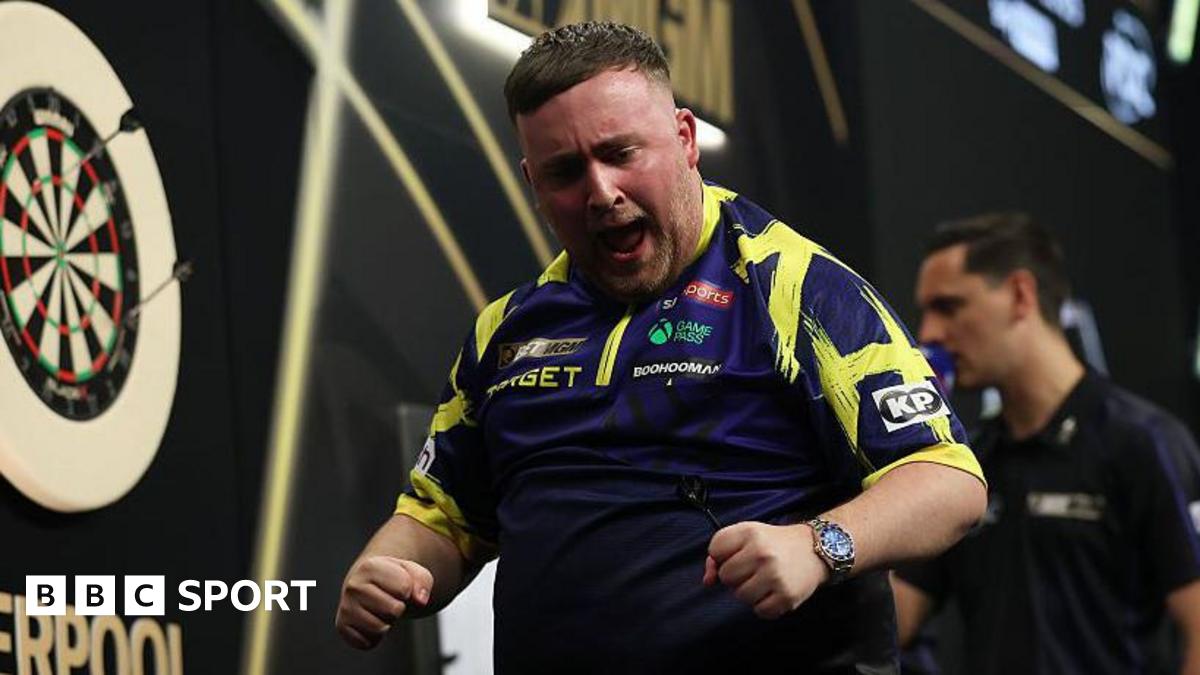
Luke Littler overcame a chorus of boos in Liverpool to strengthen his grip on a Premier League play-off place with an impressive 6-1 win over Jonny Clayton.
Manchester United fan Littler, 19, was booed throughout the night on Merseyside, but he kept his cool to claim his fourth nightly win in week 12.
The world champion saw off Luke Humphries 6-2 in the quarter-finals, but was pushed to the limit by Michael van Gerwen in the last four.
With the top four in the Premier League table going through to the finals night, Clayton leads the way overall, three points clear of second-placed Littler, who is 15 ahead of Gian van Veen in fifth.
Advertisement
Clayton and Littler are clear of the rest with four league-phase nights to go before finals night at London’s O2 Arena on 28 May.
When comparing his reception in Rotterdam last Thursday to the one he got in Liverpool, Littler said: “Rotterdam was way louder than this tonight.
“There was a little bit [of booing] but this week was nothing compared to last week.
“I’ve just got to forget about it. I was definitely focused and wanted to win tonight, and that’s what I’ve done.”
Advertisement
Littler has finished top of the table in the previous two years and is determined to do so again, saying: “I’m very close to Jonny now and I’m going to go chasing.
“I want to finish top once again and if it’s not to be then it’s not to be, but there are still four weeks left to play for.”
Littler, who was booed in Rotterdam last week following his exchange with Dutch number one Gian van Veen in Manchester three weeks ago, showed his resilience to secure another five points.
He quickly raced into a 4-0 lead over Clayton in the final after capitalising on missed doubles from the 2021 Premier League champion.
Advertisement
While Clayton was only able to land one out of his six double attempts, Littler averaged more than 104 and had a 60% checkout rate to secure victory.
Trump was asked about Harry’s comments after the Duke of Sussex made a surprise visit to Kyiv
Mikey Smith , Christopher Mallett and Ambarish Awale Trainee Trends, Showbiz and Lifestyle Writer
23:09, 23 Apr 2026
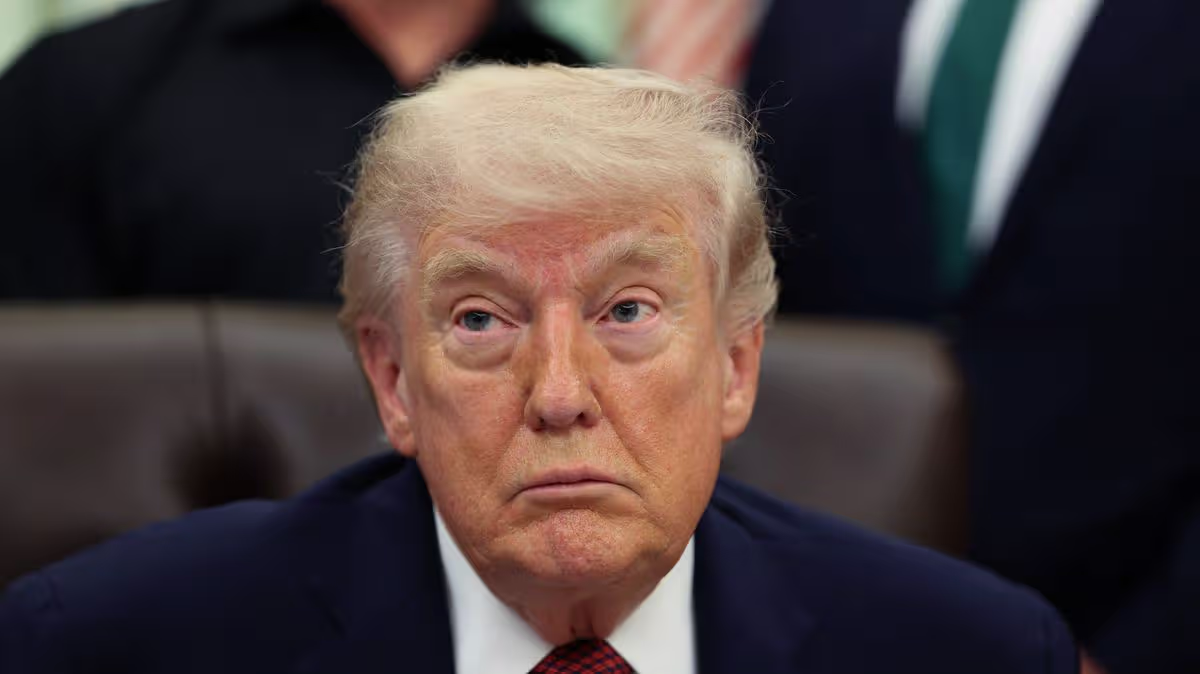
Donald Trump has responded after Prince Harry urged world leaders to do more to end the war in Ukraine, saying the Duke of Sussex does not speak for Britain.
The former US President was asked about Harry’s remarks after the royal made a surprise visit to Kyiv, where he praised Ukraine’s resistance to Russia and appealed for stronger international action.
Speaking to reporters, Trump first joked about the Duke and Duchess of Sussex before dismissing Harry’s political influence, Mirror reported.
Advertisement
He said: “How’s he doing? How’s his wife? Please give her my regards, OK?”
Trump then added: “I don’t know. I know one thing, Prince Harry is not speaking for the UK, that’s for sure. I think I’m speaking for the UK more than Prince Harry, that’s for sure. But thank him for his advice.”
Harry travelled to the Ukrainian capital this week in an unannounced visit, arriving by overnight train from Poland and reaching Kyiv’s central station at around 8am.
Advertisement
During an address in the city, the Duke spoke directly about the conflict and called for renewed efforts to bring it to an end. He praised the country’s resilience and described Ukraine’s defence as brave in the face of continued aggression.
Addressing Russian President Vladimir Putin, Harry said: “Years into this war, with immense losses and limited gains, it is increasingly clear that this path offers no victor only more loss.”
He continued: “President Putin, no nation benefits from the continued loss of life we are witnessing.”
Although he did not mention Trump by name, Harry also directed comments at the United States, referring to the responsibility of American leaders.
Advertisement
He said the US, now his adopted country, has a “singular role” in the conflict because America had pledged to support Ukraine’s sovereignty and borders when the country gave up its nuclear weapons.
He told the Trump administration: “This is a moment for American leadership – a moment for America to show that it can honour its international treaty obligations – not out of charity, but out of its enduring role in global security and strategic stability.”
The visit marked Harry’s third trip to Ukraine since Russia launched its full scale invasion in February 2022.
His arrival came shortly after reports of a Russian drone strike on a railway yard in the Zaporizhzhia region. According to Ukraine’s Deputy Prime Minister Oleksii Kuleba, a train driver was killed in the attack.
Advertisement
Harry was welcomed in Kyiv by Ramina Arseniy Yatsenyuk, executive director of the Open Ukraine Foundation, which organised the Kyiv Security Forum.
After stepping off the train, he spoke briefly to reporters and explained why he had returned.
He said: “It’s good to be back in Ukraine,” adding he wanted to remind people around the world what Ukraine is up against, and to support the those doing extraordinary work every hour of every day in incredibly tough conditions.
In the first of the last-16 matches, 2005 winner Shaun Murphy moved into a dominant 6-2 lead over China’s Xiao Guodong.
Murphy scraped through 10-9 against Fan Zhengyi in the first round, calling his match-winning break of 50 in the decider the best break he had ever made at the Crucible after he had trailed 53-17.
But the 43-year-old Englishman found this session to be calmer as he made breaks of 79, 103, 63 and 64 to go 5-0 ahead.
World number nine Xiao took the next two frames, but Murphy ended the session well and took the last with a run of 61 to have a four-frame lead in the first-to-13 match.
Advertisement
That match resumes on Friday at 10:00 BST and Murphy could win it with a session to spare if he wins seven of the eight frames in that session. The third session, if needed, will take place from 19:00.
Northern Ireland’s Mark Allen holds a 5-3 lead against England’s Kyren Wilson, the 2024 champion.
Two-time semi-finalist Allen made breaks of 50 and 78 to race into a 5-0 lead, but Wilson won the last three frames of the session, helped by runs of 75 and 50.
The second session is on Friday from 14:30, before it is played to a finish on Saturday morning.
Meta, the parent company of Facebook and Instagram, announced a new tool to allow parents to see what their children are discussing with its AI bots. While parents are already given alerts if their children engage with topics like suicide or self-harm, the new tool will give them a more detailed overview of their children’s AI discussions.
Beginning on April 23, parents using the supervision tools offered by Facebook, Messenger, and Instagram will have access to an “Insights” tab. One of the options within the tab is labeled “Their AI Interactions” and provides a list of topics their children have discussed with Meta’s chatbots over previous seven days.
The topics are broad categories that include subjects like school, travel, writing, entertainment, lifestyle, health and wellbeing, as well as sub-topics under each of those umbrellas, the company said.
Subtopics under well-being, for example, might include subjects like mental health or physical health, and lifestyle might list topics like fashion or food.
Advertisement
In order to make use of the Insights tab, parents will have to ensure their children are using Teen accounts, which are available on Meta’s platforms, PC Mag reports. The new tool will be available for parents in the U.S., U.K., Australia, Canada, and Brazil. The company says it will roll out a global version of the tool in the coming weeks.
Meta announced new tools for parents that will allow them to monitor the topics their children are discussing with its AI chatbots (Reuters)
Meta has also announced the creation of an AI Wellbeing Expert Council, which it describes as a “group of experts who will provide ongoing input on our AI experiences for teens, to help make sure they continue to be safe and age-appropriate.”
Company employees working on AI projects will reportedly have regular meetings with the council to discuss updates to its features and to hear feedback on its products.
The safety and health of children on social media has become a standout issue in recent months.
Advertisement
In March, both Meta and Google were found negligent for their roles in contributing to the depression and anxiety of a woman who sued the companies, claiming their products were addictive and had kept her locked into their use since she was a small child.
A court in California awarded her $6 million. The ruling marks the first time social media companies have been held liable for the ways their products affect individuals, especially children and teenagers.
The jury determined that Meta and Google’s app — in Google’s case, YouTube — were designed to be addictive and that appropriate measures to protect younger users were not put in place.
This is the text from The Conversation UK’s World Affairs Briefing email. Sign up here to receive weekly analysis of the latest developments in international relations, direct to your inbox.
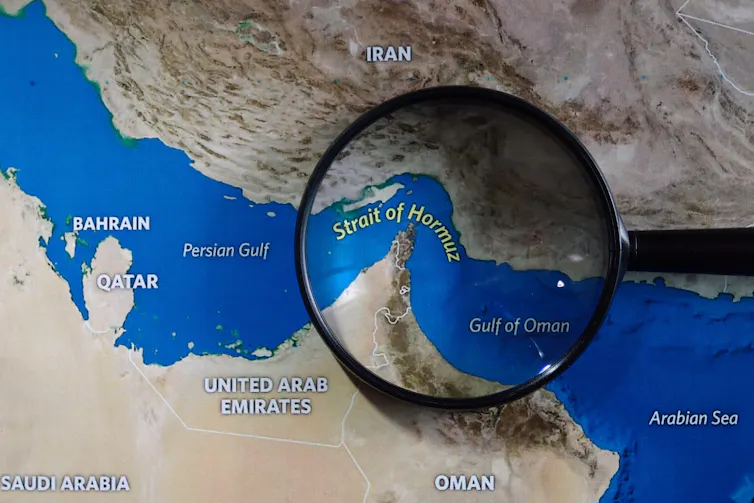
Napoleon Bonaparte is said to have commented in connection with his invasion of Russia that “geography is destiny”. Take a look at a live maritime tracker to see how Napoleon’s aphorism is playing out in the Middle East today. There are presently hundreds of vessels either side of the Strait of Hormuz, idling in either the Persian Gulf or the Gulf of Oman. But nothing is passing though.
In normal times, 20% of the world’s oil flows through this waterway. But since the US and Israel began to launch attacks at the end of February, Iran has effectively closed down the Strait, both by depositing mines and by threatening to board any ships trying to pass without their permission.
The US has countered with its own blockade. And both sides have demonstrated how serious they are in recent days by threatening, boarding or forcing vessels to reroute.
Advertisement
That Iran would close the Strait of Hormuz should have come as no surprise to anyone. The leaders of the Islamic Republic have threatened to do so every time they have felt under threat over more than four decades. Christian Emery, an expert in US-Iran relations and Persian Gulf security at University College London, believes this is why no previous US president has chosen to launch a full-scale attack on Iran.
As we’ve already seen, the ability of Iran to hugely disrupt the global economy by shutting down the Strait was obvious: “The only person who seems not to have understood this is Donald Trump,” Emery concludes.
So now there appears to be a deadlock. It’s an unwinnable war, write Bamo Nouri and Inderjeet Parmar, experts in international security at City St George’s, University of London. The US and Israel may enjoy massive military superiority over Iran, but this is beside the point, Nouri and Parmar believe.
Advertisement
While both the US president, Donald Trump, and Israeli prime minister, Benjamin Netanyahu, need to be able to demonstrate to their voters that they have emerged triumphant, Iran isn’t looking to win. It is looking to endure – while making sure that the cost of this conflict becomes unsustainable. And not just for the US and Israel, but for pretty much everybody else besides.
We’re already seeing that. Oil prices have surged and reserves are coming under strain. Supply chains are disrupted. And political friction is stressing relationships, not just between the US and its Nato allies, but – more ominously – with China, which typically buys between 80% and 90% of Iran’s oil exports and said this week that the Strait must be opened without delay.
Iran, our experts conclude, “does not need to win. It only needs to prevent its adversaries from achieving their aims. So far, it has done exactly that.”
There’s a principle in classical game theory which explains why Iran’s position is so strong. It’s known as Rubinstein bargaining, writes Renaud Foucart, an economist at Lancaster University. As Foucart explains it, this holds that in a conflict the respective strength of adversaries each depends on two things: “how badly off it would be without a resolution, and how impatient it is to get things resolved”.
As we’ve heard, all the pressure is on the US, while the leverage is mainly in Iran’s hands. “The US’s position is much weaker than first thought because of a stretch of water the world can’t do without,” he concludes.
On Tuesday, as we waited to see what might happen if the 14-day deadline imposed by Trump on April 8 expired without Tehran opening the Strait, it was clear that both the US and Iran, to varying degrees, were looking for an off-ramp. The blockade is financially ruinous for Iran – whether it is losing US$500 million (£370 million) a day, as Trump claims, we don’t know. But the shutting down of its oil exports is hitting an already parlous economy and this week the social security minister said 2 million people had lost their jobs since the beginning of the war.
Advertisement
For Trump, it’s soaring prices at the gas pumps and the prospect of rising inflation angering voters ahead of November’s midterm elections. The war is very unpopular with Americans – and, significantly, it’s beginning to fracture the Maga coalition which brought Trump to power in the 2024 election.
Fuel prices have risen in the US and across much of the rest of the world. EPA/Jim Lo Scalzo
But there are ways both sides can find off-ramps, writes David Galbreath of the University of Bath. The key thing is to find a settlement that the leaders of both sides can sell as a “win”.
For Iran, this could be an easing of sanctions and access to some of the many billions of dollars of frozen assets held overseas. It could be a recognition of its right to enrich uranium to the level needed for medical uses – particularly given the recent assertion by the Chinese president, Xi Jinping, that such a solution would “safeguard its [Iran’s] national sovereignty”.
We know a little about what Iran is prepared to offer because a great deal of it was on the table in February when the US and Israel launched their strikes. But one of the stumbling blocks for the US president appears to be that Iran’s proposals may too closely resemble the deal struck in 2015 by his predecessor, Barack Obama.
Advertisement
Signalling it is willing to open the Strait of Hormuz could be one way for Iran to signal it is willing to make concessions. But this would need to be matched by the US. Sipa US/Alamy Live News
But Galbreath concludes that as things stand, some combination of opening the Strait of Hormuz, acceptance of limits on uranium enrichment and agreeing to stringent inspections could be made to appear a “win” for Trump. This could be a starting point, writes Galbreath, in what is known in conflict resolution as “sequenced de‑escalation”. It could deliver an initial settlement and allow negotiators on both sides to get to work and hammer out the details. Obama’s treaty took 20 months to agree. It’s early days yet.
One stumbling block is likely to be that there appears to be something of a power struggle raging at the top of Iranian politics. This was seen very clearly last weekend, when Iran’s foreign minister, Abbas Araghchi, announced that the Strait of Hormuz was completely open, only to be swiftly overruled by the Islamic Revolutionary Guard Corps (IRGC), which said it would decide when and how the Strait would be opened.
Since then, a new figure has emerged at the head of the IRGC: a longtime guards member and hardline former commander of its elite Quds force, Ahmad Vahidi. And it seems that with Iran’s freshly minted supreme leader, Mojtaba Khamenei, badly injured after the attack that killed his father on February 28, Vahidi is now calling the shots in Iran. Andreas Krieg, an expert in Middle East politics at King’s College London explains the power struggle that has led to Vahidi assuming control.
Sign up to receive our weekly World Affairs Briefing newsletter from The Conversation UK. Every Thursday we’ll bring you expert analysis of the big stories in international relations.















































You must be logged in to post a comment Login