Connect with us
DAPA Banner

NewsBeat

All you need to know about the assisted dying as Welsh politicians debate law

Published

on

Wales Online

The vote could have huge ramifications to a law which has hugely passionate supporters and objectors

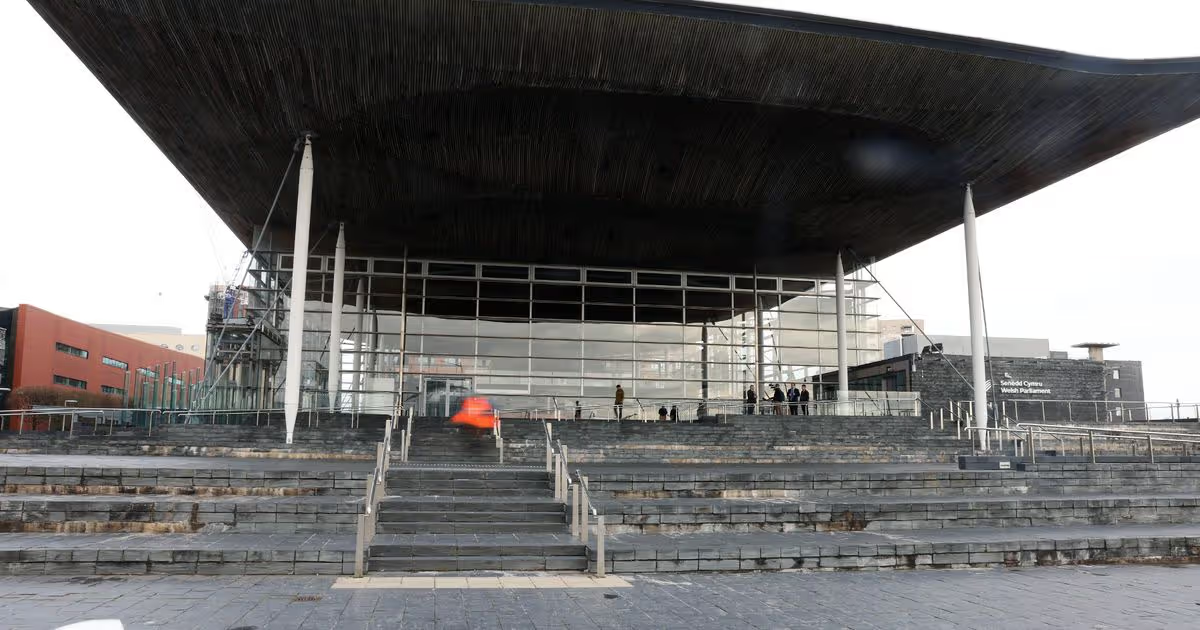
Today (February 24) Senedd members in the Welsh Parliament will debate the assisted dying law. The law would allow adults who are terminally ill, subject to safeguards and protections, to request and be provided with assistance to end their own life.

Advertisement

It is a UK law which has to be passed by Westminster, and not directly a matter devolved to Wales but it does have an impact on areas of politics which are devolved to Wales so a vote has to take place here too.

There are often occasions where this happens, and the Senedd vote is a formality, but this one is expected to be different. Not just because of the magnitude of the law, if it passes, but also what it will mean if it doesn’t pass. For the biggest stories in Wales first sign up to our daily newsletter here

The vote on Tuesday will be seen as important and historic, but it’s important to remember – as we explain below – this isn’t a vote on Senedd members personally backing or opposing the introduction of assisted dying, it is a vote on the legal rules around how the devolved and Westminster administrations could enact it.

What would this change?

Currently it is a criminal offence, because of section 2 of the Suicide Act 1961, to intentionally assist or encourage the suicide or attempted suicide of another person. This law would mean that it would not be an offence if someone assists a terminally ill adult to end their life in accordance with procedures set out in the law.

Advertisement

It would mean neither the registered medical practitioner, nor any other person who supports the terminally ill person to seek assistance under the Act, faces criminal liability for doing so.

It would amend the Suicide Act 1961 and regulate the assistance given to someone.

What is happening with the law?

The law, formally known as the Terminally Ill Adults (End of Life) Bill, would allow adults who are terminally ill, subject to safeguards and protections, to request and be provided with assistance to end their own life.

The bill has made it through all the stages of the House of Commons, passing the final reading by 314 votes to 291 in June 2025.

Advertisement

It is now being debated by the House of Lords and that process is not yet completed. More than 1,100 amendments have been tabled- a record number for this stage – and that process is ongoing.

What is happening in Wales?

The Senedd does not have the powers over to legalise assisted dying itself as the law is part of the Suicide Act 1961. Although suicide itself is no longer a criminal act, it remains a criminal offence for a third party to assist or encourage another to commit suicide.

But because this this is a law which has an impact on areas devolved to Wales – like health – there will be a vote in the Senedd on what’s called a Legislative Consent Motion (LCM).

A LCM is a formal vote used by the Senedd when Westminster legislates on devolved matters, it is politicians here in Wales giving their consent for a piece of legislation to also apply in Wales.

Advertisement

Although not legally binding, there is a convention which is that the UK Parliament will “not normally” legislate on devolved matters without consent from the Senedd. If, for example, the Senedd didn’t give its backing it would be quite a big deal if Westminster then overruled the will of devolved politicians.

What would the law mean in Wales?

Welsh health minister Jeremy Miles has said the law will mean Welsh Ministers will need to make regulations to make provision about voluntary assisted dying services in Wales, and that they will need to ensure that anyone involved in assisted dying can do so via the Welsh language.

The Welsh Government would only be able to implement assisted dying through the NHS if the Senedd agrees. When Mr Miles was asked to clarify what role the Senedd and Welsh Government have, he was asked by Senedd health committee chair Peter Fox whether NHS Wales can offer assisted dying, fall within devolved health powers: “If they are not made by the Welsh Government and consequently approved by this Senedd, the NHS in Wales will not be able to provide assisted dying services – is that the case?”

“That is correct,” Mr Miles replied, also saying that without NHS provision, assisted dying could become available in Wales through the private sector.

Advertisement

The Senedd’s health committee had looked into the law, saying it had taken a neutral position but it thought there would need to be a “wide-ranging public consultation” with people about the law, and for all Senedd committees to be given time to look at the regulations. For our free daily briefing on the biggest issues facing the nation, sign up to the Wales Matters newsletter here

They also expressed concern about long-term impact on palliative and end-of-life care in Wales if the law came into force.

The LCM includes things specific to Wales, including that people can give information, have assessments, and get reports in Welsh; that Welsh ministers will be able to give guidance specific to Wales, allowing the Welsh healthcare system (including the NHS) to provide assisted deaths.

If it does not pass, then it would not block the law, alter eligibility, nor delay implementation but it could mean those Welsh-specific elements are withdraw, and there will not be a Wales-specific service.

Advertisement

Instead, it could mean only private firms deliver assisted dying services in Wales for a fee; Welsh residents could have to travel to England for both assessment and if they continue to an assisted death and there will be no specific Welsh clinical guidance or tailored oversight reflecting Welsh communities and health needs.

Why does the LCM matter?

Supporters of the law say that if the LCM does not pass it will result in a difference in the way this could be offered between England and Wales. For example, the Humanists say: “For over 50 years, abortion was legal in England, Scotland, and Wales, but not in Ireland or Northern Ireland, leading to a quarter of a million women travelling, often alone, to access it.

“This type of injustice risks being repeated between England and Wales if Welsh politicians vote down assisted dying proposals – as then, people will need to travel to England to have the procedure on the NHS. Humanists UK and My Death, My Decision are urging politicians to give terminally ill Welsh people the same options and choices that hundreds of thousands of dying people have around the world.”

They say the abortion ban disproportionately impacted people on low incomes, those living in remote areas, or socially vulnerable people and if assisted dying becomes available only through private providers or by travelling to England, people on lower incomes will face the greatest barriers.

Advertisement

Graham Winyard, director of campaign group “My Death, My Decision”, agreed: “It would be deeply unjust for people in Wales to be denied access to assisted dying through the NHS while people in England are supported to die on their own terms. Without NHS provision, those who cannot afford private services ,or who are too unwell to travel, may be left without any meaningful choice at the end of life.”

Ensure our latest news and sport headlines always appear at the top of your Google Search by making us a Preferred Source. Click here to activate or add us as Preferred Source in your Google search settings

What do opponents say?

Those who oppose the law say there has been “inadequate” oversight of the bill and that it “undermines devolved independence in healthcare and poses unacceptable risks to patient safety and equity”. They say the law is “deeply flawed” – they are all quotes from a letter signed by 250 healthcare professionals sent to Senedd members ahead of the key vote.

It says: “We have worked across the nation with vulnerable patients, and in under-resourced health and social care services. Those who are distressed as they face a terminal illness deserve better. unachieved. We know that care provision currently fails too many, but this Bill is not the answer.”

Advertisement

The medics argue that the Bill “fails to recognise the risks from mistaken diagnosis or misinformation. Accurate prognostication is impossible…. Patients will be eligible to access lethal drugs if they feel a burden or because of a lack of services. Coercion is often covert and difficult to detect, particularly when undue influence comes from family or from a person with authority.”

You can read their comments in full here.

How many people would it impact?

An assessment by the UK Government was based on people being able to access it from October 2029, and working on financial years would mean between 17 and 80 people in Wales would likely apply in that year. By its tenth year, between 106 and 462 people would apply.

In terms of those having assisted deaths, in the first year, it would be between 10 and 48, by 2039, that would be 63 to 277.

Advertisement

What would it cost?

The impact assessment says that very roughly it would cost between £26,000 and £123,000 in the first six months, and between £163,000 and £716,000 by the tenth year (2039).

What do the governments say?

Both the UK and Welsh governments have adopted a “neutral” position.

How will Senedd members vote?

We don’t yet know how anyone will vote on January 20, but we’d expect the parties to give their members a “free vote” meaning they do not have to follow a party position. In October 2024, Senedd members did take part in a vote but it was symbolic and not legally binding.

However, that vote, which 19 members backed, 27 opposed and nine abstained on, was not quite the same as the law making its way through the Commons and it was about the whole concept of legal dying, not the legislative rules around it, as this is.

Advertisement

In that most recent vote, First Minister Eluned Morgan and Wales’ health minister Jeremy Miles both voted against.

Source link

Continue Reading
Click to comment

You must be logged in to post a comment Login

Leave a Reply

NewsBeat

Labour migrant plans under scrutiny and Iran gas field targeted

Published

on

Labour migrant plans under scrutiny and Iran gas field targeted
The headline on the front page of the Guardian reads: "'A dangerous escalation': Israel strikes world's largest gasfield."

Israeli strikes on a gas field, which the UAE has described as a “dangerous escalation” in the US-Israel war with Iran, is the main focus of the Guardian. The South Pars site in the Gulf is shared between Iran and Qatar, and is “the world’s largest natural gas field”, the paper reports.

Source link

Continue Reading

NewsBeat

Spurs go down fighting to raise hopes ahead of Forest death-match

Published

on

Spurs go down fighting to raise hopes ahead of Forest death-match

This could be a strange match with an empty feeling around it. The priority for Tottenham Hotspur is Premier League survival and Nottingham Forest’s visit on Sunday is of greater importance than this game.

Given the 5-2 deficit after the Kinsky horror show in the first leg, the Europa League champions will need a three-goal winning margin just to take the tie to extra-time.

“Difficult, but not impossible,” was manager Igor Tudor’s assessment of the task in hand. The Croatian remains confident that they will stay up.

Advertisement

Funnily enough, Tottenham have won all four of their home Champions League matches this season with an aggregate score of 10-0. Still, given their form, it feels like this is one for Saint Jude, the patron saint of lost causes.

They cannot quite afford to give up this Champions League round of 16 second leg as a hopeless task, rest all key players and hope for a creditable performance.

The Opta supercomputer gives the home side a marginally better chance of winning tonight than their opponents and there was encouraging fight shown in the 1-1 draw at Liverpool on Sunday. A little momentum and a win at home could go a long way.

Micky van de Ven is back from suspension and called reports that players had switched off or were focusing on next season “the biggest nonsense” yesterday.

Advertisement

They are missing some key players: target-man Richarlison is out with a one-match suspension, Conor Gallagher and Dominic Solanke are injury doubts. Cristian Romero ought to be back in the team, but João Palinha has been ruled out.

Atlético Madrid’s stalwart goalkeeper Jan Oblak is out with a muscular problem, so Juan Musso will deputise.

Kick-off at the Tottenham Hotspur Stadium is at 8pm GMT. Line-ups coming shortly.

Source link

Advertisement
Continue Reading

NewsBeat

Songs halted at Renee Rapp gig at AO arena as fans need medical assistance

Published

on

Manchester Evening News

Security responded quickly and Rapp was quick to stop songs and speeches to ensure that fans were okay

Multiple fans were recovered from the crowd due to medical concerns at the AO Arena this evening (Wednesday, March 18).

Advertisement

US pop star Renee Rapp was performing at the arena this evening and had to stop the performance multiple times whilst security helped those in the crowd.

Security responded quickly and Rapp was quick to stop songs and speeches to ensure that fans were okay.

Get MEN Premium now for just £1 HERE – or get involved in our WhatsApp group by clicking HERE. And don’t miss out on our brilliant selection of newsletters HERE.

Around nine people in the crowd were attended to throughout the concert. The song I think I like You Better was halted as fans waved their touches around in the crowd to signal for medical help and during this period another two groups of fans also secured security to attend.

Advertisement

Then again, just one song later, Tummy Hurts was also stopped due to concerns for the crowd. The numbers of incidents increased as the night went on.

Rapp asked those at the back to take a step back to make room for those at the front as they were more often the ones who required attention. She often requested for the house lights to be brought up so that security could better reach fans.

During one part of the concert, the song Not My Fault, is always interrupted as part of a gag Rapp does with the audience to switch to play a different song. However tonight that did not run as smoothly as other nights as Rapp had to stop again for fans who needed help.

Rapp reassured the crowd the security were coming saying: ‘They are right here and ready to help you’.

Advertisement

Source link

Continue Reading

NewsBeat

How Mohamed Salah and a tactical tweak breathed life back into Liverpool’s campaign in Champions League win over Galatasaray

Published

on

How Mohamed Salah and a tactical tweak breathed life back into Liverpool’s campaign in Champions League win over Galatasaray

There may not be too many ways in which this season is better than last for Liverpool but Arne Slot can at least point to a significant one. Liverpool have gone further in the Champions League, and this was progress in more ways than one.

A quarter-final was booked in emphatic and entertaining fashion. The boos that greeted the final whistle against Tottenham on Sunday were replaced by cheers, the lethargy with which Liverpool have played too often giving way to an energy and intensity. This was frenzied and fast, players and crowd feeding off each other. “There was a great dynamic between the players and fans,” said Slot. “Almost a perfect game.”

For him, it was a response when the scrutiny upon him had heightened. The Dutchman switched tactics, to something of a 4-4-2, and the team changed tack. This was much better. This was one of their best displays of the campaign. It was so good it was almost unrepeatable, Slot argued. “Because 5.02 xG on a Champions League night, conceding 0.18 xG, that is not going to be easy to copy,” he said.

Mohamed Salah curled home a fine goal

Advertisement
Mohamed Salah curled home a fine goal (Liverpool FC via Getty Images)

If it was like the Liverpool of old, what could have shaped up as further evidence of Mohamed Salah’s decline instead became a cathartic evening for him. His was a throwback performance. His was a throwback performance. At half-time, when Liverpool’s dominance was not reflected by a one-goal lead, there was the possibility Salah’s missed penalty would cost them. This threatened to be his last European game for Liverpool until he had a part in three goals in 11 minutes, capped gloriously. “He scored a trademark goal that he has scored so many times in this stadium and for this club, cutting inside, finding the corner,” said Slot, who was delighted with Salah’s response to a setback. “It says a lot about his mental strength.”

Galatasaray were overwhelmed, Liverpool’s defeat in Istanbul last week rendered irrelevant amid a blur of 32 shots, 16 of them on target. The catalyst for the turnaround, perhaps inevitably, was Dominik Szoboszlai, who added to his collection of terrific goals and who, as he often does, broke the deadlock.

If Galatasaray had a gameplan for holding on to their first-leg lead beyond timewasting, it was not visible. It got Slot more animated. “It is not something I can do anything about except running around like a lunatic,” he said afterwards. The running was not confined to his team.

They had started at pace, and got a reward. Liverpool had conceded to Galatasaray’s set-pieces twice in Istanbul this season. They scored from one on Merseyside. It was beautifully worked, Alexis Mac Allister disguising a low corner and Szoboszlai delivering a first-time, left-footed finish from 15 yards. The routine was so expertly planned in that it ended up with the man who had the technique to provide the finish. It was, remarkably, Szoboszlai’s fifth Champions League goal of the season, to add to four assists. His name echoed around Anfield; the fans he had criticised for leaving early on Sunday recognise he has become a talisman.

Advertisement
Dominik Szoboszlai has become a talisman for Liverpool

Dominik Szoboszlai has become a talisman for Liverpool (Reuters)

And then Liverpool mounted a ferocious onslaught. Salah, in behind the Galatasaray defence, failed to dink the ball over Ugurcan Cakir. Florian Wirtz had a ferocious shot deflected over the goal. Mac Allister headed on to the bar from four yards. Szoboszlai had a long-range shot parried. The best chance of all went to the Egyptian. It was a wild and needless challenge from Ismail Jakobs to send Szoboszlai flying. In contrast, Salah’s penalty was too tame. Cakir saved it with his trailing foot.

If it reinforced the sense Liverpool can be a side who struggle to double a lead, they got their second, third and fourth goals in swift succession. Each revolved around Salah. First he sprang the offside trap and centred to give Hugo Ekitike a tap in. Then, after Cakir parried his half-volley, Ryan Gravenberch bobbled in the rebound. After Wilfried Singo was spared an embarrassing own goal by an offside flag, Salah scored his 50th Champions League goal in classic fashion. A curler from outside the box nestled in the net. Salah grabbed the Liver Bird on his shirt in celebration. High in the stands, Steven Gerrard joined in the applause.

Advertisement
(Martin Rickett/PA Wire)

Salah should really have had a second, hitting the bar from Ekitike’s cutback. It nevertheless felt a sign he was irresistible; until, suddenly, he wasn’t. He went off, seemingly substituting himself for once, and headed down the tunnel for treatment. “He felt something,” added Slot.

Galatasaray’s attacking superstar was long gone by then. Hampered by an arm injury, Victor Osimhen did not reappear for the second half. His manager, Okan Buruk, thought Victor Osimhen’s arm injury was a psychological blow for his team. His top scorer departed at half-time, heading for hospital, where he was later joined by Noa Lang, stretchered off with a potentially serious finger problem.

(Getty)

It completed an awful night for Galatasaray. Having gone further than expected in Europe, they shrank from the challenge. Liverpool rose to it. And so in this season, unlike last, they will play European football in April. There is a similarity nonetheless. It is Paris Saint-Germain again, a rematch that offers the prospect of revenge. And for Salah, an opportunity to plot a course towards his fourth Champions League final.

Advertisement

Source link

Continue Reading

NewsBeat

Council’s plea for help from Scarborough businesses on public loos

Published

on

Council’s plea for help from Scarborough businesses on public loos

​Despite the fast-approaching tourist season, North Yorkshire Council (NYC) has not been able to secure a public bathroom in Scarborough’s town centre and has asked businesses to reach to the authority. with offers.

​Earlier this month, Scarborough businesses were asked to make their toilets available to the public following concerns over a lack of facilities in the town centre.

​A Community Toilet Initiative (CTI) proposed by Scarborough Town Council would provide “modest financial support, signage, and inclusion in promotional materials” to cafes, pubs, and shops that voluntarily make their toilet facilities available for public use.

Advertisement

​NYC said it had not been able to convince any local businesses to work with it to provide a public bathroom.

​Cllr Rich Maw told a full meeting of NYC on Wednesday, March 18: “Scarborough has no public toilet provision in the town centre and residents and visitors will understandably be dismayed by this.

​“What immediate and longer-term steps is the council taking to restore adequate public convenience provision in the town centre for residents and visitors alike?

“I am aware of the West Pier temporary toilet provision, but I’d remind the executive committee that it is nowhere near the town centre.”

Advertisement

​Cllr Richard Foster, executive member for managing the environment, replied: “Since the closure of the Brunswick Centre, there hasn’t been any provision within the town centre.

​“There was the Railway Station, and there is the indoor market and that is a seven-minute walk away from the main retail space.

​“We do agree there’s a gap in the provision and officers have been working closely with businesses to get a community toilet in place, but have so far failed to negotiate one. So, maybe highlighting it today can bring forward a business that can help us with that.”

​Cllr Foster said: “We realise it’s an issue and we are working on it, and there are further things officers will bring forward for consideration. But that would be the easiest solution if we could get a local firm in place to help us with that.

Advertisement

​“If any members know anybody who might be willing to negotiate something with us, please come forward to council officers.”

Source link

Advertisement
Continue Reading

NewsBeat

Senegal vows to appeal ‘unfair, unacceptable’ ruling stripping it of African football trophy | World News

Published

on

Referee Jean-Jacques Ndala awards a penalty to Morocco after a VAR review. Pic: Reuters

Senegal says it will appeal the “unfair, unprecedented, and unacceptable decision” to strip it of its Africa Cup of Nations title after a chaotic final against host Morocco.

On Tuesday, the appeals board of the Confederation of African Football (CAF) ruled that Senegal had forfeited the final in January by walking off the field in extra time to protest a penalty given to Morocco.

They subsequently returned to the field, only for their rivals to miss the crucial penalty, but now the board’s decision has turned Senegal’s 1-0 win into a default 3-0 victory for Morocco, making them the tournament’s winners.

Image:
Referee Jean-Jacques Ndala awards a penalty to Morocco after a VAR review. Pic: Reuters

Now the Senegalese government is pledging to “pursue all appropriate legal avenues” to challenge the ruling.

Advertisement

“This unprecedented and exceptionally serious decision directly contradicts the fundamental principles of sporting ethics, foremost among which are fairness, loyalty and respect for the truth of the game,” the government said in a statement.

The statement also branded the ruling “grossly illegal and deeply unjust” and a “manifestly erroneous interpretation of the regulations”.

Similarly, the Senegalese Football Federation said the decision was “unfair, unprecedented, and unacceptable” and “discredits African football”.

Senegal's Sadio Mane lifts the trophy with teammates as they celebrate after winning the Africa Cup of Nations. Pic: Reuters
Image:
Senegal’s Sadio Mane lifts the trophy with teammates as they celebrate after winning the Africa Cup of Nations. Pic: Reuters

The organisation said it would appeal “as soon as possible” to the Court of Arbitration for Sport in Lausanne, Switzerland.

Justifying its decision, the CAF referred to Articles 82 and 84 of its Africa Cup Regulations.

Advertisement

The former stipulates that a team will lose the game and be eliminated from the tournament if it refuses to play or leaves the field without the referee’s permission.

The latter article mandates a 3-0 win for the opposing team.

Senegal fans clash with security as fans invade the pitch
Image:
Senegal fans clash with security as fans invade the pitch

However, the referee has “full authority” to decide what happens in a match under Law 5 of the International Football Association Board, which sets the rules of the game globally.

Read more:
Five sporting results which were overturned after Senegal drama
Women ‘may leave sport unless tech giants tackle online abuse’

In its own statement, the Royal Moroccan Football Federation said its appeal to the CAF had “never been about challenging the sporting performance” of the teams, “but solely to ensure that the tournament rules are respected”.

Advertisement

“CAF has acknowledged that the rules, known to all and applicable to all, had not been respected,” it added.

Source link

Advertisement
Continue Reading

NewsBeat

Steel strategy announced to preserve production in the UK

Published

on

Steel strategy announced to preserve production in the UK

Business and Trade Secretary Peter Kyle gave details of the strategy on a visit to Tata Steel’s plant in Port Talbot, South Wales, warning that without action, the UK’s steelmaking capability faces “real jeopardy”, leaving the country reliant on overseas suppliers for materials essential to energy security, defence and transport infrastructure.

Source link

Continue Reading

NewsBeat

The UK’s high electricity prices are here to stay. But could they offer an opportunity?

Published

on

The UK’s high electricity prices are here to stay. But could they offer an opportunity?

Four years after Russia’s invasion of Ukraine, the world is bracing for another energy crisis. The US-Israel bombing of Iran and then the blockade of the strait of Hormuz have forced up the price of oil. The price of natural gas in Europe has also risen sharply.

In the UK, Prime Minister Keir Starmer has announced a £50 million package to support consumers who heat their homes with oil. The government is also considering a U-turn on the decision to increase fuel duty (currently almost 53p per litre of petrol or diesel) in September after a 15-year freeze. Other taxes would need to go up to compensate.

But the main question concerns what will happen to electricity prices this summer. A sustained crisis could push prices higher for both households and businesses. It could also push the Bank of England to avoid interest rate cuts, making mortgages more expensive. And the government could even end up paying part of everyone’s bills directly as it did between 2022 and 2024, piling up tens of billions of pounds of public debt.

To secure most of the future production of electricity – wind farms or new nuclear power stations for instance – the government signs what are known as “contracts for difference” with electricity producers. These contracts fix the price of electricity for decades, typically above expected wholesale prices.

Advertisement

These guaranteed prices correspond roughly to the expected average cost of producing electricity. Unlike gas, once a wind farm is built, each additional unit of electricity costs almost nothing to produce. So, without a guaranteed price, renewable producers would fear having to sell the electricity for free and never recouping their investment.

Consumers are shouldering the risk

The UK is not as sunny as somewhere like Spain and so will never get very cheap solar power. It is also trying to build new nuclear power plants, but the first attempt (Hinkley point C, currently expected to begin delivering electricity in 2030) is so expensive that the French state-owned energy operator EDF lost £10 billion in the process. Future projects now ask taxpayers to take most of the risk and pay upfront in the form of higher bills.

Consumers mostly notice these extra costs added to their bills (called “environmental levies”) when gas prices are low. The levies currently make up 6.5% of a typical bill, which is down from 13% after the government shifted some costs so that they would be paid for through general taxation.

So given that they’re paying upfront for the infrastructure, consumers might expect renewables to cut their bills when gas prices spike. But that is not how markets work: the price is set by the most expensive unit sold. Around 85% of the time in the UK this most expensive unit uses liquefied natural gas (LNG) transported by boat.

Advertisement

If one day the UK becomes like Spain where prices are mostly set by renewables (thanks to huge leaps in wind and solar), wholesale prices will often be zero. But consumers will still pay more, because they will still be charged the environmental levies that were put in place years before to invest in the infrastructure.

This is what led the CEO of energy giant E.ON, Chris Norbury, to declare in parliament that “even if the wholesale price was zero, bills would still be where they were today”. That’s true, but also a bit misleading.

Wholesale prices only go to zero because the country invested in renewables. The alternative – going back to more gas – would probably be much more expensive for everyone. It would certainly be more risky as the current conflict in the Middle East is illustrating.

Sunshine and wind do not need to pass through the strait of Hormuz and cannot be used as leverage by dictators. And what looks like a costly subsidy heaping pressure on billpayers in good times becomes insurance in a crisis.

Advertisement

During the peak of the energy crisis in 2022, the wholesale price of electricity was higher than the guaranteed one, and renewable generators paid money to the government instead of receiving subsidies. But because the government was helping out with everyone’s bills, consumers never saw the benefit.

Investing in storage at scale will be vital.
btimagery/Shutterstock

In 2025 in the UK, less than a third of electricity was generated using gas. Replacing renewables with gas would mean building power plants and importing more gas at ever-higher prices and greater geopolitical risk.

Gas is cheaper in the US where fracking makes the country almost energy independent. But fracking is much harder in places that are as densely populated as England. The government is currently planning to ban it everywhere in the UK.

Advertisement

But the UK’s vulnerable situation also gives it a chance to innovate and export. The key is making sure that consumers pay a price that reflects the real cost of electricity at any given moment.

The more we switch from fossil fuels – heating, cars, trucks – to electricity, the more battery capacity we have to fill. The price signal (the gap between cheap and expensive electricity) gives industries and households a strong incentive to innovate and invest in storage.

Most people only care about their monthly bill and won’t adapt directly. But smart appliances, home batteries and vehicle-to-grid systems (where vehicles can store electricity and sell it back to the grid when required) will do it for them.

The UK can gain in efficiency what nature has not provided in resources. This could give Britain a chance to sell its innovations to the world. Selling services is what the UK does as a country, after all. The large majority of global investments in energy are in renewables, and there will be huge opportunities for the countries that figure out how to run a grid on intermittent electricity sources.

Advertisement

Source link

Continue Reading

NewsBeat

DJ Greg James arrives in Sunderland on his ‘Longest Ride’

Published

on

DJ Greg James arrives in Sunderland on his 'Longest Ride'

Greg set off on his sixth day of the ‘Longest Ride’ from York this morning (Wednesday, March 18), powering through the likes of Stokesley, Blackhall, Horden, Seaham, Ryhope, and the gruelling North Yorkshire Moors.

Crowds gathered all along the route to cheer him on, but no crowd was a match for the Mackem welcome he received as he arrived into Sunderland – his final stop for the day.

Crowds cheered him on through the North East towns. (Image: Sarah Caldecott)

The DJ arrived into Sunderland just after 5pm to loud cheers from supporters.

Dismounting his bike, he said: “Hello Sunderland!

Advertisement

“I’m overwhelmed and I’m knackered – what a day that was.”

null (Image: BBC)

He described the journey through the moors as particularly challenging, saying: “That bit in the Yorkshire Moors, I really nearly cracked, I really did, I don’t know how I’m still going, actually.”

Jennifer Wale, who travelled to Sunderland to see him cross the day six finish line said: “He was cycling along and we were running to get to him, then the camera van stopped, and he almost went into the back of it.”

Danielle Summers from Sunderland, who was enjoying a glass of wine at the finish line said: “If I could say one thing to Greg, it would be to just keep listening to Radio 1 and everyone that is spurring you on.”

Advertisement

Danielle Summers and Claire Porter cheered on Greg at the Sunderland finish line. (Image: Will Foxx)

The BBC announced his current total at more £1.6m so far.

Claire Porter from Seaham praised his determination despite personal challenges.

She said: “He actually drove past where I live, but I was at work.

“I work in a school and the kids were like ‘that’s easy’ – I told them, no it’s not!

Advertisement

“To push through everything that’s going on with his Dad is just amazing.”

Another fan, Judith English, brought along her therapy dog to the finish line.

Kay Robinson with dog Cooper, and Judith English with her therapy dog Bonnie. (Image: Will Foxx)

She said: “It’s phenomenal, Bonnie is a therapy dog who I’ve brought along to give Greg some TLC.”

Kay Robinson, a teacher from Middlesbrough, also showed her support.

Advertisement

She said: “I think it’s amazing.

“Our school was on the Breakfast Quiz and he was so lovely off-air, my sister died two weeks before Christmas and she donated five organs to people on waiting lists – he was so supportive of me so I’m here to support him.”

The eight-day challenge saw the DJ set off from the South Coast on March 13, and sees him riding through England and Wales before crossing the finish line on Red Nose Day, March 20.

Greg sets off today from Sunderland on his next leg to Galashiels, on the Scottish borders, before cycling his last leg up to Edinburgh on his last day.

Advertisement

Source link

Continue Reading

NewsBeat

‘One of the greats’ Tom Georgeson dies unexpectedly as tributes paid to BBC acting legend

Published

on

Daily Record

The Liverpool-born actor was famous for appearing in the BBC’s Boys from the Blackstuff, Between the Lines and John Cleese and Michael Palin movie classic A Fish Called Wanda.

Tributes are being paid to an actor instantly recognisable to generations of TV viewers.

Advertisement

Tom Georgeson has died at the age of 88. The Liverpool-born actor was famous for appearing in the BBC’s Boys from the Blackstuff, Between the Lines and John Cleese and Michael Palin movie classic A Fish Called Wanda.

Tom appeared in many of the UK’s best-known shows, including Z Cars, Holby City, The Bill, Doctor Who, Poirot, Ashes To Ashes and Foyle’s War. He also appeared in the Alan Bleasdale drama GBH and played the clerk Clamb in the BBC’s 2005 adaptation of Bleak House.

Tom played a gangster called George Thomason – a mixed-up version of his own name – in the box office smash A Fish Called Wanda and also appeared in its 1997 follow-up Fierce Creatures.

Tom’s nephew, Danny Conway, told the Liverpool Echo he was “gutted” by the news, saying: “We weren’t expecting it. Last time I spoke to him he was in good health. I woke up to that news today and it’s just sad. I was really proud of him and felt lucky to have a famous uncle.”

He added: “The whole family has got an artistic streak through them. They’re either artists or performers. It started with my grandad, who was into amateur dramatics. He got Tom into it as well. One of his other brothers, Greg, used to read audio books. He passed away last year.”

A spokesperson for the Liverpool Everyman and Playhouse Theatres said: “We’re deeply saddened to hear of the passing of Tom Georgeson – a much‑loved Liverpool actor whose talent, generosity and unmistakable presence shaped so many moments on our stages since he first performed with us in the 1970s.

“In more recent times, Tom appeared in The Kindness of Strangers, Tony Green’s play created for the Everyman’s 40th birthday season in 2004. He returned memorably to the Playhouse in the comedy When We Are Married, sharing the stage with Les Dennis and Jodie McNee.

Advertisement

“In each of these roles, he brought the same depth, wit and humanity that defined his work across film, television and theatre. Tom was one of our city’s great actors, and we’re grateful and proud to have been an artistic home he returned to throughout his career. Our thoughts are with his family and friends.”

Tom – who was living in London when he died – is survived by his wife Prim and children Richard and Roslyn.

Get more Daily Record exclusives by signing up for free to Google’s preferred sources. Click HERE.

Source link

Advertisement
Continue Reading

Trending

Copyright © 2025