



Connect with us
DAPA Banner

Tech

Google Chrome adds infostealer protection against session cookie theft

Published

on

Google Chrome adds infostealer protection against session cookie theft

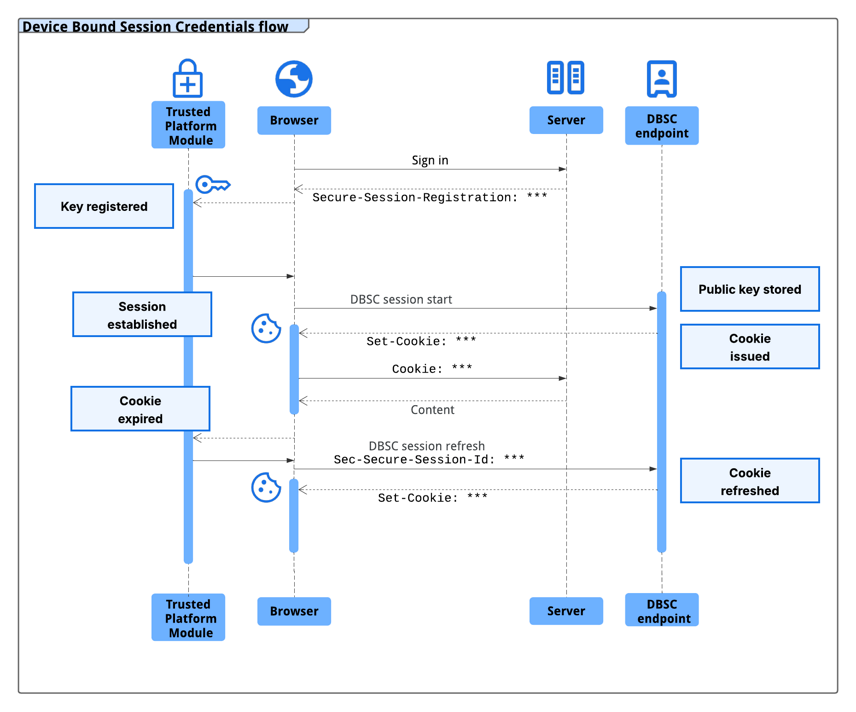
Google has rolled out Device Bound Session Credentials (DBSC) protection in Chrome 146 for Windows, designed to block info-stealing malware from harvesting session cookies.

macOS users will benefit from this security feature in a future Chrome release that has yet to be announced.

The new protection has been announced in 2024, and it works by cryptographically linking a user’s session to their specific hardware, such as a computer’s security chip – the Trusted Platform Module (TPM) on Windows and the Secure Enclave on macOS.

Wiz

Since the unique public/private keys for encrypting and decrypting sensitive data are generated by the security chip, they cannot be exported from the machine.

This prevents the attacker from using stolen session data because the unique private key protecting it cannot be exported from the machine.

Advertisement

“The issuance of new short-lived session cookies is contingent upon Chrome proving possession of the corresponding private key to the server,” Google says in an announcement today.

Without this key, any exfiltrated session cookie expires and becomes useless to an attacker almost immediately.

The Device Bound Session Credentials (DBSC) flow
Browser-server interaction in the context of the DBSC protocol
source: Google


A session cookie acts as an authentication token, typically with a longer validity time, and is created server-side based on your username and password.

The server uses the session cookie for identification and sends it to the browser, which presents it when you access the online service.

Advertisement

Because they allow authenticating to a server without providing credentials, threat actors use specialized malware called infostealer to collect session cookies.

Google says that multiple infostealer malware families, like LummaC2, “have become increasingly sophisticated at harvesting these credentials,” allowing hackers to gain access to users’ accounts.

“Crucially, once sophisticated malware has gained access to a machine, it can read the local files and memory where browsers store authentication cookies. As a result, there is no reliable way to prevent cookie exfiltration using software alone on any operating system” – Google

The DBSC protocol was built to be private by design, with each session being backed by a distinct key. This prevents websites from correlating user activity across multiple sessions or sites on the same device.

Advertisement

Additionally, the protocol enables minimal information exchange that requires only the per-session public key necessary to certify proof of possession, and does not leak device identifiers.

In a year of testing an early version of DBSC in partnership with multiple web platforms, including Okta, Google observed a notable decline in session theft events.

Google partnered with Microsoft for developing the DBSC protocol as an open web standard and received input “from many in the industry that are responsible for web security.”

Websites can upgrade to the more secure, hardware-bound sessions by adding a dedicated registration and refresh endpoints to their backends without sacrificing compatibility with the existing frontend.

Advertisement

Web developers can turn to Google’s guide for DBSC implementation details. Specifications are available on the World Wide Web Consortium (W3C) website, while an explainer can be found on GitHub.

Automated pentesting proves the path exists. BAS proves whether your controls stop it. Most teams run one without the other.

This whitepaper maps six validation surfaces, shows where coverage ends, and provides practitioners with three diagnostic questions for any tool evaluation.

Source link

Advertisement
Continue Reading
Click to comment

You must be logged in to post a comment Login

Leave a Reply

Tech

10 companies in Ireland actively recruiting in cybersecurity

Published

on

If you have ambitions to further your career in the cyber space, consider one of the following 10 exciting organisations.

The cybersecurity sector is constantly evolving and more and more organisations are adding to their teams in order to meet increasing global demands. From penetration testing and incident response, to intelligence analysis and SOC management, there are a plethora of opportunities for professionals looking to advance their careers. 

If this sounds good to you, keep reading to discover more about the companies based in Ireland currently in the process of cybersecurity recruitment. 

Accenture

Irish technology consulting platform Accenture currently has three roles on offer for professionals available to work out of the Dublin premises. Vacant roles include a CyberArk associate manager, cyber incident responder and CyberArk specialist. Interested potential applicants can apply via the organisation’s careers page. 

Advertisement

Arctic Wolf

US cybersecurity company Arctic Wolf has three positions open to professionals based in Cork and remotely. There is a senior cybersecurity engineer role available, as well as opportunities for a triage security engineer with proficiency in German and a cybersecurity engineer 2. 

BMS

US multinational pharmaceutical company Bristol Myers Squibb, or BMS, has a role that, while not strictly cybersecurity, requires someone with cybersecurity skills. There is currently an opening for a senior manager in AI operations at the company’s Dublin office. The successful candidate will have a range of duties that include work in security, compliance and governance – such as implementing security controls, supporting model governance workflows and collaborating with cybersecurity teams to maintain secure and compliant environments.

Centripetal

US cybersecurity platform Centripetal has its European headquarters in Galway, Ireland and is currently looking for a senior software engineer to join its security-based Intelligence Services team. This role is available at the Galway facility and in a hybrid capacity. There is also a senior software UI engineer role open on the Intelligence Services team in Galway.  

Eli Lilly

US multinational pharmaceutical Eli Lilly has multiple job vacancies for jobseekers with cybersecurity skills and qualifications. Interested professionals should consider applying for roles such as cyber intelligence analyst, SecOps engineer and senior application security engineer. All the roles are based out of the company’s Cork facility.  

Advertisement

Google

Search engine Google is looking to add to its Ireland-based security personnel with a regional IoT operations and cybersecurity specialist, who would be situated at its Dublin facility. The Dublin team is also on the lookout for a security sales specialist for Google Cloud who can speak French fluently, as well as a senior policy escalation specialist for YouTube trust and safety.

Integrity360

Earlier this year, Irish cybersecurity company Integrity360 announced plans to acquire Canadian cybersecurity services and solutions provider Advantus360. There are plenty of roles open to qualified professionals globally and in Ireland specifically, Integrity360 is looking to recruit a penetration tester, senior penetration tester, SOC manager and an IAM architect. 

PwC

Professional services firm PwC has a range of opportunities on offer to cybersecurity experts based in Ireland. In Dublin and Cork, open roles include jobs in cybersecurity security operations and crisis incident management, cybersecurity third-party risk management, and cybersecurity threat and vulnerability. 

Smarttech247

Detection and response security platform Smarttech247 is looking for a few senior swimlane automation engineers and architects to join the team in remote, Ireland-based roles. The chosen professionals will lead the end-to-end design, implementation and deployment of security automation playbooks on the company’s swimlane platform. 

Advertisement

TCS

IT services, consulting and business solutions platform TCS has one role open to a professional in cybersecurity. Candidates can apply for a hybrid, Dublin-based role as an SAP SuccessFactors security consultant. 

Don’t miss out on the knowledge you need to succeed. Sign up for the Daily Brief, Silicon Republic’s digest of need-to-know sci-tech news.

Source link

Advertisement
Continue Reading

Tech

TVs Are Getting Uncomfortably Bright, and This is Why

Published

on

In this CNET Labs exclusive, I look at why the overall brightness of TVs I’ve measured has increased over the past few years.

Source link

Continue Reading

Tech

NASA’s Lithium Thruster Reaches Record Heights in a Vacuum Chamber Test

Published

on

NASA Lithium Fed Thruster Electric
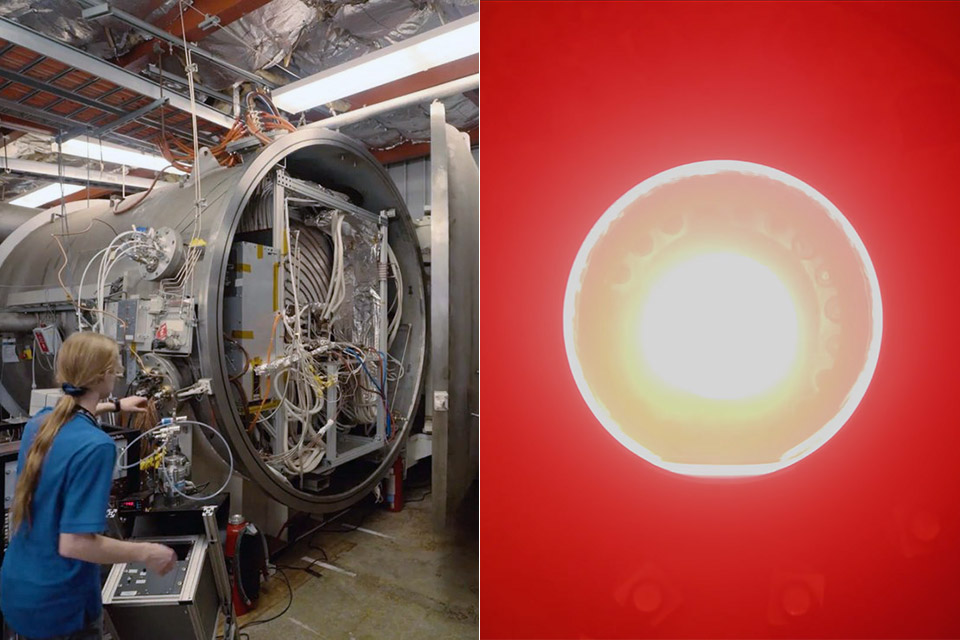
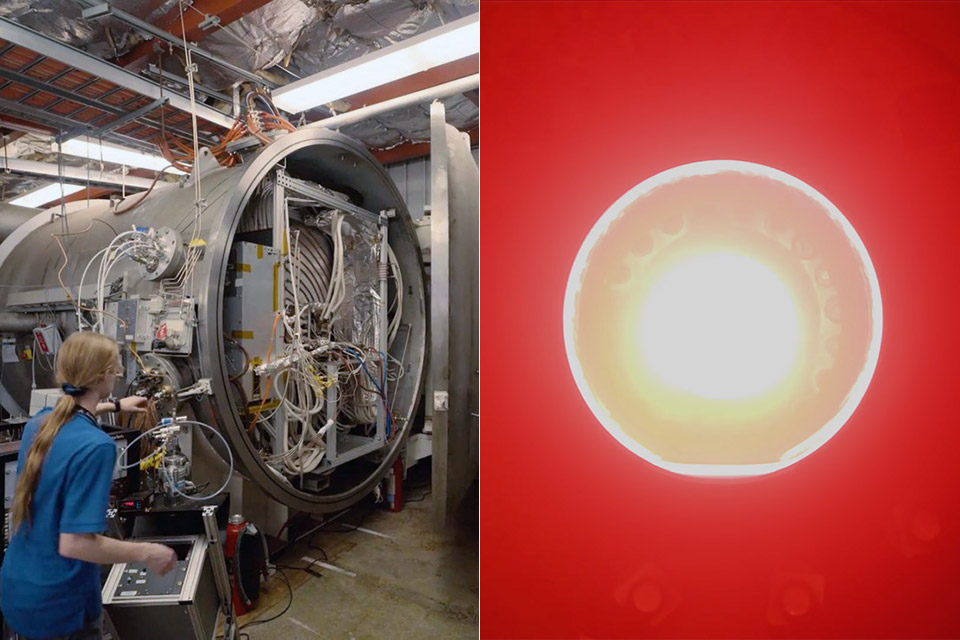
Engineers at NASA’s Jet Propulsion Laboratory gathered around a special 26-foot vacuum chamber in February of last year to witness a prototype engine fire five times in a row. The temperature within that device skyrocketed, exceeding 5,000 degrees Fahrenheit, with a center tungsten electrode burning a brilliant white and an outer nozzle spewing out an astounding crimson stream of lithium plasma into the void of space.


Those short bursts of fire boosted the engine to a clean 120 kilowatts, a level not even the most powerful US-built electric propulsion system had ever achieved. High voltage electric currents rip through lithium vapor inside the engine, interact with a magnetic field, and suddenly the plasma blasts out of the nozzle at a breakneck pace. It everything works together to provide you with a consistent thrust without any flames or explosions, just a smooth and continuous push that accumulates over months or even years in space. The lithium works so well for the job because it ionizes cleanly, can run on lower voltages than other choices, and allows the system to pack a big punch into a small space once everything is scaled up.


LEGO Technic NASA Artemis Space Launch System Rocket Building Toy for Boys & Girls – STEM Learning…
  • BUILD AN OFFICIAL NASA ROCKET – Kids prepare to explore outer space with the LEGO Technic NASA Artemis Space Launch System Rocket (42221) building…
  • 3-STAGE ROCKET SEPARATION – Young builders can turn the hand crank to watch the rocket separate in 3 distinct stages: solid rocket boosters, core…
  • STEM BUILDING TOY FOR KIDS – This educational rocket kit was created in collaboration with NASA and ESA to showcase the authentic system that will…

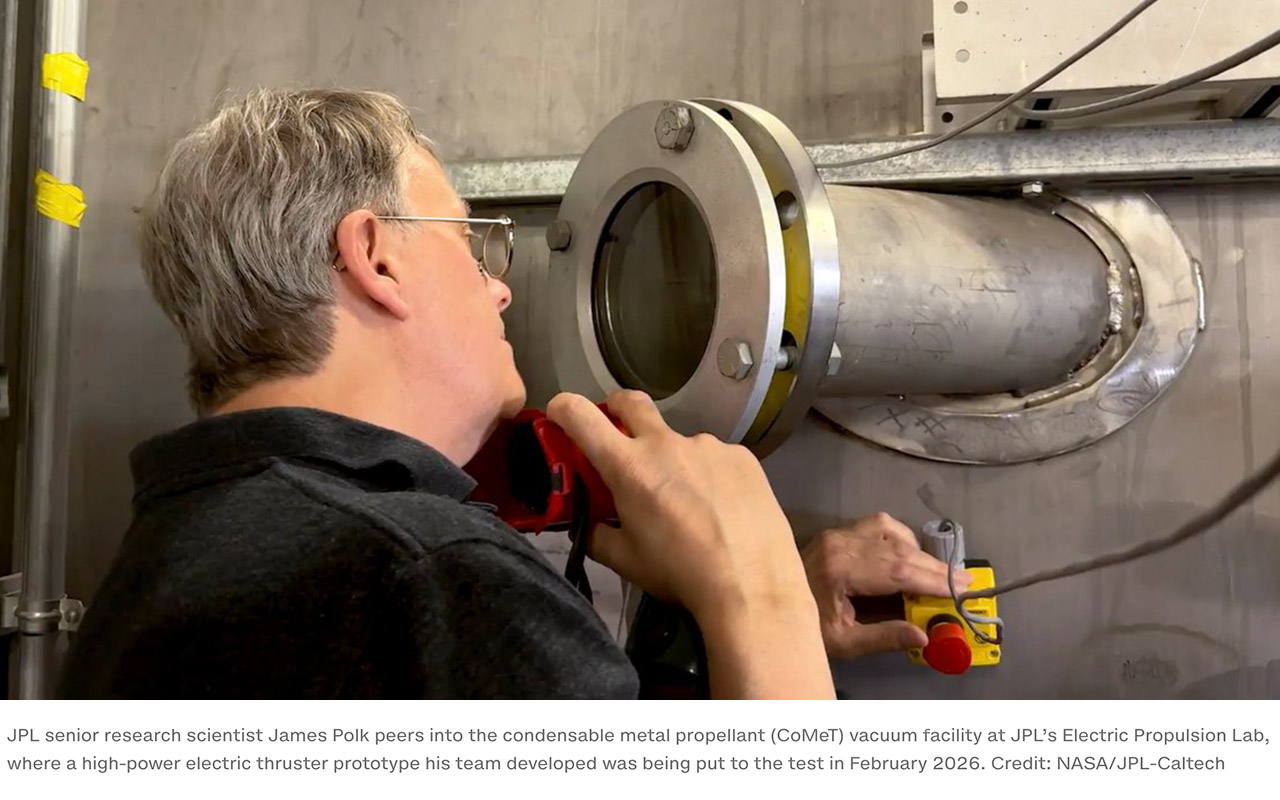
Senior Research Scientist James Polk from JPL is the driving force behind the operation, with assistance from his colleagues at Princeton University and NASA’s Glenn Research Center. They spent a long two and a half years planning and building the monster with funds from the space nuke propulsion program. Polk described the test as a “big stride forward” because they not only demonstrated that the engine works but also achieved their target power exactly as expected. The data acquired throughout those five test cycles is now being used to plan the next releases.


NASA has already tried electric propulsion on missions with a lot lower power outputs, such as the Psyche spacecraft. This one revolutionary design can deliver 25+ times more power than those units while utilizing only a fraction of the prop required for a chemical rocket. In general, these techniques will reduce fuel requirements by up to 90%, allowing spacecraft to launch much lighter and carry far more cargo or crew supplies.

Advertisement

Eventually, nuclear reactors will provide enough electricity to keep the thrusters going over extended distances. A mission to Mars, for example, will most certainly require 2-4 megawatts to get the entire crew there. Once this configuration is in place, the transits will be much shorter because the spaceship will be able to keep chugging along steadily for the entire journey rather than coasting for the majority of it.

NASA Lithium Fed Thruster Electric
Of course, before any of this can happen, the team must first conquer a number of hurdles. The components must be able to sustain heat for thousands of hours without failing, and the engines must be capable of producing at least 500 kilowatts, if not more. The testbed they’ve set up in the vacuum chamber at JPL provides a strong foundation for them to address those difficulties one by one.

Source link

Advertisement
Continue Reading

Tech

Apple’s $599 Mac mini is gone. Blame the AI agents.

Published

on

Apple has quietly raised the desktop’s starting price to $799 after demand from developers building local AI tools cleared its shelves. Tim Cook says it could take months to catch up.


For five years, the Mac mini has been the cheapest way into Apple’s desktop ecosystem. Since the M4 refresh in late 2024, that price has been $599, an unusually aggressive figure for Cupertino, and one that turned the small aluminium box into a sleeper hit.

It became the recommended starter Mac, the home-server-of-choice for tinkerers, and, increasingly, the go-to local machine for developers running AI models on their own hardware.

As of Friday, the $599 Mac mini no longer exists.

Advertisement

The 💜 of EU tech

The latest rumblings from the EU tech scene, a story from our wise ol’ founder Boris, and some questionable AI art. It’s free, every week, in your inbox. Sign up now!

Apple has discontinued the 256GB configuration of the M4 Mac mini and made the 512GB model, which sells for $799, the new starting point. Bloomberg reported the change first, citing Apple’s own product pages, with confirmations following from MacRumors, 9to5Mac, Macworld, and AppleInsider. The pricing on each specification has not changed; the entry rung has simply been removed.

In effect, the Mac mini is $200 more expensive to buy in its base form than it was a day earlier.

Advertisement

Apple’s reasoning was made unusually explicit on this week’s Q2 earnings call. Tim Cook, the company’s chief executive, attributed shortages of both the Mac mini and the more powerful Mac Studio to demand that had outpaced internal forecasts, and tied that demand directly to AI workloads.

Both machines, he said, are “amazing platforms for AI and agentic tools, and the customer recognition of that is happening faster than what we had predicted.”

That recognition has a specific shape. The Mac mini and Mac Studio share a feature that has, in 2026, become unexpectedly valuable: large amounts of unified memory directly accessible to the GPU and Neural Engine on Apple’s M-series chips.

For developers running local large language models, agentic tools that orchestrate multi-step tasks on a single machine, or compact research setups that would otherwise require cloud GPUs, that memory architecture is a meaningful advantage. A 64GB Mac Studio costs less than the cheapest Nvidia H100, runs quietly on a desk, and does not bill by the hour.

Advertisement

The result has been the kind of run on inventory that hardware companies usually associate with launches, not nine-month-old products. Many higher-RAM configurations on Apple’s online store are listed as currently unavailable. The 16GB, 512GB Mac mini, the new entry-level model, is, by some retail accounts, backordered into June.

Behind the consumer-facing story is a less visible one about supply. The same advanced memory chips that ship in Mac minis and Mac Studios are also a critical input for the AI server farms being built by hyperscalers, and the imbalance between data-centre demand and global memory production has been intensifying for more than a year.

DRAM prices have risen sharply, and analysts have begun warning that consumer electronics manufacturers will increasingly find themselves second in line behind cloud providers willing to pay above market.

Cook acknowledged the constraint on the call, telling investors that supply-demand balance for both machines is “several months” away. He stopped short of predicting further price changes, but Notebookcheck and others have noted that the pattern, AI demand absorbs memory, memory becomes scarcer, consumer prices rise, is unlikely to be unique to Apple.

Advertisement

There is also a US manufacturing dimension to the story. The M4 Mac mini is one of the products Apple has begun assembling in part within the United States, and analysts at Technetbook and elsewhere have argued that some of the cost pressure on the entry tier reflects that shift rather than chip availability alone. Apple has not commented publicly on the relative weights of the two factors.

For most consumers, the change is a soft price rise dressed up as a product simplification. The 512GB Mac mini that used to be a $200 upgrade is now the floor. Anyone who would have bought the 256GB version, students, second-machine buyers, light office users, now pays more for storage they may not need.

For the segment Apple appears to be courting, the developer running Claude- or Llama-class models locally, the new entry tier is closer to a sensible minimum. 256GB of storage was always cramped for that workflow, and 512GB combined with 16GB of unified memory is a more honest starting point.

Either way, the broader signal is harder to miss. Apple, a company that historically holds prices steady through chip cycles, has just lifted a starting price by a third in response to AI-driven demand. The Mac mini is no longer a sleeper. It is, briefly and inconveniently, an AI workstation.

Advertisement

Source link

Continue Reading

Tech

Debugging A Stopped Foucault Pendulum’s Electronics

Published

on

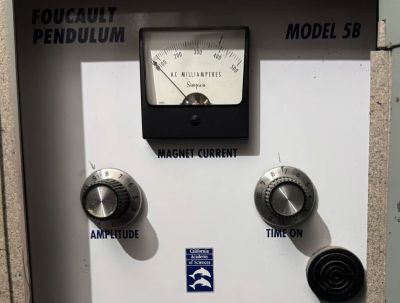
After the Foucault pendulum at the Houston Museum of Natural Science stopped working a while back after maintenance on the building, workers set out to determine what was wrong with the mechanism that normally keeps it in motion. Fortunately, it turned out that all they had to do was fiddle with some knobs to get everything dialed back in proper-like.

When we previously covered this dire event, it was claimed that this was a one-off system, hacked together by some random bloke. But as can be seen in the video and further detailed in the comments to the video the reality is far more interesting.

This particular Foucault pendulum is one of many that were created by the California Academy of Sciences, with hundreds of them installed throughout the US and possibly elsewhere. That said, since a pendulum of any description will never be a perpetual motion device, the electromagnet installed near the top of the installation has to carefully add some kinetic energy back that was lost due to friction as the pendulum moves around.

Advertisement

Sadly the video doesn’t go into much detail on what exactly was wrongly configured with this particular pendulum. Keeping a weight at the end of a long cable moving around at a set velocity is a tricky business, so it’s little wonder that getting some parameters wrong would engage and disengage the electromagnets at the wrong times and making the pendulum stop swinging.

Advertisement

Source link

Continue Reading

Tech

Coatue has a plan to buy up land for data centers, possibly for Anthropic

Published

on

Coatue, one of the biggest names in venture capital and hedge funds, has a new plan to generate bigger returns on AI beyond its sizable stakes in Anthropic, OpenAI, xAI, and data center companies like Singapore’s DayOne and CoreWeave.

It has launched a venture called Next Frontier to buy up land near large power sources with the goal of turning those parcels into data centers, the Wall Street Journal reports. Sources tell the WSJ that Next Frontier has already signed a joint venture with Fluidstack, a cloud infrastructure startup that penned a $50 billion deal to build data centers for Anthropic. (Coatue did not respond to a request for comment.)

Although the U.S. already has 3,000 data centers, more than 1,500 new ones are in various stages of being built, according to Pew Research, most of them in rural areas. The frenzy is enticing land speculation and data center financing projects from lots of players, ranging from Blackstone to Kevin O’Leary from “Shark Tank.”

.

Advertisement

Source link

Continue Reading

Tech

Meta buys robotics startup to bolster its humanoid AI ambitions

Published

on

Meta has acquired humanoid robotics startup Assured Robot Intelligence (ARI) for an undisclosed sum, the social media giant said.

“We acquired Assured Robot Intelligence, a company at the frontier of robotic intelligence designed to enable robots to understand, predict, and adapt to human behaviors in complex and dynamic environments,” a Meta spokesperson told TechCrunch in an emailed statement.

ARI’s team, including its co-founders, will join Meta’s AI unit, the Superintelligence Labs research division. ARI had raised an undisclosed seed round from AI seed firm AIX Ventures.

The startup was building foundation models for humanoid robots to perform all types of physical labor such as household chores. Co-founder Xiaolong Wang was previously a researcher at Nvidia, and an associate professor at UC San Diego, with a list of prestigious awards to his name. Co-founder Lerrel Pinto, who previously taught at NYU and co-founded the kid-size humanoid startup Fauna Robotics before Amazon snapped it up last month, has also won a string of prestigious awards.

Advertisement

ARI will help Meta with its humanoid ambitions. “This team, led by Lerrel Pinto and Xiaolong Wang, will bring a deep expertise in how we can design our models and frontier capabilities for robot control and self-learning to whole-body humanoid control.”

Meta researchers have been working on humanoid robotics tech for years. A leaked memo from a year ago discussed Meta’s ambitions to build such a robot, including AI models and hardware, aimed at consumers.

Even if Meta never releases a consumer humanoid product, many AI experts these days believe that the path to artificial general intelligence (AGI) — the theoretical point at which AI reaches or surpasses human-level intelligence across all domains — will require training AI models in the physical world, where robots learn through direct interaction rather than data alone.

Techcrunch event

Advertisement

San Francisco, CA
|
October 13-15, 2026

The ARI and Fauna deals reflect a broader industry sprint — one where forecasts vary wildly, from Goldman Sachs’ projection of $38 billion by 2035 to Morgan Stanley’s estimate of $5 trillion by 2050 — a spread that reflects both the enormous potential and the uncertainty around tech that’s still finding its footing.

Advertisement

When you purchase through links in our articles, we may earn a small commission. This doesn’t affect our editorial independence.

Source link

Continue Reading

Tech

No new Macs or iPads before September

Published

on

Apple’s earnings call revealed a few things that make it easy to see what products we can and can’t expect between now and September. The “not coming” list is much longer than the “is probably coming” one.

The Mac is supply-constrained, the iPad isn’t being updated, and iPhones don’t release again until the fall. So, there’s not much left that could arrive in the intervening months.

The Mac mini, Mac Studio, and iMac are all awaiting their M5 upgrades, but Apple’s supply chain is already backed up quite a bit. You can’t purchase an M4 Mac mini if you wanted to.

Memory prices and scarce parts could mean a longer-than-usual wait for new Macs. It’s pretty safe to say based on Tim Cook’s remarks during earnings that there won’t be any through the summer.

Advertisement

The iPad is a gimme because Apple said one isn’t coming without directly saying so. During the earnings call, Apple made it clear that it would be a tough compare since the iPad with A16 was released a year ago.

So if you’re holding your breath for that new budget iPad with A19 and Apple Intelligence, you’ll be waiting a little while longer.

We’ve already got iPhone 17e, so there won’t be any new iPhones until September. Also, Apple Watch won’t get touched until then either.

Close-up of two white iPhones with large rear cameras, wireless earbuds, and a silver smartwatch on a gray felt surface

iPhone, Apple Watch, and AirPods are done with updates for now

Advertisement

AirPods and AirPods Pro tend to be announced alongside iPhone too. AirPods Pro were just upgraded in September 2025, but if AirPods 5 are ready, those likely won’t be announced until the iPhone event.

Apple Vision Pro just got the M5 chip in October 2025 after about 20 months on the market, so that won’t be touched anytime soon. And no, that product line hasn’t been abandoned even if rumors attempted to say as much.

There is one product category Apple could touch upon due to its unpredictable release cycle.

Apple Home products are always possible

The Apple TV 4K is still rocking the A15 processor that first debuted in the iPhone 13 in 2021. It is still supported by Apple’s modern operating systems, but at nearly 5 years old, it’s time for an update.

Advertisement
Black HomePod on a shelf beside a white Wii and a row of vertically stacked video game cases in the background

It’s time for Apple to update the HomePods

Since Apple TV 4K is the brains of an Apple Home, it might make sense to make that product capable of Apple Intelligence. I know I’d appreciate the upgrade to my new smart home.

The HomePod and HomePod mini are both rocking Apple Watch processors — the S7 and S5 respectively. The S7 debuted in Apple Watch Series 7 in 2021, while the S5 was included in the Apple Watch Series 5 in 2019.

It might not be entirely relevant, but watchOS doesn’t even support the S5 chipset anymore. While HomePods run a version of tvOS, that does indicate exactly how old these chipsets are.

Advertisement

It might be time for Apple to do a basic chipset upgrade of the HomePod and HomePod mini. While they likely won’t support Apple Intelligence natively, it would do them good to have modern networking standards for use in Apple Home.

Those are the only Apple Home products Apple offers today, but there are some rumored products too.

Home Hub and cameras are unlikely

Apple is expected to debut what we’ve been calling the Home Hub tablet at some point in 2026. There are also Apple security cameras in the pipeline, or at least a doorbell, but that release window isn’t known.

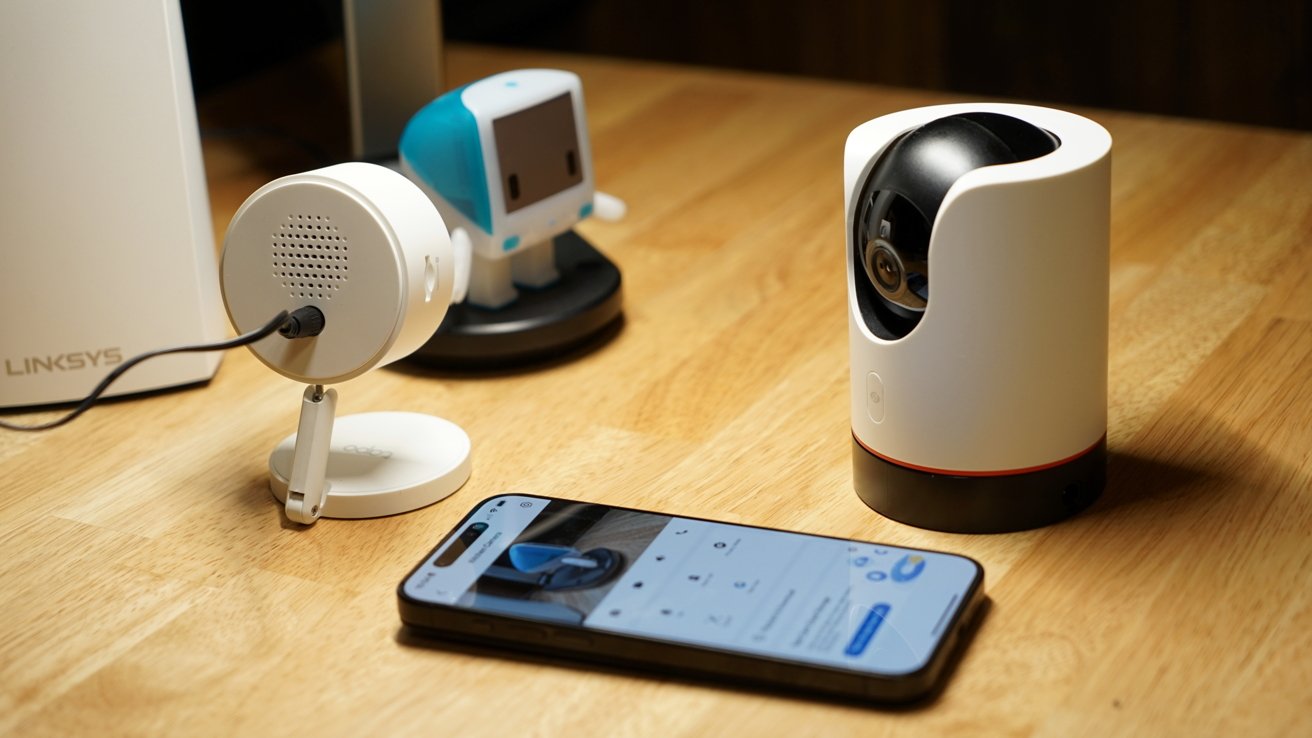
Smart home setup on wooden desk with two security cameras, a smartphone displaying a camera app, a small toy-like monitor figure, and a Linksys networking device in the background

Apple security cameras, doorbell, and Home Hub are all waiting on AI

Advertisement

WWDC 2026 is expected to be filled with announcements regarding Apple Intelligence. One of the biggest announcements will be about Siri and its new Apple Foundation Model backend.

That Siri upgrade is what the Home Hub has been waiting for. However, while Apple could show off the Home Hub during WWDC to demonstrate AI advancements, it is unlikely to put it for sale until later.

Since the Home Hub product and Apple doorbell don’t have an Apple-equivalent, the company can safely pre-announce them at any point. I believe WWDC would be the best place to demonstrate the Home Hub, but the already-packed event may not have room for it.

Likely nothing until the fall

Since Apple has a bundle of smart home products waiting in the wings, it is safe to assume there might be an Apple Home-focused event in the future. So, even if Apple TV and the HomePods are ready to go, Apple might hold off on them for now.

Advertisement

If you’ve been keeping count, that means we should all have little to no expectations for hardware before the iPhone event in September. While many are likely waiting for their pet product to get an update, they’ll just have to make do with WWDC instead.

The OS 27 cycle will be an important one for Apple. It will be among the first things released to the public under the new CEO John Ternus.

Source link

Advertisement
Continue Reading

Tech

Apple Vision Pro isn’t dead, Ternus talk, & AI rumors

Published

on

An odd rumor led to premature calls of Apple Vision Pro’s death, rumors of AI and Home Hubs abound, and Apple’s App Store troubles continue on the AppleInsider Podcast.

AppleInsider Managing Editor Mike Wuerthele joins host Wesley Hilliard as a guest this week to catch up on CEO transition news. It’s clear that the silly coverage surrounding the upcoming transition is already becoming exhausting.

The Apple vs Epic trial continues to be an ongoing event that seems to have no end. This time, Apple has to go to the Supreme Court and Circuit Courts at once.

Your hosts dive into the odd Apple Vision Pro rumor that said Apple had given up on the product. They discuss why this likely isn’t the case and how the Vision product line will continue forward.

Advertisement

There’s also a lot to discuss around incoming products like the Home Hub and security cameras. Wes asks Mike if Apple makes too many products.

The show concludes with a discussion around WWDC and Apple’s AI efforts.

BONUS: Subscribe via Patreon or Apple Podcasts to hear AppleInsider+, the extended edition. This week, Wes and Mike discuss their work at AppleInsider and some odds and ends surrounding that.

More AppleInsider podcasts

Tune in to our Smart Home Insider podcast covering the latest news, products, apps and everything HomeKit related. Subscribe in Apple Podcasts, Overcast, or just search for HomeKit Insider wherever you get your podcasts.

Advertisement

Podcast artwork from Basic Apple Guy. Download the free wallpaper pack here.

Those interested in sponsoring the show can reach out to us at: [email protected].

Subscribe to AppleInsider on:

Keep up with everything Apple in the weekly AppleInsider Podcast. Just say, “Hey, Siri,” to your HomePod mini and ask for these podcasts, and our latest HomeKit Insider episode too. If you want an ad-free main AppleInsider Podcast experience, you can support the AppleInsider podcast by subscribing for $5 per month through Apple’s Podcasts app, or via Patreon if you prefer any other podcast player.

Advertisement

Source link

Continue Reading

Tech

Resident Evil's next reboot leans into horror, not just action

Published

on


Resident Evil promises an all-new story that follows a medical courier called Bryan, who isn’t having a good night.
Read Entire Article
Source link

Continue Reading

Trending

Copyright © 2025