Connect with us

NewsBeat

‘Antisocial’ car park meets slammed as locals say ‘show a bit of respect’

Published

on

Cambridgeshire Live

Cambridge and South Cambridgeshire councils propose £1,000 fines after 22 incidents of dangerous driving and vehicle stunts

Cambridgeshire Live readers have shared strong views after reports of antisocial driving at park-and-ride sites across Cambridgeshire. Many want tougher action, while others say the problem will simply shift to other places if rules change in one spot.

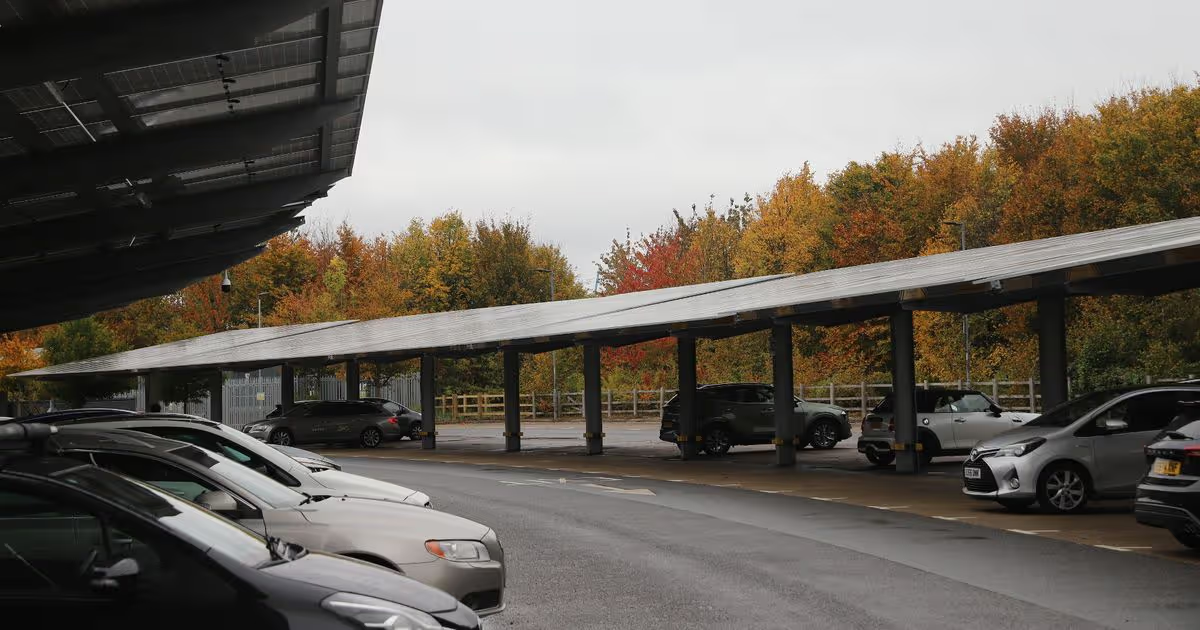
Antisocial driving at a park and ride site in Cambridge has made “people feel unsafe”, according to a councillor. A total of 22 separate incidents were recorded at Babraham Road Park and Ride between April 2024 and mid-January this year.

Advertisement

Babraham Road Park and Ride, situated between Cambridge and South Cambridgeshire, has seen persistent problems with inconsiderate and dangerous driving, alongside loud music, according to South Cambridgeshire District Council and Cambridge City Council.

Most of these incidents are reported to occur during evening hours or late at night, frequently continuing beyond midnight. Both councils say that additional gatherings are being organised, and that despite reports being submitted to police, vehicles often reappear after being dispersed.

The councils wish to introduce new measures to tackle the antisocial behaviour. They are proposing to implement a Public Space Protection Order (PSPO) covering the Babraham Park and Ride site.

Automatic Number Plate Recognition (ANPR) alongside existing CCTV would be used, enabling councils to monitor vehicles and issue fines without requiring a physical presence. The new measures would make it a criminal offence to do any of the following within the park and ride:

Advertisement
  • Speeding or reckless driving that risks causing harassment, alarm or distress.
  • Revving, racing and disruptive vehicle behaviour, including unnecessary acceleration, loud engine revving, horn misuse and amplified music causing nuisance.
  • Dangerous stunts such as drifting, doughnuts, burnouts, wheel spins, J‐turns or wheelies.
  • Organised meets or racing‐style activity, including entering the site for vehicle display or performance driving.
  • Threatening or abusive behaviour towards other Park and Ride users.

Should the PSPO be implemented, anyone breaking the rules could face prosecution and fines of up to £1,000 or receive a Fixed Penalty Notice of up to £500.

One reader, Freddly, comments: “The PSPO needs to allow the car or van to be taken off the driver. Let’s spare a thought also for much more ‘respectable’ antisocial driving. Recently a pedestrian was killed by a car in a local car-park. Why was anyone driving fast enough in a to do this in a car-park? Since lawless and careless driving around supermarkets has become so commonplace, these car-parks, like our streets, need speed tables that damage cars if taken at more than 10mph.”

Campete2 says: “The penalty seems a little light. Although I suspect that a criminal conviction would have more impact after the fact, the prospect of vehicle seizure might be more effective at prevention. The thing is to make sure this doesn’t just move the problem elsewhere. People can break laws faster than authorities can make them.”

Skipper says: “Given that it seems legal for Lycra enthusiasts to hold push bike meets and race through the streets of Cambridge – and even get roads closed – plus free push bike tracks, how about some levelling up? Let’s have a taxpayer-funded tarmac area where car drivers can go to enjoy themselves, instead of the unfair demonisation of the car.”

Over on our Facebook page, Adam Barton comments: “Hope this happens and happens soon. Don’t get me wrong, there’s nothing wrong with youngsters having fun. However, right next door to Babraham Park & Ride, you have the Arthur Rank Hospice, which houses some terminally ill patients. Please show a little bit of respect to these people and their families.”

Advertisement

Molly Raé Hill disagrees: “Barley [sic] antisocial when people are meeting to socialise and appreciate each others [sic] cars, never known one to last past midnight either.”

Marshall Mars says: “This measure will hurt good and bad enthusiasts alike. Not all drivers go there for anti-social behaviour. Unfortunately, there are some groups that go there and can’t behave, acting like hooligans, ruining it for everyone else. Most go there just to be away from housing complexes and just park up for a chat.”

Are car meets really that bad? Comment below or HERE to have your say.

Source link

Advertisement
Continue Reading
Click to comment

Leave a Reply

Your email address will not be published. Required fields are marked *

NewsBeat

Brits stranded in Dubai by Iran war – NHS doctor, ‘fight or flight mode’ and funeral plans

Published

on

Daily Mirror

Scores of Brits have been left trapped in Dubai on holiday, and have complained about receiving little or no assistance from authorities and insurers amid the US assault on Iran

Donald Trump’s ongoing assault on Iran has left scores of people stuck in neighbouring regions like Dubai, a Brit holiday hotspot, from which people have been unable to escape – all the while watching bombs fall.

Multiple families have revealed they are struggling to get back home after travelling to the sun-kissed city on holiday or to visit relatives, with fleeting contact from British authorities. The Foreign Commonwealth and Development Office warned in an alert over the weekend that only “all but essential travel” should be undertaken to the United Arab Emirates, and for people there to register their presence in the nation – more than 100,000 of whom have done so as they await evacuation.

That waiting has landed some people in dire straits as they are urgently required home for events like funerals, while others are finding the situation is not covered by their insurance.

Advertisement

READ MORE: Donald Trump boasts about $400m ballroom after paying tribute to US soldiers killed in IranREAD MORE: Iran wants bloody ‘war of attrition’ with Donald Trump after US makes key mistake

Ensure our latest headlines always appear at the top of your Google Search by making us a Preferred Source. Click here to activate or add us as your Preferred Source in your Google search settings.

Salli-J

Mum Salli-J said she has been left stranded in Dubai with her two sons and a friend, and has no idea when her group will be able to get home.

Advertisement

She said: “Me and my family are stuck over in Dubai. I’m here with my partner, two sons and friend not knowing when we can get home.” The mum added that they have received little help from authorities, and that their insurance provider has been unable to provide cover as the incident is “classed as terrorism or war”.

Claire and Chris

Claire, 42, and husband Chris, 47, are worried they will miss Claire’s mother’s funeral on Friday following military activity in the Middle East. Fiona died from motor neurone disease (MND) on February 7 and her daughter is desperate to get back to the UK to support her sister with funeral arrangements.

Claire, who did not want her surname to be published, said: “There are just the two of us and I hate the thought of her going through that on Friday without me.”

Advertisement

She cannot reschedule because other family members have already made travel and accommodation plans. She added: “I would feel really bad if we left mum at the funeral directors until I might be able to get home, because we just don’t know how long this may go on for.”

The couple, from Braunston, Northamptonshire, were staying at the Five Palm Hotel in Dubai on Saturday with their children Noah, 18, and Pippa, 17, when the missiles began appearing.

Claire said: “There were a couple of intercepted missiles overhead, very loud. We’re not used to dealing with this sort of thing, so it’s not a case of just being on holiday for a few more days. The local government has one of the most sophisticated defence systems in the world, so we are probably better off here than we would be in the UK if we started being attacked.”

Claire has spent around an additional £2,000 on flights for Wednesday and Thursday trying to get home for the funeral. The couple run The Wheatsheaf Inn, Braunston, and have cancelled events at the pub to help staff cope with their absence.

Advertisement

James and Rebecca

Meanwhile, James Gill, 31, a golf instructor, was staying in Business Bay, Dubai, celebrating his girlfriend Rebecca Crawford’s 28th birthday when the couple first heard explosions. Mr Gill, from Galashiels in the Scottish Borders, said: “I’ll be honest, I have hardly slept. I am in fight or flight mode.

“We have work to go back to, my girlfriend, she is an A&E nurse and she is supposed to be working on Sunday, she might have to cancel things. It is not a good situation.

“There is no word of what we should do in this situation. Very few people have found themselves stuck between a kind of war zone. I witnessed a missile getting shot out of the sky. It was pretty surreal to see. One of the nights we got an alert that said ‘incoming missiles, take shelter’, that was frightening.”

Advertisement

Back home, their families are “worried sick” and Mr Gill explained the next available flights he could find are around £5,000. Mr Gill said: “We are trying to get a flight back to anywhere at this point. We just want to get home where we feel safe. It is an absolute mess.”

Nick and Joanne

Nick Westwood, 62, a retired train driver from Barnham, West Sussex, and his wife Joanne, 61, a retired credit analyst, have been sleeping in the lobby of their high-rise rental.

The couple, who are in Dubai for a “bucket-list” holiday, had planned to leave on Sunday but have had to extend their seven-day stay, paying an extra 400 AED (£81) per night. Mr Westwood, whose 25th-floor accommodation is only available until Thursday, said: “It is very, very scary, very stressful and it’s just like being trapped in limbo.

Advertisement

“We have been sleeping down in the reception room of this building. We came back up to the room at 4am this morning and we got another four hours’ sleep.

“And as soon as we got up, there were more drone attacks straight over the building.” The couple have been told that rebooking their flights back to the UK will cost them £6,000. It is just a waiting game really. It is getting dark here again now and this is when the [missiles] usually start.”

Bea, who requested for her surname not to be published, was at a boat party on Saturday when she saw “white plumes of smoke” and heard “booming” noises. The 23-year-old from London is in Dubai to visit her brother and said the missile looked like “a very slow shooting star”. She added that her biggest concern is “escaping” the region.

Muhammad Irfan

Muhammad Irfan, an NHS doctor, was making his way back to the UK when the missiles launched at Dubai by Iran left him stuck. The 31-year-old was on a layover when he was supposed to catch a flight to London Stansted Airport. Muhammed arrived in the United Arab Emirates city on February 28 – the day the attacks started.

“I was in disbelief that conflict had spread to the Gulf including Dubai,” said the doctor, from Colchester, Essex. “I received a message from my brother in Pakistan advising me to stay safe as the US and Israel had attacked Iran and this conflict could escalate.”

“This news was absolutely shocking for me as I hadn’t read anything like a possible conflict in the news before taking my flight to Dubai. Before leaving Dubai airport for the hotel, I heard a loud boom. I later read in the news that Dubai airport took a hit, unfortunately.”

Around 2.30pm, Muhammed was informed that his flight was delayed before being cancelled. He has now been left stranded in Dubai and is staying in a hotel. The doctor is away from both his wife and child, who live in Ireland. Muhammed said: “We have kindly been evacuated by authorities to a hotel, which is our temporary accommodation. This was absolutely unbelievable for me. I always thought that this region would be safe from such conflicts.”

Advertisement

Ola Jaworska and Pawe Jaworski

Influencer couple Ola Jaworska and Pawe Jaworski were left stranded in Dubai after flying out on the day of the military campaign against Iran as they “don’t follow the news”.

The pair said they intend to cross into Oman and take a return flight home from there. They announced that they are expecting their second child three days ago. The celeb couple, who have 640,000 and 1.7m YouTube subscribers respectively, have been preoccupied with Ola’s pregnancy.

As a result, they have been busy creating content related to their family news. They flew to Dubai on Saturday (28 Feb), the same day Operation Epic Fury was launched against the Islamic Republic of Iran.

Advertisement

They said on Instagram that they “totally didn’t know” about the conflict. Ola, who has 388,000 Insta fans and Pawe , who has 546,000 Insta followers, confirmed that they are both safe, and are looking for options to leave Dubai. Ola and Pawe , better known online as Zukoll and Jawor respectively, said: “We totally didn’t know, we don’t follow the news, especially recently.

“It’s been quite intense for us. Our pages have mainly been pregnancy announcements. We didn’t know what was happening. We wouldn’t have come here if we knew the situation was so tense.”

The couple, who lives in the Polish port city of Gdynia, said they saw missiles falling from the sky followed by nearby explosions. “We’re hiding in low buildings with as few windows as possible and recommend others do the same,” they advised. “People are generally functioning normally, there are no alerts or alarms.

“Fragments fell when we were at the Marina. We have to wait for information, we can’t really do any more. Don’t go into tall buildings, don’t walk outside in open spaces, and most importantly don’t panic.”

Advertisement

They said they are currently looking for ways to leave Dubai. They were considering the option of crossing into Oman by land before taking a flight back to Poland from there. They have yet to provide any further information on their departure. Regional tensions have escalated after the US-Israeli strikes against Iran.

Elbi Henshaw

Elbi Henshaw, 24, was given the advice to stop her windows of 46th floor apartment from shattering during attacks from Iranian missiles.

Elbi, moved to Dubai in January 2025 due to “the crime rate” and “miserable weather” in the UK. But for the last few days, Elbi has had to shelter in her high rise flat as Iranian drones are shot down overhead. She has been struggling to sleep over fears that a drone or debris may hit her building and claims she would rather “sleep outside on the floor.”

Advertisement

Elbi was told to “Keep one window of your house slightly open so that if there is any pressure from outside it can balance instead of shattering.”

The personal trainer, from Barnet, North London, said: “I really struggled to sleep because I know we’re really high. “I’d rather be on the floor outside than be in a high-rise building. “We’ve been told to keep one window open so if anything hits the window, it can help relieve the pressure.

“During the day yesterday, the drones were being hit out the sky all day. “We can see all of downtown and business bay but people on the marina side have fled.

“Yesterday when I saw a drone being shot down – my heart dropped, I felt so sick. If there’s any building work going on, everyone thinks it’s a drone. Everyone’s so on edge and on their phones waiting for alerts.” The nightmare ordeal began two days ago when UAE residents received an alert telling them to shelter in place.

Advertisement

Elbi said: “It’s been so scary. Two nights ago, was the scariest night as we got an alarm at 12:30am. We were told to take shelter and stock up on essentials.

“We heard screaming and shouting outside our door. It was a family of eight running to the basement with mattresses and pillows. Were on the 46th floor so it’s very high and you can imagine the fear from everyone.” Despite her fear, Elbi says she feels “less lonely” in Dubai than the UK.

She added: “I actually feel less lonely that I did in the UK. There’s so many people checking up on you. It’s really nice seeing the community come together. But it’s very eerie and quiet. I’m a PT and a lot of clients cancelled today. It’s very high risk.”

Source link

Advertisement
Continue Reading

NewsBeat

Harry Styles’ first concert in three years to stream on Netflix this weekend

Published

on

Harry Styles’ first concert in three years to stream on Netflix this weekend

Harry Styles is making his highly anticipated stage return this Friday in Manchester, England, with a recording of the performance arriving on Netflix shortly thereafter.

In celebration of the release of his new album, Kiss All the Time. Disco, Occasionally, the British pop star, 32, will perform a special “One Night Only” concert — his first in nearly three years. It will see the former One Direction star perform all 12 tracks from the new album from start to finish, including its recently released lead single “Aperture,” which The Independent’s Roisin O’Connor described as “a house and dance-influenced track that yearns for adventure.”

Titled Harry Styles. One Night in Manchester, the concert film will be available to stream on Netflix on Sunday, March 8 at 7pm GMT/ 3pm ET/ 12pm PT.

Styles announced the special in an Instagram clip shared Monday. The clip shows Styles and his band practicing and tuning their instruments, before the “Watermelon Sugar” singer mimics Netflix’s signature “tudum” sound into a microphone.

Advertisement

Following his show in Manchester, Styles will embark on a global tour in support of his album, out this May.

'Harry Styles. One Night in Manchester' will stream Sunday on Netflix
‘Harry Styles. One Night in Manchester’ will stream Sunday on Netflix (Getty)

Styles is scheduled to bring his Together Together tour to seven global cities for multi-day residencies, totaling 50 shows.

Over the weekend, the Grammy-winning artist gave his first live performance of his latest era at the 2026 Brit Awards. Joined by a group of backup dancers, Styles performed his song “Aperature.”

His forthcoming album will mark the end of a two-year musical absence following his 2023 world tour.

“At the end of the tour, the idea of taking time out felt insane,” Styles admitted in a new interview. “I didn’t know if I could do it. But it was time for me to stop for a bit and pay some attention to other parts of my life.”

Advertisement

Source link

Continue Reading

NewsBeat

Chelsea FC injury update: Estevao, Marc Cucurella and Jamie Gittens latest return dates

Published

on

Chelsea FC injury update: Estevao, Marc Cucurella and Jamie Gittens latest return dates

Estevao remained out however, as did Marc Cucurella, Jamie Gittens, Levi Colwill and Dario Essugo. Here is all the latest Chelsea injury news and return dates amid a hectic fixture schedule in March that also includes the FA Cup clash with Wrexham, Premier League meetings with Newcastle and Everton, and a two-legged Champions League last-16 blockbuster against holders Paris Saint-Germain.

Source link

Continue Reading

NewsBeat

Oil and gas costs surge but some stocks defy war-focused sell-off | Money News

Published

on

Gas production facilities are seen in Qatar. Pic: iStock

Oil and gas prices have seen dramatic lifts as financial markets give their first reaction to the war in the Middle East.

Global stock markets were down across the board but some sectors, such as energy and defence, helped limit losses.

Brent crude oil rose by as much as 13% to $82 per barrel at the start of Asian trading. It later settled around the $79 mark.

That was despite confirmation from two major oil and gas-producing nations that output had been hit due to aerial attacks by Iran on their state-owned infrastructure.

Advertisement

Markets latest: Key developments as war grips Middle East

The world’s largest oil refinery in Saudi Arabia was shut down after it sustained damage.

Contracts for day-ahead natural gas delivery to the UK were up more than 30% early on Monday afternoon while those for April delivery spiked by more than 50%.

The rises were attributed to news that Qatar’s state-owned energy firm had suspended production of all liquified natural gas (LNG).

Advertisement
visualization

The country accounts for about 20% of global LNG supply, which is delivered by ship.

It means we face the prospect of bigger bills ahead, if the higher wholesale prices were to be sustained for an extended period of weeks.

It’s worth remembering however that no hikes to household bills could come until the beginning of July, for those on the price cap. That is because the cap level for April to June has already been set.


Qatar shuts down the world’s biggest gas terminal – here’s what it means for the UK

It would take many weeks of elevated prices to hurt the outlook for bills.

Advertisement

When it comes to oil, the RAC said average unleaded petrol costs, already tipped to rise by 1p a litre this week due to earlier market shifts, could go up by a further 2p at current wholesale oil price levels but added that it was far too early to call it.

Advertisement

Oil price ‘could surpass $100 per barrel’ if Strait of Hormuz faces long closure

Again, it would take many weeks of elevated prices to crystalise that prospect.

Stock market values have suffered globally, with the FTSE 100 in London plunging by 1.2% to close at 10,780.

Advertisement

Defence-facing stocks saw the biggest gains, with BAE Systems rising 6%. Energy firms also did well on the back of those higher wholesale prices though the chance of prolonged disruption to supplies limited increases later in the session.

Read more:
What are the risks for petrol prices?
Why the Strait of Hormuz is so important

Advertisement

Financial and travel-related shares suffered the most. The biggest faller was IAG, the parent firm of British Airways, down 5.5%.

It was a similar story on the continent where major indices saw larger falls that those witnessed in London. The DAX in Germany and CAC 40 in Paris were down by more than 2% as their trading sessions ended.

In the US, the broad S&P 500 was just 0.2% lower.

Stock markets, analysts said, were reflecting a flight-from risk, though precious metal miners benefited from a 2% rise in the price of ‘safe haven’ gold earlier in the day.

Advertisement

The dollar, Japanese yen and Swiss franc also saw support.

John Wyn Evans, head of market analysis at the investment manager Rathbones, said of the outlook: “Everything hinges on the Strait of Hormuz.”

This is the shipping lane off the Iranian coast which usually accounts for the passage of hundreds of ships per day – now largely empty of traffic as vessels are kept at anchor for their own safety amid the withdrawal of insurance policies.

“The longer it is closed, the worse the effects”, Mr Evans said of the strait. “For now, inventories and limited rerouting options provide some buffer, but the situation remains finely balanced.”

Advertisement

Source link

Continue Reading

NewsBeat

Why the UK’s trade deficit makes household bills so vulnerable to global shocks

Published

on

Why the UK’s trade deficit makes household bills so vulnerable to global shocks

The UK’s trade deficit of goods is the widest it has ever been. In 2025, the country spent £248.3 billion more on things than it sold to the rest of the world.

This is not just some abstract number, of interest only to markets and economists. The UK’s trade deficit has practical consequences which help to explain why global events show up so quickly in people’s food and energy bills.

Nor is this a new situation. While the UK runs a strong surplus in services such as finance and professional consulting, it consistently imports more goods than it exports.

On its own, that is not necessarily a problem. Many advanced economies run trade deficits of goods. The more important issue is what a country imports, and how essential those imports are to daily life.

Advertisement

For example, the UK relies heavily on imports for many things that households cannot easily live without, such as 40% of the food they consume.

It imports much of its energy too – and although the UK produces some domestic oil and gas, wholesale energy prices are strongly influenced by international markets.

Food and energy are not optional purchases. Households cannot simply stop eating or heating their homes when prices rise. Economists describe these goods as “inelastic”, meaning that demand does not tend to fall even when the price increases.

And this creates a direct link between global volatility and household vulnerability. When global supply chains are disrupted, whether it’s because of geopolitical tensions, extreme weather or commodity price spikes, any country which is dependent on imported essentials (Germany, Italy and Japan are other examples) feels the impact quickly.

Advertisement

The Bank of England has highlighted how global energy and food price shocks played a major role in the recent surge in UK inflation. International adjustments feed quickly into domestic cost-of-living pressures.

Currency changes

The UK’s trade deficits also mean it needs plenty of foreign currency to pay for all of the things it imports. When financial markets become volatile, the pound can weaken, increasing the cost of these imported goods – which leads to rising inflation.

For an economy that depends heavily on imported food, fuel and manufactured goods, currency movements can amplify inflationary pressure. Households may not follow exchange rate fluctuations, but they do notice higher supermarket prices and energy bills.

Not everything is in deficit, though. The UK runs a significant surplus in services, particularly in finance.

Advertisement

But this creates a disconnect between the UK’s overall national economic performance and household experience. While the export of services supports national income and employment, it does not directly reduce the prices people pay for imported food or energy.

This is why everyday price vulnerability can remain high even when overall trade figures appear manageable.

Also, import-driven price shocks do not affect all households equally. Lower-income households spend a larger share of their income on essentials such as food and energy. When prices rise, they have less flexibility to absorb the increase. Higher-income households may cut back elsewhere, but lower-income households often cannot.

When import costs rise, the financial strain is therefore more intense for those people with the least. The same global shock can be manageable for some households but seriously disruptive for others.

Advertisement
The UK is reliant on many imported goods.
Sunshine Seeds

Part of the reason for this general situation is that since the early 1990s, global trade policy has prioritised efficiency through trade liberalisation and manufacturing processes being spread across multiple countries.

Importing goods from the most competitive global suppliers reduced prices in stable periods. But efficiency often comes at the expense of resilience. When supply chains are disrupted, countries that rely heavily on imports for essential goods have fewer domestic buffers. Politicians may then struggle to stabilise prices because the source of volatility lies abroad.

Trade off

The result is something many households recognise. Events far away can rapidly translate into higher bills at home.

But the issue is not trade itself. International trade brings clear benefits, including lower prices, greater choice and access to global goods and services.

Advertisement

The question is whether the UK’s balance between efficiency and resilience leaves households overly exposed to volatility. Recent cost of living pressures have demonstrated how quickly global shocks can reach household budgets.

Trade policy is therefore not just about competitiveness or GDP growth. It is also about economic resilience – how well households are protected from forces beyond their control. But this does not mean reversing global trade or pursuing full self-sufficiency, which would be likely to increase costs.

Instead, the government should be working on the UK’s resilience through things like diversified supply chains and stronger strategic reserves. Clearer contingency planning for essential goods would reduce the UK’s vulnerability to global shocks.

While the UK’s trade deficit is often treated as an abstract macroeconomic statistic, for many households its consequences are felt in something far more tangible – grocery and energy bills.

Advertisement

Source link

Continue Reading

NewsBeat

FA want to trial ‘coach’s challenge’ in bid to reduce VAR delays

Published

on

Daily Mirror

VAR has long courted controversy since its introduction into the Premier League ahead of the 2019/20 season but the game’s lawmakers in England want a significant tweak to the technology

The FA are mulling over a ‘coach’s challenge’ in an effort to cut down on the number of VAR delays. The technology has been used in the Premier League since 2019/20.

Advertisement

But rather than reduce the amount of controversial refereeing decisions, complaints have only grown, with some believing that VAR has not managed to cut out mistakes from officials. Others have been left irritated at the lengthy stoppages that the technology has caused.

One route that the FA could go down to reduce that is by using a technique such as a coach’s challenge. That would see a similar system to cricket being implemented where coaches would have two unsuccessful appeals to use per game, a successful overturn would see be an appeal be retained.

VAR and other technology would be used for factual decisions such as offsides but for subjective decisions, coaches would have a chance to make a VAR review. The International FA Board (Ifab) is set to hold a two-year review of VAR and the FA will push for a trial scheme.

MAKE THE MIRROR YOUR FIRST CHOICE! Click here to activate or add us as Preferred Source in your Google search settings

Advertisement

READ MORE: Arsene Wenger’s radical offside rule change takes next step despite UEFA rejectionREAD MORE: Chelsea handed clear VAR verdict vs Arsenal as Premier League told mistake made

Chief executive of the FA, Mark Bullingham, said after Ifab’s annual meeting: “The other interesting area is looking at what can we learn from other trials being done? So [FVS] and where you have a model where referees are refereeing the game but then the coach has a challenge system.

“What can we learn from that? Are there elements of that we should consider adopting for the future? Because that changes the dynamic, that reduces the amount of times when there is a VAR intervention and effectively puts the onus on the coach.

“I think that’s just something which we might continue to learn as we trial that model in the parts of the game that fundamentally can’t afford full VAR at the moment — but that doesn’t mean it’s necessarily the wrong model for the future.”

Advertisement

JOIN US ON FACEBOOK! Latest news, analysis and much more on Mirror Football’s Facebook page

He added: “There is a review going on looking at how we use VAR best and that balance between getting the big decisions right and not slowing the game down.”

And while the FA would be big advocates of the system, former referee David Elleray would not agree. Speaking about the introduction of challenges, the now Ifab technical director said: “There’s no reason to have challenges with VAR because the video match officials check every single incident. It is mainly designed for competitions where you’ve only got one, two, three or maximum four cameras.”

Advertisement

Join our new WhatsApp community and receive your daily dose of Mirror Football content. We also treat our community members to special offers, promotions, and adverts from us – and our partners. If you don’t like our community, you can check out any time you like. If you’re curious, you can read our Privacy Notice.

Content cannot be displayed without consent

Source link

Continue Reading

NewsBeat

Gas prices rocket as Qatar halts production after Iranian attacks

Published

on

Gas prices rocket as Qatar halts production after Iranian attacks

Gas prices have leapt at the fastest pace since the outbreak of war in Ukraine, after Qatar halted production of liquified natural gas after attacks by Iran.

Oil prices also soared and global financial markets reeled from the fallout of an intensifying conflict between Iran and US-Israeli forces.

European whole gas prices soared by 52% on Monday, marking the sharpest rise since prices were pushed dramatically higher by the Russian invasion of Ukraine in March 2022.

The surge came after Qatar’s state-backed energy company QatarEnergy said it “ceased production” because of attacks on its facilities.

Advertisement

Qatari ministers had said earlier on Monday that an Iranian drone had attacked one of the company’s production facilities.

Qatar is a major producer of LNG, cooled gas which can be transported via ships, responsible for about a fifth of global supplies.

On Monday in London, the price of natural gas for delivery in April was up by about 43% to 115p per therm.

In the UK, gas prices are a key driver for the cost of domestic energy bills, indicating that a sustained spike could affect households in the coming months.

Advertisement

Neil Wilson, Saxo UK investor strategist, said: “Qatar is a top three LNG exporter, controlling roughly a quarter of expected supply over the next decade.

“Looks like Iran’s tactic is to pressure Gulf states so they in turn pressure the US and Israel to back off.

“I am much more concerned about European natural gas prices than oil prices, in terms of seeing a repeat of the 2022 European energy crisis.”

Global financial markets faltered after intense strikes across the Middle East and attacks on ships drove fears of energy supply disruption.

Advertisement

London’s FTSE 100 was weaker as trading was knocked by the growing conflict between Iran and US-Israeli forces.

The blue chip share index shed 130 points, closing 1.2% lower at 10,780.11.

Other European indexes suffered bigger drops with France’s Cac 40 down about 2.2% and Germany’s Dax tumbling 2.4% on Monday.

But it was a more tentative start to trading over on Wall Street with the S&P 500 relatively flat, and Dow Jones dipping by about 0.1% by the time European markets had closed.

Advertisement

Israel launched strikes on Lebanon’s capital Beirut on Monday after missiles were fired by militant group Hezbollah.

The latest strikes came after the US and Israel hit targets across Iran on Sunday as part of an intensifying military campaign which followed the killing of Supreme Leader Ayatollah Ali Khamenei.

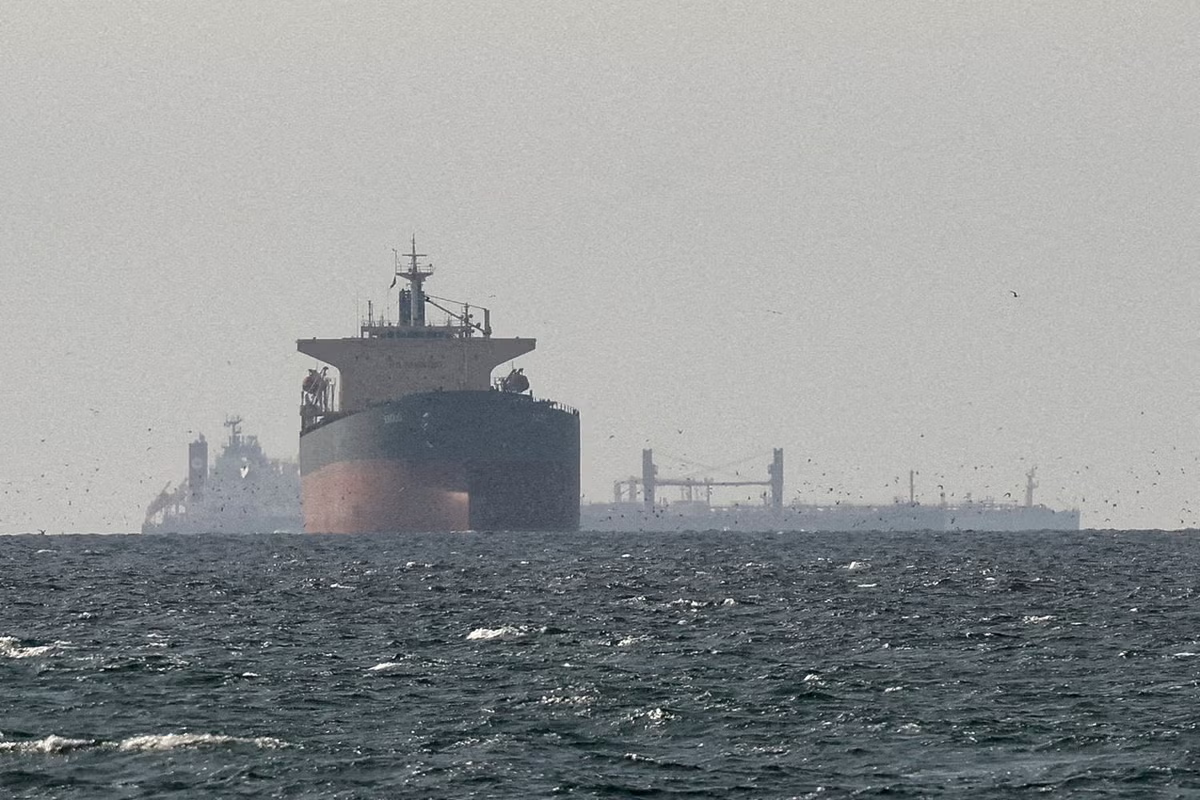
Oil supplies could be affected by the conflict after Iran reportedly warned tankers on the strait of Hormuz that no ships would be allowed to pass through.

UK Maritime Trade Operations Centre officials said that two vessels have been struck near to the key trade artery.

Advertisement

The Strait of Hormuz is used by tankers carrying about one fifth of the world’s oil supplies and seaborne gas.

On Monday, the price of Brent crude oil soared by as much as 13%, rising above 82 dollars a barrel, before paring back.

It was 8.4% higher at 79.2 dollars a barrel shortly before 2pm, before easing slightly to be 5.5% higher at 76.9 dollars a barrel by early evening.

Nevertheless, City analysts have said the markets have been relatively contained so far in reaction to the conflict.

Advertisement

Chris Beauchamp, chief market analyst at IG, said: “While we have seen a significant surge in oil prices since markets opened last night, the gains appear contained for now as we wait to see if shipping through Hormuz can continue at lower levels or will be blocked entirely.

“Oil and gas infrastructure in the region has not yet been extensively targeted, keeping oil well south of the 100 dollar barrel range that many expected as a result of the weekend.”

Meanwhile, the pound dipped in value against the US dollar to its weakest level since December.

The fall is partly linked to the strength of the dollar, with investors pouring funds into the US “safe haven” currency.

Advertisement

The pound was down about 0.8% at 1.338 versus the dollar during the day, before parring back some losses to be down around 0.3% at 1.34 against the dollar by early evening.

London stocks were broadly weaker, with travel stocks among those dropping particularly sharply.

Cruise giant Carnival slid by 8%, while airline firm IAG, the parent firm of British Airways, dipped by 7.6%.

Rival Wizz Air, which typically runs flights to Dubai and Abu Dhabi, was also down 7.3% in early trading on Monday, while travel-focused retail groups SSP and WH Smith were also firmly lower.

Advertisement

However, defence stocks were among the gainers, with BAE Systems lifting by 7.4% to 2,268p.

Elsewhere, oil and energy stocks were also stronger – Shell and BP rose by 4.5% and 3.5% respectively as prices lift.

International stock markets also opened weaker after the start of trading, with the Nikkei 225 in Tokyo falling by 1.5% after Asian markets opened.

Source link

Advertisement
Continue Reading

NewsBeat

‘America voted for no new wars – now Trump’s sending troops to die in Iran’

Published

on

Daily Mirror

Trump promised “no new wars” but has plunged America into conflict with Iran, leaving even his own MAGA base accusing him of betraying the very pledge that returned him to power

Donald Trump did not just campaign against war – he weaponised the promise of peace to recapture the power he craves.

He rode back into the White House on a vow that he alone would end America’s addiction to regime change and pointless foreign entanglements. No more reckless invasions. No more flag-draped coffins returning from deserts most Americans could not point to on a map. No more sacrificing working-class sons and daughters to the foreign policy vanity projects of Washington elites. For millions of MAGA voters, that pledge was not incidental. It was foundational.

In 2016, Trump relished breaking with Republican orthodoxy, declaring that “regime change is a proven, absolute failure.” He pledged to “stop racing to topple foreign regimes,” drawing a clear line between himself and the architects of Iraq and Libya. It was a rebuke to the conservative consensus and a direct appeal to voters exhausted by two decades of blood and service lost in the Middle East.

Advertisement

Ensure our latest headlines always appear at the top of your Google Search by making us a Preferred Source. Click here to activate or add us as your Preferred Source in your Google search settings.

READ MORE: US refuses to rule out boots on the ground in Iran as FOURTH American soldier diesREAD MORE: Trump’s war claims in question as Pentagon says Iran DIDN’T pose an imminent threat

Carlson is no fringe dissenter. He campaigned for Trump, spoke at rallies, and addressed the 2024 Republican National Convention. He is closely aligned with Vice President JD Vance and has long championed Trump’s supposed restraint abroad. He reportedly met the president last week to urge him not to strike Iran. His public break signals something deeper than disagreement.

Former congresswoman Marjorie Taylor Greene, once among Trump’s fiercest attack dogs, has also turned her fire on him. “Thousands and thousands of Americans from my generation have been killed and injured in never-ending, pointless foreign wars, and we said no more. But we are freeing the Iranian people. Please,” she wrote. “There are 93 million people in Iran; let them liberate themselves. But Iran is on the verge of having nuclear weapons. Yeah, sure.”

On social media, critics have resurrected Trump’s own words from the Obama years. In September 2013, he posted: “Remember what I previously said, Obama will someday attack Iran in order to show how tough he is.” Two months later: “Obama will attack Iran because of his inability to negotiate properly-not skilled.” It came after in 2011 he declared: “Our president will start a war with Iran because he has absolutely no ability to negotiate.”

Those posts now read less like prophecy and more like self-indictment.

Advertisement

Barack Obama, for all the controversy surrounding his nuclear deal, never attacked Iran. Trump has now done so repeatedly, after tearing up that agreement and failing to negotiate a replacement. The accusation he once hurled at Obama – that war would mask diplomatic failure – now hangs over his own presidency.

Trump’s political genius was identifying that Republican voters were tired of endless war. His political gamble now is that they will swallow another one.

As American blood is shed and the rhetoric of “no new wars” collides with the reality of fresh graves, the question echoing through parts of MAGA is not whispered; it is shouted: Was the promise ever real, or was it just another lie to get their vote?

Advertisement

Source link

Continue Reading

NewsBeat

How to talk to children about what’s happening in the Middle East

Published

on

How to talk to children about what's happening in the Middle East
Children will likely have questions and be more aware than you realise (Picture: Getty Images)

As the crisis in the Middle East escalates, so do anxieties around the situation.

The US and Israel have launched airstrikes in Iran, and the conflict is spilling over into neighbouring countries, with missiles fired at a British airbase in Cyprus.

For those caught up in the violence and attacks, it’s unimaginable – and for those looking on from afar, the feelings of fear and helplessness can be overwhelming.

For children, who have less of an idea of what is going on, this can be even more terrifying.

Advertisement

Hearing words like ‘bombing’ and ‘World War Three’ without a full understanding of what’s going on is worrying for us all, and it doesn’t escape our little ones.

Mother comforts her crying daughter in a bedroom, sharing a tender hug and emotional support
The news can be terrifying for little ones (Picture Getty Images)

‘Children are like sponges; they’re absorbing everything,’ explains hypnotherapist, psychotherapist and mentor, Tania Taylor.

‘Whether it’s on the news, someone talking to the shop checkout lady, parents chatting in the playground, or a TikTok video, much of what they are hearing, especially once at school, is out of your control.

‘And sometimes, external factors (for example, Kevin in the playground telling everyone that World War Three is starting and we’re all going to die) can provoke more of a fear response.’

Even very young children may be more aware of what war is than we might even realise.

Advertisement

‘Many children have been exposed to adults or older siblings playing war-type computer games or watching YouTube influencers play such games on their own or a friend’s mobile phone or tablet,’ Tania says.

‘So, words like “bombing” may not be as unfamiliar to our children as we might assume.’

Therefore, it’s worth considering your language around younger children. 

But how is best to explain what’s going on to the children in your life? And how can you go about reassuring any anxieties (while also managing your own)?

Advertisement
Boy using smartphone with headphones
Kids might be familiar with words like ‘war’ and ‘bombing’ because of video games and social media (Picture: Getty Images)

How to approach the subject

As parents and carers, we can feel like what we should be doing is giving them all of the facts and keeping them informed. But this approach can sometimes leave children feeling overwhelmed, Tania explains.

‘Children tend to be really good at spontaneous questioning. If they want to know something, they’ll ask,’ she says.

But if they do ask, or you feel that they need some explanation or reassurance, it’s important to think about how you’re feeling first.

Tania recommends: ‘First of all, you need to consider your own state of mind in relation to what is going on and how much information you would personally like to give your child.

‘This is important as even if you are led by your child’s questioning, you begin with at least some self-awareness of how you are feeling and where you want to go with it. 

Advertisement

‘If you are particularly anxious about it all, it may be that you choose to wait until a time when you’re feeling less anxious to talk about it. Or perhaps having a discussion with another important adult in your child’s life, who can talk to your child instead, like a teacher or grandparent.’ 

Tania suggests that you may want to start with a non-specific question, like ‘have you learned about wars at school?’, and then listen to your child’s response.

‘What you’re doing here is enabling your child an opportunity to talk about something which they may not realise they can talk about,’ she notes.

‘If your child isn’t interested, they’ll tell you so, and there’s no need to push the conversation. If they go on to hear something at school, they’ll know you know about it, and be more likely to approach you with any questions.’

Advertisement

It’s always a good idea to let children know that, if they have any questions, they can ask you.

Father and son having serious conversation in bedroom
Let children ask you questions (Picture: Getty Images)

What can parents do and say to explain but not frighten?

Talking about the distance between the UK and ongoing events can be helpful, suggests Tania.

‘As much as we don’t want to normalise war, it is something that has been happening at varying points across the globe for the whole of your child’s life,’ she explains.

‘Knowing this can help to reassure your child that the chance they will be directly impacted is quite minimal.

‘Although they may want to talk to you about the people who are directly impacted. Keep language age-appropriate and be led by your child.

Advertisement

‘Taking action, such as getting in touch with a charity organisation that may accept shoebox-type gifts, is a really good way of showing your child that although this is happening far away, there are still small actions we can take to give our support.’

Active listening

Tania also recommends a technique called ‘active listening’, which you can use if your child is interested and wants to know more.

‘What you are doing here is paying full attention to your child during the whole conversation, ignoring distractions, and putting all your focus on listening to your child’s words,’ she tells us.

‘Listen to what they’re asking, and don’t give more information than they are asking for. We humans have a habit of oversharing, which is a situation when that’s not necessarily helpful.’

Advertisement

And if you don’t know all the answers to their questions, don’t be afraid to say you don’t know.

Tania adds: ‘Perhaps you can spend time searching for information together, or maybe you feel more comfortable saying you’ll find out and let them know later on.’

How to talk to kids of different age groups

News like this can be scary to children if not handled in the right way, and it will be different for different ages, explains Kirsty Ketley, a qualified early years and parenting consultant.

‘There is no ‘one way’ approach, as all children are different, but it is important that the subject is treated with sensitivity and understanding of what children need to know, weighed against what they are hearing from other sources,’ she tells us.

Advertisement

‘Children of all ages will also feel more worried when they think that no one is willing to talk about things that are worrying to them – they will think that it is too scary or upsetting to talk about, which then adds to their worries.’

Under seven

‘I think it is unlikely for this age group to properly pick up on what is going on,’ says Kirsty.

‘But, if they do overhear your conversations or see the news and ask questions, it is important to make sure they know they are safe and that what is happening is not in our country – perhaps showing them on a map or globe, so they can grasp the distance.

Advertisement

‘Kids of this age don’t need to be burdened with news that they are unable to understand, so if they don’t mention it, don’t bring it up. Let them be blissfully unaware.’

Jacqui O’Connell is a Youth Leader and Co-founder of the charity Spiritus, supporting homeschooled children in West London.

She says: ‘For younger children, we recommend reading a book about general worries and how to deal with them, such as Scared and Worried by psychiatrist James J Crist, PhD. You can then apply this to their worries about the situation with Ukraine and Russia.

‘Age-appropriate books on worries can help us discuss concerns and support children without too much detail.’

Advertisement

Tweens (between eight and 12)

‘Tweens are at an impressionable age and are more aware of the world around them,’ says Kirsty.

‘They will have learned about war and conflict in history lessons at school, and so they will have preconceived ideas of what it is all about.

She recommends watching something like Newsround, aimed towards 6-12-year-olds, which explains things in an appropriate way. ‘If you are worried about how to go about things, watch it with your child and then have a discussion about what you have watched.’

Advertisement

Another key to talking to children between the ages of 7-12 yrs is also how we question them.

‘Keep it positive,’ says educational expert and founder of KidCoachApp Kavin Wadhar.

‘Don’t ask why they are worried. Children often struggle to understand their emotions, which can lead to further anxiety. Instead, ask them questions to help them work out solutions to their worries.’

‘It is also crucial for parents to be aware of how they discuss the situation in the Middle East with other adults around children or in earshot.

Advertisement

‘Children are susceptible to how parents respond to issues, which can have a massive impact on a child’s anxieties. Studies have shown that children from as young as one to two years old will mimic parents’ behaviour.’

Teens (12 and above)

Kirsty suggests asking them what they already know and giving them lots of reassurance if they are worried.

‘Let them know that you are there to talk through things,’ she says.

Advertisement

‘I think it is important that they know that what they are seeing on social media won’t all be accurate and suggest that they watch the news or read reliable news sources online, instead.’

For teenagers, it is important to research the issues, look at the history of wars, and discuss why we have wars,’ support worker and joint founder of Spiritus, Gemma Eni Cherish, says.

‘We have had group discussions to give everyone a chance to share their point of view after exploring what is happening and why, which helps ease their concerns.

‘It also helps support children in finding their confidence as we suggest they develop ways to deal with anxieties. They build trust and confidence by sharing, and we all learn how to support each other.’

Advertisement

Do you have a story to share?

Get in touch by emailing MetroLifestyleTeam@Metro.co.uk.

Advertisement

Source link

Continue Reading

NewsBeat

Snooker hall and cafe plans for listed Bolton mill building

Published

on

Manchester Evening News

Plans show 14 tables would be installed at the historic Grecian mills complex

Part of a listed textile mill in Bolton is set to be converted in a snooker hall.

Advertisement

Plans published within the past week seek to transform Catherine House on Lever Street. The building forms part of the Grade II listed Grecian mills complex, south of Bolton town centre.

Floor plans published as part of the planning application show 14 full size snooker tables would be installed in the building over two floors.

Click here to prioritise Manchester news in Google from the MEN

A planning statement in support of the plans on behalf of applicant Yasar Wasim has been published on the council’s planning portal.

Advertisement

It said: “The proposal seeks change of use and works to facilitate a snooker club as the primary and predominant use across both the ground and first floors.

“A small café and kitchen facility is included at ground-floor level solely as an ancillary refreshment offer for patrons of the snooker club.”

Catherine House is a two-storey red brick building with a slate roof, fronting Lever Street. It is currently vacant.

Advertisement

The only external alteration within the plans is the installation of an extractor fan on the rear ground floor to serve the proposed kitchen.

The planning statement said that the council had advised that, in principle, a snooker hall and café may be capable of justification given the mixed-use nature of Grecian Mills, but identified key requirements to be addressed through supporting information.

The statement, adds: “In economic terms, the proposal will re-activate a redundant building, support business investment and create employment.

“In social terms, will provide an indoor recreation facility which, by its nature, supports social interaction and contributes to a ‘strong, vibrant and healthy’ community function.”

Advertisement

The Grecian mill complex of which Catherine House is a part is Grade II Listed and was formerly a cotton spinning and doubling works. The main spinning mill dates back to 1845 with other buildings dated 1850s-60s.

Catherine House is noted for its heavy Italianate detailing.

A heritage report, supporting the application, said: “As part of a large mill complex, the building provides evidence of the rise of industry in Bolton through the mid to late 19th century, and along with the remainder of the complex serves as a reminder to the historic industry, which was responsible for much of the growth of the area.

“In essence the key drivers of the building’s significance will be conserved, change being of a very low level and directed to areas of lower significance.”

Advertisement

Planners in Bolton will consider the application in th coming weeks.

Source link

Continue Reading

Trending

Copyright © 2025