Connect with us
DAPA Banner
DAPA Coin
DAPA
COIN PAYMENT ASSET
PRIVACY · BLOCKDAG · HOMOMORPHIC ENCRYPTION · RUST
ElGamal Encrypted MINE DAPA
🚫 GENESIS SOLD OUT
DAPAPAY COMING

NewsBeat

‘Apocalyptic’ fire bears down on Bordeaux: Inferno so big it generates its own thunderstorms threatens entire city with 38C heat set to fan the flames

Published

on

Bordeaux Council is considering a total evacuation of the city where more than 270,000 people live. So far, over 300,000 residents have been evacuated between France and Spain

An ‘apocalyptic’ wildfire bearing down on Bordeaux is so big it is generating its own thunderstorms, with 38C heat threatening to fan the flames of the terrifying blaze.

More than 325,000 people have fled the region, in southern France, as the inferno burns down forests and destroys villages. 

Firefighters are struggling to contain the flames, which stretch kilometres, leading volunteers, including local farmers, to help all they can. 

Convoys of tractors were spotted driving through towns on Sunday towing huge water tankers in an effort to reinforce the fire crews heroically battling the blaze, injuring 75 and killing two. 

Advertisement

One farmer was pictured wearing personal protective equipment as prepared to drive into the inferno to reinforce crews with water. 

Some 2,500 firefighters, 1,500 military personnel and around 1,200 police have been deployed to the Gironde region. 

It ranks among one of the worst fires to hit France in peacetime down on Bordeaux: Inferno so big it generates its own thunderstorms threatens entire city as Italy and Spain also continue attempts to suppress their own terrifying infernos. 

The Bordeaux blaze has caused an unprecedented ‘pyrocumulonimbus’ – a gigantic fire cloud that creates its own winds and packs lightning that causes more fires.

Advertisement

Bordeaux Council is considering a total evacuation of the city where more than 270,000 people live. So far, over 300,000 residents have been evacuated between France and Spain

Burning forest near the town of Lege-Cap-Ferret, southwestern France yesterday

Burning forest near the town of Lege-Cap-Ferret, southwestern France yesterday

Firefighters in Lege-Cap-Ferret, where 2,000 military personnel have been deployed to aid emergency services in an unprecedented situation in France

Firefighters in Lege-Cap-Ferret, where 2,000 military personnel have been deployed to aid emergency services in an unprecedented situation in France

Advertisement

But despite the efforts of emergency services, who have been battling the fire for days now, 38C temperatures threaten to spread the flames.

Advertisement

Eric Brocardi, of the National Firefighters Federation of France (FNSPF), said: ‘It’s a David-versus-Goliath scenario… at some point, we’ll find a weak spot and strike there.’

It comes as France enters its fourth heatwave this summer, spreading panic as wildfires across the country destroy thousands of tonnes of crops – leading to fears of vegetable shortages on supermarket shelves.  

French president Emmanuel Macron has called a Monday morning crisis meeting with his cabinet to discuss the emergency. 

Scientists say climate change is making such extreme weather events more frequent and intense.

Advertisement

Coming at the height of the summer holiday season, the fires were fuelled by woodland parched to tinder by successive heatwaves and lack of rain since May.

The prefect of the southwestern Gironde region where the country’s fires are concentrated urged tourists to stay away and seek ‘alternative destinations’.

Residents are desperately doing what they can to prevent the spread of the fire to their homes – armed only with their hosepipes. 

Local man Georges Clivaz sprayed water along a road leading to his property in Saint-Jean-d’Illac as the blaze burned a few kilometres away.

Advertisement

He said: ‘We’re doing this to slow down the fire’s advance; we want to save our homes.’ 

Although the village was evacuated on Friday, Mr Clivaz said he and his family were trying to hold out.

‘But,’ he said, ‘the firefighters are telling us that in two or three hours the fire will be here.’ 

Interior minister Laurent Nunez warned that ‘the situation remains very unfavourable’ across France, where more than 250,000 people had been evacuated.

Advertisement

The main fire in Gironde, home to Bordeaux, was ‘extremely intense and unpredictable… generating its own winds and advancing erratically toward the Bordeaux metropolitan area’, said Mr Nunez. 

Since Wednesday, the fire in the Gironde region has injured 75 firefighters, ten of whom have been evacuated, according to the latest situation report published on Sunday by the prefecture.

It comes amid claims from the leader of France’s CFDT union, Sebastien Bouvier, that firefighters are not adequately equipped to protect themselves from the fire’s toxic fumes.

A farmer in Bordeaux is pictured kitting up into his firefighter gear and joining efforts to suppress the wildfire flames

A farmer in Bordeaux is pictured kitting up into his firefighter gear and joining efforts to suppress the wildfire flames

Advertisement
Footage posted on social media has shown a convoy of tractors reinforcing fire crews

Footage posted on social media has shown a convoy of tractors reinforcing fire crews

The tractors were carrying huge water tankers to reinforce fire crews on the frontline of the blaze

The tractors were carrying huge water tankers to reinforce fire crews on the frontline of the blaze

Smoke from nearby wilfires has covered the skyline of the city of Bordeaux

Smoke from nearby wilfires has covered the skyline of the city of Bordeaux 

The closed A63 highway near Cestas, southern of Bordeaux, on Sunday as a wildfire ravages the forest north of the Arcachon Basin (Gironde)

The closed A63 highway near Cestas, southern of Bordeaux, on Sunday as a wildfire ravages the forest north of the Arcachon Basin (Gironde)

Advertisement
People gather at an exhibition centre being used for people displaced by the wildfires, in Bordeaux

People gather at an exhibition centre being used for people displaced by the wildfires, in Bordeaux

Thousands of people evacuated from their homes rest at the Bordeaux Exhibition Centre, which has been converted into a temporary emergency shelter

Thousands of people evacuated from their homes rest at the Bordeaux Exhibition Centre, which has been converted into a temporary emergency shelter

Bordeaux is facing the evacuation of more than 270,000 residents amid 'apocalyptic' wildfires

Bordeaux is facing the evacuation of more than 270,000 residents amid ‘apocalyptic’ wildfires

More than 2,500 firefighters are battling a 20km-wide front of flames that is spreading towards Bordeaux in southwestern France

More than 2,500 firefighters are battling a 20km-wide front of flames that is spreading towards Bordeaux in southwestern France

Advertisement

Join the discussion

Advertisement

Are governments doing enough to protect people and nature from these devastating wildfires?

Meanwhile, Sebastien Berge, head of the Gironde firefighters union, said: ‘The firefighters are overwhelmed. 

‘When there’s a fire of this magnitude, it creates its own weather pattern… it’s difficult to monitor – especially when there’s a fire front that stretches for more than 20km.

‘When you see how far it’s spreading, I think we can now be concerned about the city of Bordeaux.’

Advertisement

Firefighters have become ‘overwhelmed’ and are ‘concerned’ about Bordeaux as they fight back the fires spreading out of control in southwestern France. 

Weather forecasters warn another heatwave could hit France from Tuesday, with temperatures reaching 40C in some areas.

At least 240 homes have been destroyed in Gironde region, many of them in village of Le Porge.

But the mayor of Bordeaux, Thomas Cazenave, said there were no plans to evacuate the city’s urban area, home to 850,000 people and sheltering thousands displaced by the fires. 

Advertisement

He warned on Sunday that the fire ‘is now at the city’s gates’ and said the authorities remained ‘very vigilant’ and ‘ready for anything’.

Mr Cazenave told reporters at a shelter for people displaced by the wildfires that the blaze is further south.

‘It is still on the edge of the metropolitan area, but it is not advancing on the western side of the metropolis,’ he said. 

The French defence ministry said it has taken special steps to protect industrial sites around the city, a key centre of its aerospace industry.

Advertisement

The main motorway south of Bordeaux and rail services have been cut. 

As the flames edged closer to city’s borders on Sunday, Bordeaux’s world-famous vineyards, that define the region’s identity, are also now under threat of destruction.

At Château Haut-Bacalan, the western-most vineyard in Bordeaux, owner Charles-Henri Gonet said the blaze is now just 10km (six miles) from his estate, which lies surrounded by dense pine forests in the direct path of the inferno.

After friends in nearby Saint-Jean-d’Illac were forced to flee their homes, Mr Gonet, 63, is waiting for the emergency SMS alert telling him to evacuate.

Advertisement

His 18th-century château, where he has lived since 1998 with his co-owner wife, Corinne, sits on an eight-hectare estate producing around 20,000 bottles of Merlot, Cabernet Sauvignon and Sauvignon Blanc each year, with wines exported around the world.

Charles-Henri Gonet, 63, runs the Château Haut-Bacalan vineyard with his wife, Corinne, which is just 10km (six miles) from the wildfire

Charles-Henri Gonet, 63, runs the Château Haut-Bacalan vineyard with his wife, Corinne, which is just 10km (six miles) from the wildfire 

Mr Gonet is yet to be evacuated but is waiting for the SMS alert to vacate, having friends nearby already forced to flee their homes

Mr Gonet is yet to be evacuated but is waiting for the SMS alert to vacate, having friends nearby already forced to flee their homes 

The remnants of a burned-out home and cars following a devastating wildfire in Pelayos de la Presa, 65km west of Madrid

The remnants of a burned-out home and cars following a devastating wildfire in Pelayos de la Presa, 65km west of Madrid 

Advertisement
Only the walls remain of this house following a wildfire in Le Porge, in the Gironde region of France

Only the walls remain of this house following a wildfire in Le Porge, in the Gironde region of France

Firefighters launched an aerial and ground response to contain a wildfire that broke out in scrubland near Torretta, outside Palermo on the island of Sicily, Italy, on Sunday. The island has also been hit by wildfires

Firefighters launched an aerial and ground response to contain a wildfire that broke out in scrubland near Torretta, outside Palermo on the island of Sicily, Italy, on Sunday. The island has also been hit by wildfires 

Fire engines and two firefighting aircraft were deployed as the blaze threatened nearby residential areas

Fire engines and two firefighting aircraft were deployed as the blaze threatened nearby residential areas 

While he believes the vines themselves are unlikely to burn, he fears the thick smoke could irreparably damage this year’s harvest just weeks before the grapes are due to be picked.

Advertisement

He said: ‘We have to hope for some rain between now and harvest to wash the smoke from the grapes, otherwise there’s a danger that some of them will be ruined.

‘In Bordeaux, traditional winemaking relies on natural rainfall so that roots grow deep into the soil to absorb unique minerals. By law we cannot water them ourselves.’

Smoke taint occurs when grapevines absorb compounds from wildfire smoke which later create burnt, smoky and ashy flavours during fermentation.

Mr Gonet said the smoke arrived suddenly on Friday evening.

Advertisement

‘One minute it was daylight and the next we were shrouded in darkness. I could only see about 200m [65ft] in front of me and motorists had to put on their headlights. We could really smell the smoke and there was ash falling too.’

Smoke from the inferno has already been billowing into the sky above the city and sinking into its streets, which has caused concern among residents who may be hit with respiratory problems.

Mr Gonet said on Sunday he and his wife have already packed their bags in case they receive an evacuation order overnight.

He said: ‘We are the most westerly of all the Bordeaux vineyards and at the moment the closest to the fire, which is about 10km or 12km away.

Advertisement

‘It was heading right for us, but the wind direction is changing all the time and fortunately the flames have started to head south and west of us.

‘The areas around us have already evacuated. We have places we can go. It’s just a case of waiting for the phone alert.’

He also warned of another potential danger if the fire continues to spread.

‘There is a factory producing gunpowder close to Bordeaux airport. If that catches fire… everyone is in trouble.’

Advertisement

Firefighters are continuing to battle the advancing blaze from the ground and air, with water-bombing aircraft, including a converted A400M military transport plane, dropping water and flame retardant over the forests as crews attempt to slow its advance toward the city.

A further 55,000 people were ordered to evacuate the city late on Sunday night, taking the total to 250,000 forced to flee their homes in the Gironde region.

Some 500 French military personnel were deployed to aid firefighters on Friday, and a further 1,500 were sent on Monday evening following a ‘crisis meeting’ held in Paris.

Mr Nunez said a hulking A400M military transport aircraft will join 18 other water and retardant-dropping planes and helicopters waging an expected ‘long and very difficult’ battle against the blaze in the Gironde region.

Advertisement

As of Sunday evening, Mr Nunez said that 98,000 hectares have been burned in the wildfire. 

The final leg of the Tour de France, which took place on Sunday, had been shortened from 113km (83 miles) to 89km (55 miles) so that security forces can be redeployed to areas affected by the fire.  

Across Europe, Spain and Italy are fighting their own battles against wildfires wreaking havoc thousands of people. 

Spain’s interior minister Fernando Grande-Marlaska said on Sunday evening that the fires were advancing, but slowly.

Advertisement

Firefighters there were battling a new blaze near the eastern coastal city of Valencia, where 15,000 people have been forced to flee their homes.

‘Difficult hours lie ahead,’ Spanish prime minister Pedro Sanchez said as he visited the fire zone in Avila province west of Madrid Sunday. He is due to visit affected areas in Valencia on Monday.

Describing the fire around Avila, civil protection chief Virginia Barcones said the country was battling a ‘monster’.

‘We are dealing with a perimeter of 280 kilometres encompassing 77,000 hectares,’ Barcones told state broadcaster TVE of the wildfire.

Advertisement

Other EU countries have sent aircraft, crews and vehicles to help both countries.

The first death of the wildfires was recorded yesterday in Spain, where a man – believed to be in his 70s – was found in a car in a ravine in the Spanish town of Manises near Valencia following a forest fire, according to the local fire brigade.

Ms Grande-Marlaska told local press: ‘It has not been a positive day. The weather conditions have been absolutely difficult.

‘If it hasn’t got worse, it’s thanks to the work of all the emergency services.’

Advertisement

Wind gusts yesterday blew the flames south, and Mr Grande-Marlaska warned yesterday that ‘the night is not going to be very positive or very friendly to us.’

Nearly 60,000 people have been evacuated from the Madrid and Ávila regions, while more than 28,000 remain confined to their homes, according to Spain’s interior ministry.

Eight municipalities near Toledo were ordered to evacuate late last night, but it is not clear how many that involved.

Mr Sánchez said that 130,000 hectares have been reduced to ash in the fires – ahead of the annual average of 100,000 hectares.

Advertisement

Officials voiced optimism they were starting to get a grip on some fires – though a new blaze near the eastern coastal city of Valencia forced 15,000 people to flee over the weekend.

King Felipe VI, visiting an emergency shelter on Madrid’s western outskirts, said the wildfires had caused ‘incalculable’ damage to Spain’s natural heritage.

Around 75,000 residents have been evacuated from the Madrid region, Avila, Toledo and from the eastern region of Castellon in Valencia.

Officials said winds were pushing wildfires near Madrid to the south, away from the capital for now, but forcing more evacuations of villages in their path. 

Advertisement

One person was killed on Saturday in a separate, smaller fire near Valencia, the only civilian death so far reported in the wildfires. In France, two firefighters were killed near Bordeaux on Tuesday.

Pope Leo IV, in his prayers on Sunday, expressed solidarity with all those affected by the ‘devastating’ Spanish and French fires and called on people to pray for them and first responders.

Pilar, a 69-year-old New Zealand tourist who declined to give her last name, said: ‘When we flew into Madrid we could see the fire very close to the airport.’

Letisha Lucas, a 33-year-old tourist from Canada said the smoke smell was obvious on arrival in Madrid, irritating her throat.

Advertisement

The wildfires ravaging areas around Spain’s capital Madrid have included the largest forest fire in the country’s recent history, a government official said on Sunday.

Sara Aagesen, minister for ecological transition, told journalists the part of the wildfires affecting 50,000 hectares of the Avila area west of Madrid was ‘the largest forest fire in our country’s recent history’.

She did not define the extent of damage or burned land in the total of 77,000 hectares she said had been ‘affected’ in the Madrid, Avila and Toledo regions hit by the wildfires.

Italy was facing its own fires as more than 400 tourists and beachgoers were evacuated by sea near the town of Peschici in the southern Puglia region, with 300 more expected to be rescued, said the coastguard. 

Advertisement

Wildfires have also taken hold in Italy where more than 350 fires – including ten major fires – ignited on the island of Sicily.

Hundreds of people were evacuated by sea on Sunday as a wildfire swept through parts of the southern Adriatic coast, with many more expected to be rescued, the coastguard said.

‘More than 400 tourists and beachgoers have been evacuated by sea, the only viable evacuation route,’ the coastguard said, adding that operations were ongoing.

Evacuees were being rescued from the area around the town of Peschici in the southern Puglia region.

Advertisement

A coastguard spokesman said that around 300 more people were expected to be evacuated.

Six coastguard vessels, three boats from Italy’s financial police and around 10 private vessels were involved in the operation.

Images showed firefighters and a Canadair waterbomber battling the blaze, which was not immediately threatening homes in the town.

A huge plume of smoke could be seen from dozens of kilometres away.

Advertisement

‘The situation is currently under control,’ Peschici mayor Luigi d’Arenzo said.

Fires have also taken hold in the UK as the Cairngorms National Park has been burning for the last 11 days. Emergency services declared it a major incident on Friday.

Source link

Advertisement
Continue Reading
Click to comment

You must be logged in to post a comment Login

Leave a Reply

NewsBeat

Two people dead after being pulled from sea at Newquay beach

Published

on

Daily Record

A man and a woman have died after being pulled from the water at Fistral Beach in Newquay, Cornwall. Emergency services including police, the RNLI, ambulance and coastguard attended the scene on Sunday evening.

A man and woman have tragically lost their lives following an incident at a beach in England. Emergency services rushed to Fistral Beach in Newquay at approximately 9.30pm last night (July 26).

Advertisement

Police, ambulance crews, and coastguard teams all responded to the scene. The Royal National Lifeboat Institution (RNLI) has confirmed that two lifeboats were dispatched to the incident.

Eyewitnesses reported seeing as many as nine emergency vehicles present at the location, while a rescue helicopter was observed circling overhead for an extended period, reports Cornwall Live.

In a statement issued on Monday, July 27, police confirmed that both individuals were declared dead at the scene after being recovered from the water, according to Cornwall Live.

A Devon and Cornwall Police spokesperson stated: “Police were called by the South Western Ambulance Service at around 9.45pm on Sunday 26 July following reports that two people had been recovered from the water at Fistral Beach, Newquay.

Advertisement

“Emergency services attended and a cordon was put in place, which has since been removed.Sadly, a man and a woman were pronounced deceased at the scene. Their families have been informed, and our thoughts are with them at this extremely difficult time.A file will be prepared for HM Coroner.”

A spokesperson for the coastguard added: “HM Coastguard has been responding to an incident in the South Fistral area, Newquay, overnight. First informed at around 9.30pm (26 July), Coastguard Rescue Teams from Newquay, Padstow and St Agnes, lifeboats from Newquay RNLI and an HM Coastguard helicopter were sent to the scene, alongside other emergency services.”

Ensure our latest stories always appear at the top of your Google Search by making us a Preferred Source. Click here to activate or add us as your Preferred Source in your Google search settings.

Source link

Advertisement
Continue Reading

NewsBeat

Why We Shouldn’t Befriend Foxes, And How To Help Instead

Published

on

Why We Shouldn't Befriend Foxes, And How To Help Instead

We’ve written before at HuffPost UK about why you should probably be on your best behaviour around crows – they remember faces really well, and can even tell their friends and family about humans they don’t like.

Being kind and even befriending them (while maintaining a safe distance) could get you some serious corvid kudos.

But what about foxes, creatures some think might be becoming increasingly domesticated?

You’ve probably seen viral videos of people treating the wild animals as pets, hand-feeding them and even bringing them into their home.

Advertisement

We asked James Benwell, a Senior Marketing and Communications Officer at the Birmingham and Black Country Wildlife Trust, for his thoughts.

Treating foxes as pets could seriously endanger them

James stressed that it’s important to “ leave out food and water for wildlife in a responsible manner”. Fox populations dropped 46% between 1995 and 2021, and providing them the sustenance they need to get through, e.g., heatwaves and winter could make a difference.

But “we absolutely do discourage people from hand-feeding, overfeeding or befriending foxes,” he added.

Advertisement

“Foxes are equally cursed and blessed in being such beautiful, striking animals, and it is no wonder that people are so captivated by them and want to interact with them,” he explained.

“However, in every interaction with wild animals, we have to keep their best interests at heart rather than our own. Foxes need to retain their wildness in order to survive. Hand-feeding or overfeeding them can lead to a reliance and overconfidence in humans which could spell their downfall.”

It’s not just that the animals need to remember how to forage and hunt on their own – though that’s part of it.

The expert said we also need to remember that not everyone sees foxes in the same way.

Advertisement

“Foxes have suffered centuries of persecution and vilification at the hands of man,” he reminded us.

And because some people might seek to get a seemingly “aggressive” fox culled, “every interaction which causes them to lose their natural wariness of humans could lead them to having a negative interaction with a person, and ultimately could cost them their lives.”

How can I look after foxes safely?

That’s not to say we shouldn’t have any interaction with the “striking” animals – far from it, James said.

Advertisement

Particularly in urban environments, where wildlife can be hard to find, having a backyard visitor is “one of the most spellbinding interactions with wildlife you could hope to have, and something which can lead to a lifelong love of nature”.

So, he advised, garden with the creatures in mind.

“Leave out food that can supplement a fox’s natural diet, create areas of shelter, and especially in these hot, dry conditions that we are currently experiencing, leave out plenty of water.”

Some great options include cooked or raw meat, tinned dog or cat food (not bones, though), peanuts, fruit (except grapes and raisins) and even cheese, per Woodland Trust.

Advertisement

“Whether it be a fox, a hedgehog, a badger or any other fabulous creature which visits your garden, savour every moment of their time with you, but let them live wild and free. They will repay you more than you could ever imagine!”

Source link

Advertisement
Continue Reading

NewsBeat

Indonesia plan to cut landfill methane alters trash picker livelihoods

Published

on

Indonesia plan to cut landfill methane alters trash picker livelihoods

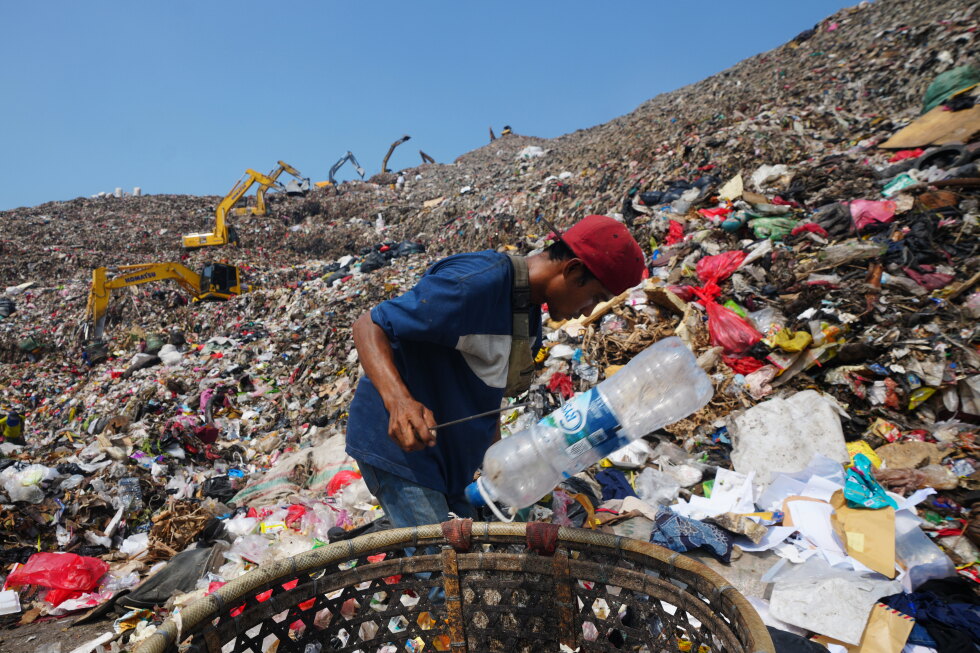
BANTARGEBANG, Indonesia (AP) — Long before dawn breaks over Indonesia ’s largest landfill, Nur Wencih joins thousands of waste pickers climbing mountains of garbage, searching for anything they can sell.

The 35-year-old widow has worked at the site on Jakarta’s eastern edge for two decades, following her parents, who still earn a living there. The Bantargebang landfill has paid for food and rent while helping her two teenage daughters living with a relative in a rural village. She hopes her daughters will never have to follow the same path.

Living alone in a rented room near the landfill, Wencih earns about 200,000 rupiah ($12) on a good day collecting discarded toys, cardboard and plastic bottles before bulldozers bury them beneath fresh waste. Occasionally, she finds gold jewelry.

“It feels like hitting a jackpot,” Wencih said while taking a break from the sweltering July heat.

Advertisement

But those lucky finds, and perhaps her livelihood, may soon become far rarer.

Beginning Aug. 1, Indonesia plans to start transforming the site from open dumping to a more controlled system as part of a national waste management plan. The government last month announced it will shut down open-dumping operations at 343 of Indonesia’s 550 disposal sites, requiring them to transition to controlled or sanitary landfill systems and gradually accept only garbage that cannot be recycled or composted, such as diapers, dirty paper towels and stickers.

Meanwhile, residents are being asked to set aside organic waste and recyclables for separate processing, a practice many households have never been taught to do on a large scale.

Dudi Gardesi Asikin, head of Jakarta’s Environment Agency, said the policy aims to improve environmental health, reduce pollution and curb emissions of methane generated by decomposing waste.

Methane is responsible for roughly one-third of global warming and traps more heat than carbon dioxide, making it a key focus of worldwide climate efforts. U.N. Secretary-General António Guterres, for example, is urging governments to sharply reduce methane emissions, calling it one of the fastest ways to slow global warming.

Advertisement

A landfill at the center of the methane debate

Researchers say Bantargebang emits more methane than nearly any other landfill in the world, placing it at the center of Indonesia’s waste management reforms.

Advertisement

Asikin said Bantargebang opened in 1989 as a sanitary landfill equipped to collect methane. Unlike open dumps, sanitary landfills also cover waste with soil.

But after a private-sector contract ended in 2016, the facility gradually drifted toward open dumping.

“What was never intended to be open dumping became full open dumping,” Asikin said.

Only two of the landfill’s original 12 methane extraction wells remain operational, Asikin said.

Under the new plan, parts of Bantargebang are already being covered with tarps, and officials hope to cover much more. Asikin estimated that covering the rest of the disposal area could cost as much as 200 billion rupiah ($12 million).

Uncertain future for waste pickers

Indonesia faces a dilemma as it attempts one of its biggest waste-management reforms in decades while also protecting the livelihoods of an estimated 600,000 waste pickers.

At Bantargebang alone, officials estimate more than 4,000 registered waste pickers work among trucks, excavators and mountains of garbage each day. The materials they recover are sorted and sold to a network of traders and recycling businesses that have grown around the landfill.

Advertisement

“What worries me most is how I will feed my family,” Wencih said of the new plan, while excavators behind her pushed fresh waste onto exposed slopes.

Asikin said the government wants to improve conditions for waste pickers, who already receive some workplace protections and healthcare through a national social security program.

Advertisement

He believes the new policy will eventually create safer formal jobs in recycling and composting.

“Today they are practically racing against our excavators to grab recyclable materials. It is extremely dangerous,” he said.

Bunin, a 53-year-old neighborhood chief who lives nearby, said while the landfill causes pollution, it also creates business opportunities including rental housing and food stalls catering to waste pickers.

“The landfill not only brings negative impacts, there are also economic benefits,” said Bunin, who like many Indonesians uses a single name.

A landfill at its limits

Covering roughly 110 hectares (272 acres), Bantargebang has grown into a human-made mountain reaching as high as 60 meters (196 feet), roughly the height of a 20-story building. About 7,500 tons of waste arrive daily from the capital city.

“The waste people produce does not disappear. It is gathered in one place and has become a mountain,” said Agung Pujo Winarko, who heads the facility.

Advertisement

A collapse triggered by heavy rain in Bantargebang in March killed seven people, underscoring the risks posed by the landfill’s sheer scale.

“This situation is extremely urgent,” Winarko said. “Its carrying capacity is reaching, or even exceeding, its limits.”

Satellite data analyzed by UCLA’s STOP Methane initiative ranked Bantargebang in 2025 as the world’s second-largest landfill methane emitter after a site in Argentina.

Evan George from UCLA’s Emmett Institute on Climate Change and the Environment said reducing organic waste entering landfills could lower emissions, but that existing landfills will still require decades of monitoring and gas collection.

Changing Jakarta’s throwaway culture

Under the new approach, Jakarta residents are expected to separate food scraps and other organic waste from recyclables and residual trash before collection. New refuse-derived fuel plants are also part of the plan.

“What we are doing is somewhat revolutionary,” Asikin said. “For decades, people were never asked to separate their waste.”

But many households are only beginning to learn the system, raising questions about whether enough public education has taken place.

Advertisement

“All we know is to throw the trash in the bin, not to sort it,” said Rukasih Wanti, a Central Jakarta resident. “The new rule is confusing us. It’s inconvenient, creates extra work and wastes our time.”

Asikin said multiple government institutions, including education and health ministries, are supporting the efforts.

Environmental advocates say new recycling and composting infrastructure is also needed. The transition is daunting because government data shows only about one-quarter of Indonesia’s daily waste is currently handled by formal systems, with the remainder dumped, burned or otherwise unmanaged.

David Sutasurya, executive director of the environmental organization YPBB, said about half of Jakarta’s waste is compostable and another 30% recyclable, meaning up to 80% could be kept out of landfills.

“We delayed transforming our waste-management system for too long, and only realized the problem when landfills were already close to full,” Sutasurya said.

In a West Jakarta neighborhood, Monica T. Anggriani has spent more than a decade persuading neighbors to separate household waste, building a community waste bank that now processes about one ton of organic waste daily through composting, maggot cultivation and urban farming.

Advertisement

“Our generation was never taught to separate waste,” Anggriani said. “If we don’t start now, nothing will change in the future.”

___

Associated Press writer Jennifer McDermott in Providence, Rhode Island, contributed to this report.

___

The Associated Press’ climate and environmental coverage receives financial support from multiple private foundations. AP is solely responsible for all content. Find AP’s standards for working with philanthropies, a list of supporters and funded coverage areas at AP.org.

Advertisement

Source link

Advertisement
Continue Reading

NewsBeat

Trump paused attacks on Iran to make space for talks, US ambassador says

Published

on

A woman with short brown hair looks directly into the camera with a slight smiling expression. She is wearing a pink top and a silver necklace with a heart charm.

President Donald Trump has paused attacks on Iran for the second night in a row to give diplomacy more time, the US ambassador to the UN said.

Speaking to Fox News on Sunday, ambassador Mike Waltz said the president was “giving talks some space, he’s giving it a little bit of room”.

An Iranian army spokesperson said on Sunday that Tehran had halted “retaliatory” attacks in the region in response.

The pause follows nearly two weeks of daily US strikes and tit-for-tat attacks, effectively unravelling the ceasefire struck in June.

Advertisement

Asked whether Trump had decided against escalation for now, Waltz told NBC: “I wouldn’t go that far at all. The president is keeping all options on the table.”

Waltz also rejected reports in the New York Times, external that administration officials had warned expanding hostilities could dangerously drain a diminished stockpile of air defence munitions.

“The US military… has everything that it needs to conduct this campaign as effectively as it needs to be,” he said.

As of Sunday evening, Trump had not spoken publicly on the latest developments, but earlier posted computer-generated images on his Truth Social account that depicted US military planes bombing Iranian ships and Kharg island.

Advertisement

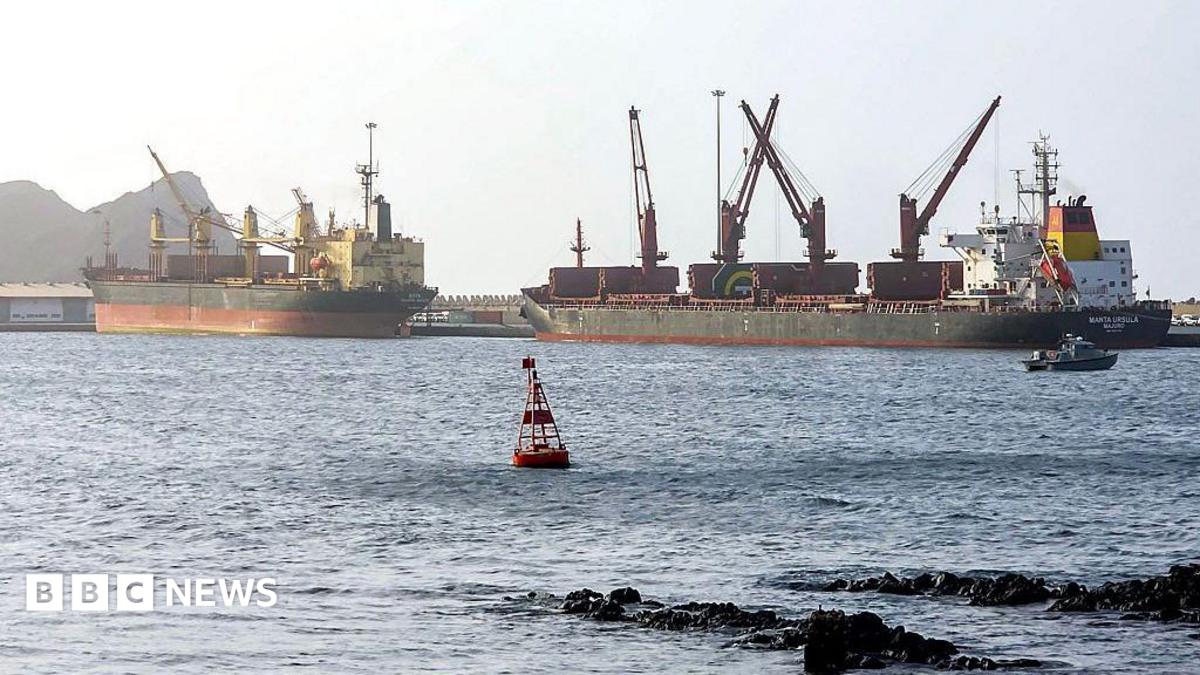
Meanwhile, Iran and Oman held several rounds of technical talks in Tehran on Friday and Saturday to discuss management of the Strait of Hormuz, according to Iranian foreign ministry spokesman Esmail Baghaei.

Disputes over control of the strait reignited US-Iran tensions earlier this month and it remains a major block to permanently ending the war.

Iran and the US signed a memorandum of understanding in June to halt military operations and reopen the strait, as well as to reach an agreement to end the war over the following 60 days.

But after Iranian forces attacked tankers in the Strait of Hormuz on 13 July, the US resumed airstrikes on the country and reinstated its naval blockade on Iranian ports.

Advertisement

Iran retaliated with attacks on US military facilities and bases across the Middle East, killing four American soldiers. The US strikes have since killed dozens of people, according to Iran’s health ministry.

In the UK, new Defence Secretary Wes Streeting said he would meet his US counterpart Pete Hegseth in the coming week to discuss the strait, which is one of the world’s key transport routes for oil, liquid natural gas and other essential commodities.

“When it comes to securing maritime freedom and free commercial shipping in the Strait of Hormuz, that’s where we are absolutely aligned,” Streeting told the BBC.

Last week, oil prices hit $100 a barrel for the first time since May, as the renewed fighting stoked fears over global energy supplies.

Advertisement

As the war nears its fifth month, it remains largely unpopular in the US, with a new poll from CBS/YouGov suggesting 57% of Americans are frustrated about the conflict and only 19% optimistic.

Thousands of people have been killed across the Middle East since the US-Israeli war with Iran began in February, official figures show, with the vast majority coming from Iran and Lebanon.

President Trump is set to meet Israeli Prime Minister Benjamin Netanyahu in the White House on Tuesday.

Source link

Advertisement
Continue Reading

NewsBeat

Three killed, 4 wounded in shooting at Seattle food festival

Published

on

Three killed, 4 wounded in shooting at Seattle food festival

SEATTLE (AP) — Police arrested one suspect and were looking for another after gunfire erupted at a crowded food festival beneath Seattle’s Space Needle, leaving three people dead and four others injured, including a toddler.

Investigators believe the two suspects were shooting at each other and, although one remained on the loose, Assistant Seattle Police Chief Tyrone Davis told a news conference Sunday night that there was no ongoing threat to the public.

Police did not have a description of the outstanding suspect, he said.

“We’re still trying to figure this out,” Davis said.

Advertisement

Two people died at the scene and a third died at a hospital. The four wounded, including a 2-year-old boy, were hospitalized and in stable condition, said Grace Nuñez, spokesperson for the Seattle Fire Department. The rest of the injured were adults. Davis couldn’t say if any of the victims were involved in the confrontation.

The gunfire erupted around 6 p.m. in the waning hours of the Bite of Seattle, an annual three-day festival that draws hundreds of food and retail vendors and performers.

Dozens of officers were providing security at the event and some saw one of the suspects firing, Davis said. One suspect surrendered at the scene, but the other fled. Law enforcement searched the grounds to no avail.

A large number of police and emergency crews responded and began evacuating the area around the sprawling Seattle Center campus.

Advertisement

Faith Adia Hunter said she and her friends had just gotten food from a crepe vendor when gunfire broke out. She realized a shooter was near them. She and others found shelter in the nearby Seattle Children’s Museum.

“We were right next to him when it started so we took off running,” Hunter said. “So we took off running too into the building with the crowd.”

In the chaos, many vendors bolted toward the exits, abandoning their food stands. Hours afterward, some milled outside the police tape, wondering when they would be allowed to return to collect their tents, food and cooking gear.

Roberto Ramirez, a vendor at the event, said he heard what sounded like firecrackers before people began yelling “shooter” and frantically running.

Advertisement

“Suddenly everything was empty,” he said. “People were freaked out.”

After the initial panic, new guests continued to arrive unaware of what had happened and were told by police to leave, he said.

Advertisement

Estan Wakonabo said he and his girlfriend were at the festival waiting in line for a photo booth when he was shoved from behind and he turned to see a rush of people fleeing.

“People were hiding, were pushing, people were falling on the ground, baby strollers were falling,” Wakonabo said, adding that was when he heard gunshots.

“Once I heard a ‘pop, pop, pop,’ that’s when I knew it was a shooter,” he said.

After he escorted his girlfriend to safety, he returned to the scene to make photos and saw multiple victims on the ground, Wakonabo said.

Advertisement

The annual festival started in 1982 and draws 350,000 attendees over “three days of food, drink, and community celebration,” according to its website.

___

Associated Press journalists Manuel Valdes and Lindsey Wasson in Seattle, Annika Wolters in Bangkok and Christopher Weber in Los Angeles contributed to this report.

Advertisement

Source link

Continue Reading

NewsBeat

Rotting in solitary with a target on his back: Inside Axel Rudakubana’s new life in Broadmoor as experts reveal transfer from prison will be NO ‘holiday’ for Southport monster

Published

on

Rotting in solitary with a target on his back: Inside Axel Rudakubana's new life in Broadmoor as experts reveal transfer from prison will be NO 'holiday' for Southport monster

Southport child killer Axel Rudakubana‘s transfer to Broadmoor is not an ‘easy ride’ or a ‘holiday’, a former psychiatrist at the high-security hospital has insisted.

The 19-year-old triple murderer was accused of ‘manipulating the system’ after being shipped out of maximum-security HMP Belmarsh this month.

Consultant psychiatrist Dr Bradley Hillier dismissed claims that Rudakubana would now have a cushier existence – despite now being treated as a patient instead of a prisoner.

And the expert, who has worked with some of Britain’s most dangerous minds, revealed that the fiend could be left facing even tighter restrictions than he endured in prison.

Advertisement

He said: ‘I can say for sure that there is no basis in this misperception that going from prison to hospital is like an easy ride or a light touch or a sort of holiday. It’s not.

‘It’s increasing the levels of restriction and the ability to remove rights in order to treat people because of the risks they pose.

‘It may even remove rights that somebody has when they’re in prison because there’s so much focus on risk and there’s so much scrutiny and observation.’

Rudakubana murdered Alice da Silva Aguiar, nine, Bebe King, six, and Elsie Dot Stancombe, seven, at a Taylor Swift-themed dance class in July 2024. He also attempted to murder eight other children and two adults during his barbaric knife rampage on Merseyside.

Advertisement

Southport child killer Axel Rudakubana has been transferred from HMP Belmarsh to Broadmoor hospital

Rudakubana murdered Bebe King, six, Elsie Dot Stancombe, seven, and Alice da Silva Aguiar, nine, during a Taylor Swift-themed dance class in 2024

Rudakubana murdered Bebe King, six, Elsie Dot Stancombe, seven, and Alice da Silva Aguiar, nine, during a Taylor Swift-themed dance class in 2024

The teenager, from Banks, Lancashire, was incarcerated at Belmarsh after being handed a life sentence with a minimum term of 52 years.

Advertisement

While there, he underwent psychological assessments by experts to determine whether he is mad or bad – or both.

The transfer also followed an alleged attack in May in which a prison officer at Belmarsh was doused in scalding water.

Sources suggested Rudakubana had been ‘very keen’ on a move to Broadmoor and that he had described detention in a hospital as ‘easy street’.

The national chair of the POA union, which represents prison workers, said Rudakubana was ‘playing the system and is nothing more than evil’.

Advertisement

‘He should spend his entire sentence in solitary confinement staring at four walls,’ national chair Mark Fairhurst said.

However, Dr Hillier said the hospital maintains prison-level security while subjecting patients to intensive scrutiny.

He told how the facility was surrounded by towering double perimeter barriers and contained layers of locked internal walls, wards, doors and security checkpoints.

Staff and visitors must pass through enhanced checks, while mobile phones and items capable of being used as weapons are tightly controlled.

Advertisement

All staff carry keys and personal alarms.

Broadmoor hospital, where Rudakubana has been transferred, is a high-security psychiatric unit for adult male prisoners with severe mental disorders

Patients including notorious names such as Charles Bronson, Peter Sutcliffe and Kenneth Erskine have all spent time at the hospital

Patients including notorious names such as Charles Bronson, Peter Sutcliffe and Kenneth Erskine have all spent time at the hospital

Dr Hillier said: ‘It’s not like a hospital when you go into St George’s or somewhere like that, with beds and bays and people wandering around. Broadmoor is highly, highly secure.

Advertisement

‘All of the wards are locked, with multiple doors and locks that you have to go through, and security procedures and checks.

‘They are not going into a hospital and walking around and being able to do what they want. There are lots of things that you’re not allowed to take in, just like a prison because they’re high-risk items.

‘People don’t have phones in there and people don’t have anything that you could use as a weapon, and you go through a level of security just like when you go into a prison.

‘It’s like going through security at an airport but enhanced.’

Advertisement

Broadmoor is one of only three high-security psychiatric hospitals in England, alongside Ashworth on Merseyside and Rampton in Nottinghamshire.

Everyone at these facilities is detained under the Mental Health Act and cannot leave freely.

Prisoners are generally transferred only when doctors determine that their illness cannot be adequately treated behind bars.

This can include cases in which a prisoner is severely unwell, poses a danger to himself or others, or requires medication administered against his wishes.

Advertisement

Dr Hillier said: ‘The usual reason is because their mental illness can’t be treated in prison.

‘They may be harming themselves or others, or be at high risk of doing that.

‘It is giving somebody treatment under the Mental Health Act in a very secure environment because they cannot be allowed to escape, and that’s the reason that high security hospitals exist.’

Dr Bradley Hillier, a consultant psychiatrist, said Broadmoor would be no 'holiday' for Rudakubana

Dr Bradley Hillier, a consultant psychiatrist, said Broadmoor would be no ‘holiday’ for Rudakubana

Advertisement

Rudakubana is expected to face a detailed assessment before doctors decide how he should be housed and treated.

He could initially be placed in seclusion, with staff closely monitoring his movements, behaviour and contact with others.

A former senior member of staff at high-security NHS psychiatric hospitals said patients in seclusion could be watched constantly, with formal checks every 15 minutes throughout the day and night.

‘Officially, nobody says a patient is going into seclusion for years,’ the former employee said.

Advertisement

‘But in reality, some of them do remain there for years.

‘People would be horrified at how long seclusion can go on. I saw men who were meant to be there temporarily end up staying in seclusion for decades.’

The former worker said Rudakubana could remain under the most restrictive conditions for as long as doctors believed he posed a serious danger.

‘The day is stripped down to the absolute minimum,’ the source said.

Advertisement

‘Everything depends on risk – risk to staff, risk to other patients and risk to himself.’

Only if Rudakubana responds to treatment and is judged to pose a reduced threat could he gradually be granted access to Broadmoor’s wider facilities.

Patients considered stable enough can follow a structured daily routine involving education, work placements, cookery, metalwork, woodwork, exercise and supervised leisure activities.

Approved patients may have physical contact with visiting relatives, including hugging them, holding hands and posing for photographs.

Advertisement

But any such privileges would depend on repeated risk assessments and are strictly monitored.

‘If his mental state improved and the risk reduced, then in theory he could move into more normal conditions.

‘But it would surprise me to see that ever happen,’ the former staff member said.

Broadmoor has previously housed the likes of Yorkshire Ripper Peter Sutcliffe, who was sent there in 1984, Ronnie Kray, Charles Bronson and Robert Maudsley.

Advertisement
Reggie Kray (left), pictured with his elder brother Charlie and twin Ronnie, was housed at Broadmoor

Reggie Kray (left), pictured with his elder brother Charlie and twin Ronnie, was housed at Broadmoor

The facility, which opened in 1863 as the Broadmoor Criminal Lunatic Asylum, is based near the affluent village of Crowthorne.

Dr Hillier said Broadmoor staff would already have procedures to deal with the intense attention surrounding Rudakubana.

I know the truth about Marilyn Monroe’s long–lost diary 
Advertisement

I’m Rachel Sharp, US Crime Desk Editor, and I have learned shocking details about Marilyn Monroe’s long–lost diary – details that change everything we thought we knew about her mysterious death.

For decades, her missing diary has belonged to the realm of hollywood myth. But now, an investigator I spoke to not only insists it’s real, but that he found it. Sign up to read exactly what he found.

<!- – ad: https://mads.dailymail.co.uk/v8/de/truecrimeuk/none/article/other/mpu_factbox.html?id=mpu_factbox_1 – ->

Advertisement

Asked whether Rudakubana could have a target on his back because of the nature of his crimes, Dr Hillier said it was a possibility.

‘It is a potential situation with any high-profile individual, whether they’re in prison or in a secure hospital.

‘If somebody is a high-profile person, then there’s a risk associated with that because people may try and gain access to the treating team, for example, and try and get information and things like that.’

Advertisement

But he added: ‘Broadmoor is very familiar with having procedures about ensuring that these risks are managed for every patient.

‘This particular plan will not be something Broadmoor has not dealt with before, in terms of the potential risks, the profile and the emotive nature of his offences.’

The move to psychiatric care has provoked fury among those representing the families of Rudakubana’s victims. The cost to the taxpayer could stretch to an eye-watering £300,000 a year.

Chris Walker, a lawyer for the three bereaved families, suggested Rudakubana could be attempting to ‘manipulate the system’.

Advertisement

‘We do have an evil person but being evil does not mean that you’re suffering with psychosis of some sort,’ he told BBC Radio 4’s Today programme.

‘We need to know is this a single event, is this a recurring event, is this him playing the system and we need those answers.’

Mr Walker said the families had received only the ‘barest of details’ and were urgently seeking a meeting with ministers and officials.

He said the timing of the transfer, days before the second anniversary of the attack, would further devastate them.

Advertisement
Patients' kitchen inside Broadmoor hospital shows off a modest series of tables, chairs and a sink area - plus pin-ups on the wall

Patients’ kitchen inside Broadmoor hospital shows off a modest series of tables, chairs and a sink area – plus pin-ups on the wall

Former CPS chief crown prosecutor Nazir Afzal said of Rudakubana’s transfer on social media: ‘Broadmoor is a high security prison with pills, a place where every move is observed and every decision controlled.

‘It houses murderers including Sutcliffe who killed 13 women. There are only two exits, back to prison or a coffin. It is as far from an easy option as some are from the truth.’

Before Rudakubana was sentenced in January 2025, his barrister told the court there was no psychiatric evidence showing that a mental disorder had contributed to his crimes.

Advertisement

The court heard that he had autism without associated learning disabilities and had been found mentally fit to be prosecuted.

Because he pleaded guilty shortly before his trial, his mental health was not examined in detail before a jury.

Sentencing him, Mr Justice Goose said Rudakubana had a ‘settled and determined intention’ to carry out the attack.

The judge said he would have killed all 26 children at the dance class, as well as any adults who tried to stop him, had he been able to do so.

Advertisement

The Southport Public Inquiry has since heard evidence about Rudakubana’s previous dealings with mental health, education and safeguarding services.

He was under the care of Alder Hey Children’s NHS Foundation Trust between 2019 and 2023, when he stopped engaging with its mental health service.

One senior clinician told the inquiry that his lack of empathy, fascination with violence and neurodiversity had created a ‘really toxic mix’.

He had also been referred to the Government’s Prevent counter-terrorism programme three times, although officials found no evidence that he followed a fixed ideology.

Advertisement
The Southport child killer had been held at the high-security HMP Belmarsh, which previously housed Soham killer Ian Huntley and the murderer of soldier Lee Rigby

The Southport child killer had been held at the high-security HMP Belmarsh, which previously housed Soham killer Ian Huntley and the murderer of soldier Lee Rigby

Rudakubana’s transfer does not change his life sentence. He has not been given a hospital order and must be returned to prison once doctors decide that he no longer requires treatment at Broadmoor.

The Ministry of Justice said the decision was based on independent clinical assessments carried out under the Mental Health Act.

A spokesman said: ‘Any decision to transfer an offender is made following an independent, clinical assessment, under the Mental Health Act.

Advertisement

‘Following rigorous security checks, the offender has been transferred to a high-security psychiatric unit, where he will remain until assessed fit to return to prison.’

Dr Hillier said doctors were required to treat patients based on their medical needs, regardless of the horror of their crimes.

He added: ‘While we may not be approving of what they’ve done or wanting to give them any easier time, there is a basic human element of treating somebody who is ill, getting them better and then sending them back to prison.’

However, he stressed that the victims and their families must remain at the centre of the authorities’ concerns.

Advertisement

‘We also must remember about the victims and victims’ families when we make these decisions. No one can ever know what it must feel like to lose a child in that way. It has been devastating, devastating.

‘I hope the NHS and services are also there for those families.’

The Ministry of Justice stressed that Broadmoor should not be viewed as a softer option.

A spokesman said: ‘The families of those murdered and injured in Southport will be in this country’s heart forever and our thoughts remain with them.

Advertisement

‘The offender who carried out these vile crimes will rightly spend the entirety of his 52-year custodial sentence locked up, and is unlikely to ever be released.

‘High secure hospitals are not places of freedom. He will remain under constant supervision in a high-security psychiatric unit, and be returned to prison as soon as possible.

‘The transfer of an offender follows a robust independent clinical assessment.’

Source link

Advertisement
Continue Reading

NewsBeat

Deep clean your air fryer without scrubbing using just 2 kitchen items

Published

on

Wales Online

A cleaning guru shared her go-to method for deep cleaning an air fryer using two common kitchen items – and there’s no need for scrubbing

Air fryers have established themselves as one of the most beloved kitchen appliances, making meal preparation considerably faster and more straightforward, particularly during hectic weekdays. To maintain the appliance in good working order, it is advisable to clean it after each use.

Advertisement

That said, cleaning can sometimes be neglected, meaning you may occasionally need to carry out a thorough deep clean to preserve its condition and ensure it continues to cook efficiently. A deep clean is particularly effective at tackling stubborn food residue or built-up grime lurking in hard-to-reach areas.

To help restore your air fryer to a gleaming finish, cleaning expert and TikTok creator Chantel Mila (Mama Mila) has shared her preferred technique.

Better still, there’s no scrubbing required whatsoever. You’ll only need two items already found in your kitchen to get the job done, reports the Express.

Advertisement

How to clean air fryers

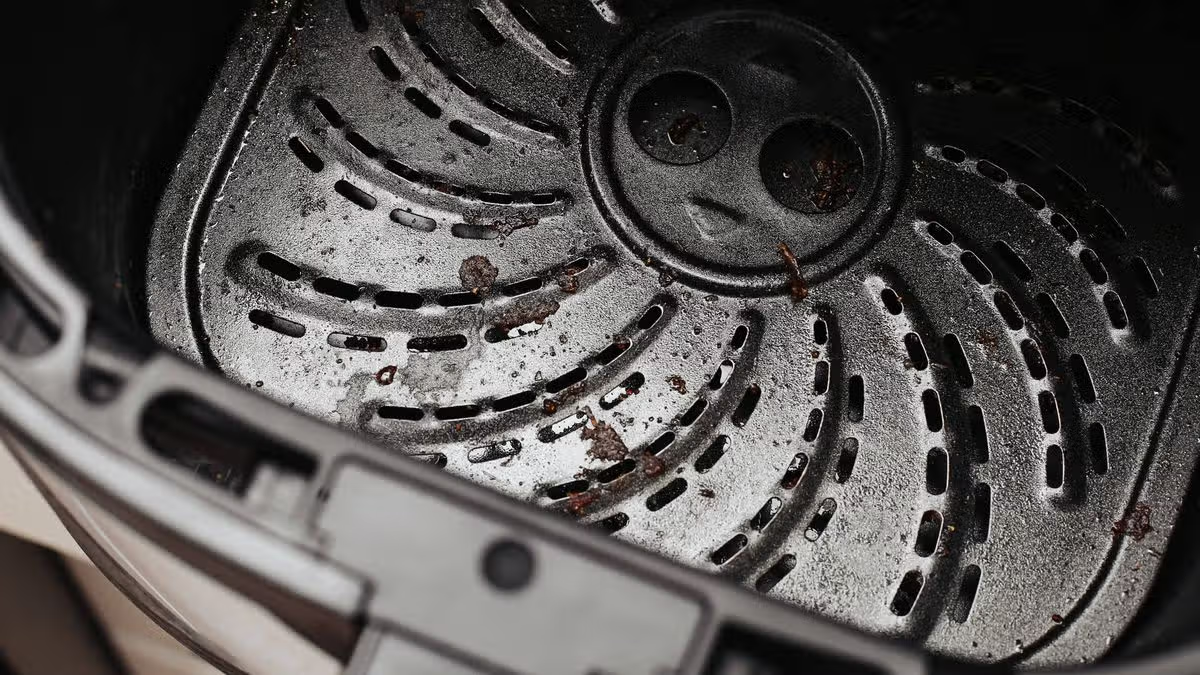
Begin by removing the basket from the air fryer and placing it in the sink. Chantel applies a generous coating of bicarbonate of soda to the basket, making sure any stuck-on food and grease is thoroughly covered.

Next, drizzle over some washing-up liquid, before pouring boiling water from the kettle over the mixture, washing away the fizzing bicarbonate of soda.

This process helps to dislodge any food that has burnt onto the air fryer basket. Leave the mixture to do its work and soak in the basket for a period of time.

Once you are satisfied that all the stubborn grease and grime has been sufficiently loosened, drain away the dirty water. There should be no need to scrub at all.

Advertisement
Content cannot be displayed without consent

While you can simply combine the ingredients and allow them to work in tandem, creating a baking soda paste offers additional benefits for tackling more stubborn areas. The pairing of baking soda and washing-up liquid is particularly effective at breaking down greasy residue, owing to its mildly abrasive properties, making it well-suited for cleaning greasy kitchen surfaces and cookware.

Incorporating washing-up liquid increases the concentration of surfactants — molecules that lower the surface tension between two substances. These surfactants facilitate the mixing of water and oil.

Washing-up liquid also assists in targeting bacteria that baking soda alone may not eliminate, helping to ensure the air fryer remains hygienic and safe for use.

These two common household products work to remove persistent stains and grime by encasing and lifting grease and dirt particles from the affected surface. Baking soda also functions as a natural deodoriser, helping to eliminate any lingering odours following a comprehensive deep clean.

Advertisement

Baking brand Dr Oetker explained the reason baking soda is so good at banishing unwanted odours: “Most nasty smells in the air contain some sort of acid. As an alkali, baking soda reacts with those acids and neutralises them.”

Source link

Continue Reading

NewsBeat

When will the next heatwave hit the UK? Met Office forecast

Published

on

When will the next heatwave hit the UK? Met Office forecast

The prolonged hot weather is raising fresh fears of wildfires across the country and placing further strain on emergency services and public health.

A yellow heat alert has been issued by the UK Health Security Agency covering the East and West Midlands, the south-east, south-west, and east of England, as well as Yorkshire and the Humber.

The alert is in place from 9am on Tuesday (July 28) until 9am on Friday (July 31).

When will the next heatwave hit the UK?

Senior meteorologist at the Met Office Dan Stroud said the upcoming heat spell would likely bring a north-south split in weather conditions, with Northern Ireland, Scotland, and northern England experiencing cloud and rain.

Advertisement

Meanwhile, southern parts of England are expected to once again meet heatwave criteria, with temperatures forecast to reach 32C or 33C on Wednesday (July 29) and Thursday (July 30).

He said the hottest weather would be “almost a blink and you miss it,” with temperatures expected to return closer to seasonal averages by the weekend.

Meteorologist Marco Petagna said that as the climate continues to warm, the definitions used for heatwaves will also need to change.

Mr Petagna said that heatwave thresholds for some counties were raised by one degree four or five years ago.

Advertisement

Mr Petagna said: “Going forward they’ll need to be adjusted to take into account… current climate, otherwise we’re going to more frequently go into heatwaves. “It’s a moveable thing, really, as we go through a warming world.”

The heat is being compounded by exceptionally dry conditions.

Southern England has recorded just one per cent of its average July rainfall to date.

England as a whole has received only five per cent, while the UK overall is at 20 per cent of typical July totals.

The sustained dryness has led to low water levels.

Advertisement

North Wales and the Upper Severn became the first part of the UK to be officially declared in drought status on Thursday.

The latest Met Office data, used by Natural England and Natural Resources Wales, indicates that any fires that do start are likely to become “exceptionally severe” on Wednesday in pockets of the east, south, and south-east of England.

The Fire Severity Index considers factors such as recent rainfall, temperature, and humidity to assess how intense a fire could become if it breaks out.

It does not predict the likelihood of wildfires starting, only the potential seriousness of those that do.

Advertisement

Risk of more wildfires as temperatures rise in UK again

At the peak of the third heatwave in mid-July, fire crews in England and Wales were tackling 19 significant blazes at once, underscoring the scale of the threat posed by the prolonged hot and dry conditions.

Recent weeks have already seen large blazes break out in Wales and Scotland.

Some fires have been severe enough to force evacuations from homes.

Smoke from a fire on the side of Bangor Mountain, in GwyneddThere have been wildfires in the UK, such as on the side of Bangor Mountain, in Gwynedd, Wales (pictured) (Image: Nigel French/PA Wire)

A spokesman for the National Fire Chiefs Council (NFCC) said: “With the Met Office warning that a fourth heatwave could develop this week, bringing another period of very hot weather to parts of the UK, fire and rescue services remain on alert and are continuing to prepare for renewed wildfire risk.

Advertisement

“Most wildfires are preventable and we are asking everyone to play their part in helping to protect our communities, wildlife and natural spaces, while easing the pressure on firefighters who have already faced an exceptionally challenging summer.”

The risk is not confined to the UK, with wildfires causing massive disruption in mainland Europe.

Some 220,000 people have been forced to leave their homes in south-west France.

A further 116,000 have been evacuated in Spain.

Advertisement

Recommended reading:


The heatwave comes during what is shaping up to be one of the UK’s hottest Julys on record.

Provisional data from the Met Office indicates temperatures are running three degrees above the July average.

This could make it one of the three or four hottest Julys ever recorded.

Advertisement

How hot has it been this summer where you live? Let us know in the comments.

Source link

Advertisement
Continue Reading

NewsBeat

Four people including baby die after car crashes into trees in Derby

Published

on

A woman with short brown hair looks directly into the camera with a slight smiling expression. She is wearing a pink top and a silver necklace with a heart charm.

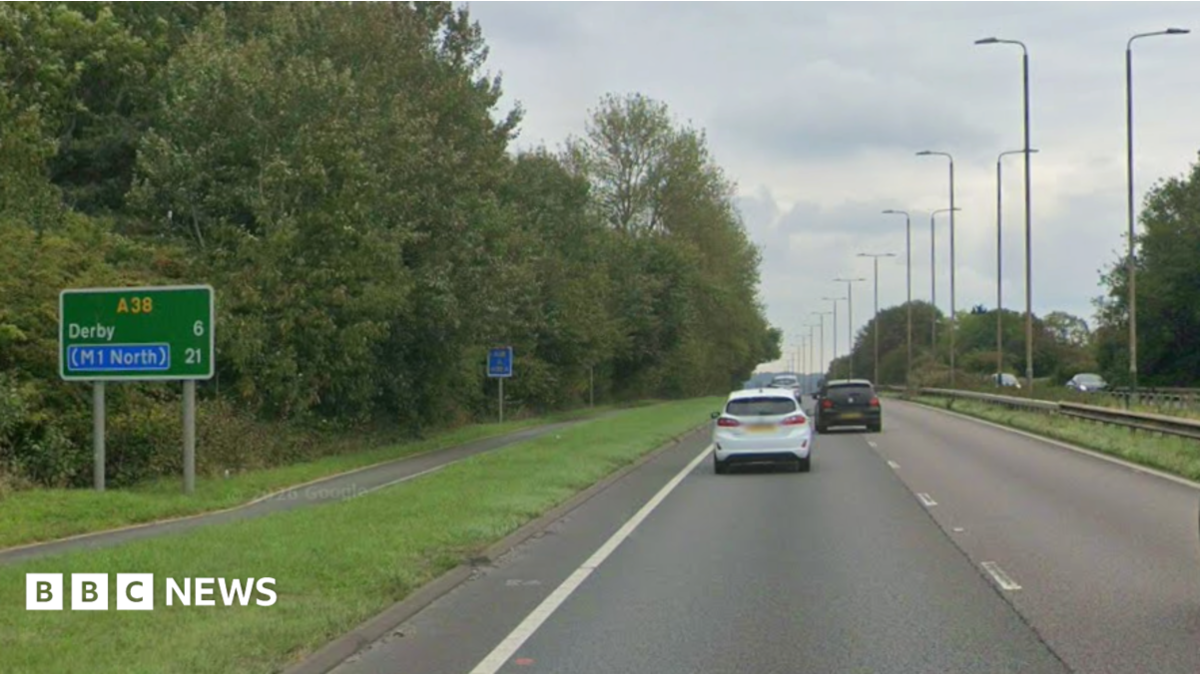
Four people, including a baby, have died after a car crashed into trees on a busy dual carriageway in Derby.

Emergency services were called after a red Hyundai car left the A38 and crashed into trees – between the A50 Toyota Island and the A516 – at about 23:00 BST on Saturday.

Derbyshire Police said the passengers, two women, 18 and 30, and a man, 36, died at the scene. The baby girl was taken to hospital where she died shortly after.

The force said the driver, a 33-year-old man, was arrested on suspicion of causing death by dangerous driving. He was subsequently taken to hospital for serious injuries.

Advertisement

Police said all those involved were from Leeds in West Yorkshire, adding their relatives have been informed and are being supported by specialist officers.

“Our thoughts are with them at this most distressing time,” a spokesperson said.

In a statement, Derbyshire Fire and Rescue Service said three crews attended the scene following a 999 call to its control room.

The fire service added: “Our thoughts are with everyone impacted by this terrible incident, the deceased and all of the emergency services who responded to the scene.”

Advertisement

The carriageway was closed for several hours while emergency services dealt with the crash, but it has since been reopened.

Anyone who witnessed the crash or has any dashcam footage has been urged to contact police.

Source link

Advertisement
Continue Reading

NewsBeat

M60 traffic LIVE updates after traffic stopped as queues build following crash

Published

on

Manchester Evening News

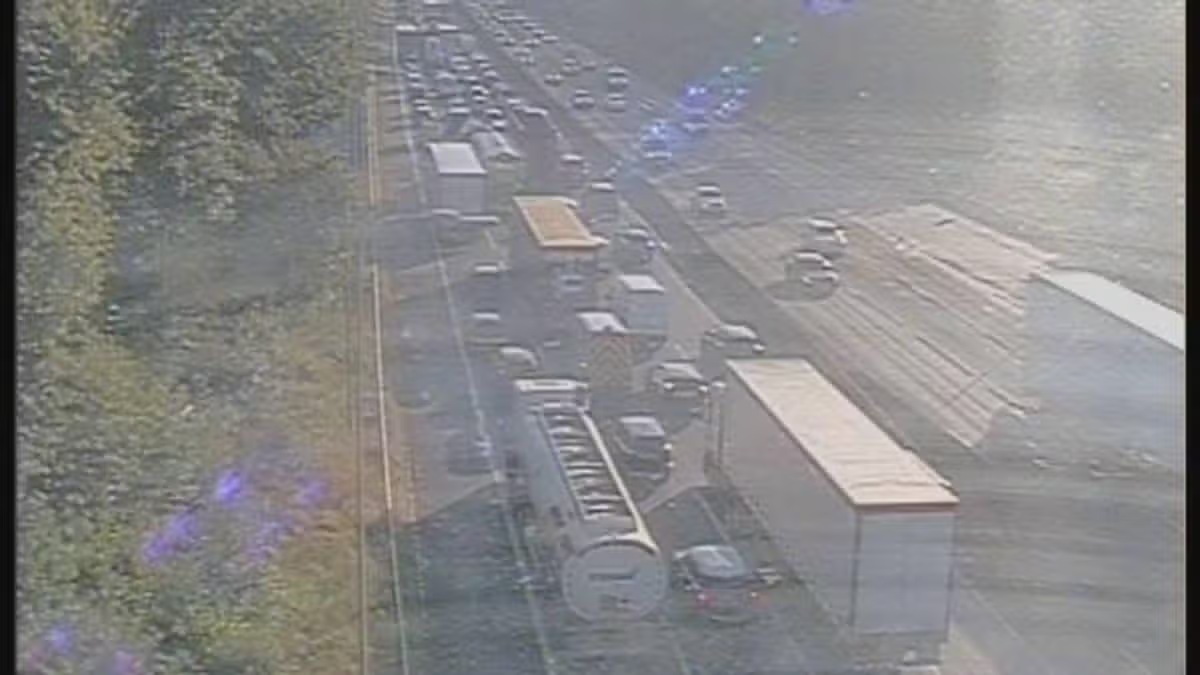
Two lanes of traffic have been closed on part of the M60 following a crash this morning.

Long delays are building on the M60 clockwise as a result.

The lane closures are in place between junctions 16 at Pendlebury and 17 at Prestwich.

Advertisement

Traffic is tailing back to junction 13 at Worsley, while queues are also affecting the M61 southbound approaching the M60.

There are also delays on the anticlockwise side approaching the crash scene.

Firefighters are in attendance following the incident.

Further details about the incident are yet to be confirmed.

Advertisement

Source link

Continue Reading

Trending

Copyright © 2025