
Connect with us

NewsBeat

Autism Could Be Linked To ‘Hyper-Empathy,’ Says Lecturer

Published

on

Autism Could Be Linked To 'Hyper-Empathy,' Says Lecturer

To be frank, I was always surprised to read that some people associated autism with a “lack of empathy” or “empathy dysfunction”.

I know autism is a broad spectrum, meaning a “rule” that applies to one person doesn’t necessarily show up in another. But I’d noticed some loved ones with autism seemed to experience more empathy (or at least a more intense empathy) than average, not less.

In 2024, researchers found a high percentage of “hyper-empathy” among autistic people.

Here, we spoke to one of the study’s authors, Dr Stephen Connolly, a Senior Lecturer in Autism from the Sheffield Hallam Institute of Education, about his team’s findings.

Advertisement

What is hyper-empathy?

Hyper-empathy is “an intense emotional response to people, plants, objects, animals, even fictional characters, often to the point of distress. It is intense, all-consuming thoughts and feelings that can make it hard for someone to distinguish their own feelings from another person’s.”

Sometimes, Dr Connolly said, this overwhelming hyper-empathy can be so intense that it can lead to vomiting, nausea, pain, agitation, crying, depression, anxiety, and burnout.

A person with hyper-empathy might even lose money over it. This can happen when “someone wants to pay to try resolve the problem such as taking in an animal from a shelter, paying for someone’s shopping, [or] replacing an item someone has lost or broken”.

Advertisement

And the trait could even cause issues in relationships, as people’s friends and family may wonder why “someone is seen as putting emotional resources into a damaged piece of furniture, an injured bird, or a homeless person but not their partner or friend… Some people can blame the hyper-empathic person for their responses, leading to breakdowns in relationships.”

Dr Connolly added that people with hyper-empathy might avoid situations that elicit this often extremely intense response.

Therefore, they might not “be willing to enter some environments or be there for people when they are needed.

“There is an immense emotional, cognitive and physical load attached to a hyper-empathic response that can be all-consuming. At best it can halt a person’s day, at worst it can lead to suicidal ideation.”

Advertisement

What link is there between hyper-empathy and autism?

Dr Connolly’s research is not the only study to link autistic people with a greater likelihood of experiencing hyper-empathy.

“Early and growing research is suggesting it can be a fairly common response in autistic people, but understanding it can be difficult,” the lecturer told us.

“One of the challenges is that some people have talked about how they felt empathy so much they had to ‘shut it off,’” meaning that while their baseline levels of empathy might be very high, they could have adapted to hide it.

Advertisement

Meanwhile, many autistic people may have alexithymia, or difficulty naming, identifying, and/or expressing their own feelings.

“There is also a well-researched issue of the double empathy problem, where someone’s empathic response is not validated or accepted as empathy and so goes unacknowledged by those around the person,” Connolly continued.

This can happen when two people have very different experiences of the world.

“All this can lead to the person [being] seen as not having empathy.”

Advertisement

Of course, hyper-empathy is not a universal autistic trait. In his 2024 research, Connolly and his team found a “huge amount of variation in the empathic experiences of participants”; some identified with having lower empathy, while others described very powerful empathetic reactions.

So… why don’t we see autistic people as empathetic?

The expert told us that hyper-empathy is “substantially” underplayed and ignored in discussions about autistic people, partly due to “historic misunderstandings”.

For instance, he said, early autism research from people like Leo Kanner and Hans Asperger suggested that people with autism seemed to have less emotional reactivity in empathetic scenarios.

Advertisement

Experts like Professor Sir Simon Baron-Cohen, a student of Uta Firth who created the first UK clinic for adults seeking a diagnosis of Asperger Syndrome in 1999, may have been influenced by their ideas, Connolly claimed.

(Asperger’s is no longer a diagnostic term; it’s now seen as part of the autism spectrum).

Baron-Cohen has since expressed regret over characterising autism using an “extreme male brain” theory, telling The Guardian: “Some of those terms were very easily misunderstood… It can lead to simplistic headlines like ‘autistic people lack empathy’, which is not true”.

However, he said that the underlying science still stands, calling the idea that autistic people lack empathy a “myth”.

Advertisement

Dr Connolly said that later, researchers Dr Luke Beardon and, separately, Dr Damian Milton suggested that major studies might have missed empathy in autistic people because they were only looking for the kind typically expressed by those without autism.

But the problem is that many of the ideas that influenced popular thought about autism were set in the ’80s and ’90s, overtaking newer ideas, he added. They may have even been “central to the development of understanding of autism in the DSM [Diagnostic and Statistical Manual of Mental Disorders, the standard diagnostic tool used by mental health experts in the US].”

So, Connolly said, potentially outdated tropes were “reproduced in media (e.g., Rain Man, The Big Bang Theory) and spread the message that autistic people lack empathy. It is even a core element of the diagnostic process still in 2026”.

Therefore, “When [autistic] people express hyper-empathy, it [can] go unacknowledged, and often the impact (burnout, physical, and other costs) will be attributed to something else… people can also be seen as challenging because of their hyper-empathic responses,” he ended.

Advertisement

“We have a significant number of autistic people who society deems to lack empathy but experience intense emotional responses that can lead to psychological, physical, social, and economic impact[s], and this will all go unsupported, or even [be] seen as challenging, or a problem leading to potential long-term impacts.”

Source link

Advertisement
Continue Reading
Click to comment

You must be logged in to post a comment Login

Leave a Reply

NewsBeat

Four murder investigations launched in eight days across Greater Manchester – full details of each case

Published

on

Manchester Evening News

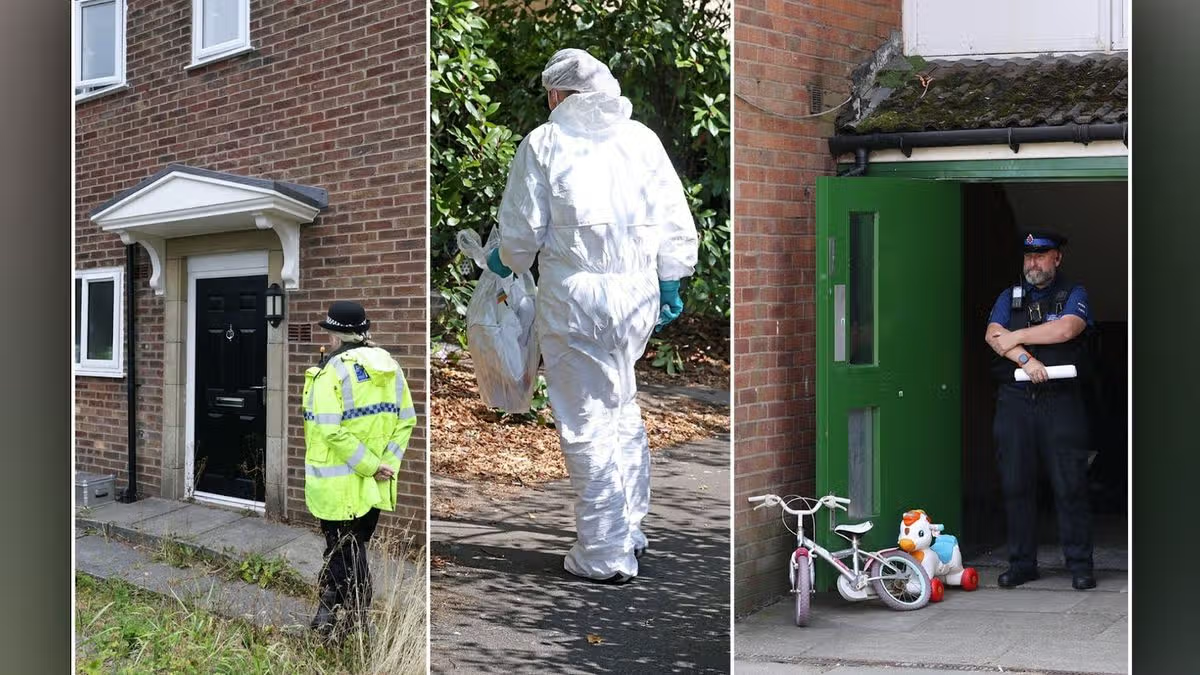
Four murder investigations have been launched in eight days across Greater Manchester. Two probes were launched on the same day following the separate deaths of two women.

Police are investigating four incidents – in neighbourhoods in Bolton, Tameside, Rochdale and Salford. Two women, 39 and 61, and two men, one in his 30s and one 31-years-old, died in the incidents.

Click here to get the biggest stories straight to your inbox in our Daily Newsletter

There is no suggestion any of the cases are linked. Crime scene investigators and forensic specialists have been seen working at crime scenes across the region in recent days.

Advertisement

Coroners across Greater Manchester have been handed files in relation to the cases.

This is what we know about each case…

Breightmet

Emma McGowan, 39, was found unresponsive at a property in Breightmet in Bolton in the early hours of August 4.

Police attended at around 3am on Yewdale Avenue, where Ms McGowan was pronounced dead at the scene.

Her family described her as a ‘much-loved daughter and adored mother’ to four young children. “Our hearts are broken and we will miss you forever,” they said in a statement issued via police.

Joseph Webb, 36, of Yewdale Avenue, has been charged with murder. He was remanded into custody following an appearance before magistrates.

Mossley, Tameside – August 4

Later on August 4, Greater Manchester Police officers were called to a property on Winterford Road in Mossley. A woman was sadly found dead at the scene.

She was later named as 61-year-old Julie Loco. A 60-year-old man has since been arrested on suspicion of murder.

Advertisement

He remains released on bail while officers work to ‘establish the full circumstances’, police said in an update on Thursday (August 13).

A neighbour told the Manchester Evening News there was a ‘significant’ emergency response, with paramedics arriving first.

“I’ve never seen anything like it in my life, it was like something from a movie,” they added. “They were in the house, I could just hear all the machines beeping, then it just went silent.

“They had to wait for the police to come. I’ve not been able to sleep from it.”

Advertisement

Wardle, Rochdale – August 11

Nathan Haigh, 31, was found unresponsive at a flat on Great Howarth at around 7.30pm on Tuesday (August 11). He was pronounced dead shortly after despite the best efforts of paramedics, GMP said.

A 37-year-old woman was arrested on suspicion of murder and remains in custody for questioning, the force said in an update on Thursday (August 13).

A force spokesperson said detectives are ‘exploring several lines of enquiries in what initially appears to be suspicious circumstances’.

Advertisement

There is not believed to be any risk to the public. On Thursday afternoon the investigation continued, with a police officer stood guard at the entrance to the block of flats on the estate near the village of Wardle, on the outskirts of Rochdale.

Neighbours said earlier in the day forensics officers were seen examining the ground floor flat where Mr Haigh is thought to have lived.

It’s understood he had no children and had previously worked as a roofer. It is thought he had lived on the estate for around 20 years.

Mr Haigh’s mother, Keeley Greenwood, spoke of her heartbreak on Facebook. She has set up a GoFundMe page to raise funds to give her son ‘the send off he deserves’.

Advertisement

Ms Greenwood wrote: “It is with the heaviest of hearts that I share the heartbreaking news that my beautiful son, Nathan Haigh, tragically passed away on 11th August 2026.

“We are now trying to raise funds to give Nathan the send off he deserves during this incredibly difficult time. Any donation no matter how big or small, would mean so much to our family and would be deeply appreciated.

“Thank you from the bottom of our hearts for your kindness, love and support. Any further details will be updated as soon as we have more information.”

Advertisement

She added on Facebook: “RIP my son. I will always love you Nathan Haigh.” Lauren Reeves posted: “RIP Nathan Haigh. Sending love to all your family and loved ones.”

Broughton, Salford – August 12

GMP officers were called to reports of a disturbance at a flat on Kempster Gardens in Broughton in the early hours of Wednesday (August 12).

A man in his 30s was pronounced dead at the scene. He has not yet been named. Another man in his 30s was arrested on suspicion of murder and remained in custody on Thursday (August 13).

Advertisement

Neighbours reported hearing screaming for help as an incident unfolded. One person reporting seeing a police officer leaving a flat in tears as forensics worked at the scene.

A neighbour told the Manchester Evening News: “I woke up at around 5.30am and heard shouts of ‘help’ and ‘call the police’. I thought someone was just messing about so I ignored it and went back to bed.

“In the morning we saw the police cars. I didn’t take it seriously at the time, but I feel a bit sick to my stomach now. What if I had called the police earlier? Would they have come sooner? I feel guilty for ignoring it.”