George the seagull has become part of the family – and even welcomed by two Bengal cats.
Baby seagull and Bengal cat form unlikely friendship in Arbroath
An abandoned baby seagull has become an unlikely member of a family – and their Bengal cats have become adoptive parents.
Andrew Moore, 33, from Arbroath, has been raising the gull, named George, after the week-old chick tumbled from the roof above the family’s home and fish shop last month.
The dad who lives above The Fish Hoose with his children, Eva, 13, and Nairn, 10, said the family initially hoped George’s mother would return.
“We had seagulls nesting on our roof and one of the young fell off at about a week old,” he said.
“It was on our balcony, so we just left it because we thought its mum would come back. But she never did, so we decided to feed it.”
Since then, George has gone from strength to strength, thanks to a steady diet of fresh fish from the family’s shop.
Advertisement
“He’s become quite a part of our family,” Andrew said. “We’re keeping him well fed with little bits of fish from our shop. He’s scoffing down everything we give him.
“My son named him George. He had been staying out on the balcony but somehow made his way into the house.
“We even got him a wee paddling pool.”
The biggest surprise has been George’s relationship with the family’s two Bengal cats, Benji and Bow, who have been keeping a watchful eye on the chick.
“They’ve really taken to him, which is quite a surprise because they’re hunting cats,” Andrew said. “They just seem to be intrigued by him.
“They watch everything he does and keep an eye on him. I think they just think he’s part of the family.”
The family has been learning how to care for the gull as they go, relying on online advice while hoping to prepare him for life in the wild.
“We’ve just been Googling how to look after them,” Andrew said. “We just want to bring him up and hopefully he’ll be okay to go on with his life.
“They’re supposed to fly within about six weeks. He has been spreading his wing and jumping around.
Advertisement
“I reckon it’s nearly time to say our goodbyes.”
While Andrew hopes George will soon take to the skies, he suspects the young gull may not become a complete stranger.
He added: “He’ll probably be coming back to see us when he knows he gets food.”
Videos of George’s adventures have attracted plenty of attention online, with viewers charmed by the unusual friendship between the gull and the family’s cats.
“We’ve had a lot of folk messaging us joking about how they can get a pet seagull from our videos,” Andrew said. “I’ve even had customers coming in wanting to see him.”
Get more Daily Record exclusives by signing up for free to Google’s preferred sources. Click HERE.
South Wales Fire and Rescue Service said it is currently responding to what it described as a “large industrial fire” at Llantrisant Recycling Centre.
Crews have been on the scene since 2.05am this morning. A number of resources are being deployed, including eight fire appliances, four water bowsers, an aerial ladder platform, and a range of specialist equipment. Drones are also in use.
The wildfire started in heathland at Ryvoan Bothy, near Nethy Bridge, late on Wednesday morning.
07:55, 16 Jul 2026Updated 08:32, 16 Jul 2026
Firefighters have worked through the night tackling a wildfire in the Cairngorms which now stretches 3.5km wide.
The inferno started in heathland at Ryvoan Bothy, near Nethy Bridge, late on Wednesday morning.
A number of homes and businesses, including campsites and ski resorts in the Glenmore Forest Park area, have been closed and evacuated as a result.
Advertisement
Fire crews battled the blaze overnight and four fire engines remained at the scene at 6.45am on Thursday.
Ian McMeekin, head of prevention at the Scottish Fire and Rescue Service, said they expect to be at the scene for the rest of the day.
He told BBC Radio Scotland’s Breakfast programme: “We’re still fighting the fire, working with a range of different partners, with the landowners and local authorities and so on to deal with the incident. Currently we have a fire front of just roughly about three and a half kilometres wide.
“We are reassessing situation, and our resources may change throughout the morning.
Advertisement
He added: “This is very much a multi-agency situation. As a precautionary measure some of the areas have been evacuated, including a campsite and some properties in close proximity.
“We have been working with our local resilience partners to make sure they try and support people where possible, and we’re advising people to keep an eye out for key messages coming from the partners, whether through Police Scotland or other trusted local media outlets.”
Mr McMeekin said it is too early to determine what may have caused the fire. There have been no reports of any casualties.
Duncan Ferguson lives in Glenmore, a village near Aviemore. Mr Ferguson, operations manager at the Spey Fishery Board, said police came to his house during the afternoon, telling residents to “leave your pets and go”.
Advertisement
The Scottish Fire and Rescue Service (SFRS) urged people to avoid the area and has also advised residents in Aviemore, Glenmore and the surrounding communities to keep their doors and windows closed due to the smoke.
Group commander Raymond King said: “While we want people to enjoy the good weather, we ask that anyone in the Cairngorms National Park near to Aviemore and Glenmore avoid the area.
“This part of the Cairngorms National Park is popular with hillwalkers, and we ask that people remain vigilant while active firefighting continues.”
Cairngorms National Park Authority said that firefighters have been working with landowners to contain the incident and create fire breaks, with high winds causing the fire to spread across areas of trees and woodland.
Advertisement
A spokesperson for the Cairngorms National Park Authority said: “The ongoing incident near Ryvoan Bothy is deeply concerning, and we are grateful to all those who are working to tackle the fire.
“We would echo the advice of SFRS to avoid the area while firefighters and partners work to bring this blaze under control.
“This incident – alongside wildfires we are seeing across the UK this week – serves as a stark reminder of the risks that periods of drier, hotter weather can pose.”
The blaze comes while parts of Scotland are at very high risk of wildfire over the next few days.
Advertisement
The SFRS, in conjunction with the Scottish Wildfire Forum, has issued wildfire warnings for the central Highlands, southern and eastern Scotland.
The alert, warning of a very high risk of wildfire, came into force on Wednesday and lasts until Monday.
It follows days of hot and dry weather in many parts of the country.
Get more Daily Record exclusives by signing up for free to Google’s preferred sources. Click HERE.
The plans are supposed to make public transport more accessible – but a disabilities campaign group says it’s doing the opposite
A £23.4m scheme to create a public transport ‘corridor’ between Salford Crescent station and MediaCity has been slammed as ‘dangerous’ and ‘not thought out’ by disability campaigners.
Advertisement
The Transport for Greater Manchester and Salford Council are aiming to cut down travel times on the 50 bus route, improve safety for cyclists, and improve accessibility for pedestrians.
But Kay Fairhurst, Chair of the Salford Disability Forum, challenged councillors over the decision during a full council meeting on Wednesday, July 15.
Click here to get the biggest stories straight to your inbox in our Daily Newsletter
She told the Local Democracy Reporting Service: “The plan seems to favour bikes over pedestrians. There are parts of the route where bicycles, scooters, and e-bikes share space with pedestrians on the pavement, or intersect with pavements at crossings and bus stops.
Advertisement
“If you’re partially sighted and have hearing loss like me, it’s hard to get out of the way on time if there’s a cyclist coming at you full pelt. I could easily end up in an accident. I’m worried I won’t feel safe anymore.”
Ms Fairhurst, who lost her eyesight in one eye 20 years ago due to Glaucoma, and is slowly losing sight in her other, walks with a mobility cane. She’s particularly concerned about how plans for ‘floating bus stops’ along the full route could affect her.
To access these stops, pedestrians have to step across bike lanes, a design that has already attracted criticism in areas such as Oxford Road in Manchester City Centre.
Advertisement
The Royal National Institute for the Blind has also mounted a campaign against floating bus stops. Last year, the Department for Transport told councils to pause plans introducing more floating bus stops – but they currently still form a part of Salford’s plans.
Councillor Mike McCusker, Deputy Mayor and cabinet member for Transport and Planning, responded to Ms Fairhurst’s questions in the chamber, stating the plans as they stand are ‘within regulation’ and incorporate considerations to make public transport more accessible for those with disabilities.
Coun McCusker said: “We’re the fastest growing city within Greater Manchester. We’ve seen an increase in car usage – though around 44 per cent of people in Salford don’t have access to a car. It’s really important that we encourage active travel and that we have a bus service that people can use to get around. New bus stops, better routes for pedestrians, better bus routes, this is ensuring that [public transport] is more accessible.”
The plans were made in consultation with disability focus groups, according to coun McCusker.
Yet Ms Fairhurst feels the decisions have ‘already been made’ and the concerns of partially-sighted and blind people are not being heard.
The plans involve creating a number of segregated cycle lanes, putting bus stops on raised platforms so it’s easier to board and alight from buses, cyclops pedestrian crossings, and a new bus gate on Langworthy between Montford Street and Kansas Avenue.
Police are at the scene of a serious crash in the York Street area of north Belfast this Thursday morning, July 16.
The PSNI says roads are closed between Limestone Road and North Queen Street, Mountcollyer Avenue, and York Street on either side of these junctions. Road users are advised to seek an alternative route.
The FA has made its position on Thomas Tuchel clear after England’s World Cup collapse sparked fierce criticism of the manager
The Football Association has thrown its support behind Thomas Tuchel and has no plans to sack the England manager following the country’s painful World Cup semi-final defeat, according to reports.
Advertisement
England were within five minutes of reaching their first World Cup final since 1966 after Anthony Gordon gave them the lead against Argentina in Atlanta.
However, Tuchel’s decision to make a series of defensive substitutions came under intense scrutiny as the reigning world champions mounted a dramatic late comeback.
Enzo Fernandez fired Argentina level from distance in the 85th minute before Lautaro Martinez headed home Lionel Messi’s cross in stoppage time to complete a devastating 2-1 turnaround.
The defeat prompted furious criticism of Tuchel’s tactics, with former England captain Wayne Rooney among those claiming the manager’s decisions had cost his side a place in Sunday’s final against Spain.
Advertisement
Despite the backlash, the FA has no intention of removing Tuchel from his position according to The Daily Mail.
The former Chelsea boss signed a two-year contract extension in February and remains committed to leading England into Euro 2028, which will be staged across England, Wales, Scotland and the Republic of Ireland.
FA chief executive Mark Bullingham retains full confidence in Tuchel and issued a statement following the defeat.
“It is heartbreaking to be so close,” Bullingham said.
Advertisement
“The players and Thomas gave it everything today and the squad, coaches and staff could not have worked harder during the tournament.
“I would like to thank them all — and also give my heartfelt thanks to our wonderful fans here in the USA and at home.
“We felt your support every step of the way and we are all so disappointed not to go further.”
Tuchel also made it clear that he intends to remain in the role and lead England into the next European Championship.
Advertisement
“We keep on going for the contract until the home Euros, and I’m looking forward to that,” he said.
“Even like now, it’s difficult to look that far ahead.”
Tuchel was heavily criticised for replacing goalscorer Gordon with defender Ezri Konsa before later introducing Dan Burn and Nico O’Reilly for Reece James and Declan Rice.
The changes left England with six defenders on the pitch and little attacking threat as Argentina applied wave after wave of pressure.
Advertisement
Tuchel nevertheless rejected the suggestion that he regretted his decisions.
“No, I believe that’s just the nature of the game,” he said when asked whether he had got his tactics wrong.
“As soon as you lose, you get criticised. It’s just what it is. No one knows what would have happened if we made different decisions.
“So it makes no sense to engage in that and lose my head. I’m responsible for them. I took them, so I take the criticism.”
Advertisement
Tuchel said England had already begun to struggle before he altered the system and insisted the changes had been designed to help his tiring players deal with Argentina’s aerial threat.
“We got too passive after we scored and conceded a lot of chances,” he added.
“We could not turn the ball possession around and just conceded so, so many crosses and chances and shots.
“We were close but couldn’t keep the level up after we scored.
Advertisement
“I have to make a decision on the pitch. I take the responsibility. No regrets in the moment. The team gave everything and we were very, very close.”
Rooney offered a far less forgiving assessment during the BBC’s coverage, claiming Tuchel’s tactical gamble had backfired.
“We got ourselves in such a good position, and then we didn’t know what to do,” Rooney said.
“We sat back, we allowed them to come onto us. They were creating a number of chances, then we cracked.
Advertisement
“Once we got the first goal, we didn’t look to go for the second goal.
“The gamble he made was to go with five at the back, which allowed them to dictate the game.
“The decisions Thomas Tuchel made, we have to be honest, have cost us tonight.”
England captain Harry Kane said the squad must now find the “missing piece” required to convert deep tournament runs into trophies.
Advertisement
“We had a lot of good moments in this tournament, a lot of good games,” Kane said.
“Another semi-final. We talk about knocking on the door. We’re close.
“We just need to find that missing piece in the final stage of the tournament.”
Tuchel and his players must now prepare to face France in Saturday’s third-place play-off before turning their attention towards Euro 2028.
Advertisement
For all the criticism surrounding the manager, the FA’s immediate position is clear: Tuchel retains the governing body’s backing and will be given the opportunity to continue.
Researchers found that up to 8,300 deaths could be prevented across Canada if the country’s population halved its consumption of ultra-processed foods.
Between a fifth and over a third of all heart disease-related deaths, including coronary heart disease and stroke, are attributable to consuming ultra-processed foods (UPFs), scientists warned in a new study.
Coronary heart disease and stroke are among the leading causes of death, responsible for nearly one in four deaths in many parts of the world.
High intake of ultra-processed food has been associated with increased risks of chronic diseases, particularly cardiovascular diseases (CVD).
Advertisement
A new study attempted to estimate the burden of CVD that can be attributed to ultra-processed food (UPF) consumption among adults in Canada.
A photo illustration of ‘Ultra Processed’ foods (Getty Images)
In the study, scientists looked at the diets of Canadians over 20 years old in 2015, and found UPFs made up 43 per cent of their total daily energy intake.
They estimated that between 23 per cent and 38 per cent of all CVD events in 2019 were attributable to UPF intake.
This corresponds to 58,200 to 96,000 new cases of CVD, and 10,600 to 17,400 CVD-related deaths, researchers noted in the study published in The American Journal of Preventive Medicine.
Advertisement
Scientists then estimated the effects of different scenarios of reduced and increased UPF intake to estimate the potential health impacts, and calculated the number of avoidable or excess CVD cases, deaths at varying consumption levels.
Reducing UPF consumption by half may have prevented 5,000 to 8,300 CVD-related deaths and 27,300 to 45,900 new CVD cases across the Canadian general population, they estimated.
“These findings reinforce the need for clinical and public health interventions aimed at reducing UPF intake as a key component of cardiovascular disease prevention,” scientists wrote.
“Similar trials could investigate the extent to which reducing UPF intake in the diet could reverse or prevent CVD precursors/risk factors, including high blood pressure, high cholesterol, diabetes and obesity,” they wrote.
Advertisement
(Getty)
Researchers warn that UPF dominates the food environment, making excessive consumption a widespread and involuntary phenomenon.
“While public education and individual counselling remain important components of health promotion, their impact is limited without broader environmental and policy support,” scientists wrote.
“To drive meaningful change in dietary patterns, comprehensive structural measures are essential. These include regulations on food taxes, front-of-package labelling, marketing restrictions and reformulation targets aimed at improving food quality,” they wrote.
Experts unrelated to the study point out that while reducing UPF consumption may be beneficial, they highlight that the findings are “observational” in nature and do not yet prove a thorough causality between UPFs and CVDs.
“Observational studies can only provide information about an association, but not causality,” explained nutritionist Gunter Kuhnle from the University of Reading.
Advertisement
“UPF are often more affordable than less processed foods, which means that people who consume larger amounts of ultra-processed foods might already be disadvantaged, which can result in poorer health,” he said.
“In my view it would be more accurate to interpret this study as a modelling exercise that reinforces what we already know about poor diet and heart disease, not as evidence that industrial food processing is itself a distinct cardiovascular hazard,” said Alberto Fiore, a professor of food chemistry from Abertay University.
Adam Atherton sent the victim large sums of money with vile threatening messages attached
Patrick Edrich and Olivia Bridge Reporter in Live News Network
08:10, 16 Jul 2026
A young man has landed in court after he was found to have sent a string of threatening messages to a woman online and having stalked her to the pub.
Adam Atherton, who referred to himself as ‘Slave Adam’, contacted the financial dominatrix and sent her large sums of money, but attached terrifying messages to the payments with violent fantasies about sexually assaulting her and hitting her with a hammer.
Advertisement
The 24-year-old first sent the victim, who worked as a “findom” – a type of dominatrix who financially dominates people – a cash donation in November 2024 under the username ‘Slave Adam’. A meeting was then arranged for two days later, but the victim late received an anonymous message: “Watch out for me in Liverpool. I might rape you”, which caused her to cancel the arrangement and block the account.
The court heard that didn’t deter Atherton whose behaviour continued to snowball. It reached a head when the victim was on a night out with friends in Liverpool city centre and played the “Wetherspoon’s game”, posting her table number and location so followers and fans could send her drinks. Instead, Atherton arrived at the pub and sat on the table behind her, with the victim only being alerted to the fact he was there because of the nature of his continuing messages.
A crown court judge told Atherton: “You are an individual who at this stage in your life had trouble with forming healthy relationships with females. It is clear you embarked on this behaviour in a way that got out of any level of control and resulted in behaviour that, when you look back at the messages, regret and are remorseful for.”
Bethany Leigh, prosecuting, told Liverpool Crown Court on Wednesday that the victim, whose identity is protected as a result of the nature of the messages sent by Atherton, had blocked the account from ‘Slave Adam’ at the first instance of the rape threat but received another message from him a month later.
Advertisement
Around October 2024, Atherton asked for the money back and apologised for his previous behaviour where he said his autism caused him to say things without meaning to, reports Liverpool Echo.
But in March last year, the victim said she was “terrified” when she realised he was sat behind her in Wetherspoons. Ms Leigh told the court she received a message from Atherton which said: “Sorry goddess, the service is slow in here. Do you notice me?”
He followed that with another message which said: “You are so beautiful. I have to see you for myself. I’m sick but I’m trying to become better.” The victim realised at this point the defendant was sitting behind her in the pub. Her friend told the pub staff and Atherton was asked to leave, but continued to loiter outside.
Advertisement
Ms Leigh said Atherton again apologised but later sent further messages telling her he would sexually assault her and it would be her fault. In October last year he also said he would hit her with a hammer.
These messages continued intermittently until he was eventually arrested and interviewed on May 21, 2026, where he made “full and frank admissions”. He told police he made the sexually violent threats because they were the “most extreme thing he could say to get a reaction”, Ms Leigh said.
The victim told the court the impact of Atherton’s actions had been “profound and it’s impacted my sense of safety”. She said: “I have lived with constant stress, anxiety and fear knowing he was threatening me. It left me feeling vulnerable and unable to relax.”
The victim said the most frightening incident was when she was in the pub and Atherton followed her. “He positioned himself behind me,” she said. “This made me feel terrified and trapped…I immediately feared for my safety.”
Advertisement
She said after being asked to leave he remained outside “trapping” her inside the building. “Looking back I genuinely dread to think what would have happened if I had been alone…he was willing to seek me out and harm me.”
The victim said after the pub incident she stopped socialising in Liverpool city centre because of fears he would find her again. She continued: “His behaviour restricted my freedom…as his messages became more threatening I became terrified of what he would do if I encountered him again in person.”
She finished: “I feel this experience has changed me…I have been trapped in a continuous nightmare. No human being should be subjected to the vile misogynistic actions of Atherton. He tried to dehumanise me but by coming forward I have shown him to be the weak one.”
Atherton, of Fisher Avenue in Whiston, admitted stalking causing fear of violence at a plea and trial preparation hearing. He had no previous convictions.
Advertisement
In mitigation, Lloyd Morgan, defending, said: “When the court heard the messages the court could be forgiven for coming to the conclusion this was a very dangerous man, but in my submissions the documents [provided by his family] paint a different picture about the person doing the offending.”
Mr Morgan told the court his client had been open and honest about the offending when interviewed by the Probation Service and there “was no minimisation of his actions or the impact on the complainant”. He added: “He is a young man who recognised what he did was wrong and wanted to do something about it.”
The court heard Atherton had been diagnosed with attention deficit hyperactivity disorder (ADHD) and emotional dysregulation, and was on the autism spectrum disorder pathway. Since his arrest he had also been undergoing therapy and counselling and was under the support of Mersey Care.
Mr Morgan added: “He has a stable home, living with his parents, who both work. His brother, who is in court, was employed and his two other brothers’ work. There is no evidence of drug or alcohol abuse. Importantly this crosses over to the realistic prospect of rehabilitation.
Advertisement
“He has been found to show good self-reflection. He was open and showed good motivation to engage with treatment. The author [of the pre-sentence report] considered whether he had suffered trauma but came to the conclusion of no, but found he had been bullied and subject to social isolation.”
The court heard Atherton had ceased paying money to women online “with the assistance of a psychiatrist” after sending around £4,000 in total to various people on the internet. Mr Morgan said Atherton was university-educated, had been employed in a number of jobs in the community and was at the time of his arrest on a council gardening apprenticeship.
Sentencing, Recorder Carwyn Cox: “The complainant was a woman who you had entered into a contact with based upon a relationship you were perceiving for sexual gratification as she was offering her services as a dominatrix for financial domination; something you at that time found gratifying.
“Unfortunately you were not able to control yourself and your behaviour deteriorated to the point you were sending grossly inappropriate messages. The court has heard what was contained in those messages and the extent of the threats made to her.
Advertisement
“Compounding that was an incident which took place when you attend a Wetherspoon public house when [the victim] was on a night out with friends. She was playing the Wetherspoon’s game, when groups post what table they are at and seek people to buy them drinks.
“You became aware, which shows you were still tracking what she was doing, and attended causing her a significant amount of fear. She wanted you removed but you still hung around. Your messaging still continued and you sought her friends to contact her.
“The level of threats is something that is troubling. You have said you would never act on those messages, but you get some gratification from the way you were interacting. All of this behaviour came to an end in April of this year when the police were contacted and you were arrested.”
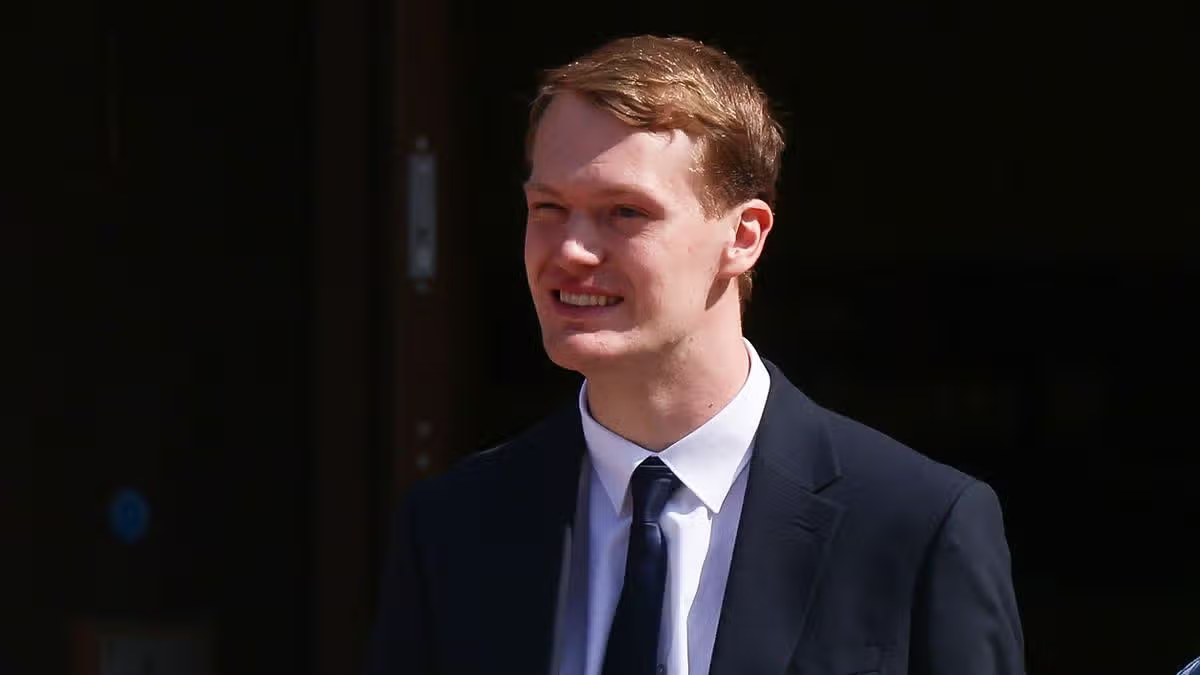
Recorder Cox sentenced Atherton, who wore a blue suit and sported brown hair in the dock, to 18 months in prison, suspended for two years. Atherton will also have to carry out 20 rehabilitation days and 200 hours of unpaid work. The judge also imposed a restraining order preventing him from contacting the victim for five years.
Advertisement
Atherton, who was supported in court by his brother, thanked the judge after being told: “I hope you never come back here again.”
Ed Miliband is angry. Reports that the former Labour leader has been ditched as Andy Burnham‘s chancellor have apparently turned Red Ed a peculiar shade of puce.
‘His office has been preparing to make the move to the Treasury,’ one cabinet source told me, ‘and all the briefing has been that he’s been lined up for the job. If he loses out now he’s going to be really p****d’.
Another source explained: ‘Ed’s spent the best part of a year talking to Andy about his economic strategy. In the past fortnight he’s been the main person in with him and James [Purnell, Burnham’s chief of staff] over putting together a package to reassure the markets.
‘It’s not that he was specifically promised the job. But he basically assumed he was nailed on. So the reports he’s been ditched have made him pretty angry.’
Advertisement
Miliband should curb his ire a little longer. According to sources close to Team Burnham no decision has yet been taken. ‘The choice genuinely hasn’t been made yet,’ one told me. ‘Andy isn’t going to be bounced into anything. Nothing is going to be finalised until he’s inside No 10.’
If the rumours of a U-turn by our incoming prime minister before he’s even entered Downing Street are true, it will presage chaos when it comes to the appointment of his new government.
The role of chancellor is so pivotal, a change of heart would ripple across the whiteboard being used to chart the alterations. ‘There are some roles you can swap in and out pretty painlessly,’ another cabinet minister told me, ‘but Chancellor is too fundamental. If you reverse your decision on that, the whole plan goes out the window.’
Yesterday, people were casting around for reasons for the possible reversal. Some pointed to opposition from the unions, worried that Miliband’s anti-North Sea drilling, net-zero obsession would find its way into the Treasury. Others claim that, having put discreet feelers out to the City, word had been sent back that Miliband’s appointment would push the markets closer to the edge.
Advertisement
Ed Miliband is angry. Reports that the former Labour leader has been ditched as Andy Burnham’s chancellor have apparently turned Red Ed a peculiar shade of puce
But I was presented with a third theory. ‘Andy knows he’s got a woman problem. He can’t chuck out the most senior female politician in the party [Rachel Reeves] from her job, and replace her with a bloke who already had a run out as leader a decade ago. The women in the PLP (Parliamentary Labour Party) won’t put up with it.’
This is why much of the speculation about Reeves’s replacement is now focused on current Home Secretary Shabana Mahmood. Yesterday, Mahmood’s supporters were in overdrive, briefing that she was ‘nailed on’ as Reeves’s replacement. Another told journalists: ‘I won’t steer you away from that.’
Advertisement
But again, the briefings may be a little premature. The other contender for the post, Foreign Secretary Yvette Cooper, has let it be known she would prefer to remain in her current brief.
But I understand that while Mahmood is regarded highly by Burnham and his inner circle, there are some residual concerns over her lack of economic experience.
One thing is clear, though. The recent speculation that both Miliband brothers could be handed major portfolios – with Ed in the Treasury and David Miliband returning, Cameron-like, to run the Foreign Office – is wide of the mark.
As one Burnham ally said: ‘He’s not mad. Having as many men in the great offices of state from the same family as there are women would see him hung by his privates from Big Ben.’
Advertisement
Burnham recognises he is vulnerable on the thorny issue of gender representation on three fronts. First, since its inception in 1900 Labour has had 19 leaders. And when Burnham is formally appointed the 20th on Friday he will also be the 20th white man to hold the position.
The second is what Burnham’s lot acknowledge as ‘The Demon Eyes’ issue. This was the name of the football team he and James Purnell played for during the Blair years. As one minister explained, ‘All the high-profile New Labour boys were on the team. And it was seen as a big clique. The women were all excluded. There’s a danger that No 10 starts to look a bit like the Demon Eyes dressing room.’
Andy Burnham recognises he is vulnerable on the thorny issue of gender representation
The third major problem is the hang-up from the Starmer era. Rightly or wrongly, among Labour’s women a perception has developed that the No 10 operation run by Sir Keir’s former chief of staff Morgan McSweeney developed into a ‘Boys’ Club’ from which women were at best ostracised, at worst the subject of aggressive and negative briefings.
Advertisement
As one MP close to Burnham metaphorically observed, ‘when Andy goes into Downing Street the lads’ mags and cans of Red Bull are going in the bin’.
But Burnham has one difficulty. He is still a man, and he will be squaring off against the Tories’ fourth female leader in Kemi Badenoch. So his strategy for counteracting her inevitable gender jibes is simple. He’s going to pack his cabinet with as many women he can lay his hands on.
Mahmood and Cooper are nailed on for senior roles. As is Rachel Reeves, if she can be persuaded to accept her withdrawal from the Treasury firing line. Lucy Powell, a key ally – and the party’s deputy leader – will replace David Lammy as deputy prime minister.
Louise Haigh, who masterminded Burnham’s leadership coup, will also be rewarded with a plumb position. Although I’m told she will have to watch her back. Other members of Burnham’s inner circle were apparently irritated with her candour at a question and answer session last week, when she admitted she had been in cahoots with the former Greater Manchester mayor about replacing Starmer for at least a year.
Advertisement
She is also in the sights of Starmer’s vengeful former staffers. ‘Morgan [McSweeney] has some stuff on her,’ one told me darkly, ‘and he’s going to wait for the right moment to drop a bomb on her’.
Other women who are said to be in line for significant portfolios are Transport Secretary Heidi Alexander, who worked with Burnham during her time as an adviser for London Mayor Sadiq Khan, and made the politically astute decision to nominate him for all three of his leadership contests.
A place will also be found for Angela Rayner. Though her influence is seen to have waned as a result of her own manoeuvring during the anti-Starmer plotting. As one member of Burnham’s inner circle revealed, ‘Andy thought he had a deal with Angela. Then found out she was working against him behind her back. So he’ll pay his respects to her. But she’s not going to be a major part of his plans moving forward.’
Advertisement
All of this may seem trite and tokenistic. But inside Labour, where tensions are simmering over the party choosing to anoint yet another male leader, the gender balance – or imbalance – of Andy Burnham’s cabinet is regarded as a defining issue.
Which may mean Ed Miliband is ultimately robbed of the role he covets. But that could be the price Labour pays for finally having a leader who at least knows what a woman is.
Britain came close to blackouts during last month’s heatwave – but energy bosses tried to hide it, whistleblowers have claimed.
Tory energy spokesman Claire Coutinho told MPs yesterday that operators said the grid failed to meet necessary standards as temperatures reached 34C on June 23.
She added that they claimed that the Neso (National Energy Systems Operator) corporate affairs team had tried to cover up the crisis.
But energy minister Michael Shanks insisted that electricity supplies were maintained and that no customers lost power.
Advertisement
However, he said that Neso – a government body set up by Energy Secretary Ed Miliband – had now ordered an independent investigation into the claims against it.
In an urgent question, Ms Coutinho told MPs that whistleblowers had warned that the country was close to blackouts.
‘I’ve been approached by multiple whistleblowers within our grid operator,’ she said.
‘The allegations are that first, on June 23, the operator failed to meet the grid security standards put in place to prevent blackouts.
Advertisement
Whistleblowers claim Britain was on brink of shutting down on June 23 during heatwave and that a government body set up by Energy Secretary Ed Miliband had tried to cover up the crisis
‘Second, that the corporate affairs team interfered with operational decisions.
‘That is not something that the minister denied – putting the reputation of the operator above security of supply.
Advertisement
‘And third, that operational decisions are being recorded in live documents with no audit trail. Again, something the minister did not deny.’
She previously accused grid bosses of ‘risking blackouts to protect Neso’s reputation’.
In the run-up to the incident in June, Neso issued an emergency margin call – a request to generators to increase supplies – after forecasting a shortfall.
Government departments were warned about the risk of power cuts.
Advertisement
Mr Shanks said that there had been no blackouts last month and said that there was no kind of ’emergency situation’.
‘Electricity supplies were maintained throughout the June heatwave. No customer demand was disconnected,’ he said.
‘Statutory frequency limits were maintained throughout the whole event, and the largest credible loss that could have occurred was also covered.’
He added that at no point did the country ‘come close to breaching’ the ‘margin’ – the buffer above peak demand.
Advertisement
‘It did not indicate any kind of emergency situation. Demand was met, and those are the facts,’ he added.
He later added that although the electricity demand had been met, ‘I don’t for a second doubt that it was difficult on some of those days, as it was across all of Europe.’
He also said that Neso had instructed a legal firm to conduct an independent investigation into the claims of the whistleblowers.
The report will be delivered to the operator and to regulator Ofgem ‘in the coming weeks’, Mr Shanks said.
Advertisement
But Ms Coutinho dismissed this as a ‘sham’ because there was no guarantee that workers would be granted anonymity.
Her fellow Tory MP Julian Lewis questioned whether the review would be independent because Neso was paying for a law firm to investigate.
Meanwhile, Bill Esterson, the Labour chair of the energy committee, said a director at Neso had told him it was ‘not plausible’ that corporate staff had taken decisions in the control room.
Neso issued its third electricity margin notice of the year last week.
Advertisement
They are the first such notices to be put out in summer and it has issued only two others – both in January last year – since it took charge in October 2024.
Extreme heat puts pressure on the electricity system by making processes less efficient, including generation from nuclear power plants, gas stations and water-cooling systems.
Britain has not suffered a major blackout since 2019 when the Little Barford gas-fired power station in Bedfordshire and the Hornsea windfarm in the North Sea failed at the same time, causing large parts of the grid to automatically shut down.
Joshua Komisarjevsky and Steven Hayes were convicted of killing Jennifer Hawke-Petit and her daughters in the Cheshire home invasion murders on 23 July 2007
One Connecticut family became the target of a horrifying ordeal inside their own home when a brutal killing duo launched a seven-hour rampage of rape, sexual assault and ultimately murder.
Advertisement
Joshua Komisarjevsky and his accomplice, Steven Hayes, were found guilty of murdering Jennifer Hawke-Petit, a nurse, along with her daughters during the terrifying attack on July 23, 2007.
The pair had spotted Jennifer and her daughter at a supermarket and tailed them back to their residence in New Haven, where the family’s harrowing nightmare would begin.
Komisarjevsky memorised their address, returned home to put his own daughter to bed, then came back to the Petit family home in the dead of night while they were sleeping. His original intention was burglary — but this straightforward crime escalated into an act of unspeakable depravity.
The duo subjected the family to hours of torment. They began by beating father William Petit with a baseball bat so severely that he was rendered unconscious as the nightmare unfolded around him, reports the Express US.
Advertisement
His two daughters, 17-year-old Hayley and 11-year-old Michaela, were bound, and Jennifer was compelled to withdraw $15,000 from a bank account after the depraved pair escorted her to a local branch.
Hayes raped and strangled Jennifer, while Komisarjevsky sexually assaulted her 11-year-old daughter, Michaela. Michaela and her 17-year-old sister, Hayley, were tied to their beds and succumbed to smoke inhalation after the house was doused in petrol and set ablaze.
Both Hayley and Jennifer were sexually assaulted, according to Vocal Media. The entire nightmare lasted seven hours.
Advertisement
Jennifer even managed to discreetly alert their bank, who then notified authorities the family was being held hostage, but by that point Komisarjevsky and Hayes had escalated their crimes into a full-blown nightmare. One detective described the crime scene as something that “never leaves your mind.”
The intruders doused the house in accelerant before setting it ablaze. Miraculously, William Petit, the father, managed to survive.
The doctor had been beaten, bound and dragged to the basement, where he drifted in and out of consciousness for several hours.
He managed to break free and crawl to a neighbour’s house to raise the alarm, but was unable to save his two daughters or his wife.
Advertisement
Petit campaigned to retain the death penalty in Connecticut, successfully lobbying state senators to delay repeal legislation while Komisarjevsky was still facing a capital punishment trial.
“July 23, 2007, was our personal holocaust,” Petit said following Komisarjevsky’s death sentence, referring to the day his family was murdered. “A holocaust caused by two who are completely evil and actually do not comprehend what they have done.”
Hayley endured horrific final moments after managing to free herself from her restraints, before collapsing from smoke inhalation. Michaela never made it out of her room.
The killers tried to flee in the Petit family’s car, but were arrested by police almost immediately. Komisarjevsky has since said he considers volunteering to be executed on his darkest days.
Advertisement
In the past 50 years, Connecticut has carried out only one execution — a serial killer who was put to death in 2005 after voluntarily waiving his right to appeal.
“I don’t think I’ll be executed against my will,” Komisarjevsky said in his first interview since his conviction the previous year. “I think if I volunteer, the state will execute me.
“I guess my reaction is not the reaction society expected,” Komisarjevsky said.
Cynthia Hawke-Renn, the sister and aunt of the victims, told NBC she had not anticipated any apology from the killer, according to ABC.
Advertisement
“He doesn’t have nightmares, but I have nightmares and I can’t stop thinking about it,” she said. “I wish I could. And I think it’s really sad that he doesn’t have a conscience and have remorse and apologize to my brother-in-law or my parents.”
Komisarjevsky now passes his days in solitary confinement by drawing, watching television, reading, and responding to both hate mail and letters from supporters.
“Some days you’re just overwhelmed by the isolation and the difficulties in communicating with loved ones, dealing with your own crisis of conscience,” Komisarjevsky said.
Connecticut Governor Dannel P. Malloy signed legislation abolishing the state’s death penalty for future crimes, though the new law does not apply to those already on death row.
Advertisement
“In order for some to swallow this bitter pill, it was inevitable that we would be left out,” Komisarjevsky said.

















































You must be logged in to post a comment Login