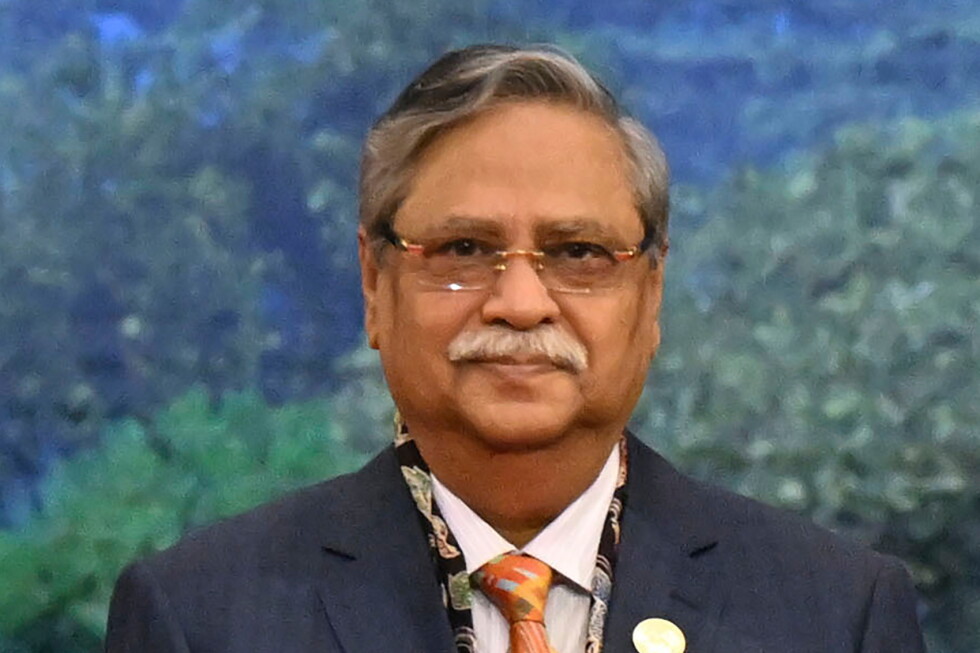
DHAKA, Bangladesh (AP) — Bangladesh’s President Mohammed Shahabuddin, appointed during the rule of ousted Prime Minister Sheikh Hasina, resigned Friday halfway through his term following years of political turbulence in the South Asian country.
A new government headed by Tarique Rahman, the son of former Prime Minister Khaleda Zia and Hasina’s archrival, came to power with a landslide victory in February after 18 months of interim rule under Nobel Peace Prize laureate Muhammad Yunus. Hasina stepped down and fled to India in August 2024 following an anti-government movement that ended her 15-year rule.
Hasina fiercely criticized the interim administration led by Yunus.
Shahabuddin submitted his resignation on Friday to Parliament Speaker Hafiz Uddin Ahmad, citing medical reasons. The resignation letter was seen by The Associated Press. The speaker told a news briefing later on Friday that he accepted the resignation.
Advertisement
But local media reported that Shahabuddin had to resign under pressure from the current government as he allegedly talked to Hasina by phone when he visited London for medical treatment in May. The AP could not confirm the incident independently.
Shahabuddin was known to be a trusted follower of Hasina. Following her ouster, he faced strong opposition from a student group that led the uprising against Hasina. The protesters branded him a collaborator of Hasina and took to the streets demanding his resignation and arrest.
A new political party formed by the student leaders of the uprising, the National Citizen Party, has long been campaigning against Shahabuddin.
According to Bangladesh’s constitution, if the president resigns, the speaker of Parliament automatically takes over the post on an interim basis until a new president is elected by lawmakers. The NCP joined an election alliance led by the Bangladesh Jamaat-e-Islami party, the largest Islamist party in the country.
Advertisement
The president is the head of state and primarily a figurehead but also has a constitutional role during a political crisis. The president also acts as the commander-in-chief of Bangladesh’s armed forces.
Shahabuddin was sworn in as the 22nd president of Bangladesh on April 24, 2023. Hasina won a fourth consecutive term in a January 2024 election that was boycotted by major opposition parties including Rahman’s Bangladesh Nationalist Party and Jamaat-e-Islami.
Advertisement
Sign up for Morning Wire:
Our flagship newsletter breaks down the biggest headlines of the day.
Advertisement
Shahabuddin’s resignation has deprived Hasina of a powerful ally. The ousted prime minister has told mainly Indian media that she wants to return to Bangladesh in December and surrender in court to face charges.
India refused to hand over Hasina to Bangladesh despite repeated requests by both the Yunus-led government and the current one.
In November, a special tribunal on Bangladesh sentenced Hasina to death in absentia for ordering a crackdown on the uprising. The United Nations in a report said nearly 1,400 people were killed in the crackdown. Hasina denied the charges against her from exile.
How do you tell if a sports bra is the wrong size?
One of the biggest mistakes shoppers make is assuming that if a sports bra feels tight, that’s enough. In reality, support comes from the right fit rather than simply compressing your chest.
Cardwell advises thoroughly testing a sports bra by moving in it in the same way as you will during the sport you will be doing. “Your breasts don’t just move up and down,” she says. “They move all around – circles, up, down, left, right. We want to try and restrict that as much as possible, but not to the extreme where you’re not able to breathe.”
What is a high impact sports bra?
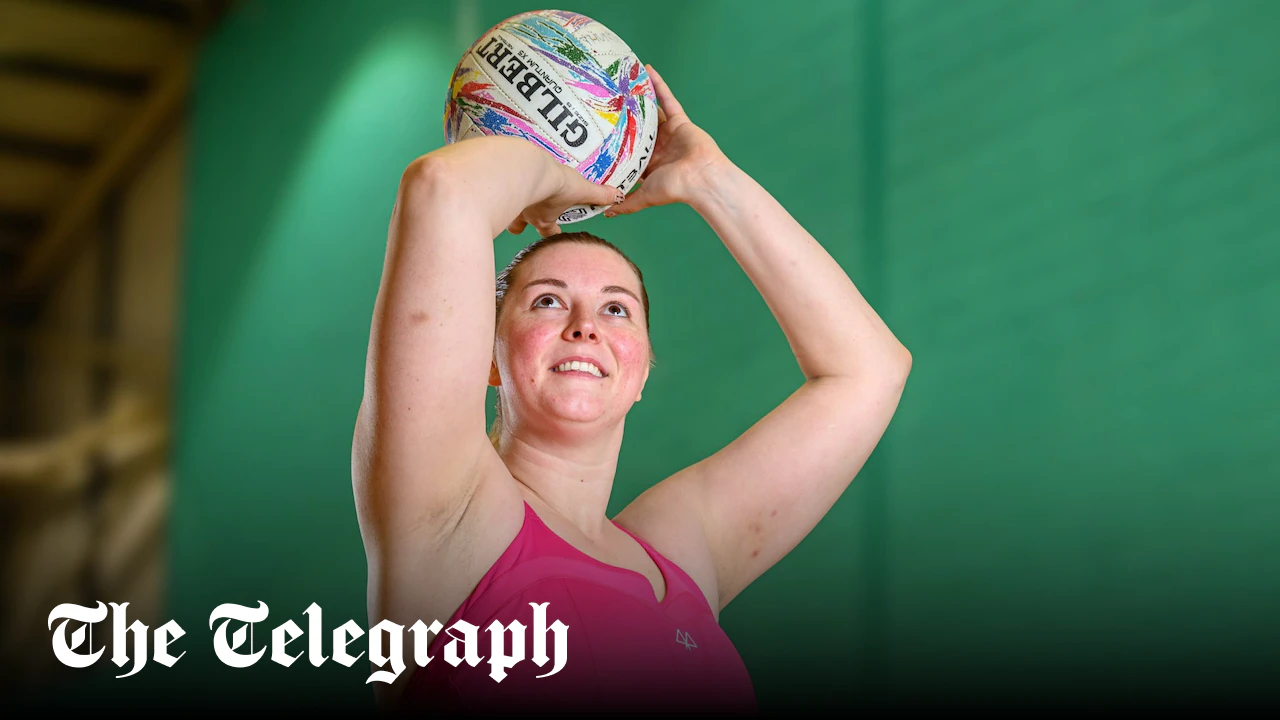
High-impact sports bras are designed for activities where your breasts experience the greatest movement, such as running, HIIT, tennis and netball. Their job is to minimise breast movement in every direction, helping reduce discomfort while allowing you to move more efficiently.
Advertisement
To measure how high-impact a sports bra is, Wakefield-Scurr asks women to run in a laboratory, both without a bra and while wearing different sports bras. “For a bra to be classed as high support, it has to reduce breast movement above certain thresholds,” she says. “If your breasts move 10 centimetres without a bra and five centimetres in a sports bra, that bra has reduced breast movement by 50 per cent.”
In the lab, Wakefield-Scurr and her team found that “if you run in low support compared with high support, you reduce your stride length by four centimetres. Four centimetres might not sound like a lot, but over the course of a marathon, those four centimetres add up to around a mile.” This proves that wearing a high-support bra doesn’t just keep you comfortable, but it can improve your athletic performance.
Cardwell, who wears a double G cup, says high-impact support has improved dramatically in recent years. “There has been a lot more research into high-impact sports bras, especially for larger-chested women.” She also warns against assuming that every sports bra offers the same level of support. “If it’s the same material as a smaller cup size, it’s probably not going to be sufficient for someone like me with double Gs.”
How often should you replace your sports bra?
There’s no set rule for replacing a sports bra, according to Wakefield-Scurr. This is because its lifespan depends more on how you care for it than how often you wear it. “The lifespan of a sports bra is affected more by how you wash and dry it than by how often you wear it,” she says. In one of her team’s studies, support dropped by around a third after 25 washes. “Always follow the washing instructions,” she advises. “You’d be surprised how many sports bras should be hand washed or washed at a lower temperature.”
Advertisement
Looking after your sports bra properly will help it last longer, but no bra lasts forever. Once the underband loses its elasticity or the support noticeably decreases, it’s time to replace it to ensure you have the right level of support.
SPØTTRUP, Denmark (AP) — With swords, axes and shields, competitors from 30 countries are going head-to-head in the grounds of a Danish fortress in a modern version of old-fashioned battle.
The International Medieval Combat Federation’s annual world championship roared into gear in northern Denmark this week. First staged in Spain in 2014, it features armor-clad competitors fighting with 14th-century medieval weapons. But it’s also a modern combat sport with safety rules and sporting conventions.
A mixture of historical and modern techniques
“It’s historically inspired,” combat federation spokesperson Kamila Studencka said. “It’s a mix of modern techniques with historical ones. We have something between full combat sports and fencing.”
And while the swords and axes are blunted, the battles are anything but harmless reenactments. Studencka said some competitors are attracted by “the violence,” while others prefer the technical aspects of face-to-face duels.
Advertisement
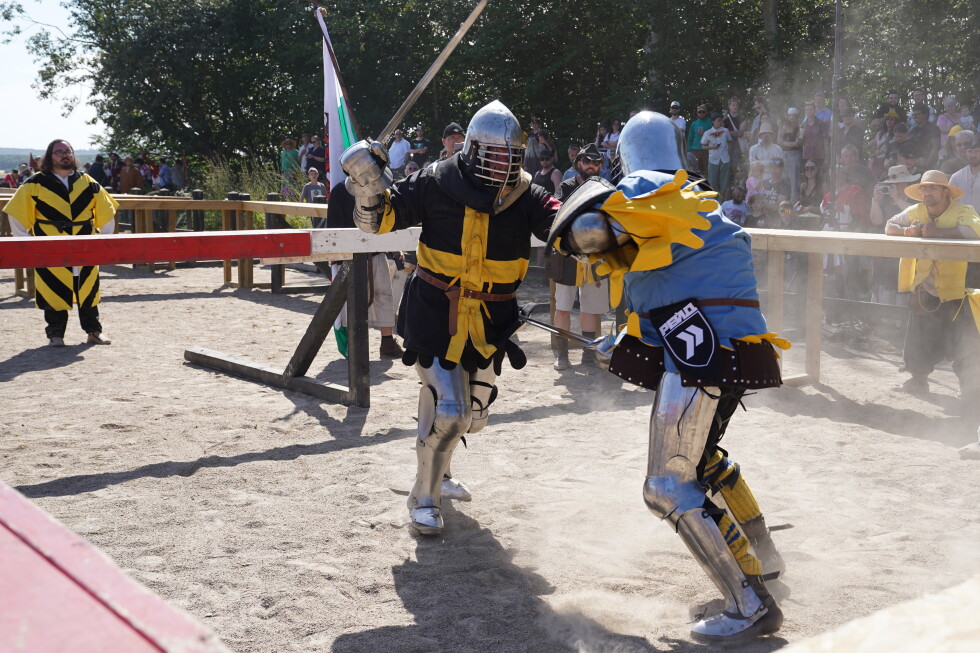
Two fighters battle during the International Medieval Combat Federation’s World Championship at Spottrup Castle, in Spottrup, Denmark, Thursday, July 23, 2026. (AP Photo/James Brooks)
Advertisement
Two fighters battle during the International Medieval Combat Federation’s World Championship at Spottrup Castle, in Spottrup, Denmark, Thursday, July 23, 2026. (AP Photo/James Brooks)
Advertisement
Advertisement
Advertisement
Advertisement
“Some people like the friendship and being a team member … to be a part of something bigger,” she added.
This year’s championship is being held in the shadow of Spøttrup Castle, a formidable Danish fortress that was completed around 1520.
The event has drawn fighters from 30 countries, including the United States, Canada, China, and Brazil.
Brazilian competitor Rodrigo Sinckevicius, who traveled with a team of eight from São Paulo, said he previously competed in jiu-jitsu and other mixed martial arts, but when he first saw this kind of medieval combat, he “couldn’t believe it.”
Advertisement
“People falling and grabbing and the sound of the steel cracking, it’s like something that you cannot fake,” added the 33-year-old, who works in sales back home.
Duels and team events
The four-day championships, which opened Thursday, see competitors battle in one-on-one “duels” made up of two one-minute rounds each. Opponents are eliminated after hitting the ground three times or when they submit. If neither happens, marshals declare a winner based on points scored.
There are also chaotic mass-team events, known as “Buhurt,” in which up to 10 competitors on either side participate.
Martin Gill, from Milton Keynes, England, said he first got involved “to hit someone in the face with an ax.”
Advertisement
Sign up for Morning Wire:
Our flagship newsletter breaks down the biggest headlines of the day.
Advertisement
“This had that kind of niche appeal to it, that people were willing to consensually come up and say, ‘You can hit me in the face with the ax, as hard as you can,’” the 37-year-old geotechnical engineer said.
“This had that kind of niche appeal to it, that people were willing to consensually come up and say, ‘You can hit me in the face with the ax, as hard as you can,’”
Martin Gill, participant from Milton Keynes
Advertisement
The IMCF says fighters wear thick, shock-absorbing padded garments beneath the armor to distribute the force of impact, and that fights are strictly controlled by trained marshals who enforce the rules of engagement. It says that overall injury rates are comparable to those in mainstream full-contact martial arts.
Advertisement
Two fighters battle during the International Medieval Combat Federation’s World Championship at Spottrup Castle, in Spottrup, Denmark, Thursday, July 23, 2026. (AP Photo/James Brooks)
Advertisement
Two fighters battle during the International Medieval Combat Federation’s World Championship at Spottrup Castle, in Spottrup, Denmark, Thursday, July 23, 2026. (AP Photo/James Brooks)
Advertisement
Advertisement
Advertisement
Gill said almost everything the competitors wear, including his 30-kilogram (66-pound) suit of armor, is historically accurate. Some outfits and fighting techniques are informed by the writings of 14th-century Italian knight Fiore Dei Liberi and German fencing master Johannes Liechtenauer.
Advertisement
“We follow manuscripts as best we can,” said Gill. “Everything is legitimate techniques from all of their writings throughout the 14th century.”
A growing sport
Nearly 600 fighters are taking part in this week’s championship. The sport, an unflinching blend of mixed martial arts, fencing, and historical reenactment, has been growing in popularity.
Competitor Alex King, a 37-year-old financial crime specialist from Shoreview, Minnesota, said that when he first started three years ago, there were just 10 or so members in his local team. Now there are over 50.
“In America, it’s definitely growing, with the short videos you see now highlighting the sport,” King said. “A lot of people have become interested.”
Advertisement
A marshal checks a fighter following a battle at the International Medieval Combat Federation’s World Championship at Spottrup Castle, in Spottrup, Denmark, Thursday, July 23, 2026. (AP Photo/James Brooks)
Advertisement
A marshal checks a fighter following a battle at the International Medieval Combat Federation’s World Championship at Spottrup Castle, in Spottrup, Denmark, Thursday, July 23, 2026. (AP Photo/James Brooks)
Advertisement
Advertisement
Advertisement
The last big event in the U.S. featured over 40 teams, he added.
Advertisement
Men and women compete in separate events. Miisa Kaivos, a 27-year-old bartender from Helsinki, Finland, said the women’s side of the sport is also “drastically growing all around the world.”
“It’s amazing to see,” said Kaivos. “It’s always nice to come to these events and fight each other, and have that awesome girl power.”
Participants from across the globe drew swords as medieval combat contest roared into life at a castle in northern Denmark. First staged in Spain in 2014, the International Medieval Combat Federation’s annual world championship features armor-clad competitors fighting with 14th-century medieval weapons. (AP video shot by: James Brooks)
Earlier this week two firefighters died tackling a fire close to the airport
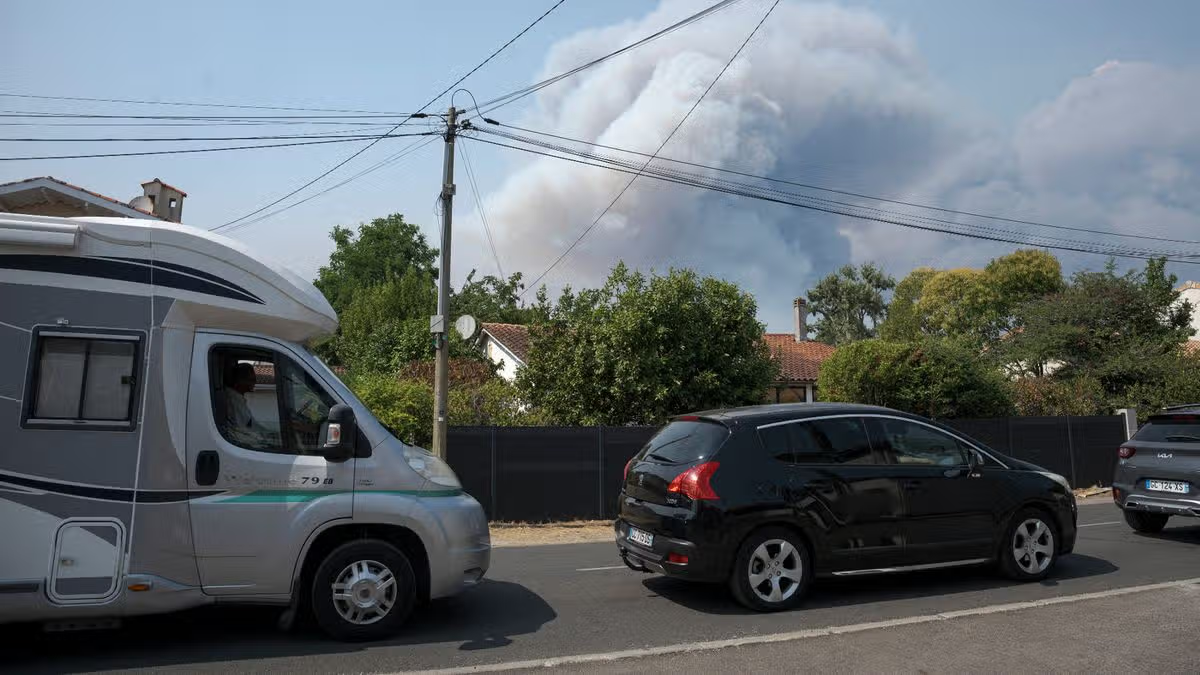
Bordeaux Airport has issued an update for passengers as wildfires blaze in south-west France and Spain, resulting in the evacuation of around 200,000 people.
Bordeaux Airport has issued an update to passengers. It states: “Airport operations are still ongoing. Bus and tram service has been suspended. No trams or buses between Mérignac Soleil and the airport.”
Click here to get the biggest stories straight to your inbox in our Daily Newsletter
easyJet flies from Manchester Airport to Bordeaux four times a week in summer, on Sundays, Mondays, Wednesdays and Fridays. The next flight is expected to depart Manchester tomorrow evening at 6.05pm.
Advertisement
Earlier this week it was announced that two firefighters died while battling a huge blaze near the airport. On Tuesday, July 21, around 100 firefighters reportedly battled a blaze near one of airport’s car parks, which spread to a building after originating from a brush fire, BBC News reports.
Officials announced that two of the fire fighters had died. On July 22, Bordeaux Airport issued the following statement on social media: “Yesterday, in the face of the fire that occurred near the airport, Bordeaux Airport would like to acknowledge the commitment and courage of the firefighters from the SSLIA of the platform, the SDIS and all the services mobilized to protect people, infrastructure and the environment. We would like to express our deepest gratitude to them.
“Today, the entire airport community extends its sincerest condolences to the families, loved ones and colleagues of the two SDIS firefighters from Gironde who died in the line of duty and wants to pay tribute to their dedication and daily commitment to serving everyone.”
Advertisement
According to FlightRadar24, only two flights have been cancelled from Bordeaux Airport today. These were the 7.15am easyJet flight U21863 to Hurghada, and the 9.20am Air France flight AF7653 to Nice.
On Friday, July 24, the UK Foreign Office issued an update for Brits in, or travelling to the region, It stated: “Wildfires are affecting parts of Gironde, including areas around Saumos, Le Porge and Lège-Cap-Ferret, where French authorities have evacuated campsites, tourist accommodation and some residential areas. A separate wildfire is also affecting parts of Landes, including Biscarrosse and surrounding areas.
“Access to affected areas may be restricted and roads may close at short notice. If you are in the area or planning to travel there, follow the advice of local authorities, monitor local media, and check with your accommodation or travel provider before travelling. “
It added: “If you are affected by a wildfire or other emergency, call 18 (fire service) or 112 (emergency services).”
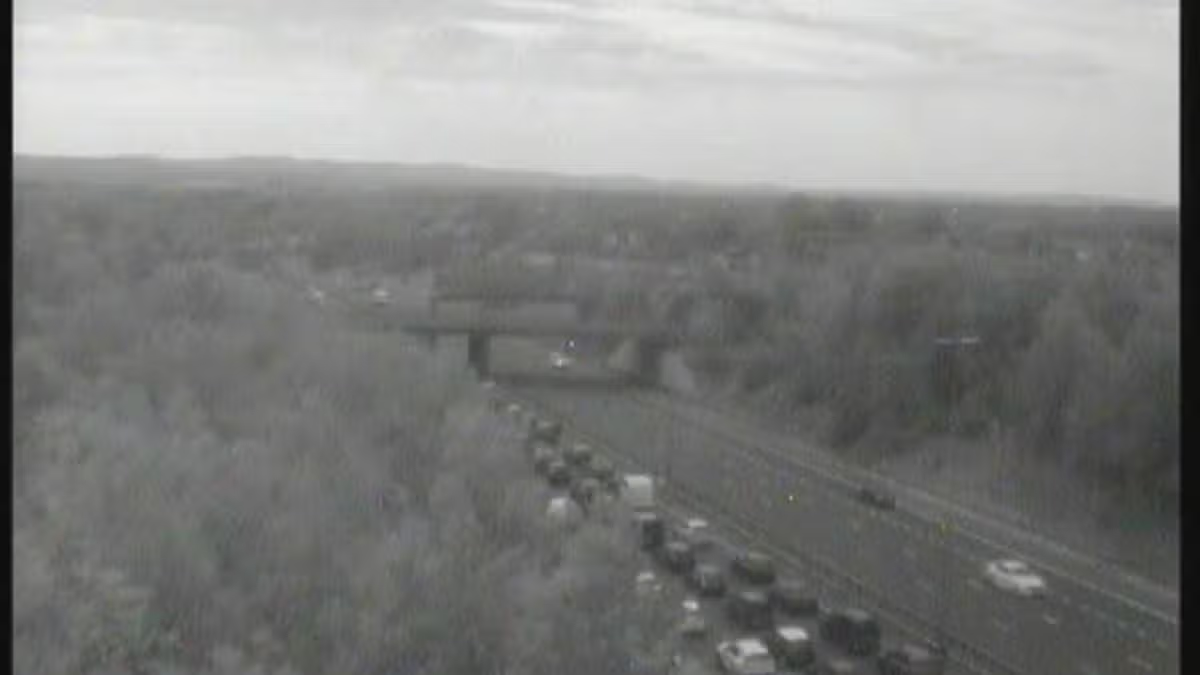
All traffic is being held on the M60 this morning (July 25) as Greater Manchester Police respond to an incident.
Traffic service Inrix first noted the incident at 10:50am today as an ‘obstruction’ on the clockwise carriageway between junction 22 (Failsworth) and junction 23 (Ashton-under-Lyne).
In an update at 11:20am National Highways confirmed that the carriageway was shut due to a ‘police-led incident’ with Greater Manchester Police ‘leading’ at the scene.
Advertisement
Click here to get the biggest stories straight to your inbox in our Daily Newsletter
There are delays of around 45 minutes and three miles of congestion on approach, the service said.
Iran‘s new Supreme Leader is far more willing to pursue a nuclear bomb than his late father, US intelligence agencies believe.
It is a dramatic shift that sharpens the stakes as President Trump weighs fresh and bigger military action.
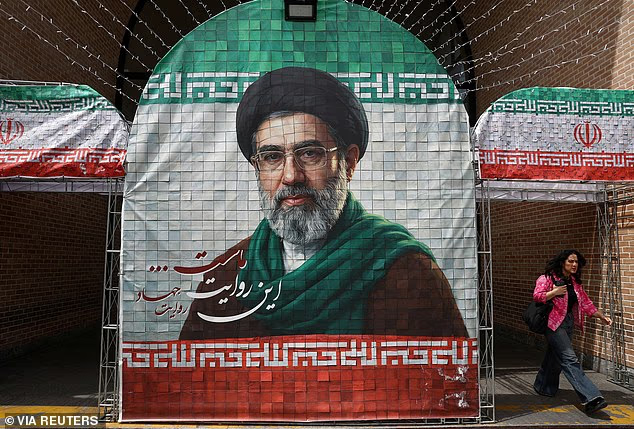
Ayatollah Mojtaba Khamenei took power after his father, longtime leader Ayatollah Ali Khamenei, was killed earlier in the conflict in an Israeli strike reportedly backed by US intelligence.
For years American officials judged Ali Khamenei’s religious ban on nuclear arms to be genuine, even as Tehran quietly expanded its nuclear infrastructure and preserved the option to build a weapon if it chose.
Advertisement
His son, officials now believe, is taking a harder line. Mojtaba has never publicly called for a bomb, but intelligence assessments reportedly show he has fewer ideological qualms about weaponization and may back a more advanced arsenal, according to The New York Times.
The shift could bolster the case for further strikes. Officials say the new intelligence would strengthen Trump’s hand if Washington concludes Tehran is edging toward a political decision to build a weapon.
For now, Iran has not restarted enrichment or resumed weapons work since last year’s US airstrikes, which inflicted major damage. Instead, Tehran appears focused on salvaging what remains, above all the heavily fortified underground complex known as Pickaxe Mountain.
Advertisement
Although Ayatollah Mojtaba Khamenei has never publicly called for Iran to build a bomb, intelligence assessments reportedly indicate he has fewer ideological objections to weaponization than his father and may support developing a more advanced nuclear arsenal
Although the late Ali Khamenei issued a religious fatwa banning the use of nuclear weapons, the decree did not prevent Iran from developing much of the technology needed to produce one
Trump had declared the 2025 strikes on Iran’s nuclear facilities had obliterated its nuclear program. However, early intelligence assessments reportedly found the damage, while significant, had likely delayed the program by only several months rather than destroying it completely
US officials say Iran has already moved at least some centrifuges into the facility, which burrows deep beneath a mountain in central Iran and is thought to lie beyond the reach of America’s most powerful conventional bunker-busters.
Advertisement
Israeli intelligence reportedly tracked the equipment, though Washington believes the goal is to shield critical assets, not restart enrichment. Tehran has poured extra ground forces around the site, amid fears the US could attempt a commando raid rather than rely on airstrikes alone.
That fear is grounded in what happened in June 2025, when Trump ordered strikes on Iran’s three most important nuclear sites. B-2 stealth bombers dropped massive bunker-busters on Fordo and Natanz, while Tomahawk missiles hit Isfahan. Trump declared Iran’s program obliterated.
His own spy agencies reportedly disagreed, finding the damage had set the program back only months, not destroyed it.
The delay stretched longer only because Iran chose not to rebuild or restart enrichment elsewhere. Crucially, its stockpile of highly enriched uranium survived intact, leaving much of the raw material for a bomb within reach should Tehran decide to move.
Advertisement
Intelligence on Mojtaba Khamenei’s intentions comes with heavy caveats. Much of it predates the current fighting.
The new Supreme Leader was reportedly wounded early in the war and has all but vanished from public view, nursing his injuries and wary of becoming the next airstrike target.
Officials also doubt he yet commands the authority his father wielded over three decades.
What they do believe is that his nuclear appetite runs further than his father’s. Where earlier intelligence suggested Iran had explored a crude, World War II-style device, Mojtaba is thought to favour sophisticated warheads small enough to sit atop long-range missiles.
Advertisement
Ali Khamenei’s fatwa banning nuclear weapons never stopped Iran mastering the technology to build one, and hardliners long argued Tehran should be able to assemble a bomb at speed if it had to.
Officials now warn the war may have handed those hawks their strongest argument yet: that only a credible nuclear deterrent can deter future strikes or another push to topple the regime.
If they are right, a campaign meant to end Iran’s nuclear ambitions may have done the opposite, sharpening its appetite for the very weapon Washington has spent decades trying to deny it.
Per the NHS, it can be caused by everything from strains and twists during exercise to conditions like osteoarthritis (knee osteoarthritis seems to be the most common form of the disease).
According to Dr Syed Nadeem Abbas, a surgeon and regenerative medicine expert from the Knee Pain Clinic, “most knee pain [among over-40s] comes down to wear and tear, and that’s still the most likely explanation.”
However, he says one type of knee pain should always be investigated.
Advertisement
Speak to your doctor about night knee pain
“What tends to get missed is pain that doesn’t follow the usual rules, pain that’s worse at rest than at activity, or wakes someone up at night rather than settling,” the expert said.
“That’s the pattern I’d always want checked properly rather than put down to getting older, because catching anything unusual early makes a real difference to the outcome.”
Knee pain caused by osteoarthritis or overuse tends to ease off at rest, he added.
Advertisement
But issues that get worse at night might very rarely be caused by a bone tumour, he added – indeed the NHS said a possible symptom of bone cancer is if “pain or tenderness in a bone, particularly if it’s worse at night”.
Chondrosarcoma, the most common type of primary bone cancer, is known to affect adults over 40, the surgeon added.
Of course, these symptoms aren’t limited to your knee: common sites include the pelvis (hip), rib cage, arms, shoulder blades, and other parts of your leg.
Why else might I have knee pain at night?
Advertisement
It’s important to remember that primary bone cancer is very uncommon – about 550 people in the UK face it yearly.
Other conditions which can cause nighttime knee pain include:
Dr Abbas added that even vitamin D deficiency might cause unexpected knee pain.
But as orthopaedic surgeon Dr Kim Stearns also told the clinic, “People with healthy knees usually don’t get pain at night. There’s typically a reason, and it can be caused by several conditions.”
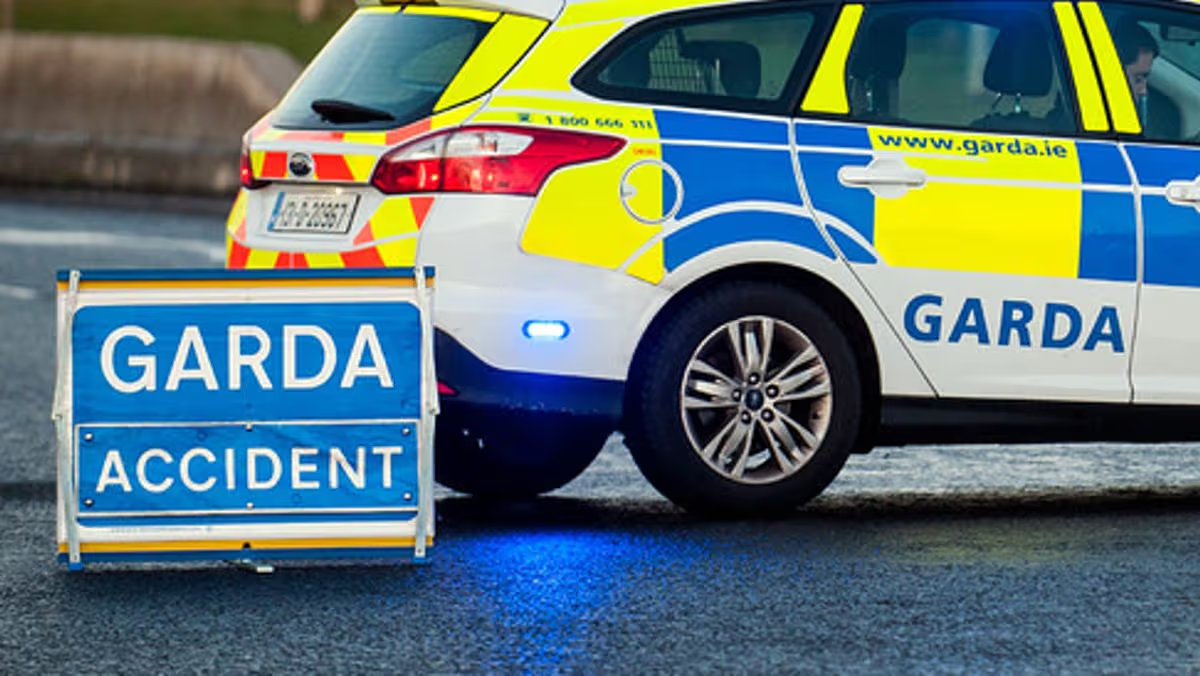
LONDON (AP) — An Irish law student was charged Friday with possessing explosives after being arrested with what police called an “extremely significant” car bomb they intercepted near the Northern Ireland border during an investigation of dissident republicans.
Isobella Perrie Sullivan, 25, was stopped while driving Wednesday on a highway near Carrickmacross, County Monaghan, police said. They discovered plastic explosives and a detonator in a bag in the back of the car.
“What we found was an extremely significant seizure,” Garda Commissioner Justin Kelly said. “This was an explosive device.”
An Irish military bomb disposal team was called to examine the car, though no details were provided on how they disposed of the ordnance.
Advertisement
Defense lawyer Gavin Booth said Sullivan had been manipulated and was unaware of the contents of a bag she was asked to take to the north. She was freed on 15,000 euro ($17,054) bail after her appearance in Trim District Court.
While it’s unclear where the car was headed, there have been two car bomb incidents this year in Northern Ireland that police have blamed on dissident republicans, including one that exploded outside a police station on the outskirts of Belfast in April. No one was injured and an earlier attempted bombing at a police station was thwarted by officers who detonated the bomb in a controlled explosion.
The incidents are reminders of the decades of violence known as “The Troubles.” The conflict involving Irish Republican and British Loyalist militants and U.K. security forces left almost 3,600 people dead before the 1998 Good Friday peace accord.
“We certainly know that there are a small minority of dissident republicans who did not agree with the Good Friday Agreement,” Kelly said. “There’s a small minority of these individuals, I would describe them as radicalized republicans, and this is a threat that we’re going to continue to face for some time.”
Advertisement
Republicans want to reunify Ireland by ending British rule of Northern Ireland.
Police requested as a condition of release that Sullivan not contact anyone with Saoradh, the Irish republican revolutionary party, or the New Irish Republican Army.
The brother of Madeleine McCann is set to swim for Commonwealth gold today, some two decades after his older sister vanished.
Sean McCann, 21, took to the pool in Glasgow for the 400m freestyle heats this morning in his major competition debut.
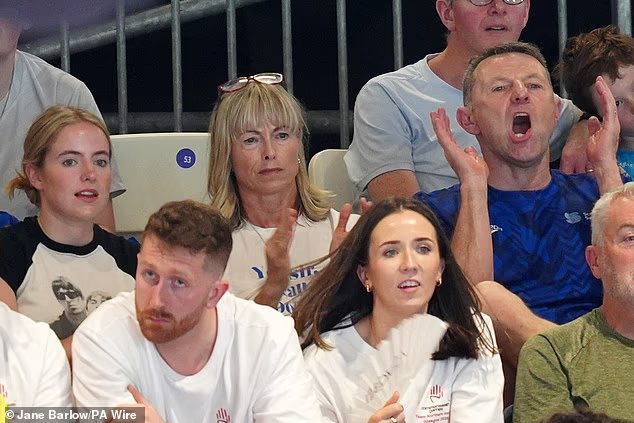
His parents Kate and Gerry and twin sister Amelie looked on proudly as they arrived early on Saturday morning to cheer on their son – and the rest of the Scotland team.
Sean hoped to use the home crowd behind him to progress to the final tonight, ahead of his other events later this week, the 800m and 1500m freestyle.
Advertisement
Almost two decades on from the infamous Portugal family holiday which saw Madeleine abducted, the McCann family’s unimaginable tragedy still haunts Sean and his twin sister, Amelie, wherever they go.
But today, the family could finally see themselves talked about for a different reason as their son’s remarkable story takes centre-stage.
Sean’s mother Kate has previously told how he ‘hated’ the water when he was first taken swimming – and yet he soon found his drive, attending up to nine two-hour training sessions every week, many requiring 4am starts.
Inspired by his sporting family – Kate and father Gerry even went on a run on their first date – Sean’s dedication has paid off as he sets his sights on success in his first major international meet.
Advertisement
Sean came fourth in his heat and was cheered on today by both parents, as well as his sister Amelie, who herself competes regularly in triathlons.
Amelie, Kate and Gerry McCann in the stands cheering on their son and brother Sean McCann at today’s Commonwealth Games swimming heats
The family sat with other Scottish fans as they supported Sean at a home Commonwealth Games
Advertisement
Scotland’s Sean McCann competes in the Men’s 400m Freestyle heats during the swimming event at the Tollcross International Swimming Centre in Glasgow
Sean McCann of Scotland goes through his final preparations before the race
He is the younger brother of missing Madeleine McCann and was in the room when she was abducted from her family’s holiday villa in Portugal in 2007
The elite distance swimmer is eligible to represent Scotland through his father, who was born in Glasgow.
Advertisement
This week a former member of Sean’s coaching team told the Daily Mail that the combination of a young man who was ‘really driven and never one to take the easiest route’, and parents who willed him on, had made him a powerhouse and his story an inspiration.
In his teenage years Sean’s parents would ferry him to training sessions at Braunstone Leisure Centre, a 20-minute drive from the family home in Rothley, Leicestershire, where he would clock up eight or nine two-hour swim sessions a week, plus two or three punishing gym workouts.
Kate and Gerry ‘encouraged their children, but didn’t push them’ said the insider, who coached Sean as a youngster.
He remembered the young man being focused on the Commonwealth Youth Games in Trinidad in 2023 and then deciding he wanted to race for Scotland and for GB in open-water events – so for swimming competitively he changed his nationality to Scottish.
Advertisement
‘For the Commonwealth Games, I was lucky enough to be at the trials in London when he was racing. It was great to watch him and talk to him between prep, to be a part of it and see his journey unfold,’ he said.
What a journey, too, for Sean, who is studying chemical engineering at Loughborough University – chosen for its unrivalled sports facilities.
Distance swimming is an unforgiving sport. Yet those who know Sean’s career describe a steady, determined progression, even during the pandemic lockdown when he would train out of the pool, at home with Amelie, who is also a keen swimmer.
Sean McCann, 21, after finishing fourth in his heat of the 400m freestyle – he will go later this week in the 800m and 1500m
Advertisement
McCann dives from the starting block at the beginning of his heat at the Tollcross International Swimming Centre
Amelie, Kate and Gerry McCann applaud as they watch the programme at Glasgow’s Commonwealth Games on Saturday morning
Amelie, Kate and Gerry McCann in the stands at Tollcross International Swimming Centre in Glasgow ahead of Sean’s heat on Saturday morning
The family were in the stands early on Saturday to support the rest of Britain’s swimmers before their son takes to the pool
Advertisement
For almost two decades Kate and Gerry McCann have been known as the parents of missing Madeleine, (bottom right) the toddler who disappeared on a family holiday to Praia da Luz, Portugal, in May 2007 – now the family will be known for something else
In the 2023 Commonwealth Youth Games, he reached the finals of the 400m and 1500m freestyle, and has since qualified for the European Open Water Championships representing Great Britain.
Sean himself said this week that he was ‘very excited’ about the challenges ahead. ‘It’s the pinnacle really – of representing Scotland in the Commonwealth Games, and especially at a home games.
‘I’ve got lots of family up in Glasgow so that makes it even more special. I was there in 2014 watching as a kid, so to make it now, 12 years later, is really a full circle moment.
Advertisement
‘It’s my first senior games, so I’m just looking forward to be representing Scotland and doing my absolute best. I always tend to go out quite slow and build my way into a race. That’s just how I like to pace it.’
It’s quite the change from what Sean has been known for by many until now, solely for his close proximity to Madeleine’s disappearance.
He was, after all, in the same room when she was abducted from the family’s holiday apartment in Praia da Luz in 2007 when he was just two.
Although he might not remember the international fallout, both siblings have grown up in the shadow of the mystery surrounding their older sister, who would now be 23.
Advertisement
For Sean, and by extension his whole family, this is his opportunity to step into the light of something new.
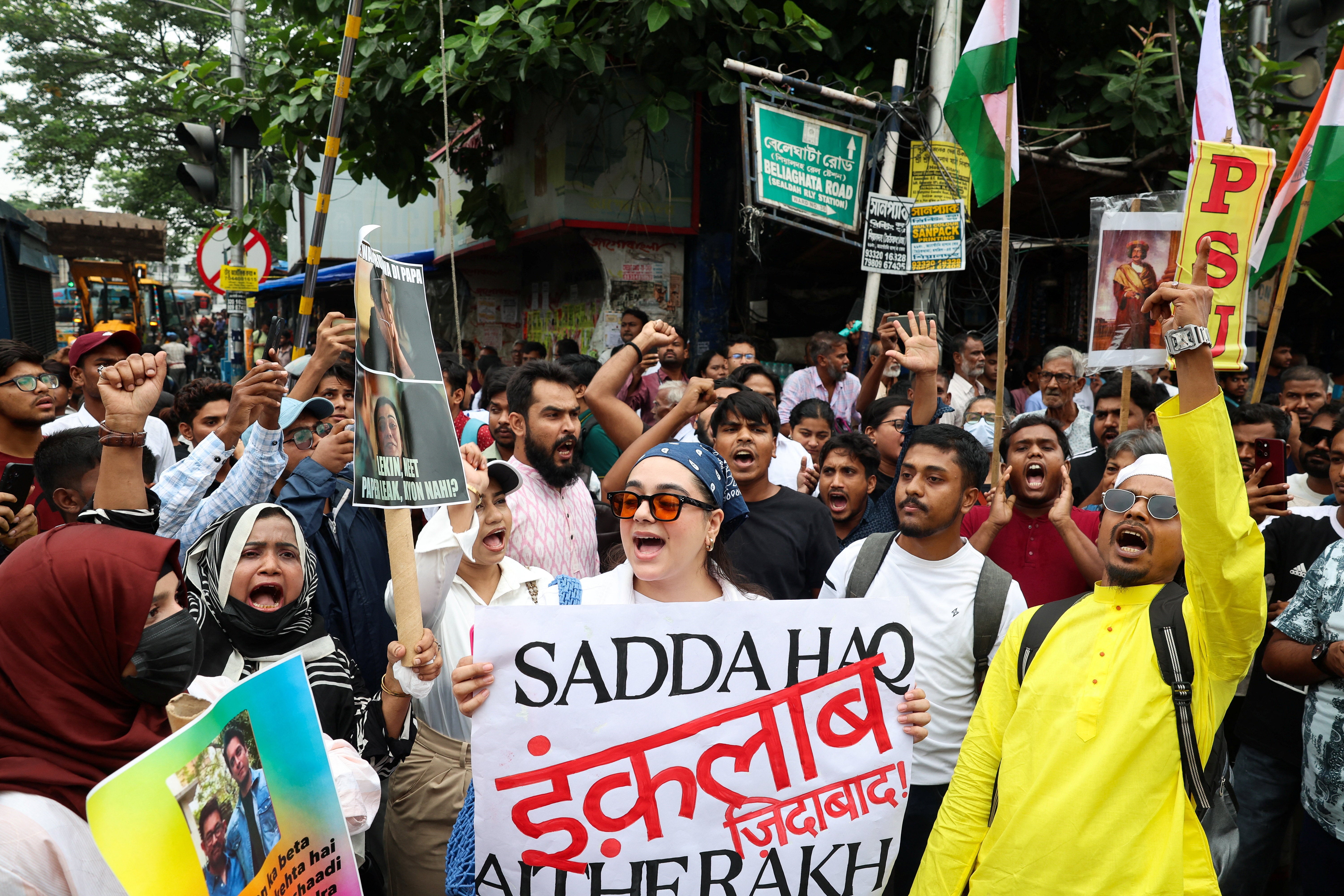
It is well past midnight at Jantar Mantar, and the crowd shows no sign of thinning. Music drifts across the humid air, tabla beats mixing with snatches of Bollywood songs, as new arrivals keep streaming in on foot — students, labourers, parents — even at this hour.
Somewhere near the stage, a spokesperson is trying, and failing, to keep the swelling numbers from tipping into a stampede. On walls near the protest site, fresh graffiti is still wet. “Modiji, return us our bad days,” one pleads, a jab at the prime minister’s campaign slogan “Achhe Din”, the promised good days that many say never came.
In the crowd is Mohan Yadav, 43, a man who doesn’t fit the profile that the government’s supporters imagine when they picture these protests. He is not, he insists, an opposition plant, or a professional agitator. He voted for Narendra Modi’s BJP party. He voted for its ally Nitish Kumar in Bihar state. Yet, he’s standing at Jantar Mantar, trying to explain why the government he once trusted has, in his eyes, turned on people like him.
“I have a son and a daughter,” he says. “And I can understand that pain of a parent. Because I know how much sacrifice it takes to raise a child and then to lose them like this.”
Advertisement
He is far from alone.
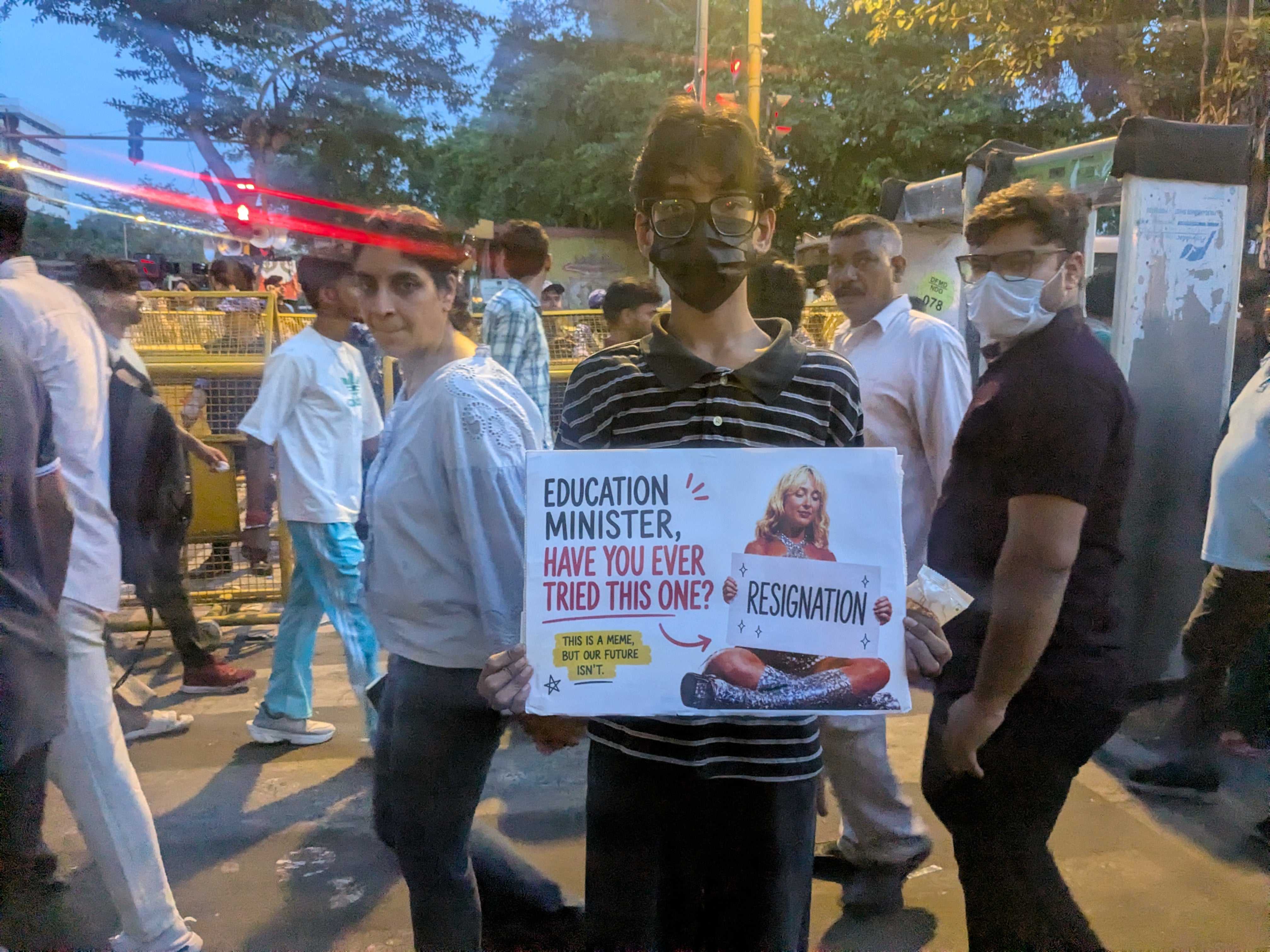
Protesters gather at Delhi’s Jantar Mantar seeking the resignation of education minister Dharmendra Pradhan (Namita Singh/ The Independent)
What started out as a joke by a group of students is now one of the most sustained waves of public dissent against Modi’s government.
On Saturday, India’s education minister Dharmendra Pradhan resigned, handing a major victory to the youth protesters.
With millions of followers online and clear displays of support on the ground, the Cockroach Janta Party had said it would not stop protesting until Modi’s education minister – the powerful veteran politician Dharmendra Pradhan – resigned
The protesters said Pradhan must take responsibility for the shambolic handling of a key university entrance exam for would-be medical students, the cancellation of which affected 2.3 million young people. Activists said at least 21 students died by suicide during the debacle.
Advertisement
Nitesh Aryan, 26, from the northern city of Lucknow, has been at the protest site daily since 19 July. He says he is driven by the fact “that exam papers are repeatedly leaked. And when we demand our rights, the government responds by baton-charging the students, cracking our skulls, breaking legs and back.”
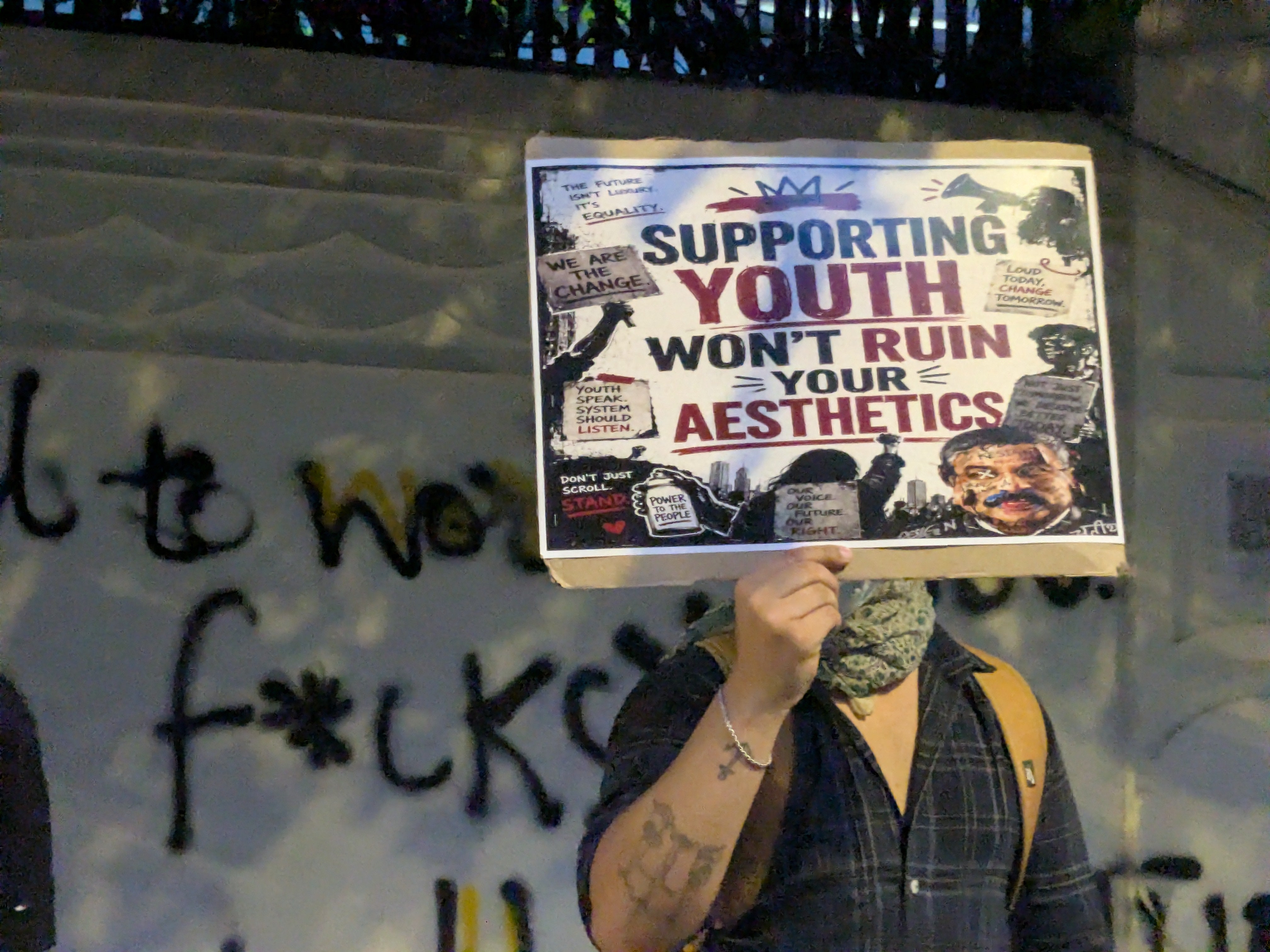
A poster at Jantar Mantar (Namita Singh/ The Independent)
Akanksha, 31, who has lived in Delhi her whole life, frames her motivation as a slow, cumulative betrayal rather than a single scandal. “I’m a victim of the education system,” she says. “I know how rigged the system is, how messed up our schools are. Teachers are demotivated. Nobody is studying in a government institution.”
For Muskaan, 40, leaving the protest site with her two children close to midnight, the stakes are more immediate. She’s a labourer and her husband drives an autorickshaw. “There are poor people who with great difficulty manage to educate their children,” she says. “My children will also study with as much hard work. Right now they are young. My son is in 8th standard and daughter is in 11th standard. It is about their future as well.”
When papers leak, she argues, “the future of my children is being ruined. I’m here to protect their future and prevent it from being ruined.”
What turned a grievance into a full-blown anti-government movement was the events of 20 July, the day police moved against the protesters at Jantar Mantar as they prepared to march towards parliament, using batons and teargas against them and leaving scores injured.
Advertisement
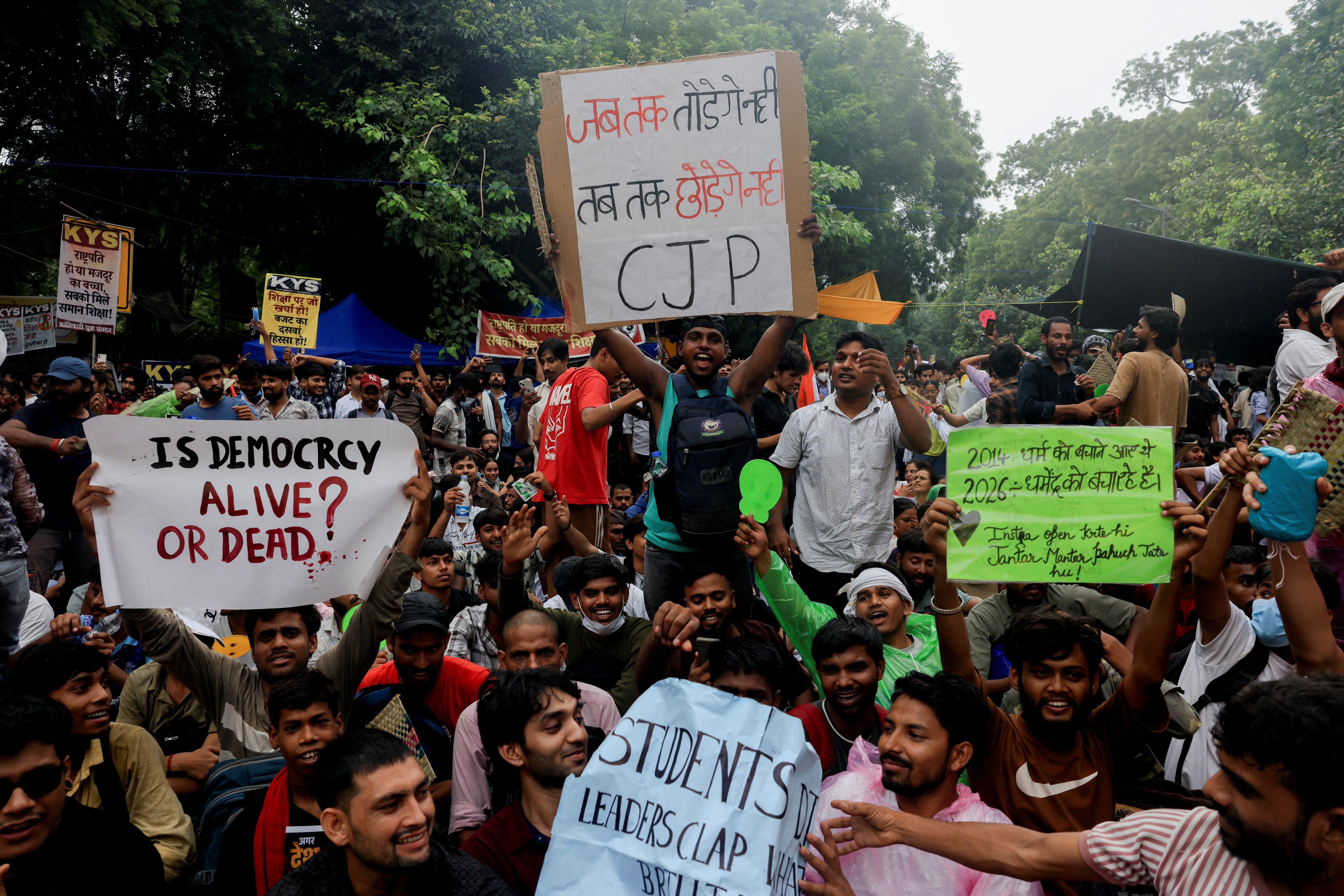
People gather in solidarity with Cockroach Janta Party protesters at Jantar Mantar in Delhi (Reuters)
Birku Yadav, 26, who joined the movement after learning about it on 18 July, describes what happened to her two days later. “I was charged with baton by a male police officer who did not even have his name tag on,” she says. “I feel like they were not wearing name tags because they were not police officers but supporters of the ruling regime.”
Ashutosh Ranka, 30, a spokesperson for the Cockroach Janta Party, says the scale of the crackdown caught even the organisers off guard. “The kind of brutality meted out against the students, young protesters and our own volunteers who were helping them manage the crowd crossed all levels of brutality,” he said. “Crossed all levels of shamelessness.”
It’s this moment – the baton-charge against unarmed students demanding accountability – that Mohan Yadav can’t reconcile with the government he voted for. “I still don’t know why we were assaulted by the police,” he says. “It was only about the resignation of one person. The government should have just conceded to the demands of the public, ‘my constituents and voters are asking for this, we should give them.’ We would have been so much happier.”
Supporters of India’s Cockroach Janta Party hold placards and chant slogans during a protest in Delhi (Reuters)
There is a striking gap between the government’s public posture and what protesters describe living through. Modi has floated a proposal for fast-track courts to try paper-leak cases, a move Saurav Das, another Cockroach Janta Party spokesperson, dismisses as cosmetic.
“It’s an eyewash,” he says, noting that a 2024 law against organised exam-paper mafias is already meant to solve this, with little visible effect. “That law wasn’t implemented properly, that’s why you have these kinds of instances again.”
That disconnect between official reassurance and street anger runs through nearly every conversation.
Advertisement
Where the government speaks of isolated lapses and administrative fixes, the protesters describe something closer to institutional collapse, and a chain of accountability that never seems to reach anyone at the top. “Post-2014, the government takes great arrogance in not sacking its minister,” Das says. “It was automatic before 2014.”
For Mohan Yadav, the gap is personal, not political. He frames his disillusionment as stemming not from ideology but a broken bargain.
“If we brought Modiji to power and he is the head of the country, then he should have taken care of our well-being and happiness,” he says. “But instead he went against 65 per cent of the youth of the country. In front of my eyes, so many women and children were beaten up. I felt really sad.”
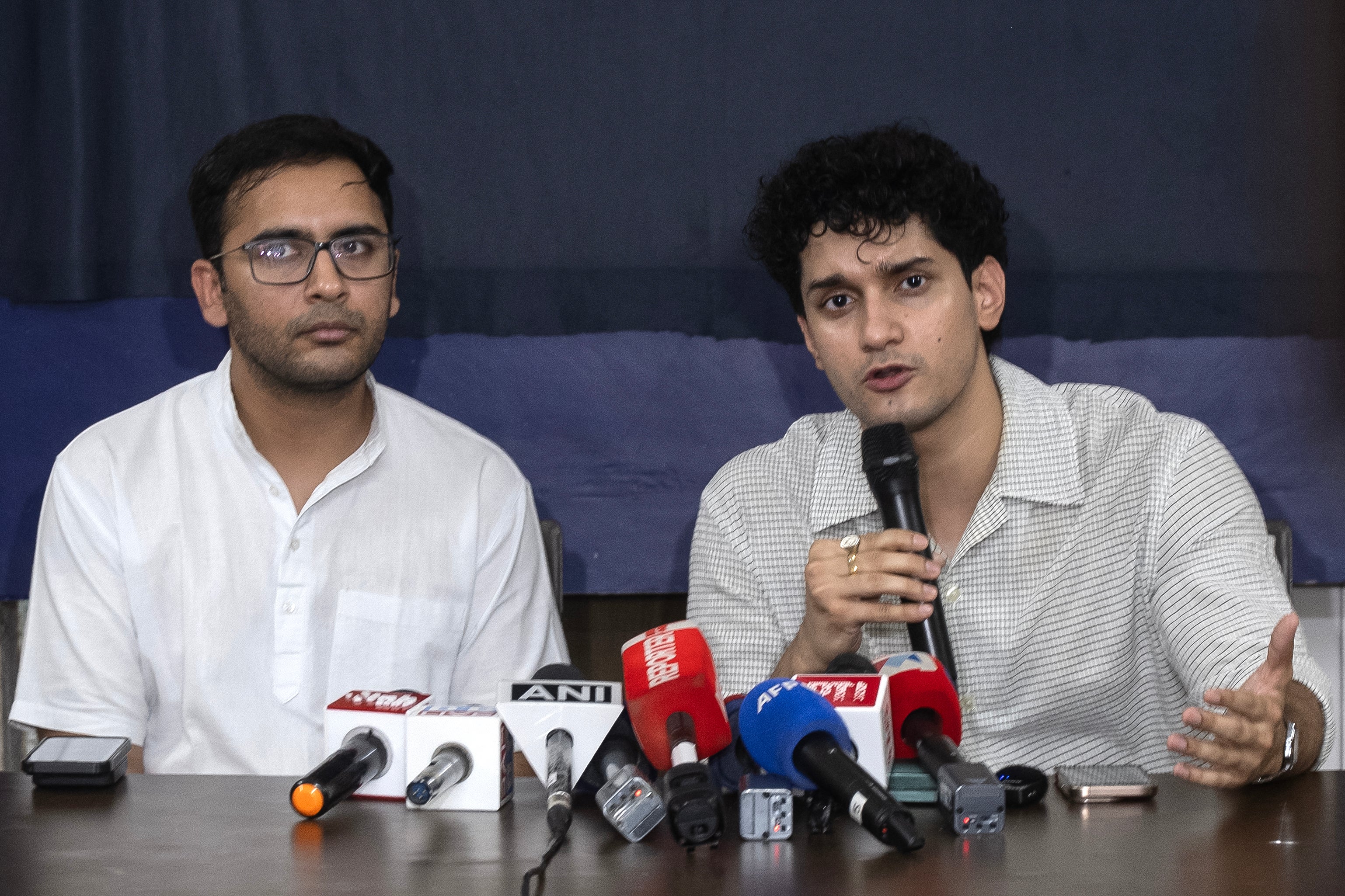
India’s Cockroach Janta Party spokespersons Saurav Das and Ashutosh Ranka address the media in Delhi (AFP/Getty)
Nitesh Aryan’s demand is starker still: “My demand is that those responsible for it are duly punished. And all the people who were at their posts at the time this happened, resign.”
Ranka insists the movement will not fold under pressure even as he acknowledges the personal risk protesters are taking on. “We expect police action but we don’t fear it,” he says. “This is a fight much bigger than one person and we are ready to pay the price.” Asked how far organisers are prepared to go if the government refuses to budge, he allowed himself a rare smile. “The government has to concede. They don’t have a choice this time.”
Advertisement
Mohan Yadav says he still does not fully understand how he ended up here, holding a grievance against a government he helped elect. He’s careful to say he isn’t asking for anything extraordinary. “I’m not asking for a plot of land in Delhi,” he says. “I am not asking Modi to transfer 1.5 million rupees to my account. I am asking for accountability.”

















































You must be logged in to post a comment Login