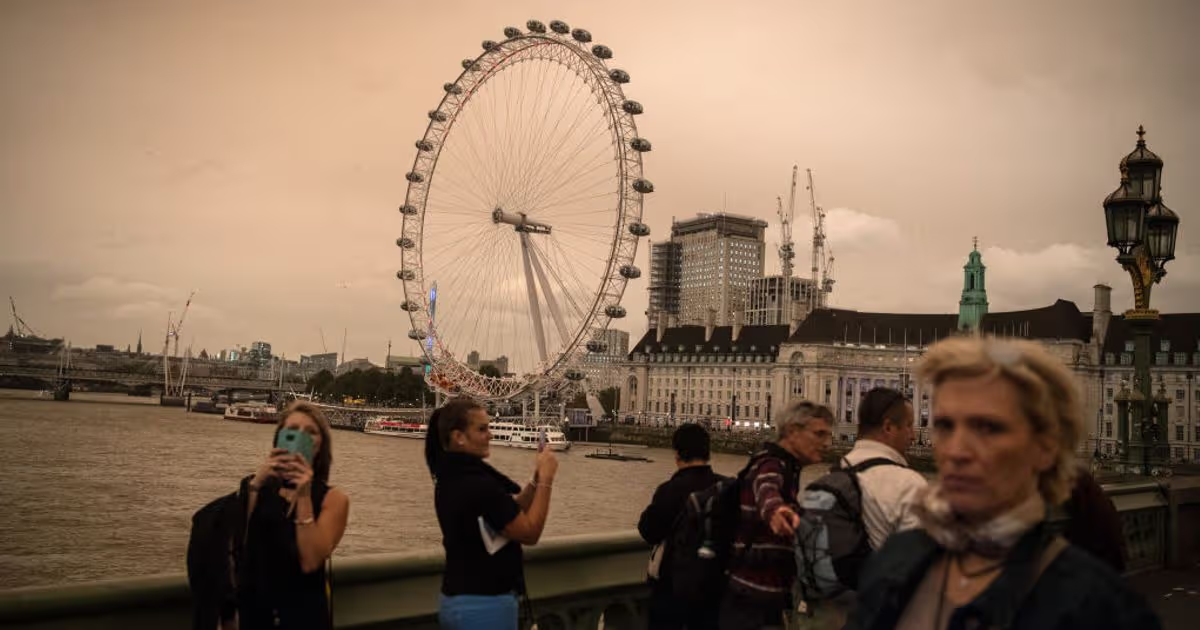
So-called “blood rain” could fall across the UK as dust picked up from the Sahara Desert spread across Europe and tint the skies into many bright colours from gold to deep orange
Brits are set to be lashed with “blood rain” as a Saharan dust cloud sweeps over the country – but how does it form?
Another phenomenon that is also expected is so-called “blood rain.” The phenomenon occurs when dust mixes with rain that, in turn, gives water a reddish colour and is particularly visible when it falls on windows, garden furniture and other outdoor items.
While “blood rain” evokes a sinister phenomenon, the Met Office said it is not a scientific phrase, nor does it describe a clearly defined meteorological event. It added: “For rain to appear red, relatively high concentrations of red‑coloured particles must mix with the water droplets in the cloud.
“Typically, these particles are sand or dust rich in iron oxides, giving them their characteristic colour. When rainfall occurs while these particles are suspended in the atmosphere, the droplets can take on that tint.”
The Met Office noted genuine red rain is “extremely rare.” While dust rain is not uncommon, the concentration of the particles are typically seen when it leaves behind dust after it dries.
In its forecast, the Met Office said today the combination of a moist south-westerly airflow and a broad dust plume could lead to some dust settling out with the rain.
It added: “At this stage, concentrations are expected to remain relatively low, meaning rainfall itself is unlikely to appear noticeably red. Instead, where dust mixes in, the impact is more likely to be seen after showers have passed, with a light film of yellowish or brownish residue on surfaces.
“For those in the southwest, the timing of the rainfall will be a key factor. Overnight showers or early‑morning rain on Thursday could leave dust deposits by dawn. Elsewhere across the UK, dust levels are currently forecast to remain even lower, with largely unremarkable rainfall expected.”
Thankfully, there is no concern from a health perspective for the levels in the UK. Those with respiratory sensitivity might notice a slight increase in airborne particles before rainfall clears the atmosphere.
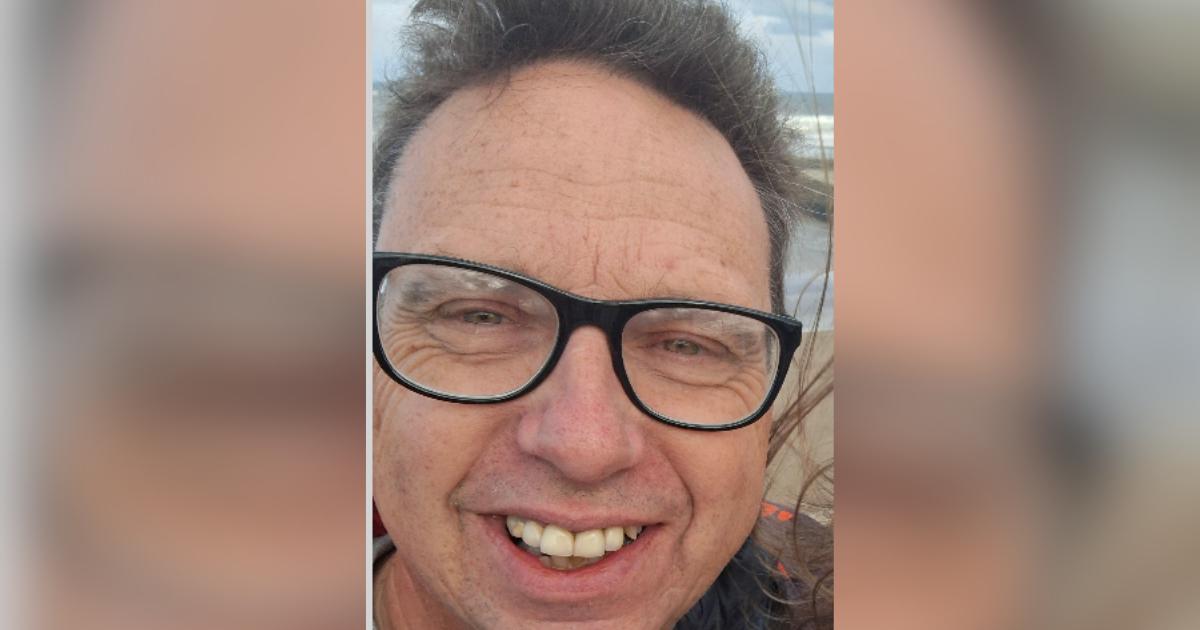
North Yorkshire Police have launched an urgent appeal to find missing Mark West who was last seen in a village in the north of the county earlier today (March 5).
The 63-year-old has not been seen or heard from since 7.45am this morning and was last seen in Romanby near Northallerton.
RECOMMENDED READING:
Advertisement
The county’s police said it believes he may have links to York and Whitby, but could still be in the local area.
“Mark is described as a white man, around 6ft 3in tall, with short dark brown hair and glasses. He may be wearing a grey parka-style coat with a fur‑trimmed hood, along with black jeans or trousers and black trainers.
“We are extremely concerned for Mark’s welfare and extensive searches are taking place to try and locate him,” said a spokesperson for the force.
For immediate sightings of Mark, please dial 999 so the police can quickly make sure he is safe. You can also pass on information by calling North Yorkshire Police on 101.
Advertisement
Please quoting reference number 12260040028 when providing details.
Skiing duo Menna Fitzpatrick and Scott Meenagh, who are Great Britain’s flagbearers, will not be at the ceremony as they are competing the following day in Cortina.
Instead, they will take part via a video sequence, along with fellow ParalympicsGB team-mates, to be shown as part of the parade.
“We made that decision [not to attend] about a year ago when we knew that the opening ceremony was going to be as far away from where we are up here in the mountains as we are,” ParalympicsGB chef de mission Phil Smith told BBC Sport.
“I think there are a number of nations who are in the same boat. We know that any athletes who do attend from here in Cortina won’t be getting back to the athlete village until between two or three in the morning.
Advertisement
“All of our athletes here compete on the first day so from a pure performance and sport perspective, it was never our intention to send athletes to the opening ceremony.”
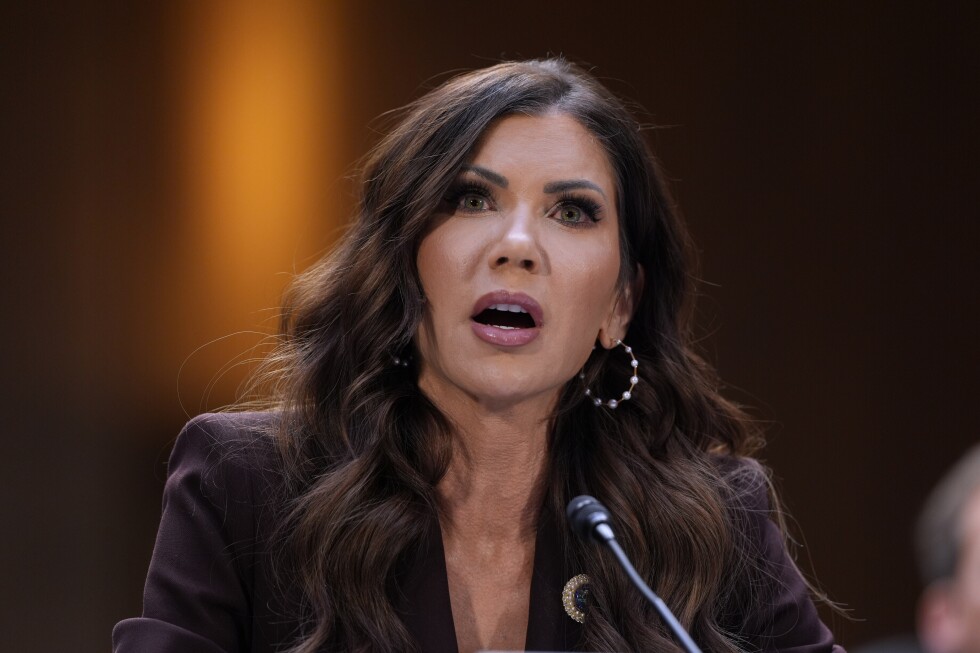
WASHINGTON (AP) — President Donald Trump on Thursday fired his embattled Homeland Security Secretary Kristi Noem, after mounting criticism over her leadership of the department, including the handling of the administration’s immigration crackdown and disaster response.
Trump, who said he would nominate Oklahoma Republican Sen. Markwayne Mullin in her place, made the announcement on social media after Noem faced a two-day grilling on Capitol Hill this week from GOP members as well as Democrats.
Noem’s departure marks a stunning turnaround for a close ally to the president who was tasked with steering his centerpiece policy of mass deportations. But she appeared to increasingly become a liability for Trump, with questions arising over her spending at her department and over her conduct in the aftermath of the shooting deaths of two protesters in Minneapolis earlier this year.
Trump said he’ll make Noem a “Special Envoy for The Shield of the Americas,” a new security initiative that he said would focus on the Western Hemisphere.
Advertisement
Noem, who appeared at a law enforcement event in Nashville, Tennessee, moments after Trump’s announcement, did not address her ouster there. She read from prepared remarks and was not asked by attendees about the development.
Later, in a social media post, she thanked Trump for the new appointment and touted her accomplishments as secretary.
“We have made historic accomplishments at the Department of Homeland Security to make America safe again,” she wrote.
The administration’s immigration crackdown faced criticism, especially in Minnesota
Noem is the first Cabinet secretary to leave during Trump’s second term. Her tenure looked increasingly short-lived after hearings in Congress this week where she faced rare but blistering criticism from Republican lawmakers. One particular point of scrutiny was a $220 million ad campaign featuring Noem that encouraged people in the country illegally to leave voluntarily.
Advertisement
Noem told lawmakers that Trump was aware of the campaign in advance, but Trump disputed that in an interview Thursday with Reuters, saying he did not sign off on the ad campaign.
Noem has faced waves of criticism as she’s overseen Trump’s immigration crackdown, especially since the shooting deaths of the two protesters in Minneapolis at the hands of immigration enforcement officers. The former South Dakota governor was also criticized over the way her department has spent billions of dollars allocated to it by Congress.
Her department, DHS, has been at the center of a funding battle in Congress over immigration enforcement tactics and has been shut down for 20 days, although many of the employees are continuing to work, often without pay.
Even before Noem’s appearance before key congressional committees this week, Republican lawmakers had been anticipating the secretary’s eventual ouster, particularly after her handling of the immigration enforcement crackdown in Minneapolis.
Advertisement
As they tried to end the ongoing Homeland Security shutdown, Senate Republicans had noted privately to Democratic senators that Noem was likely on her way out and that that should prompt Democrats to move forward with agreeing to fund the department again, according to two people familiar with the discussions.
Democrats did not see that as an actual concession by Republicans, considering Noem was becoming a political liability for the GOP, said the people, who spoke on condition of anonymity to discuss private negotiations.
DHS leadership changes come at a pivotal time
Aside from immigration, Noem also faced criticism — including from Republicans — over the pace of emergency funding approved through the Federal Emergency Management Agency and for the Trump administration’s response to disasters.
Mullin would need to be confirmed by the Senate, but under a federal law governing executive branch vacancies, he would be allowed to serve as an acting Homeland Security secretary as long as his nomination is formally pending.
Advertisement
Voting in the Senate just after Trump’s announcement, Mullin said he has “no idea” how quickly his nomination will move.
“The president and I are good friends. So we look forward to working closer with the White House, and obviously I’m gonna be over there a lot more,” he said.
Mullin would need to be confirmed by the Senate, but under a federal law governing executive branch vacancies, he would be allowed to serve as an acting DHS secretary as long as his nomination is formally pending.
Mullin would take over the third-largest department in government that has responsibility for carrying out Trump’s hardline immigration agenda. And he would assume the role at a pivotal time for that agenda.
Advertisement
Immigration enforcement during the first year of Trump’s administration was largely defined by high-profile, made-for-social-media operations with flashy names, often led by Border Patrol commander Gregory Bovino, who reported directly to Noem. Noem herself often went out on those operations, riding along with officers when they went out to make arrests.
But those high-profile operations in places like Los Angeles, Chicago and Minneapolis often led to clashes with activists and protesters that were captured on video and drove opposition to the president’s immigration agenda.
That culminated with the shooting deaths in Minneapolis after which Trump shuffled leadership of the operation. The number of officers there was drawn down shortly after.
___
Advertisement
Associated Press writers Seung Min Kim and Mary Clare Jalonick contributed.
Satellite images have revealed the scale of damage at Iranian military sites following US and Israeli strikes, but civilian infrastructure has also been hit, including schools and hospitals.
There has been an internet blackout since the start of the war on 28 February. Satellite imagery has become one of the few ways to find out what is happening on the ground.
Zoom in to explore strike locations in satellite maps
Advertisement
Missile bases
The US and Israel are targeting Iran‘s missile bases to reduce the regime’s ability to launch ballistic missiles.
A base in the northwest of Isfahan, located near the ‘Ahmad Kazemi barracks’, named after IRGC general Ahmad Kazemi, was targeted.
Images from 1 March show initial damage to a building at the site and then on 3 March show the same building flattened.
Advertisement
The building on the left-hand side was previously targeted in June by Israel and has been targeted again.
It’s one of several missile bases that have been targeted. Another close to Kermanshah in northwest Iran was also hit.
It’s one of Iran’s extensive underground “missile cities”, which are deep tunnel complexes built into mountains to house and shield large parts of the country’s missile arsenal from detection and attack.
In imagery from 4 March provided by Planet Labs, Sky News has identified at least 10 buildings that have been destroyed. Alongside the buildings, there are craters left from strikes at the front of tunnel entrances. This tactic may be being used to collapse the tunnels.
Iran’s missile capabilities are a threat to the US and Israel. They produce multiple different missile types. The longest-range missile, the Sajjil, has a maximum range of up to 2,000km (1,242 miles). That’s far enough to hit Moscow or Athens – making any missile base a key target.
Advertisement
Datawrapper
This content is provided by Datawrapper, which may be using cookies and other technologies.
To show you this content, we need your permission to use cookies.
You can use the buttons below to amend your preferences to enable Datawrapper cookies or to allow those cookies just once.
You can change your settings at any time via the Privacy Options.
Unfortunately we have been unable to verify if you have consented to Datawrapper cookies.
To view this content you can use the button below to allow Datawrapper cookies for this session only.
US Central Command (CENTCOM) said on 4 March that the number of Iran’s missile launches has dropped 86% in four days.
Admiral Brad Cooper, commander of CENTCOM, said that hundreds of air defence sites, ballistic missiles and drones had been destroyed by US strikes.
Advertisement
Naval ports
Ports have also been targeted by the US and Israel. They are being targeted as this is where Iran’s navy operates from, launching missiles and attacks.
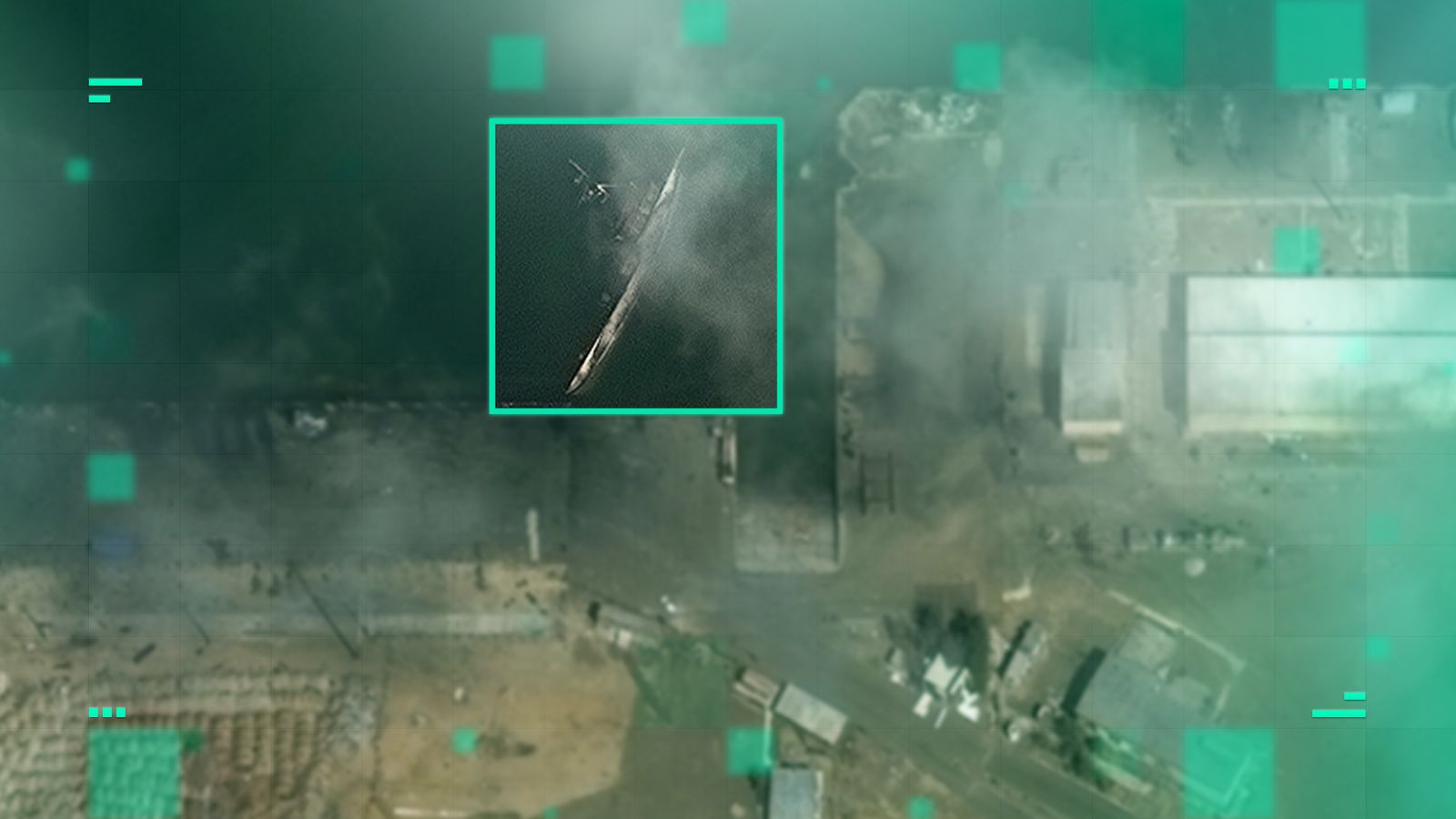
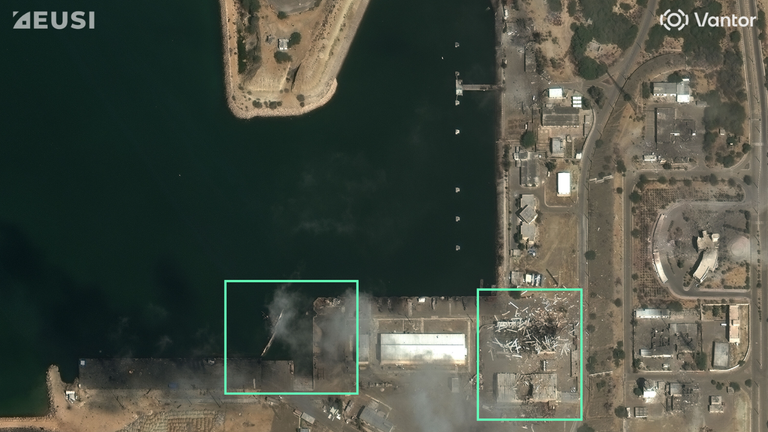
Imagery from satellite provider Vantor and European Space Imaging show Konarak naval port in southern Iran was badly damaged.
Image: Satellite image from 4 March 2026. Pic: Vantor provided by European Space Imaging
Satellite images from 4 March show two destroyed buildings at the port and a sunken Iranian ship.
The head of US Central Command, which oversees American military operations in the Middle East, claimed that 17 Iranian vessels, including its “most operational” submarine, have been destroyed.
Advertisement
The naval base is significant because it sits very close to the Strait of Hormuz, a key commercial shipping route being controlled by Iran. The base is used by Iran’s Revolutionary Guards (IRGC) and is said to launch patrols and exercises in the Gulf of Oman and Indian Ocean, staging missile and naval training operations.
Konarak also supports the port of Chabahar, one of Iran’s only deep-water ports with direct access to the Indian Ocean.
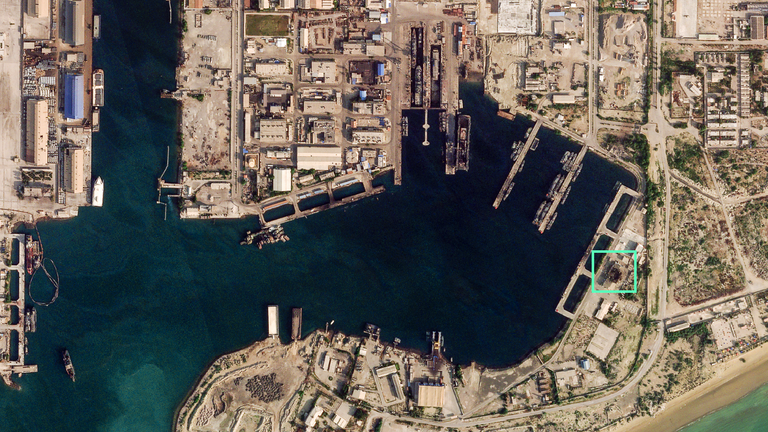
Another port targeted was the military harbour at Bandar Abbas, which is the main headquarters of the Iranian Navy, and provides access to the Strait of Hormuz.
The imagery shows the Iranian vessel, IRIS Makran, with a plume of smoke after a strike on 2 March.
Although unclear how much damage the vessel sustained, the ship is Iran’s largest naval vessel and serves as a floating base, if out of operation this will be a blow to the naval capabilities of the regime.
Advertisement
In more recent imagery from 4 March, it appears a building can be seen with major damage to the roof.
Image: Satellite image from 4 March 2026, shows a hole in the roof of a building at Bandar Abbas port. Pic: Planet Labs PBC
Nuclear facilities
Nuclear facilities have been targeted as the West believes Iran is building a nuclear weapon.
One of the locations targeted was Natanz Fuel Enrichment Plant in western Iran.
Natanz Fuel Enrichment Plant is Iran’s primary uranium-enrichment plant that is known to be operating after US and Israeli strikes in June 2025. According to Rafael Grossi, of the International Atomic Energy Agency (IAEA), the centrifuges were “severely damaged if not destroyed altogether after this strike”.
Advertisement
Additional strikes appear to have taken place on 2 March.
Imagery from 3 March shows three buildings destroyed at the site.
The IAEA confirmed damage to the entrance on the site on 3 March.
The Institute for Science and International Security (ISIS) confirmed the buildings were damaged as personnel and vehicle entrances.
The dispute over Iran’s nuclear programme is ongoing. The regime in Tehran has long insisted it has no intention of making a nuclear weapon.
Advertisement
Civilian infrastructure
Civilian infrastructure has been hit in the airstrikes. Some of the sites are near Iranian Revolutionary Guard Corps (IRGC) facilities, including police stations.
Iranian officials said more than 150 people were killed when a girls’ school was hit in the city of Minab on 28 February.
The school was located near an IRGC base.
Advertisement
Imagery from 4 March appears to show six locations where missiles or shrapnel likely fell on the school.
US secretary of state Marco Rubio said in an interview that “the United States would not deliberately target a school. Our objectives are missiles”.
Israel also said it had not found any connection to their operations.
More satellite imagery shows Gandhi Hospital in Tehran.
Images from 1 March and 3 March show a television tower directly next to the hospital in ruins. Videos verified by Sky News show it wasn’t just the television tower affected; the hospital was also hit.
The Data x Forensics team is a multi-skilled unit dedicated to providing transparent journalism from Sky News. We gather, analyse and visualise data to tell data-driven stories. We combine traditional reporting skills with advanced analysis of satellite images, social media and other open source information. Through multimedia storytelling we aim to better explain the world while also showing how our journalism is done.
A petition is calling for the UK Government to stop the State Pension age rising from 66 to 67 starting in April
Linda Howard Money and Consumer Writer
20:00, 05 Mar 2026
The State Pension age is set to begin increasing from 66 to 67 in April, with the change due to be implemented for all men and women across the UK by 2028. The scheduled adjustment to the official retirement age has been enshrined in law since 2014, with a subsequent rise from 67 to 68 planned for the mid-2040s.
The Pensions Act 2014 brought forward the increase in the State Pension age from 66 to 67 by eight years. The UK Government also altered the manner in which the increase in State Pension age is phased.
Advertisement
This means that rather than reaching State Pension age on a particular date, individuals born between March 6, 1961 and April 5, 1977 will be eligible to claim the State Pension upon turning 67.
Nevertheless, a new online petition is urging the UK Government to “stop the State Pension age rising to 67”. It goes further by suggesting it should be reduced to 65.
Petition creator Lynne Calder says: “Let people have the choice whether to retire or keep working. Many people have been working since they were 16. We think a state pension retirement age of 65 for all is ample enough.”
At 10,000 signatures of support the petition would be entitled to a written response from the UK Government. At 100,000, the Petitions Committee would consider it for debate in Parliament, reports the Daily Record.
Advertisement
Under the Pensions Act 2007 the State Pension age for men and women will increase from 67 to 68 between 2044 and 2046. The Pensions Act 2014 mandates a regular review of the State Pension age, at least once every five years.
The review is centred on the principle that individuals should be able to spend a certain proportion of their adult life drawing a State Pension.
The UK Government recently launched a new Pension Commission to investigate how to boost pension saving with its findings due to be published in 2027. Areas for consideration will include auto-enrolment saving rates, boosting saving among groups such as the self-employed and a review of the State Pension age.
Dr Suzy Morrissey will report on factors the UK Government should consider relating to State Pension age and the Government Actuary’s Department will prepare a report on the proportion of adult life in retirement.
Advertisement
The review of the State Pension age will take into account life expectancy along with a range of other factors relevant to setting the State Pension age. Following the review’s completion, the UK Government may then choose to bring forward changes to the State Pension age.
However, any proposals would have to go through Parliament before becoming law.
Defence secretary John Healey has twice declined to rule out Britain joining strikes on Iran, when asked by Sky News.
He also said he’d had the option of deploying HMS Dragon to the Mediterranean for weeks.
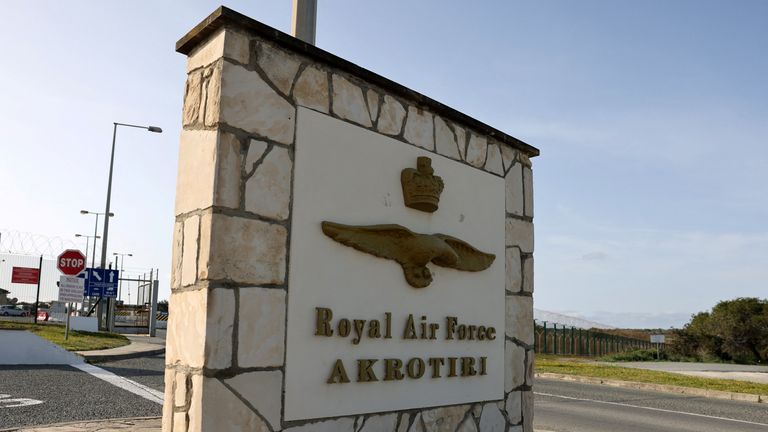
Interviewed at RAF Akrotiri in Cyprus, the minister was asked by Sky’s Europe correspondent Ali Bunkall if he could rule out Britain joining the conflict in an offensive capacity.
Image: Defence Secretary John Healey interviewed at RAF Akrotiri in Cyprus.
He responded: “As circumstances in any conflict change, you’ve got to be willing to adapt the action you take.”
Mr Healey then listed defensive measures that were being taken, including the use of anti-drone helicopters, deploying HMS Dragon to the eastern Mediterranean, and bringing in planners to co-ordinate an international response.
Pressed on whether he would rule out British aircraft taking part in offensive operations over Iran, Mr Healey again demurred.
“Everything that we have done is defensive, is legal, and is coordinated with other allies,” he said.
Advertisement
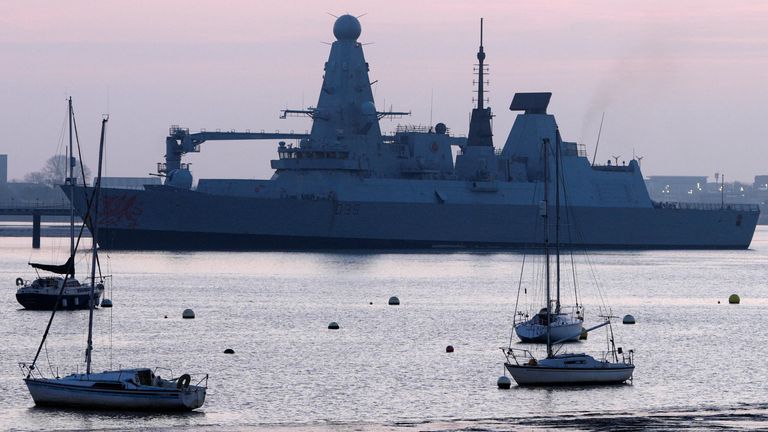
Image: HMS Dragon in Portsmouth gearing up for deployment. Pic: Reuters
The minister’s visit to the island comes after a drone attack on RAF Akrotiri on Monday, with two more UAVs intercepted en-route to the base later that day.
During his visit, Mr Healey met with his Cypriot counterpart Vasilis Palmas “to discuss how the UK is further reinforcing our air defences to support our shared security”, a government spokesman said.
Iran has been unleashing rocket and drone attacks across the Middle East after the US and Israel launched a joint-attack on the country on Saturday.
Image: RAF Akrotiri, a British sovereign base in Cyprus that was hit by a drone early Monday, causing limited damage, in Cyprus March 4, 2026. REUT
In the aftermath of Monday’s drone attack, the decision was made to deploy HMS Dragon, an air-defence warship, to the Mediterranean.
But Sky News revealed on Wednesday that the ship was not ready to depart and would not sail until next week.
Asked when the option of deploying HMS Dragon first crossed his desk, Mr Healey deflected.
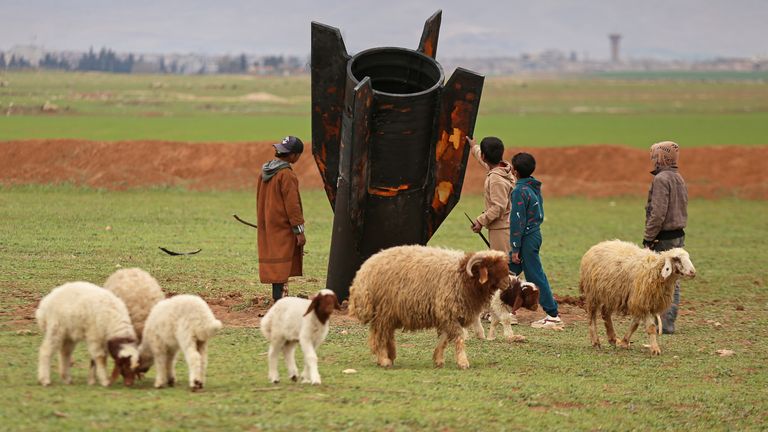
Image: An unexploded Iranian projectile that landed in near Qamishli, eastern Syria. Pic: AP
He said it was one of the options he’d had available when he made decisions weeks before the start of the conflict to strengthen British defences in the region.
He added that the decision to deploy the warship had been taken because the government was “now in a position to judge better the nature of the Iranian response”.
The Metropolitan Police said three men – aged 39, 43 and 68 – were arrested by counter-terrorism officers in London and Wales after being accused of assisting a foreign intelligence service. On Thursday morning, officers said all three had been released on bail.
Advertisement
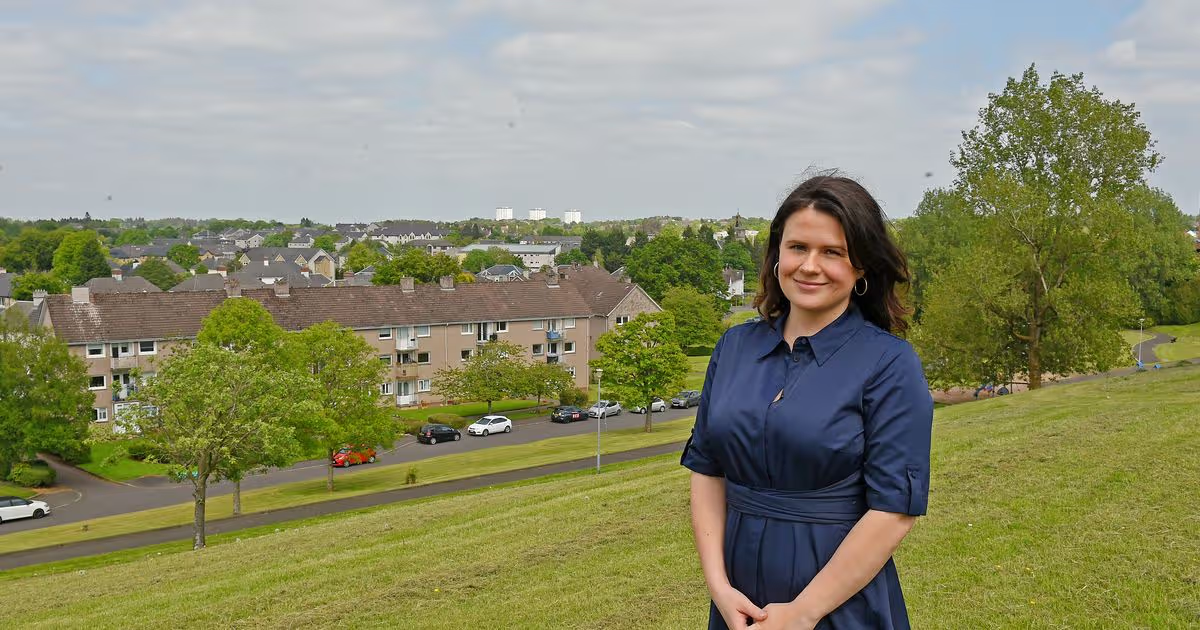
Reid, who said she is not under police investigation and has denied any wrongdoing, has faced questions about her business ties to her husband.
In a statement she said: “This week has been the worst of my life. The shock of recent days has been difficult for me and my family. I want to reiterate something very important: I am not under investigation by the police and no accusations have been against me. I have done nothing wrong.
Advertisement
“I love my country. To serve the people of East Kilbride and Strathaven as their MP and the Labour Party has been – and continues to be – the privilege of my life.
“I understand that speculation and gossip is fevered at a time like this. I do not want the circumstances that I and my family find ourselves in to be a distraction for this government, of which I am proud and in whom I believe.
“I also do not want my children – who have nothing to answer for and who deserve privacy and compassion – to find themselves subject to intrusion.
“Following discussions with the Chief Whip, I am voluntarily suspending myself from the whip this evening and will not sit as a Labour MP until internal investigations are concluded. I will welcome and cooperate with any questions and worries the party may have.
Advertisement
“I, and my team, will continue to serve my constituents in the normal way as their Member of Parliament.”
Scottish Labour leader Anas Sarwar said of Reid on Thursday afternoon: “We are considering all these matters because they are serious questions that you are putting to me.
“As you know, we have an independent Governance and Legal Unit that’s considering many of these matters and we will have judgements to make today.”
In a statement on Wednesday, Reid strongly rejected any claims of wrongdoing: “I have never been to China. I have never spoken on China or China-related matters in the Commons. I have never asked a question on China-related matters.
“As far as I am aware, I have never met any Chinese businesses whilst I have been an MP, any Chinese diplomats or government employees, nor raised any concern with ministers or anyone else on behalf of, even coincidentally, Chinese interests. I am a social democrat who believes in freedom of expression, free trade unions and free elections.
“I am not any sort of admirer or apologist for the Chinese Communist Party’s dictatorship. I have never seen anything to make me suspect my husband has broken any law. I am not part of my husband’s business activities and neither I nor my children are part of this investigation, and we should not be treated by media organisations as though we are. Above all I expect media organisations to respect my children’s privacy.”
Taylor, 39, is listed as a “lobbyist” on Reid’s MP registered interests.
Advertisement
Companies House names him as the director of Earthcott Limited, a public relations and communications firm. The Herald reported on Thursday that Reid’s consultancy received more than £20,000 in interest free loans from two of her husband’s businesses before she was elected to Parliament.
Security minister Dan Jarvis said there will be “severe consequences” if it is proven that China attempted to interfere with UK sovereign affairs.
Jarvis said the investigation “relates to China” and “foreign interference targeting UK democracy”.
He told MPs: “Let me be clear, if there is proven evidence of attempts by China to interfere with UK sovereign affairs, we will impose severe consequences and hold all actors involved to account.”
Advertisement
To sign up to the Daily Record Politics newsletter, clickhere
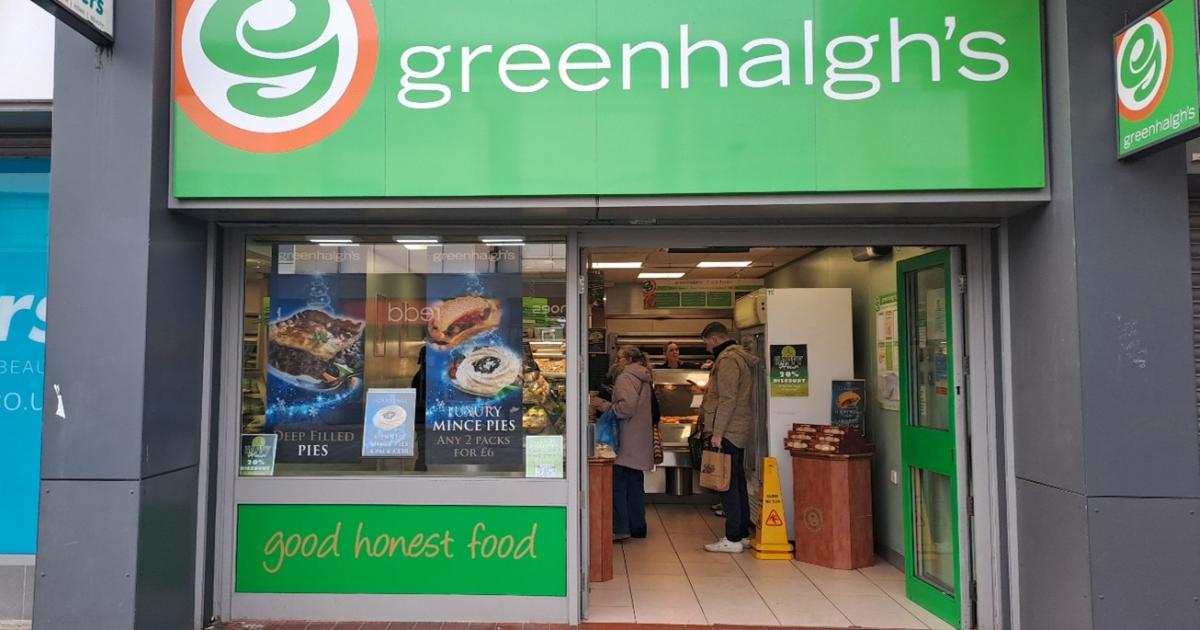
Greenhalgh’s Craft Bakery in Horwich welcomed the Bolton-born television and radio presenter on March 4, as he stopped by his local shop for a quick catch-up and no doubt a tasty treat or two.
The Bolton-born star, who grew up in Horwich, made the day of staff members Jackie and Natalie, the shop’s mother-and-daughter team, who were “all smiles” as they grabbed a quick selfie with the presenter.
The Greenhalgh’s bakery said: “It was a brilliant surprise to see Vernon pop into our Chorley New Road shop!
Advertisement
“As a proud Boltonian, he clearly knows best where to come for his pie fix.”
Sharing the moment on social media, the bakery added: “Look who popped into our Horwich shop yesterday!
“Thanks for stopping by, Vernon!”
Advertisement
Vernon Kay is best known for presenting popular television shows, including All Star Family Fortunes and Beat the Star, as well as hosting programmes on BBC Radio 2.
Greenhalgh’s is a favourite across the borough, offering a wide range of award-winning and freshly baked goods, from multi-portion pies and bespoke celebration cakes to fan-favourite pasties.
The family-run business has grown into one of the largest employers in the Bolton area, with around 950 staff and 59 retail shops.
The number of 12-hour trolley waits at the York and Scarborough Teaching Hospitals NHS Foundation Trust has increased for a second month in a row.
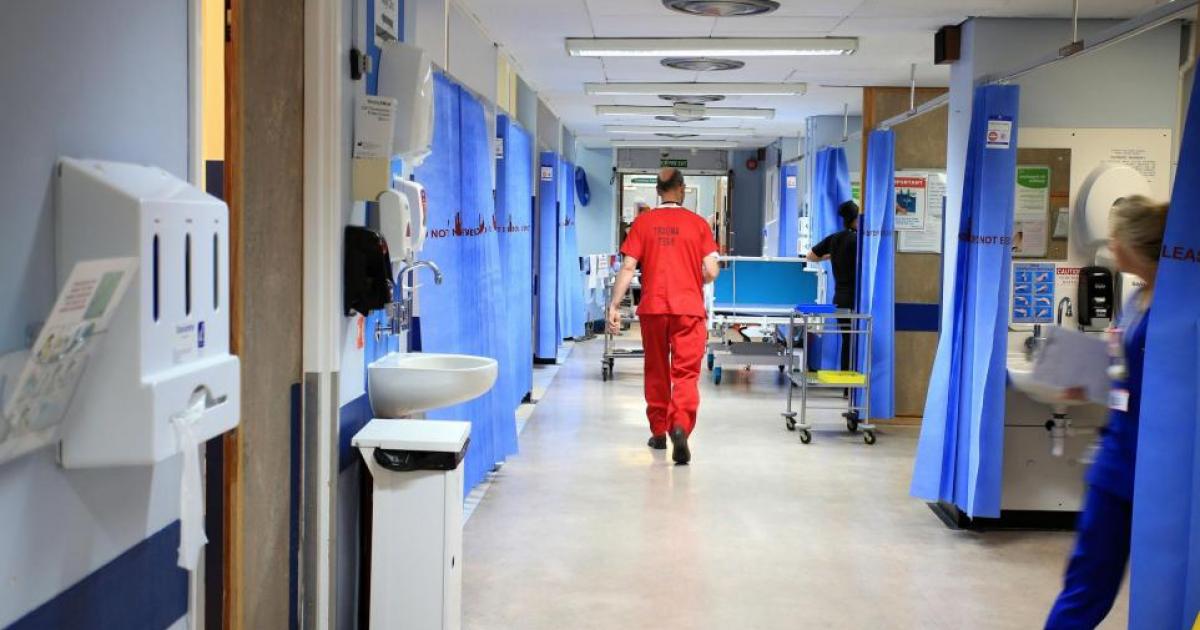
Updated figures show that 930 patients had to wait on trolleys for more than 12 hours after attending emergency departments in January. In December, there were 759 trolley waits that lasted longer than 12 hours, which was an increase of 453 from November.
A spokesperson for the York and Scarborough Teaching Hospitals NHS Foundation Trust said that factors impacting flow through its hospitals included high demand, patients presenting with more complex needs, and delays in discharging people who are well enough to leave hospital.
Advertisement
“Like hospitals across the country, we are experiencing sustained pressure in our urgent and emergency care services, which can at times lead to an increase in longer trolley waits,” the spokesperson said.
They added: “We are sorry for the impact this has on patients and families.
“We are working closely with our health and care partners to improve patient flow, including supporting earlier discharge, making best use of available beds, and strengthening same-day emergency care.”
Readers had their say in the comments section of The Press website.
Advertisement
Teddy Duchamp said: “I wish it had been 12 hours, for me it took 17 hours, and most of that time was spent on a bed in the corridor right next to the doors that people are brought into in A&E.
“But I was lucky. I saw two dead bodies wheeled by whilst in there. The poor nurses and staff are rushed off their feet.”
Tiny toes said: “Free care is available, how lucky we all are.
“Why, oh why, did the powers that be close the rehab units across the city? They alleviated beds in the hospital wards and got people back home faster and safer.”
Advertisement
Pinza-C55 said: “I thought Labour was going to sort all the NHS problems out?”
Cricket70 said: “At least you’re getting free health care.”
Readers also shared their thoughts on social media.
Commenting on Facebook, one reader said: “I went to Scarborough A&E last week and the staff were amazing.
Advertisement
“I was in for five hours from arriving, being seen, and going home. I was even offered food and drink – great service.”
Another reader commented: “I was also seen by A&E doctors two months ago with suspected sepsis following a dental treatment. Once again they were prompt and I was transferred to York within a few hours.
“All the staff in A&E have been amazing recently. We are very fortunate to have this hospital in [Scarborough] and I for one am extremely grateful.”
Everyone’s been in a debate when someone says: “You’re taking that out of context.” But what does it actually mean to understand something “in context”?
Appeals to context feel irrefutable. Of course we need context. But “context” is one of those ideas that seems obvious until you actually try to define it. What counts as context? Where does context end and the thing itself begin? And whose context matters?
Take a typical example: a quote from a politician surfaces that seems damning. Condemnation ensues. But a defence is mounted: the quote has been taken out of context – the politician was being sarcastic, as you’ll see when you look at what else they said at the same time.
But the assault continues when it’s pointed out that the quote fits with other remarks the politician has made. Meanwhile, still further defences are mounted on the basis of the wider political debates around the subject of the quote. Everyone’s invoking context, but nobody’s agreeing.
Advertisement
“Context” isn’t one thing, though the way we use the word often suggests it is. It’s dozens of different things we’ve given different names to over centuries. Social context. Historical context. Cultural context. Political context. Economic context. Linguistic context. Biographical context. Institutional context. Each of these emerged as distinct ways of thinking about how to situate meaning, and each implies a different kind of explanation.
We haven’t always been as concerned about context as we are now – and we haven’t always understood it in the same way. The historian Peter Burke dates “context” in roughly its current (and quite capacious) senses to the counter-enlightenment romanticism of the 19th century.
This same counter-enlightenment romanticism is partly the context in which my own discipline of anthropology emerged – and people started insisting we understand human practices “in their total social context”. They meant something specific: that you can’t understand a ritual or belief by isolating it, and you have to see how it fits into an entire way of life.
When historians talk about “historical context”, they often mean the sequence of events and conditions that preceded something – the causal chain. When literary critics invoke “textual context”, they often mean the surrounding words that shape meaning. These are all genuinely different intellectual operations, and they often pull in opposite directions.
Advertisement
The philosopher Ludwig Wittgenstein spent much of his life thinking about this problem. In his early work, he thought meaning depended on logical context – how a statement fits into a formal structure.
Later, he abandoned this for something messier: meaning depends on what he called “form of life” – the shared practices and assumptions that make our words intelligible to one other. There’s no algorithm for context, there’s just the hard work of making explicit what we normally take for granted. This helps to explain why political arguments can sometimes be so frustrating. We think we’re disagreeing about facts when we’re actually disagreeing about which kind of context is relevant.
Things are going great! And also absolutely terribly. Shutterstock/Maya Lab
Take recent debates about crime statistics. In 2024, the then Conservative government of the UK argued that crime had fallen by 56% since 2010, yet it also claimed that knife crime had risen dramatically in London since the arrival of Labour mayor Sadiq Khan.
More recently, meanwhile, Reform’s Nigel Farage argues that crime has skyrocketed since the 1990s in ways that records fail to make clear because people aren’t reporting crimes. Still others point to the economic context of austerity and cuts to policing that have hit deprived areas the hardest.
Advertisement
Who’s right? They all might be, in a sense. But they’re playing different games with context. The Conservative government used temporal context (crime down since 2010) and regional context (but up in London). Farage invokes methodological context (the problem of unreported crime skewing the data). Critics of austerity point to economic and structural context (resource distribution and its effects). Each context tells you to look at different things, weigh different factors, draw different conclusions.
There’s no neutral context, no view from nowhere. Every context is itself a choice: a decision about what matters, what explains what, which background is relevant. When we invoke context, we’re not just adding information, we’re making a claim about what kind of thing the world is. These aren’t just different amounts of context, they’re different ideas about what makes things meaningful.
What do we do with this?
Choosing a context is itself an argumentative move. When you invoke historical context, you’re claiming – probably – that temporal sequence and precedent matter most. When you invoke social context, you’re claiming that group membership or structural position matter most. These are substantial commitments, not neutral framings.
It’s also helpful to recognise that contexts can conflict. The immediate linguistic context (x was being ironic) might point one way, while the historical context (but x voted for similar measures) points to another. Both can be “true” while supporting opposite conclusions.
Advertisement
None of this means context doesn’t matter. It means it’s helpful to be honest about what we’re doing when we invoke it. We’re not just adding background information. We’re making claims about what kind of background matters, which in turn depend on deeper assumptions about how the world works.
It’s helpful to be explicit about which context we’re operating in, and why we think it’s the relevant one. That certainly won’t resolve all arguments. But it might help us see that we’re not always arguing about the same thing.
Understanding context isn’t an invitation to add more and more information until everyone agrees. It’s an acknowledgement that meaning is situated, and that different situations generate different meanings. The hard part is figuring out which situation we’re actually in.
This article contains references to books that have been included for editorial reasons, and this may include links to bookshop.org. If you click on one of the links and go on to buy something from bookshop.org The Conversation UK may earn a commission.